Alain Delon Did Not Drink Eau de Cologne*.

« Better to have a lousy character than no character at all. » — Alain Delon (Nov. 8, 1935 – Aug. 18, 2024)

Quite recently, we lost monstre sacré Alain Delon. He was a complicated man, a bit of a prickly bastard, but he sure made a lot of great movies*. But comics, you ask? Well, I’m sure he never asked for it, but like many a celebrity (Jean-Paul Belmondo, Ornella Muti…) his famous countenance was appropriated by those incorrigible rascals at Edifumetto and Ediperiodici.

So Alain Delon became… « Alain Velon, a billionaire playboy who lives on an island “a 3-hour flight from New York“. He spends his private life conquering women in a continuous stream even if he is already engaged to the film actress Lizzy Scarlett, but “due to his innate sense of justice” he periodically transforms into Playcolt, a sort of superhero. His enemy is Linda Darnel, also a billionaire: sadistic and fetishist, she turns into the anti-heroine Za the Dead. Another historical rival is the always sadistic but lesbian Mandrakka. »

Now don’t get me wrong: these are virtually unreadable, poorly drawn, sadistic, illogical, reactionary misogynistic claptrap. But the covers are fascinating in their gonzo way, randomly cobbling together purloined bits from famous likenesses to established logos. You’d think this brazen wave of wholesale filching would have led to swift and decisive legal action from several stars’ solicitors, not to mention Hugh Hefner’s… but it seems not. This was, after all, the Italy that gave us Silvio Berlusconi.

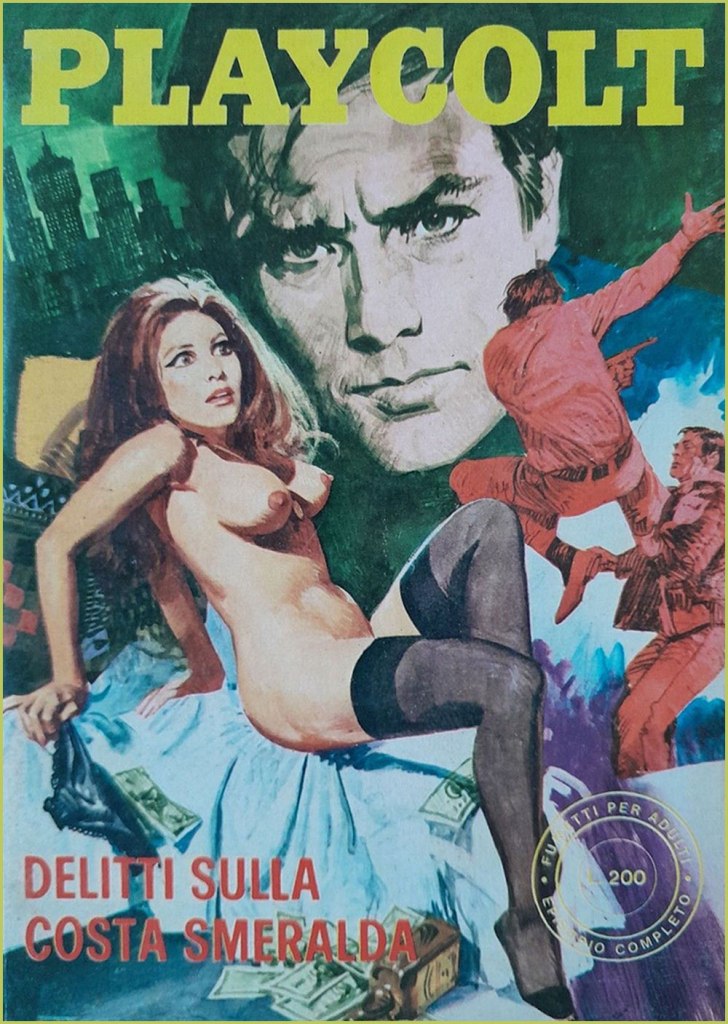
« To the Sound of Punches »; this is Playcolt Series II no. 9 (Nov. 1973, Edifumetto). Cover art by Carlo Jacono, a nice piece, but celebrity likenesses evidently weren’t among his strong suits.
« Crimes on the Emerald Coast »; this is Playcolt Series II no. 14 (Aug. 1973, Edifumetto). This one’s *possibly* the work of Alessandro Biffignandi… or his studio.
« The Golden Rain » (ahem); this is Playcolt Series II no. 23 (Dec. 1973, Edifumetto). Another Jacono, another botched likeness.
« The Divine Sadist »; this is Playcolt Series III no. 1 (July 1974, Edifumetto).
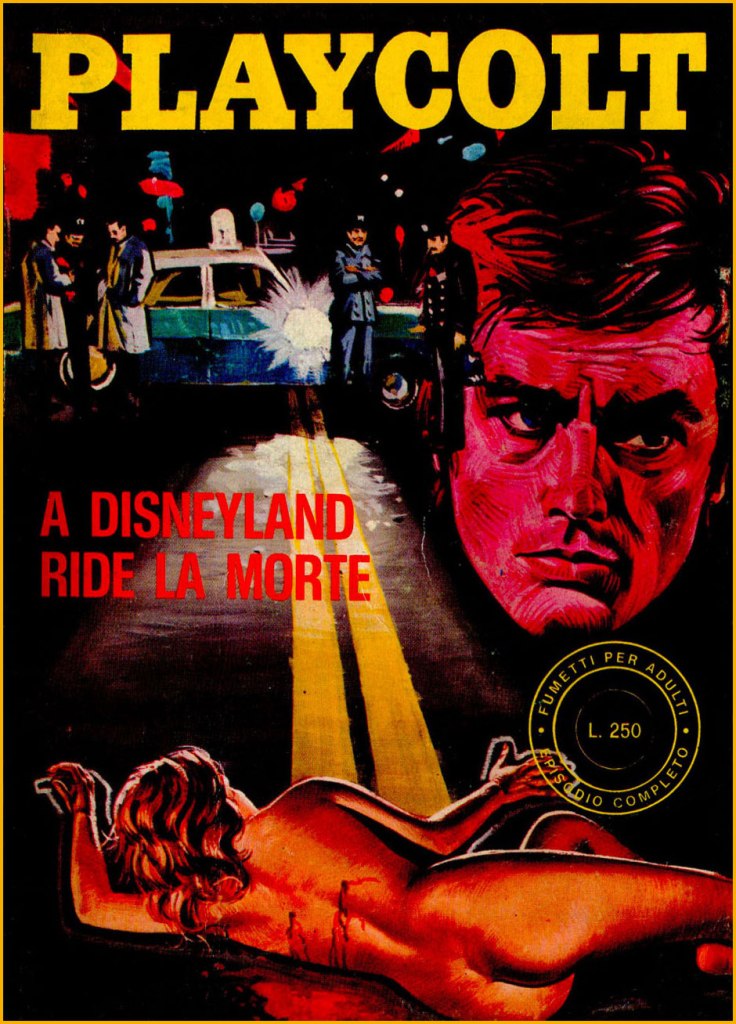
« Death laughs in Disneyland »; this is Playcolt Series III no. 11 (June 1974, Edifumetto).
« There’s a mess in the middle of the sea »; a 1980 Brazilian edition reprinting Playcolt Series III no. 18 (Sept. 1974) in Portuguese.
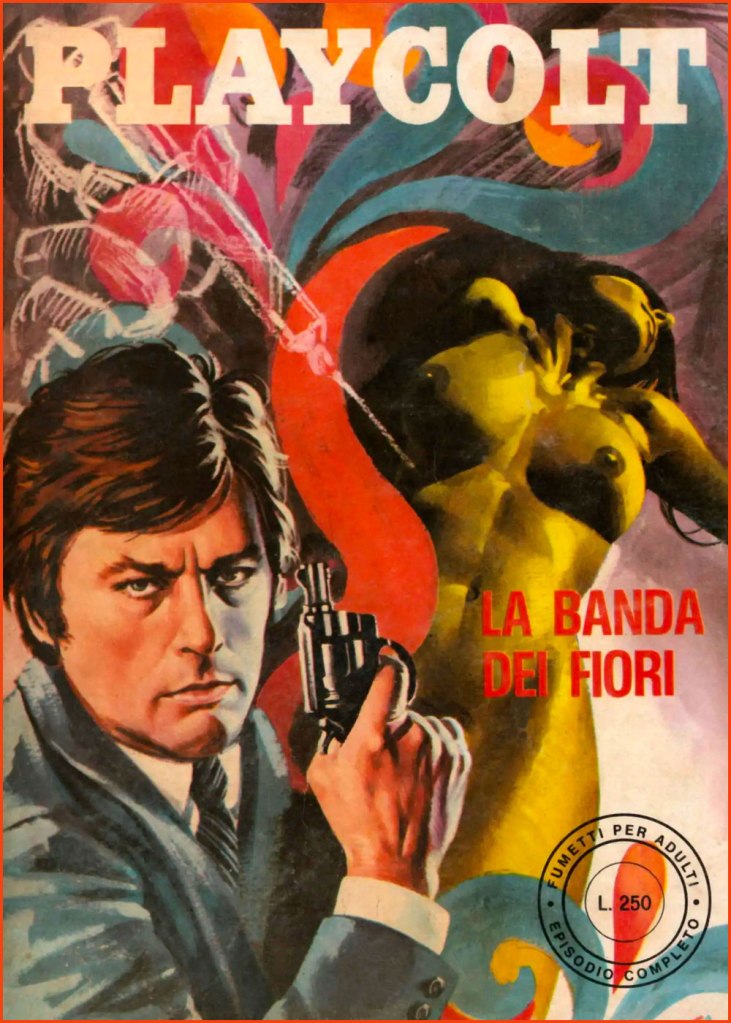
« The Flower Gang »; this is Playcolt Series III no. 22 (Nov. 1974, Edifumetto). I have no concrete evidence, but the technique displayed here reminds me strongly of British illustrator-cartoonist Ron Embleton (1930-1988), co-creator of Oh, Wicked Wanda! and illustrator of the immortal Captain Scarlet closing credits.
No need for a translation, is there? A 1980 Brazilian edition reprinting Playcolt Series IV no. 1 (Jan. 1975) in Portuguese.
« Operation Puzzle »; this is Playcolt Series IV no. 12 (Nov. 1975, Edifumetto). Cover painted by the prolific Emanuele Taglietti, who handled quite a few covers in this series. Here’s an impressive gallery of these.
« The White Shark »; this is Playcolt Series IV no. 35 (May 1976, Edifumetto). Sharks were all the rage that year.
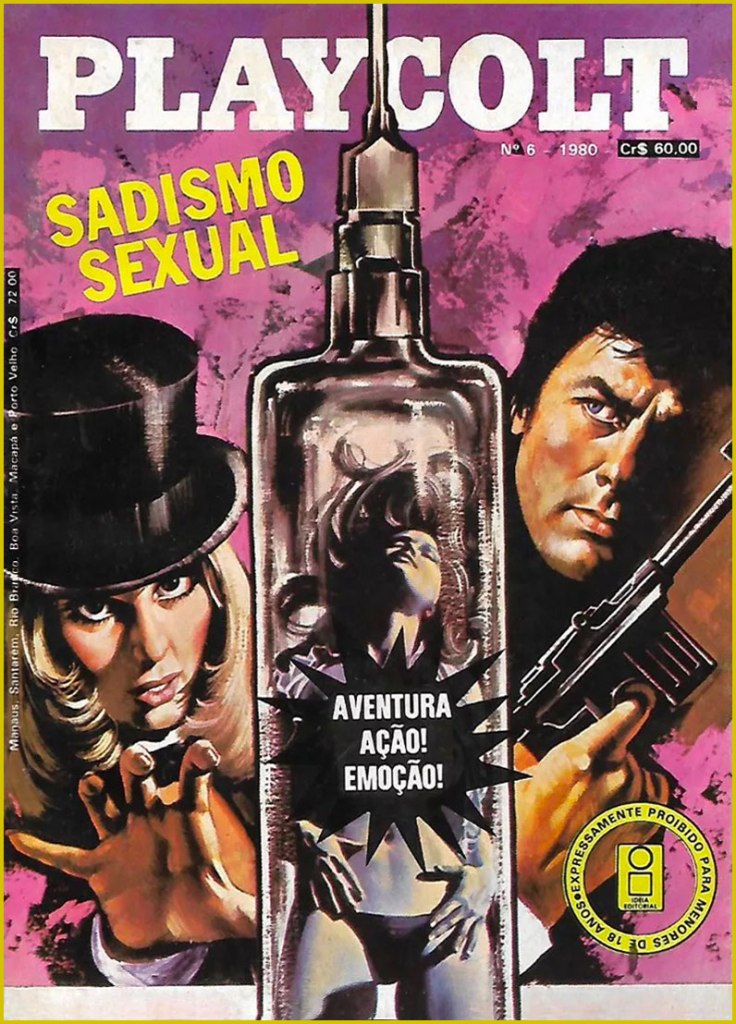
« To Love a Hole »; a 1980 Brazilian edition reprinting Playcolt Series IV no. 2 (Jan. 1975). Dig that strategic blurb placement; the Italian edition was not so coy.
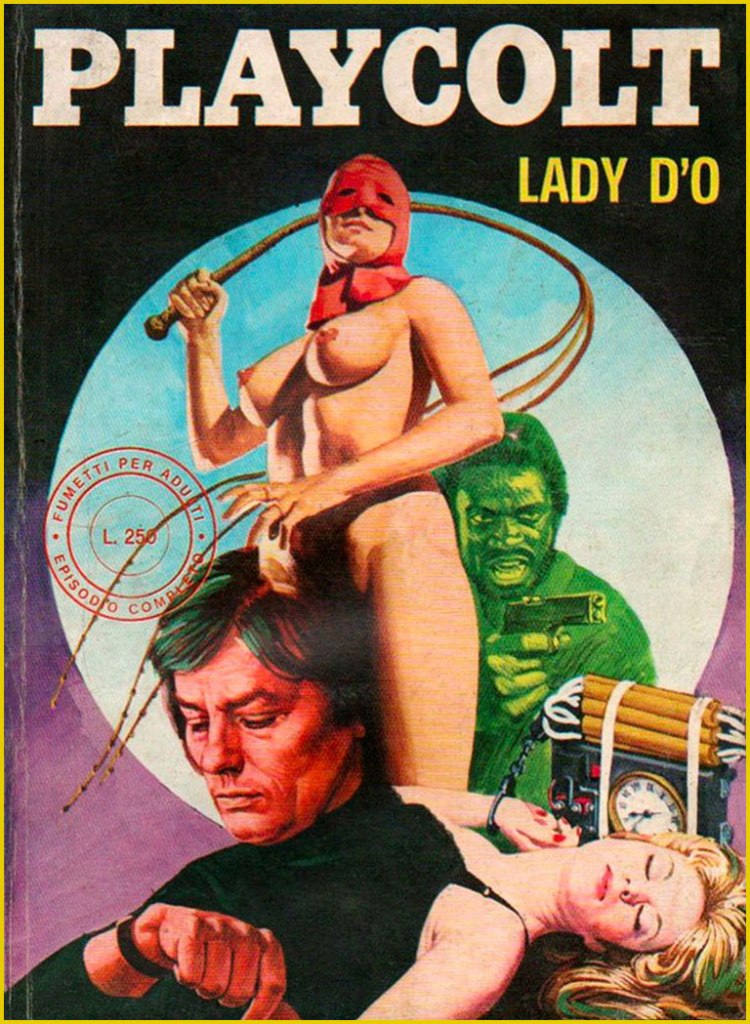
Clearly a reference to the previous year’s hit ‘erotic’ film, L’histoire d’O; this is Playcolt Series IV no. 27 (Jan. 1976, Edifumetto). It’s funny how the Delon photos used span his career up to that point, which yields visual whiplash when you go from the Delon of Plein Soleil to the jaded, grizzled one of, say, Monsieur Klein or La mort d’un pourri from one issue to the next.
« Terror in California »; this is Playcolt Series IV no. 44 (Oct. 1976, Edifumetto). The obligatory Jaws cash-in. Say what you will, those Italians didn’t miss a trick.

There was, concurrently, another Delon homage in Jean Ollivier and Raffaele Carlo Marcello‘s successful Docteur Justice, a humane but hard-hitting series about a physician and expert judoka who roams the globe’s trouble spots for the World Health Organization. There was even a film adaptation in 1975, with John Phillip Law essaying the title role… and co-starring Delon’s ex — and only — wife, Nathalie. Among Pif Gadget’s adventure series, it was only bested in popularity by the prehistoric blond heartthrob Rahan. I’ll tell you more about it one of these days.

-RG

*So claims the Russian pop song entitled Взгляд с экрана, and who are we to doubt it?

[ source ] And for those who like to dig a little deeper, here’s a most illuminating article on the subject.

**I recommend Adieu, l’ami, Red Sun — both co-starring Charles BronsonLa mort d’un pourri, Jean-Pierre Melville‘s Le Samouraï and Le cercle rouge, Plein soleil… as cinema’s first Tom Ripley.

Death to Global Imperialism: D. Moor and the Bolsheviks

D. Moor may not ring like a convincingly Slavic name, but it is the nom de plume of Russian illustrator Dmitry Stakhievich Orlov (1883-1946). Why the D. abbreviation was picked is obvious; as for the family name, he plucked it from The Robbers, a 1781 play by German Friedrich Schiller about two brothers, one of whom Orlov thought he resembled in temperament.

Orlov adopted his pseudonym in 1907, when he switched careers from typography to political cartooning after one of his caricatures was printed in a newspaper. His biting sense of humour was not always well received by the Tsarist régime, and occasionally censored, which provoked the passionate Orlov into even more acerbic mockery. In these years he also designed posters for silent films, which in a way forecast his future as an affichiste. After the Russian Revolution of 1905, Orlov joined the ranks of those actively working in favour of an uprising; when in 1917 Russia fell into civil war that would lead to the formation of the USSR, D. Moor put to good use his aggressive anti-religious stance and talent for caricaturing politics.

‘Three Russian attractions: Tsar bell, Tsar cannon, and Tsar Nicholas. Tsar bell doesn’t ring, Tsar cannon doesn’t shoot, Tsar Nicholas doesn’t reign…’, 1917
Orlov’s poster for Убійца (1910)*

He was responsible for creating much in the way of striking agitprop, and is often cited as the father of the Soviet propaganda poster. His most famous poster** was not only aped by other illustrators during Orlov’s lifetime, but also acquired great popularity after the USSR fell apart***.

The Solemn Promise (1919)
Death to Global Imperialism (1919)
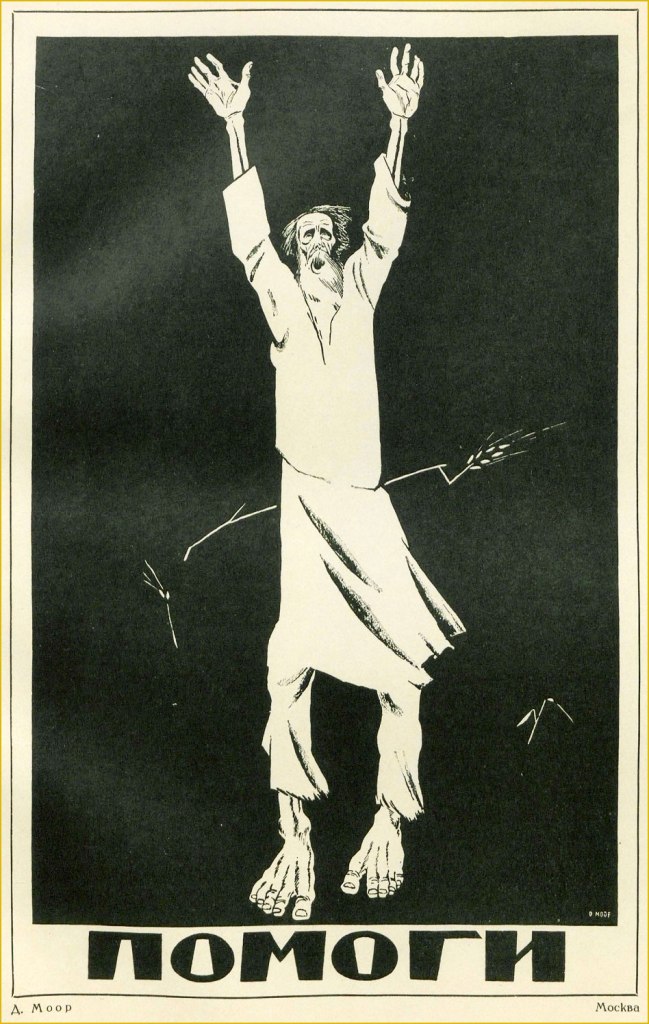
Help (1921). This is one of D. Moor’s most striking posters, and refers to those affected by the Povolzhye famine, which began in 1921 and lasted until 1922, killing an estimated six million people. Note the starving peasant being pierced by a single stalk of wheat.

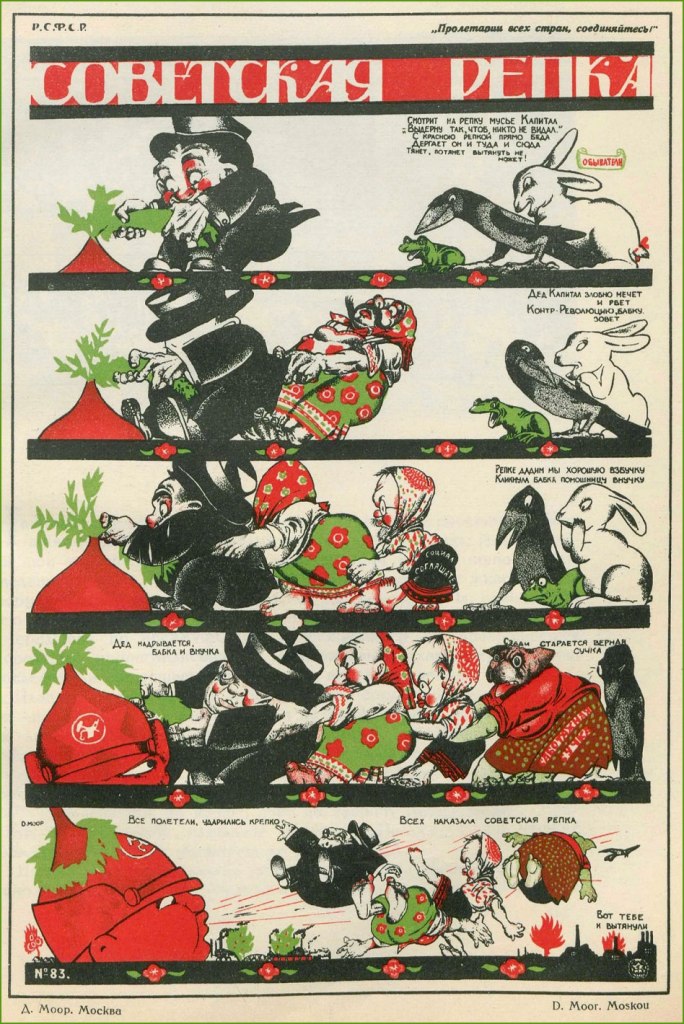
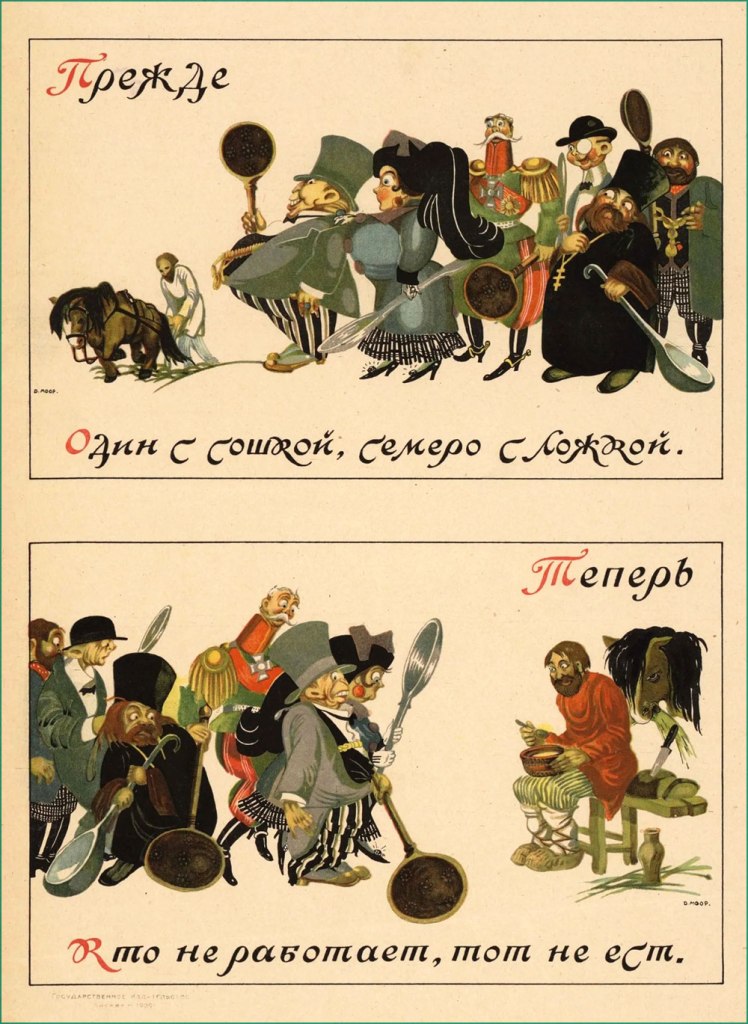
I may be somewhat straining the definition of ‘comics’ by writing this post, yet some of D. Moor’s posters clearly feature linear graphic storytelling.

Labor (1920)
The White Guards and the Deserter (1919)
The Soviet Turnip (1920). This alludes to a classic fairytale in which a family is collectively trying to rip out a big turnip from the ground, even involving the help of the dog, the cat, and the mouse.
This uses two proverbs to make its point – under ‘Before’, ‘One with a plow, seven with a spoon’ and under ‘Now’, ‘The idle don’t get to eat’. (1920)

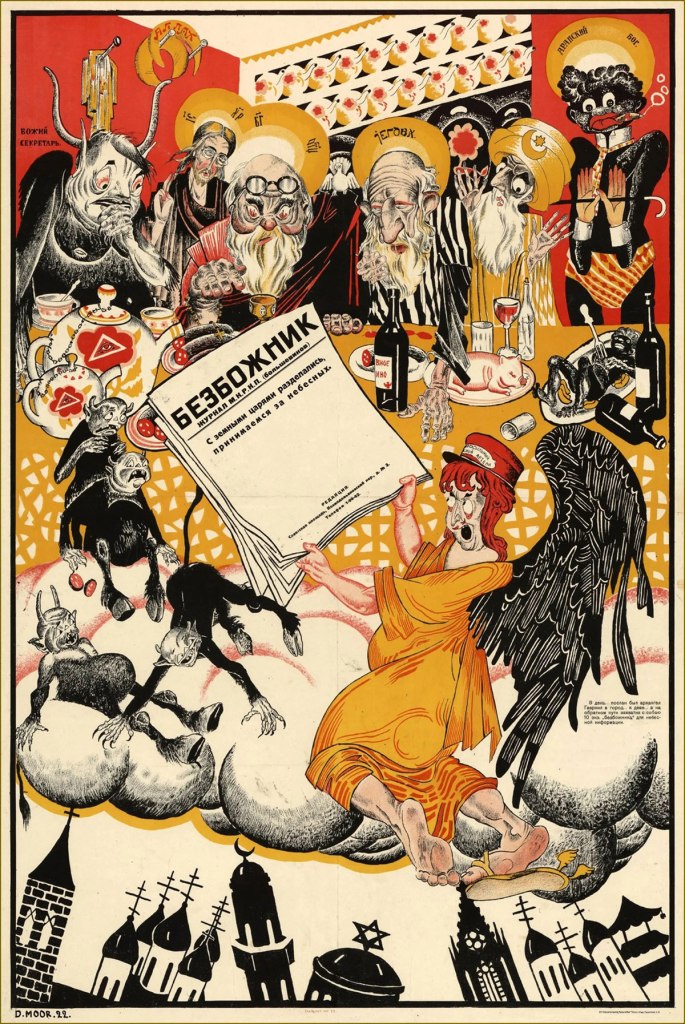
Alongside his active production of posters, D. Moor continued his career as a political caricaturist, publishing his anti-religious work in The Godless at the Workbench magazine (Безбожник у станка) — nice title, isn’t it? — and regularly contributing to various satirical magazines and communist newspapers, such as Pravda or Krokodil.

« We’re done with earthly kings, now comes the turn of heavenly ones », 1922
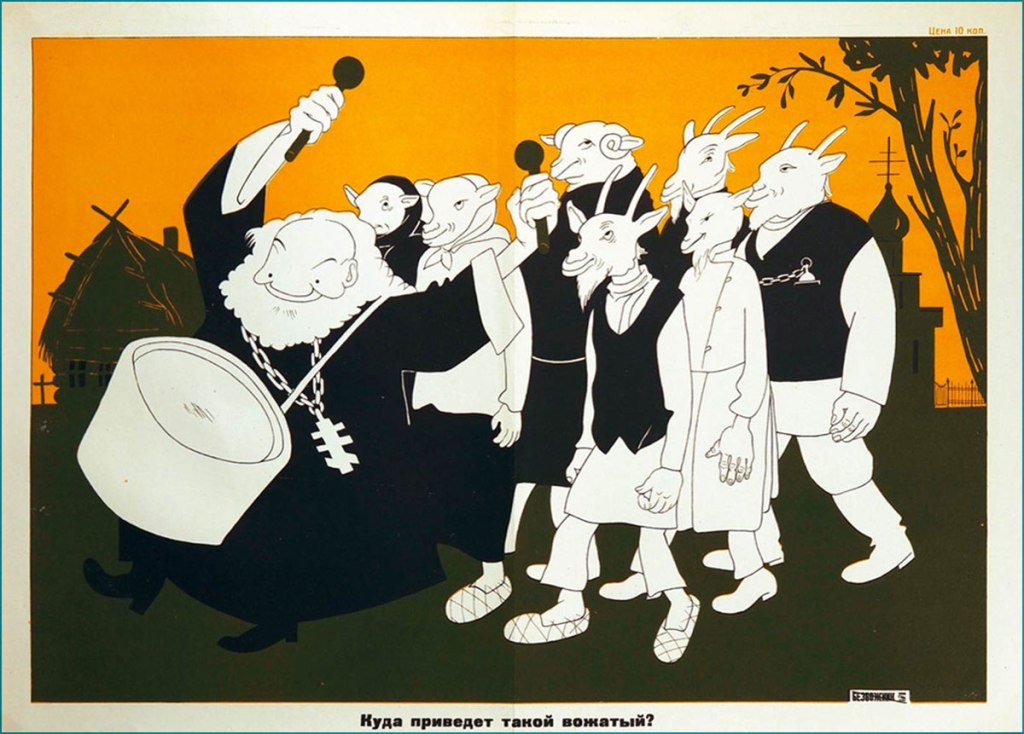
« Where will such a leader guide you? » (1930)

During World War II, Orlov of course supported anti-Nazi efforts (well, once Germany launched an invasion of the Soviet Union, at any rate).

1941. This is kind of untranslatable, but in Russian Hitler and Himmler are spelled with a hard ‘G’, not an H, leaving us with the quartet of Himmler, Göring, Hitler and Goebbels all starting with G… as well as the word for ‘shit’ (govno, говно).

Throughout his life Orlov also taught art at several institutions, and historical accounts indicate that he was a warm and talented teacher adored by his students. Did Orlov enthusiastically embrace the censorship-happy Soviet system, or was he just another artist trapped in a moment of history? I don’t have an answer for this, as one gets a very different perspective depending on which biography one consults and in which language – some emphasise his fervour for Soviet labour, and some philosophically note that he was anti-Soviet ‘like any self-respecting honest intellectual’.

You can take a look at more posters here, or head over here (perhaps with the help of google translate) to take a peek at caricatures poking (careful) fun at some Soviet figures.

~ ds

* An especially interesting thing for me was that his work spans the years of the orthographic reform in Russian. The reform was planned long before 1918 to combat the peasants’ illiteracy, so it wasn’t tied to the revolution per se, but since it came into effect in 1918, it was instilled by the Bolsheviks. The movie title, for example, is written with the letter ‘і’, which was kicked out of the alphabet.

** I am not including it for reasons of ubiquity, but take a look here.

*** Plenty of ex-Soviets feel an irresistible nostalgia about the USSR years, as if their memory can only conjure rose-coloured memories and erases everything unsavoury. The « Have you registered as a volunteer? » poster has been aped and parodied in social media.

Of Ducks, Russian Folklore, and the Mysterious Gamayun

Today’s post started out as an introduction to Moscow-born Russian cartoonist and illustrator Alexander Utkin, whose family name translates to something duck-related (‘utka’ means ‘duck’)… a few other topics may have crept in on soft paws, but sticking to one thing was never my forte.

I came across Utkin’s work in a comic book store. The volume attracted me with its stylish cover and vivid colours, standing out among its shelf companions despite the fact that they were also quite vibrant, this being the children’s corner (thankfully a reliable refuge for colour that’s often shunned in modern comics – if you haven’t noticed the absence of colour in the modern aesthetic, see this documentary about Chromophobia, or Colors: Where did they go? An investigation for a discussion).

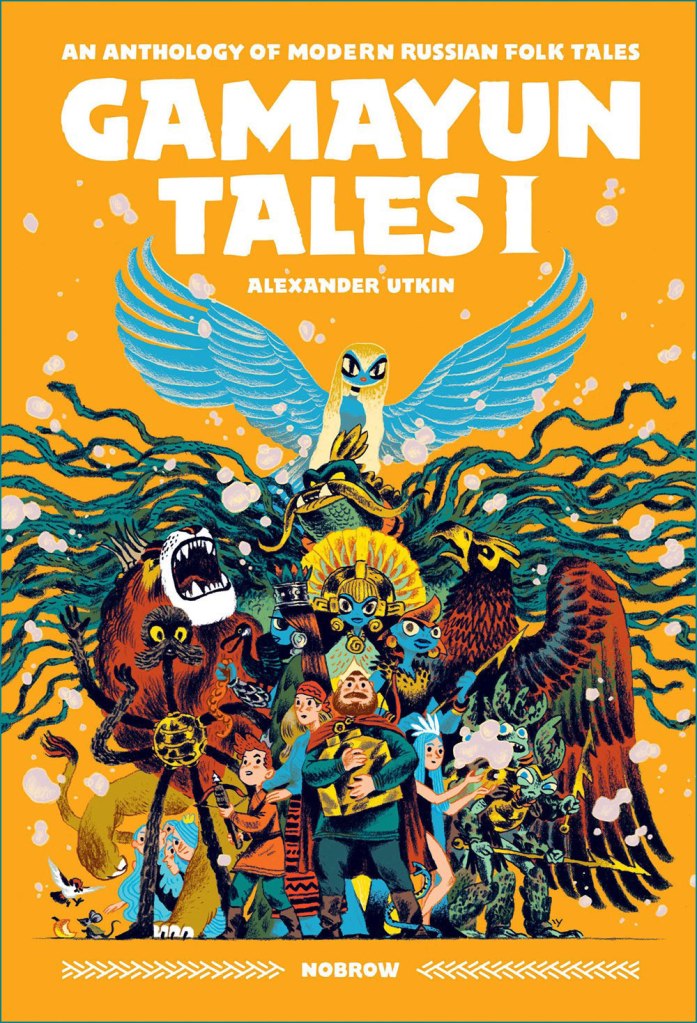
The book that introduced me to Utkin, although what I had first seen was the French edition (Le roi des oiseaux, 2020); this edition is from 2018 and published by Nobrow.

I like cases where one doesn’t have to choose between art and storytelling, when the former is lovely and the latter, substandard (or vice versa). Utkin’s illustrations are beautiful, and he coherently and engagingly tackles a topic that’s dear to my heart – namely Russian fairy tales. Remember I mentioned Baba Yaga (see Hallowe’en Countdown VI, Day 28) a few weeks ago? We will meet her again today (hide your children). We also encounter the legendary Gamayun, a prophet-bird (strangely, as a child I learned its name from the song Sirin, Alkonost, Gamayun* and not from reading folk tales) with no legs or wings, who propelled itself with its tail, and whose interrupted flight signalled death or misery. In a more modern interpretation, she morphed into a sort of bird of paradise with a woman’s face. Read about her and her ‘sisters’ Sirin and Alkonost here.

Published by Nobrow in 2020. Here’s a review of this collection.

Utkin’s Gamayun is a strange, vaguely female creature with huge eyes who narrates the stories (thus ‘Gamayun Tales’). There seems to be a resurgence of interest in all things folky** in many parts of the world, perhaps a desire to preserve some cultural heritage when faced with globalisation – in that sense, one can say that this series is part of that pattern. These revivals don’t often reach a Western audience, however, so it’s especially cool that Utkin’s forays into Slavic myths have been well received and enthusiastically lauded by French and English speakers as well.

Here are a few pages from Roi des oiseaux or The King of Birds, which are, respectively, the French and English versions of the same story… except that the French edition also contains La dispute (The Quarrel), which in English was plunked into Gamayun Tales I. It’s a bit confusing.

In case you were wondering, Utkin’s Gamayun series is technically intended for children. I’m in the habit of regularly raiding the children’s section for interesting stuff, but I can call it mother’s interest (never-you-mind that I am the mother of cats and plants, not little humans). Here are several pages from Gamayun Tales II – this story is called The Quarrel (and, as mentioned earlier, was part of the French edition of The King of Birds):

The following page are from Vasilisa and the Doll, which in English was published in Gamayun Tales II, and in French, as part of the La princesse guerrière (‘the warrior princess’) collection:

I promised you Baba Yaga, didn’t I? The way Utkin draws her predatory teeth reminded me of Canadian artist Emily Carroll, whose creepy stories often mention teeth (one might say it’s a leitmoteeth of hers – sorry for the terrible pun). Her work deserves a post of its own, but for now I restrain myself to mentioning that Carroll, clearly also a fan of traditional folklore, illustrated a graphic novel (written by Marika McCoola) about you-know-who, Baba Yaga’s Assistant (2015, Candlewick). Here is a tooth and style demonstration:

A few stylized pages tell the traditional story of Baba Yaga and the girl with the kind heart – you can read the tale (in English) here.
And here is what the slightly re-upholstered, modernized tale looks like.
Classic chicken legs!

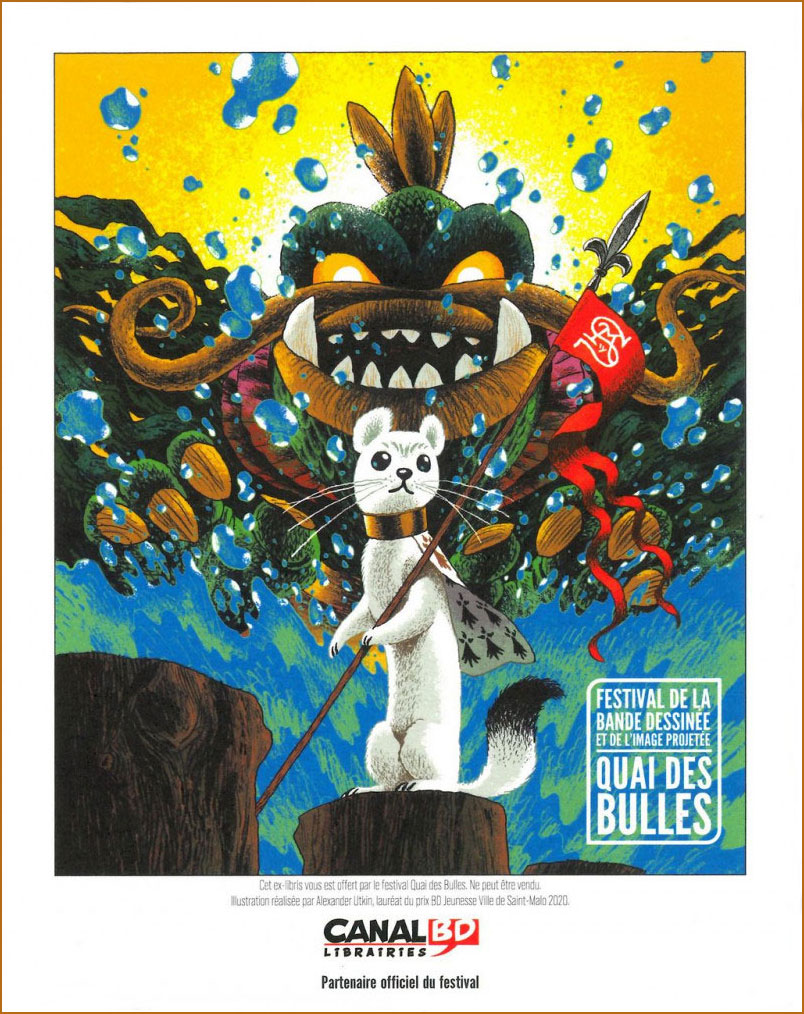
To get back to our main topic, I’ll leave you with this glorious poster Utkin illustrated for a French bédé (comics) festival in 2020:

Visit Utkin’s IG account.

~ ds

*I highly recommend the whole album for those who like folk rock – it’s by the Russian band Akvarium.

**This includes the bevy of young woman trios and quartets (from Ukraine, Georgia, Poland, Finland, Germany…) popping up seemingly all over the place, singing traditional folk songs whilst walking around. Here is a charming example from Russia.

Hallowe’en Countdown VI, Day 28

Most readers will be familiar with the East European witch Baba Yaga, she of the giant mortar, pestle, and chicken-legged-house. The Slavic tradition is rich in heroes and villains, but Baba Yaga is my definite favourite. Perhaps it’s because of her dichotomous nature – undeniably evil, kidnapping children to eat them and such, she also lends a very helpful hand to those she likes… depending on the vintage of the tale and who’s the narrator, and sometimes within the same story. Potato, pota-toh, right? She’s the kind of hag that cool women aspire to become when they’re old: a cantankerous, wise beldam who does whatever she pleases, lives alone in the middle of a forest with her cat, and tells anybody she doesn’t like to fuck off (or transforms them into something nasty to teach them a lesson).

Introduction to Vasilissa the Beautiful, illustrated by Ivan Bilibin, 1931. That’s Baba Yaga flying on top.

Interpretations of what she actually stands for abound, but to be honest I am not interested in her narrative origins, just the storytelling. She is a character who lives and breathes; it rather seems impolite to ask too many questions, lest one ends up in her oven, on the way to becoming dinner.

Folklorist Vladimir Propp‘s theory is probably the best regarded, and argues that she’s the guardian of the kingdom of the dead, with her house representing a grave (people of yore were buried in special houses built on top of tree trunks, with roots resembling chicken legs). She might have once been a deity of hills and forests, kind protector of villagers; or perhaps a goddess of harvest, punished by other gods who removed her beauty and left her a crone. Viy (yes, that Viy) is her father, and Koschei the Immortal (sometimes pictured as riding naked on his favourite horse) is either her son or her nephew. The fence around her house is built from human bones. I think she deserves her place in this year’s Halloween pantheon.

Anyway, here are a few of my favourite visual renditions of her…

Ivan Bilibin (1876-1942), co-founder of the Union of Russian Artists, is mostly remembered for his illustrations to Russian folk tales. His was the first version of Baba Yaga I was introduced to a a small child (as a matter of fact, I still have a collection of tales illustrated by him lying around somewhere). His style is easy to recognize, and full of details – while tsars and beautiful maidens get clothed in robes painstakingly adorned with golden filigree, forest scenes are crowded with branches, leaves, and mushrooms, giving the slightly claustrophobic impression of the trees closing in on the viewer. This is no civilised forest. This is a wild, slightly malicious entity that does not take kindly to strangers.

Baba Yaga in her natural habitat, the flying pestle. Ivan Bilibin, 1900.

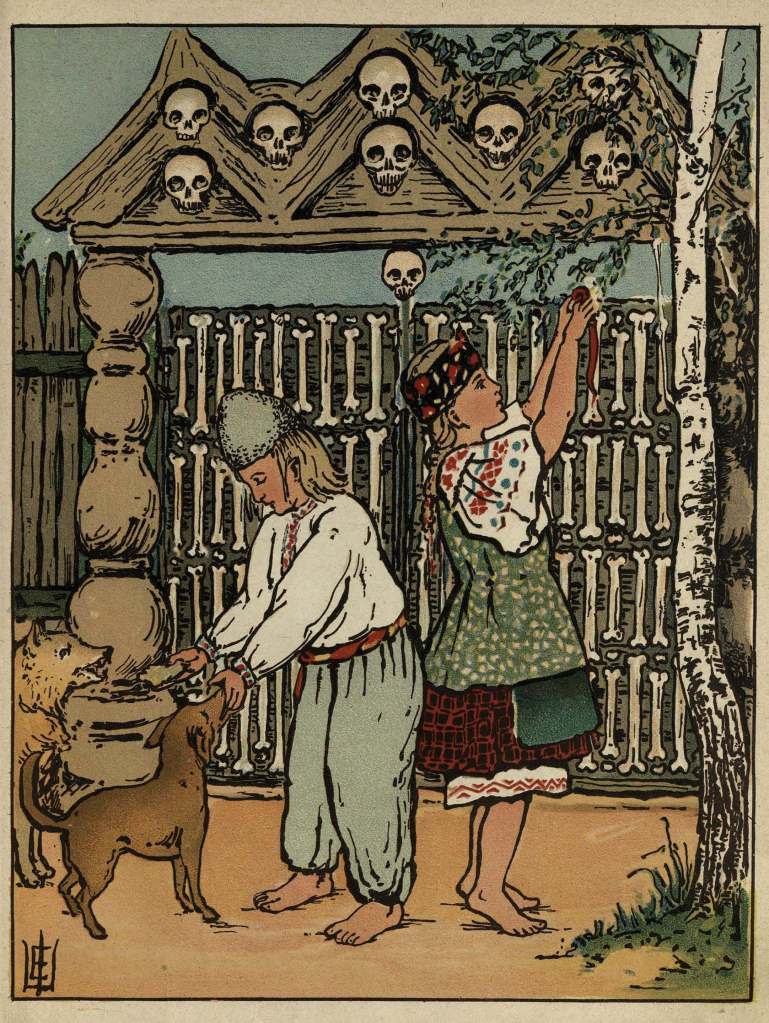
The following book from 1915 does not credit its illustrator, and I’m not knowledgeable enough to interpret their memorable signature (seen in the inside illustrations, bottom left).

Baba Yaga (this book was originally published in 1908, using the same painting, but with fewer background details; this edition is from 1915, illustrator still unknown).

Two illustrations from the inside, showing off Baba Yaga’s frequently present black cat, and her fence of human bones and skulls. Admire the decorative ‘devils dancing’ panel inside her hut. The cat can be easily bribed, and in one of the classic tales helps out the would-be victim get the best of Baba Yaga, after the young girl gives him some ham out of the kindness of her heart.

In the Western world, illustrator Nicolai Kochergin (1897-1974) is famous for his Soviet propaganda posters, but he is beloved by Russians who grew up around the so-called ‘golden age’ (1950s-1960s) of children’s book illustrations in the USSR. See a selection of the latter over at Tom Cochien’s Monster Brains Blog. WOT habitué Barney might be interested in his first-ever illustrated book, a Soviet translation of Twain’s A Connecticut Yankee in King Arthur’s Court, published in instalments in a magazine in 1928.

Although I technically grew up much after these illustrations were published, I think I can count myself lucky that my parents mostly surrounded me with old books.

~ ds