Fungus Friday: Ah, the Bohemian Life

« Parmi les champignons se cachent d’ignobles individus, des espèces savoureuses et des sujets tout à fait pacifiques… »

December may not be exactly the month one associates with mushrooms, but that is precisely when mycophiles get broody and start cataloguing (mentally or otherwise) new species encountered during the warmer months*, dreaming about spring and its new flush.

Here’s a selection of mushroom portraits taken from Le gratin des champignons by Roland Sabatier, an outstanding artist previously featured by co-admin RG in « Pépin le Long, You’re Fired! » (and, need I mention, a member of the Mycological Society of France). The second reaction I had upon leafing through this volume’s pages (the first was to squeal delightedly) was stunned admiration regarding the level of detail with which each mushroom is illustrated. I am by no means the first to note this (in his outstanding introduction, Georges Becker**, co-author of this tome, makes much the same point in far more eloquent prose), but it bears mentioning that while Sabatier may have transformed mushrooms into wonderful characters with their own games and stories, he managed to so very rigorously observe and illustrate their characteristics that one could actually use this book as a mushroom guide and not get, you know, poisoned.

Let’s get cooking!

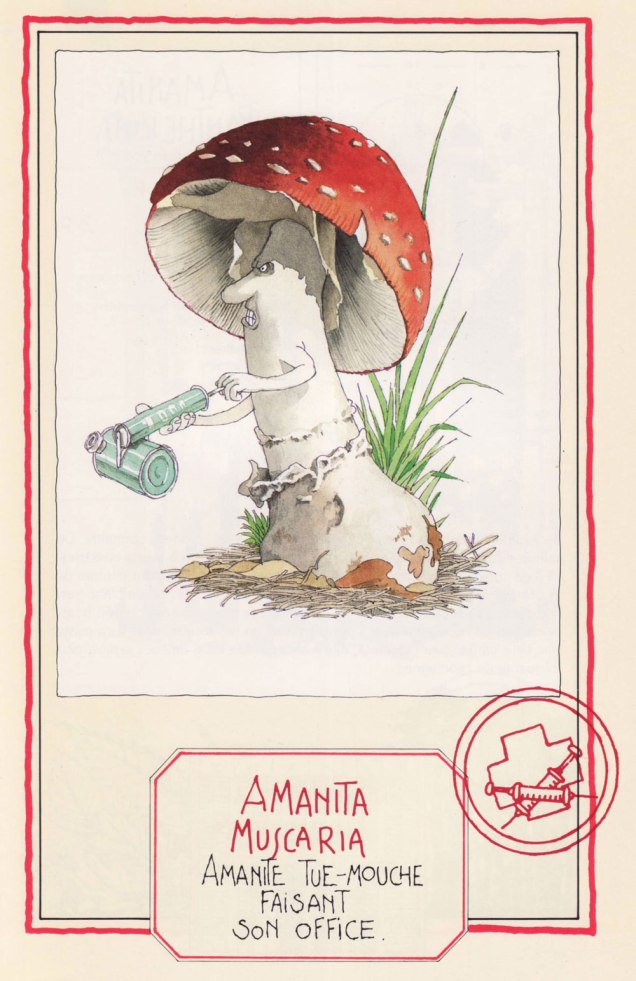
Speaking of getting poisoned, meet four Amanitas, a most deadly genus… with a few delicious, choice morsels thrown in to keep us on our toes:
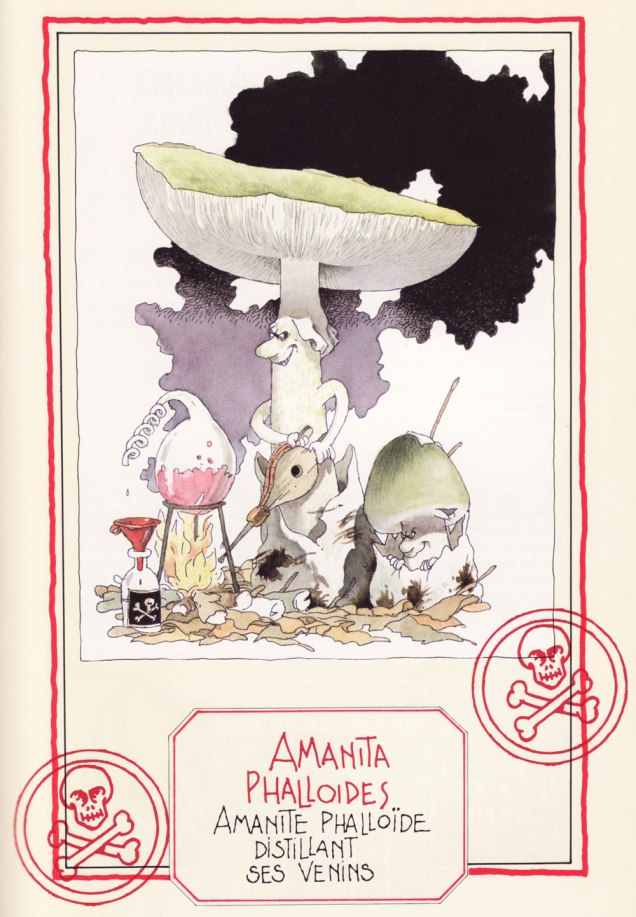
The Death Cap… distilling its own venom. A most lethal animal.
The Fly Agaric, probably the most depicted mushroom in the arts, ‘performing its function‘. Despite its reputation, it is not deadly per se, as alluded to in a previous post (Fungus Friday: Amanita New Year (To Get Over This One)).
The Blusher, so called for its propensity to blush a pink hue when bruised (or embarrassed, one presumes). These wino amanitae exiting the tavern definitely look sloshed.
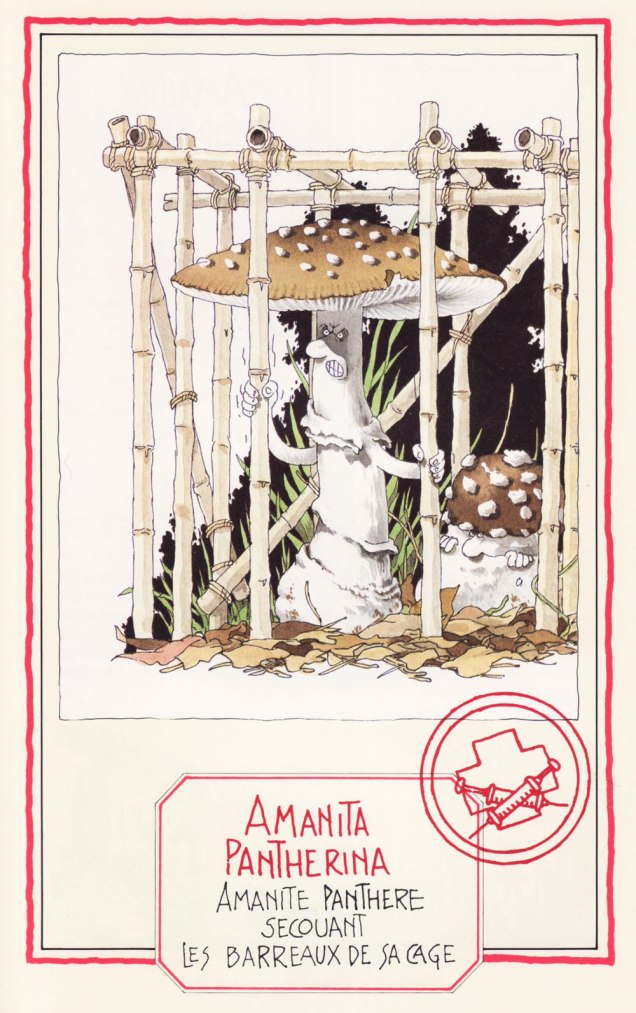
The handsome Panther Cap, shaking the bars of its cage. Like its Fly Agaric cousin, it’s not deadly as such, and has some psychoactive components. Admire its striking looks here.

Now we move on to more traditionally edible characters —

The Banded Agaric is also known as ‘Pavement mushroom’, which explains this fur-foxed lady showing her goods… walking the beat, as it were. This lady is tough as nails, and has been known to burst right through the pavement. Is she edible? You bet! ***
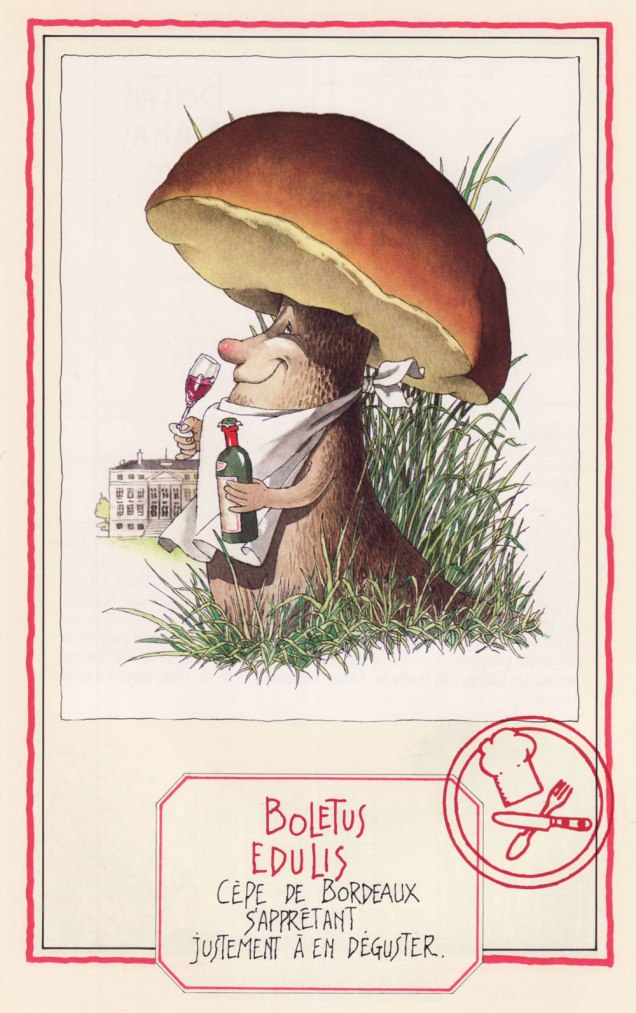
Ah, mushroom of many names (does this make it the rose of mushrooms?) – Penny Bun, Porcino, Cep, call it what you will… highly prized throughout cultures, fragrant à souhait. Here the cèpe de Bordeaux is about to savour some Bordeaux wine.
A favourite of WOT admins, the Fairy Ring Mushroom, saddled with an unfairly gloomy Latin name (‘marasme’ comes with an etymology of ‘wasting away’ or ‘decay’), dancing a ronde. Undemanding and widely spread, this mushroom dries most excellently (sometimes right on the very lawn it grows upon) and enlivens soups and stews throughout winter.
Another well-known mushroom, the Golden Chanterelle, as beautiful as it is fragrant. Will I picture these playing tiny little violins every time I find them in a forest? Absolutely.
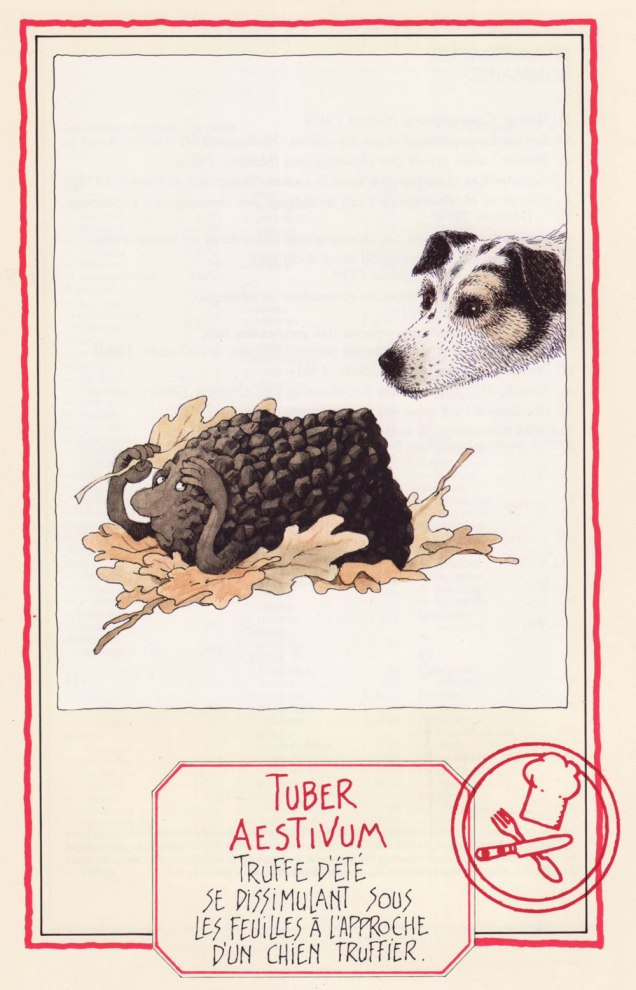
We couldn’t resist adding this scene depicting the Summer Truffle trying to camouflage itself as a truffle-sniffing dog approaches. I love the inquisitive gleam in the doggo’s eye.
We wrap up with, well… I trust you can interpret the Latin well enough without me. The Common Stinkhorn (‘stinky satyr indulging in his depravity‘) is actually edible, though not nearly as popular (or tasty) as another member of its family, the pretty Veiled Lady. Whether you would actually want to eat it is another question.

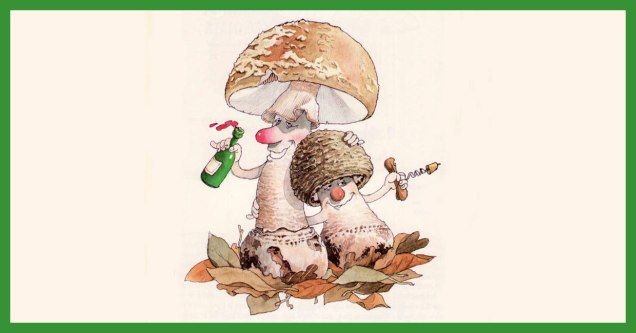
First published in 1986, this book has known several editions to update nomenclature (some mushroom families and names have changed considerably in the last 40 or so years, which is its own topic). We have the 1991 edition, published by Glénat. Sabatier had so many favourite mushrooms he illustrated, they didn’t even all make it into the book officially… which is truly a crime. Take a peek at some other of his mushroom people, only included on the inside of the book’s cover (but at least included in that smaller capacity!):
~ ds

* Technically one can find some mushrooms during winter, but that is not my area of expertise (at least as yet).

** French mycologist of renown (1905-1994), as well as writer, politician and apparently even musician (piano).

*** I’m actually not a big fan. This Agaricus tastes too much like the ‘champignon de Paris’ mushrooms sold in supermarkets to be of much interest.
« Pépin le Long, You’re Fired! »

« Qui a eu cette idée folle? » — France Gall

This is *nearly* a tale of two Rolands, both named Sabatier, both born in France and in the year 1942. One deservedly became a darling of the avant-garde as a standard bearer of the ‘Lettrisme’ art movement. He was evidently a genius, he passed away in 2022, and well, that’s not the one I’ll be writing about, at least this time.

So we’re left with the other Roland Sabatier (1942 –), who’s a bit of a cypher: the Lambiek comiclopedia somehow failed to include him, despite his considerable achievements. Roland also — bafflingly — fails to even rate a passing mention in Richard Medioni‘s otherwise exhaustive Mon camarade, Vaillant, Pif Gadget, L’Histoire complète 1901-1994. To be perfectly honest, I hadn’t heard of him until this year, when I ordered a batch of cheap issues of Vaillant from a friendly French dealer. While I already knew the vast majority of the fabled bédé weekly’s stars, one unknown entity stood out, by virtue of both obscurity and evident talent.

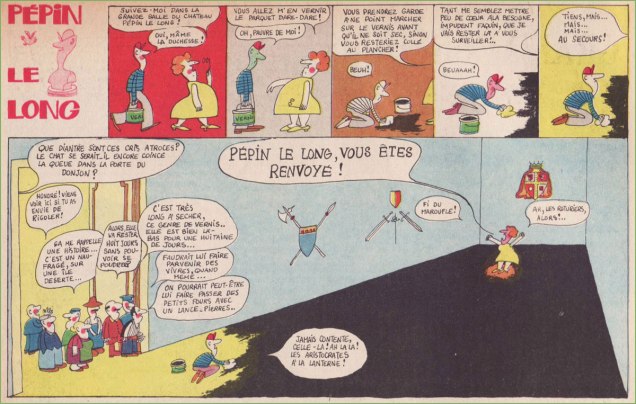
Pépin le long is a high concept strip about a poor schmuck who keeps getting fired, generally through some innocent mistake. His moniker is a play on Pépin le bref (714-768), one of the early kings of France, and a sterling example of the absolute necessity of keeping church and state separate. *That* Pépin is perhaps most famous for being papa to Charlemagne (748–814), King of the Franks and first Holy Roman Emperor.

Originally published in Vaillant, le journal de Pif no. 1131 (Jan. 15 1967, Les Éditions Vaillant).
Originally published in Vaillant, le journal de Pif no. 1132 (Jan. 22 1967, Les Éditions Vaillant).
Originally published in Vaillant, le journal de Pif no. 1133 (Jan. 29 1967, Les Éditions Vaillant).
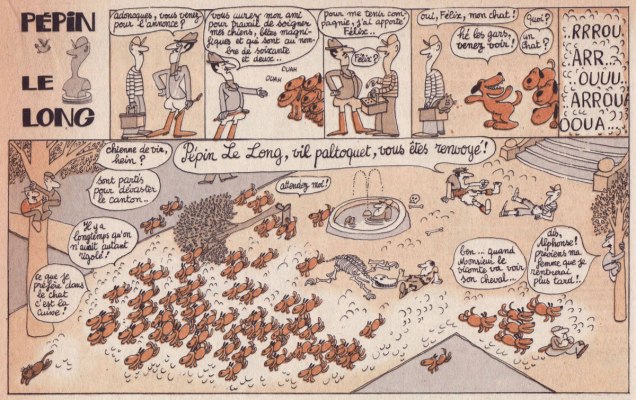
Originally published in Vaillant, le journal de Pif no. 1135 (Feb. 12 1967, Les Éditions Vaillant). I love those enthusiastic doggies, even if they do strip a horse to the bone like they’re piranhas.
Originally published in Vaillant, le journal de Pif no. 1141 (Mar. 26 1967, Les Éditions Vaillant).
Originally published in Vaillant, le journal de Pif no. 1144 (Apr. 16 1967, Les Éditions Vaillant).
… and the swan song, second of two strips appearing in issue 1144. Excellent use of the vertical format for the finale!
« No, young man: I’m the other, avant-garde Roland Sabatier. »

There were only ten Pépé le long strips, and I’ve managed to gather seven. Not bad, given their rarity.

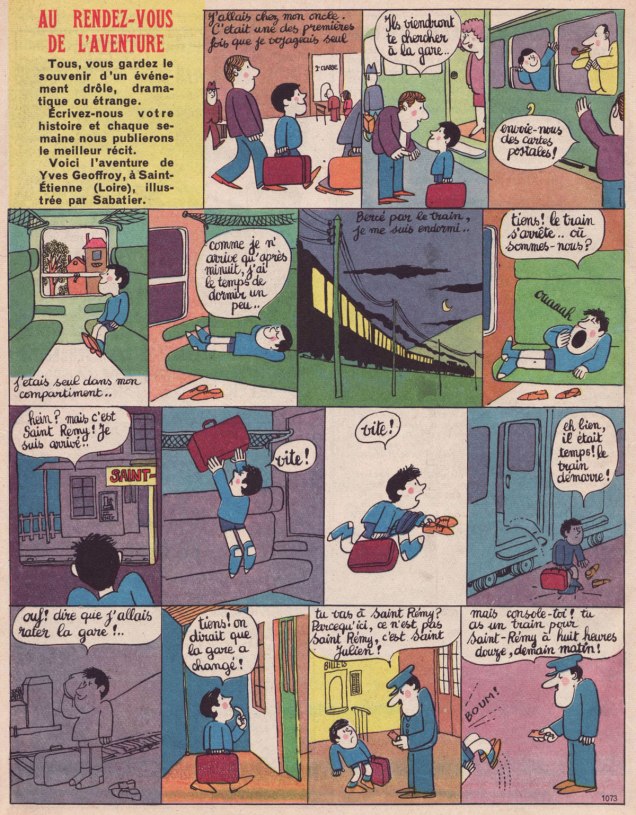
Before Pépin, in 1965-66, Sabatier had illustrated several — some forty — instalments of Vaillant’s established « Au rendez-vous de l’aventure » (1956-66), wherein readers sent in their personal stories of everyday adventure. Here’s a pair of examples.

Originally published in Vaillant, le journal de Pif no. 1068 (Oct. 31 1965, Les Éditions Vaillant).
Remember cursive? Originally published in Vaillant, le journal de Pif no. 1073 (Dec. 5 1965, Les Éditions Vaillant).

-RG