Just a Working Class Dog: Pif le chien

« The working class is revolutionary or it is nothing. » — Karl Marx

Pif le chien was introduced to the world on March 26, 1948, in the French Communist daily L’Humanité. His strip was intended to replace that of Felix the Cat, who was deemed too bourgeois, what with his magic bag and invisible means of financial support. On the other paw, Pif, early on, was even a stray, homeless and starving. In time, he was taken in by a humble working-class family (as late as 1957, it was the outhouse and public baths), and that’s when the elements clicked into place.
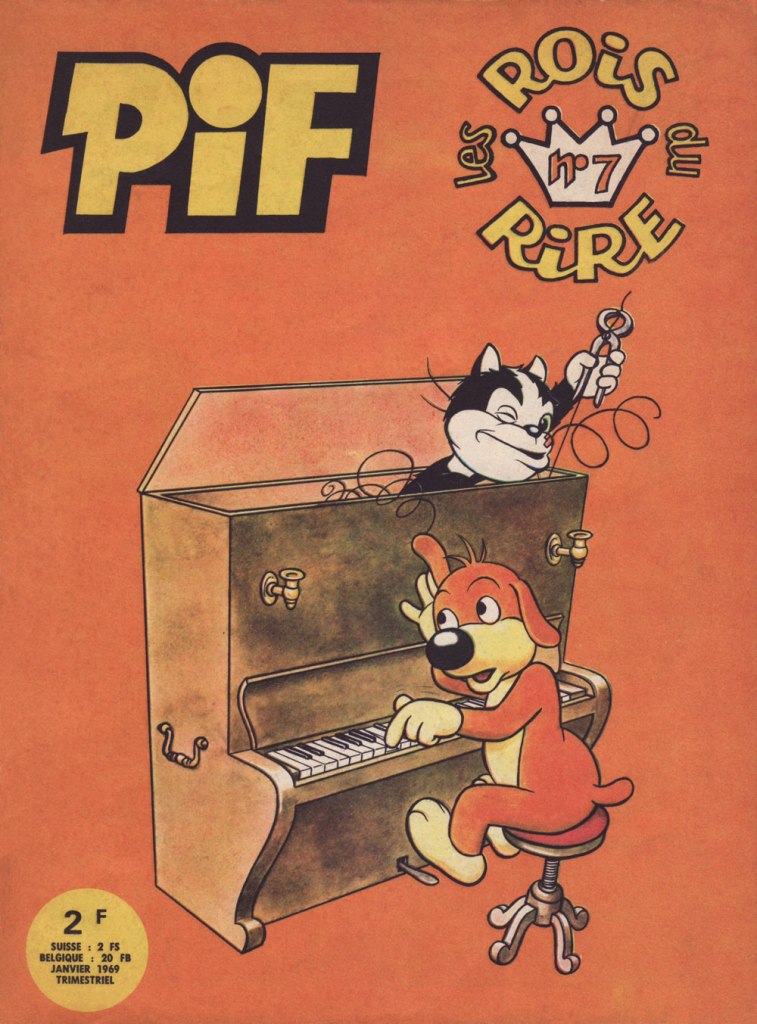
This is Les rois du rire no. 7 (Jan. 1969, Vaillant), a rotating anthology title gathering, in this case, two-pager Pif strips from the pages of Vaillant. Cover art by Pif’s creator, José Cabrero Arnal (1909-1982).

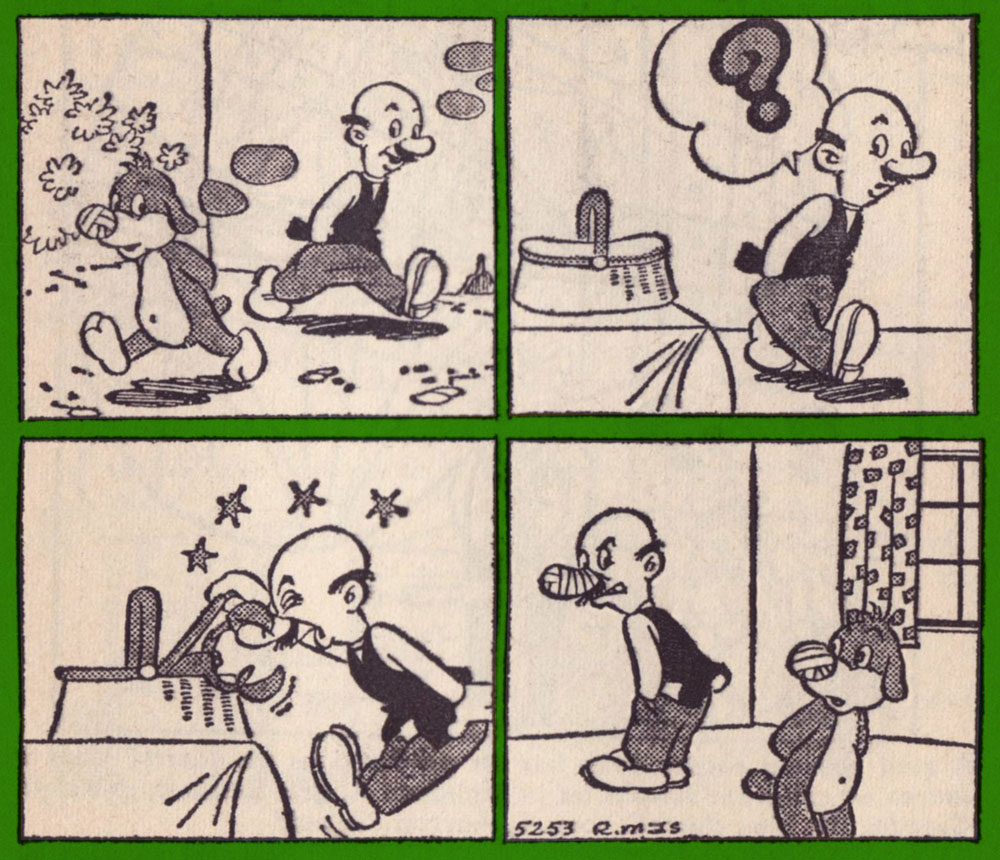
While I greatly admire and enjoy the work of Pif pater José Cabrero Arnal — and trust me, his is a story worth the telling: fought the Fascists in Spain, spent four years in a Nazi Stalag in Austria before being liberated by the Soviets, never quite recovered from the ordeal of his captivity, and remained fragile for the rest of his days. Consequently, in 1953, he handed Pif’s leash over to the truly indefatigable Roger Masmonteil (1924-2010).

Of Masmonteil (who signed R. Mas.), historian Hervé Cultru writes, in his Vaillant, 1942-1969 : La Véritable histoire d’un journal mythique (2006, Vaillant Collector):

« The problem is that, once he got his finger caught in the gears of the freelancing engine, he couldn’t just yank it out! Because giving life to the Césarin family is practically a vocation: one must provide the daily strip, six a week. Over thirty years, Masmonteil, aka Mas, crafted over eleven thousand of them. There are also the Sunday strips, the pages for Vaillant, solo Pifou stories, Léo, created for Pif Gadget. It never ceased. By his career’s end, he had racked up some 45,000 gags or so. »

« Unlucky me, I’ve smashed the vase! » « Out of sight, out of mind! » « Bleh! What a revolting aroma! » « I’m found out! »
« When the sea is too far, one makes do with a little corner of the Seine! » « I’m the back-float king ! » “Sur mer” (“On-Sea” would be the English equivalent) is a popular suffix to denote a town or resort’s coastal location. The Seine’s toxicity borders on the legendary, but things have actually improved in recent decades.
I love a good pantomime gag. And every look is a sideway glance, which makes it even more special.
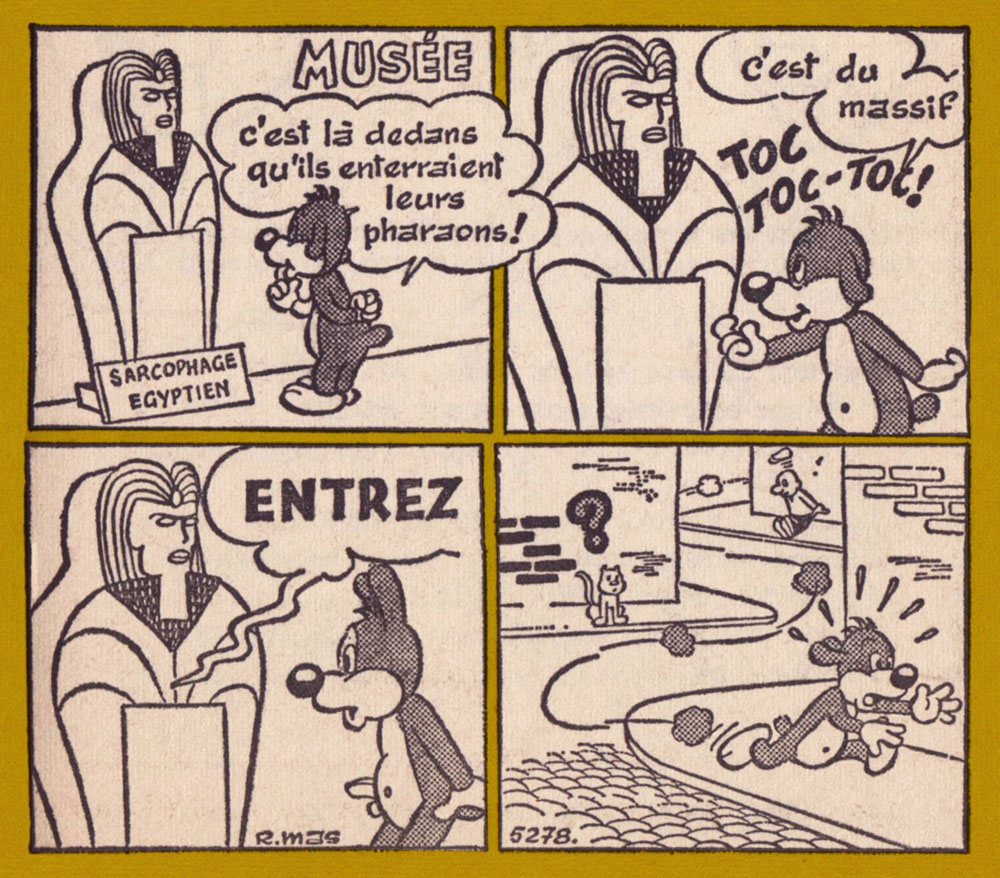
« It’s in these things that they buried their pharaohs! » « That’s solid stuff! » « COME IN ». What most impresses me here is the final panel, with its expert use of a tiny space to convey depth, distance and setting. That’s the cartoonist’s art!
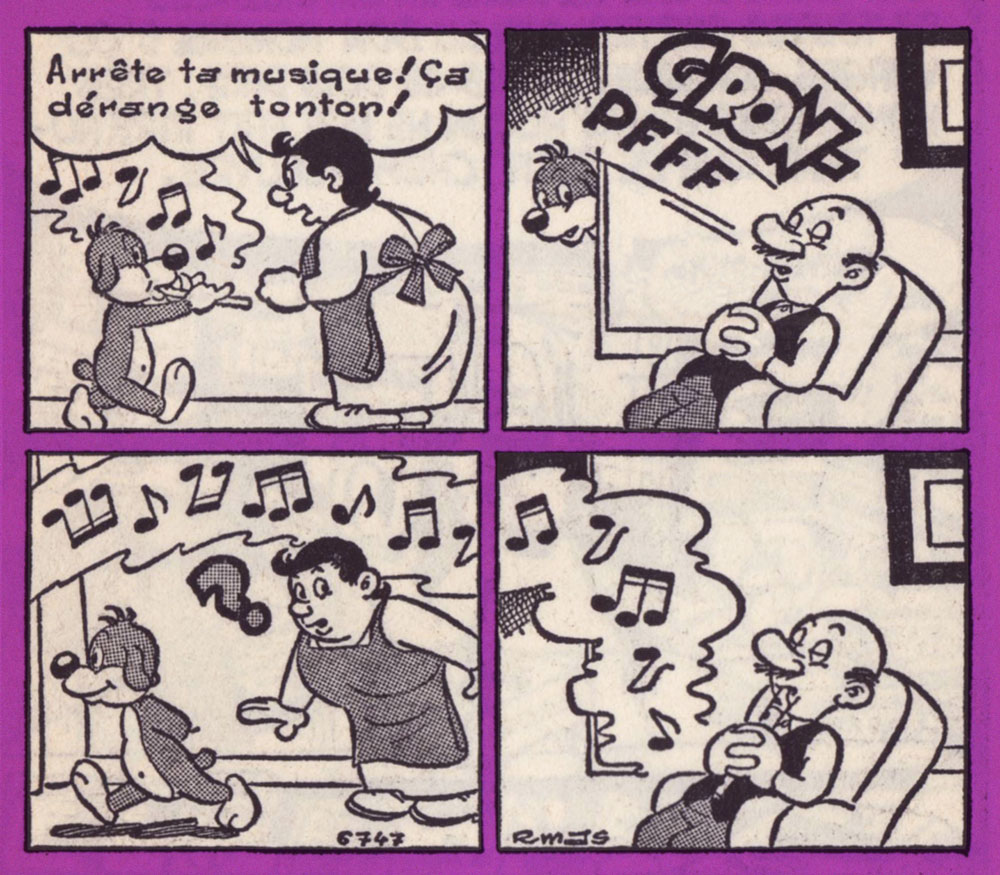
« Quit your music! It bothers tonton! ».
« And a-one! » « Brr! Doesn’t it cause him pain when you remove the hook? » « Not at all… it’s designed not to hurt… » « Next! » « Quiet! It’s designed not to! » Up yours, René Descartes!
A slice (ouch!) of politico-historical guillotine humour.
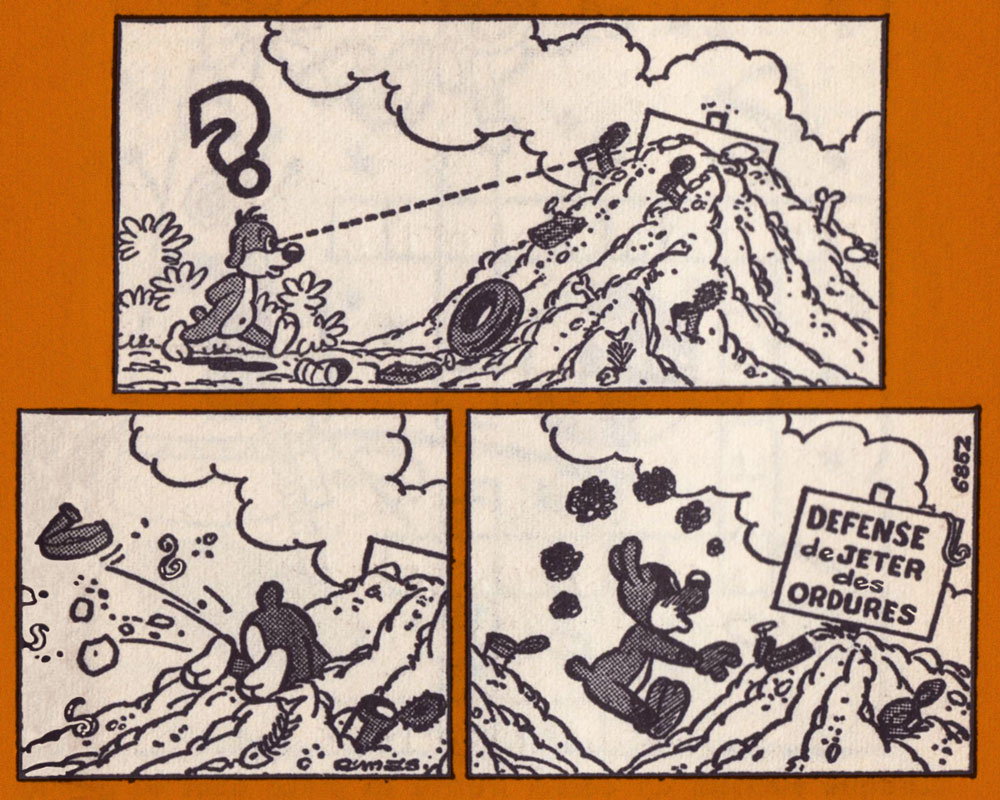
A dollop of social criticism. The sign says, naturally, « No Littering ».
Pif’s archenemy, Hercule, at work. « Who’s going to get a good soaking? The Pif, that’s who! » « Failed! »

I’m inclined to admire Mas for the same reasons I hold Nancy’s Ernie Bushmiller in the highest regard: the uncanny ability to find humour in any and every place or situation, to distill and express it in a pared-down visual language made all the more potent by its universal simplicity. But it’s hard work, even if geniuses make it look easy. As Hervé Cultru explains, in Mas’ case:

« … Pif gets the last word in: at night, he haunts Mas’ dreams. The point at which he’s about to doze off is actually one of intense creativity. He constantly keeps a notepad and pencil at his bedside, to jot down ideas straight away, because if he neglects this precaution, all is forgotten by morning. »

An ad from L’Humanité, circa the late 1950s.
Our cast: Tante ‘Tata’ Agathe and Oncle César ‘Tonton’ Césarin, Doudou, Pif, Hercule, and Pif’s son, Pifou. This is my copy of Album Vaillant no. 8 — 4th series (comprising issues 952 to 960, August to October 1963), its rather fragile spine helpfully reinforced by a previous proprietor. I long wondered why on earth the French call wrestling ‘catch’. Turns out it’s their shorthand version of the forgotten 19th century appellation of the sport as ‘catch-as-catch-can‘.

In April 1967, Mas walks away from the Pif feature in Vaillant (four pages a week!), maintaining the daily in l’Humanité and Pifou’s solo strip. Pif returns briefly to Arnal, who still can’t handle the workload; Pif then passes into other, and decidedly far lesser hands.

Mr. Cultru, again:

« In 1968, the team takes umbrage with the repetitive and by far too ‘domestic’ character of the adventures. It feels that the working class household, typical of certain post-war values, that serves as a setting, has become obsolete, if not grotesque, and that it no longer fits the social context of the times. »

So they methodically excised everything that made Mas’ Pif special, and turned him into another Mickey Mouse, which is to say the familiar mascot or standard-bearer of a company, but one whose adventures nobody reads or truly gives a hoot about. Oh well — you still had a good run, Pif!

-RG

Tentacle Tuesday: Tentacules à la mode

« Les artistes, c’est comme les pieuvres: ils crachent de l’encre pour se cacher. » — Julos Beaucarne*

It is time (again) for some French tentacles! (Upon closer inspection, a lot of these actually prove to be Belgian, but my point still holds.) We have all kinds in today’s post: tentacles merry and frightening, realistic or cartoony. There’s even an octopus in a bra (but don’t skip ahead)!

tentacletuesdayicon

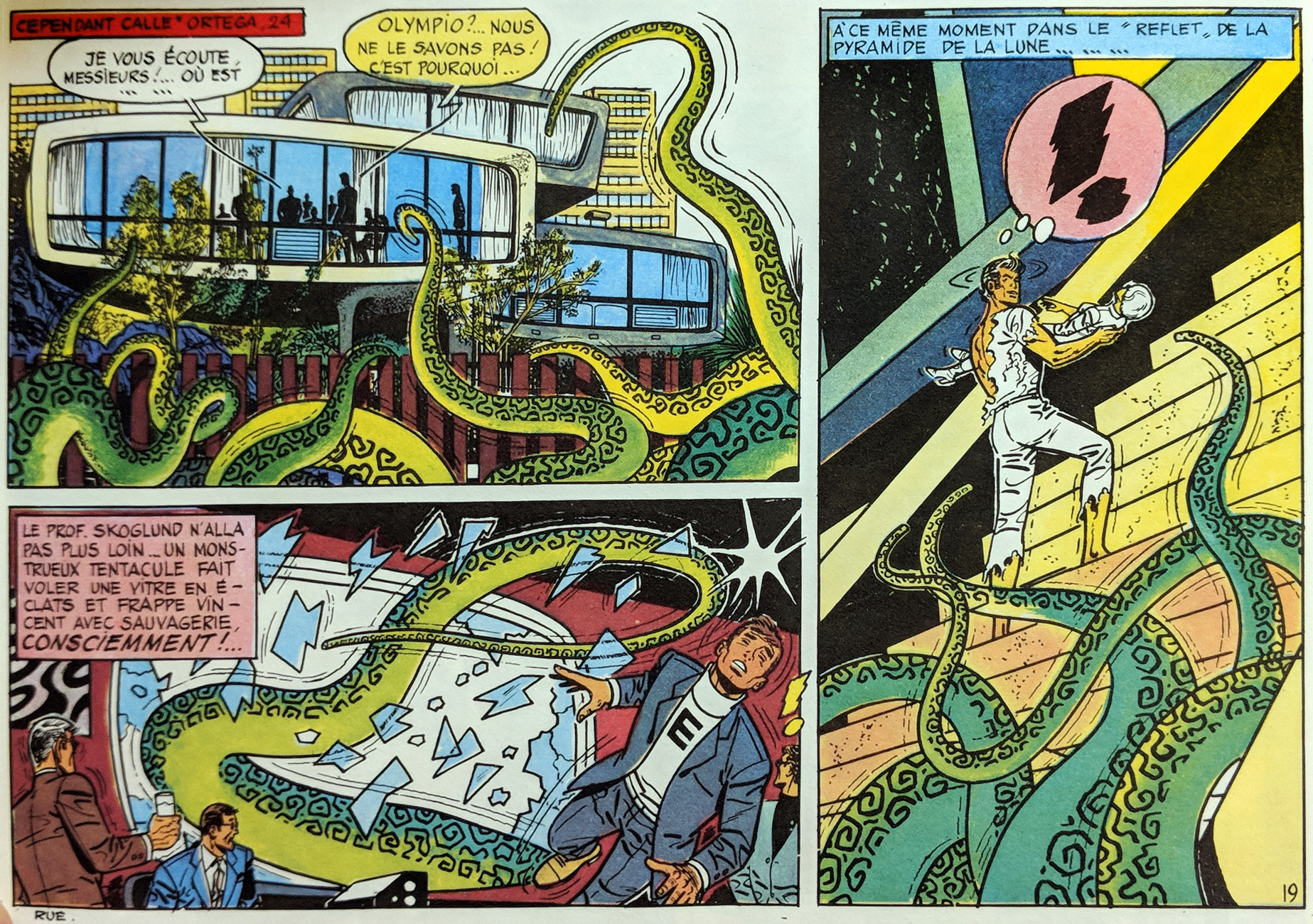
Created for Le journal de Tintin in 1963 by Raymond Reding, Vincent Larcher was a professional football player who often used his athletic prowess to defeat evil guys (he also occasionally played football). The first Vincent Larcher story had no supernatural elements, and didn’t seem to make much of a ripple amidst Tintin’s audience. After a 4-year hiatus, Reding re-introduced Vincent Larcher, this time throwing him into a three-part tale with a mad scientist (as usual, hellbent on world domination) and scary aliens. This was later christened the Olympio Trilogy in honour of Olympio, Larcher’s telepathically gifted friend, who was an important figure in these stories. The pages below are from Le zoo du Dr. Ketzal, part three of the aforementioned trilogy, published in Tintin Magazine issues 1039 to 1059 (1969).

le zoo du docteur ketzal-vincentLarcher-1

le zoo du docteur ketzal-vincentLarcher-2

tentacletuesdayicon

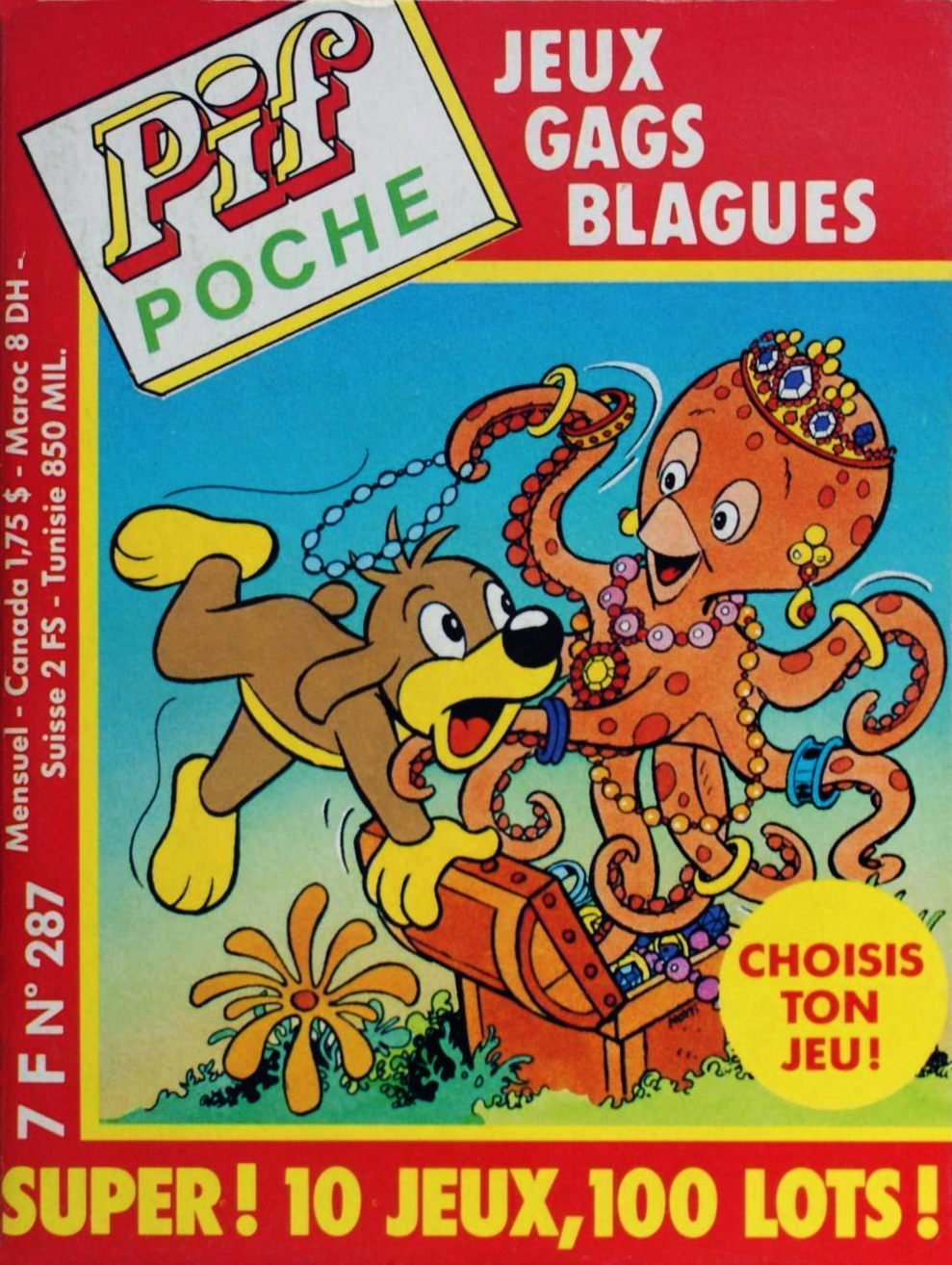
The friendly pooch fraternizing with octopuses is Pif, the mascot of Pif Gadget (« gadget » referred to the fact that each issue of the magazine was accompanied by some thingamajig to amuse the youngsters). Pif Poche were pocket-sized collections of short Pif strips (“poche” means pocket in French), meant to be easily carried to trips, picnics, and probably school as well. Pif was created by José Cabrero Arnal in 1948, who gradually abandoned the strip by the 1960s while other artists took over.

PifPoche-270
Pif Poche no. 270 (Vaillant, 1988)

PifPoche287
Pif Poche no. 287 (Vaillant, 1989)

TentacleTuesdayIcon

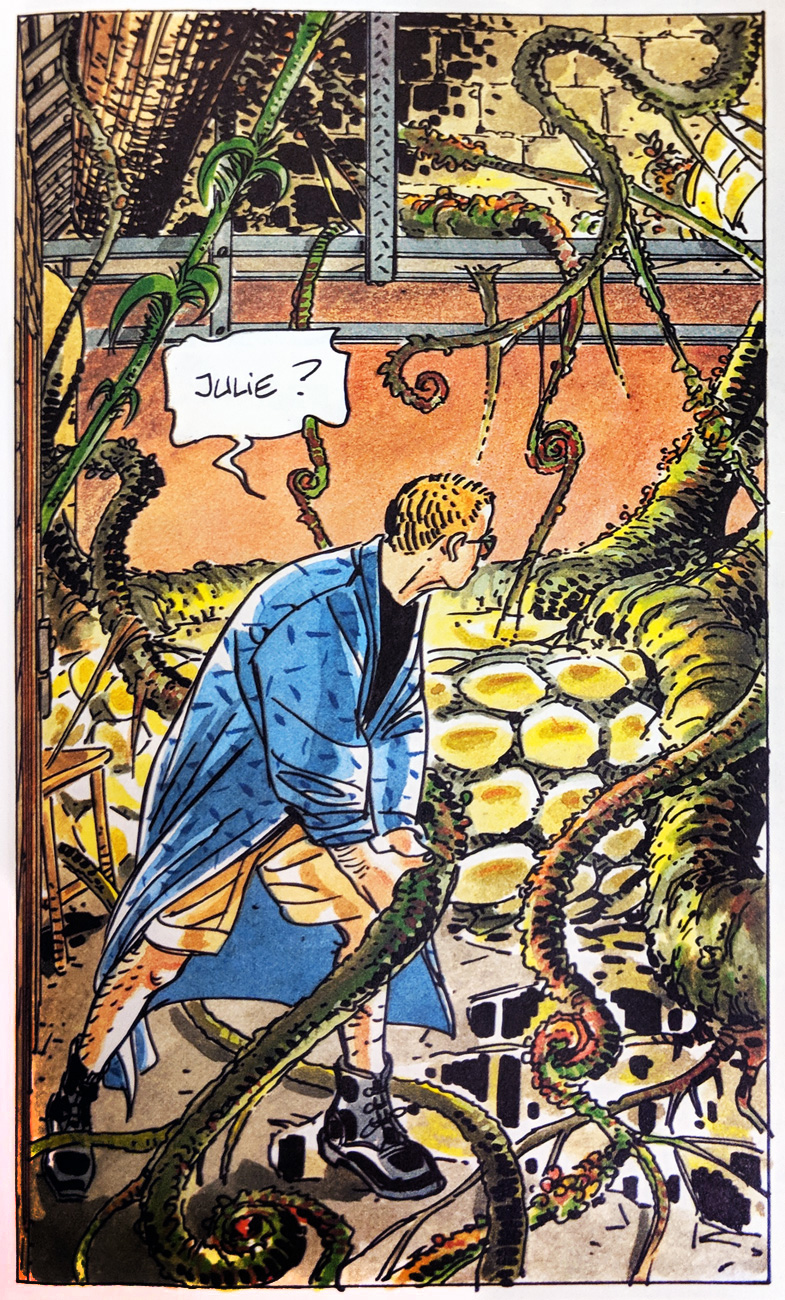
The following panels are from the series Tropique des étoiles by Christian Lamquet, more precisely from volume 4, Le réveil des poussières (1996, Claude Lefrancq).

LeReveilDesPoussieres-Tropiquedesetoiles4-ChrisLamquet1

LeReveilDesPoussieres-Tropiquedesetoiles4-ChrisLamquet2
« 19 minutes, 10 seconds, you can come out! » Experiments performed on a young woman seldom turn out as intended.

TentacleTuesdayIcon

My next peace offering to the cephalopod gods comes in the form of a very loose interpretation of Carlo Collodi‘s Pinocchio, imagined by French artist Winschluss (real name Vincent Paronnaud) and executed with the help of some friends, most notably Cizo on colours. Winschluss’ art can be quite nice, but it gets a massive boost from the first-rate colouring job, so I’d like to emphasize that Cizo deserves a lot of credit for that (the tentacle pages are actually rather dark, as the action occurs undersea, but just take my word for it).

This graphic novel received a few prizes and has been lauded by many parties, but somehow I’ve managed to be quite unaware of its existence until recently. (Frankly, I am somewhat tired of picking up comics that are supposed to be superb and end up being just mediocre, so I don’t tend to pay much attention to awards and other plaudits.) A friendly comic book store clerk pointed it out to me, explaining that it was brought in by an older gentleman whose granddaughter had presented the book to him as a gift, but it wasn’t his thing at all. I was quickly won over by the art, and the story, well… it’s not for the faint-hearted or easily offended, but it’s a good one.

Winschluss’ Pinocchio was originally published in 2008 by Les Requins Marteaux, but has been reprinted several times in French (in increasingly fancier editions) as well as translated into English in 2011.

WinchlussPinocchio01A

« French comics artist Winshluss leaves his robot child hanging beneath a giant lollipop on a hill for a good quarter of his largely dialogue-free adaptation, as regimes fall, fake prophets rise and a pizza delivery girl is saved from torture at the hands of seven dwarves. It’s a grim, puerile and rather brilliant update, combining chaotic, inked panels and gorgeous full-colour paintwork to great effect. Pinocchio, designed as a killing machine, is plunged from crisis to crisis by a series of greedy men and women, his story interrupted by a tortured detective, a grieving couple and Jiminy the cockroach. » |source|

WinchlussPinocchio02A

Actually, don’t take my word for anything, you can admire the colours in this preview:

tentacletuesdayicon

CosmikRoger

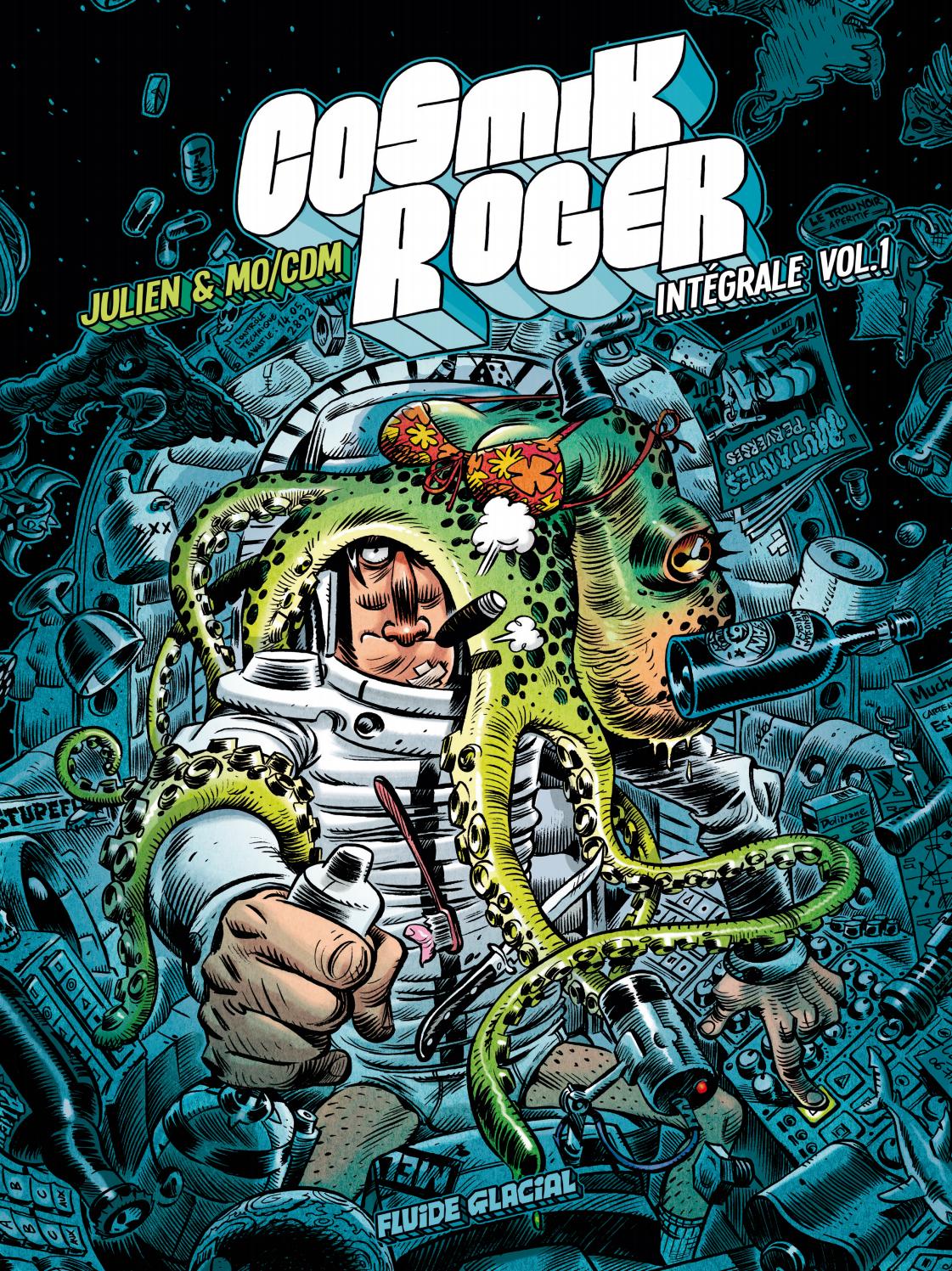
Cosmik Roger is a sci-fi/humour comic series scripted by mo/CDM (no, seriously, that’s his nom de plume, and no, I don’t know what it stands for) and drawn by Julien/CDM (real name Julien Solé – they used to go to school together, which apparently led them to adopting the same stupid monicker). This is the cover of the collected Cosmik Roger (volume 1), published in 2018 by Fluide Glacial.

Just tuning in now? Visit the previous Gallic Tentacle Tuesdays: Tentacle Tuesday: Franco-Belgian Edition, Part I and Tentacle Tuesday: Franco-Belgian Edition, Part II.

~ ds

*artists are like octopuses: they spit out ink to hide.

Tentacle Tuesday, Franco-Belgian Edition

Today’s Tentacle Tuesday comes to us courtesy of France and its long-suffering neighbour, Belgium. There’s an easy joke one could make about the reputation Frenchmen possess of having hands like grabby tentacles, but instead I’ll concentrate on their wonderful comic writers and artists and the classic bande dessinée. Let’s gracefully step over all the obscene connotations of a “French edition” and delve into exhibit A:

DavidBFroideA
“So that’s it, your real face?” asks the old man. “What were you expecting?” asks the emerald-eyed cephalopod.  This is a page from Les chercheurs de trésor, volume 2: La ville froide, David B. (2004, Dargaud).

David B. is the nom de plume of Pierre-François David Beauchard. Non-Francophone audiences might know him from Epileptic, an autobiographical graphic novel that won accolades and awards from an international audience. And yet it’s not his most interesting œuvre, as far as I’m concerned. Although Epileptic is full of imagery and allegories, it’s when David B. lets his imagination soar without the constraints of real life that he creates his most dazzling worlds and astonishing stories. He’s one of those rare comic artists whose art is as accomplished as their storytelling.

Here’s a bonus “tentacle” from Monsieur B.:

DavidBLesIncidentsdelaNuit
La lecture des ruines was published by Dupuis in 2001. (It loosely translates to “reading the ruins”, “study of the wreckage”.) It’s the story of a mad scholar who tries to find a mathematical equation for violence in the decayed rubble that war has left behind. Excerpted material from an imaginary periodical is appended, Les incidents de la nuit (Incidents of the Night). This tentacled worm – Le Grand Ver, the Great Worm – is one of the creatures that lurk within…

Give a hand of applause, ladies and gentlemen, to David B., and let’s move to our next topic.

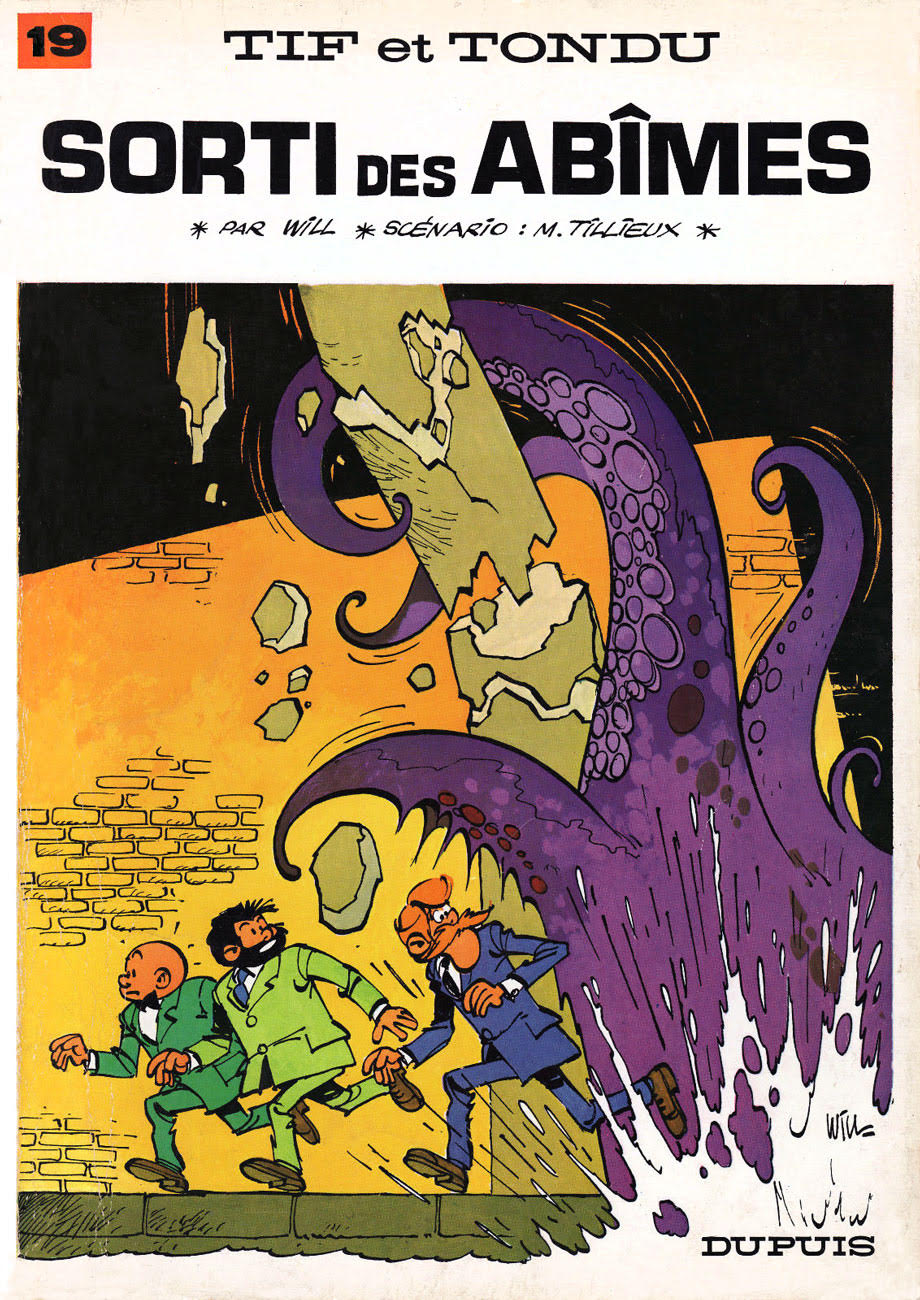
“Sorti des abîmes” translates to something like “Risen from the abyss” – and what sort of thing rises from an abyss? Why, tentacles, of course!

TifTonduSortiDesAbimes
Tif et Tondu: Sorti des abîmes (1972)

Tif and Tondu, an intrepid team of private investigators, were originally created by Fernand Dineur, but their most popular incarnation is by writer Maurice Tillieux and artist Willy Maltaite (who mostly went by the nickname Will), which is what you’re currently admiring. The strip saw birth in 1938 in journal Spirou and lasted a whopping number of years, ending in 1997, one year short of its 60th birthday.

Things are a bit tricky with the numbering, because Tif et Tondu are popular enough to have been anthologized several times. Sorti des abîmes appeared as the series’ 19th entry (1972), after being serialized in Spirou no. 1746 (September, 1971) to no. 1764 (February, 1972).

TifTonduSortiA(1)
A closer look at the creature from the abyss: not exactly an octopus, but in distinct possession of tentacles. “Armed and dangerous”, as they say! The poor thing is dissolved at the end of the story by some infrared rays.

Incidentally, “Tif” is slang for hair in French, and “Tondu” means “shaven, sheared”. Naturally, Tif is the bald guy, and Tondu is the hairy one.

Now that we’ve had our fill of scary, destructive tentacles, I’ll move on to something friendlier.

Pif2
Pif Poche no.72 (Aug. 1971) The last panel says “Paws off… Don’t touch! You’ve got cold hands!”

Pif3.jpg
Pif Poche no.72 (Aug. 1971) “This creature is starting to annoy me with its tickling!”

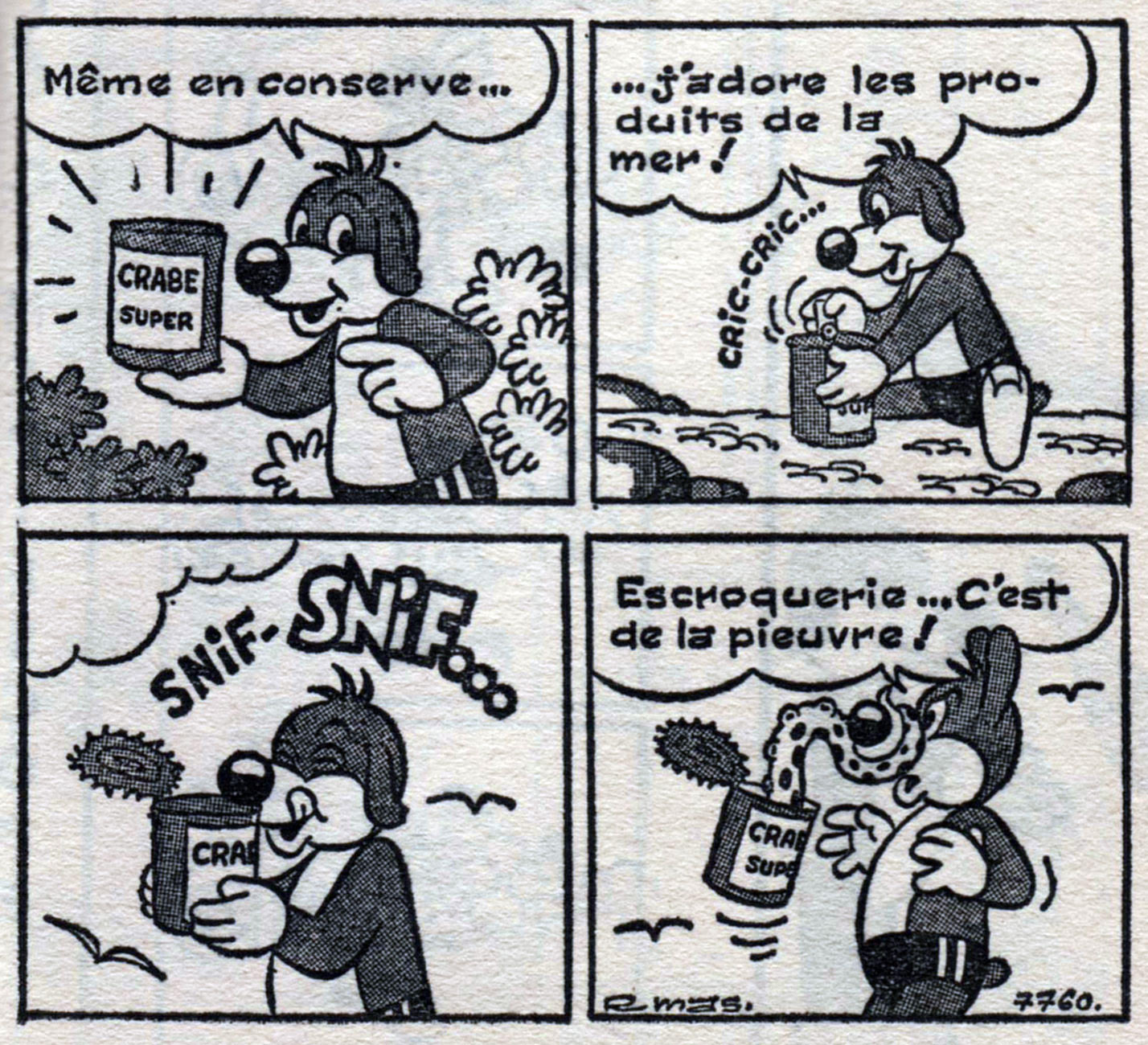
Pif the dog was the mascot of the kid’s magazine Pif Gadget (« gadget » referred to the fact that each issue of the magazine was accompanied by some thingamabob to amuse the youngsters). Pif Poche were pocket-sized collections of short Pif strips, as well as jokes, games and such. The character was created by José Cabrero Arnal in 1948, who gradually abandoned the strip by the 1960s while other artists took over.

Pif1
 Pif Poche no.72 (Aug. 1971) “Even in a can… I adore seafood! Ripoff… it’s octopus!” Story and art by Arnal’s immediate and worthiest successor, the prolific Roger Mas (1924-2010)

~ ds