« Truly the universe is full of ghosts, not sheeted churchyard spectres, but the inextinguishable elements of individual life, which having once been, can never die, though they blend and change, and change again for ever. » — H. Rider Haggard
Here at WOT?, we’re both Russell aficionados, but with some reservations. I think I needn’t delve into such details, when my partner ds already eloquently laid it out in her post Grains of Golden Sand: P. Craig Russell’s Fantasies… and I happen to fully agree with her reasoning.
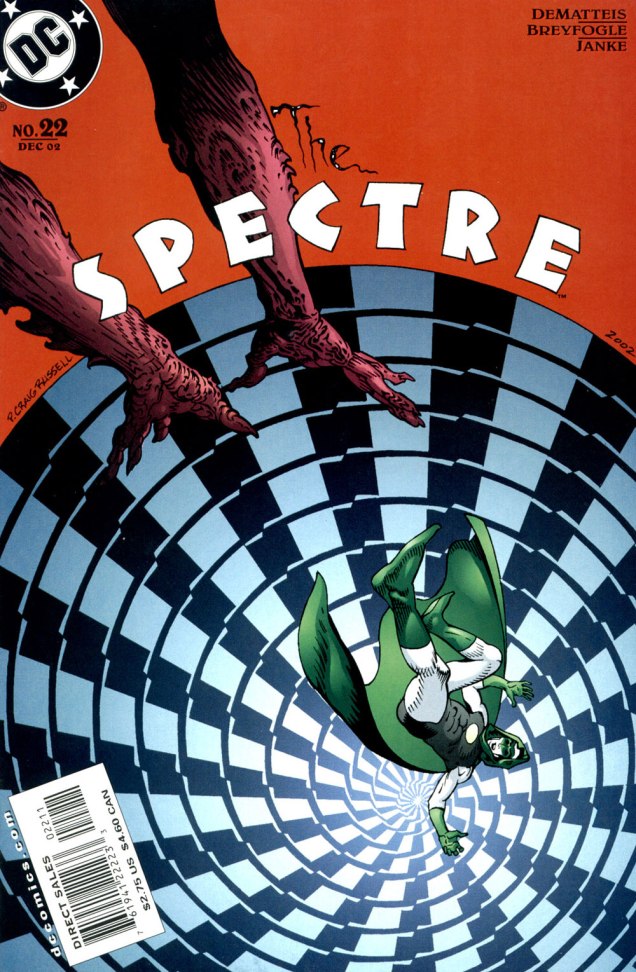
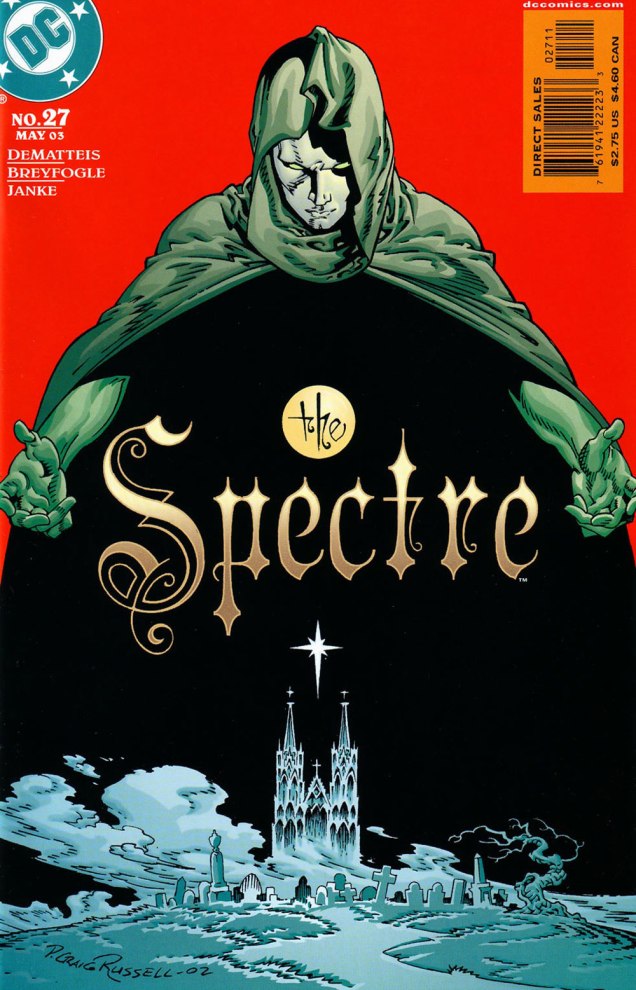
What’s perhaps not been explicitly stated is Russell’s virtually infallible way with a cover, both in design and execution. As I keep emphasising, great — and consistently great at that — cover artists are pretty thin on the ground.
Someone at DC must have seen his gorgeous seven-issue run of covers for Elric Stormbringer*(1997, Dark Horse/Topps) and offered him the Spectre gig.
Hey, something from this century! This is The Spectre no. 19 (Sept. 2002, DC). A nice bit of Kirby tribute on Darkseid. In this case, and in fact throughout the Russell sequence, the expressive colours are the work of Lovern Kindzierski.This is The Spectre no. 20 (Oct. 2002, DC). It’s worth pointing out the added value of Russell being a consummate letterer/font designer. Without a logo set in stone (as is generally the case, usually at the insistence of the marketing department) the savvy artist benefits from the extra freedom of counting the title logo among the moving parts of his design. Cue the de rigueurWill Eisner/Abe Kanegson mention.This is The Spectre no. 21 (Nov. 2002, DC). When I showed her these, ds expressed some surprise at her failing to devote a Tentacle Tuesday Masters entry to Mr. Russell.This is The Spectre no. 22 (Dec. 2002, DC).This is The Spectre no. 23 (Jan. 2003, DC).This is The Spectre no. 24 (Feb. 2003, DC).This is The Spectre no. 25 (Mar. 2003, DC).This is The Spectre no. 26 (Apr. 2003, DC).This is The Spectre no. 27 (May 2003, DC). Thus ends the streak…. with the series.
It doesn’t hurt that The Spectre, the brainchild of Superman co-creator Jerry Siegel (1914-1996) and artist Bernard Baily (1916-1996), boasts one of the best-designed superhero costumes of all, virtually unchanged since his introduction, some eighty-five years ago. The exception in this case is the chest emblem, which I presume is meant to indicate that *this* Spectre is former Green Lantern Hal Jordan, instead of defunct flatfoot Jim Corrigan. A bit of a boneheaded notion, imho, and typical of the incessant rebooting and tinkering these poor legacy characters are subjected to by dishwater-dull ‘creatives’.
-RG
*The Elric series was also under consideration, but The Spectre’s nine-issue streak is numerically more impressive.
In his introduction to Isolation and Illusion (2003, Dark Horse), a collection of short stories illustrated and sometimes scripted by Philip Craig Russell between 1977 and 1997, Will Pfeifer argues that ‘thekey to Craig’s art – what really brings it to life – is the small stuff‘.
I would rephrase that to ‘personal stuff’. Russell’s own stories (such as Breakdown on the Starship Remembrance or La Sonnambulaand The City of Sleep A Fragment of a Dream that appeared in Night Music no. 1 and no. 2 published by Eclipse Comics in 79 and 85) blew me away when I first encountered them. Imagine my initial enthusiasm when I finished reading them and anticipated exploring Russell’s bibliography… to find myself amidst seemingly endless comic book adaptations of Wagner and Mozart operas and traditional fairy tales. His work with Neil Gaiman did not spark any further curiosity on my part.* Artistically speaking, almost all Russell draws is impeccable, majestic, and ambitious in scope — but what is the pleasure in all this splendour without an emotional connection? Again and again he deploys a lush romantic carpet upon which innocent youths frolic… but it is a walk, alas, through a rose garden in which everything is scentless.
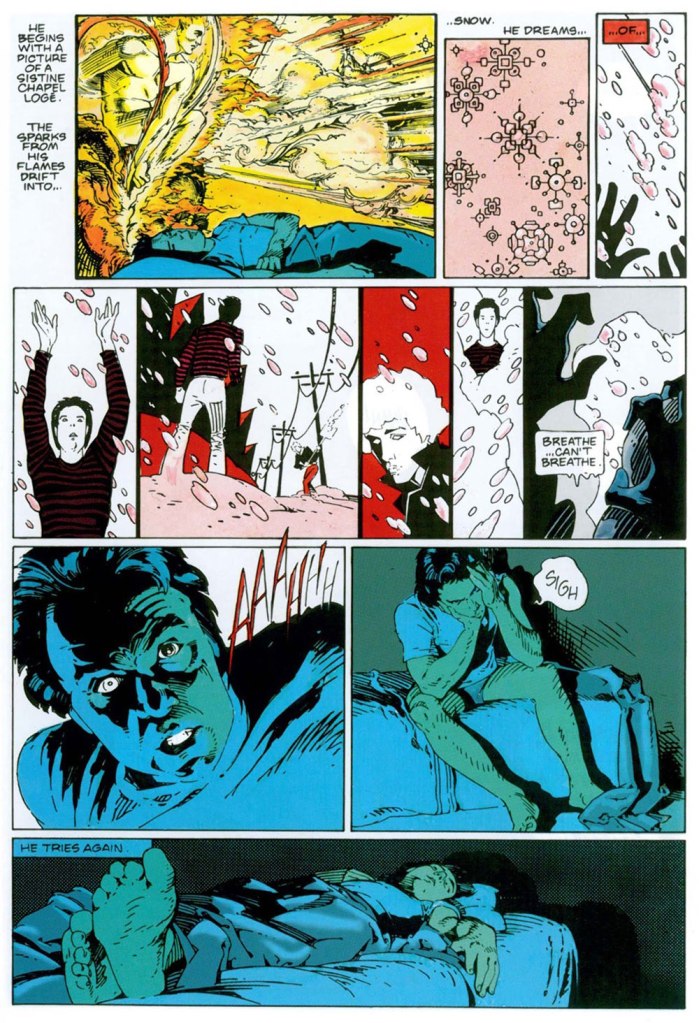
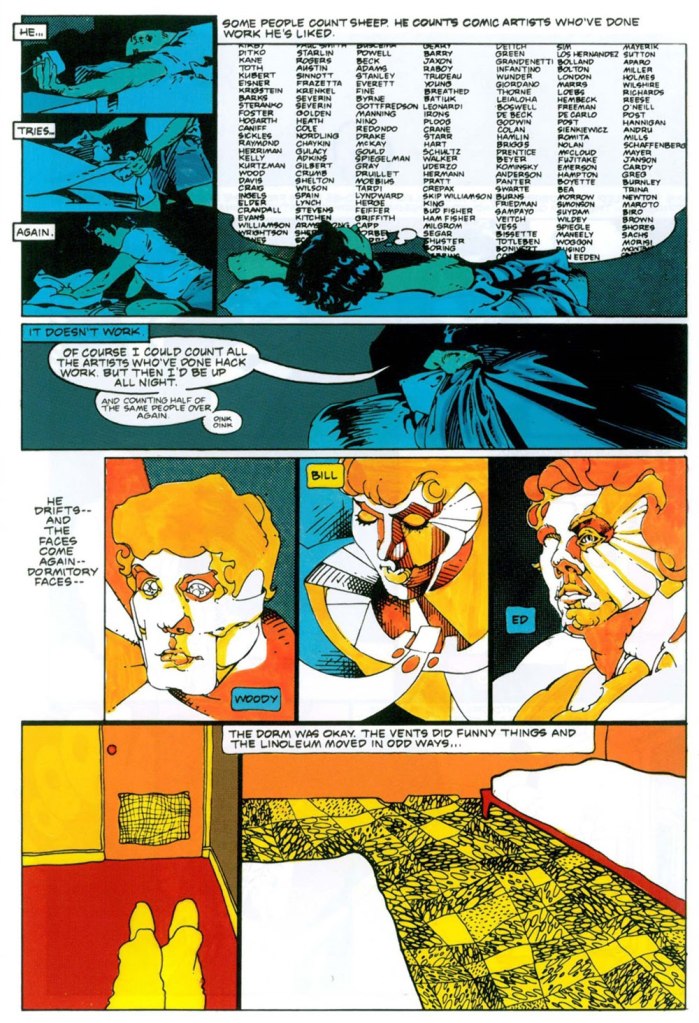
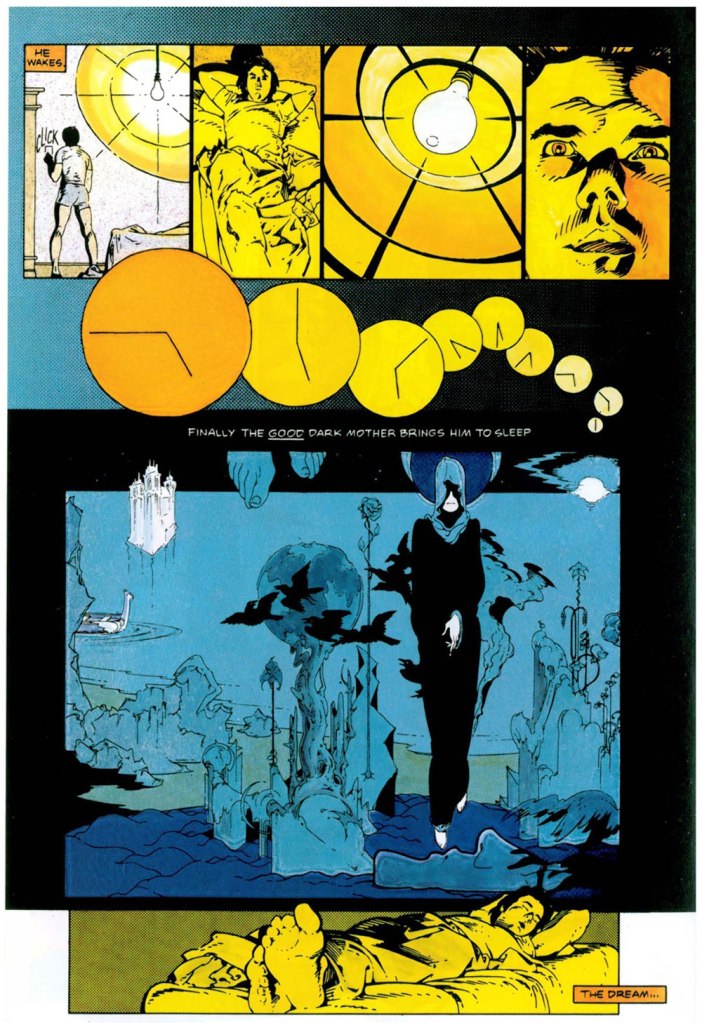
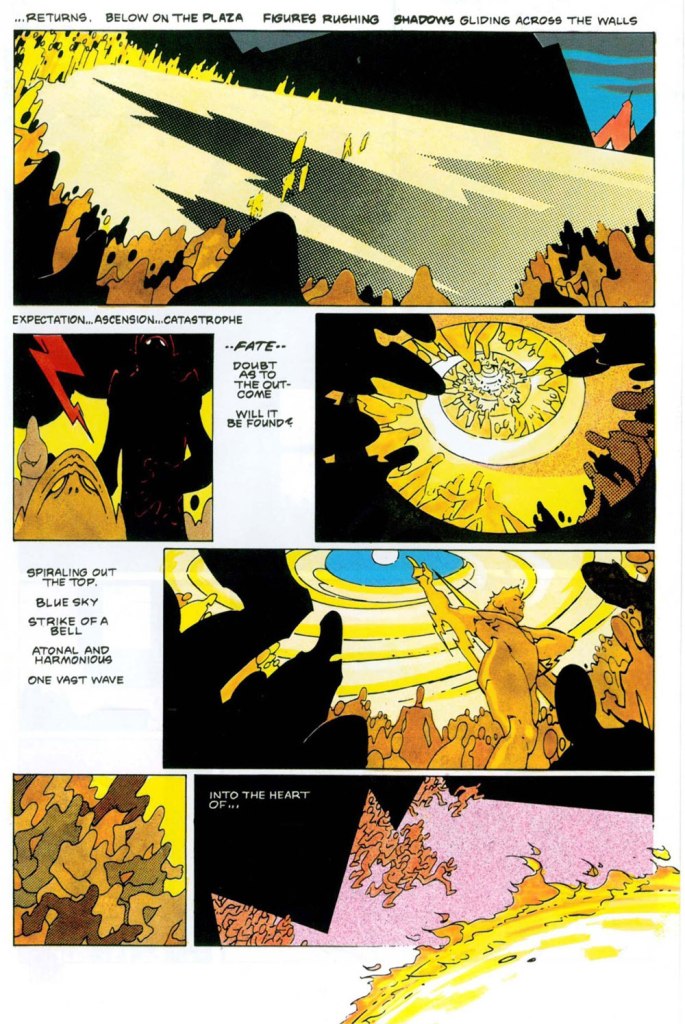
Today we’re running The Insomniac (originally published in Night Music no. 1, February 1985), one of my favourite Russell stories. It also makes for a great showcase of his artistic abilities as well as his landmark celestial landscapes. His favourite main character, a wide-eyed young man, is present and accounted for, but he’s not nearly as doe-eyed as usual, instead presented as a squinty, vaguely nerdy type, with no classical musculature with a proud Roman profile in sight.
Russell explains: «The Insomniac was conceived in 1979 and realized in 1984. Its walking/dreaming shifts in tone enabled me to work in various visual styles. From the early 80’s sketchbook surrealism to record album covers to photorealism, it incorporated about 15 years of drawing into a 12-age story. »
There’s something Eddie Campbell-esque in these panels of everyday life… As for the aforementioned celestial landscapes, they bring to mind the music of Jon Lucien (for example).
~ ds
*This is not a pro-Neil Gaiman household, unless the cats are hiding their proclivities on that subject.
Let’s commence Tentacle Tuesday on a ticklish note (tentacles are itchy, you know, especially when they’re crawling up one’s leg) with Rip Off Comics no. 23, “the rip-snorting science fiction issue!”
Typical: the good-looking gal has to defend herself and her goofy-looking idiot of a partner from tentacles, claws, fangs, and other typical dangers of deep space. Rip Off Comics no. 23 (summer 1989), cover by Hal S. Robins, with colours by Guy Colwell. Look closely at the tiny drawings hiding inside “Rip Off”, and you’ll see Fat Freddy’s cat bouncing around merrily! Actually, you’ll see pretty much the whole cast of Furry Freak Brothers, and then some.
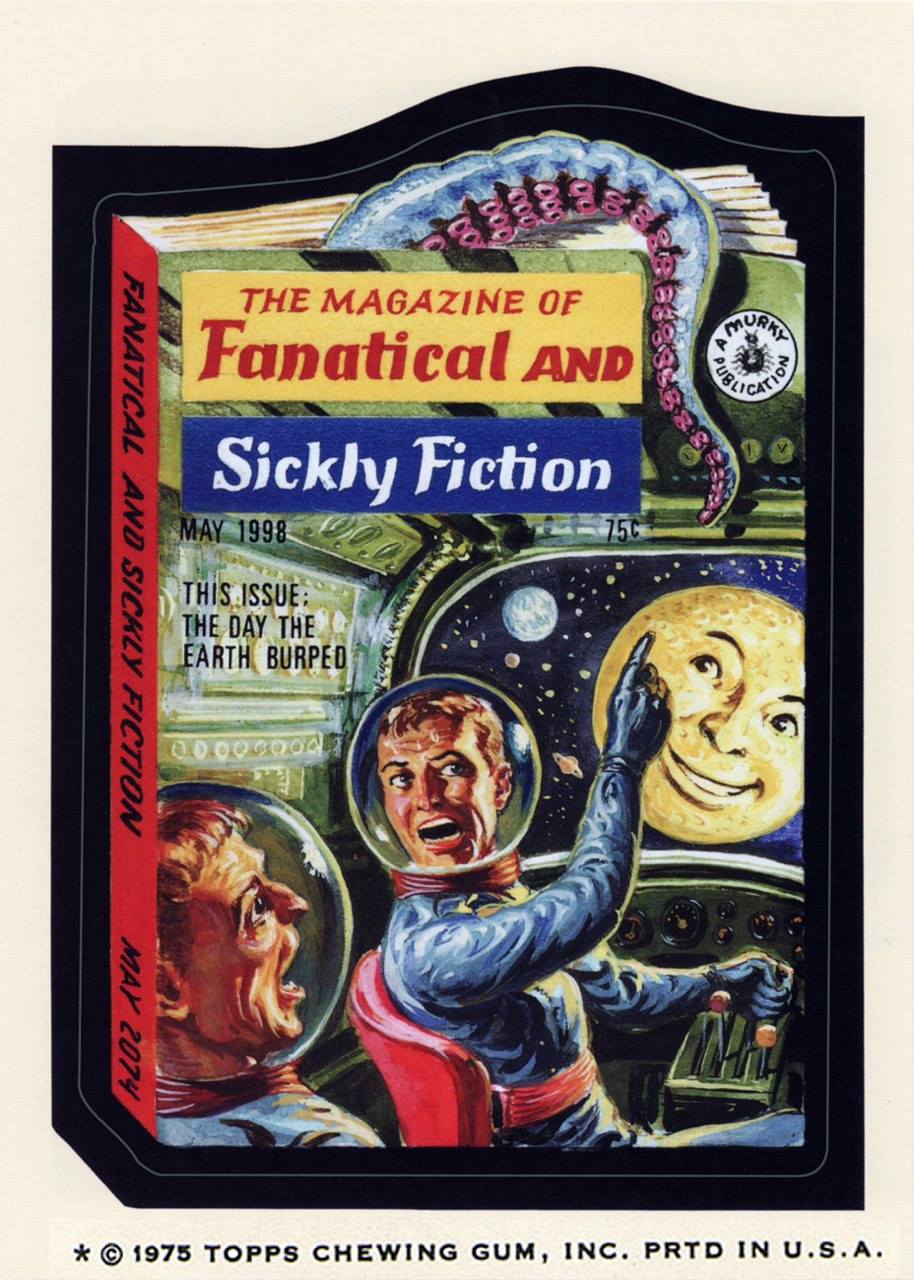
If a tentacle creeps out from the pages of a book you’re reading to gently prod you, you know you’ve made the right choice of reading material.
This Wacky Packages card (from the 14th series, released in April/June 1975) is painted by Norman Saunders from a concept by Jay Lynch (which looks like this). Given that the moon is grinning at them, I think these two are high on something (I’m willing to accept tentacles in space, but I draw the line at anthropomorphized satellites).
Sometimes tentacles masquerade as waves, but we know better! Dunno why some sea god would want a cyborg chunk of metal, though.
Rom no. 1, July 2016 (IDW), a variant cover from something called « Retailer Incentive ». Art by the ever-decorative and undeniably stylish P. Craig Russell, who unfortunately seems to mostly have squandered his talents on operatic and fairy tale adaptations (not counting a few marvelous short stories). Some people’s thing, no doubt, but not mine!
Rom the Spaceknight was a toy created by three men (Scott Dankman, Richard C. Levy and Bryan L. McCoy) in 1979. His creators called him COBOL (a programming language), but he was renamed into ROM (« read only memory ») by the executives of Parker Brothers, the company that bought rights to the this « beeping, thinking toy » (which Time predicted would « end up among the dust balls under the playroom sofa »). As part of a promotional effort, Parker Brothers promptly licensed him to Marvel. Rom the toy was a commercial failure, but Rom the comic book went on to last 75 issues, beeping its last bleep in 1986 (not counting the comic’s revival by IDW in 2016).
The comic may have passed from Marvel’s hands into IDW’s, but the description still seems to have been written by a hyper-ventilating lummox flinging spit everywhere as he croaks: “WE’VE BEEN INVADED AND ONLY A SPACE KNIGHT CAN SAVE US! Now the ongoing tale of ROM begins in earnest! Christos Gage, Chris Ryall, and David Messina kick off the wildest new series of the year as Rom’s war with the DIRE WRAITHS hits close to home in ‘Earthfall, part 1!’ ‘The long-beloved and even longer absent space hero returns at long last! First, we brought back MICRONAUTS! And Now… ROM! As if Rom’s return wasn’t enough, wait’ll you see how this one ends!” Brr.
So far, the tentacles featured have been rather on the tame side. Let’s have something properly terrifying…
Lance Lewis (Space Detective) and his girlfriend Marna may be in a tight spot… but I’m sorry, I’m having trouble imagining the terror of being overcome by these teeny-tiny octopuses. They’re just too dang cute, clinging to Marna’s legs like puppies begging for food. Startling Comics no. 53, 1948, the last issue of this series. Cover by Alex Schomburg (1905-1998), a prolific Puerto Rican artist (this is signed as Xela).
Oh well, terror petered out today. I guess this Tentacle Tuesday is not going to scare anybody witless. There’s always next time!














 Who's Out There?