It was high time to finish what I started! Here is part two of Tentacle Tuesday: Planet of Tentacles, courtesy of Fiction House. I doubt I will exhaust Planet Comics’ source of tentacles when it comes to inside stories, but at least we’ll be able to say that we’ve completed our tour of its tentacle-bearing covers.
Planet Comics no. 2 (February 1940). Cover by, believe it or not, Will Eisner, a mere 23 at the time. If it’s meant to be scary, it is! Though perhaps the garish colours have something to do with it.
Planet Comics no. 15 (November 1941). Cover by Dan Zolnerowich, under his nom de plumeZolne Rowich.
Planet Comics no. 52 (January 1948). Cover by Joe Doolin.
Honestly, I wasn’t quite sure whether these were tentacles or what, but one look at the cover story dispelled my doubts. Does anybody care that the monsters inside look nothing like the ones on the cover? Naaah.
Mystery of the Time Chamber! was scripted by Ross Gallun and illustrated by Maurice Whitman.
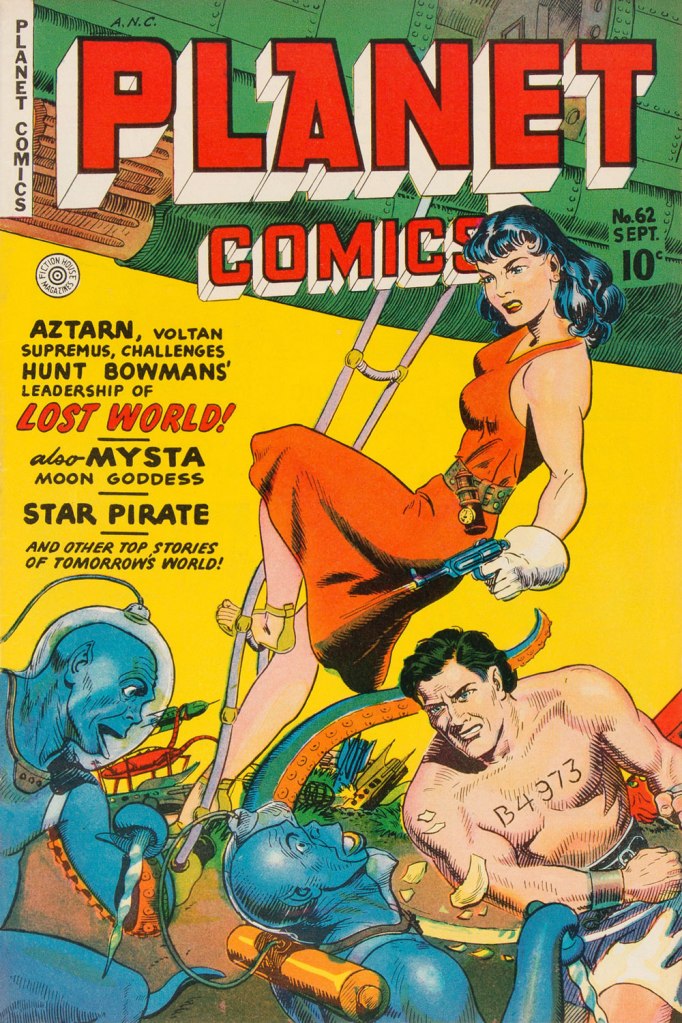
Planet Comics no. 62 (September 1949). Cover pencilled by Joe Doolin and inked by John Celardo.
And, last but not least, look at these baby cephalopods! So cute.
The Golden Age of comics proffered quite a lot of anthropomorphic animals to its readers. The stuff on offer ran the gamut of different definitions of humour, from inane slapstick to pleasant goofiness, all the way to batshit surrealism. There’s at least one common streak running through this zoological revelry – tentacles!
Our first exhibit is a charming comic from the 40s. Land of the Lost was a radio series broadcast from 1943 to 1948 on Mutual Broadcasting System and ABC, written, produced and narrated by Isabel Manning Hewson. Each episode started with the line « In that wonderful kingdom at the bottom of the sea… », and presented a new under-the-sea adventure of Isabel and Billy, two kids lucky enough to have an adorable avuncular fish for an underwater guide. (The fish was called Red Lantern, and was most notably voiced by Art Carney.) You can listen to an episode from 1945 here.
Coming back to our beloved cartoons: in 1946, EC Comics started publishing Land of the Lost Comics, a series that lasted for 9 issues. Hewson remained the writer, and the art was handled by Olive Bailey (not the Olive Bailey who helped crack Germans’ Enigma cipher machine in WWII.) The result was impressive: these comics are delectable, combining beautiful art with inventive plots that may be goofy, but have a solid internal logic. Hewson gave her sea-creatures vibrant personalities, and it’s so much fun to dive (not pun intended) into this world.
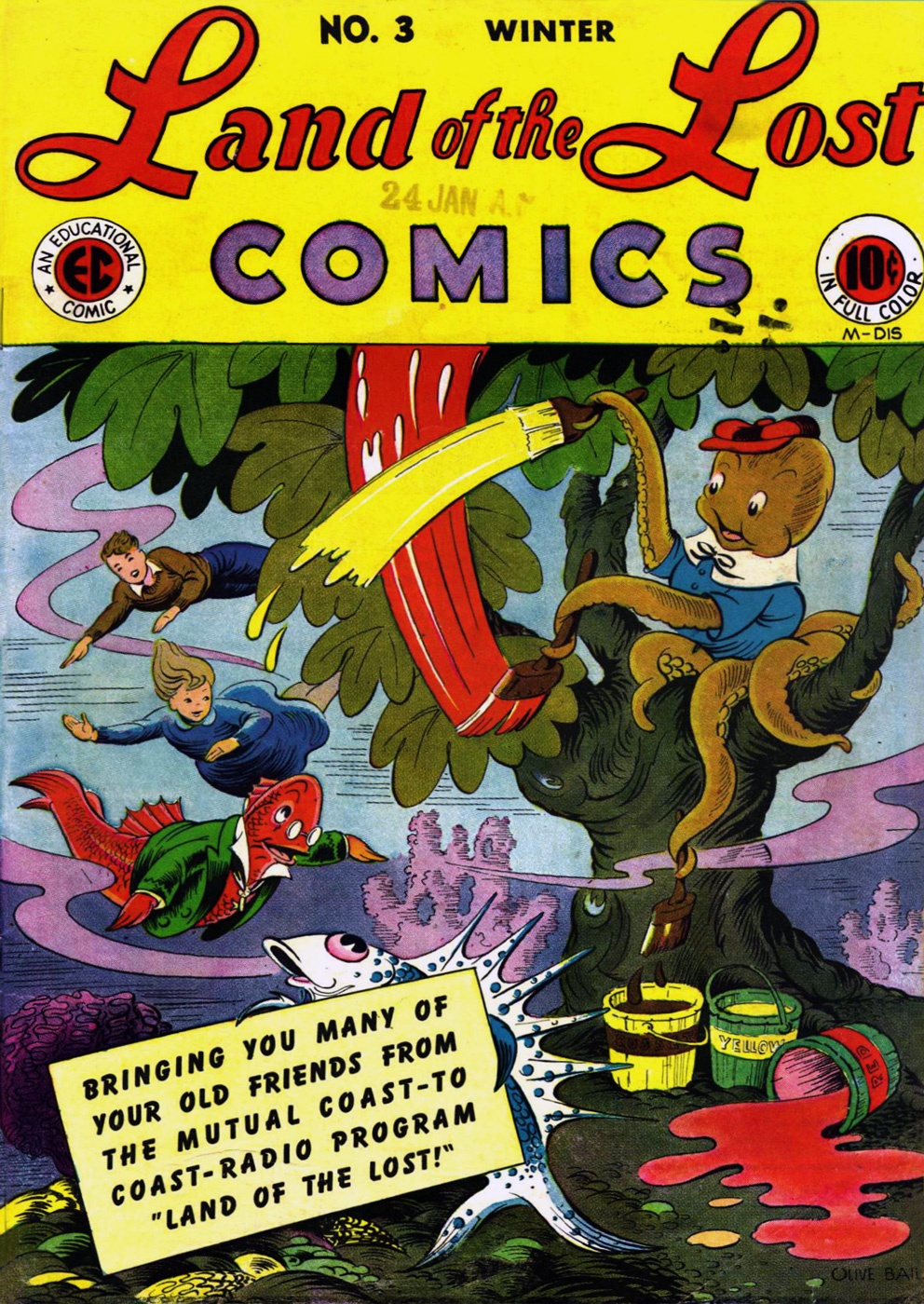
Land of the Lost Comics no. 3 (winter 1946), cover by Olive Bailey. Read the whole issue here… and then read other issues, too. Somebody needs to publish a collection of this stuff.
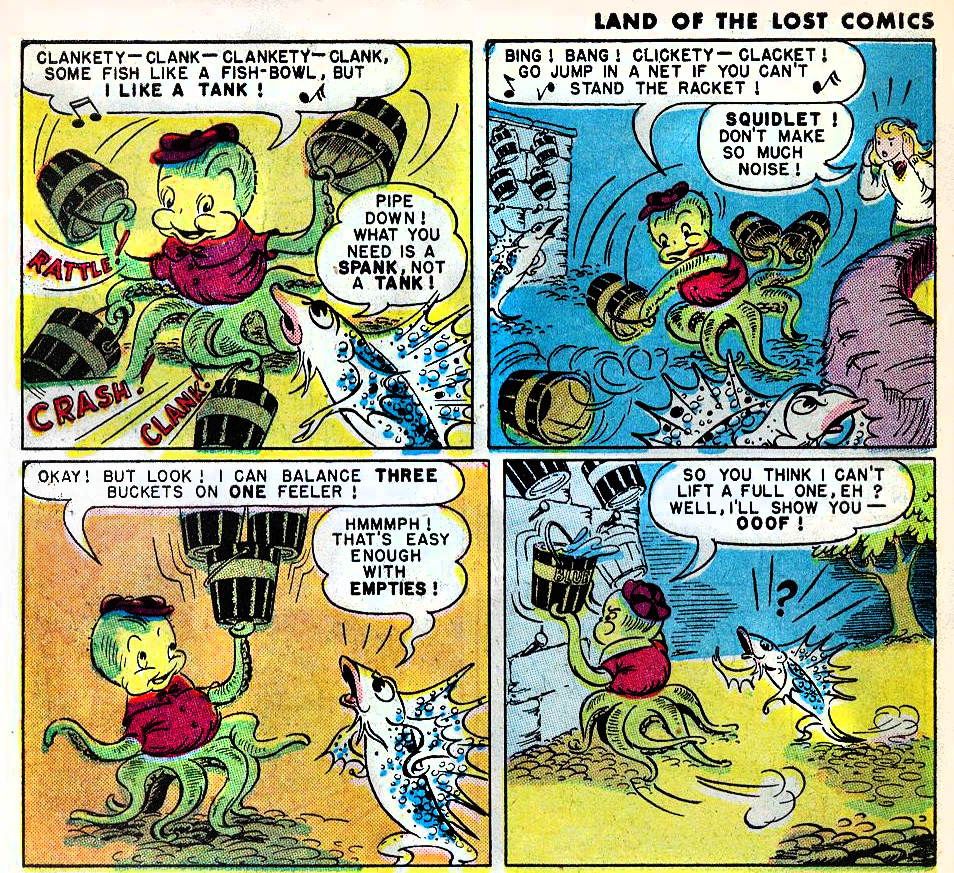
The following panels are from “Jack Frost“, scripted by Isabel Manning Hewson and drawn by Olive Bailey, published in Land of the Lost Comics no. 3.
Squidlet goes out of control, like all young octopuses are prone to doing.
Thank you, cool ladies, for all the fun!
Land of the Lost also became an animated cartoon as part of Famous Production Studios‘ Noveltoon series: Land of the Lost (1948), Land of the Lost Jewels (1950) and Land of Lost Watches (1951). I find the animation to be definitely subpar to the comics or the radio show, but I’ll let you judge for yourselves. (Jack Mercer is in it, albeit briefly!)
Did you know octopuses love to box? This implausible situation is definitely part of the lazy artist’s roster. To wit:
Ha Ha Comics no. 66 (June-July 1949), cover by Dan Gordon. It was really hard to find a scan of this issue in decent condition (thanks to co-admin RG), and comicbookplus doesn’t even have it in its database (you can read pretty much all the other issues of Ha Ha Comics, though).
Ha Ha Comics, a sister anthology of Giggle Comics, was published by ACG. (With issue #100, Ha Ha became Teepee Tim, going from animal hijinks to young Indian shenanigans for all of… three issues.) It’s quite a the playground of anything goes, but upon careful inspection, one easily finds good art shining among the dirt-pile of mediocrity, and diverting storytelling among hackneyed yarns.
Coo Coo Comics no. 48 (November 1949), cover by Carl Wessler. Published by Standard Comics under the imprint of Pines (from Ned L. Pines, publisher). Read the issue here (no tentacles whatsoever, though).
How many arms does the fellow up above have, nine? I suppose that’s why he’s the champ!
Comic Cavalcade went all funny-animals only with issue 30 (Dec-Jan 1948), when superheroes faded from popularity (oh man, that’s hard to imagine now, isn’t it?) It lasted until 1954, by which time it shrank from its original 96 pages to 76, however retaining its 15-cent cover price.
Comic Cavalcade no. 59 (Oct-Nov 1953), art probably by Rube Grossman. Read it here.
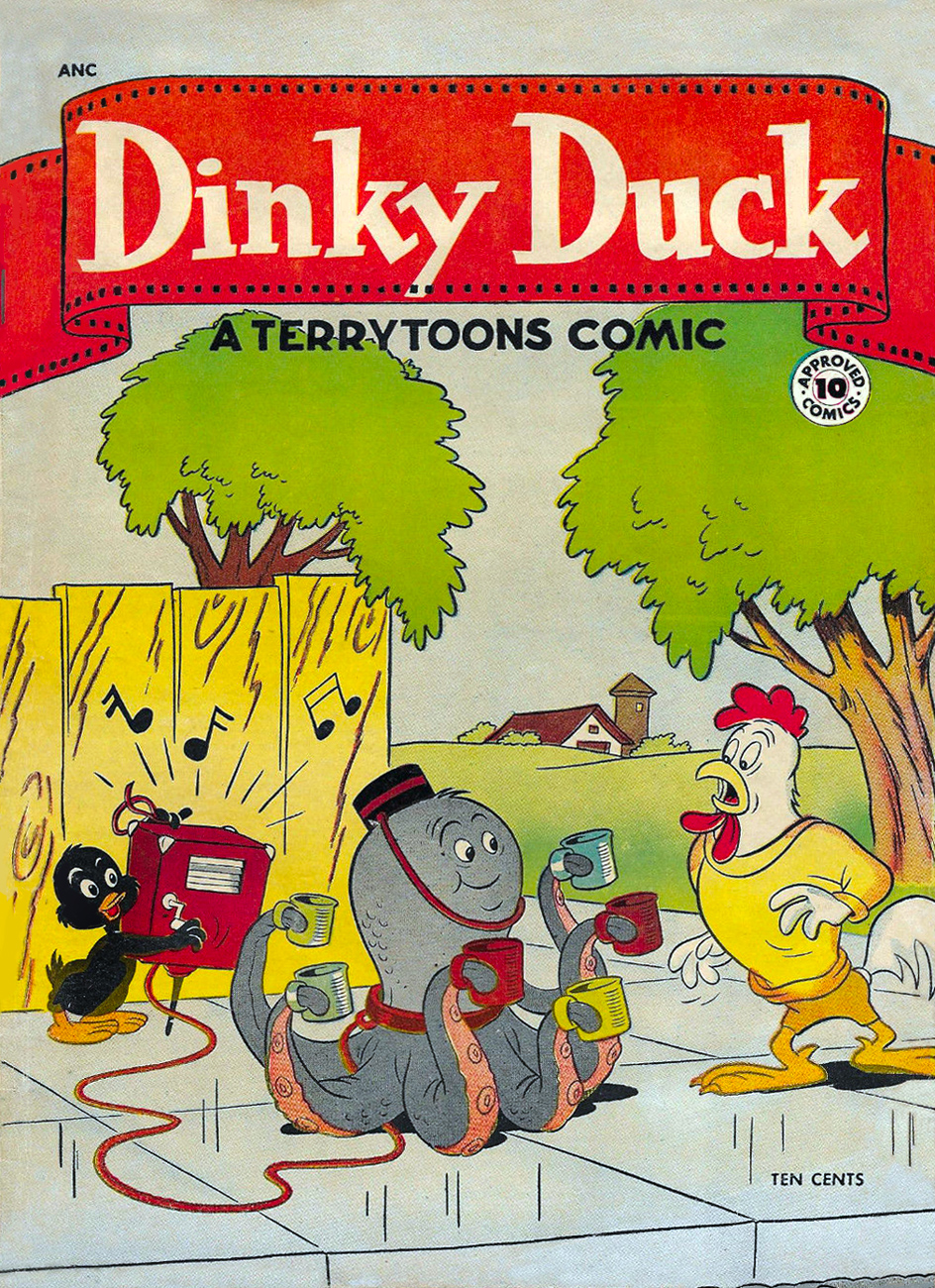
Dinky Duck no. 10 (July 1954). WTF is a Dinky Duck? Terrytoons’ answer to Daffy Duck, says Toonopedia; or, tout simplement, a smaller-than-average duck. The poor duckling never caught on, but the cartoons did result in a comic series, published by Pines and then St. John.
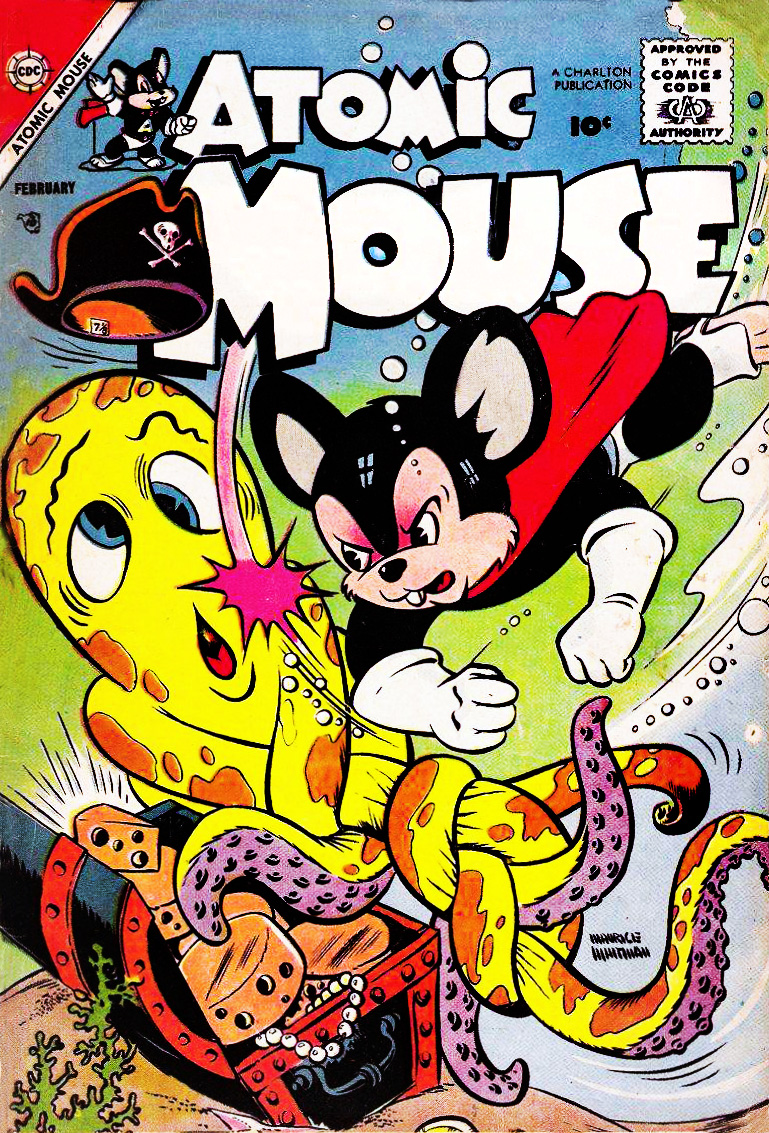
Atomic Mouse no. 25 (February 1958), cover by Maurice Whitman. Atomic Mouse was created in 1953 for Charlton Comics by Al Fago, their first animal superhero. The series was published for ten years (!), between 1953 and 1963, so it must have had at least a modicum of popularity.
At its best, Maurice Whitman’s art has the power to capture one’s imagination. He has an excellent eye for dynamic layouts, and his ghoulies and creepies are often drawn in a kind of a squiggly, sketchy way that really brings them alive for me. Not to be forgotten are his shapely women, usually in various states of déshabillé. Sometimes his covers are too chaotic, and don’t really hold together, leading the viewer to scratch his (or her!) head in confusion; but when it works, when all the pieces fall into place, his art can be glorious.
Ghost Comics had but 11 issues published between 1951 – 1954, so I could have included all of them in this post… but you can see a gallery of these covers on other websites, and besides, some of them are firmly in the “doesn’t quite work” category. Here are my favourites, then – five out of eleven, not bad!
Ghost Comics no. 1, 1951. I like the details, such as the lost shoe, the cute little ghost in the bottom right corner, a mysterious dark figure by a lamppost (as if the green demon wasn’t terrifying enough)… and the warping of the scene really works, imho.
The following cover is kind of the raison d’être of this whole post – I adore it. Whitman put so many reach-out-and-touch-it details into it – talk about the juxtaposition between terror and sex-appeal! The woman’s négligé is probably the sheerest it has been my pleasure to encounter in pre-code comics. Her hair is also beautifully drawn, especially that little curl that seems to be reaching for the candle.
Clearly, I’m not the only one to pay special attention to this cover – it was chosen as the cover of Ghosts and Girls of Fiction House!, another addition to Craig Yoe’s Chilling Archives of Horror Comics.
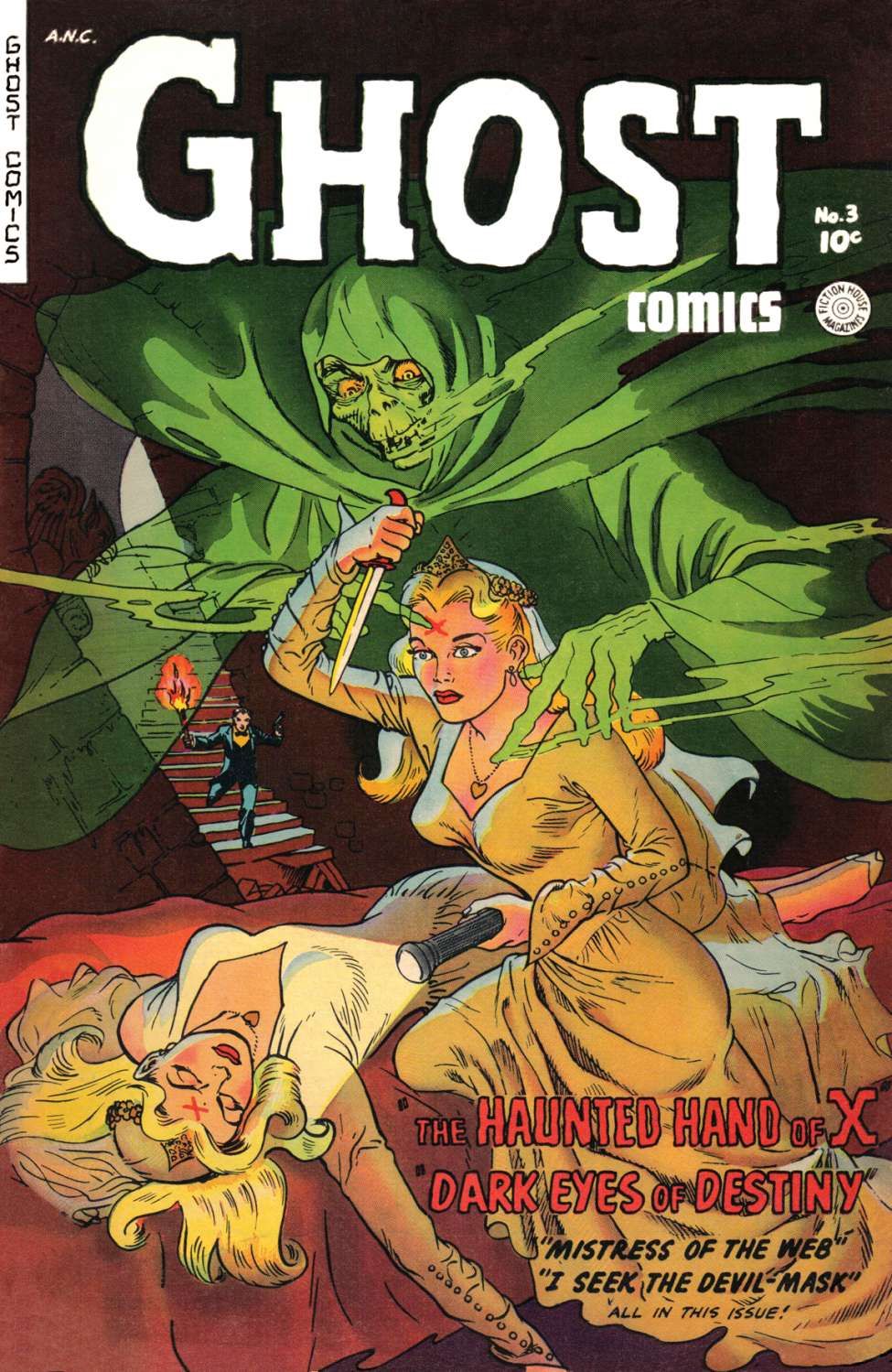
Ghost Comics no. 3, 1952. This one has crisper, cleaner lines, but the potent composition calls out to the viewer (and after a few minutes spent in contemplation of the art, you can start wondering what the hell is going on here, and how on earth does it make any sense?)
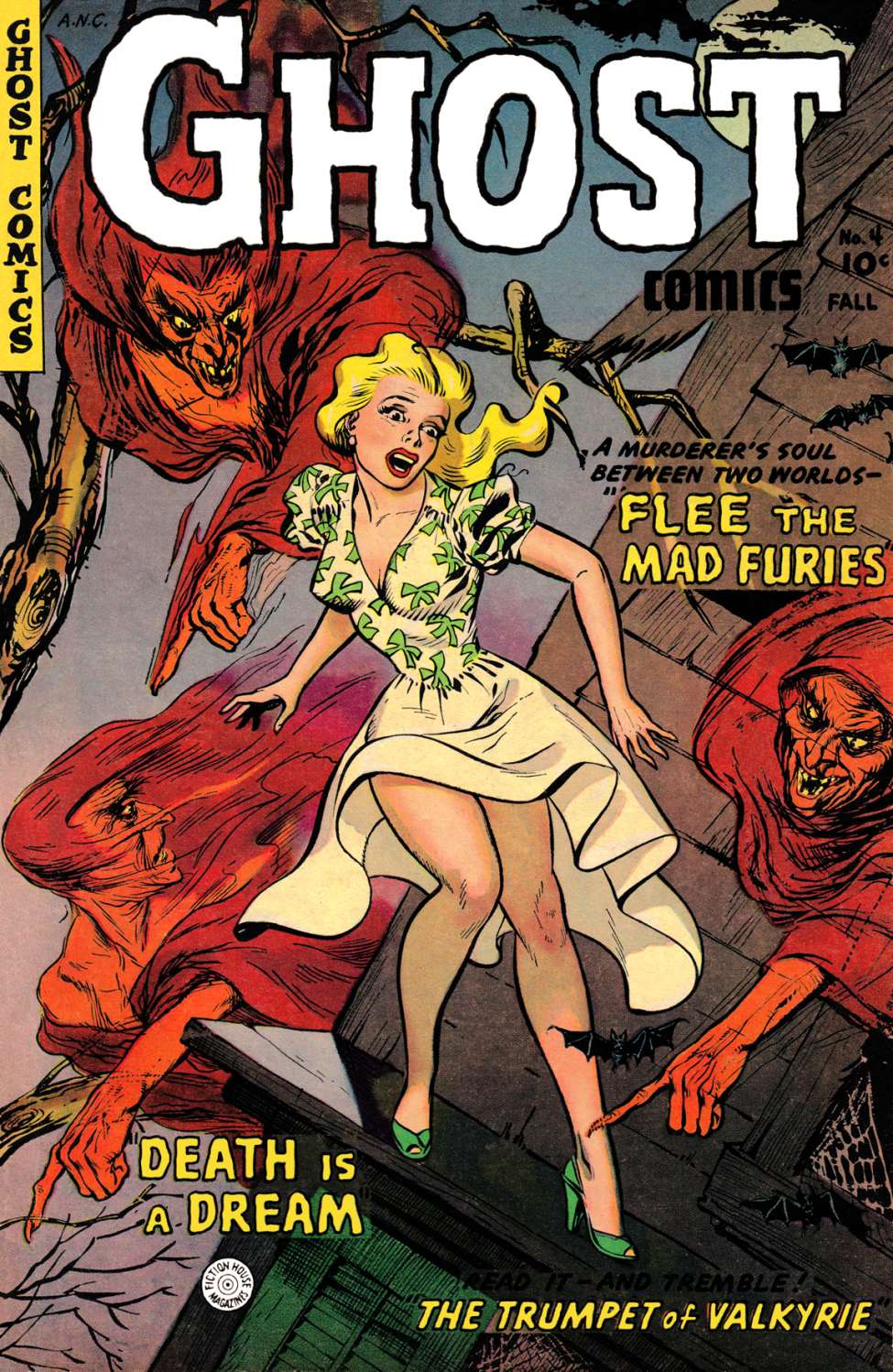
Ghost Comics no. 4, Fall 1952. Whitman was clearly fond of a certain type of blonde… not that anyone’s objecting. The two teeny bats on the right have captured my heart.
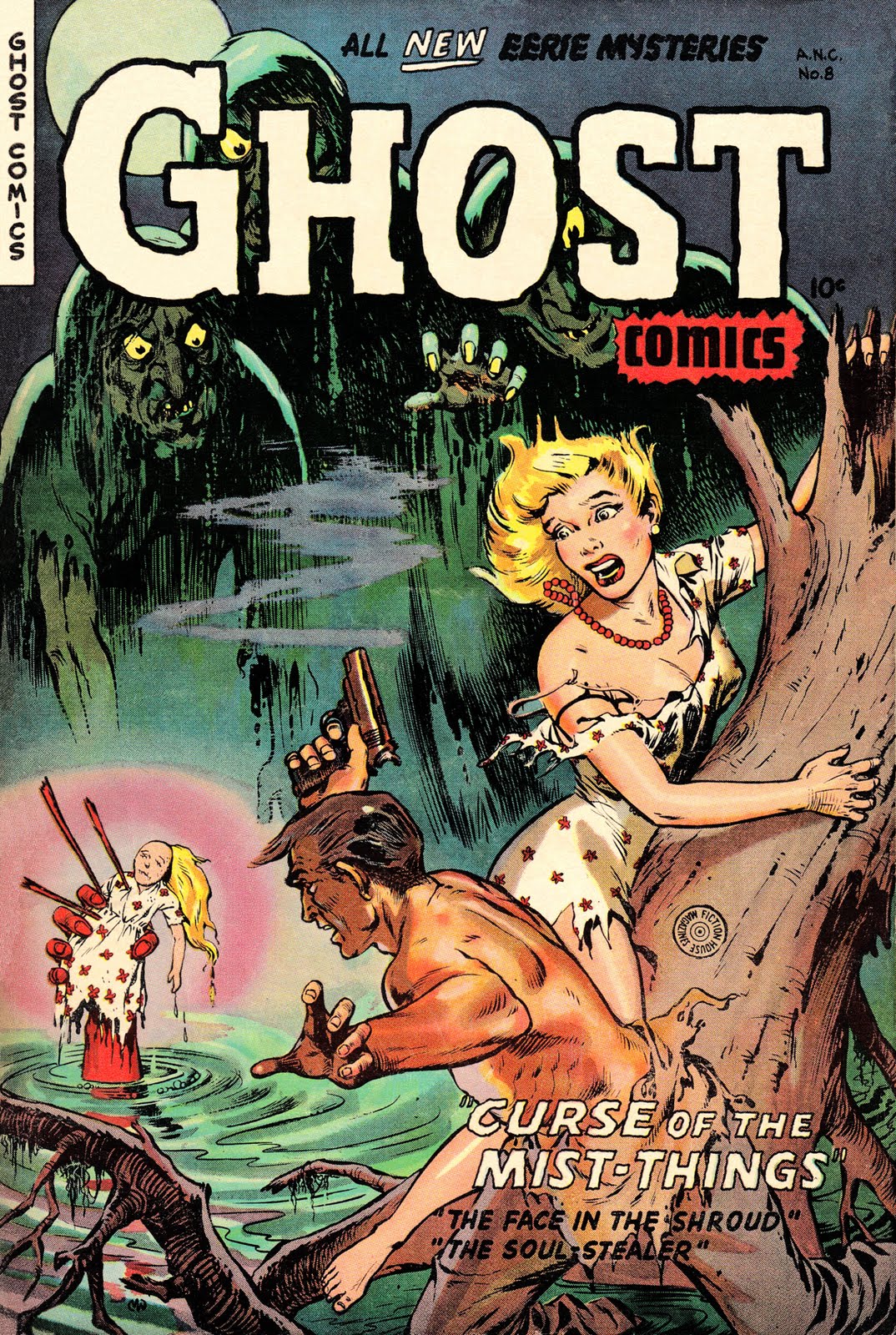
Ghost Comics no. 8, 1953. Come on, witch, you could have made a better effort with the doll’s hair! Are these the furies from no. 4?
All issues, should you want to read them, can be found at comicbookplus.
In today’s Tentacle Tuesday, I’d like to demonstrate that Planet Comics, a sci-fi comic series published by Fiction House from 1940 to 1953, liked to tantalize its rapt audience by featuring tentacled monsters as often as basic decency permitted. Not to say that they limited their cheap pandering to tentacles; other tropes reared their ugly head, too. Faithful to its pulp magazine roots (Planet Comics was a Planet Stories’ spinoff), there’s always some stunning damsel in distress on the cover, and often some dashing muscle-head to rescue her. Mike Benton summarized Planet Comics’ raison d’être beautifully, if somewhat cruelly, in his Science Fiction Comics: The Illustrated History (1992) as «the barest smattering of sense and substance».
In its defence, P.C. also often ran stories in which female protagonists saved their friends’ bacon. How oddly progressive: the gals were clearly dressed to impress, but their skills and smarts repeatedly allowed them to overcome the odds while the big hunks stood helpless. Between that and all the tentacles, there’s a warm spot in my heart for Planet Comics.
Let’s start with no. 42, which features Gale Allen, a Venusian princess with a knack for getting into trouble and the courage for getting herself out of it. Her Girl Squadron, comprising female pilots and soldiers, may have been an excuse for drawing yet more pretty girls, yet in the stories the squadron was still a force to be reckoned with, by friend or foe.
Planet Comics no. 42, May 1946. Cover by Joe Doolin, adept at depicting the female form in an aesthetically pleasing way. Here Gale is being rescued by some dark-haired stud with a laser gun (who cares about him?), but let’s peek inside…
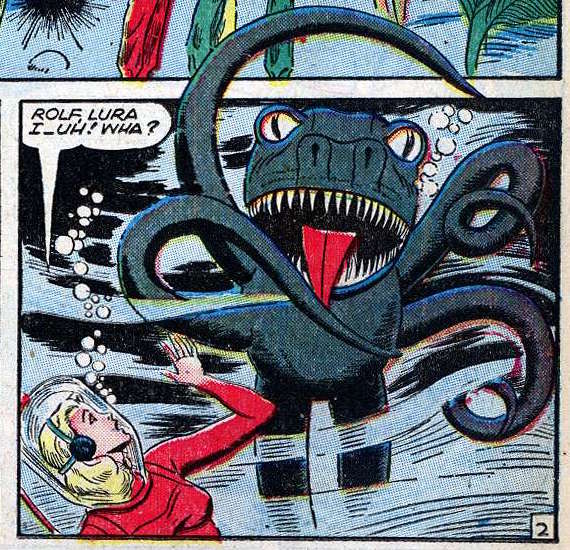
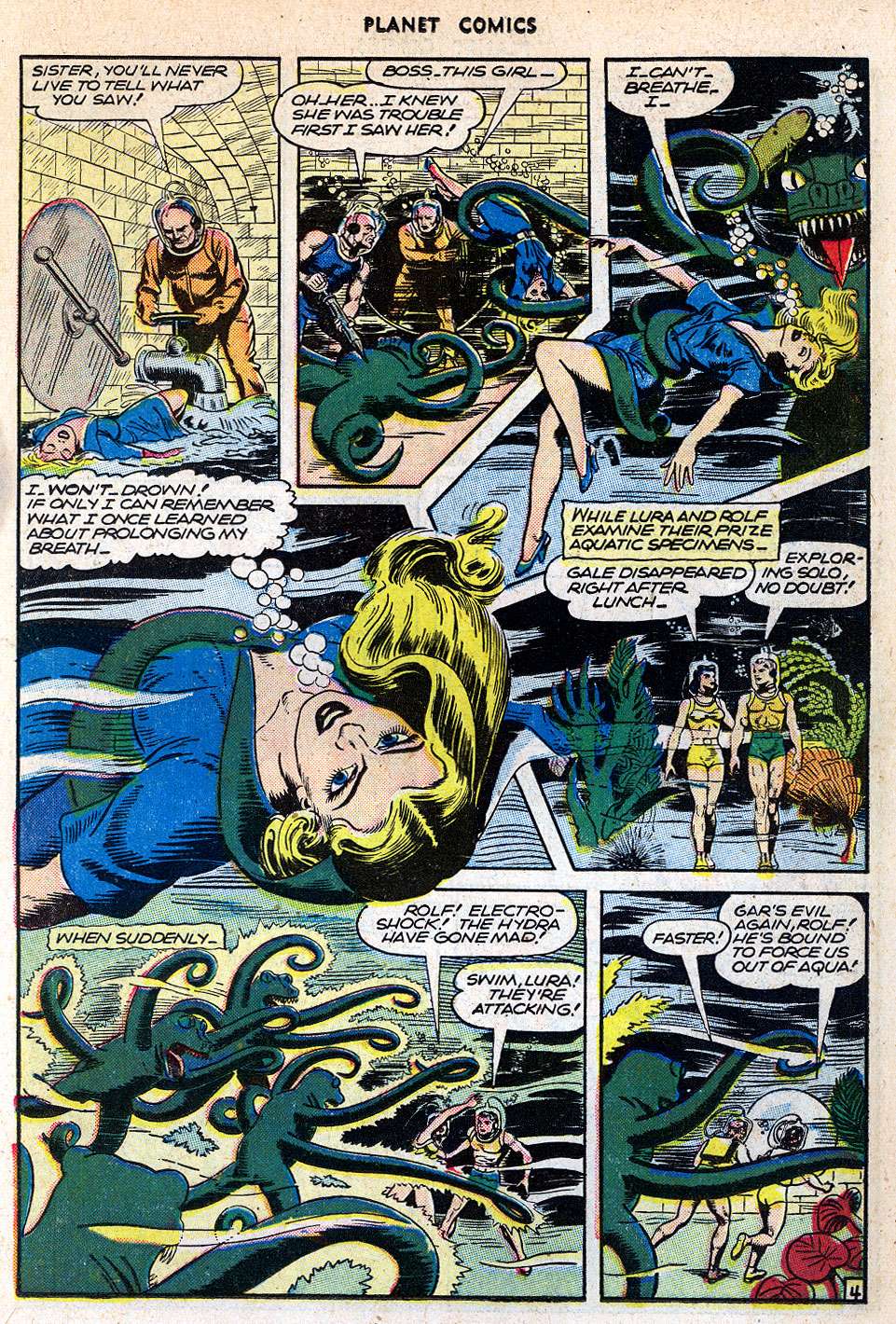
This is what Gale has to deal with in « Slave of the Hydra », also drawn by Doolin. This toothy beast is supposed to be a Hydra. Hydra of the Hydridae family, or the Greek many-headed serpent? Neither supposition makes sense.
Our plucky heroine manages to save the day by escaping a certain drowning! It’s a little known fact that girls can actually store extra oxygen in their boobs. Kidding aside, I can understand why Planet Comics had a female readership that must have enjoyed reading about women who don’t crumble under pressure, and sometimes even kick monster tush.
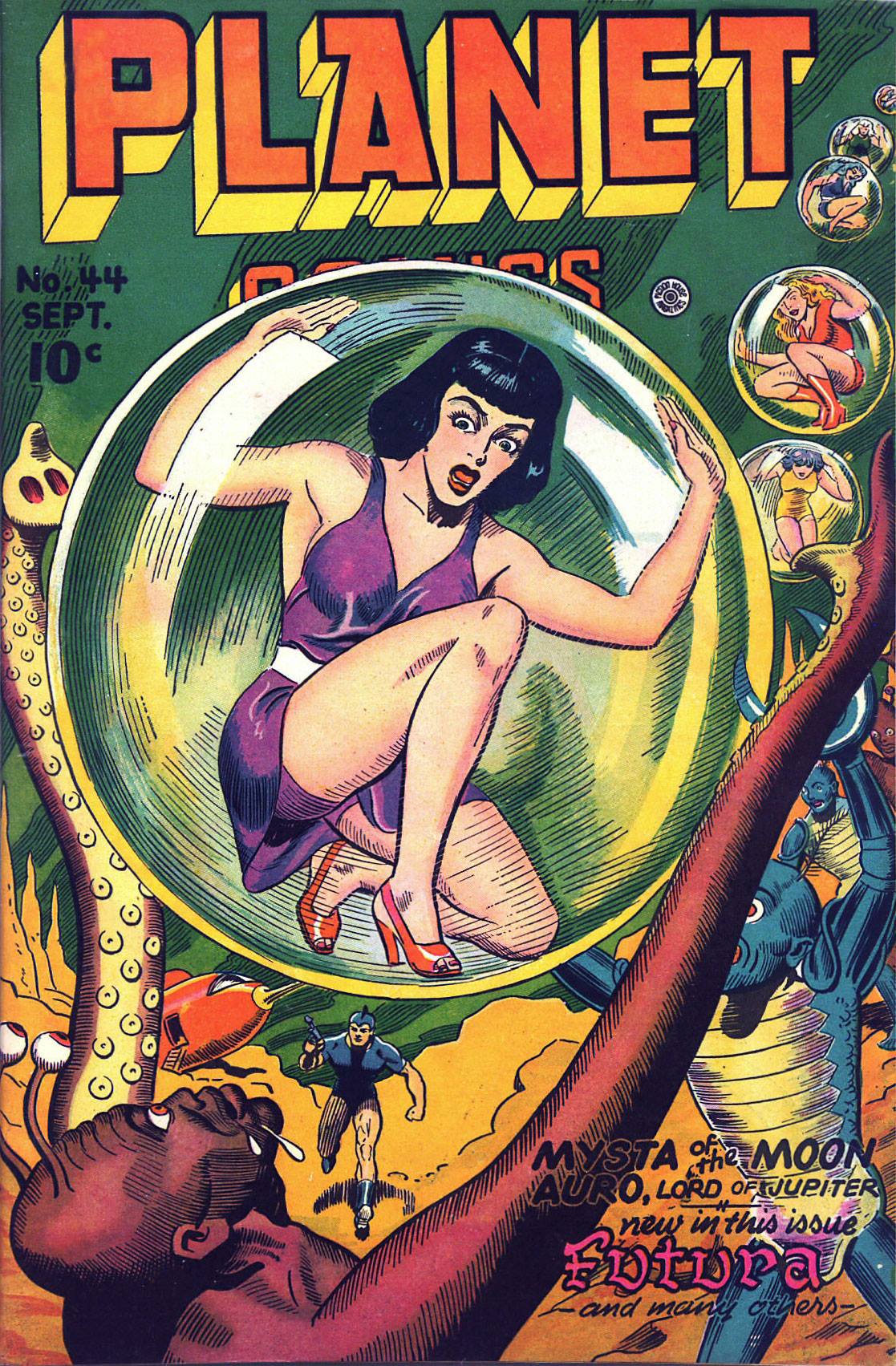
Moving on to the next cover, an odd one even by Golden Age sci-fi standards:
Planet Comics no. 44 (September 1946), cover by Joe Doolin. She’s a generic damsel-in-distress, I get that, but the alien is strange – even for an alien. I imagine that the artist’s internal conversation went something like this: “okay, I’ll give him arms that double as tentacled snouts, and snail eyeball stalks. Oh, and I’ll make him a cyclops while I’m at it. And he’ll be drooling. And I’ll make him look black because that’s more exotic.” Yikes.
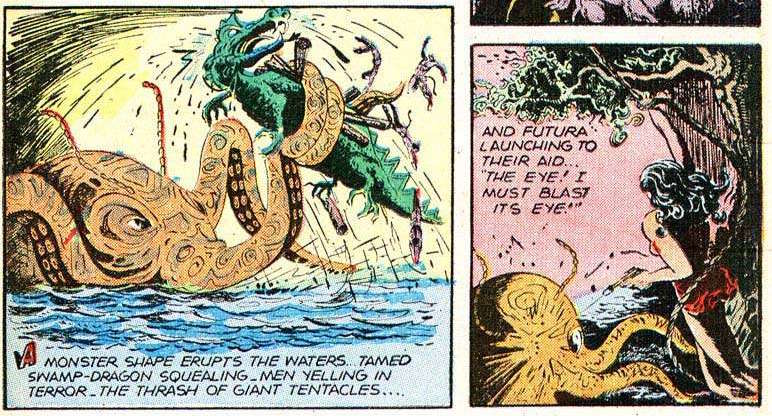
A glimpse at the stories inside quickly proves that the cover has nothing to do with Mysta of the Moon, or any of the “many others” advertised on the cover. There is, however, an octopus in the Futura story. Futura was another recurring heroine, an ordinary girl abducted by Brain-Lords of Cymradia and “improved” into a stronger, smarter version of her old self. Smart, resourceful and a damn good fighter, Futura is fun to watch in action. Especially when tentacles are involved! Take a look:
Officially signed by John Douglas; pencils and inks by Chester Martin. I feel oddly sorry for the crocodile.
Let’s have a look at several covers where tentacles are actually used as the good lord has intended, i.e. for grabbing pretty girls:
Ah, yes, the old “reptiles with tentacles” scare. Planet Comics no. 51, November 1947. Cover by Joe Doolin (again). Man, his girls are pretty delectable.
Planet Comics no. 67, summer 1952. Cover by Maurice Whitman. There are absolutely no tentacles in any of the stories. Boo, I say.
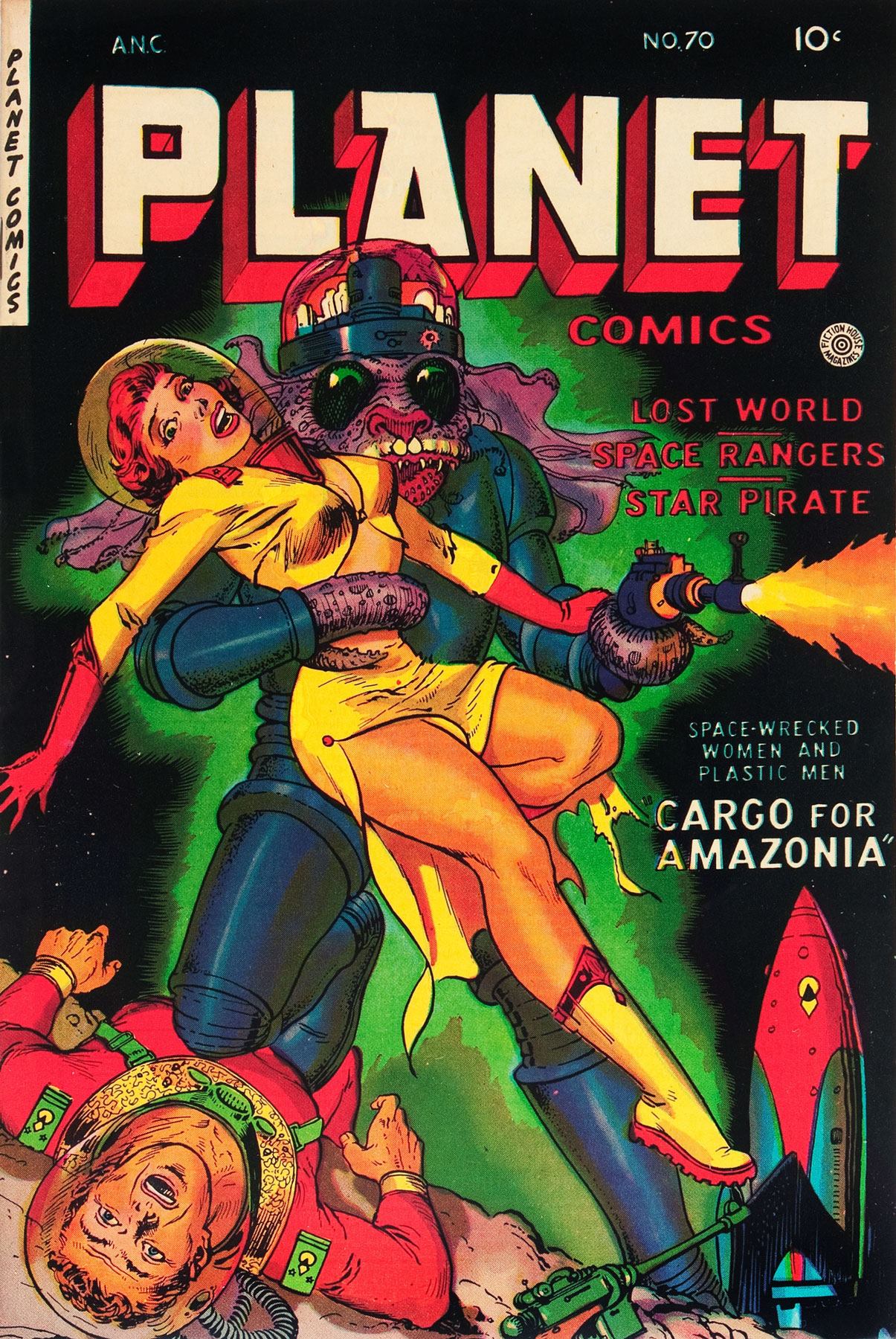
Planet Comics no. 70 (spring 1953), cover by Maurice Whitman. I like the alien’s get-up in general: his flappy ears, the motorcycle helmet, the hip lip piercings… He’s one cool cat. I am equally impressed by how he’s managing to fire a gun when he doesn’t have opposable thumbs (maybe the pistol is specially tentacle-adapted; instead of a trigger, some sort of squeeze sensor). Disappointingly, the insides of this issue don’t have any tentacles whatsoever, although there are some dinosaurs and giant man-eating spiders (and most of us will be happy to settle for that).
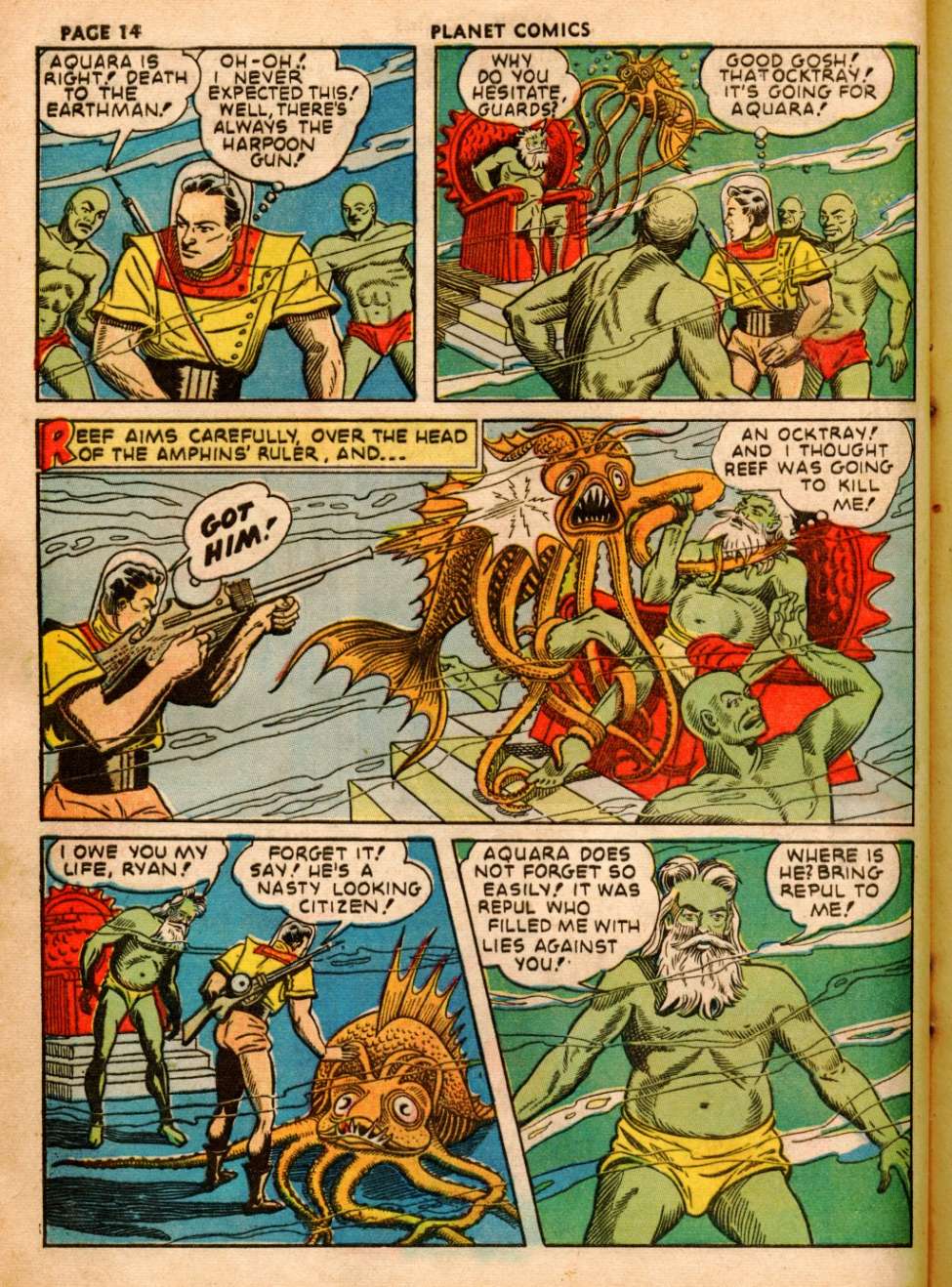
Oh, perhaps I have been neglecting burly heroes a tad. Those of us who prefer muscle to curve deserve some eye candy, too! So here’s good old Reef – and some green men in Speedos.
Planet Comics no. 17, March 1942. A Reef Ryan story, possibly pencilled by George Appel and inked by Al Gabriele, though it’s credited to Hugh Fitzhugh, a funky nom-de-plume for parties unknown.
And men get grabbed by tentacles, too:
Planet Comics no. 32, September 1944. Art by Lee Elias.
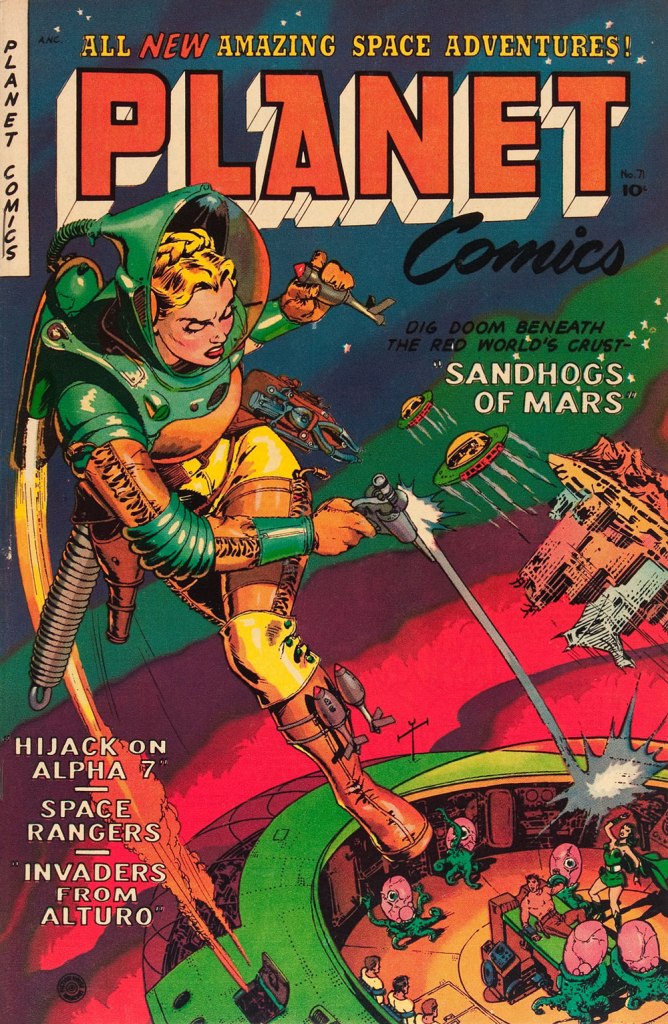
There’s about 10 more Planet Comics covers with tentacles left, and quite a few more interior pages showcasing the beauty of the octopus, or tentacled alien, or cephalopod reptile, or whatever else the kooky minds writing and drawing for Fiction House have dreamed up… but that’s enough for now. There’s only so much probing appendage the human mind can take in one go, so I’ll say Auf Wiedersehen.
Until the next time our paths (and tentacles) cross again!












 Who's Out There?