Marooned in Time With Paul Gillon

« We all have our time machines. Some take us back, they’re called memories. Some take us forward, they’re called dreams. » — Jeremy Irons

Today, we note the birth anniversary of the powerful French bédéiste Paul Gillon (May 11, 1926- May 21, 2011). Working in a classical, realistic style, he began his career in comics with the weekly Vaillant. For daily newspaper France-Soir, he co-created the daily soap opera strip 13, rue de l’Espoir (1959-1962, scripted by Jacques Gall and François Gall), strongly inspired by Elliot Caplin and Stan Drake’s The Heart of Juliet Jones, but set in Paris.

Then, in 1964, for the short-lived bédé newspaper Chouchou (an eight-pager published for a mere 14 issues, a tragedy!), Gillon co-created, with scripter J.C. Valherbe (alias Jean-Claude Forest, of Barbarella fame), one of the great classics of French science-fiction comics, Les naufragés du temps (“Castaways of Time”). Several wonderful features (for instance, Georges Pichard‘s Ténébrax) were left stranded by Chouchou’s demise, including (literally) Les naufragés.

Fortunately, its authors deemed its premise too worthy to let the matter drop forever. Nearly a decade on, Gillon tweaked the saga’s opening pages and resumed the narrative, which France-Soir published. Forest scripted the first four collections (1974-76), then Gillon took full command of the strip, which found a warm new home in Métal hurlant from 1977 right to the end of the series with Le cryptomère (The Cryptomeria), collected in 1989.

GillonNaufragés01AGillonNaufragés02AGillonNaufragés03A

Les naufragés’ premise is this: In 1990, a man (Chris) and a woman (Valérie) are placed into suspended animation. A thousand years hence, the man is picked up and woken. Where’s the woman?, he wants to know. A futuristic bout of cherchez la femme ensues, to make a long story short.

Forest, wrote, in 1967, of his original plans for the saga: « Chris was searching for an image. After many adventures, he manages to find Valérie only to realize that this image no longer fitted that of his dream. »

The sequence presented here comprise the second, third and fourth pages of the first tale, as they appeared in Chouchou in 1964. Say, that cool metal creature reminds me of one of the most ridiculous Marvel super-baddies of the 1960s, disgruntled government employee Alexander Gentry, aka… (see below for the answer).

GillonNaufragésÉtoileA
The first album in the series, L’étoile endormie (The Sleeping Star) – 1974
GillonNaufragésCannibaleA
The fourth album in the series, L’univers cannibale (The Cannibal Universe) – 1976
GillonNaufragésChimèreA
The fifth album in the series, Tendre chimère (Sweet Illusion) – 1977

A peek at a page of original art from album 3, Labyrinthes (1976):

NaufragésOriginalA

More about the series: http://www.coolfrenchcomics.com/naufragesdutemps.htm

… and you can read the entire series here (if you can read French) or, if not, just admire the artwork.

– RG

… and here’s your answer:

TTA48PorcupineA
Stan Lee and Don Heck‘s The ‘Dreaded’ (ha!) Porcupine, or what happens when neither Steve Ditko nor Jack Kirby are on hand to design your costume (and ghost-write your story). Incidentally, Stan, porcupines don’t project their quills. Here he is depicted by Kirby, from the cover of his inaugural appearance, in Tales to Astonish no. 48 (October, 1963).

Buon compleanno, Gianni De Luca!

« Though this be madness, yet there is method in’t. »

On the ninety-first anniversary of his birth, we take the opportunity to salute fumetti gran maestro Gianni De Luca (b. January 25, 1927; d. June 6, 1991)… and to share some of the striking images he crafted. In comics, the term « innovative » has been applied far too liberally, all too often in ignorance. In the case of of Mr. De Luca, no hyperbole is involved, I assure you.

I first came upon his work in the mid-70s, through my parent-sponsored subscription to the québécois catholic youth magazine Vidéo-Presse (1971-1995), which was kind of didactic, I suppose, but still quite fun. The publisher had licensed much of its comics content from Italy, and it was definitely high-toned stuff, such as adaptations of Jules Verne novels. I recall « L’Île mystérieuse » being among them. Accustomed as I was to the madcap and hyperkinetic tone of the dominant Franco-Belgian and American schools, the Verne stuff, while clearly well-executed, seemed a bit languid and wan.

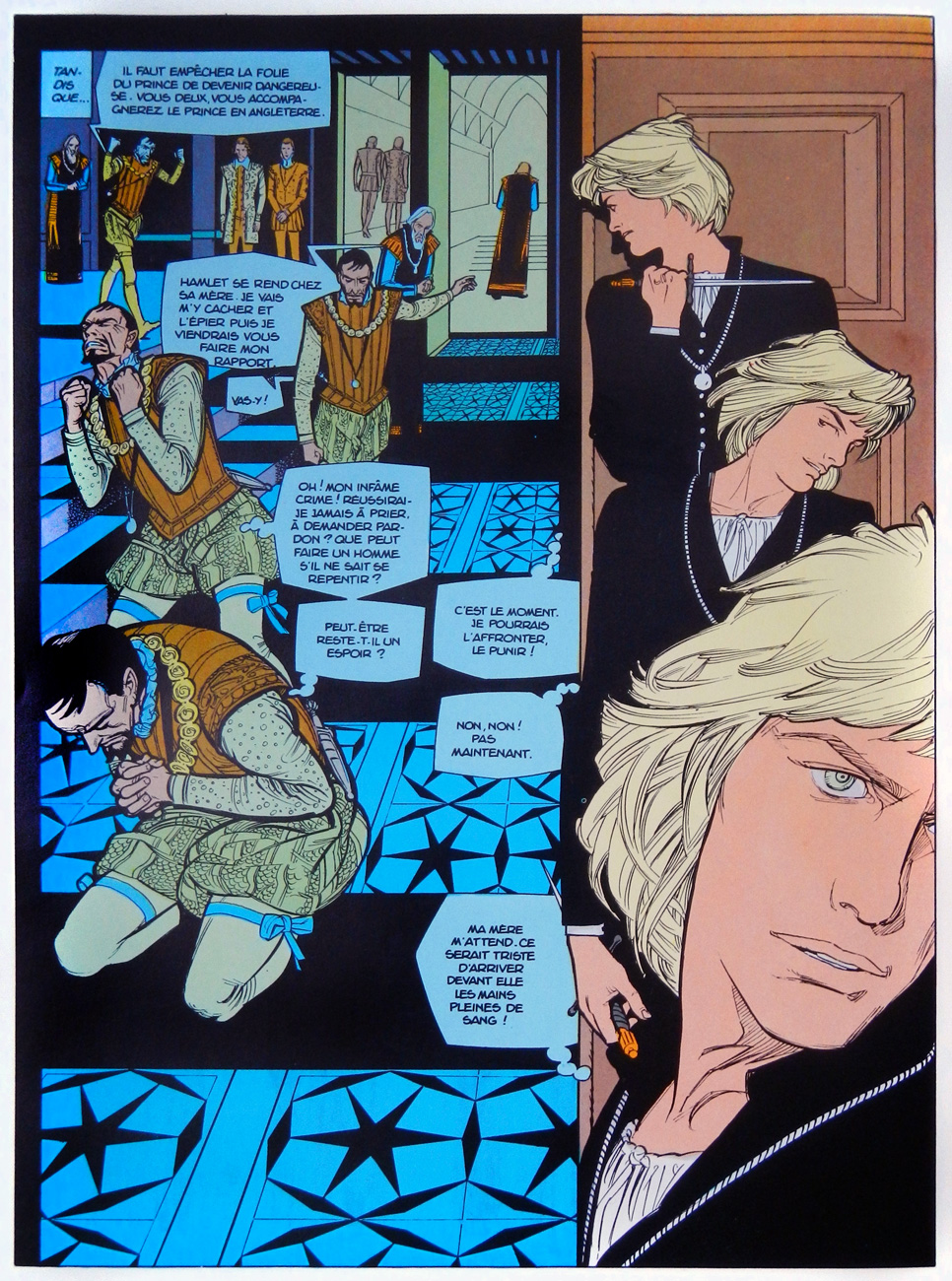
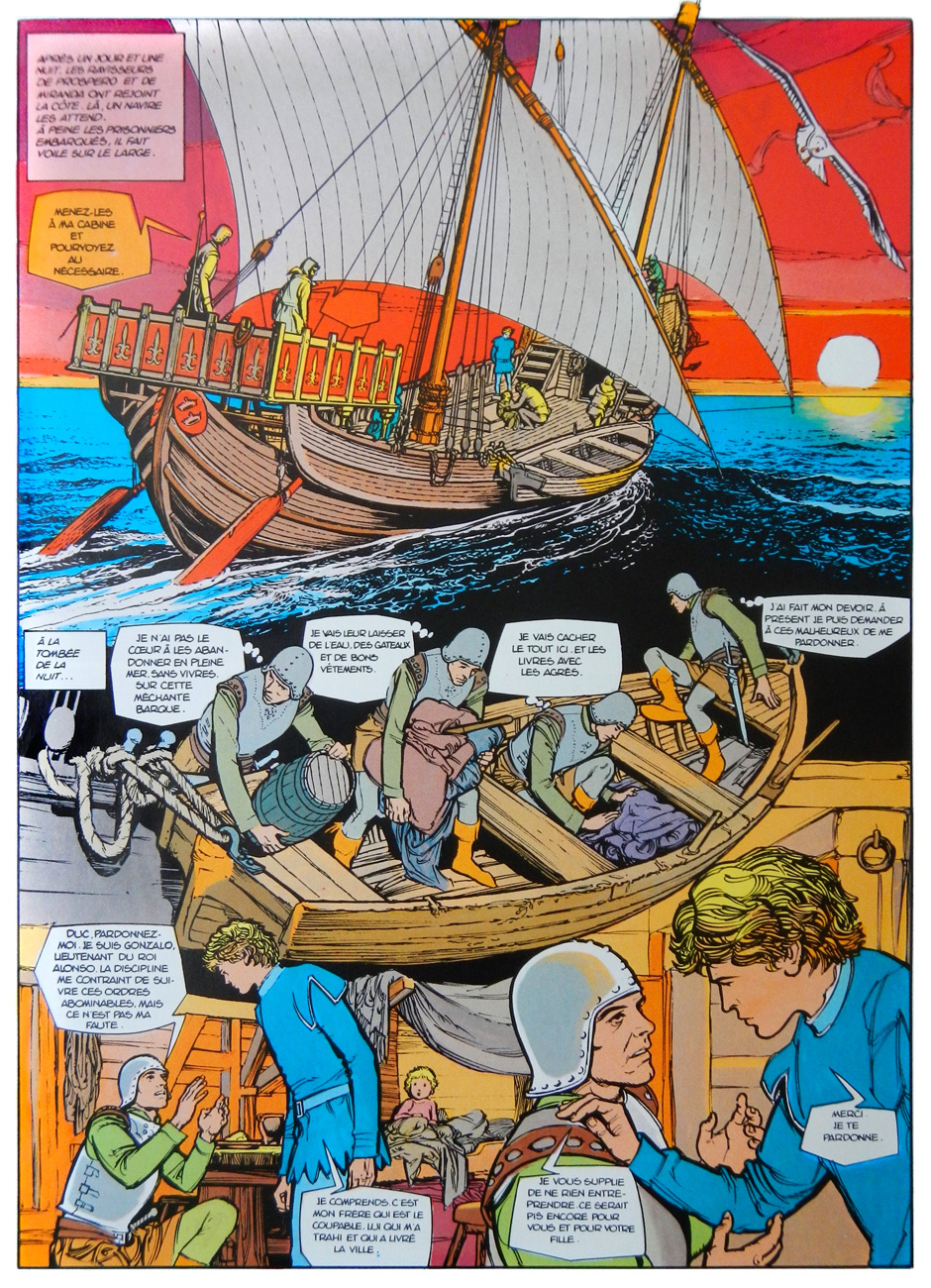
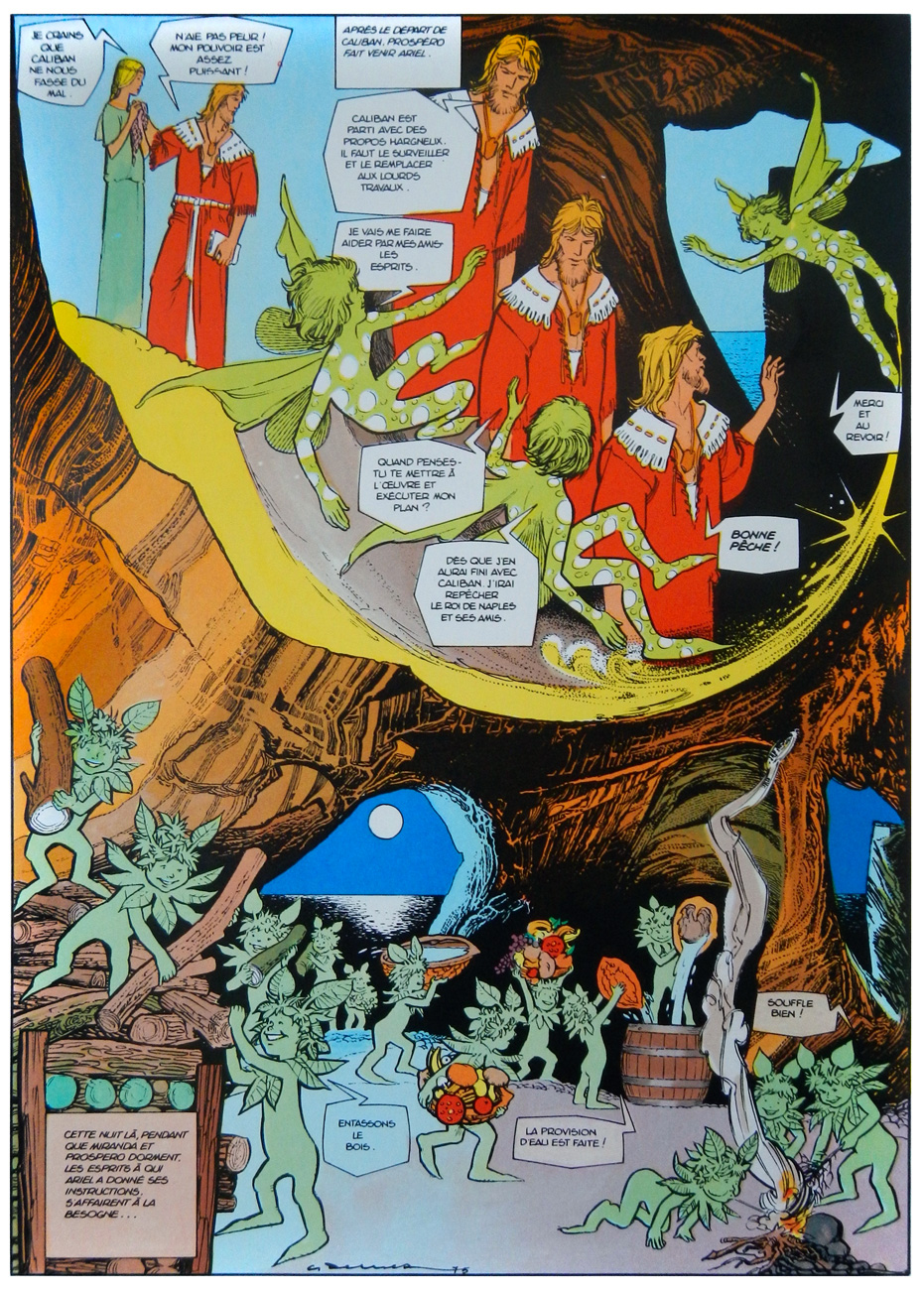
However, this feature was followed by, as fate would have it, the bane of any schoolboy*, Shakespeare adaptations. But wait… these were MIND-BLOWING. Decades later, I became fast friends with another cartoonist roughly my age, and he’d had the very same epiphany with De Luca’s Hamlet. Other than that, I’ve never really met anyone familiar with the work. Even locating a copy was a bit of an ordeal, but I managed to snag, a few years ago, a handsome volume gathering Hamlet and La tempête (The Tempest), published by Les Humanoïdes Associés in 1980.

Hamlet19A
Hamlet, page eighteen. Adaptation by Barbara Graille and lettering by Roberto Roquemartine. Colours presumably by De Luca himself, as the credits are mute on that point.

Hamlet22A
Hamlet, page twenty-three.

Tempête57A
La tempête, page five.

Tempête64A
La tempête, page twelve.

I don’t believe there’s any De Luca out there in the English language… save for one happy exception: UK publisher Running PressThe Mammoth Book of Crime Comics, discerningly edited by critic Paul Gravett**, contains « Strada », a superior entry in writer Gian Luigi Gonano and De Luca’s ‘Il Commissario Spada‘ series (1970-1982). « The series was groundbreaking in many ways, since it introduced subjects like violence, organized crime, satanic sects, terrorists and murderers to the pages of a Catholic magazine for young readers, that was at the time mainly distributed in parishes. »

*To be fair, we never studied Shakespeare in school.

**Speaking of Mr. Gravett, he happened to write an illuminating essay on De Luca’s Hamlet: http://www.paulgravett.com/articles/article/gianni_de_luca_hamlet

-RG

Tentacle Tuesday: the PG-13 Edition

Most of us may be in a winter holidays kind of mood, but tentacles don’t take holidays, especially not on the last Tentacle Tuesday of the year. While you lounge around in front of a roaring fire (or, more likely, in front of a TV screen), the tentacles continue their arduous work… of grabbing (and possibly disrobing) women.

However good they may be at undressing their victims, did you know that octopuses take the utmost care to hide indecent lady-parts from the audience? Case in point (it would have been much more efficient to grab her by the neck or midsection):

OdeonViboraRubia
« Víbora Rubia » means « blonde viper » in Spanish, and « Chicago, anos treinta » is pretty self-explanatory – Chicago in the thirties. Víbora Rubia (or Vipera Bionda in Italian), is the heroine of an Italian erotic comic series that was regularly printed in Italian comics magazine Odeon and occasionally translated into Spanish. This is one such Spanish edition, 1978, cover painted by Emanuele Taglietti. No, I have no idea what Chicago has to do with a quasi-nude chick in an octopus’ embrace.

As far as I can figure out (Italian not necessarily being my forte), « Odeon » was an Italian comics anthology for adults published from 1977 to 1988. While the earlier issues proudly displayed the enticing warning « for 18 years and older! », later issues modestly called themselves « relatos gráficos para adultos », which loosely translates to « graphical records for adults ». Ironically, the relatively staid covers of early issues became progressively smuttier and more risqué, with bare breasts galore and more rape and bondage scenes than you can shake a stick at, the whole thing veering more than just a little bit into over-the-top ridiculousness. Frankly, I don’t even know why the octopus is bothering to hide the blonde’s nipples.

You can see a gallery of Odean covers here. NSFW, obviously.

TentacleTuesdayIcon

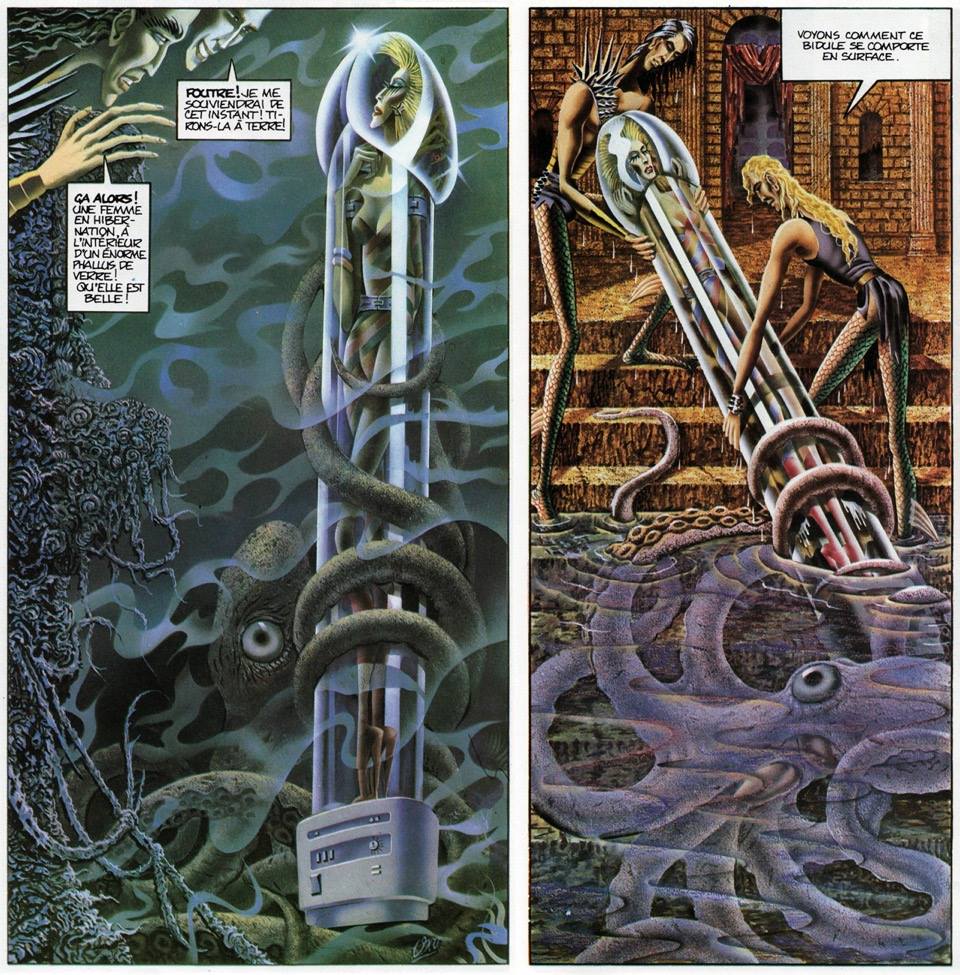
Continuing the march into tentacular extravagance, here’s a couple of panels from a comic called « La mort amoureuse » (either “Death in love” or “romantic death”, depending on how one interprets it). It’s a rather violent story of Death (personified as a lusty though decrepit female), her equally prurient servant Destiny, her two semi-amphibian lovers (a torero and a rock singer kidnapped from the world of the living), and a beautiful woman in a capsule fished out of the sea.

OxoLaMortAmoureuse
A page from « La mort amoureuse » by OXO, a Spanish artist whose name is Eusebio Perdices… which is all I’ve been able to find out about him. Published by Les Humanoïdes Associés, 1987. The lads are polite enough to thank Miss Octopus for her help.

I found this comic to be charmingly over the top, proving that digging through stacks of haphazardly piled up comics in the back of a comic store sometimes pays off. It opens with the story of a lesbian mermaid who dies of a broken heart when her lover callously betrays her, and merrily makes its way through all sorts of sexy shenanigans, amputations and transplants (as well as one decapitation), with dangling eyeballs and dream sequences cheerfully peppering the plot. The sex scenes aren’t explicit (although they’re “suggestive as hell”, as one of my friends would put it, and everyone is quite sex-starved), but the dialogue is equal parts titillating and gross, which elicited quite a few disgusted nose-crinkles and chuckles from me.

Here are two quotes, picked from two randomly selected pages, with quick (and rather literal) translations into English so you can get a feel for OXO’s poetic style. Memorize these in French and you can impress your lover during your next tryst – don’t forget to thank me later.

« Laisse-moi sucer, pour tuer le temps, et pour trouver l’oubli, la moëlle amère de tes os! » (Let me suck, to kill time and find oblivion, the bitter marrow of your bones!)

« Je suis au parfum: la passion est biodégradable! Amour et chair se putréfient également! Laisse-moi plutôt rêver de ton puissant gourdin… ta queue, tendre et primesautière, qui me défonce et défroisse un peu plus les plis de mon vagin flétri. » (I’m well aware: passion is biodegradable! Love and flesh both putrefy! Rather let me dream of your powerful cudgel… your tail, tender and impulsive, which shatters and smooths the folds of my withered vagina!)

TentacleTuesdayIcon

And for our last entry, here’s a cornucopia of fun: Communists! Tentacles! Aliens with good taste in girls! Uncensored nipples! (Actually, the nipples *were* censored on my scan of this cover, but co-admin RG restored them to their former glory with a bit of Photoshop. Thanks, partner.)

CommiesFromMarsTentacles
Commies From Mars no. 2 (Last Gasp, December 1979). The cover is by John Pound. The fallen gal seems to be enjoying herself more than her still-conscious friends… but those spikes, ouch. Once again, the tentacled beast makes sure to modestly cover its victim’s privates from prying eyes.

Actually, I’ll be a generous little communist sympathizer and give you a two-for-one: here’s another issue of the same series, also with tentacles. Why break a formula that works?

CommiesFromMars3
Commies From Mars no. 3 (Last Gasp, February 1981). Cover also by John Pound,  a man equally at ease drawing hot babes and mean tentacles.

~ ds