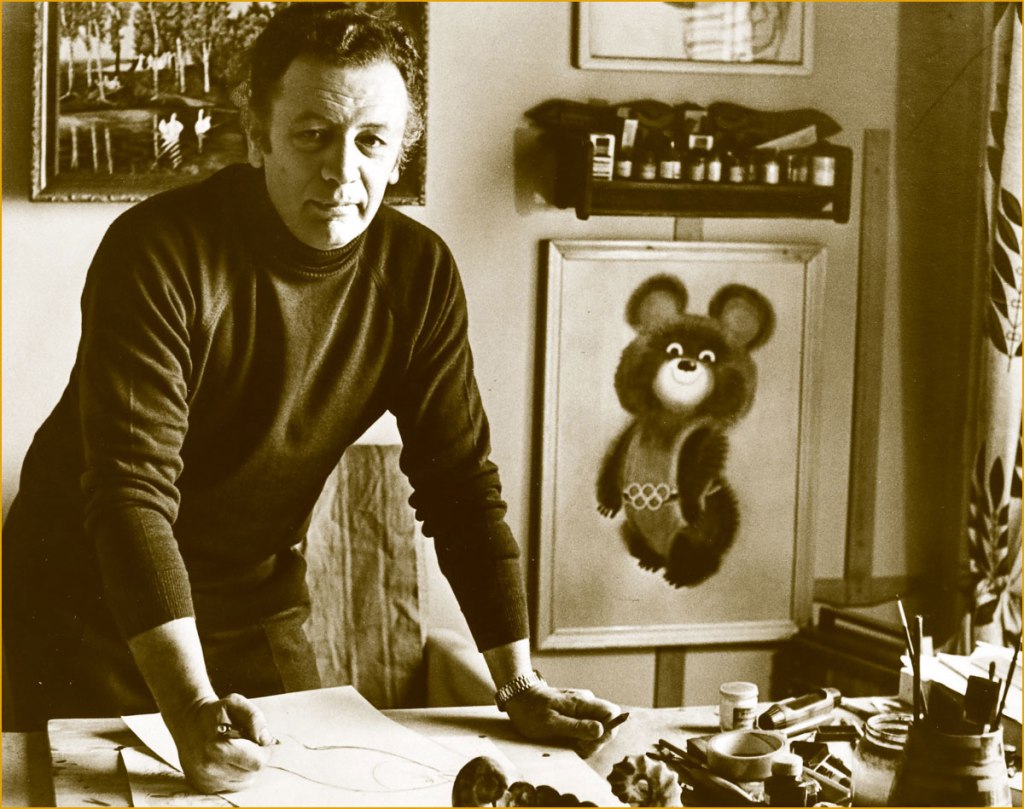
I grew up on the illustrations of Soviet illustrator/cartoonist Victor Chizhikov (1935-2020). I’m not sure whether I’m from the last generation that remembers his work this well — on a similar topic of ‘boy, we’re old’, older non-Slavic readers might be familiar with Misha, the mascot that Chizhikov designed for the 1980 Moscow Olympic Games.
Chizhikov with his creation Misha (both a nickname for Mikhail, and a contraction of ‘bear’).
In 1955, Chizhikov started contributing illustrations and caricatures to Krokodil, a publication I was born too late to be personally familiar with (though I did write a post about it). While he has definitely drawn a number of ‘adult’ cartoons in his life, it’s his cheerful anthropomorphic animals, mushroom-studded landscapes and gently roguish children that linger in people’s minds, and those appeared from 1956 and onwards, frolicking through the pages of Весёлые картинки (Merry pictures), a publication aimed at children between 4 and 11. In 1958, Chizhikov also joined the staff of Мурзилка* (Murzilka), a magazine for the 7 to 13 year old crowd. I had subscriptions to both as a child. My grandfather was especially keen on giving me a well-rounded education, though he needn’t have worried, as I come from a family where nearly everybody was a voracious reader, albeit occasionally disagreeing on genre. I used to have a stack of Весёлые картинки somewhere, but I got rid of it at some point with the impetuousness of a young adult, alas.
An issue of «Мурзилка» from 1968.
A page from a 1965 issue of «Мурзилка» depicting scenes made up of palindromes.
Original art for an illustration created for a 1975 issue of «Мурзилка».
Page from a 1966 issue of «Весёлые картинки» — ‘Petrushka in the land of fairytales‘ was a recurring feature. Chizhikov had a most fluid line when needed.
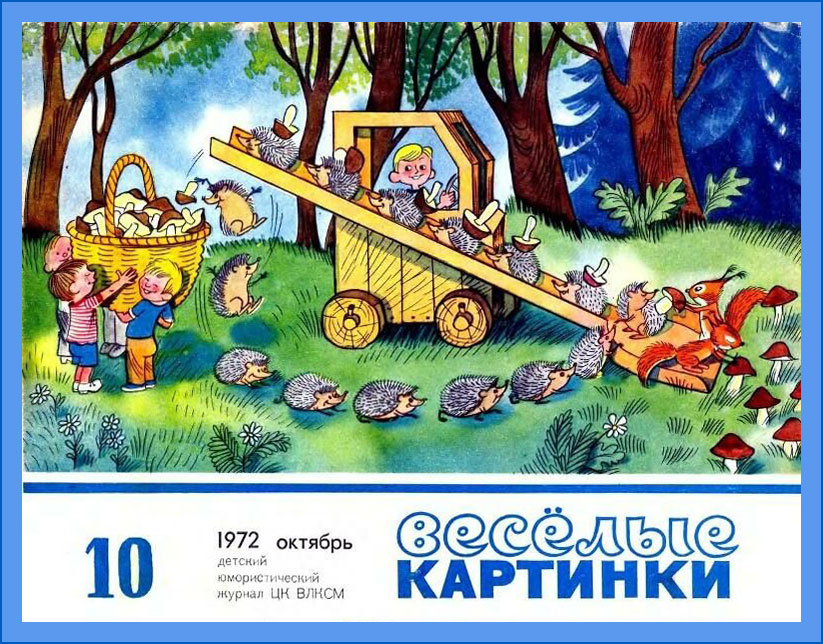
The October page from a 1972 calendar published in «Весёлые картинки».
An issue of «Весёлые картинки» from 1982.
Interestingly, Chizhikov was daltonic, something one would never be able to guess from his illustrations. It is said that his wife would label pots of paint and pencils to help him out, but I don’t know what variant of colour blindness he was stricken with. A critic once described his characters as having a ‘mischievous squint, as if they live in an eternal summer in the bright sun‘ — maybe they were just squinting trying to discern the nuances between colours?
‘The Lamplighter Ant’
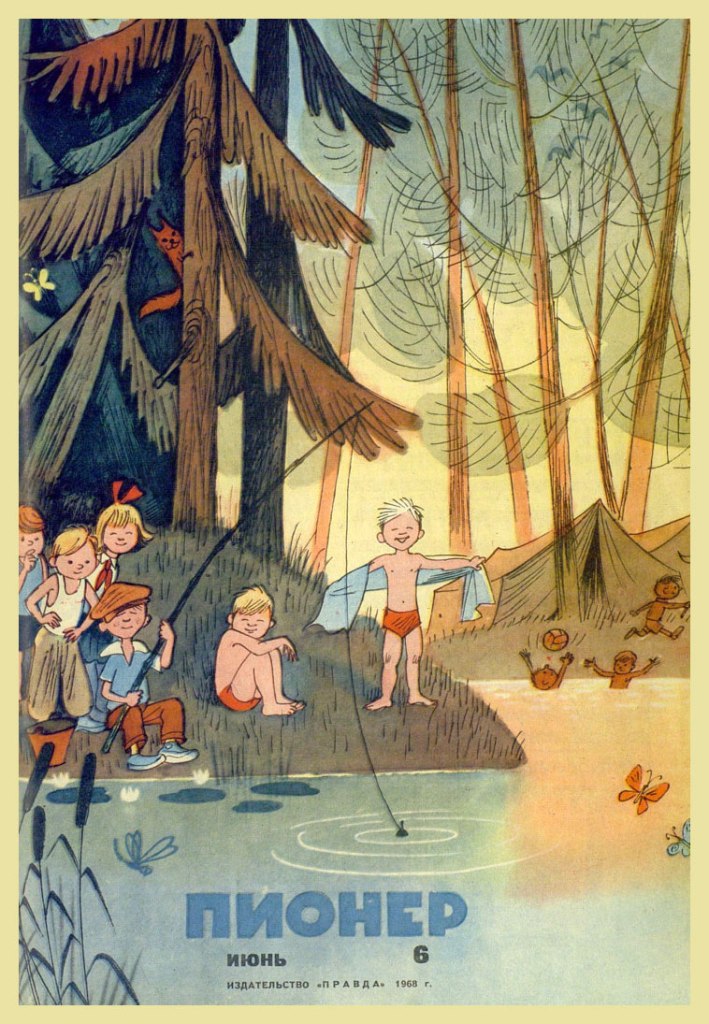
Issue of «Пионер» from 1958 — this was a magazine for 10 to 14 year-olds, but I don’t remember ever encountering any issues in the wild (possibly because my family objected to buying something called ‘Pioneer‘).
I owe this trip down memory lane to a friend who gave me a 1971 edition of 25 загадок — 25 отгадок (25 riddles — 25 answers) written by the immensely energetic and thus ubiquitous Korney Chukovsky** and illustrated by Chizhikov. Many thanks, Drew!
« Two stallions I have, they carry me on water. The water is tough, as if it were a stone. »
« If pine trees knew how to run and jump, they would flee from me to never cross my path again, because I am very steely, mean and toothy. »
« Small houses are running down the street, carrying little girls and boys. »
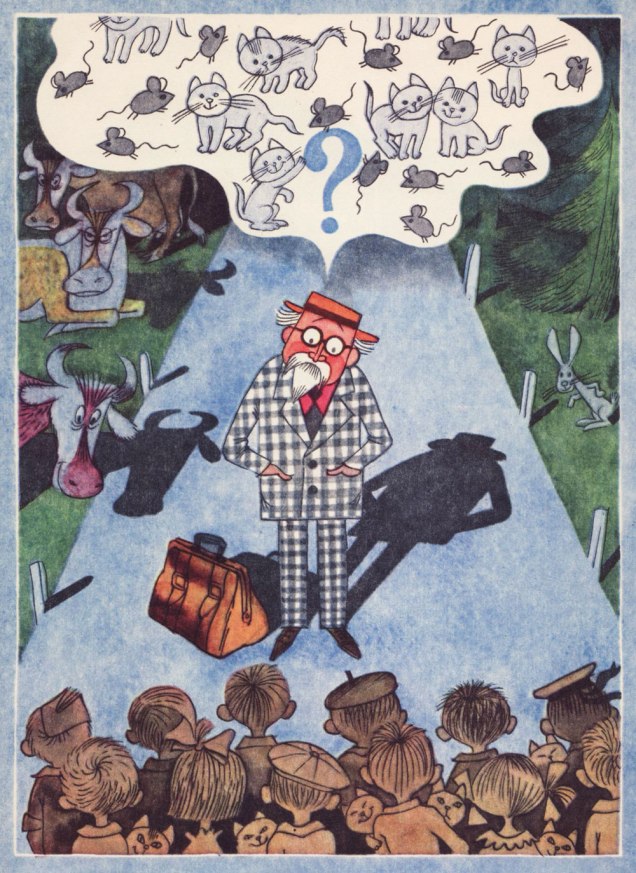
« Kondrat was walking to Leningrad, and coming towards him were twelve kids, each with three baskets, with a cat in each basket, and each cat having 12 kittens, each kitten holding four little mice. How many kittens and mice are the kids carrying to Leningrad? »
Cover of another book by Chukovsky, the ever-popular Doctor Aybolit, whose name translates literally to something like ‘Doctor Ouchithurts’. This character was loosely based on Hugh Lofting’s Doctor Dolittle, as well as Chukovsky’s friend Zemach Shabad, known for treating not only sick children, but also the equally ailing animals the children would bring along to their appointments.
~ ds
*Мурзилка is still around today, and given that it began publication in 1924, it is now listed in Guinness Worlds Records as the longest running children’s magazine in the world.
** 1882-1969, author of innumerable absurd ditties, rhymes and poems so well remembered and loved that many got incorporated into Russian as idioms; brilliant translator of English novels, stories and poems, making them accessible to a Russian-speaking audience for the first time; dissenter of governments, be it Soviet or Russian.
An elephant pink crawled outta the sink and snuggled up in my bed A purple mole’s in the goldfish bowl, he’s trying to steal a drink*
Today’s post was originally planned as a panegyric to Larry Marder’s Beanworld, but I quickly realized that attempting to write about it was a bit like trying to dissect a joke. Here I am, then, doing a 180 degree turn to talk about a Soviet cartoonist.
Evgeniy Milutka (Евгений Милутка, b. 1946) was a teacher of Russian literature by profession, but his proclivities clearly lay elsewhere. After teaching in middle school for a few years, he officially switched to the career of a cartoonist in the early 1970s, and quickly rose to the ranks of the best known caricaturists in the USSR, in part thanks to his long-lasting (from mid seventies to mid eighties) collaboration with satirical magazine Krokodil(see Krokodil Smiles: Cartoons in the USSR).
I am most interested, however, in the new, kid-oriented direction his work took in the 1980s, namely the cartoons/comics published within the pages of Веселые Картинки (something like ‘funny pictures’ in translation), a literature-bent humour magazine for kids. Founded in 1956, it was still sort-of around (with some financial issues) when I was a child, and my grandfather, who was always very preoccupied with making sure I grew up knowledgeable and smart (sorry, grandpa?), was kind enough to buy me a subscription.
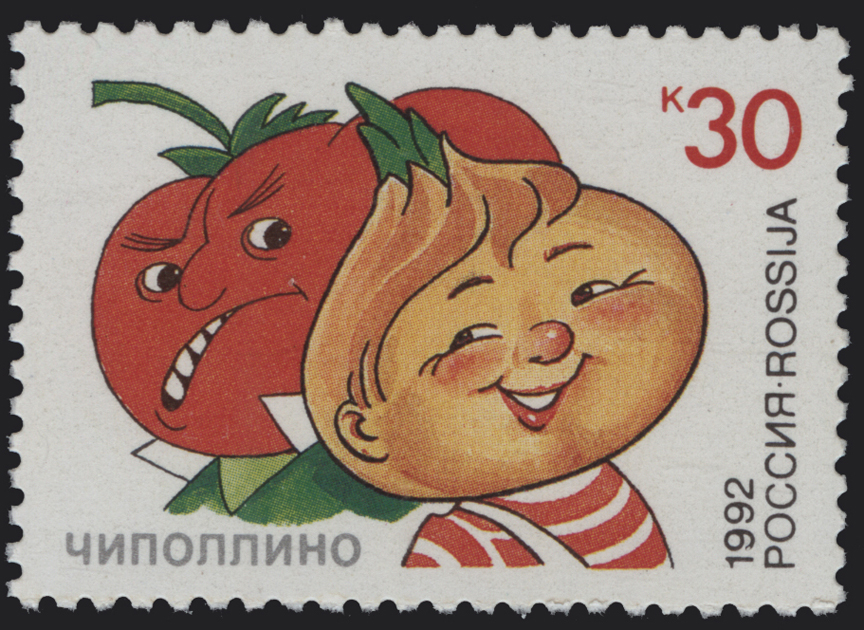
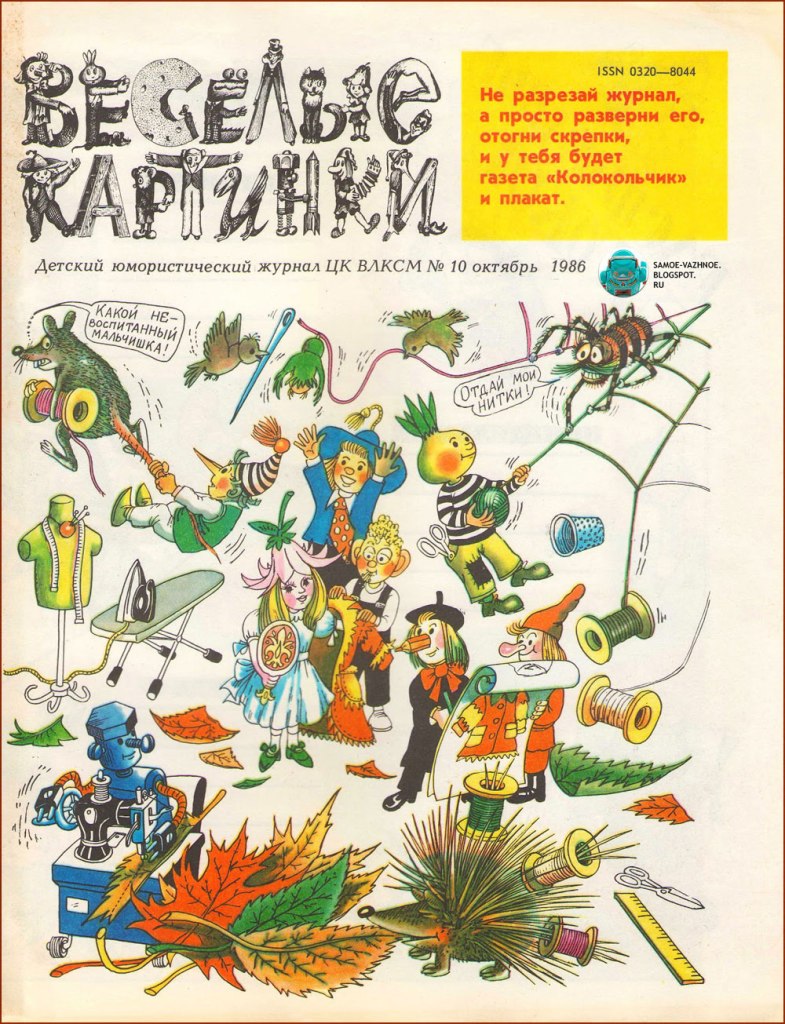
An issue from October 1986, with a cover by Milutka. It features the 8 ‘merry little people’ that were the mascots of this journal and whose adventures Milutka illustrated. This included Karandash (which in Russian means ‘pencil‘), the boy with the pencil nose; Cipollino (little onion), the boy with an onion head, from Gianni Rodari’s Cipollino, a tale that was so popular in the Soviet Union that we even have a Cipollino stamp; Buratino, the Russian Pinocchio; Neznayka, literally translated to ‘don’t know’, a favourite character from Nikolai Nosov‘s merry trilogy of fairy-tales; Petrushka, a character from Slav folk puppetry; Samodelkin, the boy robot whose name translates to something like ‘do-it-yourselfer’; Hurvínek, a character from a Czech puppet duo; and the only girl, Thumbelina.
The first thing that jumps out is that Milutka’s strips are really weird. Green elephants, watermelon men, mosquitoes capable of lifting a person, bats in a cavern made out of teeth, a giant spider wearing running shoes… a lot of it is most delirious delirium tremens. Milutka could aptly handle a variety of styles, but his basic, more recognizable modus operandi is extremely Slavic. The other interesting thing about his work, though you have to take my word for this, is how he squeezed in some distinctly unchildlike content into his strips. He was, after all, a caricaturist, with a keen eye honed by the sometimes subversive Krokodil.
Here is a selection from within the pages of Веселые Картинки from 1991 to 1996, which is pretty much the period I was able to follow in person.
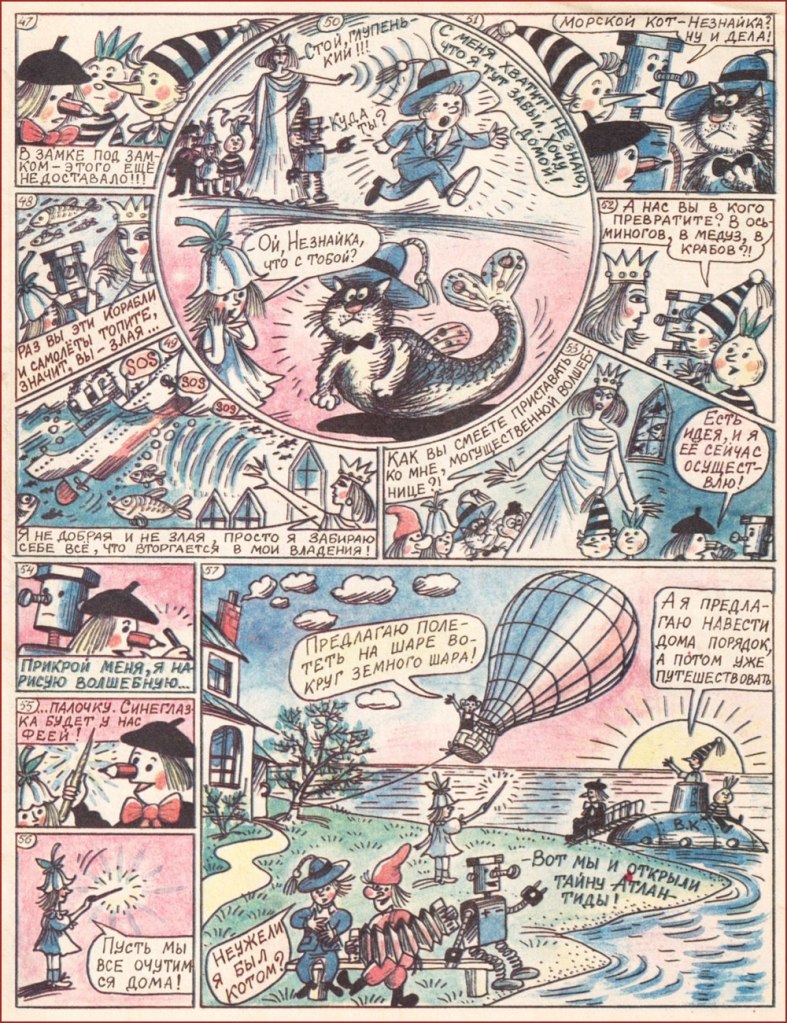
The sorceress gets accused of being evil by Thumbelina, ‘since you crash ships and airplanes‘. ‘I am nor evil nor good,‘ she responds, ‘I just take everything that barges into my kingdom.‘ Nezknayka gets turned into a mer-cat. (1991)
More metamorphosis! The kids keep asking the green elephant ‘what are you? Are you an ungulate? A mammal? Are you an insect? He’s probably an amphibian…‘ but to all their questions, he answers “I dunno…“, which is how they guess that it’s Neznayka in disguise. (1991)
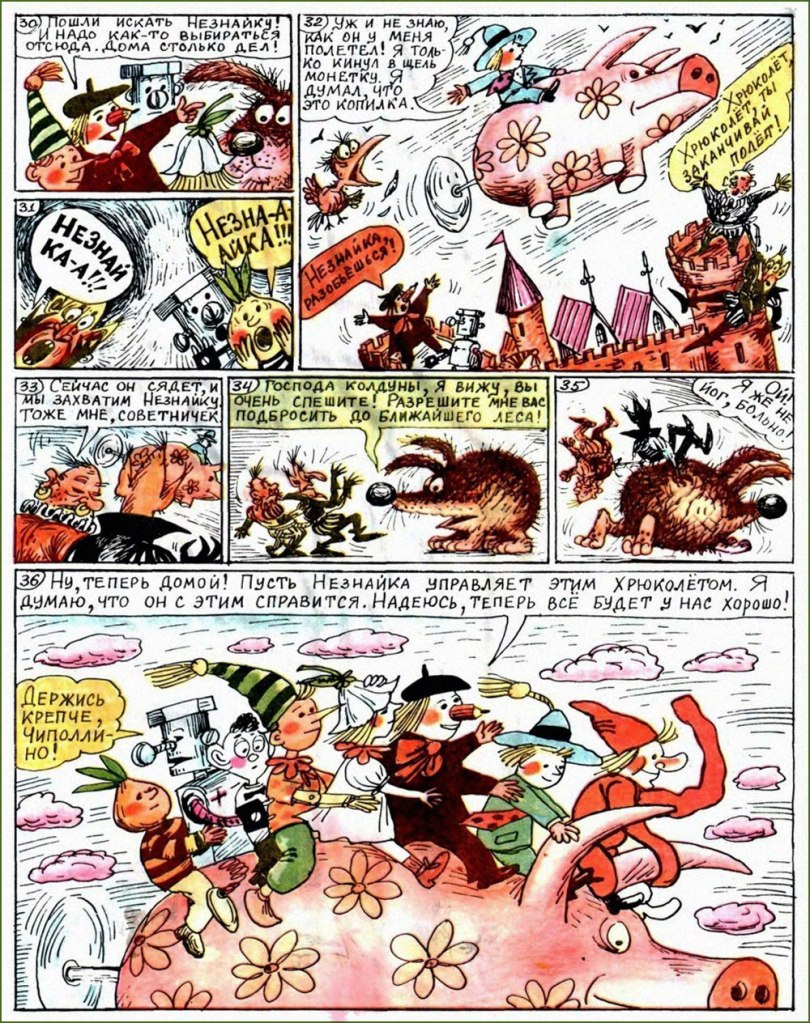
A sword-hog is turned back into a normal hedgehog once he’s fed an apple, and Neznayka, who’s named head advisor to the bad guys (everybody has untranslatable funny names), advises them to tie themselves together with a rope… (1994)
… after which the merry little people escape on a flying pig with a propeller in its ass (1994).
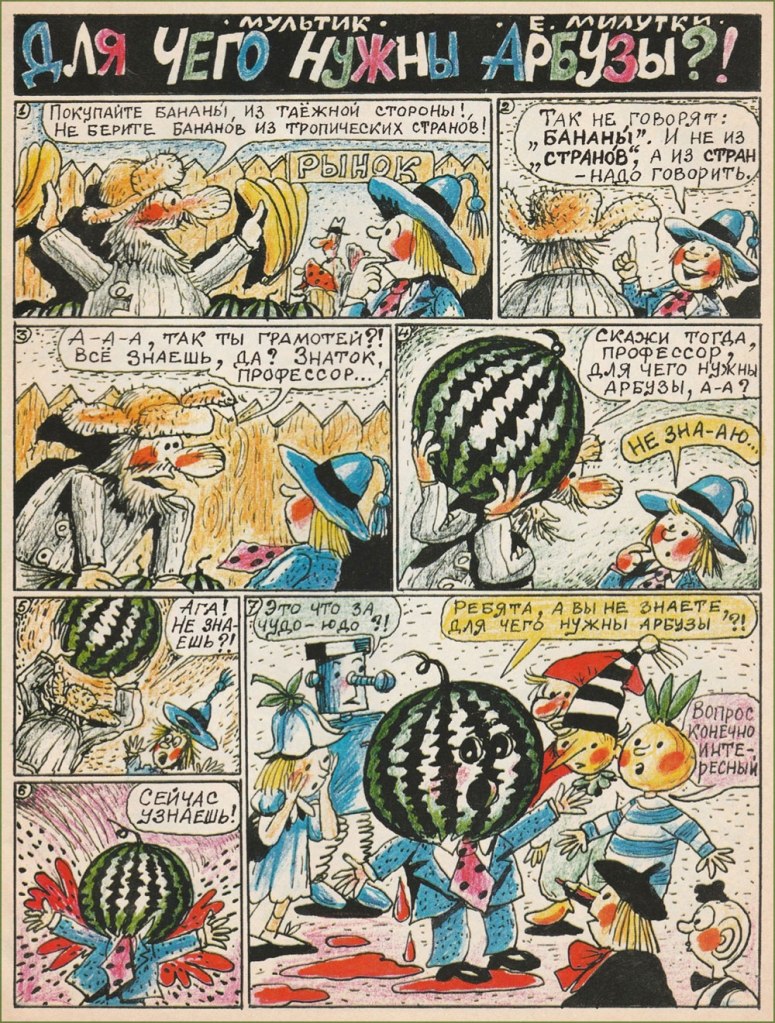
Watermelon man! “Kids, do you know what watermelons are good for?” “It’s an interesting question, of course” (1994).
This is spider named Filia, shod in very nice shoes. Isn’t he cute? (1994)
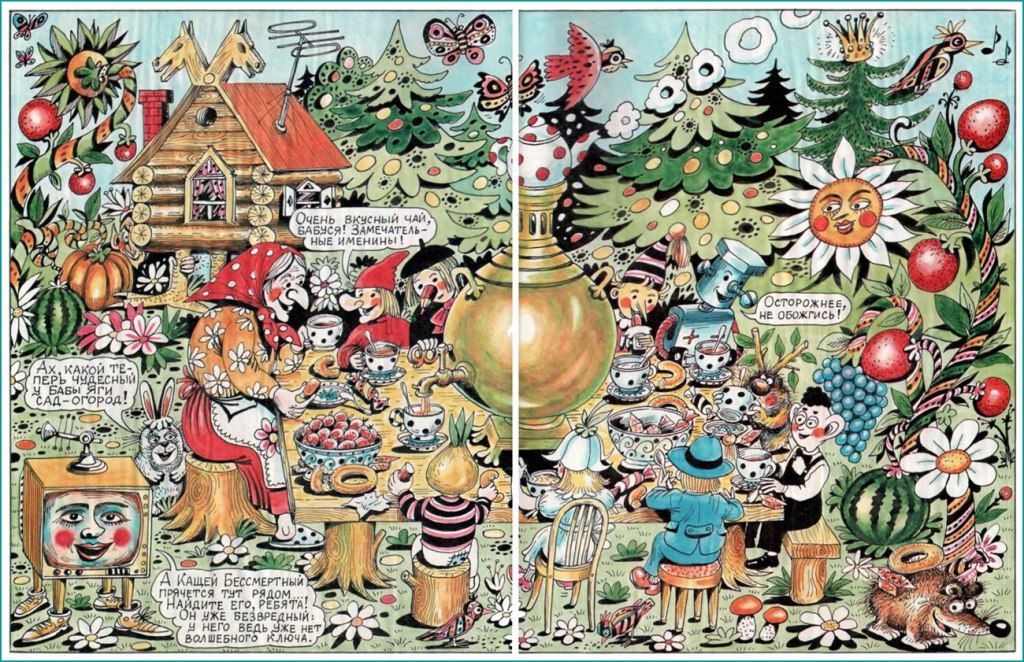
A splash page featuring a prototypical Babushka (actually a Baba Yaga in a good mood!) and an assortment of flora and fauna (1994)
After a lot of untranslatable puns on the word ‘vitamins’, the cat (who’s, once again, Nezknayka, having a pronounced tendency to transform into other creatures) is told to ‘eat the magic balls!‘ to turn back into himself. Thumbelina is also rescued from being… err, whatever that furry thing with the rolled-up nose is. (1995)
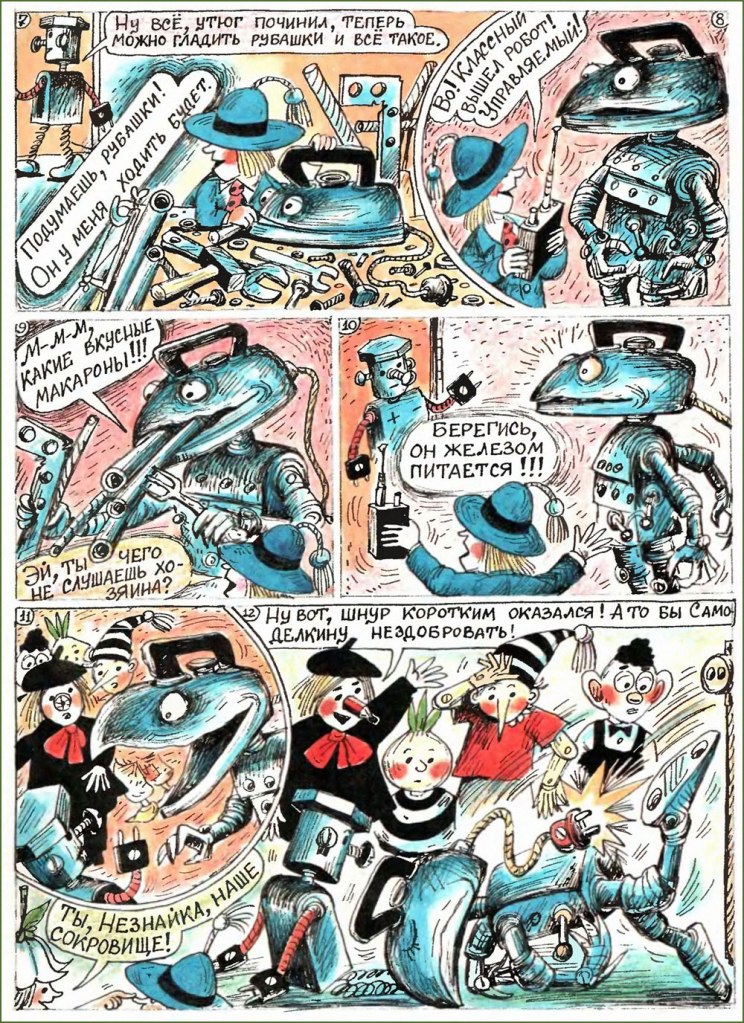
Neznayka invents a robot to do the ironing for him, but the robot is hungry for metal ‘macaroni’ (which we call anything pasta, usually some form of spaghetti) (1996).
A poster advertising the journal (1996), with mushrooms, a Pushkin reference, singing cats, some sort of flying elephant (?) with an accordion, a little furry bee-cat, and so on and so forth.
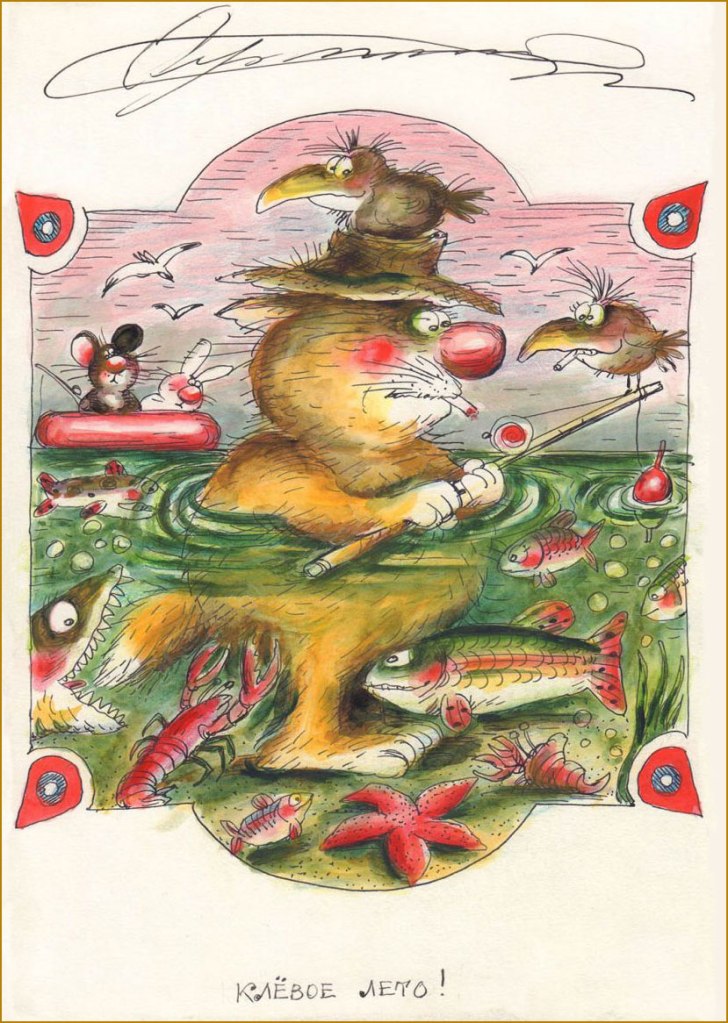
I hope you enjoyed these despite the language barrier! I’ll wrap this up with two fun illustrations from the early 90s:
‘The flight of a bumblebee’
The title is a pun on fish biting and the summer being a neat one.
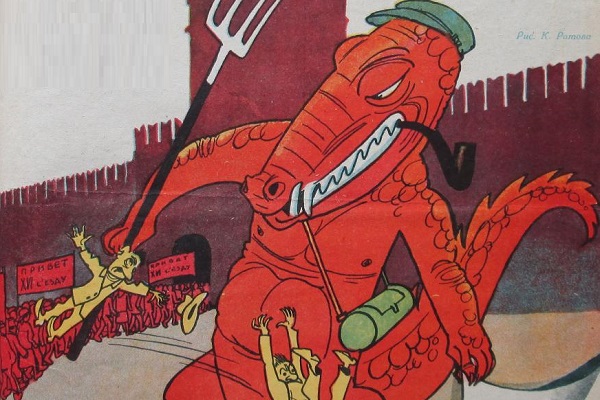
« Krokodil » («Крокодил» in Russian, a crocodile) was a Soviet satirical magazine founded in 1922 and that outlasted the Soviet Union by a number of years. In 2000, it was driven to its deathbed by a general lack of interest and failing finances – no longer being relevant to the modern age, alas! – and though weak attempts were made to breathe life into it in the 2000s, it finally croaked altogether, wheezing its very last in 2008.
Right from the beginning, The Crocodile (personified by a pipe-chomping red crocodile, holding a pitchfork) featured quite a lot of satirical drawings, which were basically panel cartoons, and sometimes even actual comics. The magazine’s modus operandi was to viciously skewer various enemies of the State and the People, such as bureaucrats, alcoholics, bribe-takers, church-goers, various delinquents, ne’er-do-wells and anti-Soviet villains. Institutions were also attacked, sometimes gleefully and sometimes sternly, and that list was long, too: American imperialism and capitalism, German Nazism, colonialism, and more other -isms that you could shake a stick at.
“There were pickpockets, dope peddlers, murderers and thieves Card shark gamblers with aces up their sleeves Bank robbers, burglars, boosters and pimps Prostitutes and call girls and all kinds of nymphs Loan sharks, swindlers, counterfeiters and fences Crooked politicians spending campaign expenses Hijackers, arsonists, bookies and the mob And anybody else who ever killed, cheated or robbed” Hustler Groove, Apollo 440
I would not like to leave you with the impression that Mr. Crocodile was an unsympathetic fellow, however; in its gentler moments, Krokodil’s tongue-in-cheek humour could be a delight, and its savage attacks sometimes masked a subversive anti-Soviet streak. Many prominent writers and artists worked for the magazine, and some of them started their careers within its pages. Aside from a plethora of cartoons, the magazine also featured news, stories, aphorisms, epigrams, and reviews of books, films and theatrical plays, etc.
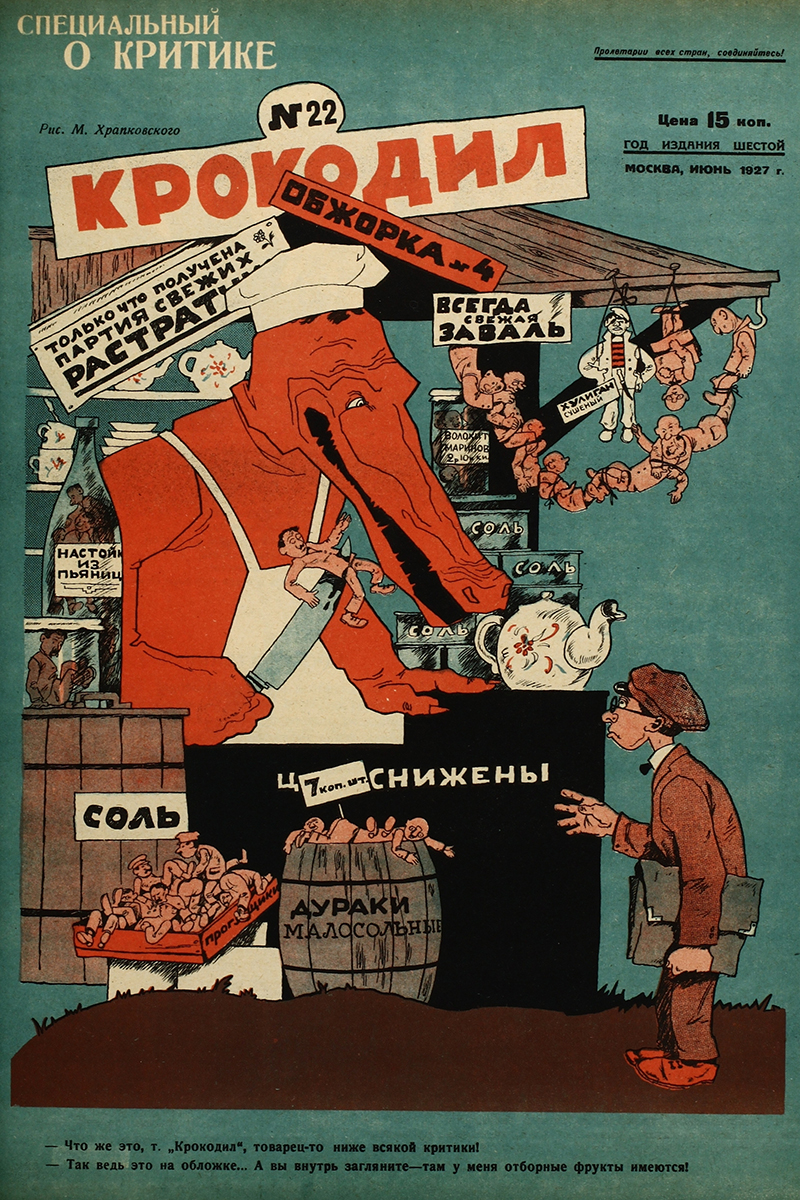
June 1927, cover by Hrapkovskoy.
Mr. Crocodile came with an extensive family. He had a wife, the Big Krokodila, who lost her marbles in the 1930s, and two twin children, who acquired hilariously caricatural careers in 1990 – Totosha went into management and Kokosha moved to the U.S. to design men’s magazines. These (and other recurring) characters marked several generations of Soviet citizens, and many of their catchphrases have become an everyday part of the Russian language.
Without further ado, here’s a few Krokodil cartoons on very Slavic topics, like drunkenness, and general debauchery and bureaucracy, including the disappointing lack of goods (and poor quality control of actually available goods). In no particular order…
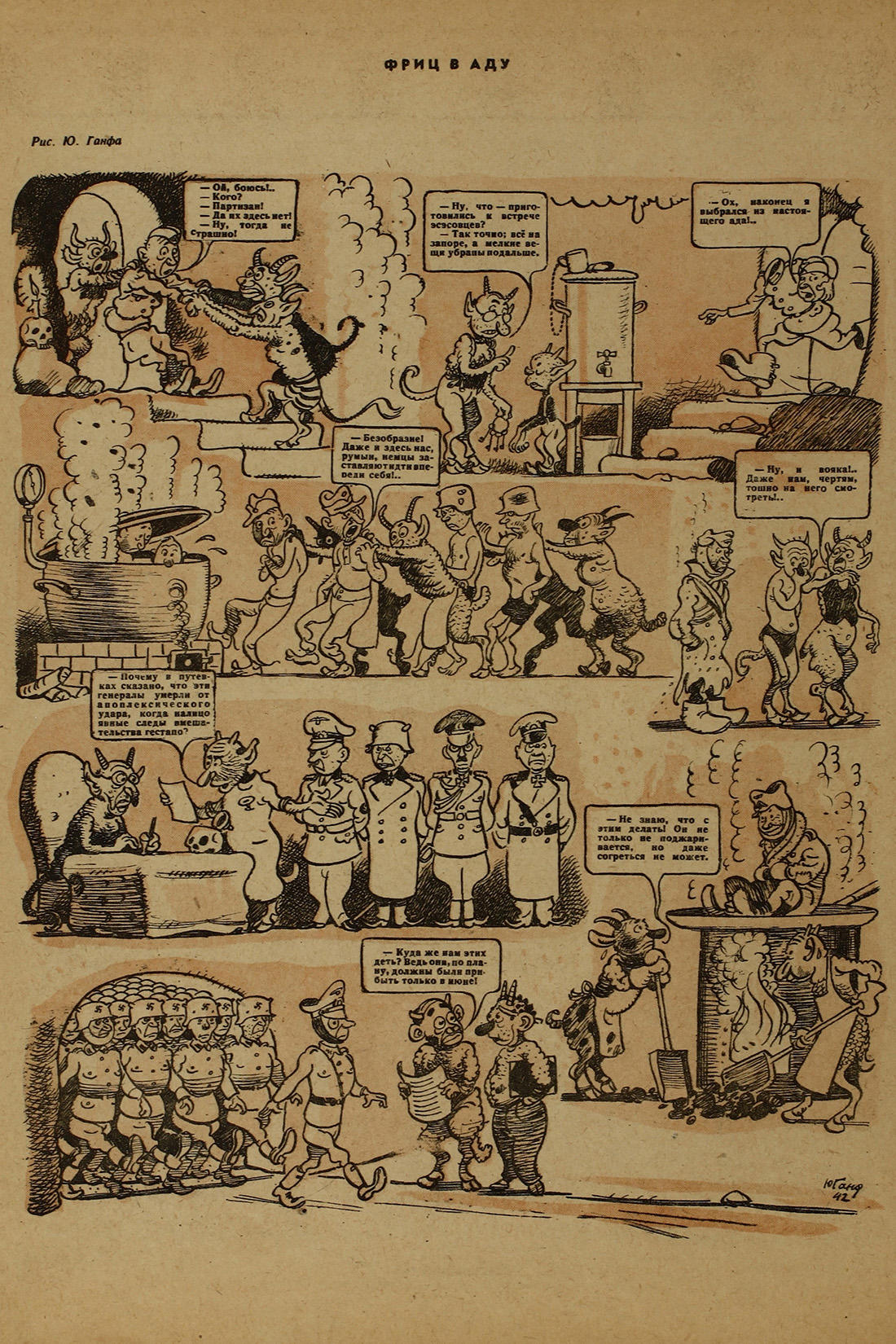
“Fritz in Hell”, 1942. Illustration by Y. Ganf. “Fritz” is used as a moniker for any of your average, humdrum Nazi.
“Tribe of wild ones at the seashore”, 1956. Illustration by I. Rotov.
“We made a big mistake when we brought them to the puppet show!” 1978.
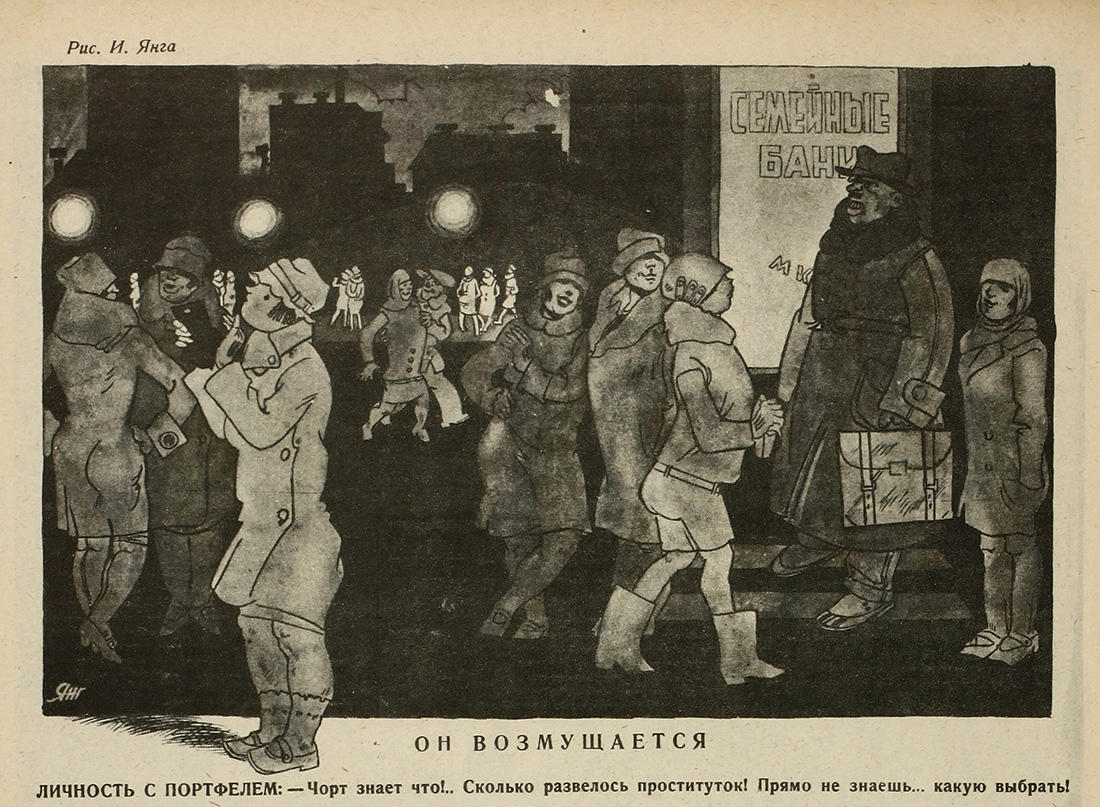
“THE MAN WITH THE SUITCASE IS INDIGNANT: What the hell is happening!… There’s so many prostitutes… One doesn’t know… which one to pick!” Illustration by I. Yang, 1929.
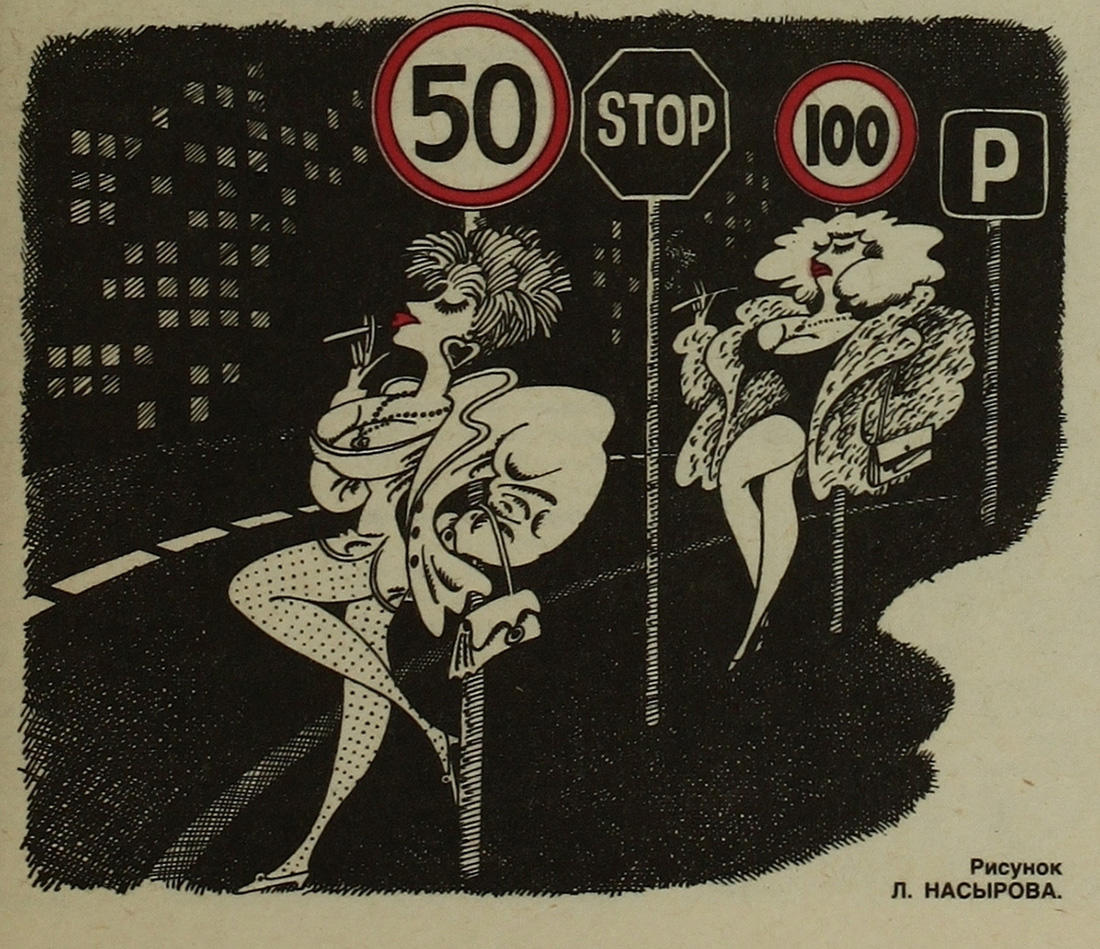
1987. Illustration by L. Nasirov. Nearly 50 years later, prostitutes are still around, but their goods are a little more on show. You couldn’t really be an above-board pin-up artist in the USSR, but some people clearly had, shall we say, proclivities for depicting the female form.
The lion says in the first panel: “It’s disgusting! An elephantess in the role of a gazelle! I’ll go to the theatre manager and find out who gave her this role!” 1956, illustration by Y. Ganf.
A charming case of bribery: “And here, dearie, is some evidence for your examination!” Perhaps this requires some context: this charming granny makes moonshine at home, and she hopes to soothe off the irate-looking policeman with an offering of a glass of vodka and a pickle (traditional accompaniment to vodka – highly recommended, perhaps with some mushrooms. I’m getting distracted, sorry.) Illustration by G. Ogorodnikov.
“It’s a good omen: first let a cat walk into a new apartment!” 1975, cover by G. Andrianov.
“And where are the potatoes, the pepper, the salt?” Illustration by V. Shkarban, 1979.
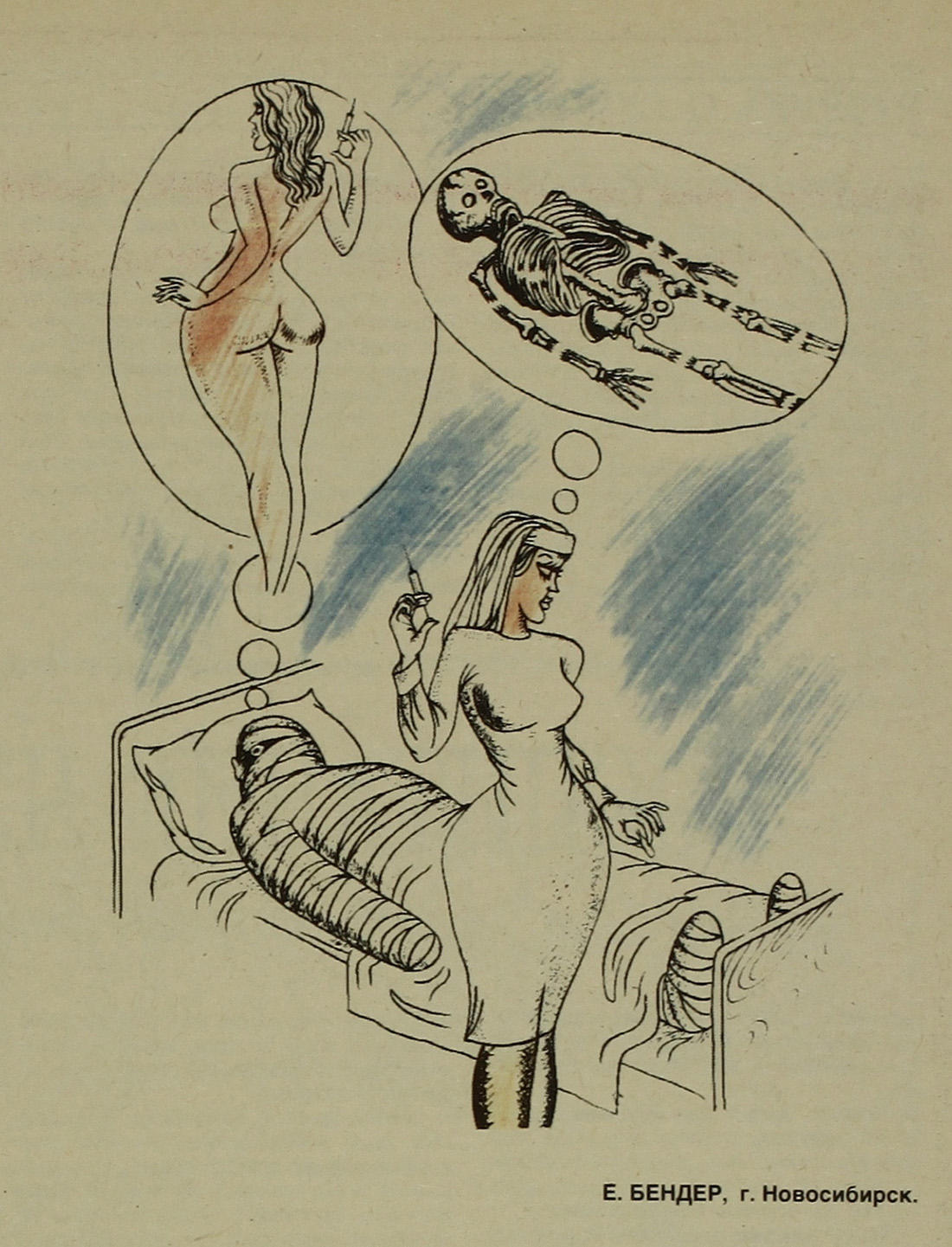
1989, illustration by E. Bender. I think somebody wanted an excuse to draw voluptuous women!
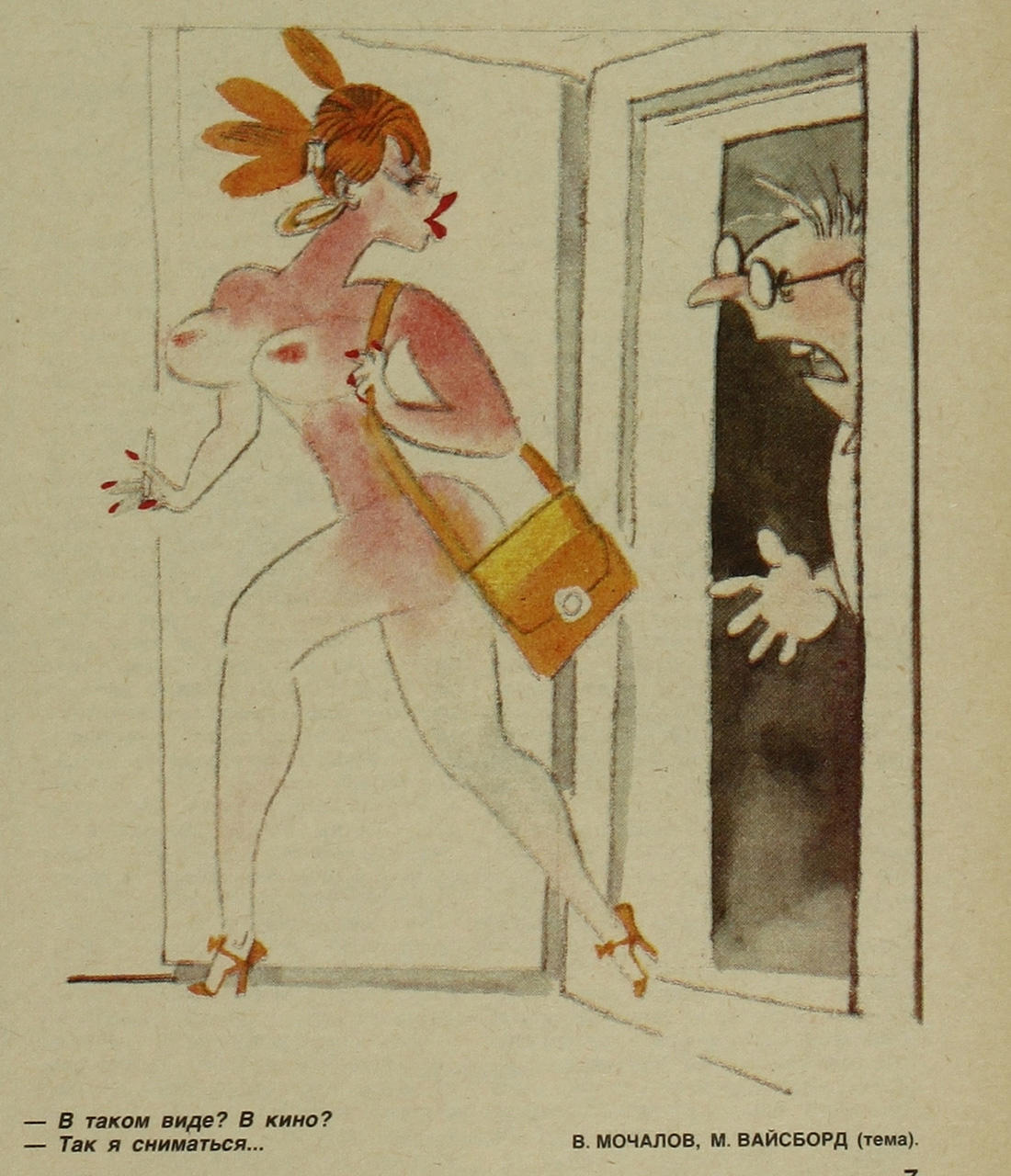
“Dressed like that? To the cinema?’ “– I’m going over there to be filmed…” Illustration by V. Mochalov, idea by M. Vaisbord, 1989.
“Now just watch it: oink the way I taught you to!” Illustration by S. Kuzmin, 1963. What happened to the missing pigs? They were most likely sold off to finance the kolhoz foreman’s drinking and gluttony. A kolhoz was basically a sort of collective farm or production cooperative, but corruption and negligence ran rampant.
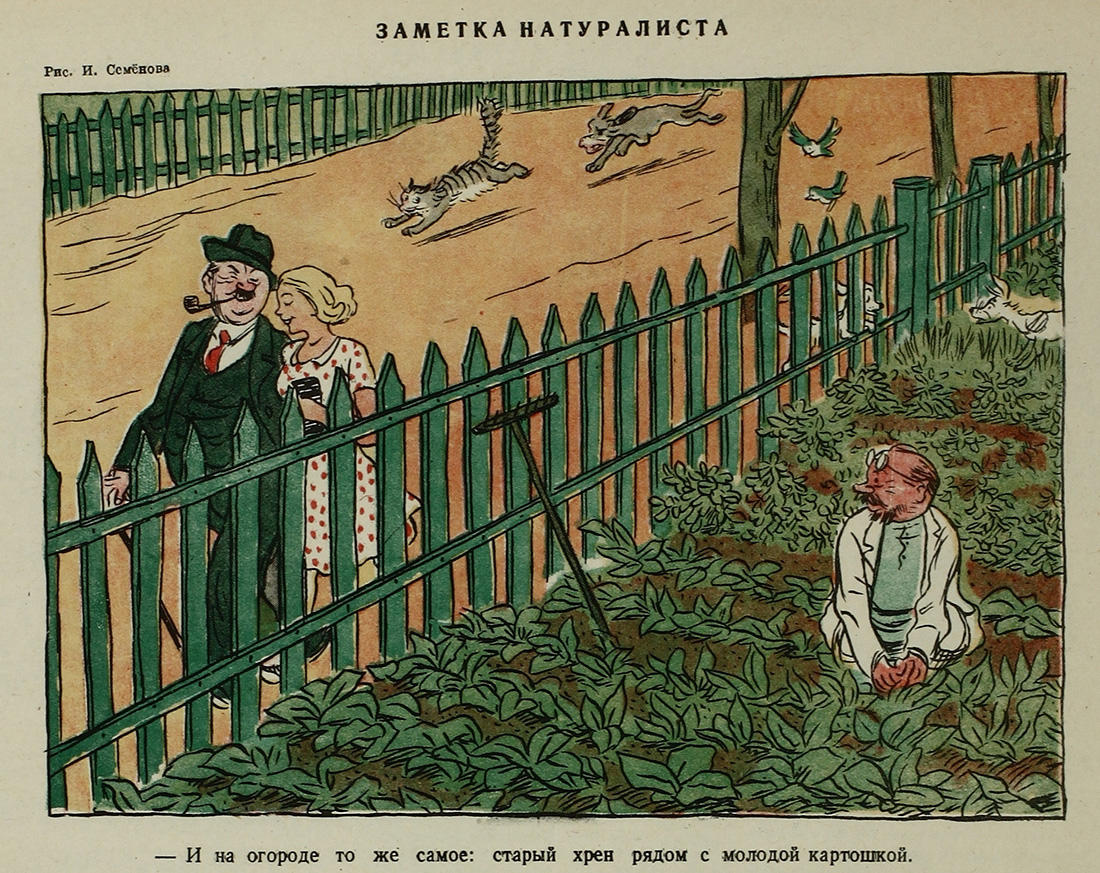
“Same thing as in the vegetable patch: old horseradish next to a young potato.” Illustration by I. Semenov, 1945.
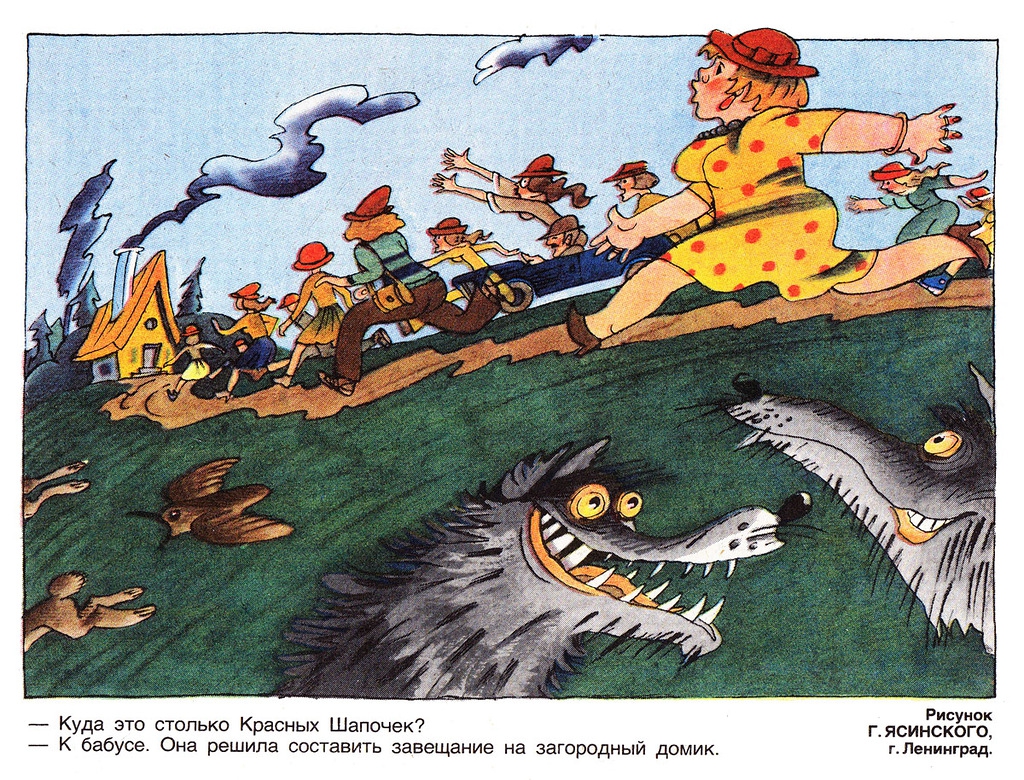
“Where are all the Red Riding Hoods going?” “–To grandma’s. She decided to write a will for her country house.” Illustration by G. Yasinkiy, 1984.
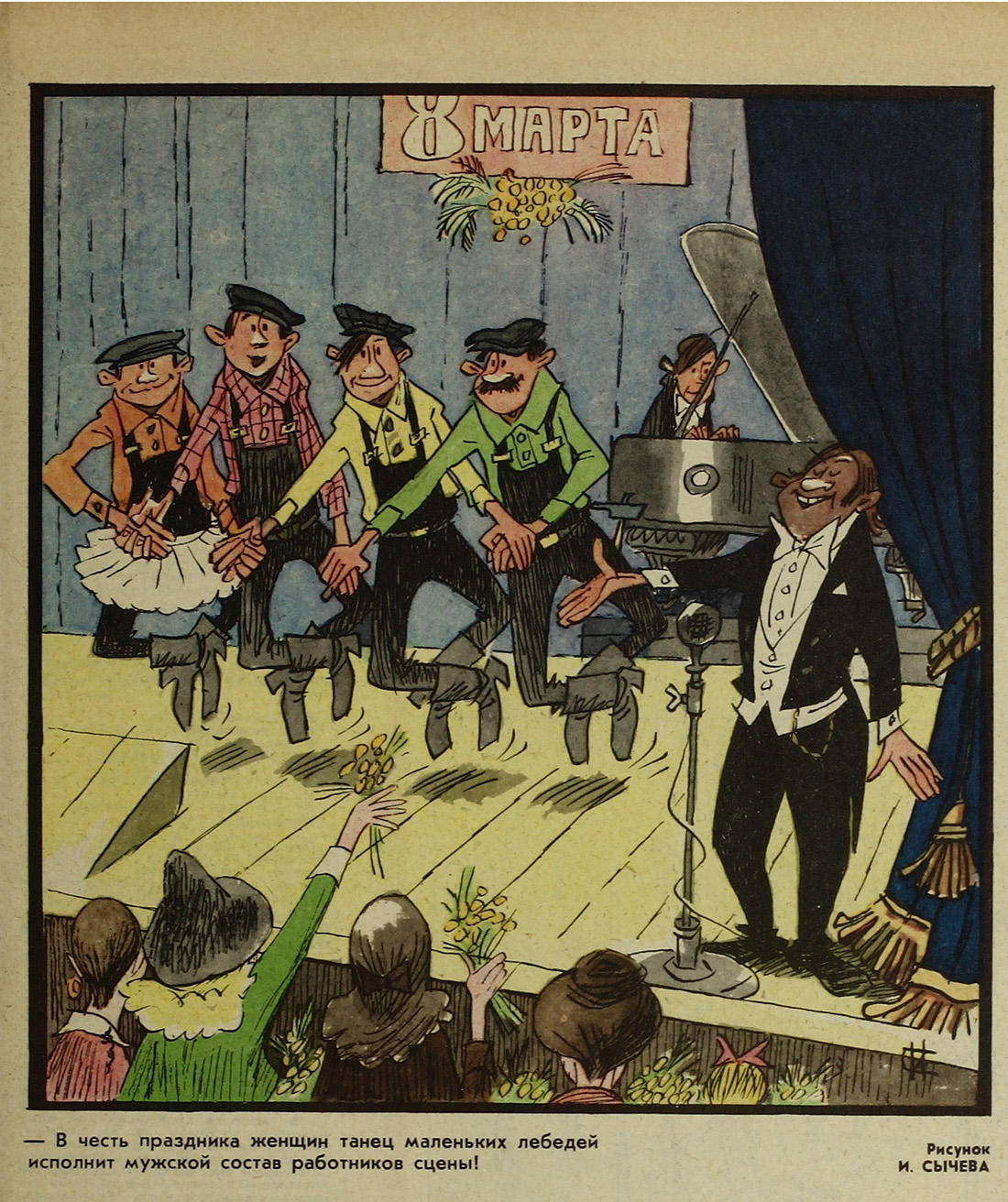
“In honour of the International Women’s Day, the dance of the Little Swans will be performed by the stage crew workers!” The 8th of March was a big deal in the U.S.S.R., and not only for one’s mothers and grandmothers; if I recall correctly, even students were supposed to bring in flowers for their female teachers. Illustration by I. Sichev, 1975.


















 Who's Out There?