« Fascism will come to America wrapped in a flag. » — Sinclair Lewis
With the exception of its daily strip incarnation (1941-44), principally ghosted by Jack Cole, the early years of Will Eisner’s The Spirit never drew me in. Next to the work Eisner produced upon his return from WWII, the first years seemed tentative and inchoate. It didn’t help that the original artwork — or even quality photostats — of the material had not survived, and so reprints were consequently hobbled by dodgy reproduction.
The other day, a most generous friend presented me with the second volume of Will Eisner’s The Spirit Archives — he had a spare copy — and, not wishing to look a gift horse in the mouth, I duly proceeded to read it. I should state that DC Comics’ complete reprinting of Eisner’s magnum opus is a definitive one, so the pill was far easier to swallow this time.
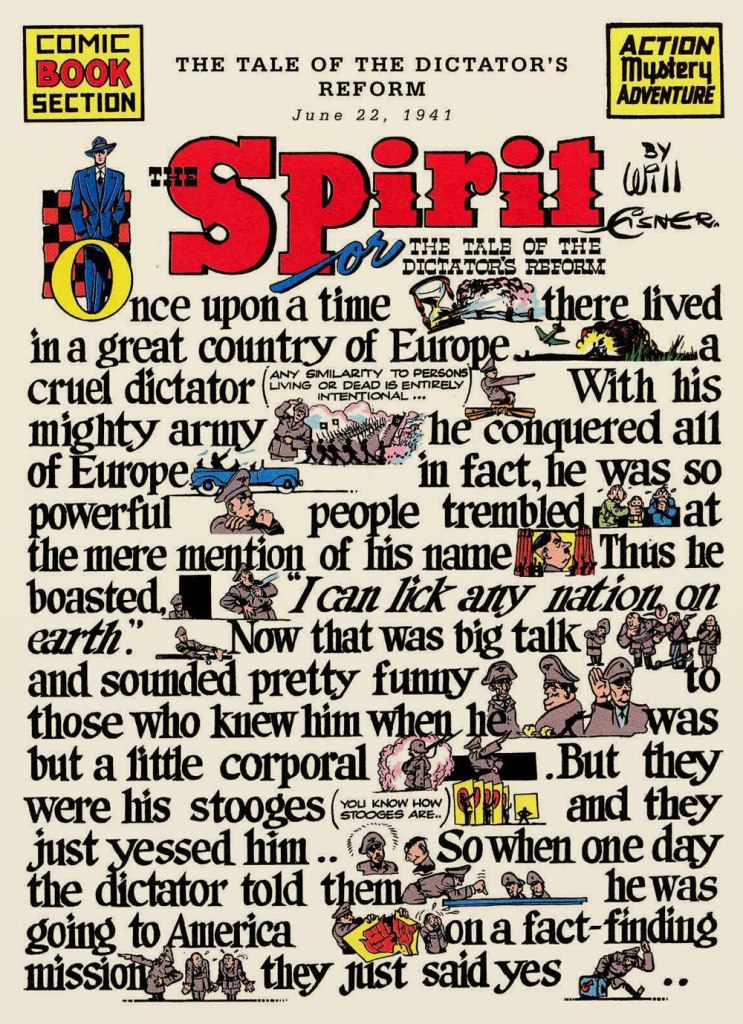
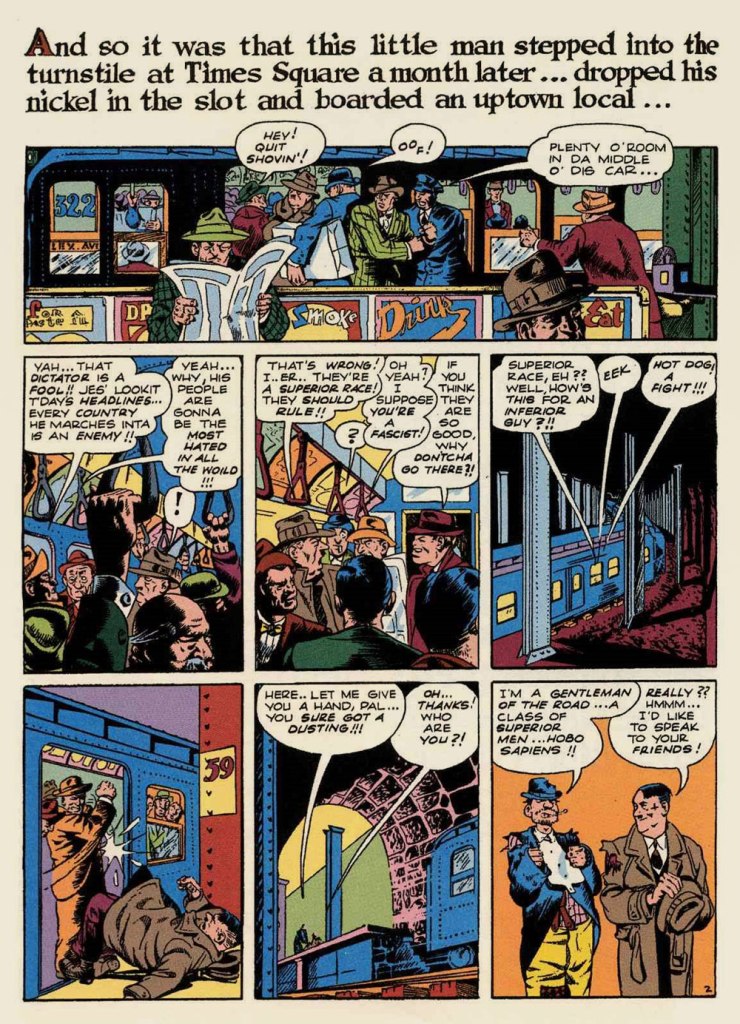
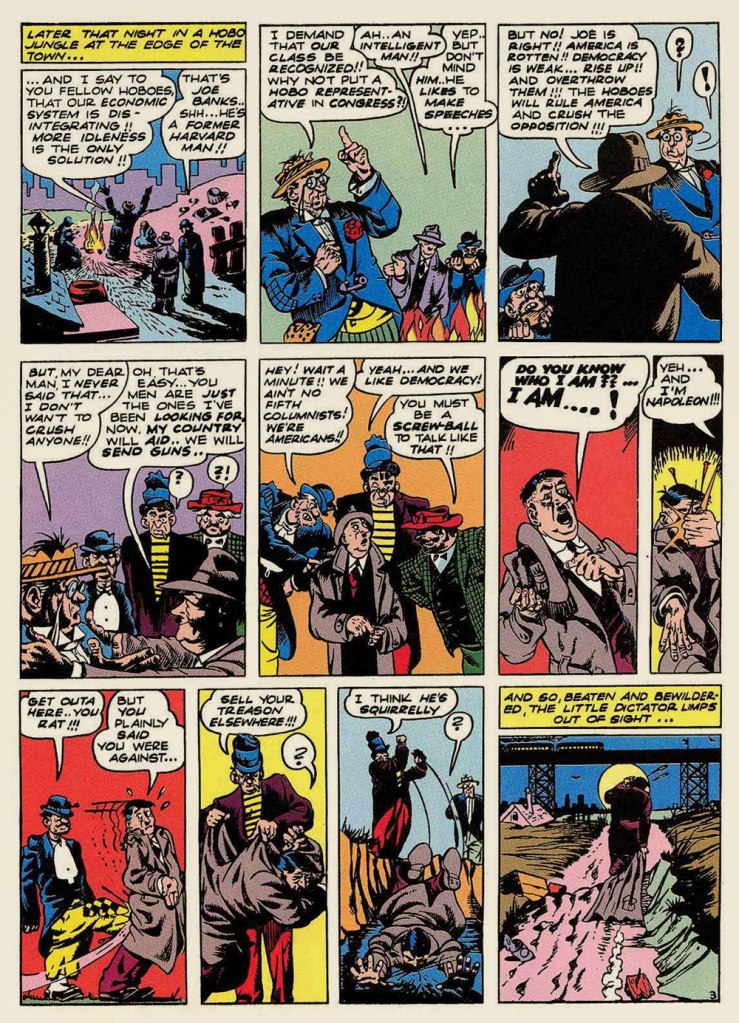
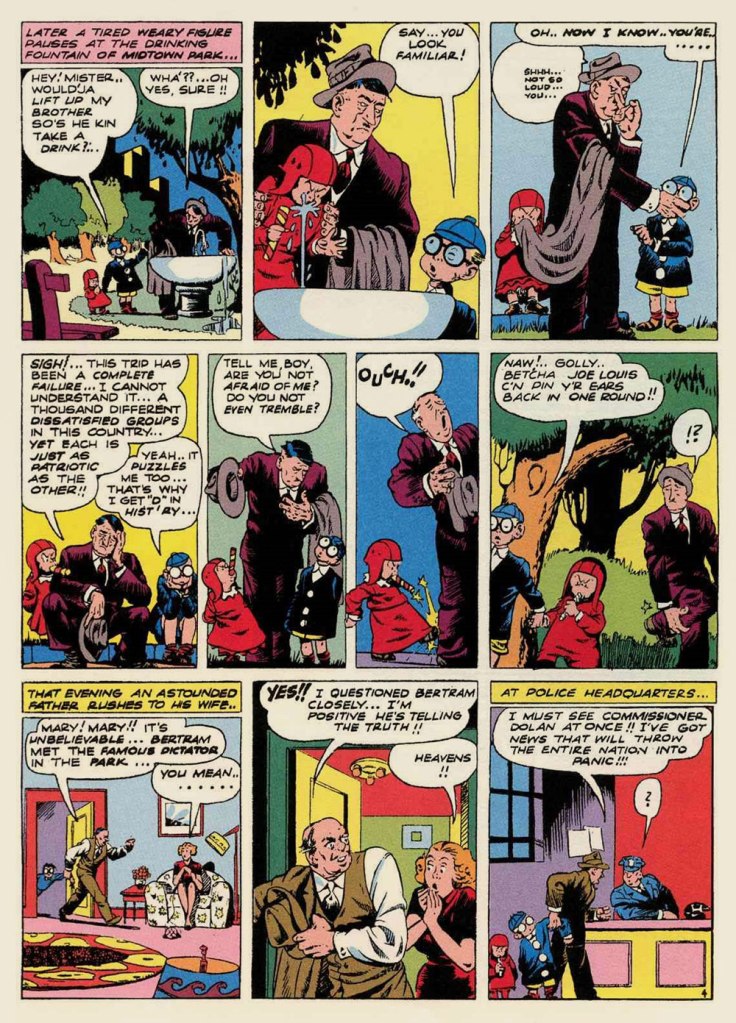
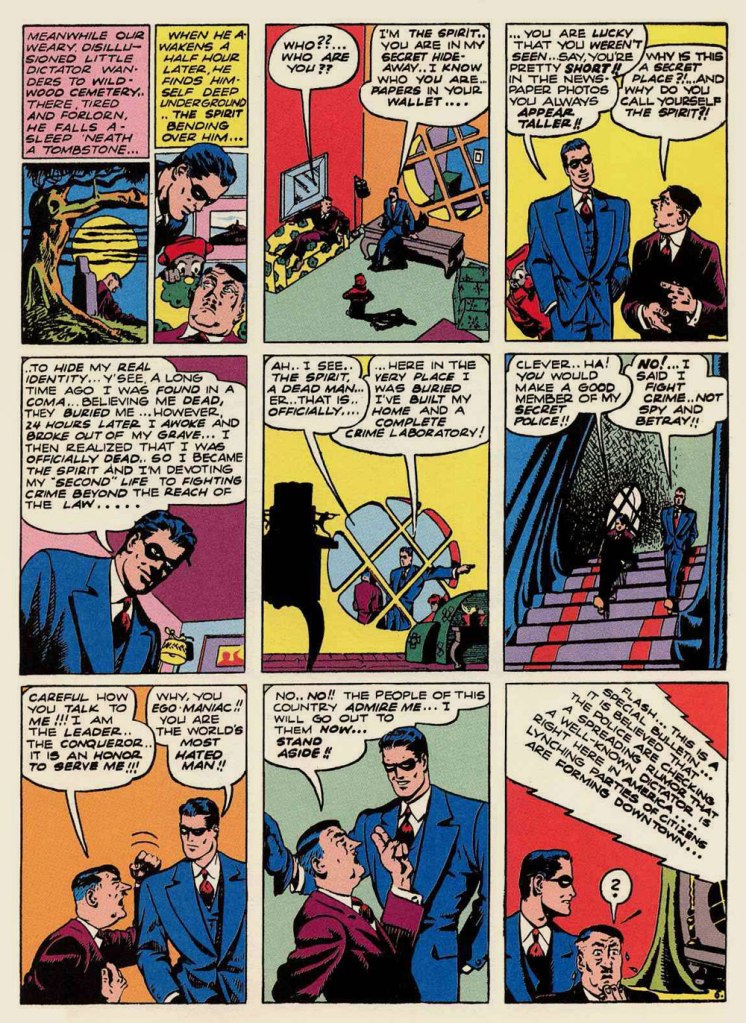
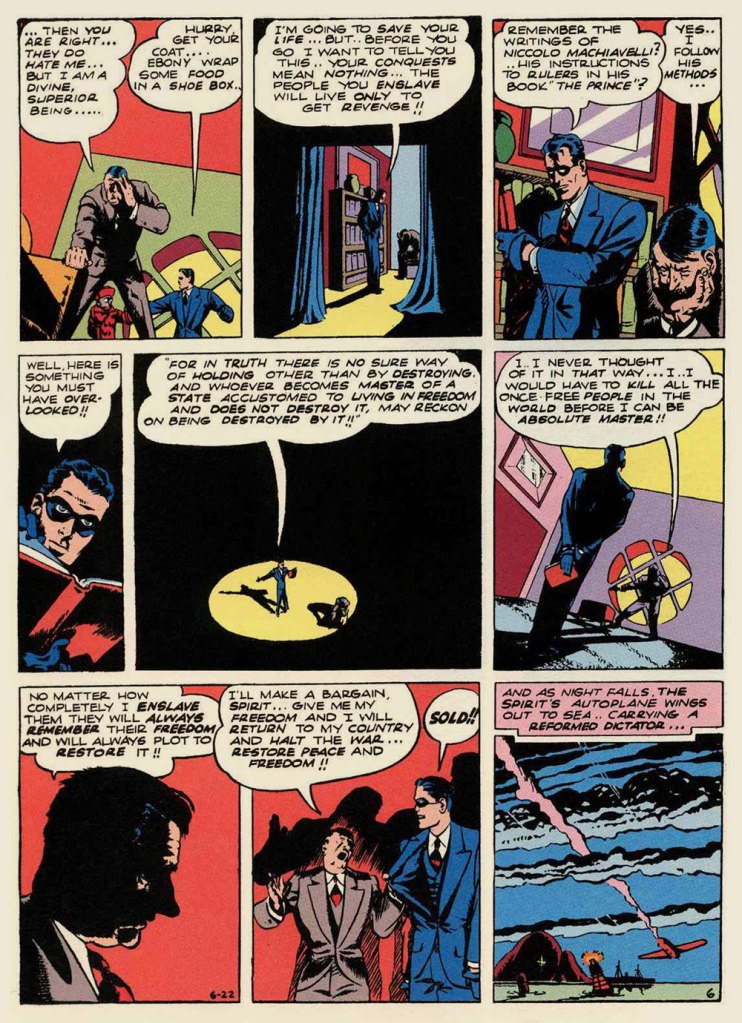
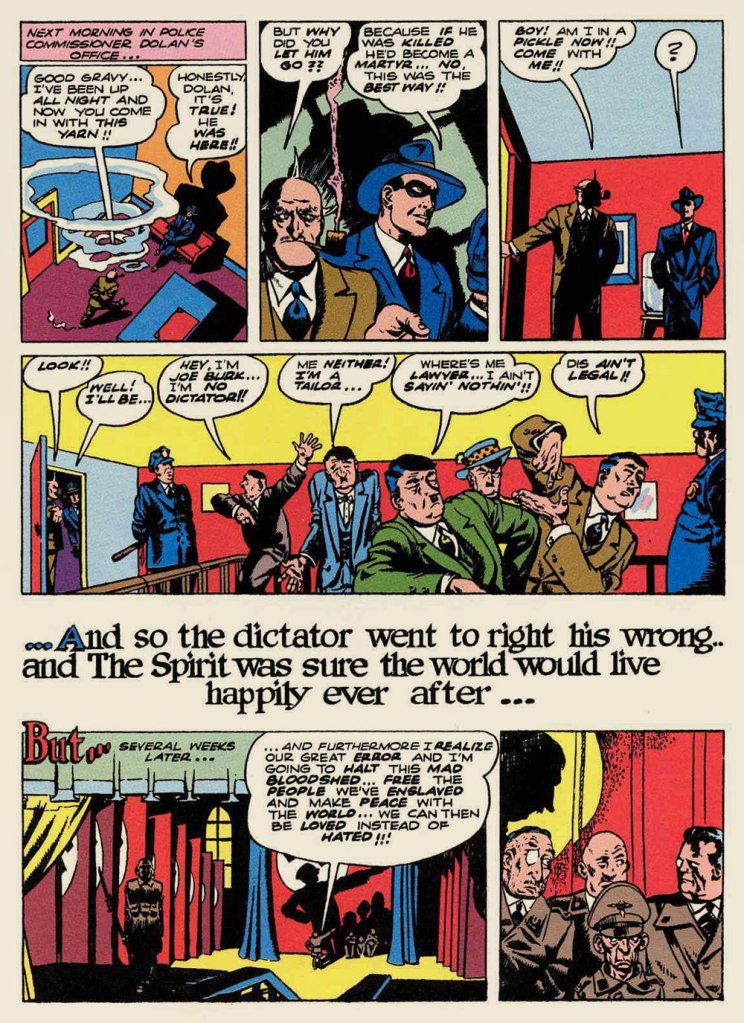
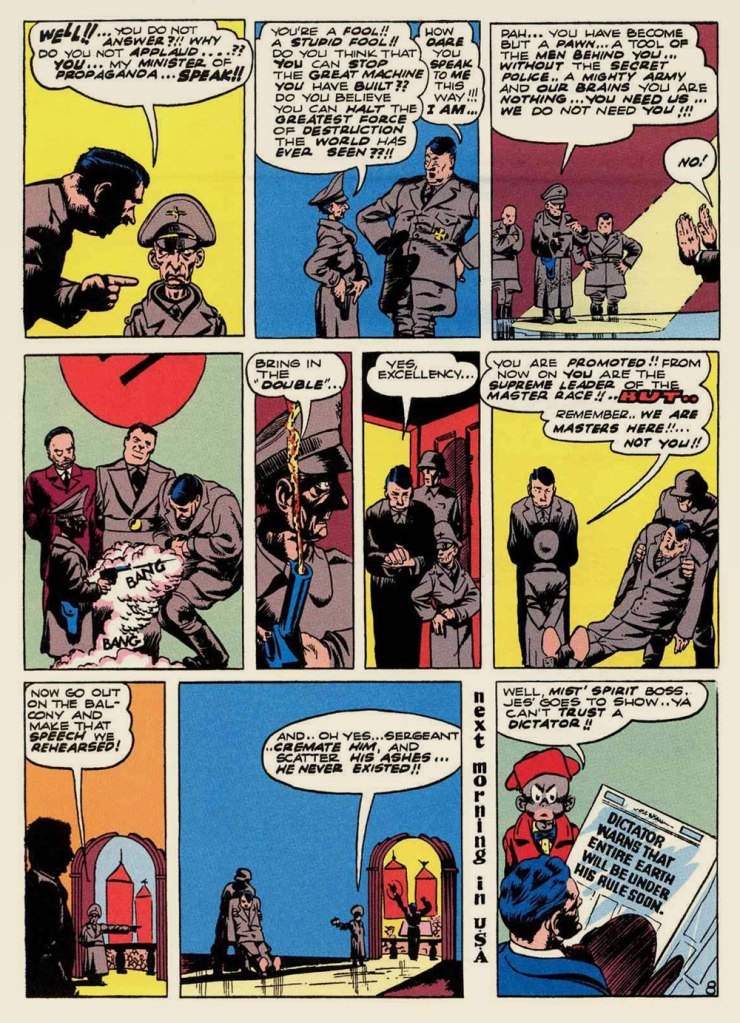
I was particularly taken with one gem near the end of the volume. And since America is currently awash in fascists and Brownshirts, Eisner’s political parable seems unnervingly apropos. See what you think!
Like it says at the top of page one, The Tale of the Dictator’s Reform was originally published on June 22, 1941. The United States’ December 9th entry into the war was still several months away.
This episode was cited as a solid favourite of his lone surviving The Spirit assistant*, the mighty Jules Feiffer (born 1929) in his pioneering work of comics history, 1965’s The Great Comic Book Heroes. Mr. Feiffer wrote: « Eventually, Eisner developed story lines that are perhaps best described as documentary fables — seemingly authentic when one reads them, but impossible, after the fact. There was one about Hitler walking around in a Willy Lomanish middle world: subways rolling, Bronx girls chattering, street bums kicking him around. His purpose in coming to America: to explain himself, to be accepted as nice guy, to be liked. Silly when you thought of it, but for eight pages, grimly convincing. »
When the story finally was reprinted — some sixteen years after Feiffer’s tantalising plot summary — in Will Eisner’s The Spirit no. 32 (Dec. 1981, Kitchen Sink), associate editor Cat Yronwode added: « Indeed, the story is all that Feiffer said of it and more. He forgot to mention that The Spirit fixed Der Fuehrer a nice bag lunch, for instance, and obligingly flew him home after his American sojourn. It’s been a long time coming, but at last we can proudly bring you this little gem, possibly the most eccentric political homily ever produced in the comics form. Enjoy it, but don’t ask for more of the same. It’s unique. »
-RG
*the next-to-last Spirit assistant, Don Perlin, passed away earlier this month. He had pencilled three stories over Feiffer’s layouts in 1951, late in The Spirit’s run.
« … And so Hooten Landing remained unchanged through the years… a landmark and a memorial… a colonial world that had made only one or two concessions to the march of progress. » — From Ye Olde Spirit of ’76 (July 3, 1949)
Having reached the last half of Kitchen Sink’s chronological reprinting of the Post-WWII Spirit, we come at last to the end of our own chronicle. As stated earlier, facing an inexorable dwindling of Eisner’s involvement and investment in his creation due to other commitments and an understandable sagging of his stamina, the strip slowly entered its decline. Then as now, good help was hard to find, to the point where Eisner opted to wrap up the strip rather than let it peter out completely. This sober and courageous decision most certainly contributed in preserving the feature’s solid reputation to this day.
As we embark on the inarguably lesser half of the run, we encounter fewer standout covers, which is to be expected, given the creator’s diminished affection for the contents. Nevertheless, forty-four Will Eisner covers are bound to yield some genuine sparklers. Here, then, are my picks.
Kitchen Sink Press’ The Spirit no. 46 (July 1988) cover-features Satin, originally published on June 12, 1949. Also in this issue: the clever and entertaining The Prediction (June 19, 1949); The Elevator (June 26, 1949); and Ye Olde Spirit of ’76 (July 3, 1949). Cover by Eisner, with colours by Ray Fehrenbach. Obviously, we’re still in classic territory.
This is The Spirit no. 46 (Aug. 1988), which, over six instalments, « takes The Spirit to the Peligros, a fictional group of South Pacific islands, where he interacts with an entirely new set of characters, cultures and adventures. » The issue opens with Lilly Lotus(July 10, 1949); then follows with Sally of the Islands (July 17, 1949); The Masked Man (July 24, 1949); and The Ball Game (July 31, 1949), introducing latter-day sidekick and comic foil Sammy. Cover colours by Ray Fehrenbach.
This is The Spirit no. 47 (Sept. 1988), which wraps up the masked man’s Pacific Island with the cover-featured Matua (Aug. 7, 1949), followed naturally by The Return (Aug. 14, 1949); then it’s back to Central City business with The Candidate (Aug. 21, 1949) and White Cloud (Aug. 28, 1949). Cover colours by Ray Fehrenbach.
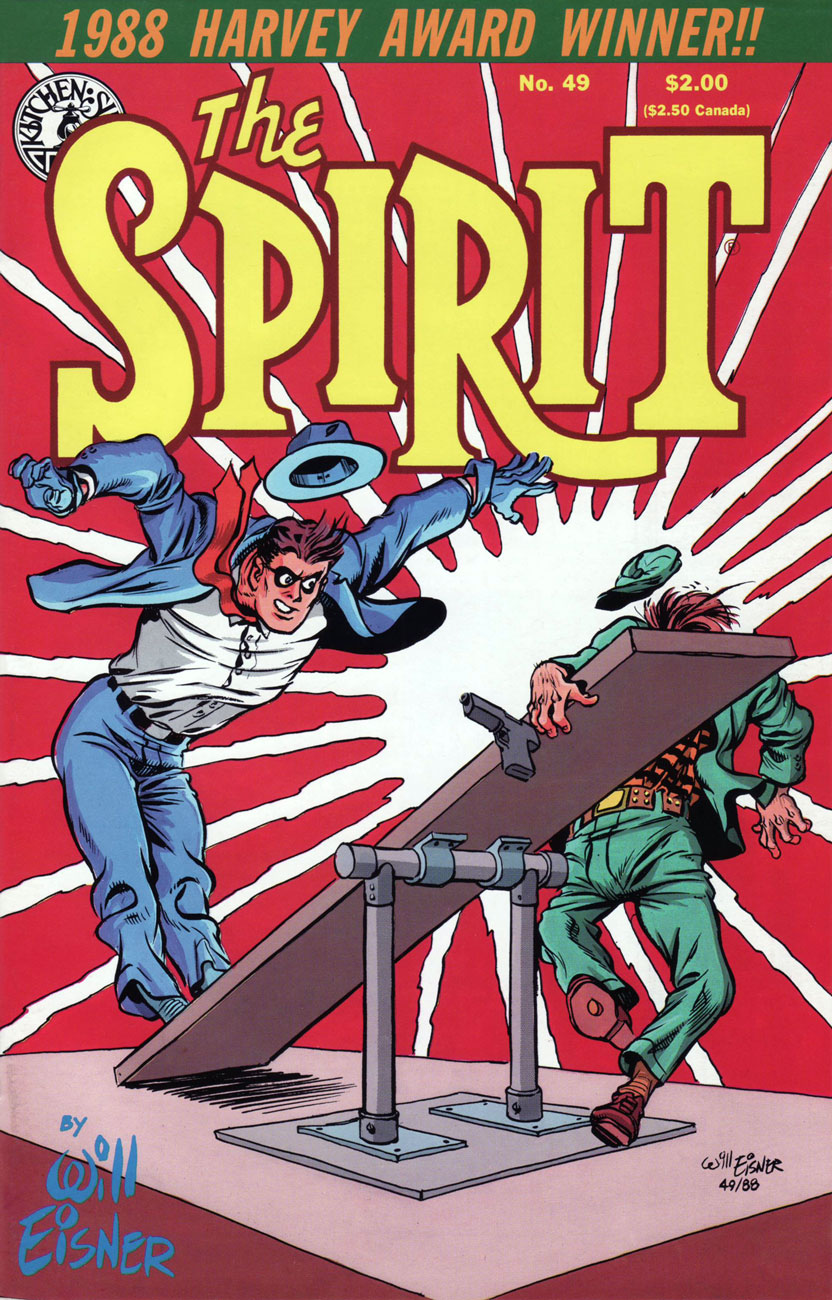
This is The Spirit no. 49 (Nov. 1988), presenting Crime (Oct. 2, 1949); Death of Autumn Mews (Oct. 9, 1949) partly a retelling of the former Denny Colt’s origin, and boasting a true-blue classic splash page; The Curse (Oct. 16, 1949); and Fox at Bay (Oct. 23, 1949). Cover colours by Ray Fehrenbach. Incidentally, The Spirit was the 1988 Harvey Awards laureate in the category of “Best Reprint Project”.
This is The Spirit no. 50 (Dec. 1988). Gathered therein are the Hallowe’en tale of Elect Miss Rhinemaiden of 1950 (Oct. 30, 1949), featuring the return of the sorcerous Hazel P. Macbeth; The eerie The Inner Voice (Nov. 6, 1949); Surgery… (Nov. 13, 1949); and The Thanksgiving Spirit (Nov. 20, 1949). And yes, The Spirit spends the entire issue on crutches. Eisner was ever the innovator! Cover colours by Ray Fehrenbach.
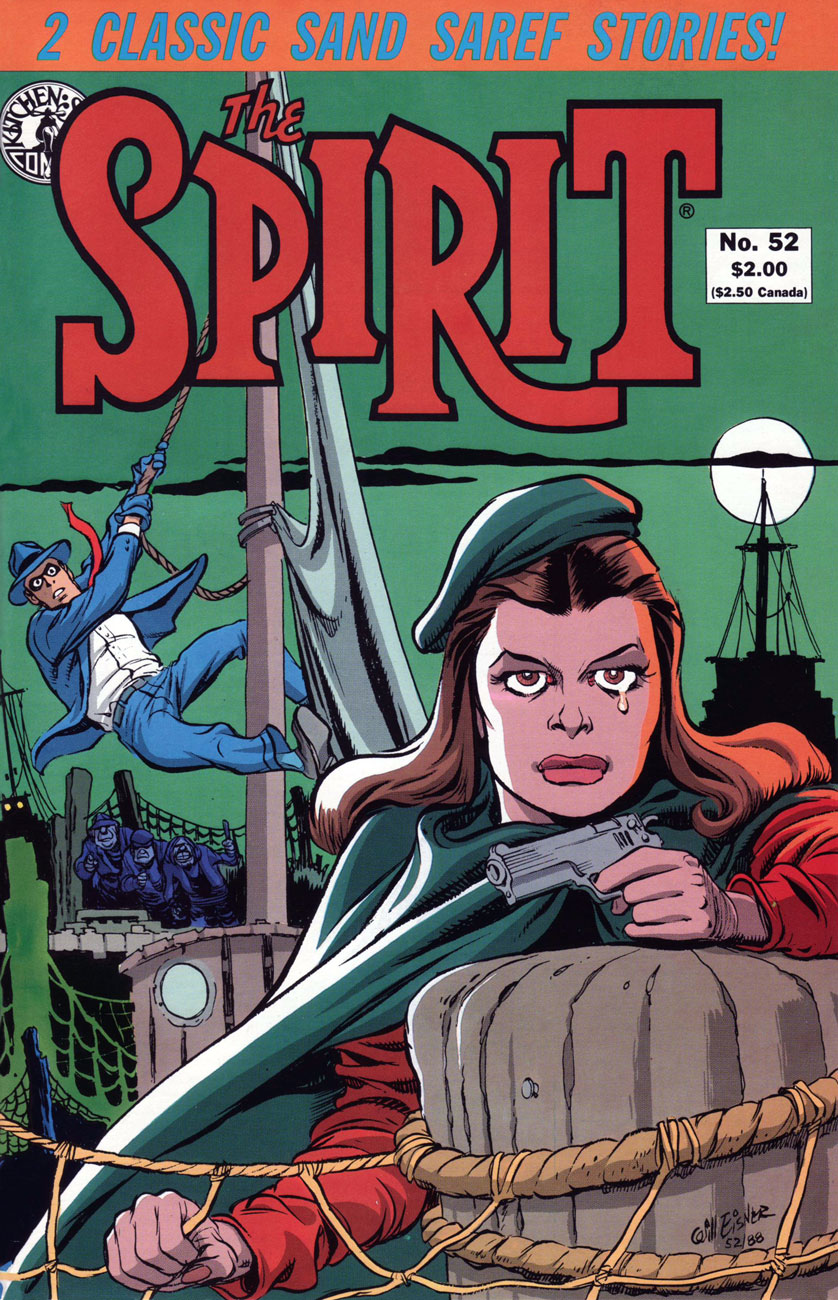
This is The Spirit no. 52 (Feb. 1989), and it cover-features the classic Bring in Sand Saref (Jan. 15, 1950); also in this issue: The Christmas Spirit (Dec. 25, 1949); Fan Mail (Jan. 1, 1950); and part one of the cover story, Sand Saref (Jan. 8, 1950); this cover bears some outstanding colour work by Mr. Fehrenbach, if I may say so.
Some background about the classic Sand Saref two-parter, from Tom Heintjes‘ Stage Settings column:
« The final two stories form one longer tale, and they’ve earned a place in comics history. Eisner’s work and film noir have been mentioned in the same breath for decades, and you hold in your hands one of the best reasons why. »
« The story’s history is unorthodox. Sand Saref and Bring in Sand Saref had their origins in Eisner’s shop, which had been producing various comic books and pieces of commercial art with growing frequency. The two stories were originally done as a single 11-page feature, but it didn’t star The Spirit. The lead character was John Law, a character Eisner intended to launch independently of The Spirit feature.
When the John Law project was shelved due to the often poor newsstand distribution of many comic books, Eisner later saw an opportunity, and seized it by breaking the 11-page John Law feature into a two-part Spirit story. Astute readers are now saying: ‘But Spirit stories are seven pages long, requiring fourteen pages of art.‘ Well, there are no flies on Will Eisner. He created the first three pages of ‘Sand Saref’ to bring up the page count.
Eisner said breaking the John Law story into two halves, eliminating all traces of the intended hero, and inking in the faces of The Spirit’s cast of characters wasn’t simple. “The characters were different people, so considerable dialogue had to be rewritten,” he said. “John Law was a policeman and The Spirit wasn’t. Merely because they both fought on the side of law and order didn’t make them the same character.” In fact, Eisner has Sand Saref tell The Spirit ‘you’re a cop’ in the climax of the 14-page story. »
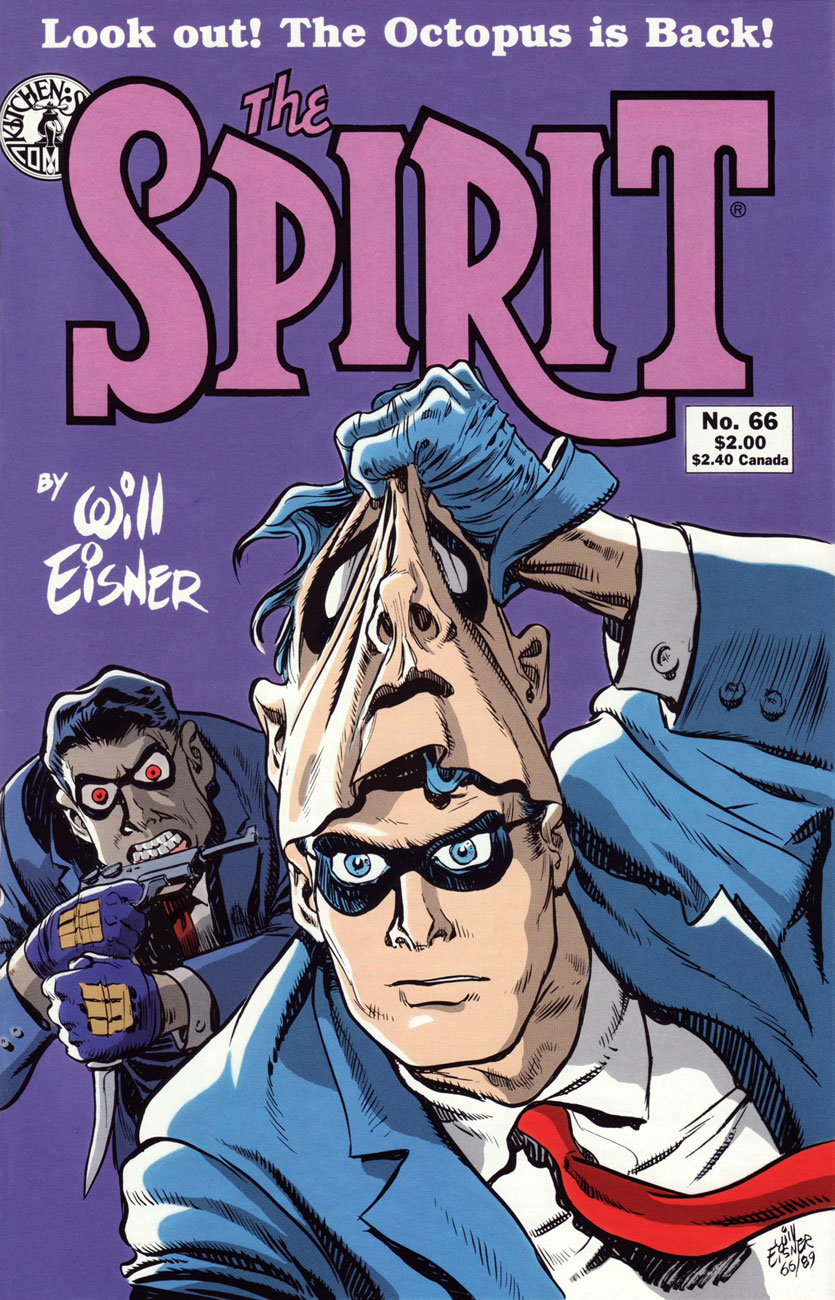
This is The Spirit no. 66 (Apr. 1990), and the issue reprints Future Death (Jan. 21, 1951); The Meanest Man in the World (Jan. 28, 1951); the shadowy, ultra-violent Showdown (Feb. 4, 1951); and its cover-featured conclusion, The Octopus Is Back (Feb. 11, 1951). Cover hues by none other than Joe Matt!
The Spirit no. 69 (July 1990) reprints Time Bomb (Apr. 15, 1951); Hobart (April 22, 1951); Help Wanted (April 29, 1951); and cover-featured The Facts (May 6, 1951); Ray Fehrenbach is back on colours.
The Spirit no. 70 (Aug. 1990) reprints The Hero (May 13, 1951); The 7th Husband (May 20, 1951); King Wang (May 27, 1951); and The Thing in the Jungle (June 3, 1951); Eisner’s cover illustration mixes elements of the second and fourth stories, and it is ably coloured by Ray Fehrenbach, comme d’habitude.
This is The Spirit no. 85 (Nov. 1991), featuring The Ballad of Greenly Sleeve (July 6, 1952); Matt Slugg (July 13, 1952); Marry the Spirit (July 20, 1952) and of course, the sadly tantalizing cul-de-sac that was Jules Feiffer and Wally Wood‘s Outer Space (July 27, 1952). Cover by Eisner and colours by Fehrenbach.
A word or two about The Outer Space Spirit, as it’s come to be called: Eisner, looking for a worthy successor to bequeath the strip to, found young Wally Wood. Talented as he was, Wood’s tragic character flaws were already well established: unlike Eisner, he couldn’t pace himself and he couldn’t stay the course, two qualities essential to the steady production of a comic strip. But for the couple of weeks before Wood started missing deadlines, such lush, interstellar beauty! Feast your peepers here.
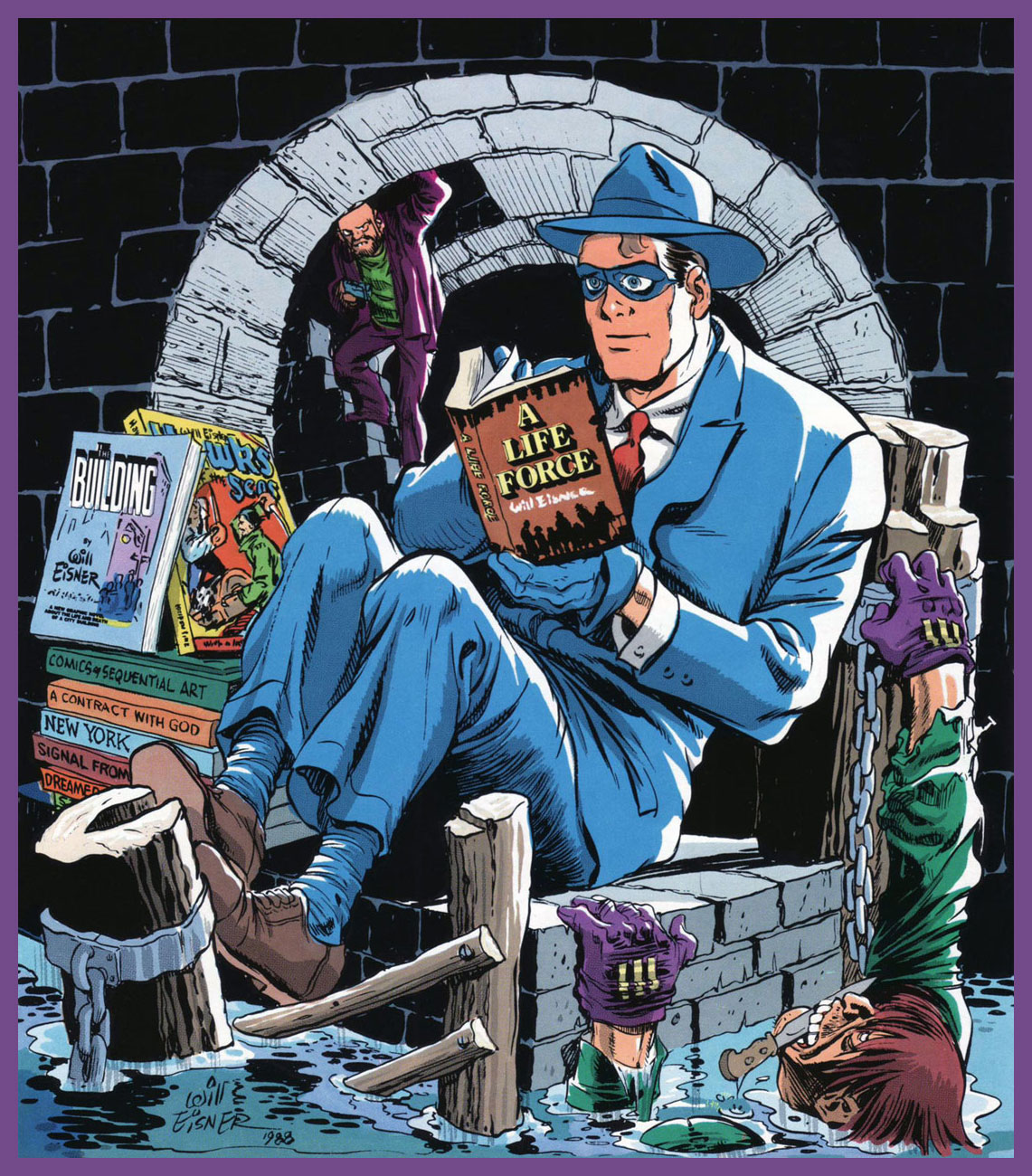
Finally, as a bonus: detail from a Kitchen Sink house ad devoted to the publisher’s more-than-fine assortment of Eisnerania; it first appeared on the back cover of The Spirit no. 45 (July, 1988).
Well, that’s it! Thanks for tagging along on Will Eisner and his most famous creation’s tireless peregrinations.
If you’ve missed the earlier entries in the series (punctuality is not one of your strong suits, is it?), all is not lost. In fact, it’s all handily archived within easy reach :
… or if single-clicking is more your speed (takes all kinds!), there’s always our general category, That’s THE SPIRIT!, which will bring up everything at once… but in chronologically inverse order.
« Our story opens on a rainy night on Central City’s waterfront… »
Continuing our chronicle of The Spirit’s wanderings from harbour to harbour over the decades, we make land today at pulp and comic book producer Fiction House, whose “Big Six” were the blandly-named but action-packed Fight Comics (86 issues, 1940–1954), Jumbo Comics (167 issues, 1938–1953), Jungle Comics (163 issues, 1940–1954), Planet Comics (73 issues, 1940–1953), Rangers Comics* (69 issues, 1941–1953) and Wings Comics (124 issues, 1940–1954). Compared to these, The Spirit’s five-issue stay was but a blip. Still, since FH’s art director was none other than Eisner’s old partner Samuel Maxwell “Jerry” Iger (1903-1990), this particular match is unsurprising.
Of course, it wasn’t common knowledge at the time, but these issues comprise little else but what came to be known as “the post-Eisner Spirit”, inarguably inferior work with the occasional highlight, generally a Jules Feiffer script let down by the visuals.
According to Eisner, interviewed in 1990 by Tom Heintjes: « Looking back, I have to say that it’s a blemish on my career that I allowed The Spirit to continue through this period, because I compromised the character just because I was busy with other things. That’s not to say that these are all bad stories, but they just don’t have the consistent outlook they had when I was directly involved. » « I look at these stories and I want to cringe – again, not because they’re bad, but because only the merest essence of the character is retained. »
This is The Spirit no. 1 (Spring, 1952), featuring The Case of the Counterfeit Killer (Sept. 16, 1951), cover-featured The Curse of Claymore Castle (Nov. 4, 1951), The Plot of the Perfect Crime (Oct. 28, 1951), and Panic on Pier 8 (Aug. 19, 1951), each scripted by Feiffer. Cover artist unknown, but it’s a considerable improvement over the actual story.
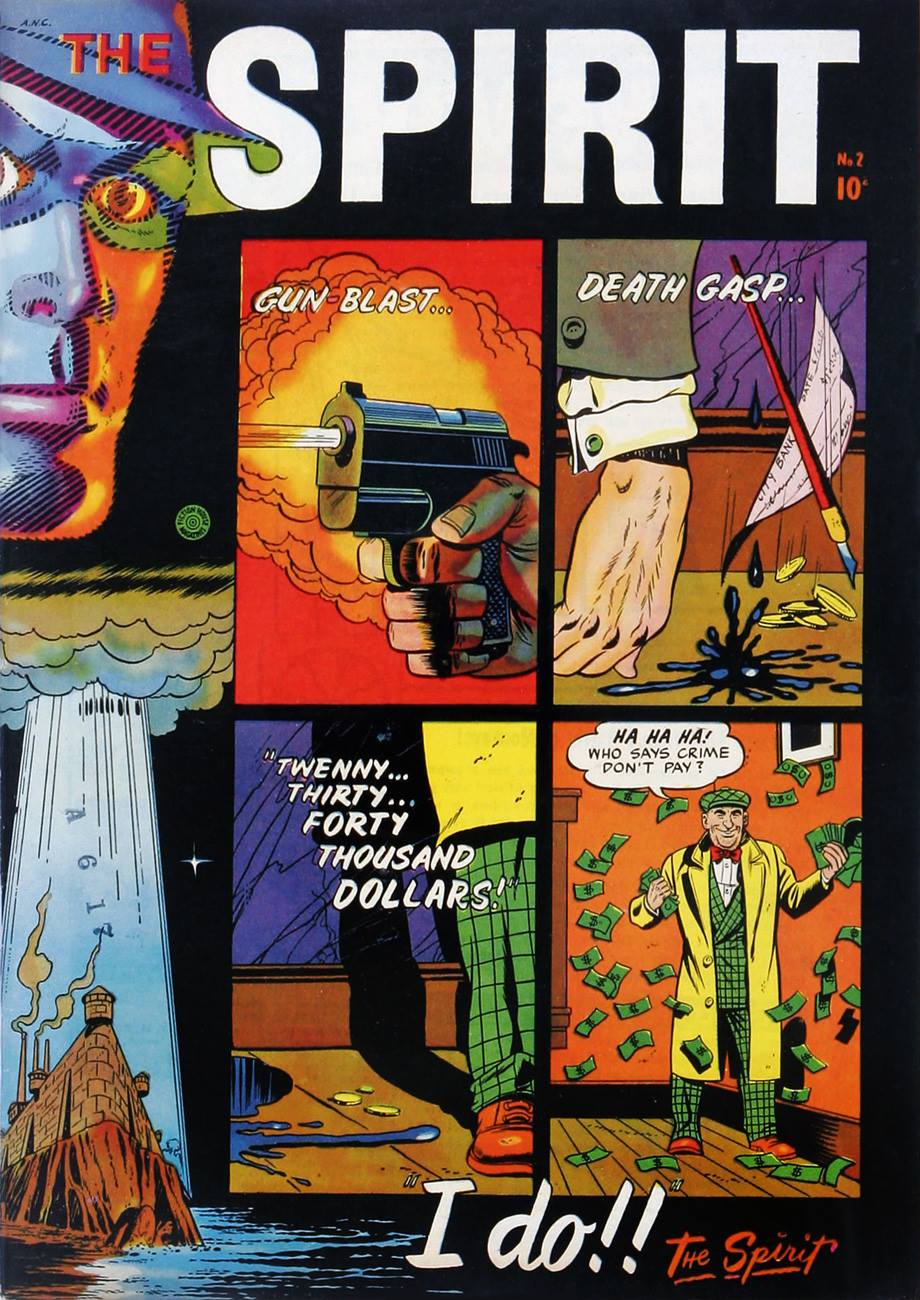
This is The Spirit no. 2 (Summer, 1952), reprinting The Amazing Affair of the First Man on Mars (Jan. 27, 1952), Contraband Queen (May 20, 1951), The Case of the Baleful Buddha (Nov. 18, 1951), and The $50,000 Flim-Flam (Apr. 15, 1951), the final three benefiting from some Eisner involvement. Again, cover artist unknown., but isn’t that gorgeously coloured?
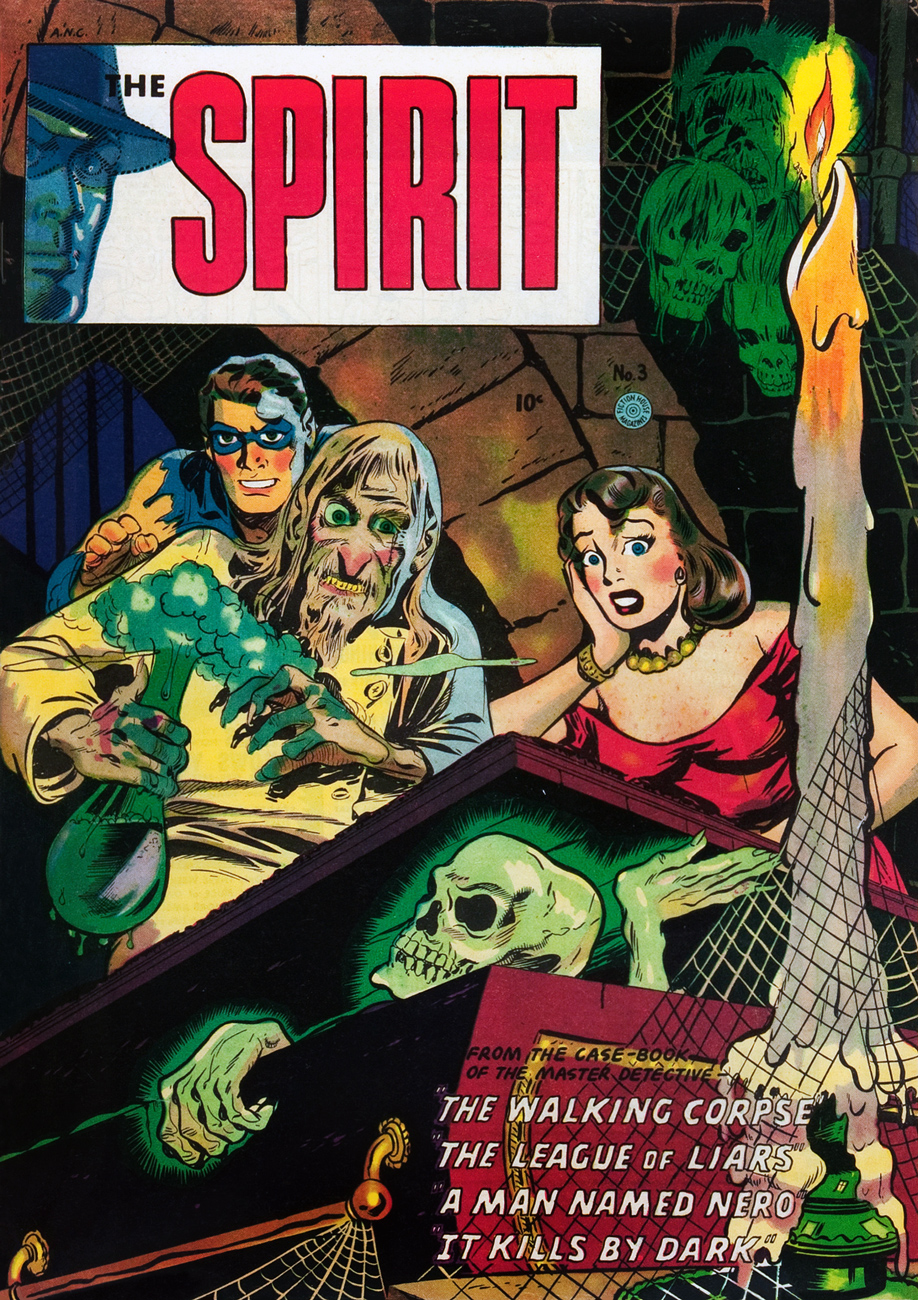
Ah, we’re getting more Eisner-ish, though not quite all the way. This is The Spirit no. 3 (1952), featuring The Walking Corpse (Mar. 9, 1952), It Kills by Dark (Feb. 24, 1952), The League of Liars (Nov. 25, 1951), and A Man Named Nero (Feb. 3, 1952). The first three are scripted by Feiffer, and the fourth is undermined; I wouldn’t brag about that one either.
This is The Spirit no. 4 (1953), featuring The Last Prowl of Mephisto (Apr. 1, 1951), scripted and illustrated by a heavily-assisted and pressed for time Eisner; Design For Doomsday (Jan. 13, 1952), The Sword and the Savage (Sept. 2, 1951), and The Great Galactic Mystery (Apr. 20, 1952), these last three scripted by Feiffer. And another nearly-Eisner cover… he never would have made it this busy, I think.
This is The Spirit no. 5 (1954), cover-featuring Dragnet for Johnny Buffalo (Apr. 8, 1951), and also The Target-Man in 16-A (July 22, 1951), Damsels in Distress (a relative oldie from August 3, 1947), and The Loot of Robinson Crusoe (July 8, 1951), scripts a toss-up or a collaboration between Feiffer and Eisner. Now this cover I can buy as the genuine Eisner article: it’s a characteristic composition for him, and it’s sloppy in all the right places. The Spirit’s sidekick in this instance is Walkalong Haggerty, who saves his hide in “Dragnet..“
So concludes our masked crimefighter’s passage at Fiction House. Fortunately, the publisher’s art department and production values were top-notch, so accommodations were quite cozy. Next time out, we’ll see how The Spirit would fare at the hands of Harvey Comics and (separately) at those of that nefarious rascal, Israel Waldman, in the swinging Sixties.
-RG
*Fiction House’s Rangers Comics featured the excellent “The Secret Files of Dr. Drew“, which ran in issues 47 to 60 (1949-51); the feature was the combined work of several of Eisner’s top Spirit alumni, namely writer Marilyn Mercer, penciller-inker Jerry Grandenetti, and letterer Abe Kanegson. The first ten (of fourteen) episodes just about out-Eisnered Eisner, until he protested and put an end to that gorgeous nonsense. This lot was lovingly restored and collected by Michael “Mr. Monster” Terry Gilbert (2014, Dark Horse). If you ask me, it’s the sole reprint of vintage colour material bearing the Dark Horse brand worth a damn… because Gilbert handled the work himself.
It’s Jules Feiffer’s birthday! Break out the bubbly (not the cheap stuff)!*
Born on January 26th, 1929, today he turns a respectable 89. He’s still releasing new books, so let’s wish him many more happy and productive years.
If a book with no pictures has no use (according to Lewis Carroll’s Alice), I figure a blog post with no pictures is equally devoid of purpose, so here’s a few fun Feiffer bagatelles.
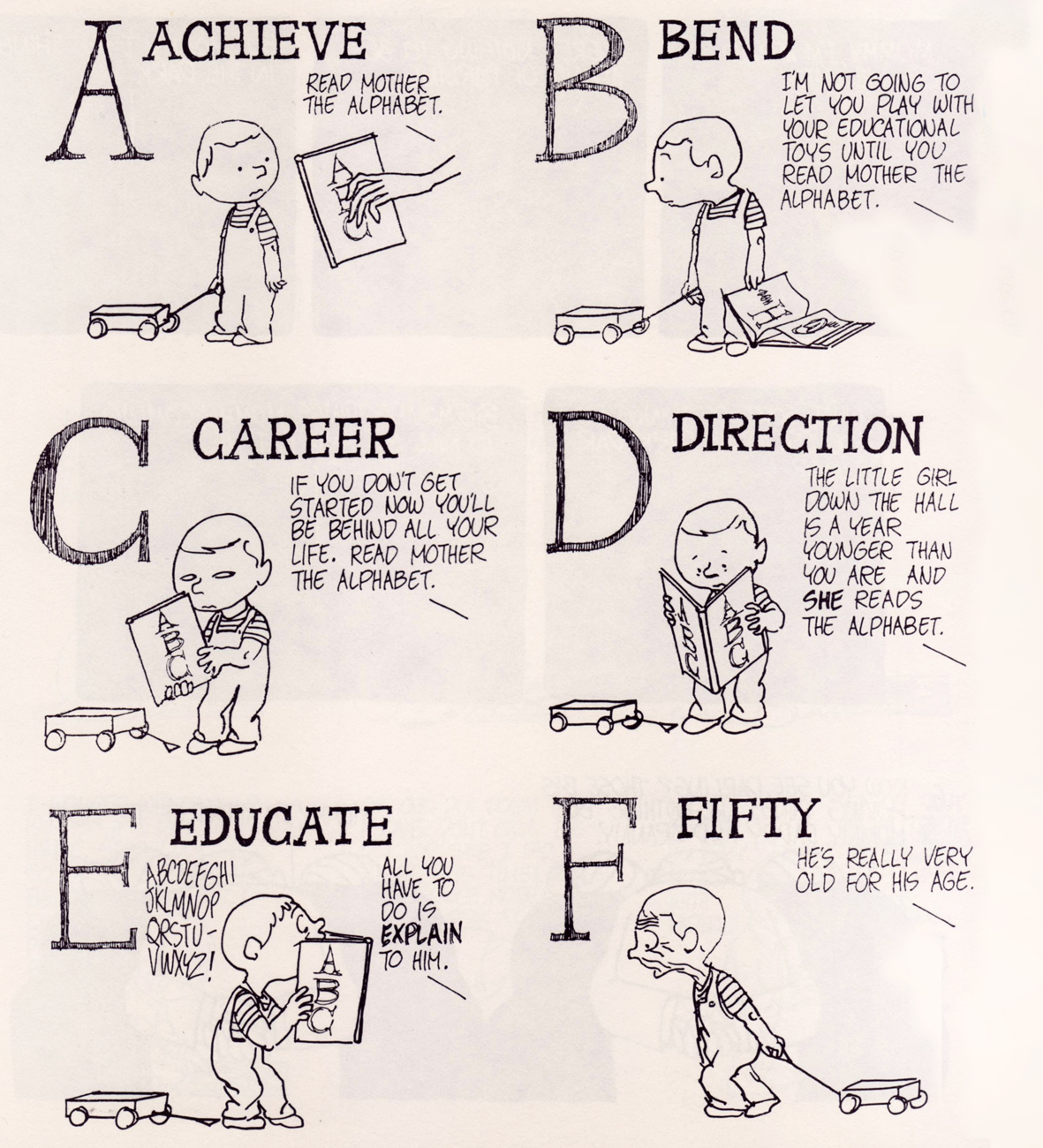
“Explainers: The Complete Village Voice Strips” was supposed to collect everything in four handy volumes, but unfortunately so far there’s only been one (published in 2008) and no mention of others to come. Still, it’s well worth seeking out. Check out an excellent review of it here, tempting you to it with this pithy quote:
« Explainers is a ‘dipping book’. It’s not something to storm your way through but something to return to over and again. Feiffer’s thoughts and language, his observations and questions are fearsomely eternal. Best of all, Feiffer’s expressive drawing is a masterclass in style and economy all by itself. »
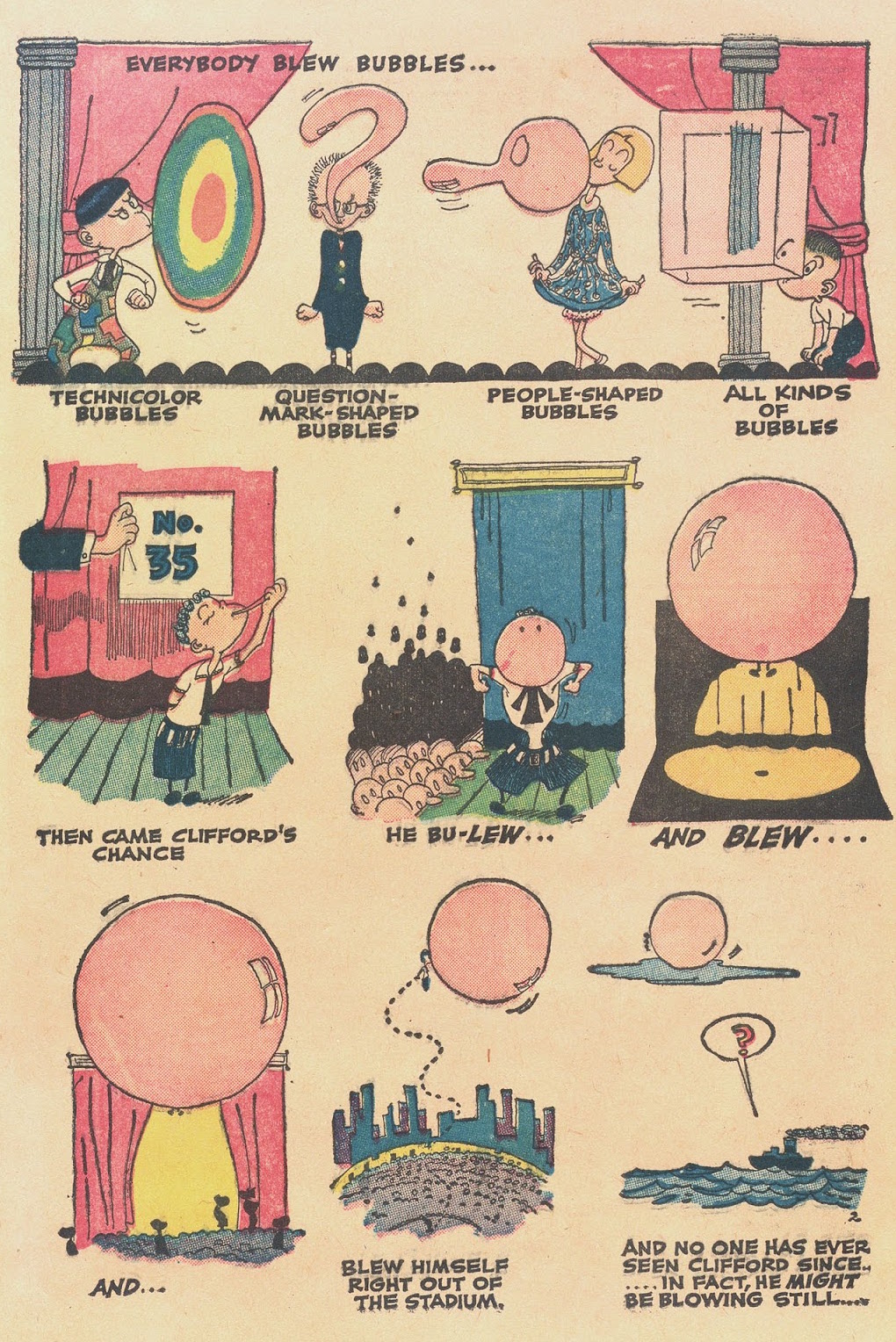
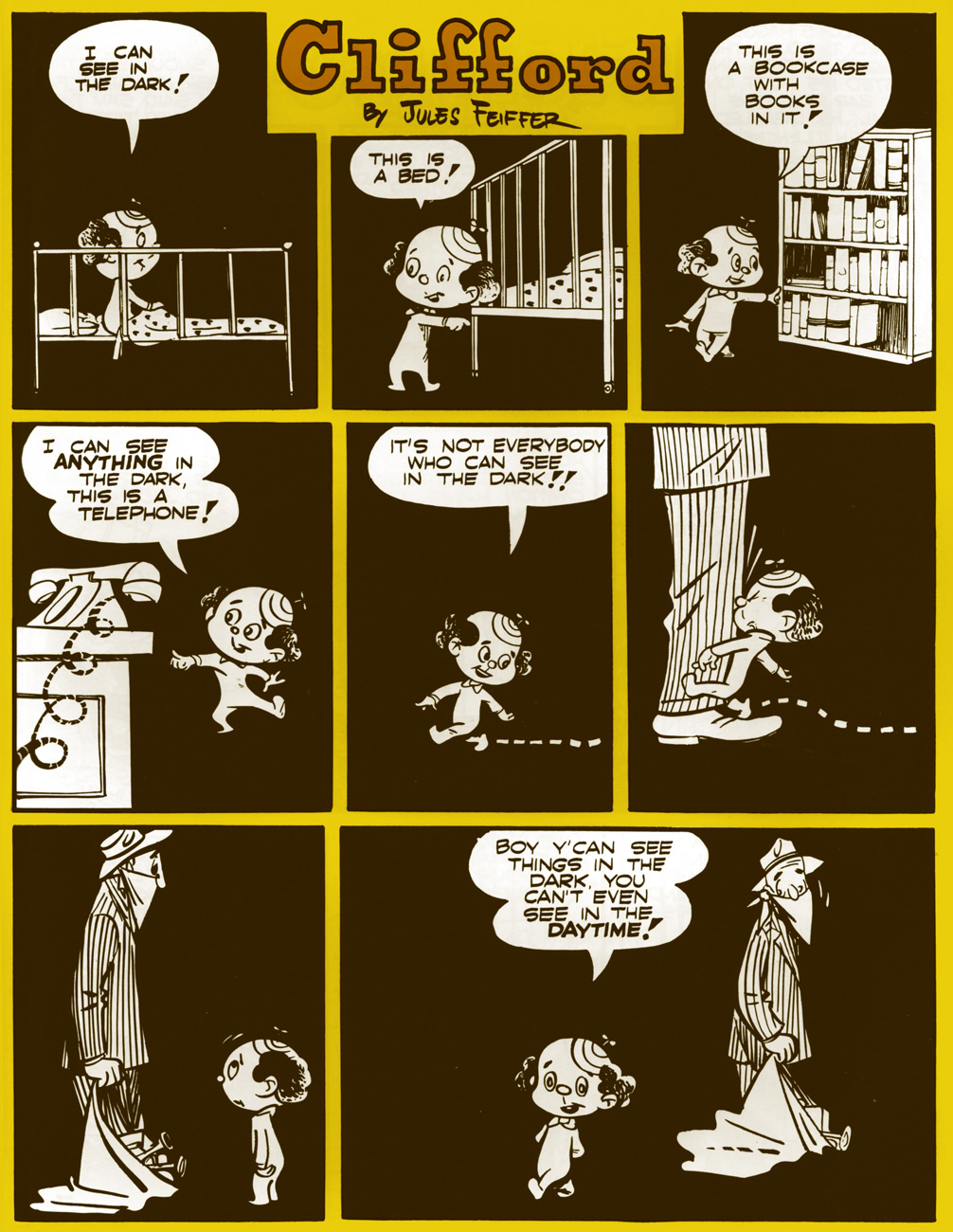
In his earlier years, Feiffer’s excitable, skittish pen was a little more subdued. Case in point: Clifford, Feiffer’s first published strip.
Kewpies #1, spring 1949.
Clifford first appeared in Kewpies #1 (spring 1949), published by Will Eisner, when Feiffer was but 20. In « Out of Line : the Art of Jules Feiffer » (2015), Martha Fay explains that Feiffer had the style of Walt Kelly’s Pogo in mind when he created Clifford.
Robert Boyd writes: « From 1949 to 1951, Jules Feiffer drew Clifford, which appeared in Will Eisner’s The Spirit Section, an eight-page comic book insert syndicated to newspapers. » This particular strip first saw print in the January 14, 1951 section.
Feiffer’s lively cover to his 1961 strip collection Boy, Girl, Boy, Girl (Random House)
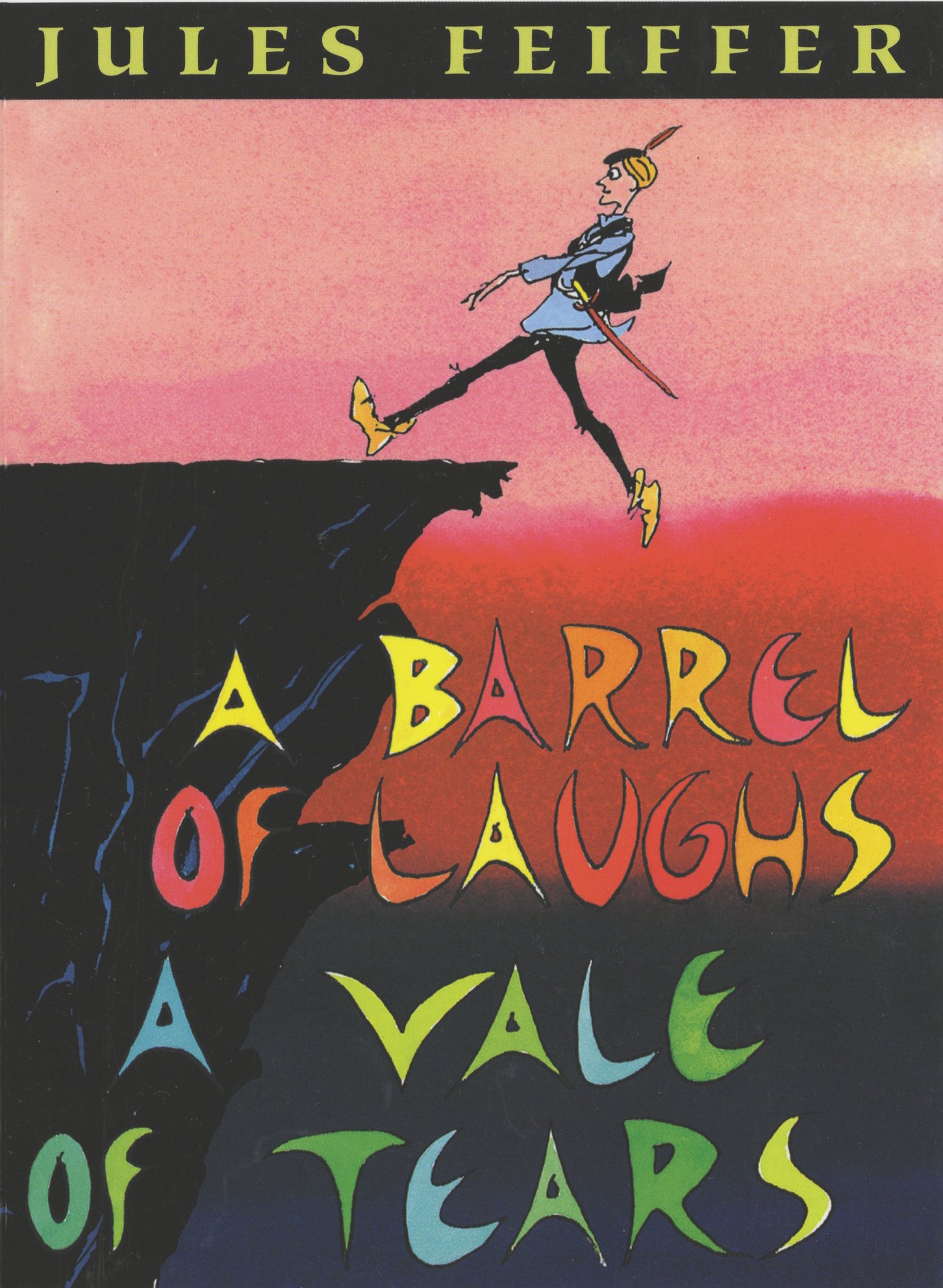
Nowadays, Feiffer is writing and illustrating children’s books. In an interview with Gary Groth, he explained that « They represent the gentler, sweeter world that, as we grow older, we go about corrupting first chance we get. No, that’s too cynical. Second and third chance we get. » They may be intended for children, but they are, for the most part, every bit as clever and multi-layered as the Feiffer-for-adults.
1995, Harper Collins.
What kind of plot would a Feiffer-book-for-children have, you ask?
« Prince Roger sets out eagerly on a quest and finds a few adventures, a lot of friends, a damsel or two in distress (not!) and himself, in the end. A ‘carrier of joy’ whose mere presence causes everyone to laugh uncontrollably, Roger finds cruelty and kindness equally amusing, and expects his quest to be a lark. It’s anything but: As Roger passes through the Forever Forest, nearly starves at the Dastardly Divide, sees people at their worst in the Valley of Vengeance, and temporarily despairs in the Mountains of Malice, he sobers up, learns to care for others, becomes an expert peacemaker, does Good Deeds, and falls in love with Lady Sadie, who says what she thinks as she repeatedly saves his bacon. »
Read an excellent (though 10 year-old) article from New York Times about Feiffer here.
~ ds / RG
*A triumphant return to the home town Treated with love and respect A special school assembly Before they would have broken my neck My favourite colour An E-type Jag Roll out the red carpet A glass of champagne – Not the cheap stuff!










 Who's Out There?