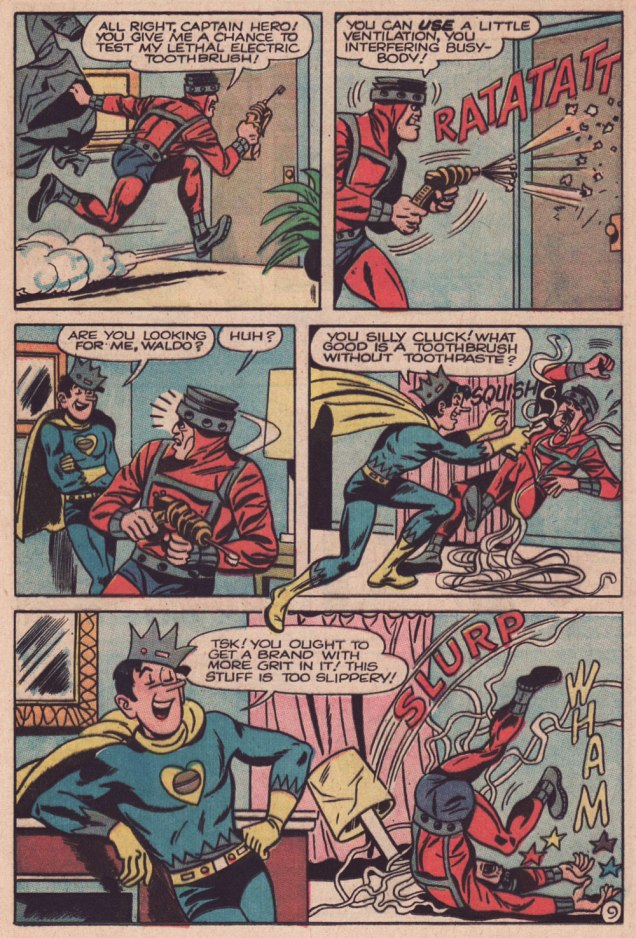
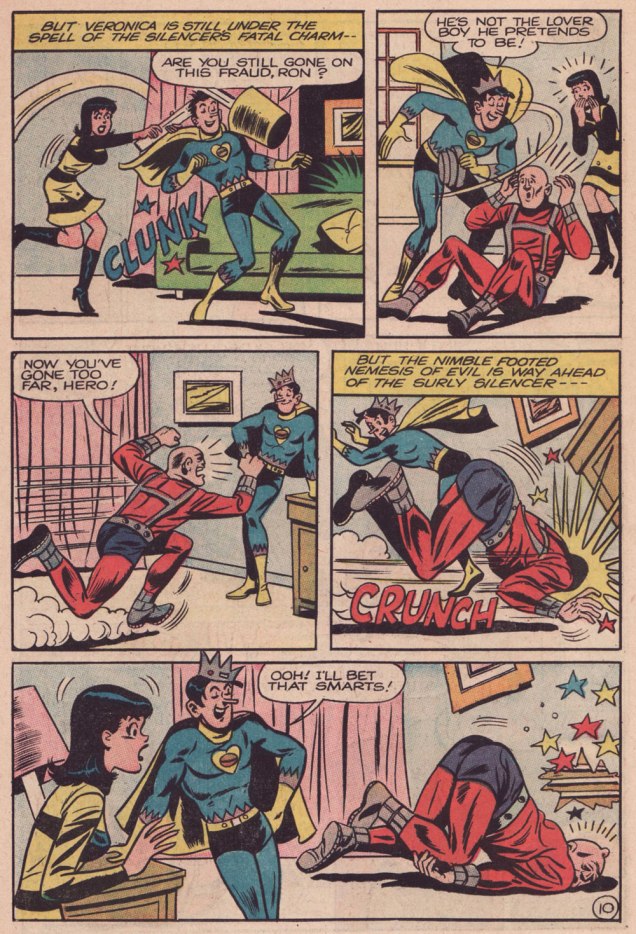
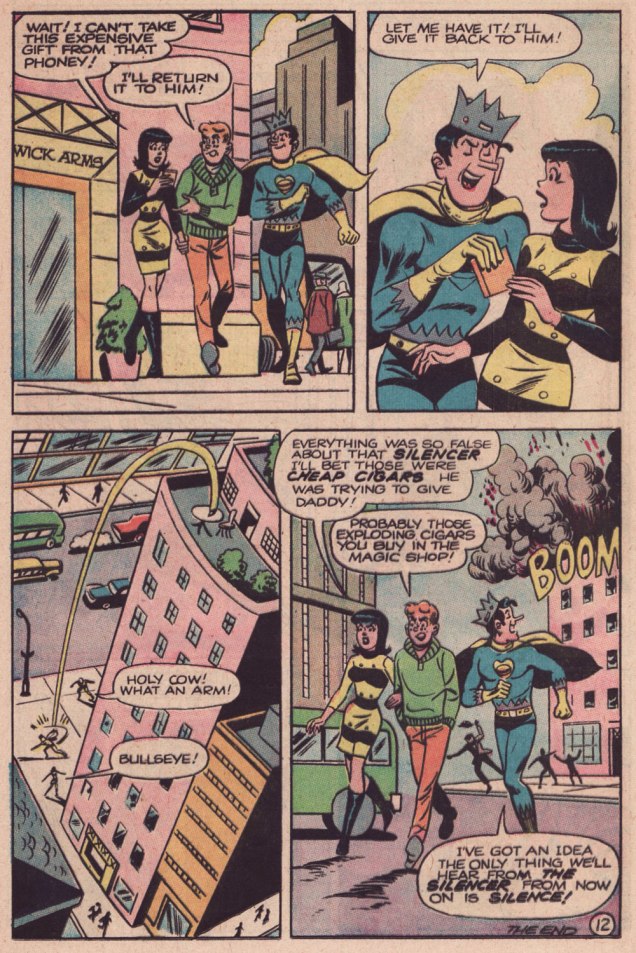
Captain Hero Shushes the Silencer!

« My collection of criminal creeps will get a real charge of hokey hassle of heroes! » — The Collector

Just last week, I read the bittersweet news that after half a century or so*, the evergreen, once-ubiquitous Archie Comics Digests are kaput… which brings us, in the usual roundabout fashion, to today’s post.

Though it’s been nearly three years since our big move, I expect to carry on practicing box archeology for a good long while, if not indefinitely. A couple of months ago, I dug out an Archie Digest I had picked up at my local newsstand back in 1981… and quite possibly never read. Until this year.

I’ve mentioned before that comics distribution was extremely spotty in my neck of the woods, so I often found myself glaring and wincing at the racks in desperation and taking home some ungainly specimen*. This was such a case, obviously.

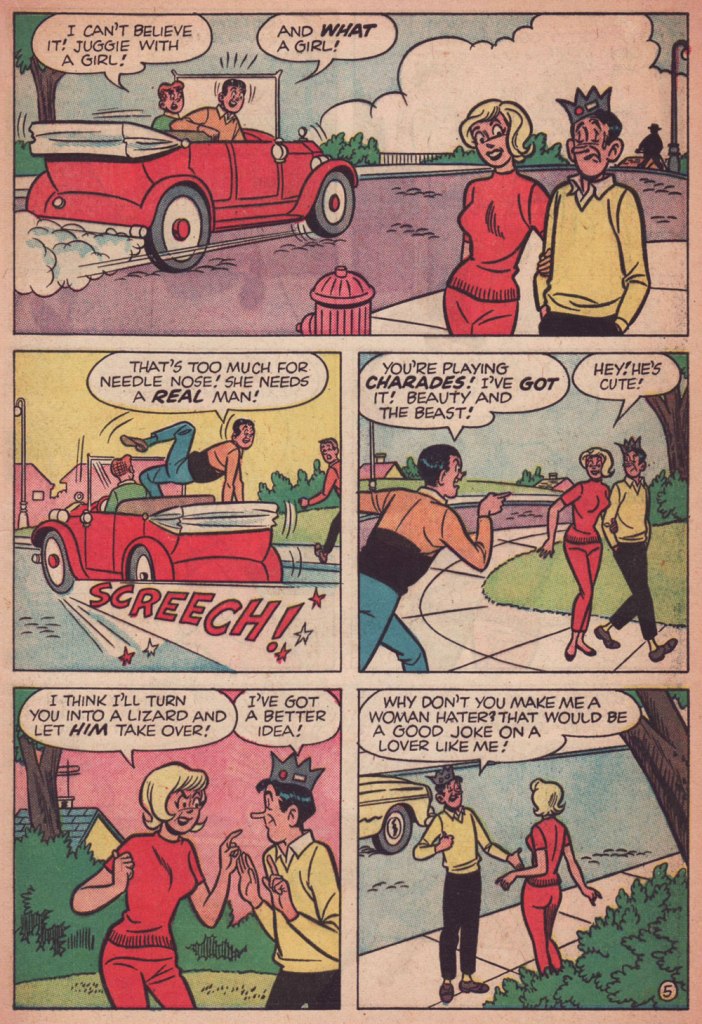
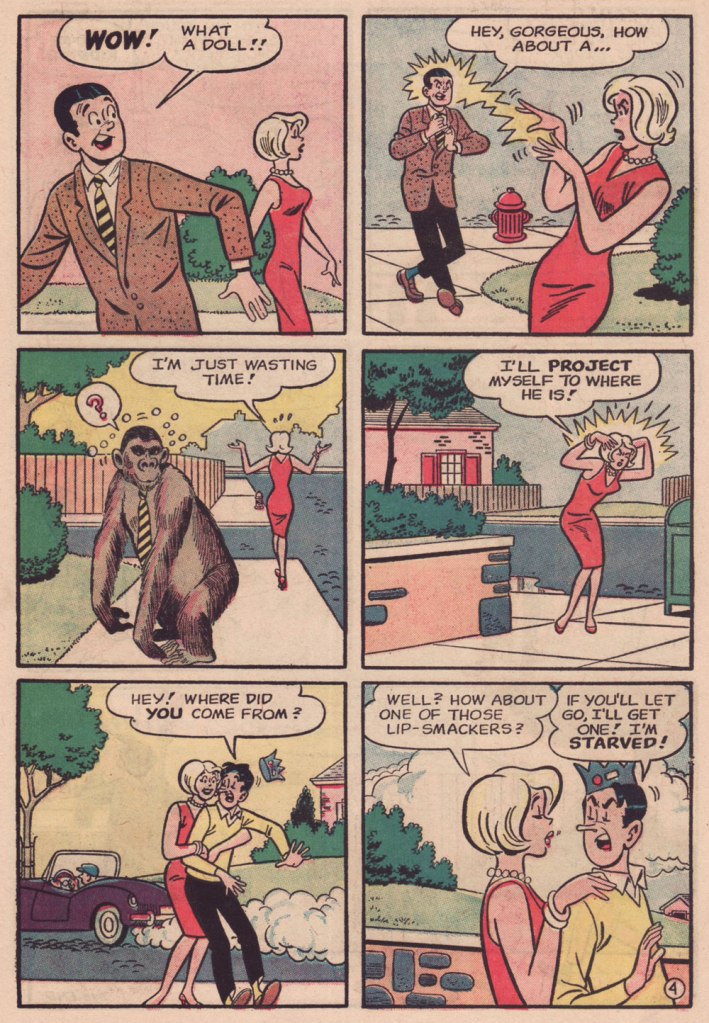
This is Captain Hero Comics Digest Magazine no. 1 (1981, Archie). Stan Goldberg’s cover is unspectacular, but better than his usual. Earlier this week, I got a good chuckle out of someone stating online that Goldberg “could do a damn good Dan DeCarlo“. I’d have to agree: Goldberg, at his peak, was nearly on the level of DeCarlo at his worst. Think I’m kidding? Here’s an example.

The Riverdale-Gang-as-Superheroes of the mid-1960s, just another bit of trend chasing** by the Archie brass, has never elicited much beyond a shrug from me. It certainly was intended as a cynical, junky cash grab by the higher-ups, but… sometimes it rose above the brief.

Bart Beaty wrote, in his 12 Cent Archie (2015, Rutgers University Press), that « On the whole, while the Pureheart material is remembered — and collected in contemporary trade editions — for its novelty within the Archie universe, it is clear that the innovation was not a particular success. The combination of Archie sensibilities and superheroes paid few dividends. »

Well, innovation wouldn’t quite be the term I’d opt for, but while the Pureheart stories are as underwhelming as surmised, but since Jughead, Reggie (as Evilheart) and Betty (as Superteen) are more interesting characters than plain ol’ Arch, it is fitting that their exploits are more compelling.

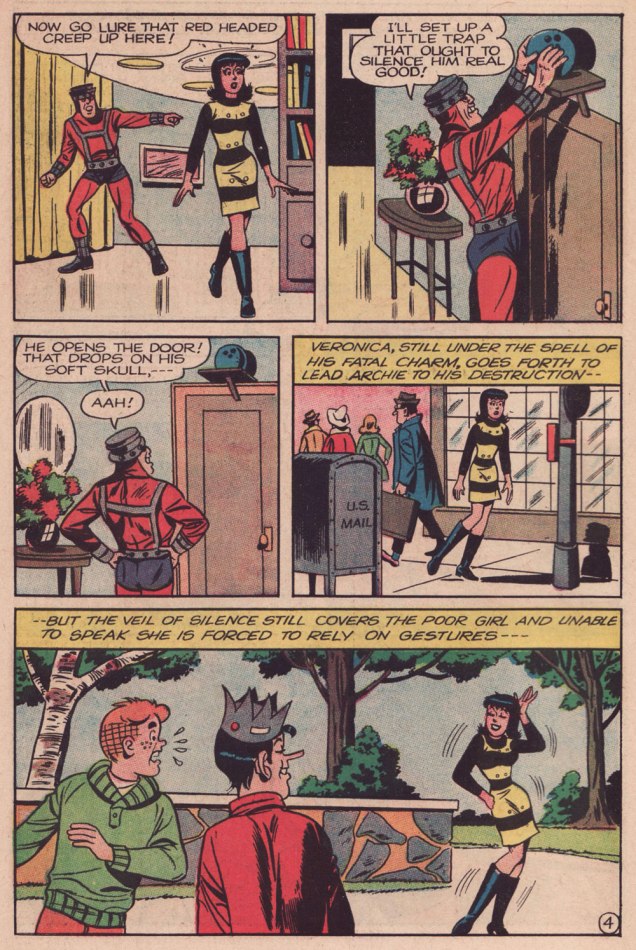
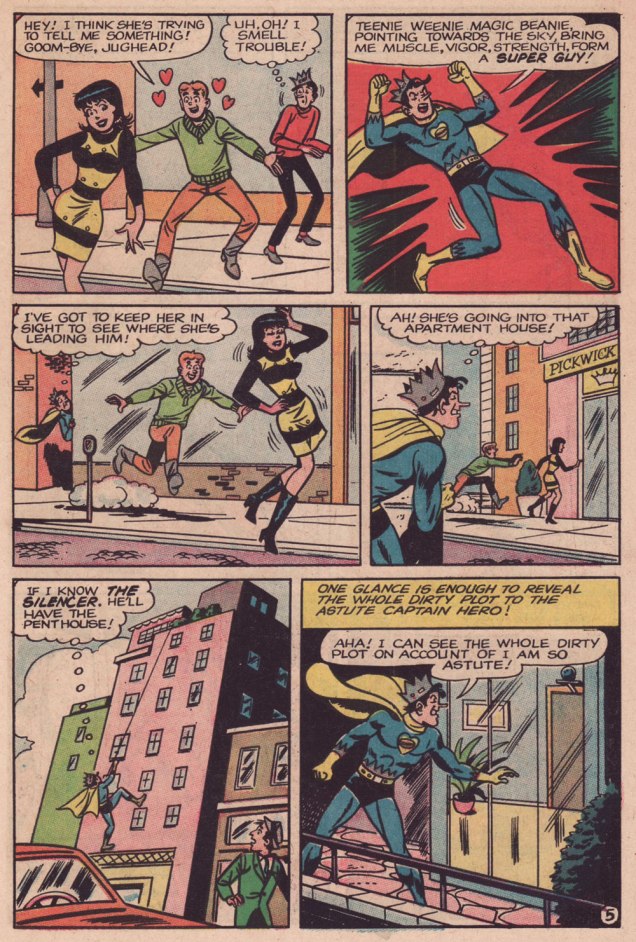
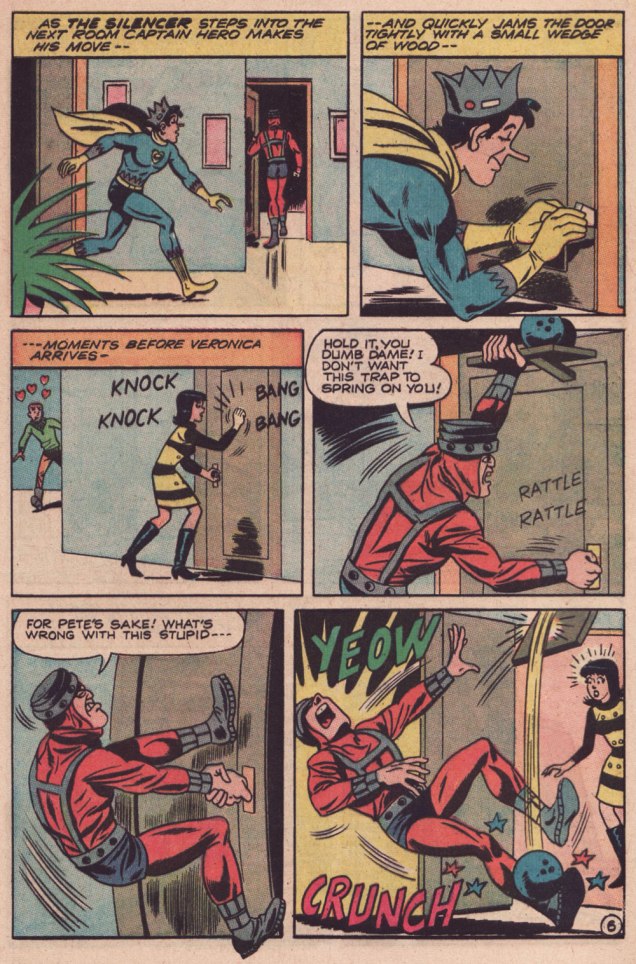
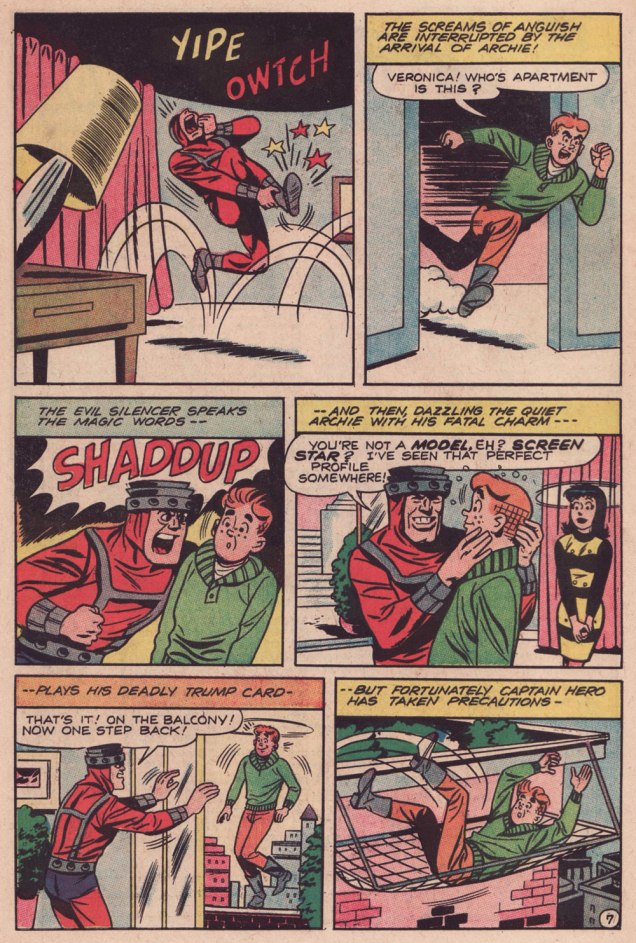
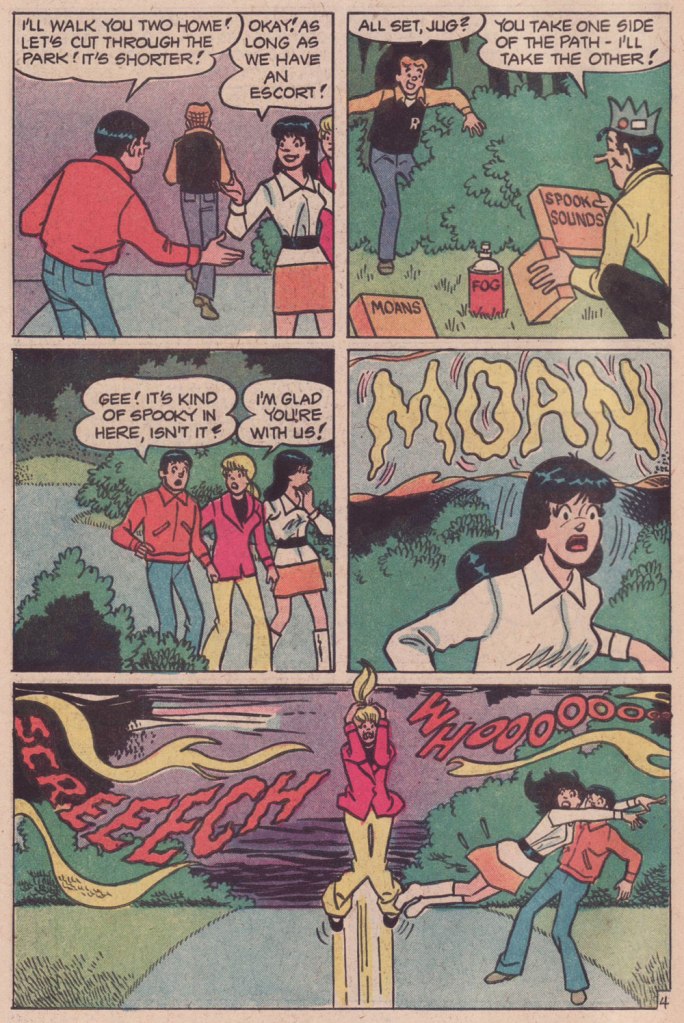
Here’s The Silencer Strikes, originally presented in Jughead as Captain Hero no. 5 (June 1967, Archie). The uncredited creators are presumably Frank Doyle, scripter; Bill Vigoda, pencils.

While Bill Vigoda (1920-1973) is hardly anyone’s favourite Archie artist, he does a creditable job here; he’s having more fun with this material than he did on the regular Jughead title, where he had the unenviable task of replacing (ha!) Samm Schwartz.

I certainly wasn’t going to use the digest for scanning, as the format’s production values weren’t much of a consideration: this was disposable entertainment, period. But I found an affordable — and in glorious condition — copy of the issue I wanted, and the printing didn’t let me down. My thanks to Keith for bringing it home!

-RG

*this also goes on in bars, I’m told.

**namely the rise of Marvel’s superheroes and the success of the campy Batman tv show, if you must know.

***Though they reaped the most bountiful rewards from the format, Archie were tardy — as usual — in adopting the digest: for instance, Gold Key had tried it out in 1968 with some Disney reprints, followed by collections of their mystery titles. DC had issued a one-shot Tarzan Digest in 1972. Marvel issued its own — slightly larger — digest in 1973, The Haunt of Horror, but it wasn’t comics, but a doomed attempt at reviving the moribund ‘Pulp’ format; finally, Archie entered the fray two months later, with Archie Comics Digest no. 1. Only Harvey lagged behind; unless I’m mistaken, it wasn’t until 1977 that some Richie Rich digests hit the glutted market.

Hallowe’en Countdown VIII, Day 15

« Well, as everyone knows, once witchcraft gets started, there’s no stopping it. » — Mikhail Bulgakov
Another, day, birthday post? Well, it’s still a mighty special occasion, as we’re celebrating the one-hundred and fourth birth anniversary of our beloved Samm Schwartz (1920-1997).
One year ago to the day, we gave you Love in Broom, first of a loosely connected two-parter (‘loosely connected’ is the strongest dose of ‘continuity’ one could expect from the Archie folks in those days).

Of course, the now-named Samantha the witch — and the rest of the cast, notably Jughead and Reggie — appear to have forgotten all about their earlier encounter… but that’s just fine: the burden of continuity is one I’m glad to see sloughed. The chief constant is that our witch has quite a yen for Jug.

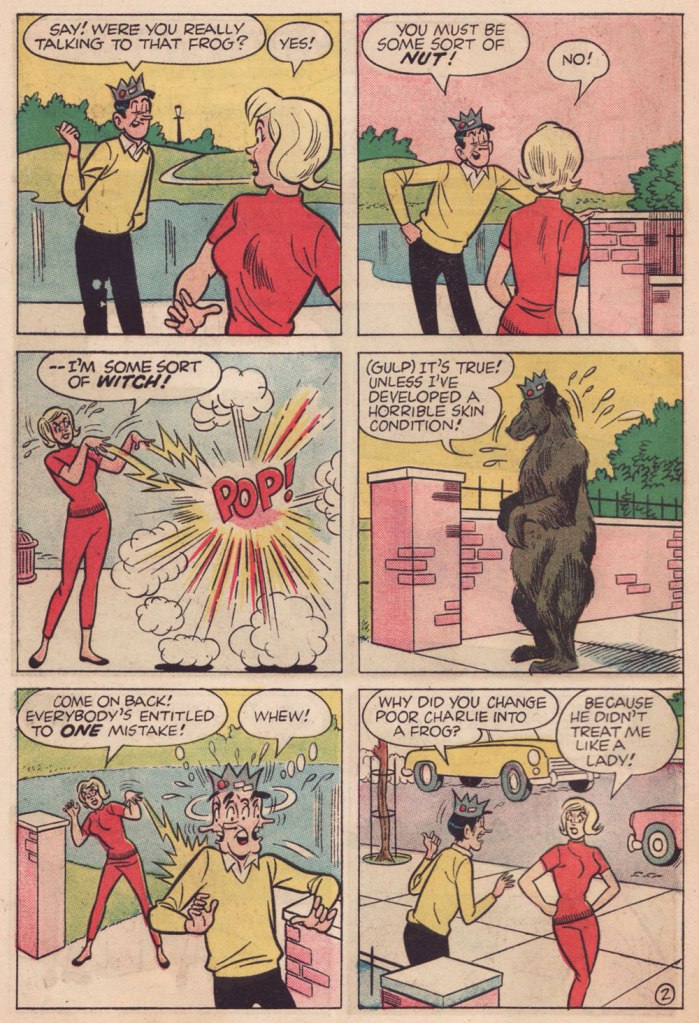
Switch Witch first appeared in Archie’s Pal Jughead no. 123 (Aug. 1965, Archie). It was presumably scripted by George Gladir (not coincidentally co-creator of Sabrina the Teenage Witch a couple of years earlier), and unmistakably illustrated by Mr. Schwartz. Of Mr. Gladir, Mark Evanier wrote: « Even when they had no credits, you could generally spot a George Gladir script. They were a little wackier, a little sillier, a little more human in their humor. And oh, yes — they were usually fresher than the ones crafted by younger writers. » This certainly fits the bill.

I had to buy three different copies of this issue to get a complete one… and it’s still a brittle mess. But hey, my ordeal, your benefit!

-RG

Hallowe’en Countdown VII, Day 15

« Real art must always involve some witchcraft. » — Karen Blixen

Ah, another Samm Schwartz story! And no wonder: born on October 15, 1920, Mr. S would be ninety-seven today.

Love in Broom“, scripted by George Gladir and inked by Vincent DeCarlo, saw print in Jughead no. 116 (Jan. 1965, Archie). That amorous witch would return in Jughead no. 123‘s ‘Switch Witch‘. In the Archie universe, that’s *almost* continuity!

Since Jughead no. 116 had a strictly non-oddball cover by Harry Lucey, here’s a more thematically fitting one from local chouchou Bob White. This is Archie no. 126 (Apr. 1962, Archie).

-RG

Hallowe’en Countdown VI, Day 7

« Special effects are characters. Special effects are essential elements. Just because you can’t see them doesn’t mean they aren’t there. » — Laurence Fishburne

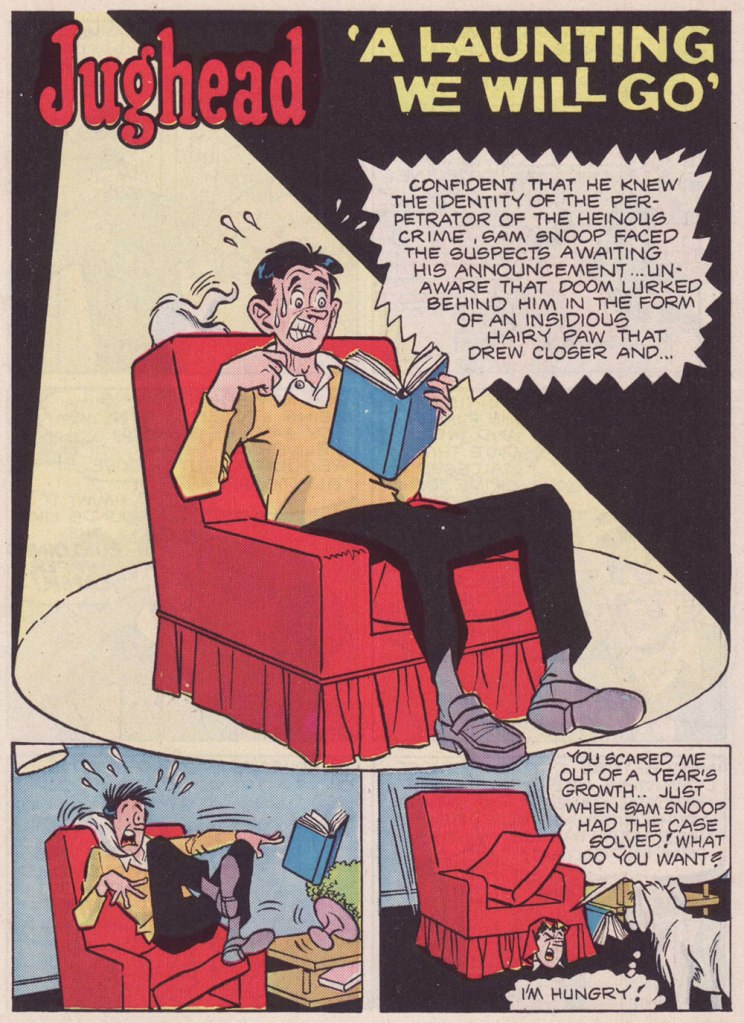
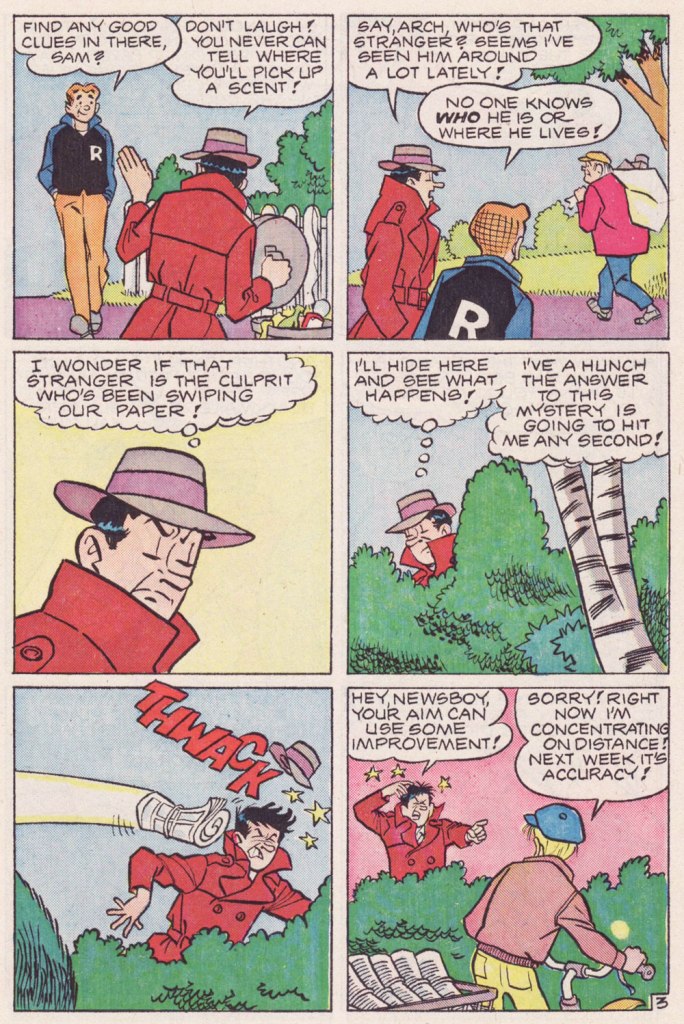
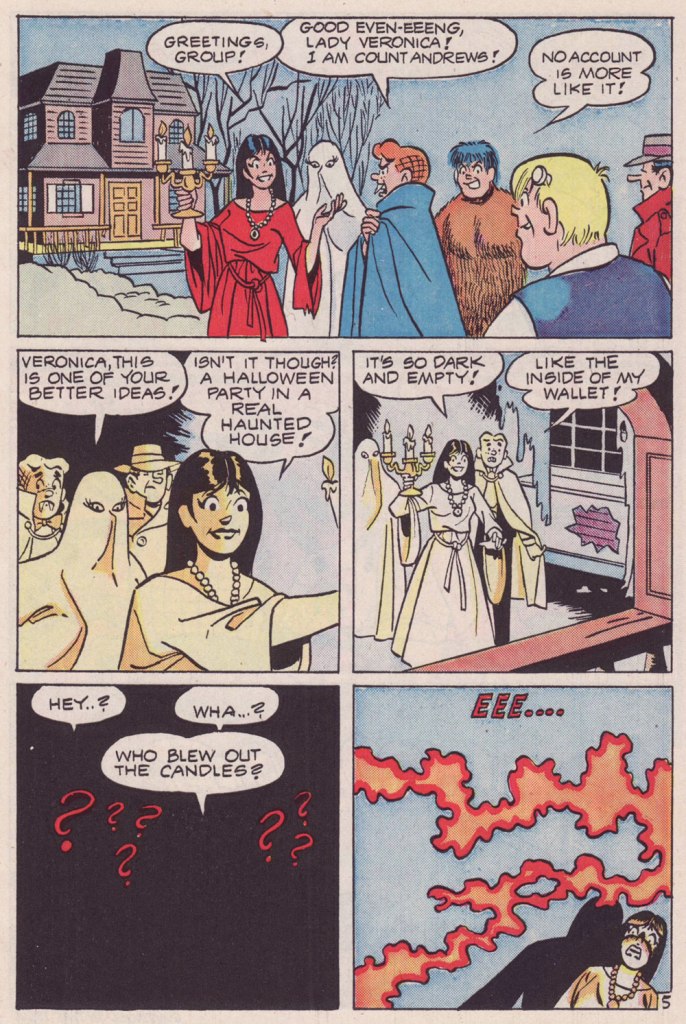
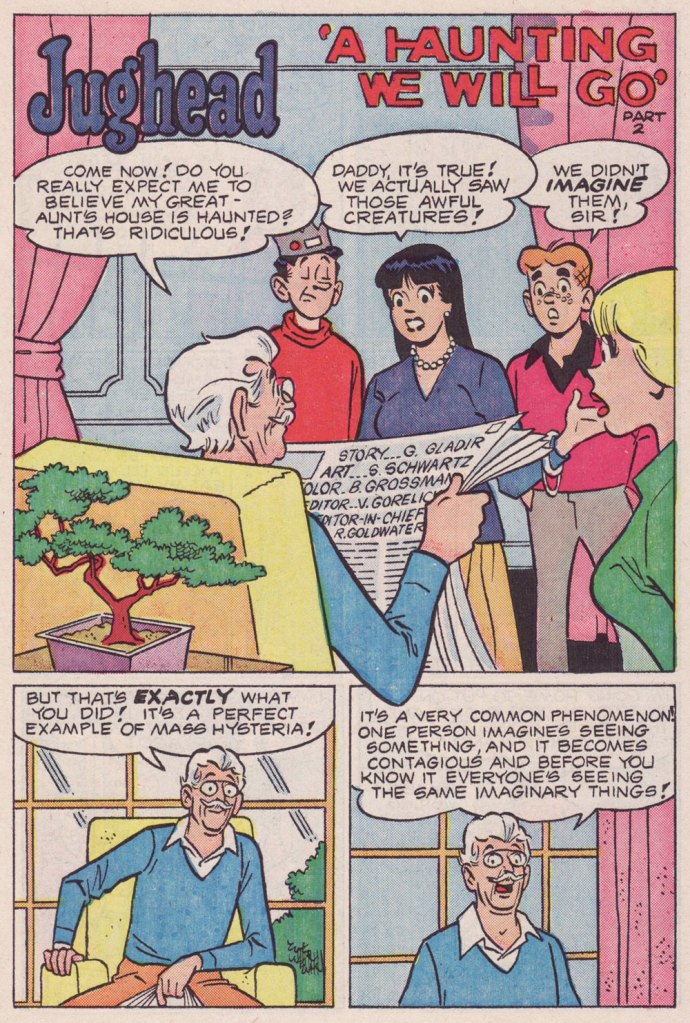
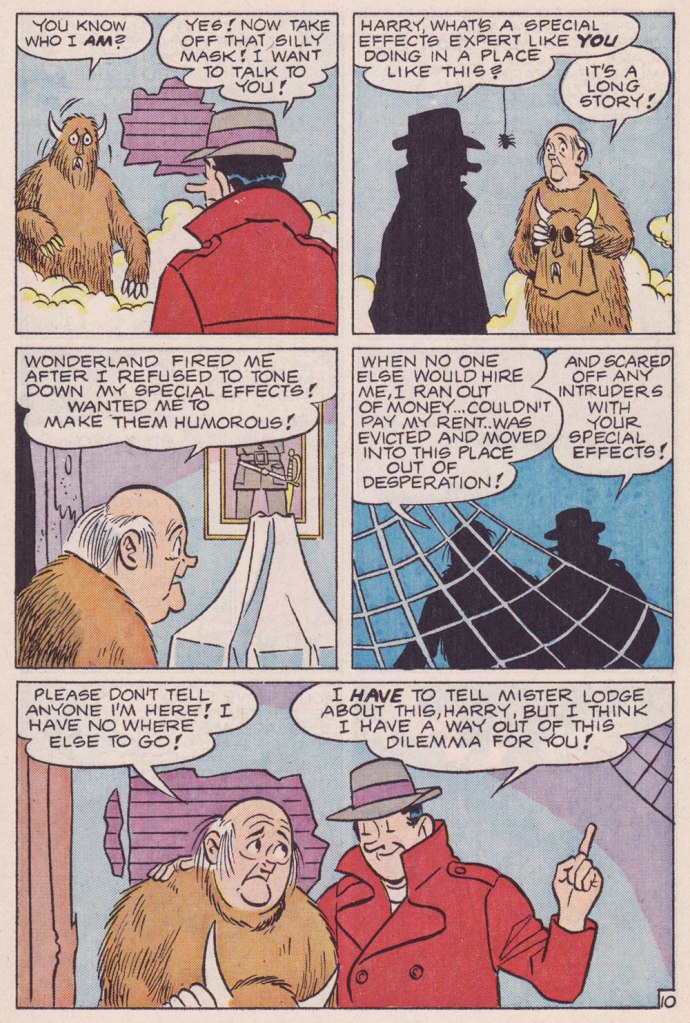
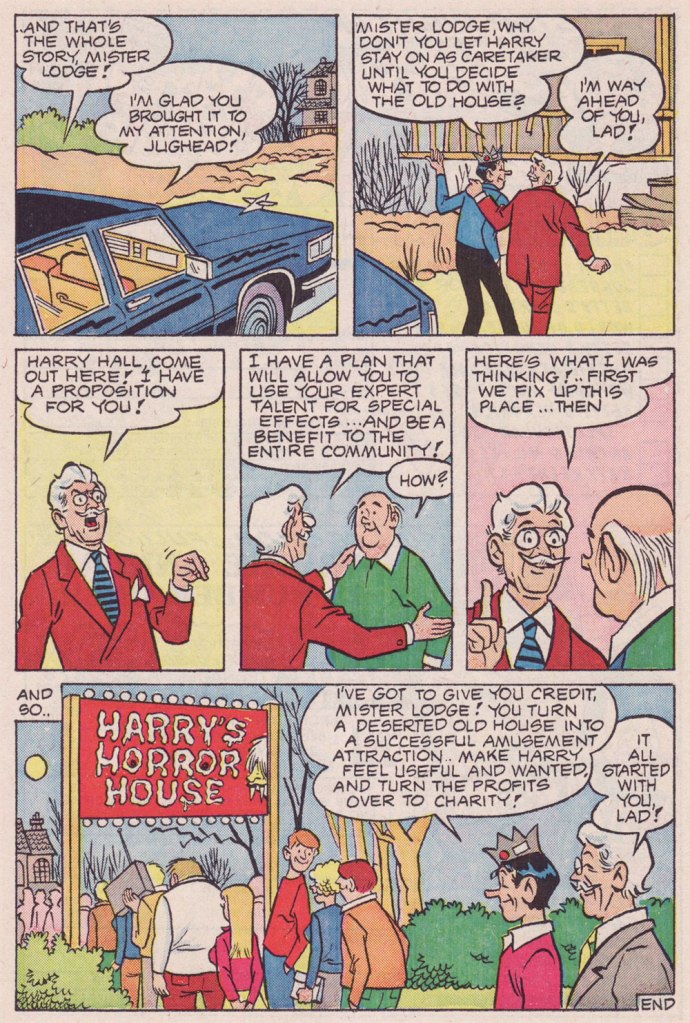
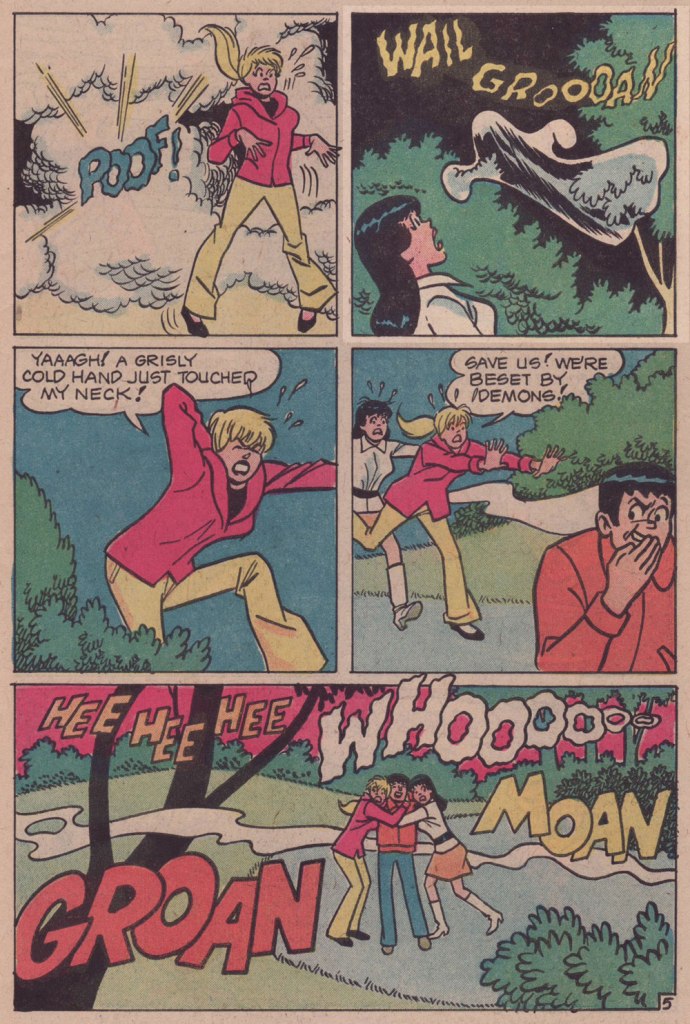
Spookiness is afoot in Riverdale! Here’s a lovely George Gladir (script) & Samm Schwartz (pencils, inks and letters) saga to suit the season. I love those longer tales, which in this case allows for a larger-than-usual cast and a more leisurely pace.

‘A Haunting We Will Go’ was originally published in Archie Giant Series Magazine no. 564 / The World of Jughead (Sept. 1986, Archie). Oh, and colours by Barry Grossman.

-RG

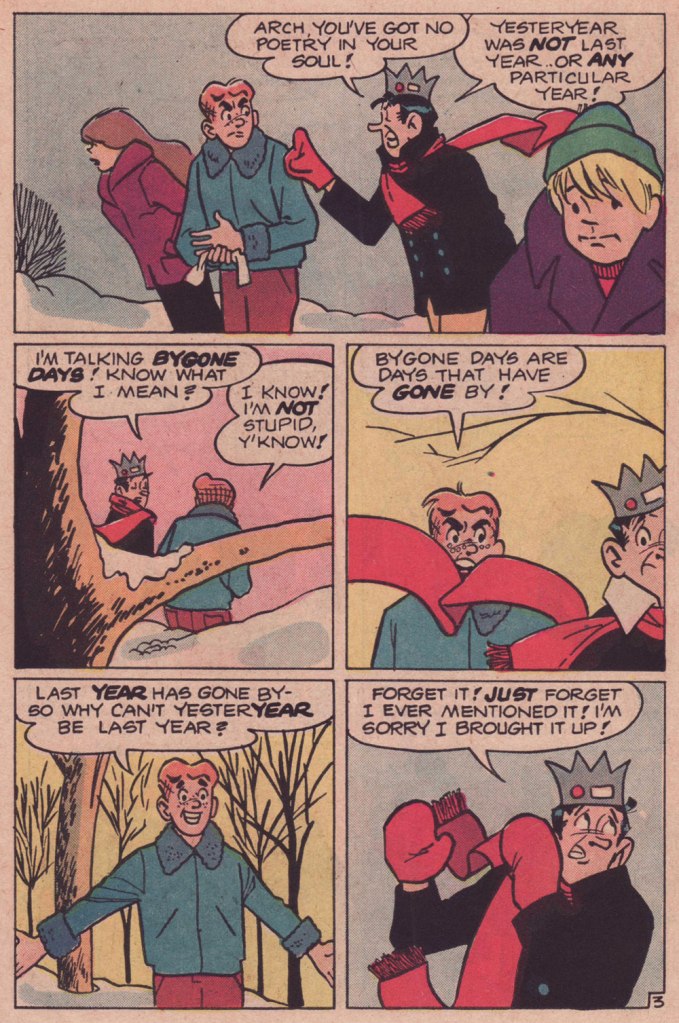
Treasured Stories: “What’s Yores?” (1982)

« The people who are always hankering loudest for some golden yesteryear usually drive new cars. » — Russell Baker

We’re having a bit of a scorcher over here, so I’m doing my bit to compensate with a piece set in wintertime.

As we surely all know, Archie stories (in the comics at least) are formulaic to a fault. This static state of affairs plays a considerable part in their comforting nature. Sure, all fashions and trends are embraced and discarded, but the characters don’t evolve in any significant, permanent way. No lesson ever sticks.

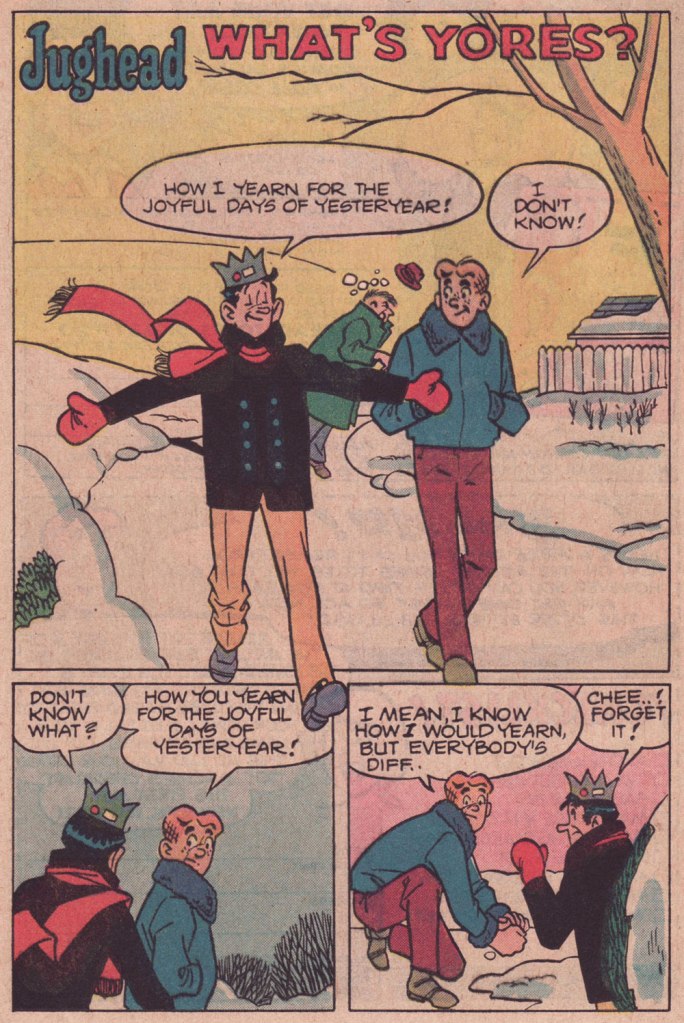
So on the rare occasion when a writer deviates from the formula, it really shows. This tale, I daresay, is such a specimen. Virtually plotless, it’s a precursor, by more than half a decade, of that rule-breaking « show about nothing »: Seinfeld (1989-1998).

While nothing much happens here in terms of plot, this is a difficult trick to pull, in any medium: as it mainly consists of yadda yadda yadda (but witty yadda yadda yadda… another daunting level of difficulty), it’s talking heads all the way, so you need some great performers who know how to keep an audience engrossed through the minimal means at their disposal.

In comics, this calls for a great illustrator, a master of body language and the art of the mise en scène, namely Samm Schwartz (1920-1997). I shudder — and not with delight — to envision this particular script landing in the hands of a lesser light, which is to say practically anyone in the Archie stable save Bob Montana (but he’d died in 1975) or Harry Lucey (retired and in poor health by then). While he was never credited for anything but his artwork, Schwartz enjoyed a free hand with his regular collaborators’ scenarios (George Gladir and especially Frank Doyle), with their blessing. And he was always enriching his backgrounds with delightful pantomime mayhem.

What’s Yores? originally appeared in Jughead no. 321 (Feb. 1982, Archie). Script by Frank Doyle, pencils, inks and letters by Mr. Schwartz.

Craving more Schwartz? Go on, help yourself to the full spread right here.

-RG

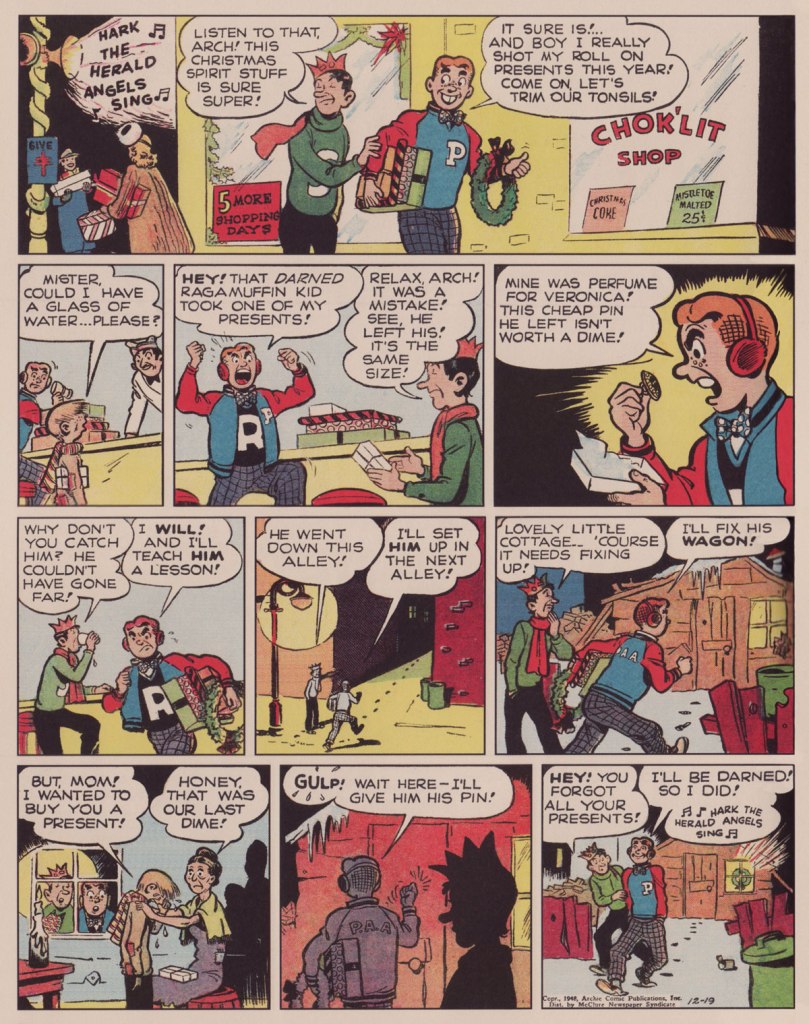
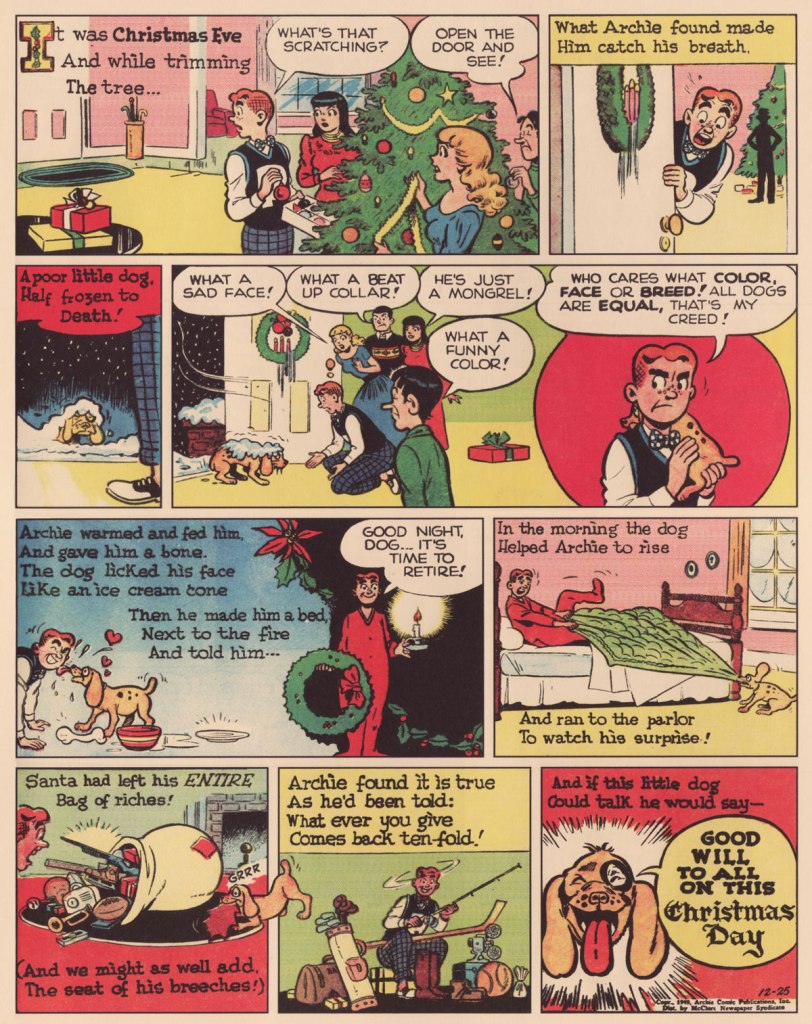
In Bob Montana’s Riverdale for the Holidays!

« Everything that happened to Archie happened to me in school, except that Archie always seemed to get out of it. » — Bob Montana

Despite the hundreds, if not thousands, of variably-abled hands that have toiled in the Archie Comics salt mines, the most important set of mitts devoted to the task was also the very first.

Archie creator Bob Montana* (1920-1975) knew what he was doing from the git-go. After all, he rubbed shoulders with the characters’ real-life counterparts from the Class of 1940: according to a 1989 Associated Press story, his buddy ‘Skinny’ Linehan became Jughead, football hero Arnold Daggett became Big Moose Mason; principal Earl MacLeod gave us Mr. Weatherbee and school librarian Elizabeth Tuck inspired Miss Grundy… and so on.

Montana was also that rare cog in the Archie machine: an autonomous writer-artist. This served him well in the newspaper strip world: he débuted the Archie feature in 1946 and remained in charge, dailies and Sundays, until his 1975 passing. I do prefer Samm Schwartz’s Jughead, but Montana drew the definitive version of every single other member of the Riverdale ensemble. In particular, as you’ll witness, Betty and Veronica were never slinkier.

The Sunday, December 22, 1946 strip.
The Sunday, December 21, 1947 strip.
The Sunday, December 19, 1948 strip.
The Sunday, December 26, 1948 strip.
The Sunday, December 25, 1949 strip.

And a bonus New Year’s-themed one for the road!

The Sunday, December 28, 1947 strip.

And with this… Merry Christmas, everyone!

-RG

*On the Archie plantation, as with the Harvey gulag, we can safely dismiss the founders’ specious and strident claims of having created their cash cows. In this case, Archie “creator” John Goldwater‘s original mandate to Montana was essentially to riff on popular radio show The Aldrich Family (1939-1953).

Hallowe’en Countdown V, Day 13

« How could you be so sure? … they could be real! » — Reggie Mantle, believer

Sure, it’s a hoary ol’ plot, used both to comedic and dramatic effect a gazillion times, but… as is often the case, the plot is more or less accessory. I always enjoy an Archie comics story that reminds us that these kids have known one another forever (from their perspective — not in the sense that they’ve been around since the 1940s, that’s too metatextual). With Archie for the most part being someone things happen to, as opposed to a catalyst — one who sets events into motion, I’m rather more interested in the adversarial (and sometimes collaborative) relationship between Reggie and Jughead… when it’s properly explored.

As with the previous Samm Schwartz story I spotlighted, Tee for Three, Dilton’s garage plays a key part. Intriguing…

Beasties of the Night originally appeared in Jughead no. 279 (Aug. 1978, Archie). It was scripted by Frank Doyle (1917-1996).

-RG

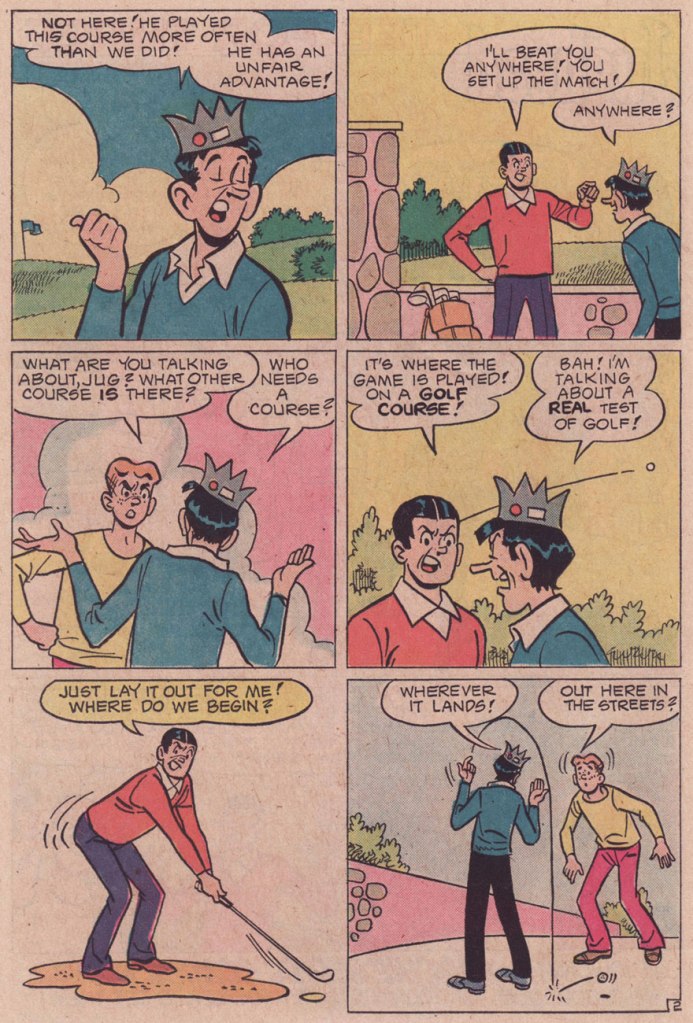
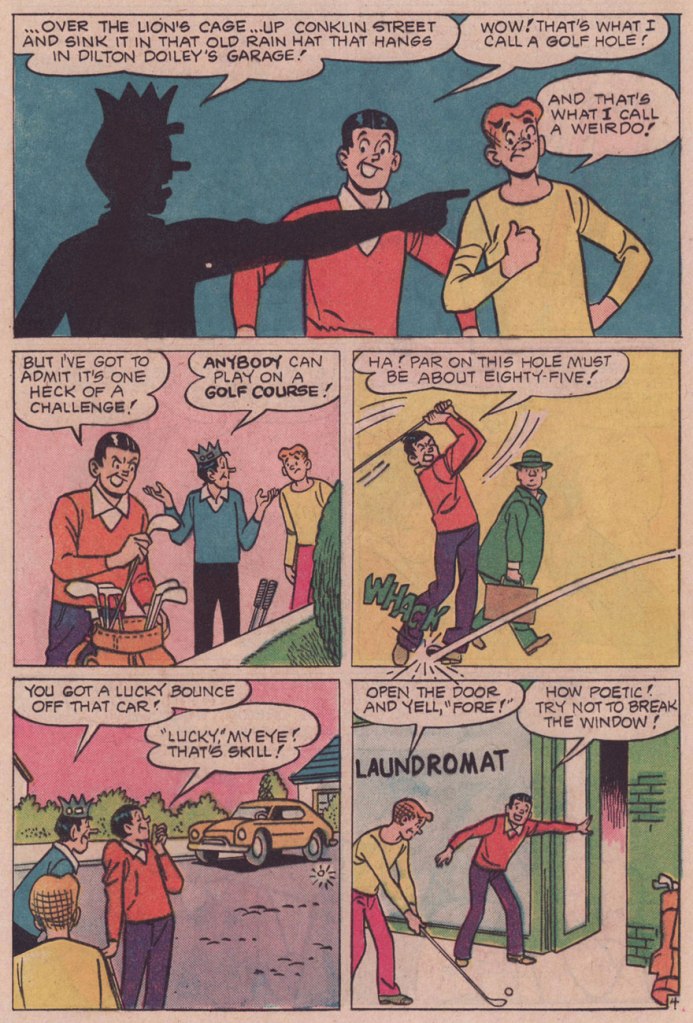
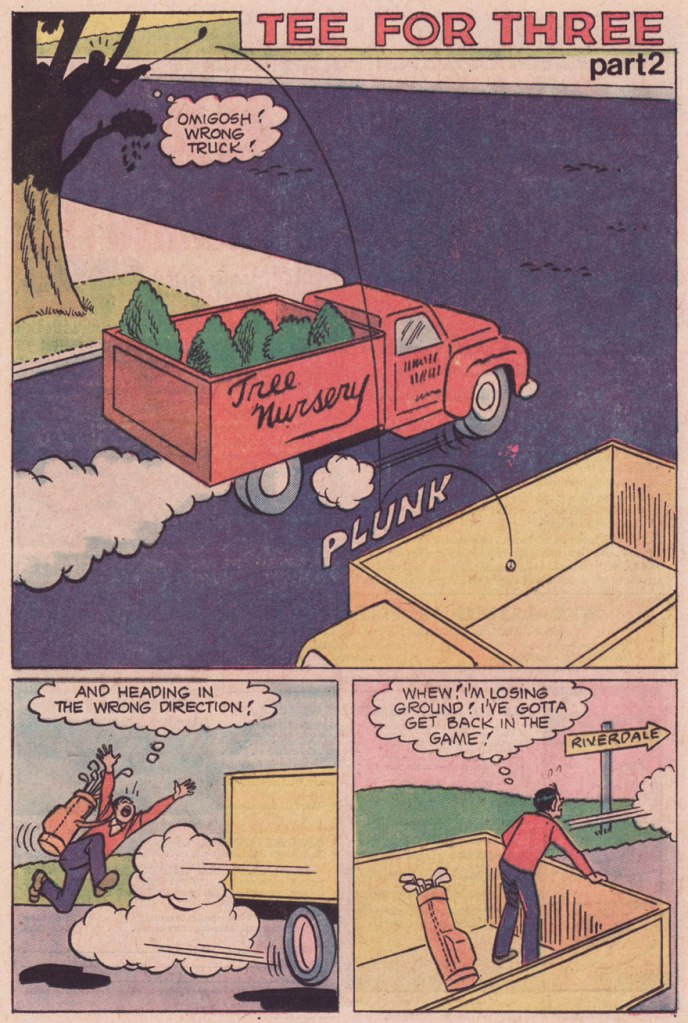
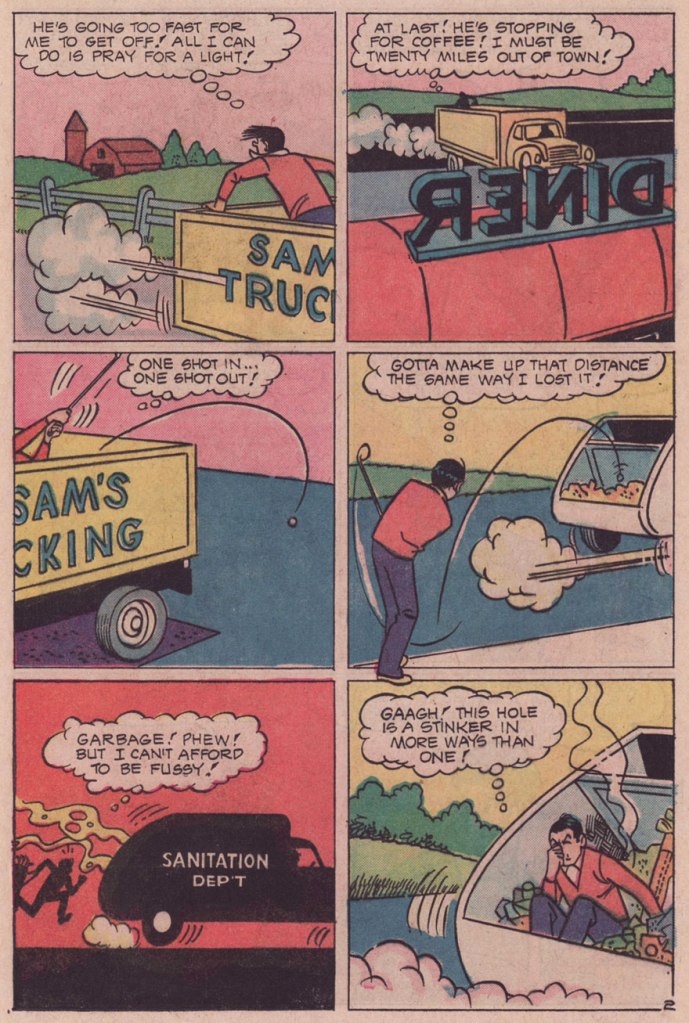
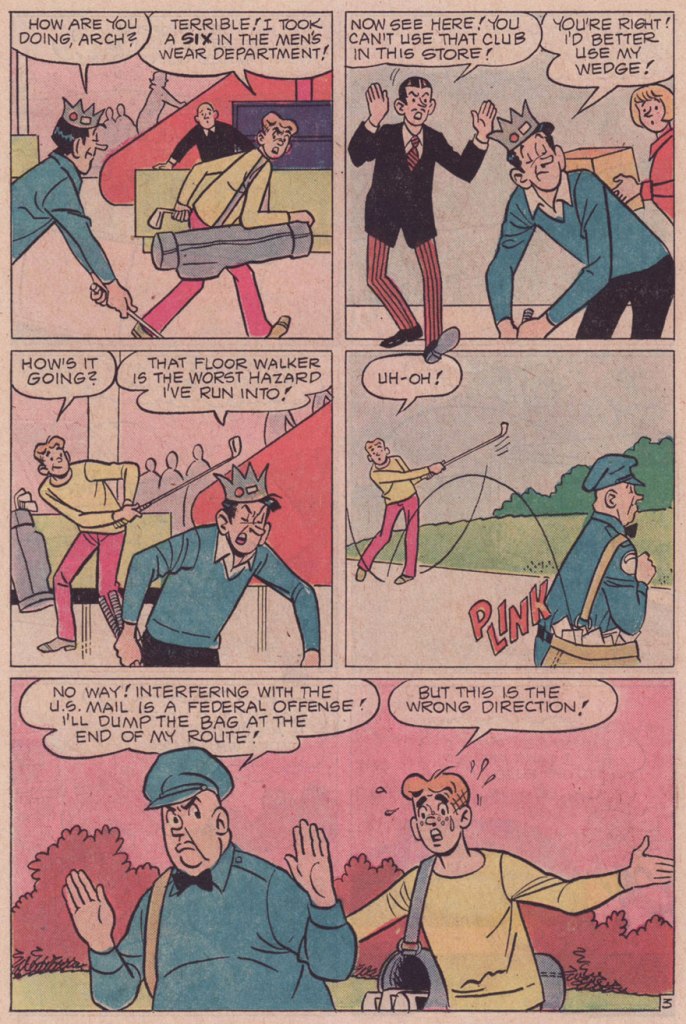
Treasured Stories: “Tee for Three” (1975)

« Coming to play golf is not what I would consider to be an essential purpose. » — Nicola Sturgeon

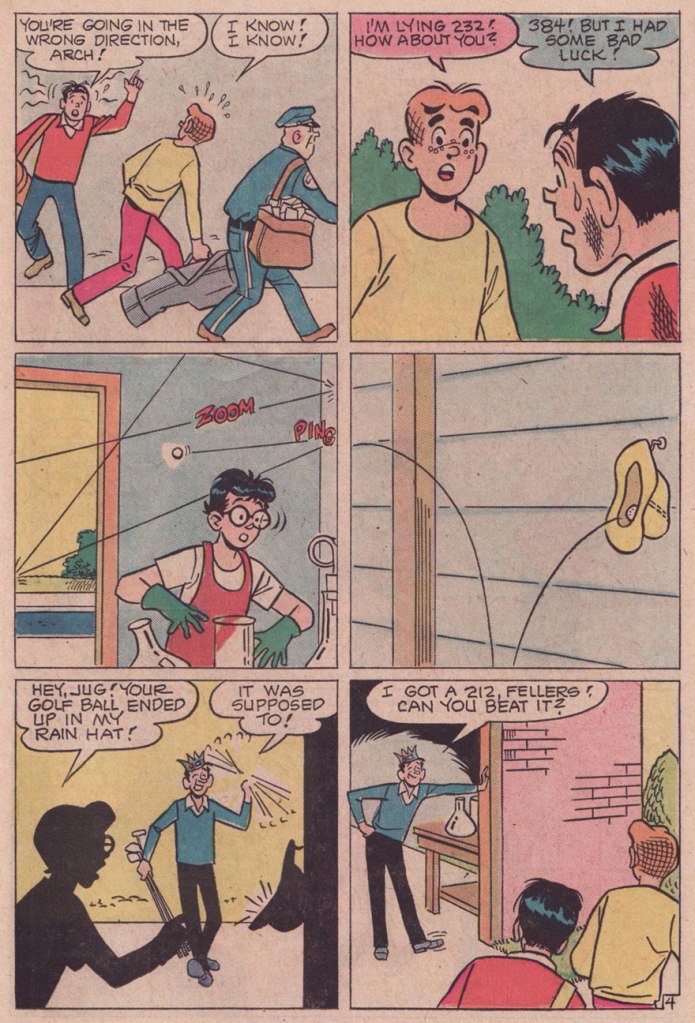
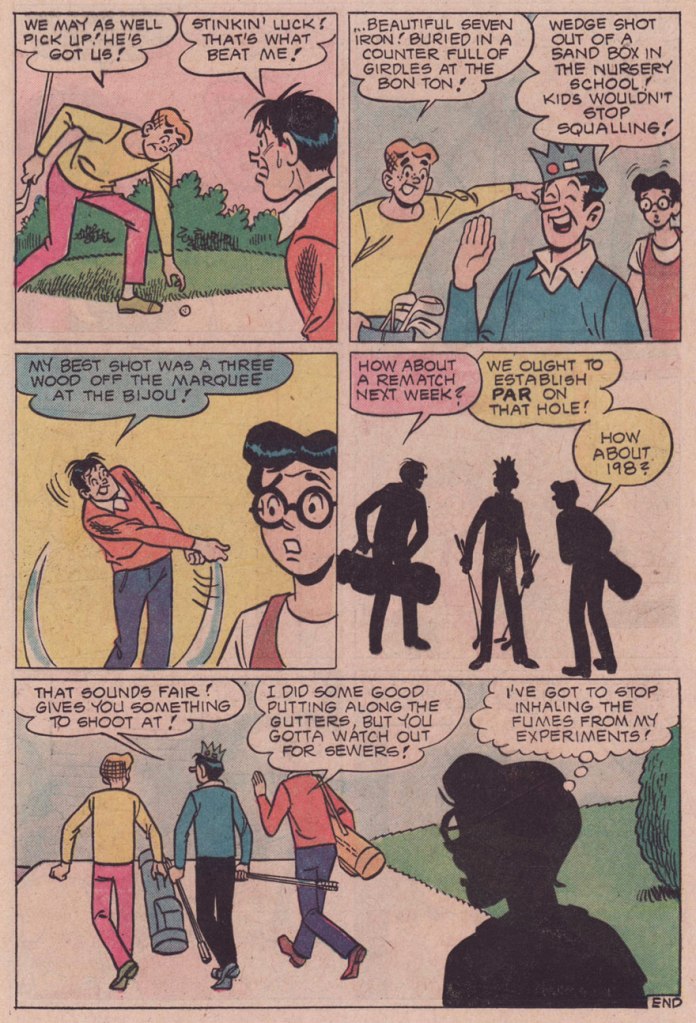
I’ve long wanted to showcase one of Samm Schwartz‘s Jughead stories on this blog, but always hit the same snag: which one? Not too long ago, while revisiting my trove of 1970s issues, I came upon just the specimen. Tee for Three appeared in Jughead no. 247 (Dec. 1975, Archie). I’ll spare you the hideous-as-usual Stan Goldberg cover.

While we know the story was illustrated by Samm Schwartz, the writer’s identity remains unknown. Schwartz usually took a hand in the scripting, but he didn’t really ever work alone. The likeliest miscreants are his usual accomplices, Frank Doyle and George Gladir.

Why this one among hundreds of others, then? For one thing, it’s longer; at eleven pages long, it’s a towering freak amidst the customary five-or-six pagers.

But that’s not all: Tee for Three also boasts an unconventional plot, one that cried out for (and received) a more leisurely deployment. Its tone is also surprising: it’s quite deadpan and sanguine in its absurdity.

For once, you can envision why these three, despite being frenemies or plain rivals, would actually hang out: they challenge and entertain one another. And even collaborate when the occasion calls for it. In this case, Jug, Archie and Reggie are so bonded in their good-natured folie à trois that the rest of the world doesn’t have a clue and hardly stands a chance.

While such a golf contest would surely result in much injury, property damage and litigation in the ‘real’ world, it sure seems like a rollicking bit of sport here, and isn’t that what good fiction is for(e)?

-RG

Jughead’s Pal, Samm Schwartz

« What is it about me, Pops? Am I different than normal people? »

One (more) thing I’ve learned in this world is that the vast majority of people, from the man or woman in the checkout line to the hard core of comics aficionados… can’t tell Archie artists apart, let alone name any of them.

If you scratch deep enough, one name will come up, like pebbles from a fallow field: Dan DeCarlo. I’m reminded of the annual restaurant poll a local alternative weekly used to hold: McDonald’s unfailingly took its category in a landslide, because of its ubiquitous familiarity. And so it is with Archie artists: DeCarlo must be the best because… well, that’s what we’ve always been told.

If you ask me, much of his peers’ work gets attributed to him. For instance, check out our gallery of Bob White covers. That Archie’s Mad House no. 27 cover, in particular…

WOT’s pick for top artist on the Archie totem is handily Samm Schwartz (1920 – 1997). He’s easily the smoothest, most inventive storyteller in the Archie universe. Despite his skill as a cover designer during Archie’s best years (1959-1965, a figure proposed by cartoonist-scholar Seth and worth carving in stone), there were no Schwartz covers chez Archie after 1965.

The likely reason? In ’65, Schwartz was hired away by Wally Wood‘s Tower Comics (by managing editor Harry Shorten, a former Archie writer-editor) to serve as their art director. While there, he conceived Tower’s relatively prolific teen humour line, featuring Tippy Teen, Go-Go and Animal, and Teen-In, often glibly dismissed as “Archie clones“, by people who clearly haven’t read the work. We’ll return to these eventually.

Now comes the clincher: Schwartz in turn hired some of his former Archie colleagues to pitch in (presumably at higher page rates); DeCarlo (a handful of stories in early issues of Tippy Teen), Harry Lucey (a decent batch, actually) and reportedly Bob White (no sign of him, though). But the bulk of the work was done by Schwartz and future Archie artist Doug Crane.

Now the Archie people didn’t like this one bit; it was a clear case of sedition, a threat to their tidy little work camp system. After the industry’s near-collapse in the mid-1950s, there weren’t a lot of options in the tight-knit little club that remained; let’s not forget that even Jack Kirby was driven to such humbling desperation in the early 1960s. It was all too easy to be blackballed. The Goldwater clan, Archie’s reigning dynasty, took careful note of Schwartz’s break for freedom and the names of his accomplices. After Tower called it a day in 1969, Schwartz went to DC for a year, but it didn’t take. He was forced to return to Archie, which certainly suited the publisher since Schwartz’s signature title, Jughead, had been wilting away in his absence.

The terms of his return are unknown… but against all odds, Samm proceeded to create the finest work of his career, pencilling, inking and lettering hundreds of inspired Jughead stories until, well, until he couldn’t any more. But no covers, considered a plum job: these went exclusively to DeCarlo (with an occasional Lucey) and later to versatile mediocrity Stan Goldberg, aping DeCarlo’s style and random design sense*.

Jughead's-Fantasy02A
Jughead’s Fantasy no. 2 (Oct. 1960); a parody of the excellent 1958-61 detective show… and yes, Peter Gunn did get conked on the head an awful lot.

Jughead78A
Archie’s Pal Jughead no. 78 (Nov. 1961)

Jughead81A
Archie’s Pal Jughead no. 81 (Feb. 1962). Check out Reggie’s body language, in particular.

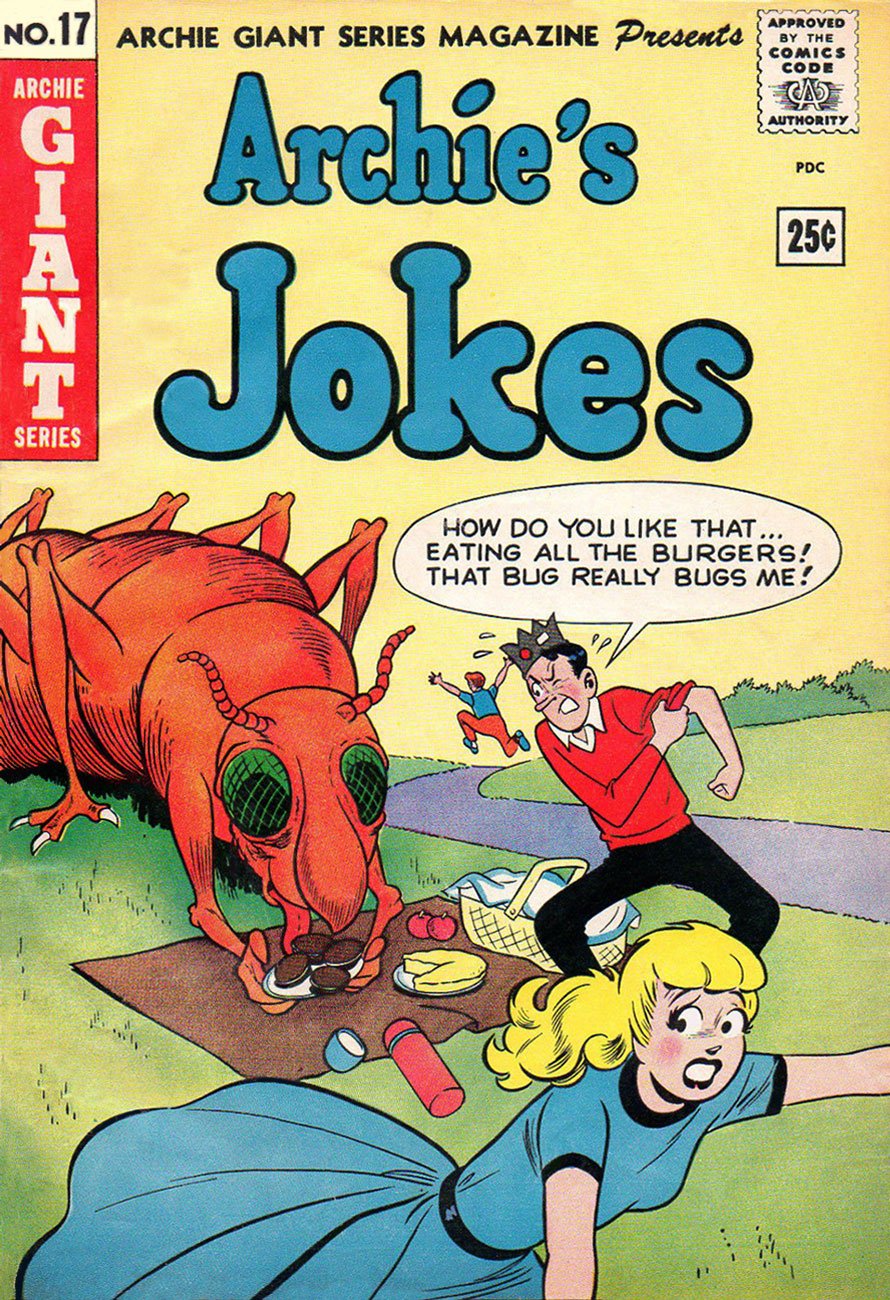
Archie's-Jokes17A
Archie Giant Series Magazine no. 17 (Archie’s Jokes, Summer 1962). There goes Archie, into the next county.

Laugh136A
Laugh Comics no. 136 (July 1962)

Jughead86A
Archie’s Pal Jughead no. 86 (July 1962)

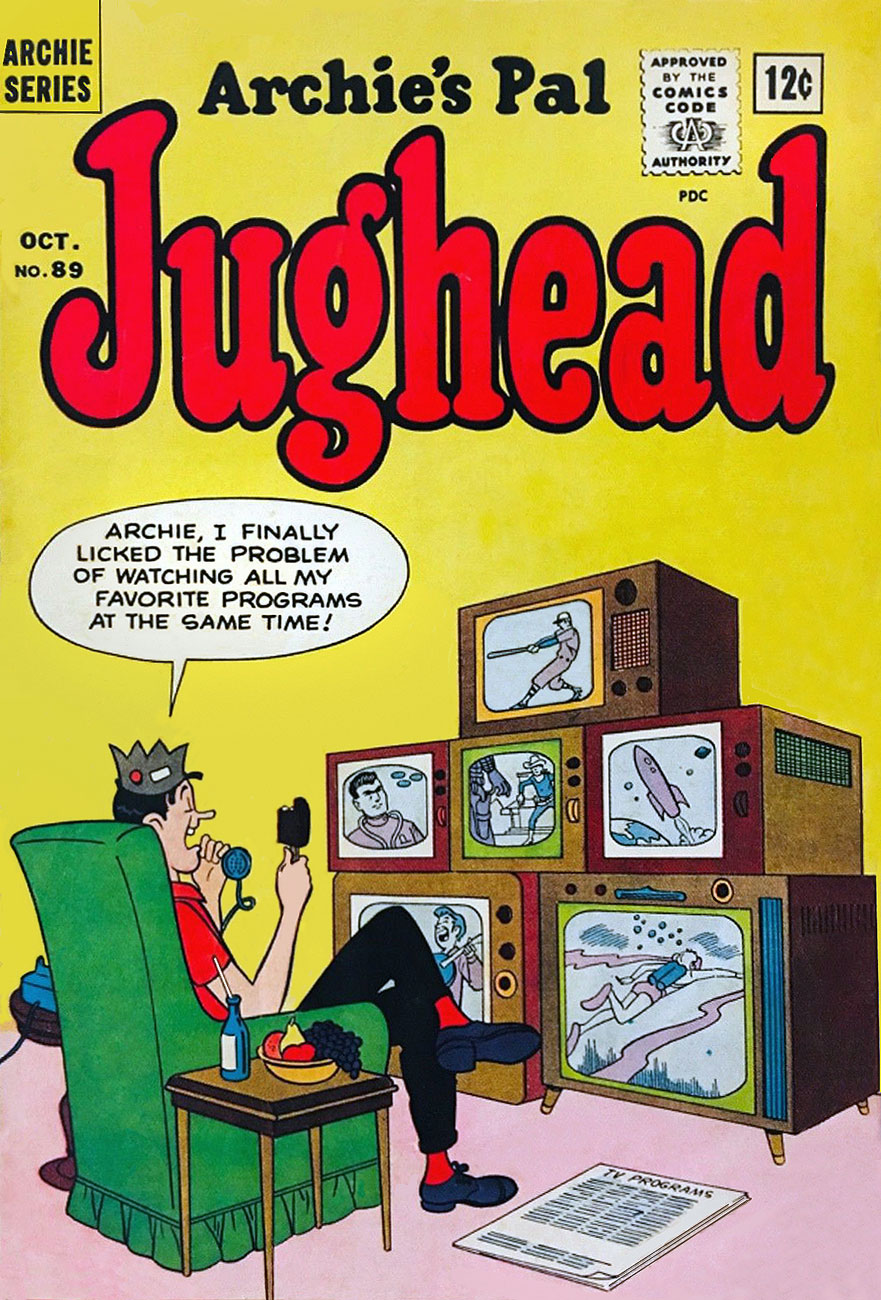
Jughead89A
Archie’s Pal Jughead no. 89 (Oct. 1962)

WorldofJughead19A
Er, interesting choice of space pioneers, USAF. Could this mission be some sort of tax dodge? Perhaps Mr. Lodge has a financial stake in it, and gently “suggested” Archie for the possibly one-way trip. Archie Giant Series Magazine no. 19 (World of Jughead, Dec. 1962)

Pep165A
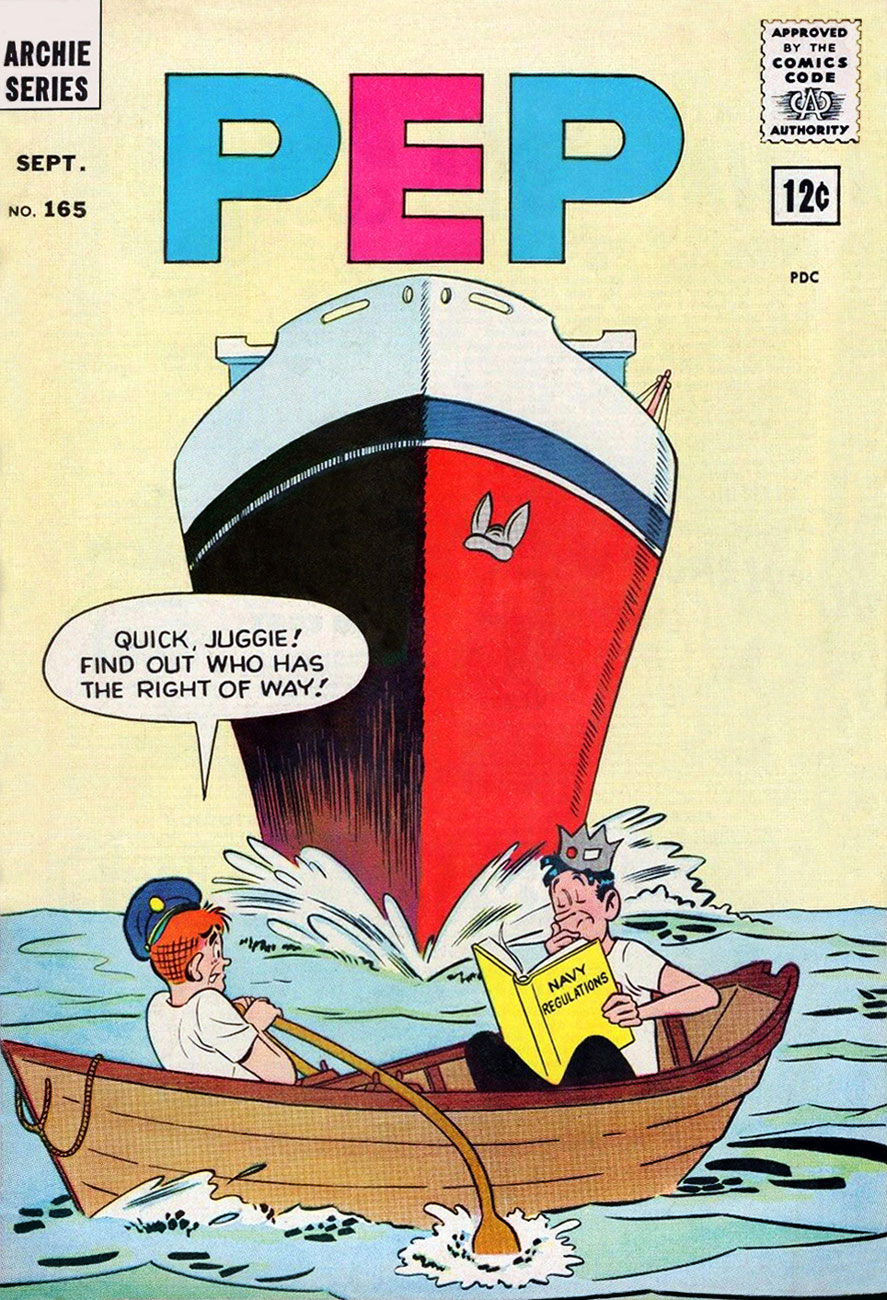
Pep no. 165 (Sept. 1963). My college graphic design teacher told our class that a poster should be “One Angry Fist”, which certainly applies to comic book covers, and this is a fine, fine example of making the most of a format.

Madhouse33A
Archie’s Mad House no. 33 (June 1964)

BettyVeronica102A
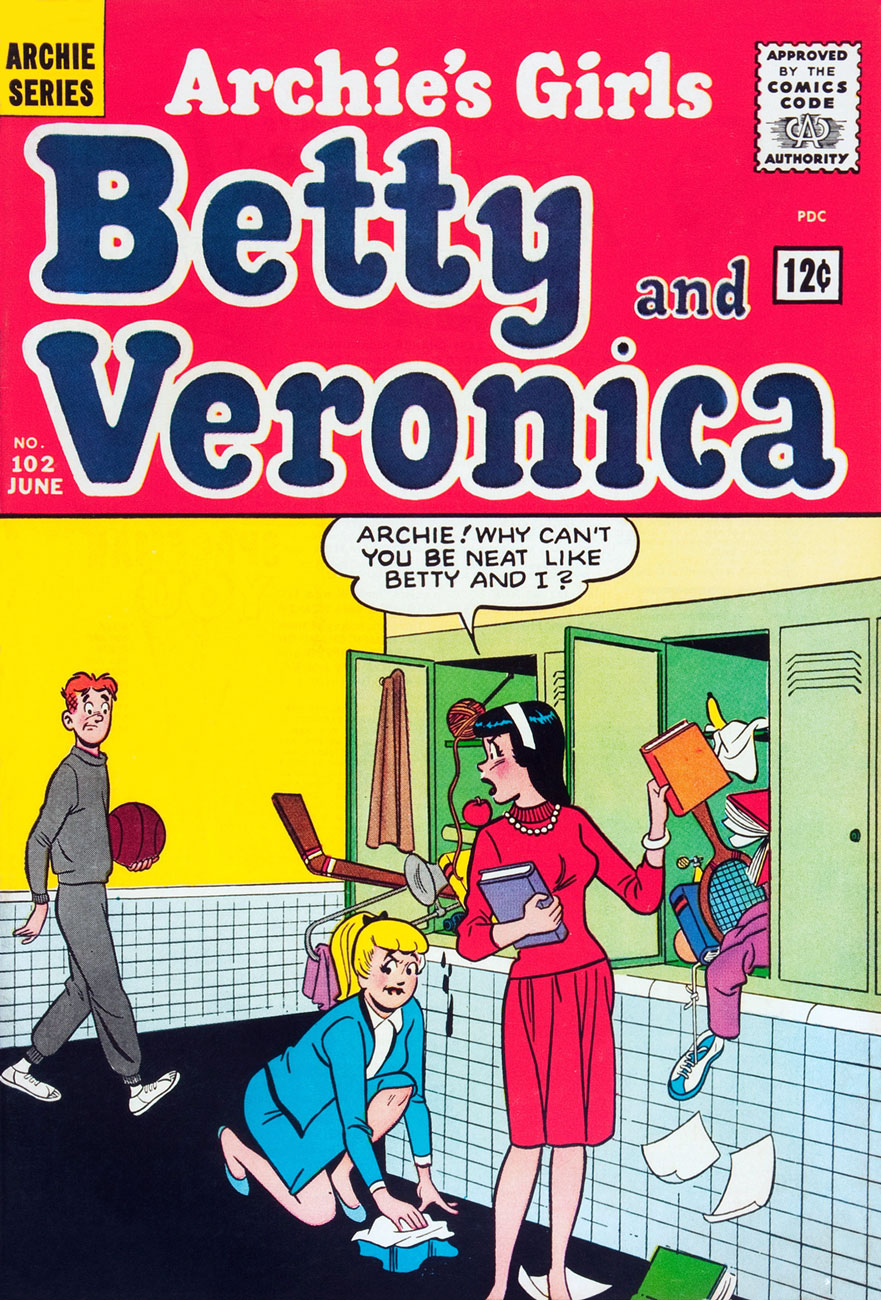
Archie’s Girls Betty and Veronica no. 102 (June 1964). The new, definitely not improved cover layout of the Archie line rears its homely head.

SammSchwartzA
Mr. Samm Schwartz, date unknown, though the cars should certainly serve as a clue.

To quote his daughter, Joanne Colt, from the introduction of 2011’s The Best of Samm Schwartz (it isn’t, but it’s pretty good): « He drew for Archie until his death on November 13, 1997, my birthday. There was an unfinished story on his drawing board. »

-RG

*the way I see it, the difference between a Bob White or a Samm Schwartz cover and a DeCarlo is the difference between a considered, effective layout and the act of pointing a camera at random and snapping the shutter. To be fair to DeCarlo, his girlie cartoons for Martin Goodman’s Humorama were excellent, and his first half-decade at Archie (60-65) was fine… then the company wore him down into a sad hack and the unfortunate protagonist-victim of a cautionary tale.

Hallowe’en Countdown, Day 21

Here’s a seasonal Sunday strip from Archie creator* Bob Montana (October 23, 1920 – January 4, 1975), from October 31, 1948. Do note (or try not to) how sultrily Veronica is portrayed in comparison to her more restrained depictions in subsequent, supposedly less prudish decades.

MontanaA.jpg

*You can safely ignore the outlandish claims of the Goldwater family on that. They may run the company, but they ain’t created squat, despite their long tradition of shoe-horning themselves into the credits. And of screwing over the actual creators of their flock of golden geese.

-RG