« The first hundred years are the hardest. » — Wilson Mizner
Having just learned this morning that today marks a century since the birth of André Franquin (1924-1997), I again pushed my planned post to the back burner. So, instead of writing about a celebrated Belgian genius, I’ll write about *another* celebrated Belgian genius.
Spirou’s ‘Albums’ were a handy way to dispose of unsold copies of the weekly magazine by collecting a trimester’s worth of issues in an attractive hardcover format. This one’s from March 1948, just to give you an idea of Franquin’s early style.A panel from Le dictateur et le champignon (1953). The ripe banana-coloured critter with the long tail, if you don’t already know, is Le marsupilami, Franquin’s homage to Elzie Segar‘s Eugene the Jeep (introduced in 1935 and known as ‘Pilou-Pilou’ in French Europe).This panel took my breath away as a kid when I first saw it, and it still does. It’s from Spirou et Fantasio no. 8, La mauvaise tête (1954). How many contemporary artists could pull off such a scene — let alone the entire sequence, wherein Fantasio ends up winning the race cycling backwards — at all convincingly? I’ve been reading, for the first time, Franquin’s collected Modeste et Pompon (1955-59). After Franquin was tricked into surrendering his creation to Tintin magazine publisher Les Éditions du Lombard, M&P became just another long-running mediocre domestic strip in many successive pairs of (necessarily) lesser hands… but seeing Franquin bring it to life is a most refreshing pleasure.A dynamic Modeste et Pompon sample from near the end of Franquin’s run. During Franquin’s relatively brief passage at Tintin magazine, he set a new standard of graphic freedom, opening a breach for his successors that Georges “Hergé” Rémi himself did *not* welcome. Tintin’s papa, in fact, deemed Franquin’s supple and organic line ‘vulgar’. Album Spirou no. 70 (March 1959, Dupuis), gathering issues 1081 to 1091 and depicting a scene from Le Prisonnier du Bouddha.Album Spirou no. 96 (April 1965, Dupuis), collecting issues 1395 to 1407. Gaston Lagaffe*, like Le Marsupilami before him, was a minor character introduced by Franquin to relieve the tedium of setting down the adventures of Spirou et Fantasio. The popularity of both these would-be background creations wound up dwarfing that of the intended protagonists. Franquin’s original painted artwork for the cover of Album Spirou no. 100 — well, duh — (March 1966, Dupuis), containing issues 1447 to 1459.
In 1977, a depressed yet inspired Franquin, suffocating within the confines of his much-imitated (at his publisher’s clueless insistence) style, created — with kindred confederate Yvan Delporte — Idées noires (Black, or perhaps more fittingly Bleak notions) as an outlet. It first appeared in the short-lived* Spirou mag supplement Trombone illustré, then moved to the more welcoming pages of Fluide glacial. An English-language edition, entitled Die Laughing, was published by Fantagraphics in 2018. Check it out here.
Here are a couple of Idées noires punchlines, which should give you an idea of their tone.
Marcel Gotlib wittily hijacked/paraphrased Sacha Guitry‘s bon mot about Beethoven : « After reading a page of Idées noires by Franquin, we close our eyes, and the darkness that ensues is still Franquin’s. »In countless instances, Franquin even used his signature to expressive comic effect.
-RG
*These days, thinking about Gaston Lagaffe puts me in an ugly mood, I’m afraid. Franquin had expressly, and all along, requested that his creation be put to rest with him. But did his publisher – having built an empire upon Franquin’s creations — honour his wishes? No more than usual. Another arrogant slap — post-mortem this time — in the face of a genius exploited and mistreated his entire adult life. In this world, the interest of the characters… oops, pardon my French, ‘properties’ obviously trumps that of the flesh-and-blood creators. Every time. For there’s always some scab hack or other backstabber (and they *always* claim to be huuuge fans, as Miller said to Eisner, betraying him with a kiss) to aid and abet venal publishers. That’s how we got a pointless Sugar and Spike revival and all those Watchmen prequels. Hopefully, Monsieur Franquin’s daughter will prevail in her lawsuit against Dupuis to settle the matter in a just and fitting manner. [ Update: it didn’t end well. The suits won. ]
**« It is upon the publication of a Franquin article that the supplement is cancelled. In his piece, the fervently antimilitarist Franquin takes to task Thierry Martens, Spirou’s then editor-in-chief, for running articles about Nazi war plane models. » (translated quote from L’histoire de la bande dessinée pour les débutants by Frédéric Duprat, p. 131, Jan. 2011)
« It’s like driving a car at night. You never see further than your headlights, but you can make the whole trip that way. » — E. L. Doctorow
Once more rooting around Europe for properly atmospheric material, we unsurprisingly dig up some gold in Belgium, a land rife with longstanding traditions of the fantastic.
While there never were — if memory serves — any explicitly supernatural elements at play in Maurice Tillieux and Arthur Piroton‘s chronicles of FBI agent Jess Long’s colourful investigations, the creators used every opportunity to instill the oppressive fog of atmosphere.
While never a massive hit, the series had solid legs, lasting from its 1969 introduction in Spirou magazine, surviving Tillieux’s tragic demise in 1978 and finally coming to the end of its road with Piroton’s own passing in 1996.
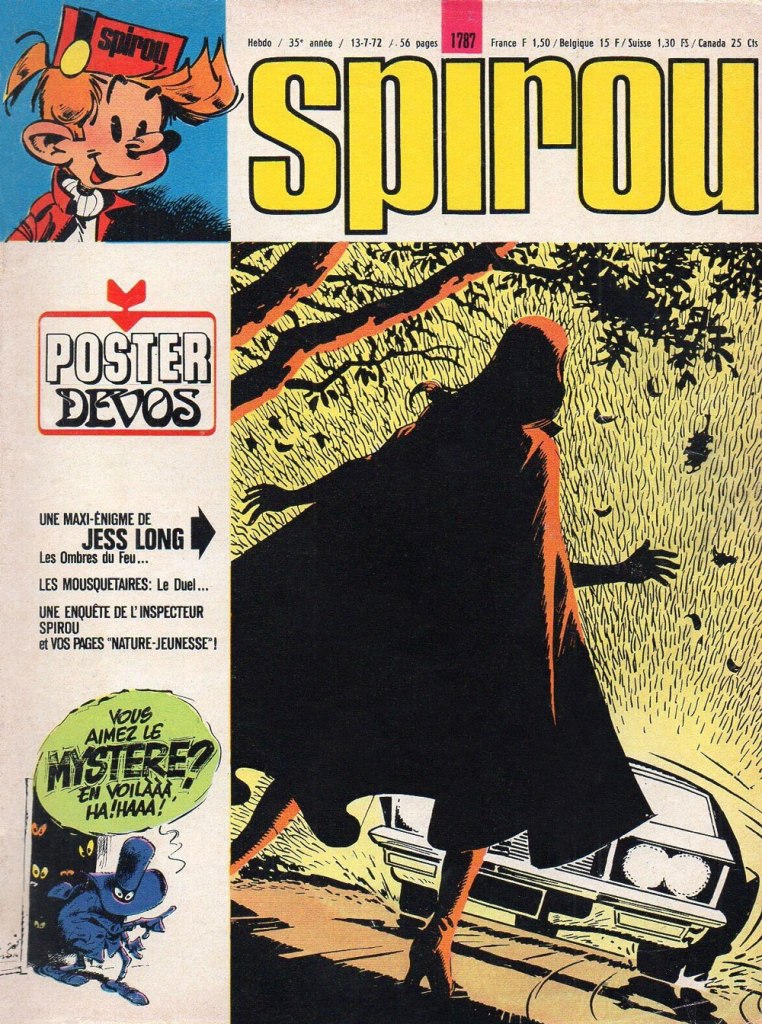
Today, we feature excerpts from Jess Long’s sixth investigation, Les ombres du feu (‘Shadows of fire’), from 1972. Fasten your seatbelts!
Pretty good spotting, Agent Corey Hart!The story runs fourteen pages, a bit long for our purposes… but I’m sure these highlights will properly convey its nocturnal essence. This is Jess Long, Police spéciale no. 2 (1977, Dupuis), comprising the fifth and sixth adventures. For some reason, the publisher didn’t start collecting the series until 1976. In the end, twenty albums were issued, a fine run!This is Spirou no. 1787 (July 13, 1972, Dupuis). Cover by Piroton, with a lower left vignette by André Franquin.Another spooky Jess Long cover, this time it’s Spirou no. 1897 (Aug. 22 1974, Dupuis), with another Franquin comment.
I’ve heard that Piroton’s style was considered a bit too ‘American’ to be that popular in Europe. Amusingly, it looked like nothing published in American comics at the time — I’d say his approach was a throwback to a mix of Bernard Krigstein and, say, Alex Raymond in Rip Kirby and Secret Agent X9 mode.
Something else worth noting about the Tillieux-Piroton collaboration: while Tillieux was the complete package — writer and artist — he was essentially forced, by some disastrously myopic editorial decisions right from the top at Dupuis (a stubborn failure to grasp that not every cartoonist can be his own writer) Tillieux had to almost entirely give up drawing, even on his own series, Gil Jourdan, to take on writing duties for a great many features. But since he was, one might say, the “Anti-Stan Lee”, he painstakingly storyboarded each page of his scripts, acting not only as scenarist, but also as metteur en scène. Thankfully, some examples of these fascinating breakdowns have survived. Check out this one and especially that one. -RG
« I believe that the Belgians do possess some surrealistic gene. » — Eddy de Clercq
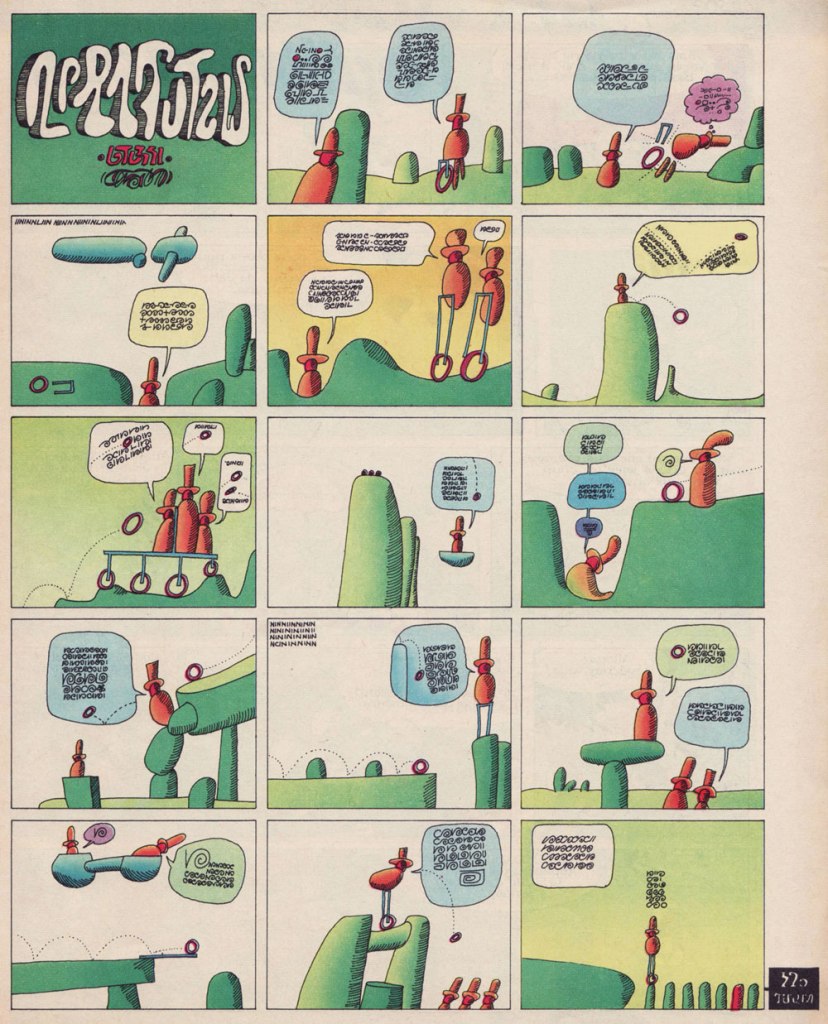
I’m afraid we’re back into surrealism territory, folks. Our focus today is on a single piece by polymath Maurice Rosy (1927-2013, Fontaine-l’Évêque, Belgium), published in bédé weekly Spirou in 1966, in the midst of Rosy’s tenure as the magazine’s co-art director (with Yvan Delporte) and boundless idea generator (1956-73, for the record… the period widely hailed as Spirou’s golden age).
As for the story in question… it was, shall we say, ahead of its time. And still is.
Nonetheless, its value was recognized almost immediately (less than one year on, for the record) by connaisseursJacques Sternberg, Michael Caen (co-founder of the epochal Midi-minuit fantastique) and Jacques Lob‘s essential Les trésors de la bande dessinée (1967, Éditions Planète), wherein they wrote:
Intrigued by oriental philosophies and General Semantics*, jazz pianist in the modern idiom, art director of the publishing house that produces Spirou, hilarious storyteller, Rosy has had drawings published in Paris-Match and Adam, all the while crafting (with Pol Deliège) tales of Bobo. He is also the author of the most bizarre story ever to appear in a kids’ magazine, which earned its publisher and author an especially venomous stream of insulting letters. Geniuses are always unsung.
Rosy has the sharp smile of a Steve McQueen and a picturesque language all his own.
You be the judge, He looked winningly impish, all right!
And now, the item in question:
From the next page over, a detail from more typical fare, namely Peyo’s La Schtroumpfette. Rosy, art director to the hilt, had opted to further mess with the readers’ minds by tampering with the magazine’s standard À suivre (to be continued) box.
When Rosy was interviewed for a deluxe, 16-volume reprinting (begun in 2007) of the adventures of Tif et Tondu (with Will as illustrator, Rosy served as writer/metteur en scène on the feature for many of its glory years, 1954-67), the notorious one-shot was touched upon:
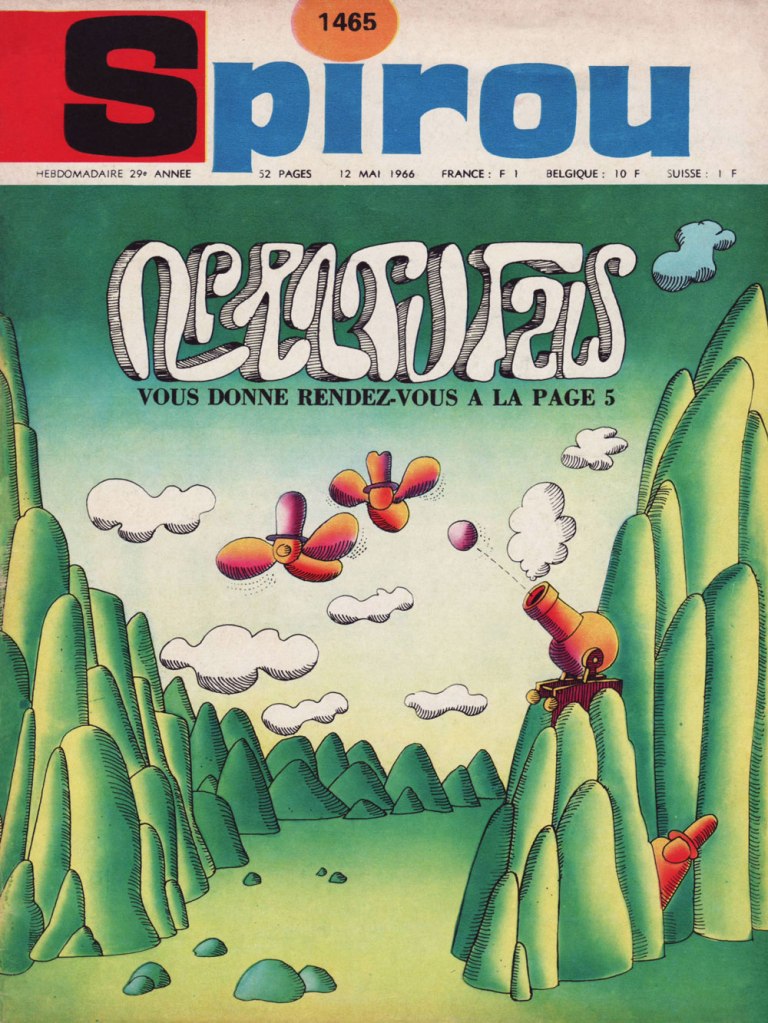
In 1966, you created a strip with an unreadable, and therefore unpronounceable name, which even made it onto the magazine’s cover: are we deep into Herriman* territory?
Rosy: That’s weird, people say that, but at the time, there was no such conscious homage. It was rather a reflection of the state of mind that I was in. I was increasingly bearing the marks of (and anguished by) the absurdity of certain facets of life.
«… awaits you on page 5. » Rosy’s cover for Spirou no. 1465 (May 12, 1966, Éditions Dupuis).
**In the same way that people with an insufficient frame of reference wrongly compare every musician they hear to The Beatles, the under-informed tend to ascribe any sign of whimsy or absurdity in the comics medium to Krazy Kat progenitor George Herriman. Yes, both were deeply influential, but come on, there are limits. In Rosy’s case, I’d posit that, if there was influence at work there, it was more likely that of the mighty Saul Steinberg.
« Flattery is like chewing gum. Enjoy it but don’t swallow it. » — Hank Ketcham
Going way back: When I was a wee lad (still in the single digits), my mother would accompany me to our area’s oldest and finest bookstore (Chicoutimi’s long-gone Librairie régionale). At the time, I had been purchasing bound collections of Belgian bédé publisher’s Spirou, the earlier the better. Even at that tender age, I held the conviction that things had already peaked.
A friendly employee ushered us into the restricted area of the bookstore’s top floor, a vast warehouse I never got a tour of… but it was immense! I was led to an aisle where, high above, dozens of older Spirou collections were kept, dating all the way back to 1962. I can afford to be specific, because I bought the oldest issue they had on hand (Album Spirou no. 84). At ten dollars a pop, they were reasonably-priced, but still costly for a child with a 1970s-scale allowance. For my parents, a reliable source of ideal birthday and Christmas gifts, however!
It was in their pages (no. 90, see below!) that, along with the established Spirou magazine series (Spirou et Fantasio, Boule et Bill, Buck Danny, Benoît Brisefer, Tif et Tondu, Gil Jourdan…), I encountered scads of unfamiliar entries. Of these, an early album caught mid-tale one that truly stuck with me through decades and therefore is the object of today’s post.
This is Album Spirou no. 90 (Sept. 1963, Dupuis), collecting the bédé weekly’s issues n° 1316 to 1328. Cover by André Franquin, depicting a scene from a Spirou adventure, the troubled production that was QRN sur Bretzelburg (under its original title, QRM sur Bretzelburg).
In short, though, here’s what’s relevant in this case: from 1949 to 1987 (with a pause between ’59 and ’63), Will illustrated the adventures of Tif et Tondu, characters owned by Éditions Dupuis, its publisher. Still, he longed to draw characters of his own, which wasn’t an idle whim, given that most of his colleagues and collaborators did just that, enjoying more latitude and far greater financial rewards. In 1962, he got the chance to try his hand at an original series, Éric et Artimon, conceived with versatile scripter-cartoonist Raymond Antoine, alias Vicq. And the result was outstandingly charming, light-hearted and hilarious.
The 1976 (and only, so far) edition of Toute la gomme. Still, I’m grateful for its existence: I was finally able to read the whole story, though without colour.
A mere two long adventures (44 pages each) were produced (Le tyran en acier chromé, 1962, and Toute la gomme, 1963, plus a six-pager, Et mine de rien, in 1967), and Dupuis never bothered to collect or reprint them. Instead, well down the pike, two separate, smaller publishers licensed the rights and issued small black and white runs of, respectively, Toute la gomme (Espace Édition, 1976) and Le tyran… (Magic Strip, 1983).
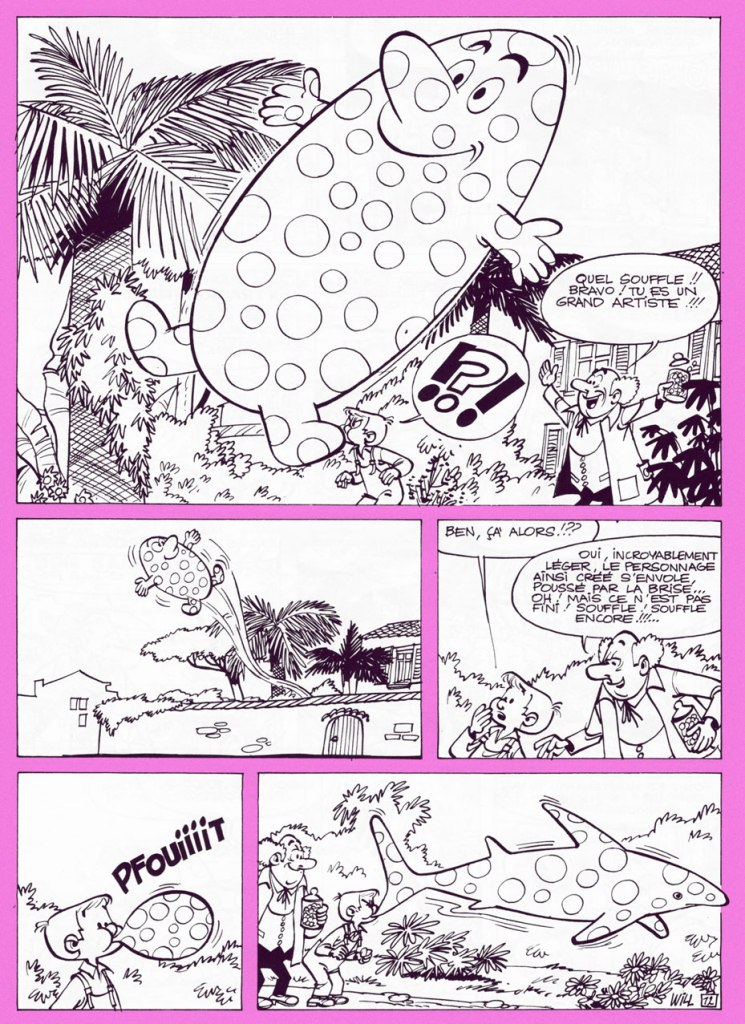
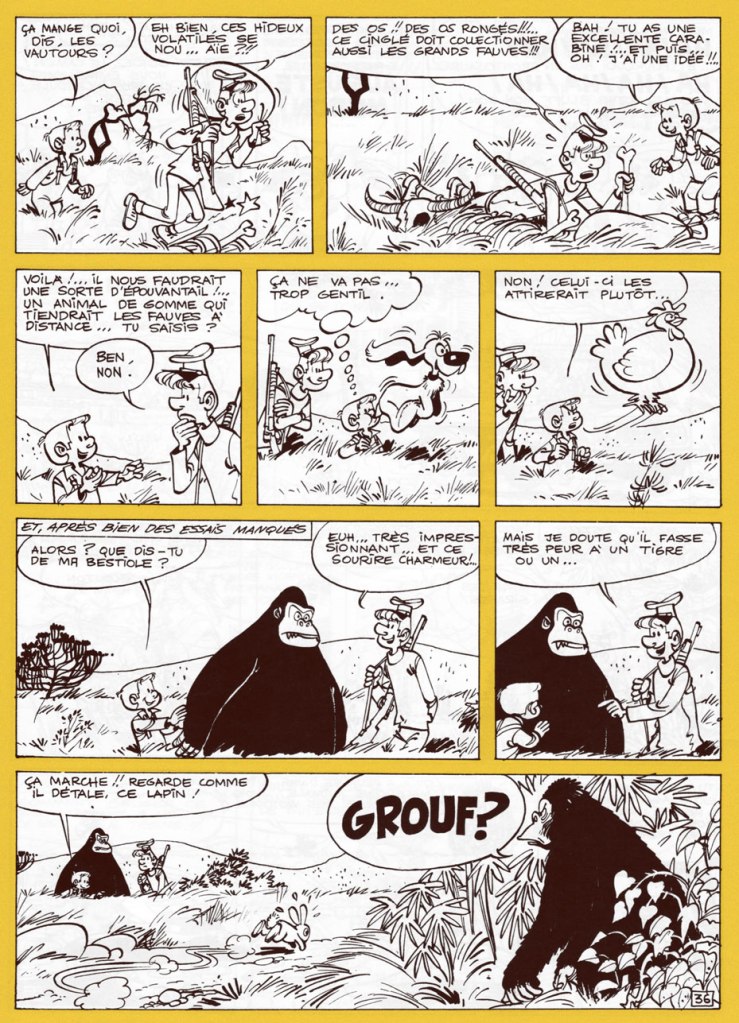
Candy aficionado Éric visits his main supplier, loveable eccentric Monsieur Grosoison, at his confiserie ‘Au bambin vorace’ (‘The Voracious Toddler’). The old man, also a brilliant inventor, shows off his new creation to his best and most loyal customer. The stuff’s not only downright magical, it’s also exquisitely delicious.
« Such lungs! Bravo! You are a great artist! »
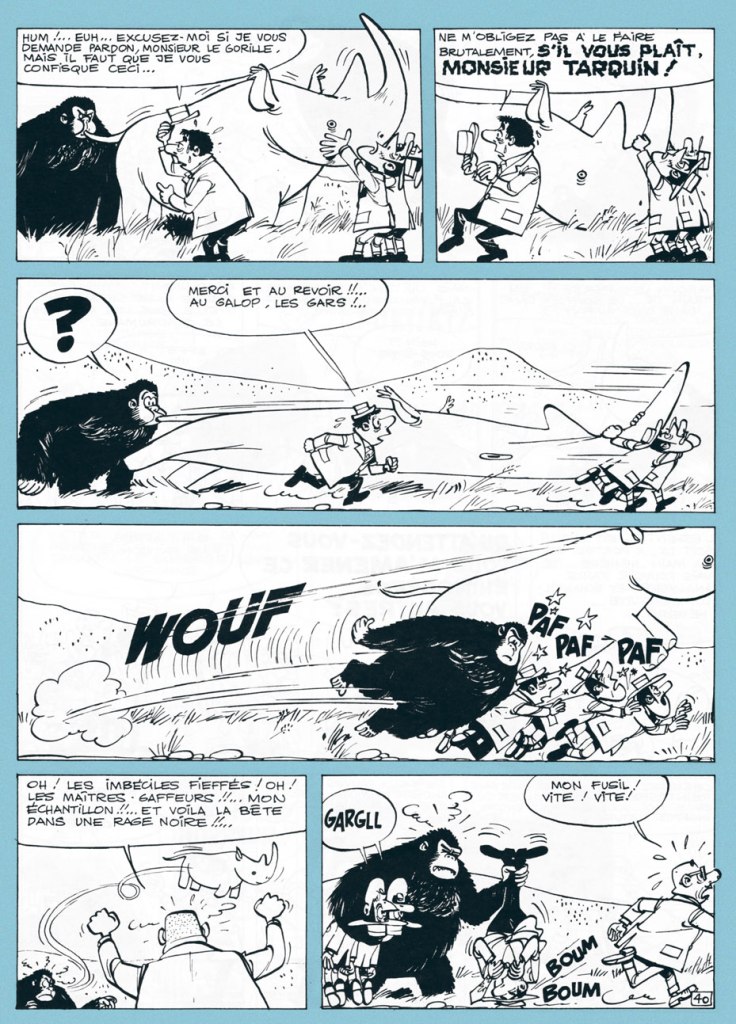
After an unscrupulous candy magnate has the inventor kidnapped by his henchmen (an uprarious pyromaniac and a pair of tiny twins afflicted with stiff necks from gaping at Éric’s balloon creations drifting overhead), and taken to his private island, he threatens to leave him in the hands of fearsome gorilla Tarquin the Superb. Meanwhile, Éric and Artimon encounter the ape, who turns out to be blessed with tremendous intelligence, a fine sense of humour, and a powerful set of lungs.
However, Tarquin doesn’t like his good-natured fun interrupted.The back cover of Espace’s Toute la gomme, wherein Éric employs ingenious means to escape a rooftop.
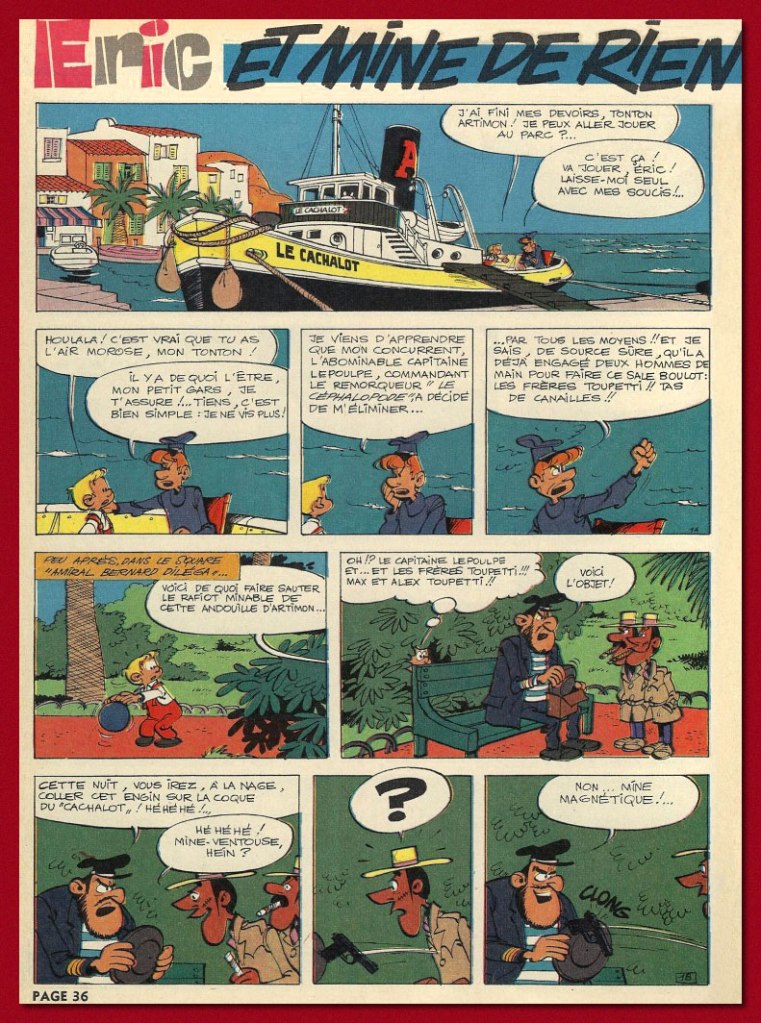
The opening page to the short concluding episode of the boy and the captain’s adventures, Et mine de rien (Spirou n° 1506, 1967).
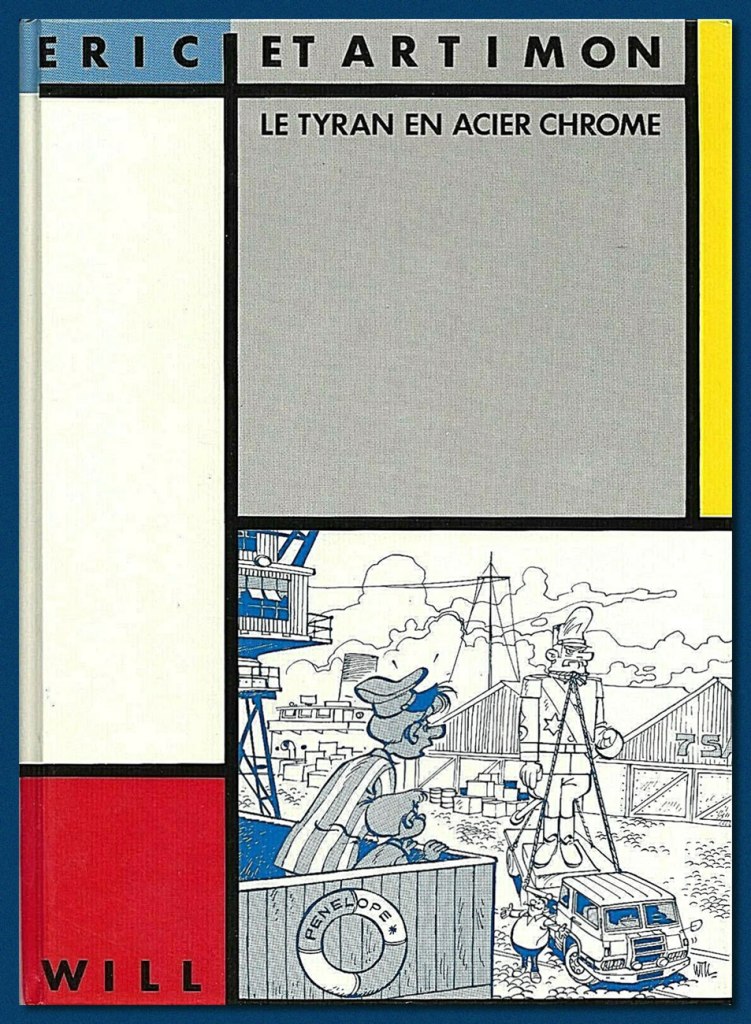
And here’s the fancy 1983 edition of Le tyran en acier chromé, scarce and fairly pricey nowadays, unlike Toute la gomme.
Thankfully, Éric et Artimon haven’t been entirely forgotten, despite the shabby treatment they received at the hands of their original publisher. Here’s a signed lithograph produced in the early 1990s by Belgian bookstore Chic-Bull. Note the fancy silver ink on the statue. Mine’s number 48!
I’ll be spotlighting Will’s other creator-owned series, Isabelle, at some point during this year’s Hallowe’en Countdown!











 Who's Out There?