Treasured Stories: “Spawns of Satan” (1973)

« Hugs can do great amounts of good, especially for children. » — Diana, Princess of Wales

Today’s entry is a tale of vampirism from the typewriter of Jack Oleck (1914-1981). In the late 1940’s Mr. Oleck’s career in comics began promisingly with his brother-in-law Joe Simon and his partner Jack Kirby‘s Prize (Young Romance, Strange Worlds of Your Dreams, Black Magic and other anthologies), followed by a stint with EC late in the publisher’s classic, pre-Mad Magazine-only run (Crime SuspenStories, Shock SuspenStories, Vault of Horror, Incredible Science-Fiction, et al), along with assignments with Hillman, Atlas, Charlton and Harvey… among others.

Finding the décor of the Code-regimented funnybook industry a bit austere to his taste, he devoted the years of 1957 to 1969 to publishing and editing the magazine Decorator News and authoring the odd novel.

In 1969, he sauntered over to DC, where he cranked out quite a caboodle of scripts over the following decade-or-so, mostly in the horror (as it couldn’t be and shouldn’t be called under The Code) genre (“Mystery”, they called it), but also the occasional bit of romance, science-fiction and adventure. I’d like to say he was great, but frankly, he was pretty much a page-filling hack.

This is probably his finest script from this most prolific period, and it’s still full of plot holes and other inconsistencies. But that’s market reality for you: Oleck was consistently readable, he was fairly competent, he turned in his work on time, and he got along with the editors. Sometimes that’s all you need.

So why am I featuring Spawns of Satan if I seem to think so little of it? Well, obviously, there’s the luxurious grace of Nestor Redondo‘s art, granted here a specially generous setting to display its virtues. The middle act of the story is virtually mute, and all the more effective for it.

Read it first, then I’ll tell you more.
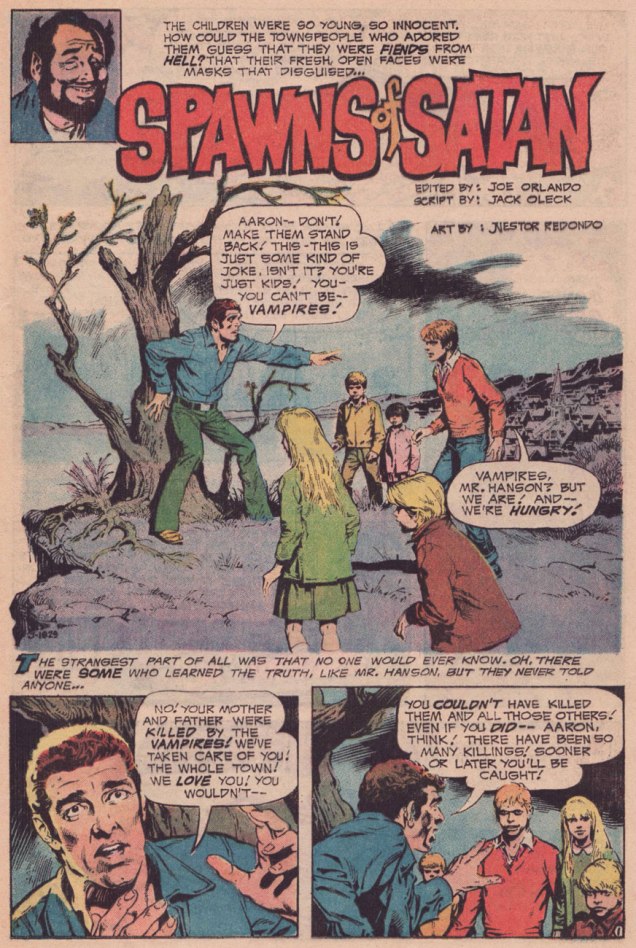
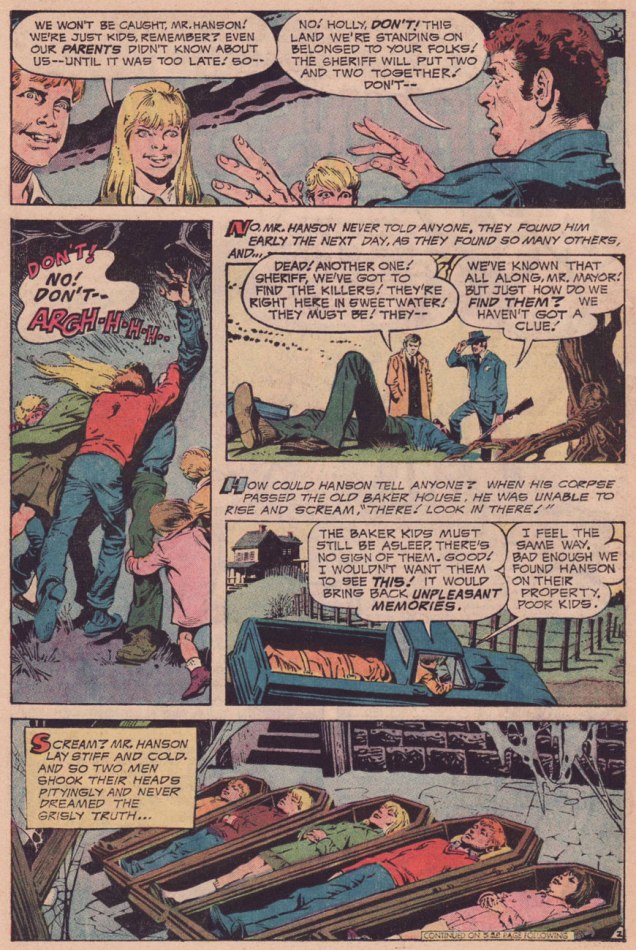
RedondoSpawns01A
Okay, if the town’s taken care of them, how come no-one’s found it unusual that the kids aren’t around during the daytime? Doesn’t anyone go to school?
RedondoSpawns02A
It certainly tips the scale in the miscreants’ favour that the sheriff just shrugs and admits he hasn’t a clue. I guess it just wasn’t an election year.
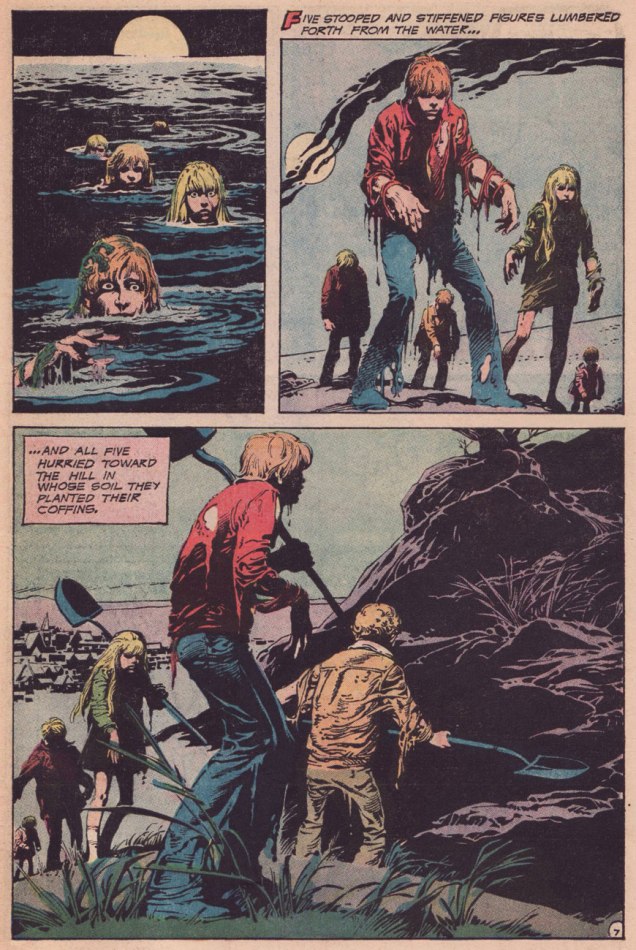
RedondoSpawns03A
Wait… kids (with one or two tackling most of the grunt work) burying five coffins on grassy ground, and “not a sign that the ground’s been disturbed“? Mighty vampire powers, I say! And can you imagine the torment and frustration of the little ones, knowing they’ll never grow up, never get to take charge or be taken seriously? This story is just honeycombed with potential avenues of exploration.
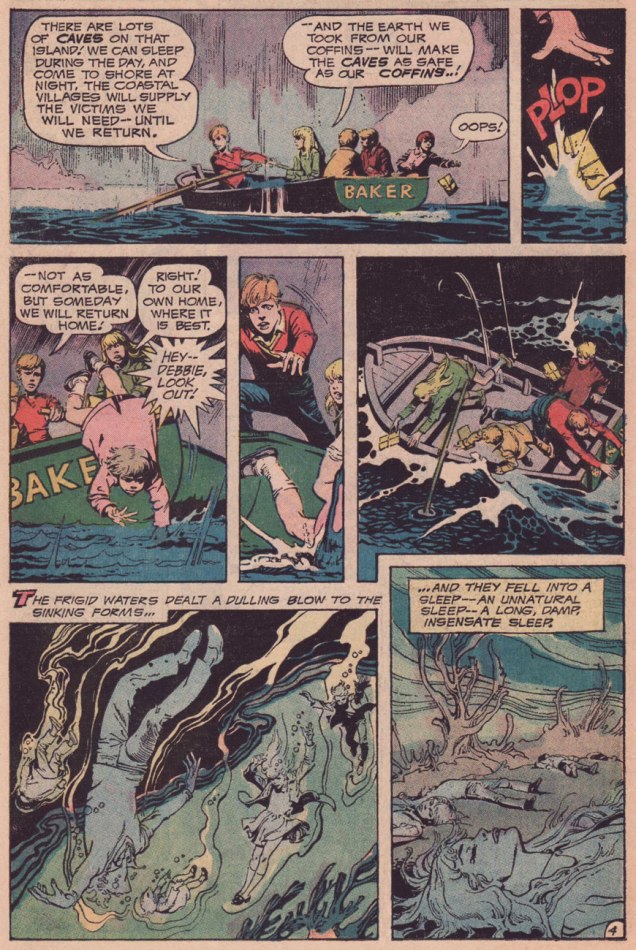
RedondoSpawns04A
One slight problem: hypothermia should not affect undead creatures without a beating heart nor, necessarily, blood circulation. A little too convenient, Mr. Oleck. But fine, you’ve got them to the bottom of the lake.

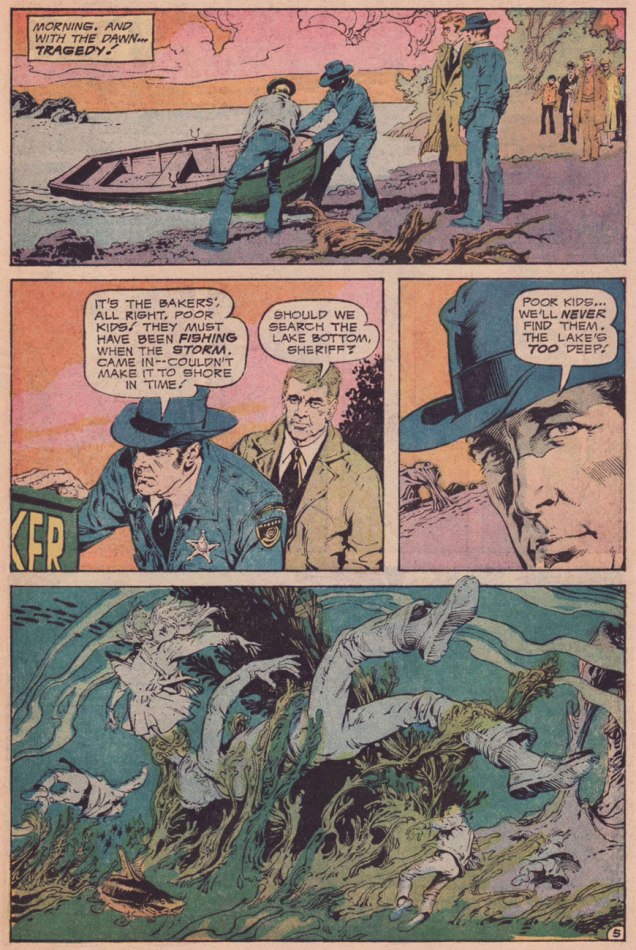
RedondoSpawns05ARedondoSpawns06ARedondoSpawns07ARedondoSpawns08A

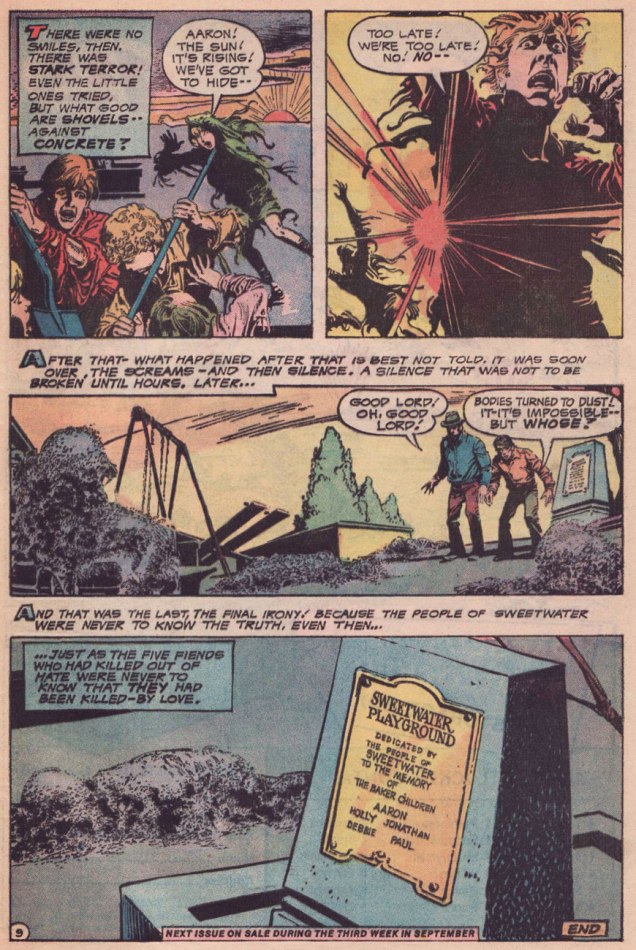
RedondoSpawns09A
For me, one of the tale’s chief assets had been Aaron’s characterization. Now how is it that suddenly, this cool-headed and calculating leader just loses his shit and gives up*? As depicted earlier, Aaron would have ordered a retreat to the lake and formulated another plan. But no, there had to be a ‘sting in the tail’. Also, if the town knew full well they were dealing with vampires, why do bodies turned to dust suddenly seem “impossible”? Finally, did you get the impression that the Baker kids killed out of hate (well, except for Holly; that girl had a bad attitude), as stated in the final panel? I think not: the clan was portrayed as a predator pack, who merely killed to survive, no sentiment allowed.

SOS is otherwise mainly notable in its introduction of themes and ideas that would be brought to full miasmic flowering by (of course) Alan Moore in issues 38 and 39 of Swamp Thing (July and August, 1985), namely the family unit of underwater vampires. Moore’s set of toothsome nasties was more-or-less introduced, but not fully-fleshed out, by his predecessor, Martin Pasko, in July, 1982’s Saga of the Swamp Thing no. 3‘s A Town Has Turned to BloodMoore’s keen eye caught the spark of potential and set the hills ablaze. However, it seems unlikely that Moore’s research hadn’t trailed back a few years to the lacustrine lair of the parasitical Baker brood.

While slaughterous children were all the rage from the late 50s (John Wyndham’s The Midwich Cuckoos, its filmic adaptation Village of the Damned and its sequel, Children of the Damned) and into the 70s, Oleck’s Spawns still preceded Stephen King’s ‘Salem’s Lot (1975), The Omen (1976) and the 1976 Spanish shocker ¿Quién puede matar a un niño? / Les révoltés de l’an 2000 (boy, did that one scar me as a kid), and given the comics field’s penchant for cribbing ideas *after* they had run their course, that’s another feather in Oleck’s fedora.

Speaking of editors, I’ve long suspected that this particular issue of House of Secrets was the dumping ground of an aborted experiment by its editor, Joe Orlando. Orlando had clearly been trying to shake things up a bit, running two longer, less compressed stories per issue instead of the usual three… as DC’s available story page count had dropped from 24 to 20 (and would reach a woeful 17 by 1976!); the two-story practice lasted but a few issues. After no. 117, it was jettisoned. It would appear that at least one of House of Secrets 113’s stories had been scheduled and delayed: eight months earlier, Jack Sparling’s grey-tone lovely cover for House of Secrets no. 105 (Feb. 1973) was a perfect illustration for Doug Moench‘s, Mike Sekowsky and Nick Cardy‘s fascinating ‘Not So Loud– I’m Blind’… which finally turned up in this issue as the lead story. Sombre and rambling, Moench’s likely first sale to DC lacks the usual forced twist ending, opting instead to trail off into darkness. In fact, when I first read it, I thought my copy was missing a page.

Moench went off to be arguably (well, he’s my pick) Marvel’s most consistent writer of the 1970s, and only returned to DC in the ensuing decade.

-RG

*short answer: The Comics Code Authority.

Treasured Stories: «Tex’s Bad Dream or ‘The Egg Lady’s Revenge’» (1988)

« You really saw that things were not at all what was portrayed in the mass media… at least not in our neighborhood. It was just a conclusion that most of the kids of that age came to, that things were extremely corrupt. » — Spain Rodriguez

While plenty of cartoonists trod the path of autobiography before him, it took Manuel ‘Spain’ Rodriguez (1940-2012) to truly show how it should be done: here at last was a genuine full-blooded practitioner, hardly content to merely observe from the sidelines, blending with the wallpaper. Lover, brawler, consummate graphic storyteller: a scarce combination indeed.

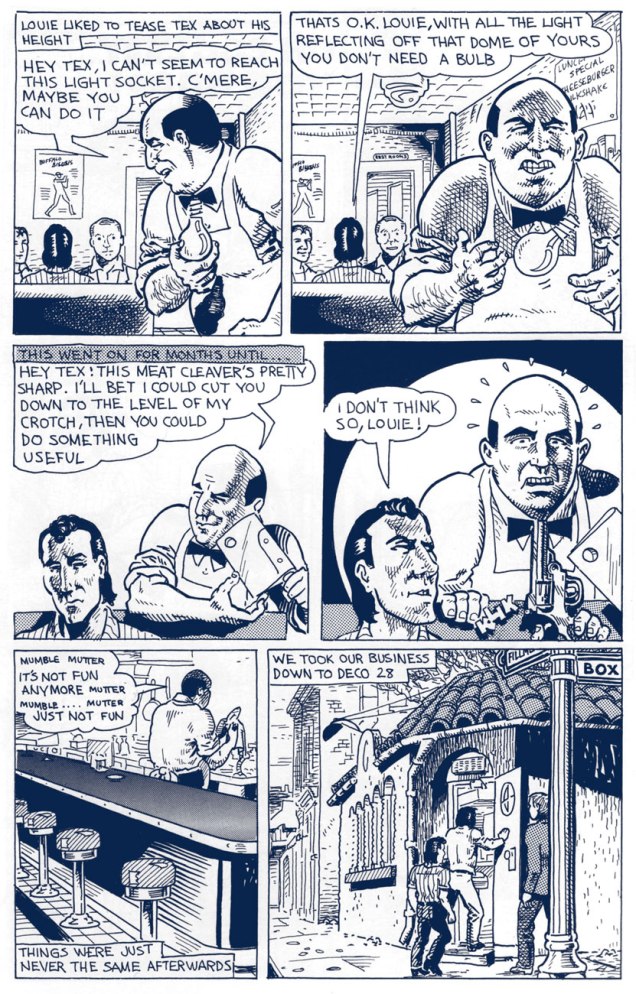
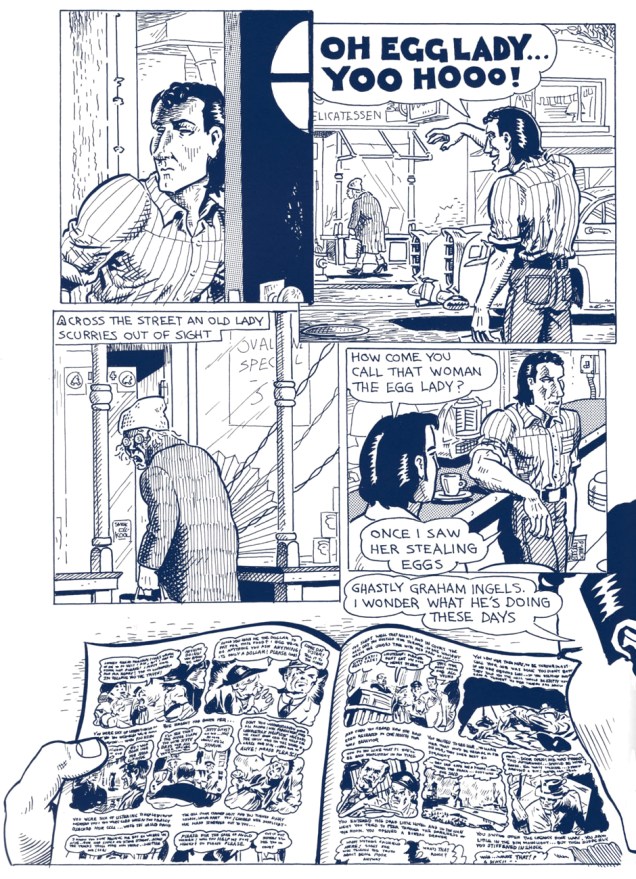
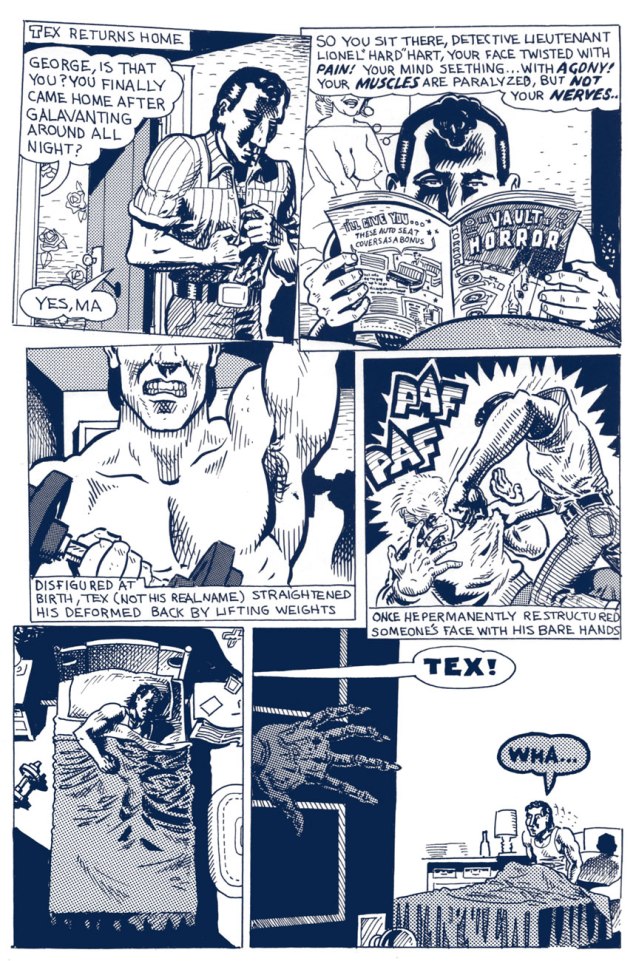
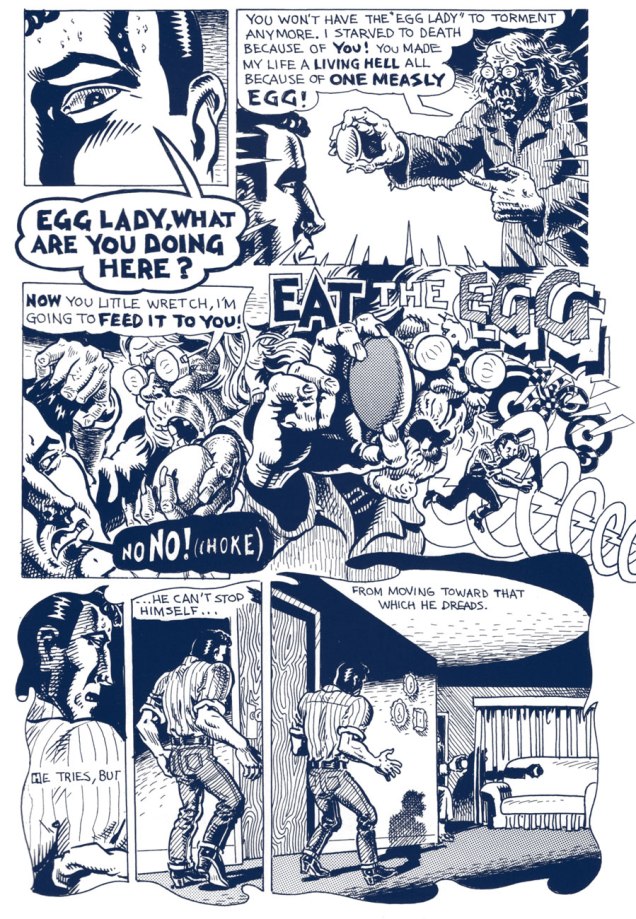
The following tale belongs to a cycle recounting the exploits and insights of The North Fillmore Intelligentsia, Spain’s closest compadres in Buffalo of the 1950s. Tex’s Bad Dream… originally appeared in Blab! No. 3 (Sept. 1988, Kitchen Sink Press); indeed, Spain’s recollections became, over time, the sole reason to purchase the once-excellent Blab! Mercifully, most of these were collected, in their usual exemplary fashion, by Fantagraphics, as Cruisin’ With the Hound (2012). You’ll still be lacking the mysteriously-omitted, quite essential « How I Almost Got Stomped to the “Still of the Night” by the “Five Satins » (Prime Cuts No. 2, Mar. 1987, Fantagraphics), which you can find in another Spain anthology, My True Story (1994, Fanta again).

In the meantime, enjoy, with my compliments, this true-life tale of original EC Fan-Addicts, facial restructuring, cautionary dreams, isometrics and pork sandwiches.

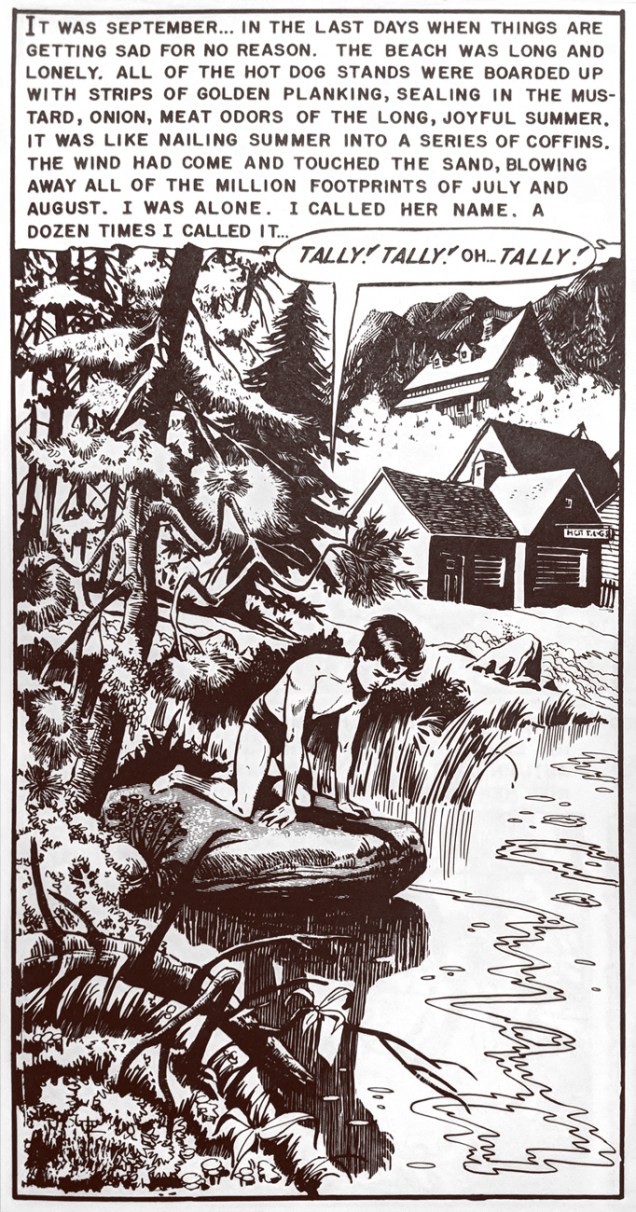
spainegg01aspainegg02aspainegg03aspainegg04aspainegg05aspainegg06aspainegg07aspainegg08a

-RG

Hallowe’en Countdown II, Day 16

« When the dark mists rise up from the graveyard, and shutters bang in the windows of old abandoned houses, and the lights burn late in the back rooms of funeral parlors, the hour has struck for the Autumn People. » — anonymous back cover blurb

Frank Frazetta‘s cover for Ballantine Books’ October 1965 collection of EC adaptations of Ray Bradbury short stories (such a string of possessives!), namely « There Was an Old Woman » (art by Graham Ingels) « The Screaming Woman » (Jack Kamen), « Touch and Go », aka  « The Fruit at the Bottom of the Bowl » (Johnny Craig), « The Small Assassin » (George Evans), « The Handler » (Ingels), « The Lake » (Joe Orlando, some of the finest, most sensitive work of his incredibly-brief peak, which he would coast on for the rest of his career), « The Coffin » and « Let’s Play Poison » (Both Jack Davis).

FrazAutumn

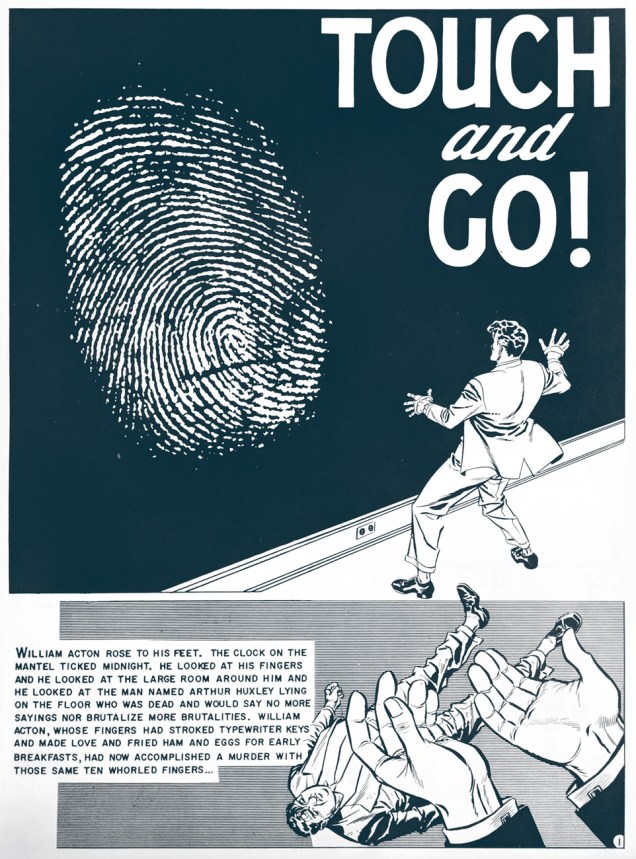
I’m feeling foolishly generous, so here’s a panel from each story. Owing to personal bias, Mr. Craig is the only one who gets a full page to show off. Seriously, though, scripting his own stuff afforded him greater latitude in storyboarding his work… and how it shows!

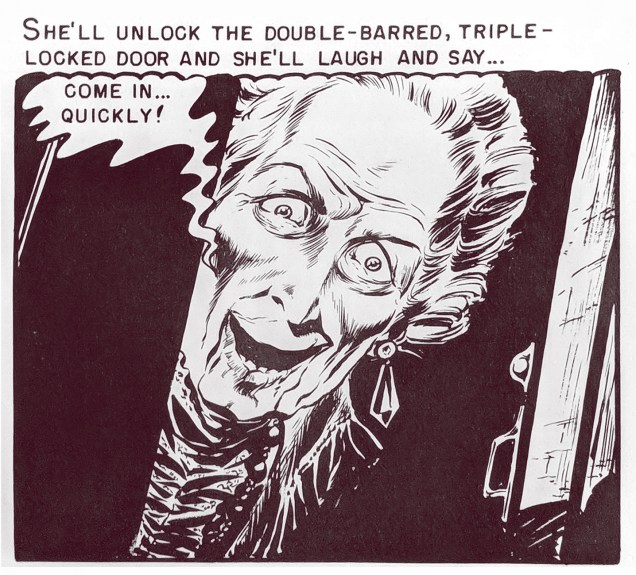
IngelsOldWomanA
« Ghastly » Graham Ingels.
KamenScreamingA
Jack Kamen.
CraigTouchA
Johnny Craig.
IngelsHandlerA
Mr. Ingels again.
EvansAssassinA.jpg
George Evans.
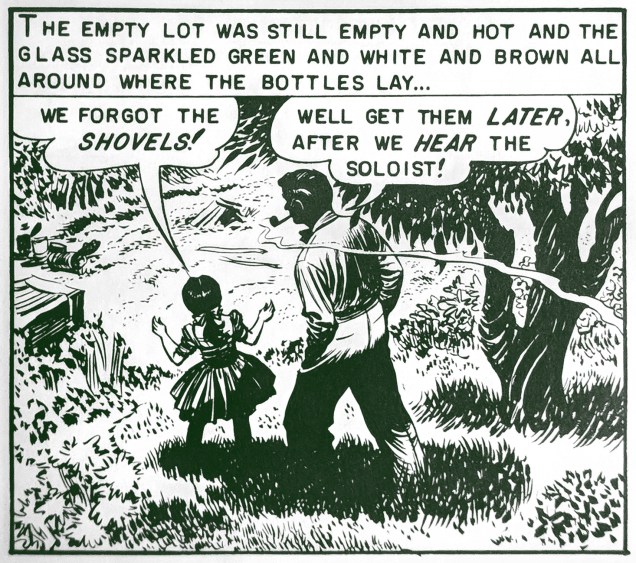
OrlandoLakeA
Joe Orlando.
DavisCoffinA
Jack Davis once…
DavisPoisonA
… and Jack Davis twice.

I first encountered Bradbury through « The October Country » (1955), which turned out, I was to discover later, to be a heavily-revised version of his initial, Arkham House-issued collection, « Dark Carnival ».

« When given the chance to rerelease the out-of-print collection in 1955, Bradbury seized the opportunity to revisit his first book and correct the things he deemed inadequate. (Ever the perfectionist, Bradbury was, throughout his career, often discontent with calling a book done, even after its publication.) He rewrote a number of stories, made light revisions on others, cut twelve tales altogether, and added four new ones to round out the collection. The stories Bradbury discarded he thought too weak, too violent, or too primitive, and not representative of where he was as a writer at that moment. »

As it happens, several of the stories that caught Gaines & Feldstein’s fancy were the very ones that Bradbury was in the process of disowning. Ditching « The Coffin » or « Let’s Play Poison » or, for different reasons, « The Black Ferris » (as he was to expand it into « Something Wicked This Way Comes » a few years down the line) I can understand, but losing the incredible « The October Game »? Especially since he was making (lots of) room for his most plodding story, the seemingly-interminable (at 44 pages) « The Next in Line ».

There was a companion volume devoted to EC’s adaptations of Bradbury science-fiction tales, « Tomorrow Midnight », also boasting a Frazetta cover.

– RG

Golly, a pop quiz?

« Have a nice nap, young man? »

OrlandoZeroforYouA.jpg

The punchline to the EC story “Pleasant Screams!”, written by the usual Bill Gaines / Al Feldstein combo, with art by Joe Orlando. From Tales From the Crypt no. 37 (August, 1953) Can anyone in the class tell me where this panel was swiped and quoted (to hilarious effect) in the eighties? The answer follows…

cropped-outthereicon.gif

Here it comes… pencils down, everyone!

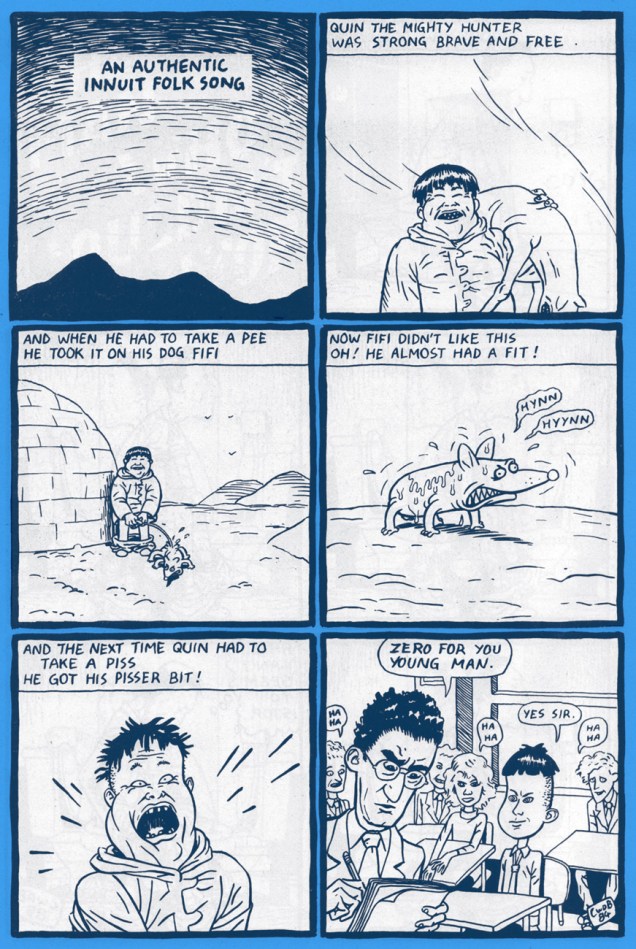
ChesterInnuitA
Poor Fifi. He hardly seems to be the right breed of pooch for the Canadian Arctic, not to mention its special precipitations. Reprinted several times since, this edifying tale of poetic justice first saw print in the final issue of the Yummy Fur mini-comic (no. 7, Sept. 1985, Tortured Canoe).
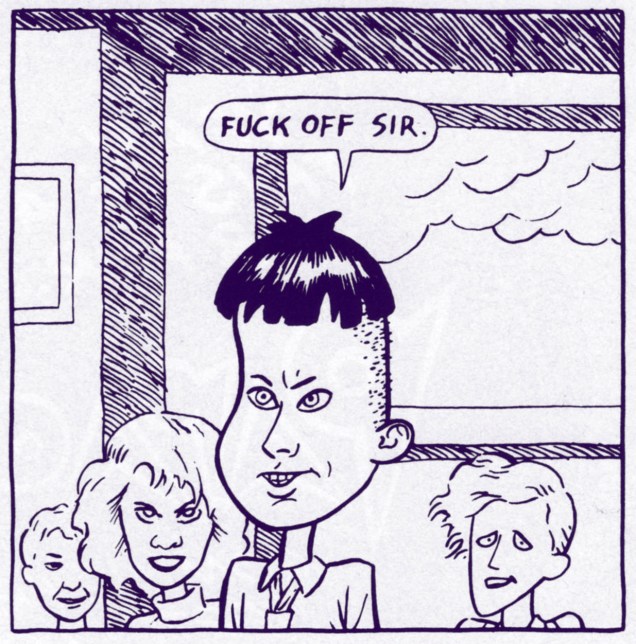
ChesterFuckOff
Chester’s closing argument in the case.

Ah, for a return to the days when we didn’t know way too much about Chester Brown, when he was a mysterious, self-published cartooning genius and Châteauguay‘s finest son. I remember how awestruck I was upon encountering his brilliant Yummy Fur minis, available at Toronto’s gone-but-not-forgotten Dragon Lady comic book store in the early-to-mid 1980s. What a surreal breath of fresh air they were!

A cat’s meow and a cow’s moo
I can recite ’em all

Just tell me where it hurts yuh, honey
and I’ll tell you who to call

Nobody can get no sleep
There’s someone on ev’ryone’s toes

But when Quinn the Eskimo gets here
everybody’s gonna wanna doze.

QuinnEskimo
The source of Bobby Zimmerman‘s inspiration: Anthony Quinn as “Inuk” in The Savage Innocents (1960). Back then, people dressed like this where and when it was actually cold; nowadays, it may be sunny and well above freezing, but those fierce, dauntless Polar explorers roam the streets in great numbers, clad in their fashionable down-filled, fur-lined hooded coats…  

-RG