« I won’t put in a load of laundry, because the machine is too loud and would drown out other, more significant noises – namely, the shuffling footsteps of the living dead. » — David Sedaris
First things first — the general plot: « Dead in the West is a short horror novel written by American author Joe R. Lansdale. It involves the tale of longtime Lansdale character the Reverend Jebediah Mercer: he rides into the town of Mud Creek, Texas that is about to be attacked by an Indian medicine man who was unjustly lynched by the town inhabitants. Soon the dead will rise and seek human flesh and the Reverend finds himself right in the middle of it. He aligns himself with the town doctor and two of the town’s inhabitants, Abbey and David. Together they fight the zombie horde and try to dispatch the medicine man who is the cause of all the evil. » [ source ]
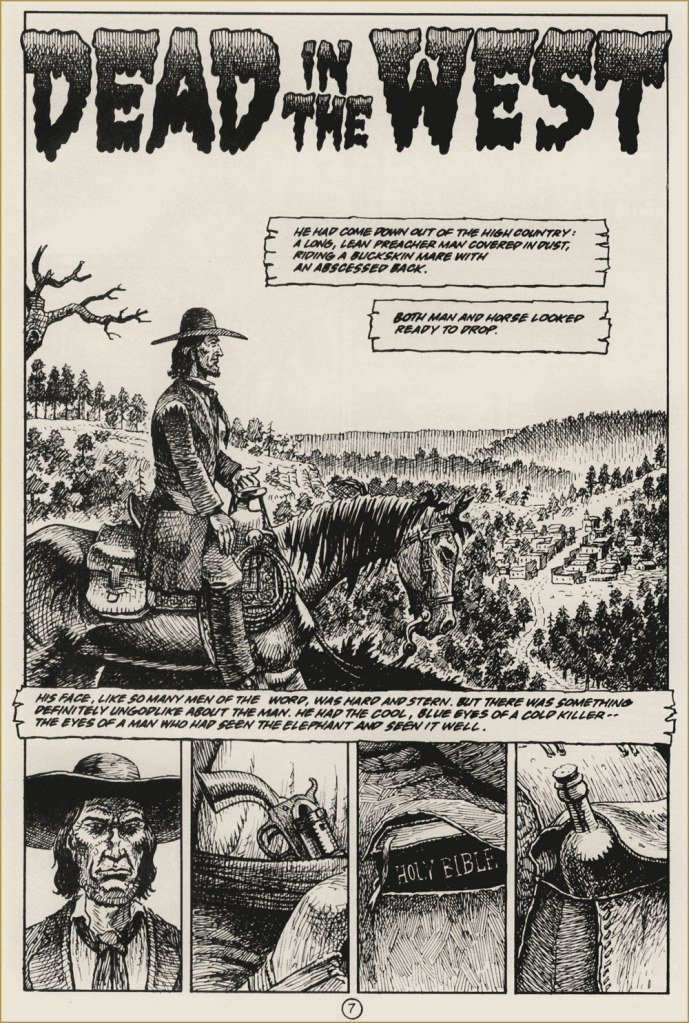
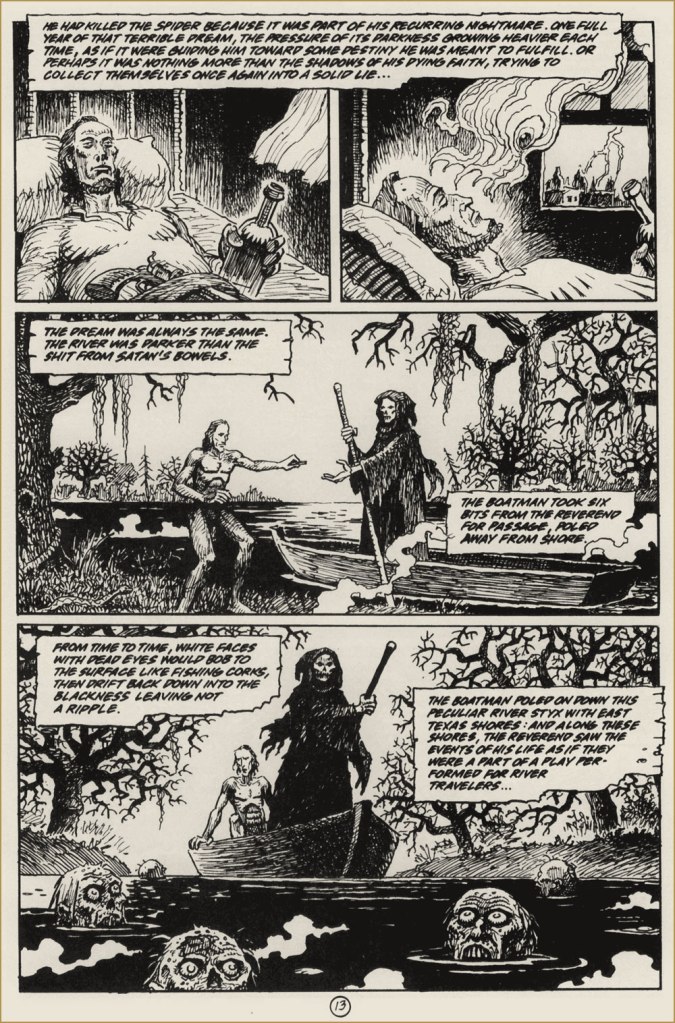
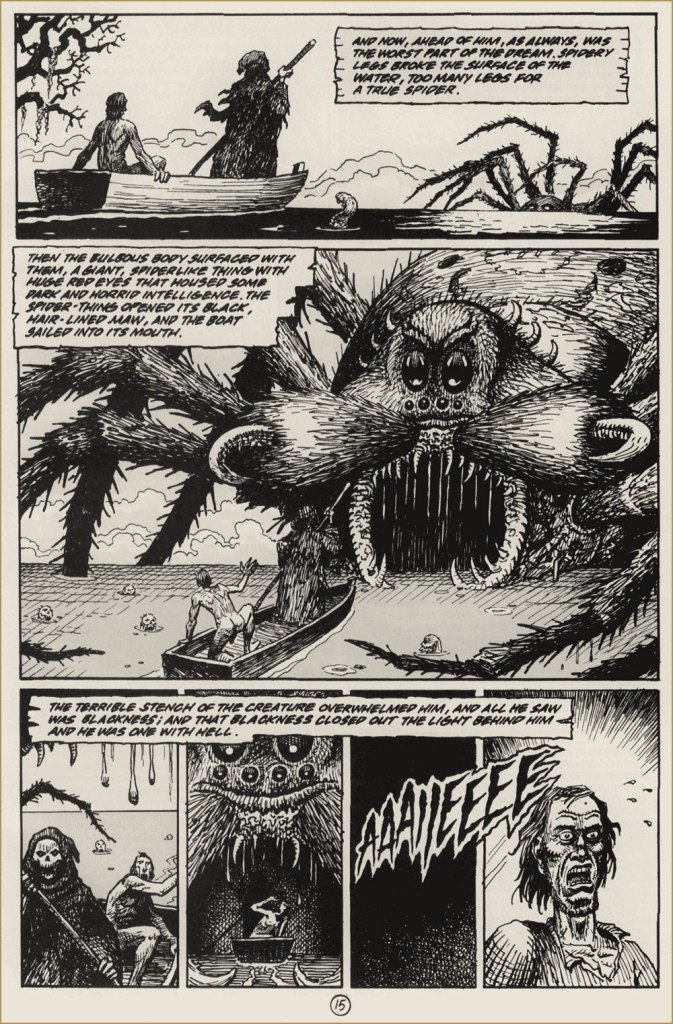
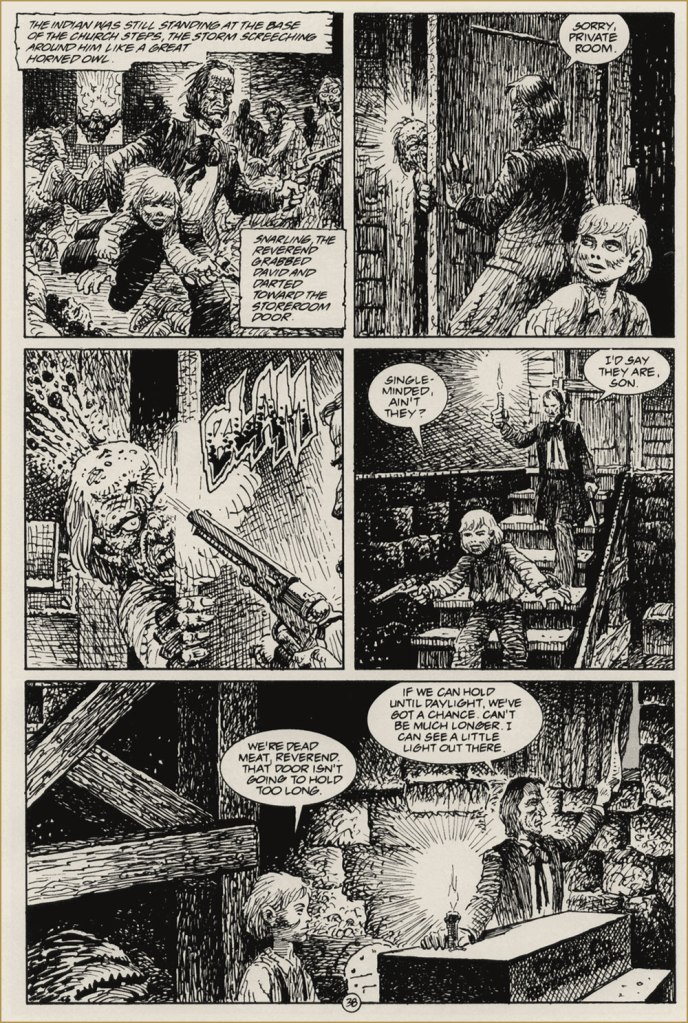
Well, I haven’t read the novel, but the comics adaptation, by seasoned scripter Neal Barrett Jr. (1924-2016) and illustrator Jack ‘Jaxon’ Jackson (1941-2006), is exemplary… well, the results are, at any rate. While we’re not dealing with anything truly new here… I mean, it’s a zombie siege in the well-trod Night of the Living Dead tradition, but in an Old West setting. But the pacing is flawless, the gore and horror balanced with judicious sprinklings of gallows’ humour — served deadpan — and Lansdale’s trademark brutal frankness strikes just the right tone.
Jackson, a fifth-generation Texan and in many ways the original Underground cartoonist, was an inspired choice, as he’s well and truly in his element here.
As this thing is fairly long — as it ought to be! — I’ve just plucked some favourite pages as examples. But if this is up your alley, do yourself a favour and grab yourself copies. Over three decades down the dusty road, these babies are still available at below cover price. It is to weep… but it’s a bargain well worth making.
This is Dead in the West no. 1 (Oct. 1993, Dark Horse); cover by Lansdale regular Timothy Truman. I guess he sells more books than Jaxon, but I’ve never been a fan, save when he’s inked by Sam Glanzman, (1924-2017) who expertly ironed out the chronic stiffness in Truman’s pencilling.I must concede that the giant spiders are a novel touch.This is Dead in the West no. 2 (Oct. 1993, Dark Horse); cover, again, by Mr. Truman.
Death rat·tle (/ˈdeTH ˈˌradl/), noun: a gurgling sound heard in a dying person’s throat.
Greetings! Today we explore Kitchen Sink‘s mostly-black-and-white horror anthology (drum roll, please) Death Rattle, which ran between 1972 and 1996 in three distinct “volumes” (please don’t forget your professional spelunking gear, things might get messy). For the pedants in the audience (and let’s be honest, that’s probably the majority of us comic-loving freaks), the break-down goes like this:
Volume 1, 3 issues published between June 1972 until June 1973 under the Krupp Comic Words imprint; volume 2, 18 issues published between October 1985 and October 1988 under Kitchen Sink Comix; finally, volume 3, five issues published between December 1995 and June 1996, also under Kitchen Sink Comix. I must admit that that my favourite period is Volume 2, and it’s from these issues that most material presented below has been drawn.
There is already a Tentacle Tuesday devoted to Kitchen Sink (see Tentacle Tuesday: The Kitchen Sink Touch) featuring, among other things, two splendid Death Rattle covers. We have also previously ogled some DR inside art in Tentacle Tuesday Masters: Rand Holmes. Today we take a longer peek into the stories promulgated by this fantabulous anthology. Get ready for some nasty fun!
(Man, I’ve got to tone down my build-ups…)
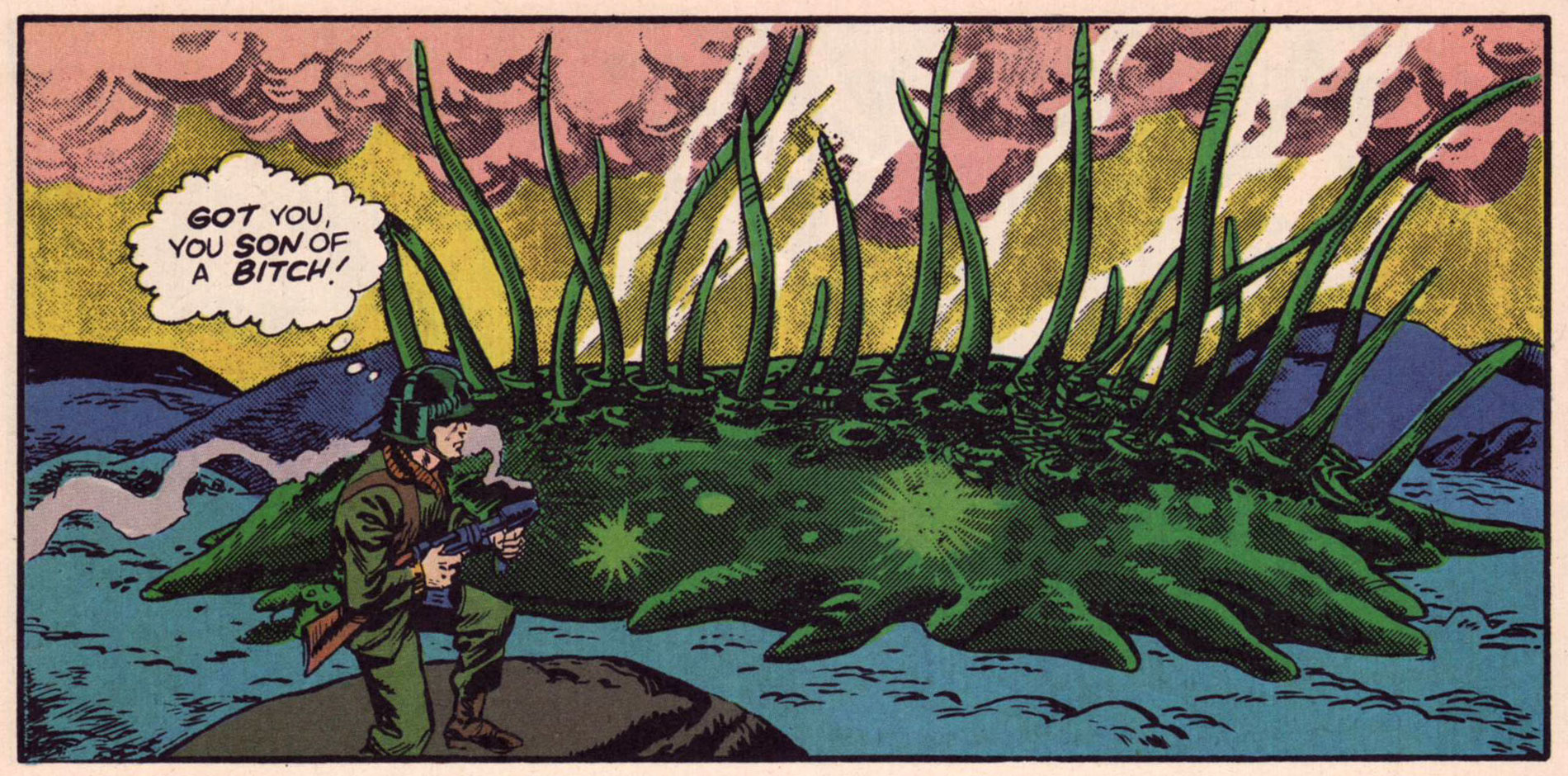
Panel from Mind Siege! by Steve Stiles, published in Death Rattle no. 3 (February 1986). The “my god!! so BIG!!” alien has the power to telepathically send mind-shattering hallucinations, eventually driving (nearly) everyone on earth insane. This issue also provides the first installment of Jaxon’s epic series Bulto… the Cosmic Slug (collected as Secret of San Saba: A Tale of Phantoms and Greed in the Spanish Southwest in 1989, for those interested).
The last soldier on earth killed it! …Or did he? Panel from Mind Siege! by Steve Stiles, published in Death Rattle no. 3 (February 1986).
The first 5 issues of Death Rattlevolume 2 appeared in glorious colour, after which the series reverted to its standard black-and-white (financial hurdles). Issue 7 came out proudly bearing the slogan “too gruesome for color!” Issue 5 gave more details of the change to come:
« It will still be printed on quality paper, so you archivists out there won’t have trouble preserving disintegrating, rotting, putrid copies that look like they’ve just risen zombified from a Graham Ingels story. We’ll still be printing atmospheric stories of the unusual, the eerie, the — dare we say it — ghastly. So let’s rejoice, not mourn. »
I remember being vaguely disappointed for just a little while (it was nice to have colour), but the high quality of (most) stories made it easy to get used to the switch, and I really liked the unapologetic way Kitchen Sink confronted their audience, making a good thing out of a bad thing.
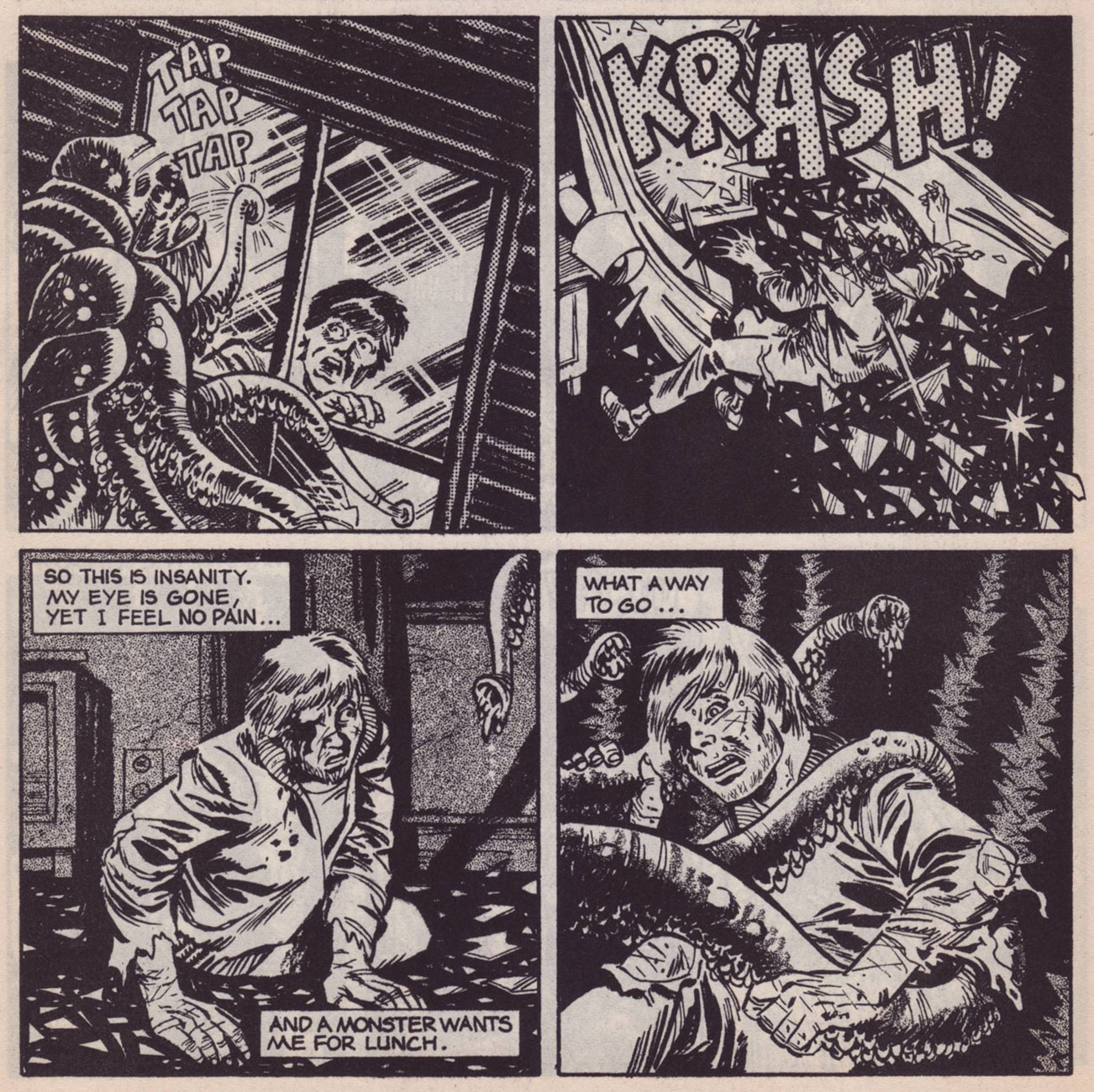
Polite monsters knock before smashing noisily through the window. Page from Old House, scripted by Kenneth Whitfield and drawn by Steve Stiles, published in Death Rattle no. 7 (October 1986).
Page from Old House, scripted by Kenneth Whitfield and drawn by Steve Stiles, published in Death Rattle no. 7 (October 1986).
I didn’t realize it immediately, but this post ends up being some sort of cephalopod love song to Steve Stiles. Speaking of the latter, I’d like to mention that he doesn’t get enough credit for his work on Mark Schultz’s Xenozoic Tales, even though he drew Schultz-scripted back-up stories for no fewer than 13 issues of XT – and, frankly, did an excellent job. Instead of getting interrupted smack in the middle of an intoxicating story, Xenozoic Tales could have continued to thrill us if Schultz scripted and Stiles illustrated. ‘Nuff said. Visit Stiles’ website – it has tons and tons of stuff.
If I may be allowed a slight digression, here are two examples of Stiles’ recent (and computer-coloured, I’m afraid) work taken from his Tumblr blog – I think tentacles still prey heavily upon his mind! 😉
Okay, no more distractions. Back to our regularly scheduled program:
Last Exit by Steve Stiles, published in Death Rattle no. 8 (December 1986). Comics *definitely* teach us that guns are useless against tentacles.
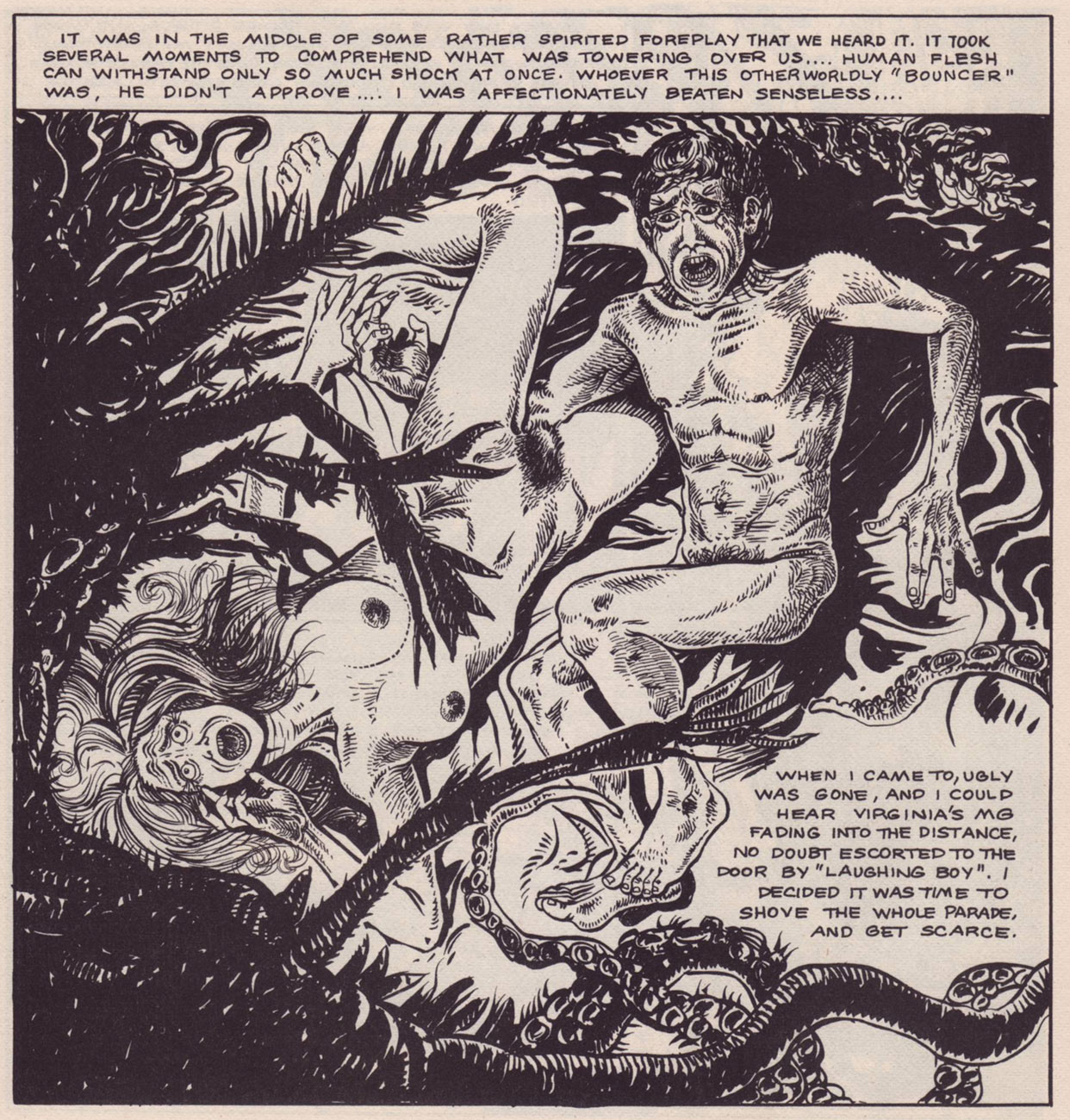
« Savoring my growing fear and horror… the crawl and prickle of my flesh.. waiting to feel the rapid feather-flutter or antennae… the clammy weight of tentacles… the jolt of pain as mandibles grip with steady pressure…» Panel from Mirrors by Eric Vincent, published in Death Rattle no. 11 (June 1987).
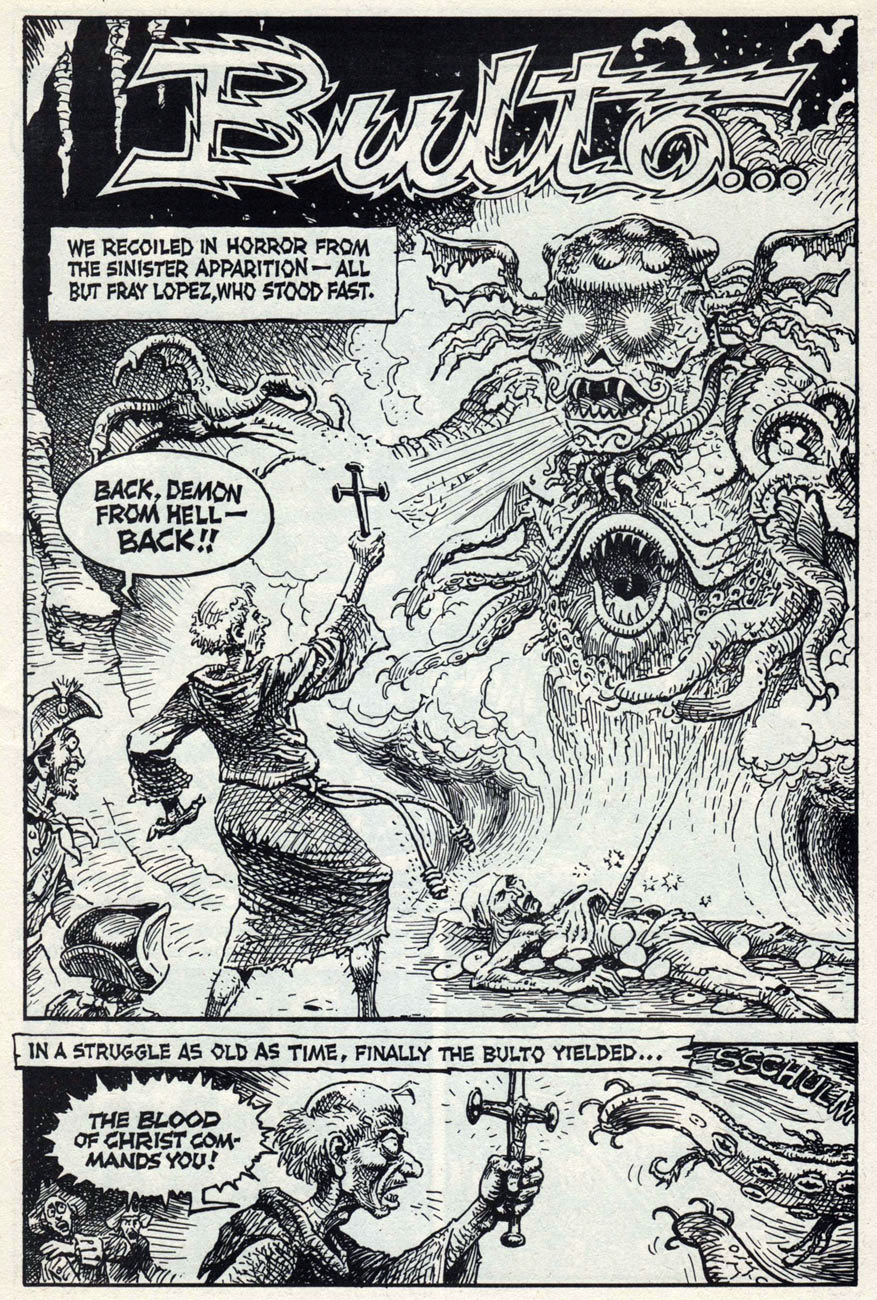
Page from Bulto – The Cosmic Slug (part 5) by Jaxon, published in Death Rattle no. 12 (September 1987). There simply isn’t anything Jaxon can’t ace: a lot of artists have no trouble depicting curvy vixens, few artists can draw an anatomically correct horse, and even fewer would be able to create a blood-curdling scene with a manic priest and a convincing Elder God.
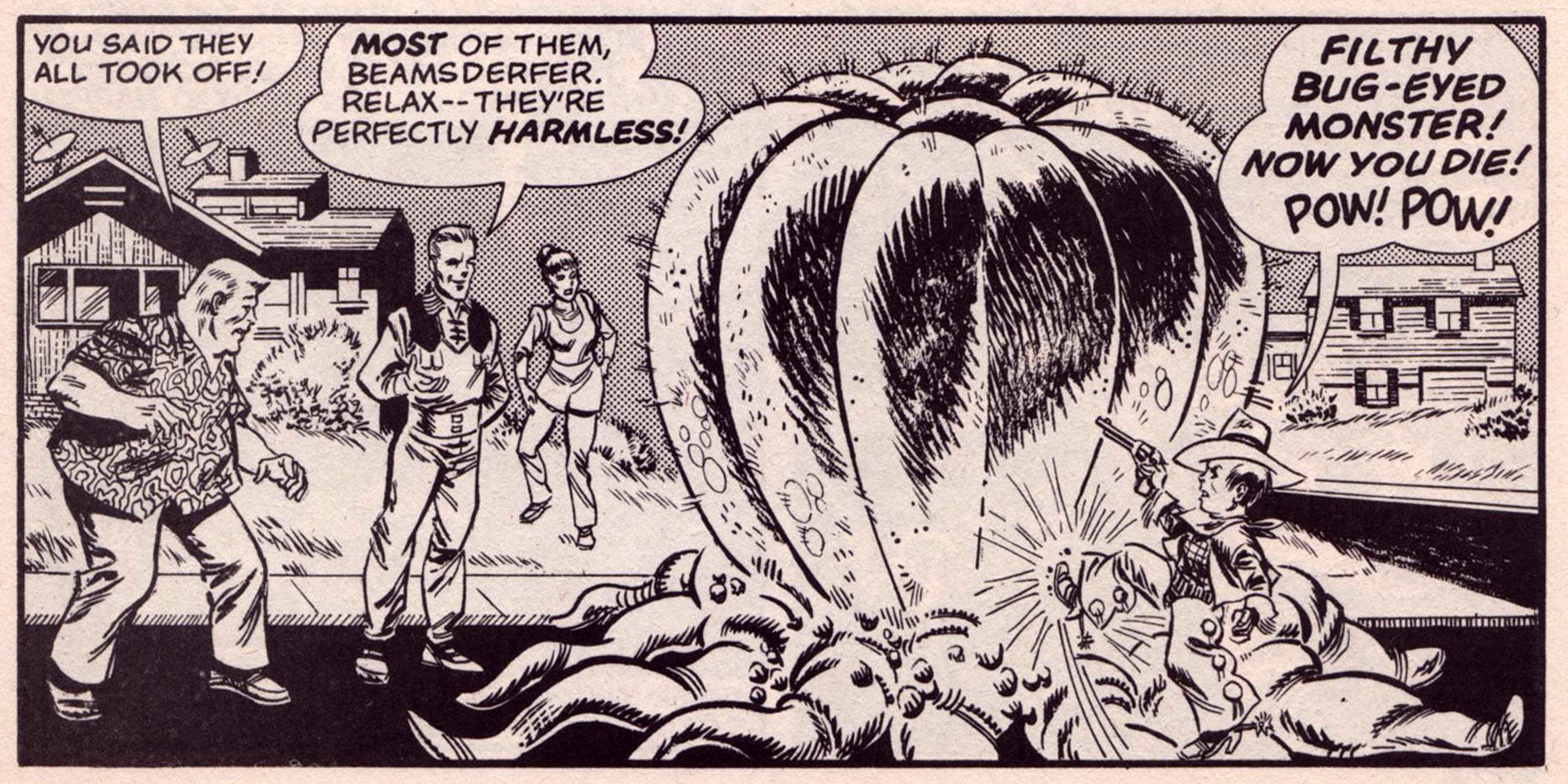
Panel from The Arrivals by Steve Stiles, published in Death Rattle no. 12 (September 1987). Watch who you’re calling filthy, kid – soon you’ll be one of them.
A bit of comic relief: panel from Dr. Stodge Rimperton, Otologist by Tony Millionaire, published in Death Rattle no. 2 (volume 3), December 1995.
« Yes, you may find yourself raving in the aisles when you read Death Rattle, although we sincerely hope not. We hope it will thrill, chill, slice, dice and possibly even amuse you. » (introduction from Death Rattle no. 4)
Kitchen Sink Press, a trailblazing publisher of underground comix that grew out of Denis Kitchen’s successful attempts at self-publishing, has seen its share of tentacles. (For a detailed story of how Kitchen Sink grew from a modest artists’ cooperative into a force to be reckoned with, as well as a discussion of its 30-year legacy, pay Comixjoint a visit.)
First we have a pair of entries from the Death Rattle catalogue. There were 3 “volumes” (series, if you will) published, and my favourite is volume 2, consisting of 18 issues coming out between October 1985 and October 1988, starting out in glorious colour but reverting to black-and-white with issue 6 (which was fine, actually). It’s a remarkably consistent anthology nearly devoid of clunkers, and featuring awesome stories and art by Rand Holmes, Jaxon, Tom Veitch, Al Williamson, Wally Wood, Steve Stiles, etc. It’s also where Mark Schultz’ Xenozoic Tales series was introduced (Death Rattle no. 8, December 1986)!
Death Rattle no. 4 (April 1986), cover by Rand Holmes, who’s already ascended to the rank of Tentacle Tuesday Master.
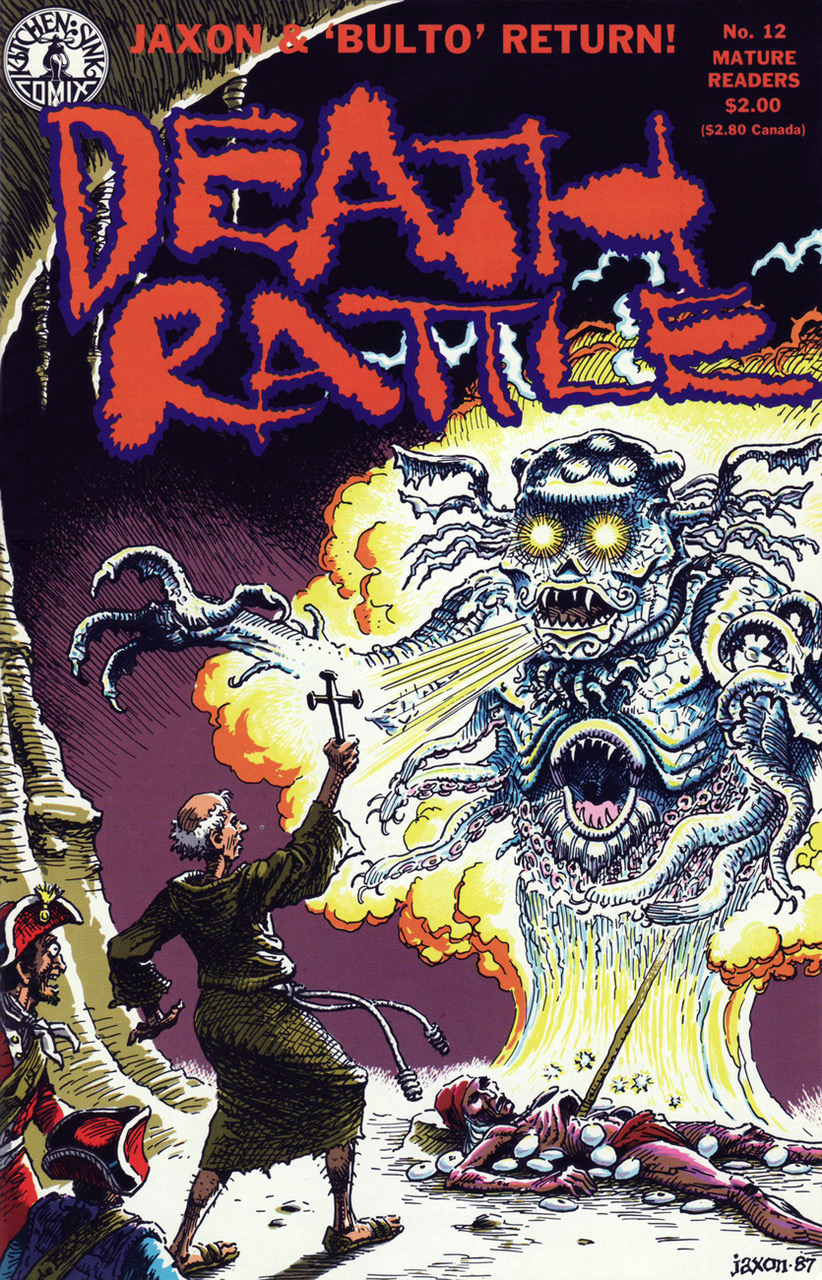
Death Rattle no. 12 (September 1987), cover by Jaxon (Jack Jackson). The cover belongs to Jaxon’s “Bulto… The Cosmic Slug“, an epic eleven-parter that I really enjoyed reading (and not only because of its manifold tentacles). We’ll talk about that again.
Speaking of Jaxon, I’d like to quote from General Jackson, a tribute written by Margaret Moser (who dated him on-and-off through the years).
« The last time I saw Jack was a humid, late summer night in 2005 at the South Austin Museum of Popular Culture. His hair was nearly white and had lost its red-brown burnish, but his mustache was bushy as ever, and he resembled God Nose himself. He was a little grumpy, probably feeling bad, and I was with my boyfriend, so I didn’t sit on his lap. I did kiss his leathery cheek and fetch him a beer. He smelled like cigarette smoke and maybe of Old Spice.
On Wednesday, June 7, just three weeks after his birthday, Jack Jackson took his life at the graves of his parents outside Stockdale. His diabetes and arthritis were getting worse, affecting his ability to draw, and he’d been diagnosed with prostate cancer. Unwilling to face a debilitating course of chemo treatment, he put down his pen forever and made his own kind of peace with the unforgiving future. »
On to something more cheerful! Next, we have a bit of a non sequitur in this otherwise horror-centric post, although one might argue that being grabbed by an octopus is a traumatic experience. What’s The Spirit doing in here, you might ask?
« Kitchen Sink continued publishing multiple undergrounds and alternative comics through the ’80s and ’90s, but also expanded into publishing non-underground comics, graphic novels and extensive anthologies, most notably by Will Eisner, Al Capp, Milton Caniff and Harvey Kurtzman. » |source|
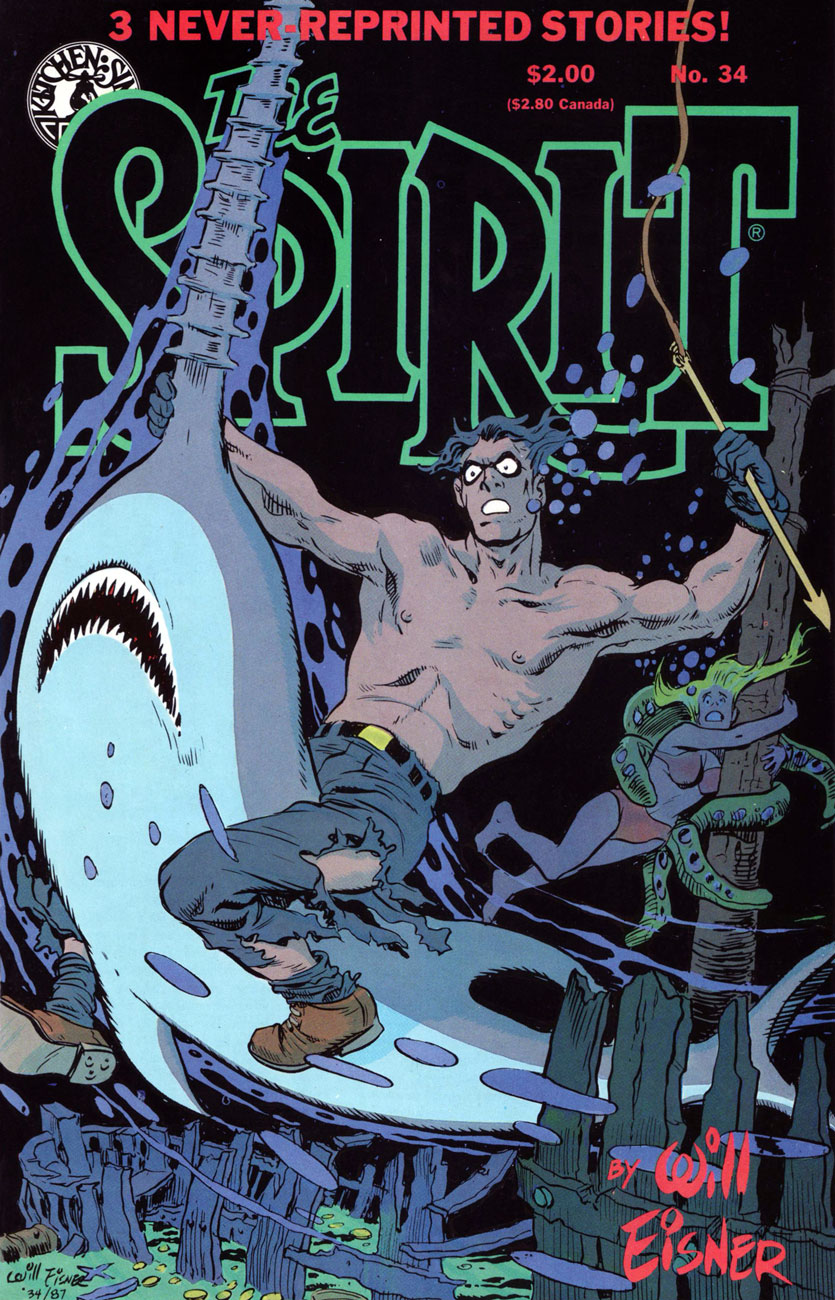
The Spirit no. 34 (August 1987), cover by Will Eisner.
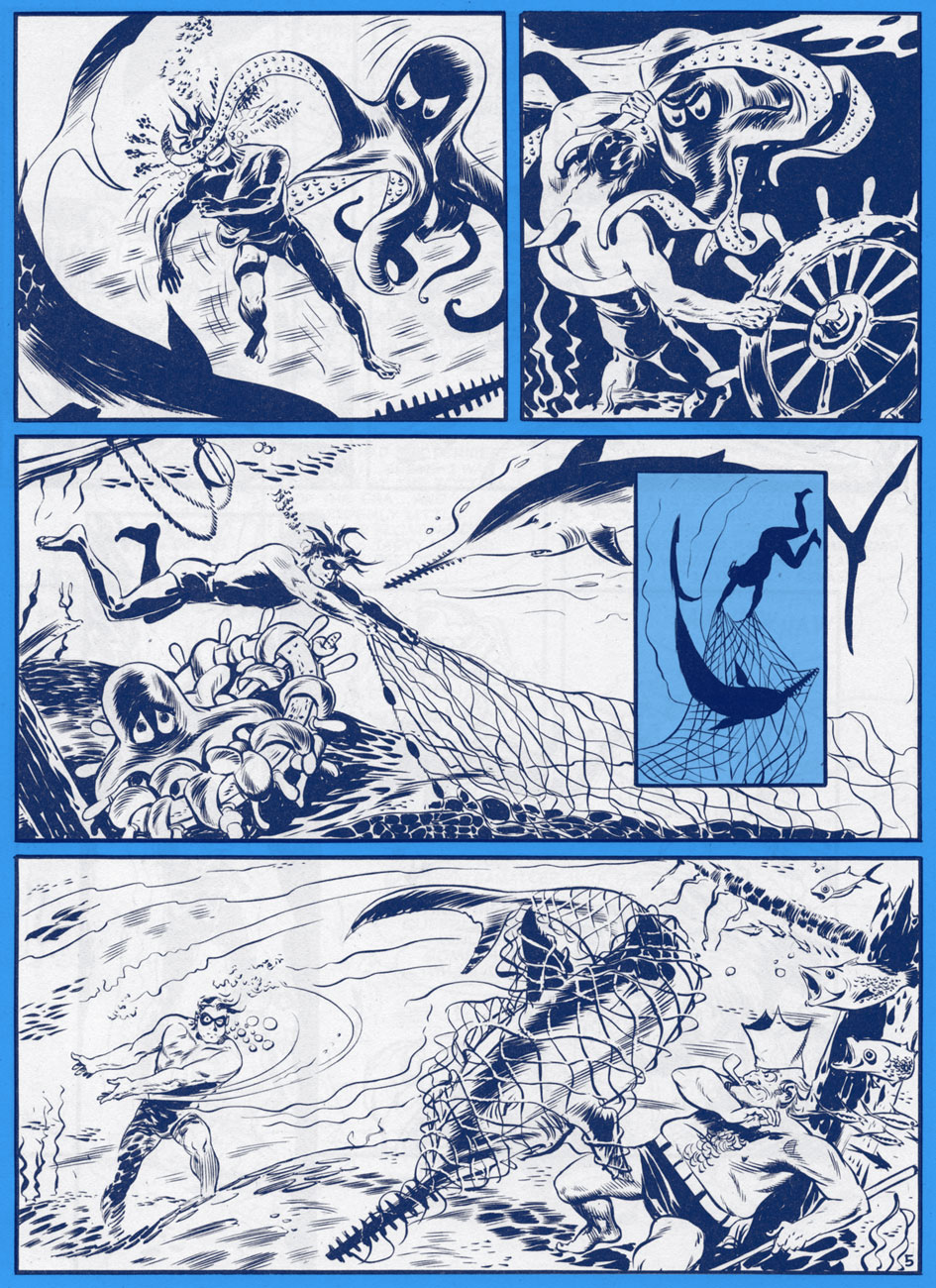
Page from “A Day at the Beach“, drawn and scripted by Will Eisner and inked by André Leblanc, printed in The Spirit no. 34 (August 1987). Somehow I’m not surprised that Eisner draws a mean-yet-elegant octopus.
All rested now? Okay, back to horror.
Flesh Crawlers no. 1 (1993), written by Richard Rainey and illustrated by Michael Dubisch. A quick look at the latter’s catalogue shows that Dubisch happily adds tentacles to whatever he’s drawing.
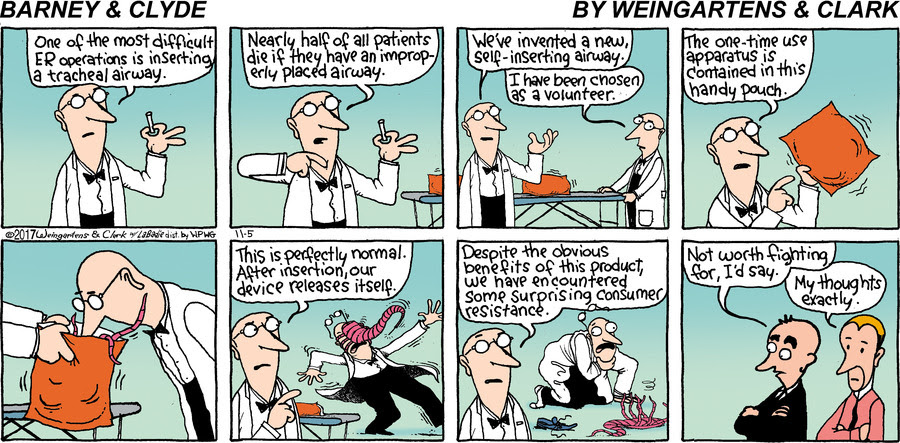
The scientist seems to have been preparing to dissect the specimen – turnabout is fair play! This cover reminds me of this, actually:
Barney & Clyde is a syndicated newspaper strip with jokes that are actually funny and characters that you can get attached to, a rarity these days. You can read it online.
Back on topic, another attack of the Flesh Crawlers:
Flesh Crawlers no. 3 (1993), written by Richard Rainey and illustrated by Michael Dubisch.
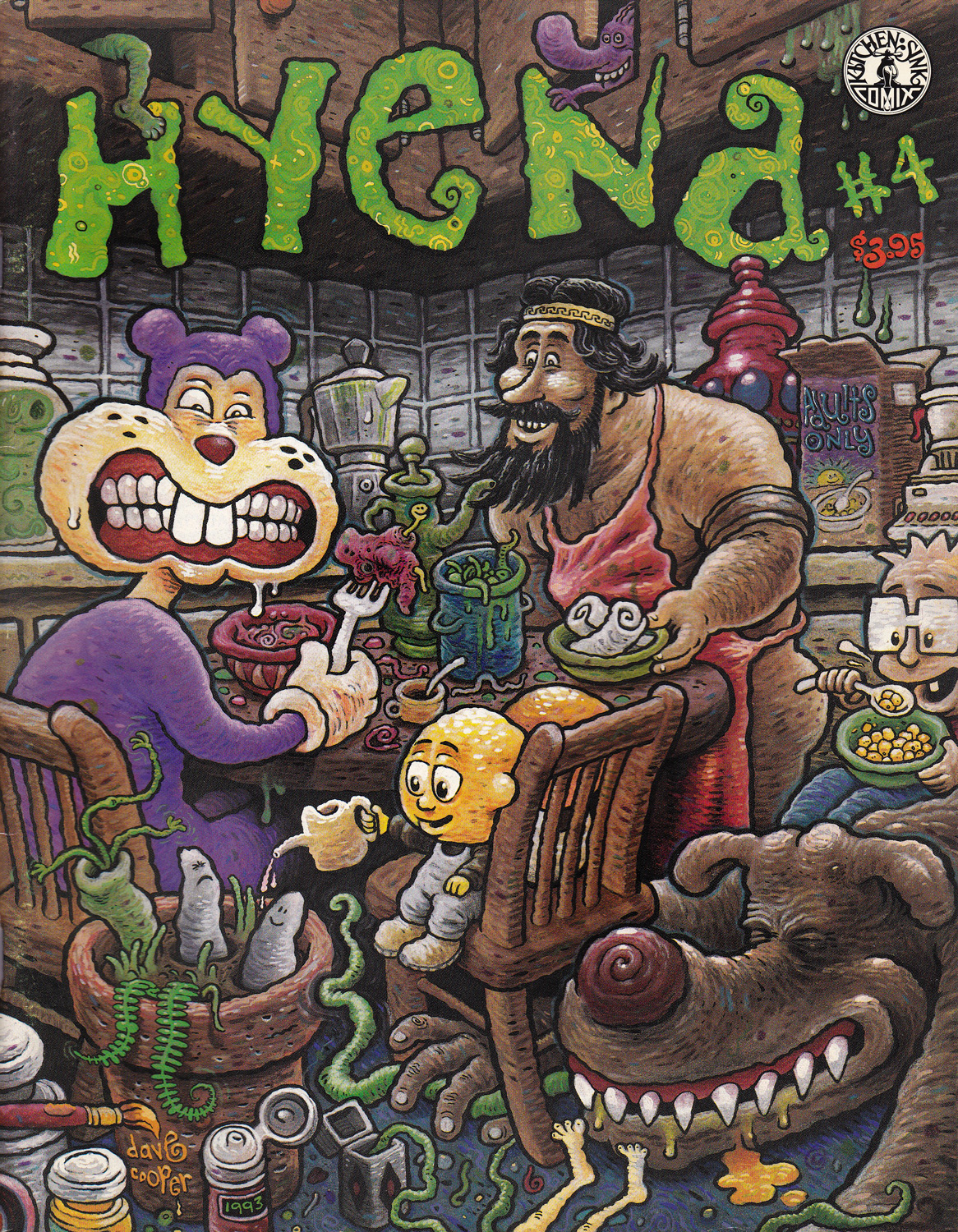
My final submission for today involves a cozy family scene where Frank is peacefully having breakfast with, err… Potted turnip babies and an almost-nude greek serial killer. I think.
Hyena no. 4 (1993, Tundra), cover by Dave Cooper. If Jim Woodring’s work frequently creeps me out, Cooper’s comics are viscerally repulsive to me (I think he goes for “nauseating” on purpose, but I’m not in the camp of people who like to experience strong emotions by watching disgusting, repulsive things happen). This cover, though, is all right.














 Who's Out There?