« The mind loves the unknown. It loves images whose meaning is unknown, since the meaning of the mind itself is unknown. » — René Magritte
Last month, we flew off to explore the wonders of Belgium, most specifically Flanders. All other attractions aside, I thought I’d share with you some of the marvels of the country’s comics culture. Hop on!
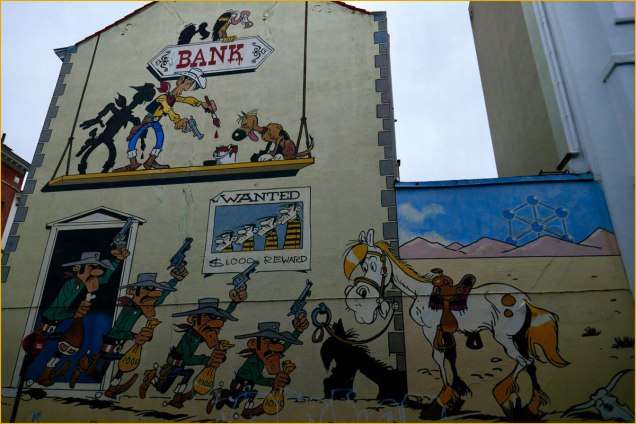
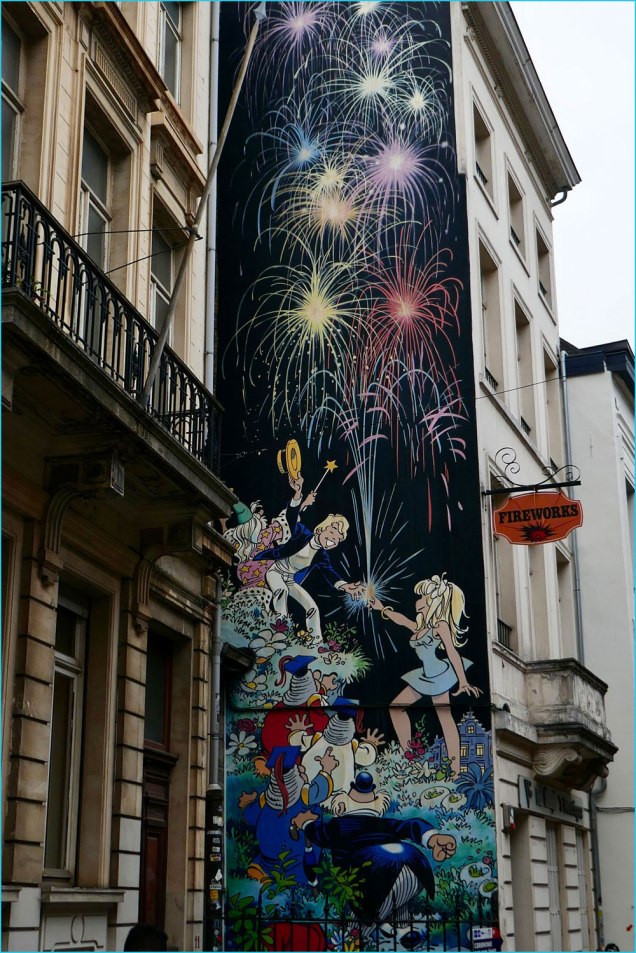
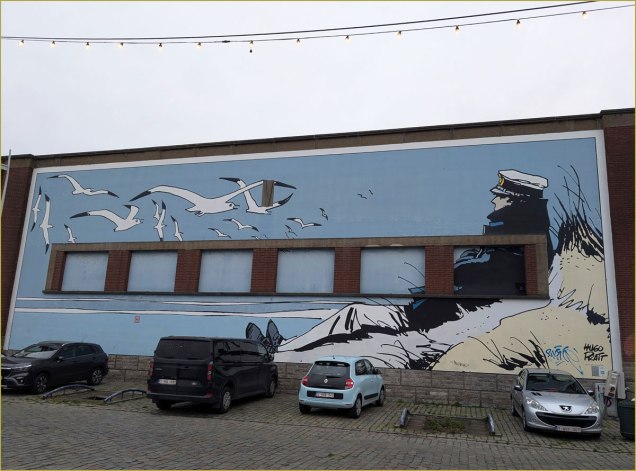
At Ostende’s cozy Le Touquet seaside restaurant, we were shown the shortest path to the loo by no less a personage than the legendary Cowboy Henk, touting local drink Blonde Kuif.This group scene from René Goscinny and Albert Uderzo‘s Astérix was appropriately located in a schoolyard, with kids eagerly playing ball just a few metres away.In a different range, this mural suitably pays homage to French ‘ligne claire‘ master Yves Chaland (1957-1990).It was nice to see the frescoes maintained. This one, located in Antwerp, celebrates Flemish cartoonist Jeff Nys‘ Jommeke: « It seems fitting that this wall by artist Jef Nys, the greatest Flemish cartoonist for children, is in an area surrounded by schools. His most popular comic was Jommeke, a story about a young boy, with a pet parrot named Flip, who goes on some crazy adventures along with his best friend Filiberke. Nys started Jommeke in 1955 and created close to 300 comic albums. They have sold over 51 million albums alone in Belgium, making Jommeke the second best-selling comic series in the country. » [ source ]I’ve no idea who these characters might be, but I raise my glass (of Belgian beer, naturally) to the vibrant creativity of the nation’s graffiti practitioners.Another lovely one saluting one of Belgium’s bédé superstars, Maurice de Bevere, alias ‘Morris’ (1923-2001).We found that Brussel’s streets were frequently adorned with striking mosaic markers, such as this one, featuring André Franquin‘s Marsupilami. I forget what thoroughfare this was, I’m afraid.This one captures Philippe Dupuy and Charles Berberian‘s Monsieur Jean and his presumed and entirely laudable and justified appreciation of Belgian beer, the world’s finest — you can keep your IPAs, thank you.A mural devoted to Michel Greg and Daniel ‘Dany‘ Henrotin’s Olivier Rameau, fittingly painted on the side of a Fireworks store at 9, rue du chêne, Brussels. Top to bottom: Ebouriffon, Olivier Rameau, Colombe Tiredaile, the 3 Ziroboudons, Alphonse Pertinent.Despite having no Belgian roots that I can figure, Hugo Pratt‘s Corto Maltese clearly is beloved in these parts. He landed no fewer than *four* murals, all neatly in a row. Here are my two favourites.A most unusual — and striking — composition.And now we come to my Holy Grail, Brussel’s Gil Jourdan mural… there are two more in Maurice Tillieux‘s hometown of Auderghem (here’s one, and the other, and yet another in the bédé-themed Janson metro station in Charleroi). The author appears for size comparison.Local graffiti artists come to the rescue: it seems inconceivable — to me, anyhow — that there isn’t a mural devoted to Willy ‘Will’ Maltaite‘s characters. There used to be a lovely « Isabelle » fresco in Brussels, but, citing damage, it was painted over in 2017. However, here’s an unofficial, and brilliant one featuring Tif et Tondu… and their archnemesis, Monsieur Choc. Take a bow!
« The poet is a madman lost in adventure. » — Paul Verlaine
Today, we’ll examine the early history of Italian fumetti maestro Ugo Eugenio Prat’s (aka Hugo Pratt, 1927-1995) most famous personage, Corto Maltese.
Maltese (named, indeed, after Dashiell Hammett’s famous novel… or rather its John Huston-helmed cinematic adaptation) created in 1967 for the Italian magazine Sgt. Kirk… saddled with a modest print run of 3000… and rather soon cancelled owing to low sales! There, Corto turned up — as a minor player — in a tale entitled Una Ballata del Mare Salato (“A Ballad of the Salt Sea”). Corto’s peregrinations then followed their tortuous course in French bédé weekly Pif Gadget from 1970-73, where the strip mostly baffled — or even enraged — readers but was tirelessly championed by the enlightened editorial team. In his Prix Goncourt-winning biography*, Hugo Pratt, trait pour trait, Thierry Thomas states: « With each new episode, the magazine received letters from readers who couldn’t make head nor tail of it, and demanded Rahan, nothing but Rahan. » Clearly, the world wasn’t ready for Corto… but that acceptance would gradually arrive, at least in the non English-speaking world**.
While the Corto saga has been made available over the years in several fine editions in most of the European languages, it took a long time for English to be added to the roster. In the USA, IDW has managed the fairly monumental but inarguably laudable task; I only wish the covers weren’t so ill-conceived, sadly a feature, rather than a bug, of editor-designer (and translator!) well-meaning Dean Mullaney‘s reprint collections at IDW**.
This presentation by Pif Gadget’s editor-in-chief, Georges Rieu, ran on the inside front cover of the magazine’s 59th issue, between Corto’s first and second appearances:
« You’ve met him while leafing through your PIF, last week… you may have deemed him, at first glance, cynical and cold… but you quickly realised that this nonchalance was but an appearance: Corto Maltese is a kind-hearted adventurer and his attitude serves only to mask a generosity that pulls him into adventures he’d rather avoid… adventures that drag him to the four corners of Central America, from Chile to the Caribbean, in savage lands where magic and ancient superstitions yet reign… in a search for lost civilisations and treasures.
Our friend, artist Hugo Pratt, has spent nearly ten years in patiently piecing together the history of Corto Maltese… in gathering all the documents that speak of these vanished worlds, in questioning the old sailors of the ports along the coasts of the Atlantic and of the Caribbean Sea…
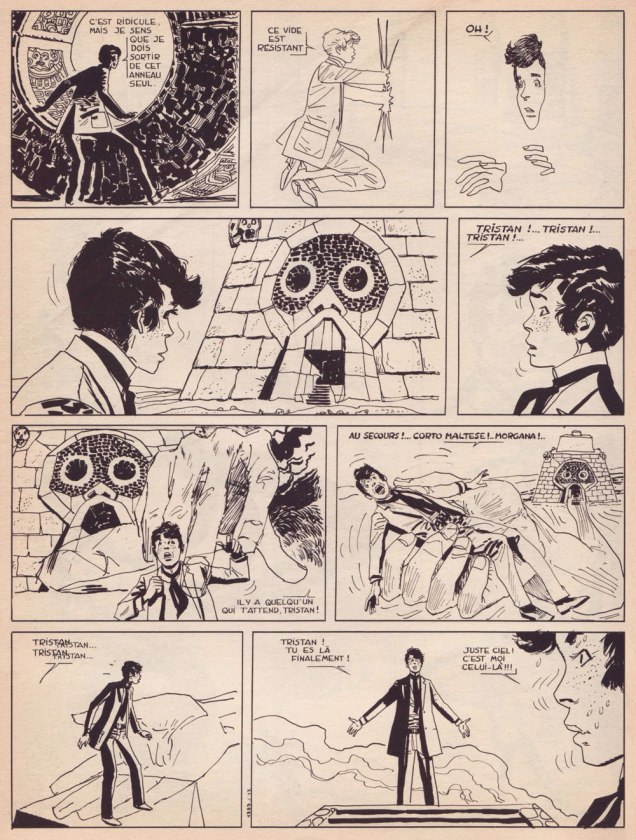
Today, he reveals to us the fruit of his research… adventures that, we are sure, will enthral you. Hurry over to page 11 and join Corto Maltese and his friends aboard their boat. »Corto’s young friend, Tristan Bantam, has some interesting visions in a sequence from Rendez-vous à Bahia (“Rendezvous in Bahia”… of course), Corto’s second solo tale, first published in Pif Gadget no. 59.
Rieu’s successor as Pif’s editor-in-chief, Richard Médioni, wrote: « In brief, in the Fall of 1969, Hugo Pratt found himself out of work. » After Pratt is crowned, that year, Best Italian Cartoonist at the Salone Internazionale dei Comics in Lucca (Europe’s oldest comics festival)… « It was expected that all publishers (French, Italian, and others, all present at the Salon) would push and shove their way to Hugo Pratt to propose a collaboration… but no such thing happened. Only Pif Gadget showed interest. »
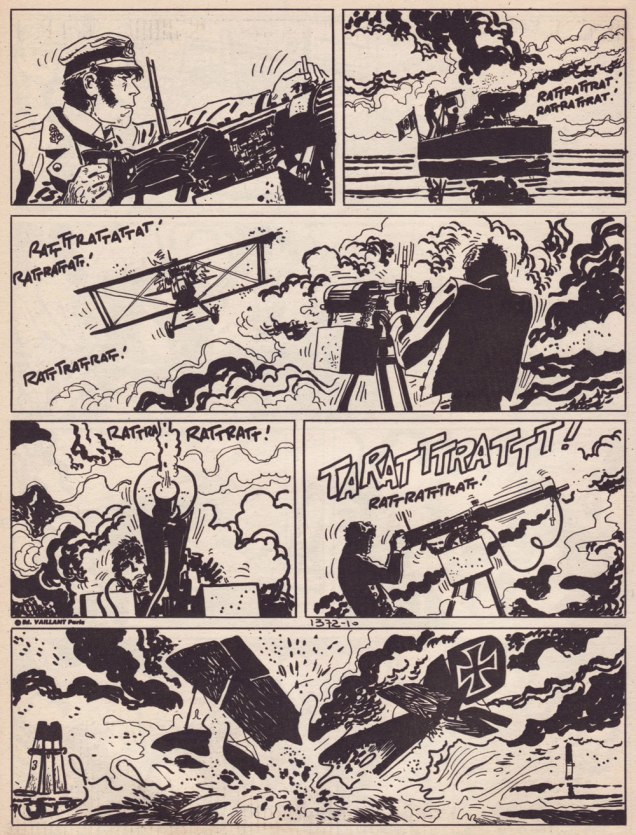
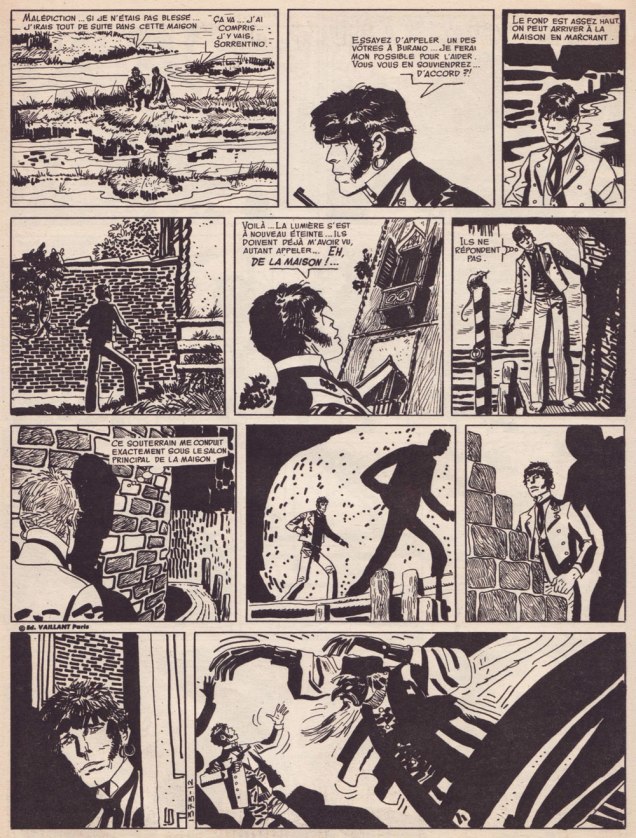
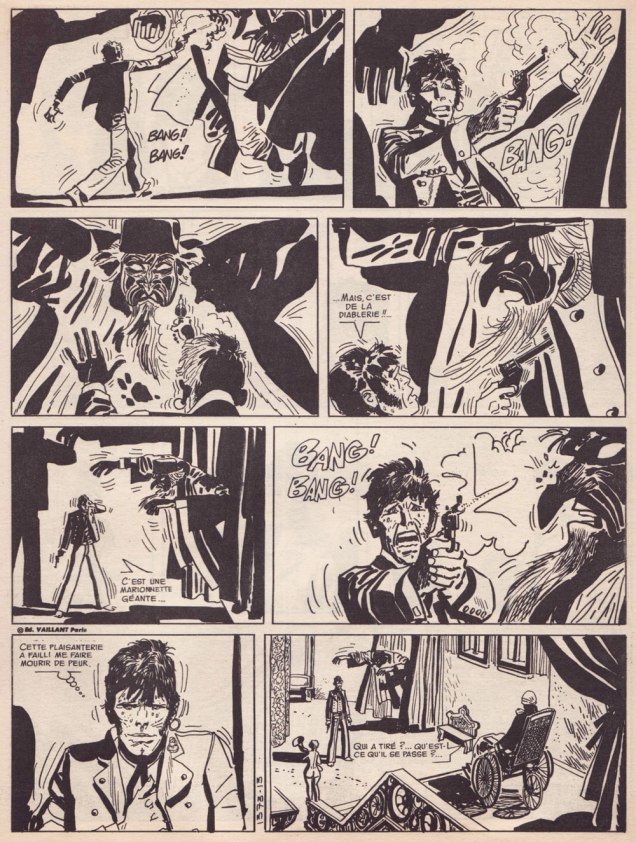
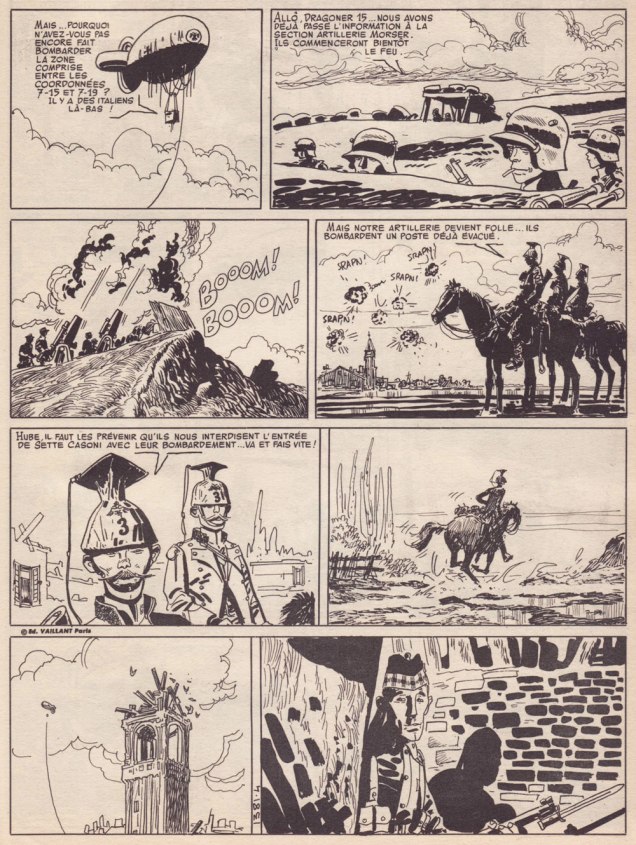
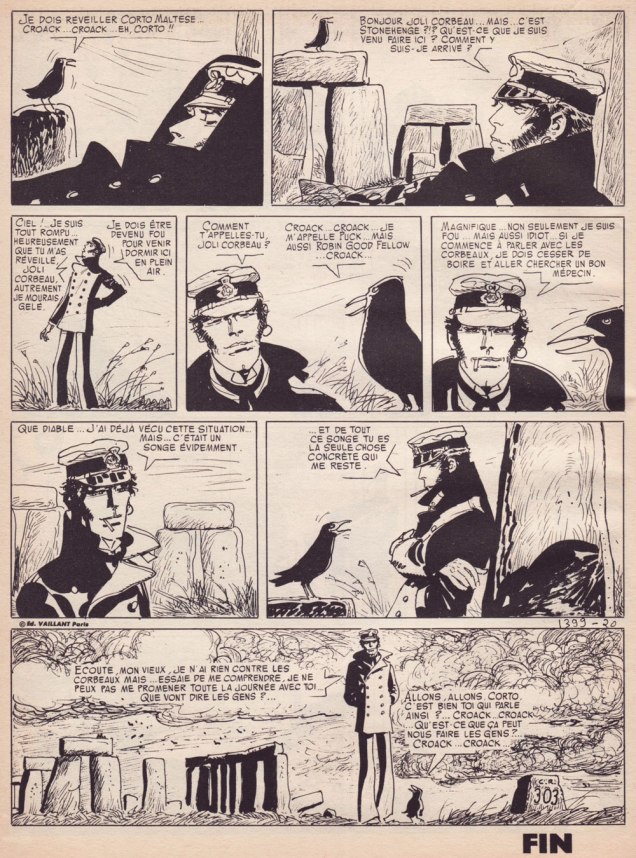
High drama and ace storytelling from À cause d’une mouette (“Because of a Seagull”), from Pif Gadget no. 89 (Nov. 1970, Vaillant).Corto is forced to take a hand in a skirmish in L’ange à la fenêtre d’Orient (“The Angel at the East Window”), first published in Pif Gadget no. 135 (Sept. 1971, Vaillant).The usually unflappable Corto gets the fright of his life in this bravura sequence, also from L’ange à la fenêtre d’Orient.Two pages from Sous le drapeau de l’argent (“Under the Banner of Money”), my initial encounter with Signor Pratt’s world. Published in Pif Gadget no. 143 (Nov. 1971, Vaillant).The quiet coda of Le songe d’un matin d’hiver (“A Winter Morning’s Dream“), set in Britain and plunging the reader into a dazzling brew of magical realism and English mythology from Pif Gadget no. 161 (March 1972, Vaillant). The featured crow is of course Puck, aka Robin Goodfellow, which you may recall from Will Shakespeare’s A Midsummer Night’s Dream. One might say it’s a bit like The Sandman, but without all the preciousness, not to mention having to deal with Neil Gaiman.
Bonus factoid: Hugo Pratt was related to another artistic giant, William Henry Pratt, aka Boris Karloff!
**According to his biographer, one of Pratt’s eternal regrets is that his work never broke through in America, land of his childhood cartooning heroes George Herriman, Milton Caniff, Alex Raymond and Burne Hogarth.
***One need only look at Mullaney’s Rip Kirby, where a blobby, lazy Photoshop shadow directly contradicts the light source indicated by Alex Raymond, a guy you’d assume it would be unwise to second-guess.








 Who's Out There?