You’ve likely noticed it already, but people getting attacked by tentacles tend to be dressed in red. Now, red will not make a bull enraged (as a matter of fact, bulls are colour-blind to red – there, you learned something new today), but what effect would it have on an octopus? None at all, as it turns out, as red light does not reach ocean depths. One might want to wear red to become near-impossible to spot at a depth of a hundred metres or more, but that doesn’t explain why tentacles would persistently seek out red targets. Crap, there goes my theory.
Nevermind; we can still feast our eyes on some fetching mam’zelles and monsieurs clad in red, theories be damned.
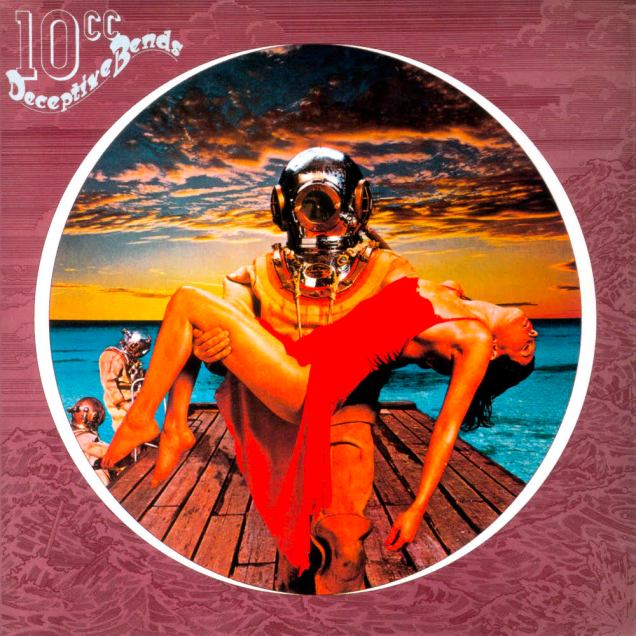
Music aficionados will notice that this cover is a tribute to something quite outside the comic field, namely this album art:
Cover of 10cc’s Deceptive Bendsalbum, designed by Hipgnosis, 1977. Where are the tentacles?! The girl’s dress is also somewhat more demure (though not by much).
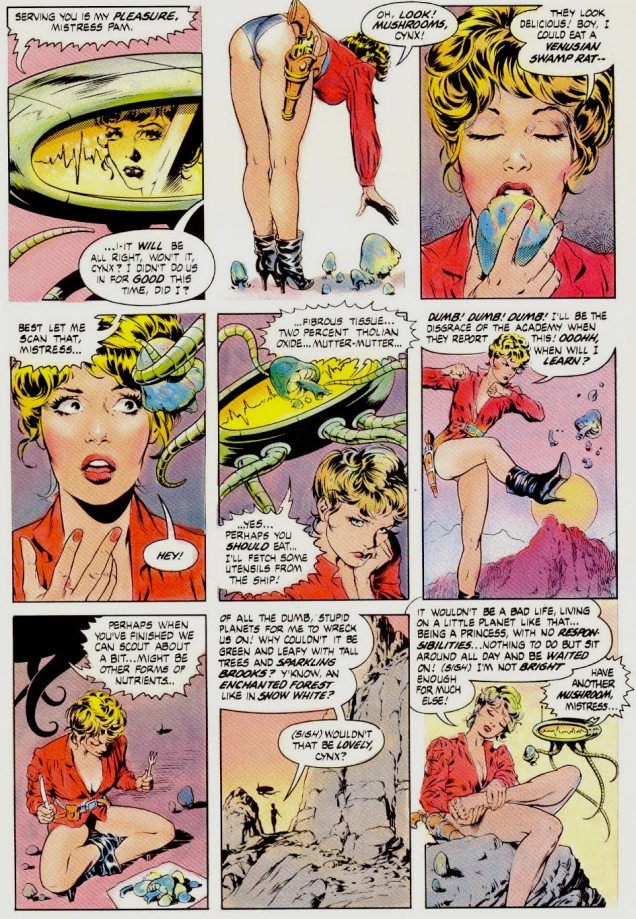
After Alien Encounters, we naturally move on to Alien Worlds. Admire the, err, tentacles on this cover:
“If he had been watching his mistress as usual, if he had been at the controls instead of giving himself a lube job, the accident might have been prevented.” Moral of the story: no lube jobs at the wheel! That tentacled thing behind Princess Pam is actually Cynx, her guardian. The science-fiction comic anthology Alien Worlds, first published by Pacific Comics and then by Eclipse after Pacific went bankrupt, was edited by Bruce Jones, who wrote the bulk of the stories, and April Campbell. This is Alien Worlds no. 4 (Pacific Comics, September 1983), cover by Dave Stevens, with colours by Joe Chiodo.Mushrooms *and* tentacles *and* some pretty gams? Sensory overload! At first glance, the story (scripted and pencilled by Bruce Jones, inked by Dave Stevens, coloured by Joe Chiodo and lettered by Carrie McCarthy) is nothing but gratuitous cheesecake – a pretty, half-naked girl wandering around with her robotic servant – but it’s actually surprisingly touching. Check it out here. Fittingly, mushrooms save the day.
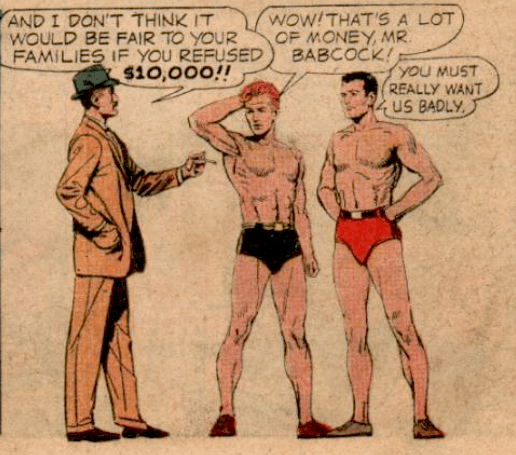
It’s not just women who like to sport flashy red outfits, by the way. The men’s costumes might cover considerably more skin, but the vermilion remains!
« The tentacles of a giant octopus emerge and grab him in a death grip. Almost as though the hideous creature has been standing guard over the treasure for all this time… » Of course it has! Any self-respecting octopus takes his job seriously. The Frogmen no. 2 (May-July 1962); the cover is by Vic Prezio, and the sumptuous inside art is by George Evans.There’s (also) an epic battle between a killer whale and the octopus in this issue (witness the aforementioned George Evans art).Of course he wants you, silly – who can resist a man in red swimming trunks? Nor octopus nor man. I retract my comment about men being more covered up. Do they have to tell their families, though?
One more for the road and I’ll conclude this vernissage…
“The bolts of current are merely absorbed by the rubber flesh of the octeel, which is part octopus and part electric eel!” Oh, for the love of puns. Weird Thrillers no. 4 (summer 1952, published by Ziff-Davis), with painted cover by Norman Saunders.
You’ll no doubt want to see what an electric octopus looks like, so here you go:
“Tentacles of Death”? Sign me up, please! The gruesome cover story is drawn by George Tuska.
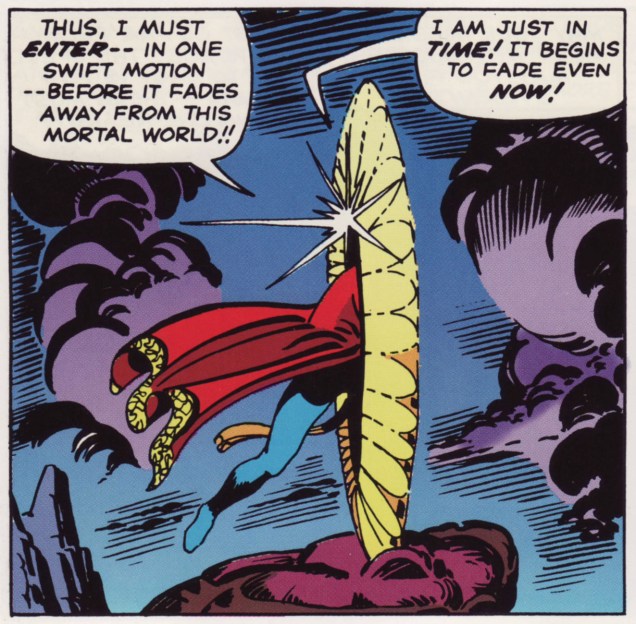
It’s Ditquotation time! In 1974, the ever-ingenious lads of legendary English art design studio Hipgnosis threw in a subtle Steve Ditko / Doctor Strange appearance in their (re)design (for the US release) of the cover of Al Stewart‘s Past, Present & Future LP in 1974. The image it quotes hails from Strange Tales no. 137‘s When Meet the Mystic Minds! (October, 1965), where the Master of the Mystic Arts seeks a doorway to Eternity. And finds it.
« I’m going nowhere with nowhere to go* »
However, according to the designers, it first leads him to the front yard of a castle depicted on Al Stewart’s following LP, Modern Times (1975). Now you guys are messing with our poor, befuddled minds.
« The blonde woman on the album cover is Pink Floyd guitarist David Gilmour’s first wife, Ginger. The Cord automobile Stewart is sitting in belonged to Led Zeppelin guitarist Jimmy Page. » And yes, there are other versions of this album cover, some of them far more familiar.
While Hipgnosis consisted primarily of Storm Thorgerson and Aubrey Powell and (later) Throbbing Gristle member Peter Christopherson, the main creative force on Past, Present & Future‘s artwork was one of the studio’s regular freelancers, Richard Manning. For those of us who love this sort of shop talk, here’s Mr. Manning’s recollection of the methods involved, in those halcyon pre-Photoshop days:
« If my memory serves me correctly, this was the first sleeve I worked on for Hipgnosis. Although, in the book ‘Walk Away Rene’ my good friend and mentor at that time,Terry Day (sadly no longer with us) is credited with working on it. A black and white montage. The figure was cut out physically and the back edges thinned and sanded and stuck in position with Columbia Cement. A Best Possible copy print was made, so now I have a flat print to work on, mounted on double weight mount board. Working to an elliptical guide on tracing paper, I carefully bleached to white the shape. Once washed and dried I then redrew some of the background with Photo Dye with a Sable brush, where the print had bleached a bit too far in the lighter areas. Finally, Permanent White was sprayed to make a sweet, soft edged shape. »
It wasn’t the first Dr. Strange reference Hipgnosis had inserted into an album cover: Pink Floyd’s A Saucerful of Secrets (the studio’s first LP cover, actually) borrows an image from the not-exactly-outstanding Roy Thomas/Marie Severin entry, The Sands of Time, from Strange Tales no. 158. Frankly, few characters have been as lost without their creator as the poor doctor has been, especially on the visual front.
Ditko’s final Dr. Strange panel (Strange Tales no. 146, The End — at Last!, July 1966) was no symbolic accident: both creator and creation were leaving the stage.
On the plus side, Al Stewart, seemingly impervious to the passage of time, remains a terrific performer and an inspired, if less prolific, songwriter. If he’s in town…









 Who's Out There?