Voyage to the Bottom of the Sea no. 2 (July 1965). Cover by George Wilson.
Todd Franklin of Neato Coolville has actually transformed this cover into a groovy wallpaper (go to his website to download the high-res version).
Voyage to the Bottom of the Sea no. 13 (August 1968). Cover by George Wilson.Brothers of the Spear no. 7 (December 1973), cover by George Wilson.
That previous cover has borderline tentacles, I agree, but the completist in me insisted on its inclusion. Also, it’s entertaining.
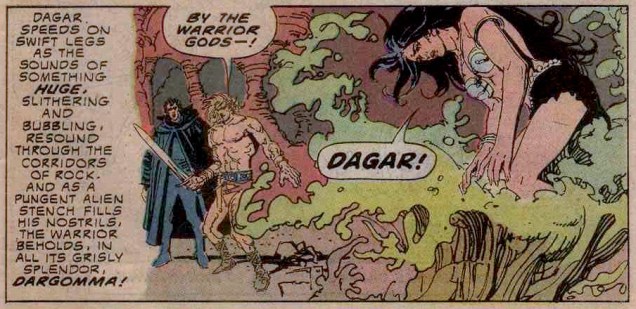
The Tree That Walks is illustrated by Jesse Santos. The story tags as detailed by GCD are «chariots; draft elands; giant carnivorous plants; human skeletons; leopard; rock slides; saddle elands». I had to look up “elands” (it’s an antelope). How much more entertaining can one get?Tales of Sword and Sorcery Dagar the Invincible no. 11 (April 1975). Cover by the underappreciated Luis Dominguez.
A beautiful cover this may be, but the insides are distinctly underwhelming. The title story, It Lurks by Moonlight, is scripted by Don Glut and illustrated by Filipino artist Jesse Santos, who seemed like a likable artist with a wide-ranging career… but his art is not my cup of tea.
« Mama threw out my Hooded Cobra and Black Widow! »
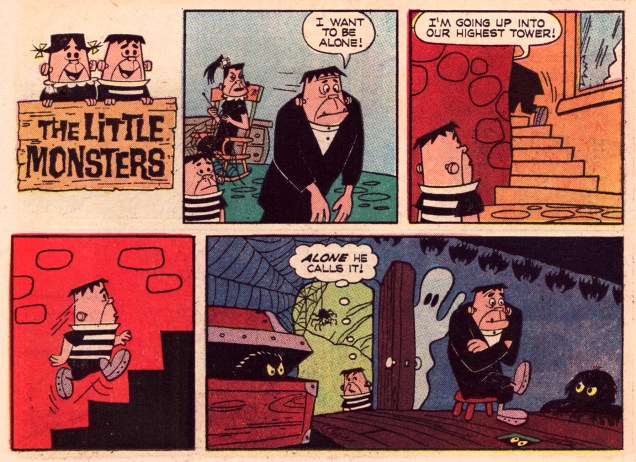
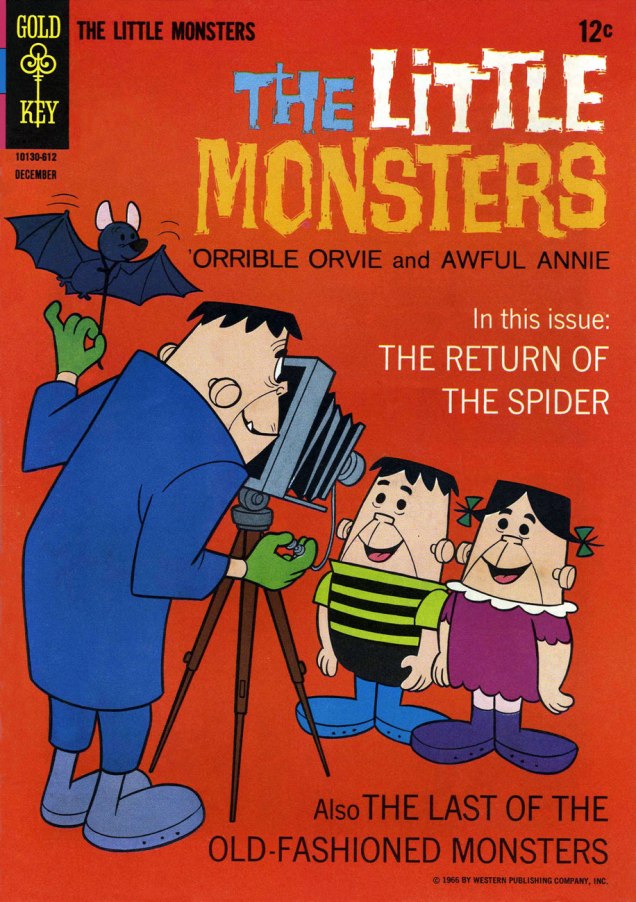
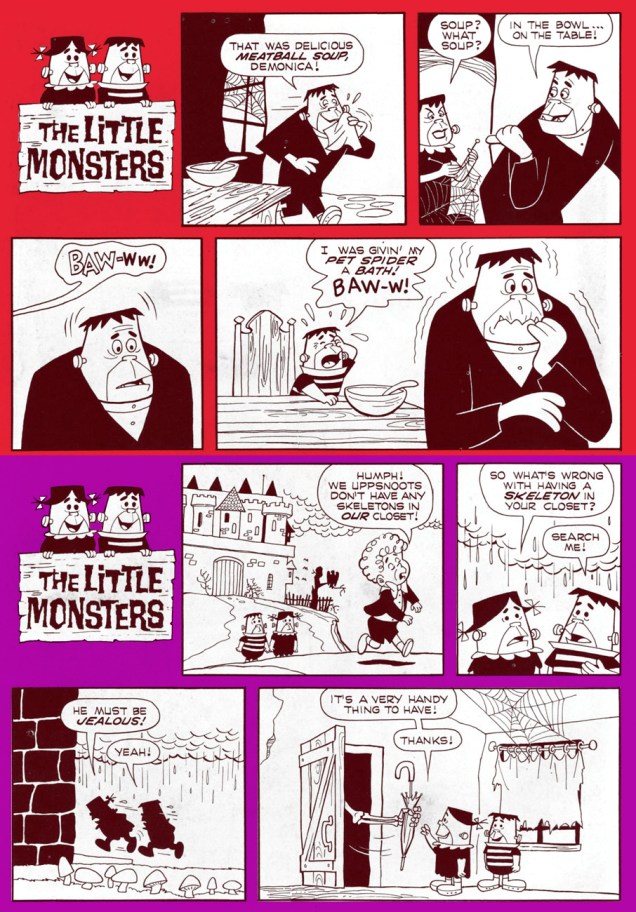
A delightful entry in the 1960s monster craze, Gold Key’s anonymously-created The Little Monsters first reared their fetchingly homely heads in the back pages of The Three Stooges no. 17 (May, 1964), predating by several months the near-simultaneous (just a week apart!) arrival on the tube of both The Addams Family and The Munsters. Now this ghastly family unit, assembled in the laboratory of kindly mad scientist Dr. Frankenfurter, comprised Papa Mildew, Mama Demonica, and their titular kids, ‘orrible Orvie and Awful Annie. The Little Monsters enjoyed a quite respectable rampage in comics, running amok for 44 issues between 1964 and 1978, outlasting by some years the craze that spawned them.
In this half-pager is from Little Monsters no. 7 (Dec. 1966, Gold Key), Papa Mildew essays Greta Garbo’s immortal line. Writer and artist unknown and uncredited, for shame. Pete Alvarado has been proposed as a possibility, but the man’s chameleonic versatility complicates identification somewhat.
Ah, why be stingy? Let’s have a few more short pieces from the same issue.
« I say let the world go to hell, but I should always have my tea. » — Fyodor Dostoyevsky
A colleague at work labelled me a “tea whore” the other day. I don’t think that’s an official expression (though apparently one can purchase tea mugs with this message), but I’ll take that as a badge of honour. And therein lies my similarity to my beloved octopods: they never say no to a nice cup of tea, either. Evidence, you may ask? I’ve a-plenty of it. Pour yourself a steaming cup of oolong and join me!
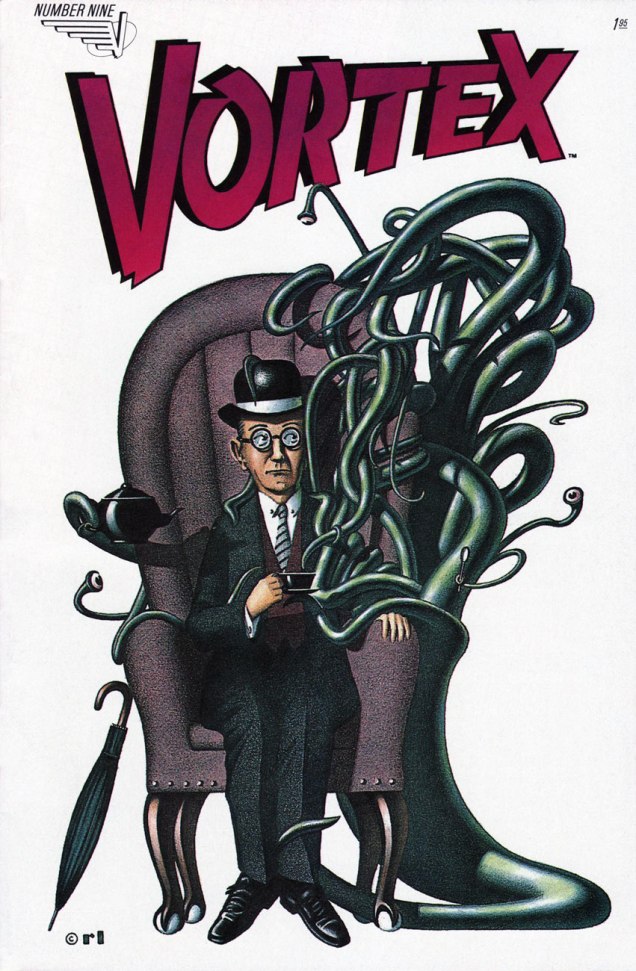
Donald Duck no. 200 (October 1978), cover by Larry Mayer. Incidentally, he has already been part of a Tentacle Tuesday.Surprise: this quintessentially British scene (an umbrella, a cup of tea and a suitably meek accountant) is brought to you by a Canadian comic! This is Vortex no. 9 (May 1984), cover by Ron Lightburn. Vortex was one Canadian Vortex Comics’ titles. Some interesting stuff was published by these guys: Matt Howarth’s Those Annoying Post Bros and Savage Henry, Los Bros Hernandez’s chunk of Mister X, Ted McKeever’s Transit, Chester Brown’s Yummy Fur…
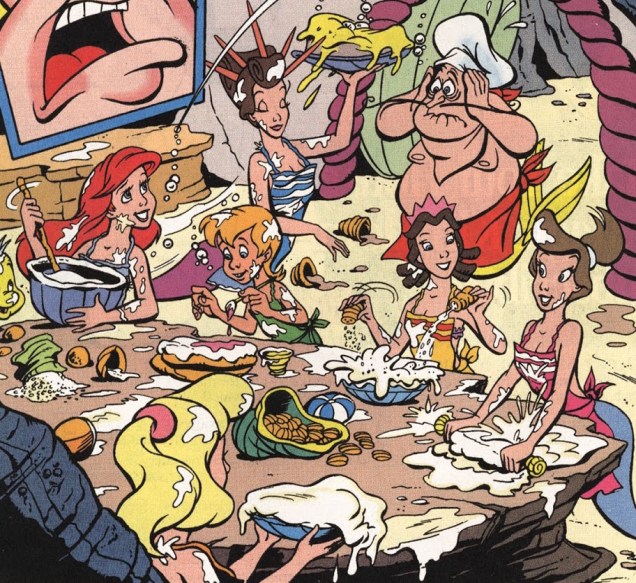
The following pages are from Disney’s The Little Mermaid no. 10 (June 1995). No, no, stick around, it’s worth it. You can read the full issue here.
So far so good, even though this begs some questions (such as “how do you pour a cup of tea underwater?”) But the following dialogue suggests that things other than tea-drinking were on the mind of *this* octopus:
You know how all this ends, don’t you? That’s right:
I tried to make this a purely innocent post, but things didn’t pan out.
Gahan Wilson is always, always good and ready for tentacles. (By the way, he is financially struggling and has dementia, which is both stupefying and depressing. I never cease to be amazed at how someone with such a wide-ranging and fruitful career can end up impoverished… His family raised enough money on GoFundMe – for now – to take care of him, but you should still visit that page for recent pictures and updates about his health.)
Cartoon by Gahan Wilson, published in Playboy’s August 2006 issue.
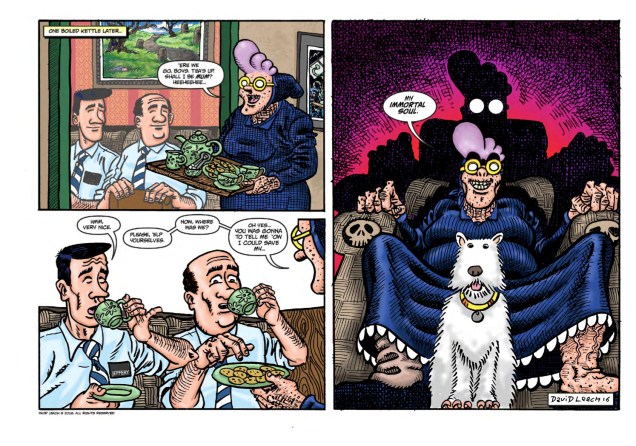
In 1986, British cartoonist David Leach unleashed Psycho Gran upon an unsuspecting world. The « five-foot high, mauve-haired, bespectacled psychotic granny with a pan-dimensional, sentient handbag called Percy, a flying dog called Archie and a pathological loathing of rudeness » first appeared in British children’s comic Oink!, where she lingered for 15 issues, pummeling purse snatchers, clobbering office workers and disciplining rampaging monsters until 1988. In 2011, she came back – her hair more purple than ever, her lust for authoritarianism unabashed – and is currently involved in a four-part mini-series.
And she’s drinking tea with Mr. Cthulhu. I’m jealous.
« We all have grannies. I think there’s something wonderfully exciting, mischievous and dangerous about them, or was that just mine? They’re old and they’re the mum of your mum, plus they spoil you rotten, but they can also tell you what to do, like your own mum does! That seemed so strange when I was a kid, the idea that they could boss not only you but also your mum or dad around. And I think we’re all a little scared of the elderly, no one likes to think that one day they’ll be old themselves, I think we resent them for showing us what we’re going to become. Psycho works because she looks frail and yet she’s super strong and batty. She’s the classic sheep in wolf’s clothing. And there’s something funny about an old granny being lethal and crazy to boot, especially since usually the elderly are portrayed as figures of fun to be mocked and laughed at. » (Look Out, Britain! Psycho Gran is Back!)
And by the way, I wasn’t exaggerating about Psycho Gran’s passion for control (and tea).
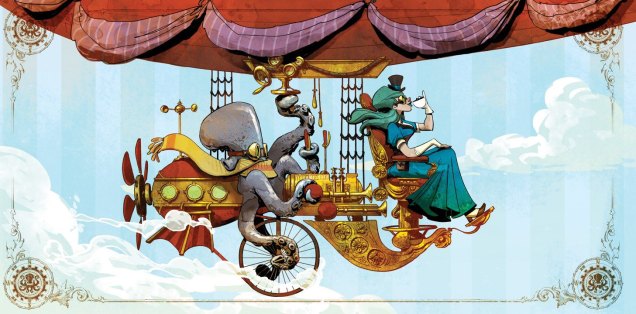
Drink tea with your octopus today… and if you don’t have an octopus, borrow one from a friend. I don’t have a dirigeable (that would be a zeppelin for younger people in the audience) , but I manage. Toodle-oo!
The cover for the 2016 calendar of Otto and Victoria, an adorable steampunk couple created by Brian Kesinger. These two were featured earlier in Tentacle Tuesday: Adopt an Octopus Today!
I’m on mini-vacation, away from all the big city violence, car noise and light pollution. One can actually see the stars out here! In honour of this mellow state of being, this Tentacle Tuesday is a friendly, gentle affair. It’s all about fishing and diving and, above all, chilling out with friends. (Sure, some folks almost get eaten, but it’s all in good fun.)
Oh, and my suggestion for summer reading (for people who are hard-pressed for time, but still want to impress others at the next cocktail party with their sparkling wit and erudition) is 20 Cool Octopus Facts.
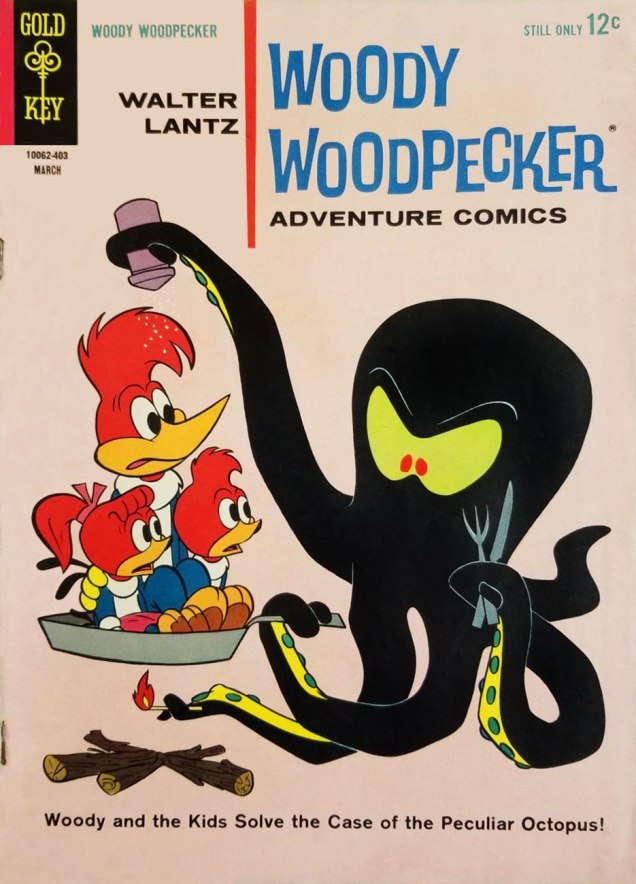
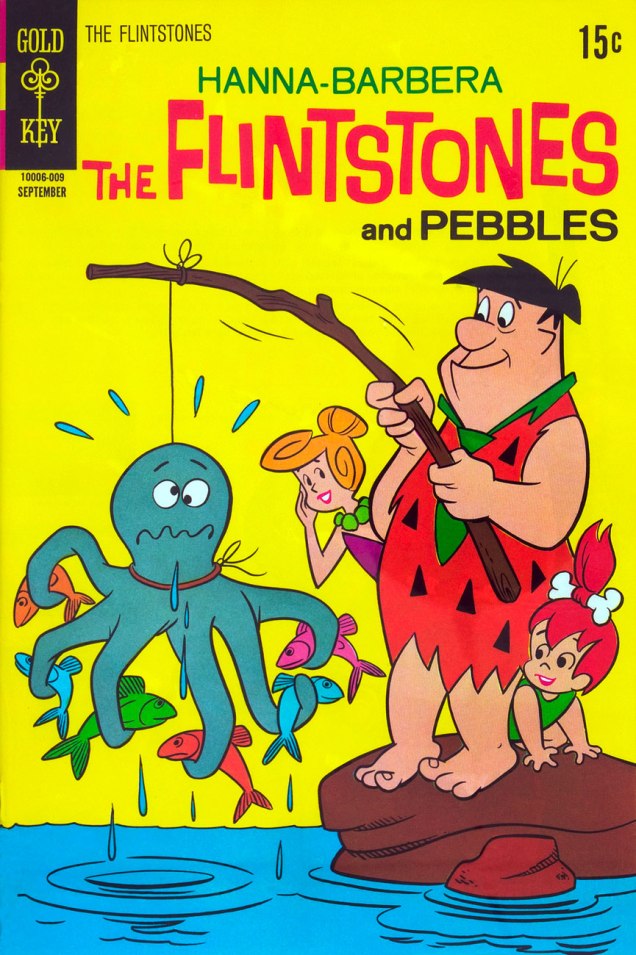
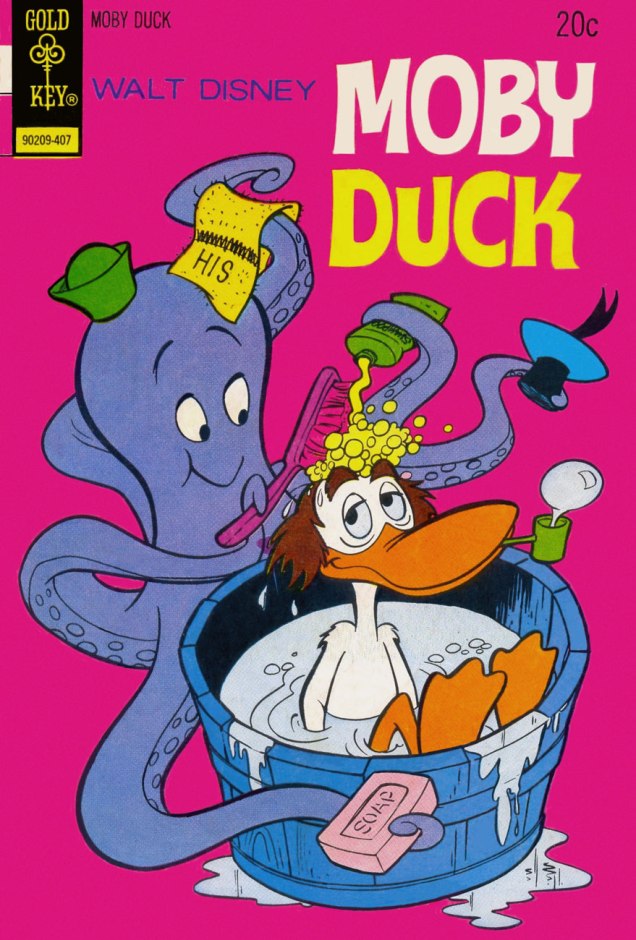
Walter Lantz Woody Woodpecker no. 79 (March 1964), cover by Phil De Lara.The Flintstones no. 60 (September 1970).Tweety and Sylvester no. 28 (January 1973).Moby Duck no. 14 (July 1974). Pencils by Pete Alvarado, inks by Larry Mayer.Woodsy Owl no. 6 (February 1975). Pencils by Paul Norris, inks by Larry Mayer.Yosemite Sam no. 43 (April 1977).Yosemite Sam no. 67 (July 1980).
Country Boy: What are you doing? City Boy: Drawing. Country Boy: Where are your guns? — Submitted by Steven Feinstein, 7, Philadelphia, PA (circa 1965)
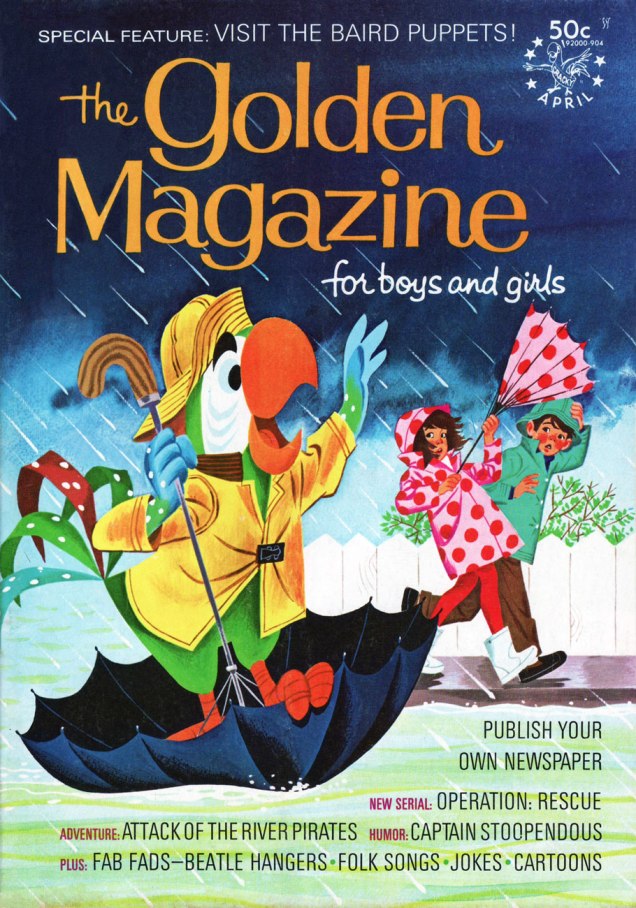
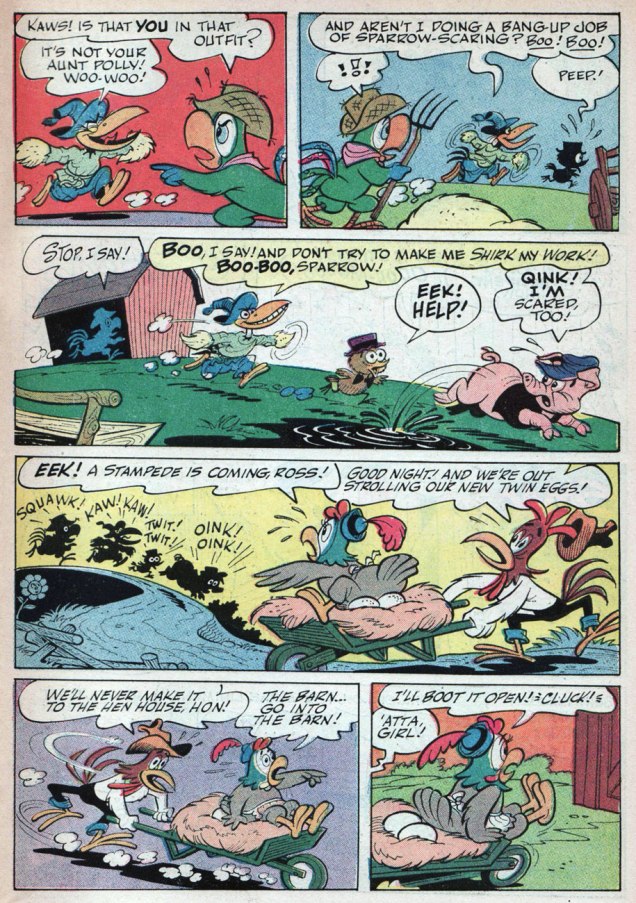
Cracky the parrot was introduced in the role of mascot for Western Publishing‘s general-interest kids’ mag The Golden Magazine (1964-71), which heavily drew upon the successful Jack and Jill (published since 1938 by The Saturday Evening Post Society) formula.
For much of its existence, The Golden Magazine thrived, having access to top creative talent from the Western publishing empire (Whitman, Gold Key, Golden Press, Golden Book Encyclopedia…)
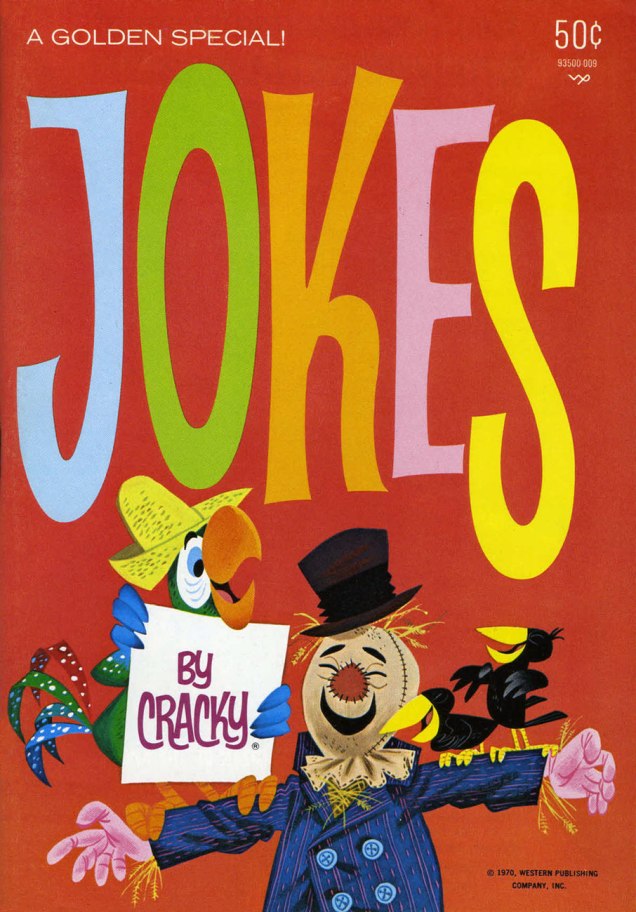
At first, Cracky stuck to sharing reader-submitted jokes. Then, around 1968, he began to show up on covers, generally depicted by versatile Canadian illustrator Mel Crawford (1925-2015). This is one such case, from April, 1969.In 1970, Cracky saw his old job expanded, branching out into two titles, Jokes by Cracky and Pencil Puzzle Fun, the latter outlasting its parent, The Golden Magazine. This is Jokes by Cracky no. 2 (1970); Cover art by Mel Crawford.Then, in 1972, it gets interesting: the lowly parrot mascot broke into comics.
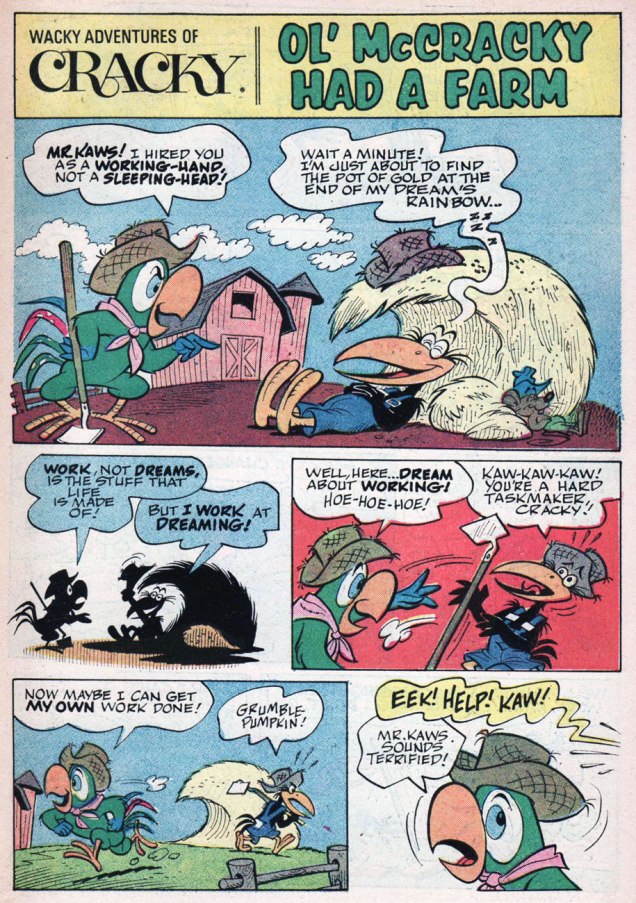
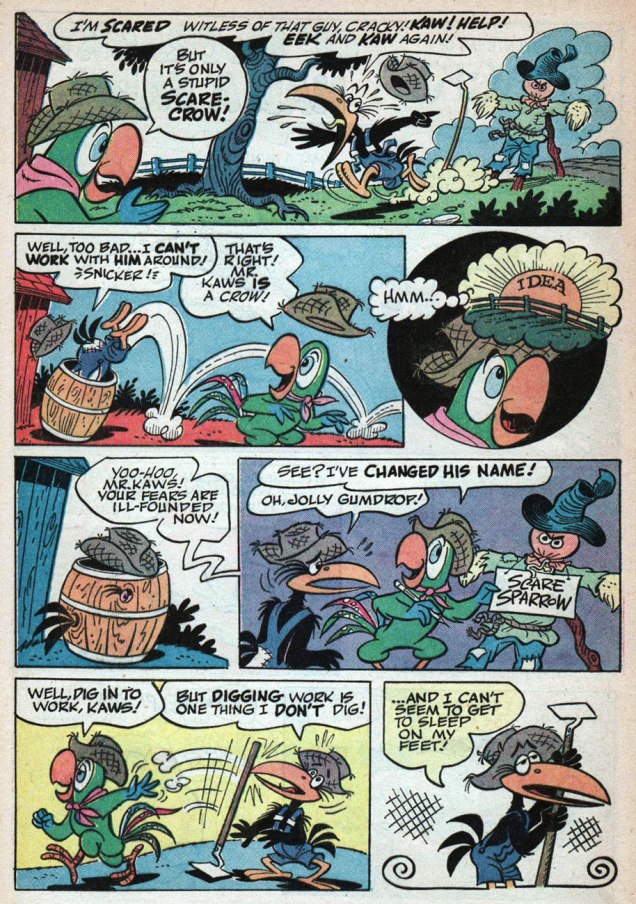
As Archie Comics had their Christian-zealot madman in Al Hartley, so did Western in the person of Vic Lockman. A significant difference, however, is that Hartley, despite quite stiff competition, is arguably the very worst Archie artist; he’s certainly got my vote [Seconded! ~ ds]. Lockman (1927-2016), a prolific but often terrible scriptwriter, was a terrific cartoonist, blessed with a gorgeously fluid line and exemplary design sense, lively and detailed. Here, then, is a story from Wacky Adventures of Cracky no. 3 (June, 1973). Script and art, including his distinctive lettering, by Mr. Lockman.
During the run of his comic book, Cracky (and sidekick Mr. Kaws) wore many hats: detective, inventor (presumably giving Lockman the chance to recycle some of his rejected Gyro Gearloose scripts), ship’s captain, escape artist, sheik… And yes, he did encounter some choice tentacles, but I leave it to my partner to conduct her own investigation. Lockman beautifully handled the first ten issues of WAOC; the instant he stepped away, the thing dissolved into tripe. Avoid accordingly.
Lockman, who seemed a loveable, well-meaning coot, was also twelve kinds of batty. Biblical Economics, anyone? For as full a picture as can be reasonably assembled, read Mark Evanier‘s fine, thoughtful obituary of Lockman.
Lockman was also among those sadly deluded souls (hello, Chuck Dixon) who tried to lay claim to the title of most published comics writer. Let’s face it: the most likely contenders (Joe Gill, Paul S. Newman, Gaylord DuBois) toiled in anonymity for most of their long careers.
In 1971, The Golden Magazine was sold (to The Saturday Evening Post Company!) and renamed, becoming Young World in 1972. Young World, in turn, got incorporated into Child Life in 1979, but that’s a story for another day. Many of TGM’s features were retained but slightly… tweaked. For instance, see who inherited Cracky’s old desk?
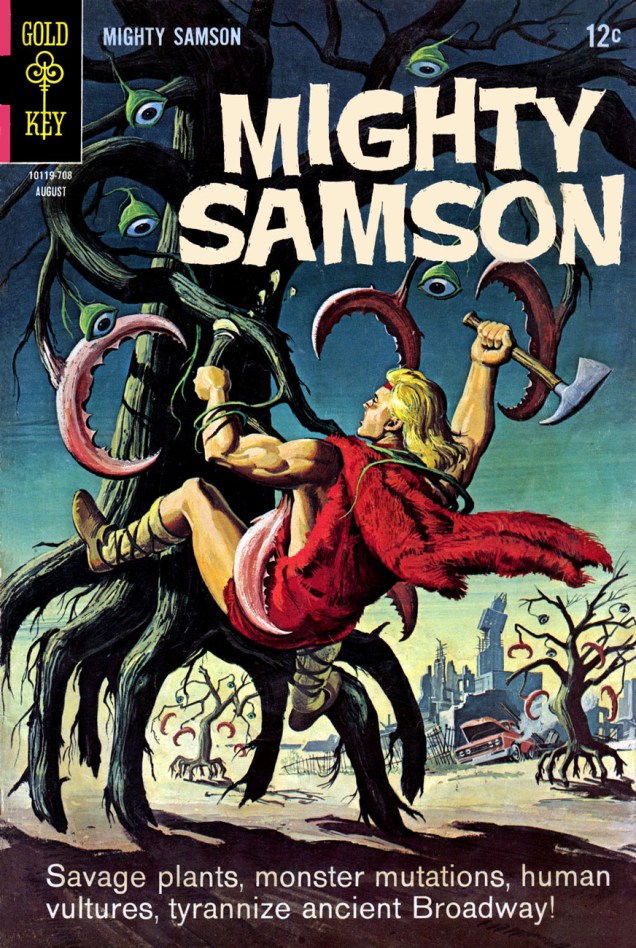
« Savage plants, monster mutations, human vultures… »
George Wilson (1921-1999), prolific cover illustrator for Dell Comics and Gold Key from the 1950s through to the 1970s, is such a ubiquitous figure for anyone interested in comics of that era that it’s almost like he’s taken for granted by comic aficionados. “Oh, yes, another gorgeous George cover”, we say and move on to something else. Let’s not, shall we? We can admire his trademark bright colours, eye-popping attention to detail and impeccable compositions *and* celebrate Tentacle Tuesday. And there’s all kinds of tentacles in these covers – organic or motorized, animal, mineral, or… plant-like. (I refuse to use “vegetable” as an adjective.)
Mighty Samsonno. 11 (August 1967). This might just be the most random menace (and the most ridiculous set-up) I’ve seen in a while.
Mighty Samson was created by writer Otto Binder and artist Frank Thorne, and involved a heroic barbarian-type sword-and-sandaler loitering around a dystopian, post-nuclear disaster world that has reverted to something resembling the Stone Age. One thing that amused me – not only is our dashing hero blond, but so is his love interest (apparently recessive traits help survive radioactivity). The evil temptress-cum-scientist is a dark-haired femme fatale, obviously. You can read each and every issue of Mighty Samson here.
Panels from “The Swamp Rats“, written by Otto Binder and drawn by Jack Sparling, whose art is for some reason hated by many (the same many who have no trouble with bad art from other, more publicly accepted artists).
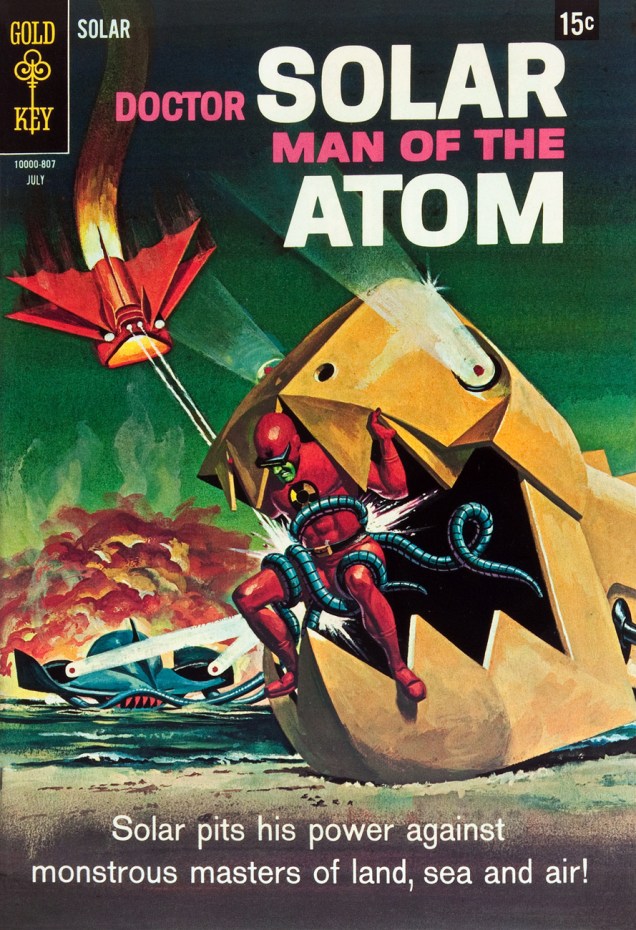
Doctor Solar, created by writer Paul S. Newman and editor Matt Murphy, was fairly humble at first, despite his somewhat ponderous moniker. (« The Man of the Atom »!) Originally clad in a normal lab-coat, he acquired his red costume in issue 5. The source of his super-powers? A nuclear disaster, of course. It’s difficult to be impressed by that when everyone and their auntie is getting exposed to radioactivity. I try to keep in mind that Doctor Solar was one of newly-formed Gold Key’s first publications, and in 1962, a nuclear war seemed imminent whatever side of the continent you were on… but I’m still bored. There’s a list of Atomic Superheroes with 27 items in it here, but it only includes public domain characters.
Doctor Solar, Man of the Atomno. 21 (October 1967).Doctor Solar, Man of the Atomno. 24 (July 1968).Page from “The Deadly Trio”, written by Dick Wood and drawn by Ernie Colón. That “monstrous master of the sea” is so freaking cute!
All of Gold Key’s Doctor Solar run is available here. How much time do you have on your hands, anyway?
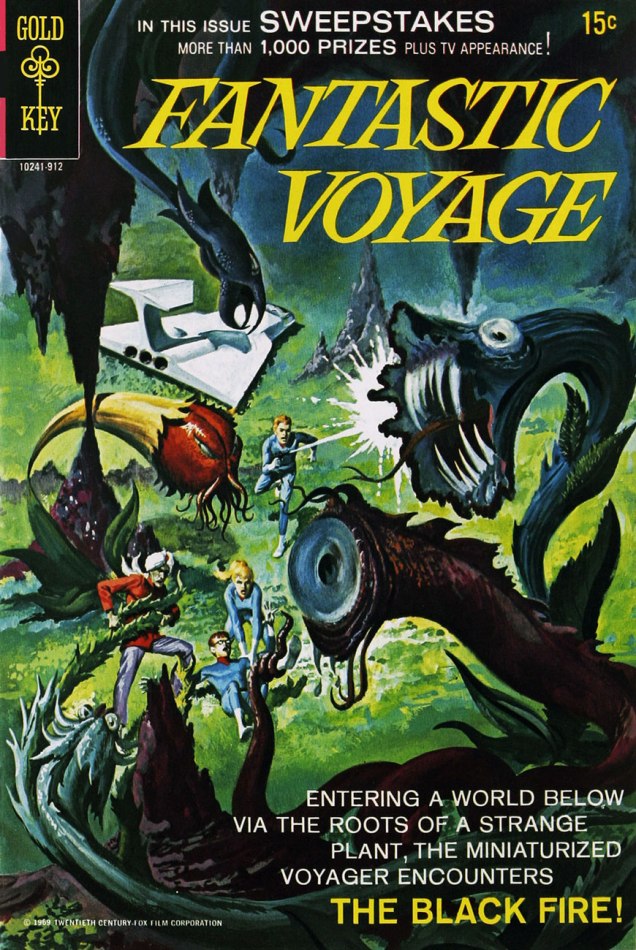
Fantastic Voyageno. 2 (December 1969).
This two-issues “series” features « adventures based on the cartoon about the Combined Miniature Defense Force (CMDF) with Jonathan Kidd, Erika Lane, Dr. Guru, and Busby Birdwell. » Clearly, nobody cared about the comic. Maybe someone cared about the animated TV series the comic was based on.
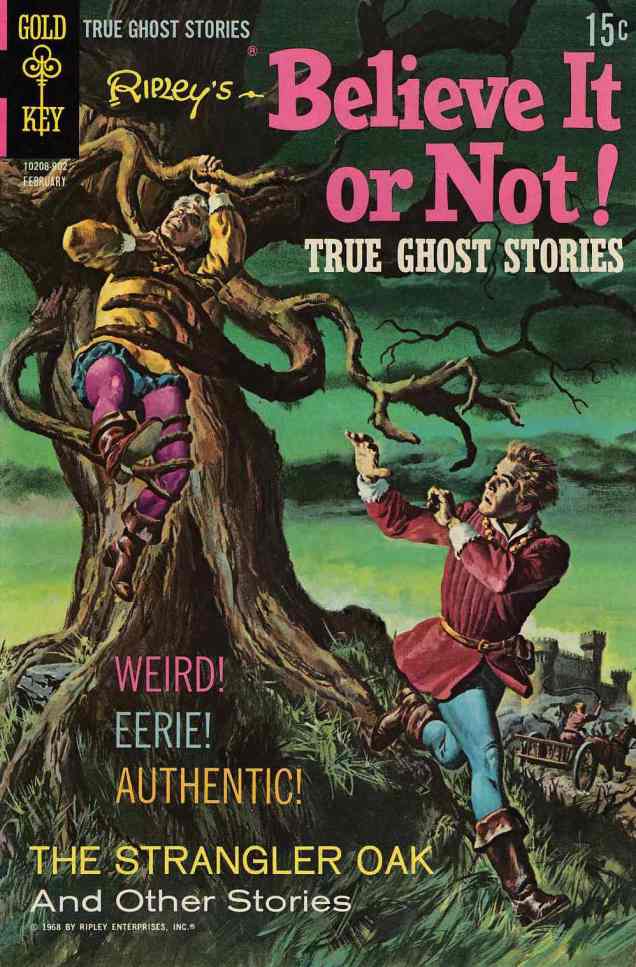
Speaking of boring… I haven’t yet encountered *one* issue of Ripley’s Believe It or Not! that wouldn’t cause me to yawn or start rolling my eyes. However, painted covers are often worth dwelling on, and the inside art is also occasionally quite nice (especially when it’s by Luis Dominguez).
Ripley’s Believe It or Not!no. 12 (February 1969).
The Microbotsno. 1 (December 1971). The tentacled monster was designed by Jack Sparling, who illustrates This Is the Way the World Ends and Day of the Juggernaut, but the cover art is by George Wilson.
There’s an excellent (and suitably sarky) review of this one issue of Microbots on Gone & Forgotten. Here’s a little taste: « Superstitious, parochial, and frequently eaten alive by mutated elephants, the people of the future world have turned their backs on technology. » Bet you’ve never seen *that* sentence before. Or — « The Microbots are the creation of Dr. Norman Micron (of the Connecticut Microns, I presume), a scientist living in the dire times of a world succumbing to man’s pollution. ‘Mankind had ample warning that he was destroying the world around him’ he muses, standing by a window with a highly-desirable garbage view. »
The crew of the Starship Enterprise keeps running into tentacles, it seems. (Presumably, they couldn’t do it as convincingly on the TV show, as the visual effects weren’t quite up to snuff.)
Star Trekno. 24 (May 1974). Gold Key published Star Trek comics between 1967 and 1978, for a total of 61 issues. They weren’t a rehash of the TV series, and featured original characters and stories, although later issues included sequels to a couple of episodes (which is pretty cool, if you ask me).Star Trekno. 29 (March 1975).
Gail O’Brien shared this snippet on a forum about Wilson’s art, sadly a fairly typical story: « You might be interested to know that George’s widow (a friend of mine) has had no income from his paintings as they “disappeared” from his estate at his death while they were separated. She is presently living on small retirement from teaching. I’ve tried to influence her to seek legal advice to acquire her share of George’s sales, but she feels it is impossible… hope there is a lawyer who enjoys George’s work, who would want to go on a 50/50 basis to acquire what is rightfully belonging to my friend. » |source|
Look at more (less tentacle-centric) George Wilson art here.
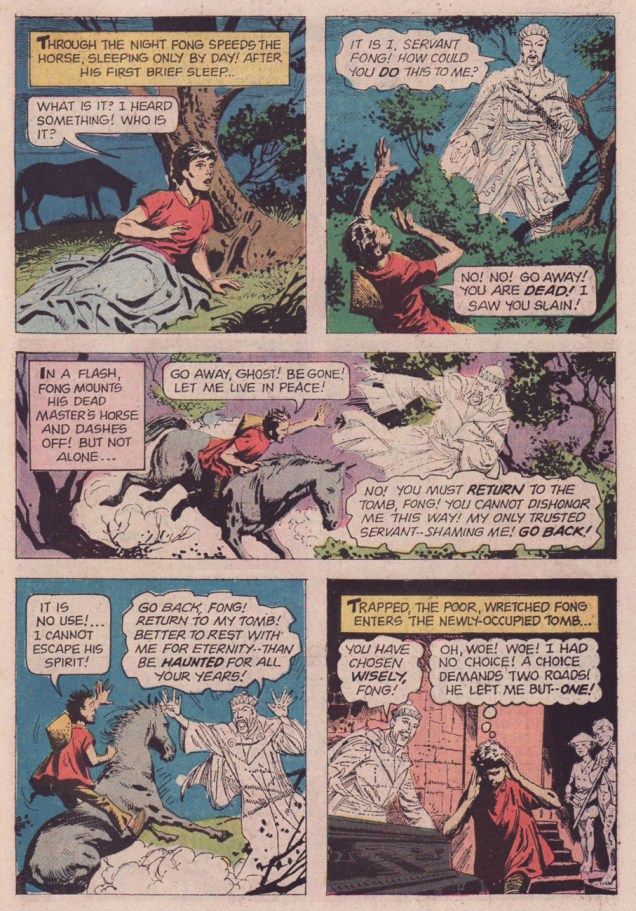
« Followers in death: Attendants and relatives who were killed so they could be buried in the tomb with the person (normally someone very important or wealthy) who had died. » — The British Museum
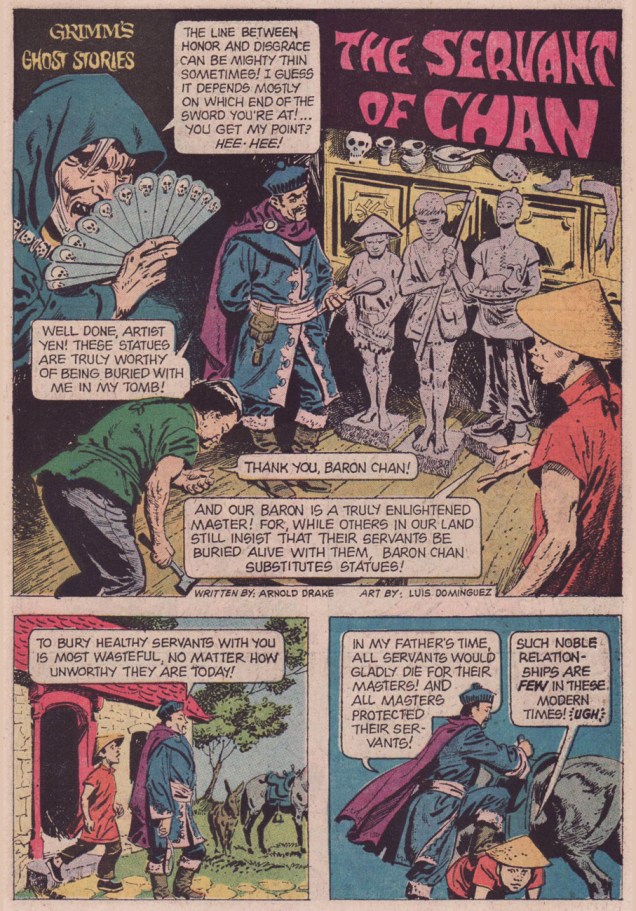
Let’s face it, Gold Key’s would-be-spooky comics rarely lived up to their habitually fine painted covers (mostly courtesy of hard-working George Wilson, with Vic Prezio, Luis Domínguez, Jesse Santos or Jack Sparling occasionally chipping in); as with most things, there were exceptions: I’ve raved earlier about a particular issue of the generally ho-hum Grimm’s Ghost Stories, namely issue 26, boasting, along with the usual Paul S. Newman sleep aids, two excellent yarns from the undervalued Arnold Drake (co-creator of The Doom Patrol, Deadman, and the original Guardians of the Galaxy).
Ah, but today, we’re celebrating Drake’s co-conspirator, the prolific Argentine master (yes, another one) Luis Ángel Domínguez, reportedly born ninety-five years ago to the day (Dec. 5, 1923), and still among the living… as far as we know. I like to envision him warmly surrounded by several generations of loved ones and well-wishers, an impish gleam in his eye.
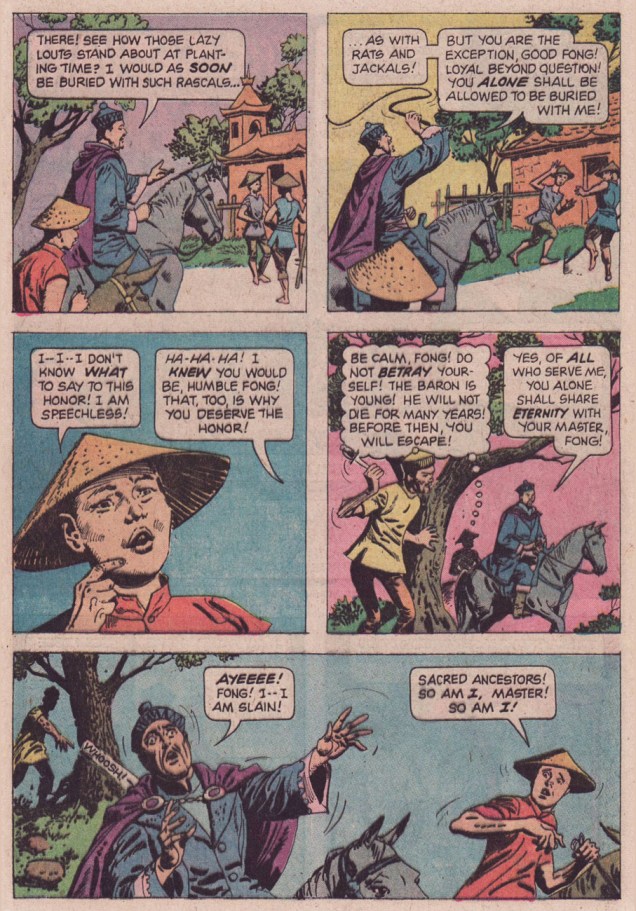
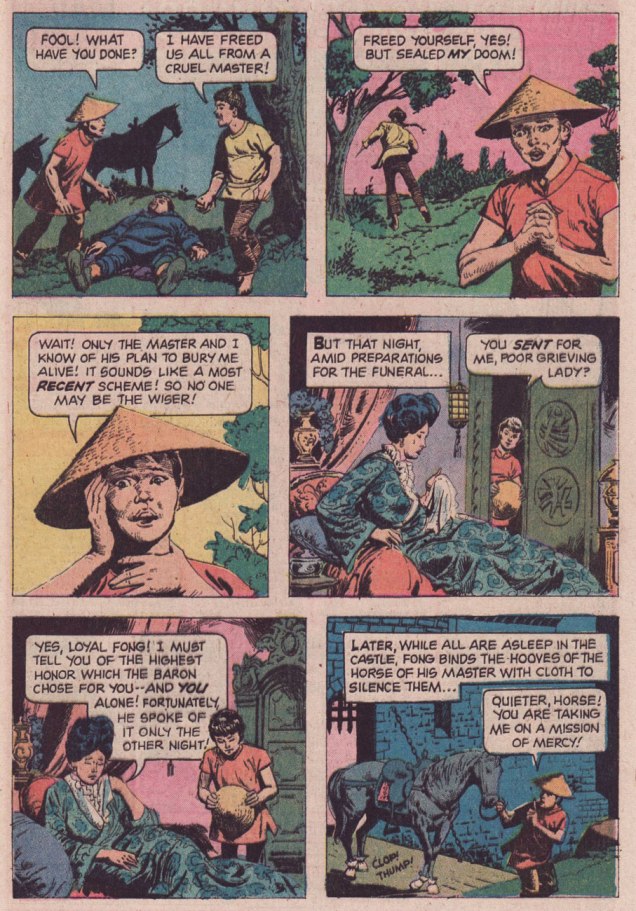
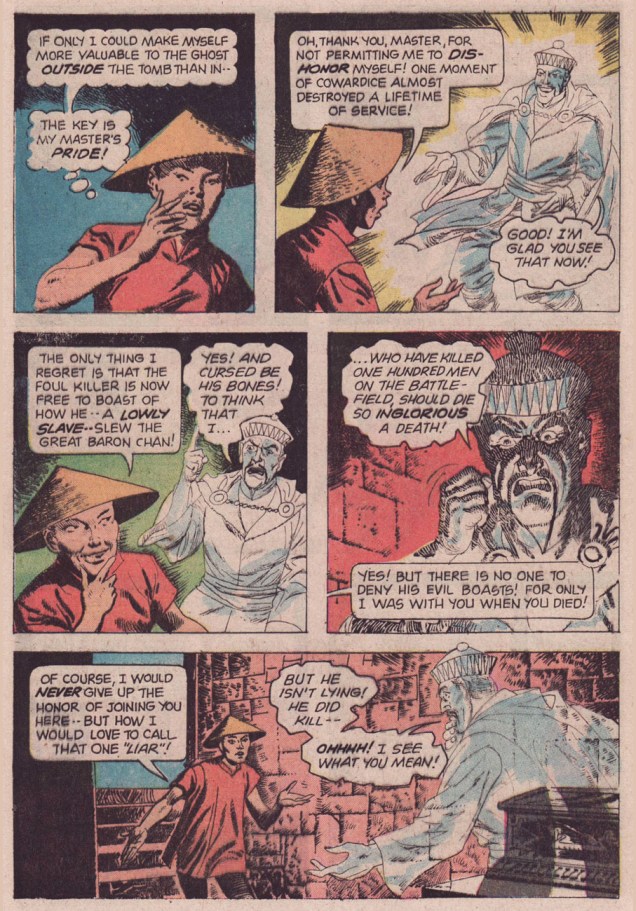
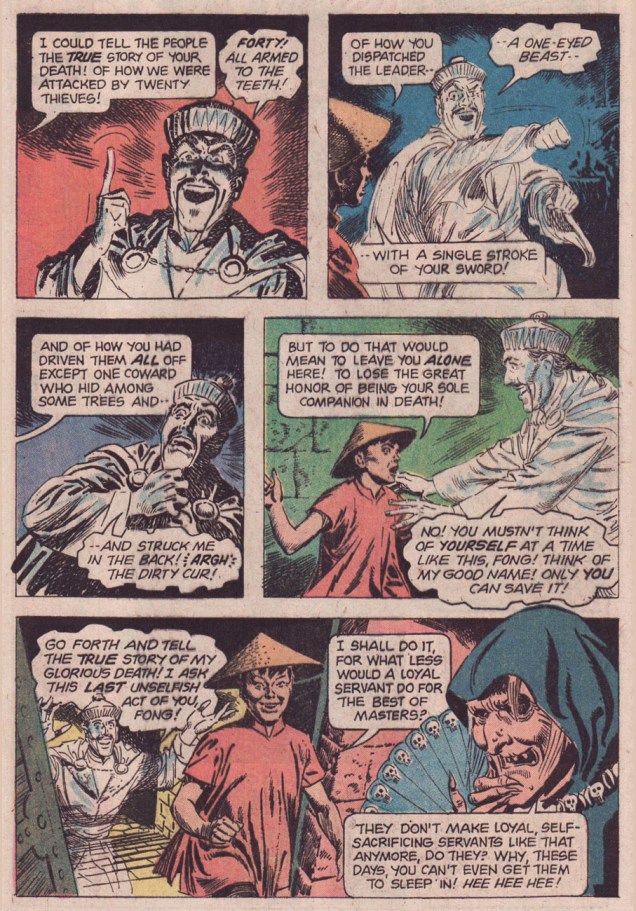
Without further foot-dragging, here’s a vintage tale of quick wits in ruling class hubris from beyond the grave, The Servant of Chan, by that dastardly duo, Drake and Domínguez.
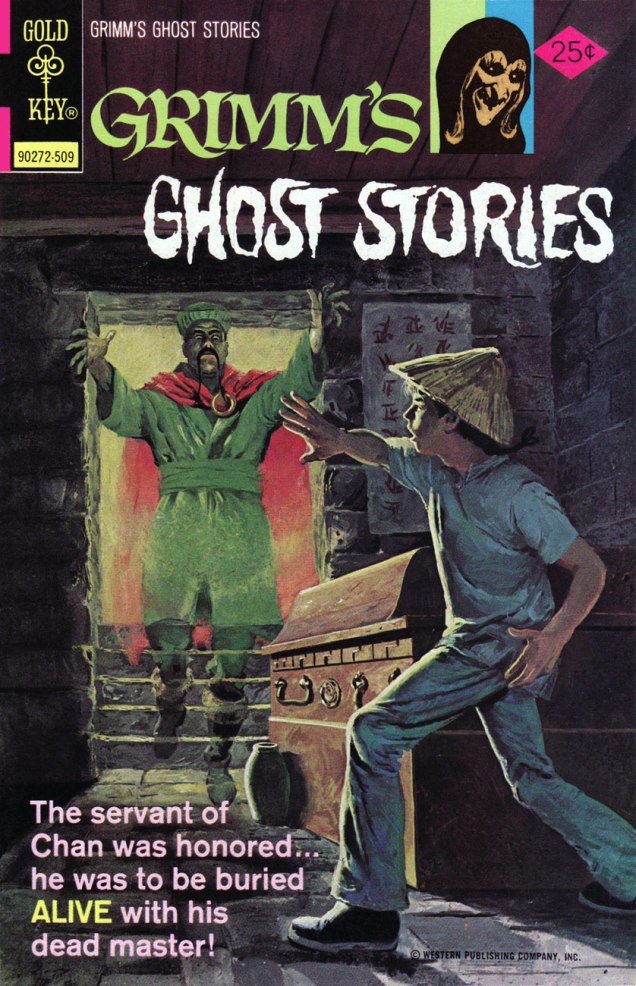
George Wilson’s cover highlights a dramatic scene from our little story. This is Grimm’s Ghost Stories no. 26 (Sept. 1975, Gold Key).
« Slavery in ancient China was not a pleasant experience. The lives of slaves were filled with hardship. Many were abused. Many slaves were children.
Most people who were slaves worked in the fields, alongside of peasants. They did the same job, and had the same hours, and pretty much the same clothing and food, as free farmers. But they were not treated with the same respect given to farmers. Some slaves built roads. Some worked in government.
But slaves who worked for the emperor, the royal family, and sometimes the nobles, had the worst of it. They could only do what they were told to do. They were treated in any way that their master and his family felt like treating them. Many were treated with great cruelty. When their master died, they were killed, and buried with their master in his tomb, so they could continue to serve their master after his death. »
Brr. All the same, if you’ve enjoyed this yarn, check out Arnold Drake’s other contribution to this issue, The Anti-13, which we enthusiastically featured some time ago.
¡Feliz cumpleaños, Señor Domínguez… wherever you may be!
« No matter what scientists say, lumbermen of the West insist that the monster exists… Believe it or Not! » — the standard Ripley’s line, from The Beast of the Humboldt
In the early 1960s, former industry leader Dell Publishing suffered a crushing blow when Western Publishing, who had been producing Dell’s comics for them since 1938, decided to handle their own distribution, which left Dell with, well… just about zilch*. But that’s neither here nor there.
Dell had opted out of the Comics Code Authority, and Western’s subsequent comics, under the Gold Key banner, also enjoyed that advantage, not that they abused the privilege much, though the exceptions are among the finest comic books ever issued: Ghost Stories No.1 and the one-shot giant Tales From the Tomb, both from the phenomenal mind of John Stanley and published by Dell in the fall of 1962.
By the mid-1960s, Warren Magazines had pounced through the loophole of the magazine format, unregulated by the Code, to bring back monsters forbidden under the CCA’s rule. Gold Key required no such stratagem.
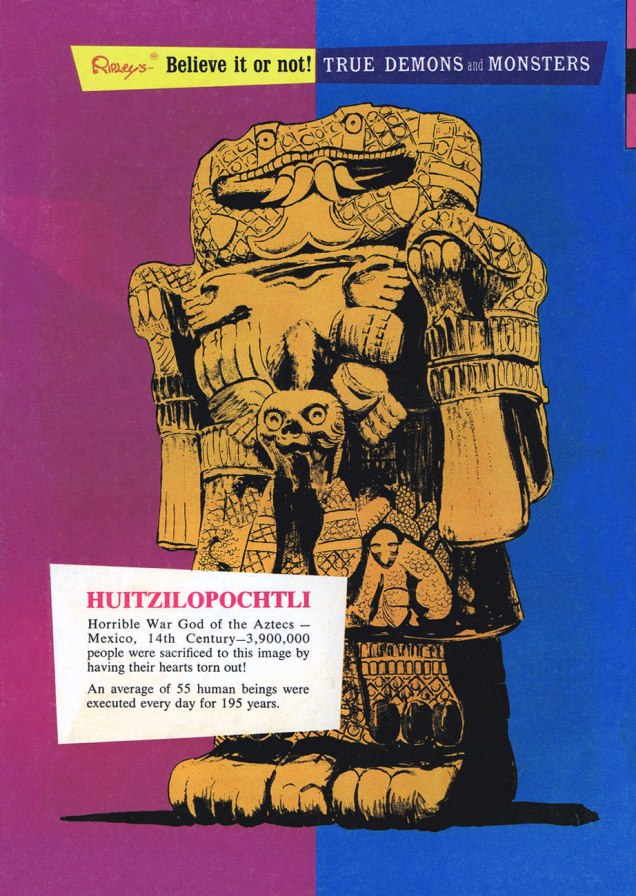
At first, GK’s long-running (1965-1980, 94 issues) Ripley’s Believe It or Not! * couldn’t decide on a focus: 14 of its initial 26 issues were devoted to « True Ghost Stories », two related « True War Stories », two shared « True Weird Stories », and six tackled « True Demons and Monsters ». With issue 27, the title stuck to ghosts, if not to the strict truth.
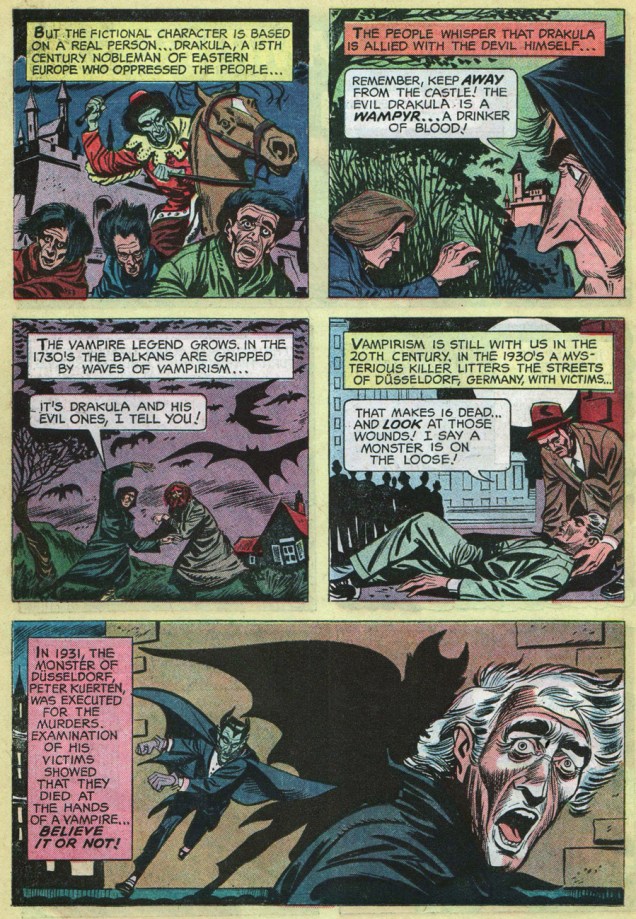
This is an excerpt from Ripley’s Believe It or Not! no. 4 (April, 1967), featuring the work of the much underrated Joe Certa (1919-1986), who began his comics career in the mid-1940s, working in just about every genre for a score of publishers, settling with Gold Key in the mid-60s and staying on until his retirement in 1980. He’s most remembered for his co-creation (with writer Joseph Samachson) of, and lengthy stint on J’onn J’onzz, the Martian Manhunter (1955-68), as well as for drawing every single issue of Gold Key’s loose adaptation of television’s first supernatural soap, Dark Shadows (35 issues, 1969-76). By this time, Certa’s style had evolved from a fairly mainstream style to a wonderfully blocky, angular and shadowy style that left him ill-suited to the depiction of standard superheroics… but prepared him well for moodier fare.
Issue 4’s front cover. Most of them featured often-splendid paintings by George Wilson, Jack Sparling or Luis Angel Dominguez, but the occasional effective photo cover crept in.Here’s a harsh factoid that makes vampires seem cuddly by comparison.
– RG
*the one priceless creative asset that Dell managed to hold onto was John Stanley, not that they appreciated him. When he left the industry, it wasn’t with a carefree grin and a spring in his step.
** « Ripley’s Believe It or Not! is a franchise, founded by Robert Ripley, which deals in bizarre events and items so strange and unusual that readers might question the claims. The Believe It or Not panel proved popular and was later adapted into a wide variety of formats, including radio, television, comic books, a chain of museums and a book series. »
Today’s tentacle adventure brings us a bounty of Gold Key covers.
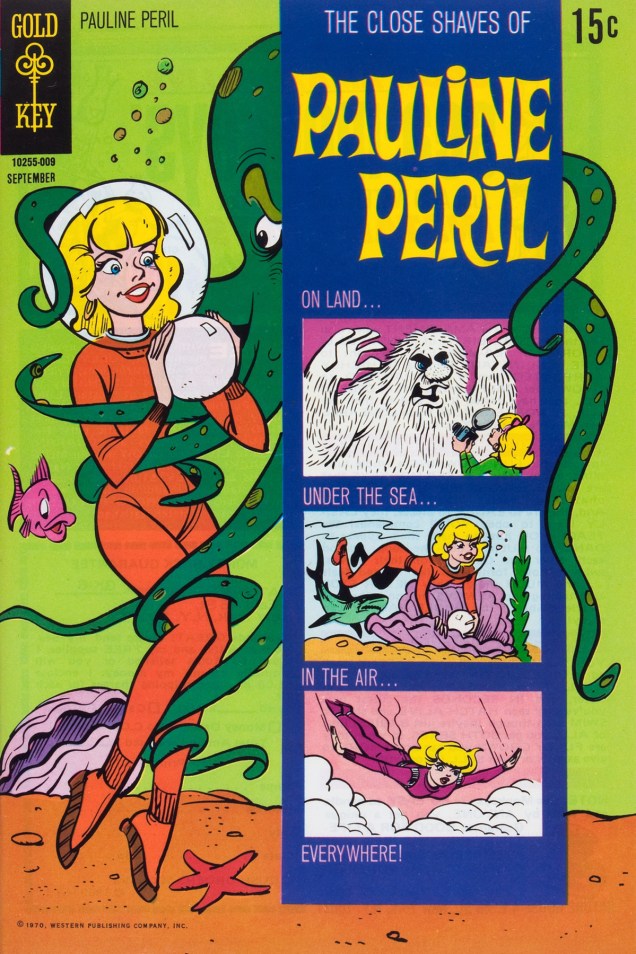
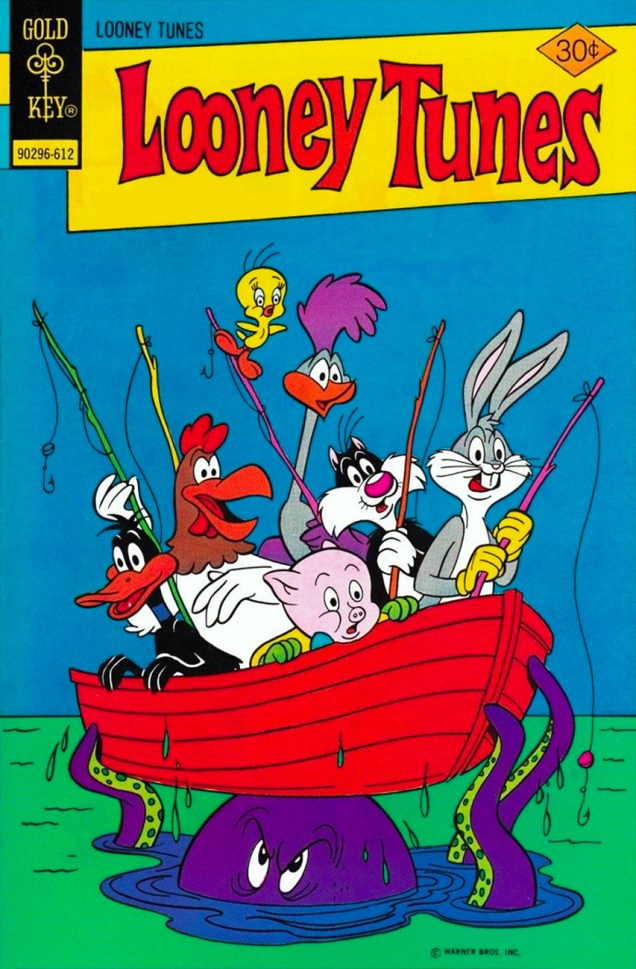
The Close Shaves of Pauline Peril no. 2 (September 1970). Cover by Jack Manning. I love the Pauline Peril series – it’s such loveable nonsense, with dynamic art and fusillade-style dialogue. However tempting it may be to jump to that conclusion, It’s not a comic-book adaptation of a TV cartoon. Read a whole issue (number four, to be more precise, the last one) at, appropriately, the Ominous Octopus Omnibus blog.Hanna-BarberaThe Addams Family no. 3 (April 1975). The adorable cover is by Bill Ziegler. Is there anything groovier than a froggy belt-buckle? I think not.Looney Tunes no. 11, 1976. Cover artist unknown. The boat has been filled beyond legal capacity, and no-one’s wearing their mandatory Mae West. The Safety Octopus is here to ensure that the offending parties are brought up to standards (or at least given a tentacle slap on the wrist).
And just to offset all the cartoony, cutesy stuff, here’s a cover featuring an epic struggle, a life-or-death situation, a decisive skirmish between Man and Beast. (I’ll let you guess which is which, though.)
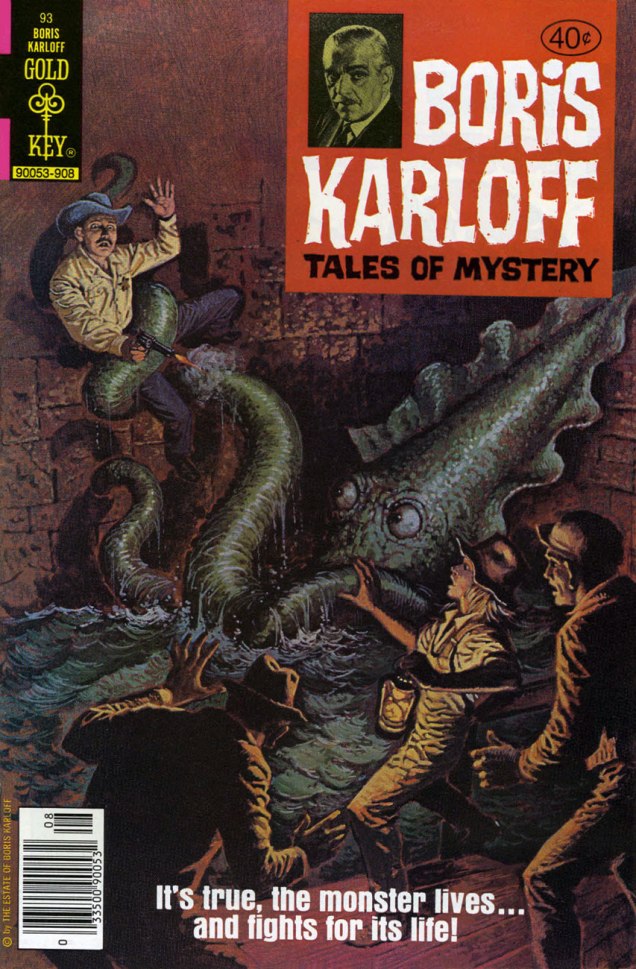
Boris Karloff Tales of Mystery no. 37 (October 1971), cover by George Wilson. Here we have a tentacled creature – “Sea-Beast” for friends – defending a village of innocent people against some sort of flaming monstrosity by shooting water from its tentacles (trunks?) at the flames. Hey, somebody should hire it as a firefighter!
Ahoy, landlubbers! Today’s Tentacle Tuesday goes back to the good ol’ days of nautical journeys, ships crushed by mighty tentacles, and brave men who end their lives as snacks for the mighty cephalopod.
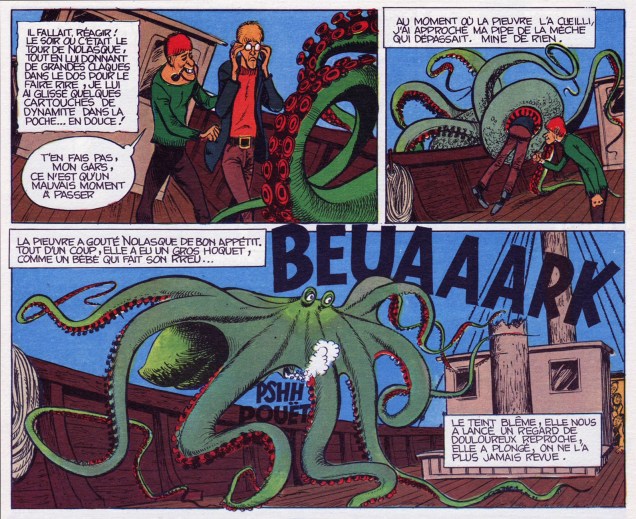
Printed in Pilote Hors série aventure no 17 bis (October 1975, Dargaud). The story is titled L’Antoinette Pécuchet, from the cycle Les histoires de Pemberton, written and illustrated by Sirius (real name Max Mayeu, Belgian cartoonist).After most of the crew is swallowed up by the starving octopus, our narrator gets the bright idea to stick some dynamite into the pocket of the next sacrificial lamb and lights it just before he’s eaten. “The octopus savoured Nolasque with a healthy appetite. Suddenly, she hiccuped loudly, like a burping baby… Pale, she threw us a glance of bitter reproach, and dove into the water, never to be seen again.”
Speaking of the Sargasso Sea (frequently depicted in fiction as a perilous area where ships go to die, mired in Sargassum seaweed, unable to escape), here’s another vignette about that mysterious spot. Incidentally, it is the only sea that doesn’t have land boundaries, enclosed by the Gulf Stream on the west side, the Canary Current on the east, the North Atlantic Current on the North and the North Atlantic Equatorial Current on the South. No wonder people thought it was full of mystery and danger! Even I, more or less immune to the siren’s call of wild maritime adventure, feel a little thrill at its mention. *Ahem* back to comics.
Boris Karloff Tales of Mystery no. 29 (March 1970), painted cover by George Wilson.
As is often the case, the original painting has a lot more detail than the printed version:
The original painting for “Creature of the Sargasso Sea” by George Wilson.
What does this peculiar, one-eyed beast look like closer up, one might ask? Something like this:
A page from Creature of the Sargasso Sea, pencils by John Celardo and inks by Sal Trapani. Furry octopuses are my favourite!
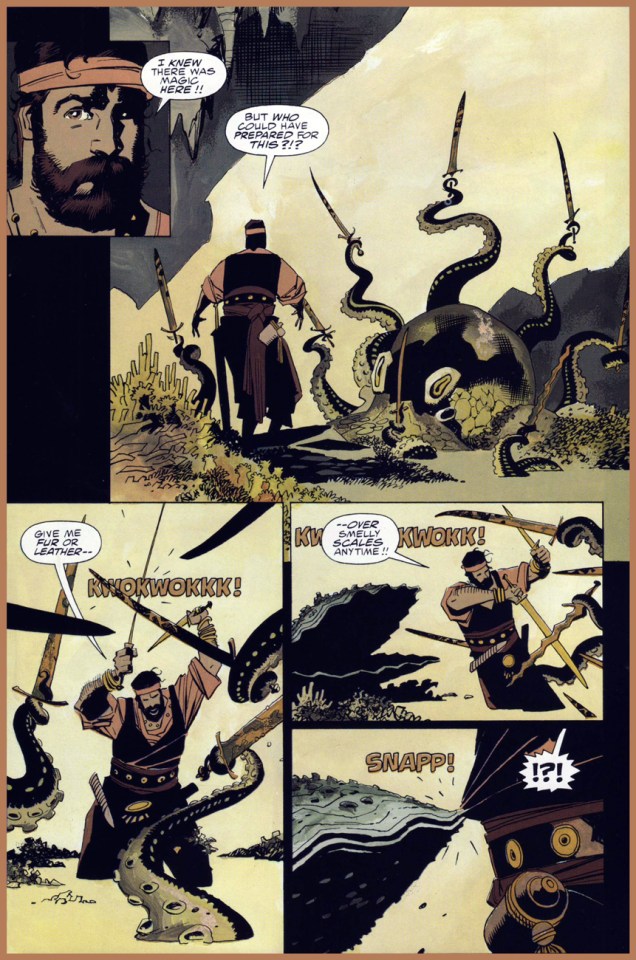
The sea can bring many (other) strange things, including a sword-wielding octopus… who should have stayed in the water, where he had the home advantage, instead of attempting to wage battle on sort-of land.
A couple of pages from Fafhrd and The Gray Mouser, a comic adaptation of Fritz Leiber’s cycle of sword-and-sorcery stories. Adaptation by Howard Chaykin, art by Mike Mignola, who’s inked by Al Williamson. This 4-issue series was anthologized in 2007 by Dark Horse; these pages were scanned from Book 4, published in 1992 by Epic Comics.One can only hope to be as stylish while fighting a many-tentacled monster.


































 Who's Out There?