Grimm’s Ghost Stories (60 issues, 1972-1982, Gold Key/Whitman) is a title I’ve been, in my usual fashion, lazily collecting for decades. I’ve always found in the Gold Key ambiance a soothing respite from the obsessive continuity and slam bam histrionics of DC and (the chief offender) Marvel.
While writer Arnold Drake‘s numerous credits at DC (and, to a lesser degree, Marvel) are well documented, his passage at Western/Gold Key in the mid-to-late 1970s is unjustly shrouded in obscurity. Let’s just say he — along with his young colleague Freff — brought complexity, warmth and wit to the publisher’s frankly formulaic fare.
.
.
.
.
.
.
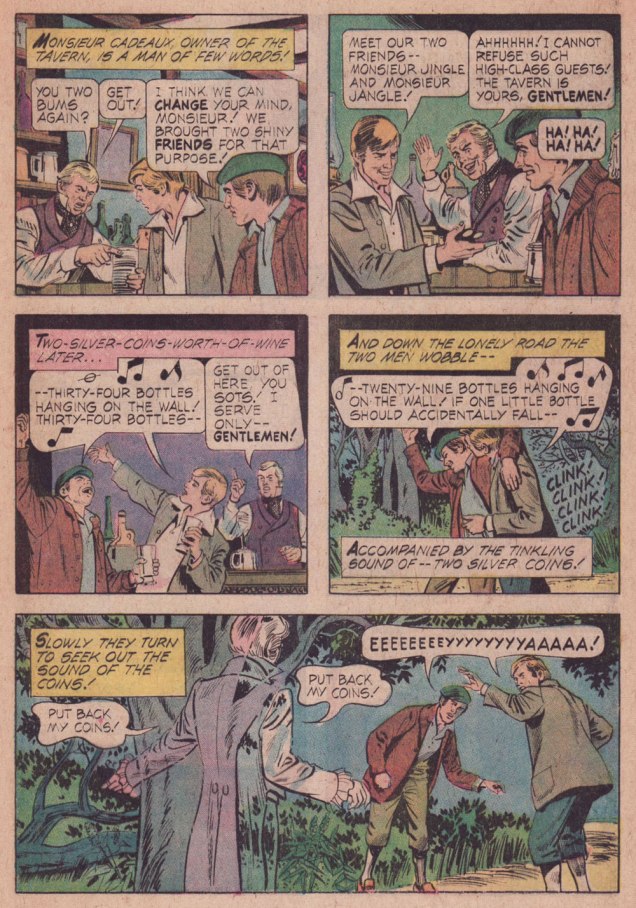
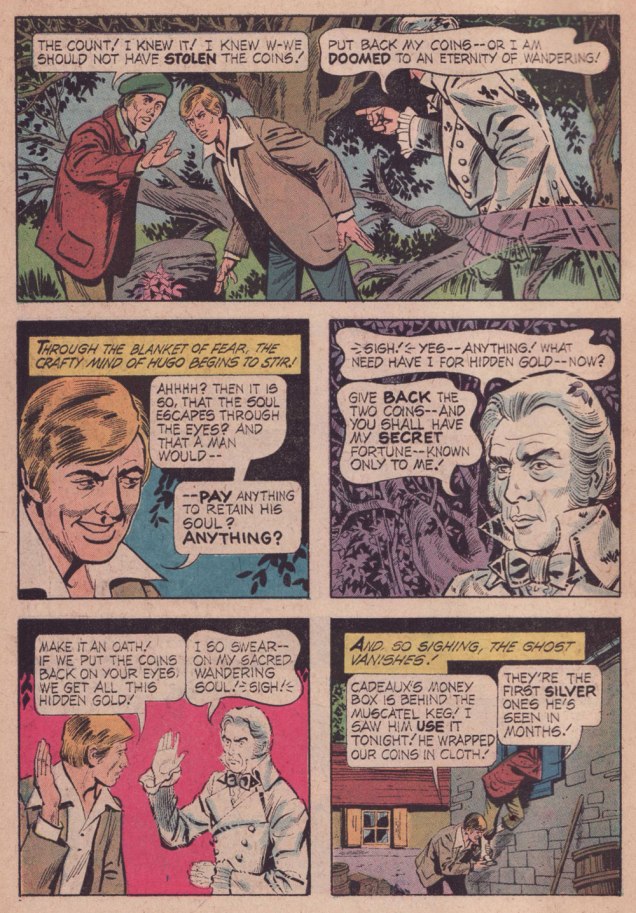
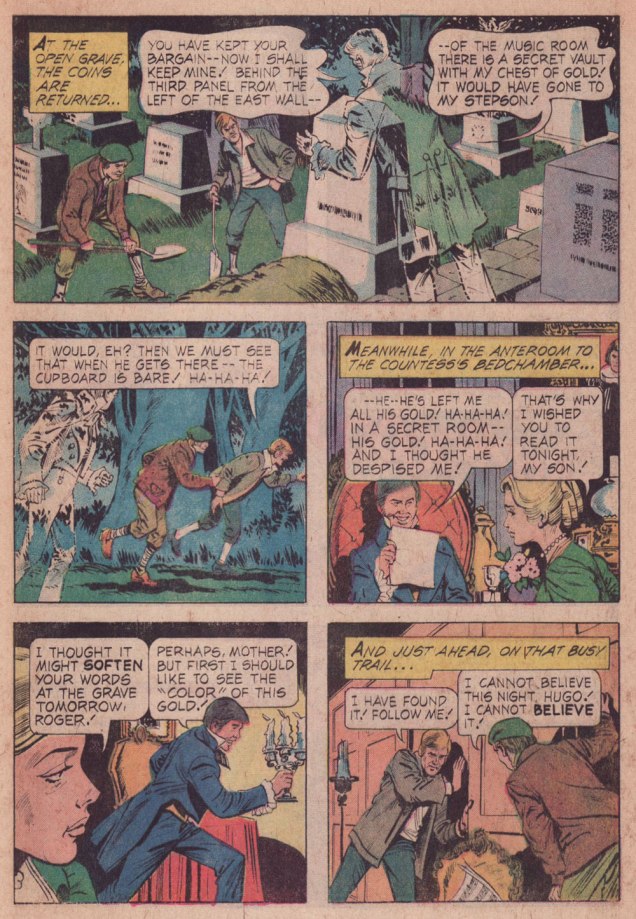
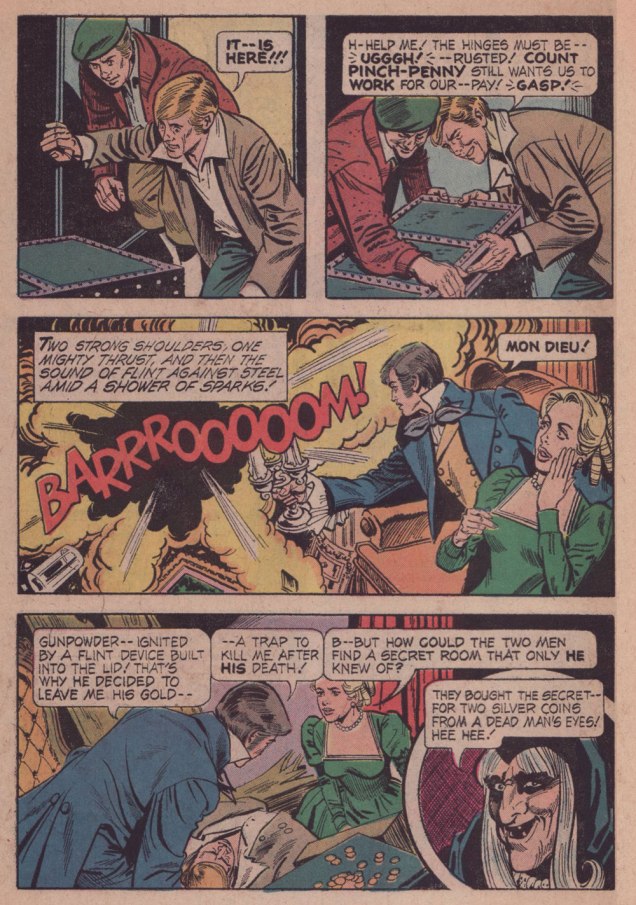
This isn’t the spookiest ghost story of them all, far from it, but that’s hardly the point, is it? Fun fact: the practice of putting coins on the deceased’s peepers was poetically called ‘Charon’s Obol‘.
I love the well-developed characters… despite the tale’s brevity. The willful stepson whose only sin is that of being a free thinker; the grave-robbers who can keep their wits about them in all circumstances; and the pragmatic miser’s spectre who’ll trade one act of revenge for another in a pinch.
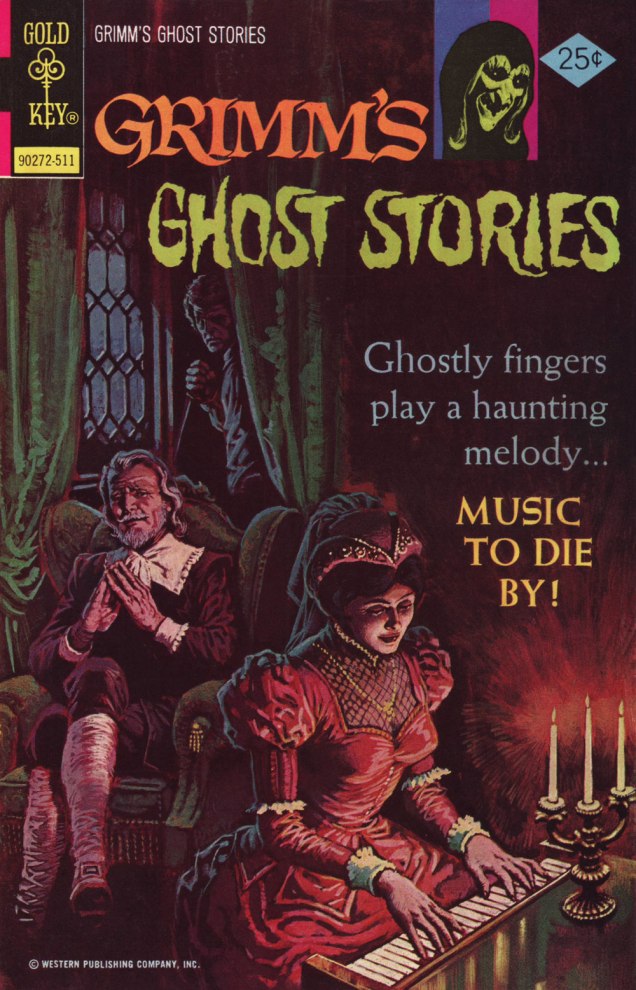
While ‘Silver’ wasn’t the cover-featured story, I wouldn’t pass up the chance to spotlight such a fine, understated Luis Domínguez painting. This is Grimm’s Ghost Stories no. 27 (Nov. 1975, Gold Key). For our gallery of this Argentine master’s finest, check out Luis Domínguez (1923-2020): A Farewell in Twelve Covers.
« Religion is like a blind man looking in a black room for a black cat that isn’t there, and finding it. » — Oscar Wilde
We certainly can’t have an Hallowe’en countdown without at least one black cat, can we?
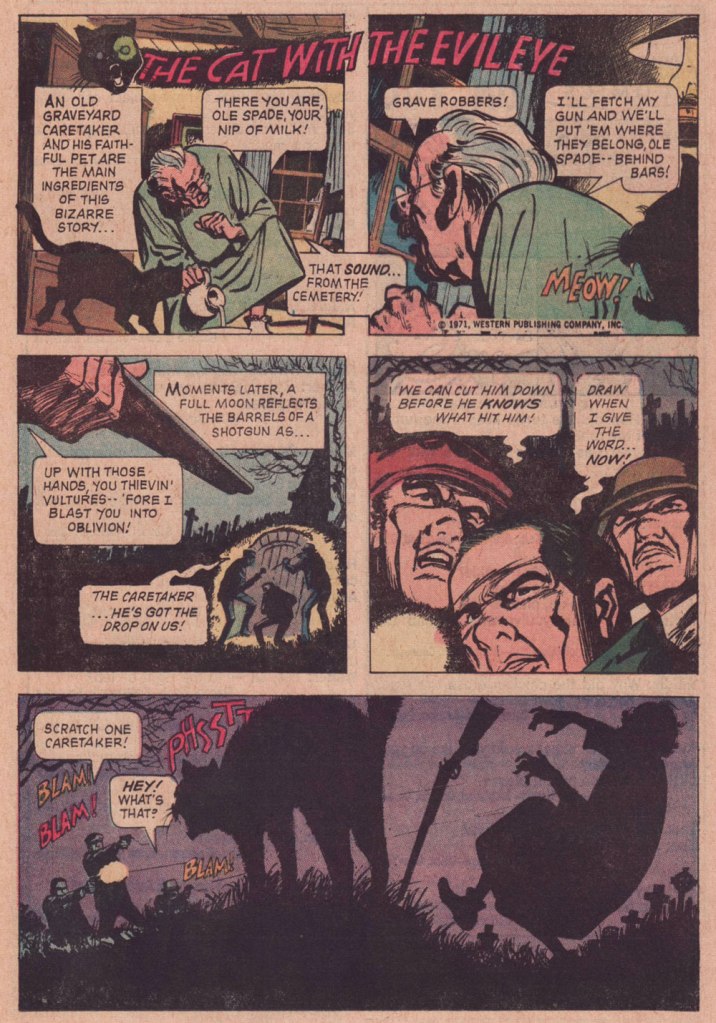
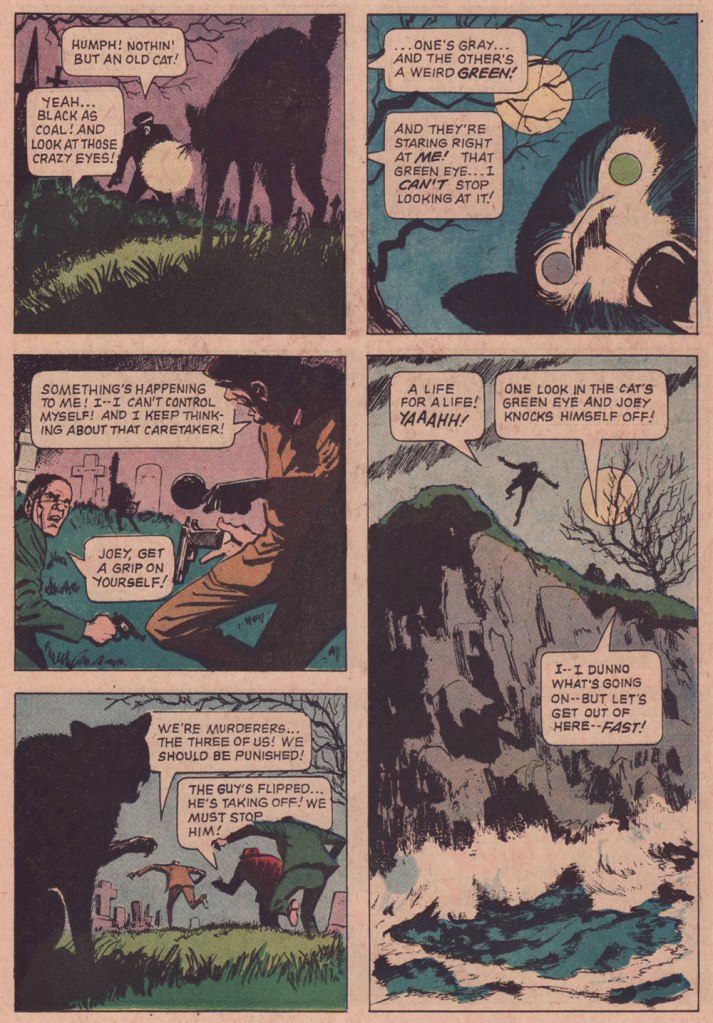
Here we have Hamilton, Ontario’s Win Mortimer (1919-1998) at his most stylish. A competent craftsman, he drew a lot of Superman and Batman for DC in the Golden Age, and may be most remembered by readers of a certain generation for his work on Marvel and The Children’s Television Workshop‘s Spidey Super Stories (57 issues, 1974- 1982). As for me, I was always fondest of his work for Gold Key’s mystery titles, where he seemed to be having more fun.
And never did he cut loose more expressively than with this tale of « The Cat with the Evil Eye », from The Twilight Zone no. 38 (July 1971, Western). Working from a barebones scenario by the über-prolific Paul S. Newman, Win messes around with shapes and textures at a breakneck pace. Four pages flicker by and it’s all over but the mournful yowling.
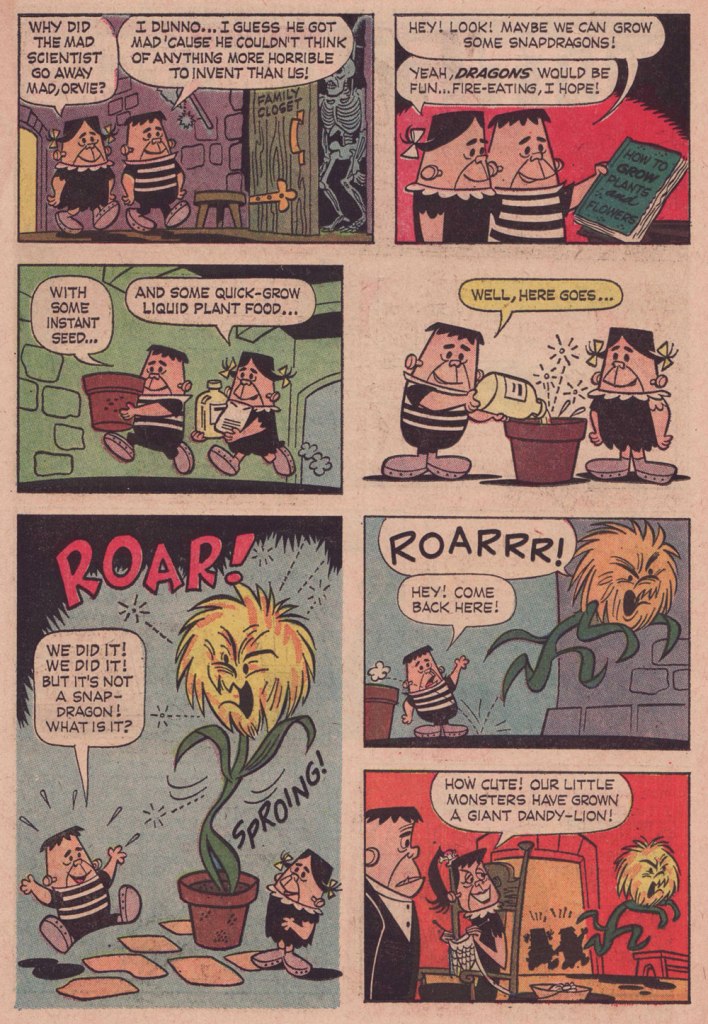
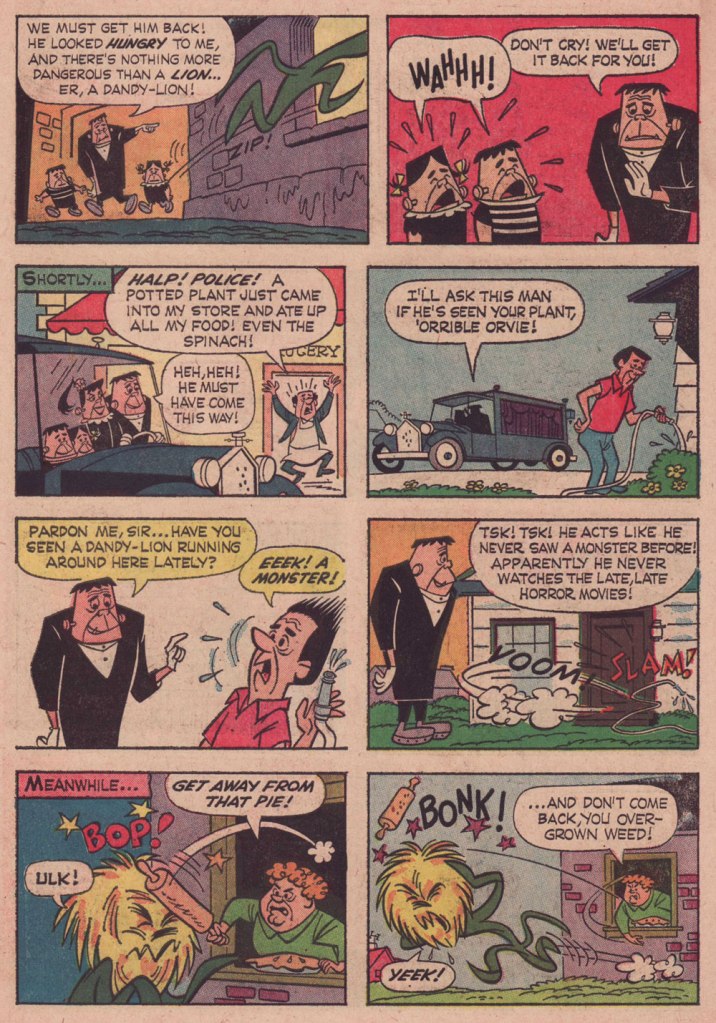
Few things evoke Hallowe’en so vividly to me as Gold Key’s The Little Monsters, one of the publisher’s relatively scarce non-licenced properties…
The series had its unlikely début as a backup feature in The Three Stooges no. 17 (cover-dated May 1964 — meaning it hit the stands in January) — months before The Addams Family (Sept. 18) or The Munsters (Sept. 24) reached television. Which is meaningless, of course, since the source for all of these fiends was Charles Addams’ New Yorker cartoons, wherein the clan did not even bear his name. Monsters everywhere! There must have been been something in the water.
Oddly enough, while Orvie, Annie, Demonica and Mildew soon (Nov. 1964) earned their own book, they remained loyal to Moe, Curly and Larry, retaining their backup slot to the very end of the Stooges’ run (no. 55, June 1972). And while the regular Little Monsters title often comprised reruns — as early as 1971’s issue 13 — the Stooges-sponsored backups never were reprinted.
I was all set to run with a furry little yarn from 1965, but then, just a few days ago, my nice mail lady fatefully handed me a box of comics that included The Little Monsters’ titular inaugural appearance.
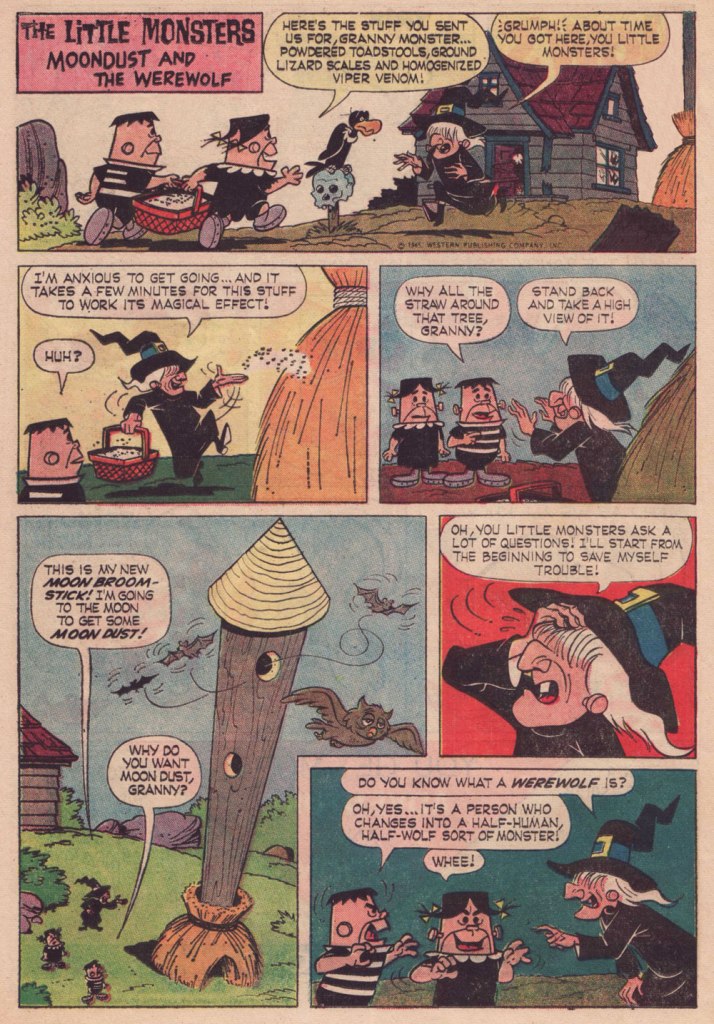
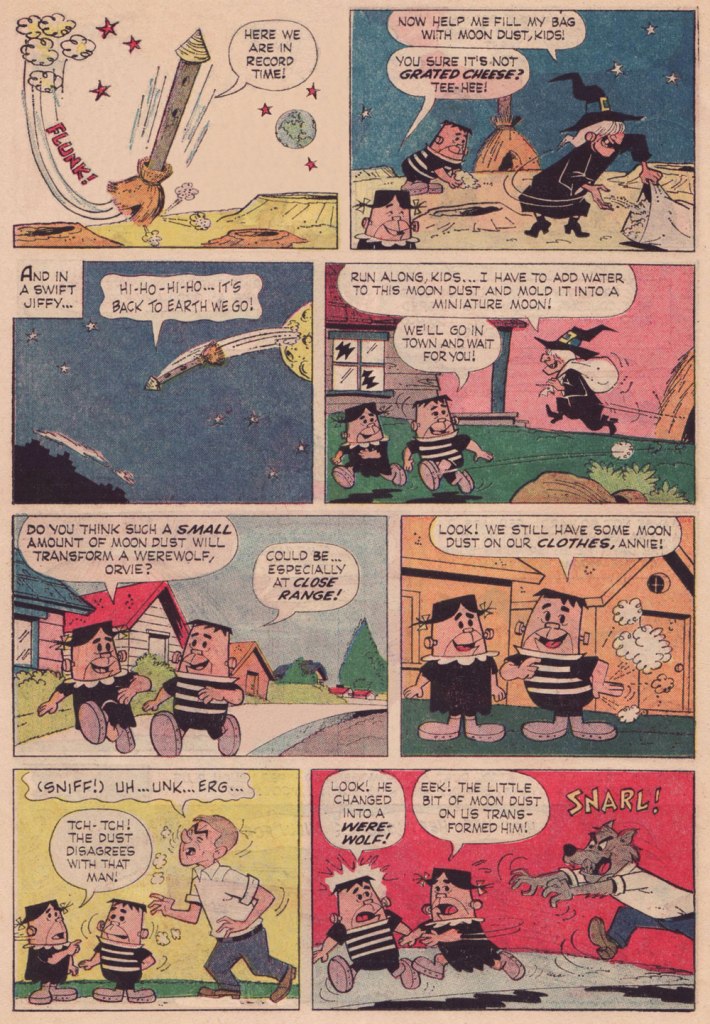
And, having mentioned it, here’s the story I had originally slated for this post: Moondust and the Werewolf from The Three Stooges no. 26 (Nov. 1965, Gold Key).
« This seems to be the Age of the Monsters. Monsters are all around us. They abound on the motion picture-screens, coming from the depths of the sea, from under the Arctic ice, from outer space, or other such unexplored regions. » — Robert Arthur, ghost-writing Alfred Hitchcock‘s introduction to Monster Museum (1965)
As Gold Key comics published fewer ads than most of their rivals, they could afford such frivolities as joke and riddle pages, even in addition to the legally mandated text pages.
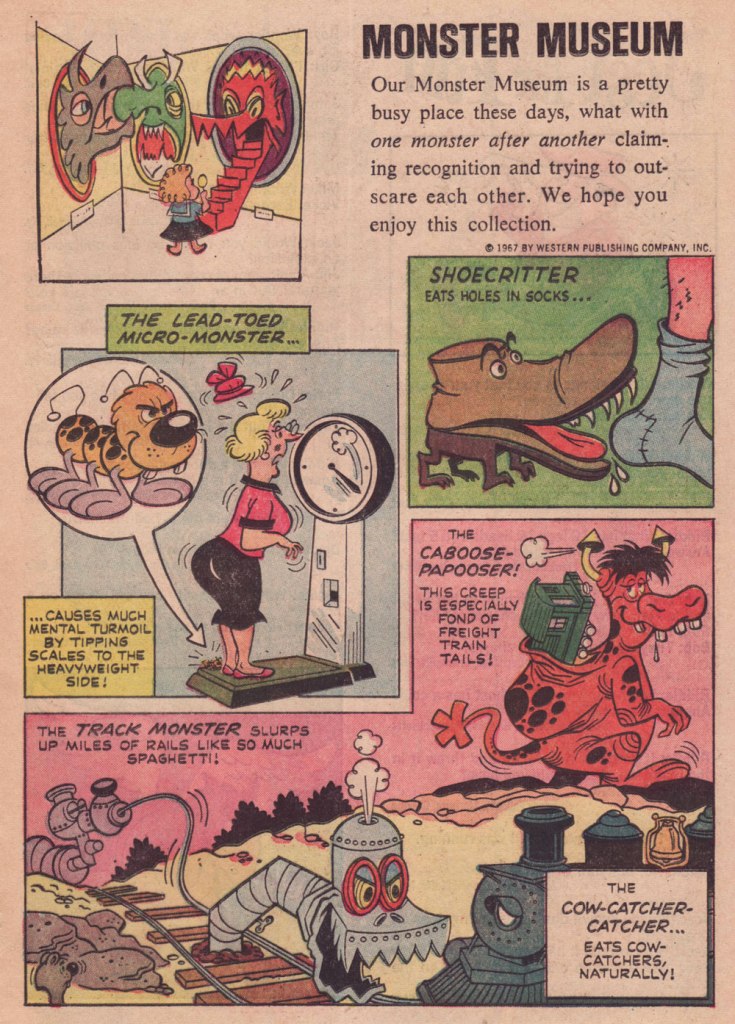
One pleasingly off-kilter feature that appeared in the publisher’s small line of ‘spooky’ titles (Boris Karloff Tales of Mystery, The Twilight Zone and Ripley’s Believe It or Not) was “Monster Museum”. Though it seemingly couldn’t settle on an approach or tone, it was witty, lightweight fun. Here are most of the highlights.
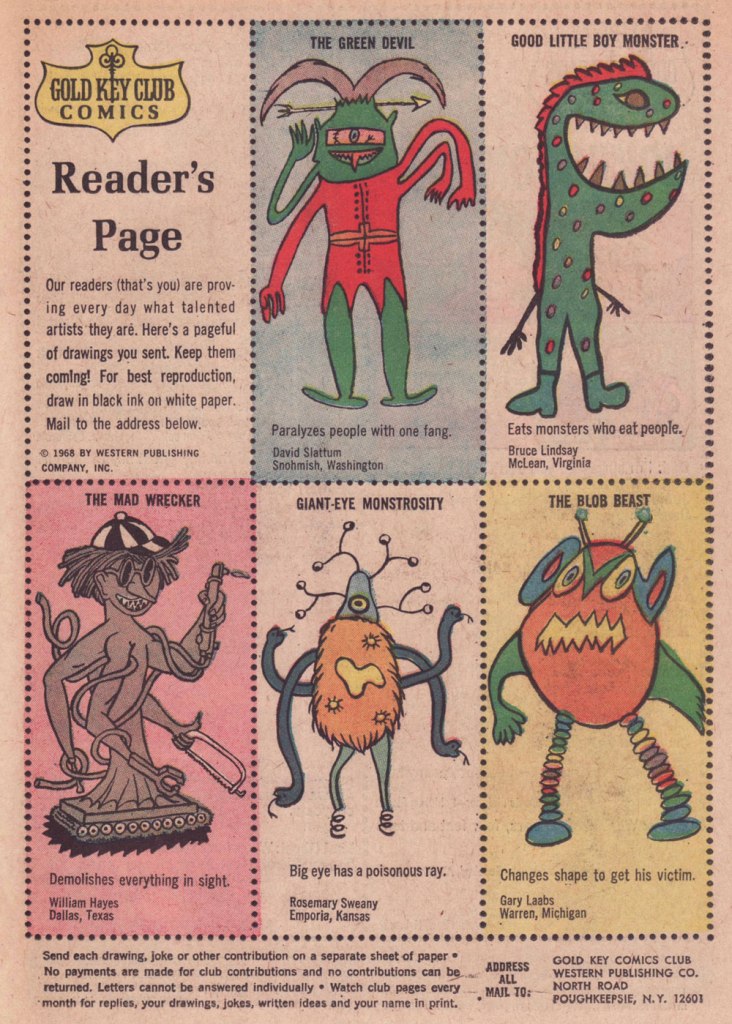
Then, as 1967 gave way to ’68, The Monster Museum became a reader-driven feature… for a single issue, namely Boris Karloff Tales of Mystery no. 22 (June 1968, Gold Key) — and two pages.
I thought it quite charming, brimming with that fascinating little-kid brand of logic we so quickly lose sight of as we ‘grow up’.
« I see a wolf-like thing coming over a dark river — at the shallows — just above a waterfall, the starlight shining up his pelt. I see a brown oak leaf blowing far up in the sky. I see a small bat flying. I see many other things, running under the forest trees and slipping through the highest branches; and they’re all coming this way! » — Ray Bradbury, The Homecoming (1946)
In the early 1960s, before Warren Magazines handled the task more decisively, there was a minor reunion of EC alumni — Joe Orlando, Reed Crandall, George Evans, Wally Wood, Williamson and Torres — at Gold Key. It resulted in some lovely art but minor, toothless stories. Even without the Comics Code, Gold Key’s material was safe as milk.
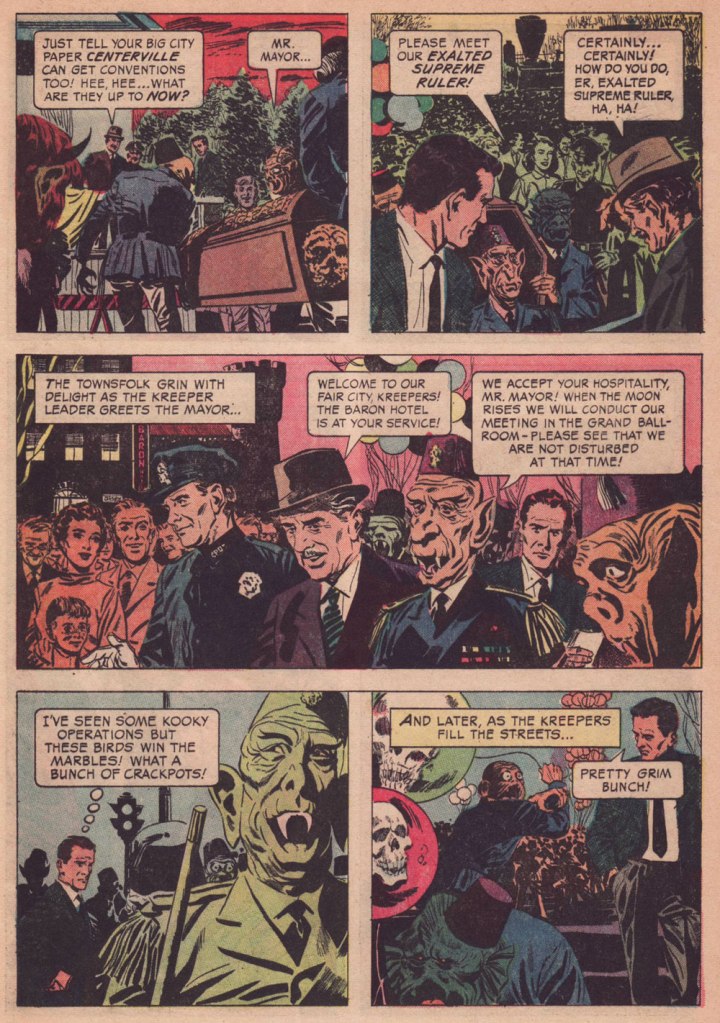
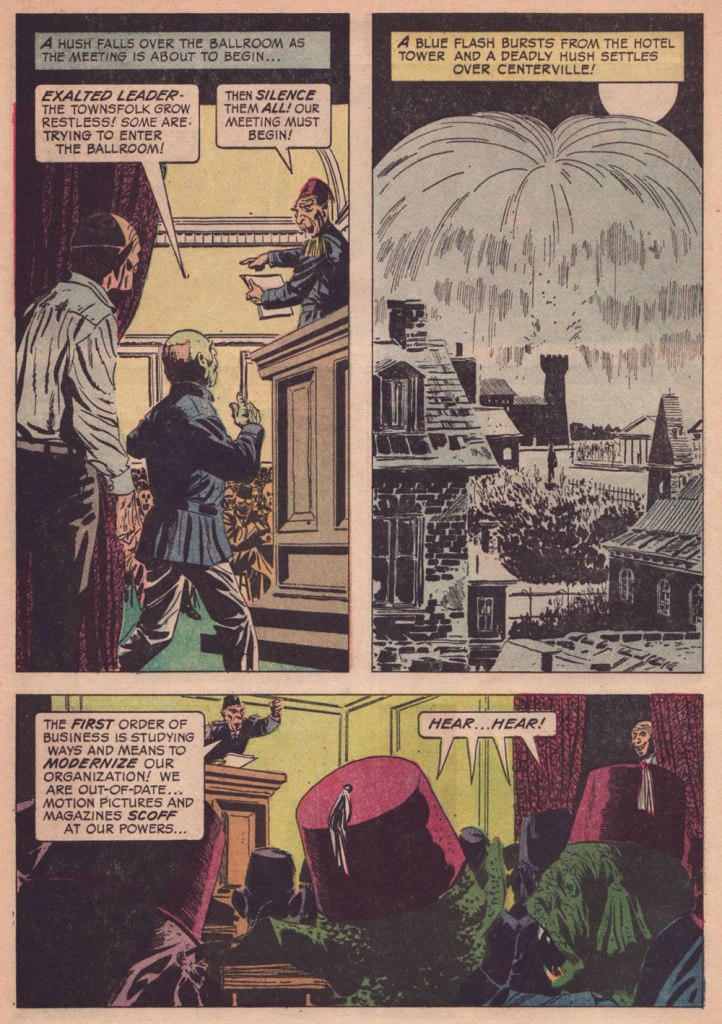
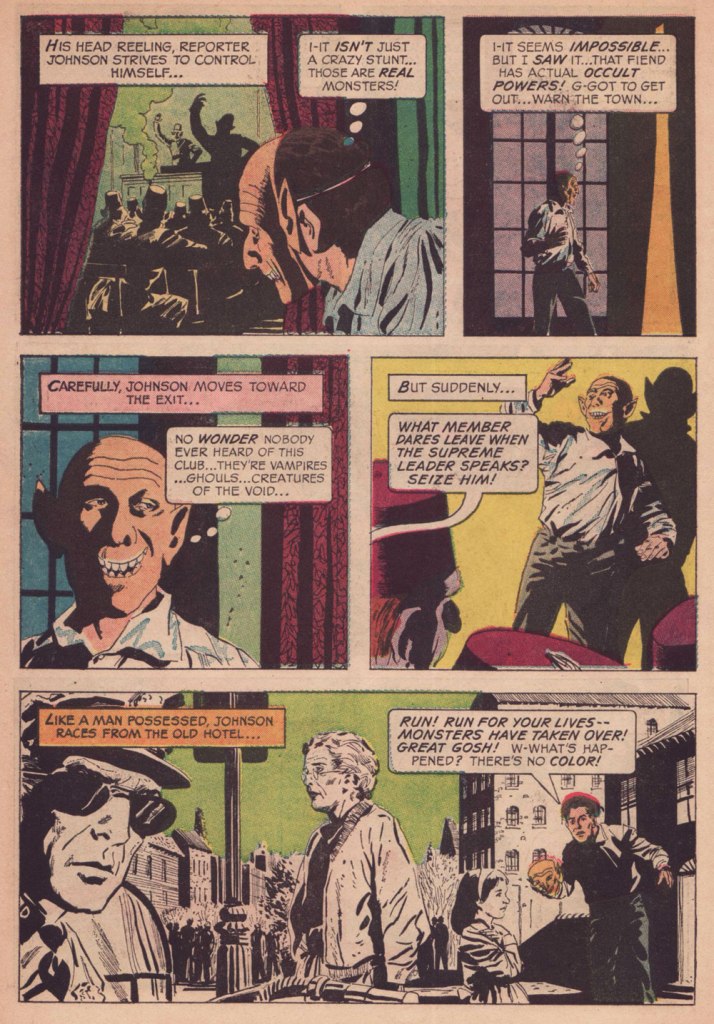
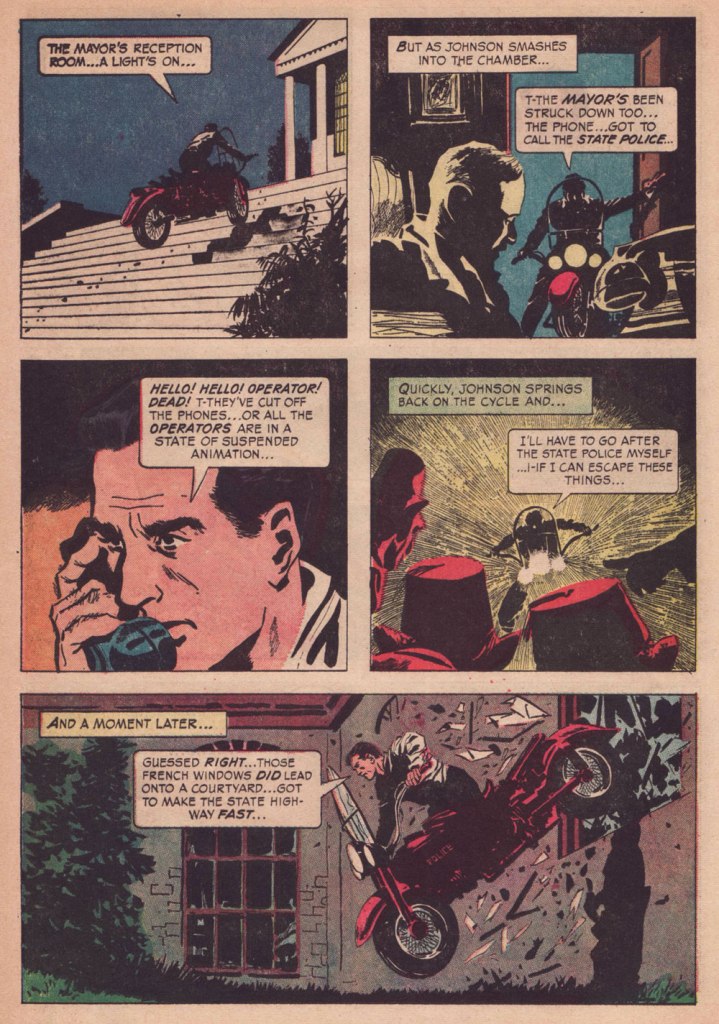
Here’s my favourite of the lot, a tale published in Boris Karloff Tales of Mystery no. 12 (Dec. 1965, Gold Key). I’ve probably tipped my hand with my choice of quote: “The Convention” reminds me of Mr. Bradbury’s timeless The Homecoming [ read it here ].
I like the point the story makes about how most towns — particularly their elected officials — will put up with a lot of obnoxiousness and outright toxicity if it fills up the hotels, bars, restaurants… and whorehouses.Really, a burning cross to vanquish evil… in 1965, given the headlines of the day? By the way, Angelo, that’s not a good Karloff.
Typically for Gold Key comics of that period, no credits are provided, but I’m strongly inclined to attribute authorship to Dave Wood (1926-1974), who happened to work for both Gold Key and DC at the time. It’s his kind of plot. Furthermore, as we’ve learned from the case of Steve Skeates, Julius Schwartz and The Spectre, there are instances when editorial changes to your original plot are significant enough that you can sell it again to someone else… and mum’s the woid.
What am I getting at? Why, our bonus, a cover-featured Dave Wood gem from the following year and with a quite familiar theme.
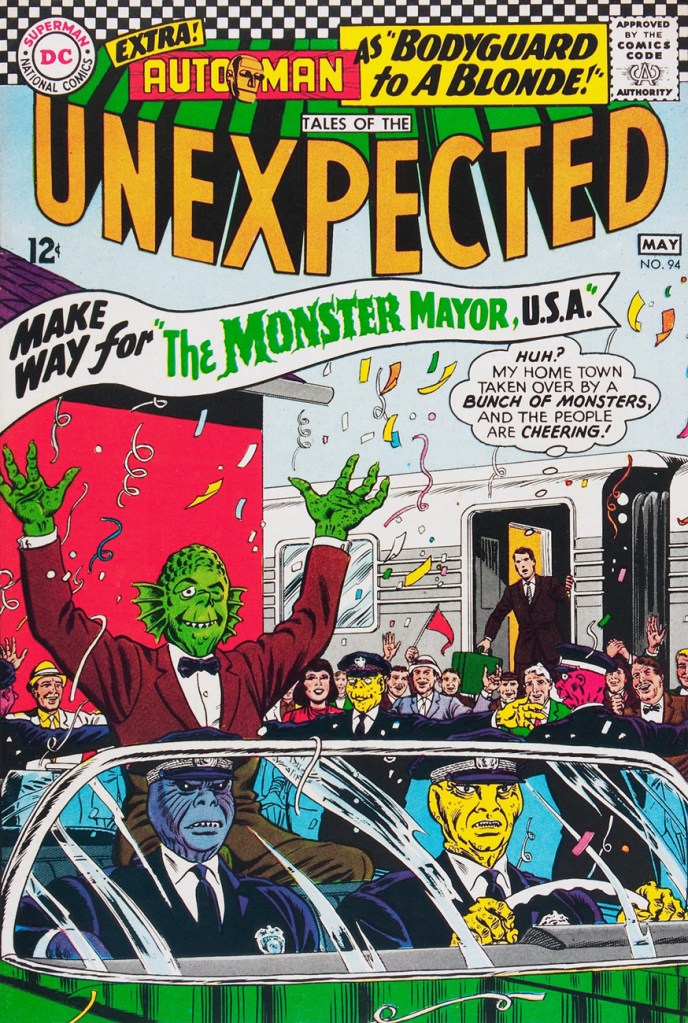
« Our appearance makes little difference… so long as we are in power! » Evidently, political cynicism is nothing new. DC’s Jack Schiff-edited “mystery” titles were a lot of utter bushwah, but oddly mesmerising if one surrendered to the spirit of the thing. And to a Bernard Baily and Mort Meskin fan, they offered a pretty sweet cornucopia. “The Monster Mayor, U.S.A.” is one of a series of oddball situations triggered by an invisible (but green!) sentient cloud from outer space called “The Green Glob“. The sort-of series ran in TOTU 85 to 98, then 100, 102 and 103. Weirdies!
This is Tales of the Unexpected 94 (April-May, 1966). Cover by Murphy Anderson.
-RG
*One might reasonably argue that Tatjana Wood (née Weintraub in 1926), who anonymously assisted her then-husband on some EC stories, is also eligible. She’s ninety-seven if she’s a day!
« We all have a thirst for wonder. It’s a deeply human quality. Science and religion are both bound up with it. What I’m saying is, you don’t have to make stories up, you don’t have to exaggerate. There’s wonder and awe enough in the real world. Nature’s a lot better at inventing wonders than we are. » ― Carl Sagan, Contact
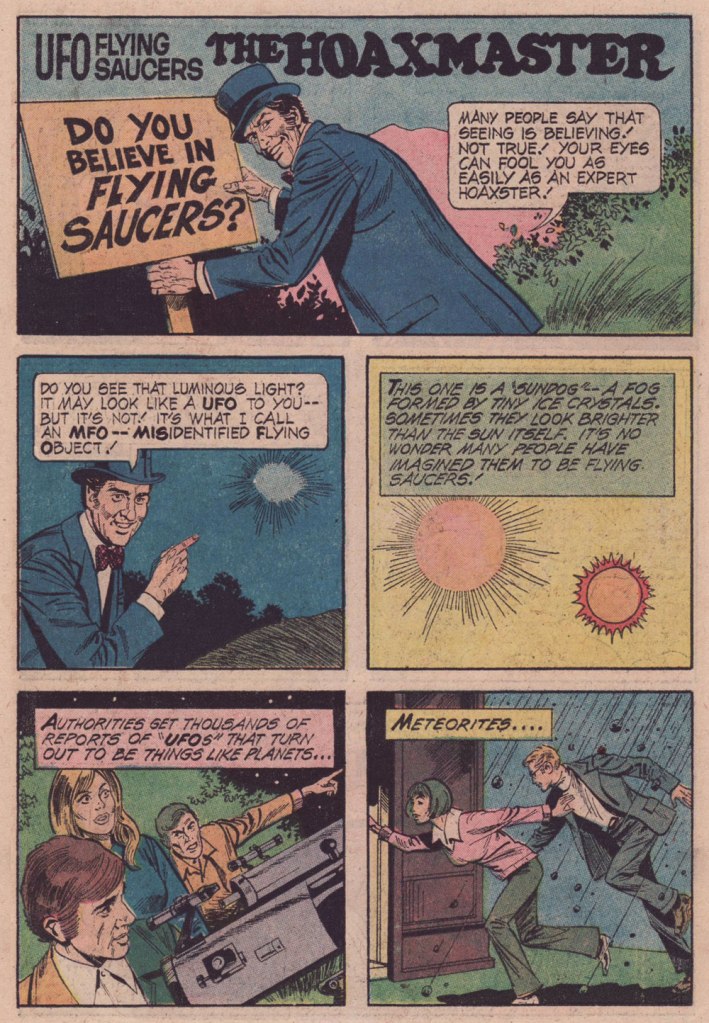
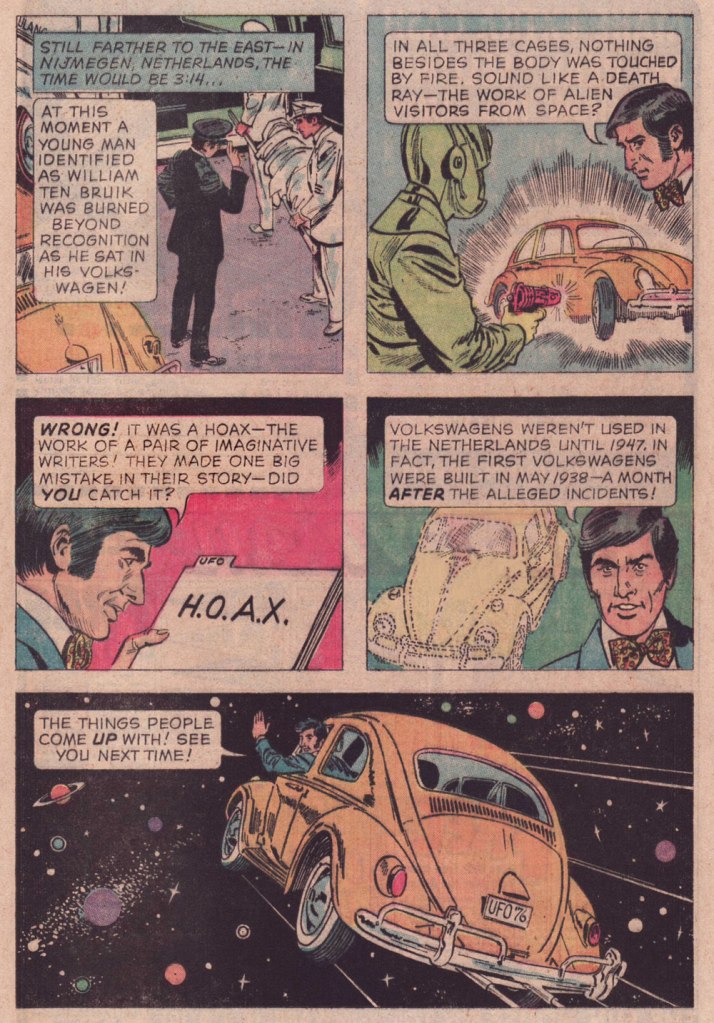
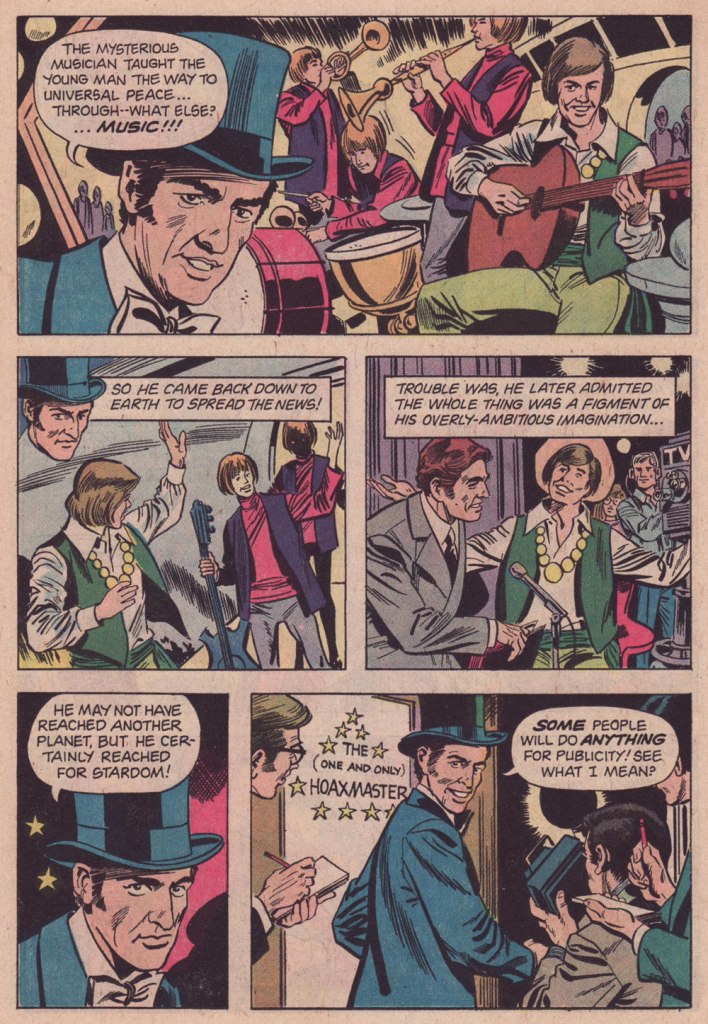
Time to keep a promise — a promise to myself, but just as worthy of being kept. A couple of years ago, I posted the first half of a favourite comics feature of mine, ‘The Hoaxmaster’, which ran in most issues of Gold Key’s UFO Flying Saucers in the 1970s. At the time, I declared that I might get around to posting the second half of the set some World Contact Day, which is today.
The bracing brand of skepticism demonstrated here by the Hoaxmaster, much needed as it was then — smack in the middle of the UFO-Spiritualism-Occultism mania of its era — is yet more urgently needed these days, as the merry-go-round of surreal disinformation spins faster and faster, further out of control with each passing day, it would seem. You may have noticed.
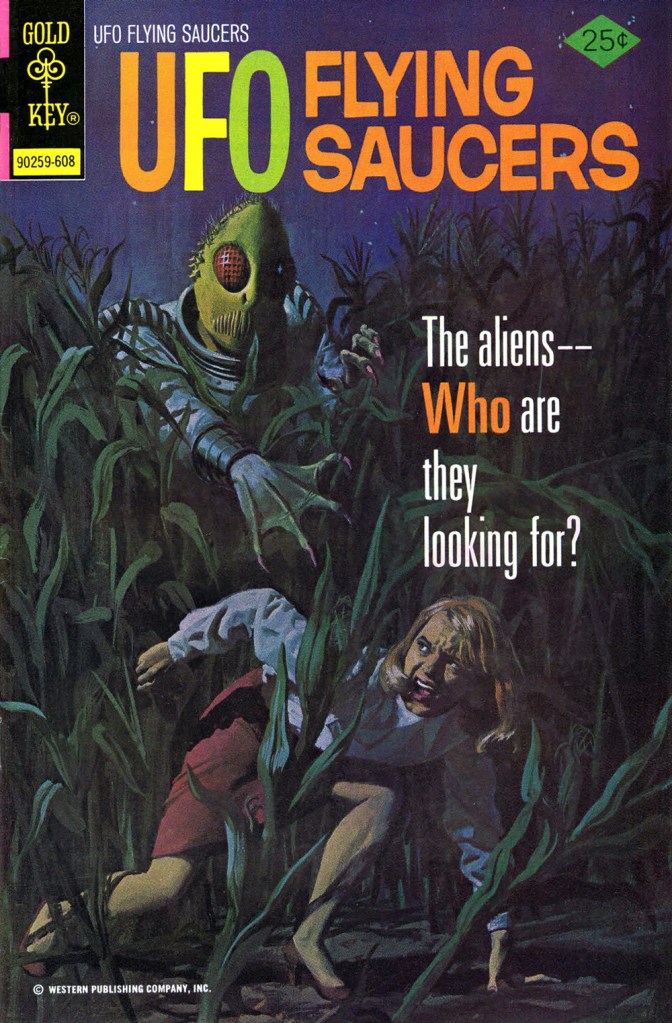
From UFO Flying Saucers no. 9 (Jan. 1976, Gold Key); as with all the Hoaxmaster vignettes, script by Pat Fortunato and artwork by Frank Bolle. From UFO Flying Saucers no. 10 (May 1976, Gold Key).From UFO Flying Saucers no. 11 (Aug. 1976, Gold Key).This was the issue in question, my introduction to the title; it bore this terrific — downright terrifying — painted cover by George Wilson.From UFO Flying Saucers no. 12 (Nov. 1976, Gold Key). Adamski!From UFO Flying Saucers no. 13 (Jan. 1977, Gold Key). Bolle was always a solid artist — which is certainly why he enjoyed such a long and busy career — but I can’t think of any, among the myriad of features he worked on, where he seemed to enjoy himself this much. His work always had a deadpan grace, but here, the wit deployed in the scripts allows him to reveal a seldom-seen facet of his talent.
Ah, the nineteen seventies… and their Satanic panic, in which we can recognize so closely the roots (or at least relatives) of today’s disinformation maelstrom, before the politicisation and weaponisation of septic paranoia and lies had become honed to such an anti-science. In a lot of sordid ways, Lawrence Pazder was an Andrew Wakefield of his day.
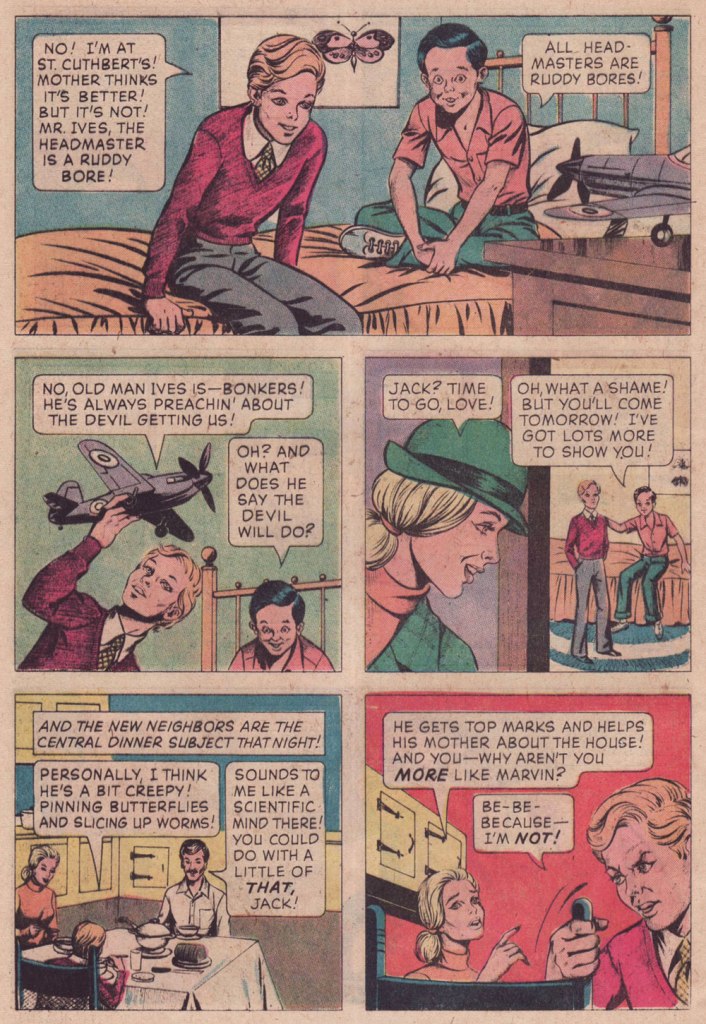
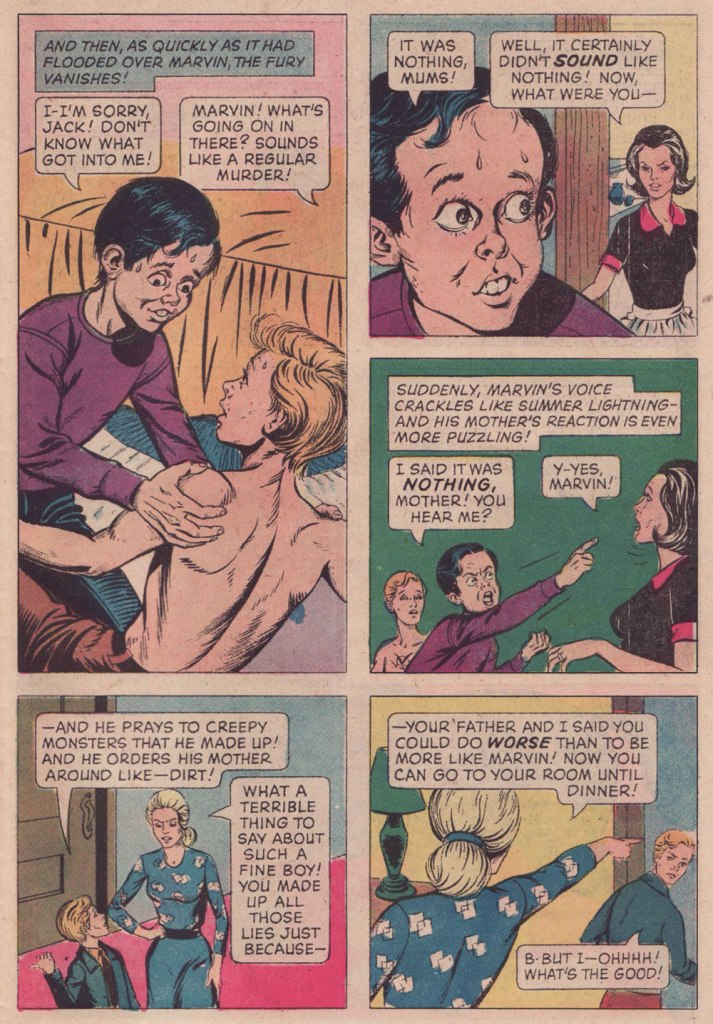
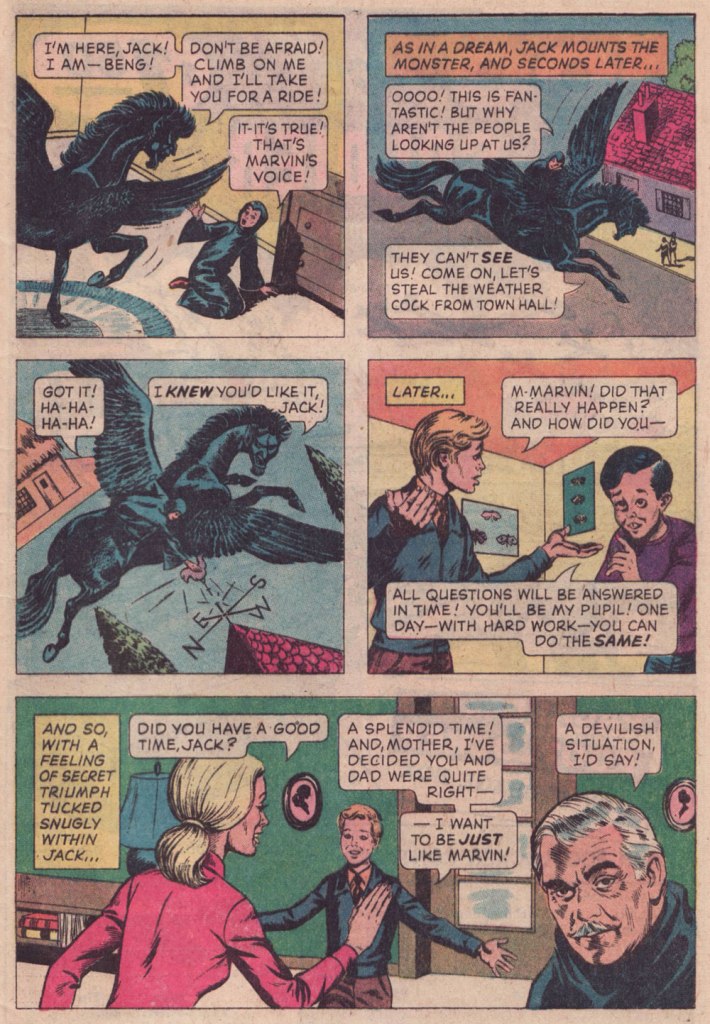
Here’s a story that I first encountered around the time of its release, remembered, but didn’t revisit until a couple of weeks ago, when a good friend (merci, Keith!) helpfully snapped up a copy for me. This deceptively dark tale was created by writer Arnold Drake (I surmise), penciller John Celardo and mysterious inker Wanda Ippolito, who may have a been a spouse or relative of Celardo’s. It’s odd to find someone else inking Celardo, as this was his chief, most enduring and distinctive strength. For comparison’s sake — and presumably, reading enjoyment — here’s another Drake-Celardo outing, The Anti-13!
I won’t make any claims that this is great art: by this time, Gold Key’s printing was shoddy, they barely bothered with the colouring (straight Magenta and Cyan and Yellow everywhere — how lazy can you get?)… but I treasure this one because of the story. Given its moral — what moral? — it’s hard to imagine The Comics Code Authority giving this one a pass, as it merrily violates several of its key precepts. I’ve got another such blasphemous entry in the pipeline… this one duly Code-Approved! Just you wait…
I had a childhood friend who was a lot like Marvin (minus the devil worship — for all I know)… he was incredibly talented, but also scarily unpredictable, and not in a good way. One day, he just disappeared.
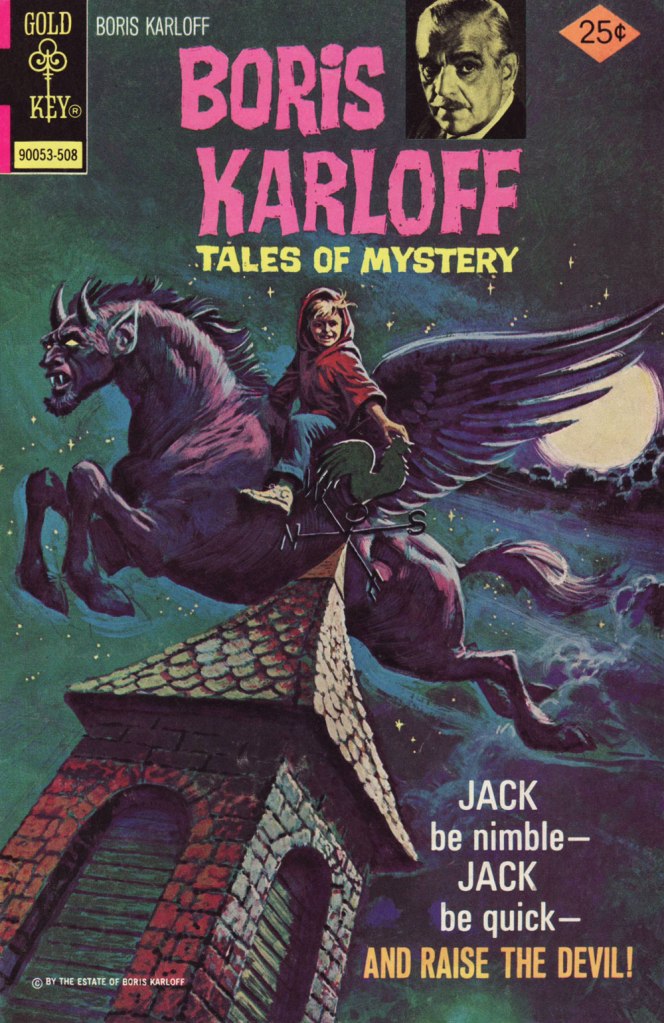
On the other hand, the accompanying cover is spectacular.
« Why Can’t You Be More Like Marvin? » originally appeared in Boris Karloff Tales of Mystery no. 63 (Aug. 1975, Gold Key), which bore this masterfully disquieting cover by Luis Domínguez. It would have made it into my Domínguez retrospective, Luis Domínguez (1923-2020): A Farewell in Twelve Covers but for the fact that I didn’t own a decent copy of the issue.
And as (nearly) always, a bonus for context: Celardo had a long and fruitful career, and I’m sure one of its highlights was to number among Fiction House’s elite cadre of cover artists. I’ve said it before, but despite their mind-numbing repetitiveness, FH covers were tops in the Golden Age in terms of draftsmanship and production values.
Aw, poor Ka’a’nga — always left at home to feed the jackals while Ann Mason goes off on escapades with her other boyfriends. And who insisted on adopting them in the first place? Ann, that’s who! This is Jungle Comics no. 98 (Feb. 1948, Fiction House). Judging from his ability in the jungle antics genre, it’s no wonder that Celardo was picked to illustrate the real thing (at least comics-wise): the Tarzan comic strip, from 1954 to 1968, between Bob Lubbers (another FH cover artiste!) and Russ Manning. And here’s one of Celardo’s Tarzan Sundays (March 27, 1954, United Feature Syndicate).
« I was already doing a lot of splendid research reading all the books about ghosts I could get hold of, and particularly true ghost stories – so much so that it became necessary for me to read a chapter of Little Women every night before I turned out the light – and at the same time I was collecting pictures of houses, particularly odd houses, to see what I could find to make into a suitable haunted house. » — Shirley Jackson
This one’s from the department of historiated text. What text? “those fiction pieces that nobody read” in comic books, prose pages mandated by the United States Postal Service. The USPS insisted that comic books «… have at least two pages of text to be considered a magazine and qualify for the cheaper magazine postage rates. »
By the Sixties, most of these pages consisted of letters to the editor, but not every company followed this practice. After EC pioneered the letters page idea in the early 1950s, ACG, DC, Archie and Marvel followed suit. But not Dell/Gold Key, Harvey and Charlton.
For its mystery titles, Gold Key naturally opted for a ‘unusual history’ format, enlisting, to provide spot illustrations, veteran cartoonist Joe Certa, best known for his co-creation of and long run (1955-1968!) on J’onn J’onzz, the Martian Manhunter and his stylish run on Gold Key’s Dark Shadows comic book series (1969-76). While Certa started out with a pretty mainstream approach, as the Sixties wore on, his style got increasingly angular, spare and expressive. Personally, I love it… but I know it’s not for all palates.
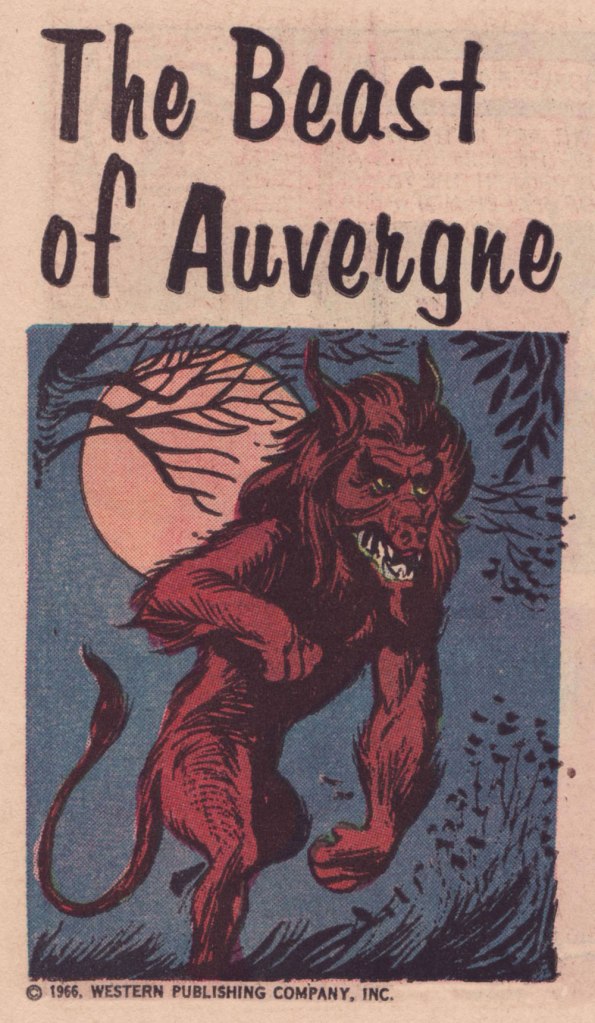
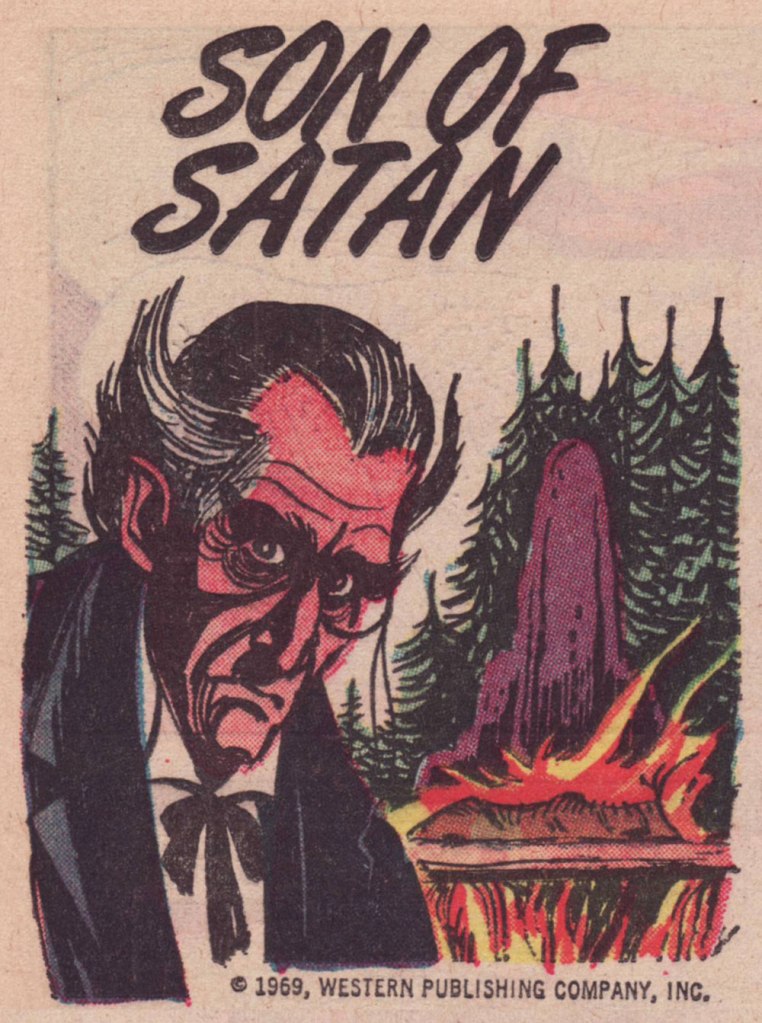
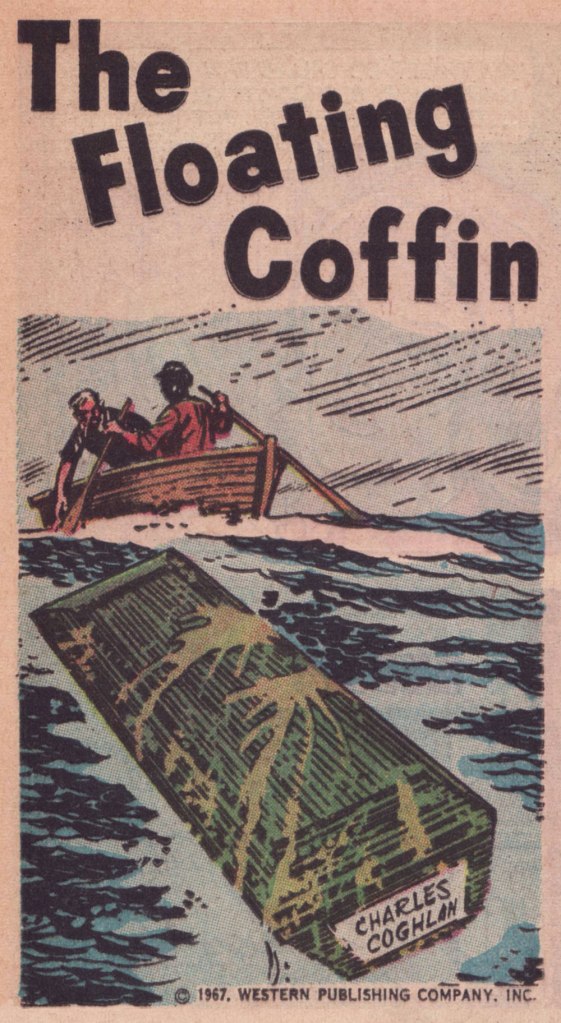
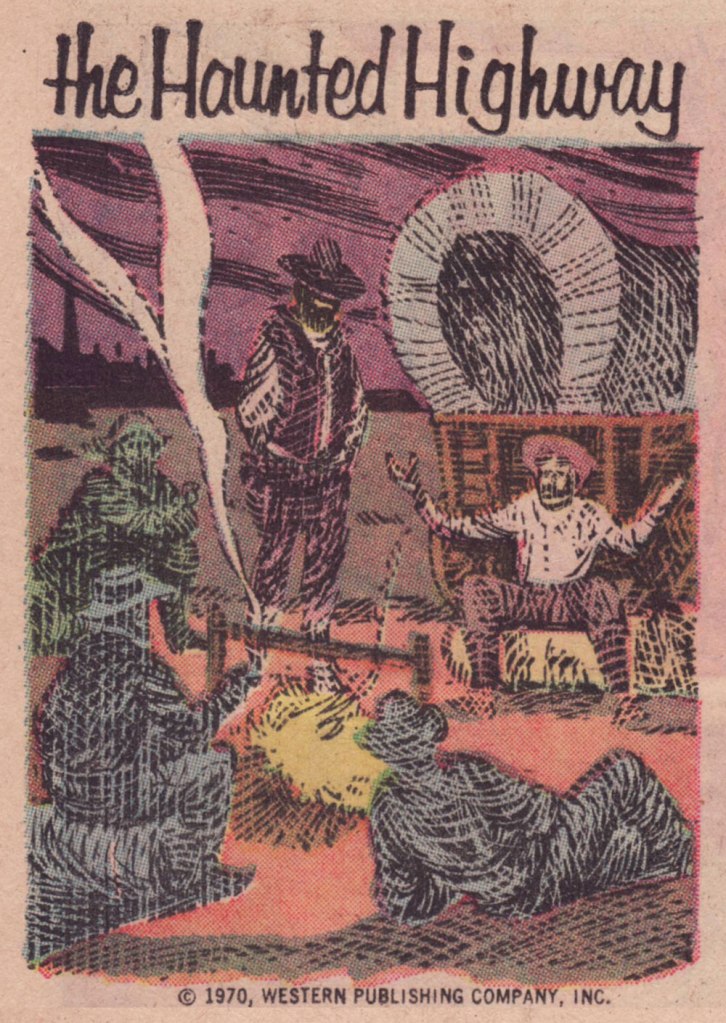
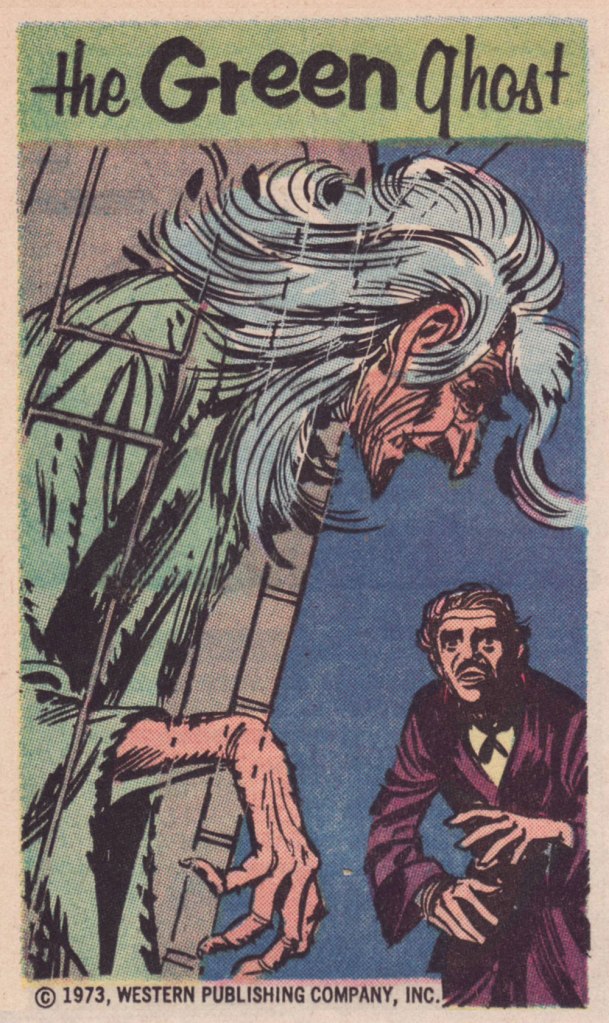
This one appeared in Boris Karloff Tales of Mystery no. 17 (Mar. 1967, Western); « It was more than two centuries ago when the monstrous creature known simply as ‘the Beast’ appeared in the province of Auvergne, in France. » Perhaps you’ve seen the action-packed, *slightly* fictionalised cinematic account of the events, 2001’s Le pacte des loups, aka Brotherhood of the Wolves.This one’s from Boris Karloff Tales of Mystery no. 28 (Dec. 1969, Western); « When Gustave Labahn appeared in Munich, Germany in 1890, he was indeed a man of mystery. Nothing was known of his except that he was tall, lithe and powerful, with strangely hypnotic eyes, and a possessor of unlimited wealth. »This one, from Boris Karloff Tales of Mystery no. 28 (Dec. 1969, Western) states: « He was a man of a hundred names and countless identities. No one knew his true origin. It was said he was descended from an evil medieval warlock. Others said he was a reincarnation of the Count de St-Germain… a man who claimed to be more than 2,000 years old. He called himself Raoul Plessy, but his followers he was known as La bête… The Beast. »Appearing in Boris Karloff Tales of Mystery no. 50 (Oct. 1973, Western), this one concerns the 1793 murder of French revolution leader Jean-Paul Marat by Charlotte Corday. Exceptionally, the art on this one is the work of John Celardo, a lovely, delicate composition.One from Grimm’s Ghost Stories no. 5 (Aug. 1972, Western). The cat’s name is Satan, we are told.From Ripley’s Believe It or Not! no. 8 (Feb. 1968, Western), this piece tells the story of a coffin that found its way home to one of my favourite places, Canada’s Prince Edward Island. Here’s a more sober account of the legend.From Ripley’s Believe It or Not! no. 15 (Feb. 1968, Western), this one concerns the purported haunting of Scotland’s Meggernie Castle.A cozy one from Ripley’s Believe It or Not! no. 21 (Aug. 1970, Western): « In the northeastern corner of Mississippi, near the town of Aberdeen, lies a stretch of deserted country road which has lately become known as one of the most haunted spots in the United States. »A great drawing from Ripley’s Believe It or Not! no. 41 (July 1973, Western); The text opens with « Ash Manor House in Sussex, England, was over six hundred years old when bought in 1934 by a man named Keel. Mr. Keel did not believe in ghosts. Neither did his attractive wife. »This hails from Ripley’s Believe It or Not! no. 42 (Aug. 1973, Western). The piece recounts anecdotes about such thespians as Burl Ives, Jackie Gleason, Rudolph Valentino and our beloved Vincent Price.And here are a couple of samples of full pieces to give you an idea of how they looked in print. This thoroughly seasonal one saw print in Grimm’s Ghost Stories no. 6 (Nov. 1972, Western).
One more? Here’s a favourite from The Twilight Zone no. 42 (Mar. 1972, Western):
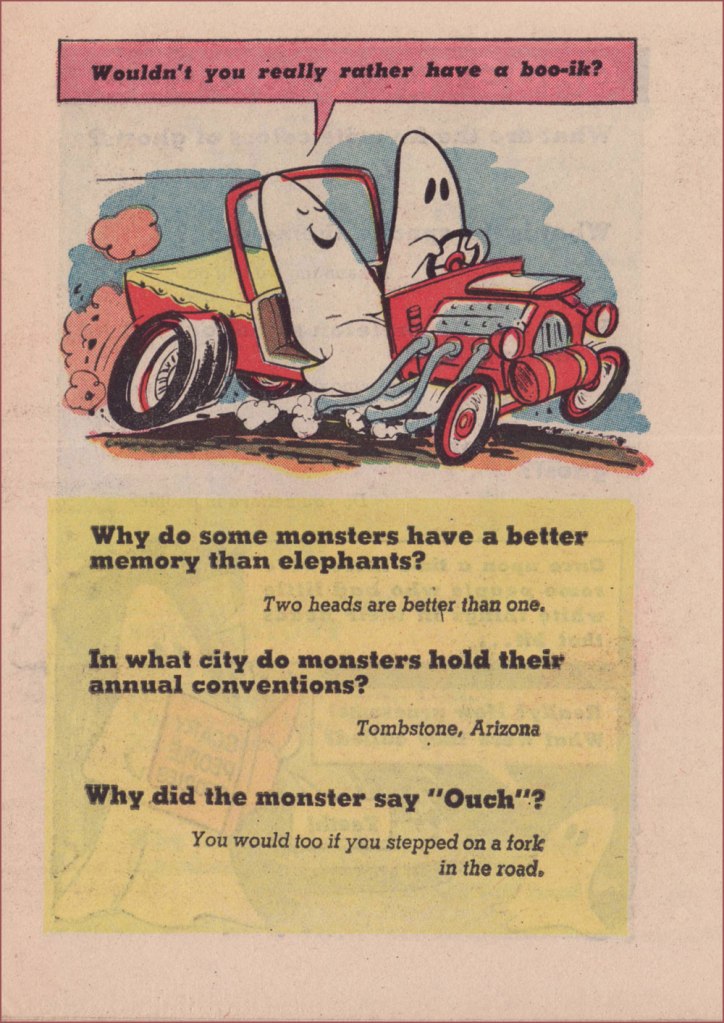
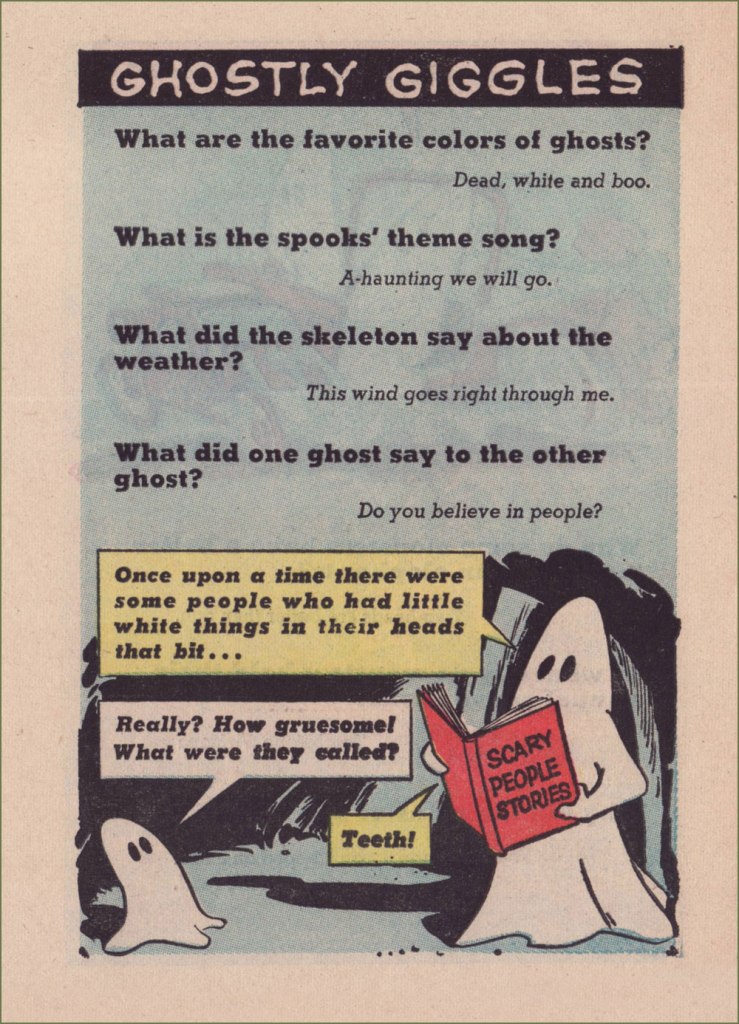
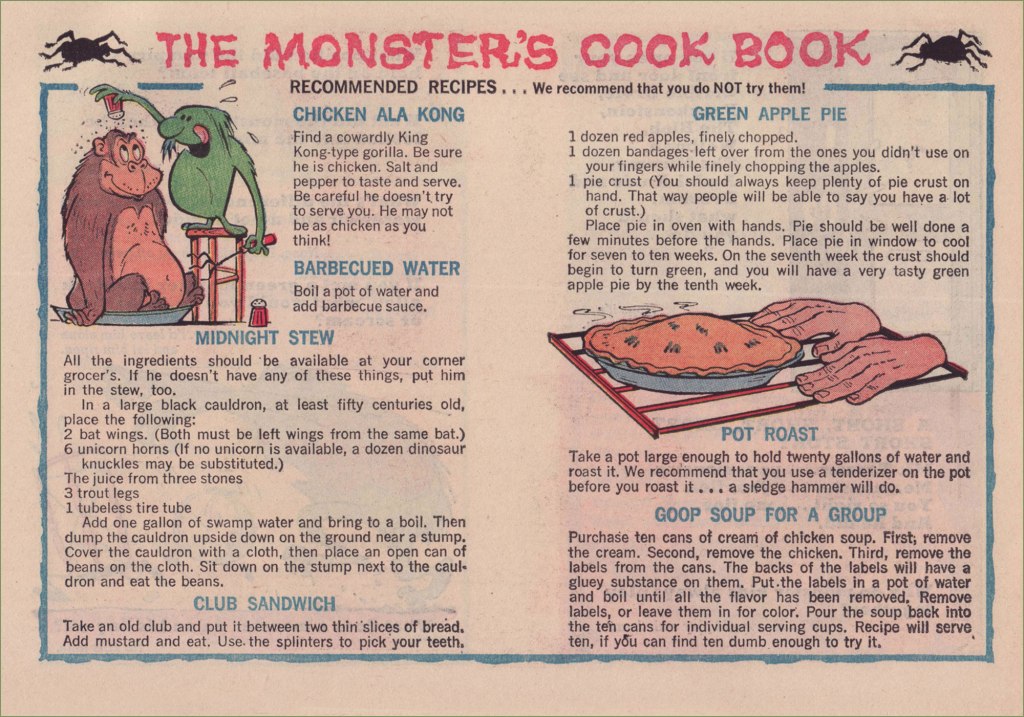
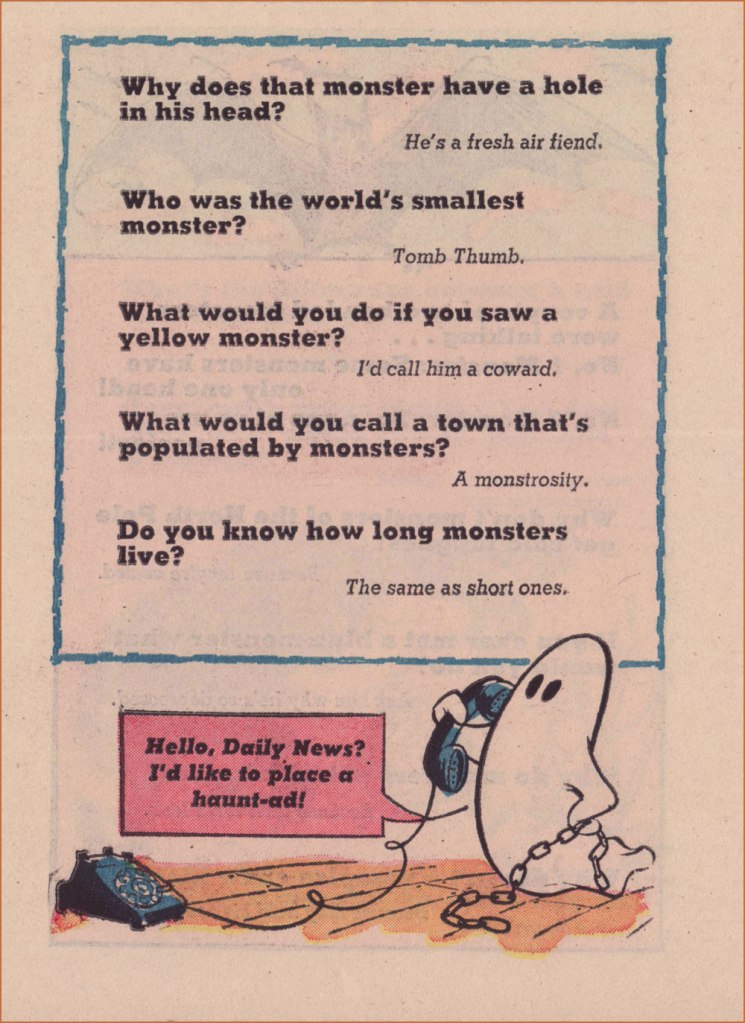
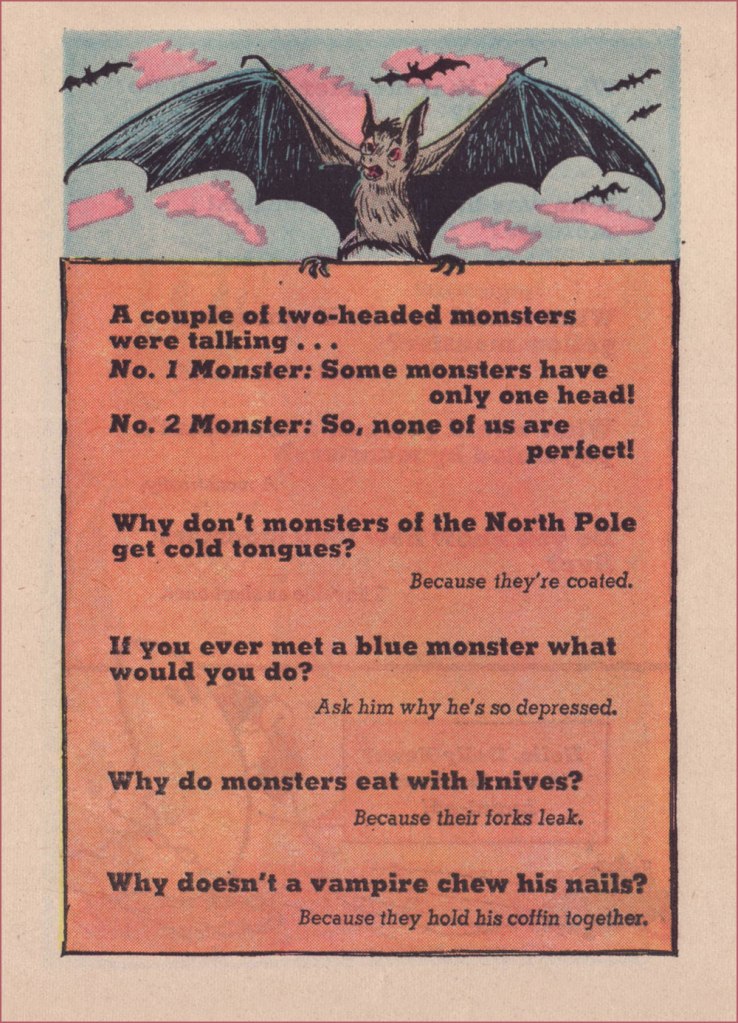
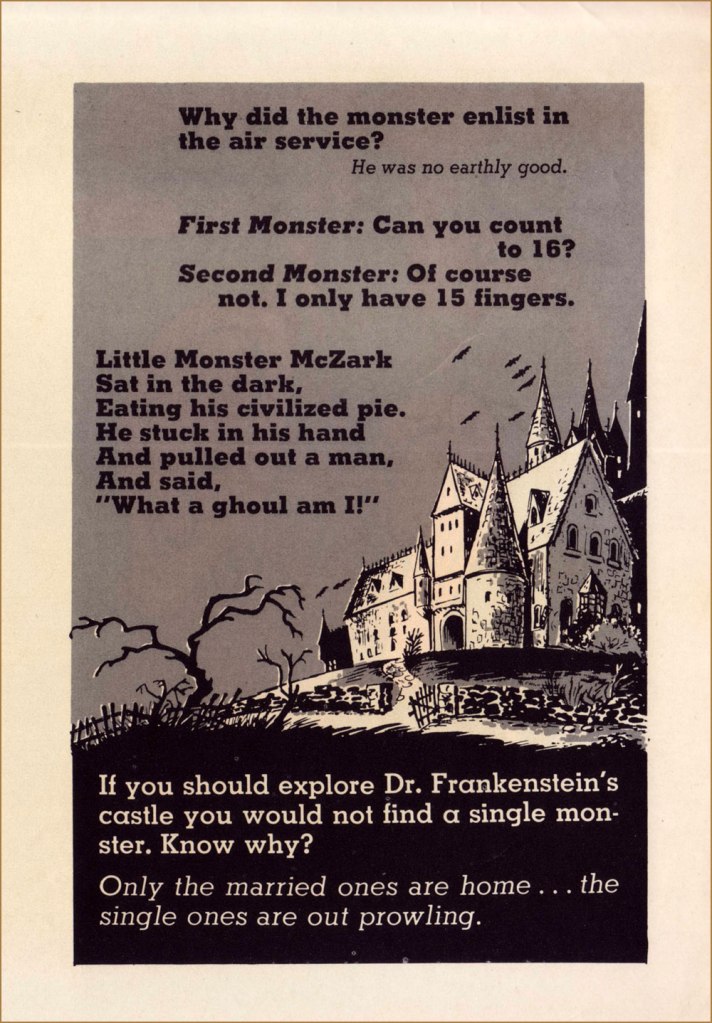
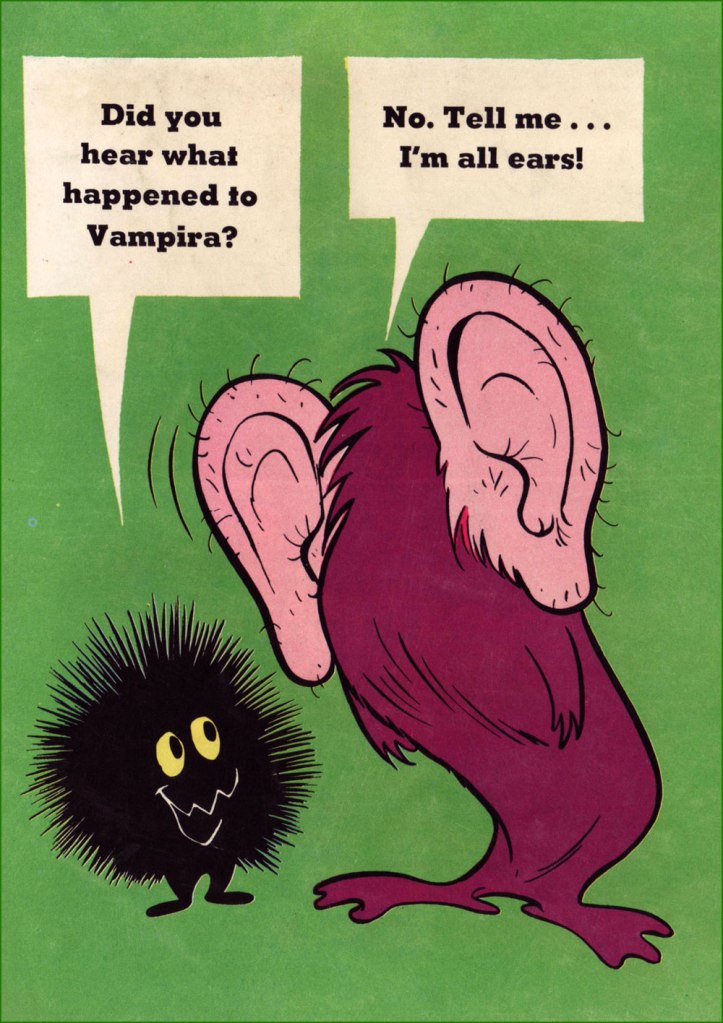
I’ve always had a soft spot for Gold Key’s The Little Monsters, who dwell within a cleverly designed and unaccountably comforting, topsy-turvy world; we’ve featured them back in the third edition of this countdown. This entry, however, isn’t strictly a return visit: I’ll be focussing on the back pages of ‘Orrible Orvie and Awful Annie’s antics. Last year, I picked up an issue I’d been missing, and was delighted with a surprise section, which I’ll happily share with our readers.
This is The Little Monsters no. 5 (July, 1966, Gold Key). Cover artist unknown, sigh.
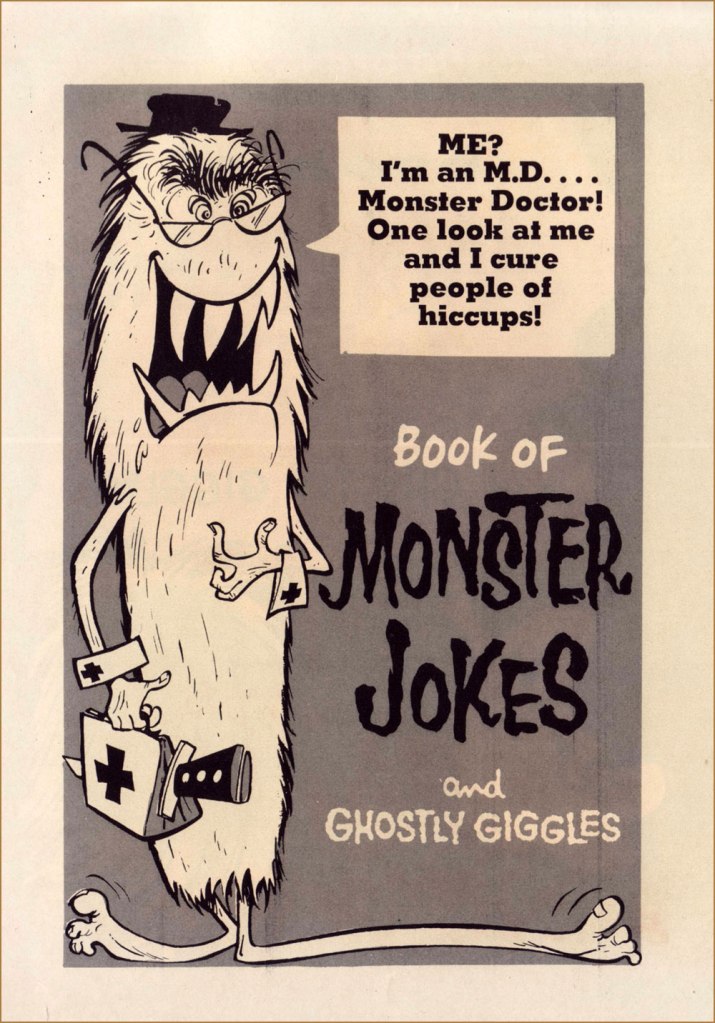
What do you say we take a peek at that Extra Bonus Book of Monster Jokes?
Another uncredited, unacknowledged and unknown artist. Why, thank you, Gold Key!
… and there you have it, and you didn’t even have to destroy a comic book (preferably someone else’s) to assemble it. The jokes are corny — what did you expect? — but I can’t help but find the whole thing quite adorable. Sometimes that’s precisely what one needs.
As a bonus, here I am holding the piece of Little Monsters original art (Page 2 from issue no. 12’s ‘Stormy Weather‘) I was fortunate enough to get my mitts on. Back in the day, comic book artists worked *large*!
What’s that? You’re not familiar with Mr. Crawford’s name? Well, perhaps his work will ring a bell. Take a look at some of his œuvre through this fine overview by historian Ivan Kocmarek.
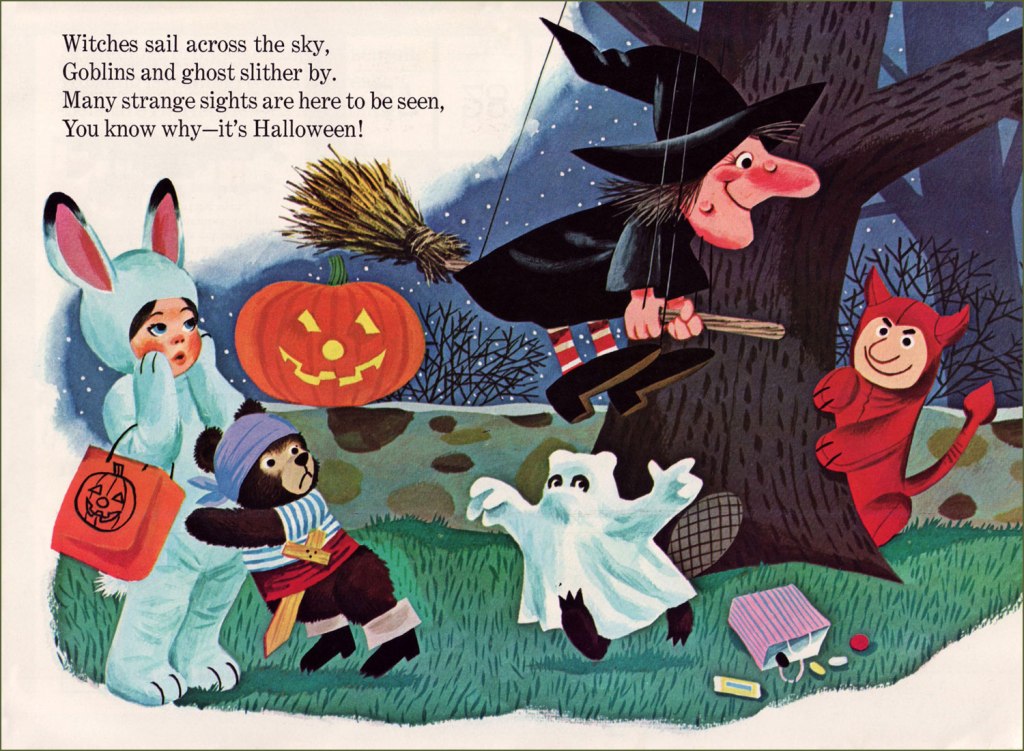
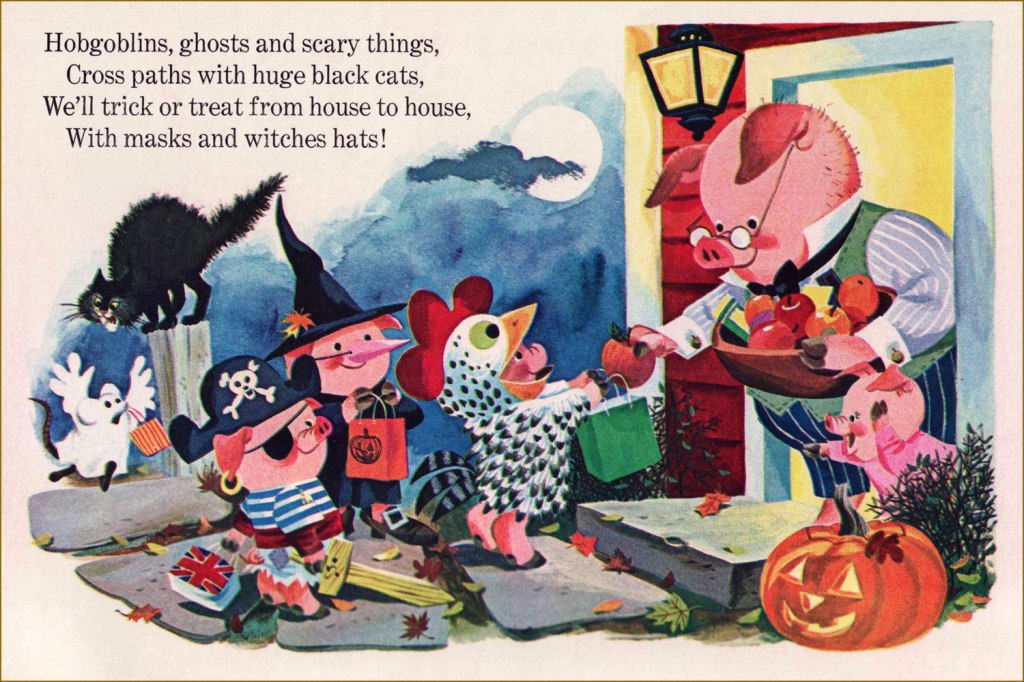
In this case, Crawford was obviously instructed to hew closely to the style of Richard Scarry (my very first artistic hero!), who’d illustrated the earliest editions of the Golden Calendar.
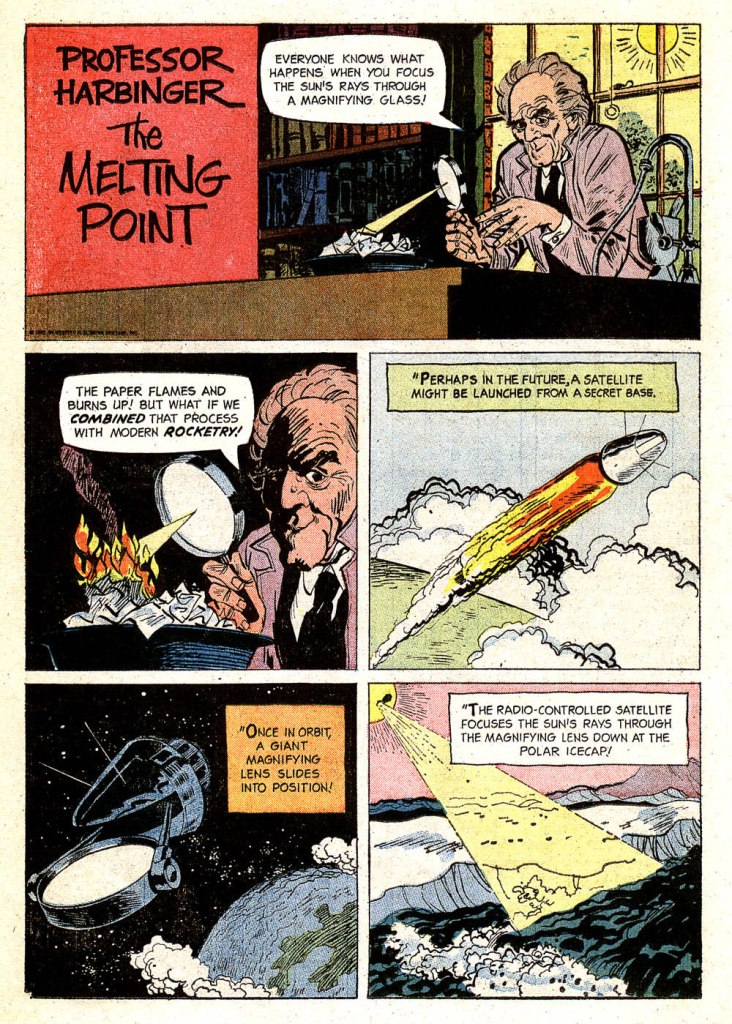
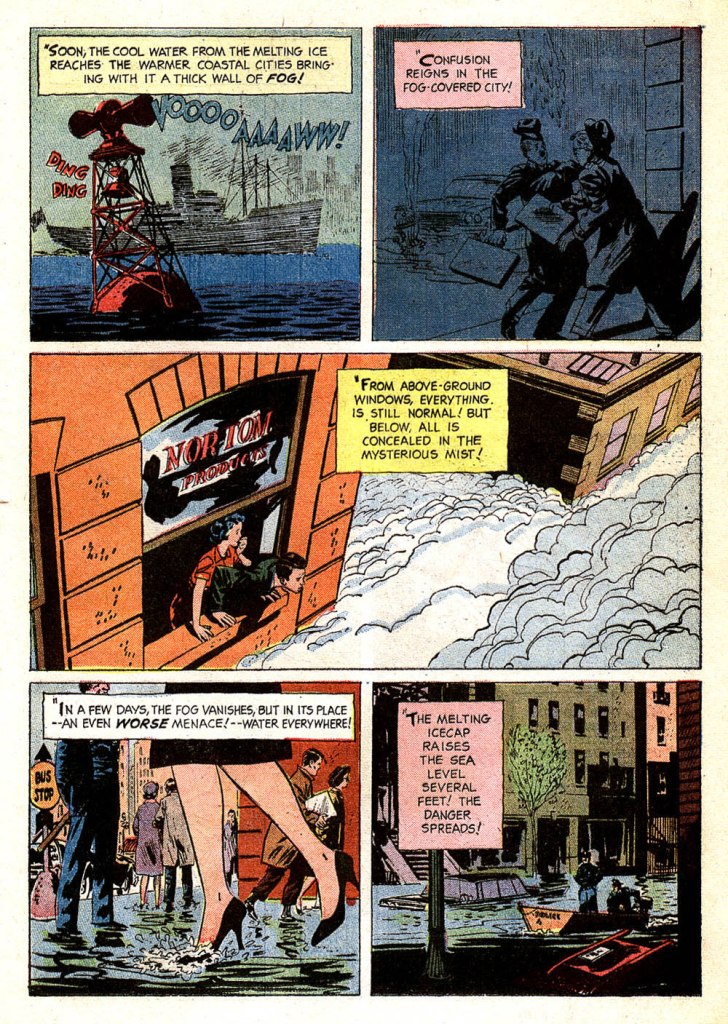
For some sense of Crawford’s range, here’s an episode of Professor Harbinger, a speculative ‘science’ backup feature that regularly appeared in Doctor Solar, Man of the Atom. This, the inaugural vignette, saw print in the magazine’s second issue (Dec. 1962, Gold Key). It was scripted by the prolific Dick Wood; Crawford must have enjoyed the feature, as he stuck around to illustrate its first dozen or so instalments. He was succeeded by fellow Ontarian Win Mortimer.
It’s what’s happening, all right, but not for the stated reason.







































 Who's Out There?