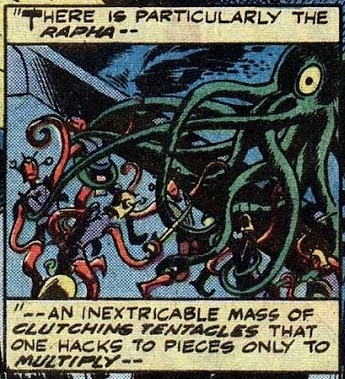
I think the most disappointing scientific discovery of recent years is that there appears to be no octopuses on the moon. Not one teensy-weensy tentacle was spotted by the lunar rovers (that we dispatched to the Moon for that very purpose, of course). But comics had led us to expect otherwise!
Mystery in Space no. 51 (May 1959), cover by Gil Kane.
The inside offers us even more tentacles:
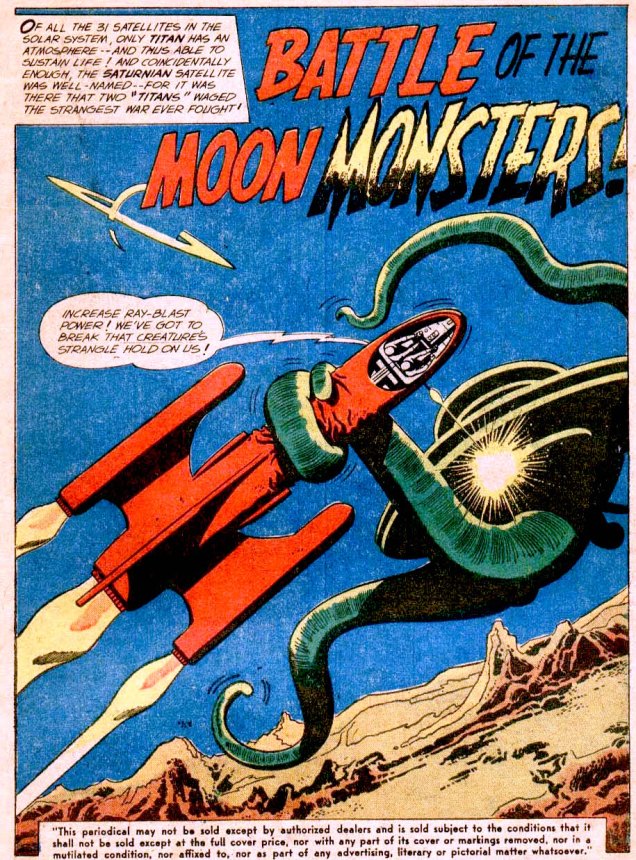
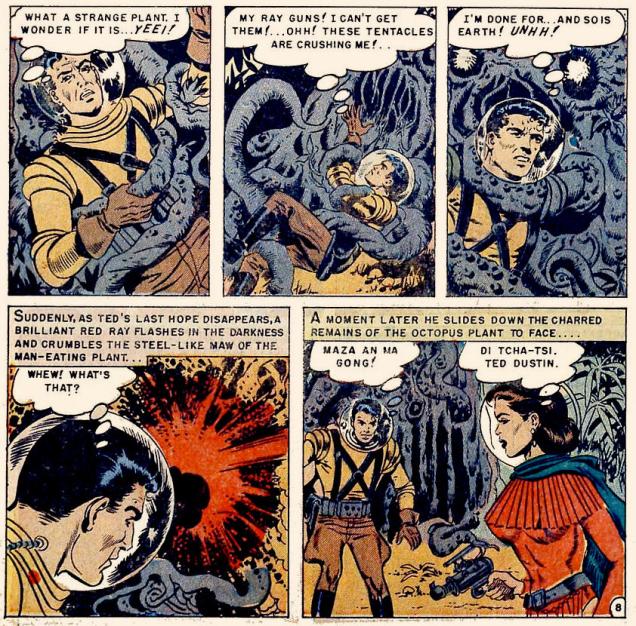
Battle of the Moon Monsters! was scripted by Gardner Fox, pencilled by Carmine Infantino and inked by Joe Giella.
In the end, our protagonists realize that the tentacled monster is actually a spaceship, and one manned by humans, at that… after which both parties have a good laugh about having almost annihilated one another. A peculiar sense of humour, those astronauts.
A bit of comic relief…
Panels from the one-pager Outer Spacewith art by Bob White, printed in Archie’s Madhouse no. 21 (September 1962)
And back to our scheduled program of lethal, tentacle-sprouting monsters that attack the moment anyone sets foot on the moon.
« Traveling at an incredible speed, the rocket reaches the moon in twenty three hours and lands in the gigantic crater… » And what is waiting for our hero, freshly stepped from his rocket? Funny you should ask… Page from Rocket to the Moon (1951 one-shot, Avon) scripted by Walter Gibson and illustrated by Joe Orlando.
Here’s a good instance of the good folks at Marvel getting quite confused. The First Men in the Moon, published in 1901, was written by H. G. Wells. From the Earth to the Moon was written in 1865 by Jules Verne. Which one is this supposed to be an adaptation of, then? I can confirm that the vaguely ant-like creatures with tentacles are H. G. Wells’ creation. His Selenites are described as following: « They are vaguely similar to quasi-humanoid ants, about five feet tall, with a light physical constitution enclosed in an exoskeleton from which slender jointed limbs and whip-like tentacles protrude. »
Marvel Classics Comics no. 31 (1978), cover by Alan Weiss.
However, the first page of this comic informs us that…
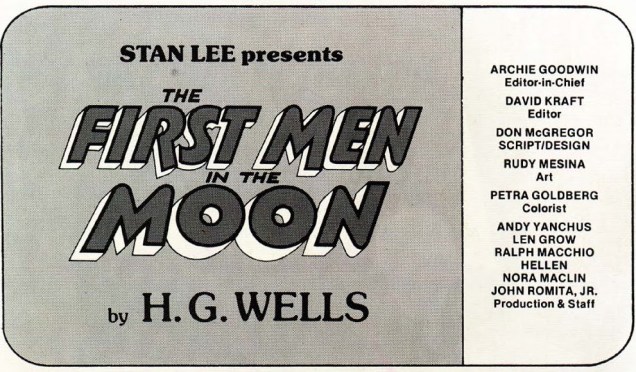
So I guess whoever laid out the cover screwed up. The insides, scripted by Don McGregor and drawn by Rudy Mesina, are considerably better drawn, and an unqualified tentacular treat.
I think the artist just wanted to draw tentacles, and this post is clearly not the place where he is likely to be judged for that little peccadillo.
Did this adaptation succeed in being faithful to and respectful of Wells’ influential novel? Well, not really, although an honest attempt was made. But I found that it focused far too much on the fight scenes, and left out quite a few complex nuances as well as skewing the philosophical underpinnings of The First Men in the Moon. That being said, if you like tentacles, I heartily recommend reading this issue. I cringe at the very idea of recommending something from the Marvel Classics line, but honestly must prevail. Really, it’s good fun. Take a look —
Did the artist go into tentacle overdrive? Oh boy, did he ever!
« A knot you are of damned bloodsuckers. » — William Shakespeare
One of my favourite Atlas mood-masters was Anthony Lewis “Tony” DiPreta (July 9, 1921 – June 2, 2010); it appears Mr. DiPreta and his colleague Murphy Anderson share not merely a birthday, but a day of birth as well.
Tony DiPreta’s long career in comics began with his arrival at the “Busy” Arnold studio, with his first credits appearing in early 1942. He worked extensively for Hillman Periodicals, handling such features as Airboy (yay!), Skinny McGinty, Flying Dutchman and Stupid Manny; Lev Gleason Publications (various crime stories and The Little Wise Guys); and of course Atlas Comics, where he chiefly, but not exclusively, cut loose on moody-but-not-gory horror stories, often with a finely-turned streak of gallows’ humour.
Tony survived the post-Code near-collapse of the comics industry when he succeeded Moe Leff on Ham Fisher‘s Joe Palooka strip, which he carried until the feature’s final curtain in 1984. In the 1970s, he also did a bit of moonlighting for Charlton, contributing to a couple of issues of The Flintstones spin-off The Great Gazoo. In 1994, DiPreta took on another venerable, long-running newspaper strip, medical soap opera Rex Morgan, M.D., until his well-earned retirement (DiPreta’s, not Morgan’s) in 2000.
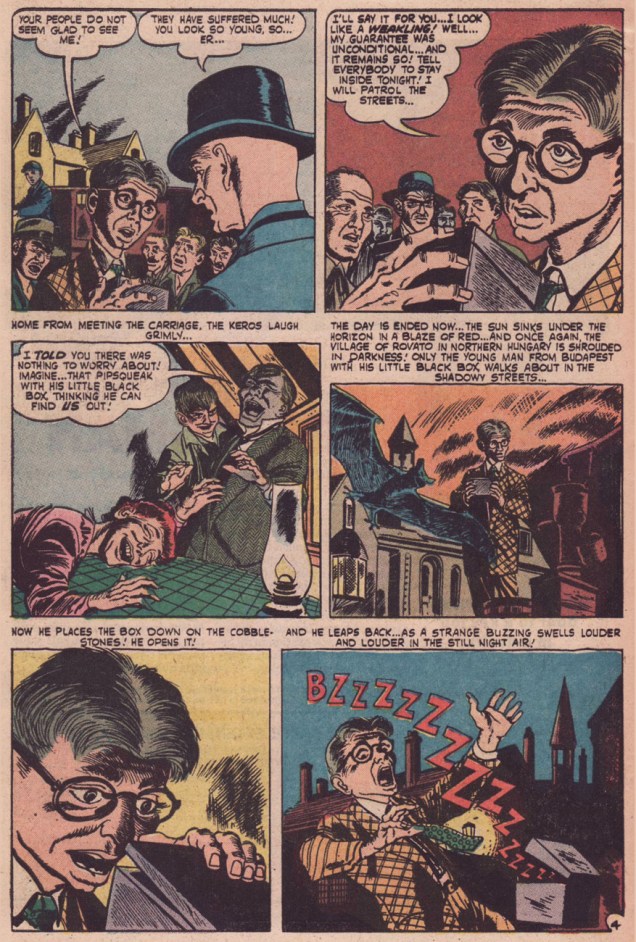
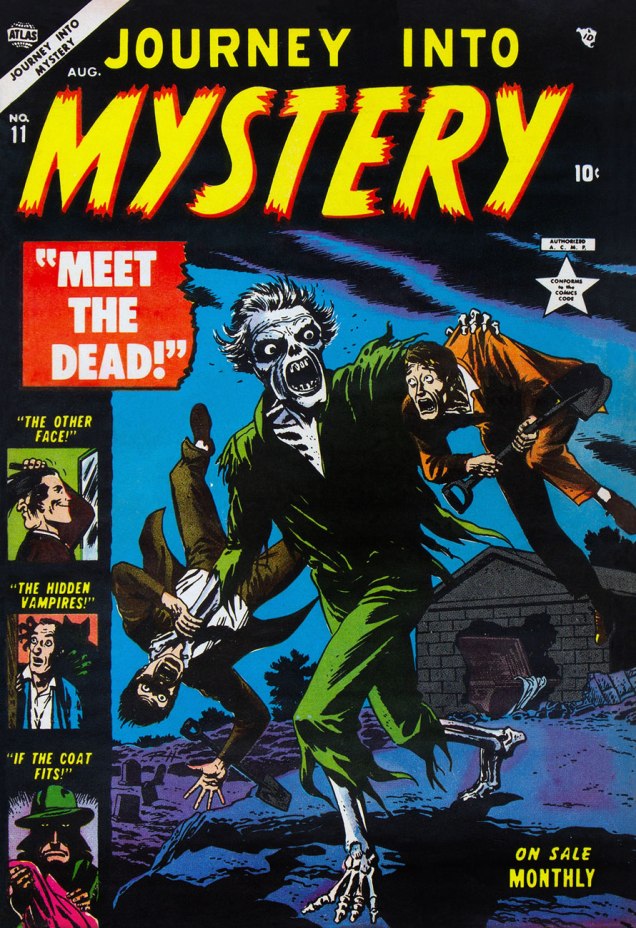
For your reading pleasure and mine, I’ve selected this adorably wacky tale from Atlas’ Journey Into Mystery no. 11 (August, 1953). Writer unknown, which is a shame.
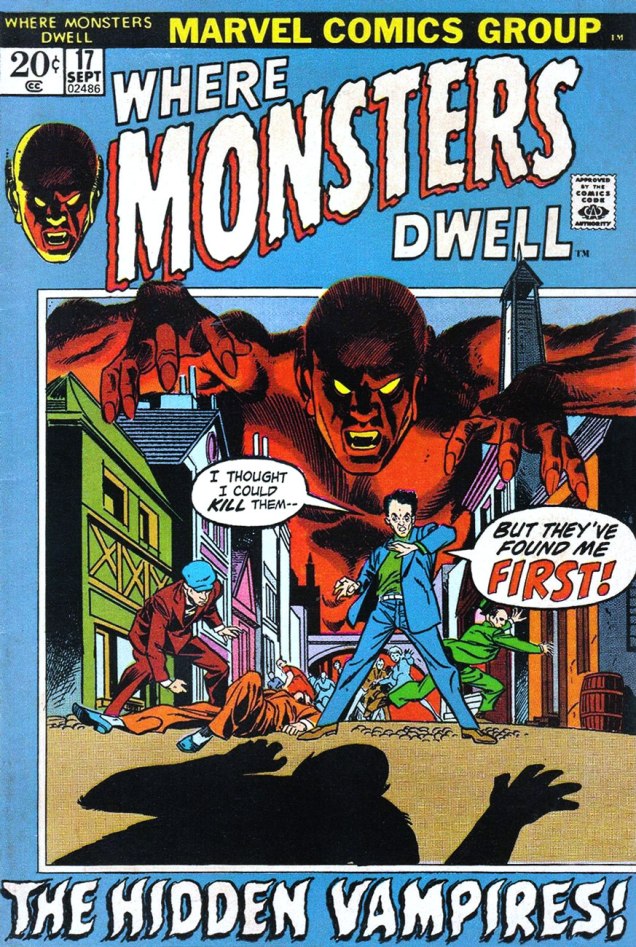
Well, I suppose it might have been simpler to see who wasn’t around in the daytime, but let’s face it, Mazerok’s method is far more entertaining and original.The story was reprinted in Where Monsters Dwell no. 17 (Sept. 1972, Marvel); though cover-featured, the cover itself was a lacklustre job by an overworked and uninspired Gil Kane, stuck here with Vinnie Colletta, though to be fair, there’s nothing here to ruin. Beyond the cover, the insides are great: two Ditko stories (« I Opened the Door to… Nowhere! » and « The World Beyond », a low-key Russ Heath (« If the Coat Fits », also from JIM 11), and our featured yarn.Now that’s more like it! The Hidden Vampires‘ original place of appearance, Journey Into Mystery no. 11 (Aug. 1952, Atlas), boasts a just-about-classic cover by Russ Heath, with a fine colouring job by Stan Goldberg.Heath did a lovely job with the small space allotted to preview the other stories. Pre-Code Atlas books were graced with a clever and attractive cover grid.
There’s some sort of Conan-mania around these parts. I’ve never understood the fascination with the Barbarian Hero (associated terms, in case you go barbarian-spotting: loin cloths or Pelts of the Barbarian, taut rippling muscles, oiled back, impressive weapons, the beard of a grizzly bear – or inexplicably clean-shaven at all times – and glorious manly manes), but clearly others go for sword-and-sorcery stuff in a big way. Conan sure puts the ‘sword’ in… err… well, he puts the sword into *everything*, slashing, hacking and dismembering his way through tedious comic after tedious comic.
He also runs into tentacled monsters, like, every 5 seconds. It seems that whatever tentacles existed in the Hyborian Age, they all made a point of appearing in concentrated clusters in whatever geographical area Conan was passing through. I understand, it’s difficult to come up with a decent monster for an Epic Fight Scene every month. Tentacles were clearly Plan B for days when nothing more exciting came to mind.
I’ve actually skipped some Tentacle Tuesday-relevant covers of this Conan the Barbarian series (275 issues published between October 1970 and December 1993) because they were just too ugly… or too boring. Can you imagine a cover with tentacles on it that’s boring?! Well, I can, now.
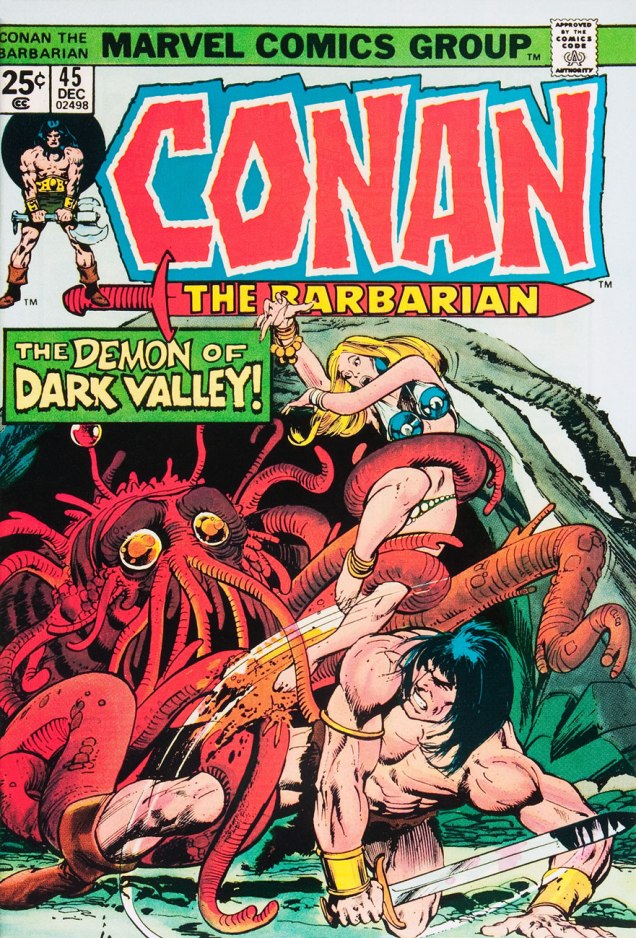
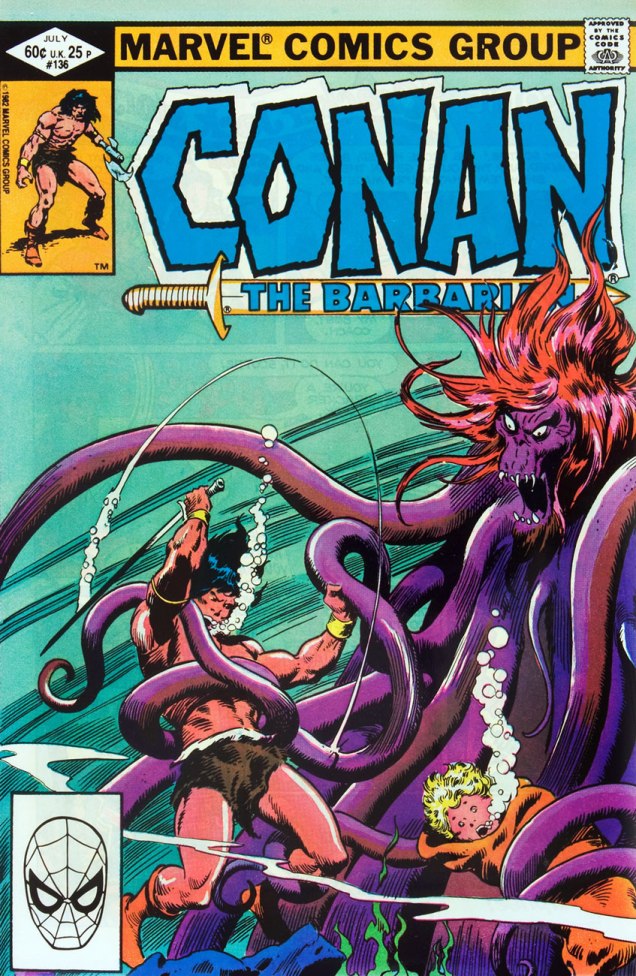
Conan the Barbarian#25 (April 1973), penciled by Gil Kane and inked by Ralph Reese. I actually sort-of like this cover. Nice totems!Conan the Barbarian #32 (November 1973), penciled by Gil Kane and inked by Ernie Chan. “Give the woman tentacles, but make sure she has huge boobs, too. And make them flesh-coloured, otherwise it’s too weird. And give her fangs because she’s also a vampire.“Conan the Barbarian #41 (August 1974), penciled by Gil Kane and John Romita (?), inked by Ernie Chan and John Romita. Conan the Barbarian #45 (December 1974), penciled by Gil Kane and inked by Neal Adams. What a cutie! I bet he was just minding his own business in a cave when he was rudely interrupted by Conan and his blondie.Conan the Barbarian #86 (May 1978), art by John Buscema. Conan the Barbarian #116 (November 1980), penciled by John Buscema and inked by Klaus Janson; the latter information has been suggested by co-admin RG, whose artistic eye I unreservedly trust. To quote him directly: «another misattribution from the GDC. They think it’s Neal Adams inking, toss in Dick Giordano’s name to try and explain away the too-thick-for-Adams lines, and still get it wrong. Giordano’s inking is sloppy and random, never ‘organic’. This, despite clearly being a rush job, isn’t botched. The main inker: Klaus Janson, then-member of Adams’ Crusty Bunkers, and an inker with a very distinctive style. Dead giveaway, if you need just one: Conan’s left boot, bottom right corner. It’s likely a group effort, but there’s no trace of Adams nor Giordano on this page. Adams does pop up later, mostly inking Conan faces and some figures.» See how hard we work to bring you not only entertainment, but also edification?« Is that you, Conan? » Conan the Barbarian #117 (December 1980), art by John Buscema. Why is Spidey’s face in the bottom left corner?* Everyone looks half-hearted on this cover – the tentacles are only making a half-assed attempt at grabbery, Conan’s in the middle of some sort of intricate ballet footwork, and the girl seems a little bored. It’s not a good sign when I start reminiscing about the good old Gil Kane covers… I don’t even like Gil Kane (although I’m gradually warming up to him, I admit).Conan the Barbarian #136 (July 1982), art by John Buscema. I’m fascinated by the sword’s arc: what direction is it going in? From the bubbles, it’s a swing backwards, but why is the tentacle in the path of that art unaffected? And why is Conan swinging backwards? That child’s face is enough to give one nightmares.
In the mood for more Conan? Visit another Tentacle Tuesday entry, the Savagery of Conan’s Savage Sword, for a gallery of painted Conan covers, replete with mostly nude cuties and of course a great heaping helping of tentacles.
~ ds
*because it’s a direct sales edition, as opposed to a newsstand edition, which would bear a barcode.
Occasionally, I notice a comic book cover with a tentacled monster so peculiar that one starts wondering whether the artist was on drugs or just couldn’t give a shit. That is not a criticism, however: where grabby appendages are concerned, the weirder, the better. Even if some of these guys have a face (muzzle? rictus?) even a mother couldn’t love, or their anatomy defies all laws of biology, we’ll welcome them with open arms!
As usual, in chronological order.
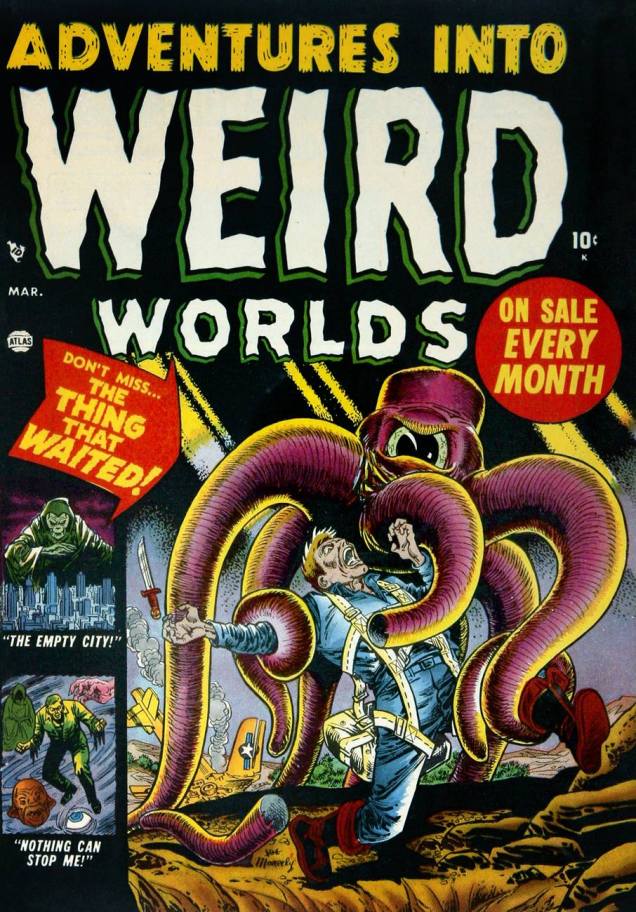
First in our line-up is this little fella in a hat. At least he looks like he’s wearing a cap, although perhaps he just has a square head with a skin flap hanging over the sides. At first glance, his tentacles are hollow, although their flesh is probably just a dull shade of battleship grey. So what’s this “thing that waited”? Soviet soldiers who are actually alien invaders. Duh.
Adventures Into Weird Worlds no. 3 (March 1952), cover by Joe Maneely.
This next cover is probably a little more standard for pseudo-octopus fare: a lady with huge, ahem, bazooms (Russ Heath liked ’em busty, it seems – seriously, just look at the size of those things!) threatened by some horrific monster who’s dispatching her companion as expediently as possible. Still, the somewhat Wolverton-esque, grave-dwelling aliens with pincers at the end of their tentacles are odd-looking enough to squeeze their way into this post.
Spellbound no. 20 (March 1954), cover by Russ Heath.
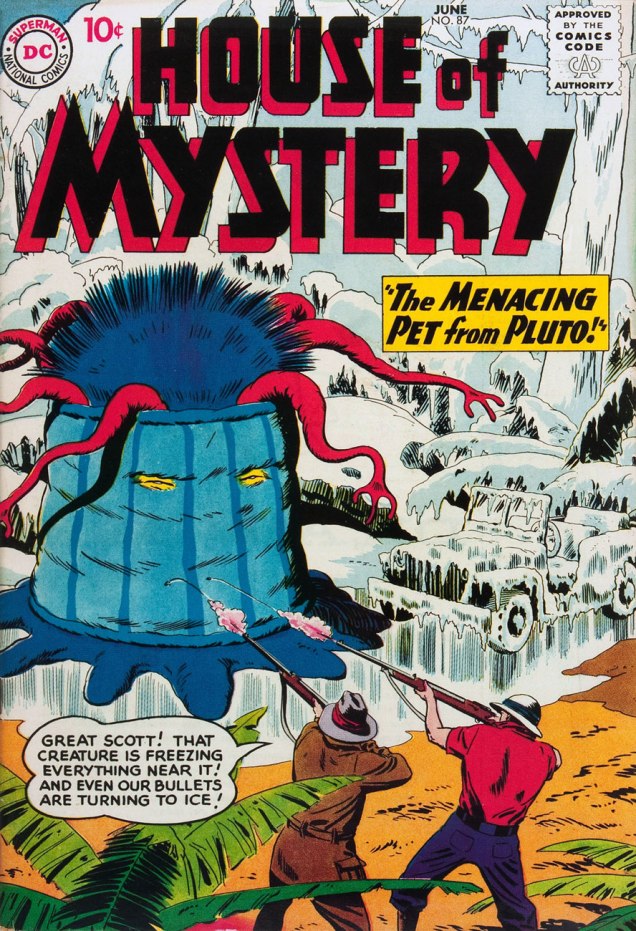
This toupee-clad creature with evil gimlet eyes doesn’t look much like a pet, if you ask me. How are those grabby little arms attached to its head, anyway? Wait, who am I talking about, again? 😉
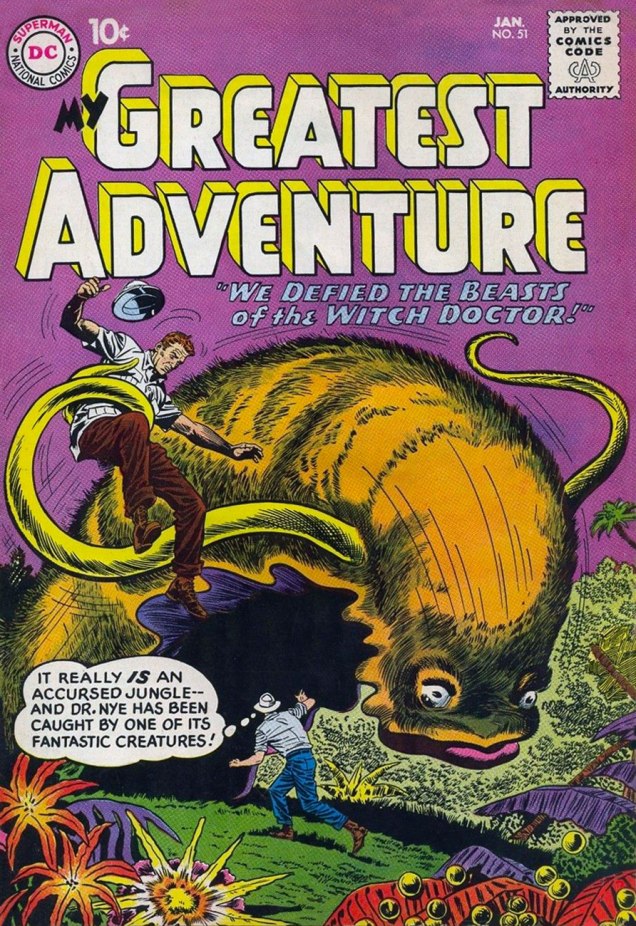
“My Greatest Adventure” was a title that promised much, and it must have been difficult to live up to it every month. Witness the following “fantastic” creature – a furry slug with disturbingly fleshy lips and tentacles. I can’t vouch for my reaction had I been an excitable ten-year old, but to this blasé adult, the poor beast summoned by some psycho witch doctor (the jungles seem to be always overrun with them) is just begging to be put out of its misery.
Our next exhibit finally features a proper alien, one who looks strange but at least makes sense as a unified, functioning creature. I love his sadly drooped whiskers, his dejected expression that’s strangely at odds with his pontifical speech.
Tales of the Unexpected no. 66 (October 1961), cover by Bob Brown.
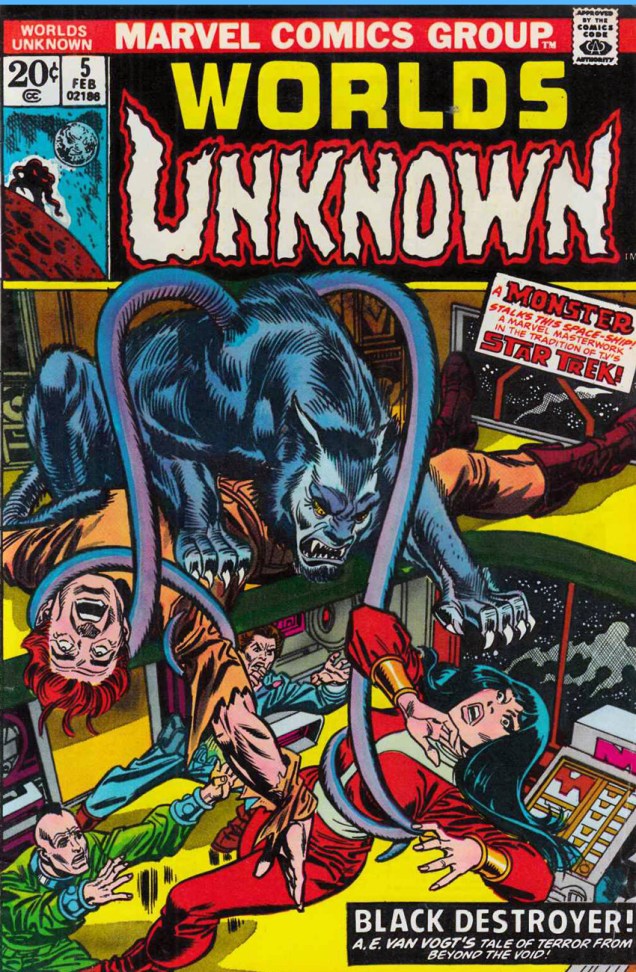
« Make him a werewolf! But in space! And give him tentacles! » Yeah, guys, that went over really well. A Marvel Masterwork, my ass. But wait: Black Destroyer! is an adaptation of A. E. van Vogt’s short story from 1939. And did Cœurl, the black cat-like creature, have tentacles in the story? Why, yes, he did.
« His great forelegs—twice as long as his hindlegs—twitched with a shuddering movement that arched every razor-sharp claw. The thick tentacles that sprouted from his shoulders ceased their weaving undulation, and grew taut with anxious alertness. Utterly appalled, he twisted his great cat head from side to side, while the little hairlike tendrils that formed each ear vibrated frantically, testing every vagrant breeze, every throb in the ether. » (read the full story here.)
Worlds Unknown no. 5 (February 1974), cover pencilled by Gil Kane and inked by Frank Giacoia. Cœurl looks like he’s floating on top of the corpse – I don’t think the artists spent too much time watching an actual cat at work.
My last offering for today is the cutest, featuring an adorable blue varmint who gets my full sympathy and support. Weird? Sure, a bit – he’s got a tentacle sprouting out of his forehead – but beauty is in the eye of the beholder, right? This cover also proves that monsters are just as interested in tooth-whitening procedures as us humans.
Where there be pirates, there be treasure; where there be treasure, there be a displeased octopus, irritable after being roused by some foolish fortune-hunter. I’d like to dedicate this Tentacle Tuesday to the murderous marauders who, in bold search for immeasurable treasure, have to tackle tentacles (and survive, hopefully).
Weird Terror no. 2, November 1952. Cover by H.C. Kiefer. Note the dead pirate’s hook embedded in the diver’s shoulder, while the former’s other hand is severing his umbilical cable… I think the octopus is the least of this treasure-hunter’s worries. By Weird Terror standards, this cover is actually pretty tame; this green octopus is not responsible for Fredric Wertham‘s nightmares.
Any octopus action inside, you may ask? Just two panels.
AAAGH-BLUB! Panels from « Wrath of Satan », pencilled by John Belcastro and inked by Joe Galotti.
I never thought I’d be posting something Garfield-related, but in Roger Langridge‘s hands, even the insipid orange cat acquires some charm.
A panel from « Pirate Cat », written by Scott Nickel and illustrated+lettered by Roger Langridge, published in Garfield no. 34: His 9 Lives Part 2, (KaBOOM!, February 2015).
Melvin the Menacing Sea Monster isn’t just a pretty eye; he’s got at least one excellent pitching arm, too.
All this proves is that there’s a simple solution to an inane plot and pedestrian characters: hire Langridge to illustrate your story, and it will magically transform into a fun yarn.
Our next selection doesn’t technically feature pirates, but it features sailors, Spanish smugglers, swindlers and cheats, as well an epic battle with an octopus and stolen treasure buried at the bottom of the sea, so it damn well qualifies.
Classics Illustrated no. 56, February 1949; cover by August M. Froelich. For one thing, I never knew Victor Hugo had written anything squid-related. As it turns out, Toilers of the Sea (French: Les travailleurs de la mer) is a novel from 1866. How educational! Classics Illustrated was created by Russian-born Albert Kanter (1897-1973), who wanted to use the power of comics to introduce young readers to “great literature” that they might not otherwise have deigned to read. “Classic Comics” began publication in 1941, with the name of the series changed to “Classics Illustrated” in 1947. The series lasted until 1971 for a total of 169 issues; various other companies reprinted its titles. I don’t know whether this series really made a difference in the edification of youth, but many of its issues are highly collectible, anyway.
As a little bonus, here’s a cover that’s somewhat lacking in swashbucklers, but boasts some decent treasure and (quintessential ingredient) some tentacles.
If Rex the Wonder Dog (created by Robert Kanigher and Alex Toth) can ride horses, show off as an expert bullfighter, use cameras, defeat a Tyrannosaurus Rex and swing on ropes (among his many other accomplishments), I don’t see why he wouldn’t be able to effortlessly fend off some pink tentacles. This is The Adventures of Rex the Wonder Dog no. 42 (Nov.-Dec. 1958). The cover is by Gil Kane on pencils, Bernard Sachs on inks, and Jack Adler on tones and colours.
Today is birthday number ninety-five for Stanley Lieber, aka Stan Lee. He was hatched on December 28, 1922. Have a good one, Stan.
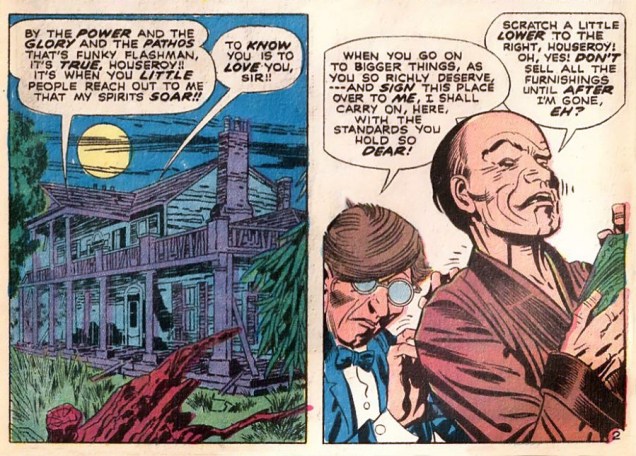
Jack Kirby recalls with fondness his former editor and his toady, in “Funky Flashman!” (Mister Miracle no. 6, January-February 1972, DC).
On this momentous occasion, let’s hear about Stan from some of his colleagues, who knew The Man and obviously loved the experience:
Wally Wood:
« Did I say Stanley had no smarts? Well, he DID come up with two sure fire ideas… the first one was ‘Why not let the artists WRITE the stories as well as draw them?’… And the second was … ‘ALWAYS SIGN YOUR NAME ON TOP… BIG’. And the rest is history… Stanley, of course became rich and famous … over the bodies of people like Bill [Everett] and Jack [Kirby]. Bill, who had created the character that had made his father rich wound up COLORING and doing odd jobs. »
EC legend Bernie Krigstein, who collaborated with Stan at Atlas, and whose « Suppressed Desire » is featured in Spellbound no. 17 (September 1953) , with a glorious cover by the above-mentioned Bill Everett.
In the course of a 1960s interview with comics scholar John Benson, Krigstein responded to Benson’s statement of « I guess you know that Stan Lee has been the spearhead of the so-called current revitalization of comics »:
« I’m delighted to learn that. Twenty years of unrelenting editorial effort to suppress the artistic effort, encourage miserable taste, flood the field with degraded imitations and non-stories have certainly qualified him for this respected position. »
Then Gil Kane, who was Marvel’s principal cover artist for much of the 70s, and who collaborated with Lee on The Amazing Spider-Man in some of its most popular years, including the infamous, comics-code unapproved “drug” issues (nos. 96-97, May-June 1971), on the respective creative roles of Stan and Jack Kirby:
« On each page, from 1964 – 1970 next to every single panel Jack wrote extensive margin notes explaining to Lee what was taking place in the story. It took Jack about 2 weeks to do a single story, it may have taken Lee as little as 4 hours to add text to Jack’s art. »
And Steve Ditko, in a letter to the editor of Comic Book Marketplace, published in the magazine’s 63rd issue in 1998, on his and Stan’s respective roles in crafting an issue of Spider-Man:
« The fact is we had no story or idea discussion about Spider-Man books even before issue no. 26 up to when I left the book. Stan never knew what was in my plotted stories until I took in the penciled story, the cover, my script and Sol Brodsky took the material from me and took it all into Stan’s office, so I had to leave without seeing or talking to Stan. »
« Geez! What’s he been feedin’ that horse?! I’m runnin’ wide-open — and he’s gainin’ on me! »
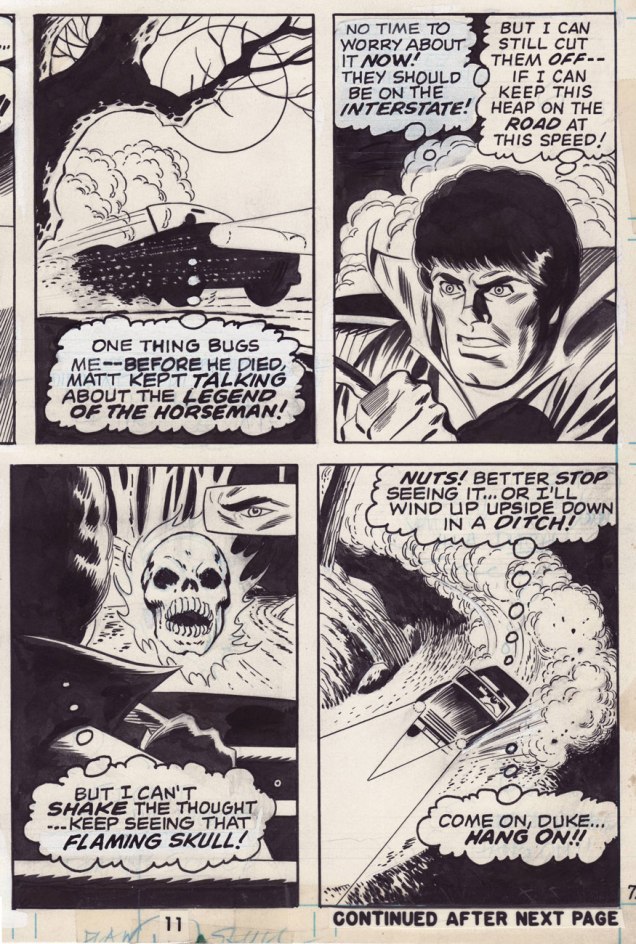
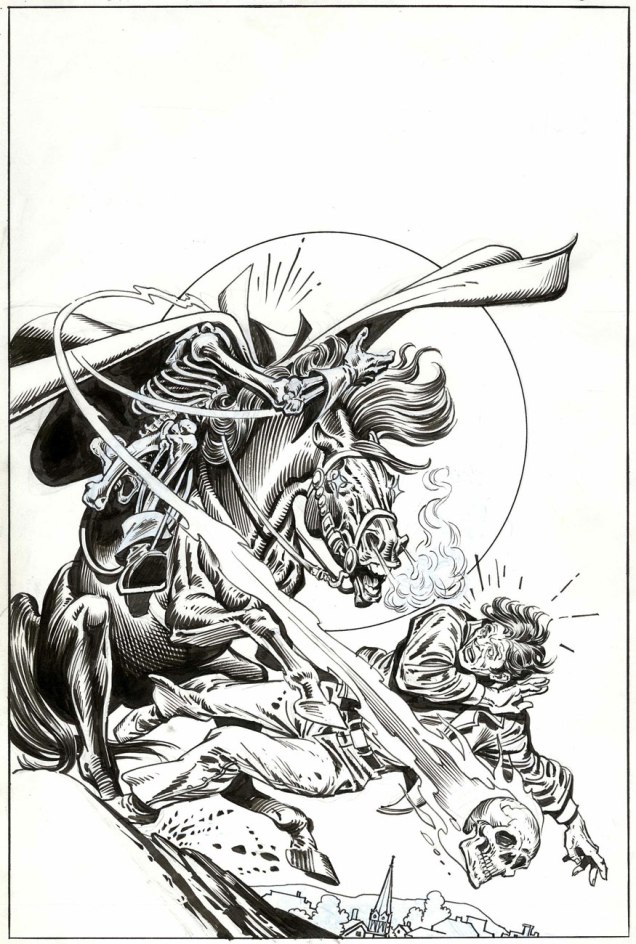
I won’t pretend that The Headless Horseman Rides Again is all that good a comic book, even by the standards of 1973 Marvel. It’s a clumsy narrative hodgepodge, a tangle of tough guy private dick clichés and your basic Scooby Doo plot, courtesy of Gary Friedrich (Ghost Rider, Son of Satan). But it’s agreeably moody in spots, considerably helped along by a solid art job by the prolific George Tuska (1916-2009), who’s not, for once at Marvel, saddled (ha!) with the likes of Vince Colletta. Here he’s smartly matched with the fine but generally undervalued Jack Abel (1927-1996), whose velvety strokes significantly add to the fittingly nocturnal ambiance.
I happen to own a page of original art from the issue, and here are some of my favourite panels. This is page 7 of 20. Script by Gary Friedrich, pencils by George Tuska, inks by Jack Abel. Love that Abel smoke!
The issue bears your typical hyperkinetic Gil Kane 70s cover, winningly inked by Ernie Chua/Chan. This is Supernatural Thrillers no. 6 (Nov. 1973, Marvel).
The published version…… and a peek at the original artwork. Note the absence of the alterations presumably made on an overlay, namely the texture on the foreground rock and the halftone mist across the middle.