« It was a fanatic’s world, and I was one of the fanatics » – Gene Deitch
Say, for a bit of a twist, let’s pay tribute to a living* legend. I’m referring to none other than Gene Deitch (born ninety-four years and change ago: August 8, 1924 in Chicago, Illinois).
A recent self-portrait of the master.
This fascinating man has led a life of such distinction, achievement and all-around coolness that I’m tripping all over myself trying to boil it down to a few highlights. Art director of legendary jazz mag The Record Changer, animator-director-scenarist for UPA, Terrytoons, MGM… Academy Award winner for his direction of his animated adaptation of Jules Feiffer‘s Munro (watch it right here), creator of Sidney the Elephant, John Doormat, Clint Clobber, Gaston Le Crayon… and co-creator of Simon, Seth and Kim Deitch. Some fine artistic genes, to be sure!
The stylish young Master Deitch.
If you don’t terribly object, I’ll sidestep the pitfall of ambition and restrict this post to a single facet of Mr. Deitch’s orbit, namely his jazzy cartoons of the 1940s and 50s. Incidentally, these succulent needles have been collected, in their usual, exemplary fashion, by the Fantagraphics team. If you dig these, and the odds are good, you’ll need to acquire, dentro de poco, their The Cat on a Hot Thin Groove (2013).
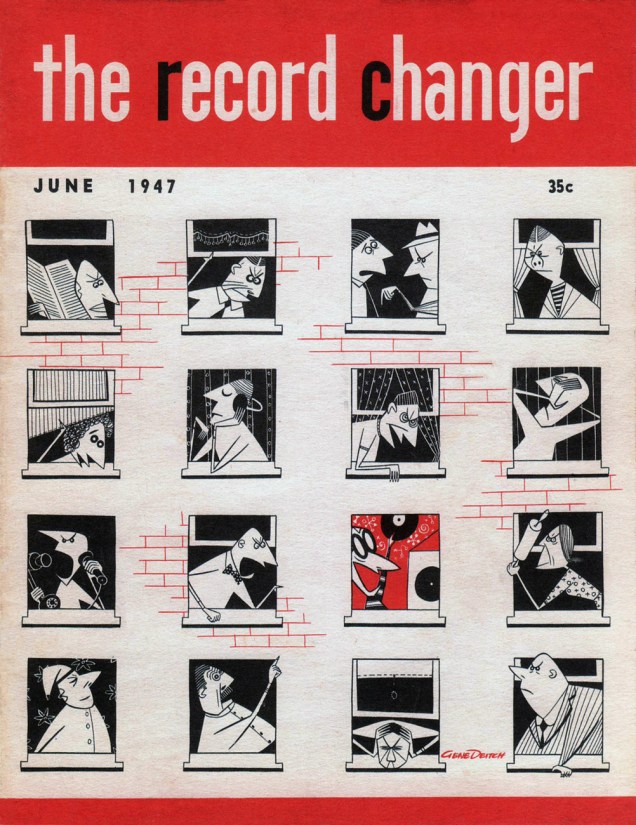
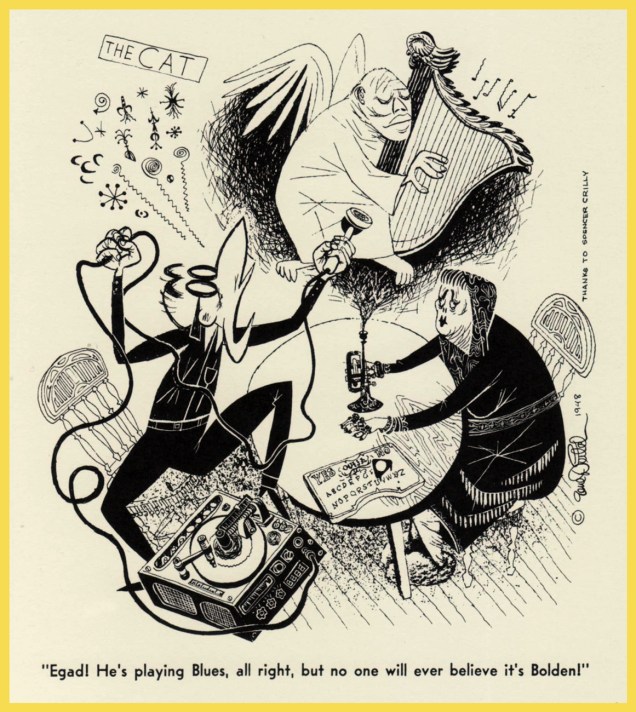
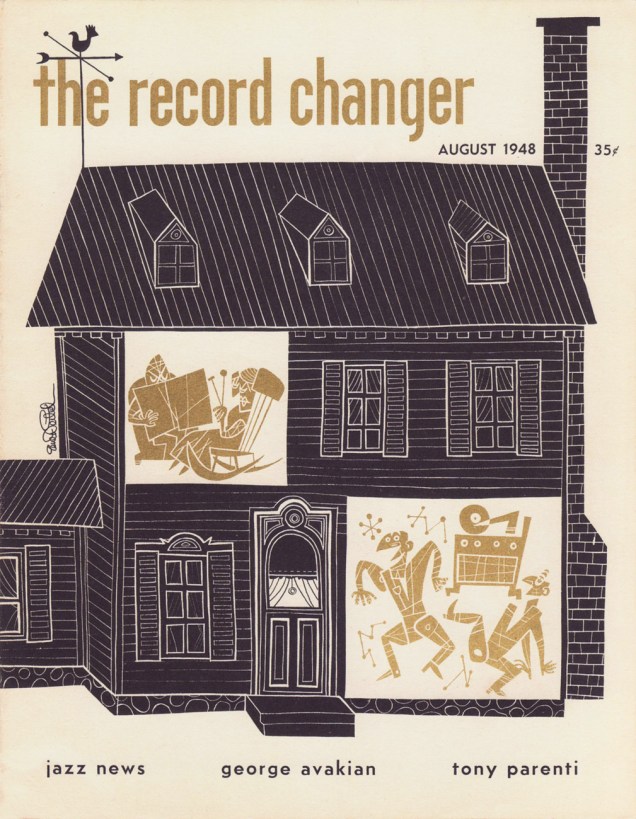
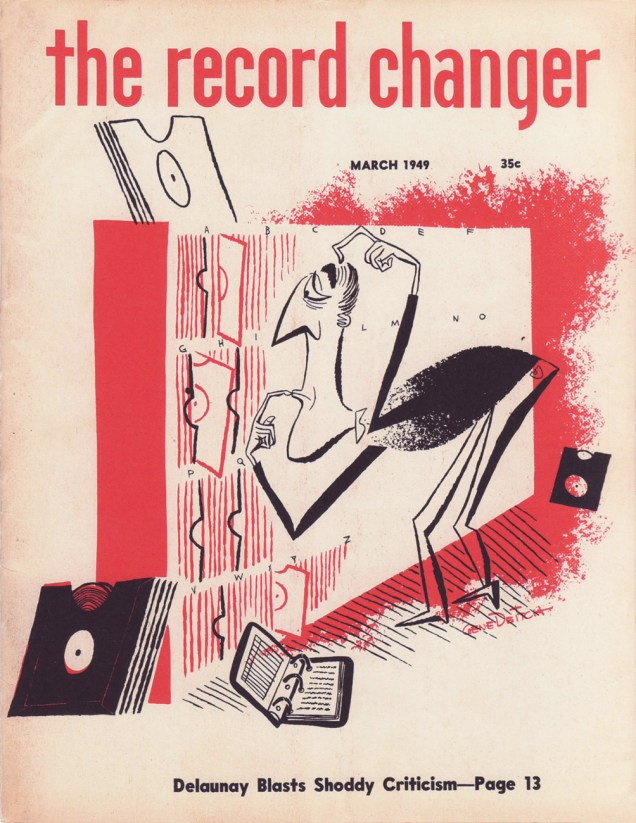
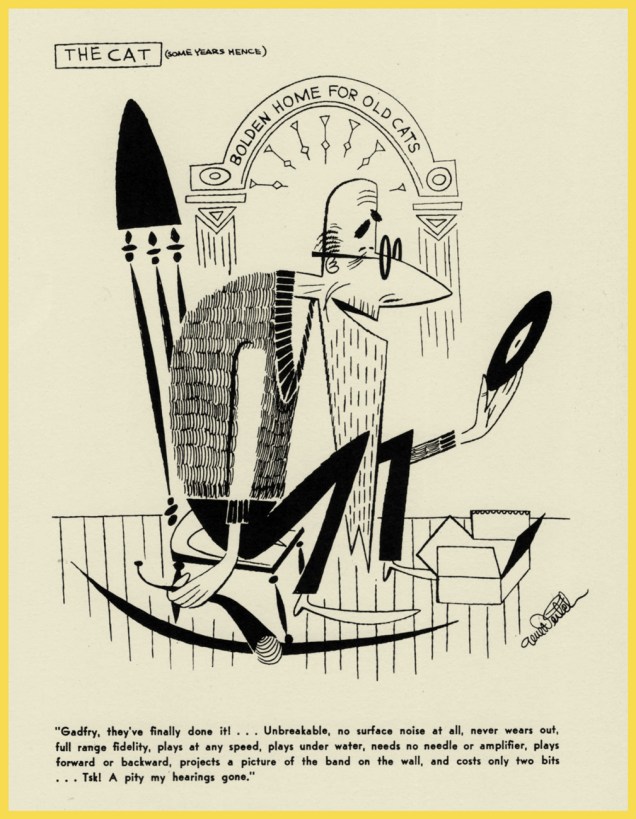
« I had just recently, for the first time, heard the magnificent pipe organ recordings of Fats Waller and imagined a portly black church janitor setting down his mop and bucket and rolling out some mighty blues in the midnight of an empty church on an elaborate organ most likely sanctified for an entirely different kind of music. This drawing was reproduced many times over the years without anyone ever asking permission, and I was tickled to find it once on an actual Fats Waller album cover!** »« The cover shows that having a loud, jazz-playing Cat as an apartment house neighbor is not all that rosy. »« My cover show the devoted bass player protecting his beloved instrument from the pouring rain by covering it with his own coat and hat. If a musician’s livelihood depended on his instrument – often expensive or hard to come by – he did everything possible to keep it from harm. »From The Record Changer (August, 1948). « The search for a recording by the legendary pioneer New Orleans trumpeter Buddy Bolden has never subsided. In this issue, The Cat has actually managed to record him from the Great Beyond, but egad, he’s playing a harp instead of a horn! »« The cover design suggests the unlikely coexistence of a quiet elderly couple and a jazz record maniac within the thin walls of a single boarding house. »« The cover showed that even with the most careful cataloging it was still mainly guess work to find the record you were looking for. »« Earlier that year I moved from Hollywood to Detroit, to take up an offer from a commercial film studio there that would give me a chance to become a director. My cover for July was inspired by the hazards of moving the most precious commodity of all. OK, I had two kids, but I let my wife arrange their things for the moving, and the moving men could do what they wanted with our furniture. But I didn’t let them touch my record collection! I schlepped every box full of discs myself, and carefully placed them in the safest positions. I was proud that my entire collection arrived in Detroit unscathed. »From The Record Changer (August, 1949). « This may be the very best Cat-toon of all. It says everything I ever wanted to say about this character. What is a mere soul in comparison to a 100% complete jazz record collection? Spencer Crilly, wherever you are, I thank you for suggesting this gag! » Perhaps the proverbial catch in the Faustian deal is that, without his soul, a cat can’t appreciate jazz any longer. You can never win.From The Record Changer (January, 1950). « The Cat, seen as a dodderer in the Buddy Bolden Home for Old Cats, basically predicts the CD and DVD records to come 50 years hence! »
I don’t necessarily like to contemplate this fact of life, but octopus flesh gets eaten a lot (in some countries more than others). However, comic artists are mostly a classy lot: they tend to like cephalopods, so it’s not too often that one runs across a depiction of them as a foodstuff. An octopus slashed in battle is one thing, but disgraced and transformed into a dish? What kind of person would want to illustrate *that*? Perverts, that’s who!
These bold souls who have drawn the forbidden, mentioned the unmentionable, shall surely be punished by the Elder Gods.
Let’s have a cautious peek (don’t forget to leave a sacrifice at the altar of the Octopus God, however).
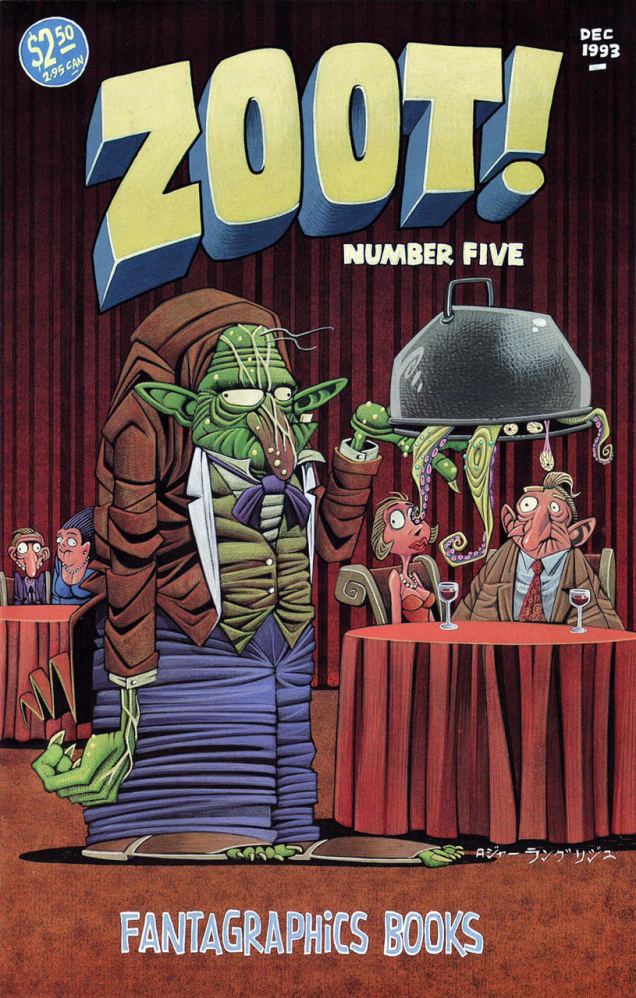
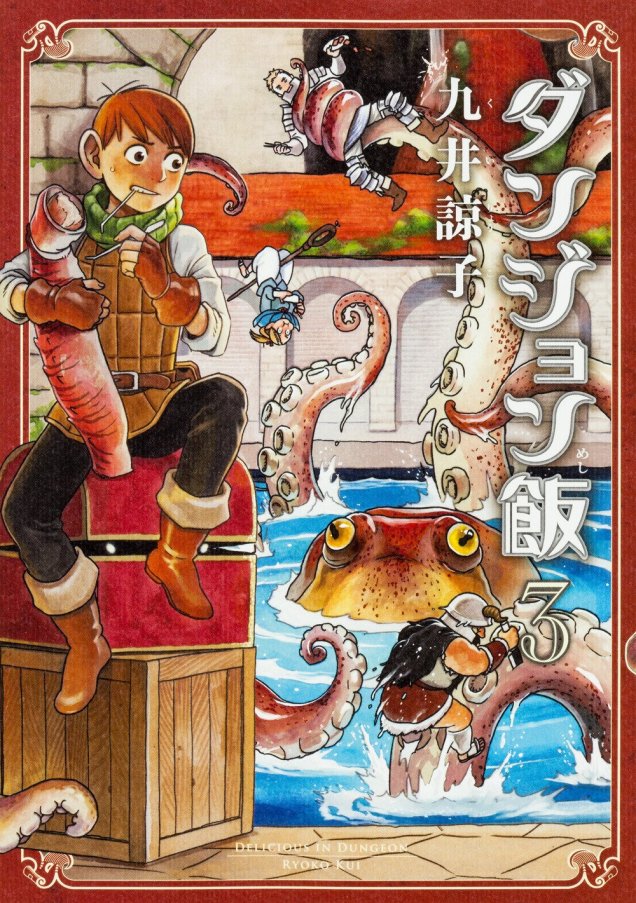
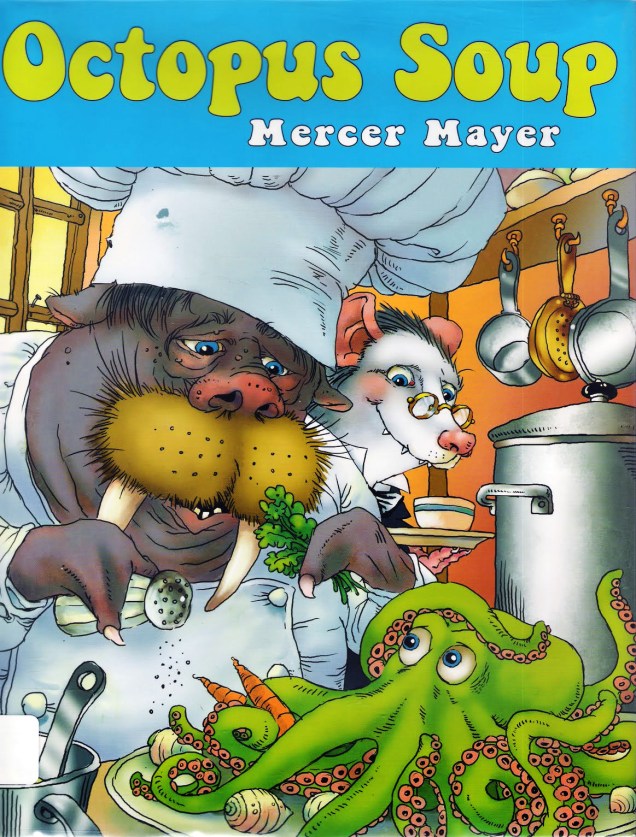
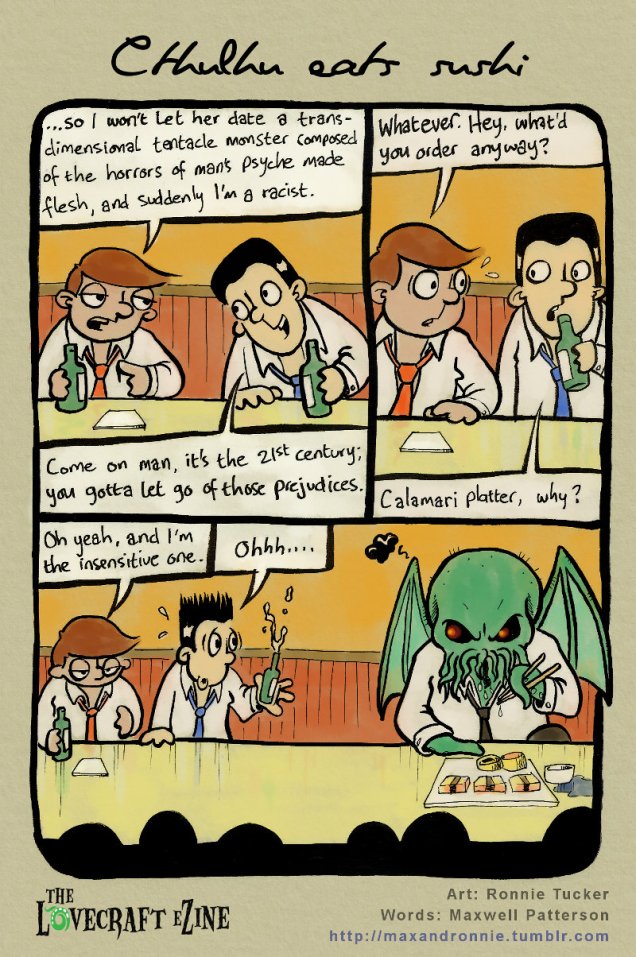
Zoot no. 5 (December 1993, Fantagraphics). Cover by Roger Langridge.Originally called “Ernie” (the name of its main character), the strip was renamed “Piranha Club” presumably because it’s a much catchier title. No, or few, pirañas are involved, but you are guaranteed to encounter Quacko the Human Duck, his wife the Bearded Lady, Effie (who often cooks octopus, much to the dismay of her husband), Bob the zombie, and a host of other irrelevant and quirky characters. Who’s responsible for all this mayhem? Bud Grace, the creator of this strip. If you haven’t heard of Piranha Club, slither over here.Delicious in Dungeon Vol. 3 (November 2017). This manga series by Ryōko Kui involves a few characters tromping around a dungeon, consuming all and any monsters they find within. “Slimes, basilisks, and even dragons… none are safe from the appetites of these dungeon-crawling gourmands!“Octopus pie, again? Is it as inedible as tuna casserole, the frequent butt of jokes in all sorts of sitcoms? This is Mom’ Homemade Comics no. 1, October 1969, cover (and everything else) by Denis Kitchen. Visit Comixjoint for the riveting tale of how this underground classic came to be published, as well as a review of its three issues.Octopus Soup by Mercer Mayer (2011, Two Lions). Technically a book for kids, but I’d highly recommend it for octopus lovers of any age.Another peek at Octopus Soup…Cthulhu Does Stuff no. 4, by Ronnie Tucker and Maxwell Patterson. Visit their website.
« You cannot work with men who won’t work with you. » — John Harvey Kellogg
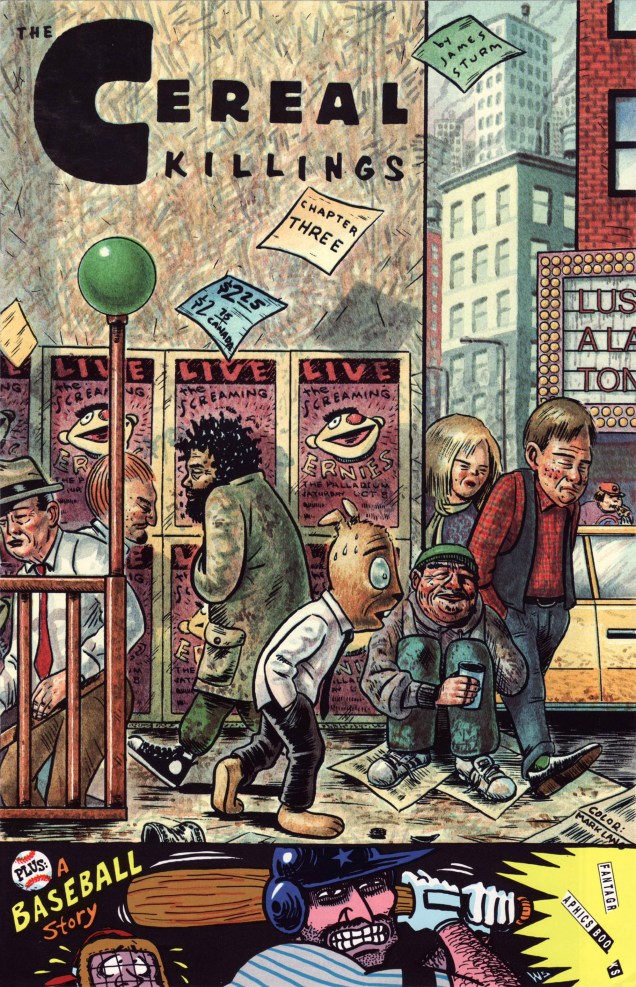
Before he created his justly celebrated The Golem’s Mighty Swing, wrote the mini-series Fantastic Four: Unstable Molecules, or co-founded The Center for Cartoon Studies, James Sturm (b. 1965) committed to paper and ink a mind-expanding, if little-noticed, saga entitled The Cereal Killings, complete in eight issues and published by Fantagraphics between 1992 and 1995. Sturm valiantly struggled through ocular problems during that period, undergoing no less than three retinal operations, leaving him with one good eye.
The Cereal Killings no. 3 (Sept. 1992), colours by Mark Lang. Hey, I’d pay good money to see The Screaming Ernies perform. I’d settle for a t-shirt!
Sturm dug well beyond the shallow pun of the title and implacably hauled it to its logical conclusion. TCK has been likened to a Watchmen with a cast of funny animal cereal mascots, and that’s not that far off the mark. But beyond its conceptual debt to Alan Moore’s superhero deconstruction, Sturm’s story actually takes aim at more adult concerns and issues, made all the more harrowing and poignant by how psychologically credible his cast of cereal pitchmen and acolytes is. Corporate malfeasance, petty theft, betrayal, bitterness, grandiloquence, blind ambition, dementia, remorse… and wisdom. You name it, it’s all there, in a gripping, kaleidoscopic and haunting narrative.
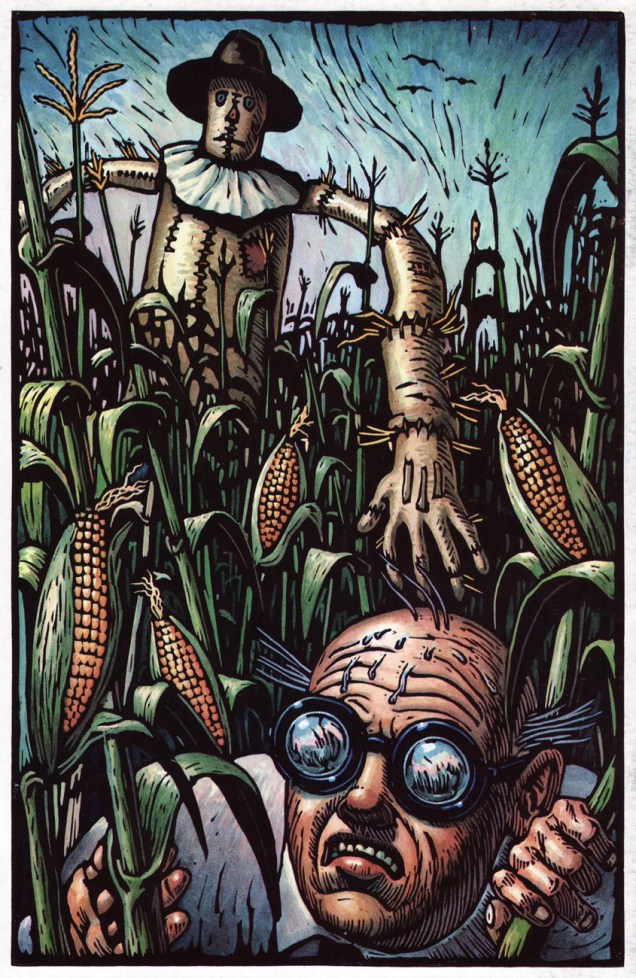
Sturm, Fantagraphics & Co. made splendid use of the entire, (actual) ad-free magazine to flesh out the concept. This is Mark Lang’s gorgeous depiction of The Scarecrow and Carbunkle. These are our good guys, appearances notwithstanding.Issue 3’s back cover provides a helpful look at our cast of characters.This is the cover of TSK no. 4, featuring Schmedly the Elephant, who wishes he *could* forget. Colour by Mark Lang.
A crucial flashback scene from the eighth, and ultimate, issue (Jan. 1995). It would appear that The Scarecrow is a stand-in for cereal giant Kellogg’s founder, John Harvey Kellogg.
« It’s the present! It’s nostalgia! It’s a crispy non-sweetened comix story that doesn’t get soggy in milk! And remember — product is sold by weight, not volume. Some unsettling may occur. »
The series has never been collected or reprinted, so you’ll have to do the work… I think I noticed a torrent file somewhere. Sturm at one point intended to issue a revised collected edition, but has apparently changed his mind since. That’s no way to treat one’s masterwork, neglected as it may be.
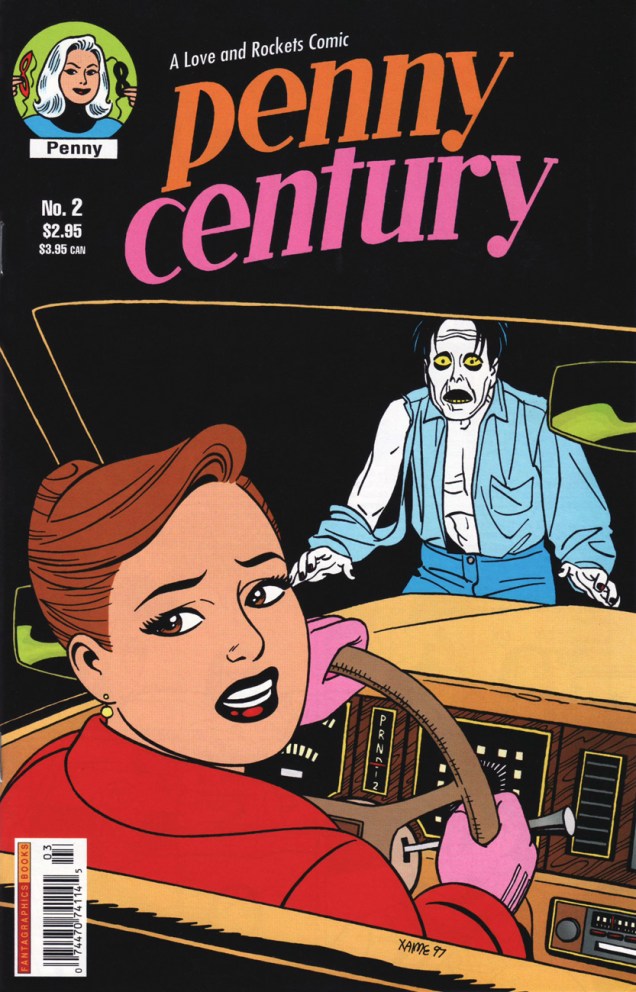
« Oh, it’s just one of those endless dark roads where ghoul men seem to lurk at night. »
Gee, thanks, Penny. At least it’s a shortcut. Jaime Hernandez makes sparing usage of the explicitly supernatural in his work, and he still likes to keep you guessing… but the goosebumps are real, all right.
In « Chiller! », Maggie lets her imagination run wild while driving home on the 696, « The Horror Highway », as Penny Century flippantly puts it.
This is Penny Century #2 (Fantagraphics Books Inc., March, 1998.) Cover and just about everything else by Jaime Hernandez; “Computer colorist: Chris Brownrigg.Maggie and the Ghoul Man go way back, thanks to those spine-tinglers Izzy told her when they were lil’ kids. And hey, there’s that lady from Black Sabbath again! A taste of our cover tale, the aptly-titled « Chiller! »
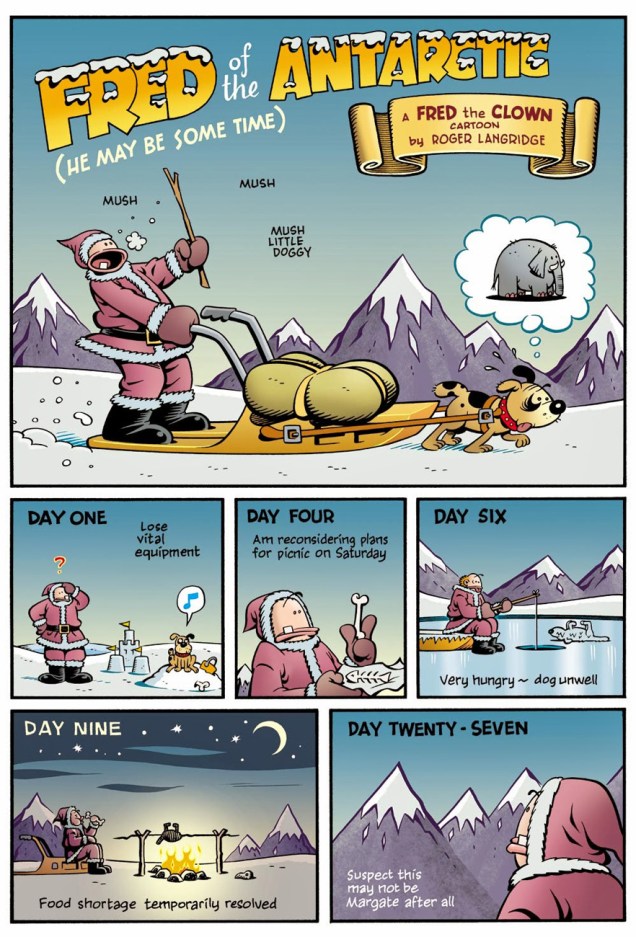
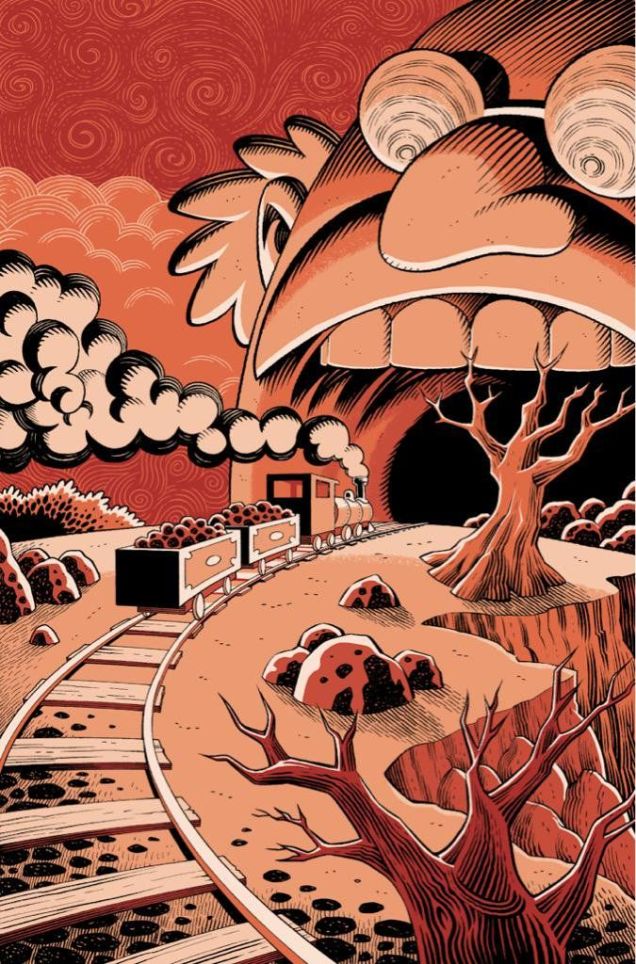
I’d like to talk about a book that’s coming out in October -“The Iron Duchess” by Roger Langridge. There’s two reasons to be excited about it: it’s a solo Langridge project; and it features Fred the Clown, a favourite character of many a R.L. aficionado. This graphic novel was initially self-published about a year ago, but Fantagraphics (displaying their usual impeccable taste) has picked it up since then, so it’s now commonly available through major stores.
But, you may ask, who is Fred the Clown and why should you care? Instead of blabbing incomprehensibly as I’m prone to doing when talking about Langridge (imagine a dog trying to explain its excitement about a juicy bone – there’s just going to be a lot of tail-wagging and drooling), I prefer to quote the back-cover blurb from the first Fred the Clown collection (equally highly recommended, published in 2004 also by Fantagraphics):
“Existential clown comedy as you like it. SEE! Fred the Clown get slapped regularly in his single-minded pursuit of l’amour! HEAR! The screams of his lady friends from several blocks away! SMELL! Fred the Clown’s scientifically improbable collection of fungal infections! The signature creation of cartoonist Roger Langridge, Fred the Clown is the thinking man’s idiot. Fred has an eye for the ladies, as well as several other organs, but the only part of themselves they’re willing to share with him is a carefully placed kneecap… Fred the Clown’s misadventures are a curious balance of bleakness and joyful absurdism; the universe may dump on Fred from a great height, but he never gives up. More often than not, they involve the pursuit of a lady—any lady will do, it seems, but bearded ladies are at the top of the list.”
Just look at this striking art and Langridge’s impeccable sense of timing:
(Fred the Clown in his initial black-and-white format.)
To which I can add that I normally can’t *stand* clowns, and Fred is the only cartoon clown whom I not only tolerate but whose antics I actually enjoy.
But to get back to the Duchess: *this* story doesn’t have bearded ladies, but it does have a (very) mad scientist, a damsel in dire and completely improbable peril, enough twists in the plot to make you yelp (and giggle) out loud (great for embarrassing yourself in public!), and heart-warming inter-species friendship, perhaps even romance. After all, there is a train involved; a train means somebody can be tied to the railroad tracks, or a couple can escape – or not – an evil father… I love people who can take a conventional story and run off with it while still “obeying” all the rules of the genre.
It’s an entirely mute story, if you don’t count evil cackling as dialogue. Fred’s best friend is a pig, by the way, and as far as I’m concerned that’s another reason to love this goofball. The pig’s also considerably more intelligent than him.
It’s exciting, riveting and really funny. Did I mention the beautiful art, expert shading, etc., etc.? Just pick it up already. Langridge can deftly illustrate anything his freaky brain comes up with, which includes animals (especially horses, which most comic artists seem to struggle with), ugly people (ditto – it seems that artists often can draw either pretty people, or grotesque ones, but rarely both)… and he’s great at architecture and perspective, too.
In an ideal world, Langridge would have free rein – and enough financial support – to draw the stories that are clearly close to his heart, instead of being forced (although he’s very gallant about it) to write for projects illustrated by pencillers/inkers so impressively inept that these comics, that should be excellent just by virtue of having a fantastic writer, become completely unreadable. Let’s at least take things one step closer to this ideal by adding the Iron Duchess to our comic book collections.
Dare to take a train ride into the dark tunnel of creativity (but avoid awkward metaphors along the way.)
Don’t forget to visit Langridge’s Hotel Fred, his official website, where you can purchase original art, books, and also see lots of goodies like sketches, commissions, unpublished pages, and whatever else he’s got lying around.

















 Who's Out There?