Alain Delon Did Not Drink Eau de Cologne*.

« Better to have a lousy character than no character at all. » — Alain Delon (Nov. 8, 1935 – Aug. 18, 2024)

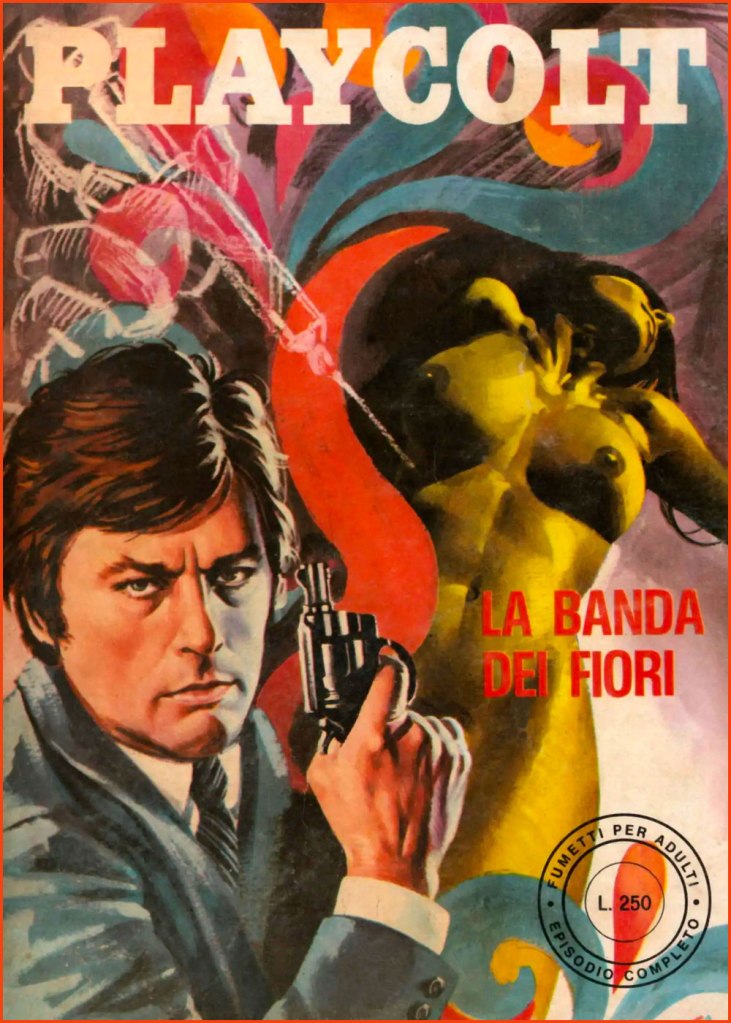
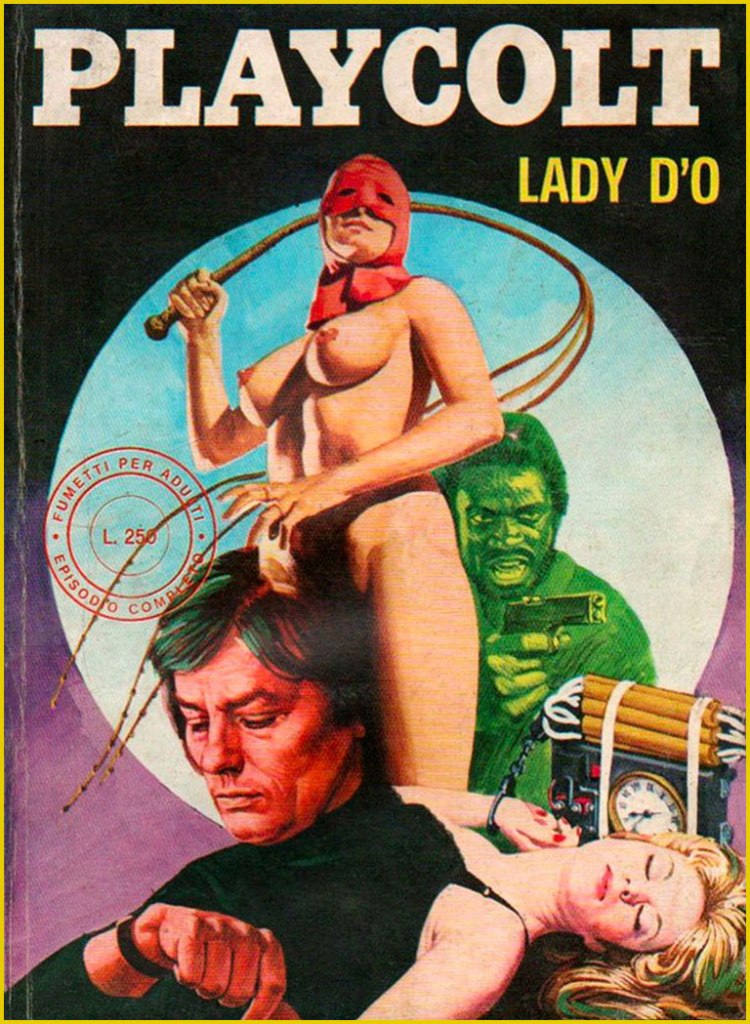
Quite recently, we lost monstre sacré Alain Delon. He was a complicated man, a bit of a prickly bastard, but he sure made a lot of great movies*. But comics, you ask? Well, I’m sure he never asked for it, but like many a celebrity (Jean-Paul Belmondo, Ornella Muti…) his famous countenance was appropriated by those incorrigible rascals at Edifumetto and Ediperiodici.

So Alain Delon became… « Alain Velon, a billionaire playboy who lives on an island “a 3-hour flight from New York“. He spends his private life conquering women in a continuous stream even if he is already engaged to the film actress Lizzy Scarlett, but “due to his innate sense of justice” he periodically transforms into Playcolt, a sort of superhero. His enemy is Linda Darnel, also a billionaire: sadistic and fetishist, she turns into the anti-heroine Za the Dead. Another historical rival is the always sadistic but lesbian Mandrakka. »

Now don’t get me wrong: these are virtually unreadable, poorly drawn, sadistic, illogical, reactionary misogynistic claptrap. But the covers are fascinating in their gonzo way, randomly cobbling together purloined bits from famous likenesses to established logos. You’d think this brazen wave of wholesale filching would have led to swift and decisive legal action from several stars’ solicitors, not to mention Hugh Hefner’s… but it seems not. This was, after all, the Italy that gave us Silvio Berlusconi.

« To the Sound of Punches »; this is Playcolt Series II no. 9 (Nov. 1973, Edifumetto). Cover art by Carlo Jacono, a nice piece, but celebrity likenesses evidently weren’t among his strong suits.
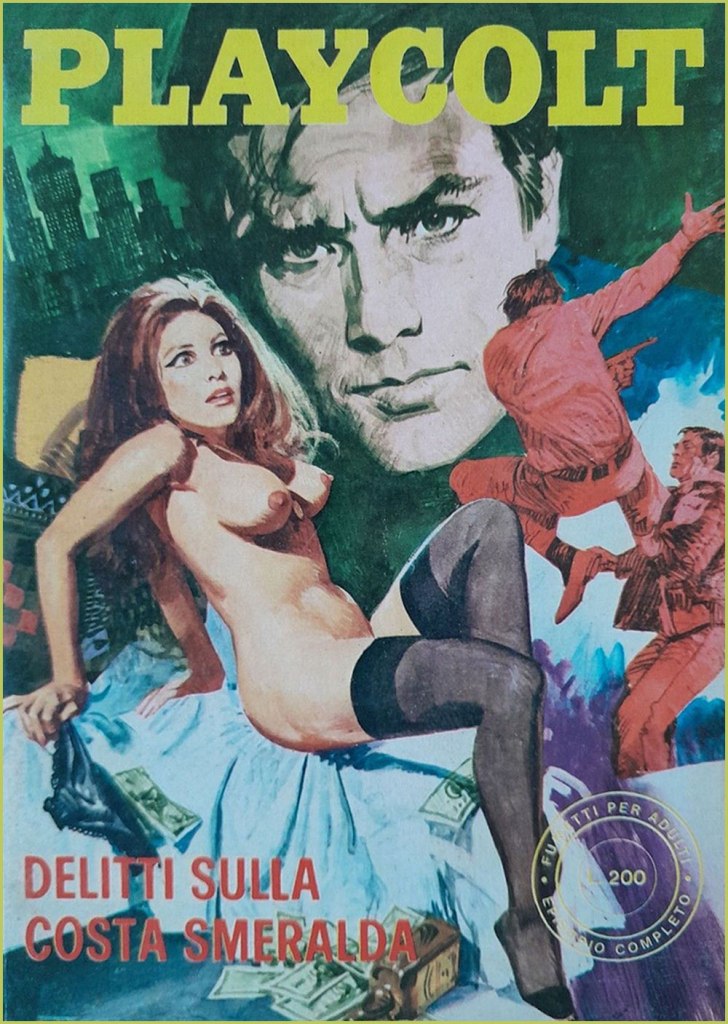
« Crimes on the Emerald Coast »; this is Playcolt Series II no. 14 (Aug. 1973, Edifumetto). This one’s *possibly* the work of Alessandro Biffignandi… or his studio.
« The Golden Rain » (ahem); this is Playcolt Series II no. 23 (Dec. 1973, Edifumetto). Another Jacono, another botched likeness.
« The Divine Sadist »; this is Playcolt Series III no. 1 (July 1974, Edifumetto).
« Death laughs in Disneyland »; this is Playcolt Series III no. 11 (June 1974, Edifumetto).
« There’s a mess in the middle of the sea »; a 1980 Brazilian edition reprinting Playcolt Series III no. 18 (Sept. 1974) in Portuguese.
« The Flower Gang »; this is Playcolt Series III no. 22 (Nov. 1974, Edifumetto). I have no concrete evidence, but the technique displayed here reminds me strongly of British illustrator-cartoonist Ron Embleton (1930-1988), co-creator of Oh, Wicked Wanda! and illustrator of the immortal Captain Scarlet closing credits.
No need for a translation, is there? A 1980 Brazilian edition reprinting Playcolt Series IV no. 1 (Jan. 1975) in Portuguese.
« Operation Puzzle »; this is Playcolt Series IV no. 12 (Nov. 1975, Edifumetto). Cover painted by the prolific Emanuele Taglietti, who handled quite a few covers in this series. Here’s an impressive gallery of these.
« The White Shark »; this is Playcolt Series IV no. 35 (May 1976, Edifumetto). Sharks were all the rage that year.
« To Love a Hole »; a 1980 Brazilian edition reprinting Playcolt Series IV no. 2 (Jan. 1975). Dig that strategic blurb placement; the Italian edition was not so coy.
Clearly a reference to the previous year’s hit ‘erotic’ film, L’histoire d’O; this is Playcolt Series IV no. 27 (Jan. 1976, Edifumetto). It’s funny how the Delon photos used span his career up to that point, which yields visual whiplash when you go from the Delon of Plein Soleil to the jaded, grizzled one of, say, Monsieur Klein or La mort d’un pourri from one issue to the next.
« Terror in California »; this is Playcolt Series IV no. 44 (Oct. 1976, Edifumetto). The obligatory Jaws cash-in. Say what you will, those Italians didn’t miss a trick.

There was, concurrently, another Delon homage in Jean Ollivier and Raffaele Carlo Marcello‘s successful Docteur Justice, a humane but hard-hitting series about a physician and expert judoka who roams the globe’s trouble spots for the World Health Organization. There was even a film adaptation in 1975, with John Phillip Law essaying the title role… and co-starring Delon’s ex — and only — wife, Nathalie. Among Pif Gadget’s adventure series, it was only bested in popularity by the prehistoric blond heartthrob Rahan. I’ll tell you more about it one of these days.

-RG

*So claims the Russian pop song entitled Взгляд с экрана, and who are we to doubt it?

[ source ] And for those who like to dig a little deeper, here’s a most illuminating article on the subject.

**I recommend Adieu, l’ami, Red Sun — both co-starring Charles BronsonLa mort d’un pourri, Jean-Pierre Melville‘s Le Samouraï and Le cercle rouge, Plein soleil… as cinema’s first Tom Ripley.

Hallowe’en Countdown VII, Day 16

« When asked if they would like to have sex with me, 30 per cent said, “Yes”, while the other 70 per cent replied, “What, again?”Silvio Berlusconi

A certain subset of Italian Fumetti — namely the sex and horror digests of the 1970s — constitutes a quagmire of oft-truly repellent material in which indisputable gems yet glimmer bright. Mostly the covers… designed to lure the sailor — or reader — to his doom.

While several of the most prolific artists of the medium were evidently talented fellows, only a couple (Averardo Ciriello being the other one) truly draw my interest, since, despite low pay and a breakneck production pace, they didn’t swipe much… or at all — unlike their colleagues. For most of the industry and society, consent and copyright appeared to be pretty fuzzy, casually dismissed notions.

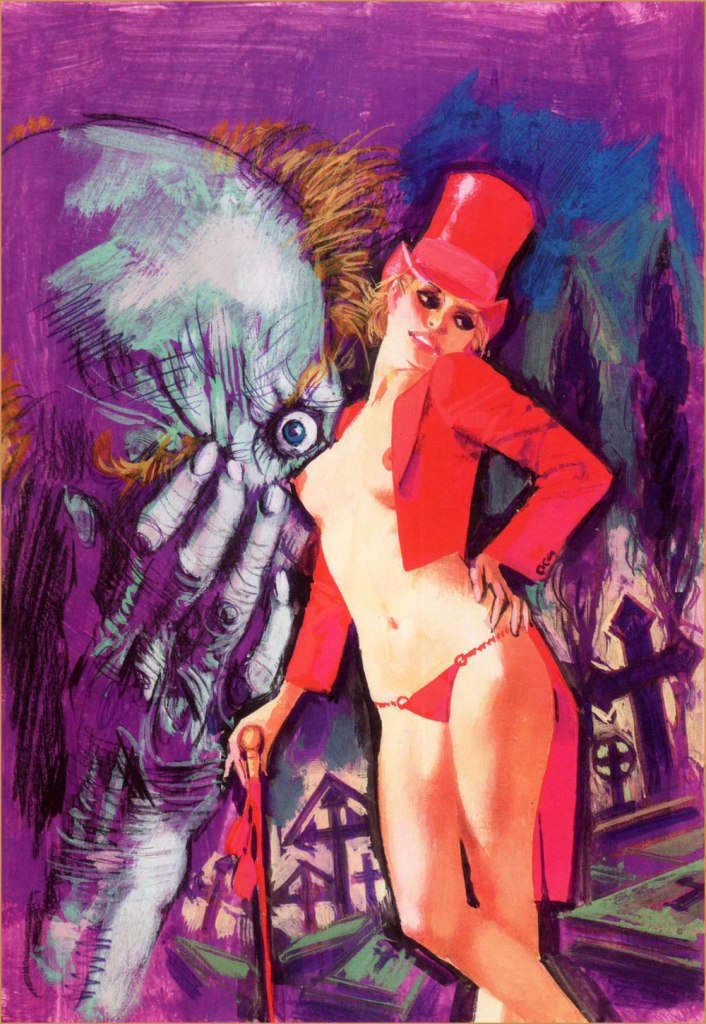
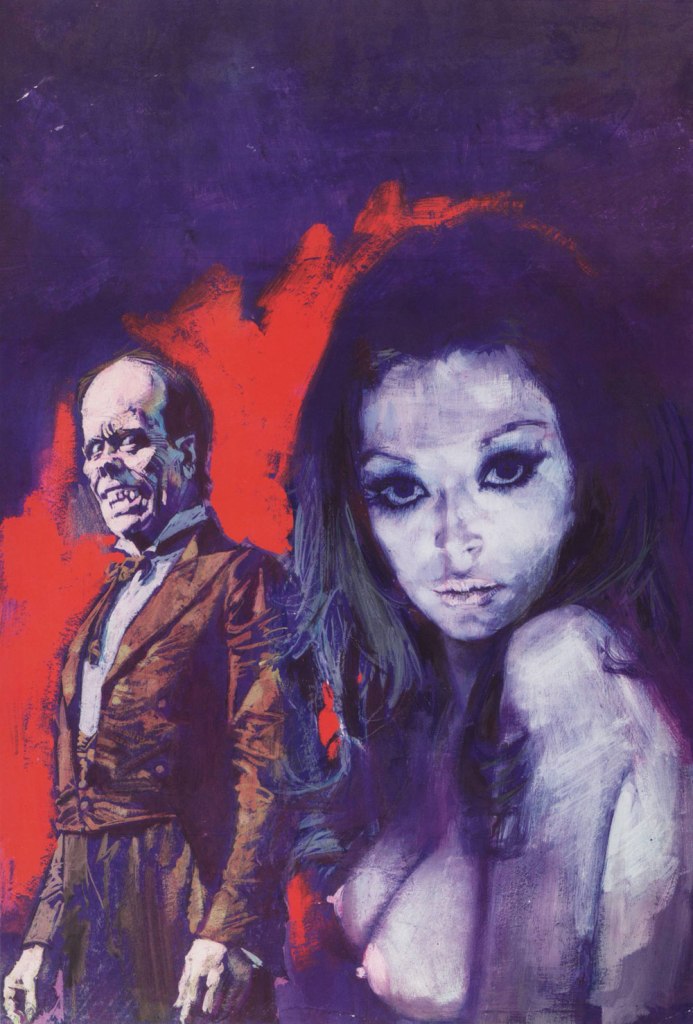
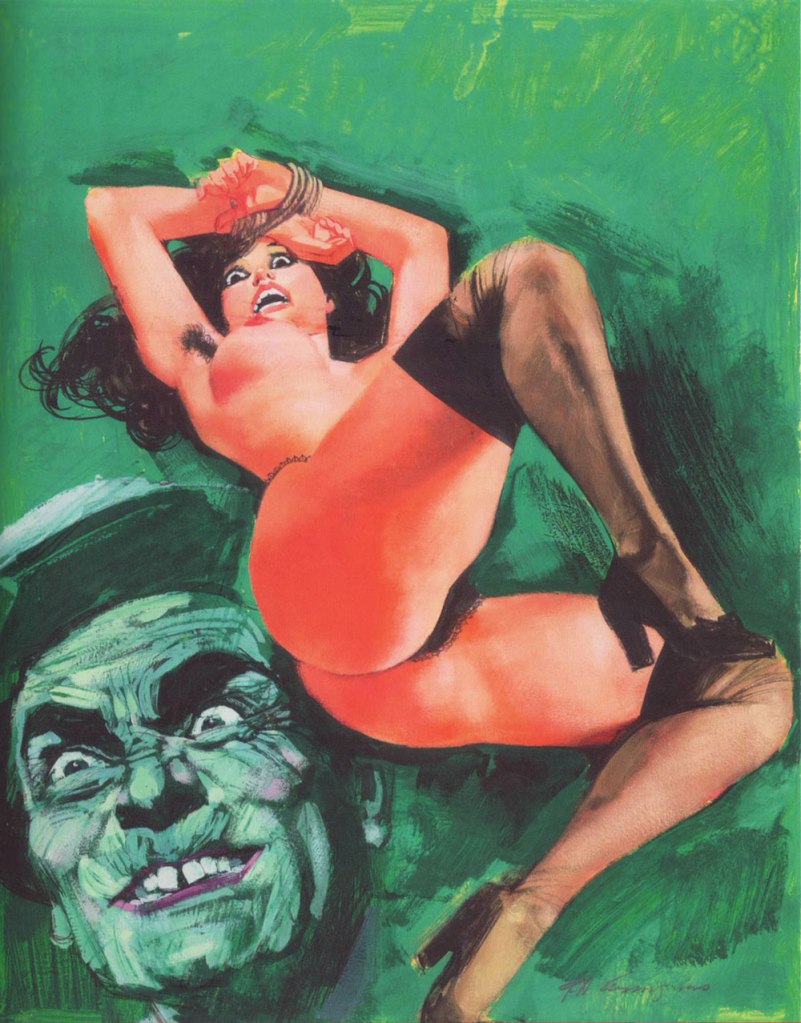
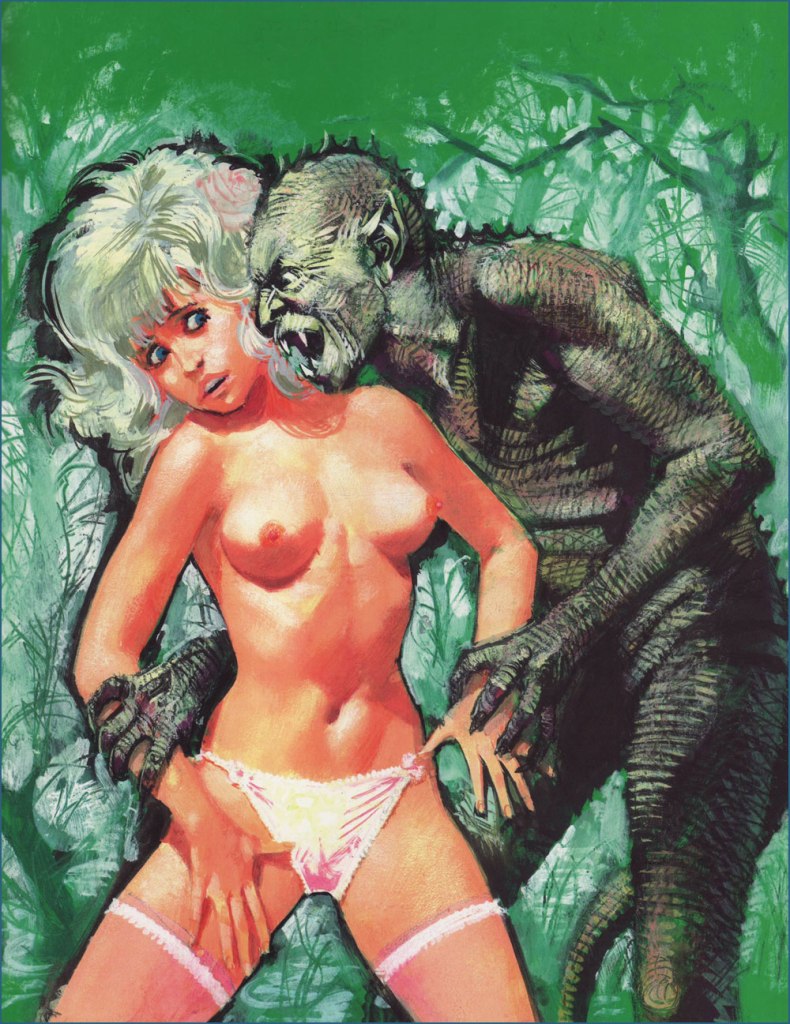
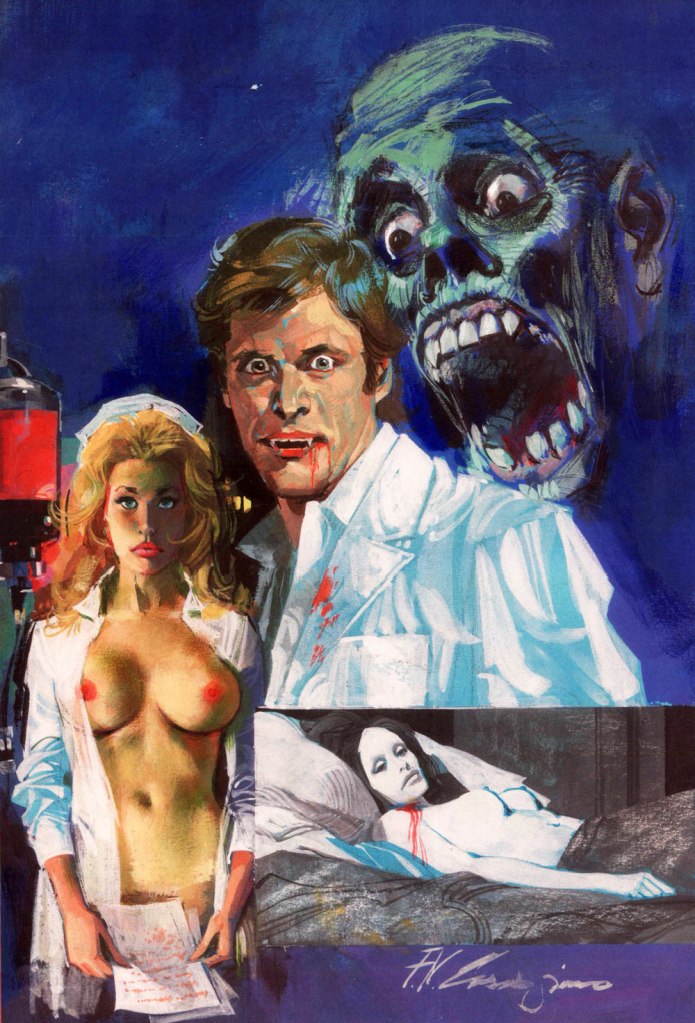
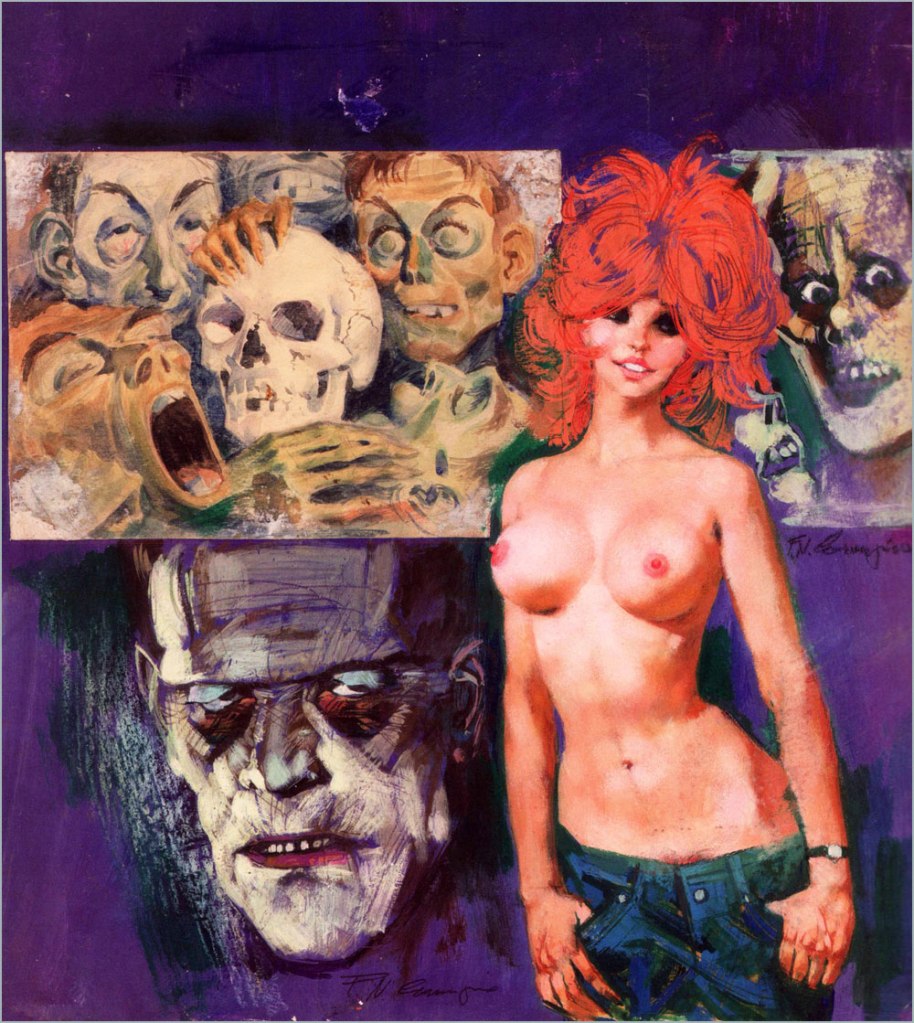
I favour the work of Fernando Carcupino (1922-2003) over that of his contemporaries because he always knew how to keep things light, bright and original — never wallowing in poor taste or sadism, even when the subject matter called for it, and I thank him for it. Here are some highlights from his illustrious career.

A piece from La Settimana Umoristica no. 5 (Apr. 1954) entitled “Celluloid Terror”. All the classic ghouls are there, even that very year’s Creature From the Black Lagoon. Carcupino could spot an enduring classic from a long way off!
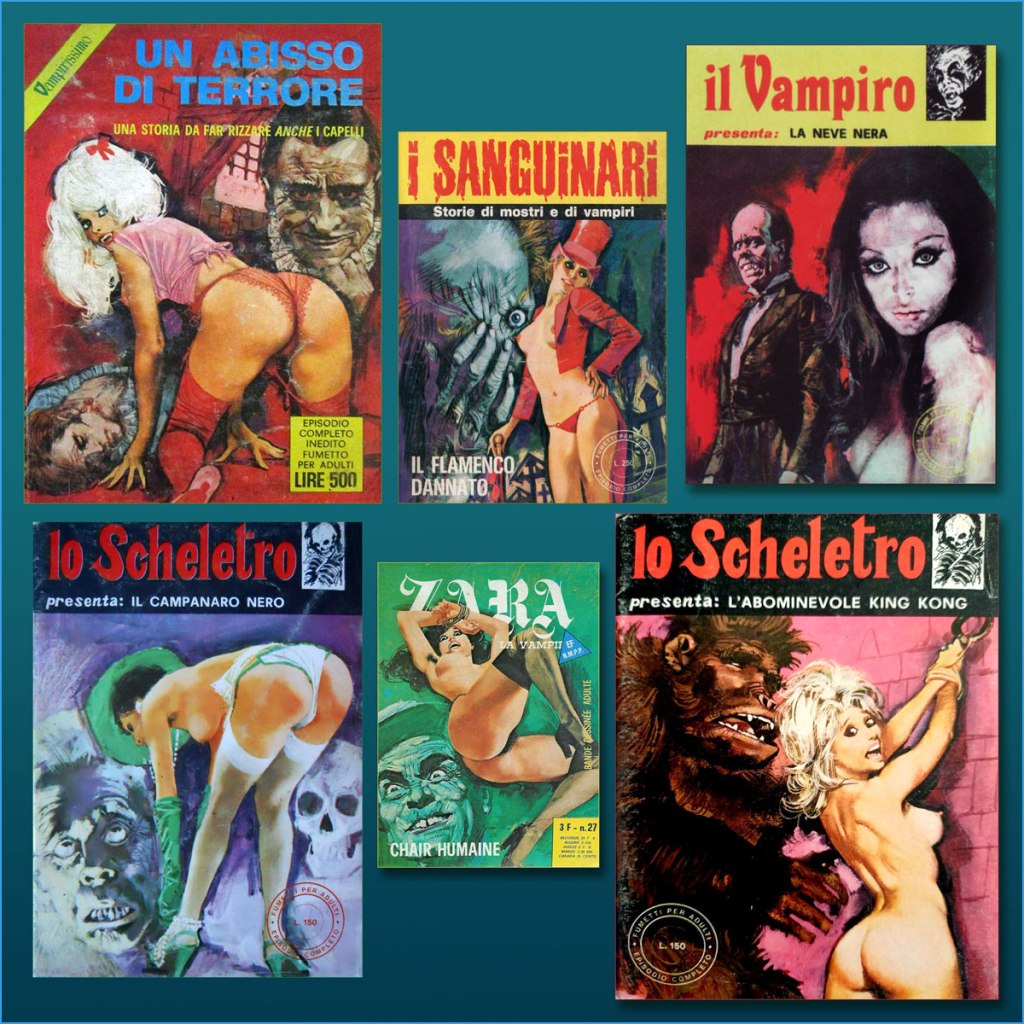
A selection of our fine products, as they appeared in print.
Vampirissimo no. 11 (Nov. 1975, Edifumetto). “An Abyss of Terror”.
Leaned in too close and got poked in the eye! I Sanguinari no. 9 (July 1975, Edifumetto). “Flamenco of the Damned”.
Il Vampiro no. 5 (March 1974, Edifumetto). “The Black Snow”. Why, hello, Mr. Chaney!
Lo Scheletro no. 13 (July 1974, Edifumetto). “The Grim Bell Ringer”.
Zora la Vampira no. 1 (Jan. 1974, Edifumetto) — “Human Flesh” In French, Zora became ‘Zara‘, for some reason.
Lo Scheletro no. 3 (March 1975, Edifumetto). “The Abominable King Kong”.
Tabù no. 23 (Oct. 1975, Edifumetto). “Please Don’t Bite My Butt”.
I Notturni no. 9 (Sept. 1973, Edifumetto). “Peter the Fornicator”. Impressive, given his mug.
Vampirissimo no. 8 (Aug. 1974, Edifumetto). “Death by Fright”. Oh, he’s a spooky one, all right.
Vampirissimo no. 7 (July 1974, Edifumetto). “Monster Dimension”. This is the sort of composition and treatment that Bill Sienkiewicz would “introduce” to mainstream comics a decade later, blowing the minds of Marvel Zombies who’d consumed naught but the House of Ideas’ offal, just as Jim Steranko had blown their older brothers’, a decade prior.
Lo Scheletro no. 7 (Apr. 1974, Edifumetto). “Demon in Love”.
This fine* monograph from Korero Press (2019) spotlights a certain facet of Carcupino’s œuvre, though it’s pretty light on the horror, which is fine by me. The narrow thematic focus (on sex, the other half of the equation) does manage to render the proceedings a tad tedious after a while, but that’s to be expected. For a better sense of the man’s versatility, check out his website.

-RG

*marred somewhat by the usual We Italians...” introduction, yet another variation on the line of “we are so passionate, we love women so much, we can’t control ourselves” bullshit. I guess it’s perfectly commonplace, for some people, to confuse misogyny with love . Right…

Tentacle Tuesday: a Day at the Beach

I am on vacation! (Or I will be, by the time this post is published.) I have no idea what sort of beaches I will have the pleasure to encounter, but I doubt it’s the kind that’s depicted below.

And now, everyone to the beach! Orrore sulla spiaggia!

LarsonNudeBeachA
Page from Rich Larson‘s Haunted House of Lingerie, Vol. 2 (July 1999). I’m pleased to see that the octopus seems to have undressed the man as well.

Beach-Sukia89
This is the original art for the cover of Sukia no. 89. Art by Emanuele Taglietti, whose specialty was sex and horror! Sukia, already part of one T.T. roster (see Tentacle Tuesday: Euro Tentacles Unto Horror), was an erotic Italian comic that ran from 1978 to 1986, published, as is often the case for such things, by Edifumetto. Sukia’s alluring form is based on that of actress Ornella Muti, though it’s probably somewhat less obvious from this cover.

I’m getting carried away here with sun-tanning and babe-centric pastures and whatnot. People also go fishing on vacation, right?

AddamsFishingTentacles
Cartoon by Charles Addams.

Or just walking along the beach…

SantaClausFunnies#2-1943
A panel from “Lord Octopus Went to the Christmas Fair”, a poem by Stella Mead. Art by Walt Kelly; published in Santa Claus Funnies n° 2, 1943. Slightly unseasonal, sorry.

Or just flingin’ an octopus about… The local authorities might object, however.

WhizComics115
Whiz Comics n° 115 (November 1949), art by Kurt Schaffenberger.

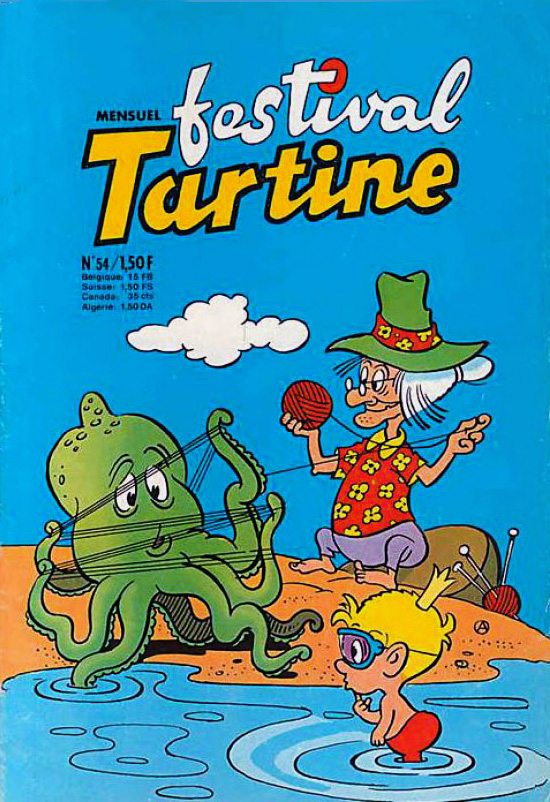
A little knitting, perhaps? Don’t mind if I do!

Festival-tartine-n-54
Festival Tartine n° 54 (November 1971). Grand-mother Nonna Abelarda, created in 1953 by Italian Giulio Chierchini, came to France in 1956 and was renamed Tartine Mariol. This intrepid granny appeared in Presto and in Arc en Ciel until her popularity prompted the publishers to give her her own series in 1957.

~ ds

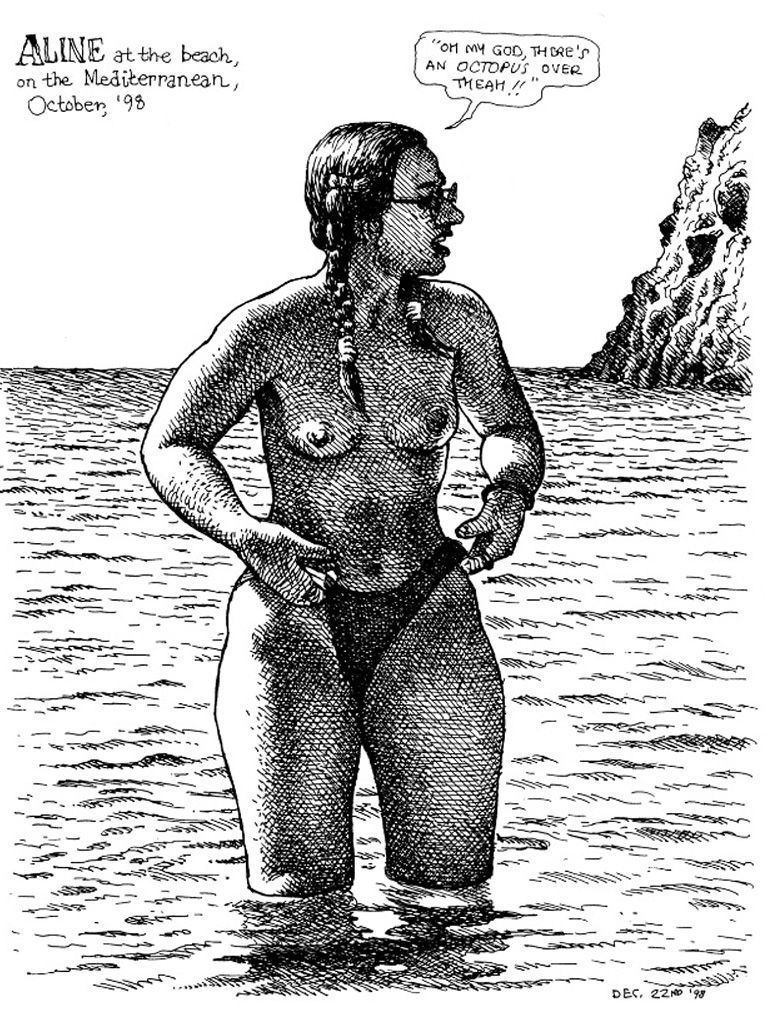
P.S. A little bonus, though only involving an off-screen sighting of an octopus:

beach-RobertCrumb-Aline
Cartoon by Robert Crumb, as if you needed to be told, featuring Aline Kominsky-Crumb.

Tentacle Tuesday: Euro Tentacles Unto Horror

Tentacles have no anglophonic bias.  A tasty human morsel is every bit as appetizing when it’s babbling in Italian or German. Join me on a visit to the European side of things, where tentacles are truly horrifying and there’s none of this politely-hold-a-girl’s-leg stuff. It’s gore and revulsion through and through!

HorrorTalesV3#2A
Horror Tales vol. 3 no. 2 (1971, Eerie Publications). Let’s have a moment of silence for what the poor guy is going through, being swallowed alive by a pulsating pink monstrosity which appears to have the same hole for eating and waste evacuation like some sea anemone (that has that has a single orifice for eating, excreting, and shedding eggs and sperm) and is about as appetizing. No, scratch that, sea anemones are much better.

The cover, painted by German artist Johnny Bruck, is a reprint from the German sci-fi series Perry Rhodan, published by Moewig-Verlag starting in 1961. Here is the original:

PerryRhodan136
Perry Rhodan no. 136. « Beasts of the Underworld », if you were wondering.

If the last cover made me vaguely think of an arsehole, this next one clenches, er, *clinches* this unfortunate association.

WitchesTalesVol3#5A
Witches’ Tales vol. 3 no. 5 (1971, Eerie Publications). Tentacles that look like furry slugs, a face like a puckered, blood-stained anus… this creature even his mother couldn’t love. And the victim? Why the fuck is a vampire in an astronaut’s helmet? And why a vampire at all – isn’t a tentacled monstrosity scary enough without bringing a blood-sucker into it? This witch is having nightmares.

The cover is by Franz Fernández, a Spanish artist born in Barcelona. He worked for Selecciones Illustrades, a Spanish art agency mostly known for its deal with Warren Publishing, which led to many Spanish artists submitting stories to Warren between 1971 and 1983.

On a somewhat less revolting, yet no less puzzling, note, we have these gorilla dinosaurs with tentacles. Why the hell not? I dedicate this cover to my friend Barney, a fan of silverback gorillas.

Gespenster Geschichten1399
Gespenster Geschichten no. 1399 (1974, Bastei Verlag). Gespenster Geschichten, “Ghost Stories” in German, was a weekly comic book series that ran between March 1974 and March 2006, which certainly gives us a clue as to how successful it was. In the early years, most stories in Gespenster Geschichten were reprints of American horror comics, pretty much what one would expect: lots of appearances from Frank Frazetta, Jack Kirby and Wally Wood, for instance. When the magazine stopped relying on reprints and started featuring new content, Argentine, Spanish, Peruvian and Italian artists provided most of the artwork, together with Yugoslav artists (such as Goran Sudzuka) and a couple of German ones, most noticeably Hans Wäscher, a revered German comics artist (whom Google comically translated as “hans scrubber”). This cover points out that the contents are “neauflage”d (i.e. reprinted).

I appear to be utterly incapable of doing a Tentacle Tuesday post without some sort of scantily clad, beautiful maiden joining the fray. Why resist? Here are a couple of precursors of The Possession.

Orror14A
Orror no. 14 (1978, Edifumetto). For once, the monster is kind of cute, as opposed to completely nauseating. Art by Alessandro Biffignandi.

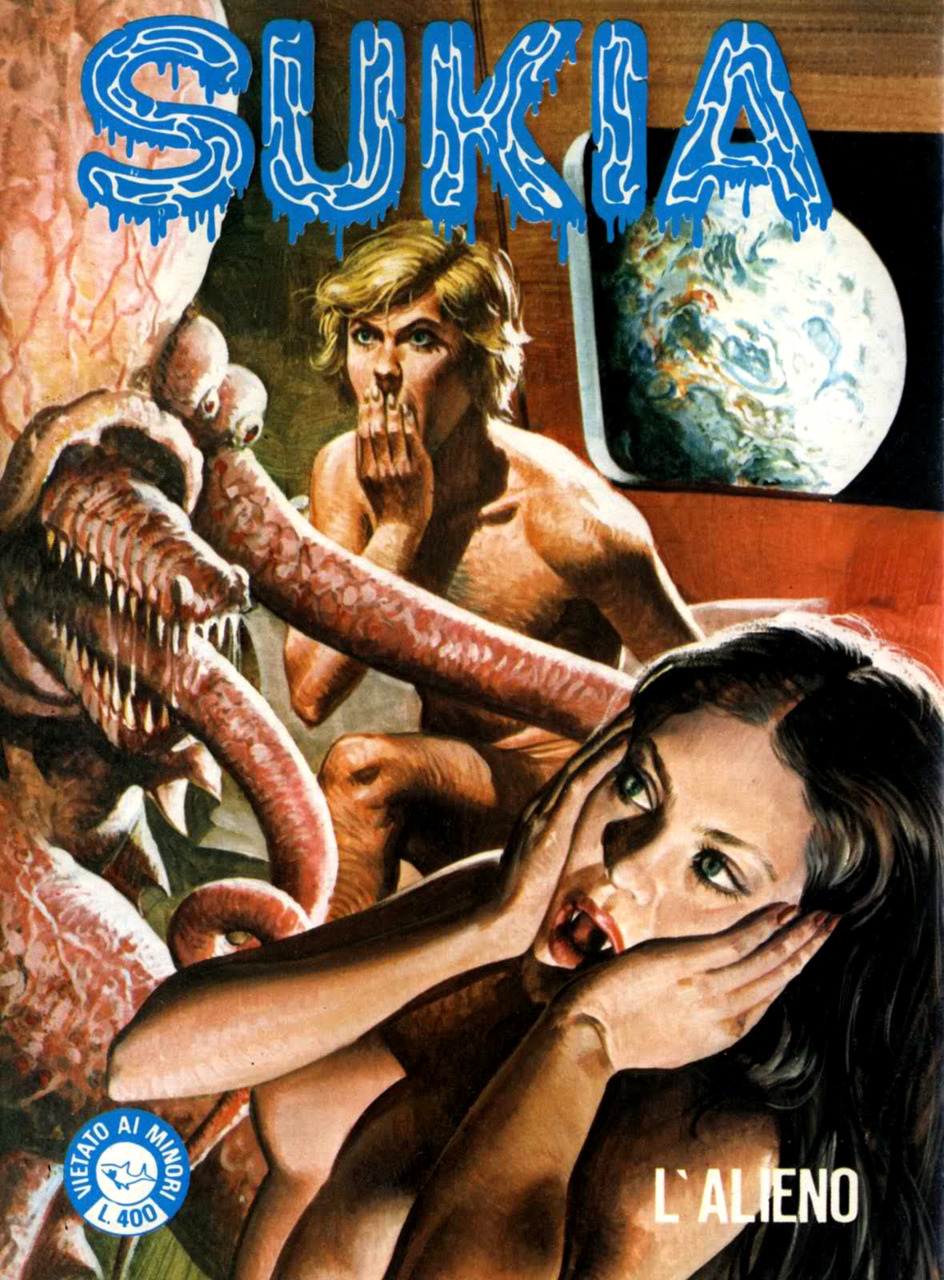
Sukia52-cover
Sukia no. 52 (1980, Edifumetto). Sukia was a joint effort of Renzo Barbieri, founder of Italian publishing house Edifumetto, and Fulvio Bosttoli. Ornella Muti fans, take note.

The original painting allows us to see more detail in the alien’s, err, anatomy. After seeing this, I don’t think anybody needs abstinence speeches.Sukia No. 52 L'alieno 1980

~ ds