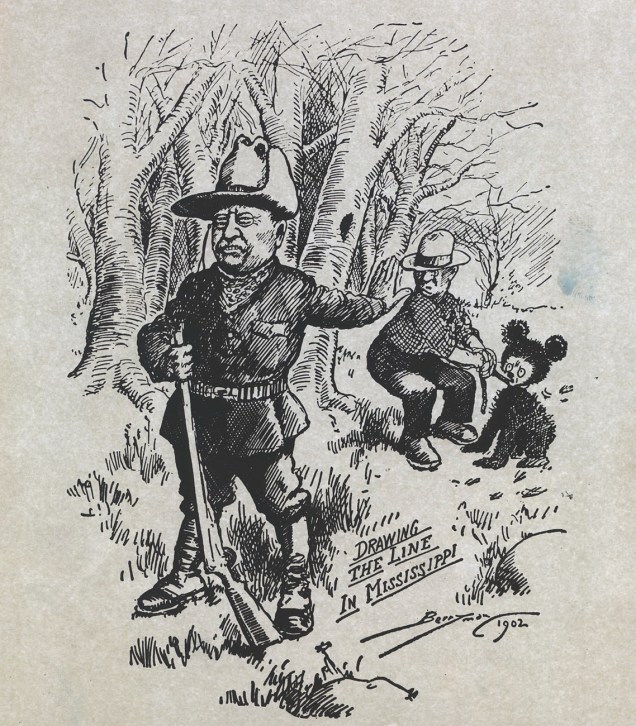
A cartoon appears in the Washington Post, prompting the Teddy Bear Craze, after President Teddy Roosevelt refused to kill a captive bear tied up for him to shoot during a hunting trip to Mississippi.
Boy, American presidents sure were different back in those days.
The history-making cartoon by Pulitzer Prize–winning cartoonist Clifford K. Berryman (1869-1949), who worked with the Washington Post from 1891-1907, then with the Washington Star from 1907-1949.
Which brings us to Teddy Bears (as they became known henceforth) returning the favour of protecting the vulnerable and innocent.
The earliest instance that comes to mind is Johnny Craig and “Ghastly” Graham Ingels’ holiday charmer, Shoe-Button Eyes!, which appeared in The Vault of Horror no. 35 (Feb.-Mar. 1954, EC), wherein a blind, put-upon little boy gets a new set of peepers… the hard way.
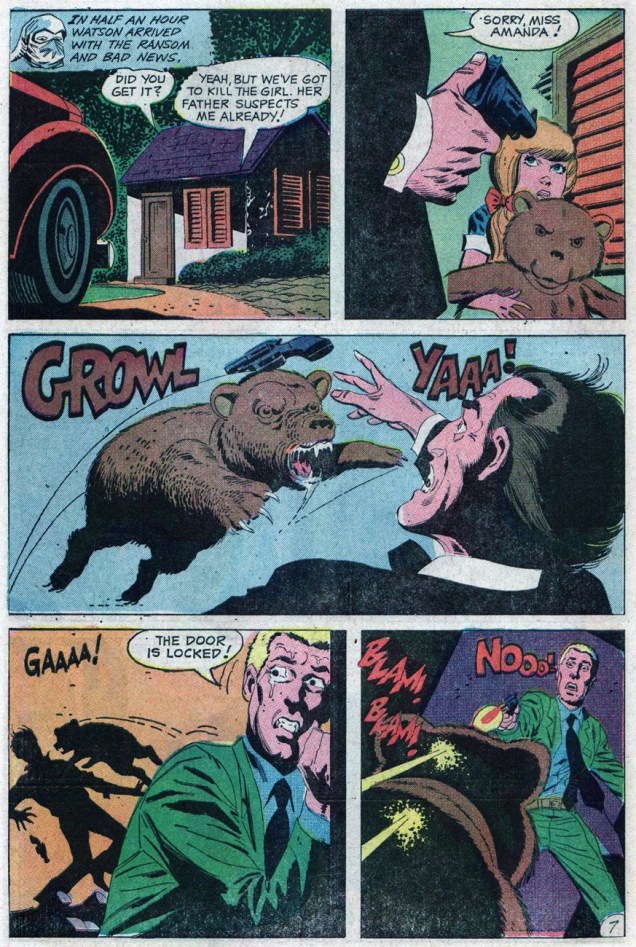
Post-Code, this sort of harsh poetic justice had to be handled very gingerly, if at all. The vengeful bear turned up again in Nicola Cuti and Jack Abel’s elegantly-told The Teddy Bear, in Haunted no. 15 (Nov. 1973, Charlton.)
Quoth the plush companion: « I was sent to you to protect you and I will! » Spoiler alert: the butler did it.
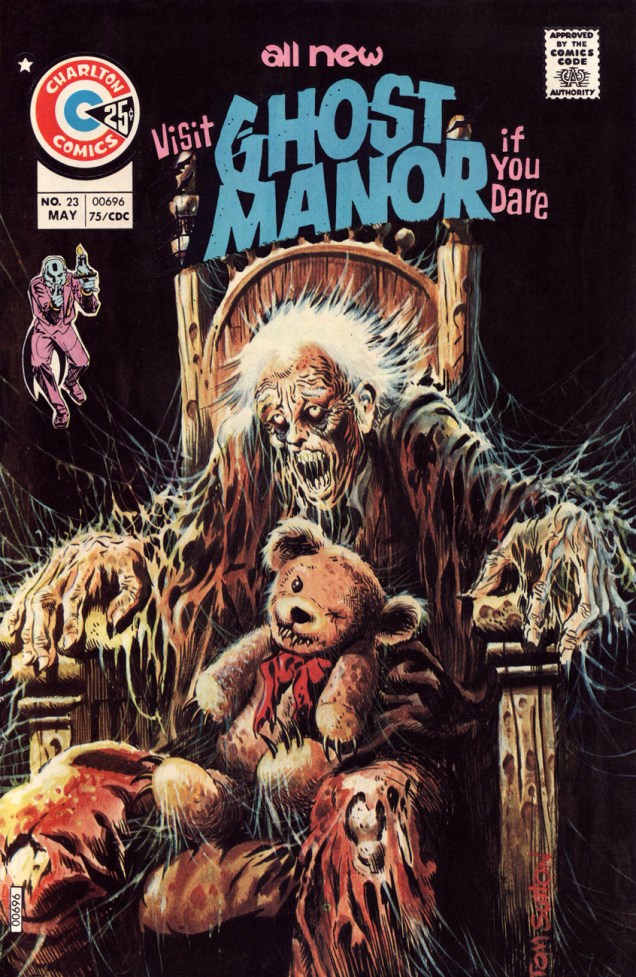
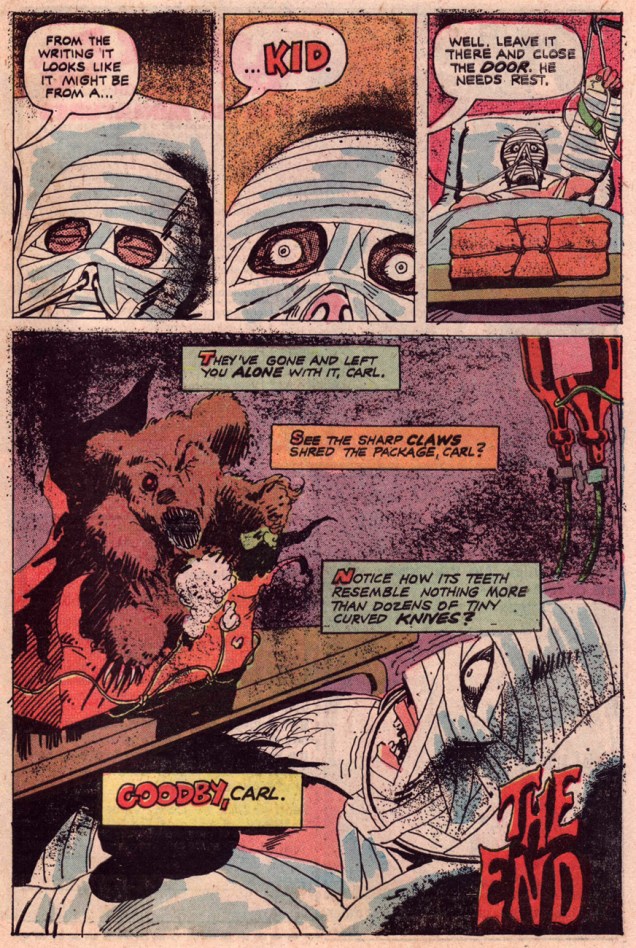
A couple of years down the pike, “Grisly”* Tom Sutton took up the gauntlet with his «Terrible Teddy!», from Ghost Manor no. 23 (May 1975, Charlton). Here it is, presented in its glorious entirety (including Sutton’s gnarly painted cover).
– RG
*perhaps more appropriately “Grizzly”, in this instance.
« Thought I’d inject a little excitement into this initiation… do I look any worse for wear? »
When EC überfanRuss Cochran launched his incredibly ambitious series of hardcover sets of the complete EC Comics in the late 1970s, there was simply no way I could afford the lot… so I gathered my shekels and mail-ordered a single volume of Tales From the Crypt (no. 3, midway through the run) and further managed to sweet-talk a nice lady at the local public library into ordering the first volume of Weird Science (years later, I would meet a couple of kids who’d become obsessed with the book, signing it out dozens of times and wondering how it had ever come to be acquired by our small, mostly francophone library).
Since the EC formula (meaning Bill Gaines & Al Feldstein) does wear thin with prolonged exposure, I gravitated to the outliers: Harvey Kurtzman, Johnny Craig, Bernie Krigstein, the Bradbury adaptations… but the true revelation in these volumes turned out to be John Benson and Bhob Stewart’s superb documentary notes, comprising astute analyses and eloquent interviews with the surviving participants… which are nowadays down to, well, colourist Marie Severin.
Anyhow, I was particularly intrigued by Gaines and Feldstein’s early system of “springboards”, which is to say that they based stories upon anecdotes encountered in newspapers and magazines. One title evoked time and again is Try and Stop Me (1944)*.
From John Benson’s documentary notes in Haunt of Fear, Volume 1 (1985):
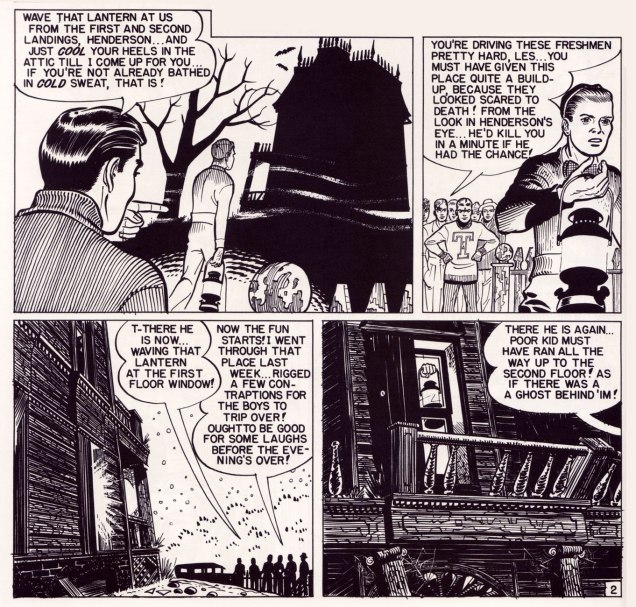
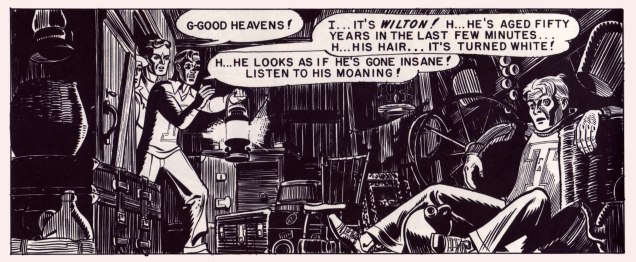
« ‘House of Horror’ [Tales from the Crypt no. 21, Dec. 1950 – Jan. 1951] is even more directly derivative; the story is merely an elaborated version of an anecdote from the Trail of the Tingling Spine chapter of Bennett Cerf’s Try and Stop Me, which was the source of a number of EC stories. Kurtzman remembers the story as ‘an ass-breaker.‘ It was the first story he did for the EC line and he wanted to make a good impression. ‘It was the effort that got me the EC account.‘ ».
House of Horror was scripted by Ivan Klapper, who contributed a few stories, early in the EC horror titles’ run. He went on to work on John Newland‘s 1959-61 anthology show, One Step Beyond.
If you’re used to the usual rubbery, sketchy (but deceptively spontanous-looking) Kurtzman, brace yourself.
« At initiation time it was my idea to take the three neophytes we had selected and brundle them out to a deserted house about fifteen miles from the campus. It had been unoccupied for years, was windowless, sagging and ugly, and was said by the villagers to be haunted. We picked a black, starless night for the initiation, and all the way out to the place poured tales of horror and the supernatural into the ears of our three apprehensive freshmen. »« I watched him enter the deserted house. It was about two hundred yards from where we were gathered. His instructions were to stay inside for a half-hour, and then come back to us. When forty-five long minutes went by without any sign of him, I experienced my first uneasiness, and dispatched the second freshman to fetch him. Ten more minutes went by. Nothing happened. There wasn’t a sound anywhere. The fire was burning low – we just sat there, quietly watching. »« ‘These kids are a little too smart for their own good’, I said at last. ‘Davis, get in there and bring them back fast,’ Davis was our prize conquest – a handsome, two-hundred-pound boy whose scholastic records foreshadowed an almost certain place on the next year’s All-American squad. He had already been elected president of the freshman class. »« The first thing that struck me when I entered was a musty smell like the smell of an attic full of old books and newspapers. I yelled for the boys, and poked my flashlight into every corner but there wasn’t a sign of them. Only a faint, steady tap that seemed to come from the roof. »The relevant illustration, by Carl Rose, from Try and Stop Me’s original version. « I stuck my head through the open skylight. There was Davis, stretched out on his stomach! His hair had turned snow-white. His eyes rolled in his head. He was mad as a hatter. In his hand he held a hammer covered with blood. » « He died in the college hospital the next morning without uttering a single syllable. We never found any trace of the other two boys… »
*I lucked out and found a nice copy in the 1980s… for $4.50, according to the usual lightly-pencilled note on the flyleaf.
« Newly dead, the gases of decomposition moving in the stomach… moving the body like a rag doll whose lips flutter and belch… »
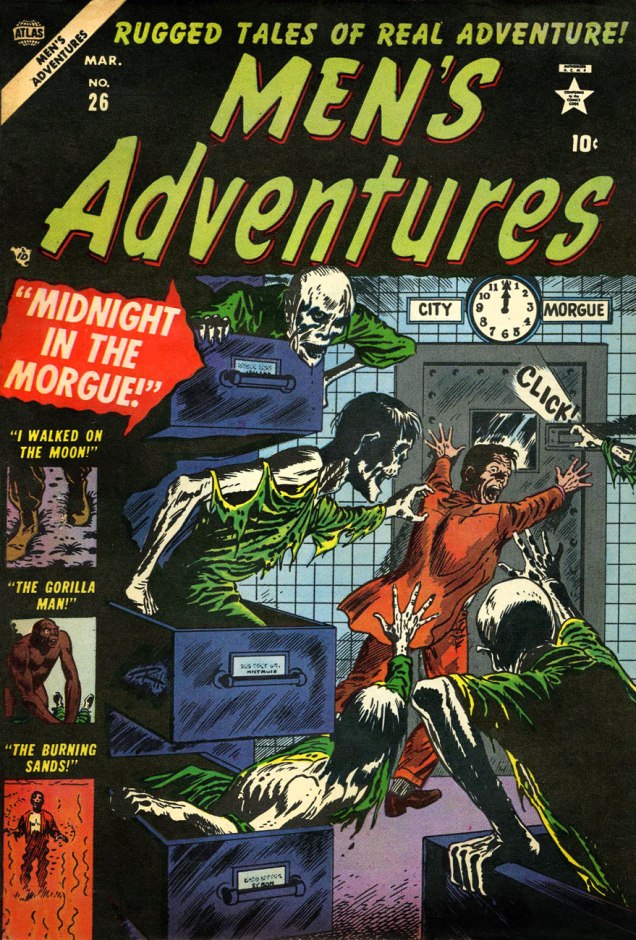
Atlas anthology Men’s Adventures (25 issues, 1950-54) was a pretty schizoid entity, with an editorial emphasis waffling from your typical would-be rugged he-man stuff (issues 4* to 8) to battle action (9 to 20) to mild horror (21-26) to, as a last resort, superheroes (27-28).
Russ Heath delivers his usual fine job for Men’s Adventure no. 26 (March 1954, Atlas). I like the matching green outfits on the cadavers. Yay, team!
In the mid-1970s you could tell that Marvel was running low on reprintable pre-Code material when items from Men’s Adventure began to pop up in its mystery anthologies.
Our cover story turned up then in Chamber of Chills no. 20 (Jan. 1976) announced by this ridiculous Ron Wilson/Dan Atkins cover. There’s a Broadway musical in there, I swear.
Since this was 1970s Marvel, the corpse is not only well-preserved, he’s buff as it gets. For comparison, read “Midnight in the Morgue” (writer unknown, art by Dick Ayers), with our thanks and a fond tip of the hat to The Horrors of It All blog.
A more haunting variation on the “trapped in the morgue with the not-quite-dead” theme is Nostalgia Press’ historically significant Horror Comics of the 1950’s (1971, edited by Bhob Stewart, Ron Barlow and original publisher Bill Gaines), which gathered, in full colour, 23 EC classics, including one previously unpublished story, An Eye for an Eye. The cover revives (ha!) Al Feldstein’s Tales From the Crypt no. 23 art from 1951.
Like many fellow modern-day EC Fan-Addicts, this book first came to my attention through the Captain Company catalogue that occupied the back pages of Warren Magazines. So many elusive, haunting grails… many of them turning out to be great beyond all reasonable expectations.
*the actual first issue… typical 1950s comics numbering scheme.
Welcome to our daily rending of calendar leaves ’til All Hallows’ Eve 2017 is upon us, all flailing fangs and claws…
We open with a salute to our kindred evil spirits, the ticklish rogues who bring us The Simpsons. Their Halloween Special / Treehouse of Horror episodes, by now numbering thirty entries, have done much to keep the torch of seasonal eeriness ablaze over the years.
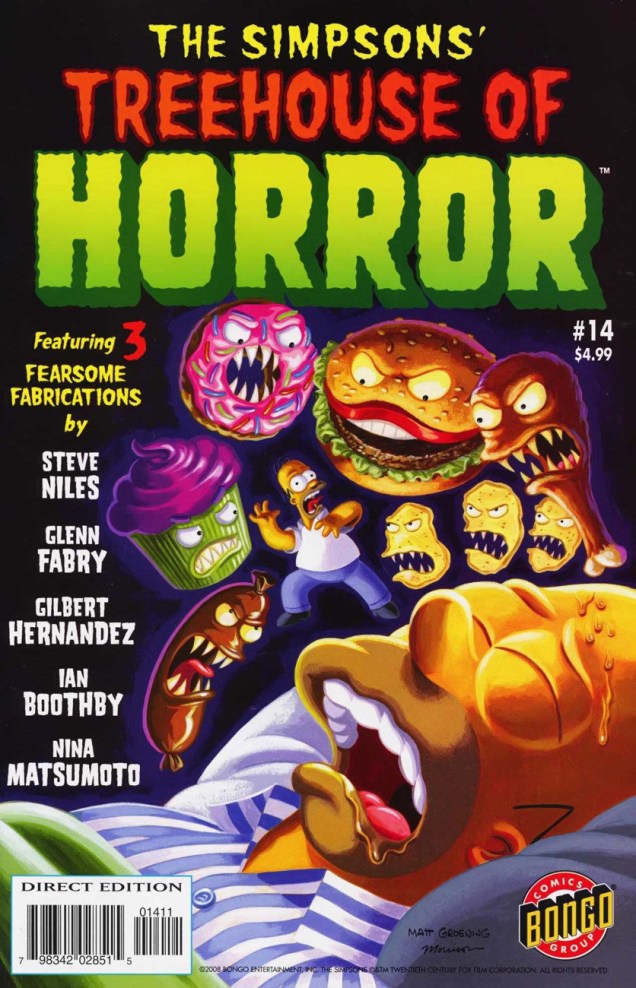
The comic book spinoff series is none too shabby, either: launched in 1995, it also appears once a year, when noons go quickly, dusks and twilights linger, and mid-nights stay**. It shares its parent show’s penchant for references to comic books and magazines, toys and films and tv shows, some recent, some rather ancient, some known to all and some surprisingly (and wonderfully) obscure.







 Who's Out There?