The Spirit in “The Tale of the Dictator’s Reform” (1941)

« Fascism will come to America wrapped in a flag. » — Sinclair Lewis

With the exception of its daily strip incarnation (1941-44), principally ghosted by Jack Cole, the early years of Will Eisner’s The Spirit never drew me in. Next to the work Eisner produced upon his return from WWII, the first years seemed tentative and inchoate. It didn’t help that the original artwork — or even quality photostats — of the material had not survived, and so reprints were consequently hobbled by dodgy reproduction.

The other day, a most generous friend presented me with the second volume of Will Eisner’s The Spirit Archives — he had a spare copy — and, not wishing to look a gift horse in the mouth, I duly proceeded to read it. I should state that DC Comics’ complete reprinting of Eisner’s magnum opus is a definitive one, so the pill was far easier to swallow this time.

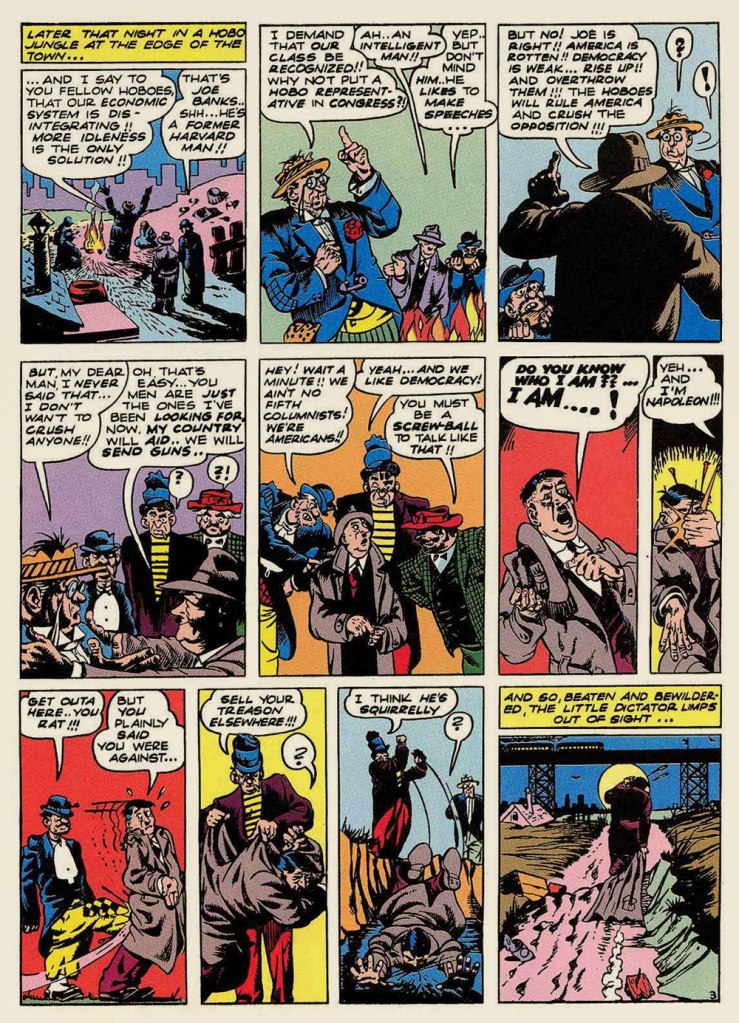
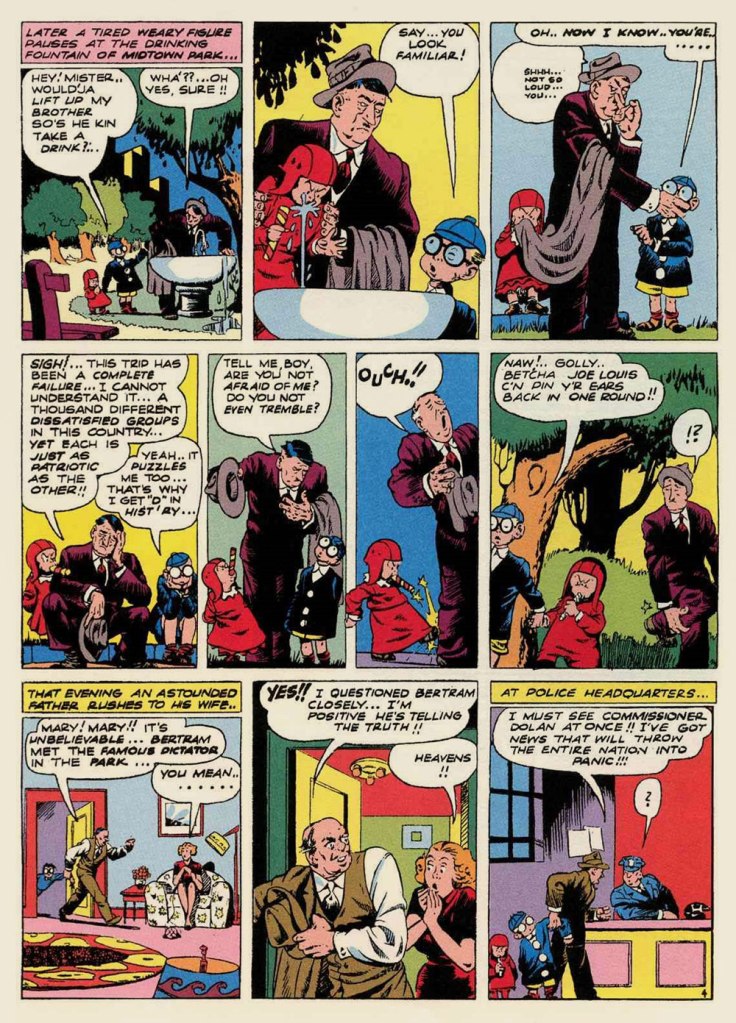
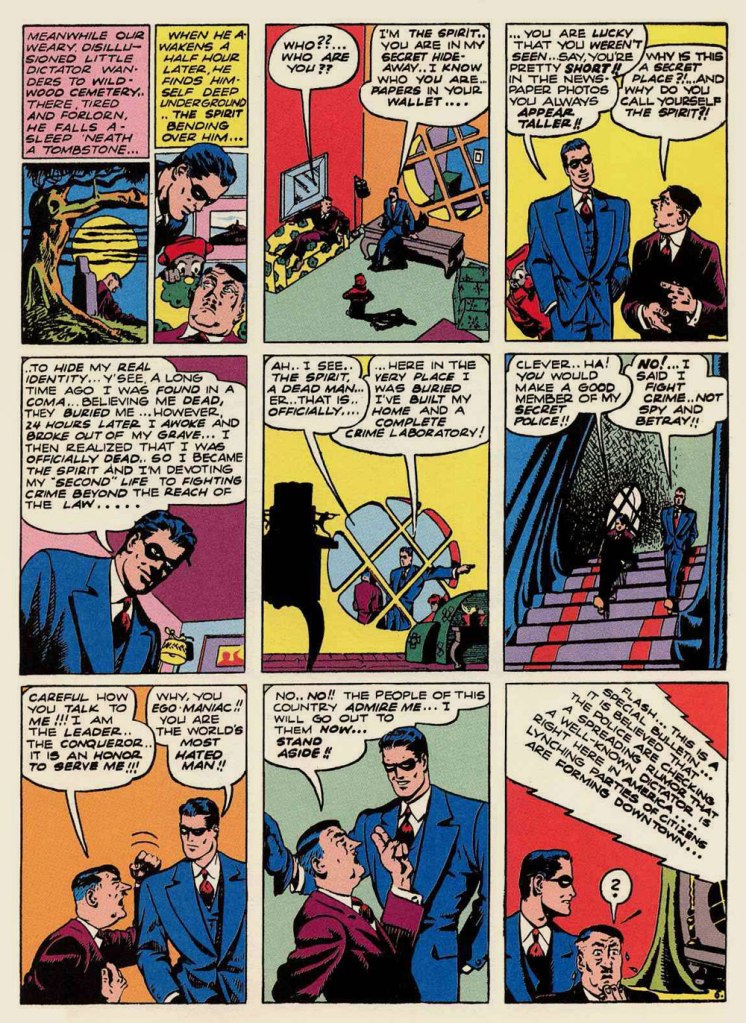
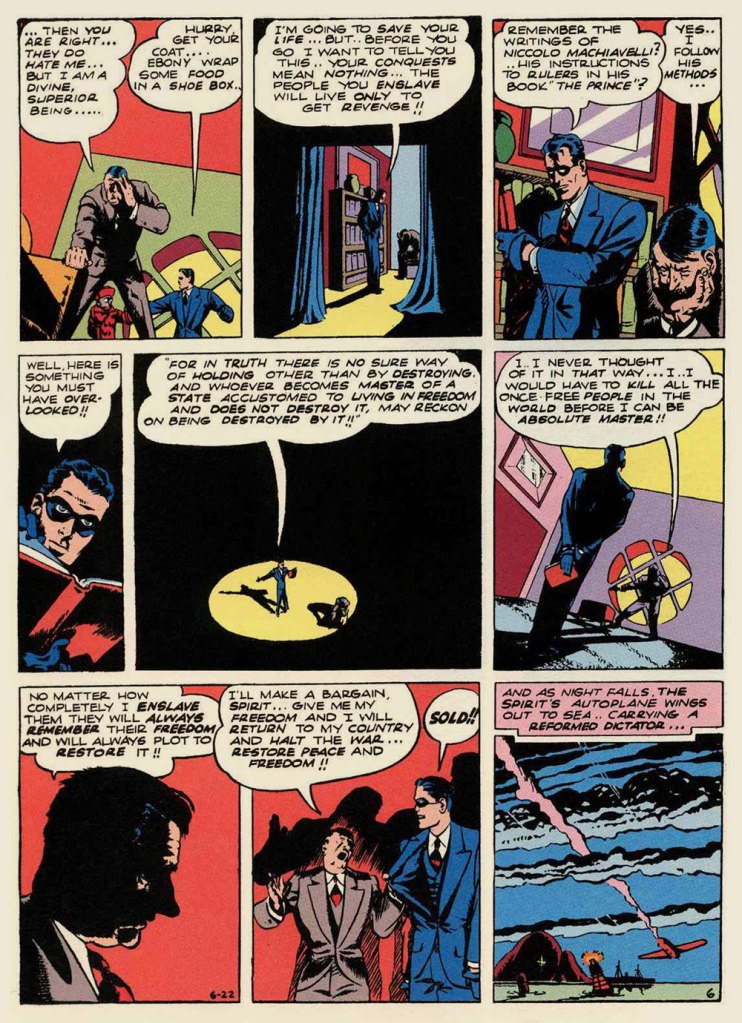
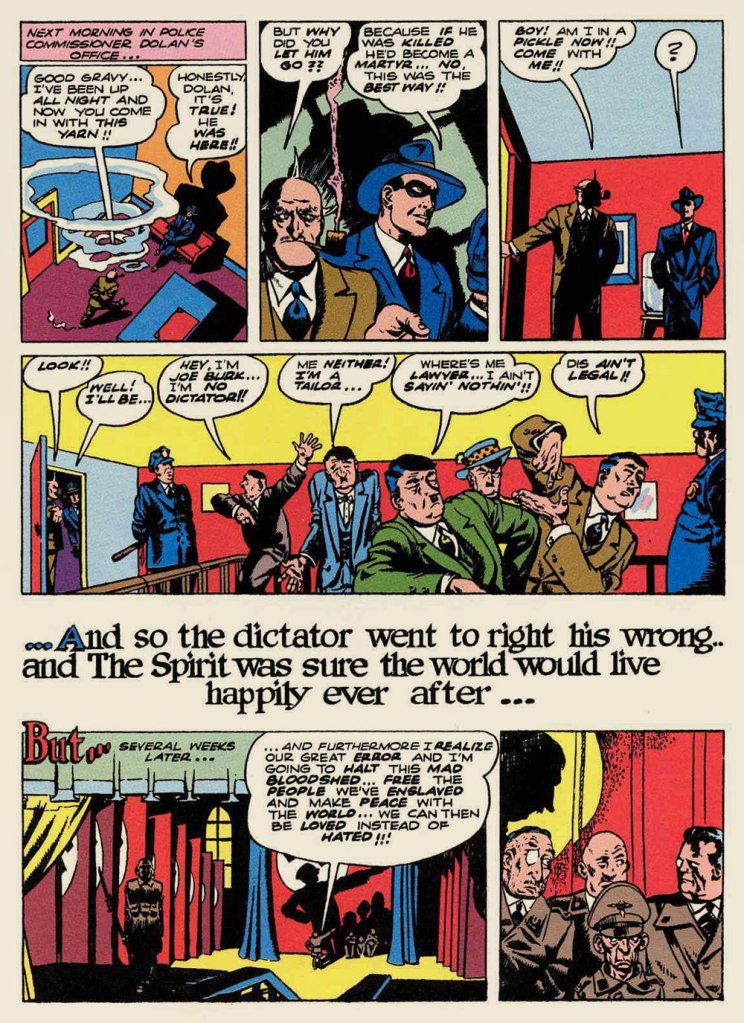
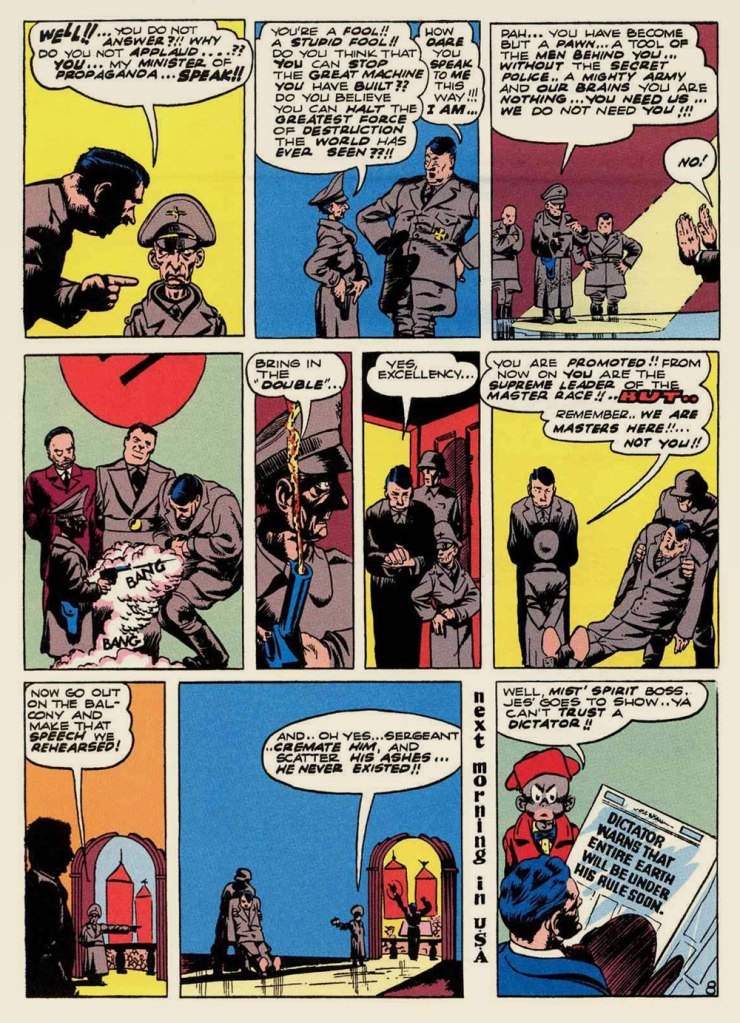
I was particularly taken with one gem near the end of the volume. And since America is currently awash in fascists and Brownshirts, Eisner’s political parable seems unnervingly apropos. See what you think!
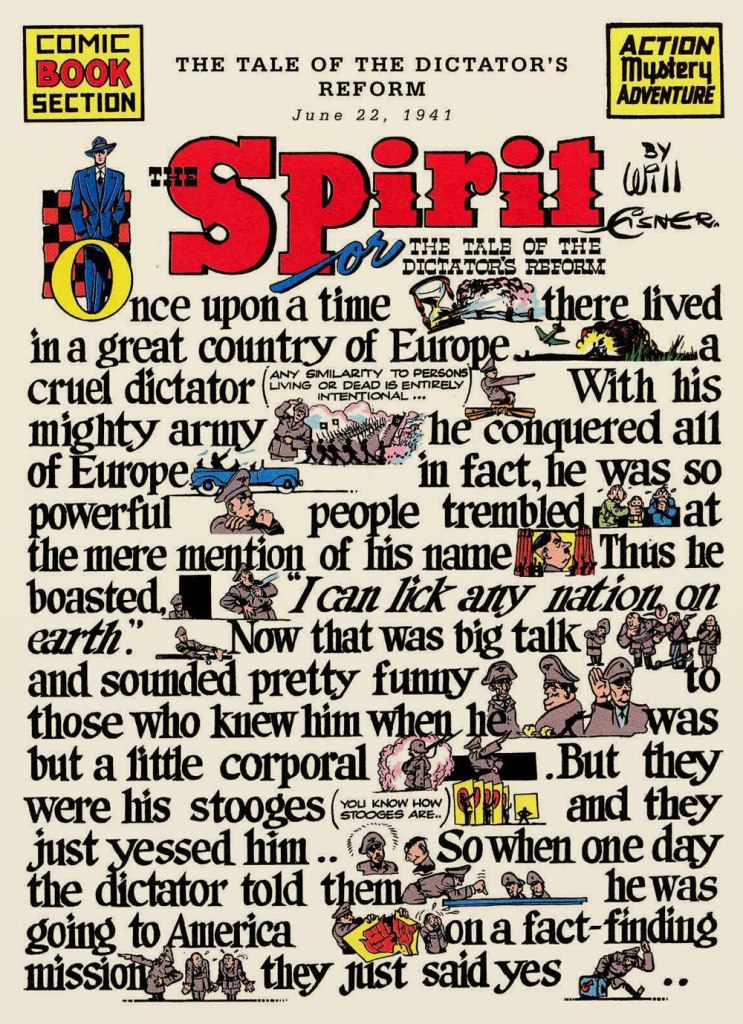
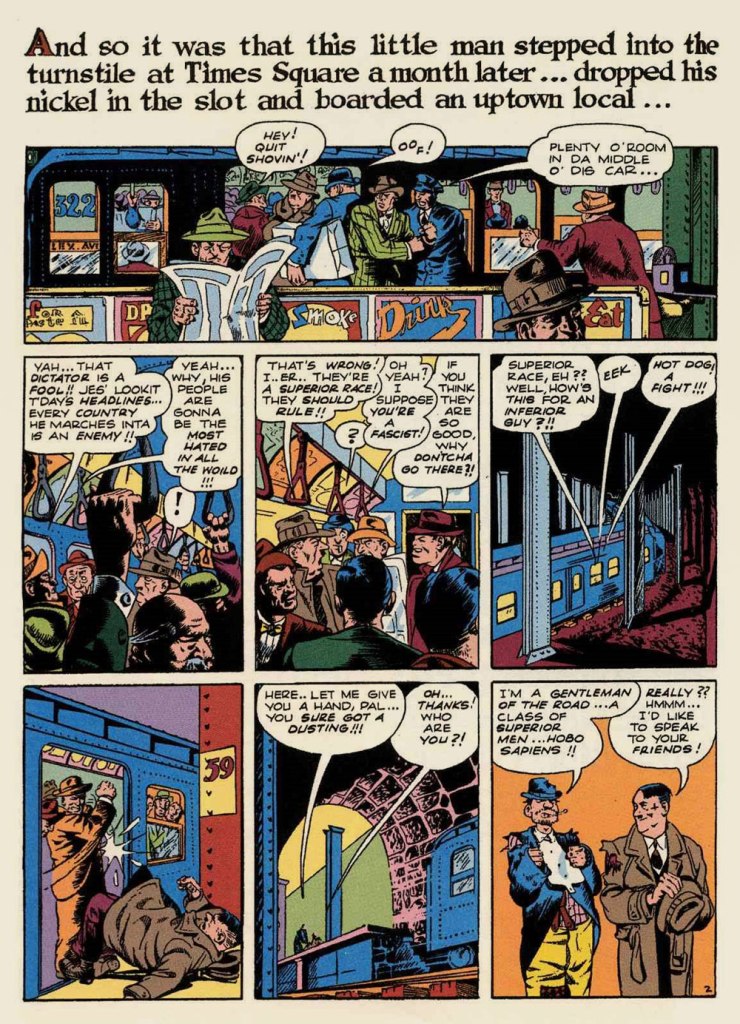
Like it says at the top of page one, The Tale of the Dictator’s Reform was originally published on June 22, 1941. The United States’ December 9th entry into the war was still several months away.

This episode was cited as a solid favourite of his lone surviving The Spirit assistant*, the mighty Jules Feiffer (born 1929) in his pioneering work of comics history, 1965’s The Great Comic Book Heroes. Mr. Feiffer wrote: « Eventually, Eisner developed story lines that are perhaps best described as documentary fables — seemingly authentic when one reads them, but impossible, after the fact. There was one about Hitler walking around in a Willy Lomanish middle world: subways rolling, Bronx girls chattering, street bums kicking him around. His purpose in coming to America: to explain himself, to be accepted as nice guy, to be liked. Silly when you thought of it, but for eight pages, grimly convincing. »

When the story finally was reprinted — some sixteen years after Feiffer’s tantalising plot summary — in Will Eisner’s The Spirit no. 32 (Dec. 1981, Kitchen Sink), associate editor Cat Yronwode added: « Indeed, the story is all that Feiffer said of it and more. He forgot to mention that The Spirit fixed Der Fuehrer a nice bag lunch, for instance, and obligingly flew him home after his American sojourn. It’s been a long time coming, but at last we can proudly bring you this little gem, possibly the most eccentric political homily ever produced in the comics form. Enjoy it, but don’t ask for more of the same. It’s unique. »

-RG

*the next-to-last Spirit assistant, Don Perlin, passed away earlier this month. He had pencilled three stories over Feiffer’s layouts in 1951, late in The Spirit’s run.

Tentacle Tuesday: The Tentacles Are Coming! The Werewolves Are Here!

« The tentacles had burned where they’d touched our skin… and the oozing slime they’d rubbed into the wound didn’t help. We panted and trembled »

I have little interest in werewolves, despite just having finished one in wool. I’d say I place them somewhere between Frankenstein’s monster (in which I have zero interest – sorry!) and Dracula (whom I am generally intrigued by, depending on whose version we’re talking about). Having said that, the bizarre concept of werewolf vs tentacles grabbed my imagination by its incongruity. “Grarr”, as the werewolf might say.

The author and her werewolf; he doesn’t have a name, yet.

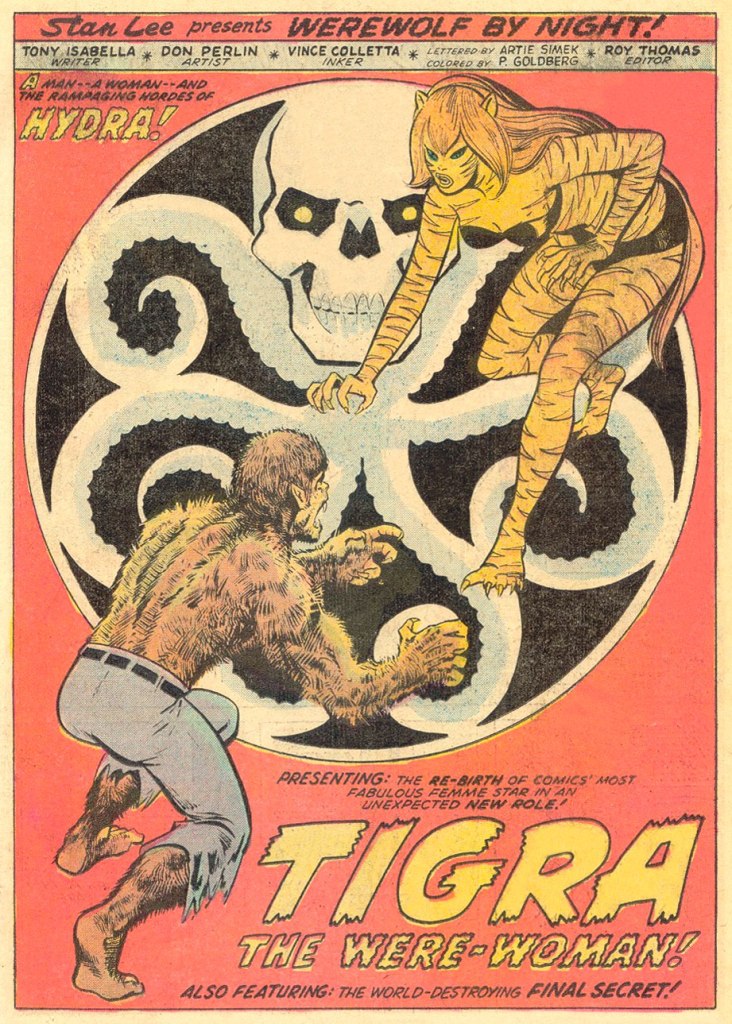
The Giant-Size Werewolf may not be as rife in tentacles as the Giant-Size Dracula, but it has its moments. “A man, a woman… and rampaging hordes” has a certain nice ring about it!

A page from Tigra the Were-Woman!, published in Giant-Sized Creatures no. 1 (July 1974). Script by Tony Isabella, pencils by Don Perlin and inks by Vince Colletta.

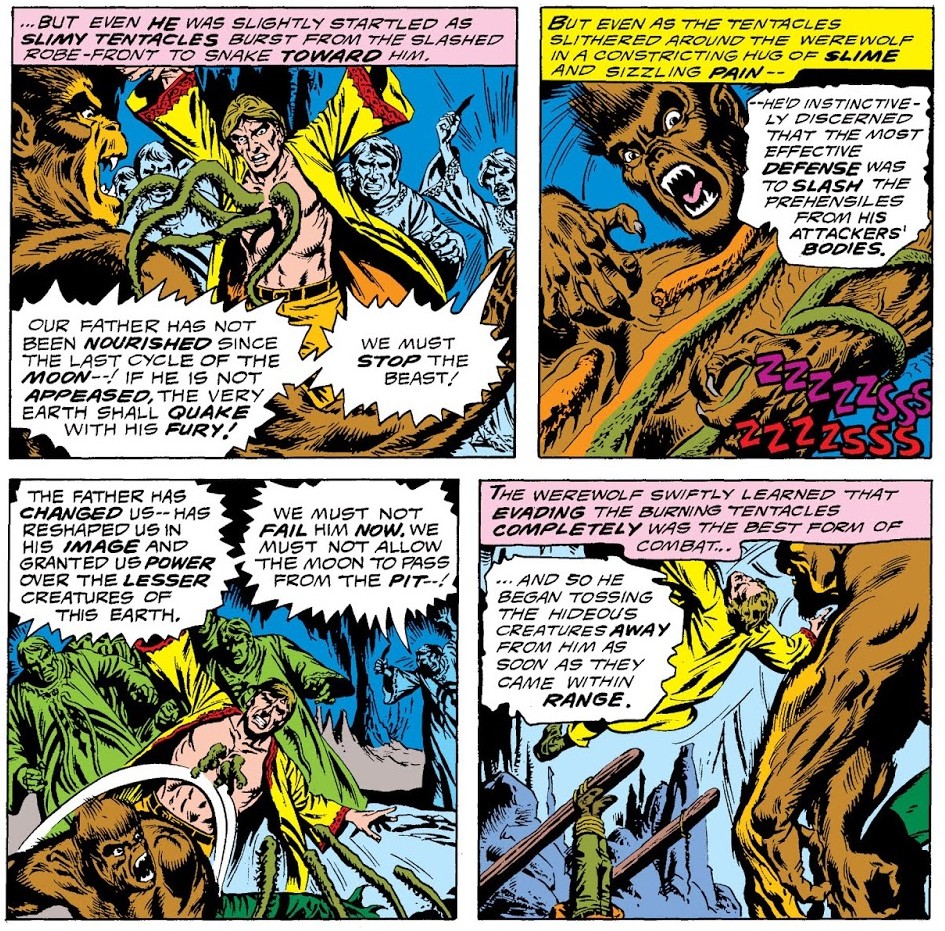
When the Moon Dripped Blood!, scripted by Doug Moench and illustrated by Yong Montaño, was published in Giant-Size Werewolf no. 4 (April 1975):

Anybody would be startled by slimy tentacles coming out from under a robe… slimy and burning, at that.

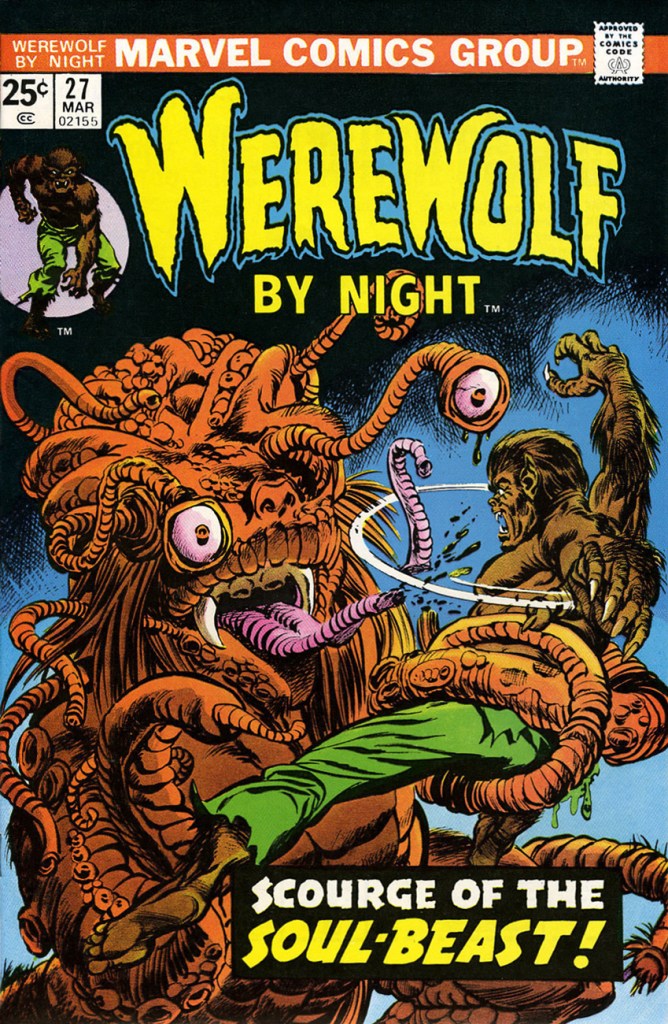
Doug Moench continues his tentacle shenanigans one month later in Werewolf by Night no. 7 (March 1975).

Cover pencilled by Gil Kane (Tentacle Tuesday dabbler!) and inked by Tom Palmer.

The Amazing Doctor Glitternight was scripted by Doug Moench and illustrated by Don Perlin:

Likely beating all records for how much text you can cram into one splash page.
The “yecch-monster” awakens as Glitternight somehow manages to exude both light and darkness, and simultaneously nourish and feed. I get the impression somebody was paid by the word for this story.
Has the werewolf ever heard that “words are very unnecessary“? Was it essential to inform us that he might have been stunned, or maybe paralyzed, and it doesn’t matter anyway, as both are just words?

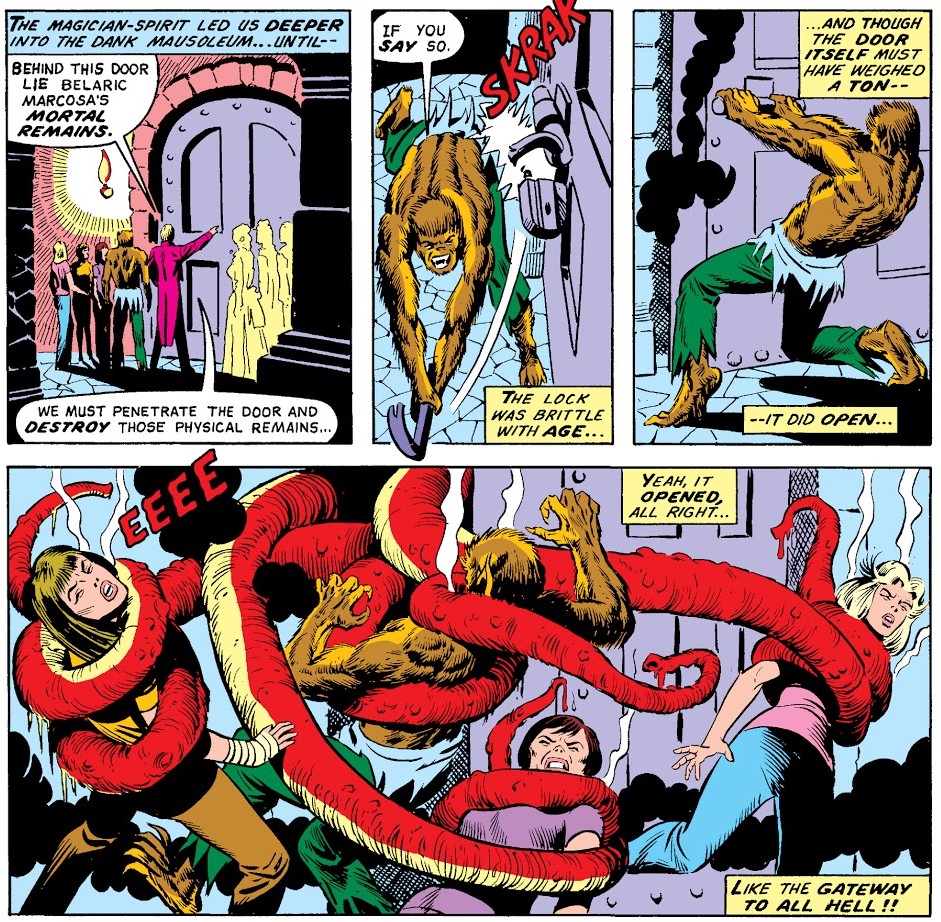
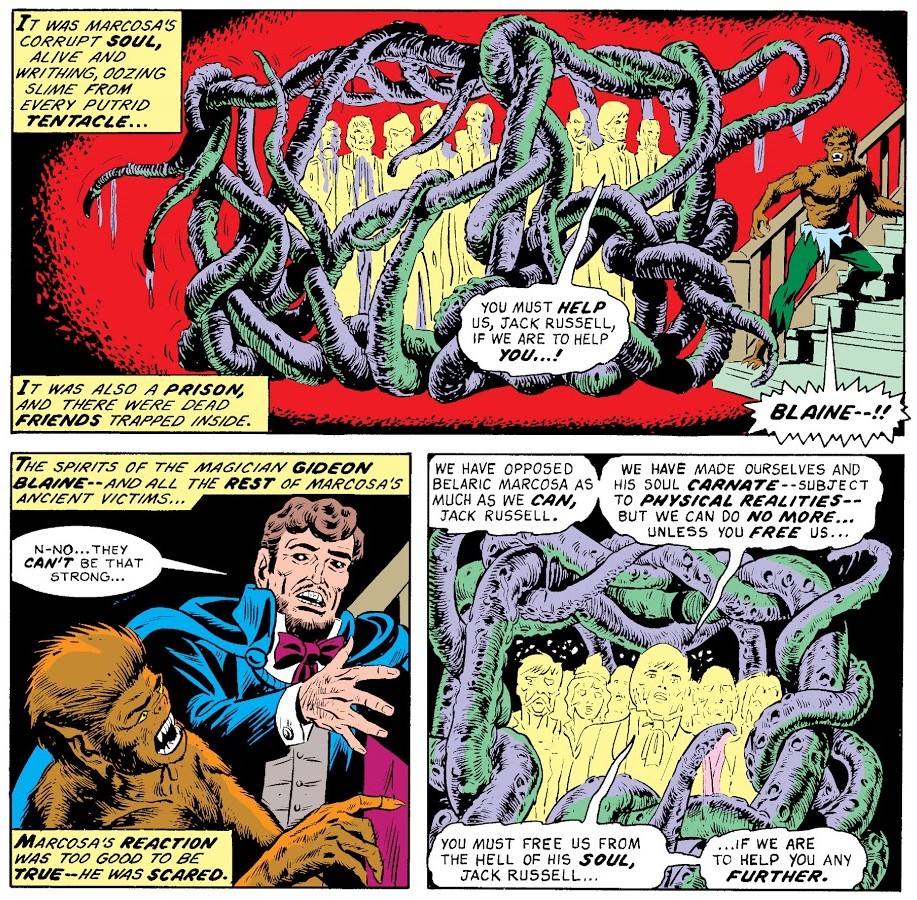
Next time the Werewolf encounters tentacles, it’s an epic, 2-issue tale of the desperate fight against ‘soul-eater’ Marcosa, an ectoplasmic wraith who occasionally takes a physical form and often deploys tentacles to do his dirty work for him.

Werewolf by Night no. 36 (January 1976). Cover Don Perlin.

Marcosa in Death (plot-spoiler: death is not actually involved) was scripted by Doug Moench and illustrated by Don Perlin:

Moral of the tale: don’t open doors when you don’t know what’s behind them.

Marcosa doesn’t quite die despite all the gnashing of teeth and ripping of tentacles, so the story continues to its grim conclusion in the next issue. The End, scripted by Doug Moench and illustrated by Don Perlin, was published in Werewolf By Night no. 37 (March 1976).

Perlin goes wild drawing teeth! An orthodontist’s worst nightmare (or perhaps a nice little earner).

What other giant-sized topic will we continue with next time? Only time will tell! Stay tuned…

~ ds

Hallowe’en Countdown IV, Day 3

« I’ve never gone to bed with an ugly woman… but I’ve sure woke up with a few » — Royal C. Bannon

Clearly, some cravings die awfully hard. This is Strange Tales no. 28 (May, 1954, Atlas), featuring a most claustrophobic… cuddle. The rest of this scarce issue contains artwork by Pete Tumlinson, Jack Katz (who recently — just last week! — turned 93), Bob Forgione, Don Perlin (who recently turned 90) and Tony DiPreta.

Cover by by Harry Anderson (1911-1970), not to be confused with his namesake, alias Judge
Harry T. Stone.
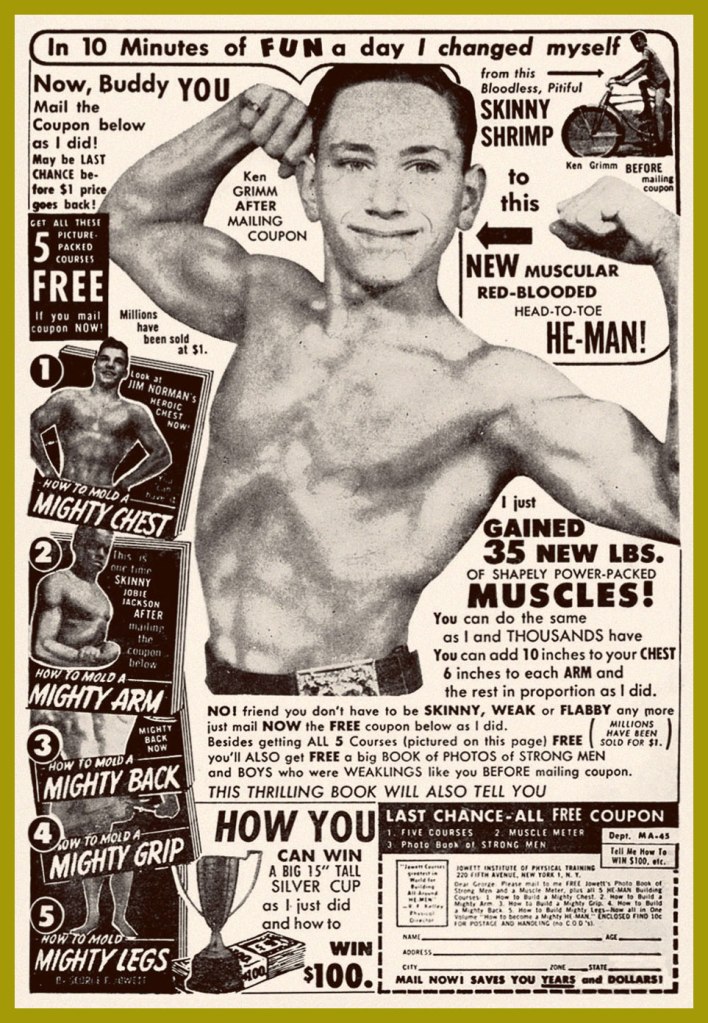
*Ken* Grimm, eh? Speaking of horror, they sure didn’t mince words to reel in the rubes, did they? This gentle, understated pitch appeared on the inside back cover of this issue of Strange Tales. « Mail the damn coupon with your shekels already, you bloodless, pitiful, skinny shrimp! », bellowed the bellicose drill sergeant.

[ psst! you can read the issue here! ]

-RG

Treasured Stories: “The Night Dancer!” (1972)

« If i should sleep with a lady called death… » – E.E. Cummings

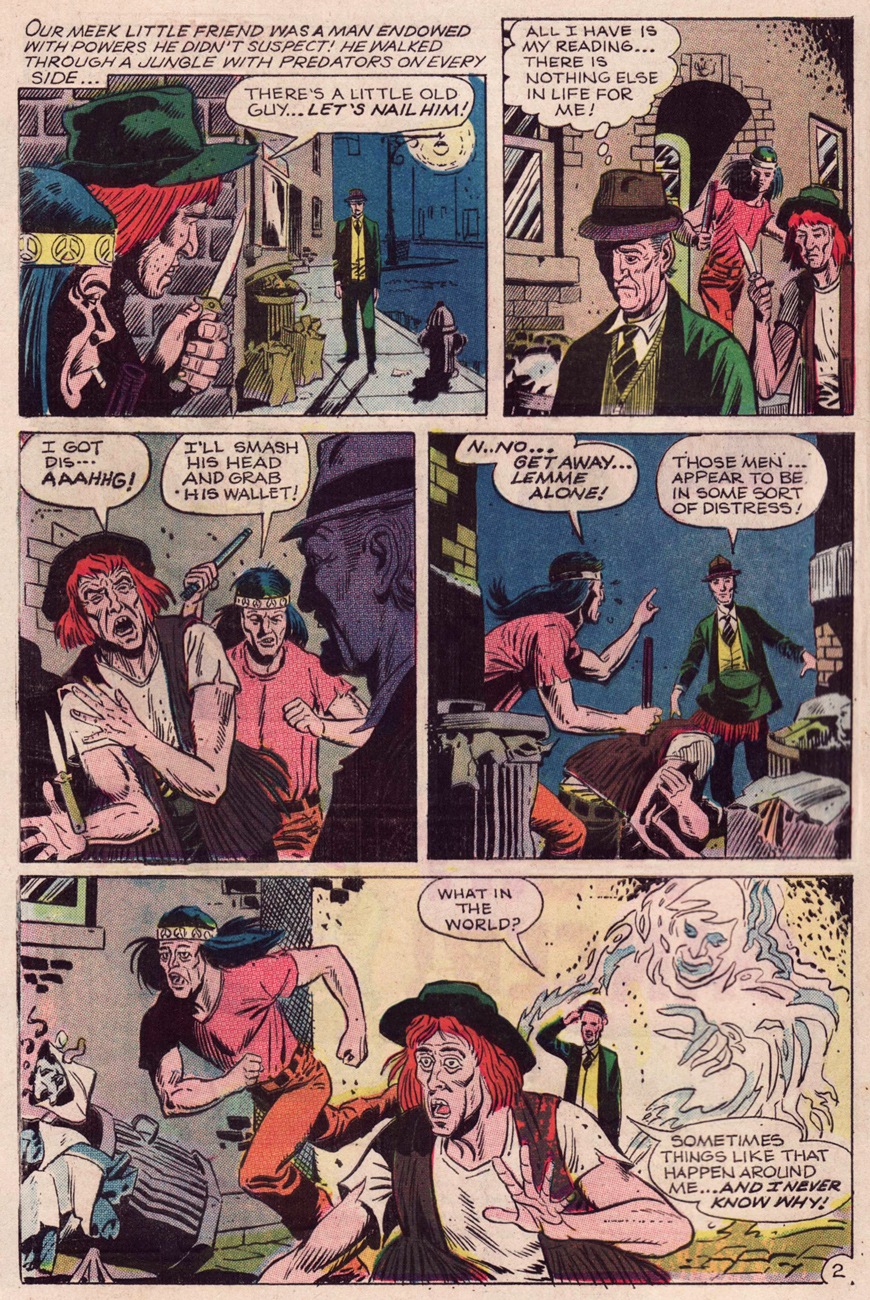
This time out, I’ve plucked a delicate story that’s resonated with me since our first encounter… somehow, the tragic plight of a lonely, vulnerable old man touched me deeply, even if I couldn’t have been more than ten years old when first I read it.

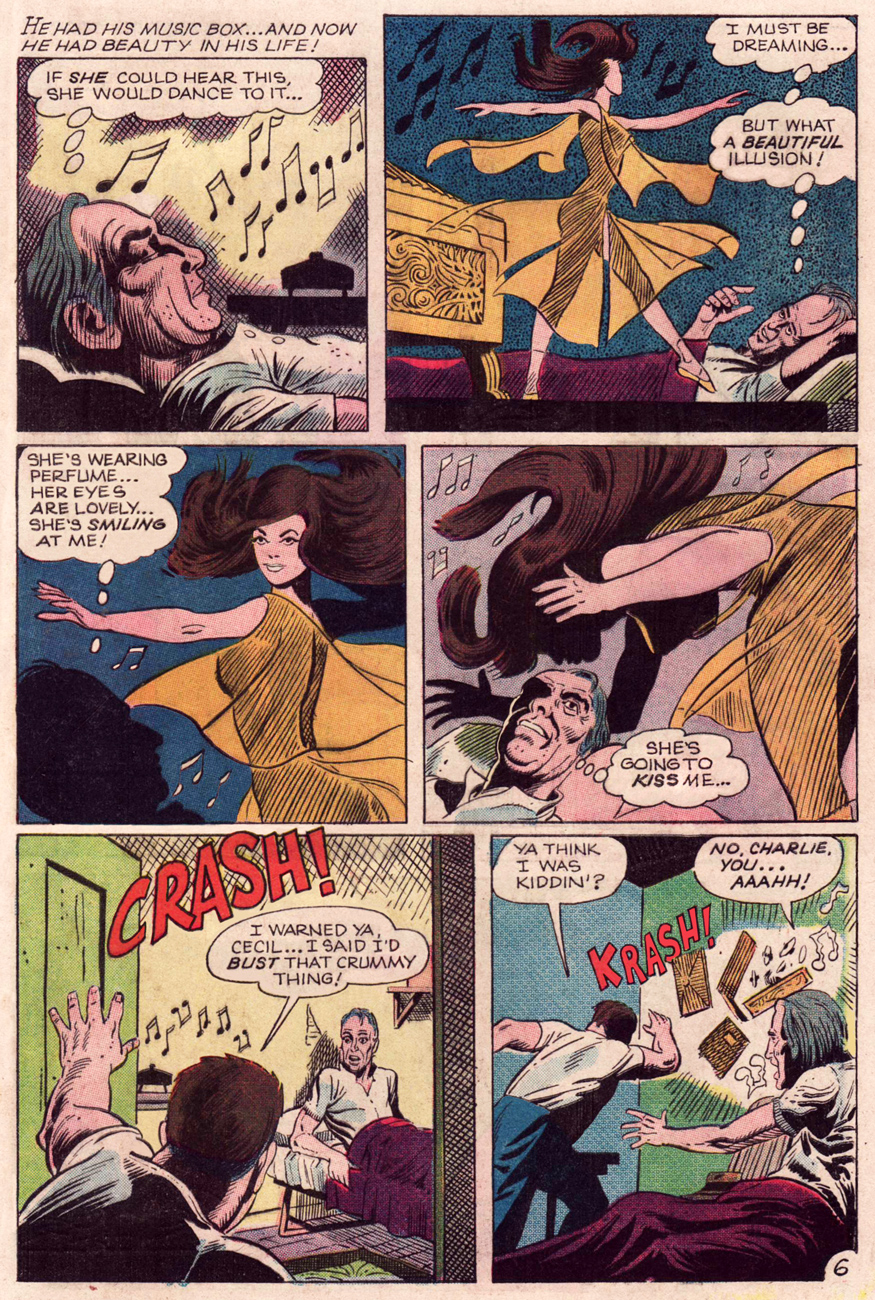
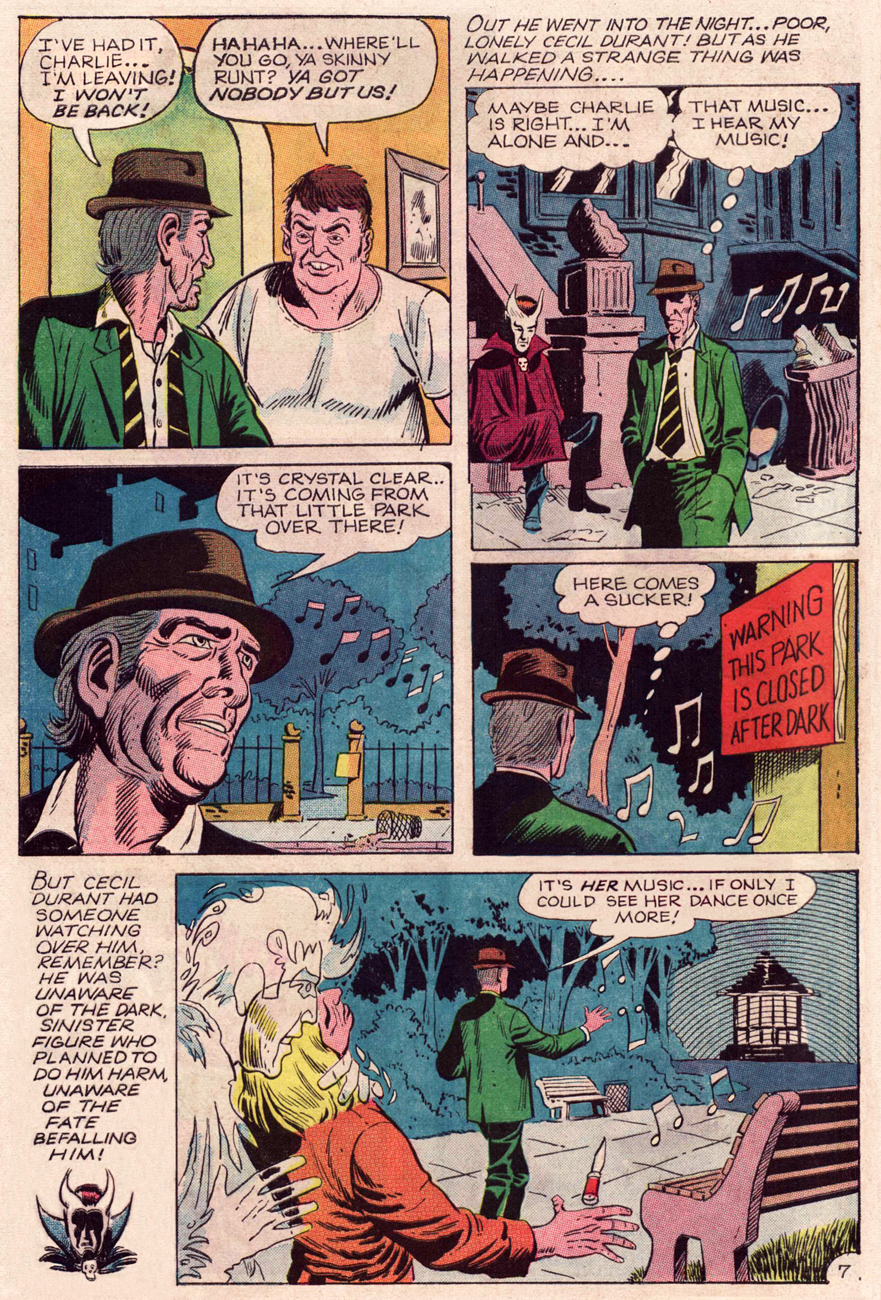
In the intervening years, witnessing the rise of elder abuse, the growing fragility of my own parents, and the sometimes desperate loneliness of acquaintances, old friends and strangers alike, Joe Gill and Don Perlin‘s The Night Dancer! (Ghostly Tales no. 99, Nov. 1972, Charlton) has steadily gained in poignancy. Its spirit, theme and mood remind me of some very fine tales by Joseph Payne Brennan*, who conveyed all too convincingly the quiet desperation of a near-destitute life lived with scant hope or companionship.

On a more cheerful note, it happens that (okay, it’s no accident) ‘Dauntless’ Don Perlin celebrates his eighty-ninth anniversary on this very day. While he’s most appreciated for his runs on Werewolf By Night, Ghost Rider, Moon Knight (his co-creation with writer Doug Moench) and The Defenders at Marvel Comics, I steadfastly cling to the notion that his finest efforts were brought to bear on hot rod and ghostly yarns for Charlton at the dawn of the 1970s. Judging by the results, I’d venture that he’s especially inspired by adventures set in the American Southwestern desert country. I’ll return to this topic in due time and present my case.

Without further tarrying ‘n’ foot dragging, meet our hapless protagonist, Cecil Durant… and his tormentors and benefactors.

PerlinDancer01APerlinDancer02APerlinDancer03APerlinDancer04APerlinDancer05APerlinDancer06APerlinDancer07APerlinDancer08A

While Mr. Perlin never became a superstar (and I suspect it never was his goal), the longevity of his career is easily explained: solid craft, excellent storytelling skills, a clean, unfussy line, and of course that supreme asset: reliability. Incidentally, co-credited Howard Perlin was Don’s young son, who was helping dad out around the studio that day.

Yom hu’ledet sameach, Mr. Perlin… and many happy returns!

– RG

*particularly The Way to the Attic (1967) and Mrs. Clendon’s Place (1984)