« The world will come to an end, but the monster models will still be around. » — James Bama, who went on to paint artwork for over twenty of Aurora’s kit boxes.
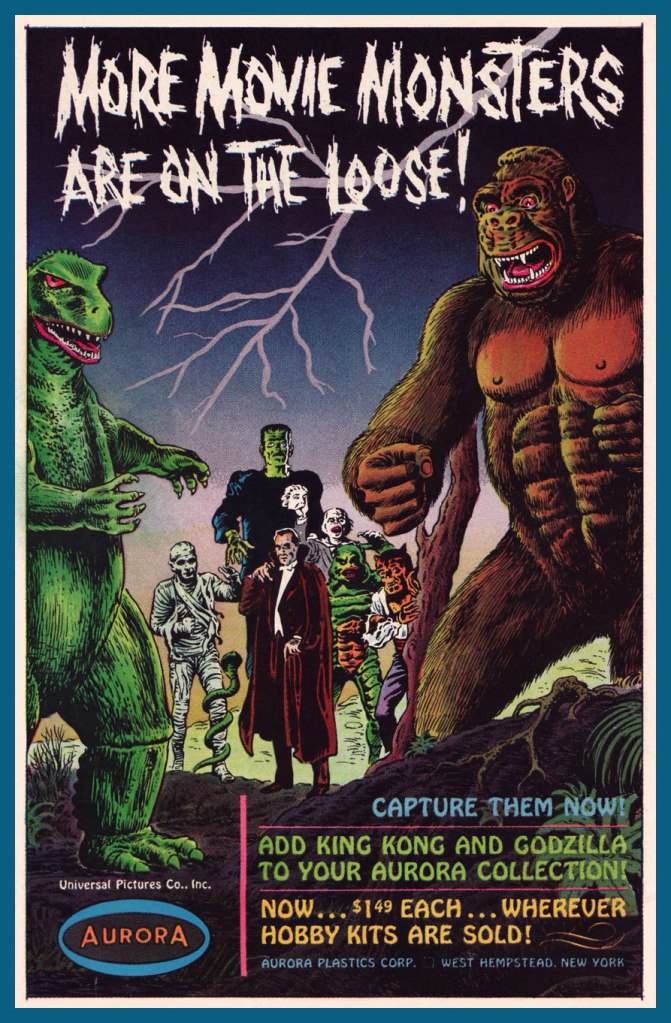
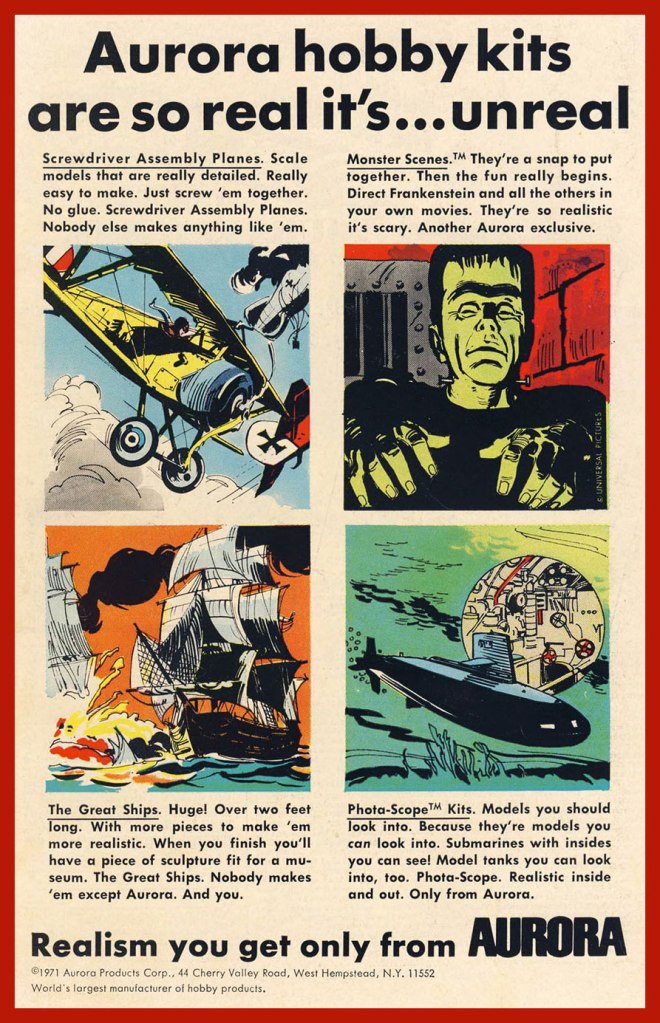
Well-executed comic book ads were often just as enticing (and sometimes more, depending on the title) as the contents proper. A prime example, this lovely Aurora Monster Kit campaign, announcing the epochal model maker’s forays out of the Universalménagerie of misunderstood fiends with Toho’s Godzilla and RKO’s King Kong.
The first Aurora monster model advertisement, it appeared in various DC Comics titles dated November and December, 1963.
The ad ran on the back cover of various DC titles in late 1964. In this case, House of Secrets no. 69 (Dec. 1964). The artwork is almost certainly that of Mr. Murphy Anderson, who goes uncredited, but is betrayed by the characteristic finesse of his inking.
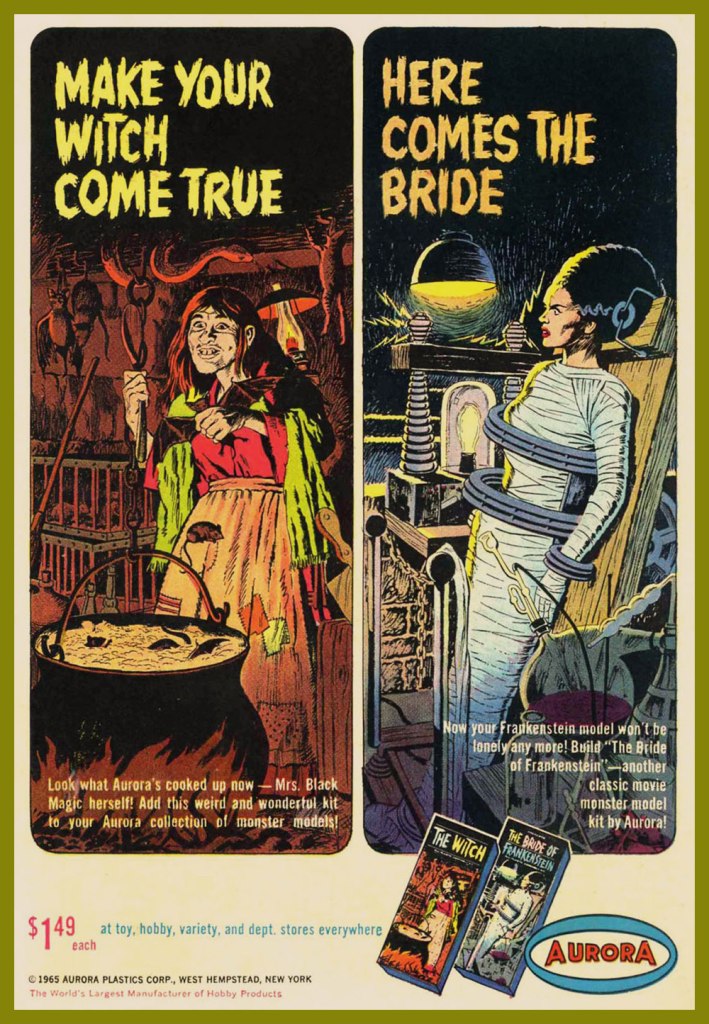
A couple of the models that usually received considerably less attention got their turn in the spotlight in this ad that appeared on the back cover of select DC titles cover-dated October, 1965.
Incidentally, if you were wondering, indeed, the giant monsters cost more… 50 cents more. A bunch more empty bottles to collect, son.
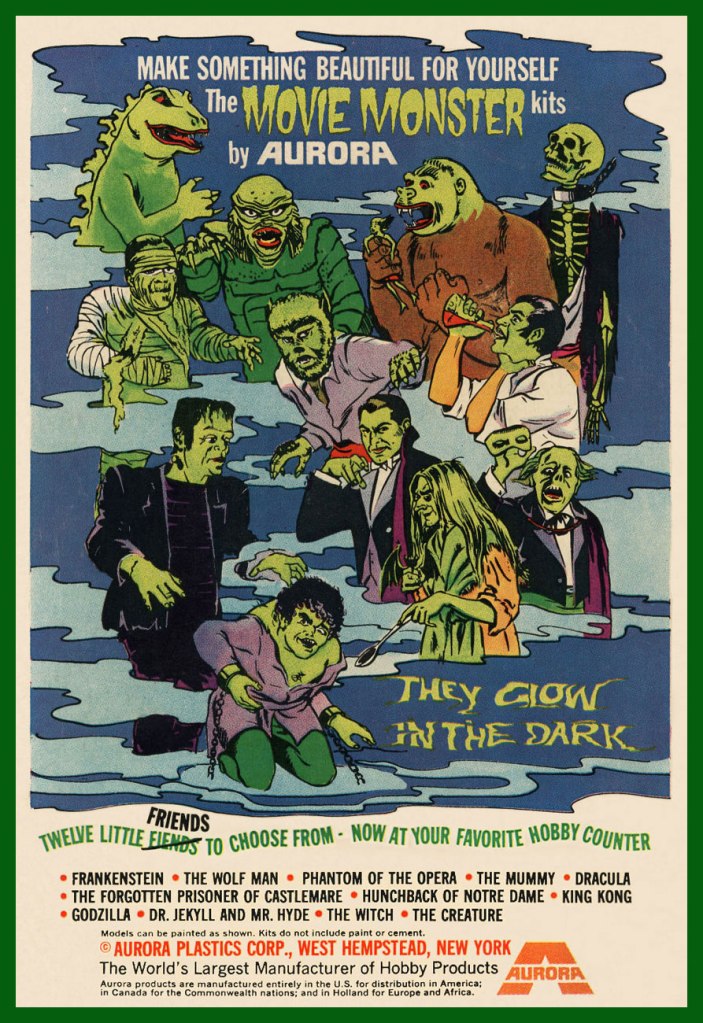
In the late ’60s, a new twist was added: phosphorescence! A cool idea, it however made painting the models, a tricky task to begin with, even less rewarding, as opacity was a bitch to achieve. It worked okay if you had mostly light-coloured The Mummy, but otherwise… This advert appeared on the back cover of DC Comics dated October, 1969… and thereabouts.
The Spring, 1970 collection.
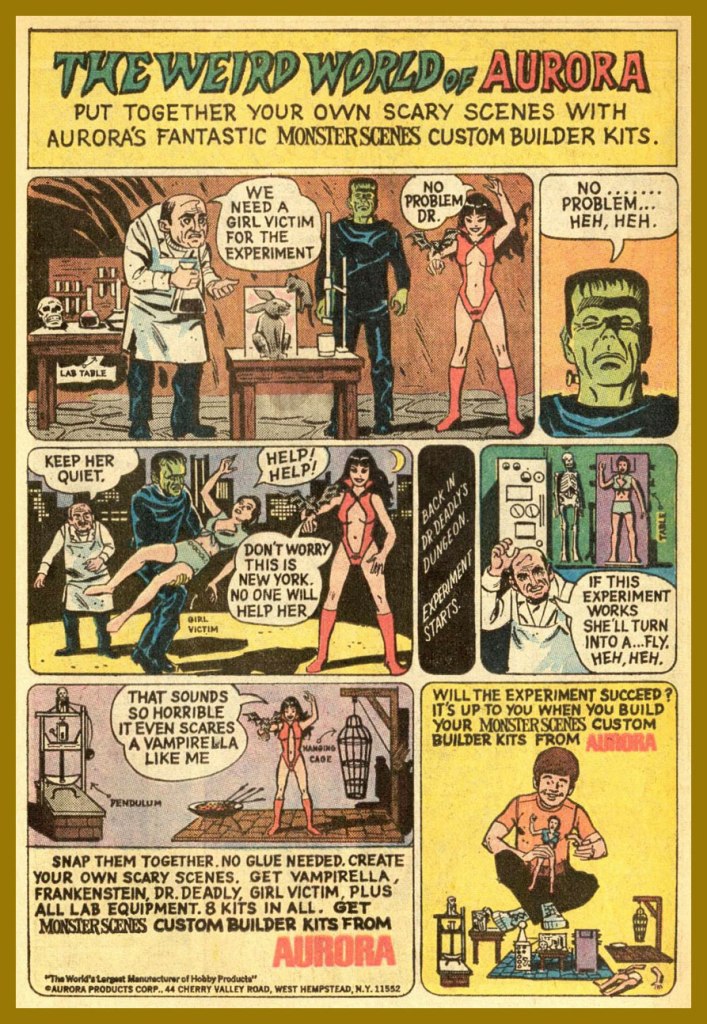
Here’s where Aurora’s close business relationship with Warren Magazines became most evident, with the appearance of a Vampirella model kit. Controversy ensued, once moms caught a glimpse of Junior’s new model kit, the heirloom of his bedroom. Speaking of controversy, Vampirella’s quip about New York was likely a barb about the infamous Kitty Genovese case. This pitch showed up in various DC titles, again, in and around June, 1971.
Warren sold a lot of Aurora kits via his mail order business, and a decision was made to include his character in the line rather than risk dissolving a partnership. Unpainted, she appeared to be virtually naked. Her counterpart, the Victim, sported hot pants and a halter top; a dress or flowing skirt was deemed impractical in order to have her fit on the torture rack.[ source ]
This beautifully-designed ad showed up in October, 1971 DC titles.
At this point, the diluted message is a hint that the bloom is off the rose. An ad from November, 1971.
As a bonus, here’s Big Frankie, the seldom-seen, long-unavailable Aurora grail (until its relatively recent reissue). As the largest Aurora model of all, BF fetched, at the time, an astronomical $4.98; now it goes for a hundred smackers, so don’t complain. Take a look at the big fella!
Though the original Aurora issues of these classic kits are mostly rare as hen’s teeth, enterprising contemporary kit companies have reissued these babies, and you now can actually afford to free the monsters from the confines of their box and assemble and paint ‘em. Mint in Box? Pfui!
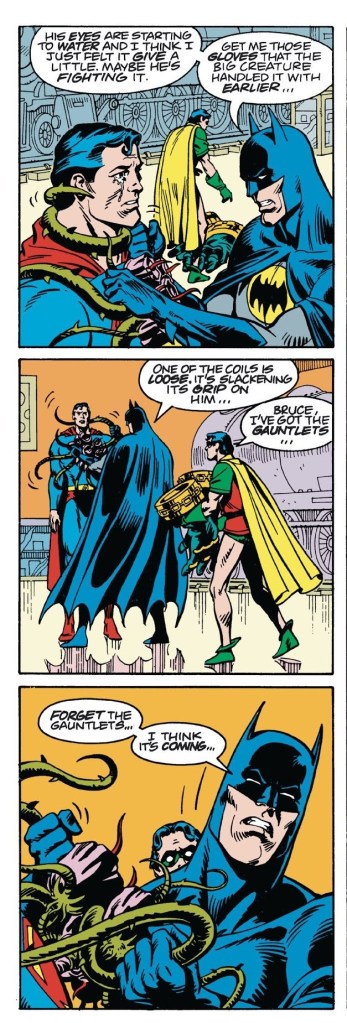
« A kryptonian octosaur — the most fearsome creature of my long-dead home planet — here — on earth! »
Since Batman was already awarded a Tentacle Tuesday back in April (see Tentacle Tuesday: All Aboard the Batmarine!), it is time to allocate one to the other superhero that crops up all the freaking time, namely good old “Supes” (for those who are on familiar terms with him). I won’t hide from you that I have very little interest in the adventures of the aforementioned character, but I made a pledge to follow tentacles wherever they may lead me. The octopus of comics demands sacrifices!
The Man of Steel. The Last Son of Krypton. The Son of Jor-El. Metropolis’ favorite son. The Man of Tomorrow. Champion of the Oppressed. The Big Blue Boy Scout. The iconic Cape. The definitive Flying Brick. The Big Good of The DCU. The Superhero.
First, we have a number of inside pages of varying interest, depicting tentacles both organic and mechanical —
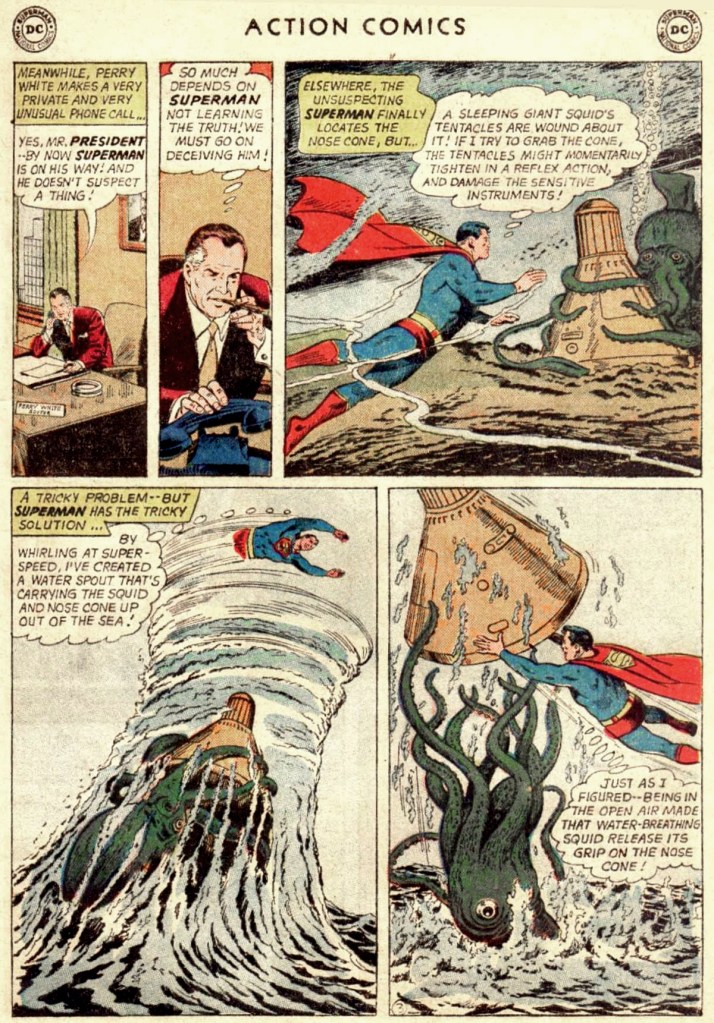
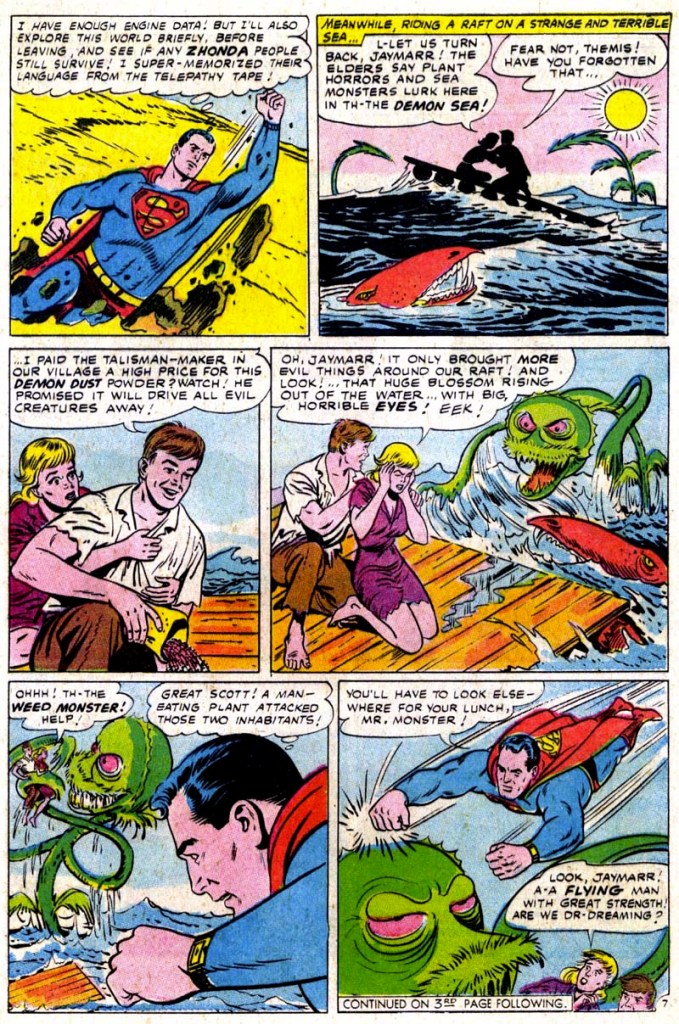
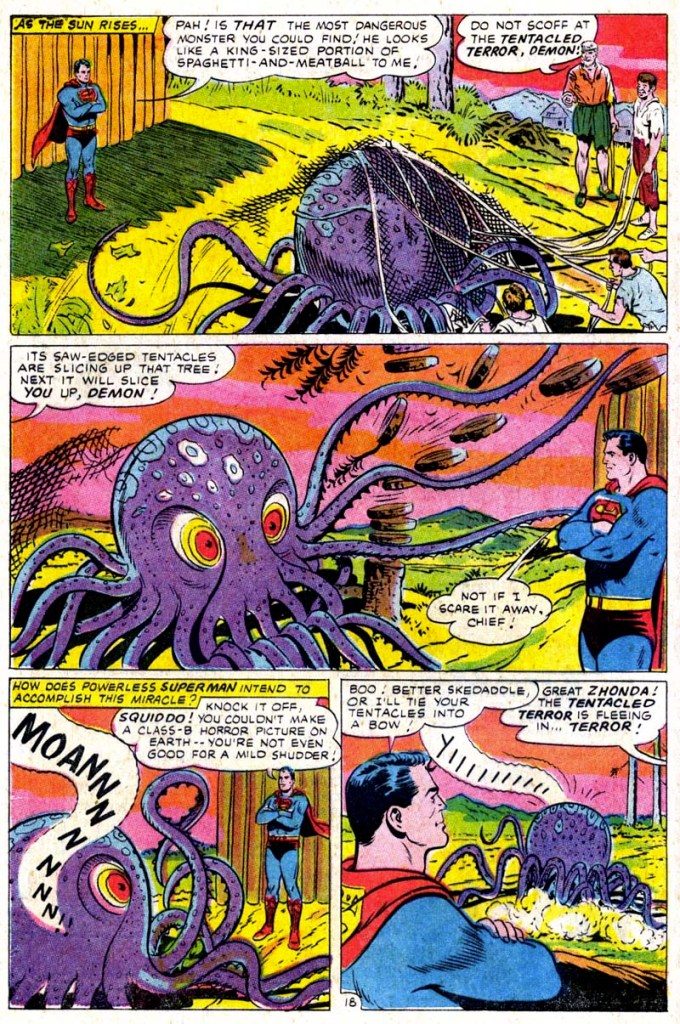
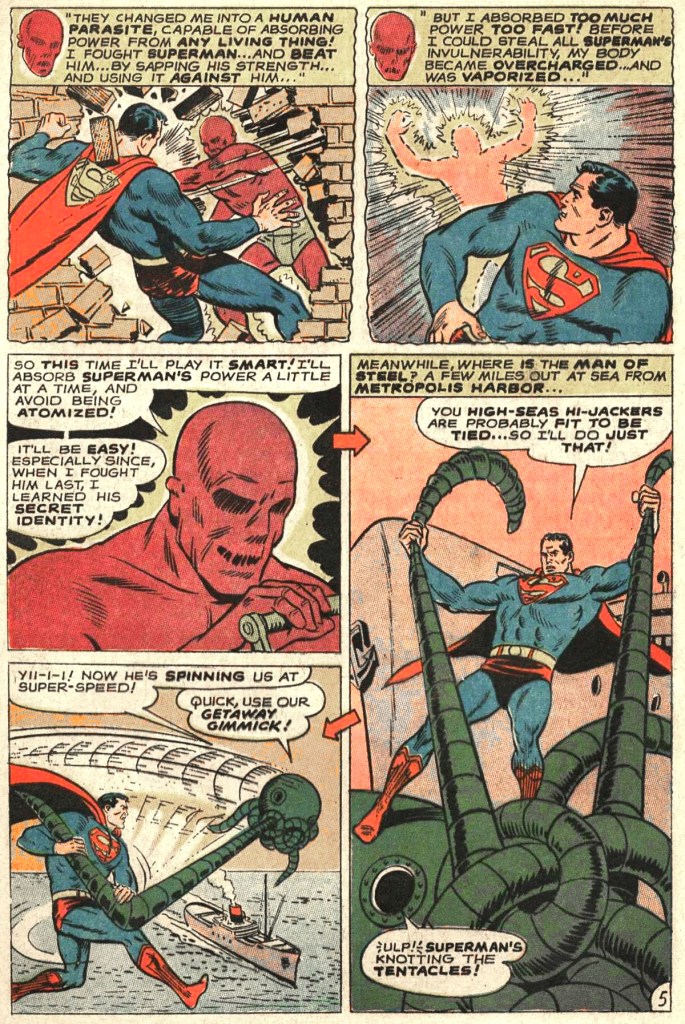
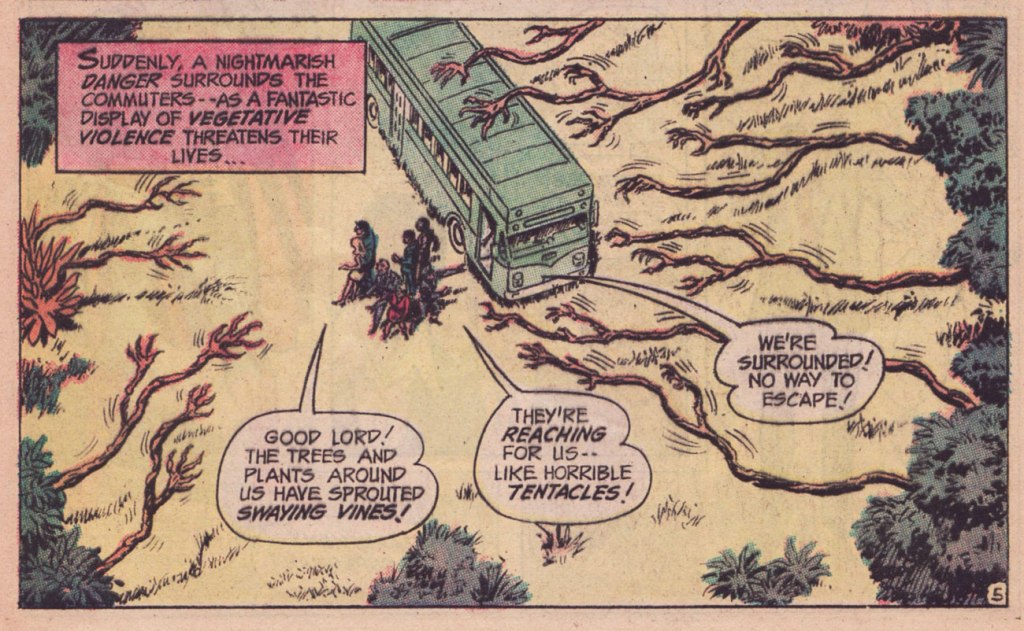
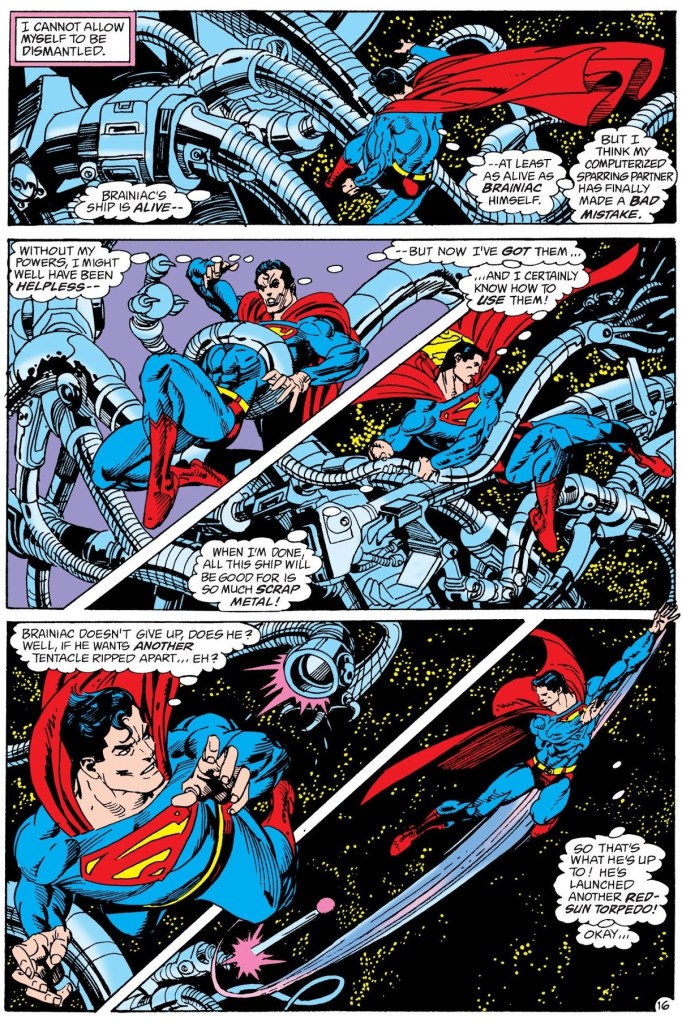
A page from The Superman Super-Spectacular!, scripted by Edmond Hamilton, pencilled by Curt Swan and inked by George Klein, was published in Action Comics no. 309 (February 1964).A page from The Demon Under the Red Sun!, scripted by Otto Binder and illustrated by Al Plastino, was published in Superman no. 184 (February 1966).The Demon Under the Red Sun!, part two. Superman wields his rapier-like wit to defeat the poor beastie. This was years before the Flying Spaghetti Monster!A page from The Power of the Parasite, scripted by Jim Shooter and illustrated by Al Plastino, was published in Action Comics no. 361 (March 1968).A panel from The Monster Who Unmasked Superman!, scripted by Cary Bates, pencilled by Curt Swan and inked by Murphy Anderson, was published in Action Comics no. 431 (January 1974).The Monster Who Unmasked Superman!: aggressive tentacle grabbery ensues.Page from Balance of Power!, scripted by Len Wein, pencilled by Dick Dillin and inked by Dick Giordano, was published in Justice League of America no. 111 (May-June 1974).A page from …With But a Single Step!, scripted by Marv Wolfman and illustrated by Gil Kane, was published in Action Comics no. 545 (July 1983).
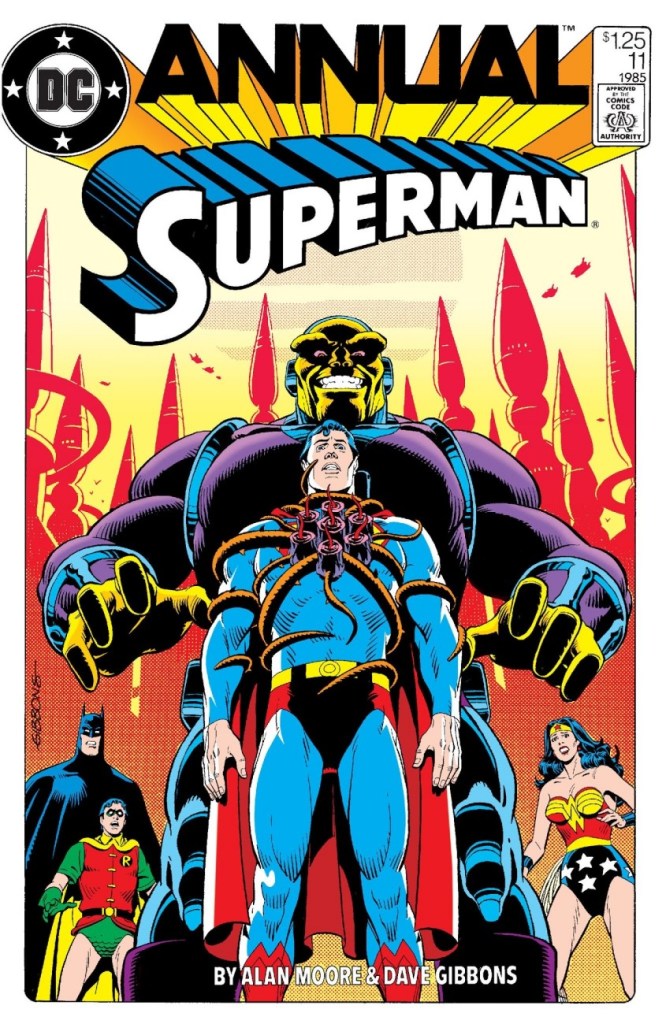
As a tastier, second part of our programme, I offer you an intriguing cover by Dave Gibbons:
Superman Annual no. 11 (September 1985)
And a page (or three) from what co-editor RG calls “the ultimate Superman story” (and I will absolutely take his word for it) — For the Man Who Has Everything… scripted by Alan Moore and illustrated by Dave Gibbons.
The tentacle mantle is taken up by other characters — pesky, clingy little buggers, aren’t they? « It’s called a Black Mercy. It’s something between a plant and an intelligent fungus. It attaches itself to its victims in a form of symbiosis, feeding from their bio-aura. Why, it gives them their heart’s desire…. », explains Mongul, the ‘benefactor’ who got Superman into this spot of trouble.
Mongul gets his comeuppance! And his heart’s desire of world domination, courtesy of the Black Mercy.
« Listen, youse guys — we’ve had enough of dis horsin’ around! When do we grab the dough? » — a hood craves action, from Haunted Halloween! (Flash Comics no. 78)
Superheroes, back when they weren’t all wrapped up in their grimness and grittiness, took a bit of time to properly enjoy the holidays.
This is Flash Comics no. 78 (Dec. 1946, All-American Comics), featuring Haunted Halloween!, scripted by Gardner Fox and illustrated by Everett Edward Hibbard… plus four more stories for your dime. Edited by Sheldon Mayer, with a cover by Hibbard.
And here’s All-American Comics no. 61 (Oct. 1944, All-American Comics), featuring The Green Lantern (and Doiby Dickles!) squaring off against a gruesome new foe, Solomon Grundy, in a tale entitled Fighters Never Quit!, written by none other than Alfred Bester (later the author of The Demolished Man andThe Stars My Destination) and illustrated by Paul Reinman. Edited by Sheldon Mayer, with a Reinman cover.
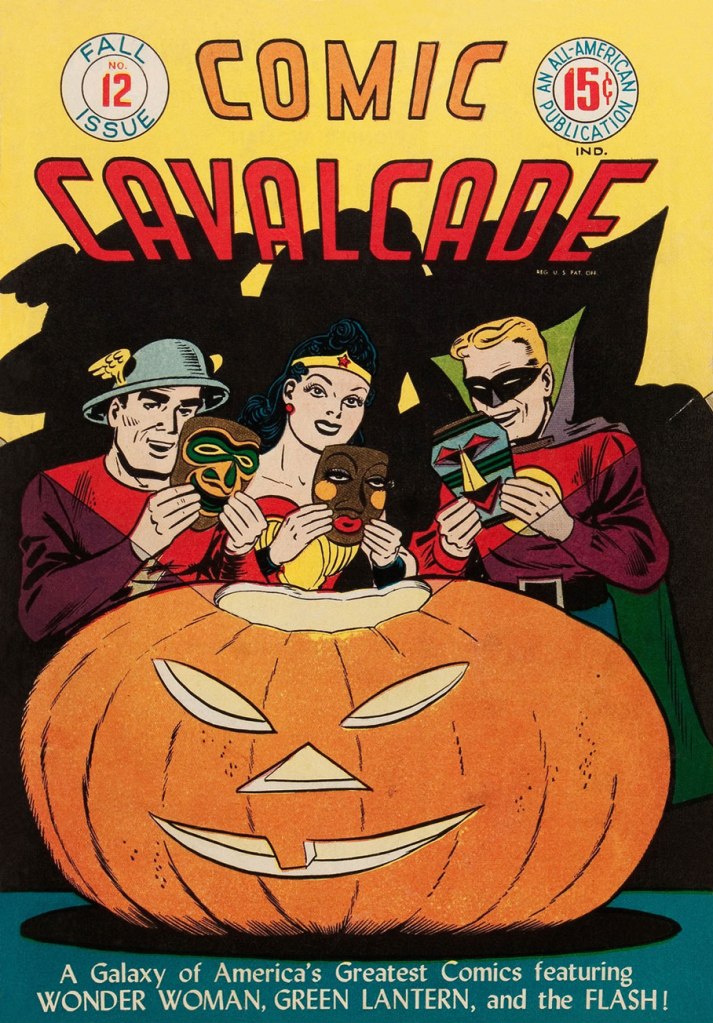
And this is Comic Cavalcade no. 12 (Fall, 1945, All-American Comics), where we catch both The Flash and Wonder Woman about to indulge in some blackface. Edited, you guessed it, by Sheldon Mayer. Cover by E. E. Hibbard (The Flash), H.G. Peter (Wonder Woman) and Martin Naydel (Green Lantern).
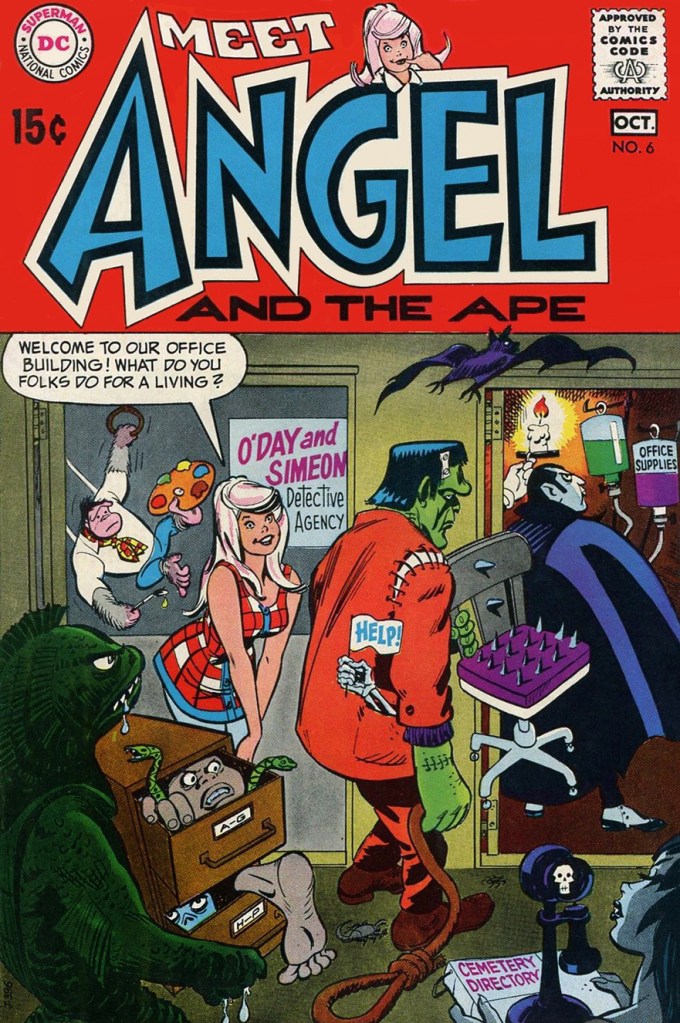
« Listen, Angel! If they’re out of bananas… I’ll meet you at the corner fruit stand! »
Today, let’s combine our general theme with a celebration of the birthday of one of comics’ great, yet perpetually underappreciated talents: Bob Oksner (October 14, 1916 – February 18, 2007), DC’s go-to humour and good girl art guy. Can you beat that? Didn’t think so.
Bob had a winning penchant for mixing monsters and babes, and for this, he’s earned our lifelong gratitude.
This is Angel and the Ape no. 6 (Sept.-Oct. 1969, DC), featuring The Robbing Robot and The Ape of 1,000 Disguises! (Would You Believe Four?), wittily written by John Albano, lusciously pencilled by Oksner, and creamily inked by Wallace “Wally” Wood. Truly swoon-inducing stuff. Edited by Joe Orlando (that explains all the monsters!), with a cover by Oksner.
You might say Angel and the Ape exist in an awkward sort of limbo: popular enough for the back issues to be kind of pricey, but not popular enough to have been reprinted (eight issues, including their Showcase appearance, ideal for a trade paperback, hint, hint).
So what else has Mr. Oksner cooked up over the years? Keeping to our theme, here are a few highlights, but first, a handy bio:
This piece appeared in The Adventures of Jerry Lewis no. 73 (Nov.-Dec. 1962, DC).
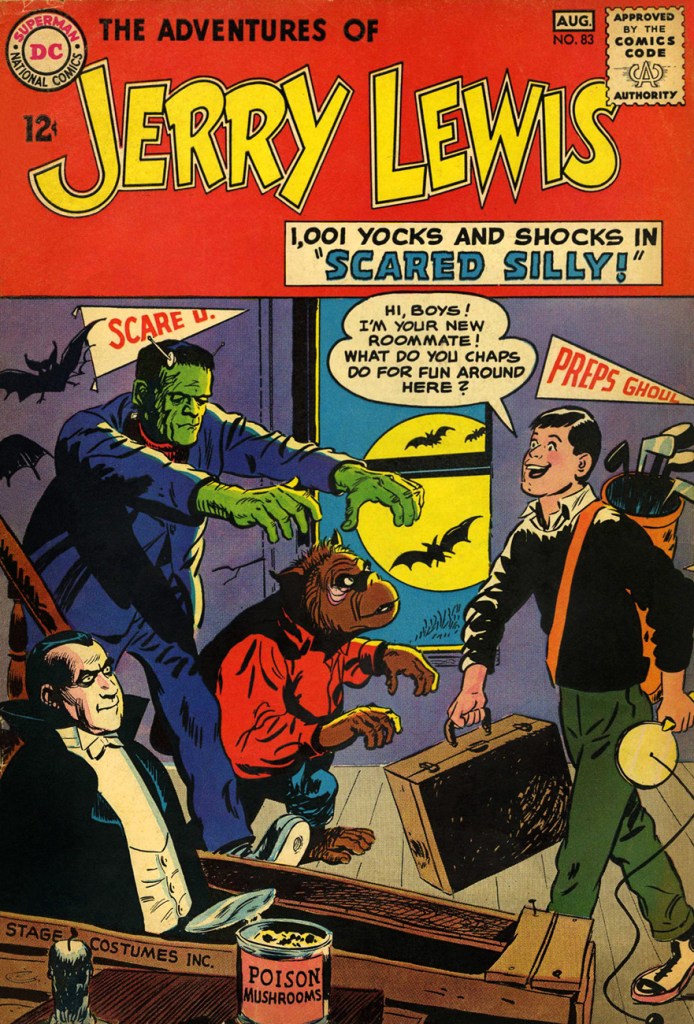
The is The Adventures of Jerry Lewis no. 83 (July.-Aug. 1964, DC). Formerly The Adventures of Dean Martin & Jerry Lewis… of course. The book (under both titles) featured some lovely artwork from Owen Fitzgerald, Mort Drucker and of course Oksner… but it was no Sugar and Spike. Still, it had its audience, long-lasting as it was (124 issues… Jerry wasn’t just big in France!)
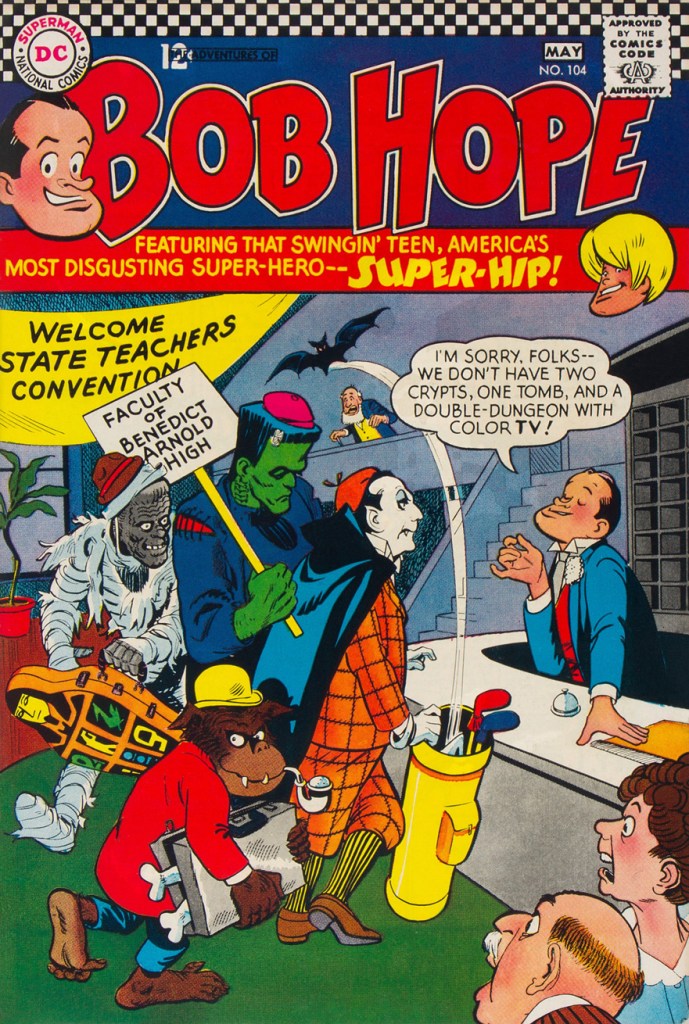
This is The Adventures of Bob Hopeno. 104 (Apr.-May 1967, DC). DC’s celebrity-licensed humour titles followed a parallel course: fading sales led to their nominal stars being more or less sidelined in their own book in favour of increasingly outlandish supporting casts.
An inside page from that issue. Good-looking comics… but they weren’t particularly witty, which can be a bit of a drawback. Arnold Drake was the writer, and while he could be pretty damn funny, it just didn’t work here. Still, you can bet that it was still more amusing than Milton Berle’s comic book.
1940s teenager Binky was pulled out of mothballs in the late 60s (ten years elapsed between issues 60 and 61). A moderate success (especially given it mostly consisted of slightly updated reprints), it returned to oblivion after another twenty-two issues, though the first seven boresome rather fine Oskner cheesecake covers. This is Leave It to Binky no. 67 (June-July 1969, DC).
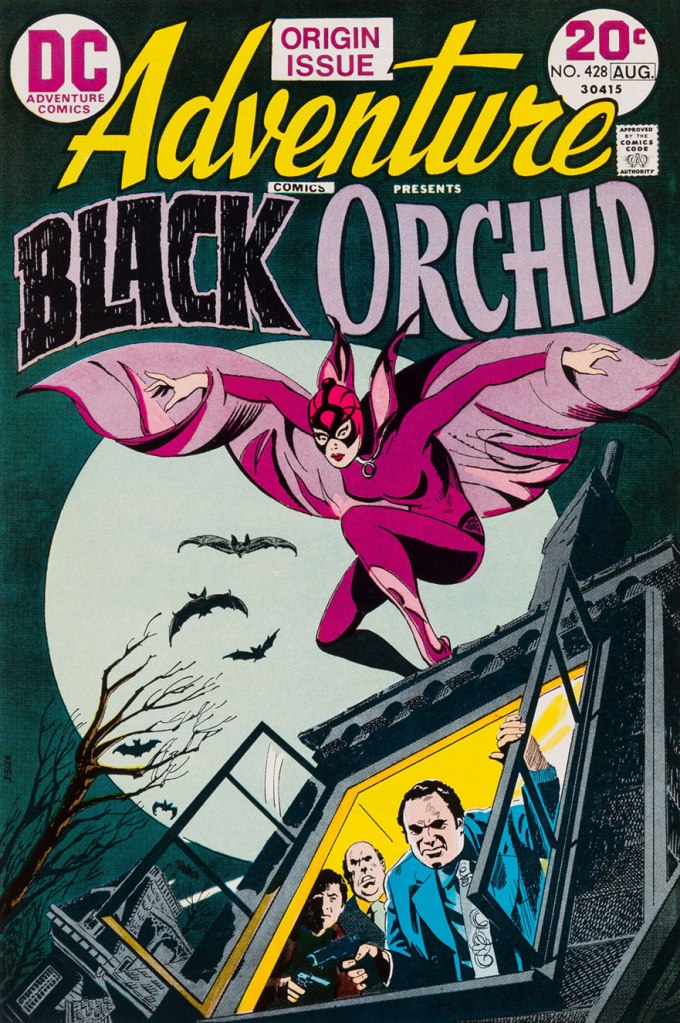
Finally, for a touch of the more ‘realistic’ Oksner style, here’s his cover introducing Sheldon Mayer‘s marvellously-mysterious Black Orchid. This is Adventure Comics no. 428 (July-Aug. 1973, DC). She deserved far more than a mere three-issue run!
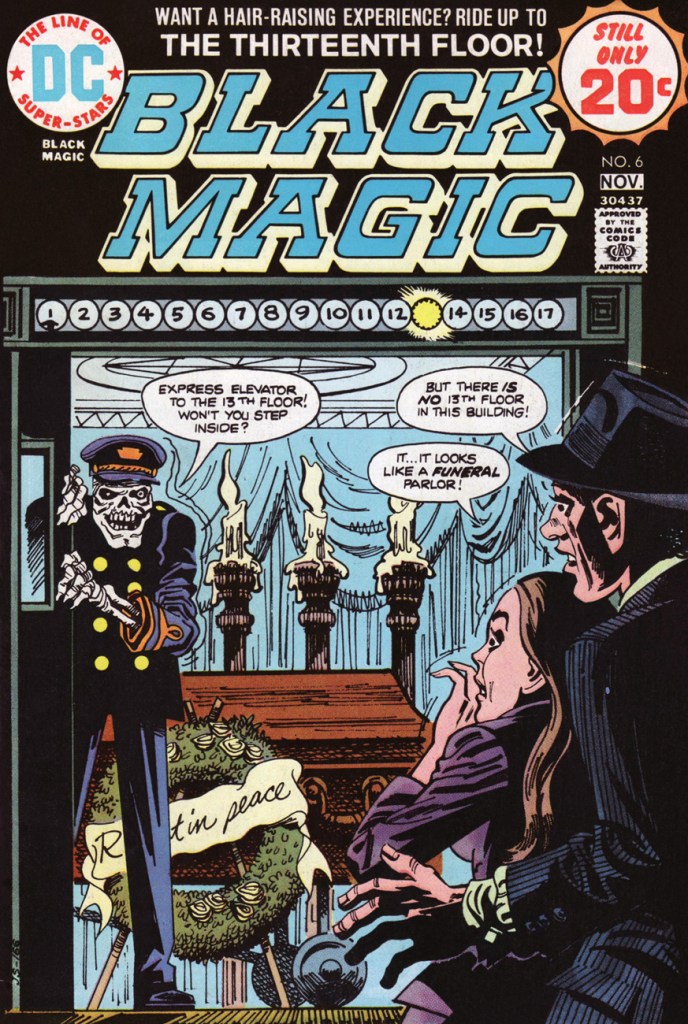
A Jack Kirby cover scene gets winningly recast for the 70s by Jerry Grandenetti, himself a contributor to the original series. This is Black Magic no. 6 (Oct.-Nov. 1974, DC).
When I was a kid (of twelve or so, if memory serves), I found a muddy and mildewed copy of this issue in the woods, which tremendously added to its allure, if not its readability.
And since I’ve mentioned it, here’s the original Kirby cover, regrettably one of the King’s least engaging, if you ask me. This is Black Magic no. 11 (vol. 2 no.5, Apr. 1952, Prize).
Well… little did I know what a protracted history this particular little scenario had. Let’s return to the presumed beginning, or at least the industrial age version.
Around the turn of the last century, the prolific English writer Edward Frederic Benson (1867 – 1940) wrote a story entitled The Bus Conductor [ read it here ] that saw print in Pall Mall Magazine in 1906. It was quite well-received, then began to widely make the rounds… as putative fact.
Things kicked into high gear in the mid-1940s, as the tale was recounted as an oft-heard anecdote in editor Bennett Cerf‘s 1944 short story anthology, Famous Ghost Stories, which contained a Benson contribution… but not The Bus Conductor.
That same year, Cerf shared the anecdote with the legion of readers who picked up his highly-entertaining (and still dirt-cheap and easy to find, over three-quarters of a century later, which gives you a sense of its original success and ubiquity) book of anecdotes, Try and Stop Me. The pertinent chapter was the splendidly-titledThe Trail of the Tingling Spine. As examined earlier on this blog, this chapter was used by EC Comics’ Bill Gaines and Al Feldstein as what they termed ‘springboards’ for their earliest stories.
Cerf’s version, from Try and Stop Me:
When an intelligent, comely girl of twenty-odd summers was invited for the first time to the Carolina estate of some distant relatives, their lovely plantation fulfilled her fondest expectations. She was given a room in the west wing, and prepared to retire for the night in a glow of satisfaction. Her room was drenched with the light of a full moon.
Just as she was climbing into her bed, she was startled by the sound of horses’ hooves on the gravel roadway. Curious, she walked to the window and saw, to her astonishment, a magnificent old coach pull up to an abrupt stop directly below her. The coachman jumped from his perch, looked up and pointed a long, bony finger at her. He was hideous. His face was chalk-white. A deep scar ran the length of his left cheek. His nose was beaked. As he pointed to her, he droned in sepulchral tones, “There is room for one more!” Then, as she recoiled in terror, the coach, the horses and the ominous coachman disappeared completely.
The girl slept little, but the next day she was able to convince herself that she merely had a nightmare.
The next night, however, the horrible experience was repeated. The same coach drove up the roadway. The same coachman pointed at her and exclaimed, “There is room for one more!” Then, as before, the entire equipage disappeared.
The girl, now panic-stricken, could scarcely wait for morning. She trumped up some excuse to her hosts and left immediately for home.
Upon arrival, she taxied to her doctor from the station and told him her story in tremulous tones. The doctor persuaded her that she had been the victim of a peculiar hallucination, laughed at her terror, and dismissed her in a state of infinite relief. As she rang for the elevator, its door swung open before her.
The elevator was very crowded, but she was about to squeeze her way inside — when a familiar voice rang in her ear. “There is room for one more!” it called. In terror, she stared at the operator.
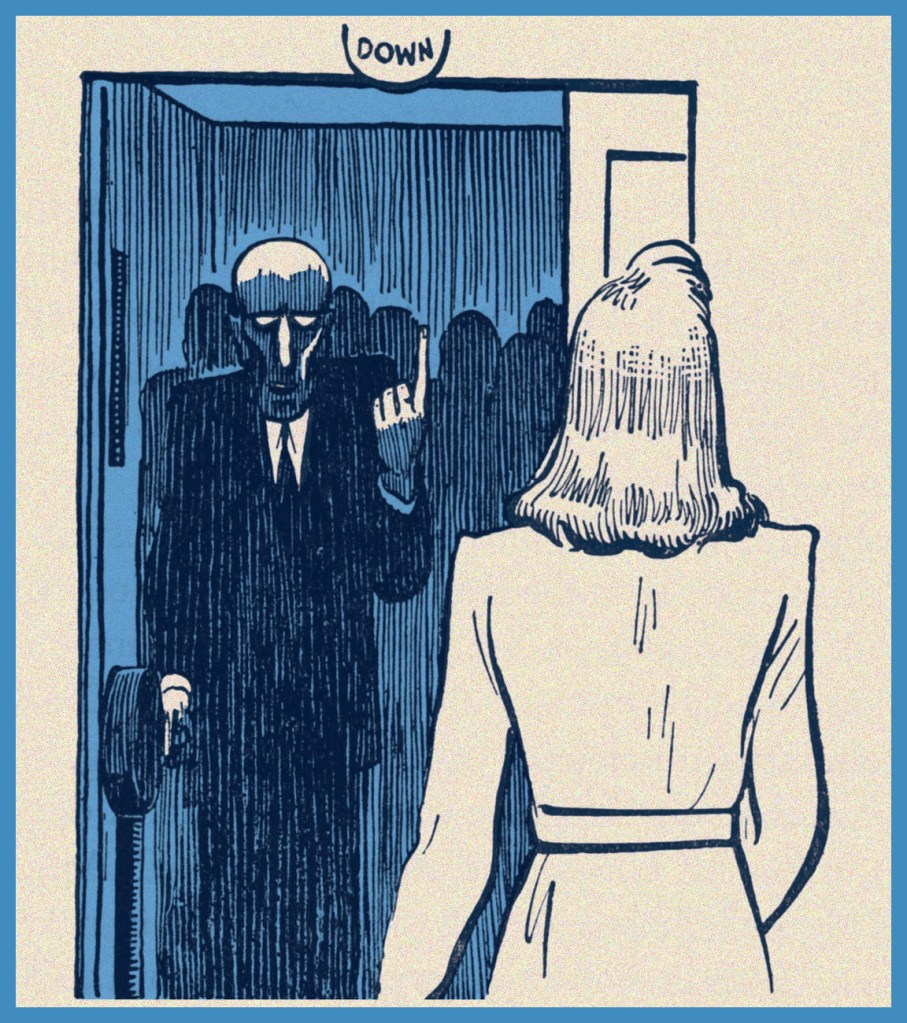
Try and Stop Me was lavishly and diversely illustrated by The New Yorker great Carl Rose, which surely must have contributed considerably to its success. I’d say Simon and Grandenetti were quite familiar with this striking image.
He was the coachman who had pointed at her! She saw his chalk–white face, the livid scar, the beaked nose! She drew back and screamed… the elevator door banged shut.
A moment later the building shook with a terrible crash. The elevator that had gone on without her broke loose from its cables and plunged eighteen stories to the ground. Everybody in it, of course, was crushed to a pulp.
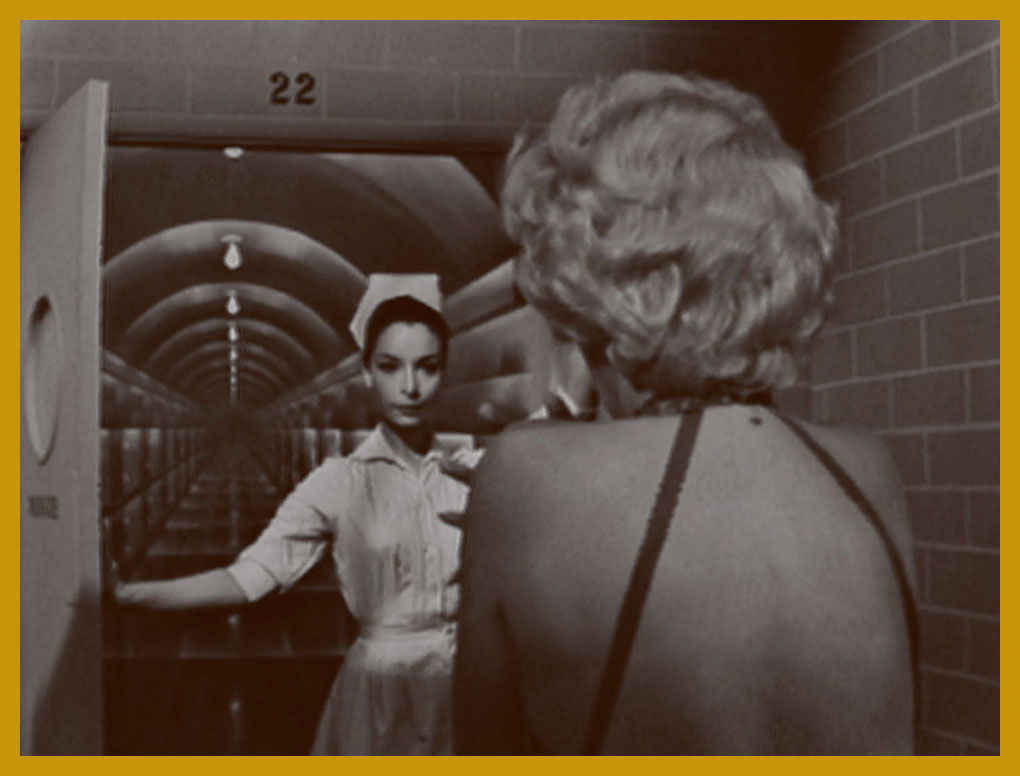
On to the Sixties: Rod Serling also drew upon the Cerf anecdote as grist for his The Twilight Zone episode Twenty Two (season 2, episode 17, aired Feb. 10, 1961). Here’s a pivotal scene from it.
Well, that’s certainly easier on the eyes than that gaunt vulture of an elevator operator… but no less menacing. You may recognize Mr. Spock’s future bride, Arlene Martel.
The Twilight Zone’s continuing popularity pretty much killed the scenario’s urban legend potency (Snopes.com checked it out!) In 1999, Urban legend authority Jan Harold Brunvand wrote, in his Too Good to Be True – The Colossal Book of Urban Legends:
According to my readers when I wrote a newspaper column in 1989 about the old ‘Dream Warning’ legends, The Twilight Zone version was the only one most of them knew. After numerous reruns, the TV episode had virtually replaced the folk legend in the popular mind. Every reader who wrote me following my column mentioned this episode, with one exception, and this person mentioned that he saw the plot enacted in a mid-1940s film, called Dead of Night. I’ll bet my legend-hunting license that this film, too, borrowed from the Cerf version.
I wouldn’t make that wager if I were you, Mr. Brunvand… since Dead of Night properly credits Benson.
To give you a sense of how effectively these stories flit and flicker across storytelling modes and media, power pop wizard Scott Miller (1960-2013) opened his band Game Theory‘s 1988 album, Two Steps From the Middle Ages, with a haunting ditty entitled Room for One More, Honey, an acknowledged quotation of the Twilight Zone episode.
« I don’t know what’s wrong with him! He’s in hellish torment! » — there’s witchery afoot, clearly
I’ll grant you in a heartbeat that Nick Cardy‘s (and, to a lesser extent, Neal Adams’) earlier The Witching Hour (full original title: It’s 12 O’Clock… The Witching Hour!, hence its twelfth day appearance) covers beat out subsequent entries on the overall quality front, but this particular beauty, in my opinion, takes home the terror tiara as the very creepiest of the bunch. Is it the otherwise-innocuous daytime setting, the tension between the pastoral and the grotesque? In the end, it induces shivers, and that’s what counts.
Though it comes as the tail end of their involvement, Carmine Infantino and Cardy still had a hand in, as publisher and art director, and took an active rôle in the design of each DC cover of the era.
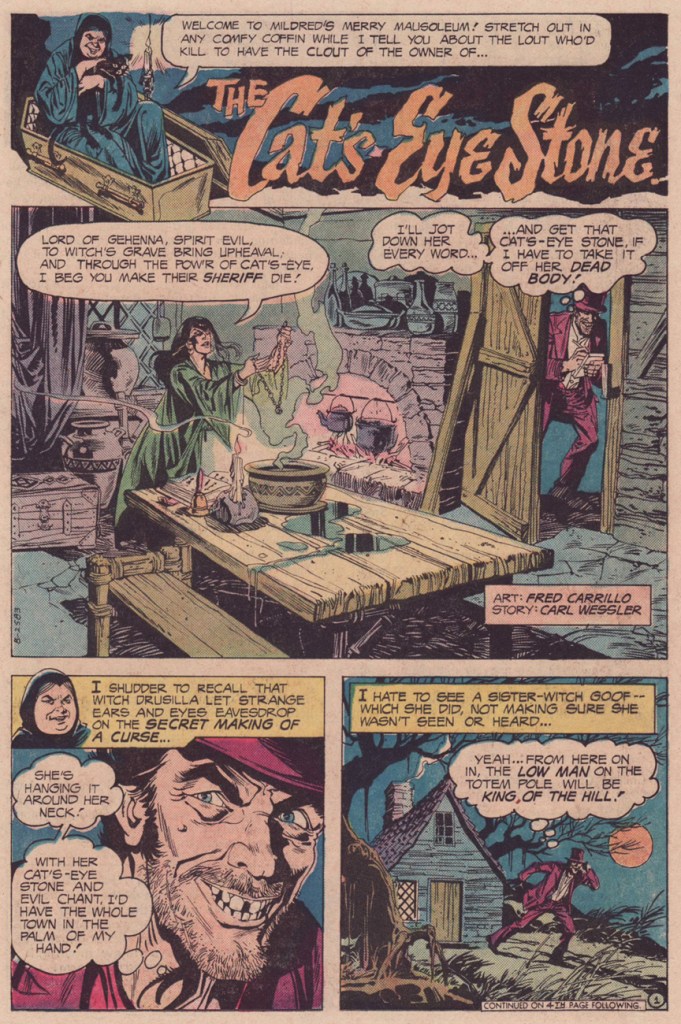
This is It’s Midnight… the Witching Hour no. 62 (Feb.-Mar 1976, DC). Edited by Murray Boltinoff. Argentine grand master Luis Dominguez’s cover art is loosely based on Carl Wessler and Fred Carrillo’s The Cat’s-Eye Stone. That aside, is it actually a picnic that Mr. Romantic has in mind, what with a “picnic place that no one will ever find“? Suspicious, to put it mildly.
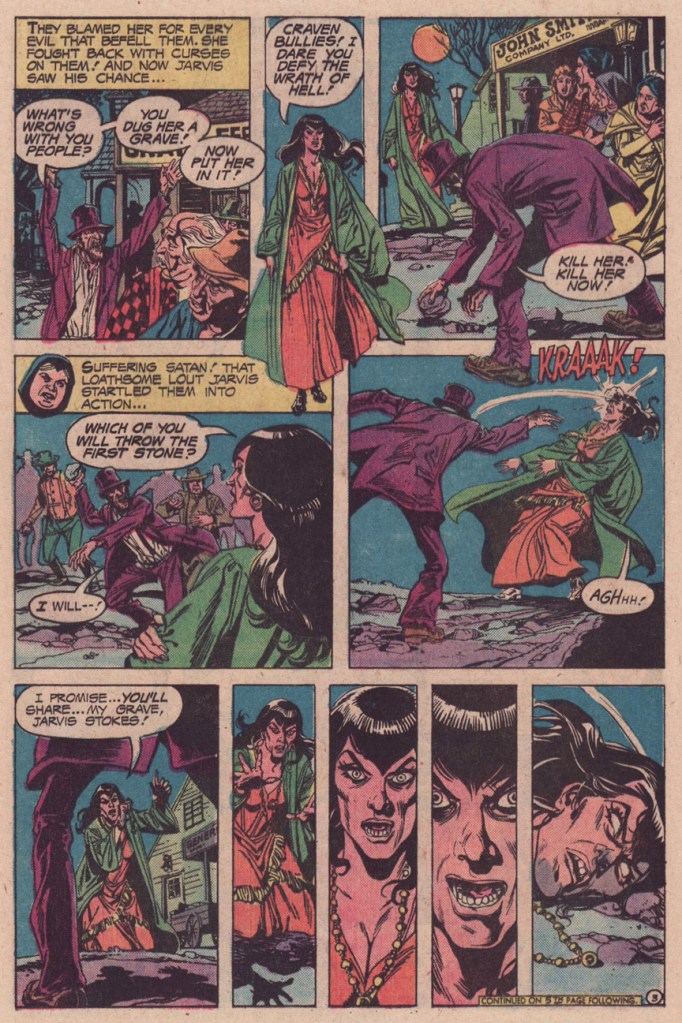
And so — why not? — here’s the full tale, so that you may judge for yourself.
One small quibble: doesn’t Drusilla’s witch’s brew count for something in the spell? Surely the words won’t suffice…
For a devil-worshipper, she’s pretty biblical (‘cast the first stone’). Or maybe that’s the point.
This story anticipates the shock ending of Carrie by almost a year. Or had this twist already made the rounds? Perhaps the cycle began with Let’s Scare Jessica to Death… but I’m not sure.
Wilfredo Limbana ‘Fred’ Carrillo (1926–2005) was an underrated Filipino artist who produced some quite fine work for DC Comics’ mystery titles in the 1970s. I was particularly fond of his work on The Phantom Stranger, when he illustrated both the titular feature and its worthy backup, The Black Orchid, at the tail end of the title’s run.
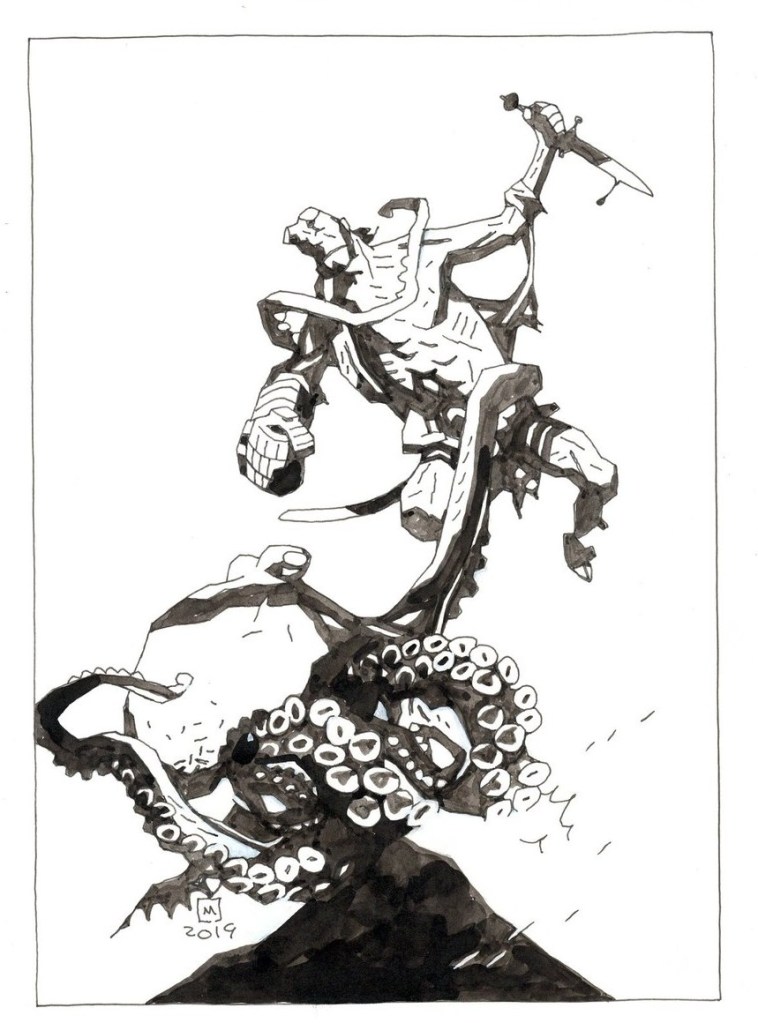
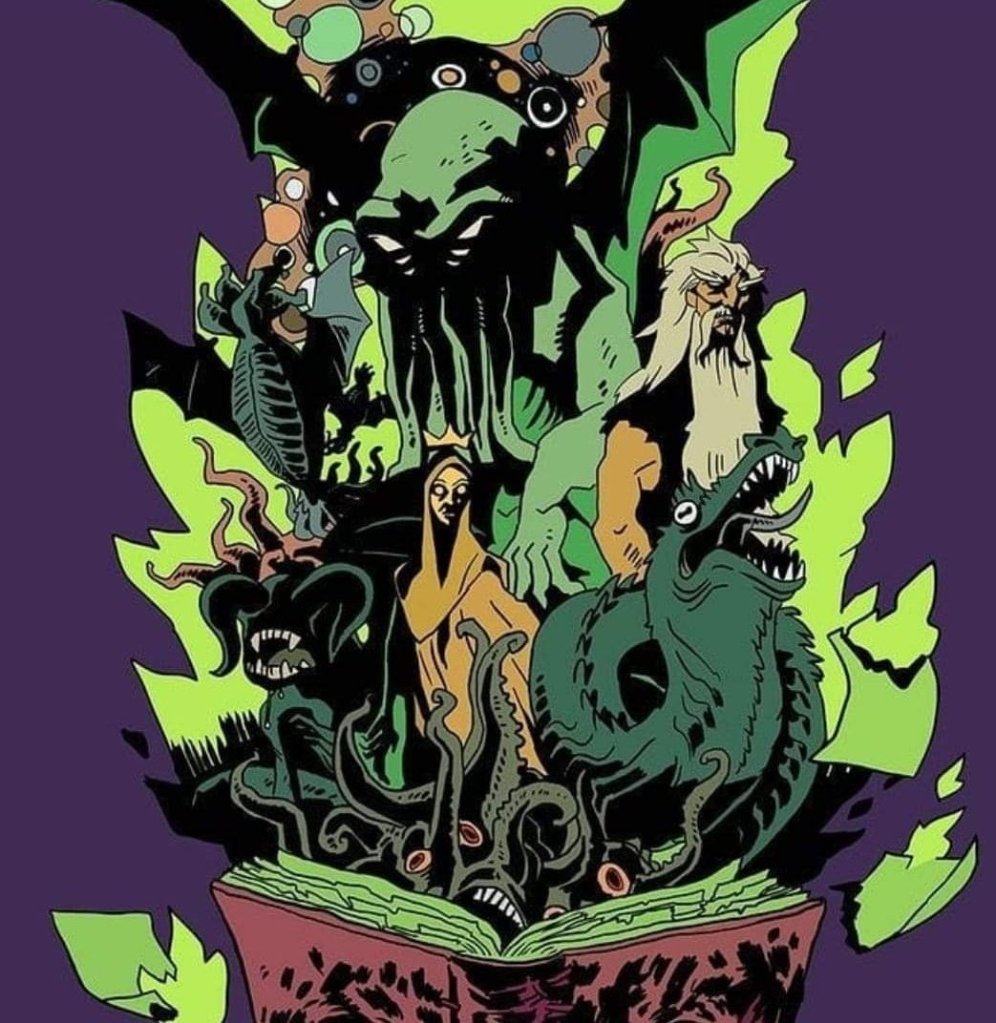
« Because sometimes, for whatever reason, you just want to draw an octopus. » — Mike Mignola, June 2019
I would say that this Tentacle Tuesday feature was started for a similar reason – sometimes one just needs to gather tentacled material, to share it more efficiently with like-minded weirdos.
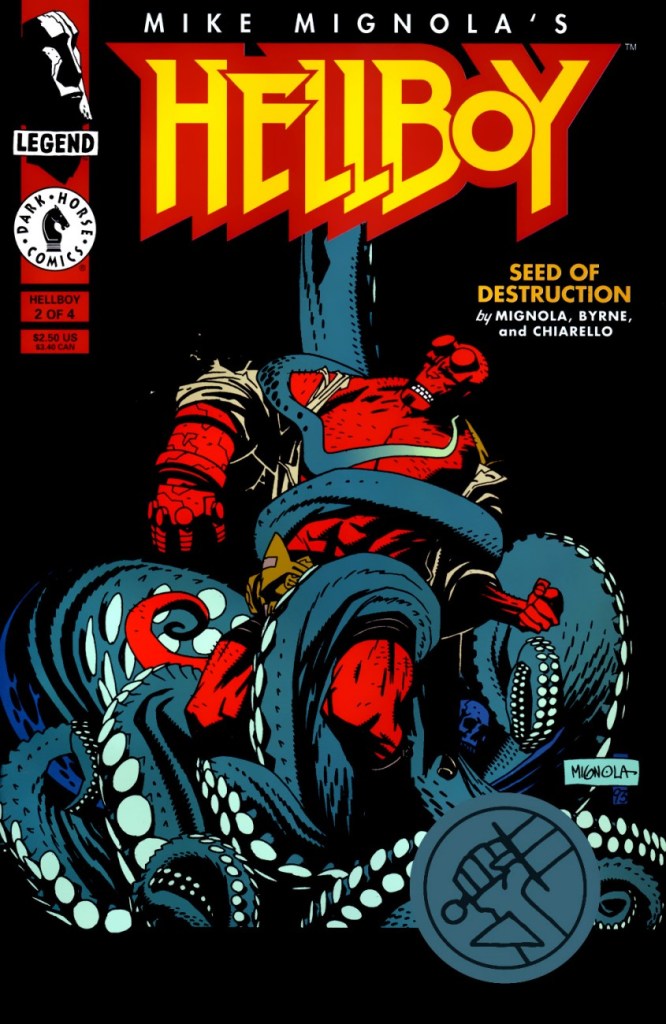
The back cover of Hellboy: Seeds of Destruction no. 2
I don’t imagine writer and comics artist Mike Mignola (most notably, creator of Hellboy and its spin-off B.P.R.D.) needs much of an introduction – he’s fairly ubiquitous in mainstream culture, and his style has been aped by many, which according to the proverb is the most sincere form of flattery. I was aware of this already, and yet was staggered by the sheer number of copycats I stumbled across while seeking out materials for this post.
I also started suffering from tentacle fatigue: as much as I love octopuses, seeing dozens upon dozens of fairly similar images made me weary. Mignola draws tentacles well, but he also draws them very, very often, and he also likes to revisit scenes already depicted. The result is a sprawling mess of sketches, variant covers and spin-offs of spin-offs… perhaps not inappropriate, come to think of it. This particular octopus has far more than just eight limbs!
Enjoy this barrage of Mignola tentacles, just make sure you’re in the proper mood for them 😉
Hellboy: Seeds of Destruction no. 2 (April 1994).
Page from Hellboy: Seeds of Destruction no. 3 (May 1994).
Sketch from June 2019.
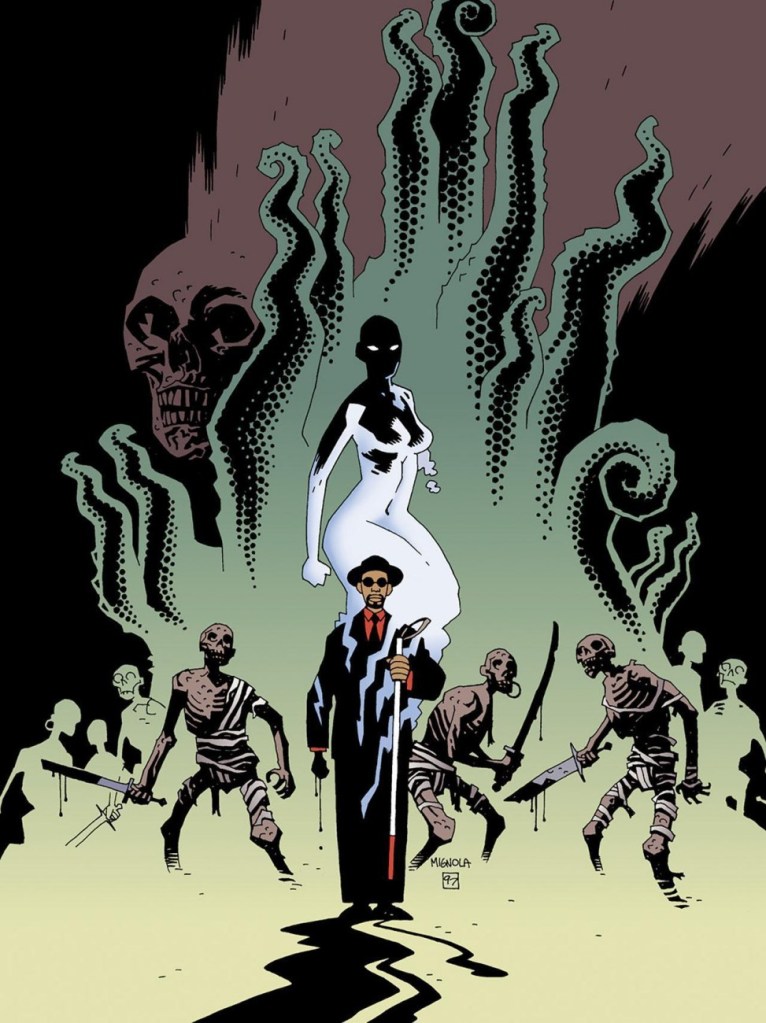
ZombieWorld: Champion of the Worms no. 2 (October 1997)
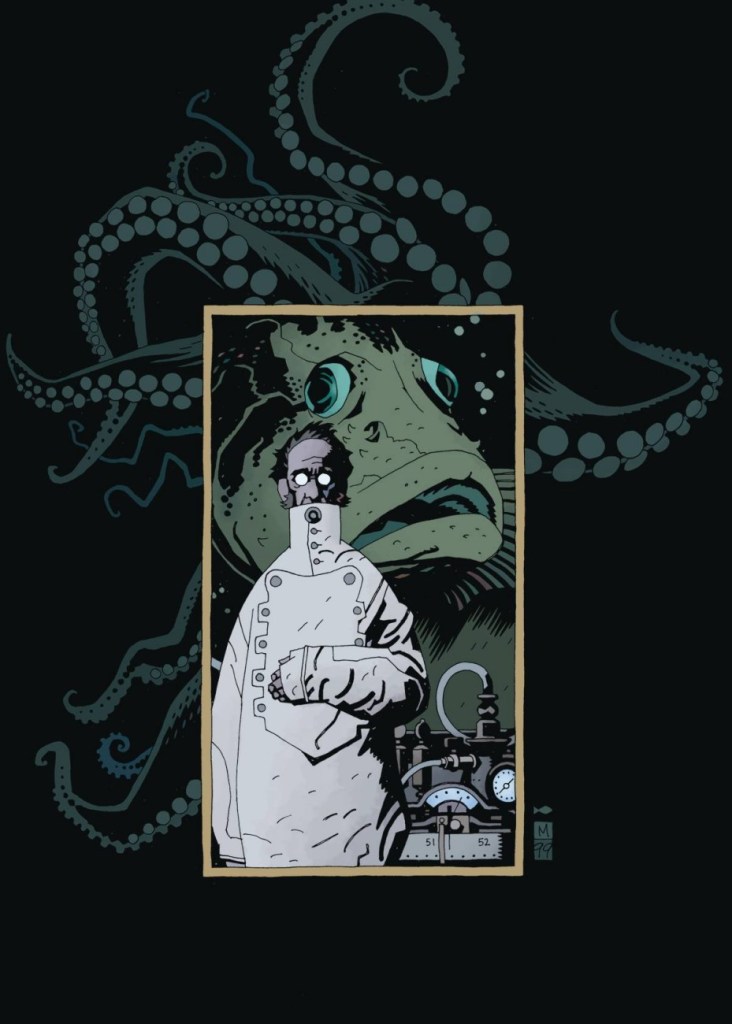
No post of this nature would be complete without featuring, in some form or other, H.P. Lovecraft, arguably the father of our modern obsession with tentacles. On that topic, I am linking to an excellent article about Mignola’s relationship with the creator of the Cthulhu Mythos (be warned that it’s in French, sorry!)
Art for the cover of Dark Horse Presents no. 142 (April 1999). Mignola made Lovecraft look downright dignified and borderline handsome, which is quite a feat, considering the latter’s unusual physiognomy.
Mignola revisited this very scene for his cover of Children of Lovecraft, and anthology of (non-comics) stories ‘inspired’ by Lovecraft (September, 2016). This was also published by Dark Horse.
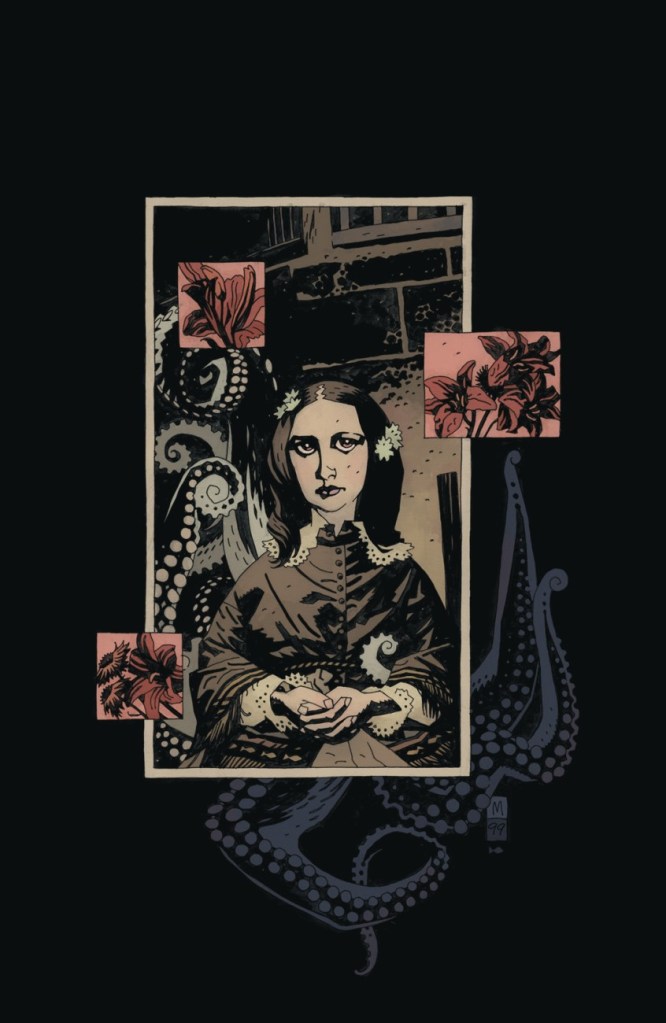
More Victorian England and Lovecraftian archetypes can be found within the pages of Jenny Finn:
Artwork for Jenny Finn no. 1 (June 1999).
Back cover artwork for Jenny Finn Messiah no. 1 (2005).
Even Batman, in Mignola’s hands, gets tentaclefied!
A page from Batman: Legends of the Dark Knight no. 54 (November 1993).
Batman: The Doom That Came to Gotham no. 2 (November 2000).
As a final note, I’d like to officially make a moue of distaste at people who share art without attribution, or without bothering to ascertain its source. To wit: a pair of images that are widely shared as Mike Mignola artwork… except that it isn’t by him at all, just by someone drawing in a similar style. Instagram and Pinterest are breeding grounds for such deplorable artistic credit robbery.
The following two illustrations are by Malaysian artist Daryl Toh.
« And with that awakening, an insane sovereign once again asserts his rightful dominion over a night of madness — as the Halloween God! »
For years after Bernie Wrightson’s career path took him away from DC Comics, cover illustrations purchased by the publisher but left unused gradually trickled into print. Some were too specific and puzzling to be published tel quel, so new stories were written to order. Such a case was Batman no. 320 (February, 1980). This is another, which yielded The Halloween God, written by Gary Cohn and Dan Mishkin, illustrated by Ading “Adrian” Gonzales, and edited by Dave Manak.
This is Secrets of Haunted House no. 44 (Jan. 1982, DC). Cover created by Mr. Wrightson way back in… 1972!
And here’s an interesting twist: Wrightson’s original drawing didn’t quite look that way. As co-writer Gary Cohn told me, a few years ago, « When [editor] Dave Manak showed me this cover, the figure being thrown had a head much like the other goblins. I said, “Can someone change that to a Jack o’lantern head? Then we can write a story called, ‘The Halloween God.’ And so… »
I then asked Mr. Cohn whether he had any recollection as to who might have drawn said Jack o’lantern, as Wrightson was unlikely to be available. He responded: « My recollection might be wrong, but I think it was Dave Manak himself, who is no slouch as an artist. » That light effect on the ground really integrates the change, sells it, so to speak. Kudos to all involved.
« Things are never quite as scary when you’ve got a best friend. » — Bill Watterson
Hey, it’s our 500th post!
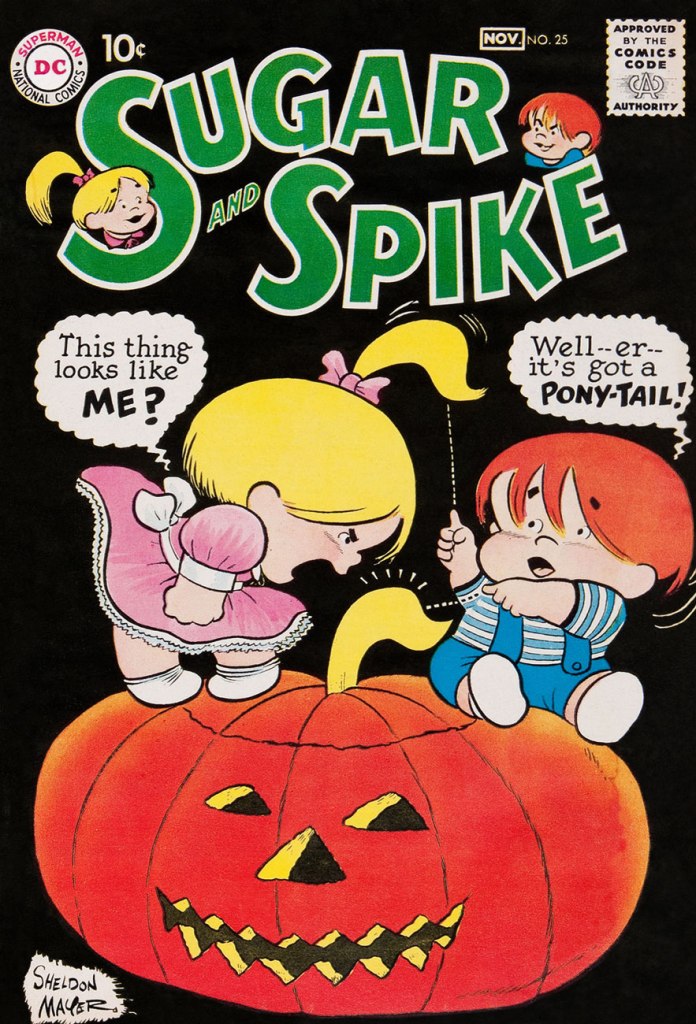
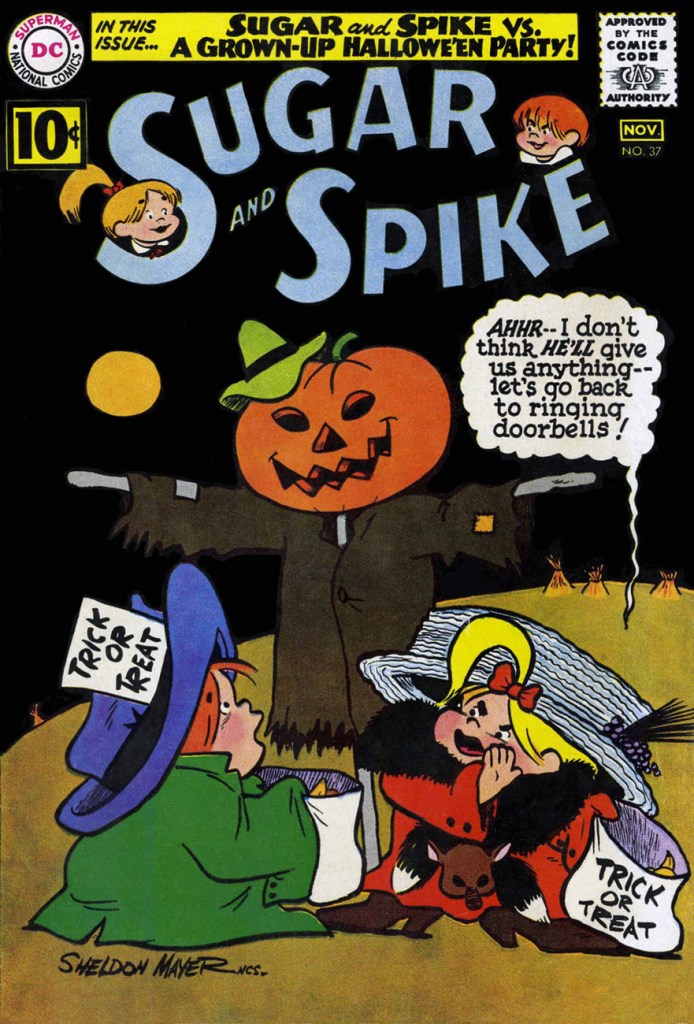
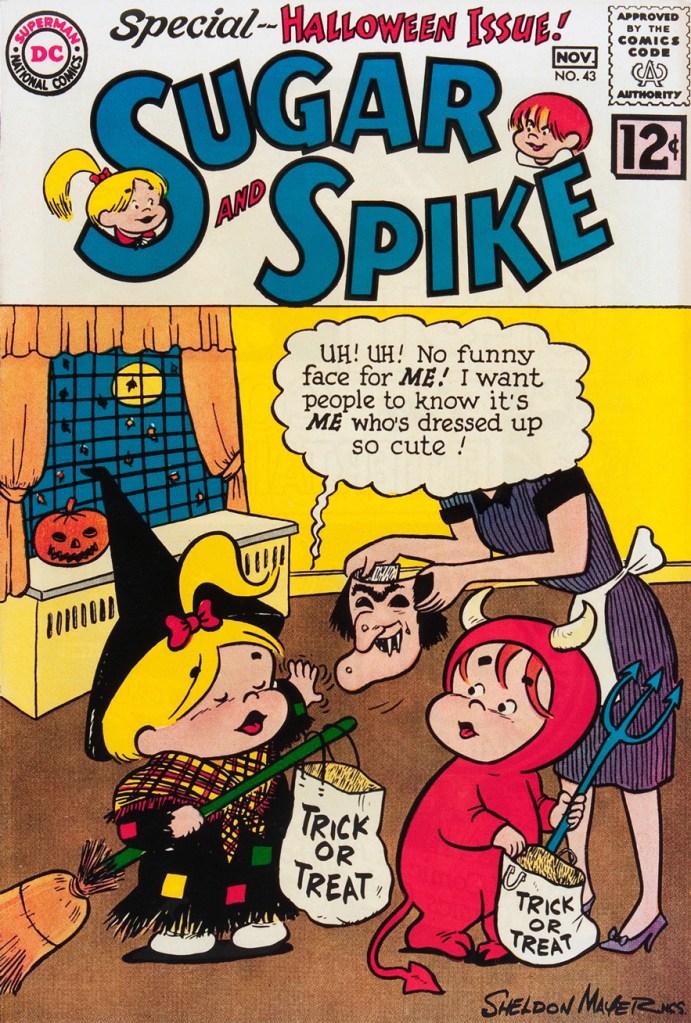
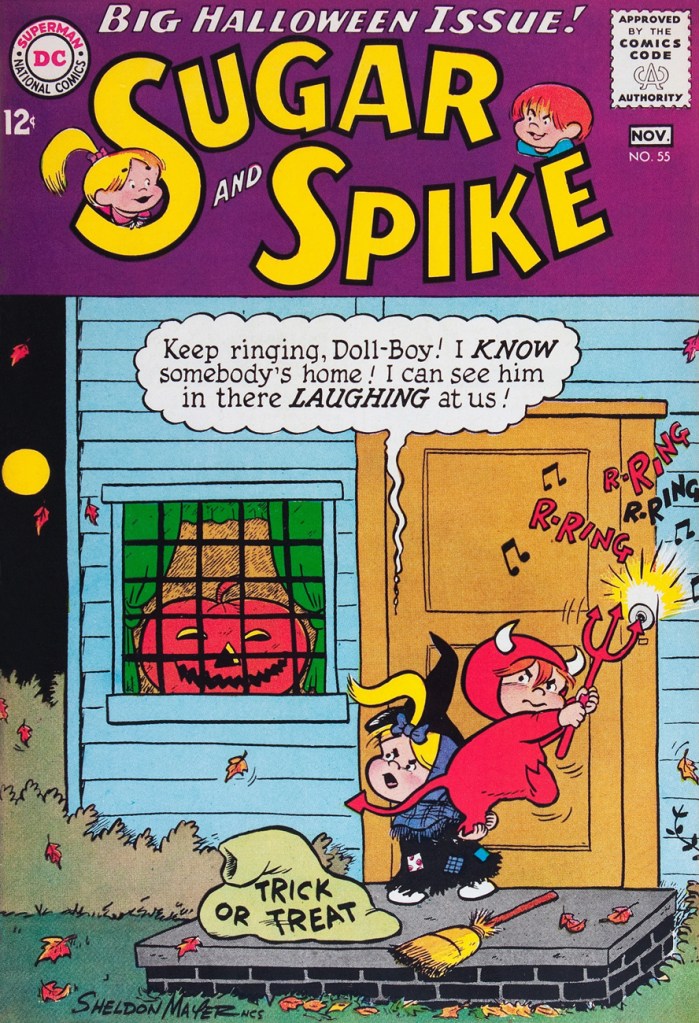
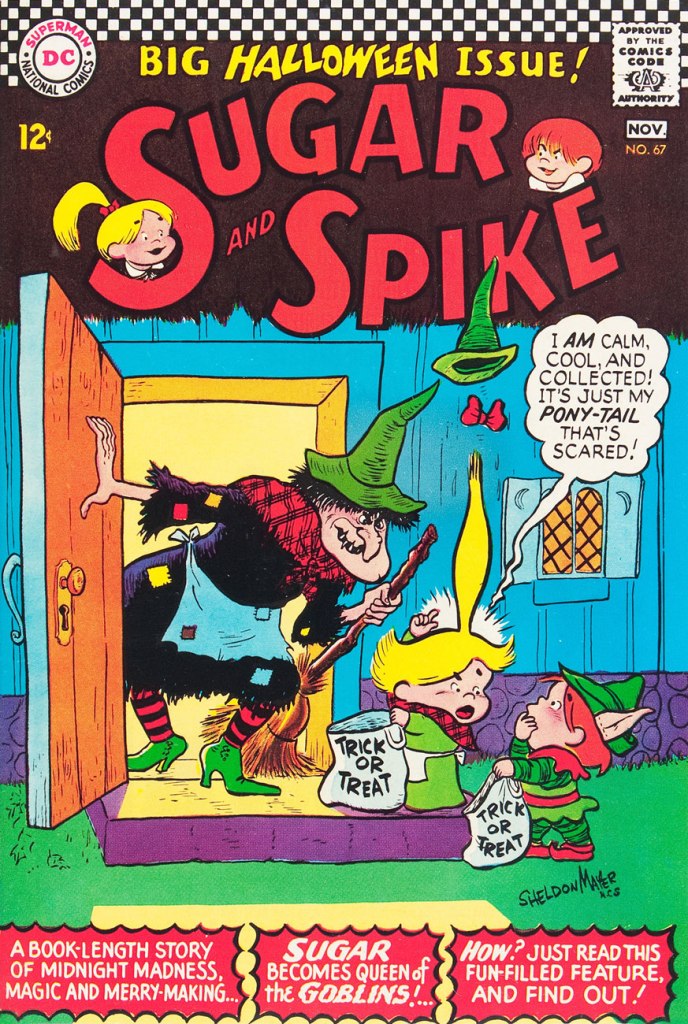
Who’d have the heart to resist Sheldon Mayer’s adorable toddlers (profiled here last year) if they came around trick or treating at your door? Even if you did resist, they’d be sure to get their grabby little mitts on the goods… some other way.
This is Sugar and Spike no. 25 (Oct.-Nov. 1959, DC).
This is Sugar and Spike no. 31 (Oct.-Nov. 1960, DC). Definitely my favourite of this splendid lot, largely thanks to that meticulous, understated colouring job. Jack Adler‘s doing, I’ll wager.
This is Sugar and Spike no. 37 (Oct.-Nov. 1961, DC).
This is Sugar and Spike no. 43 (Oct.-Nov. 1962, DC).
This is Sugar and Spike no. 49 (Oct.-Nov. 1963, DC).
This is Sugar and Spike no. 55 (Oct.-Nov. 1964, DC).
This is Sugar and Spike no. 61 (Oct.-Nov. 1965, DC).
This is Sugar and Spike no. 36 (Oct.-Nov. 1966, DC).
A reprint? Not quite. This cover scene, which originally appeared back in issue 55, was reprised (redrawn, not reprinted) for the series finale, Sugar and Spike no. 98 (Oct.-Nov. 1971). I’d hate to take part in a contest announced in the last issue of a series. There *was* a no. 99, but it was a one-shot that only followed… 21 years later.
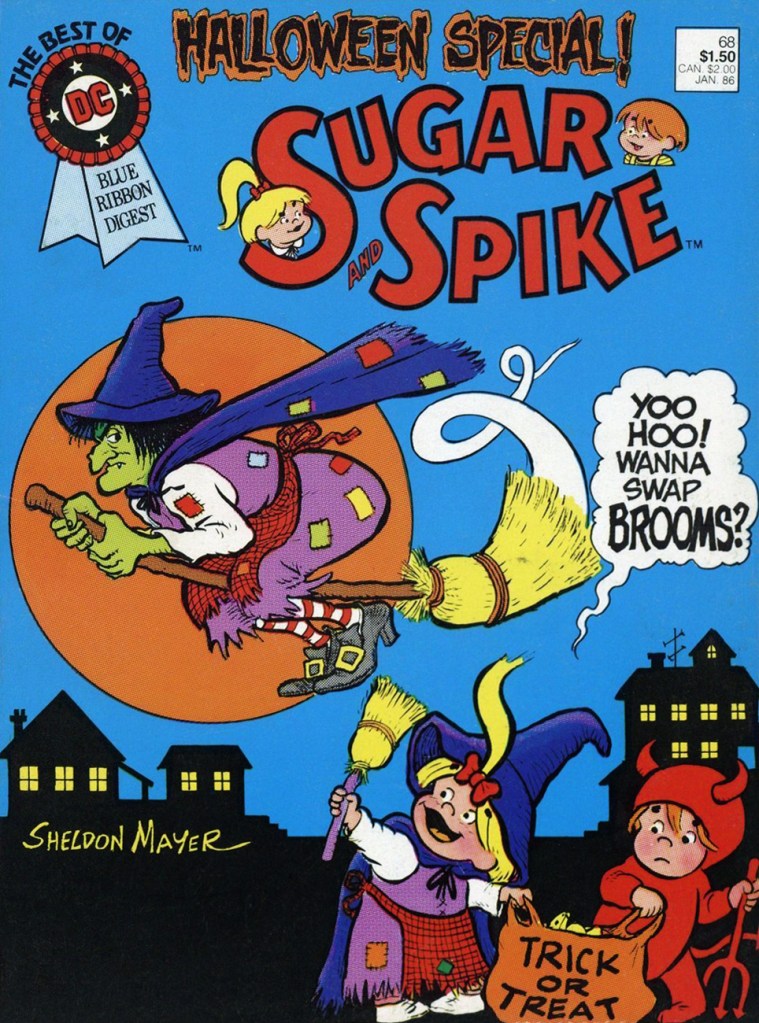
This is The Best of DC no. 68: Sugar and Spike (Jan. 1986). Edited by Nicola Cuti, and with a new cover by Mr. Mayer. Mostly reprints, but with material of this calibre, who’s to quibble?
I was initially set to feature just a couple of Sugar and Spike Hallowe’en covers, but in the end, it seemed unfair to play favourites.
“Man is a rope stretched between the animal and the Superman–a rope over an abyss. A dangerous crossing, a dangerous wayfaring, a dangerous looking-back, a dangerous trembling and halting.”
– Friedrich Nietzsche
Superheroes come in all shapes and sizes, and for every successful superhero remembered throughout the ages, there’s probably about a hundred forgotten characters of varying degrees of goofiness. Periodically, some artist or writer digs up one of them from the deep recesses of time, dresses him in a new frock and plugs him into the modern era of Internet and cellphones, with almost universally lacklustre results.
I like to contemplate these bold strangers in their natural habitat — Golden Age comics! And for a 40s superhero, there is simply no better way to demonstrate super powers and a nimble brain than a friendly tussle with a cephalopod.
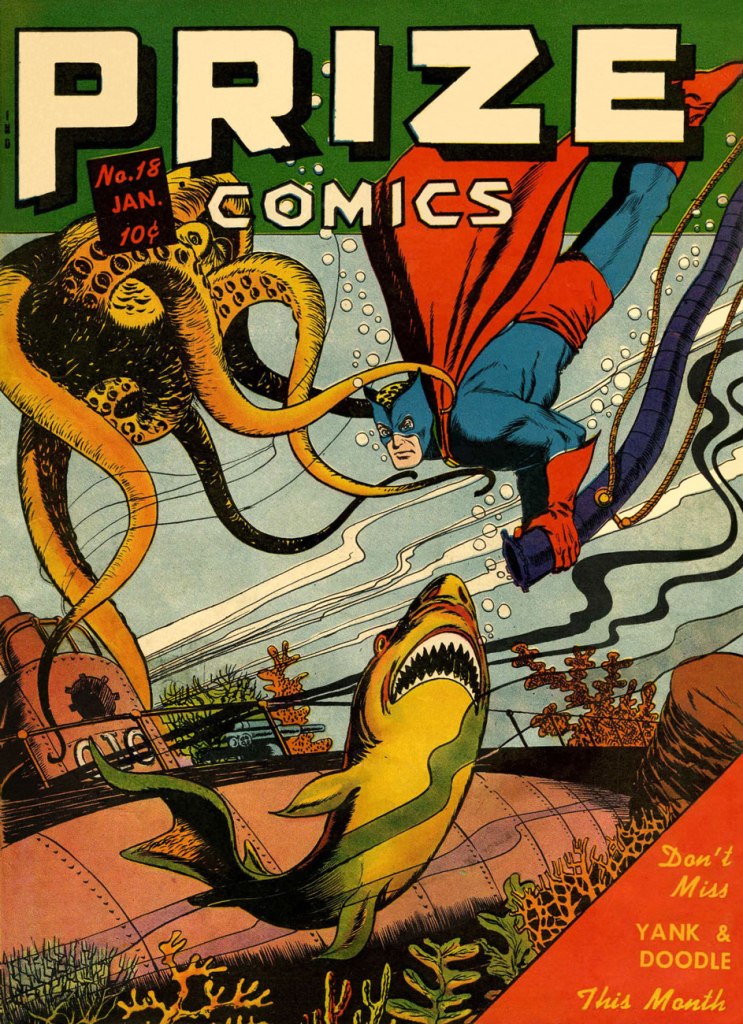
The Black Owl, clad in a red-and-blue costume with some odd leopard-print swimming cap… oh, sorry, that’s his blond hair:
Prize Comics no. 18 (January 1942). Cover by Jack Binder.
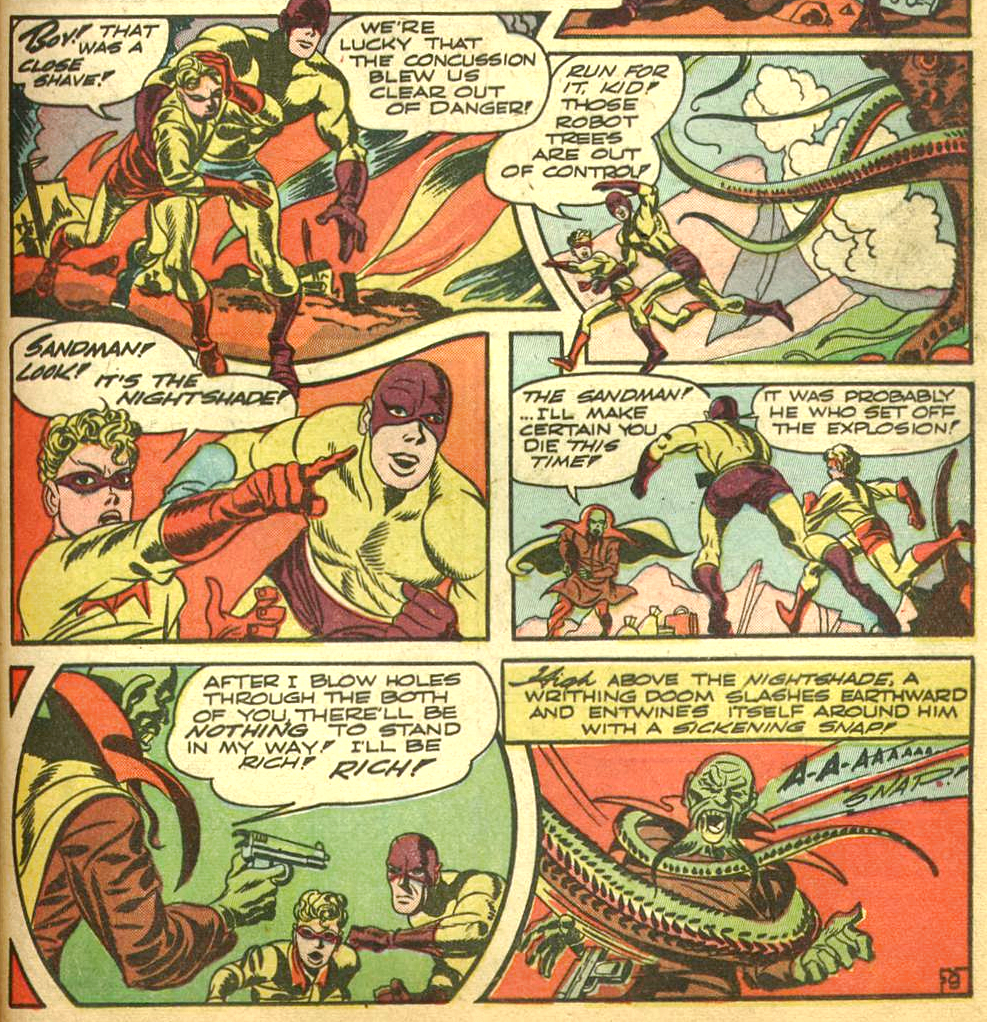
The Sandman… oh shoot, which one? Remember we have both feet firmly planted in the 40s in this post. This Sandman is Wesley Dodds, created by artist Bert Christman and writer Gardner Fox. Accompanied by his sidekick Sandy, this superhero-cum-detective wielded a special gun that could put criminals to sleep or act as a sort of truth serum.
The Adventure of the Magic Forest, published in World’s Finest Comics no. 6 (Summer 1942, DC), was scripted by Jack Kirby (Tentacle Tuesday Master!), pencilled by the King and inked by Joe Simon.
You’re not convinced that those are tentacles? Shame on you. Take a gander at this:
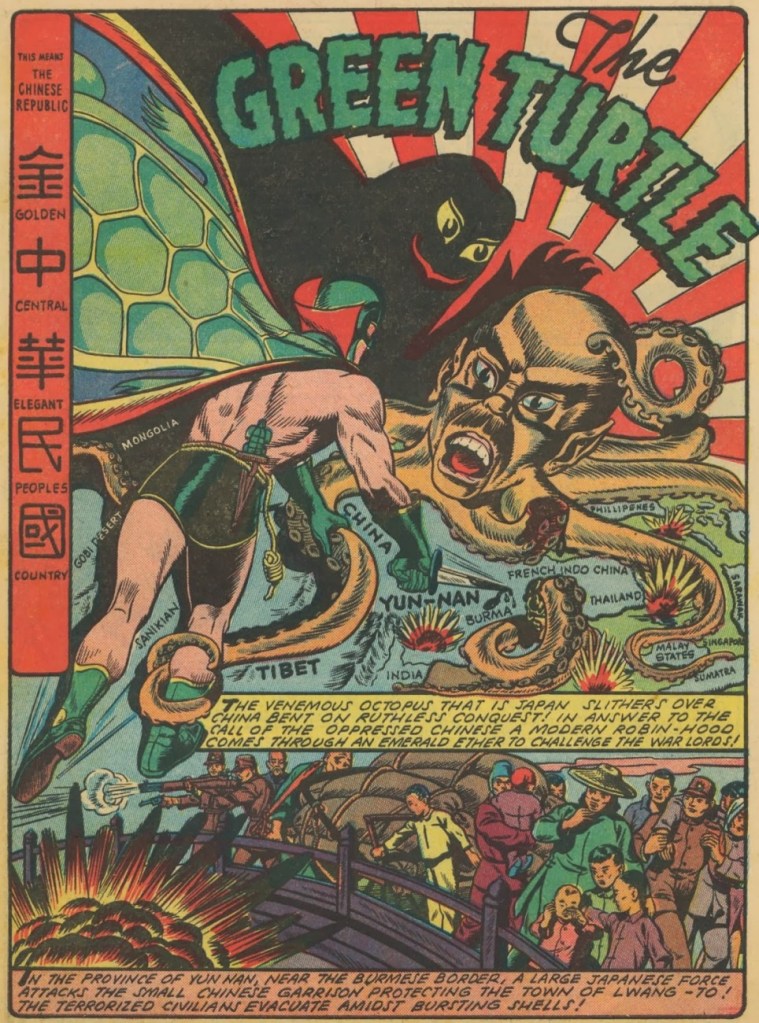
The next superhero (technically with no super powers, but managing beautifully all the same thanks to his lightning-fast reflexes and superior fighting skill) is my personal favourite Green Turtle, a Chinese superhero who fought against Japanese invaders in WWII. Unfortunately, the publisher wouldn’t let creator and artist Chu Fook Hing make his creation obviously Chinese, so the Green Turtle was never seen without a mask. It’s okay, we can read between the lines!
This Green Turtle adventure was scripted and illustrated byChu F. Hing and published in Blazing Comics no. 1 (June 1944, Rural Home). With apologies to our Japanese readers.
Magno the Magnetic Man has, believe it or not, magnetic powers (though I imagine it’s not helping him much in this particular skirmish). He’s irresistible to women (maybe they have metal parts?), impervious to harm, and is accompanied by his side-kick Davey, whom he periodically magnetizes to ensure that the little whippersnapper also has access to magnetic powers.
Super-Mystery Comics vol. 5 no. 4 (February 1946, Ace Magazines). Cover by the sudorific Rudy Palais.






























 Who's Out There?