Remembering Don Newton (1934-1984)

« Herbal tea. My own recipe.
It’s added years to my life.
May I offer you a cup? »

After producing some exceptionally solid fan art (chiefly for the long-lived Rocket’s Blast Comicollector (153 issues, 1961-1985), Arizona art teacher Don Newton made his jump into the pro leagues in 1974 with Charlton, where he got his chance to show off his considerable painting skills. After a handful of mystery stories, he took over Charlton’s version of Lee Falk and Ray Moore‘s The Phantom, which he drew for six issues (and one cover) before the title was cancelled… along with the rest of Charlton’s original comics line, really.

Phantom68ORIG_A
Newton’s original cover painting for issue 68 (December, 1975, Charlton) of The Phantom, illustrating the tale of The Beasts of Madame Kahn by Nicola Cuti and Newton.
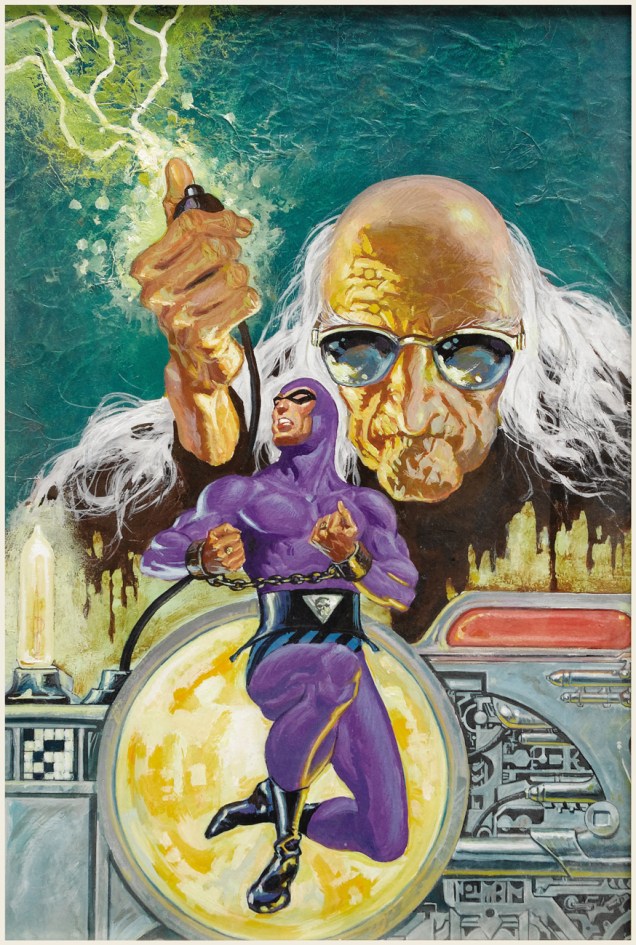
NewtonPhantom73A
Newton’s cover painting (in acrylics, if you must know) for the penultimate issue of The Phantom’s Charlton run, no. 73 (October, 1976), “The Torch”, written by Ben S. Parillo (alias Bill Pearson), pencilled and inked by Don Newton. The wizened mastermind is a fella who simply goes by the name of ‘Raven’.
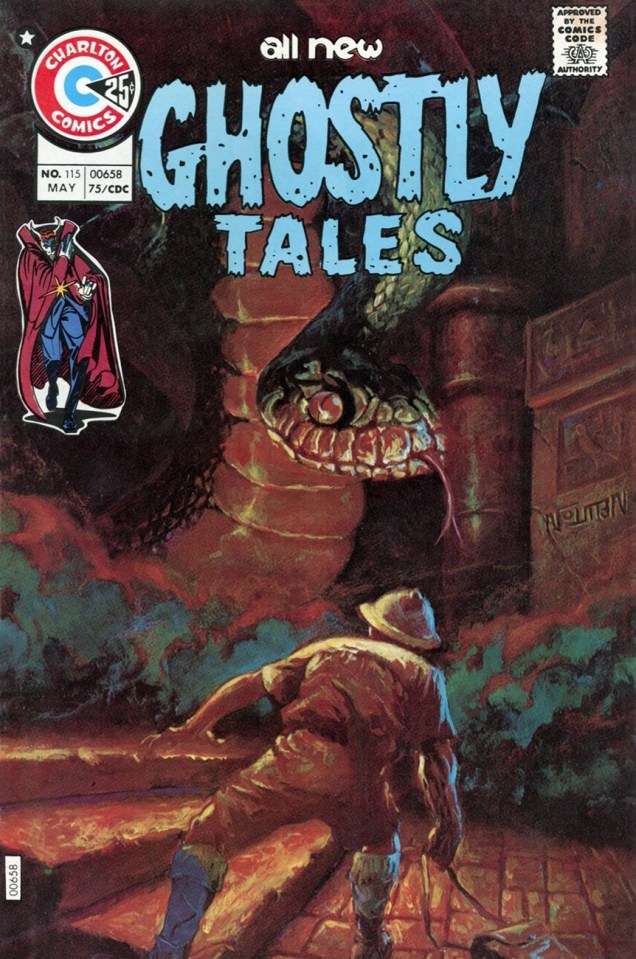
GhostlyTales115A
« How could a snake be alive here, buried deep in the earth for thousands of years? » Don Newton’s painting (Ghostly Tales no. 115, May, 1975) depicts a scene from Joe Gill and Steve Ditko’s “Wings of Death!”
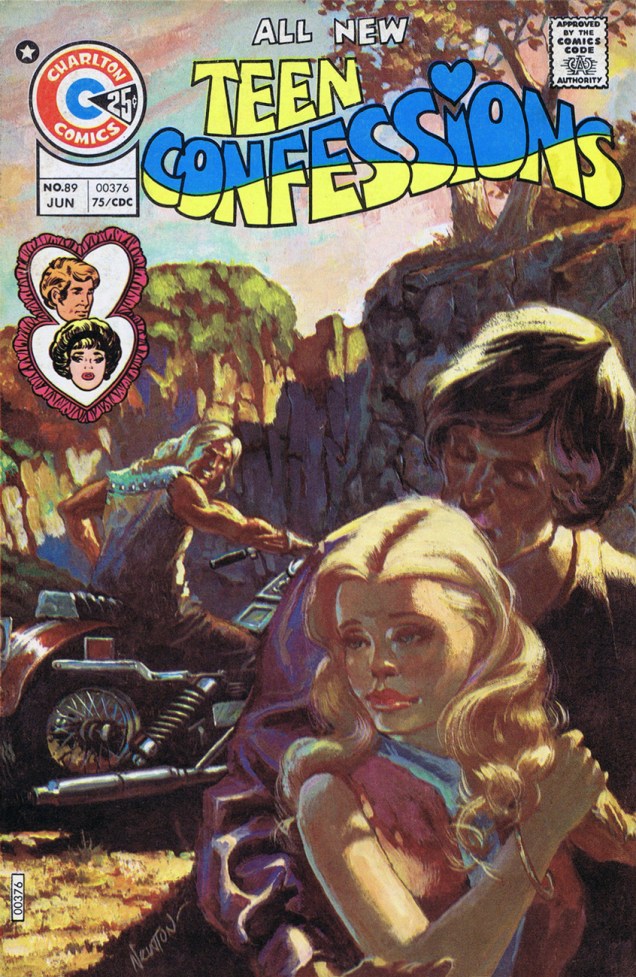
TeenConfessions89A
« Turn her loose, Pike… I want to road-test the new talent! » Mr. Newton illustrates the Unknown Scribe and Demetrio Sánchez Gómez‘s biker operetta “Running Wild!”, from Teen Confessions no. 89 (June, 1975, Charlton.)

Newton would go on to DC (and a couple of brief dalliances with Marvel), illustrating Batman, Captain Marvel (er, “Shazam!”), Aquaman, Star Hunters, and The New Gods for DC, before being, all too soon, felled by a heart attack at the age of 49. Most of the time, though, he provided great art to ho-hum stories.

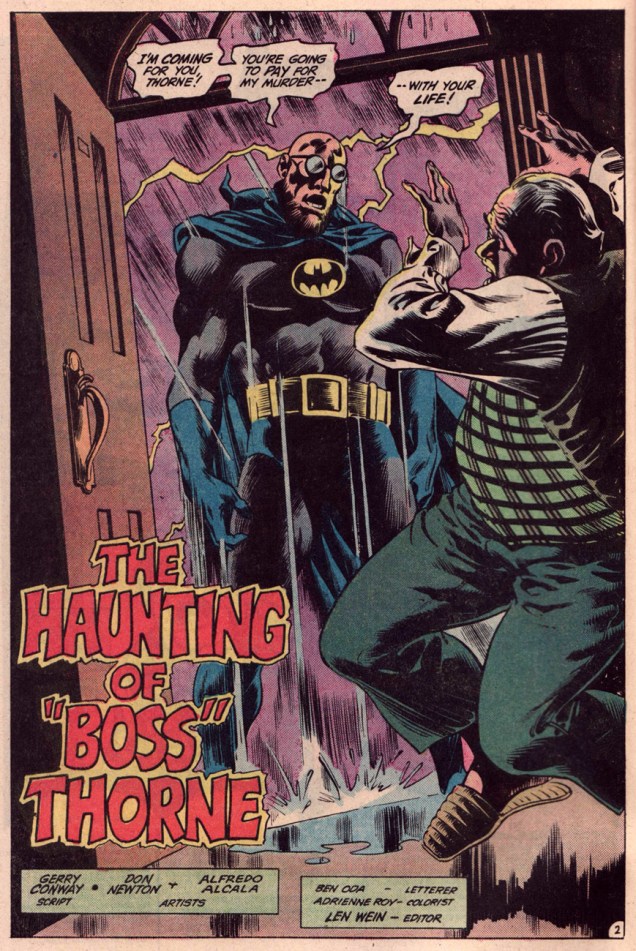
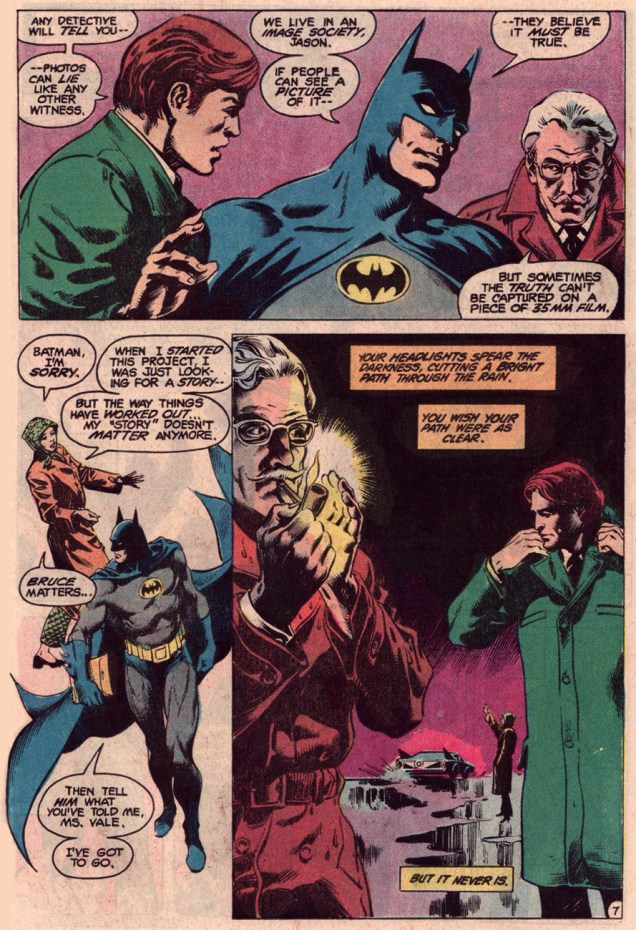
Against all odds, around 1982, scripter Gerry Conway, a name synonymous with half-assed, content-free hackwork since the early ’70s, actually blossomed into a decent writer. Fortuitously, while assigned to pencil Batman’s adventures in Detective Comics, Newton was paired with prolific* Filipino legend Alfredo Alcala, and the stars were in proper alignment. You won’t have to take my word for it, however. Feast your eyes on the palpable ambiance from the Conway-Newton-Alcala trio.
NewtonHugo1A
Picking up strands from Steve Englehart‘s  run on the book (nos. 469–476, in 1977-78), creepy-but-buff scientist Hugo Strange returns to pester his murderer, crooked politician Rupert Thorne. Colourist Adrienne Roy’s hand is betrayed by the 100% magenta/30% black mix.
NewtonHugo2A
Well, I have to show Newton’s actual Batman, don’t I? His was one of the few characterizations that were physically believable. You could buy this guy as an acrobat, as a fighter *and* as detective. Alcala often overwhelms whomever he’s inking, but since Newton’s pencils were probably tight as a camel’s ass in a sand storm, both men’s contributions mesh splendidly with no loss of identity. Pages 2 and 7 from Detective no. 520 (Nov. 1982).

– RG

*How prolific was Alcala? « It is said that his fastest page rate was twelve pages in a nine-hour sitting. » And the scary thing is that it hardly ever looked rushed or less than committed, unlike the work of some other inkers we could name. What a guy.
Happy 90th birthday, Mr. Ditko!

« Don’t be so sure! A guy that popular — he’d be a fool to fold up his act while he’s such a hot item!* »

I’ve been a Steve Ditko fan for as long as I can remember. In fact, I was a fan even before I actually saw his work. “How’s that even possible?”, you may ask. Well, when I was five, this neighbour from across the street was showing off a comic book he had just picked up, which was Teen Titans no. 29**. I was instantly captivated by two costumes on the cover: Hawk and Dove’s, designed by Ditko a couple of years earlier.

I do believe I had encountered a Ditko comic book just a bit earlier, a copy of The Many Ghosts of Doctor Graves no. 20 (June, 1970), acquired by my brother en route to the family vacation on Prince Edward Island. But that one had a (fine) cover by Pat Boyette, and I don’t recall the Ditko story within, « An Ancient Wrong ».

The bottom line is that Ditko’s been a precious part of my life for a spell. It would be easy to take him from granted, so let’s not, if you don’t mind.

Which brings us to our little tribute: running ninety covers covers would be about as practical as ninety candles on our birthday boy’s cake, so I’ll just drop a decimal and stick to a more manageable nine… I won’t even give a nod to such fickle and hollow notions as popularity, historical importance, or iconicity. I’m going with my favourites. That’s the way Steve would do it… and even if he wouldn’t, I’d still go this route.

UnusualTales9A
« Nobody here in Crestville will ever forget that night! »
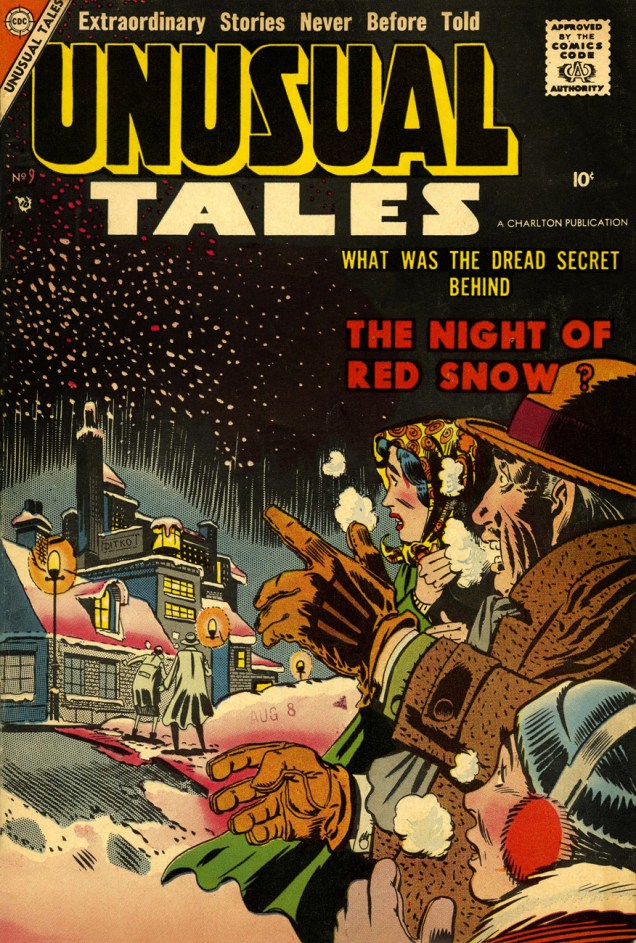
A tiny reproduction of this cover, that of Unusual Tales no. 9 (Nov. 1957, Charlton), in some late-70s edition of the Overstreet Comic Book Price Guide hooked me, and still grabs me. In the post-code era, particularly in its early days, you had to be mighty resourceful to fruitfully mine the mystery genre, what with all the verboten topics and tropes. The issue holds a whopping four, 1957-vintage Ditko stories, including the title piece, which you can read here:
http://ditko.blogspot.ca/2012/01/unusual-tales-night-of-red-snow.html
ASM2A
The Amazing Spider-Man no. 2 (May 1963, Marvel). Beyond Ditko’s departure (no. 38 was his final contribution), I have no further interest in Peter Parker and his costumed alter-ego.
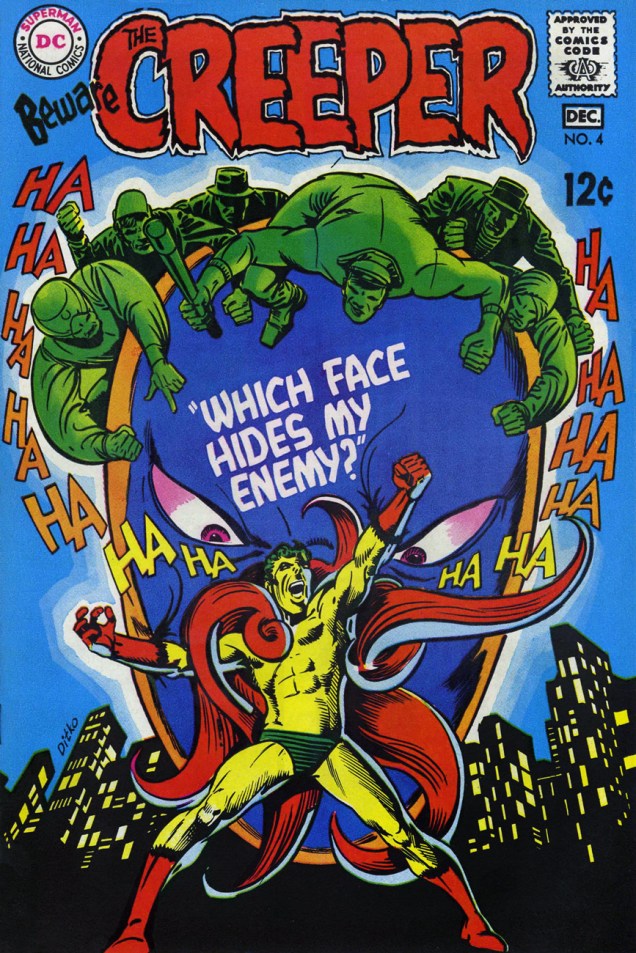
Creeper4A
« Name’s Bulldog Bird! This is Sumo! We’re secret agents from the sovereign kingdom of Offalia! »
For most of the brief run of his book (issues 2 to 6), the Creeper had to contend with a faceless enemy, Proteus, who turns out to be someone very close to him. It was as though Ditko felt the need to replay the Spider-Man – Green Goblin secret identity dynamic, not the way *he* had envisioned it (which was to make the Goblin a total stranger, a situation he’d meticulously set up in the background), but the way Lee had, as if to show his former editor how to do it properly.
This is Beware the Creeper no. 4 (Nov.-Dec. 1968, DC), “Which Face Hides My Enemy?” Pencils and inks by Steve Ditko, plot and dialogue by Dennis O’Neil
Hawk&Dove2A
« You’re still wasting your time reading! Why don’t you build up that sickly body of yours? »
DC’s Hawk and Dove (introduced in Showcase no. 75, June 1968, DC) was, as its title and covers amply make clear, a study in contrast and opposition: aggression vs pacifism, the letter of the law vs the spirit of the law, Steve Ditko vs Steve Skeates…
The concept may have been of its time, but the industry as it stood wasn’t ready to explore the issues without stacking the deck. This was still, after all, a mainstream superhero comic book of the Sixties. This is issue 2, “Jailbreak!” (Oct.-Nov. 1968), Ditko’s third and final issue with his creations. As for Ditko’s abrupt departure from DC is concerned, the reason cited at the time was a relapse of tuberculosis, a disease that had plagued Ditko in his youth. Others have invoked more political explanations, but Ditko *was* out of the game for several months, which fits the convalescence scenario. His absence until 1975 from DC fits the politics one. Why credit one single factor when several, taken together, are more plausible?
GhostManor5A
« Come off it, yer Lordship! This ain’t no blinkin’ time ter do the art connoisseur bit! »
The rakish 14th Lord Garland proves a bit of a disappointment to his forebears. Sir Steve Ditko’s cover proffers a scenic victim’s perspective… but who’s the hazy, phosphorescent figure shambling down the stairs to meet us?
This is Charlton Comics’ Ghost Manor no. 5 (second series, June 1972, Charlton). Inside, you’ll find a trio of Joe Gill chillers: “Dead Man’s Eyes”, illustrated by Joe Staton; “Devils at My Door”, illustrated by Charles Nicholas and Vincent Alascia, and of course, the pièce de résistance, “The Last Garland”, brought to you in panoramic Ditko-vision.
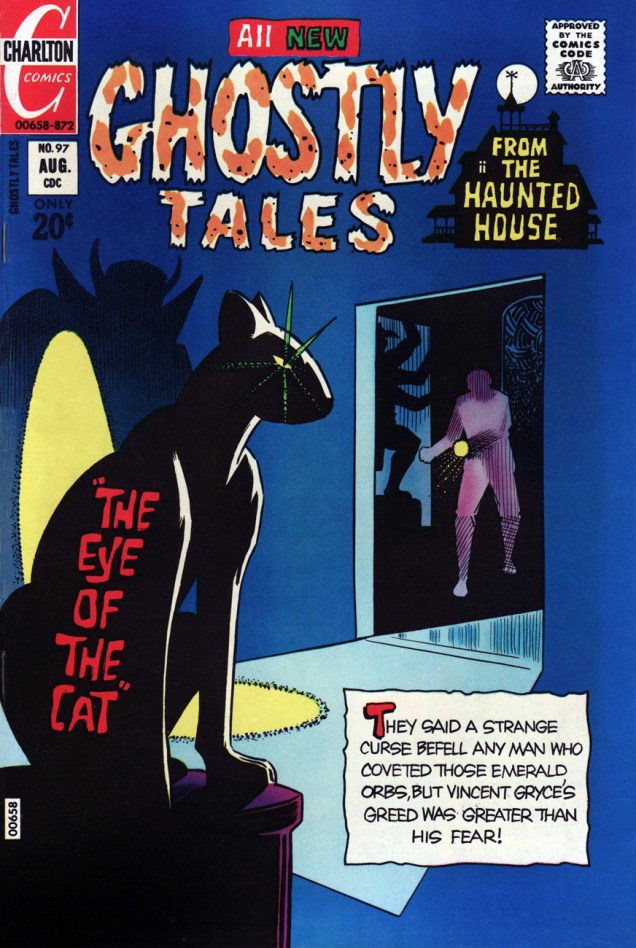
GhostlyTales97A
Ah, the largely lost art of the *soft* sell. Charlton’s cadre of artists hewed much closer to the ambience favoured by aficionados of the spectral than did the esteemed competition. You know, more Montague Rhodes James than, say, Rob Zombie.
Here, Ditko demonstrates how (dis)quiet and mystery is evoked. Dignified silence can be very attractive when everyone around is shouting. Ghostly Tales no. 97 (August 1972, Charlton) features “The Eye of the Cat”, actually handled by Don Perlin, while Ditko delivers visuals for Joe Gill’s “Journal of a Hanged Witch”. The issue also features “Poltergeist”, an effective collaboration between Creepy Magazine founder Russ Jones and the multitalented Bhob Stewart.
Haunted16A
My particular favourite among Ditko’s covers for Charlton’s Haunted (75 issues, 1971-84.) The merrily saturated colour scheme, the composition and its geometric simplicity, that well-chosen angle… the contagious joy of a master at play. This be Haunted no. 16 (June 1974, Charlton.)
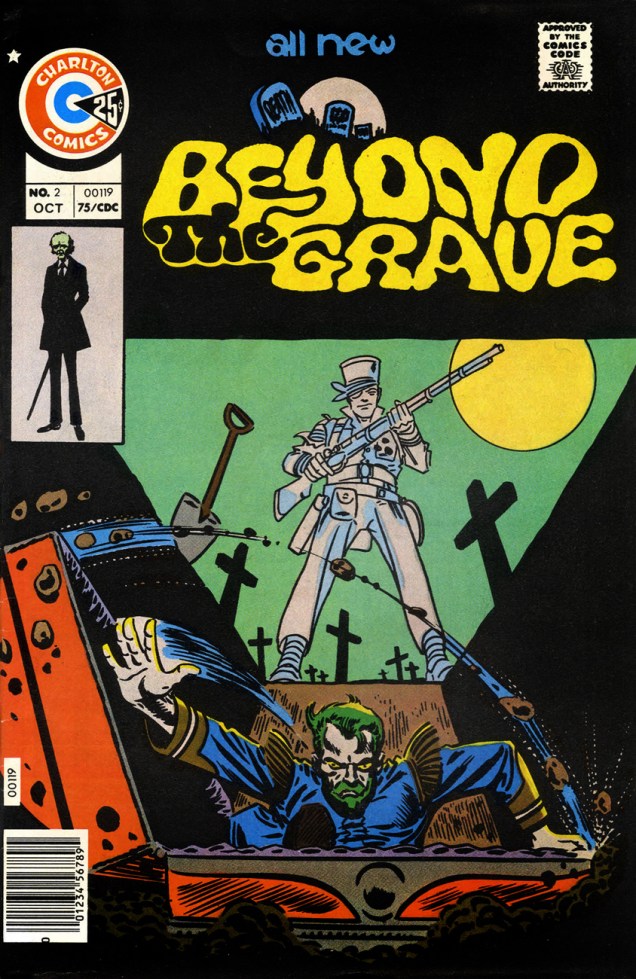
BeyondtheGrave2A
« If you visit that grave on a dark night, you may be surprised… for there is a sentry stationed there…to honor the dead? Or to make sure that General Kugar never leaves his grave? »
Here’s a cover showing the sort of solemn dignity and restraint that made Charlton’s line of ghost books so attractive to me right off the (vampire) bat. No one’s shouting deceptive hype or explaining the action; the elusive allure is undisturbed, unlike the sanctity of the tomb. 
DC, under Infantino and Cardy, generally understood this, but Marvel virtually never did or cared to. But hey, what sold and what I liked rarely sat at the same table.
Beyond the Grave no. 2 (Oct. 1975, Charlton).
Shade3A
Ah, Shade. Ditko’s last great creation, cut off in its prime by the Great DC Implosion of ’78. Later misunderstood and corrupted by hacks. Finally reprinted, including formerly unpublished issue 9, in volume 1 of The Steve Ditko Omnibus (2011). It’s still a frustrating experience, but at least issue 8’s cliffhanger has been resolved, and what happens in the Zero Zone doesn’t stay in the Zero Zone, if you know what I mean. This is Shade the Changing Man no. 3 (Oct.-Nov. 1977, DC)

*Jack Ryder (aka The Creeper)’s closing quip from “The Coming of the Creeper!”, plot and art by Steve Ditko, script by Don Segall (Showcase #73, Mar.-Apr. 1968, DC)
**Since it played such a crucial rôle in my Ditko inculcation, here’s the Teen Titans issue in question.

TeenTitans29A
Teen Titans no. 29 (Sept./Oct. 1970, DC) Cover by Nick Cardy (likely co-designed by Carmine Infantino and coloured by Jack Adler), illustrating “Captives!”, written by Hawk & Dove scenarist Steve Skeates and illustrated by Nick Cardy.

– RG

Hallowe’en Countdown, Day 26

« I’m doing some new phony ghost effects and these hicks just eat it up! Show ‘em a ghost and they’ll swear they recognize it! »

Is it just me, or are horror covers more effective when they’re basically wordless? EC and DC and Charlton got it, but Marvel never did, with its protagonists/victims standing around uselessly pointing out the obvious: “Oh no! We’re trapped with… the Thing that walks!” “Uh, honey, I think it’s more of a Thing that shambles!”

HOM236A
This is House of Mystery no. 236 (October, 1975, DC) and it’s quite an issue on the inside too: Steve Ditko with Mike Royer inks (“Death Played a Sideshow“), and Paul Kirshner with Neal Adams inks (“Deep Sleep“.) Lest we forget: this fine cover palette brought to you by Tatjana Wood.

… and since this is our first, sadder Hallowe’en without the macabre Bernie Wrightson  (1948-2017) to inspire us, let’s have one more shot, shall we?

HOM219Intro
This is the frontispiece ushering us into issue 219 (Nov. 1973) of DC’s House of Mystery.

Interestingly, BW’s signature (at bottom, on the spine of a book in the centre) is reversed, which makes one wonder whether the image was flipped before dialogue was added. On the other hand, perhaps it made for better arcane lettering for a dusty grimoire.

– RG

Hallowe’en Countdown, Day 18

« Sorry fella! But yuh fergot tuh git yore ticket punched! »

In the early 1970s, despite the western genre’s waning prospects in comics, DC found itself with a surprise hit in John Albano and artist Tony DeZuniga‘s antihero Jonah Hex, thanks to a healthy infusion of grit and spaghetti sauce. The battle-scarred Civil War veteran first reared his memorably homely puss in All-Star Western no. 10 (Feb.–Mar. 1972), which soon changed its title to Weird Western Tales with issue 12 to better accommodate its new star.

WWT’s reliably great covers probably didn’t hurt sales. Most of them were the work of Argentine Luis Dominguez, in tandem with the all-star design team of publisher Carmine Infantino, art director Nick Cardy and production manager / colourist Jack Adler. These covers all possess that elusive allure of « Mysterioso », as Infantino termed it.

WWT25A
This is Weird Western no. 25 (Nov.-Dec. 1974), featuring Showdown with the Dangling Man. Script by Michael Fleisher, art by Noly Panaligan.

– RG

Tentacle Tuesday: Domesticated Octopus Seeks Soulmate

Meet an old man’s pet, Poochy. Like most pets, he gets a little impatient and loud around mealtime, but forgive him – he’s just a healthy animal who needs his calories. Who’s a good boy?

It’s Tentacle Tuesday, and today’s offering is this barking mad (hehe) and delightfully nonsensical story with script and pencils by Jim Starlin and inks by Wayne Howard.

« The Hotel » is a mere 2 pages long, so here it is in its full and unabridged glory:

TheHotelWayneHoward

TheHotelWayneHoward2
This is no plebeian octopus. This tentacled horror, this mutated dog-like atrocity, is a force for moral good, dammit, dishing out all the punishment these evil-doers deserve! (Or maybe it’s just hungry.)

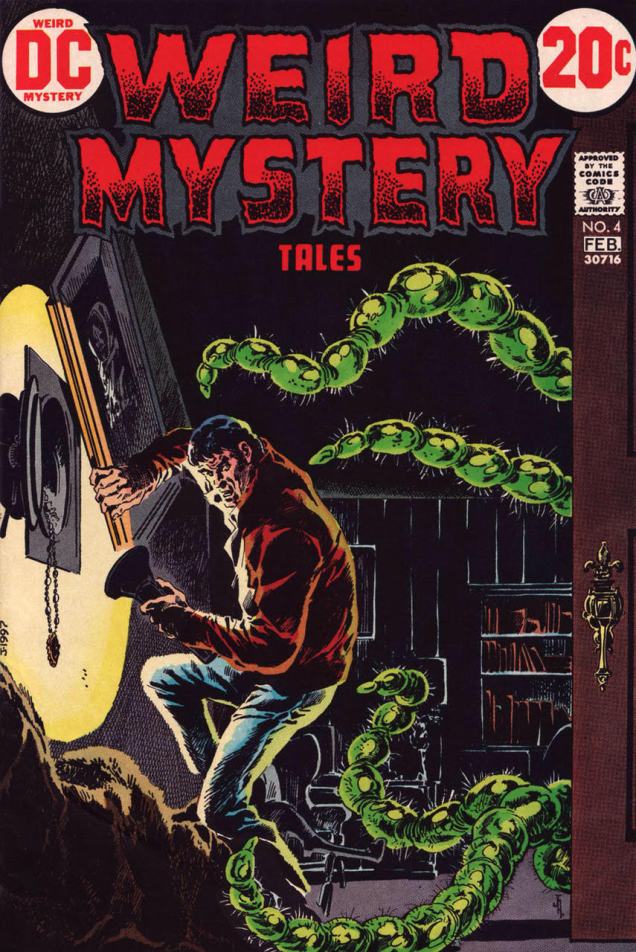
This tale of woe comes from Weird Mystery Tales #4 (Jan.-Feb. 1973), with a cover by Jim Aparo. It re-interpreted the story somewhat, making the thug’s comeuppance a little more immediate, but it’s still the same basic plot device: there’s the Deus ex machina, and there’s what I call Sudden Tentacles. Don’t know how to wrap up your story? Bam! tentacles out of nowhere, and everyone forgets that your tale makes no freaking sense.

WeirdMysteryTales4

Continuing this rather disturbing theme of stay-at-home octopuses, we have another contender for someone’s beloved pet: this sweet little (metaphorically speaking) guy from « Dum-Dum’s Basement » (Boris Karloff Tales of Mystery #93, August 1979).

DumDumsBasementMelCrawford
Art by Mel Crawford. Dum-Dum’s pet will soon want flesh instead of fish! (I also like how some people don’t give a shit about having a permanently flooded basement.)

Then we have the prototypical Sudden Tentacles and set at home, too: this panel from a chilling Tom Sutton and Nicola Cuti story called « Those Tentacles! » (inventive title), published in Ghostly Tales #106, August 1973.

TomSuttonThoseTentacles
“The tree branches remind me of those tentacles… those slimy, winding tentacles squeezing the life from Jake!”

There’s a scene in Nightmare on Elm Street 3: Dream Warriors (at 3:55) that quite terrified me as a kid – a girl reaches over a sink to turn the water on, and the tap sprouts… appendages… and grabs her hand. I wish Freddy Krueger was into tentacles, I would have spent fewer sleepless nights in my youth.

Wishing all of you peaceful nights of slumber… until the next Tentacle Tuesday rolls around – and it will.

Googly Eyed Stubby Squid
This itty-bitty octopus will haunt your nightmares.

˜ds

Hallowe’en Countdown, Day 10

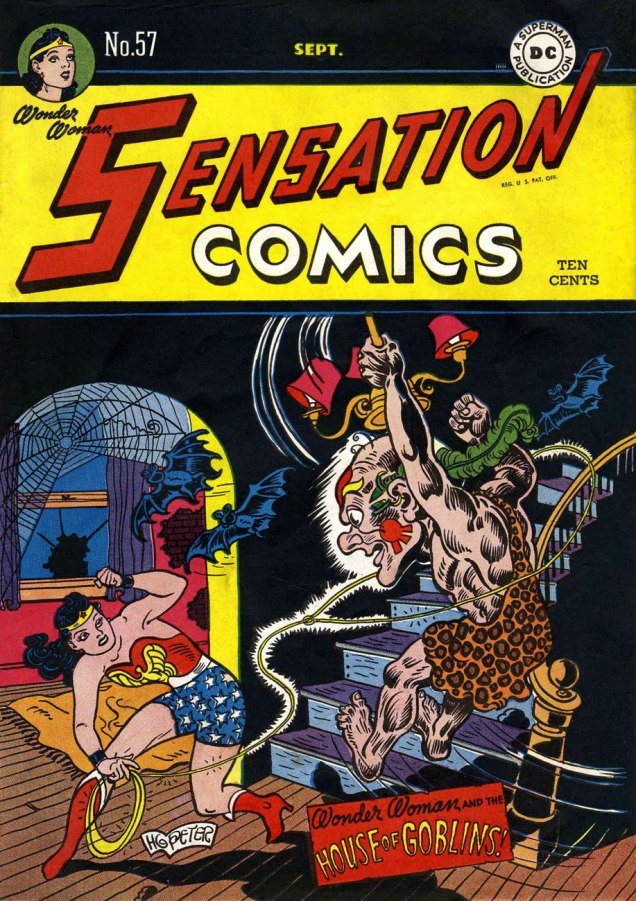
« Ever been to a maniac party held in a haunted house? Well, if you don’t frighten easily, you’re welcome to attend Etta Candy’s — but be careful or you’ll lose your scalp! »

Here’s a real hallowe’en corker from the Golden Age of comics, featuring the ageless Wonder Woman, presented here by her original creative team… with a twist. While the story is credited to Charles Moulton (the nom de plume of William Moulton Marston), it was ghost-written by his former student and collaborator Joye Hummel (1924-), the first woman to write Wonder Woman’s adventures. She is frequently credited for being the first woman to script superhero comics, but nope, that’s at least three years after Tarpe Mills gave the world her Miss Fury.

Sensation57A
This is Sensation Comics no. 57 (DC, September, 1946). Art by the sensational Harry G. Peter.
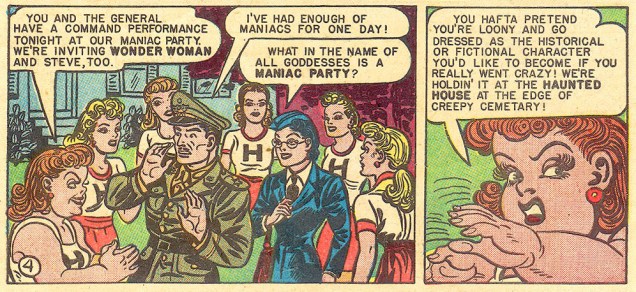
ManiacParty
Now you know what a Maniac Party is. The haunted house and the creepy cemetary (sic) are optional, but they sure do help set the properly demented mood.

Unfortunately, Joye appears to have been left out of the recently-released biopic Professor Marston and the Wonder Women. Too complicated? I guess a ménage à trois is plenty to handle already.

Check out the film’s trailer (well, one of them, at any rate.)

– RG

Hallowe’en Countdown, Day 5

« Do not come to Transylvania unless
you are prepared for the gravest of terror! »

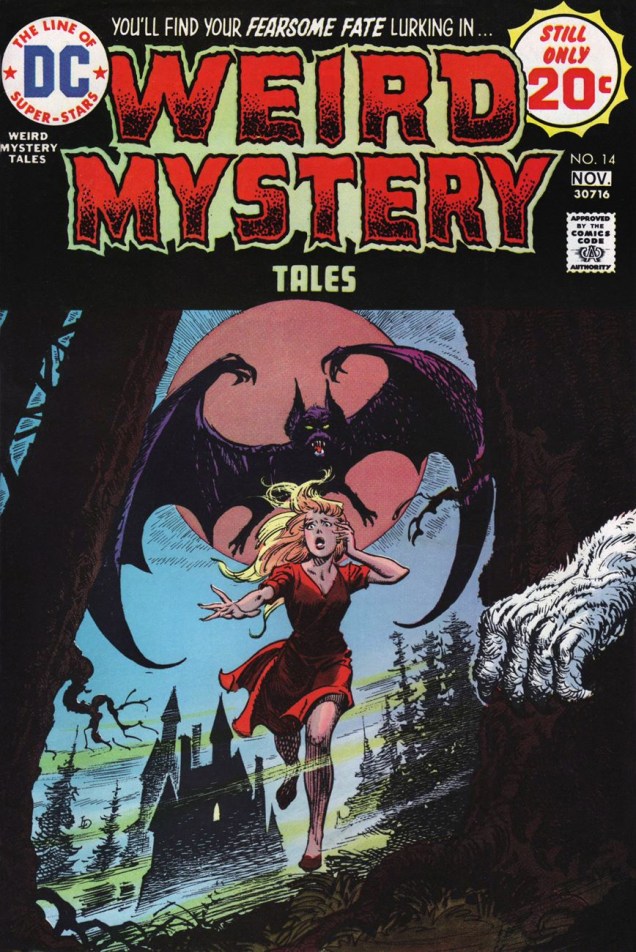
WeirdMysteryTales14A

Always one of DC’s underdog mystery titles, Weird Mystery Tales was actually more consistent than its sister titles. Its relative lack of success was perhaps due to its original host, Destiny, being a bit of a flat tire. He was replaced with Eve (you know, Cain, Abel…) with this issue.

Still, the entire run is worth seeking out, thanks to contributions from Jack Kirby (okay, leftovers, but delicious leftovers from the unpublished second issue of his Spirit World magazine), Sheldon Mayer, Robert Kanigher, Steve Skeates, Alfredo Alcala (his and E. Nelson Bridwell’s adaptation of John Russell’s The Price of the Head is my pick for the title’s finest moment; it appears in this issue), Frank Robbins, Ruben Nunag Yandoc, Michael Wm. Kaluta… hey, it’s an anthology: you *know* the list goes on and on.

This is Weird Mystery Tales no. 14 (October-November, 1974). Cover by Luis Dominguez. Mute terror… isn’t it more effective?

– RG

The Impeccable Logic of Comics


LexLuthorShazam

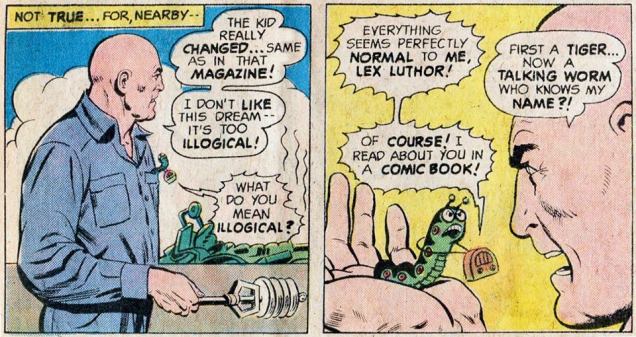
Beware of the man who only dreams logical dreams! That says a lot about Luthor’s personality, actually.

This legendary encounter between Mr. Mind and Luthor comes to us from “Captain Marvel Meets… Lex Luthor?!”, written by Dennis O’Neil, pencilled by Bob Oksner and inked by Tex Blaisdell.  It’s part of a 100-page issue (Shazam! no. 15, November-December 1974), which I think was my first exposure to The Big Red Cheese… and I was instantly hooked, even though I’m not generally fond of cross-overs (or, generally speaking, super-heroes). These issues may not cost 60 cents anymore, but they’re still totally worth tracking down!

Mr. Mind is usually considered to be a worm, but frankly, he looks more like a caterpillar (which is more dignified, anyway). In his quest for world dominion, he hatched many a plan to topple world order, some of which I will enumerate for readers’ enjoyment so you can admire the impressive span of Mr. Mind’s machinations:

  • To crush North America beneath a giant glacier using a giant gyroscope that makes the Earth shift on its axis.
  • To make Captain Marvel his mental slave using Billy Batson.
  • To topple all the buildings in Captain Marvel’s home city by controlling an army of worms and termites.
  • To trap the United States in eternal darkness by stopping the Earth’s rotation.
  • To use the ten-mile-long gun “Great Big Bertha” to literally blow holes in America and Russia.
  • To invade Scotland from an artificial floating island of ice.
  • To cause a giant volcano to erupt in the middle of Britain.

So if you encounter an angry-looking (but myopic) caterpillar on your travels, please mind what you say.

~ ds

Can You Hear Us?

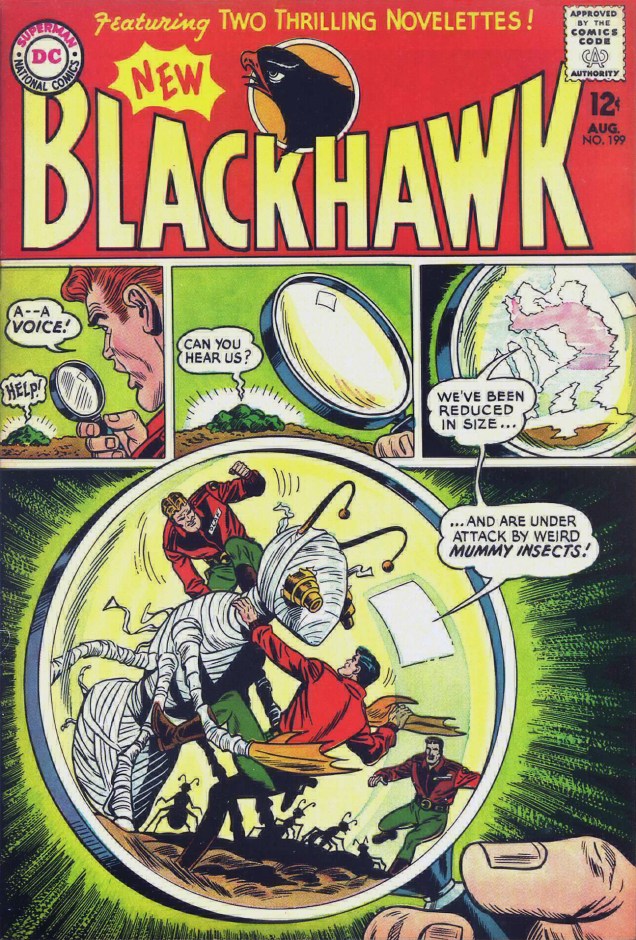
« Galloping ladybugs! What *are* those things, professor? »

Blackhawk199.jpg

It’s hard to imagine an explanation for this premise that wouldn’t raise more questions than it answered. By the 1960s, DC just didn’t know *what* to do with the Blackhawks. The title had been among DC’s top-sellers since the early 1940s, but it was becoming harder and harder to keep up with the times.

This is issue 199, from August 1964. Cover by Dick Dillin and Sheldon Moldoff. No one rushes forward to claim credit for writing The Attack of the Mummy Insects, but it’s probably Dave Wood.

The title would run until issue 243, in 1968. Ironically, its very finest issues would be its final two (until it was briefly revived in the 70s), an amazing two-parter drawn by Pat Boyette and returning these venerable characters to their roots and original uniforms.


– RG