« There will be no questions asked if I kill you here, gringo! » — Bad hombre Alejandro Roja
On February 5, 2024, versatile veteran cartoonist José Delbo (born in Buenos Aires, Argentine, on December 9, 1933) left us at the most respectable age of ninety. Comics fans of a certain age will no doubt recall him chiefly from his long stint on DC’s Wonder Woman (1975-1981, issues no. 222-286), but to my mind, that’s hardly his finest hour: he wasn’t done any favours there, hobbled as he was by pedestrian (or worse) writing and indifferent (or worse) inking. Same goes for his run on Batgirl (1976-82) in Batman Family and Detective Comics.
For a detailed rundown of his remarkably long and varied career, you can’t go wrong with this excellent bio.
This post’s title gave away my candidate for Delbo’s magnum opus, such as it is; but I would be remiss in failing to also note his charming work on Dell’s The Monkees (fifteen issues), where he got to demonstrate his deft hand at humour; and his winningly bizarre collaboration with Tony Tallarico, Geronimo Jones (nine issues, 1971-73, plus one that remains unpublished).
This is Billy the Kid no. 58 (Nov. 1966, Charlton), Delbo’s second issue on the title but his first cover. After this one, he would go on to pencil and ink the subsequent fifty or so covers and most of the inside features. When you find an artist who can draw horses, you hold on to him (or her)! How many, among the current generation, could successfully handle that particular mission?
Incidentally, Billy’s distinctive steed appears to be an Appaloosa: « The Appaloosa’s eye-catching pattern comes from the spotted horses brought into the Americas by Spanish Conquistadors. Known as the Dalmatian horse breed, it was bred in the mid-18th century by the Native American Nez Percé people. Its name comes from the Palouse River that flows through what used to be Nez Percé territory. » [ source ]
Charlton Comics’ flagship western title, Billy the Kid (153 issues, 1955-1983, including its first five as “Masked Raider”), endured as long as it did for good cause: notable runs by accomplished artists, among them John Severin, Rocco Mastroserio, Luis Domínguez, Delbo, and finally Warren Sattler. Yet, for my money, it’s Joe Gill’s spare but psychologically consistent and highly humane scripting that holds the enterprise together.
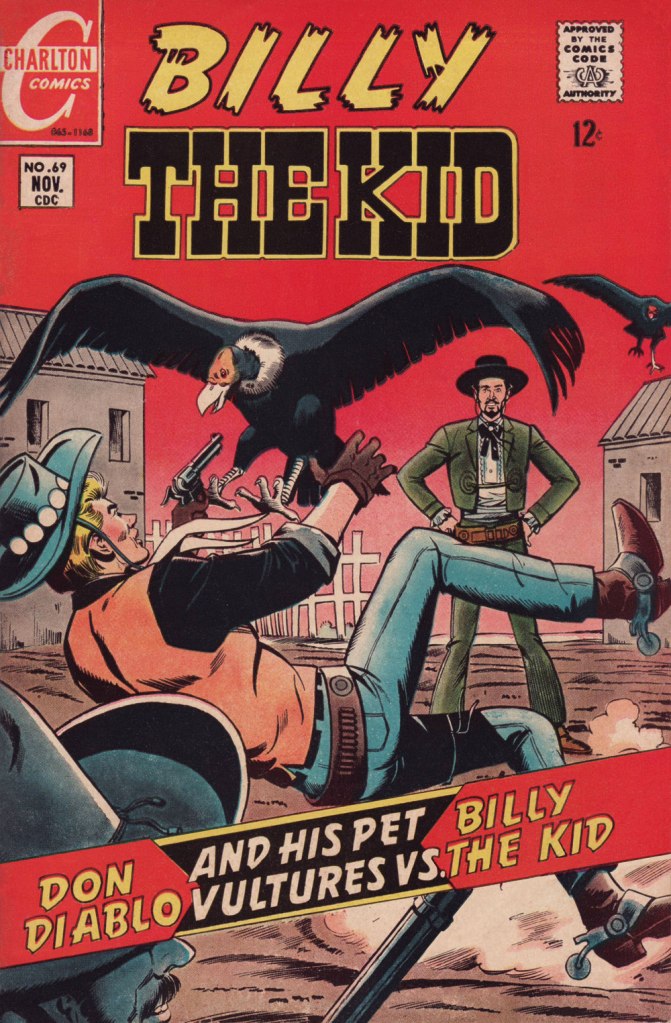
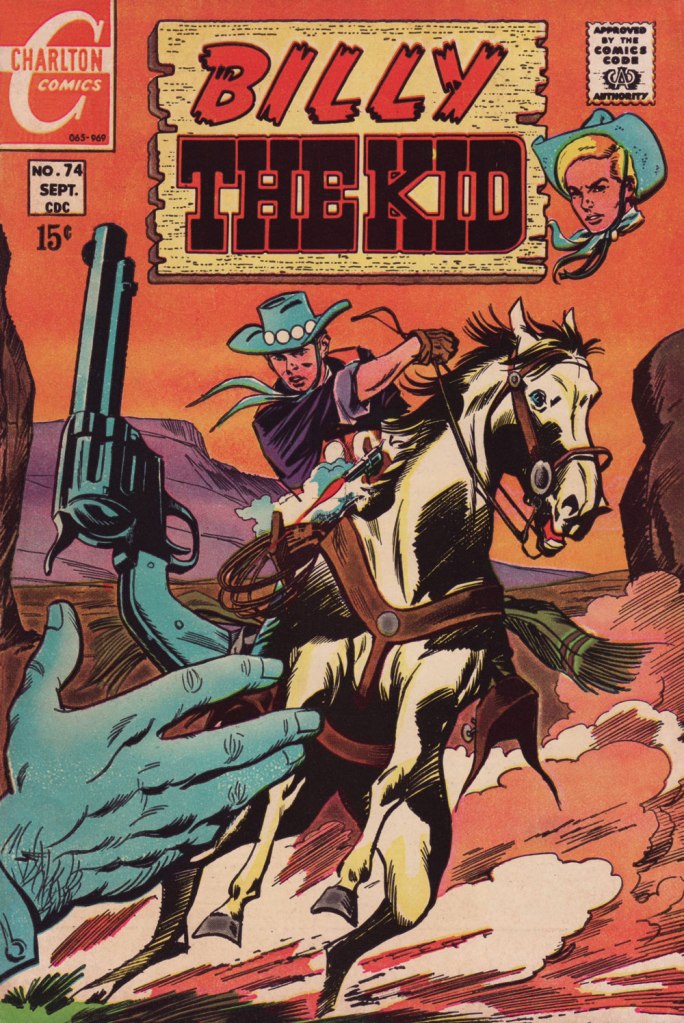
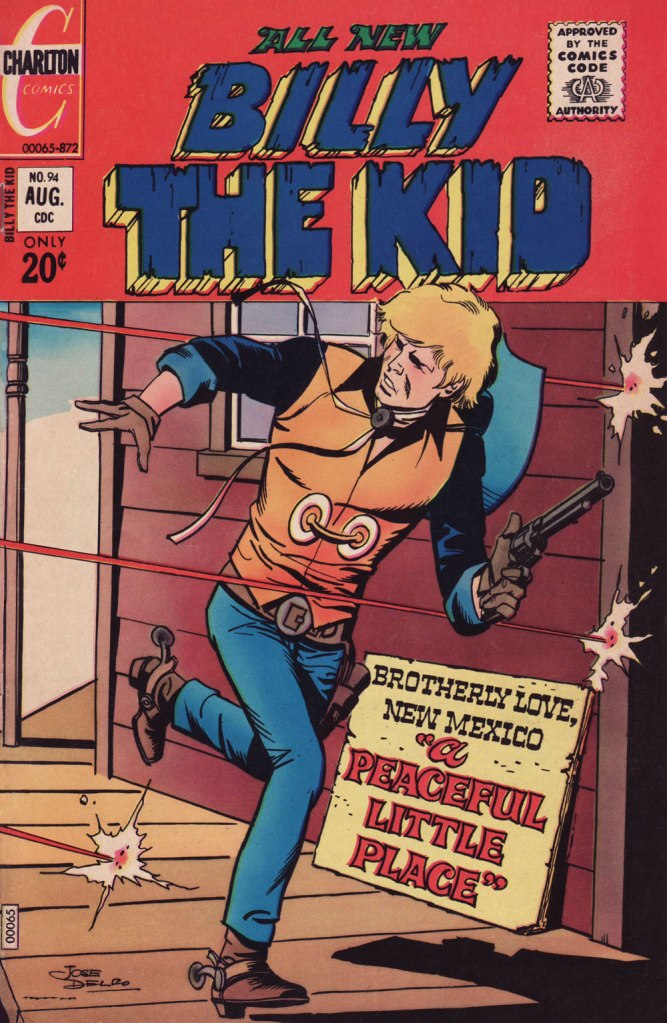
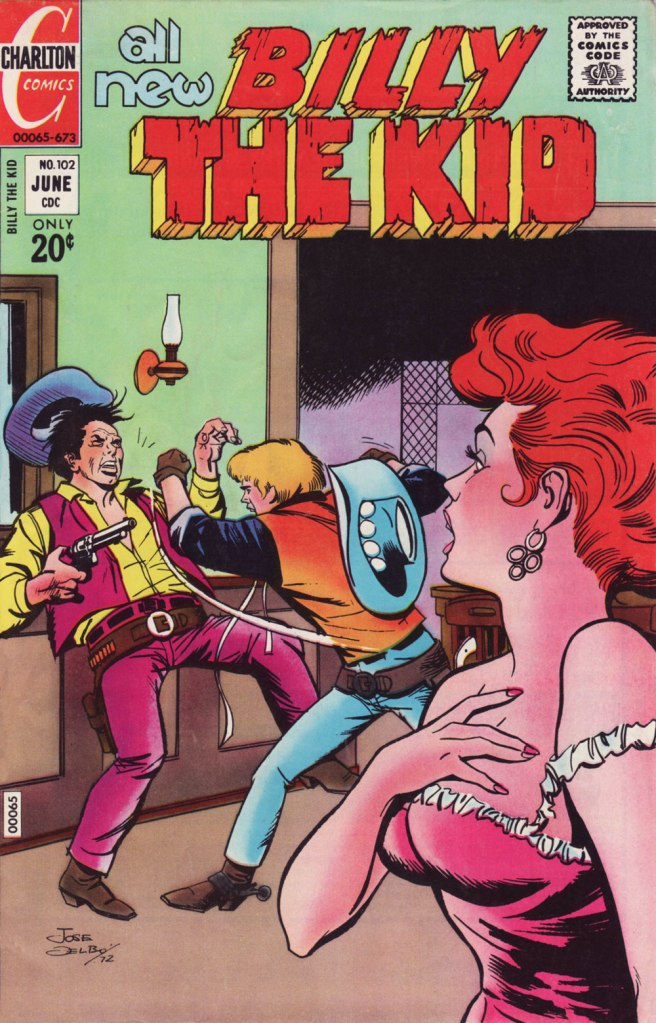
This is Billy the Kid no. 69 (Nov. 1968, Charlton).This is Billy the Kid no. 74 (Sept. 1969, Charlton).This is Billy the Kid no. 80 (Sept. 1970, Charlton).This is Billy the Kid no. 94 (Aug. 1972, Charlton); I love the clever signpost integration of the featured title.This is Billy the Kid no. 98 (Jan. 1973, Charlton). Readers accustomed to Marvel and DC-style hype may notice how light on text these covers are. A lot of shouting isn’t what sells a cover: an arresting visual will do that.This is Billy the Kid no. 102 (June 1973, Charlton).This is Billy the Kid no. 103 (Aug. 1973, Charlton).This is Billy the Kid no. 106 (Dec. 1973, Charlton). The foxy villainess Billy’s tussling with is La Duquesa, featured in “Slave of Beauty”.
Happy trails, and gracias for everything, Señor Delbo!
« You can’t wake a person who is pretending to be asleep. » — Navajo saying (attributed)
I’ve written before of my appreciation of Joe Gill‘s long-running yet consistent ‘good guy with an edge‘ characterization of Billy Bonney, but I had stuck to the book’s exteriors, namely Warren Sattler’s watercolour covers from the final stage of the series’ original run. I’ve also — twice! (first here, then there) drawn attention to John Severin (1921-2012) and his colossal powers as a cover artist. Today, at long last, we dare to peer inside.
Some may wonder at the up-to-date slickness of our current selection. Bear with me. Sure, it’s old, sure, it’s obscure, and the original comic book it saw print in is on the pricey side… but it’s work that’s found some resolute champions in the intervening sixty years.
After the Charlton comics line made the switch to a mostly-reprints mode (circa 1977-78), executive editor (and cartoonist) George Wildman, possibly nudged along by his colleague Bill Pearson, endeavoured to harvest some dusty gems from the vast archives at his disposal. In this case, six consecutive issues (nos. 124-129) of the long-running Billy the Kid were aimed squarely at the discerning fans with a bold ‘All Severin Art‘ label.
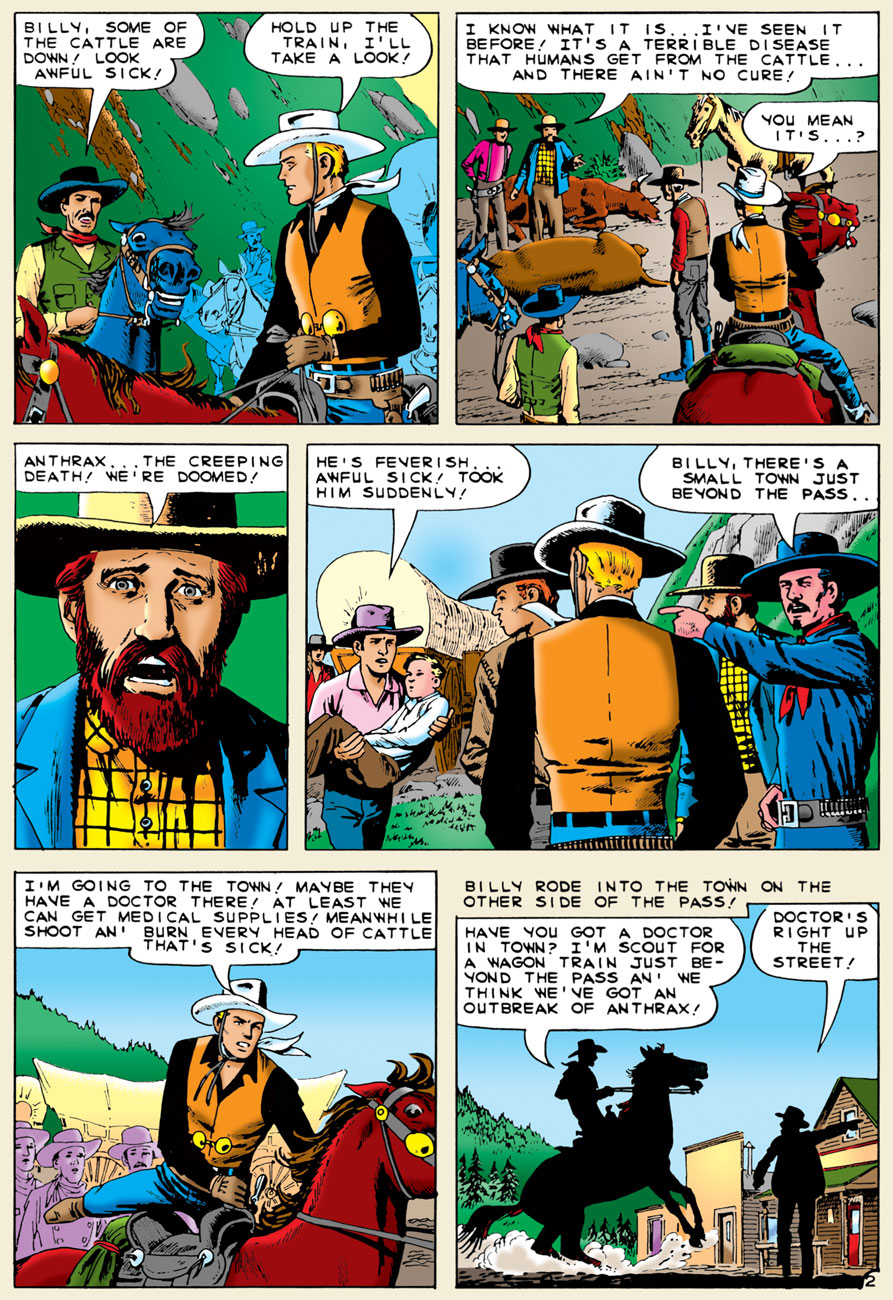
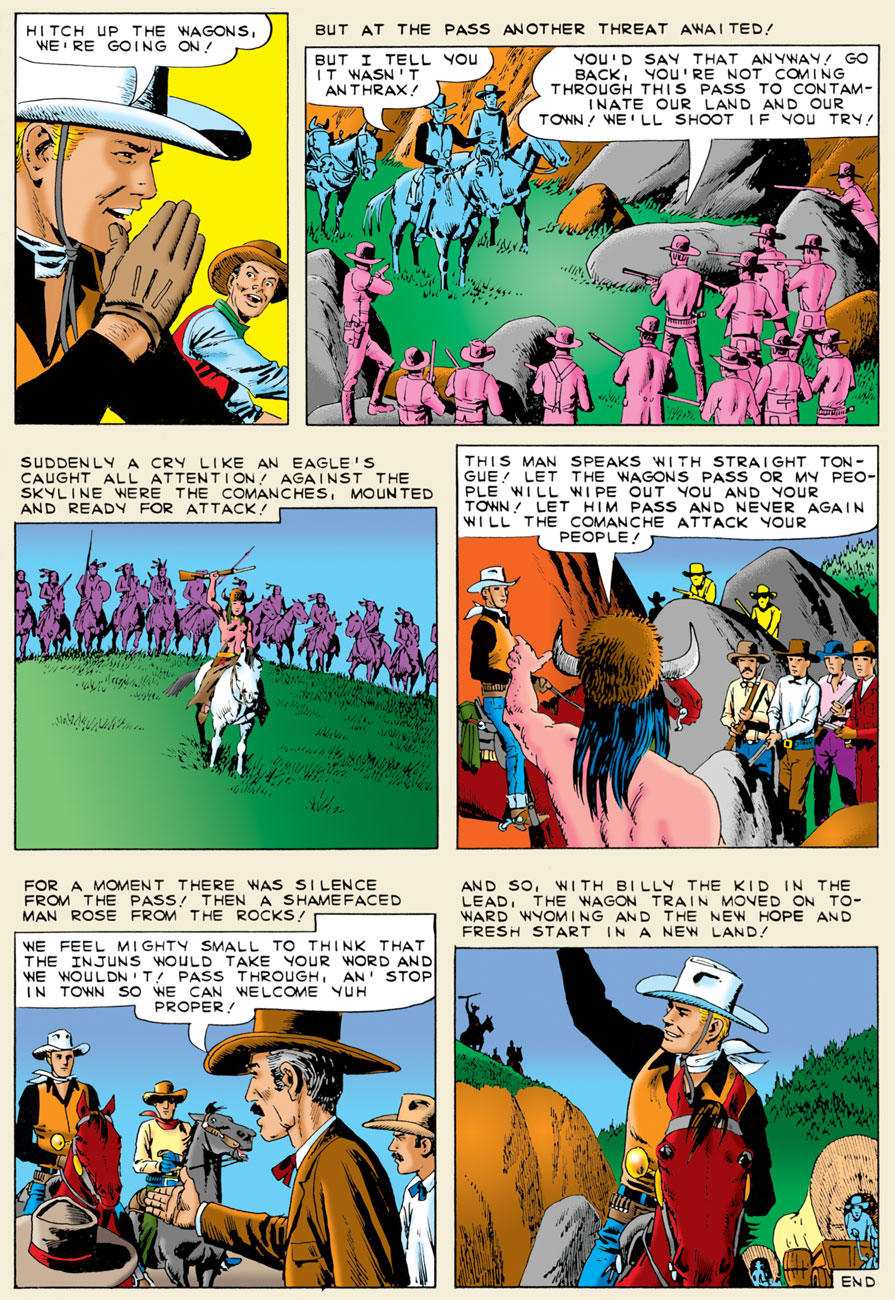
Fast forward to just a couple of years ago. As the nefarious, multifarious Mort Todd* tells it: « I had the extreme honor of working with John for many years as a writer, penciller and editor. When comics creator Bill Black told me he had a complete run of John’s work on Billy the Kid in the form of Charlton’s original photostats, we decided to recolor the work and release it in two volumes. Since the original artwork is lost to history, these photostats are the closest things to the originals to reproduce from. »
When I approached him, Mr. Todd most graciously granted me permission to showcase an excerpt from his restoration of Messrs Gill and Severin’s efforts. If you enjoy this one, do check out morttodd.com for more goodies!
Why this particular story? Doesn’t it strike you as ever-so-slightly timely? We all could use a happy ending, though, in these times of contagion and racial strife.
And here’s the original comic book in which Creeping Death appeared, namely Billy the Kid no. 20 (Jan. 1960, Charlton). Your basic “collage of interior panels” cover. Then again, with John Severin, you’re spoiled for choice… and you do get your dime’s worth.
Not to be confused with the historical William Bonney, Charlton’s Billy was the legendary bad boy’s first cousin, and he aimed to redress the damage done to the family name by its all-too-infamous black sheep. Read it here! Written by Joe Gill, with art by Pete ‘PAM’ Morisi, this tale appeared in Billy the Kid no. 15 (Feb. 1959, Charlton).
You may have noticed that this Billy the Kid fella displays some awfully progressive attitudes for 1959… and, some might say, even for today. And if you surmised that the story’s writer, Joe Gill, was a card-carrying liberal, you’d be way off the mark. He was, after all, Steve Ditko‘s favourite collaborator**. Gill was, instead, a bonafide conservative, fair-minded, intellectually honest, prudent, sagacious. It would appear that with time and shifting meanings and mores, this once-thriving breed has been overwhelmed by today’s reactionaries, who arguably went so far as to usurp and absorb its very name.
An R.J. Reynolds ad from the back cover of Coronet no. 177 (July, 1951). Put that in your T-Zone and smoke it!
By way of contrast, and speaking of cowboys… Marion Morrison*** (1907-79), better known as “Popular, handsome Hollywood Star John Wayne“, despite his renown as a so-called Conservative Icon, was no conservative… he was just another reactionary. I mean, just consider *his* stance towards African-Americans (« I believe in white supremacy until the blacks are educated to a point of responsibility. I don’t believe in giving authority and positions of leadership and judgment to irresponsible people. ») or Native Americans…
Meanwhile, Gill’s Billy the Kid, though thoroughly adept at quick marksmanship and fisticuffs, always sought to defuse conflict and avoid bloodshed through wits and compassion. His idea of paradise (just like his real-life cousin, come to think of it) was to head South of the border into México and hang loose among his amigos, who good-naturedly called him El Chivito.
-RG
*whose name basically means “Death Death” in French and German (albeit with an extra D); how cool is that?
**“The comic book story/script writer? It doesn’t matter who follows the first. That first choice is Joe Gill.” — Mr. Ditko, from his preface to Steve Ditko’s 160-page Package no.3 (1999).
« They’re drinkin’ red-eye, playin’ stud poker, and havin’ a high old time! I’ll just hang around awhile… »
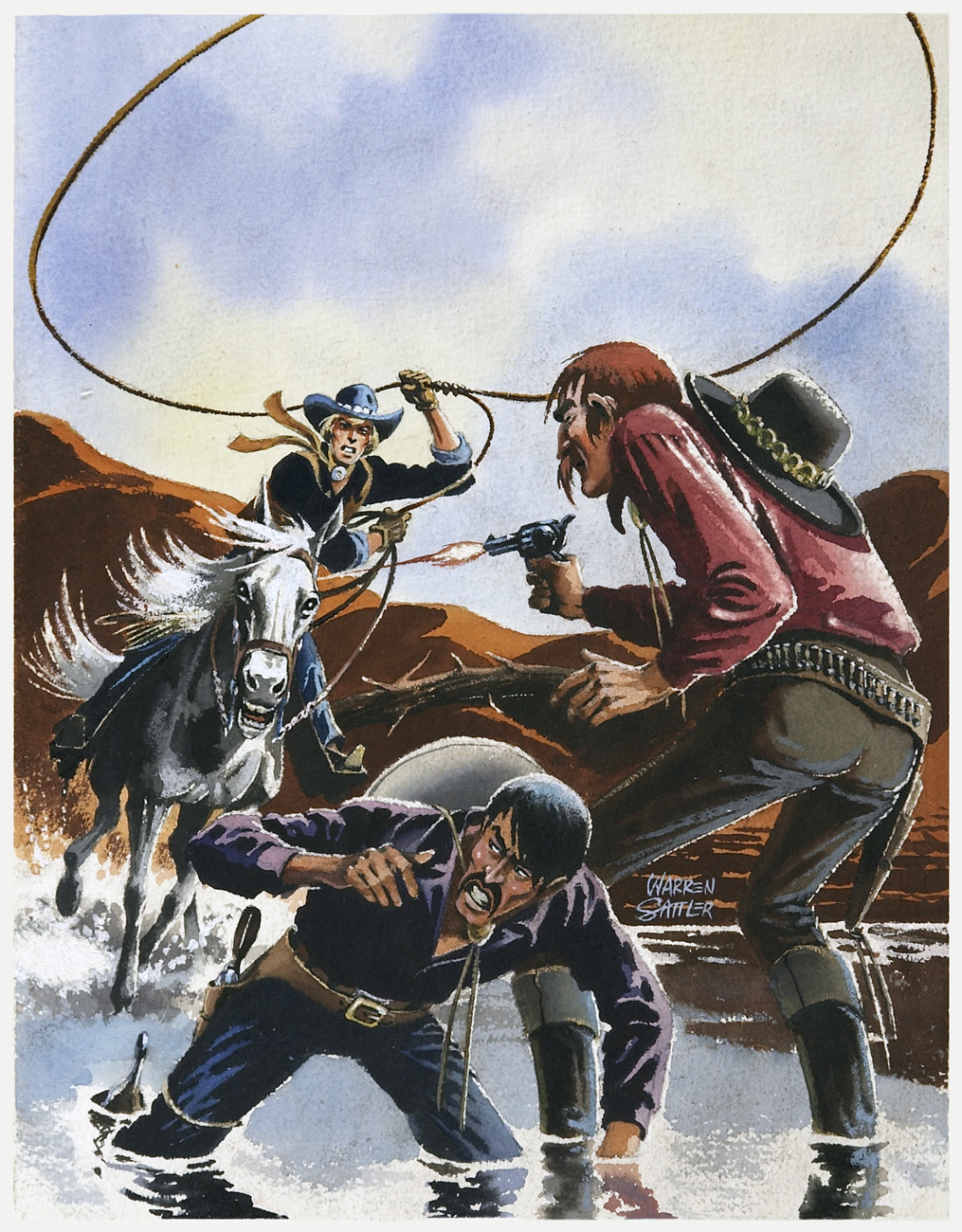
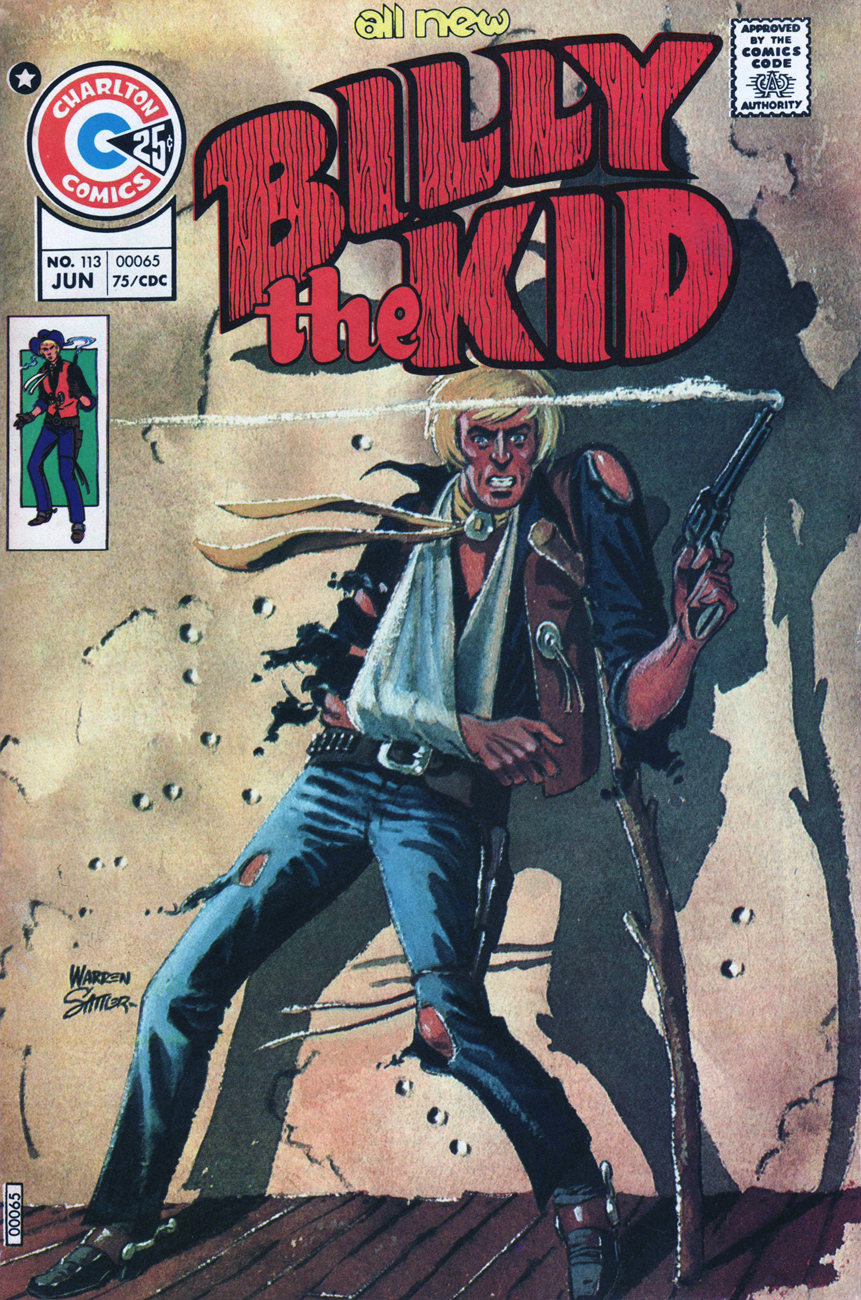
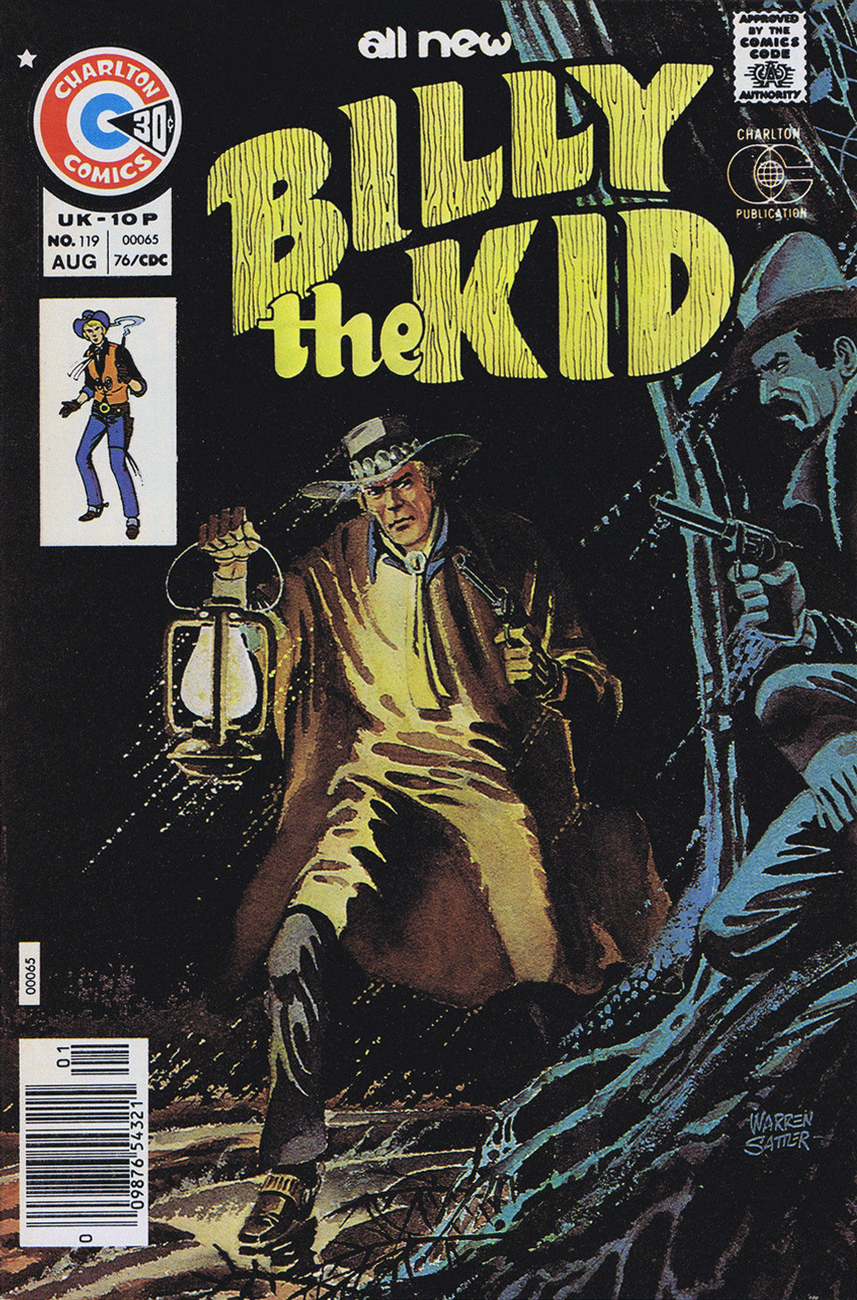
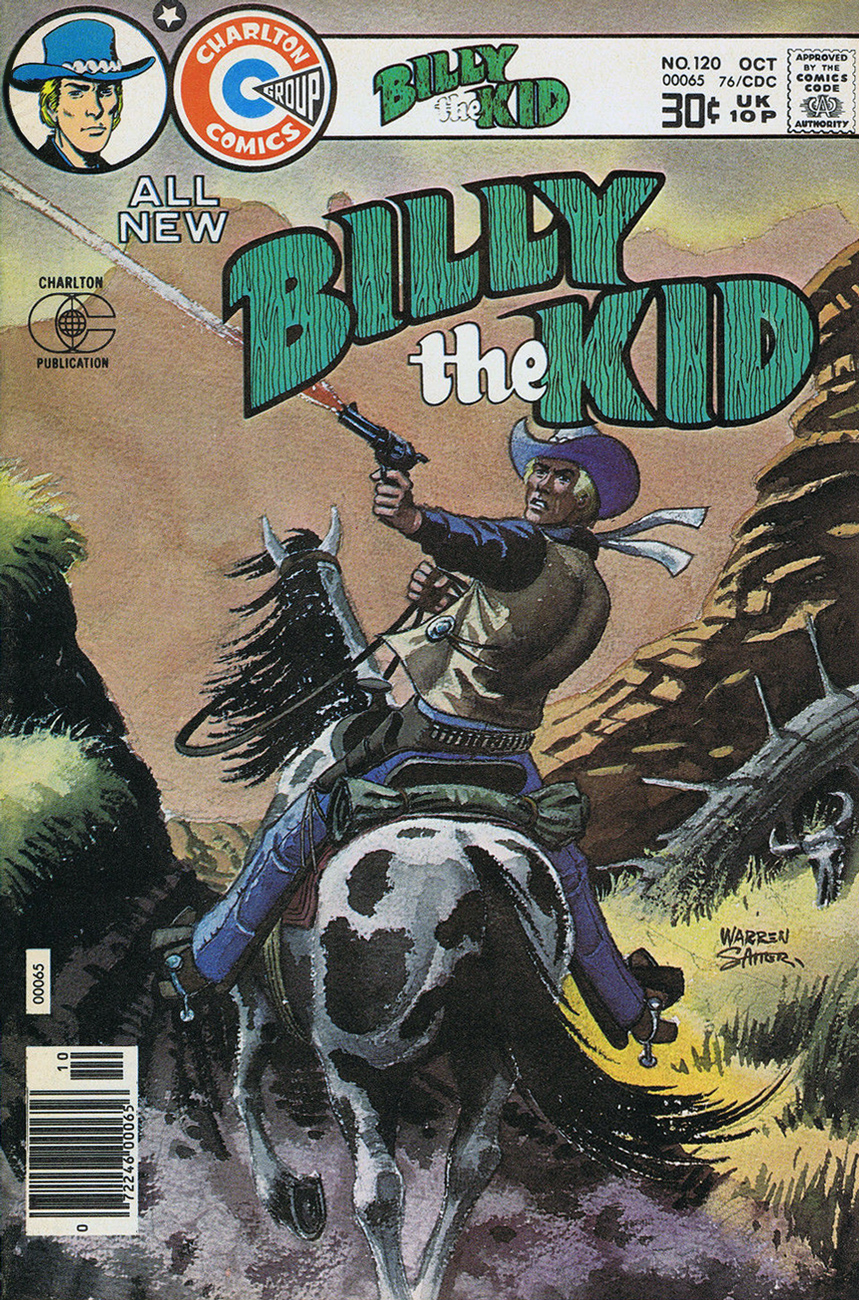
In the mid-1970s, thanks to Pat Boyette’s connections in Texas, Charlton Publications found themselves able to affordably produce painted covers, a development that several members of their iconoclastic stable of artists took full and glorious advantage of. Tom Sutton, Don Newton and Boyette were naturals, but Warren Sattler often gets unfairly sidelined from that esteemed lot… perhaps because he rarely worked for Charlton’s ghost books. Each of his cover paintings was produced for the publisher’s western / martial art adventure series, Yang, House of Yang, and Billy the Kid. And he alone worked in that most unforgiving of media, watercolours, wherein, unlike oils or acrylics, one requires unerring confidence and dexterity if you’re aiming to come up with anything above a muddy mess.
Today, Mr. Sattler (born September 7, 1934, in Meriden, Connecticut, where he resides to this day) celebrates his eighty-fourth birthday. Let’s wish him all the best!
Over the years, I’ve become quite enthused with Charlton’s long-running Billy the Kid series (1957-1983!), which featured over the years the artwork of such luminaries as John Severin, Maurice Whitman, Rocco “Rocke” Mastroserio, José Delbo and of course Mr. Sattler. As far as I know, Joe Gill just about wrote the entire series, which is one of its chief pleasures: over a hundred issues of consistent characterization of young Bill Bonney as a peace-loving, unprejudiced champion of the underdog whom his amigos in Old México fondly nicknamed « El Chivito ». I know, hardly the real-life Bill Bonney, but what could one expect under the Comics Code Authority‘s heavy thumb?
Several of Mr. Sattler’s cover paintings have, thank goodness, survived destruction. They have to be viewed in person to be fully appreciated. For the nonce, we’ll make do with mere digital reproductions.
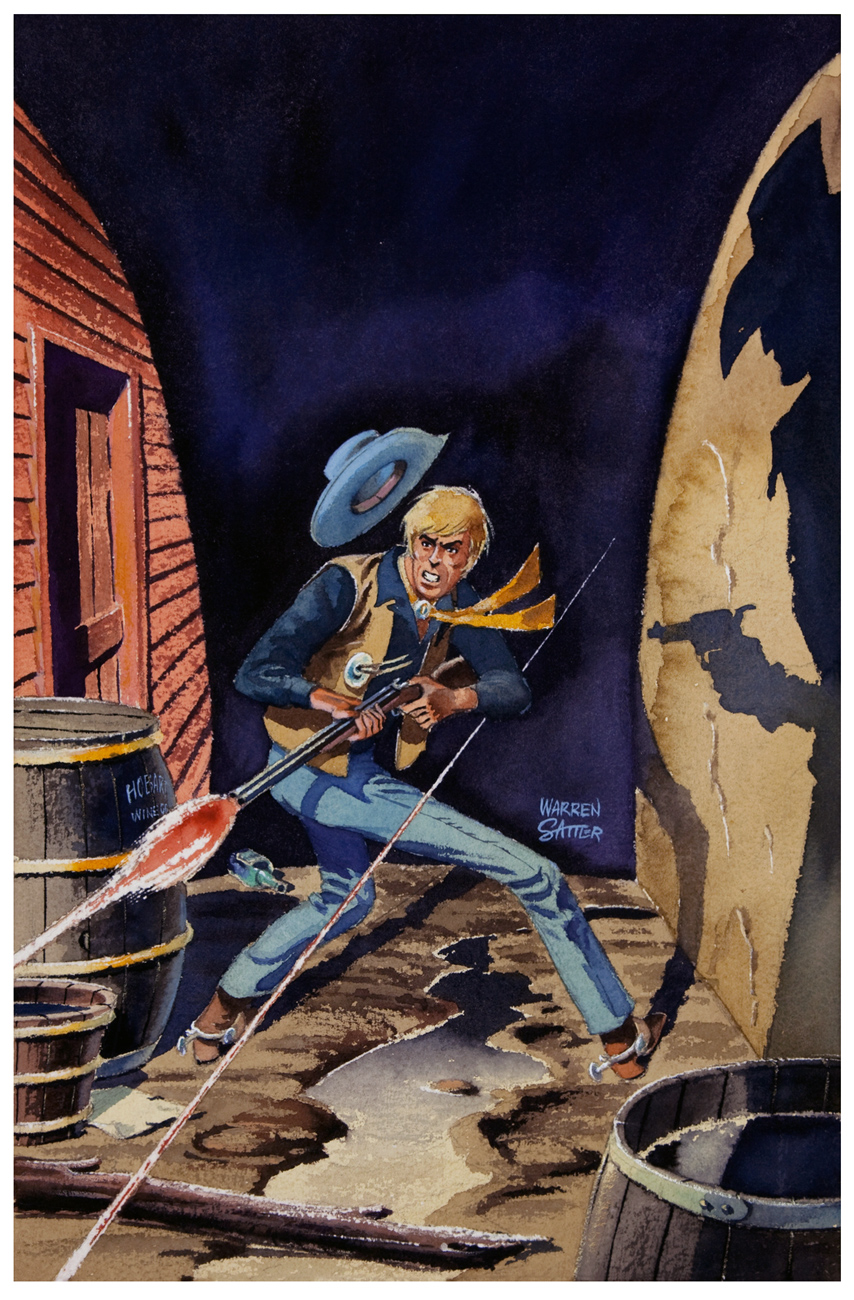
For his first painted comic book cover (or second, Yang no. 7 appeared that same month), I believe Mr. Sattler got the proportions slightly wrong, so the cover art was cropped fairly tight horizontally, which still made for a striking, action-packed cover, but since we’ve got the original…
Two Billy adventures appear in this one: the cover-featured “The Good Life” and “The Spoilers!”
This one was featured as the cover of Billy the Kid no. 114 (Oct. 1975), illustrating Gill and Sattler’s “Killers in the Shadows!”
I’m sure Billy would be admiring the lovely light of dusk if he wasn’t being ambushed. Such a splendid and unusual (for comics) palette!
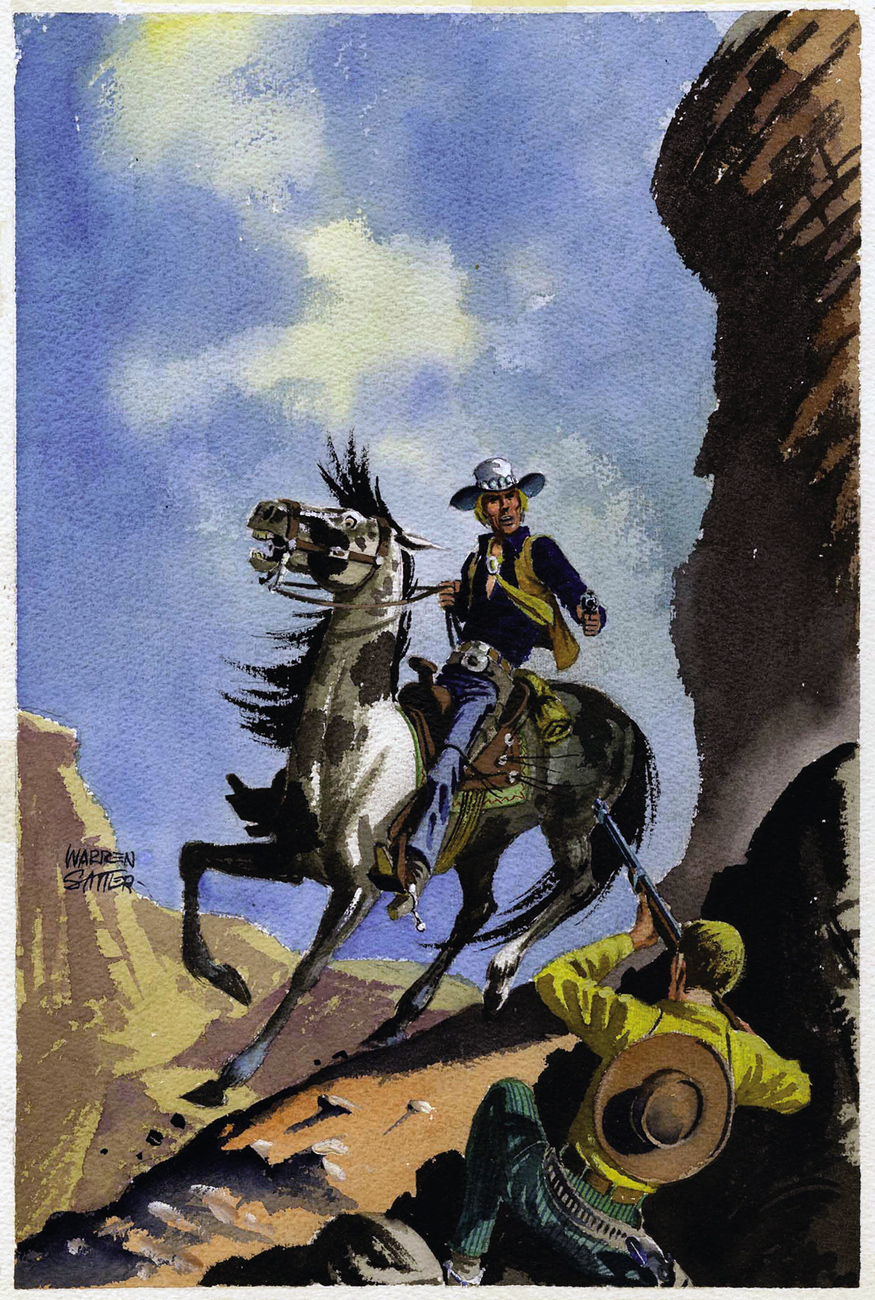
The printed version of this painting, which appeared on the cover of Billy the Kid no. 116 (Feb. 1976), lost quite a bit of its subtlety in translation, so I’m happy to show you the original. I love that bit of yellow in the clouds, echoed in the bushwhacker’s shirt. For the first time, a solo Sattler Billy the Kid tale, “The Treasure”.
Beautiful composition, and an effective and economical way to convey height and distance. Note the cattle horns in the artist’s signature.
This one’s mood and palette bring to mind the work of Doug Wildey. A good thing, you understand. Excellent use of the « dry brush » technique for texture.
After several issues’ absence from the insides, Mr. Sattler reunites with Joe Gill on “Three for the Money!”
One final painted cover before Charlton rode off into the sunset…. for the first time.
Mr. Sattler, a true prince of a man, created this piece especially for me a few years ago… without any request on my part! But you can bet I’ll always be grateful for this touching act of generosity and kindness.
As El Chivito’s many friends across the border would surely say, « ¡Que cumplas muchos más! », and thanks for everything!














 Who's Out There?