« Listen, Angel! If they’re out of bananas… I’ll meet you at the corner fruit stand! »
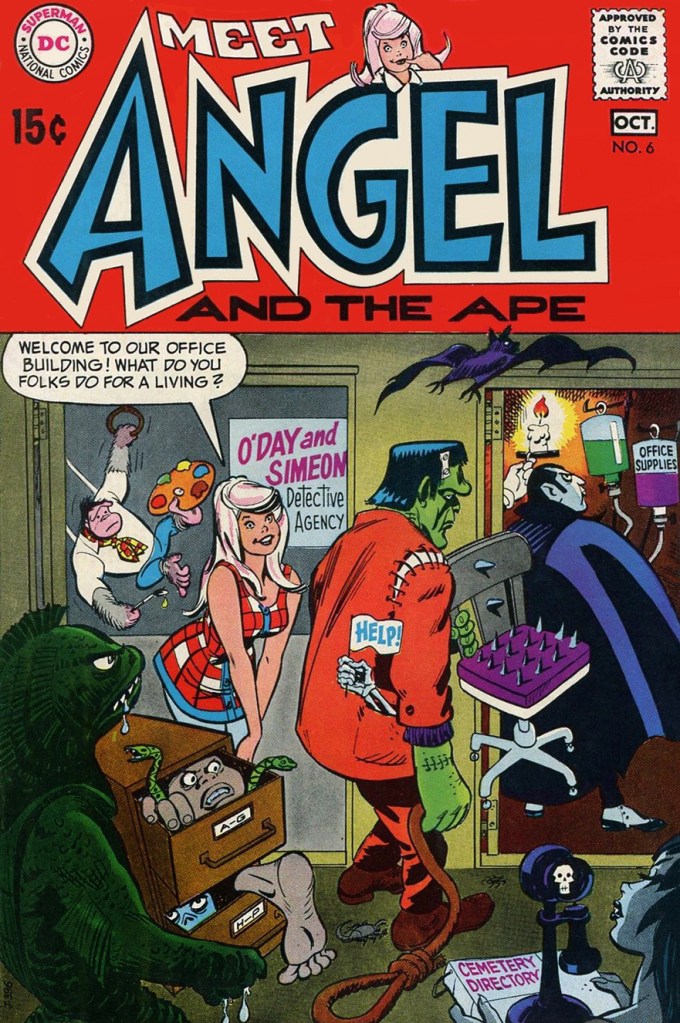
Today, let’s combine our general theme with a celebration of the birthday of one of comics’ great, yet perpetually underappreciated talents: Bob Oksner (October 14, 1916 – February 18, 2007), DC’s go-to humour and good girl art guy. Can you beat that? Didn’t think so.
Bob had a winning penchant for mixing monsters and babes, and for this, he’s earned our lifelong gratitude.
This is Angel and the Ape no. 6 (Sept.-Oct. 1969, DC), featuring The Robbing Robot and The Ape of 1,000 Disguises! (Would You Believe Four?), wittily written by John Albano, lusciously pencilled by Oksner, and creamily inked by Wallace “Wally” Wood. Truly swoon-inducing stuff. Edited by Joe Orlando (that explains all the monsters!), with a cover by Oksner.
You might say Angel and the Ape exist in an awkward sort of limbo: popular enough for the back issues to be kind of pricey, but not popular enough to have been reprinted (eight issues, including their Showcase appearance, ideal for a trade paperback, hint, hint).
So what else has Mr. Oksner cooked up over the years? Keeping to our theme, here are a few highlights, but first, a handy bio:
This piece appeared in The Adventures of Jerry Lewis no. 73 (Nov.-Dec. 1962, DC).
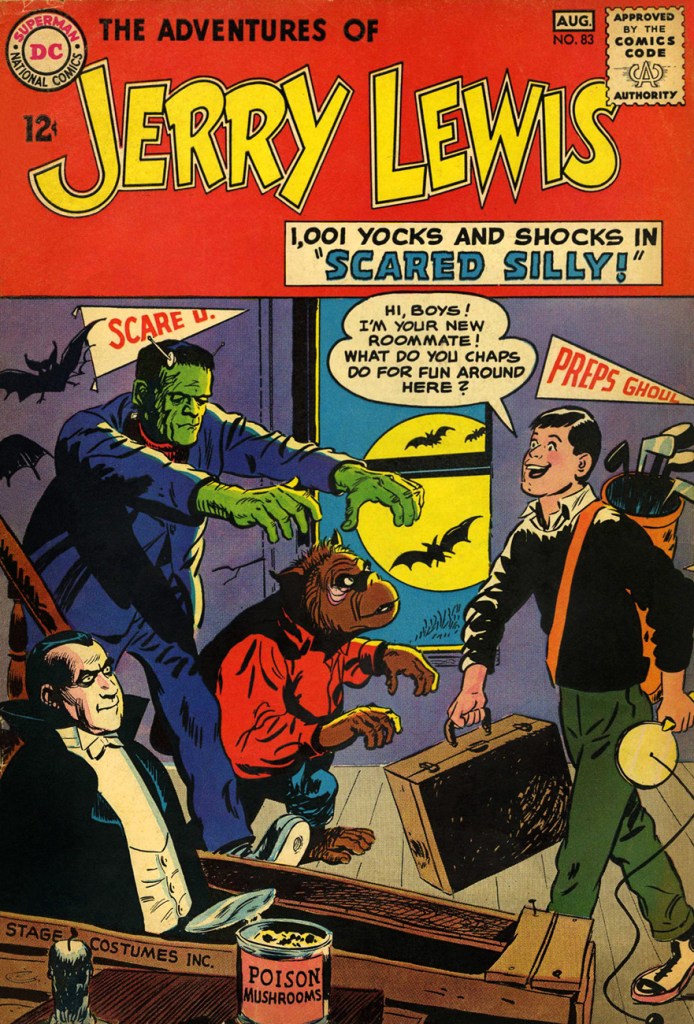
The is The Adventures of Jerry Lewis no. 83 (July.-Aug. 1964, DC). Formerly The Adventures of Dean Martin & Jerry Lewis… of course. The book (under both titles) featured some lovely artwork from Owen Fitzgerald, Mort Drucker and of course Oksner… but it was no Sugar and Spike. Still, it had its audience, long-lasting as it was (124 issues… Jerry wasn’t just big in France!)
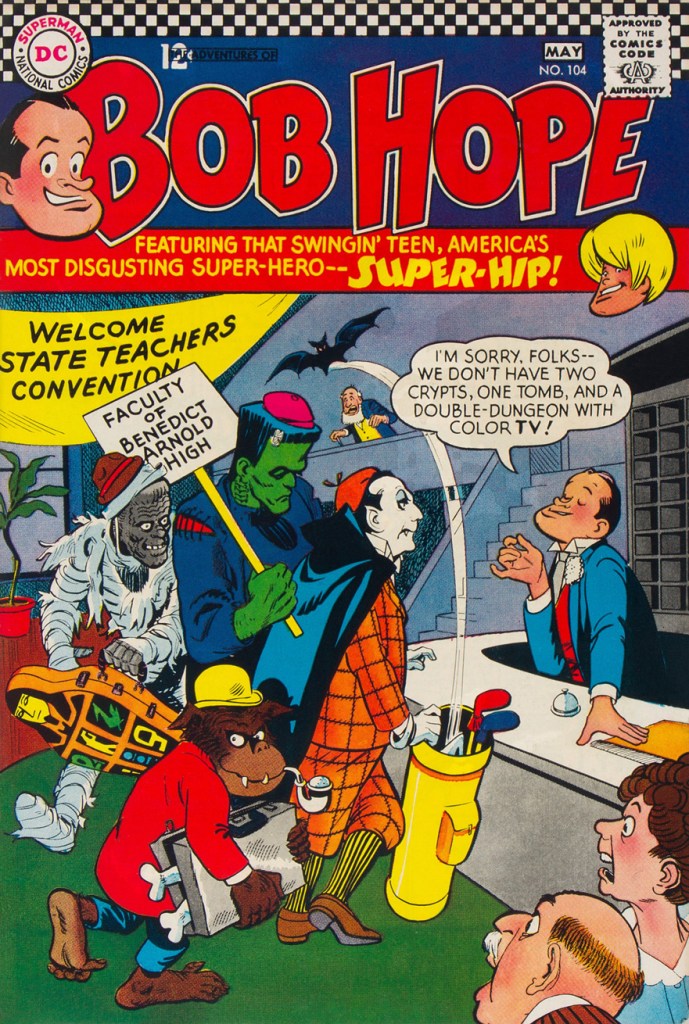
This is The Adventures of Bob Hopeno. 104 (Apr.-May 1967, DC). DC’s celebrity-licensed humour titles followed a parallel course: fading sales led to their nominal stars being more or less sidelined in their own book in favour of increasingly outlandish supporting casts.
An inside page from that issue. Good-looking comics… but they weren’t particularly witty, which can be a bit of a drawback. Arnold Drake was the writer, and while he could be pretty damn funny, it just didn’t work here. Still, you can bet that it was still more amusing than Milton Berle’s comic book.
1940s teenager Binky was pulled out of mothballs in the late 60s (ten years elapsed between issues 60 and 61). A moderate success (especially given it mostly consisted of slightly updated reprints), it returned to oblivion after another twenty-two issues, though the first seven boresome rather fine Oskner cheesecake covers. This is Leave It to Binky no. 67 (June-July 1969, DC).
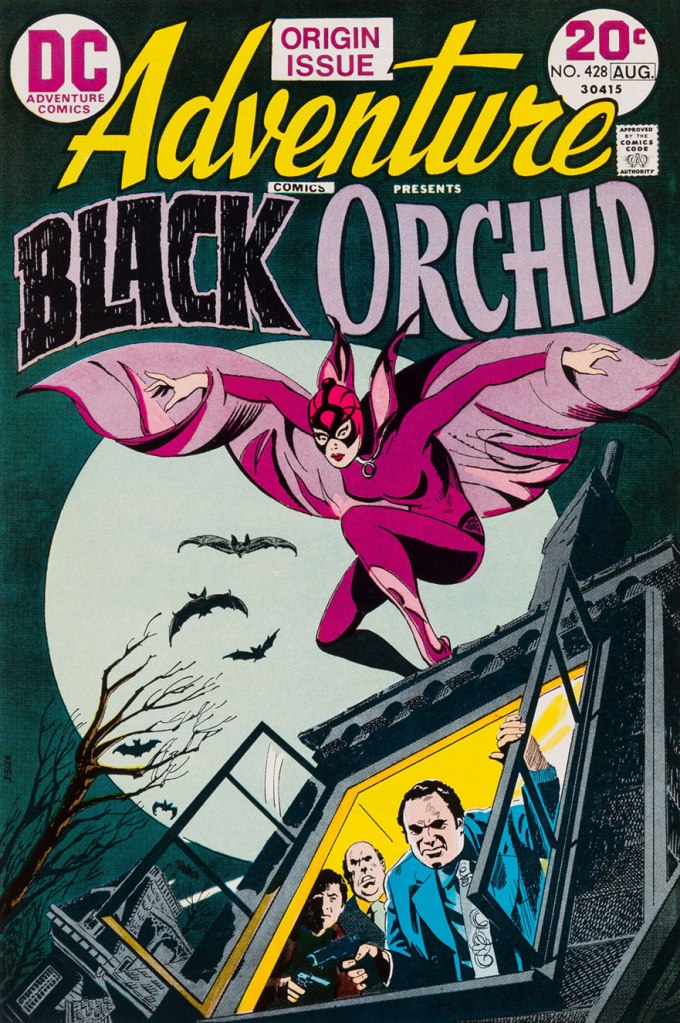
Finally, for a touch of the more ‘realistic’ Oksner style, here’s his cover introducing Sheldon Mayer‘s marvellously-mysterious Black Orchid. This is Adventure Comics no. 428 (July-Aug. 1973, DC). She deserved far more than a mere three-issue run!
Wasting the wide range of my xeno-tech training on a home office job was like putting a carpenter in charge of the psycho-ward. Like any fish out of water, I didn’t fit in. Bureaucracy said I didn’t belong.
So they finally shipped me out.
‘Murder on the O’Brien Express‘, published in Keif Llama – Xeno-Tech no. 4
« The ability to think like another species is a rare and galactically valuable gift. Those who are capable of it are called xenotechs. »
Technically, Kēif Llama (pronounced keef yamma) is a government official specializing in communication with alien species. Off record, she tends to poke her nose into beehives, and wards off attempts to deter her from doing so until she gets to the bottom of whatever’s happening, often pursuing the investigation far beyond formal confed business. When the government wants her to provide an quick’n’easy solution, or to hush things up, she kicks up a well-justified fuss. For this reason, despite being a top-notch xeno-tech, the planets to which she gets sent are further and further away from civilized life, the missions assigned to her increasingly inconsequential. Inconsequential to the government, that is – following the thread of a seemingly random event, Llama often stumbles upon some serious plot, often than not concocted by some evil corporation (and occasionally supported by the government itself).
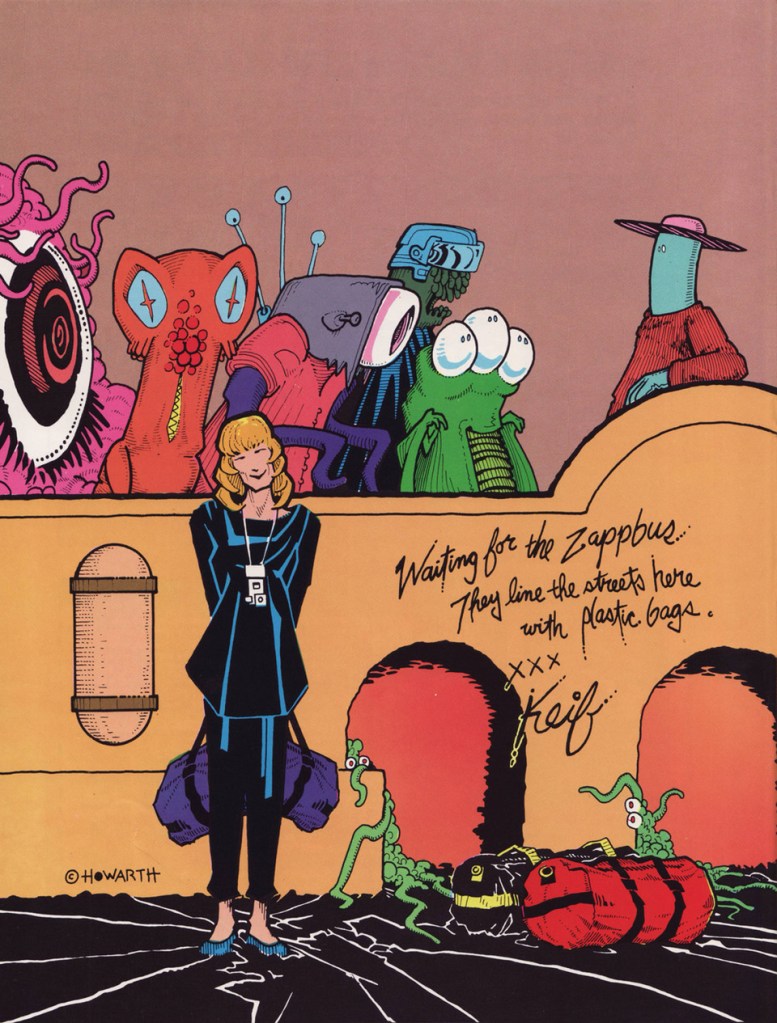
The back cover of Particle Dreams no. 1 (October 1986, Fantagraphics).
Her name is probably a sly wink to Keith Laumer, a sci-fi/fantasy writer whose Retief series is about a diplomat solving alien conflicts on various planets. Except that Retief always comes out with his nose clean and his credentials reinforced by his success. Llama, on the other hand, stumbles through the puzzling and melancholy worlds she’s banished to with an increasing sense of despondence and powerlessness. She often lacks information to make informed decisions, though not through lack of trying; and in this universe of shades of grey, it is often unclear which is right and which is wrong. Saving one alien life can lead to a whole planet perishing. Overlooking a minor detail means disaster, and when hindsight is 20/20, her burden of guilt is heavy to bear.
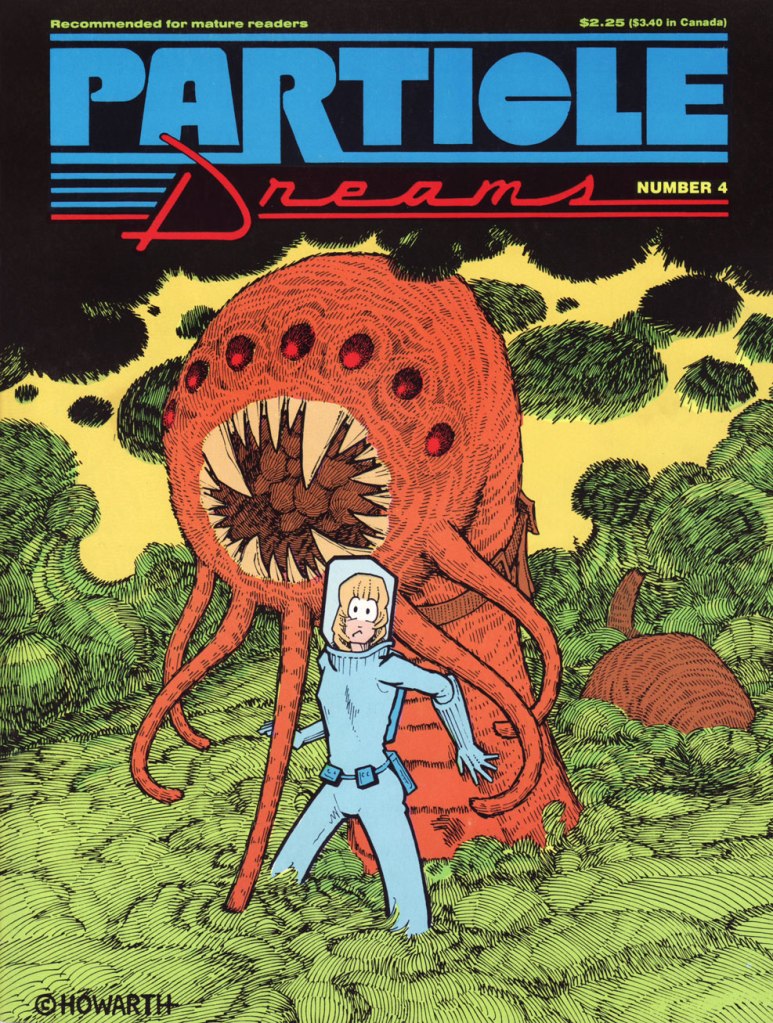
Particle Dreams no. 4 (June 1987, Fantagraphics).
In FF1986: Keif Llama, Lars Ingebrigtsen, who likes this series with a few reservations, argues that “The stories are problematic. More than a few of them end with a sense of “Huh? That’s the end? Did I miss something?” And most of them feature a genocide of some sort or another. After a while, it starts grating on you.” I would respectfully disagree: these stories are a bit like a slice of life. Sometimes we start in the middle of something that’s already under way, and sometimes we get but a small glimpse of some larger, out-of-reach picture. Not everything gets explained, but that’s not because Howarth couldn’t tie the ends of this plot together: he’s our guide through strange worlds, but even a guide doesn’t know everything. This is *excellent* science-fiction, as far as I’m concerned, imaginative and wide of scope. And Llama does have her moments of triumph (made more precious by their rarity), when she manages to outwit the fools, the bureaucrats, the religious fanatics whose actions would lead to a destruction of a precarious ecological balance or a grave injustice. Howarth’s hallmark humorous winks are scattered throughout the stories, giving the readers a welcome respite from the frequently heavy subject matter.
But more importantly, it’s those ‘problematic’ – whether downright cryptic or just lacking closure – endings that make Kēif Llama into a truly striking body of work. Depressing, it can certainly be (thus the importance to not binge-read your way through these comics, assuming you get your hands on a bunch of them at the same time). Yet as we accompany Llama on her ‘journey of discovery’ that leads her (and us) through a maze of corrupt (or just so weary they can’t be bothered) officials, profit-hungry conglomerates, macho idiots who can’t bear to take orders from women, and alien locals who mostly want to be left alone or refuse to explain their culture to an ‘ugly and smelly’ human, the weight of the universe Howarth has created settles squarely on our shoulders, and keeps us pinned until some uncomfortable truths are faced, commonly held beliefs are unravelled, and a few tears are shed. Happy endings often come at a heavy sacrifice.
Page from Particle Dreams no. 4 (June 1987, Fantagraphics).
On a lighter note, fans of Matt Howarth will indubitably have noticed the abundant presence of tentacles in all of his series. Howarth is exceptionally good at drawing aliens: tangible, ‘believable’ aliens who come in a staggering variety of shapes and sizes, and rarely look like some Earth animal with extra appendages (something artists of more limited imagination resort to quite a lot).
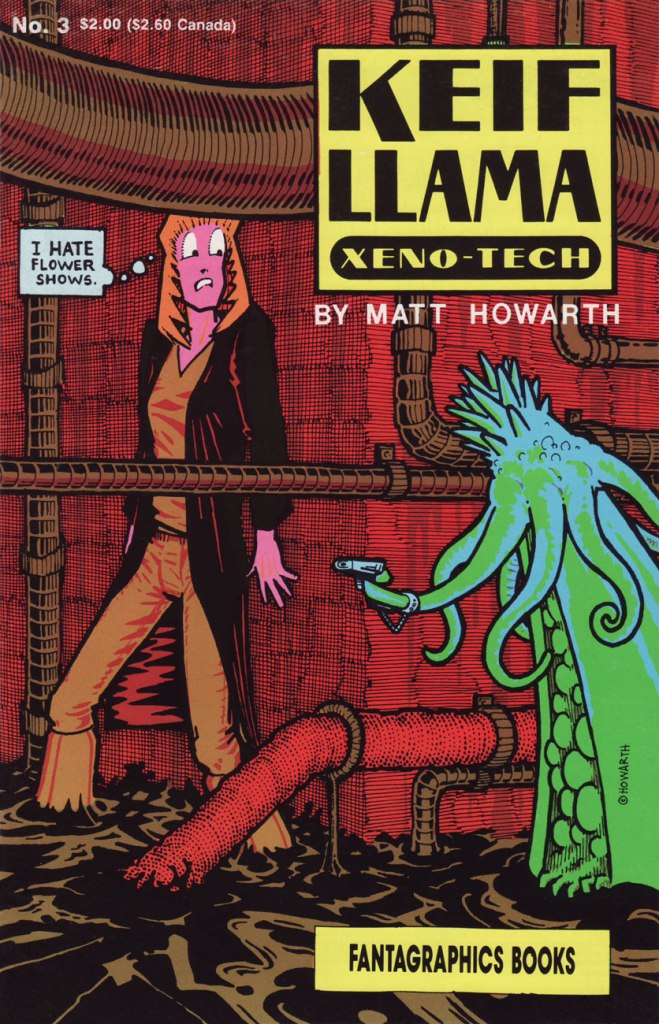
Patience, published in Particle Dreams no. 6 (November 1987, Fantagraphics).Keif Llama – Xeno-Tech no. 3 (November 1988, Fantagrahics).A page from The Thorn Beneath the Rose, published in Keif Llama – Xeno-Tech no. 3 (November 1988, Fantagraphics).
A small-time sheriff, alien as he may be, summarizes the type of thanks Llama frequently gets in this tirade: « You’re an ambulatory disaster area, Llama. Smuggling fiascos, international incidents, they can’t even ship you to the frontier without trouble following you. You’re in transit to Edison-Blue, Llama. I don’t want you or your bad luck in my town any longer than is painfully necessary. »
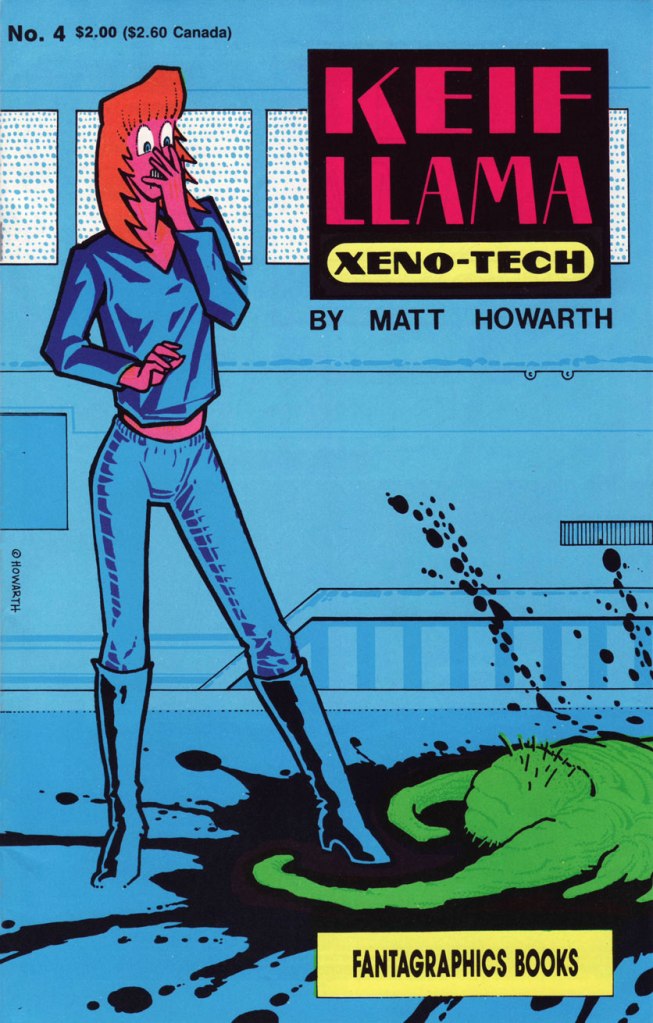
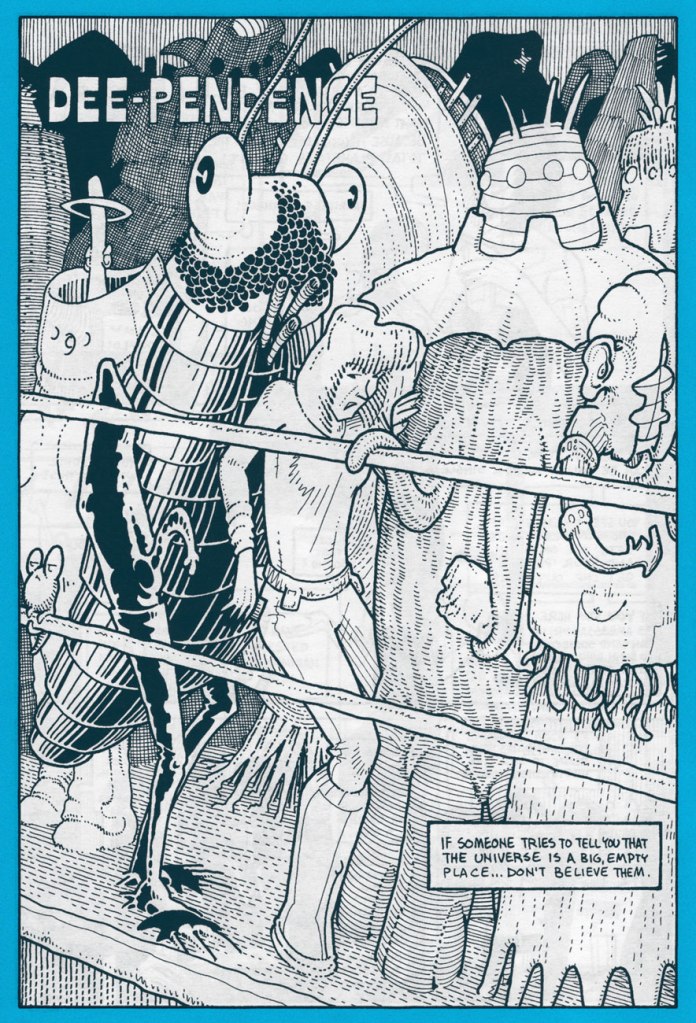
Keif Llama – Xeno-Tech no. 4 (December 1988, Fantagraphics).A page from Down and Out There, published in Keif Llama – Xeno-Tech no. 5 (January 1989, Fantagraphics).Page from Dee-Pendence, published in Keif Llama Xenotech vl 2. no. 3 (December 2005, Aeon).
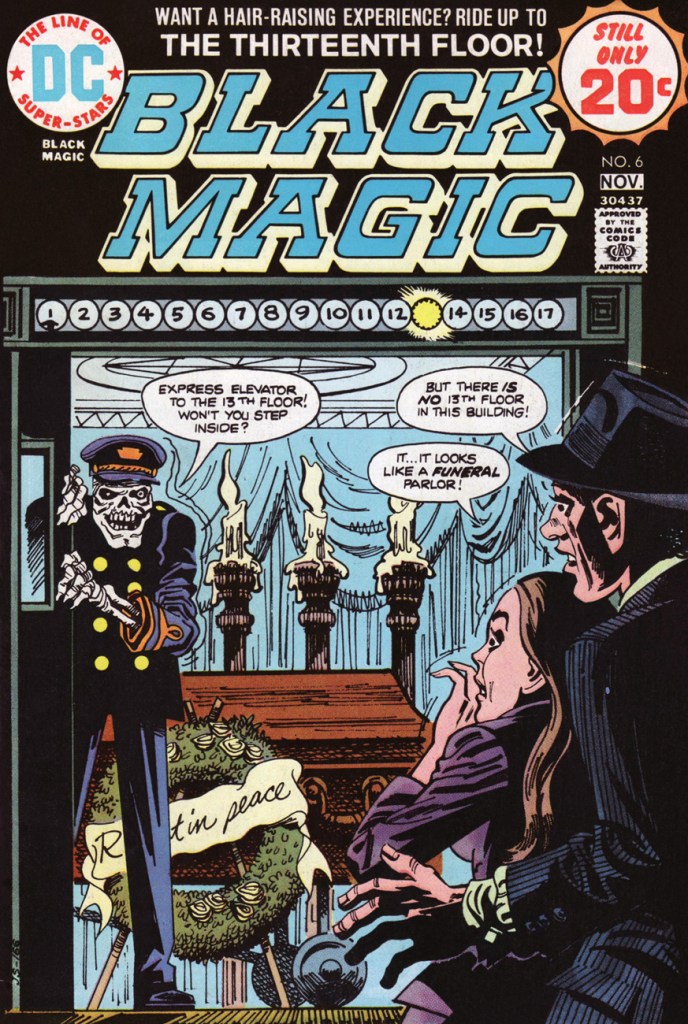
A Jack Kirby cover scene gets winningly recast for the 70s by Jerry Grandenetti, himself a contributor to the original series. This is Black Magic no. 6 (Oct.-Nov. 1974, DC).
When I was a kid (of twelve or so, if memory serves), I found a muddy and mildewed copy of this issue in the woods, which tremendously added to its allure, if not its readability.
And since I’ve mentioned it, here’s the original Kirby cover, regrettably one of the King’s least engaging, if you ask me. This is Black Magic no. 11 (vol. 2 no.5, Apr. 1952, Prize).
Well… little did I know what a protracted history this particular little scenario had. Let’s return to the presumed beginning, or at least the industrial age version.
Around the turn of the last century, the prolific English writer Edward Frederic Benson (1867 – 1940) wrote a story entitled The Bus Conductor [ read it here ] that saw print in Pall Mall Magazine in 1906. It was quite well-received, then began to widely make the rounds… as putative fact.
Things kicked into high gear in the mid-1940s, as the tale was recounted as an oft-heard anecdote in editor Bennett Cerf‘s 1944 short story anthology, Famous Ghost Stories, which contained a Benson contribution… but not The Bus Conductor.
That same year, Cerf shared the anecdote with the legion of readers who picked up his highly-entertaining (and still dirt-cheap and easy to find, over three-quarters of a century later, which gives you a sense of its original success and ubiquity) book of anecdotes, Try and Stop Me. The pertinent chapter was the splendidly-titledThe Trail of the Tingling Spine. As examined earlier on this blog, this chapter was used by EC Comics’ Bill Gaines and Al Feldstein as what they termed ‘springboards’ for their earliest stories.
Cerf’s version, from Try and Stop Me:
When an intelligent, comely girl of twenty-odd summers was invited for the first time to the Carolina estate of some distant relatives, their lovely plantation fulfilled her fondest expectations. She was given a room in the west wing, and prepared to retire for the night in a glow of satisfaction. Her room was drenched with the light of a full moon.
Just as she was climbing into her bed, she was startled by the sound of horses’ hooves on the gravel roadway. Curious, she walked to the window and saw, to her astonishment, a magnificent old coach pull up to an abrupt stop directly below her. The coachman jumped from his perch, looked up and pointed a long, bony finger at her. He was hideous. His face was chalk-white. A deep scar ran the length of his left cheek. His nose was beaked. As he pointed to her, he droned in sepulchral tones, “There is room for one more!” Then, as she recoiled in terror, the coach, the horses and the ominous coachman disappeared completely.
The girl slept little, but the next day she was able to convince herself that she merely had a nightmare.
The next night, however, the horrible experience was repeated. The same coach drove up the roadway. The same coachman pointed at her and exclaimed, “There is room for one more!” Then, as before, the entire equipage disappeared.
The girl, now panic-stricken, could scarcely wait for morning. She trumped up some excuse to her hosts and left immediately for home.
Upon arrival, she taxied to her doctor from the station and told him her story in tremulous tones. The doctor persuaded her that she had been the victim of a peculiar hallucination, laughed at her terror, and dismissed her in a state of infinite relief. As she rang for the elevator, its door swung open before her.
The elevator was very crowded, but she was about to squeeze her way inside — when a familiar voice rang in her ear. “There is room for one more!” it called. In terror, she stared at the operator.
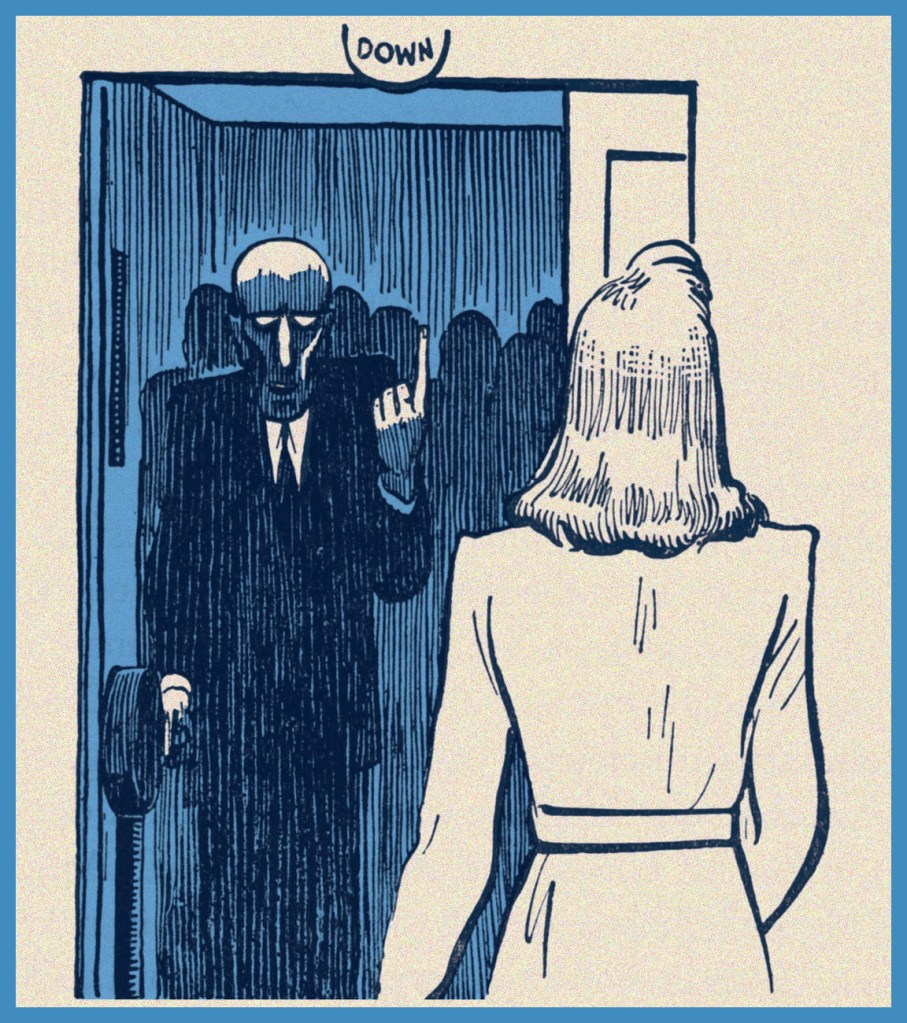
Try and Stop Me was lavishly and diversely illustrated by The New Yorker great Carl Rose, which surely must have contributed considerably to its success. I’d say Simon and Grandenetti were quite familiar with this striking image.
He was the coachman who had pointed at her! She saw his chalk–white face, the livid scar, the beaked nose! She drew back and screamed… the elevator door banged shut.
A moment later the building shook with a terrible crash. The elevator that had gone on without her broke loose from its cables and plunged eighteen stories to the ground. Everybody in it, of course, was crushed to a pulp.
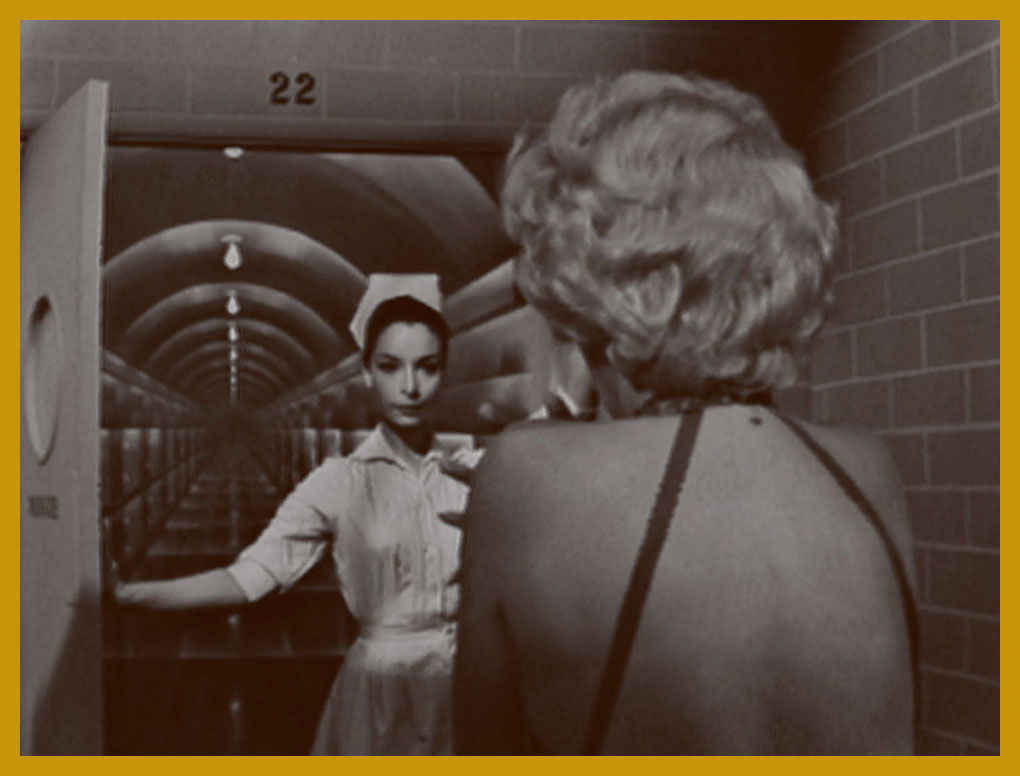
On to the Sixties: Rod Serling also drew upon the Cerf anecdote as grist for his The Twilight Zone episode Twenty Two (season 2, episode 17, aired Feb. 10, 1961). Here’s a pivotal scene from it.
Well, that’s certainly easier on the eyes than that gaunt vulture of an elevator operator… but no less menacing. You may recognize Mr. Spock’s future bride, Arlene Martel.
The Twilight Zone’s continuing popularity pretty much killed the scenario’s urban legend potency (Snopes.com checked it out!) In 1999, Urban legend authority Jan Harold Brunvand wrote, in his Too Good to Be True – The Colossal Book of Urban Legends:
According to my readers when I wrote a newspaper column in 1989 about the old ‘Dream Warning’ legends, The Twilight Zone version was the only one most of them knew. After numerous reruns, the TV episode had virtually replaced the folk legend in the popular mind. Every reader who wrote me following my column mentioned this episode, with one exception, and this person mentioned that he saw the plot enacted in a mid-1940s film, called Dead of Night. I’ll bet my legend-hunting license that this film, too, borrowed from the Cerf version.
I wouldn’t make that wager if I were you, Mr. Brunvand… since Dead of Night properly credits Benson.
To give you a sense of how effectively these stories flit and flicker across storytelling modes and media, power pop wizard Scott Miller (1960-2013) opened his band Game Theory‘s 1988 album, Two Steps From the Middle Ages, with a haunting ditty entitled Room for One More, Honey, an acknowledged quotation of the Twilight Zone episode.
« I don’t know what’s wrong with him! He’s in hellish torment! » — there’s witchery afoot, clearly
I’ll grant you in a heartbeat that Nick Cardy‘s (and, to a lesser extent, Neal Adams’) earlier The Witching Hour (full original title: It’s 12 O’Clock… The Witching Hour!, hence its twelfth day appearance) covers beat out subsequent entries on the overall quality front, but this particular beauty, in my opinion, takes home the terror tiara as the very creepiest of the bunch. Is it the otherwise-innocuous daytime setting, the tension between the pastoral and the grotesque? In the end, it induces shivers, and that’s what counts.
Though it comes as the tail end of their involvement, Carmine Infantino and Cardy still had a hand in, as publisher and art director, and took an active rôle in the design of each DC cover of the era.
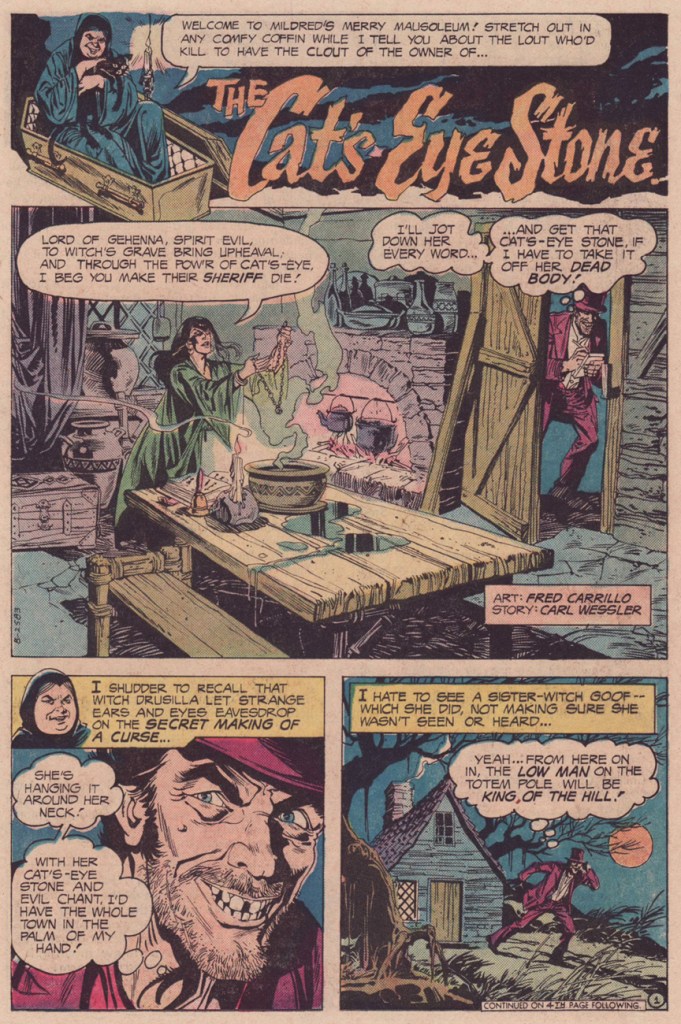
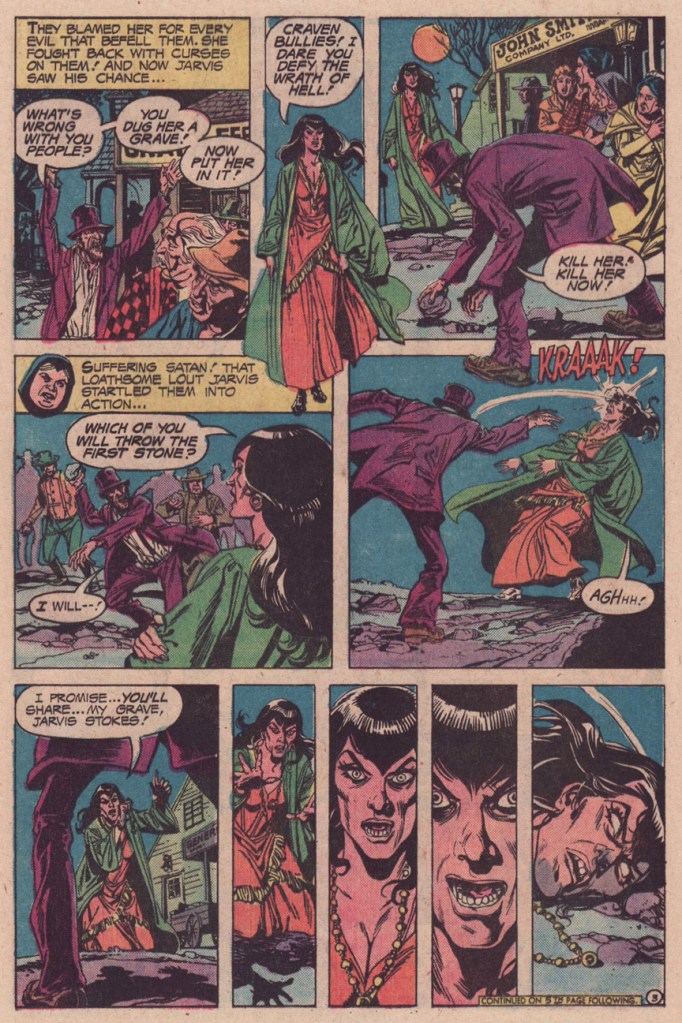
This is It’s Midnight… the Witching Hour no. 62 (Feb.-Mar 1976, DC). Edited by Murray Boltinoff. Argentine grand master Luis Dominguez’s cover art is loosely based on Carl Wessler and Fred Carrillo’s The Cat’s-Eye Stone. That aside, is it actually a picnic that Mr. Romantic has in mind, what with a “picnic place that no one will ever find“? Suspicious, to put it mildly.
And so — why not? — here’s the full tale, so that you may judge for yourself.
One small quibble: doesn’t Drusilla’s witch’s brew count for something in the spell? Surely the words won’t suffice…
For a devil-worshipper, she’s pretty biblical (‘cast the first stone’). Or maybe that’s the point.
This story anticipates the shock ending of Carrie by almost a year. Or had this twist already made the rounds? Perhaps the cycle began with Let’s Scare Jessica to Death… but I’m not sure.
Wilfredo Limbana ‘Fred’ Carrillo (1926–2005) was an underrated Filipino artist who produced some quite fine work for DC Comics’ mystery titles in the 1970s. I was particularly fond of his work on The Phantom Stranger, when he illustrated both the titular feature and its worthy backup, The Black Orchid, at the tail end of the title’s run.
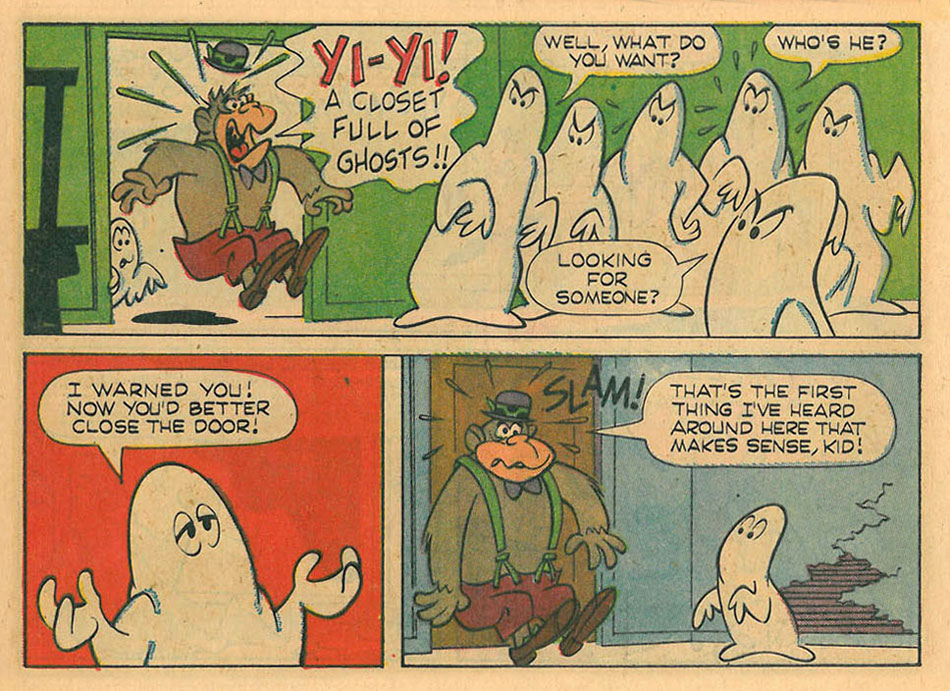
« Take our advice, at any price, a gorilla like Magilla is mighty nice. Gorilla, Magilla Gorilla for sale! »
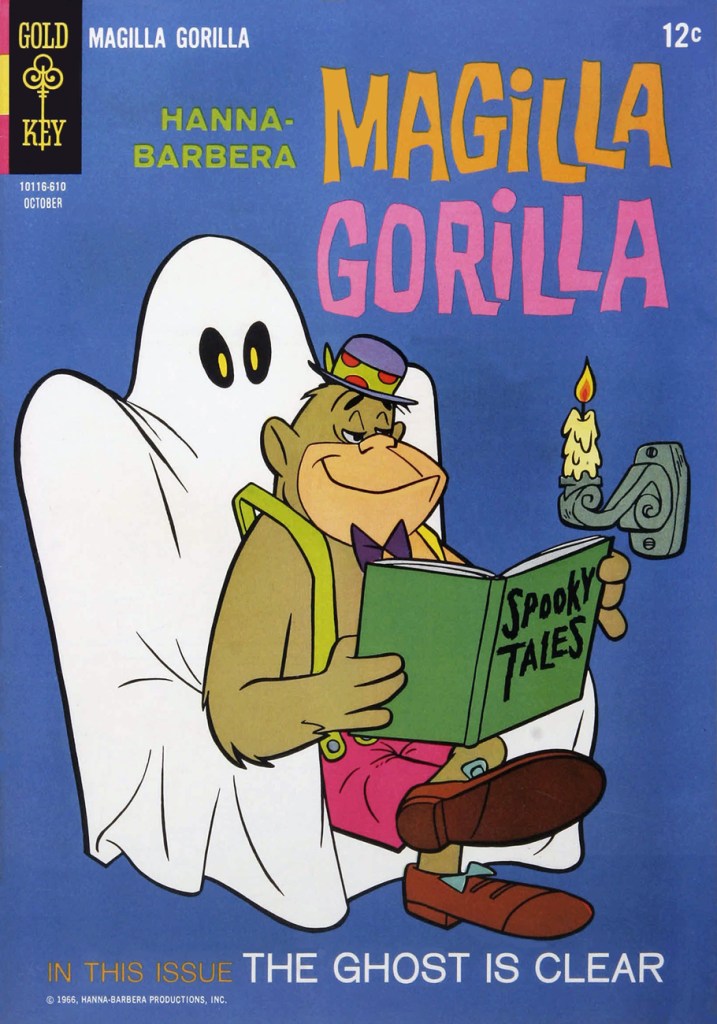
Seems you just can’t unnerve a guy (let alone an ape) who takes fright fables so lightly. I mean, look at that blasé expression! Perhaps he needs some spookier tales.
This is Magilla Gorilla no. 9 (Oct. 1966, Gold Key). Cover artist unknown…certainly a ghost.
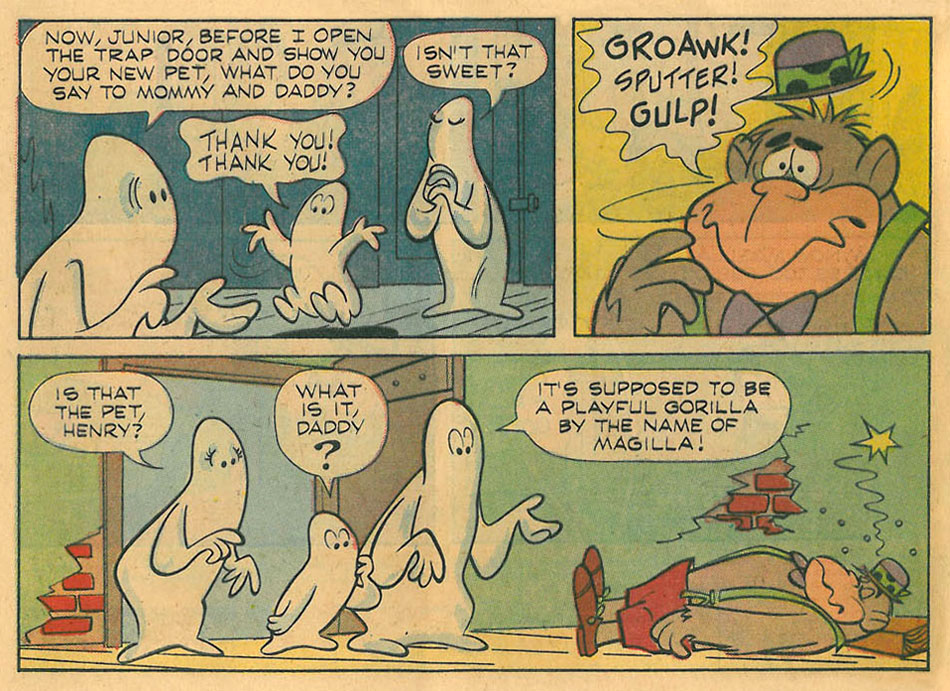
Unfortunately, the title story — and the rest of the issue — are nothing to get excited about. Nicely flowing, on-model animation-style artwork, but the stories…
Still, here’s the highlights reel. Strictly kid stuff… but did it truly need to be? A little subversion goes a long way.
In Yiddish, a megillah is a long tedious or embroidered account, from the Hebrew megillah, a story written in a scroll. One episode has Magilla saying, “Such a megillah over a gorilla.“ [ source ]
« We’ll try again next week. »
In other, loosely-related news, and in the spirit of the seemingly undying nature of pop culture icons (even minor ones)…
José Adílson Rodrigues dos Santos (born September 2, 1958), is a retired Brazilian heavyweight boxer. He scored 61 knockouts with 43 of those coming under 5 rounds. Rodrigues currently resides in São Paulo, São Paulo, where he is being treated for Alzheimer’s disease originating from dementia pugilistica. His nickname in Brazil, Maguila, comes from the cartoon Magilla Gorilla.
The gajo should have really sold the concept, and fought in a too-small bowler hat and green suspenders.
« Ghosts! Haunted house! … wow! I’m glad we don’t have to investigate around a joint like that! » — Woozy Winks… who else?
How about some Golden Age Plastic Man Hallowe’en goodness? I thought as much. All this and Woozy Winks too!
This lovely splash opens Murder in Maniac Mansion, from Police Comics no. 17 (March 1943, Quality), edited by John Beardsley. Script, pencil and inks by Jack Cole.
Mr. Cole’s splashy splash from another spooky Plas yarn, The Ghost Train, from Police Comics no. 23 (Oct. 1943, Quality). Read it here: https://comicbookplus.com/?dlid=37425
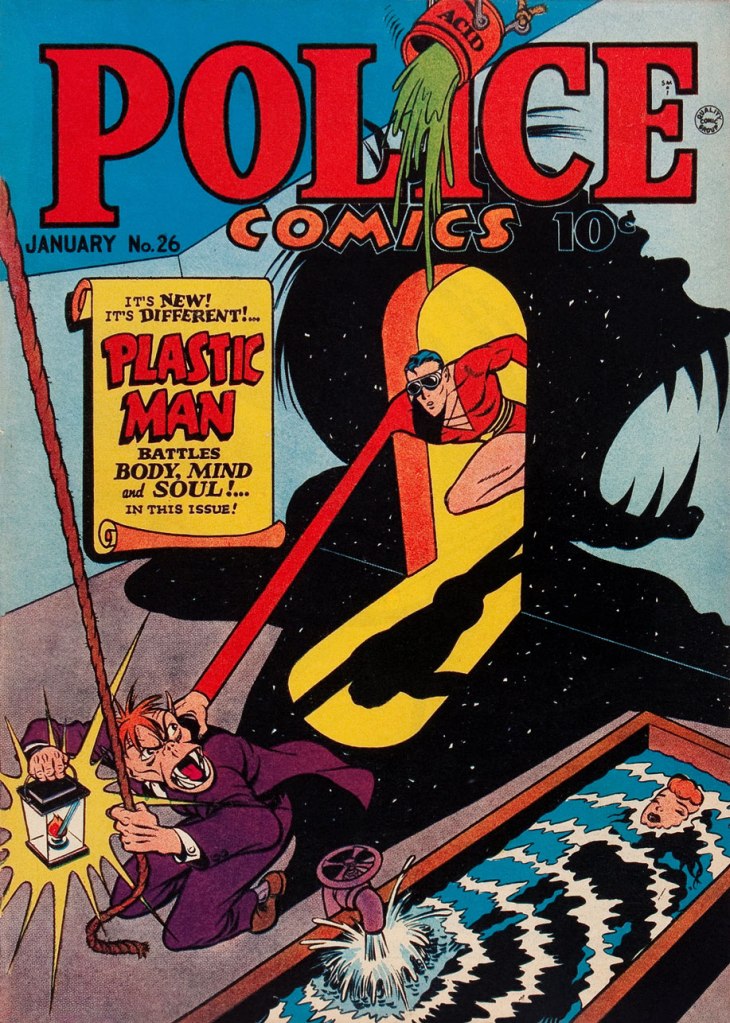
The supremely versatile Jack Cole could always be counted on to inject a bit of sinister ambiance (or over-amped sensuality, depending on his mood) to mix up the generally humorous proceedings of the stretchy exploits of the former Patrick “Eel” O’Brian. At times, things got pretty grand-gignolesque, as in the following case.
This is Police Comics no. 26 (Jan. 1944, Quality). Cover art by Jack Cole.
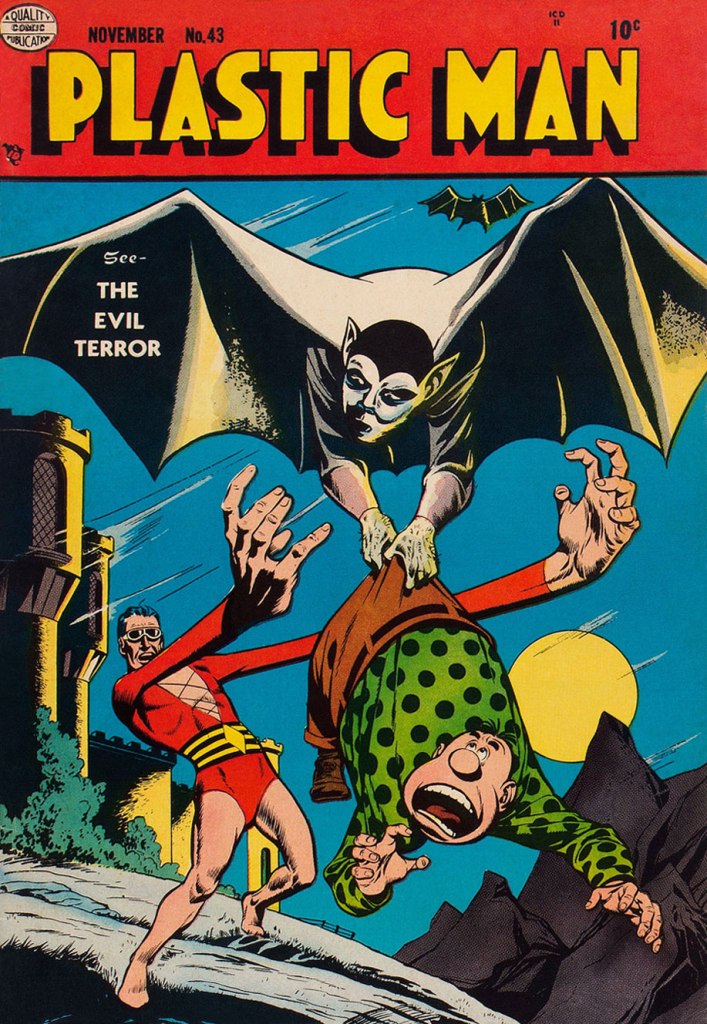
By the 1950s, Jack Cole had moved on to other pastures and projects, but Plastic Man kept right on stretching, one of the few superheroes flexible enough to withstand the horror boom. But not without a few alterations to fit the times, as evidenced by the following pair of samples.
This is Plastic Man no. 38 (Jan. 1952, Quality); cover art by Alex Kotzky. You have to appreciate that boney Monk Mauley hung on to his lucky belt even as his pants lost their corporeality. That’s commendable dead-ication! (sorry); Oh, read all about it: https://comicbookplus.com/?dlid=30201
This is Plastic Man no. 43 (Nov. 1952, Quality); cover pencils by Dick Dillin, possible inks by Chuck Cuidera.
It must be stated that, even without the masterly Jack Cole, Plastic Man clearly brought the best out of the rest of Quality’s admittedly admirable bullpen, so his adventures remain worth reading… which is certainly not the case with most subsequent revivals, with the exceptions of DC’s 1976-77 mostly-ignored Ramona Fradon run and Kyle Baker‘s award-winning 2004-06 outing.
« It was the spookiest horror ride anywhere! Mr. Awrus… a charming little old man, really… made it that way, because he liked to entertain people! But then the snake-thing arrived… and the others… heh-heh… and people went in… and didn’t come out… » — Horror Beasts Dine Tonight
First out of the gate was Irwin Stein’s Magnum Publications, with Monster Parade (four issues). It was soon followed by Monsters and Things (two issues).
As for the magazine’s grimy guts, there’s regrettably nothing outstanding: a couple of reprints of pre-Code material that was pedestrian to begin with… Curse of the Living Crossbones, illustrated by Ken Rice (a retitled Spectres of the Jolly Roger and True Tales of Unexplained Mystery #44, a one-pager about vengeful German gargoyles, illustrated by Sy Grudko, both plucked, minuscolour, from Web of Mystery no. 22 (Jan. 1954, Ace Magazines).
The issue does contain a couple of fun wash illustrations, including this one by the esteemed Mr. Powell, also (along with the cover), accompanying the main feature, Horror Beasts Dine Tonight. “And will that be your usual table, sirs?“
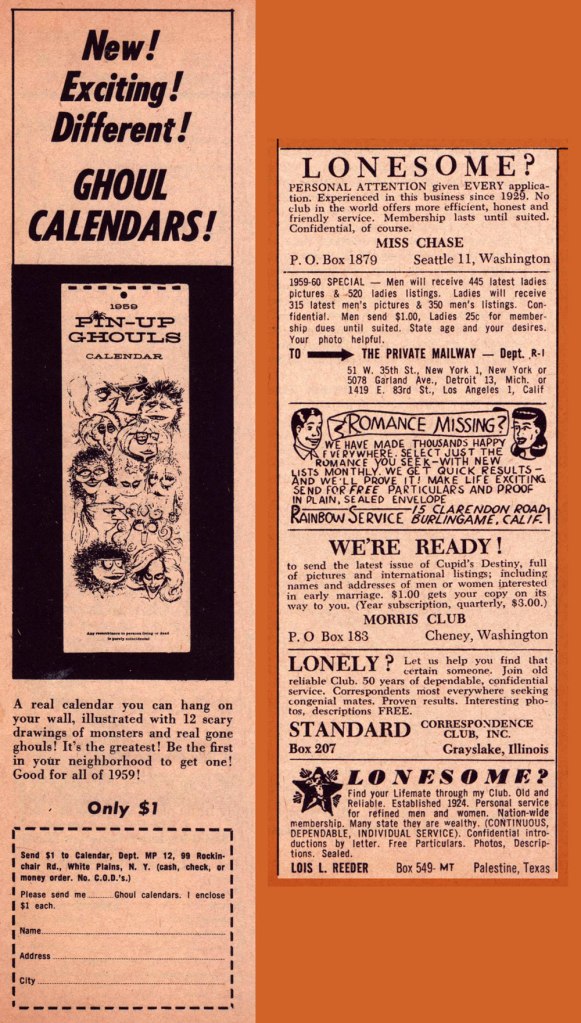
A sample of the classifieds. Do I, er… detect a certain pattern? One clear advantage of the Pin-Up Ghouls calendar is that you can reuse it next in 2026, so keep an eye out for gently-used copies!
Still, it must be said that the dank, meandering back alleys of sleaze magazine publishing of the era are oddly fascinating, if decidedly disreputable places.
« Superstition, the mother of those hideous twins, fear and faith, from her throne of skulls, still rules the world. » — Robert G. Ingersoll
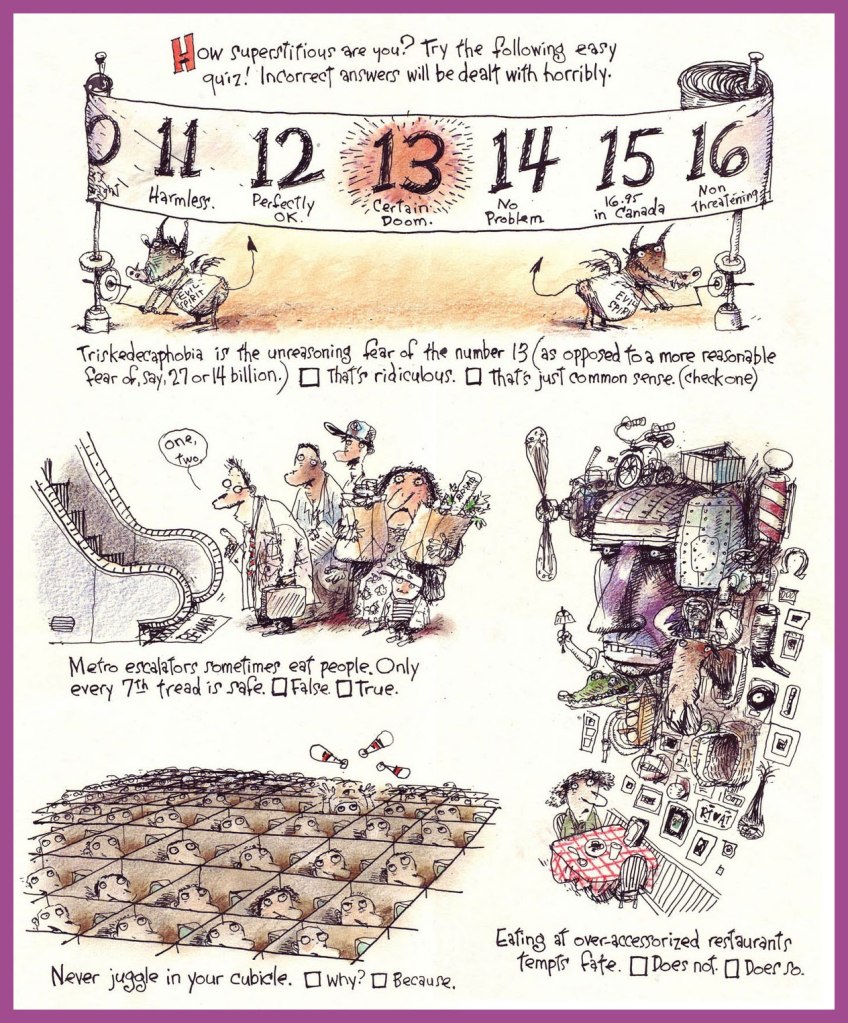
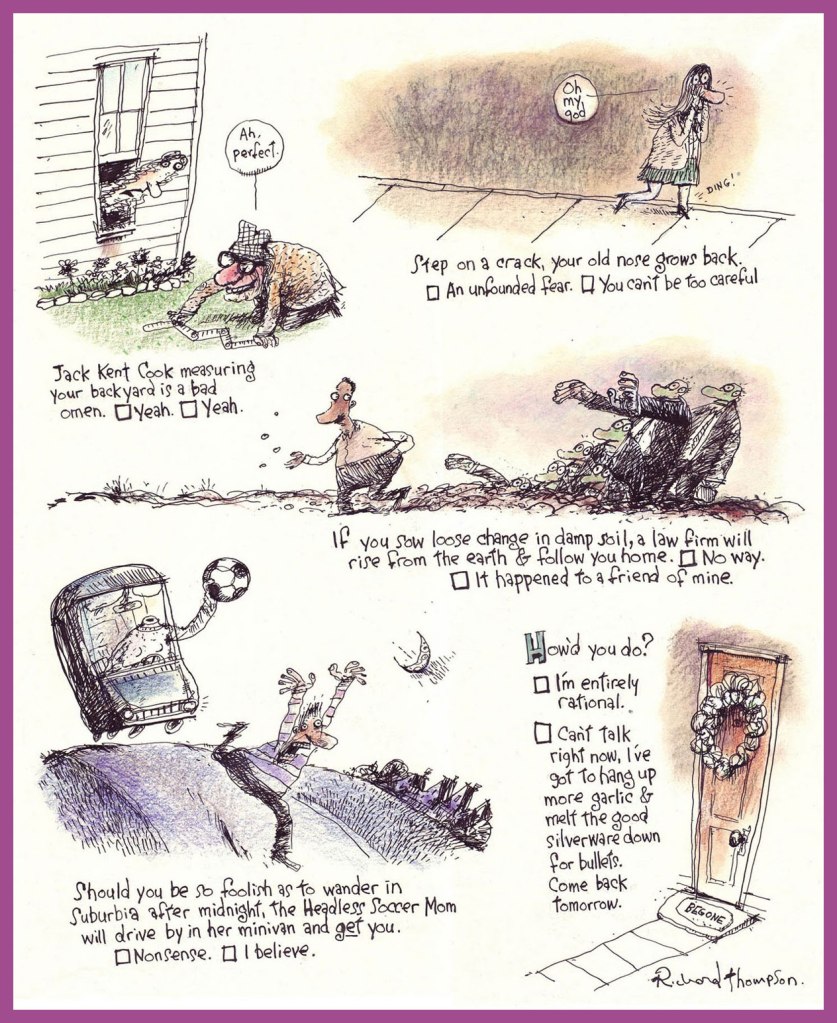
Feeling a tad superstitious? Today, as it also happens to be Richard Thompson’s birthday (coïncidence? hardly!), we combine two fabulous flavours into this confection of sheer frightful delight. Careful you don’t bite your tongue or deal yourself a case of whiplash.
Thompson « drew it for the Washington Post Weekend section back in September of 1996 and it appeared on Friday the 13th. » I believe!
Take the quiz and quell, at least for a time, those vicious neighbourhood rumours concerning you. For further such priceless resources, do take a gander at our prior Thompson posts, including this Hallowe’en-themed goodie and this fair sampling from Richard’s Poor Almanac.
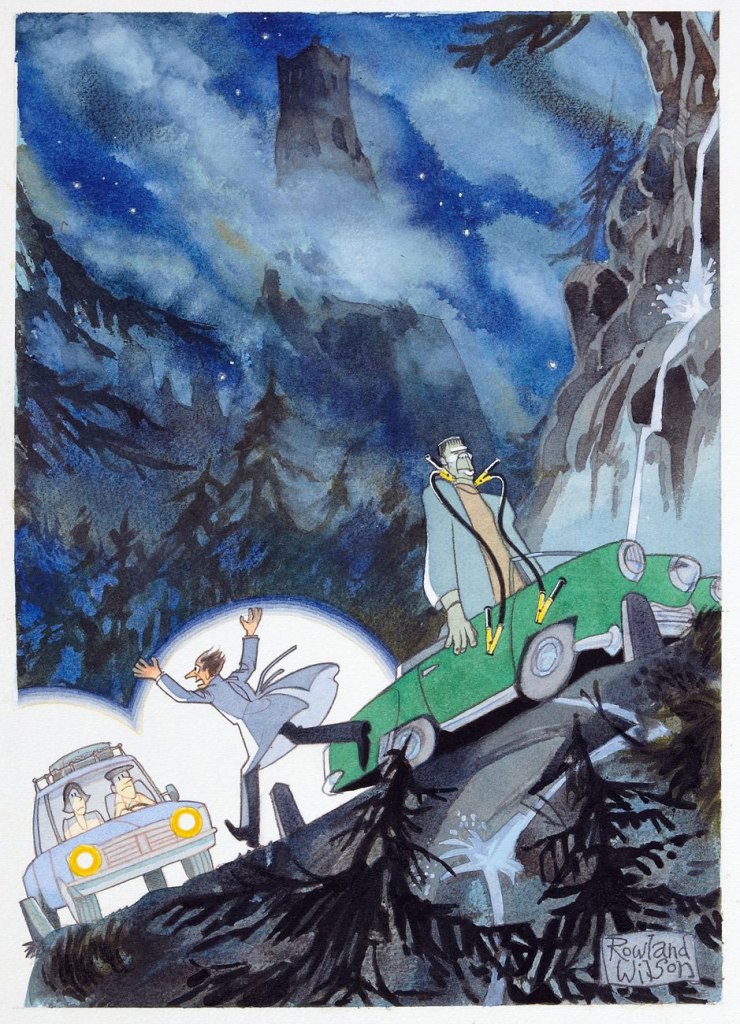
« Stop! Please, I need a jump start! » — the good doctor F.
From the pages of Playboy (Oct. 1990), a seasonal (well, soon to be!) cartoon by Texan Rowland Bragg Wilson (1930-2005).
You have to expect these things whilst motoring through the Carpathians.
In addition to his magazine work (the cream: Playboy, Esquire, The Saturday Evening Post, Collier’s, The New Yorker), Wilson made his mark in the animation field with Schoolhouse Rock! (with Phil Kimmelman & Associates) then as a concept designer with Disney Studios (The Little Mermaid, The Hunchback of Notre Dame, Hercules, Tarzan…). Quite the impressive waybill.
One more, on the same classic theme? Sure.
This one goes: « If I can bring this lovely creature to life, she will bring me lasting immorality! », and it appeared, of course, in Playboy (Nov. 1981). Ah, the difference one letter makes!
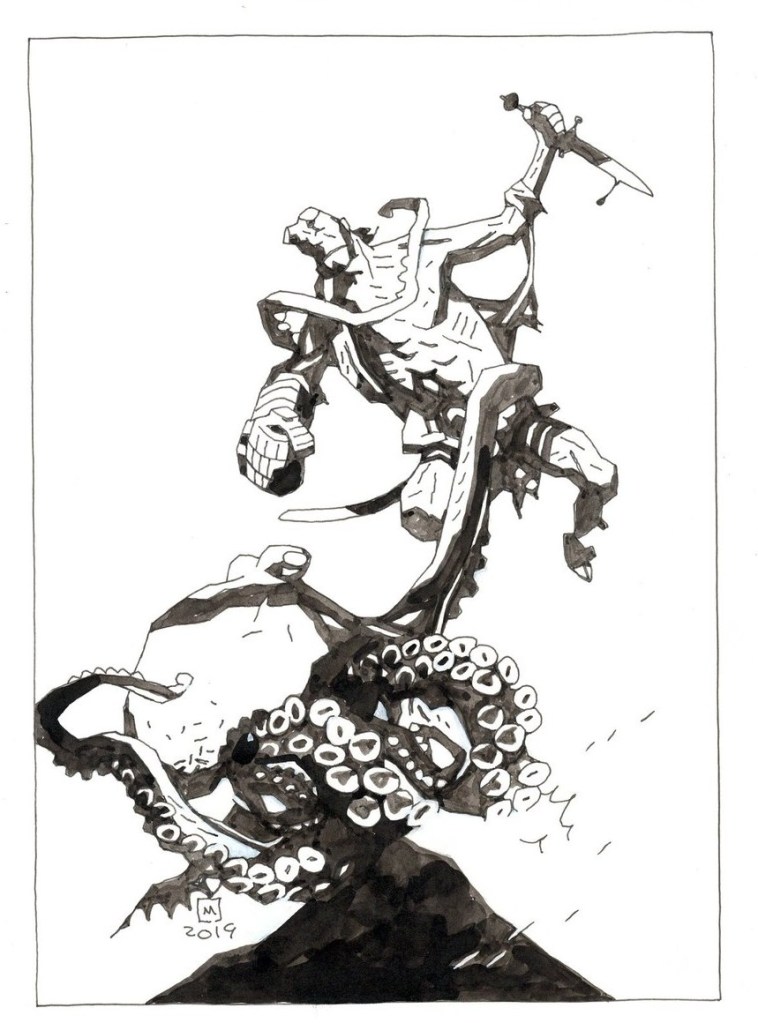
« Because sometimes, for whatever reason, you just want to draw an octopus. » — Mike Mignola, June 2019
I would say that this Tentacle Tuesday feature was started for a similar reason – sometimes one just needs to gather tentacled material, to share it more efficiently with like-minded weirdos.
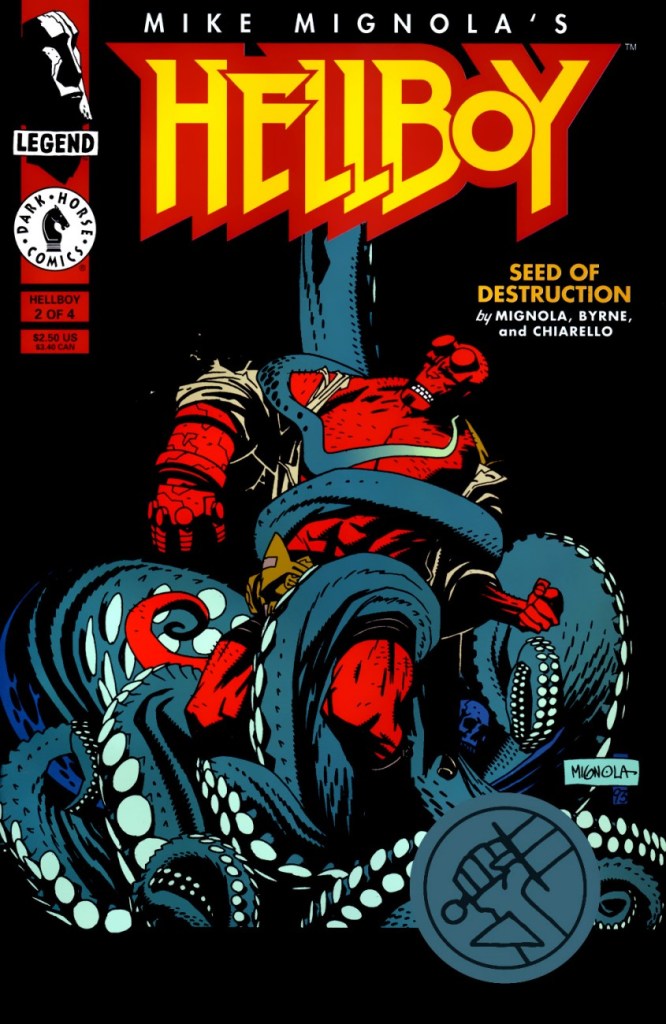
The back cover of Hellboy: Seeds of Destruction no. 2
I don’t imagine writer and comics artist Mike Mignola (most notably, creator of Hellboy and its spin-off B.P.R.D.) needs much of an introduction – he’s fairly ubiquitous in mainstream culture, and his style has been aped by many, which according to the proverb is the most sincere form of flattery. I was aware of this already, and yet was staggered by the sheer number of copycats I stumbled across while seeking out materials for this post.
I also started suffering from tentacle fatigue: as much as I love octopuses, seeing dozens upon dozens of fairly similar images made me weary. Mignola draws tentacles well, but he also draws them very, very often, and he also likes to revisit scenes already depicted. The result is a sprawling mess of sketches, variant covers and spin-offs of spin-offs… perhaps not inappropriate, come to think of it. This particular octopus has far more than just eight limbs!
Enjoy this barrage of Mignola tentacles, just make sure you’re in the proper mood for them 😉
Hellboy: Seeds of Destruction no. 2 (April 1994).
Page from Hellboy: Seeds of Destruction no. 3 (May 1994).
Sketch from June 2019.
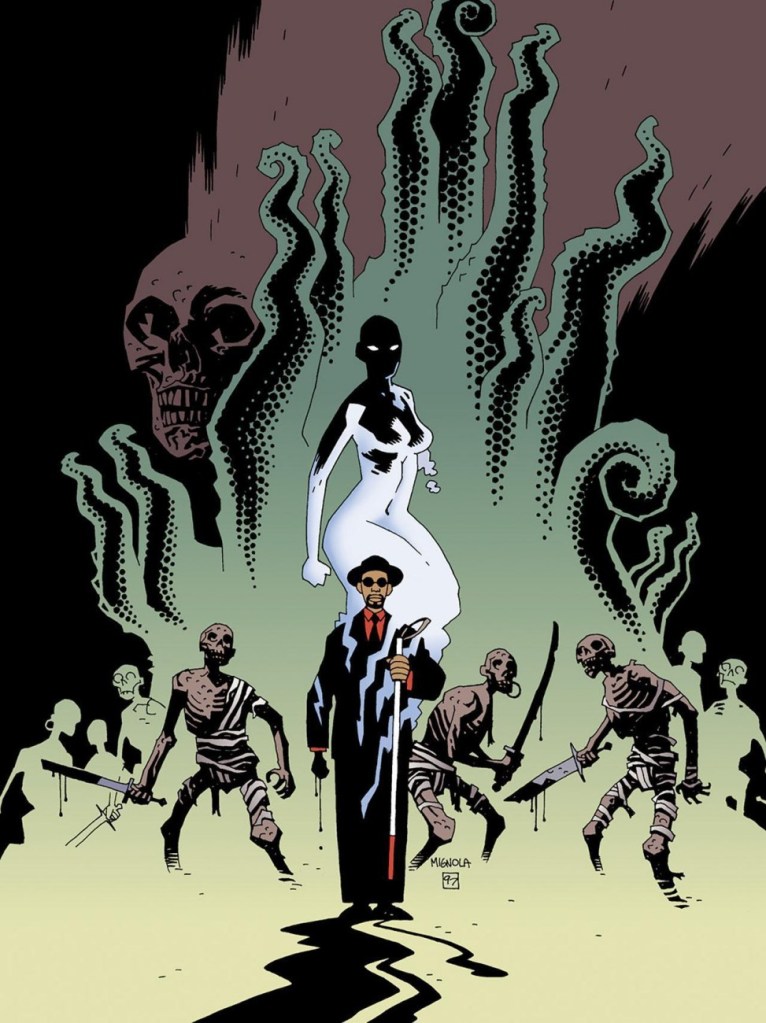
ZombieWorld: Champion of the Worms no. 2 (October 1997)
No post of this nature would be complete without featuring, in some form or other, H.P. Lovecraft, arguably the father of our modern obsession with tentacles. On that topic, I am linking to an excellent article about Mignola’s relationship with the creator of the Cthulhu Mythos (be warned that it’s in French, sorry!)
Art for the cover of Dark Horse Presents no. 142 (April 1999). Mignola made Lovecraft look downright dignified and borderline handsome, which is quite a feat, considering the latter’s unusual physiognomy.
Mignola revisited this very scene for his cover of Children of Lovecraft, and anthology of (non-comics) stories ‘inspired’ by Lovecraft (September, 2016). This was also published by Dark Horse.
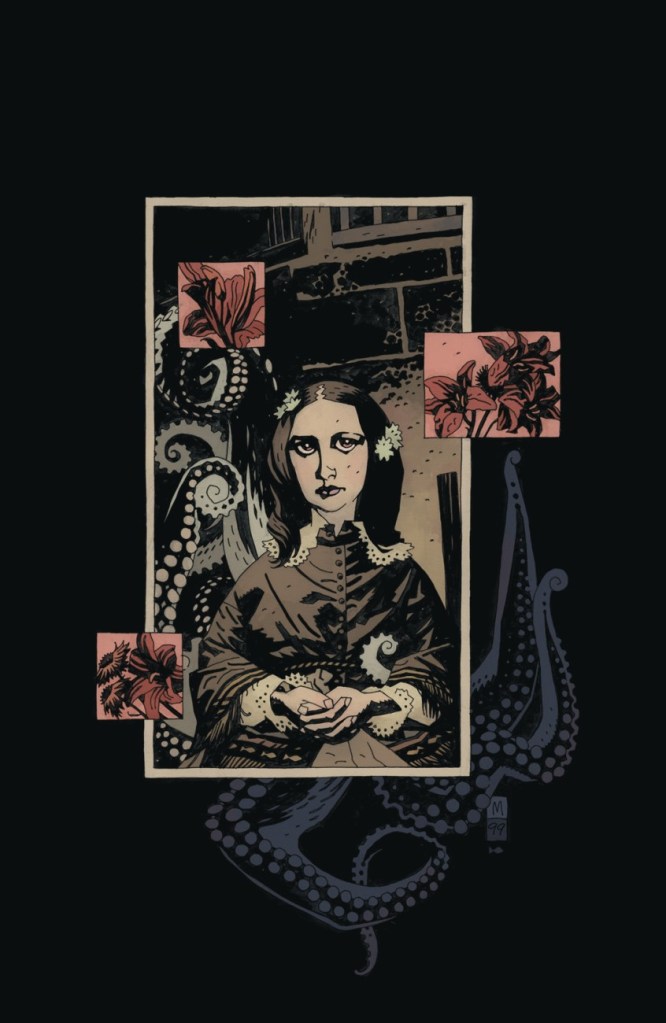
More Victorian England and Lovecraftian archetypes can be found within the pages of Jenny Finn:
Artwork for Jenny Finn no. 1 (June 1999).
Back cover artwork for Jenny Finn Messiah no. 1 (2005).
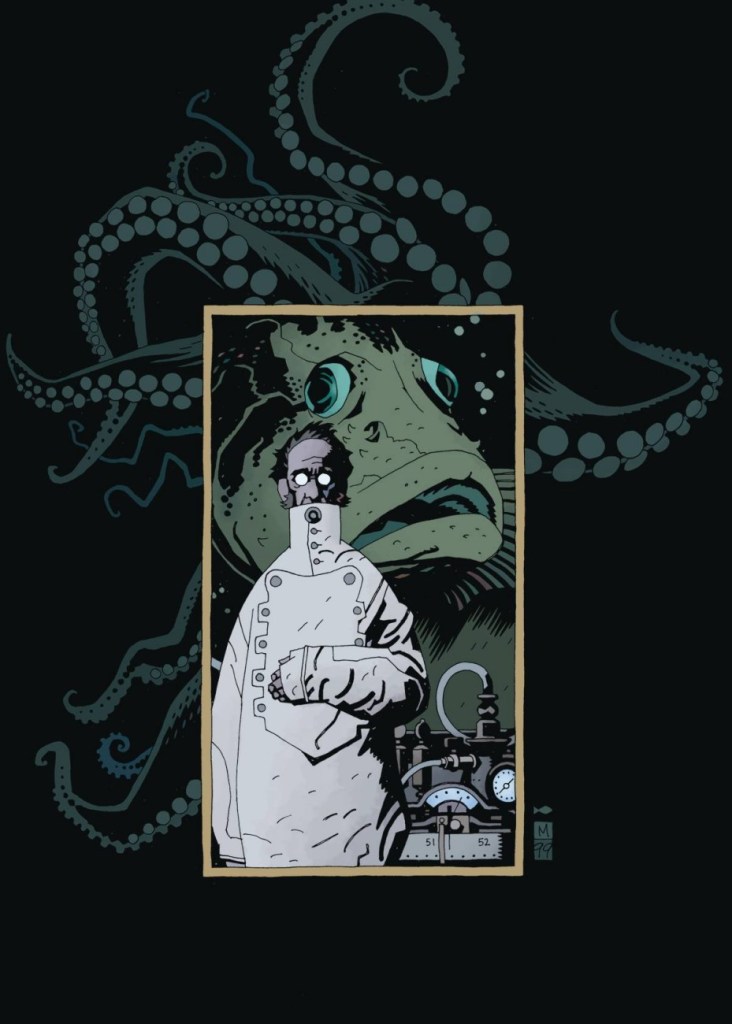
Even Batman, in Mignola’s hands, gets tentaclefied!
A page from Batman: Legends of the Dark Knight no. 54 (November 1993).
Batman: The Doom That Came to Gotham no. 2 (November 2000).
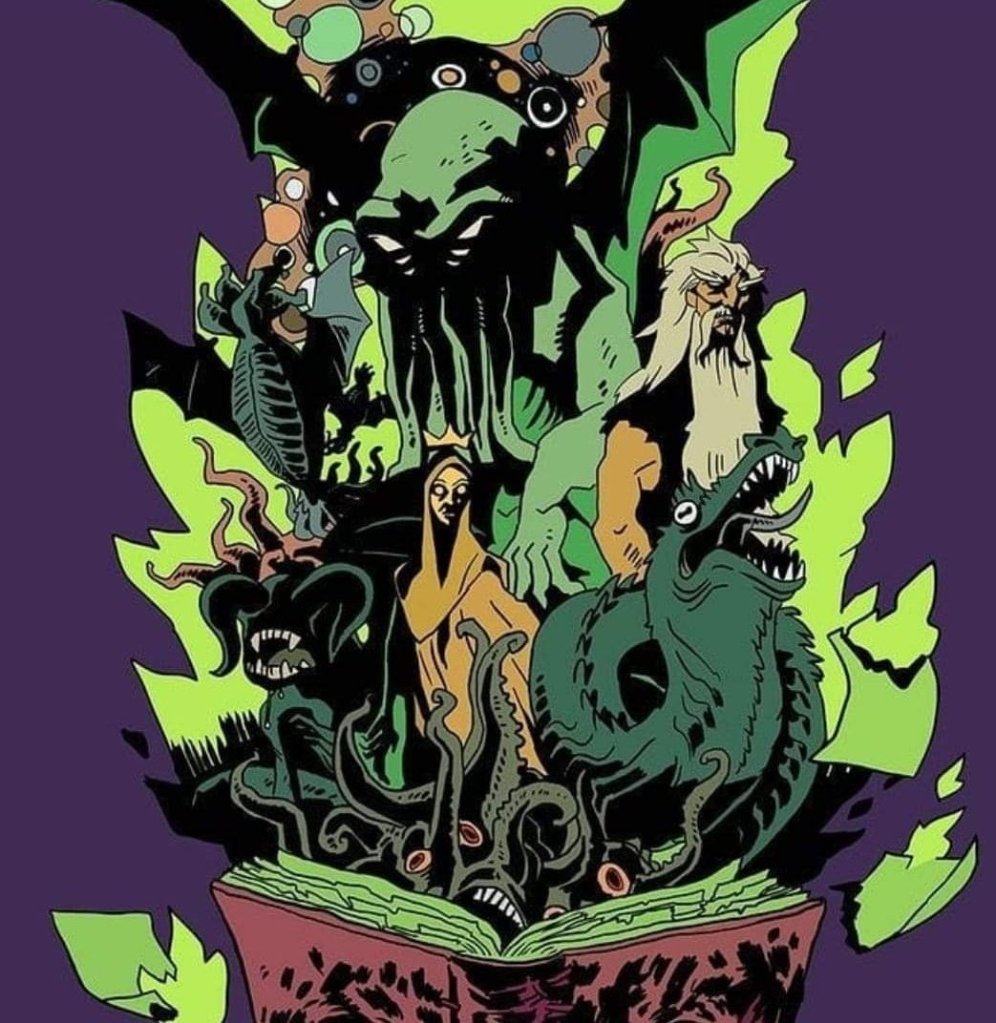
As a final note, I’d like to officially make a moue of distaste at people who share art without attribution, or without bothering to ascertain its source. To wit: a pair of images that are widely shared as Mike Mignola artwork… except that it isn’t by him at all, just by someone drawing in a similar style. Instagram and Pinterest are breeding grounds for such deplorable artistic credit robbery.
The following two illustrations are by Malaysian artist Daryl Toh.































 Who's Out There?