Somehow, after yesterday’s rather epic (or at least time-consuming) post, I thought I’d breathe a little easier today, but no… these things have a way of imposing themselves, complications and all.
When I was a young collector, say under the age of fifteen, when I still gave a hoot about what comics were ‘worth’, financially speaking, I enjoyed leafing through the Overstreet Price Guide. Not so much out of greed, but rather of curiosity about the past. One title that piqued my imagination was Pines’ The Unseen. I mostly saw tiny, tantalising postage-stamp-size reproductions of its covers, but they lived up to my expectations. Lots and lots of talented folks toiling on the insides, too!
So I thought I’d collect them for your viewing pleasure, with two exceptions: the initial one, by Ross Andru, is kind of lame, so I’ll skip it; the final one, number fifteen, was featured in last year’s countdown.
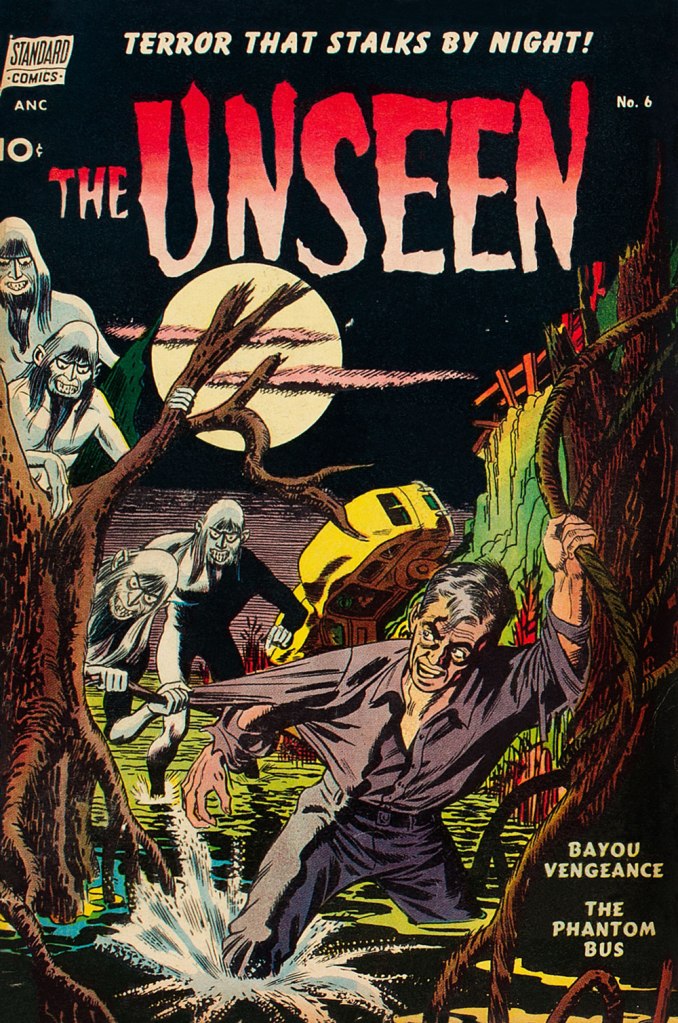
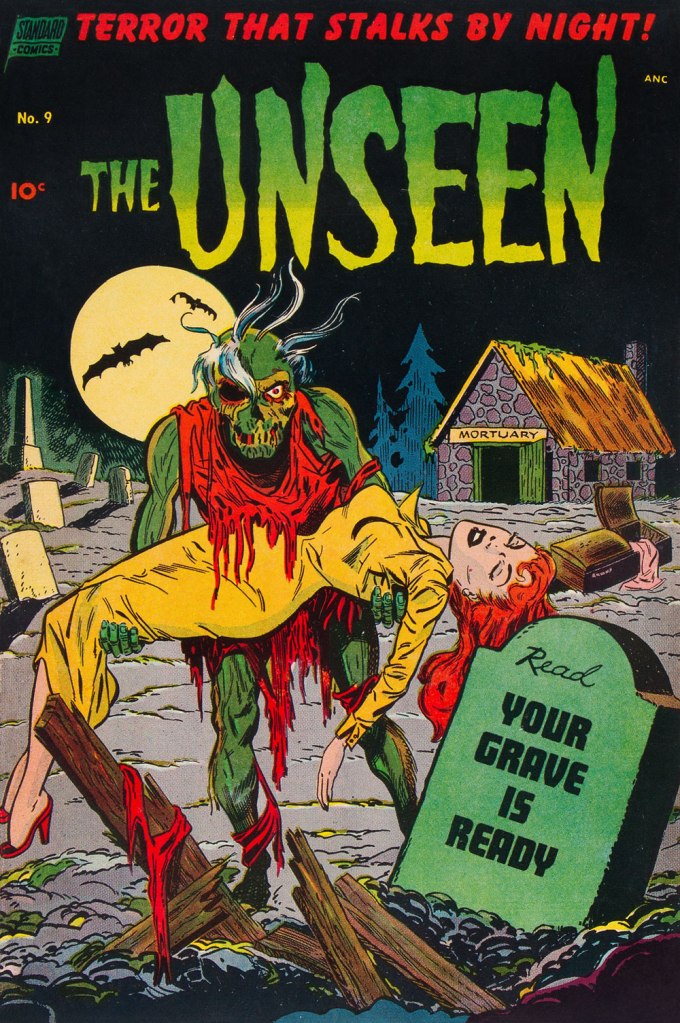
This is The Unseen no. 6 (Sept. 1952, Pines); cover by George Roussos. Read it here!From the thumbnail version of this cover, I always wondered what ol’ Adolf Hitler had done (a rhetorical question) to be stalked by vampires. Seeing it full size, the question remains. This is The Unseen no. 7 (Nov. 1952, Pines); cover by John Celardo. Read it here! This is The Unseen no. 8 (Jan. 1953, Pines); cover (possibly) by Nick Cardy. Read it here!It’s the Combover Cadaver, run for your lives! This is The Unseen no. 9 (Mar. 1953, Pines); cover (possibly) by Art Saaf. Read it here!The Spaghetti Mummy strikes! This is The Unseen no. 10 (May 1953, Pines); cover by Jack Katz. Read it here!This is The Unseen no. 11 (July 1953, Pines); cover by the fascinating Jack Katz. Read it here!This is The Unseen no. 12 (Nov. 1953, Pines); cover by Nick Cardy. Read it here!Aw, that’s sweet. This is The Unseen no. 13 (Jan. 1954, Pines); cover by Alex Toth. Read it here!Aw, give it a chance — try the cocktail, at least. This is The Unseen no. 14 (Mar. 1954, Pines); cover by Mike Peppe. Read it here!
Our heatwave is nowhere as bad as the one afflicting Europe right now, but it’s a heatwave nevertheless, and to cool off I felt like traipsing down the icy corridors of horror. Evan Dorkin‘s series Beasts of Burden, the tale of a (predominantly) canine crew who fight the supernatural to keep their small town community safe, fits the bill: though including elements of adventure, mystery, and humour, it’s genuinely tense in places (and features enough blood and grue to keep the average gorehound satisfied). One expects a comic in which all protagonists are animals to evoke baby-talk sounds of endearment, not send chills down the spine of the more sensitive reader, and yet…
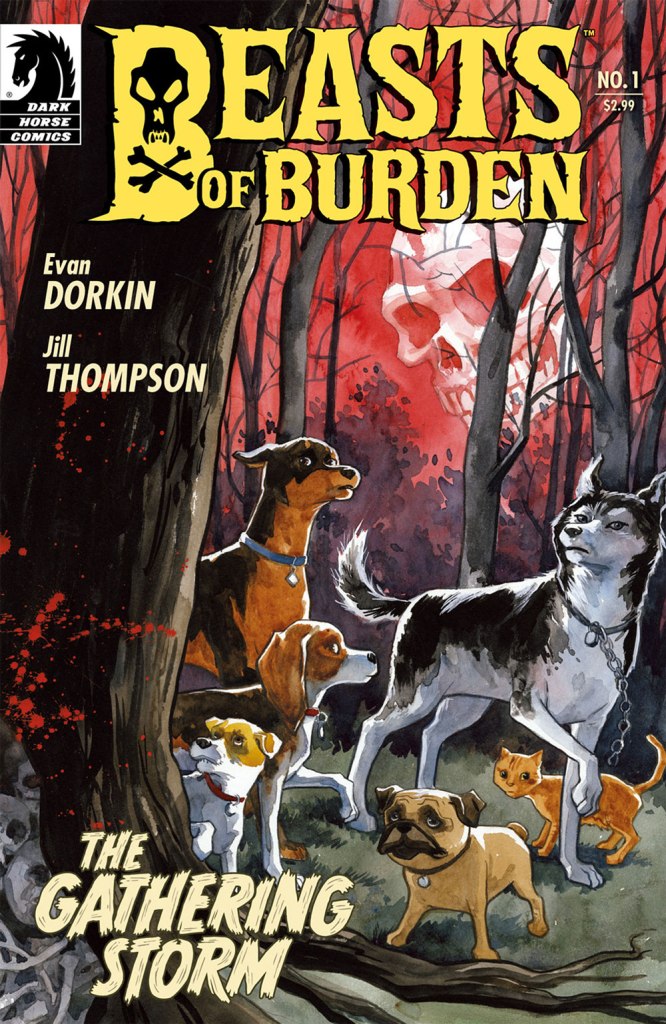
Beasts of Burden no. 1 (September 2009), cover by Jill Thompson.
However, I’ll warn you that a fondness for animals is a prerequisite for enjoying this comic, lest you miss the emotional punch to the gut of moments like a dog searching for her lost puppies, or animals mourning the loss of their friend. Despite the paranormal threats these pooches (and cat!) have to deal with, I would say that it’s that emotional horror that makes these stories memorable, especially to a modern reader well-versed in zombies, werewolves, and witchcraft (yawn, how cliché…) I am quite allergic to animals getting hurt in stories, but Beasts of Burden never feels manipulative in that regard: shit definitely happens, but is overcome through teamwork and courage.
This comic also features loving watercolours by Jill Thompson (according to the DC Comics website, ‘most well-known female comic book artist‘… not sure how they measured that), who’s not only great at evocative woodsy landscapes in all seasons, but also a deft hand at convincing portraits of animals. I have seen too many comic artists who cannot draw a convincing cat or dog (let alone a horse, a true test of artistry…) to take that for granted. This post only spotlights material from the collection Beasts of Burden: Animal Rites (2010, Dark Horse), as Thompson was later on replaced by Benjamin Dewey, whose art I suppose I could bear… if only the standard desaturated colouring job wasn’t the final nail in that coffin. It’s a bitter pill to swallow after Thompson’s bright, organic art.
All stories featured in this post are written by Evan Dorkin and illustrated by Jill Thompson.
A page from Stray, published in Dark Horse Book of Hauntings (August, 2003). This was the first Beasts of Burden story to be published; the characters got more fleshed out, both in writing and in art, later on.
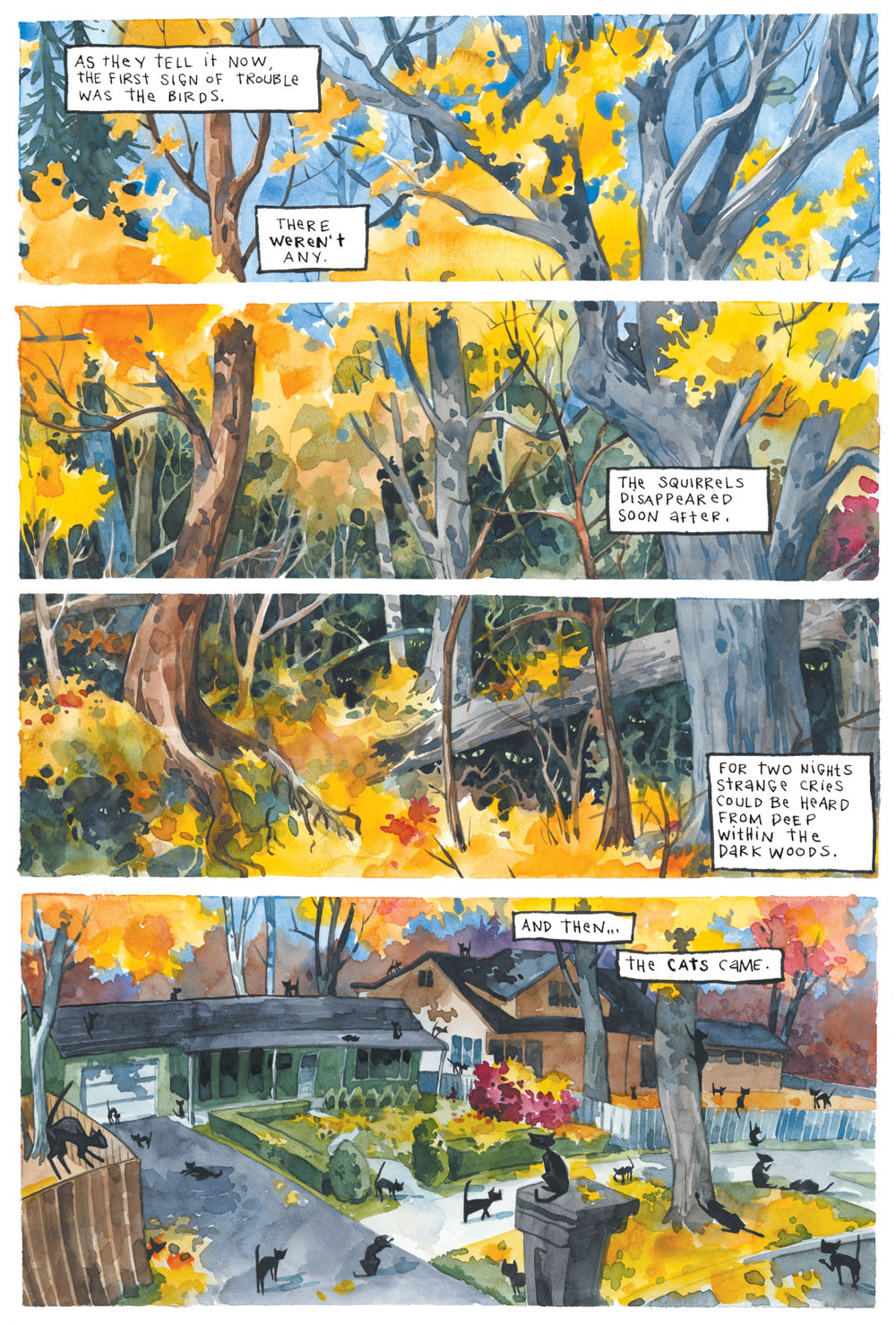
Page from The Unfamiliar, published in The Dark Horse Book of Witchcraft (July 2004). My favourite season is fall, so I couldn’t resist featuring a page of autumnal-blaze trees and black cats.
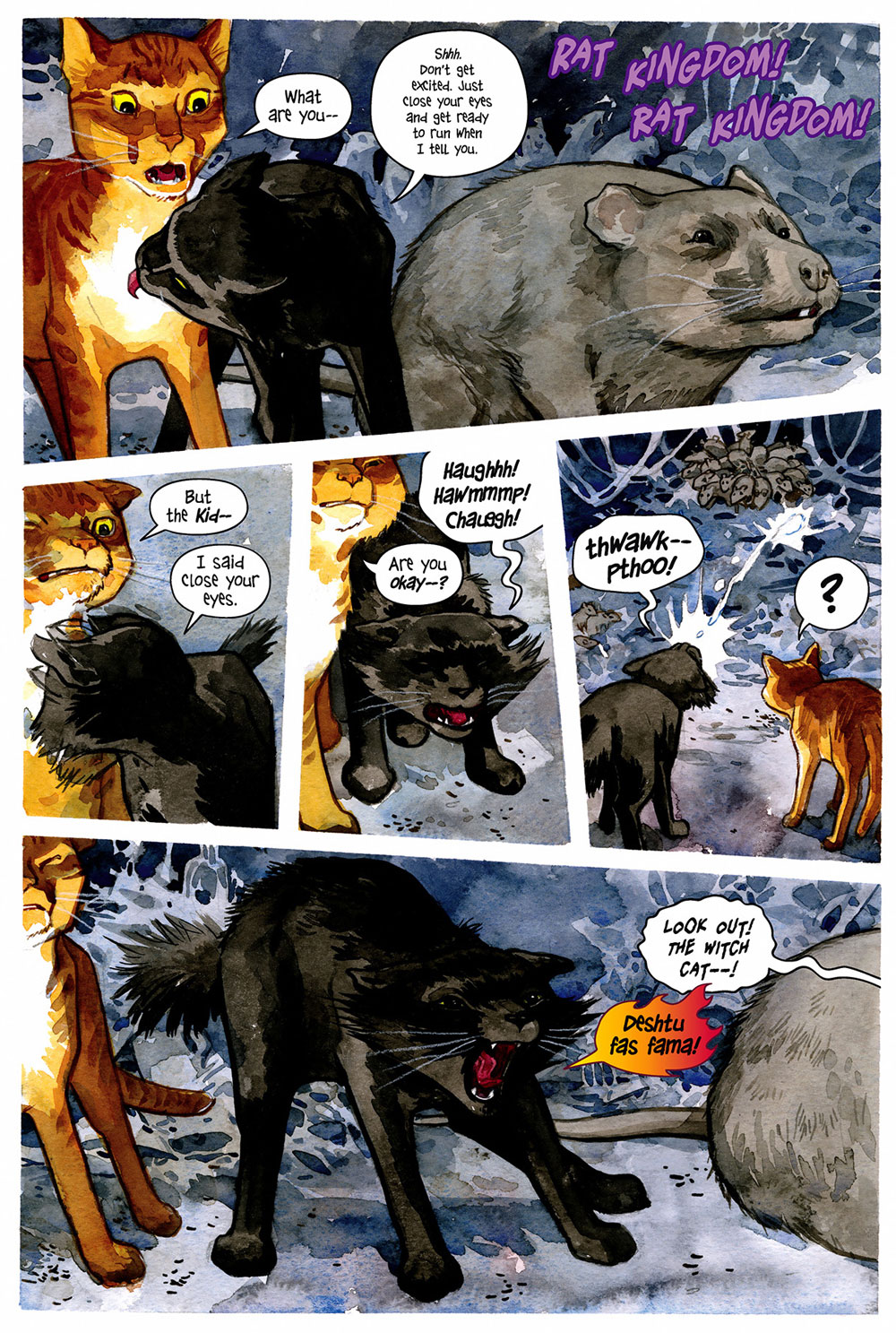
Another page from The Unfamiliar, published in The Dark Horse Book of Witchcraft (July 2004). The normally orange Orphan (who needs a better name, but at least he gets called ‘Orph’ a lot later on) gets dyed black as a subterfuge. This story is pretty goofy (two witches come to town to summon Sekhmet), and my least favourite of the early batch, but at least it has a lot of black cats.
Pages from Let Sleeping Dogs Lie, published in The Dark Horse Book of the Dead (June, 2005), in which Daphne (the black witch cat, who later becomes a part of the regular cast) returns with revenge on her mind.
Page from A Dog and His Boy, published in The Dark Horse Book of Monsters(December 2006).
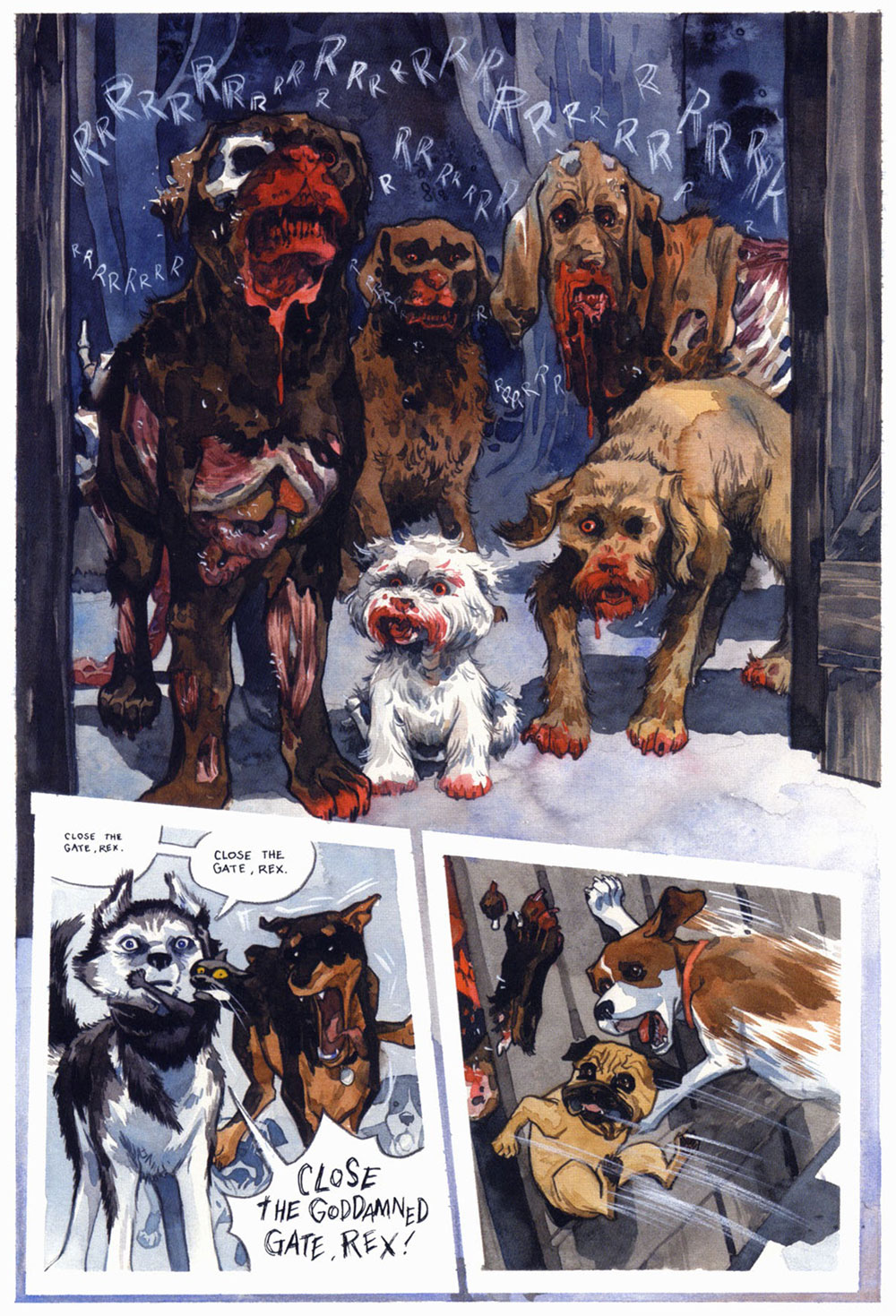
Page from The Gathering Storm, published in Beasts of Burden no. 1 (September 2009), the moment at which this became an official series, as opposed to a series of one-shot stories. The whole ‘plague of frogs’ thing is of course instantly reminiscent of B.P.R.D., a Dark Horse series that originally appeared in Hellboy.
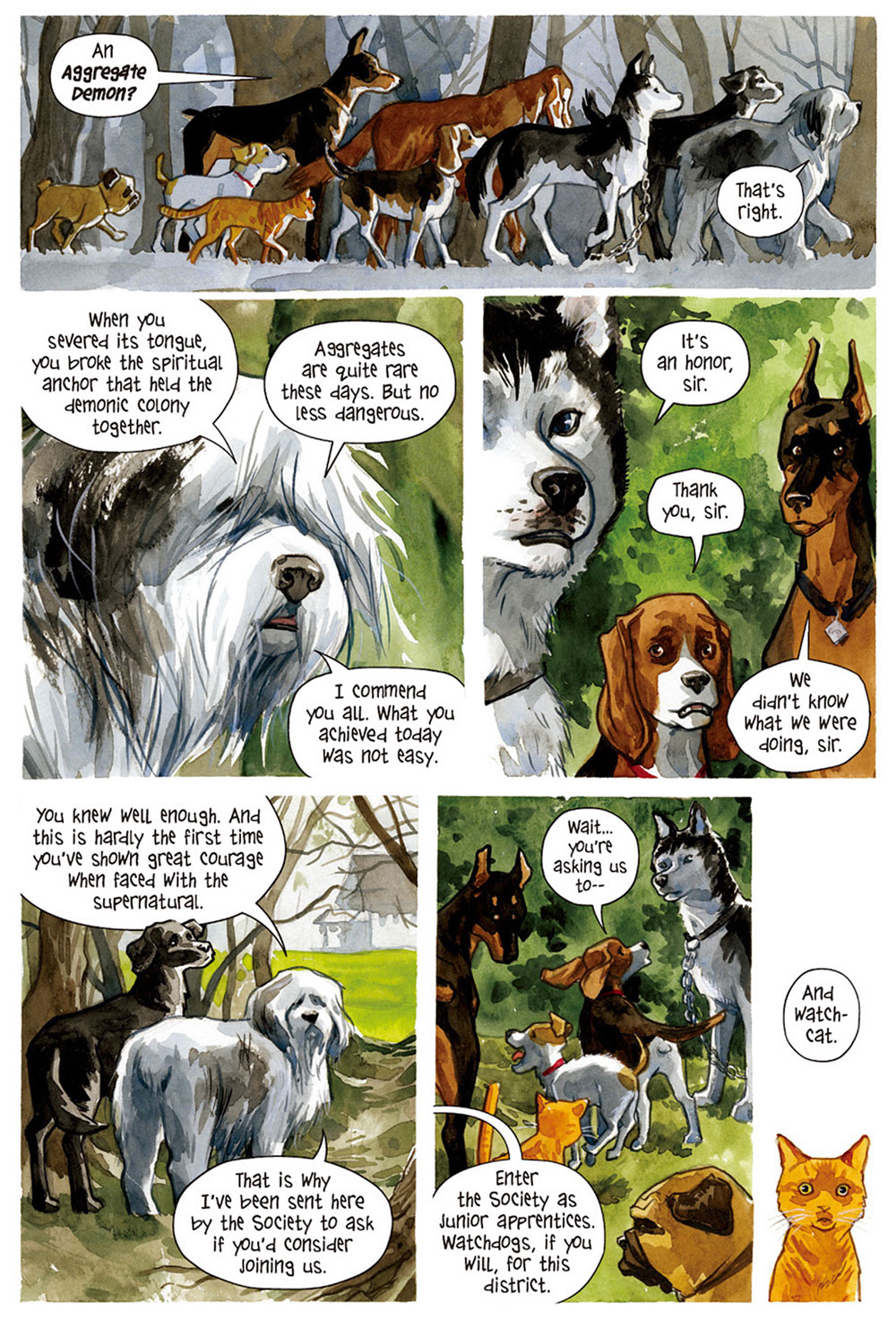
Another page from The Gathering Storm, published in Beasts of Burden no. 1 (September 2009); the moment when the gang officially becomes watchdogs. Most of the dogs have collars, but can dash around with ease, barely ever running into humans.
Art for the cover of Beasts of Burden no. 2 (October 2009).
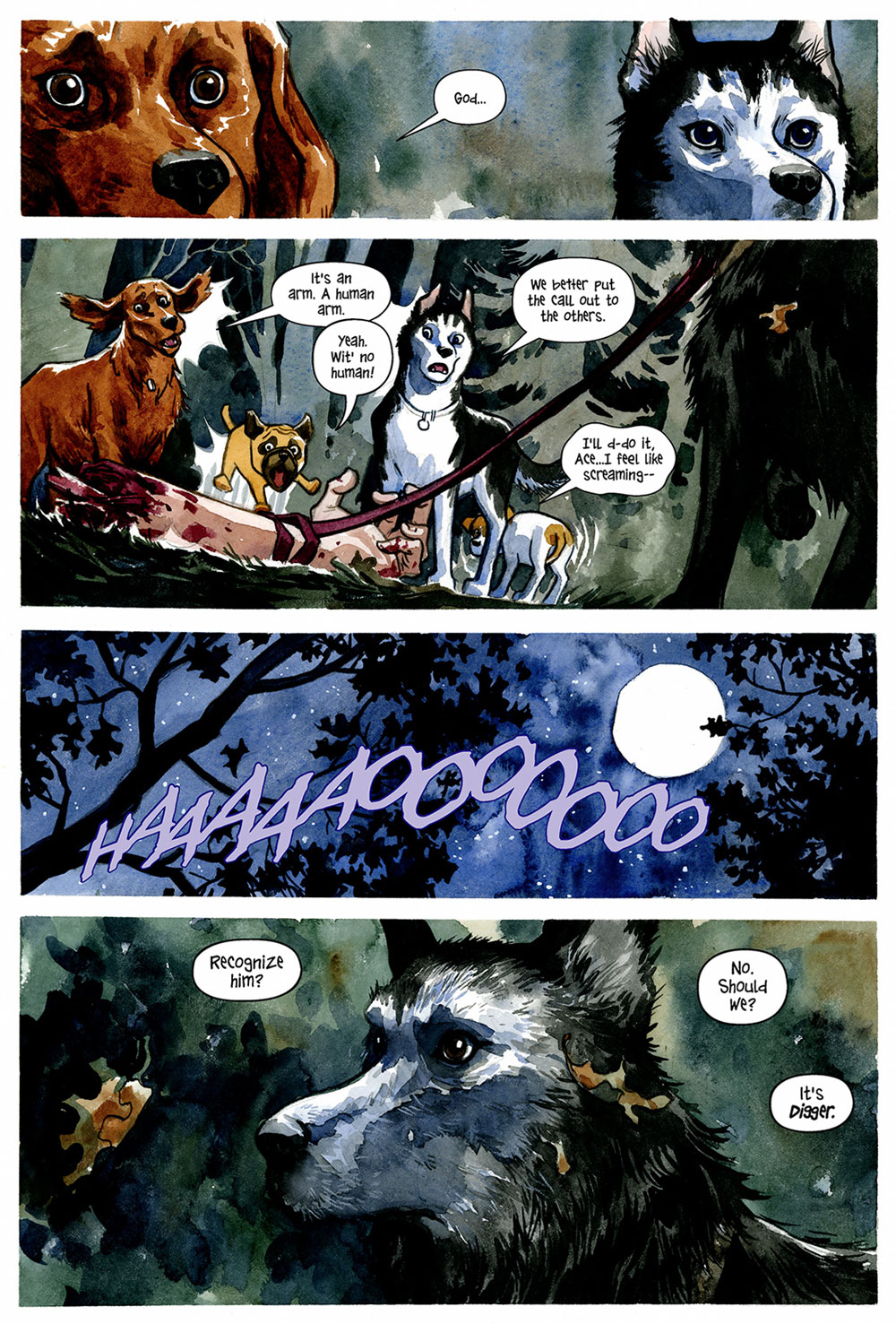
Pages from Lost, published in Beasts of Burden no. 2 (October 2009), a genuinely shocking moment – hurting a human goes against these dogs’ normal code.
Pages from Something Whiskered This Way Comes, published in Beasts of Burden no. 3 (November 2009). This story highlights the somewhat tense relationship between Orphan and his romantic interest/enemy Daphne, the black magic cat from an earlier story.
Page from Grave Happenings, published in Beasts of Burden no. 4 (December 2009).
Beasts of Burden is still ongoing, with the latest installment, Occupied Territory (illustrated by Benjamin Dewey, alas), published in July 2021.
It stands to reason that there are tons of spiffy-yet-unheralded material out there, most of it slowly mouldering away in obscurity. You may count on us to do some foraging and to showcase some of the spoils here… with proper attribution.
Our image: Artwork by Ed Robbins, from Cemetery Scene, writer unknown (The Twilight Zone no. 36, March 1971, Gold Key).











 It stands to reason that there are tons of spiffy-yet-unheralded material out there, most of it slowly mouldering away in obscurity. You may count on us to do some foraging and to showcase some of the spoils here… with proper attribution.
 Who's Out There?