« Coming to play golf is not what I would consider to be an essential purpose. » — Nicola Sturgeon
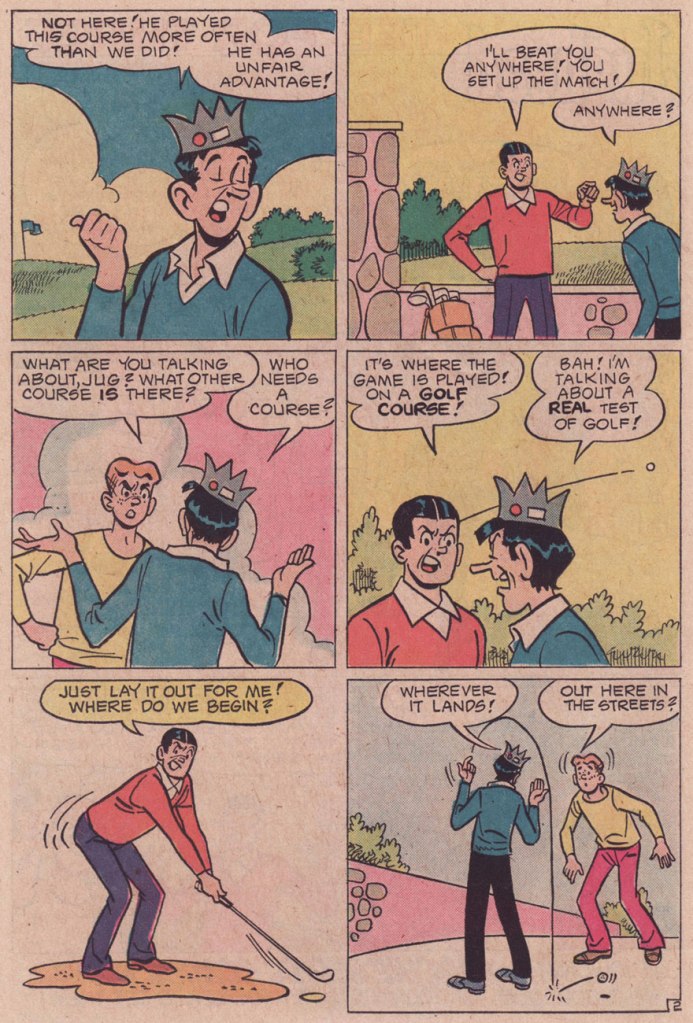
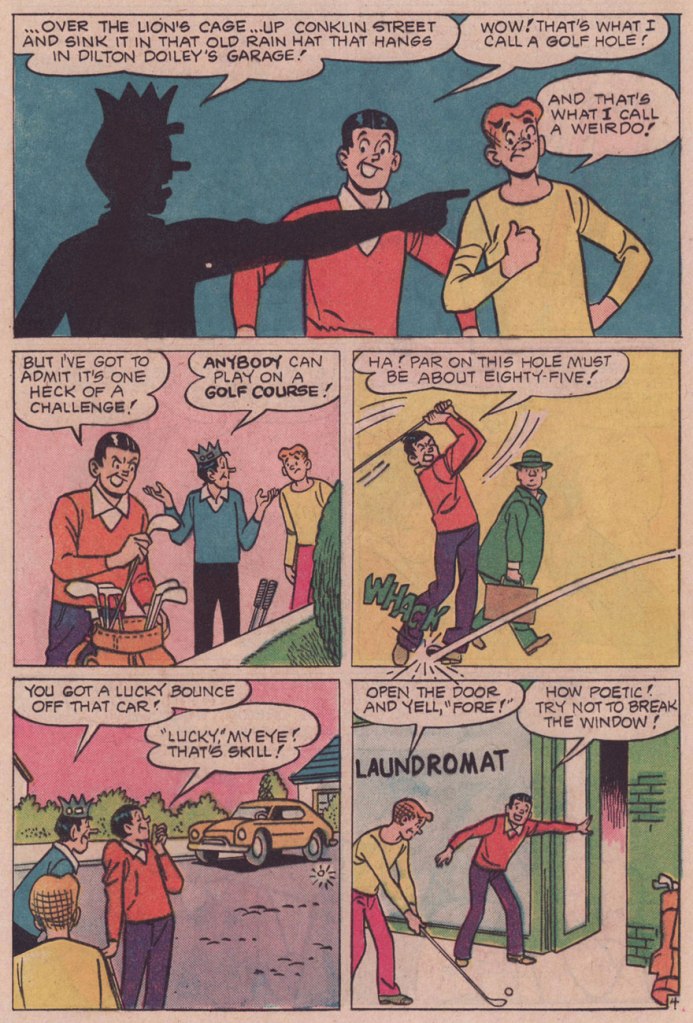
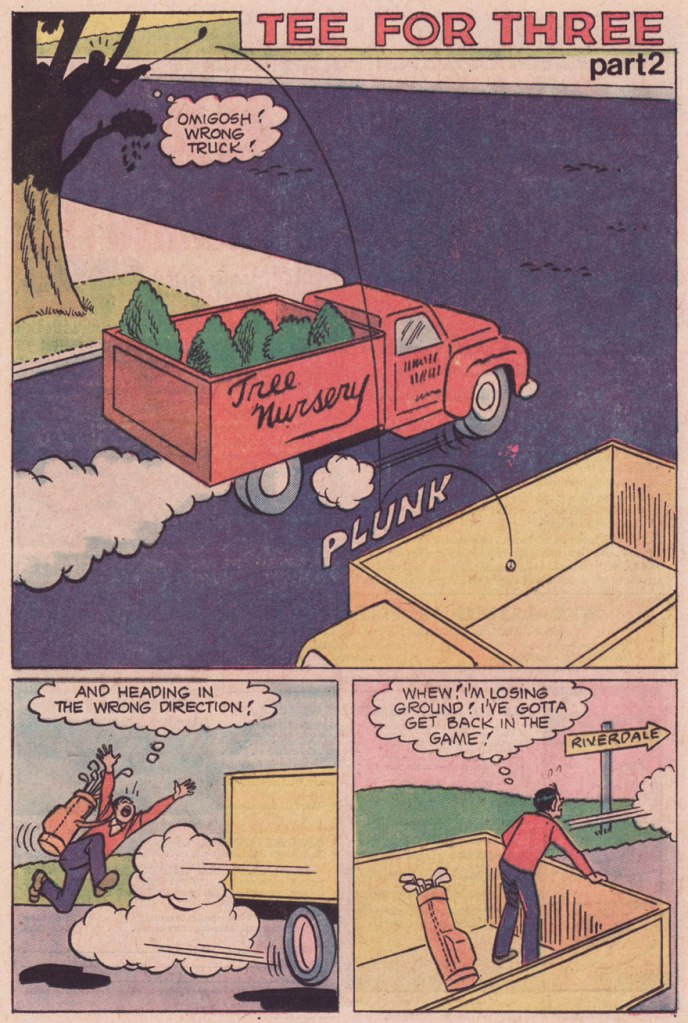
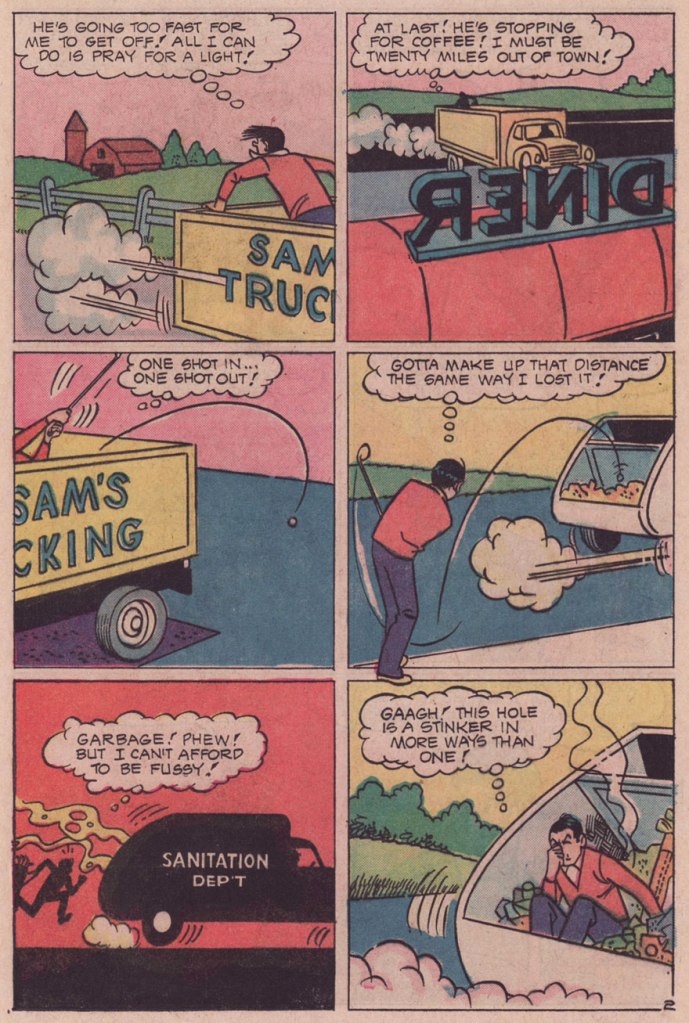
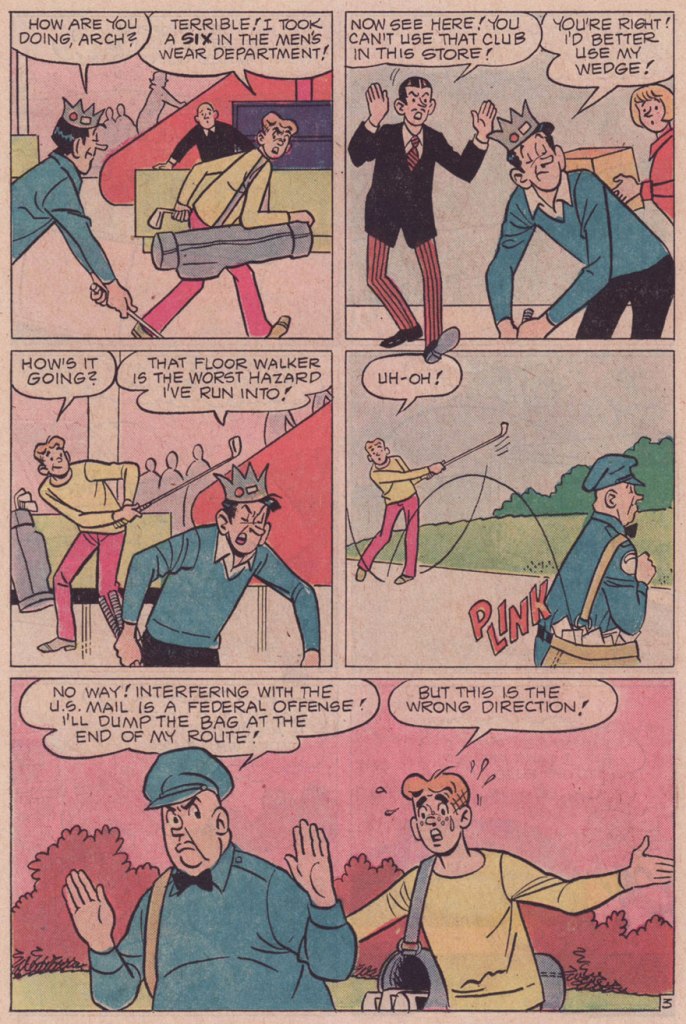
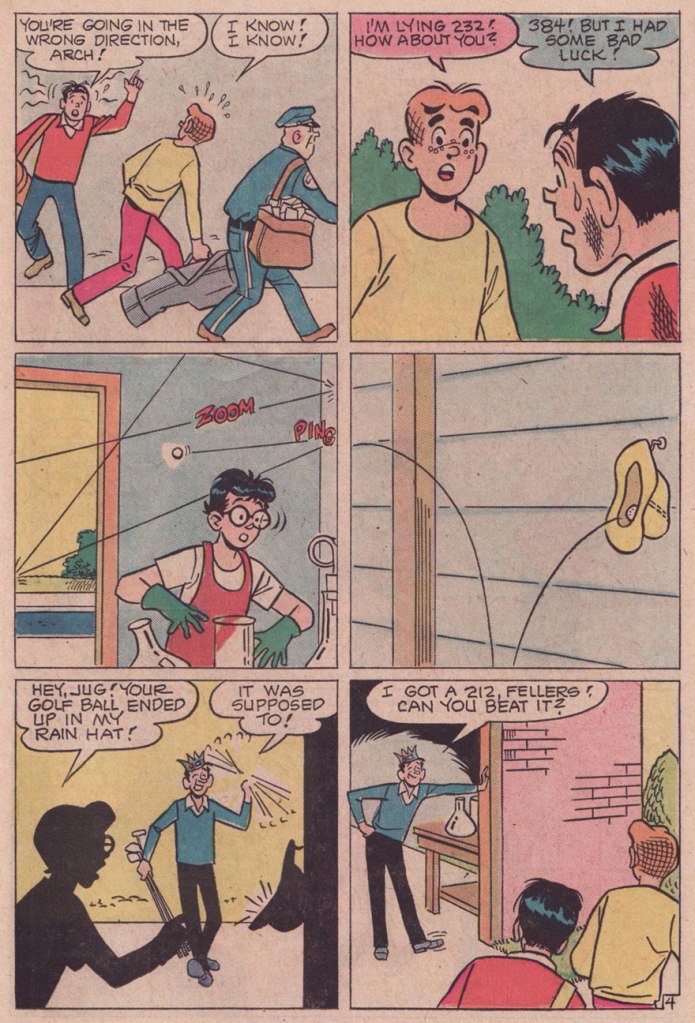
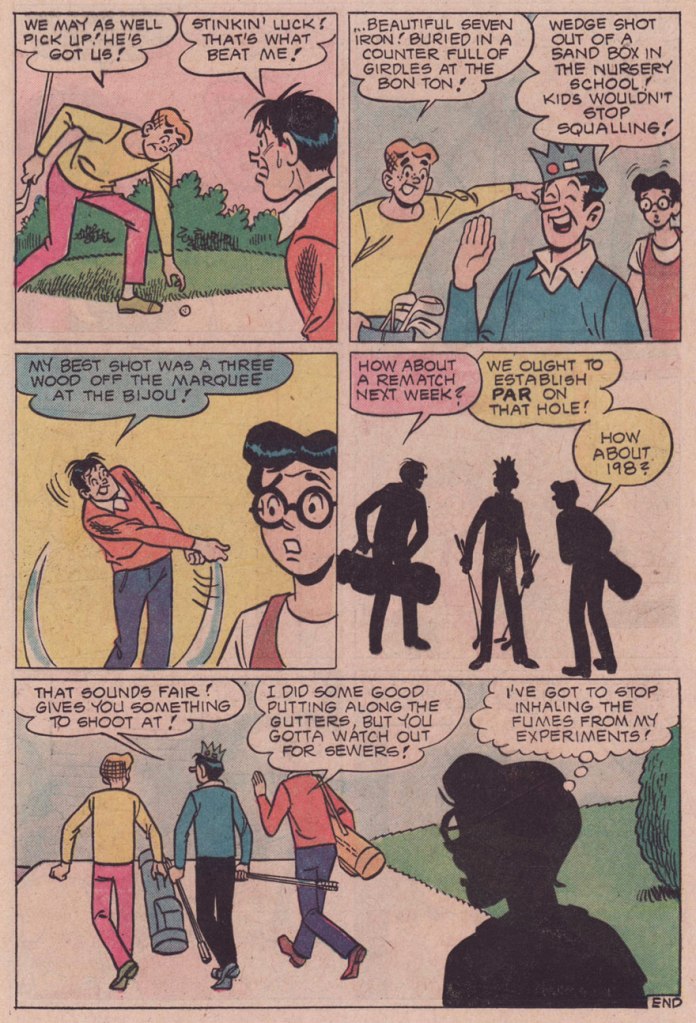
I’ve long wanted to showcase one of Samm Schwartz‘s Jughead stories on this blog, but always hit the same snag: which one? Not too long ago, while revisiting my trove of 1970s issues, I came upon just the specimen. Tee for Three appeared in Jughead no. 247 (Dec. 1975, Archie). I’ll spare you the hideous-as-usual Stan Goldberg cover.
While we know the story was illustrated by Samm Schwartz, the writer’s identity remains unknown. Schwartz usually took a hand in the scripting, but he didn’t really ever work alone. The likeliest miscreants are his usual accomplices, Frank Doyle and George Gladir.
Why this one among hundreds of others, then? For one thing, it’s longer; at eleven pages long, it’s a towering freak amidst the customary five-or-six pagers.
But that’s not all: Tee for Three also boasts an unconventional plot, one that cried out for (and received) a more leisurely deployment. Its tone is also surprising: it’s quite deadpan and sanguine in its absurdity.
For once, you can envision why these three, despite being frenemies or plain rivals, would actually hang out: they challenge and entertain one another. And even collaborate when the occasion calls for it. In this case, Jug, Archie and Reggie are so bonded in their good-natured folie à trois that the rest of the world doesn’t have a clue and hardly stands a chance.
While such a golf contest would surely result in much injury, property damage and litigation in the ‘real’ world, it sure seems like a rollicking bit of sport here, and isn’t that what good fiction is for(e)?
« She kept her ears permanently tuned to the chicken voices outside, so knew immediately when a coyote had crept into the yard, and barrelled screaming for the front door before the rest of us had a clue. » ― Barbara Kingsolver
Given how muted the holiday season is likely to be for most of us, and in light of how much our readers appear to enjoy our past Christmas offerings — (all year long!), I’d thought I’d get an early start on the festivities.
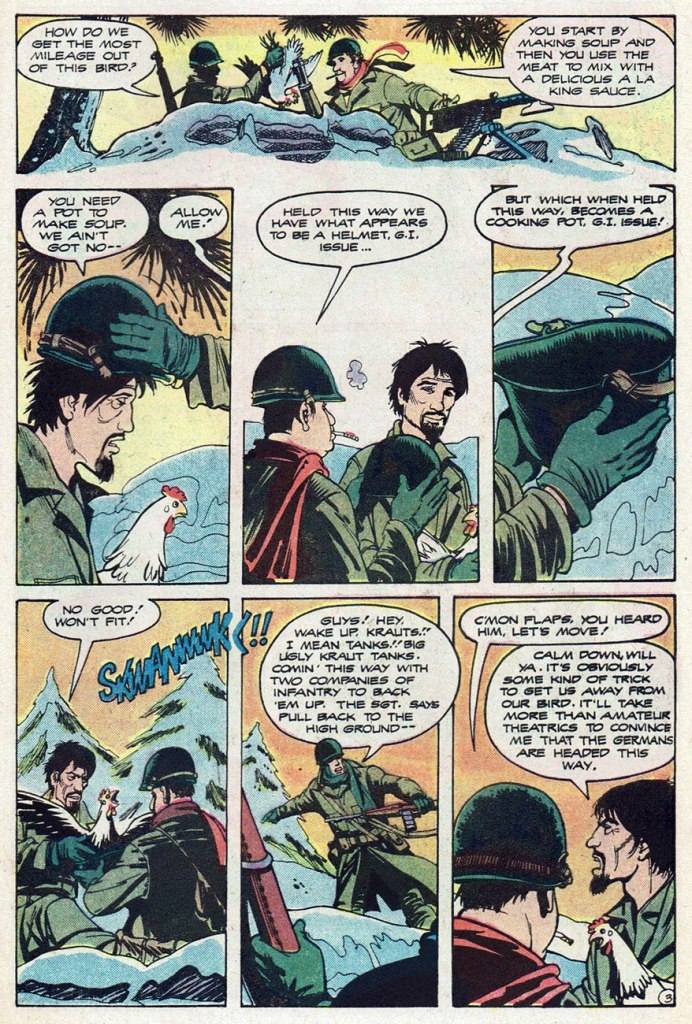
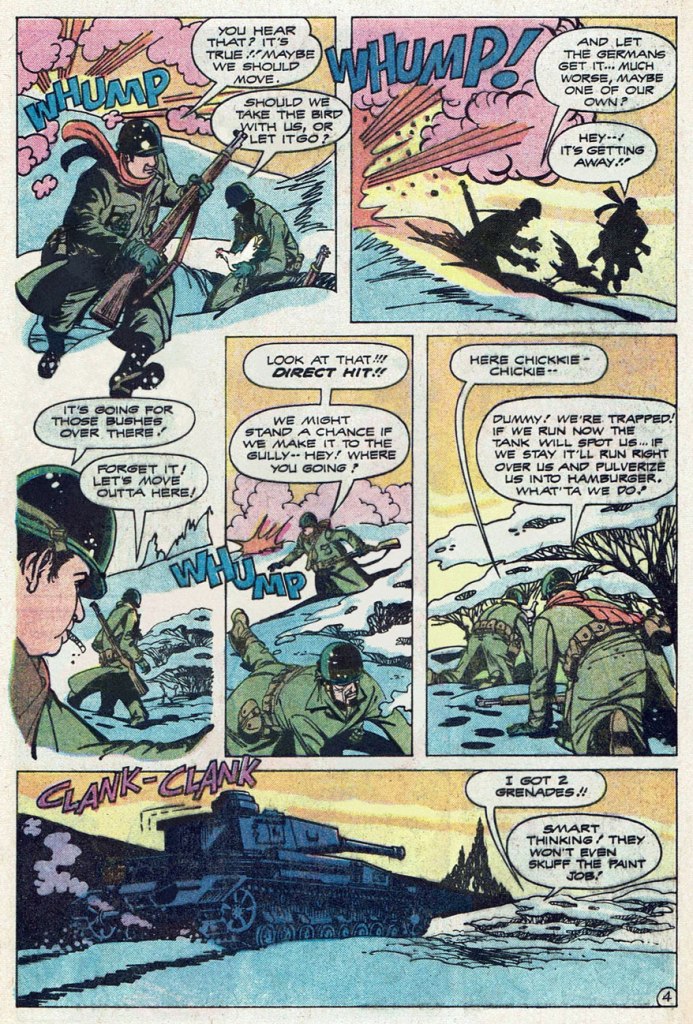
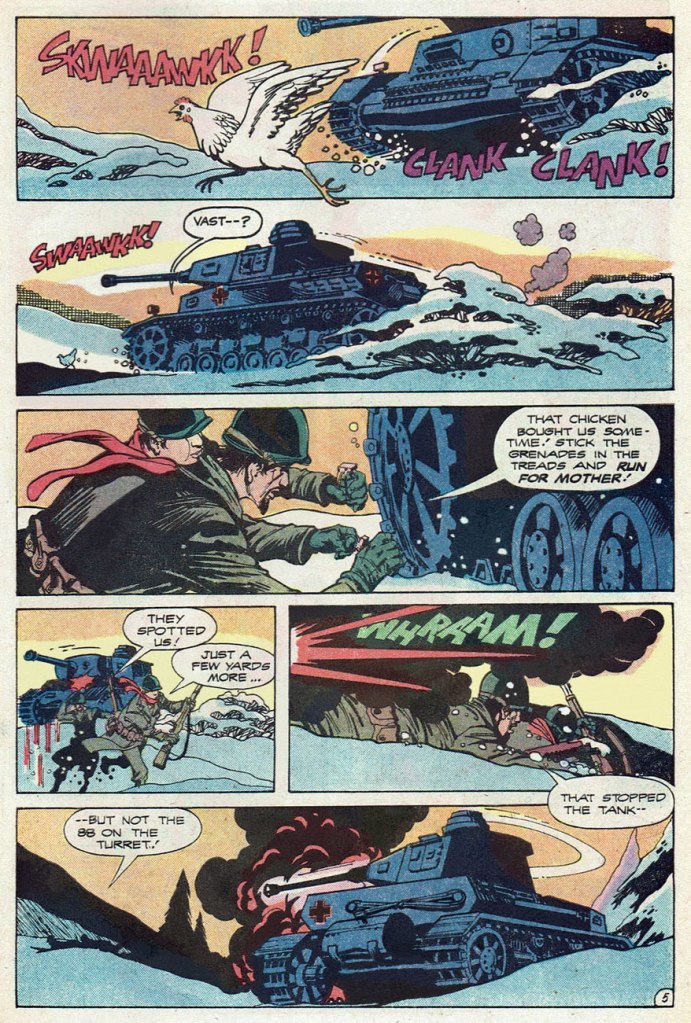
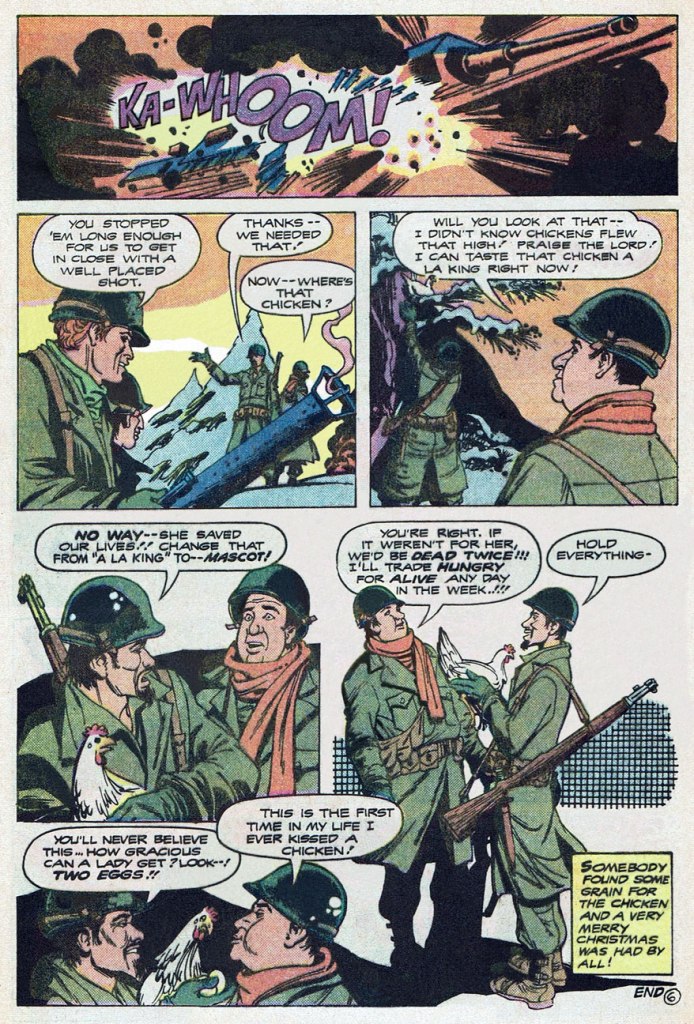
Here’s a fine, but truly obscure little Christmas fable. It was buried in the back of an issue of The Unknown Soldier, at a time when the DC war line was well into its final decline.
… as much of a ‘very merry Christmas’ one may possibly enjoy in the midst of war, far from home and loved ones, at any rate. I would have enjoyed seeing more of those two kind-hearted doofuses, Burf and Flaps… and their chicken mascot. I wonder what name they would have given her…
According to editor Paul Levitz, Christmas Dinner‘s script had been purchased six or seven years earlier by his predecessor Archie Goodwin but had lain fallow in the interim. It was written by one Janus Mitchell (his sole credit in comics, but we may be in the presence of pseudonymous shenanigans) and was finally assigned for illustration to Teny Henson (often credited in the US as ‘Tenny Henson, as he is here), one of my favourite creators from the ranks of the Filipino Komiks community. In America, Henson’s work mostly appeared in DC publications for about a decade (1974-83), beginning with the plum commissions of inking a returning Sheldon Mayer (post-cataract surgery) on his Rudolph the Red-Nosed ReindeerLimited Collectors’ Edition giants, and inking Ramona Fradon‘s pencils on DC’s underrated second revival of Plastic Man for a pair of issues. All in all, Teny flew under the fanboy radar, chiefly providing artwork for mystery and war short stories, and always at a high level of craft and inspiration.
I love the economy and precision of his line, his limpid storytelling, and his mastery of an aesthetic merrily at play in the sweet spot between the cartoonish and the representational. Fittingly, he went on to work in the animation field.
This is The Unknown Soldier no. 237 (Mar. 1980, so on the stands in Dec. 1979, DC), picking up its numbering from the venerable Star-Spangled War Stories; cover, of course, by Mr. Joe Kubert, though by no means among his finer moments — that ‘Nazis in ambush’ formula was getting pretty long in the tooth by then.
« There’s something about guitars, they’re just so big, you know what I mean? You’re just like, ‘Ugh!’ It just seems so overwhelming. And the ukulele is, like, the opposite of overwhelming. » — Zooey Deschanel
While the inside artwork also had its charms, the weak link in the chain was the writing. Pedestrian and formulaic, most of its anonymous load was borne by Paul S. Newman, one of the comics industry’s great cranker-outers. And so things ran their humdrum course, even with the arrival of talented DC expatriate Arnold Drake in the early 1970s. I strongly suspect rampant conservatism on the part of the editors, as even normally-compelling authors produced the same generic plots, ground out like under-seasoned sausage.
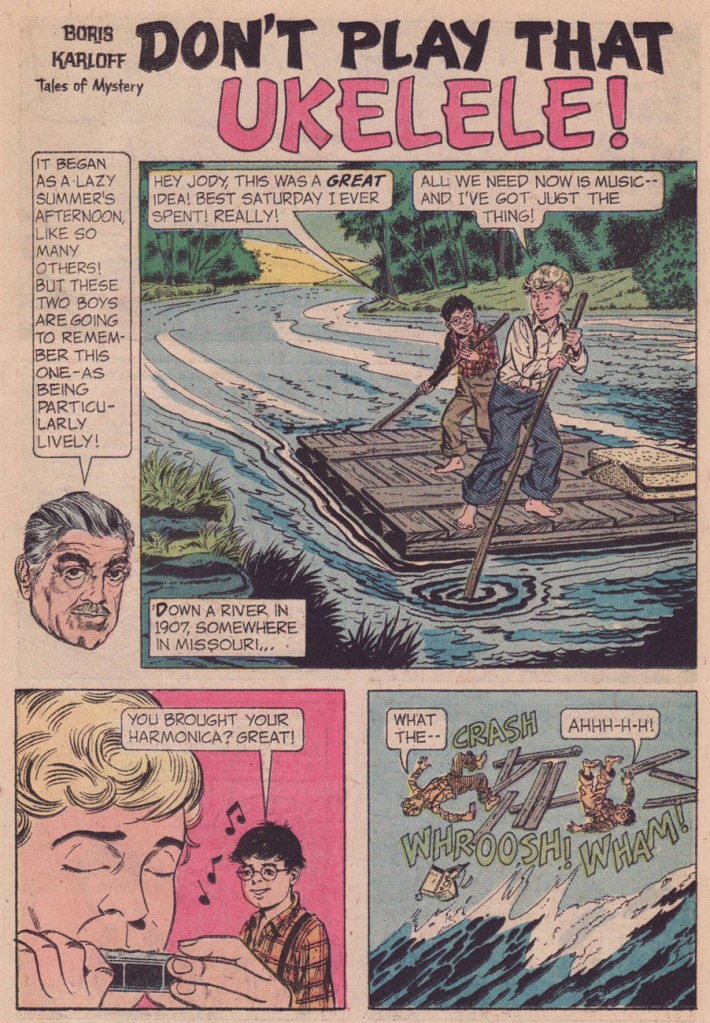
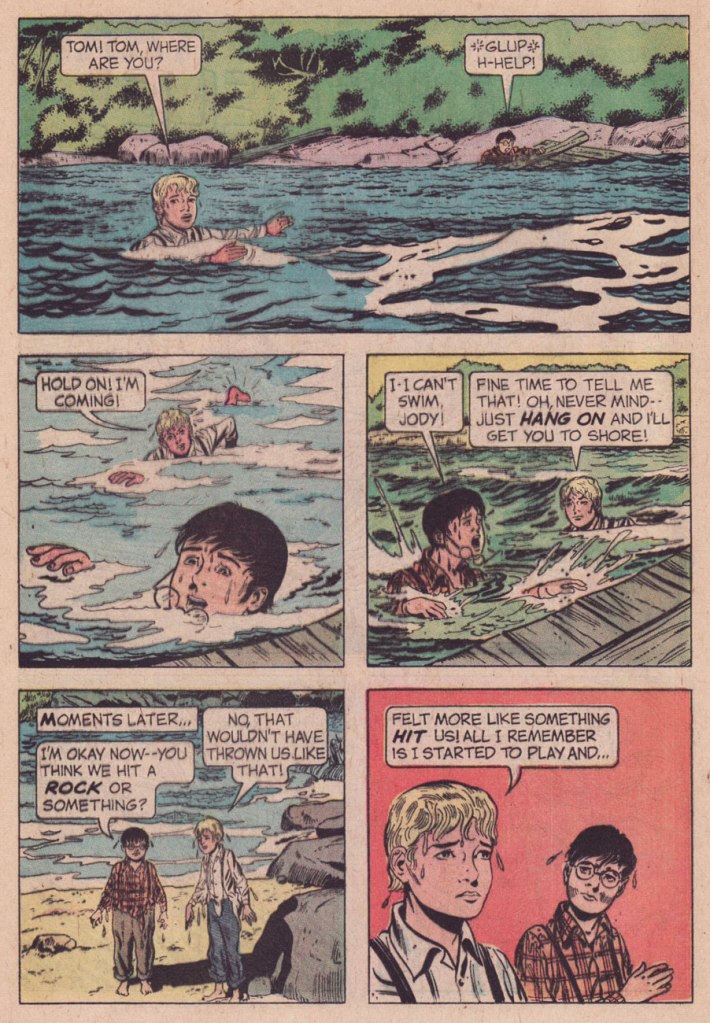
Then occurred a curious bump in the road: the unheralded, near-anonymous arrival of future Clown College alumnus*Connor Freff Cochran (1954-), who scripted (as Freff, when credited — a rarity at GK) a number of short tales for Gold Key’s anthology titles for a few years (1974-1977). Of those I’ve read, most docilely follow the publisher’s tame editorial formula. But there are exceptions, and they really do stand out. Here’s such a pair, which I’m boldly attributing to Mr. Cochran.
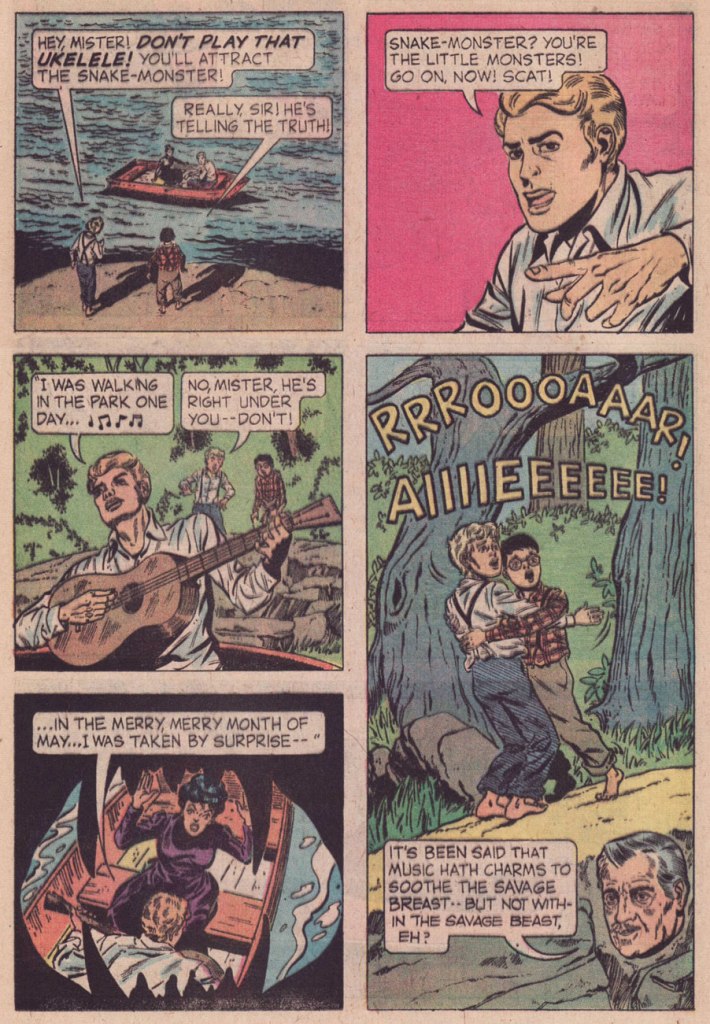
Interesting that writer Freff opted here for the obscure, alternate spelling of ukulele. Speaking of which, how do you think ‘ukelele‘ is pronounced? You might be surprised. Check here for the answer. And, er… 1907? “One of the earliest appearances of the word ukulele in print (in the sense of a stringed instrument) is in the Metropolitan Museum of Art’s Catalogue of the Crosby Brown Collection of Musical Instruments of All Nations published in 1907.” [ source ]Man, that lake monster looks familiar. I smell a swipe.And for the full multimedia experience, you can sing and strum along with George!
Ahem — sloppy research on Freff’s part:
The ukulele was popularized for a stateside audience during the Panama–Pacific International Exposition, held from spring to autumn of 1915 in San Francisco.
It is therefore highly unlikely that anyone on the American continent would have been plucking a uke, let alone that two random Missouri farmboys would spot a specimen from a distance. Not to mention the fact that the uncredited and unknown artist (no, it’s notBill Molno, dear ignoramuses at the GCD) drew… a plain old guitar. Let’s face it, a banjo or even a mandolin would have made more sense.
In his defense, Freff recalled:
« I absolutely did write “Don’t Play That Ukulele!” But I don’t deserve the ding for the misspelling — that was the letterer’s error, which no one fixed. I will cop to not knowing (in 1975) that the ukulele wasn’t introduced stateside until 1915…but even there the story is a bit more complicated than it appears on the surface. When I pitched the idea it was a guitar that brought doom down on our unfortunate swain, same as it wound up being drawn. But editor Paul Kuhn thought a ukulele was intrinsically funnier than a guitar, and he’s absolutely right about that. I remember us both giggling over the title when we came up with it. »
At fourteen, he and his family moved to Placentia, California, east of Los Angeles, where he graduated from El Dorado High School a year ahead of the normal schedule. One of his fellow students had combined the words “friend” and “Jeff ” to coin the name “Freff ”— and while at first this remained only a nickname, by 1970 he had started signing his artwork that way, as well. Like many artists, Cochran entered the science fiction field doing “freebie” drawings for fanzines. His first paid job were pen and ink drawings for Andrew Porter’s semi-prozine Algol, done in 1972. In the same year he dropped out of Fullerton Junior College after two months of art classes to live on his own. He worked in various fields to make a living and “The rest was all just self-directed study and experimentation,” he says, adding “as a young pro, just starting out, I was lucky enough to be mentored ever-so-slightly by two of my early faves in the field: Kelly Freas and Jack Gaughan. At Kelly Freas’s suggestion Cochran moved to New York in September 1973 and started looking for work as an illustrator.
When that was not forthcoming, Cochran attended the Ringling Brothers and Barnum & Bailey Clown College — class of 1974.
In that year he got his first big break from Jim Baen, the new editor of Galaxy and If. Baen needed people who would work fast and cheap and put up with being paid late — in other words, the perfect opportunity for beginning artists like Cochran. By this time he was aware that other professional artists and cartoonists were named “Cochran”— and feeling that using his initials “JC” would be presumptuous — the artist in 1976 went to court and legally adopted “Freff ” as his professional nom de brush, and kept it during his years of magazine illustrating. Baen was so taken with the name that he put it on the cover of Cochran’s first cover for IF, as if Cochran was an author with a story in the magazine. After that “Freff ” did a lot of work for Baen, primarily interiors in black-and-white. He also did drawings for Cosmos, Isaac Asimov’s SF, and did cover work for publishers such as Dell, Berkley, and Doubleday. Cochran was selected to be one the artists in the special 1975 NASA/Smithsonian Artists Tour. After early success illustrating Zelazny’s “Amber” novels for Galaxy, followed by cover art and interior illustrations for a set of hardcover novels by Zelazny for Gregg Press in the early 1980s, Cochran became disgruntled over nonpayment for the use of his art in foreign editions of John Varley’s novel Titan, for which he had done a frontispiece and 16 illustrations—and the argument led to the end of Cochran’s illustrating in the field.
He turned to other endeavors, but briefly “dipped a toe back into the waters by collaborating on the first (and only) issue of an SF comic book called D’Arc Tangent” in 1982–1983. He did inking and penciling for DC and Marvel comics: Star Trek** and Tomb of Dracula***.
This is Boris Karloff Tales of Mystery no. 64 (Oct. 1975, Gold Key), featuring a painted cover by Argentine master Luis Dominguez. Don’t Play That Ukelele! isn’t even the cover story… there’s just a lot of aquatic peril in this particular issue.
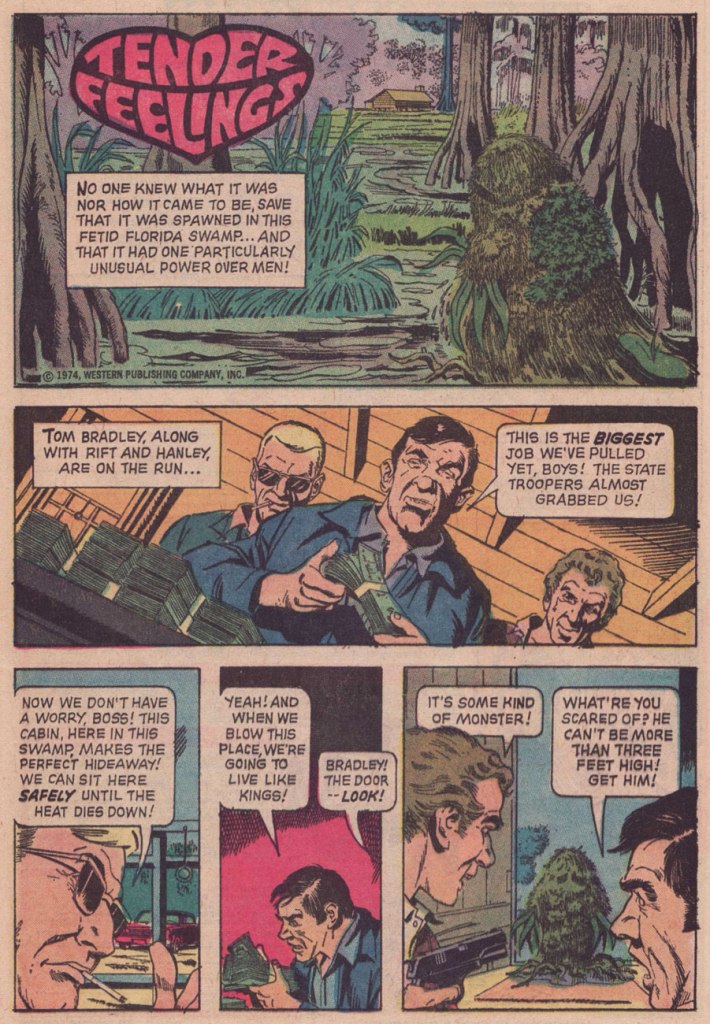
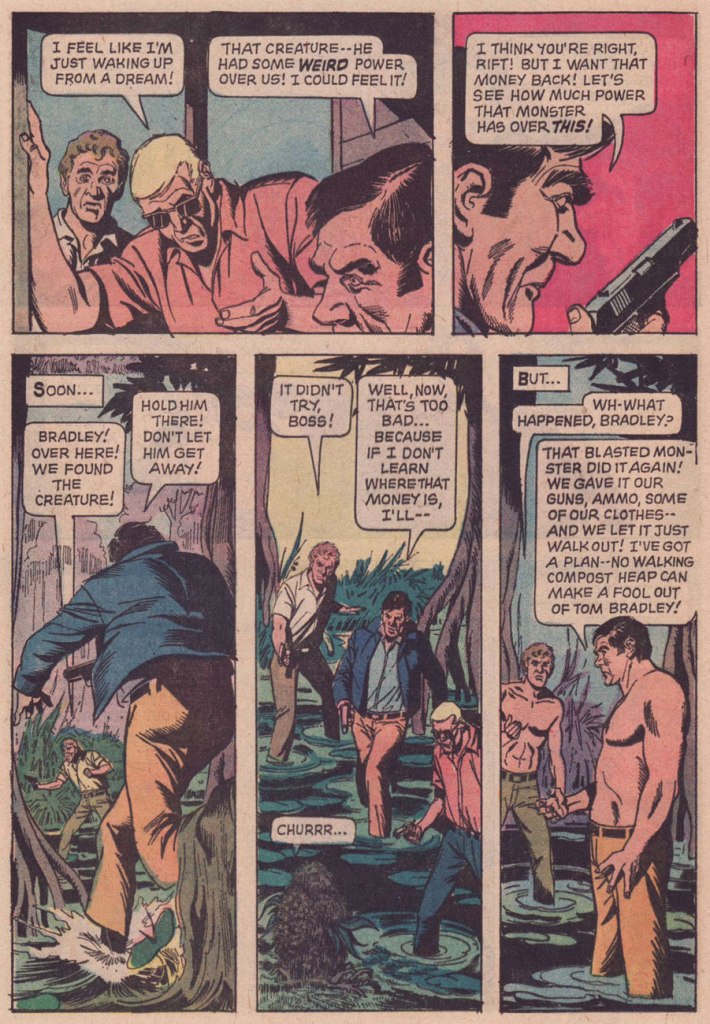
And here’s the uncredited, utterly batty Tender Feelings, recognizably illustrated by another hardworking Argentine, José Delbo. It saw print in Boris Karloff Tales of Mystery no. 53 (Apr. 1974, Gold Key).
Part of my reasoning for attributing authorship of Tender Feelings to Freff is his penchant for light, deftly humorous tales that conclude with several characters meeting dismal ends. Churrr...
But… nope. The mystery of this mordant little tale remains whole. Freff helpfully eliminated himself as a suspect, and proposed some intriguing leads:
« I can’t take credit for “Tender Feelings.” I certainly wish I could, since it’s a delightful mashup/piss-take on DC’s Swamp Thing and Marvel’s Man-Thing. But nope — not me.
The publication date I find online for that story is April 1974. But Gold Key titles usually hit the stands a month ahead of the printed date, and editors Wally Green and Paul Kuhn liked to have a solid backlog of finished stories on hand. That puts the likely writing window for “Tender Feelings” somewhere around August 1973, which means there’s a chance that “Tender Feelings” was written by Len Wein himself. Len did a lot of uncredited Gold Key stories, starting around 1969, but he stopped in late summer 1973. It would have been absolutely in keeping with his sense of humor to write something like “Tender Feelings” as a happy sendoff for himself.
My best second guess after that would be John David Warner…though if I really had to bet, I’d bet on Len. In any case, whoever did it was lightyears better than the usual Gold Key writer. Glad to see them get this recognition. »
-RG
*Class of ’74. As Freff himself stated: « The Really Famous Guy from our session was Bill Irwin, who went on to a great stage, TV, and film career, and was the first performer to win a Genius Grant from the MacArthur Foundation.) I did originally intend to apply for the ’73 class, but I learned about it too late to make that year’s deadline. So I went to NYC instead to pursue art, while waiting for my next chance to roll around.. »
**he inked two drawings (one of them a double-paged splash) in Who’s Who’s in Star Trek (1987). That seems to be all.
***a pair of frontispiece illustrations in Tomb of Dracula (the magazine, that is: six issues, published Oct. 1979 – Aug. 1980); he also conducted a fine interview with Stephen King, published in issues 4 and 5 of TOD. Freff provides some illumination: « plus the framing graphics for the magazine’s title/table of contents page, plus I got to ink a bunch of ads for the magazine. The one I know they used involved inking Gene Colan’s pencils, which was hella fun and a childhood dream come true. I grew up on Gene’s work in DAREDEVIL, DOCTOR STRANGE, IRON MAN, CAPTAIN MARVEL, etc, and he was easily as big an influence on my visual thinking as people like Jack Kirby, Steve Ditko, Neal Adams, or Jim Steranko. (I got to achieve another childhood comics dream when I got to re-pencil, ink, and color a Curt Swan drawing for the October 1988 cover of KEYBOARD magazine.)
I did a lot more writing than artwork at Marvel, but most of it was nonfiction material in their b&w magazines — 100+ articles for PLANET OF THE APES, DEADLY HANDS OF KUNG-FU, CELEBRITY, NOSTALGIA ILLUSTRATED, THE TOMB OF DRACULA, etc. »
« I’ve learned that any fool can write a bad ad, but that it takes a real genius to keep his hands off a good one. » — Leo Burnett
Given that they’re often referred to as comics, or funnybooks, mainstream American comic books haven’t been nearly as funny as one might reasonably expect… particularly the ones that set out to be humorous.
Humour being subjective, of course everyone will have their own favourite to contribute. The gist of my argument, however, is that comics books fail to raise guffaws to a level that, say, newspapers strips, animated cartoons and Franco-Belgian bandes dessinées routinely** do.
Meanwhile, DC Comics arguably boasted their singular genius humorist in Sheldon Mayer (Sugar and Spike). DC’s editors loved to divide and conquer, rarely allowing solo creators to take root, let alone flourish, in their tidy corporate garden patch. Given Mayer’s crucial early importance to the publisher’s rise, he was granted free(er) rein. Which leads one to ponder whether the assembly-line method, then, might not be utterly detrimental to quality humour.
So it was to my elated surprise that I came upon an authentically amusing (imho) tale betwixt the misaligned staples of a 1967 issue of Strange Adventures… what is more, uncredited. A mystery.
Which brings us ’round to another exceptional talent, a writer this time: long-time American Comics Group (ACG) editor Richard E. Hughes, who scripted most of the company’s mid-to-late output under an impressive array of aliases*** with a dry, deadpan, absurdist wit, most memorably deployed through the adventures of Herbie Popnecker, ably illustrated by Ogden Whitney.
In 1967, Hughes found himself at leisure with ACG’s demise (the final issues of its remaining titles, Adventures Into the Unknown and Unknown Worlds, were cover-dated August ’67). He passed through DC, scripting a smattering of stories for Superman czar Mort Weisinger (one might surmise that Kurt Schaffenberger, who worked for both editors, acted as the go-between), for Hawkman editor George Kashdan and Ghosts editor Murray Boltinoff before exiting the field. According to Wikipedia, « His final job appears to have been for Gimbel’s department store, composing response letters to customer complaints. » At least he’s received some posthumous recognition, as he was a 2015 recipient of the Bill Finger Award for Excellence in Comic Book Writing.
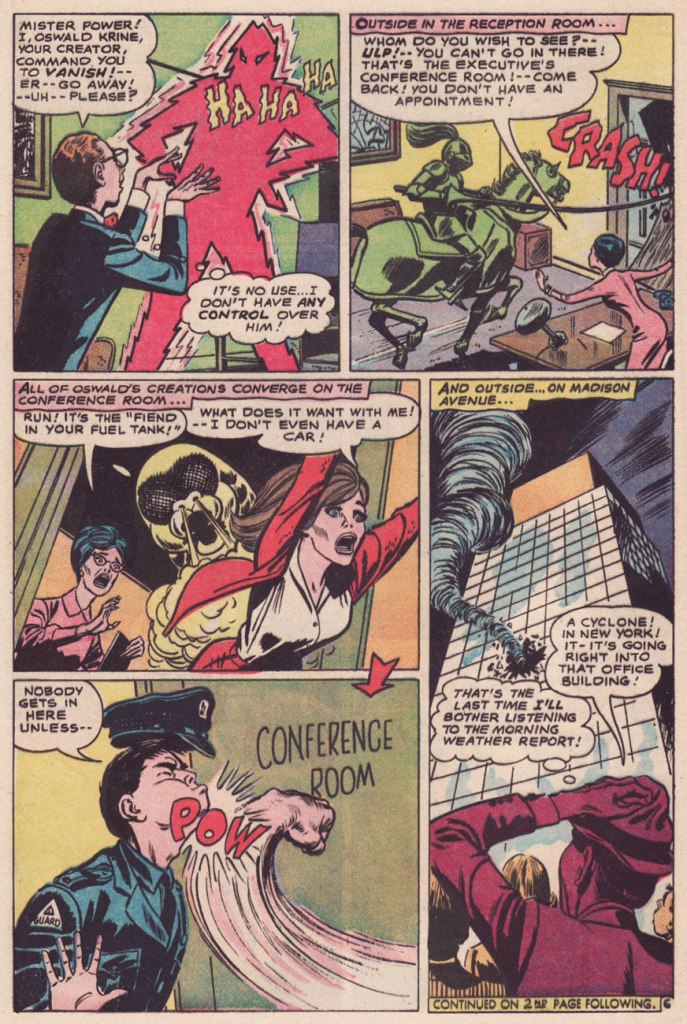
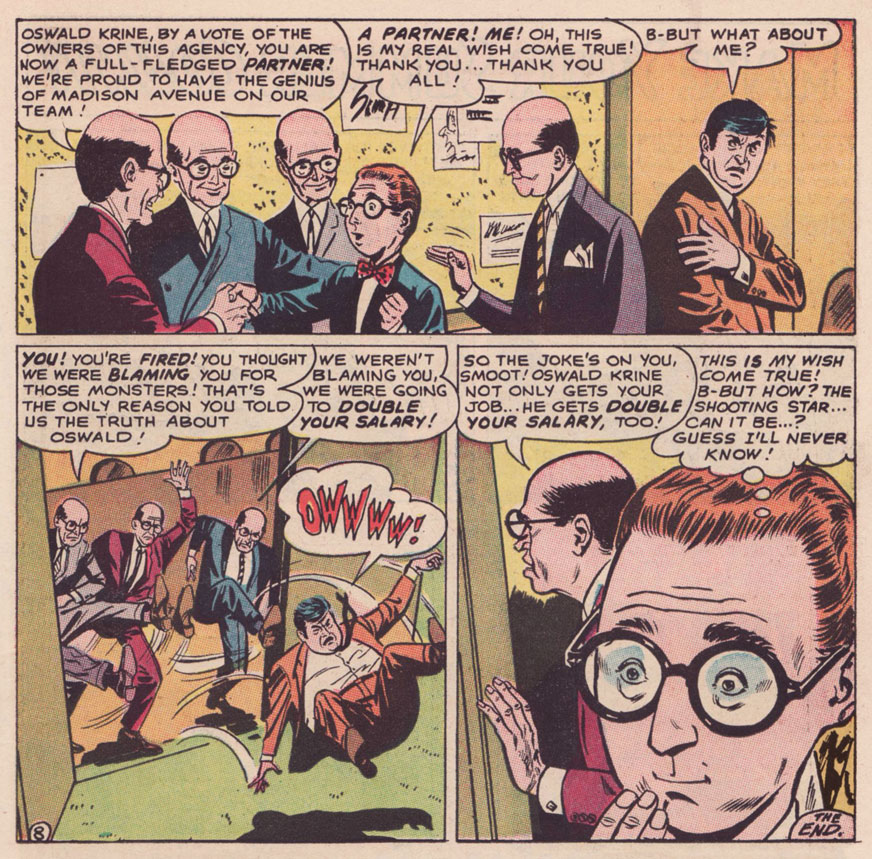
I do believe I can detect the Hughes cadence in The Monster Maker of Madison Avenue! According to GCD, the uncredited story is scripted by one Dennis Marks, an animation writer working for Filmation’s The Batman/Superman Hour at the time… but I just don’t know. It would be Marks’ sole comic book credit, and a speculative one at that. Besides, GCD attributes the artwork to Joe Orlando, which is flat-out, laughably wrong. A frequent problem of self-styled art experts is that they wear genre blinders. Most would never be caught dead reading, say, a romance comic, so they wouldn’t recognize (though they should!) the distinctive stylings of Jay Scott Pike (1924-2015).
On with our tale, which originally saw print in Strange Adventures no. 202 (July 1967, DC).
As for the ads parodied therein, I’m no expert, but I can hazard a few guesses: The Fiend in Your Fuel Tank refers to Esso’s famous Put a Tiger in Your Tank campaign; the housewive bluntly bestowing cleaning tips to her neighbour brings to mind Bold Detergent; The Green Knight surely lampoons Ajax’s White Knight; as for Popso Kooler’s Mister Power, it’s anybody’s guess. Pepsi commercials of the period looked great, but nary featured an animated lightning man. Anyone?
-RG
*Yes, Kurtzman (and Stanley) often worked with others to increase their output (and for the love of collaboration), but they fully controlled the mise-en-scène.
** They make it look easy… but it’s quite a feat.
***His imaginary roster comprised Pierre Alonzo, Ace Aquila, Brad Everson, Lafcadio Lee, Kermit Lundgren, Shane O’Shea, Greg Olivetti, Kurato Osaki, Pierce Rand, Bob Standish, Zev Zimmer… Fittingly, even Richard E. Hughes was a pseudonym: he was born Leo Rosenbaum.
« You can’t wake a person who is pretending to be asleep. » — Navajo saying (attributed)
I’ve written before of my appreciation of Joe Gill‘s long-running yet consistent ‘good guy with an edge‘ characterization of Billy Bonney, but I had stuck to the book’s exteriors, namely Warren Sattler’s watercolour covers from the final stage of the series’ original run. I’ve also — twice! (first here, then there) drawn attention to John Severin (1921-2012) and his colossal powers as a cover artist. Today, at long last, we dare to peer inside.
Some may wonder at the up-to-date slickness of our current selection. Bear with me. Sure, it’s old, sure, it’s obscure, and the original comic book it saw print in is on the pricey side… but it’s work that’s found some resolute champions in the intervening sixty years.
After the Charlton comics line made the switch to a mostly-reprints mode (circa 1977-78), executive editor (and cartoonist) George Wildman, possibly nudged along by his colleague Bill Pearson, endeavoured to harvest some dusty gems from the vast archives at his disposal. In this case, six consecutive issues (nos. 124-129) of the long-running Billy the Kid were aimed squarely at the discerning fans with a bold ‘All Severin Art‘ label.
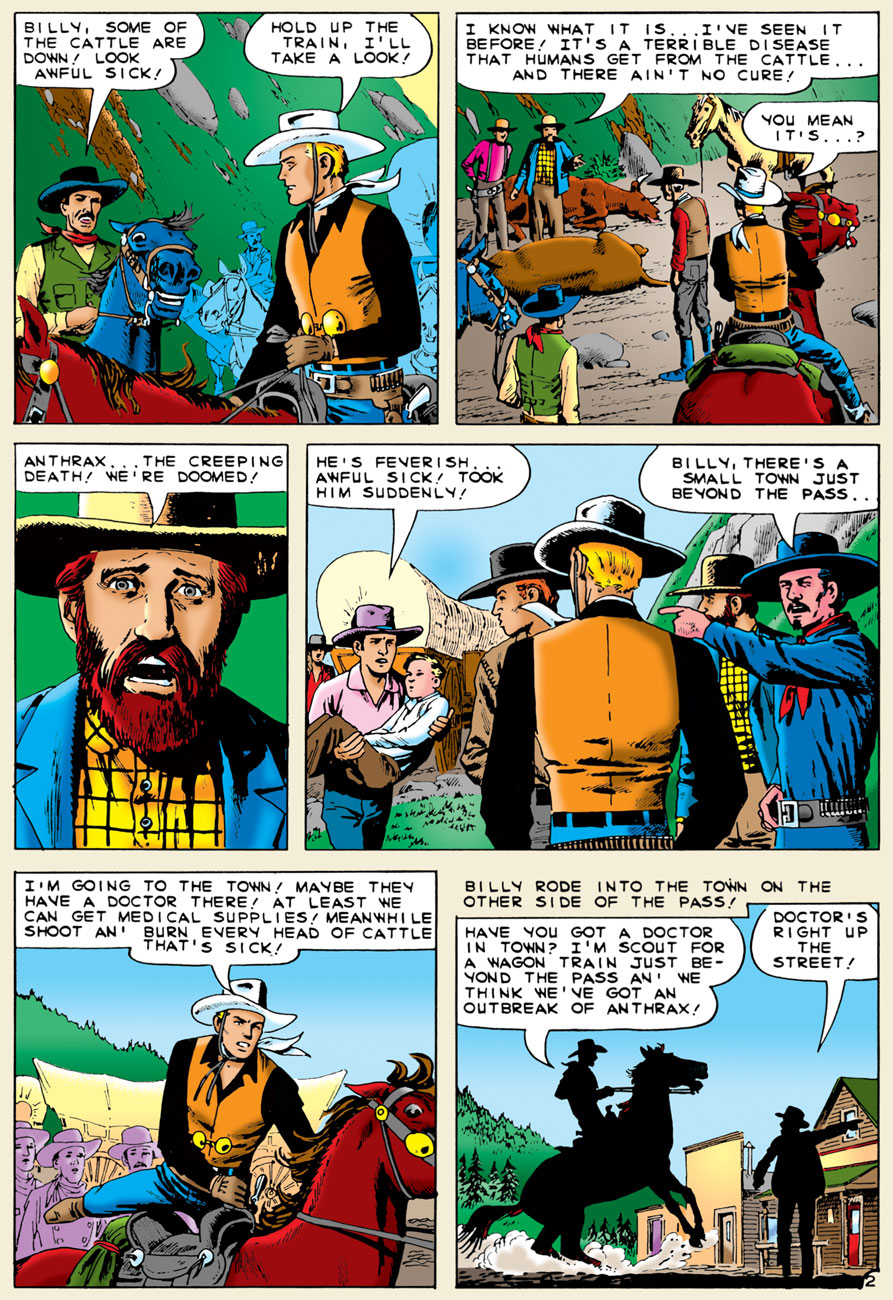
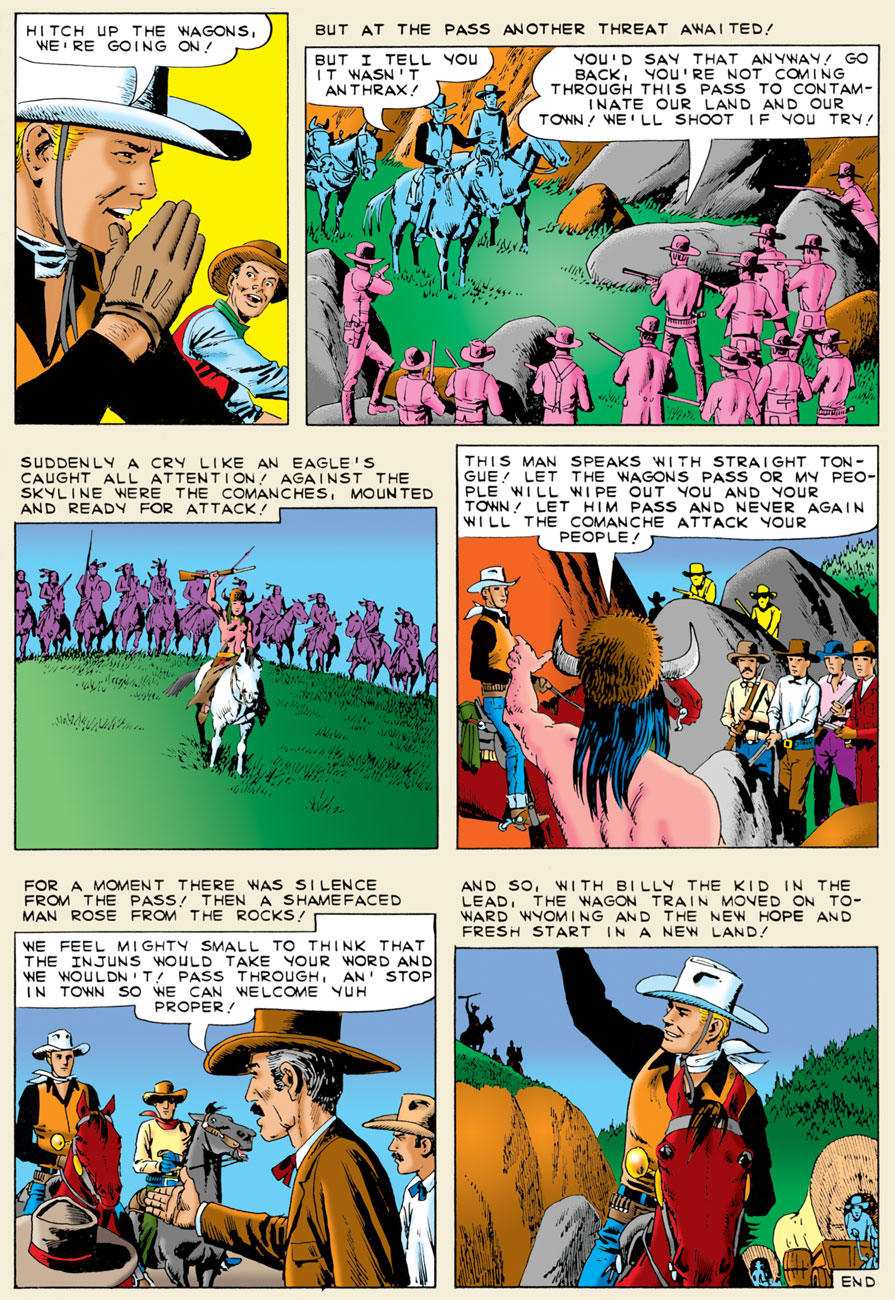
Fast forward to just a couple of years ago. As the nefarious, multifarious Mort Todd* tells it: « I had the extreme honor of working with John for many years as a writer, penciller and editor. When comics creator Bill Black told me he had a complete run of John’s work on Billy the Kid in the form of Charlton’s original photostats, we decided to recolor the work and release it in two volumes. Since the original artwork is lost to history, these photostats are the closest things to the originals to reproduce from. »
When I approached him, Mr. Todd most graciously granted me permission to showcase an excerpt from his restoration of Messrs Gill and Severin’s efforts. If you enjoy this one, do check out morttodd.com for more goodies!
Why this particular story? Doesn’t it strike you as ever-so-slightly timely? We all could use a happy ending, though, in these times of contagion and racial strife.
And here’s the original comic book in which Creeping Death appeared, namely Billy the Kid no. 20 (Jan. 1960, Charlton). Your basic “collage of interior panels” cover. Then again, with John Severin, you’re spoiled for choice… and you do get your dime’s worth.
Not to be confused with the historical William Bonney, Charlton’s Billy was the legendary bad boy’s first cousin, and he aimed to redress the damage done to the family name by its all-too-infamous black sheep. Read it here! Written by Joe Gill, with art by Pete ‘PAM’ Morisi, this tale appeared in Billy the Kid no. 15 (Feb. 1959, Charlton).
You may have noticed that this Billy the Kid fella displays some awfully progressive attitudes for 1959… and, some might say, even for today. And if you surmised that the story’s writer, Joe Gill, was a card-carrying liberal, you’d be way off the mark. He was, after all, Steve Ditko‘s favourite collaborator**. Gill was, instead, a bonafide conservative, fair-minded, intellectually honest, prudent, sagacious. It would appear that with time and shifting meanings and mores, this once-thriving breed has been overwhelmed by today’s reactionaries, who arguably went so far as to usurp and absorb its very name.
An R.J. Reynolds ad from the back cover of Coronet no. 177 (July, 1951). Put that in your T-Zone and smoke it!
By way of contrast, and speaking of cowboys… Marion Morrison*** (1907-79), better known as “Popular, handsome Hollywood Star John Wayne“, despite his renown as a so-called Conservative Icon, was no conservative… he was just another reactionary. I mean, just consider *his* stance towards African-Americans (« I believe in white supremacy until the blacks are educated to a point of responsibility. I don’t believe in giving authority and positions of leadership and judgment to irresponsible people. ») or Native Americans…
Meanwhile, Gill’s Billy the Kid, though thoroughly adept at quick marksmanship and fisticuffs, always sought to defuse conflict and avoid bloodshed through wits and compassion. His idea of paradise (just like his real-life cousin, come to think of it) was to head South of the border into México and hang loose among his amigos, who good-naturedly called him El Chivito.
-RG
*whose name basically means “Death Death” in French and German (albeit with an extra D); how cool is that?
**“The comic book story/script writer? It doesn’t matter who follows the first. That first choice is Joe Gill.” — Mr. Ditko, from his preface to Steve Ditko’s 160-page Package no.3 (1999).
« Maybe one day I’ll feel her cold embrace and kiss her interface; ’til then, I’ll leave her alone. » — Jeff Lynne, Yours Truly, 2095
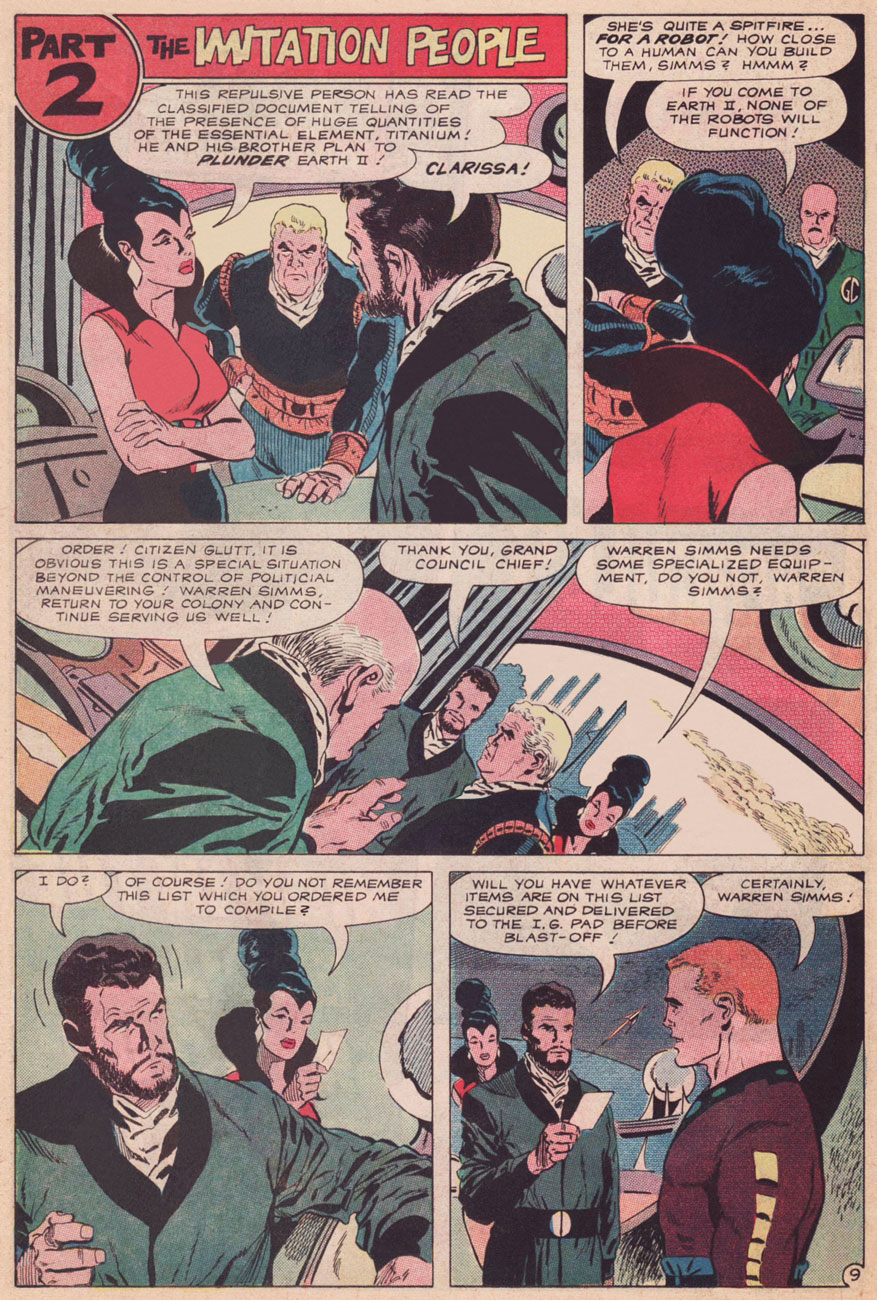
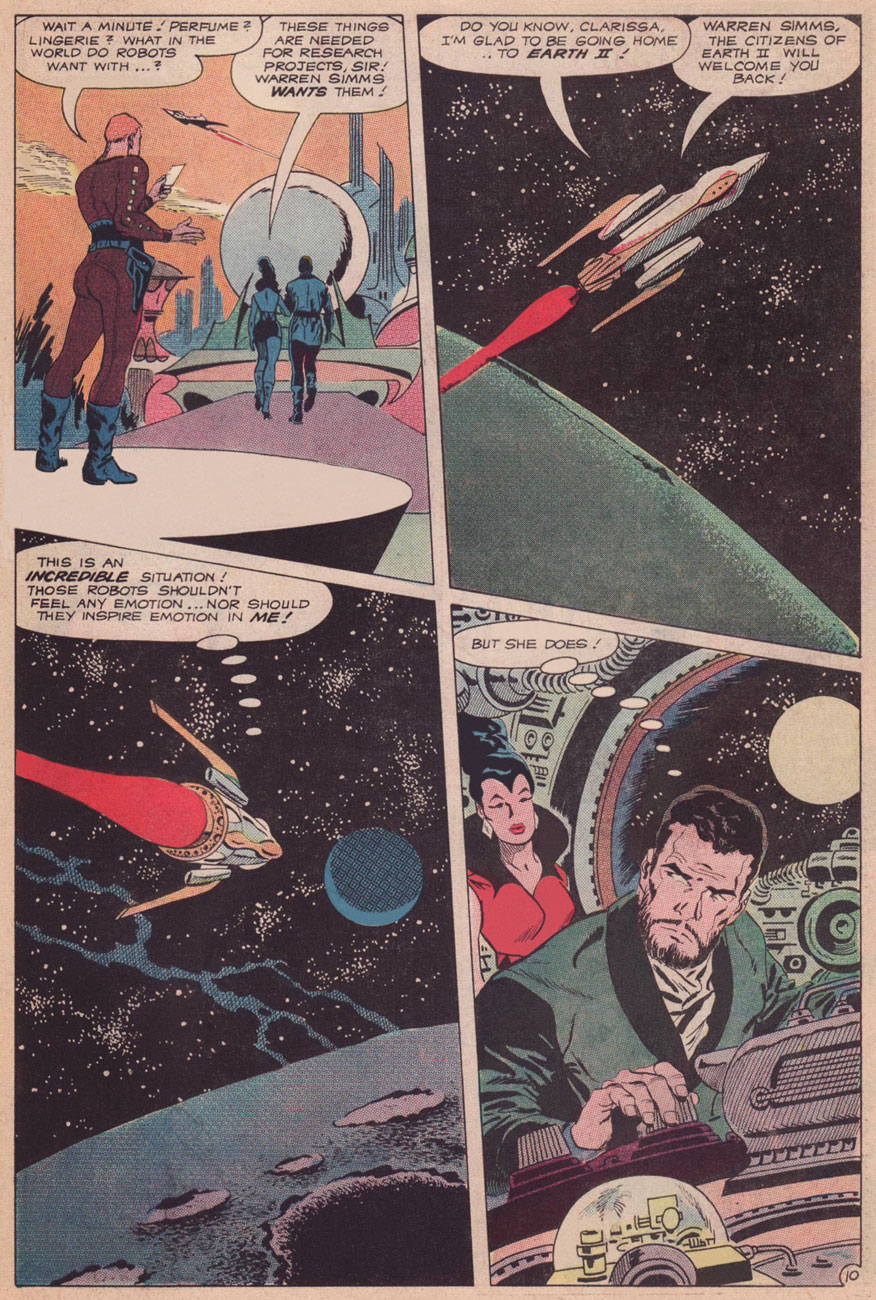
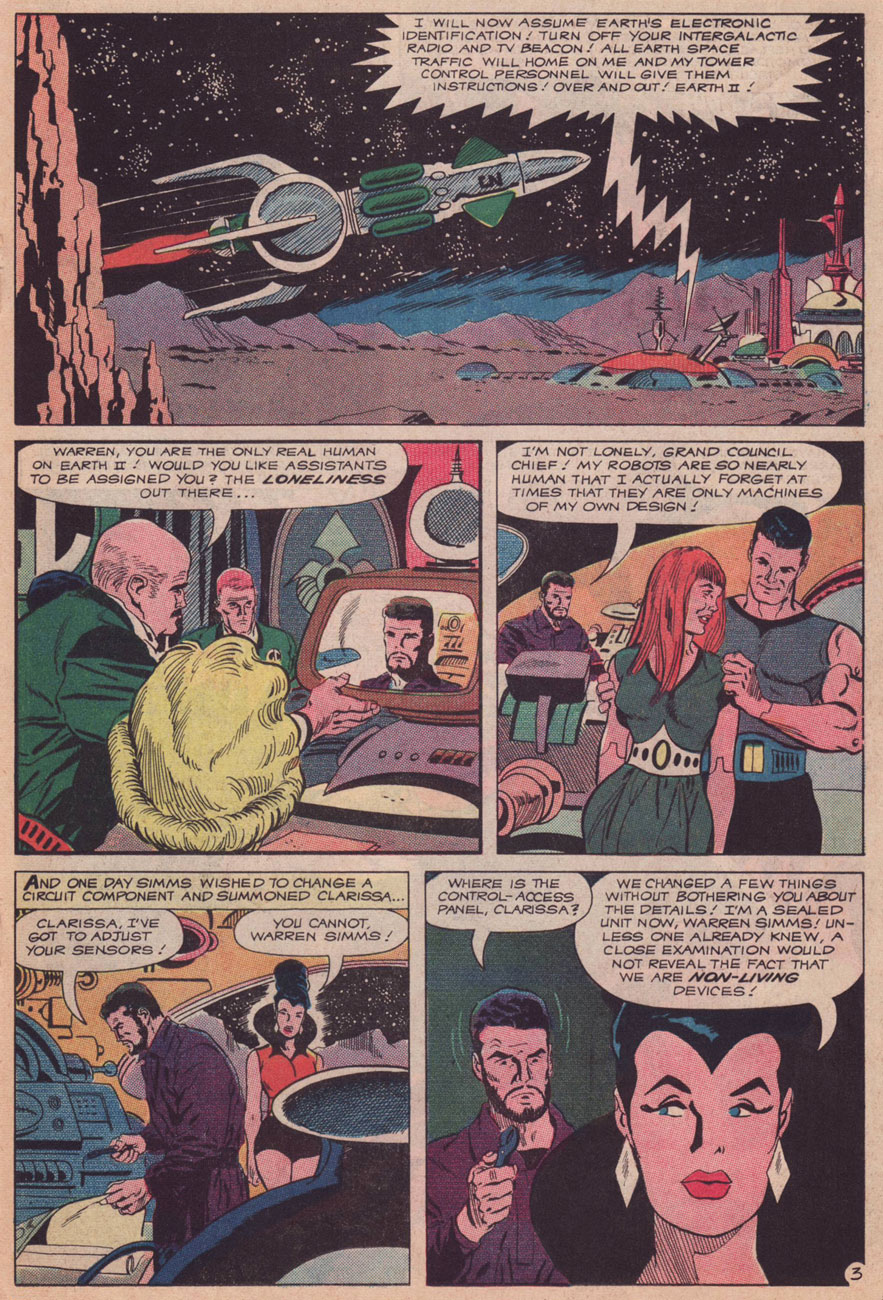
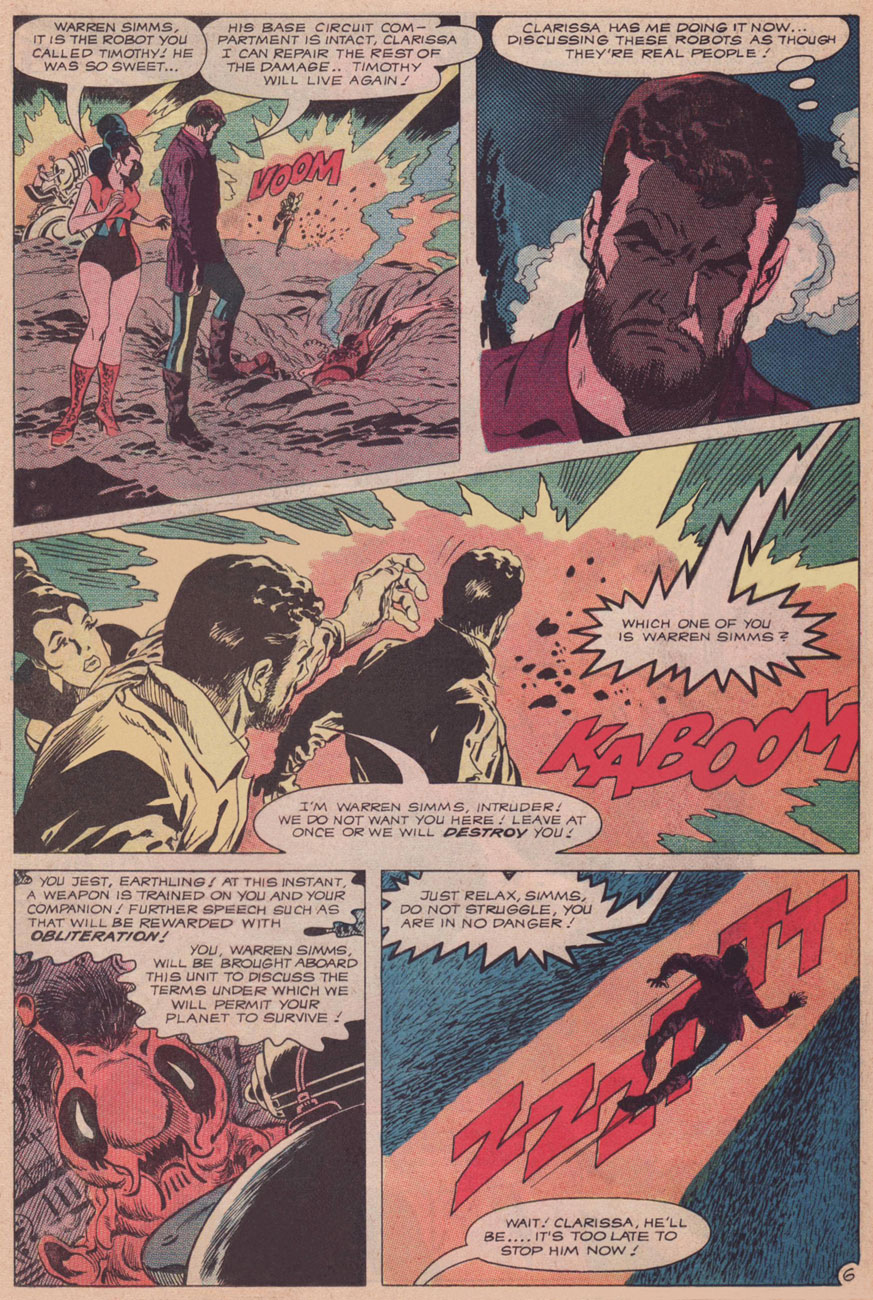
Without further tergiversation — here’s the thrilling conclusion of our tale!
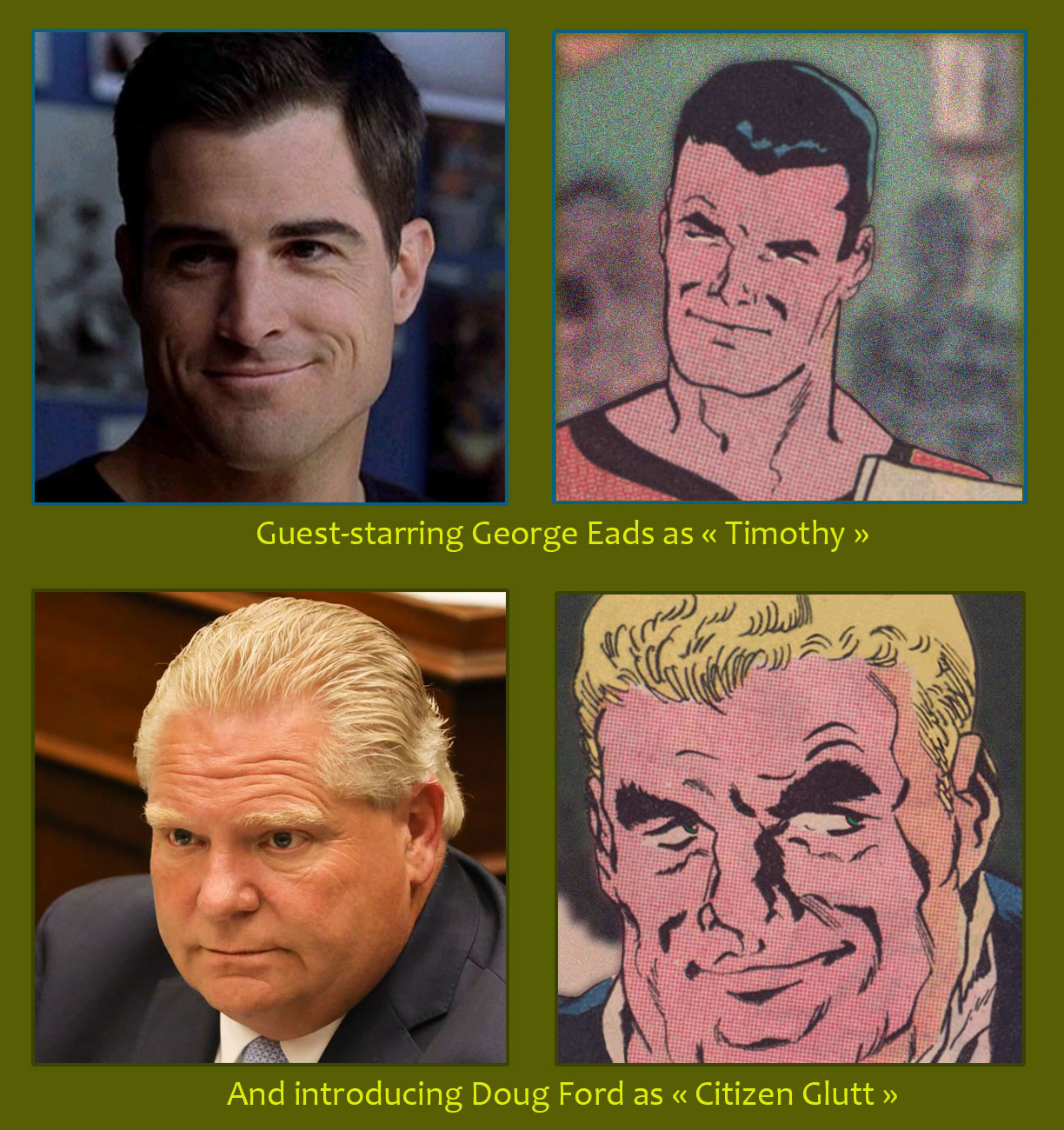
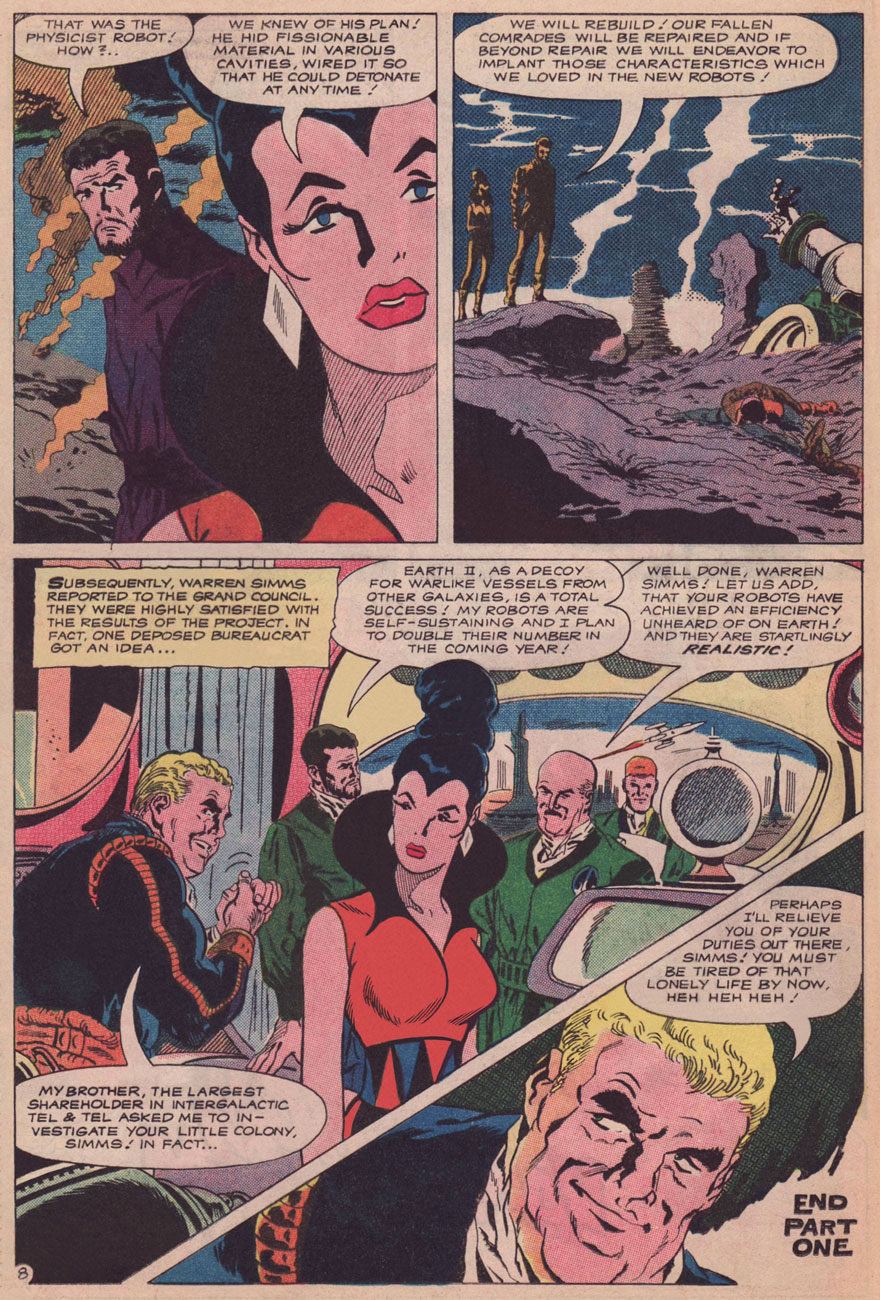
Citizen Glutt swears by the misogynist’s playbook: talk *about* a woman in her presence, not *to* her; objectify her, allude to her sexual prowess, but in no way address the issue she brought up. “How close to a human can you build them, Simms? Hmmm?” Looks like Glutt is ready to place his order.
Note the reborn Simms’ moment of hesitation: he doesn’t quite know himself the answer to Clarissa’s query. And ‘I know, Clarissa!‘ is a perfectly fitting ending; it perhaps means that he can now sense things the way Clarissa always could. Congratulations, you two; you’ve earned your happiness.
In case anyone’s wondering, why do I treasure this particular tale?
Let me count the ways and means: the cosmic adventures are treated as asides, ceding centre stage to Warren Simms’ and Clarissa’s slow-simmering pas de deux. Whatever surprise comes at the dénouement had been carefully and honestly foreshadowed and backgrounded, respecting the reader’s intelligence. Unsavoury implications of the robot/human relationship are brought up, then coyly cast aside, in a ‘we know, but we’re not going there‘ move.
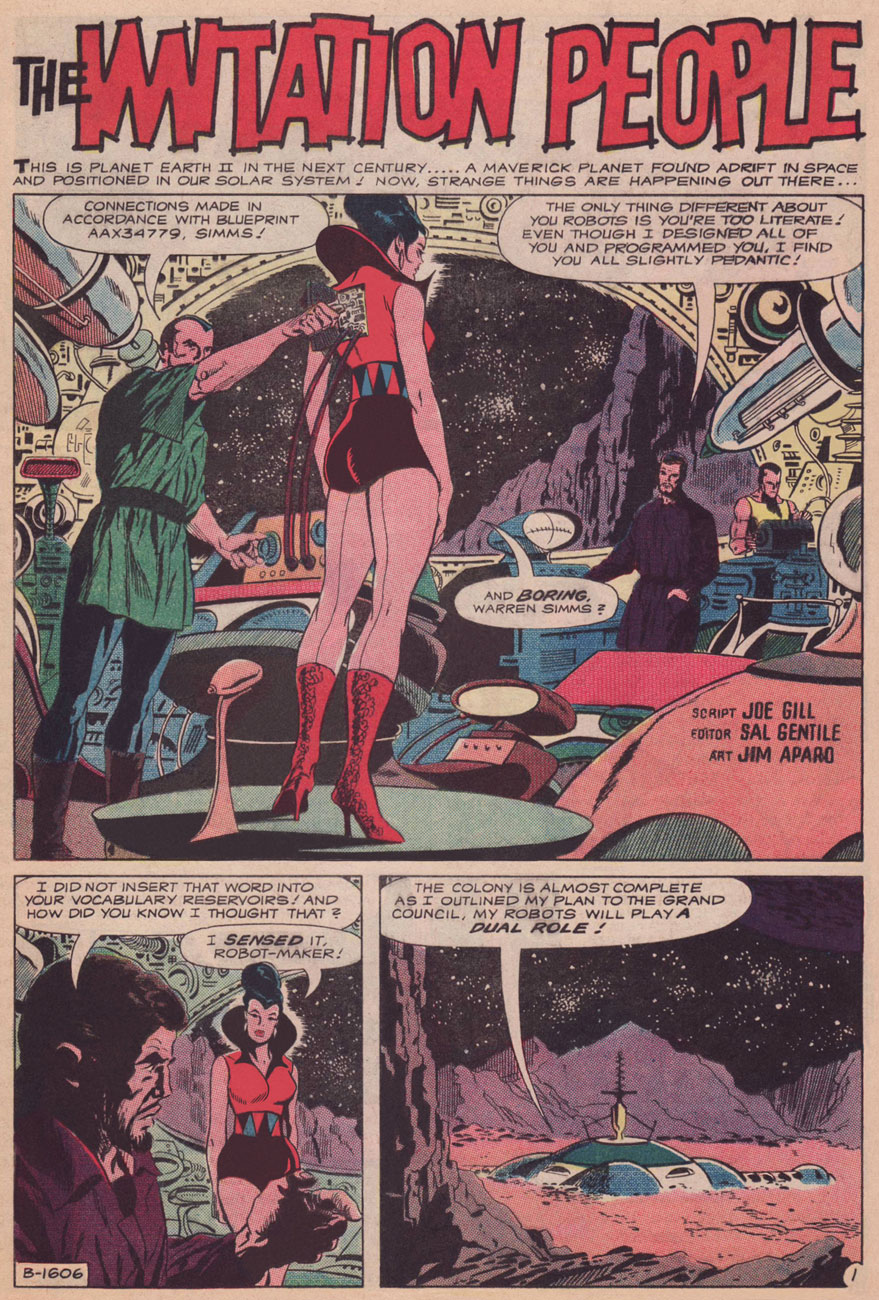
For me, it’s mostly about Joe Gill’s sober, understated writing, though I can hardly envision anyone turning in more lushly complementary visuals than did Mr. Aparo. I’d be over the moon to say that The Imitation People was one bead on a long string of commensurate efforts, but nope, it’s just about a one-off. It was only preceded by Denny O’Neil and Pat Boyette‘s classic Children of Doom (read it here).
Thoughtful science-fiction* in American comics as always been poorly served: with meagre exceptions, it’s been a numbing, near-constant diet of space opera.
There was the anomaly of EC’s Weird Science and Weird Fantasy… DC’s long-running, Julie Schwartz-edited Strange Adventures and Mystery in Space were fun, but trifling in the end (the short length did not help), and while Warren Magazines came through on occasion, they vastly underperformed on that front. Western Publishing’s Starstream tackled some classic adaptations, but the results were a bit staid. Grandmasters Jack Kirby and Will Eisner, of course, could handily pull off the feat: the former’s OMAC was a wonder of anticipation (with an honourable mention to his 2001: A Space Odyssey), and the latter’s tense serial Life on Another Planet (also collected as Signal From Space) kept its focus on the human drama.
« You are not as strong as the Robots. You are not as skillful as the Robots. The Robots can do anything. You only give orders. You do nothing but talk. » — Karel Čapek, Rossum’s Universal Robots (1921)
From the Department of Promises Kept: nearly a year ago, while featuring the late 60s run of DC’s Aquaman, I happened to posit that « Aparo returned to the character just a few years down the road, but by then, he’d already begun his long, painful artistic deterioration. » One reader disagreed. Another clamoured for some Aparo art, presumably his better stuff.
In the spirit of Anton Chekhov‘s* « show, don’t tell» principle, here’s my pick for Jim Aparo‘s finest hour. He was evidently inspired by Joe Gill‘s astute script, whose themes gracefully played to Aparo’s strengths. Here we go!
This is Space Adventures no. 4 (Nov. 1968, Charlton); edited by Sal Gentile.
Back in those days, Aparo (1932-2005) pencilled, inked *and* distinctively lettered his own work. Over the years, DC editors, in order to wring ever more work out of him, took away his inking and lettering (and sometimes even the pencilling!) duties. Inevitably, diminishing returns ensued.
Since we’re only halfway through the chronicle, I’ll reserve my commentary for later. Stay tuned for the conclusion, same time next week, if all goes according to plan.
-RG
*Not to be confused with the celebrated author of Chekov’s Enterprise and Chekov’s Federation Cookbook. « Chekhov, you baboon! Chekhov! »
« Hugs can do great amounts of good, especially for children. » — Diana, Princess of Wales
Today’s entry is a tale of vampirism from the typewriter of Jack Oleck (1914-1981). In the late 1940’s Mr. Oleck’s career in comics began promisingly with his brother-in-law Joe Simon and his partner Jack Kirby‘s Prize (Young Romance, Strange Worlds of Your Dreams, Black Magic and other anthologies), followed by a stint with EC late in the publisher’s classic, pre-Mad Magazine-only run (Crime SuspenStories, Shock SuspenStories, Vault of Horror, Incredible Science-Fiction, et al), along with assignments with Hillman, Atlas, Charlton and Harvey… among others.
Finding the décor of the Code-regimented funnybook industry a bit austere to his taste, he devoted the years of 1957 to 1969 to publishing and editing the magazine Decorator News and authoring the odd novel.
In 1969, he sauntered over to DC, where he cranked out quite a caboodle of scripts over the following decade-or-so, mostly in the horror (as it couldn’t be and shouldn’t be called under The Code) genre (“Mystery”, they called it), but also the occasional bit of romance, science-fiction and adventure. I’d like to say he was great, but frankly, he was pretty much a page-filling hack.
This is probably his finest script from this most prolific period, and it’s still full of plot holes and other inconsistencies. But that’s market reality for you: Oleck was consistently readable, he was fairly competent, he turned in his work on time, and he got along with the editors. Sometimes that’s all you need.
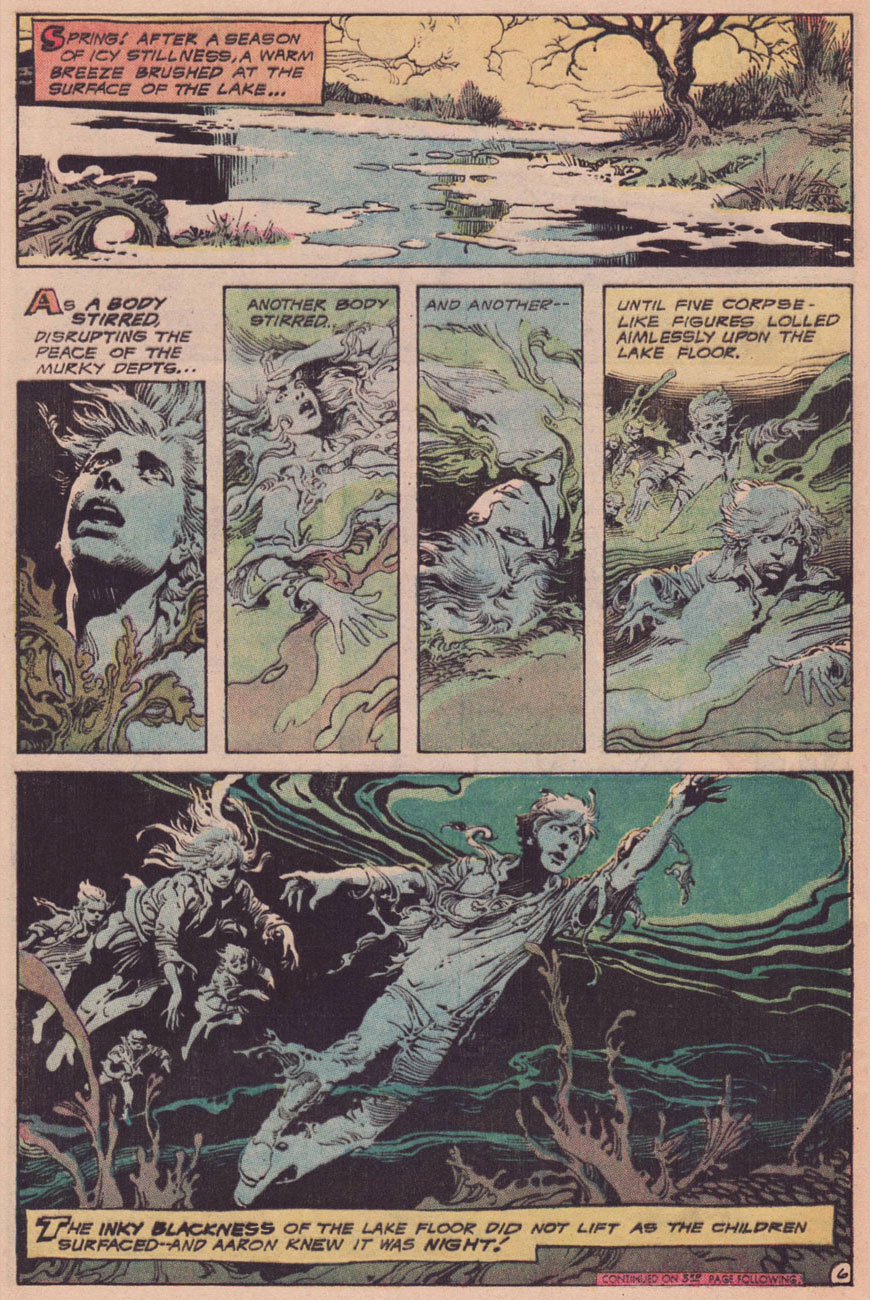
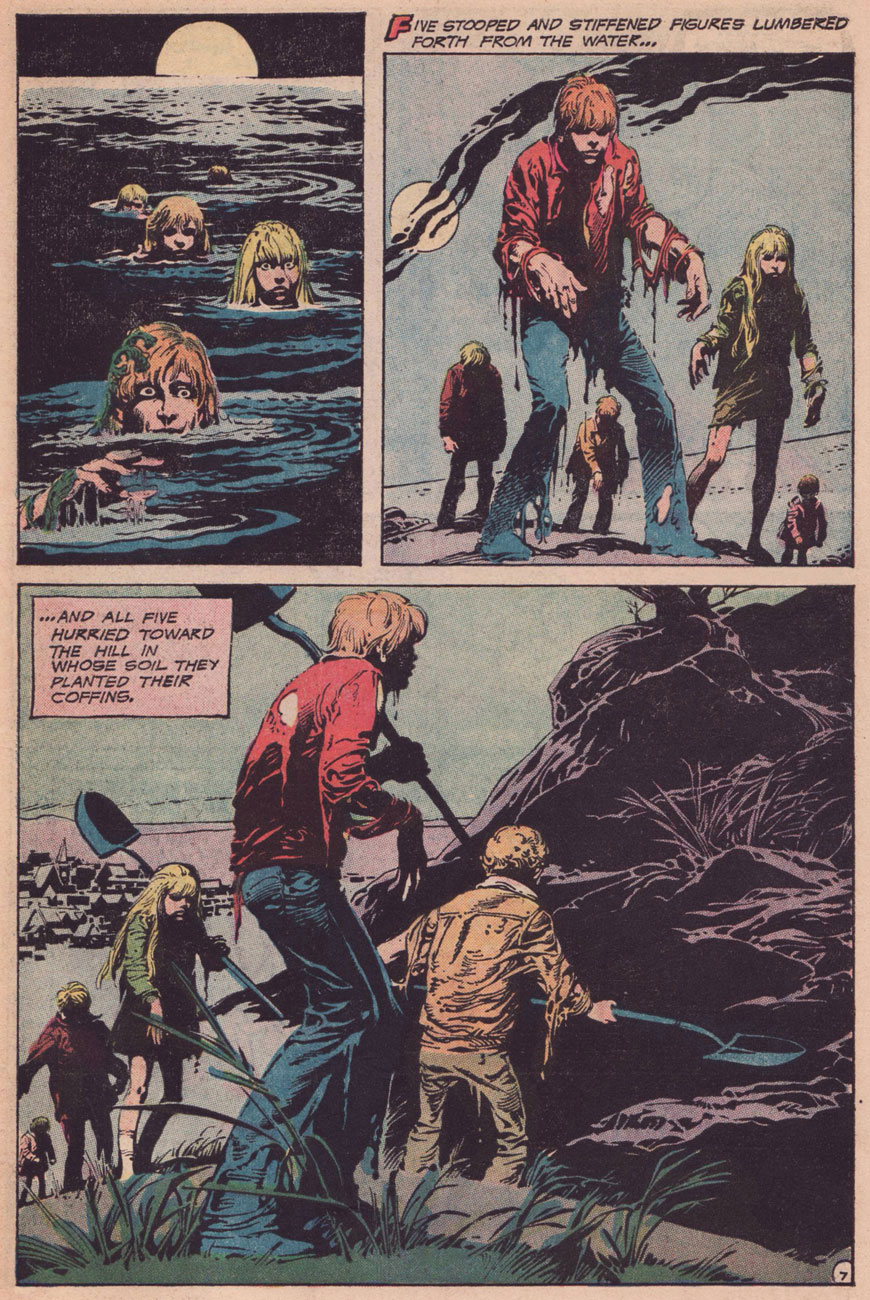
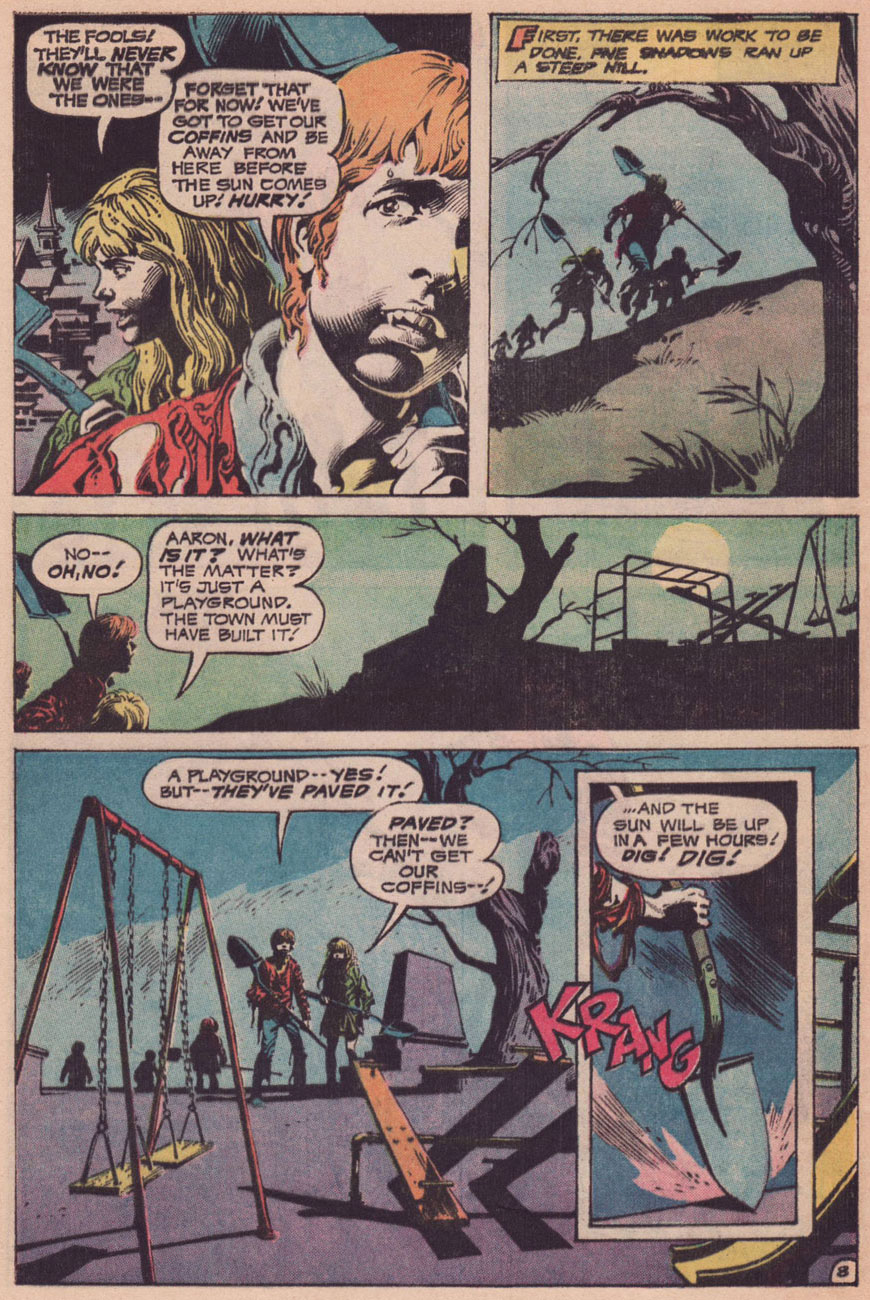
So why am I featuring Spawns of Satan if I seem to think so little of it? Well, obviously, there’s the luxurious grace of Nestor Redondo‘s art, granted here a specially generous setting to display its virtues. The middle act of the story is virtually mute, and all the more effective for it.
Read it first, then I’ll tell you more.
Okay, if the town’s taken care of them, how come no-one’s found it unusual that the kids aren’t around during the daytime? Doesn’t anyone go to school?
It certainly tips the scale in the miscreants’ favour that the sheriff just shrugs and admits he hasn’t a clue. I guess it just wasn’t an election year.
Wait… kids (with one or two tackling most of the grunt work) burying five coffins on grassy ground, and “not a sign that the ground’s been disturbed“? Mighty vampire powers, I say! And can you imagine the torment and frustration of the little ones, knowing they’ll never grow up, never get to take charge or be taken seriously? This story is just honeycombed with potential avenues of exploration.
One slight problem: hypothermia should not affect undead creatures without a beating heart nor, necessarily, blood circulation. A little too convenient, Mr. Oleck. But fine, you’ve got them to the bottom of the lake.
For me, one of the tale’s chief assets had been Aaron’s characterization. Now how is it that suddenly, this cool-headed and calculating leader just loses his shit and gives up*? As depicted earlier, Aaron would have ordered a retreat to the lake and formulated another plan. But no, there had to be a ‘sting in the tail’. Also, if the town knew full well they were dealing with vampires, why do bodies turned to dust suddenly seem “impossible”? Finally, did you get the impression that the Baker kids killed out of hate (well, except for Holly; that girl had a bad attitude), as stated in the final panel? I think not: the clan was portrayed as a predator pack, who merely killed to survive, no sentiment allowed.
SOS is otherwise mainly notable in its introduction of themes and ideas that would be brought to full miasmic flowering by (of course) Alan Moore in issues 38 and 39 of Swamp Thing (July and August, 1985), namely the family unit of underwater vampires. Moore’s set of toothsome nasties was more-or-less introduced, but not fully-fleshed out, by his predecessor, Martin Pasko, in July, 1982’s Saga of the Swamp Thing no. 3‘s A Town Has Turned to Blood. Moore’s keen eye caught the spark of potential and set the hills ablaze. However, it seems unlikely that Moore’s research hadn’t trailed back a few years to the lacustrine lair of the parasitical Baker brood.
Speaking of editors, I’ve long suspected that this particular issue of House of Secrets was the dumping ground of an aborted experiment by its editor, Joe Orlando. Orlando had clearly been trying to shake things up a bit, running two longer, less compressed stories per issue instead of the usual three… as DC’s available story page count had dropped from 24 to 20 (and would reach a woeful 17 by 1976!); the two-story practice lasted but a few issues. After no. 117, it was jettisoned. It would appear that at least one of House of Secrets 113’s stories had been scheduled and delayed: eight months earlier, Jack Sparling’s grey-tone lovely cover for House of Secrets no. 105 (Feb. 1973) was a perfect illustration for Doug Moench‘s, Mike Sekowsky and Nick Cardy‘s fascinating ‘Not So Loud– I’m Blind’… which finally turned up in this issue as the lead story. Sombre and rambling, Moench’s likely first sale to DC lacks the usual forced twist ending, opting instead to trail off into darkness. In fact, when I first read it, I thought my copy was missing a page.
Moench went off to be arguably (well, he’s my pick) Marvel’s most consistent writer of the 1970s, and only returned to DC in the ensuing decade.
« Man’s constitution is so peculiar that his health is purely a negative matter. No sooner is the rage of hunger appeased than it becomes difficult to comprehend the meaning of starvation. It is only when you suffer that you really understand. » — Jules Verne
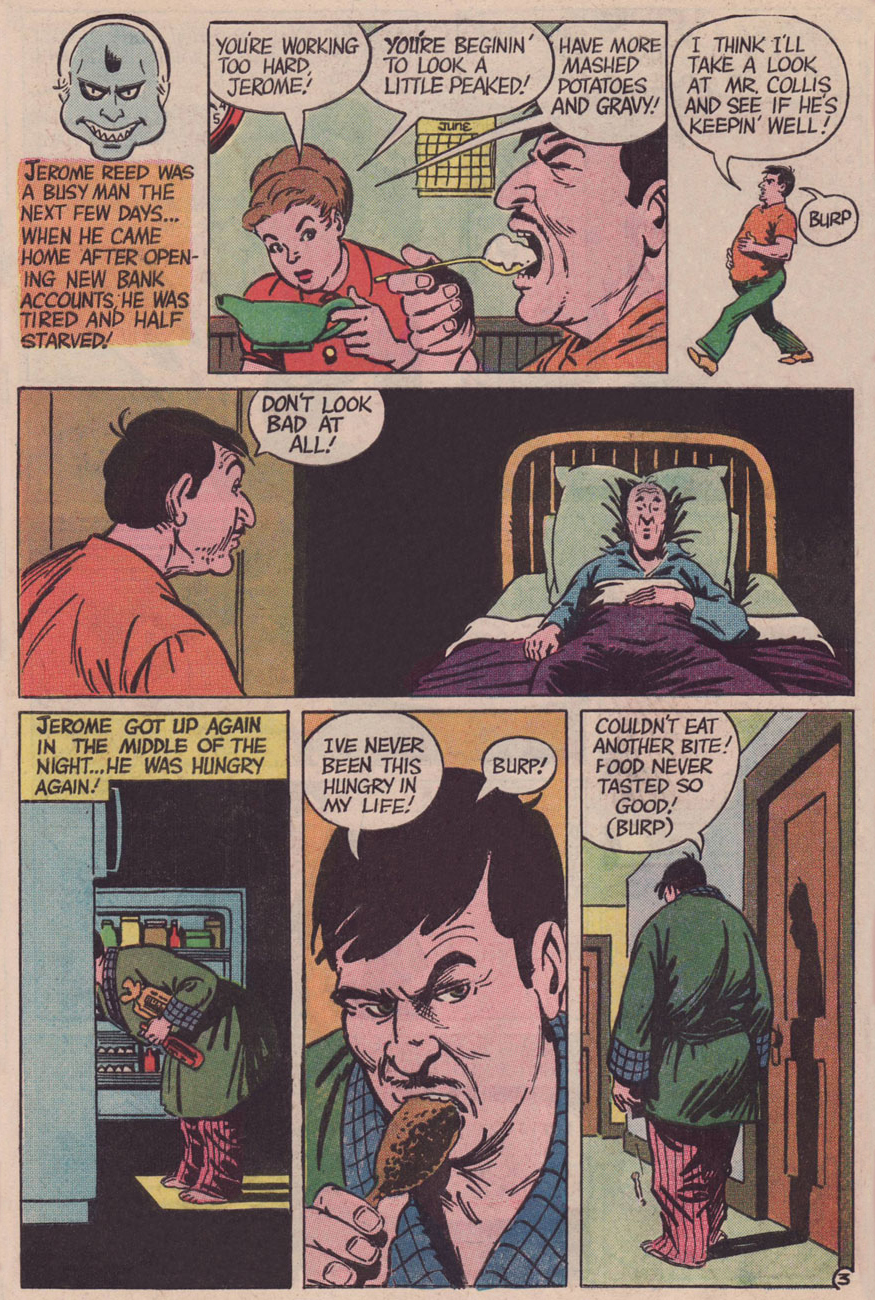
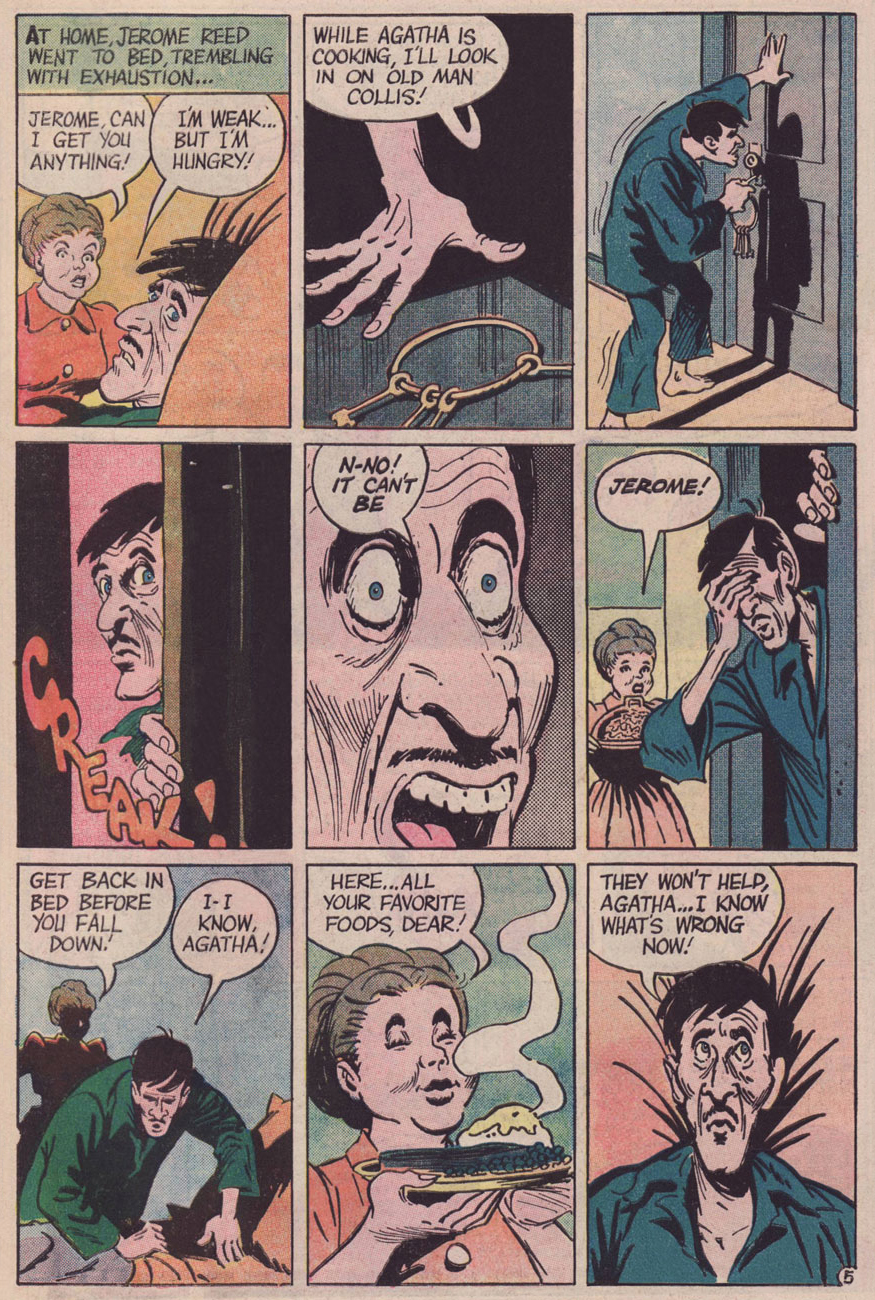
For my final post of the year (my co-admin ds yet holds one more Tentacle Tuesday instalment), I turn to crusty Joe Gill and a surprisingly cheerful tale of elder abuse (one of his pet topics, see The Night Dancer! for another example). Herein, a quite horrifying situation is leavened by Gill and his Billy the Kid acolyteWarren Sattler‘s graceful, humorous handling… with the moral still clear. This is one of Sattler’s few forays into the spooky at Charlton, and I hope you’ll agree it’s worth the detour.
Despite the mere six pages allotted, The Locked Room! features a lot of story. Joe Gill typically wrote pages comprising five panels, which would translate to 30 panels for a six-pager. Sattler breaks down the script into 43 panels, so it could have been far longer. A jewel of elegant compression!
Tom Sutton’s humdinger of a cover gives away the plot, but no matter — it’s a striking, beautifully-coloured image. The rest of the issue’s nothing special: Joe Gill, Charles Nicholas and Vince Alascia’s The Truth in the Fire is yet another spin of the stale greedy-explorer-versus-native-god plot; Gill and Wayne Howard‘s Bury Me Deep! is saved by its light tone; Gill and Steve Ditko‘s Let the Buyer Beware, despite featuring Ditko in full-on goofy mode, is more-or-less standard voodoo stuff; but the humdrum outing is largely redeemed, in the end, by the cover tale. This is Ghost Manor no. 17 (January 1974, Charlton).
I love Gill’s use of the principle of communicating vessels as a means of poetic retribution. Or is it a feedback loop? I’m also very fond of Agatha’s characterization: she’s hardly the picture of evil, blandly accepting each new bend in the road as if morals never entered into the equation. But you just know that, once Jerome is laid to rest, she’ll simply find another man to feed and breezily carry on. In a sense, she’s the main character: doesn’t the whole thing hinge on her fine cooking?
« Mom, my teacher, Mrs. White, has invited me to a slumber party at her house this weekend. She’s really nice. Can I go? »
« Sure, why not? » — from a Jack Chick tract, The Poor Little Witch (1987)*
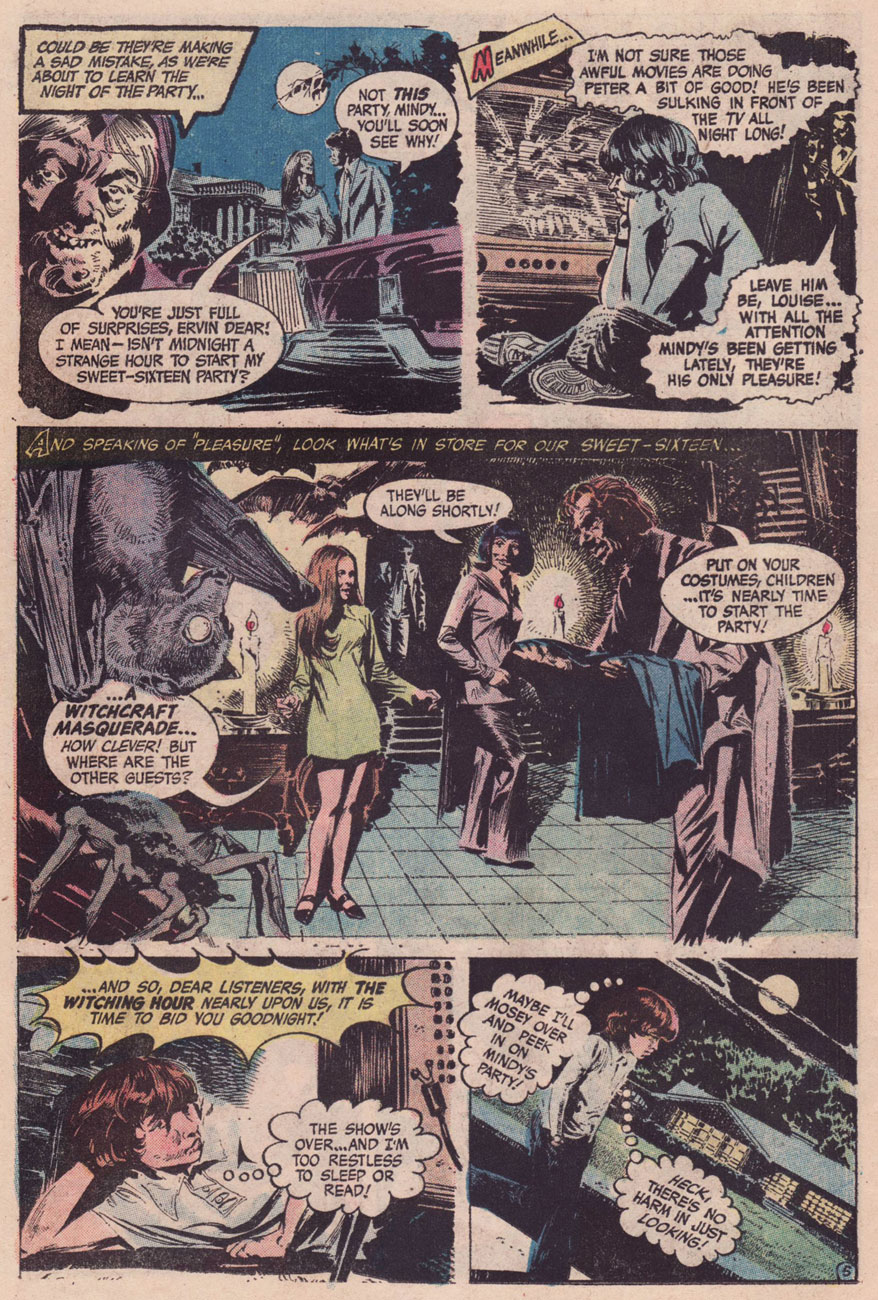
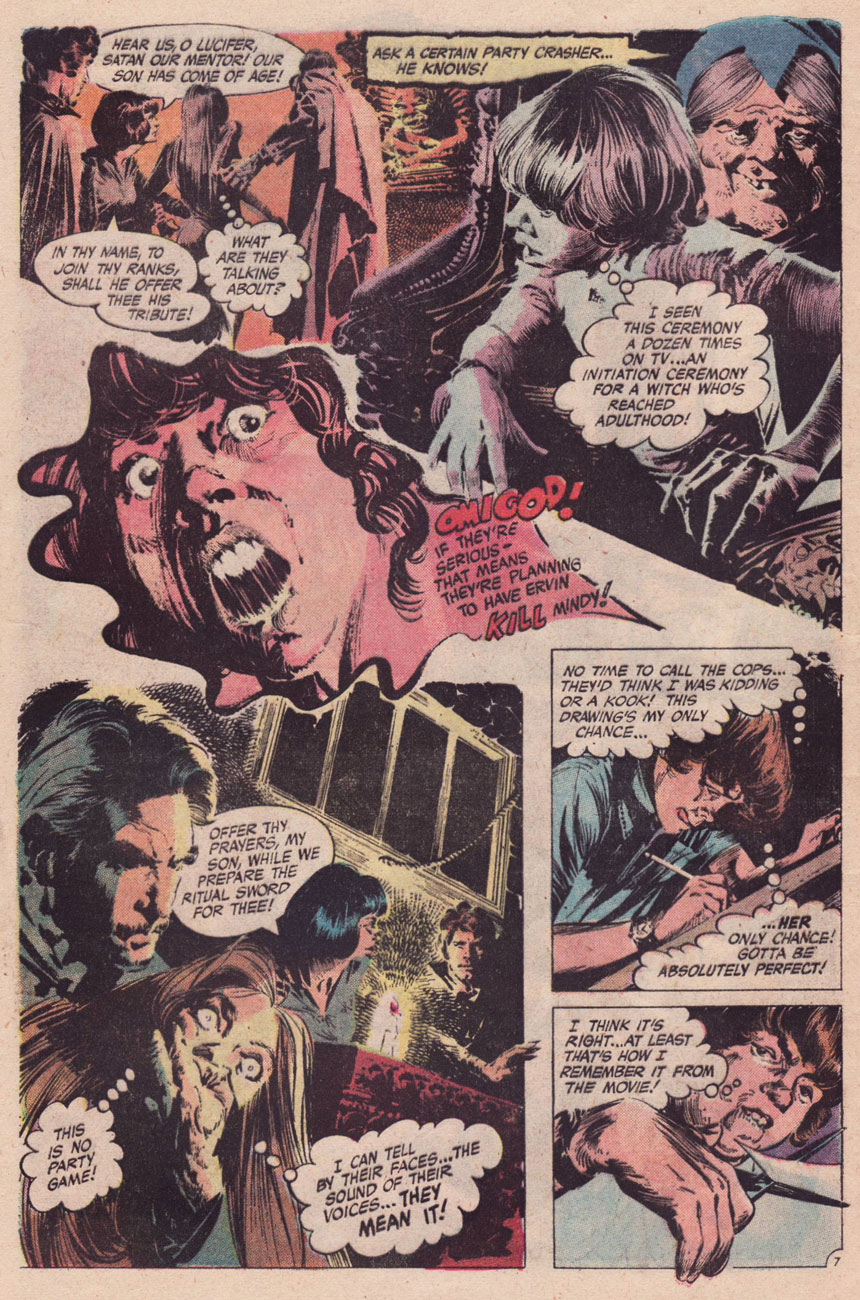
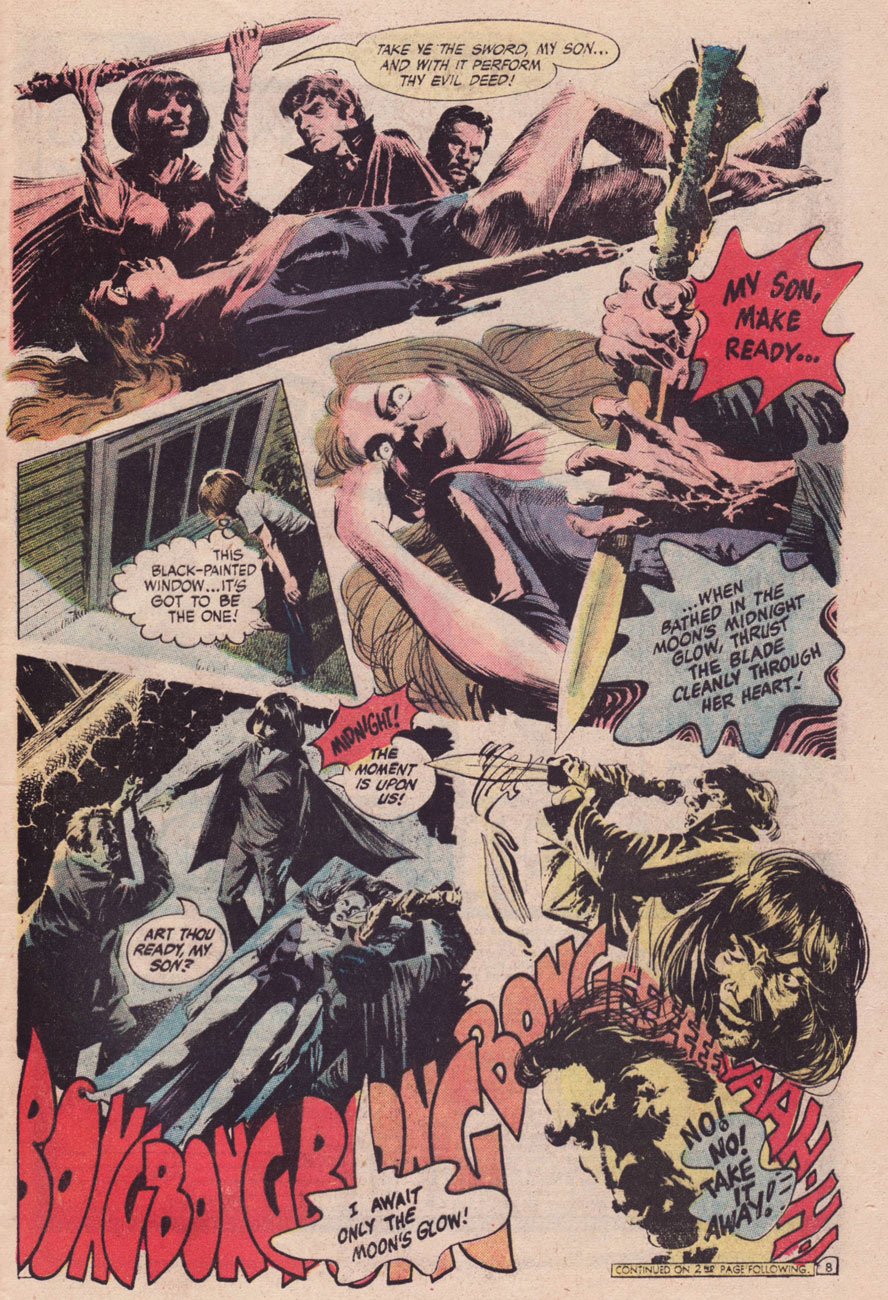
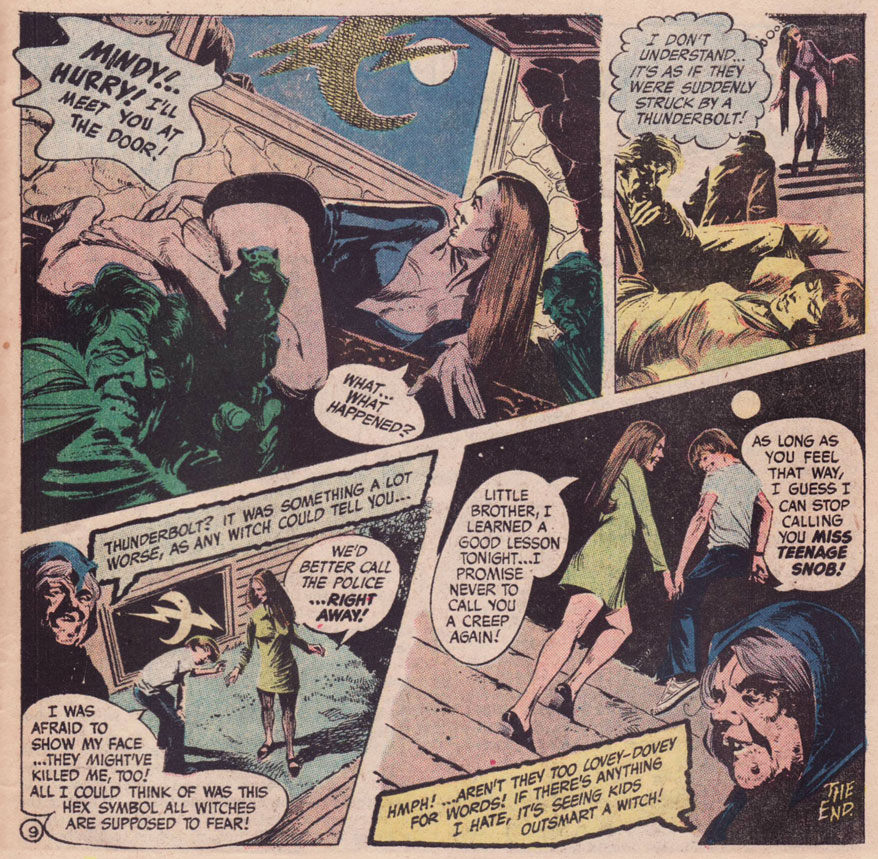
Today, we part the curtains and peek at the fair bosom of suburbia, circa 1972. In those gentle times of satanic panic, Tricky Dick’s political shenanigans, the oil crisis and all-around grooviness, the Manson ritual murders were recent history, Anton LaVey‘s The Satanic Bible (1969) and its sequel, The Satanic Rituals (1972) were all the rage, not to mention William Peter Blatty‘s The Exorcist (1971… the film another year away) and Ouija boards. DC Comics’ The Witching Hour (85 issues, 1969-1978) was well in keeping with the vibe of the times, and offered girls somewhat of an alternative to Archie, Little Dot and Young Romance. In fact, my recollection (and I’d welcome yours!) was that ghost and mystery comics overwhelmingly found favour with the ladies.
I’ve perhaps said it before, but DC’s mystery books were mostly well-drawn but mind-numbingly formulaic… but exceptions now and again slipped in.
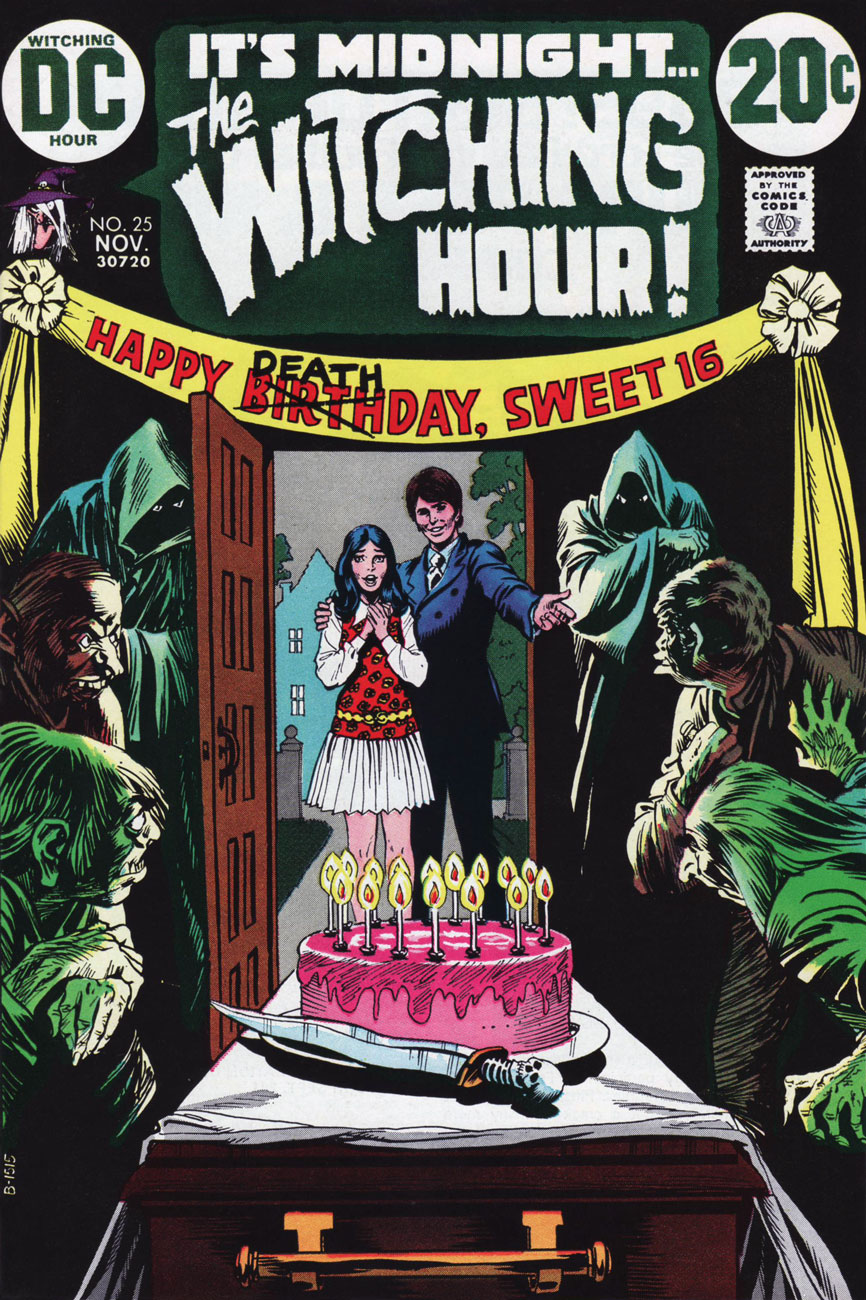
Happy Deathday, Sweet 16! was a bit of lightning in a bottle. It was illustrated by the hardly-prolific Canadian Bill Payne, who drew a dozen or so jobs for DC’s mystery and war titles, lettered a few more, then vanished. I suspect he had a day job in some advertising agency and did a bit of comics work on the side for kicks. If that’s the case, he certainly applied himself, bringing actual realism and a bit of the old ‘Ghastly’ Ingels grotesqueness to the table. The writer, however, is uncredited. The writing doesn’t quite feel like the work of any of DC’s workhorses… it’s markedly better, rising beyond the stock situations and packing in plenty of credible detail to flesh out the players in its scant eight and a half page allotment. Sibling rivalry, social aspirations**, marital and parental discord, class warfare… Lucky Peter, though: he somehow seems to have continual access to Shock Theater; for me, that’s the main cause for suspension of disbelief.
Nick Cardy‘s sweet ‘n’ sassy cover for The Witching Hour no. 25 (Nov. 1972). It’s fun to see one of his winsome romance cover girls put in a rather… perilous cross-genre appearance.
These days, I suppose the fundamentals haven’t changed, though with so-called Christians behaving in most unchristian fashion, and Satanists displaying a puckish (honestly, kind of adorable) sense of humour, things are… interestingly confusing.
-RG
*Read it here; but remember, it’s “available only in multiples of 10,000 at half-price.” ** Let’s keep in mind that, as Lori Loughlin has pointedly pointed out, “Any mother would have done the same if they had the means to do so.”


































 Who's Out There?