… in which a carnivorous reptile fights a man masquerading as a T-Rex

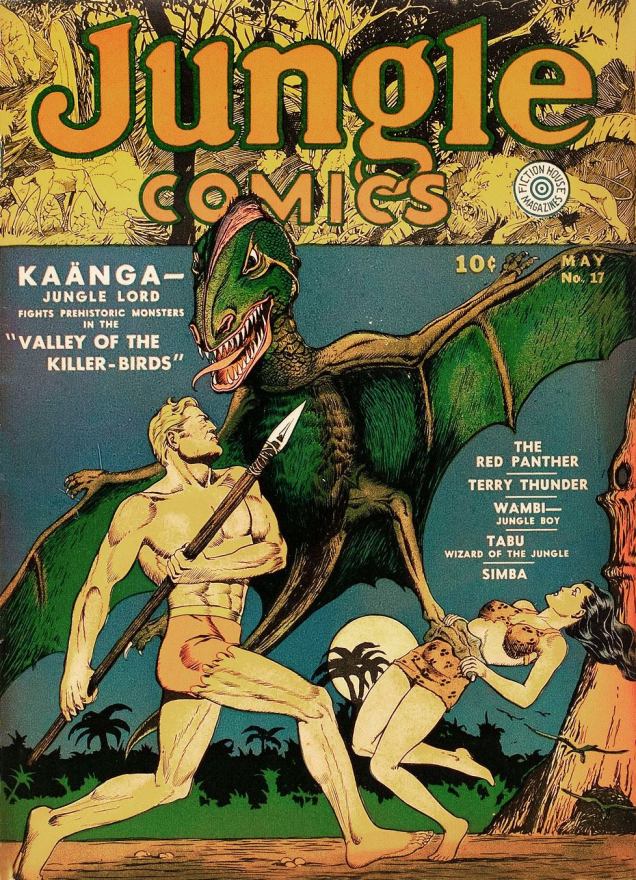
Yes, I’m sure that jungle inhabitants had to fight off vicious, anatomically impossible pterodactyls all the freaking time. Man, has John Celardo, the artist of this cover, ever seen a pterodactyl? … Oh, right, I guess he hasn’t. That still doesn’t justify this monstrosity, though.

Mark Twain comes to mind:

« The less said about the pterodactyl the better. It was a spectacle, that beast! a mixture of buzzard and alligator, a sarcasm, an affront to all animated nature, a butt for the ribald jests of an unfeeling world. »

*This* pterodactyl certainly looks like a butt for jests, given that its spine is twisted like a strand of DNA, and that its head has been put on backwards.
JungleComics17
Jungle Comics no. 17 (May 1941). Cover by John Celardo.

The premise of Valley of the Killer-Birds is exactly the same as the raison d’être of all the other ‘Jungle Lord’ comics: Kaänga (who, judging from the umlaut, is probably Danish, just like Häagen-Dazs) has to rescue his damsel-in-distress yet again. I’m sure you are dying to know what the plot is like, so here it is in more detail:

Ann, Kaänga’s mate, is “blown off her perch” (where she was roosting, presumably) by a strong wind, and is carried off by a pterodactyl that just happens to be passing by at the moment, probably on its way to the grocery store. Kaänga tries to follow, but falls off a cliff, is carried (unconscious) through a watery tunnel, and lands in “a weird prehistoric valley”. He then effortlessly kills a a dinosaur that looks like a slightly smaller-than-average T-Rex and climbs into its skin (that somehow fits him perfectly), plays dead, gets carried off by another pterodactyl and dropped off at some random cave, miraculously the same cave where Ann is captive, and even more preposterously just a few meters away from her standing coyly by in a typical “just look at my bikini!” pose.  Then he waves at her with his paw (understandably, she doesn’t understand why a dinosaur is waving at her – it’s those super-short front paws, you know), then she gets carried off (again) by a giant ape that shows up from nowhere, and Kaänga, still in T-Rex form, hotly pursues them and kills the ape. Then the hero of our tale, as clean and Arian as he can possibly be (nevermind that he just climbed from the bloody insides of an animal corpse), takes Ann’s hand and leads her out from the tunneled cave, reasoning at some point that if there’s human skulls in the passage, there must be a way out of those tunnels. (Um, no, it just means the pterodactyls and/or giant ape have had a lot of silly little humans for supper that they’ve brought in from elsewhere.)

~ ds
 

Hallowe’en Countdown, Day 12

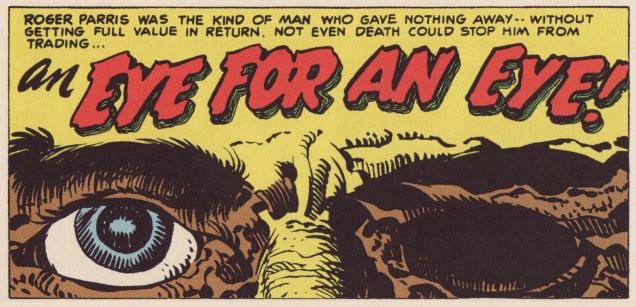
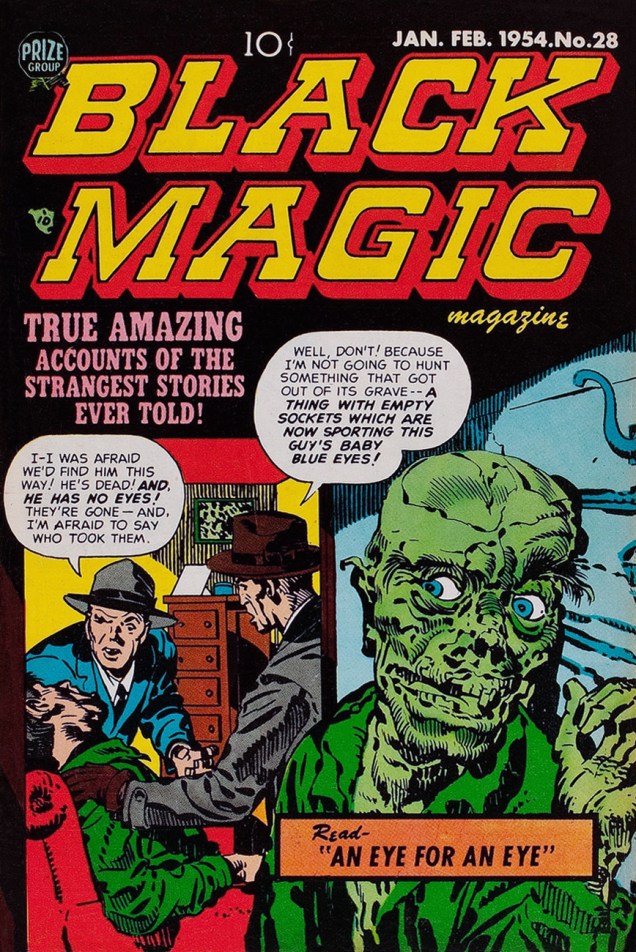
« Within the hour, Roger Parris’ eyes had been removed from his still warm corpse! »

Some specimens of walking corpse are kind enough to just snap your neck or rip out your throat, but not old Roger Parris… he was, and remains, a spiteful coot.

BlackMagic28A
This is Black Magic vol. 4 no. 4 (#28, Jan.-Feb. 1954, Prize), illustrating “An Eye for an Eye”. Pencils by Jack Kirby, inks by Joe Simon and/or Kirby.


EyeforEyeKirby
The story’s opening panel. For my money’s S&K’s Black Magic offered the scariest ride in 50s horror… often with unlikely, seemingly innocuous topics, and without showing much in the way of gore or gratuitous imagery. They took the Val Lewton high road, if you will.
DropOfWater
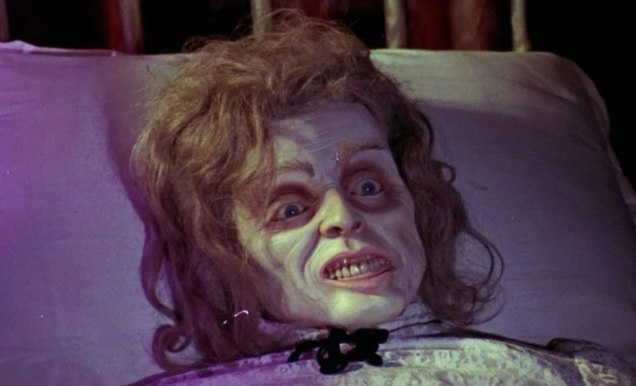
I’m reminded of another old dear who was inordinately attached to her earthly possessions (in her case, a ring) even after kicking the bucket. Well… not quite, it turned out. From Mario Bava‘s 1963 omnibus film, “I tre volti della paura” (aka “Les trois visages de la peur”, or “Black Sabbath”)’s most spine-tingling segment, “La goccia d’acqua” (“The drop of water”).

– RG

Hallowe’en Countdown, Day 10

« Ever been to a maniac party held in a haunted house? Well, if you don’t frighten easily, you’re welcome to attend Etta Candy’s — but be careful or you’ll lose your scalp! »

Here’s a real hallowe’en corker from the Golden Age of comics, featuring the ageless Wonder Woman, presented here by her original creative team… with a twist. While the story is credited to Charles Moulton (the nom de plume of William Moulton Marston), it was ghost-written by his former student and collaborator Joye Hummel (1924-), the first woman to write Wonder Woman’s adventures. She is frequently credited for being the first woman to script superhero comics, but nope, that’s at least three years after Tarpe Mills gave the world her Miss Fury.

Sensation57A
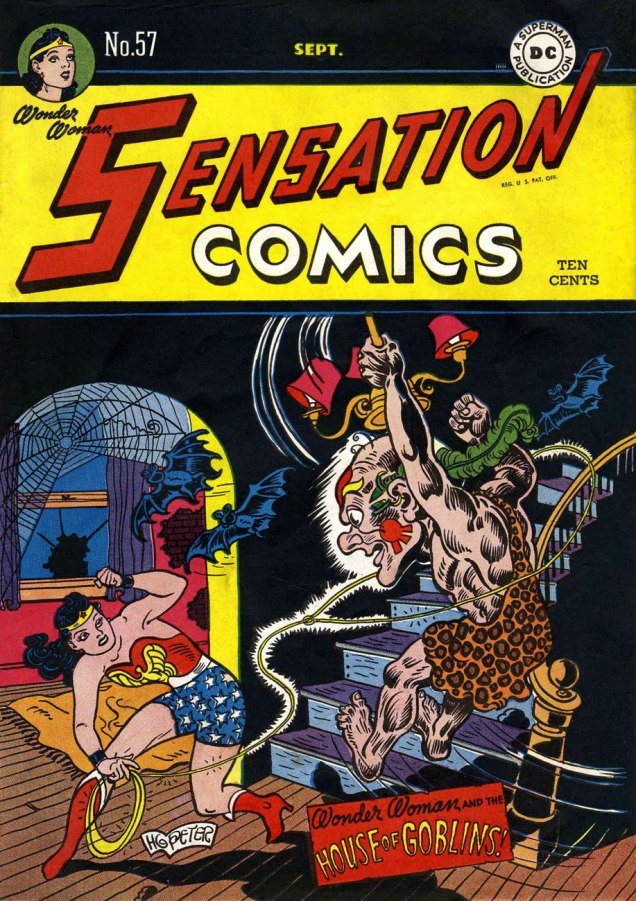
This is Sensation Comics no. 57 (DC, September, 1946). Art by the sensational Harry G. Peter.
ManiacParty
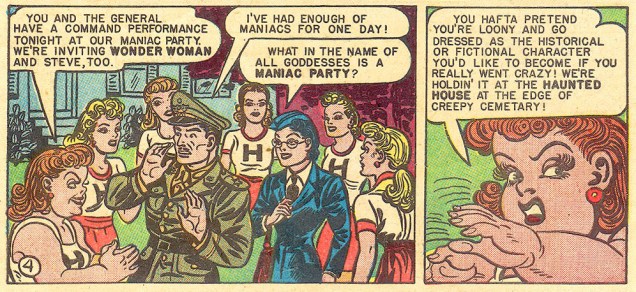
Now you know what a Maniac Party is. The haunted house and the creepy cemetary (sic) are optional, but they sure do help set the properly demented mood.

Unfortunately, Joye appears to have been left out of the recently-released biopic Professor Marston and the Wonder Women. Too complicated? I guess a ménage à trois is plenty to handle already.

Check out the film’s trailer (well, one of them, at any rate.)

– RG

Hallowe’en Countdown, Day 4

« There’s lots of heads that would be improved by removing the brains and stuffing them with punkin! »

Here’s one from early in the funnybook game. Eastern Color’s anthology title Famous Funnies (July, 1934 – July, 1955, 218 issues), is generally held to be the first true American comic book. This is October, 1939’s issue 63, with a cover by Victor E. Pazmiño (1899-1970), who often initialed his work VEP (not to be confused with Virgil Partch’s VIP). Our featured protagonists are Sam Smithers and his tormentor, Pigtails.

FamousFunnies63A

Should you have a little time on your hands, you can read this issue, and many others in the series, right here, through the auspices of the fine folks at comicbookplus.com.

-RG