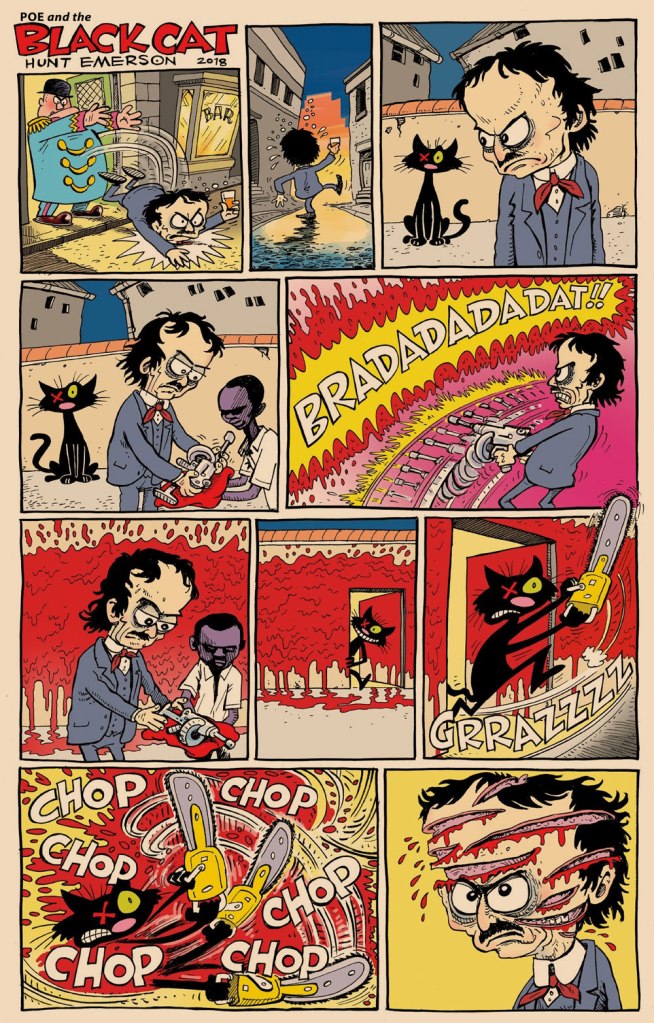
« Upon its head, with red extended mouth and solitary eye of fire, sat the hideous beast whose craft had seduced me into murder, and whose informing voice had consigned me to the hangman. » — The Black Cat (1845)
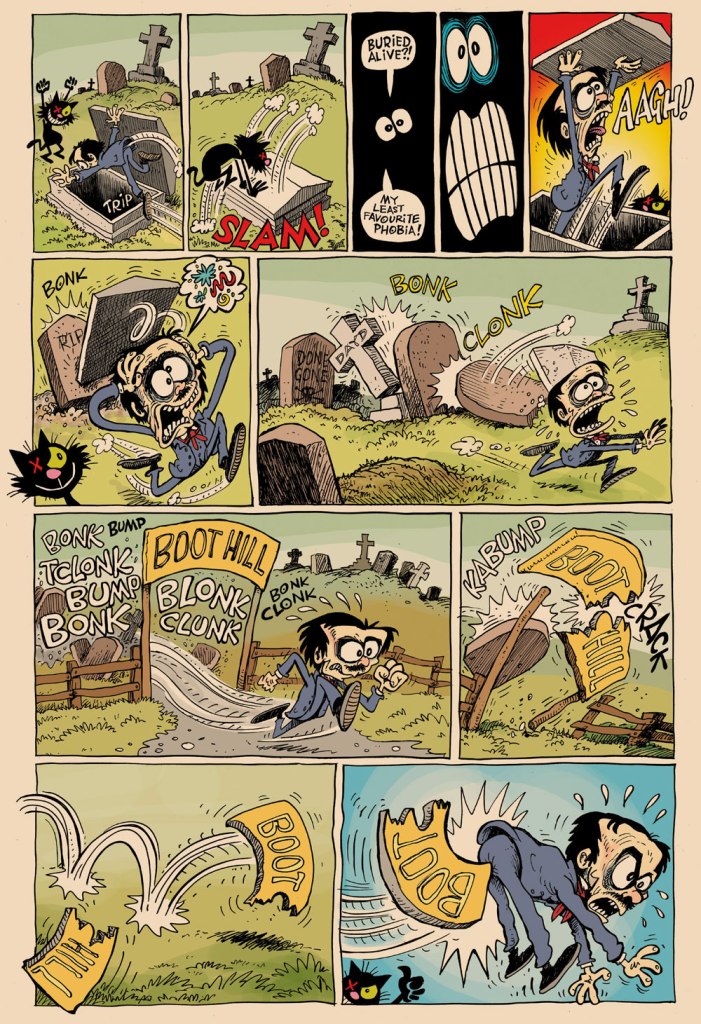
What can I tell you about the legendary English cartoonist and bon vivantHunt Emerson — born in 1952 in Newcastle and still devilishly active these days — that he can’t tell you in his own words?
Originally published in Edgar Allan Poe’s Snifter of Terror no. 2 (Nov. 2018, Ahoy).
Originally published in Edgar Allan Poe’s Snifter of Terror no. 4 (Jan. 2019, Ahoy).
Originally published in Edgar Allan Poe’s Snifter of Terror no. 5 (Feb. 2019, Ahoy).
You’ll get all these, and plenty more besides, in Edgar Allan Poe’s Snifter of Terror Volume 1 (Oct. 2019, Ahoy), collecting the title’s first six issues. Cover art by Richard Williams, with a title logo by Todd Klein.
-RG
* not, by a long shot, Mattioli’s best work. *That* would be, without question, his nonpareil M le magicien (1968-73).
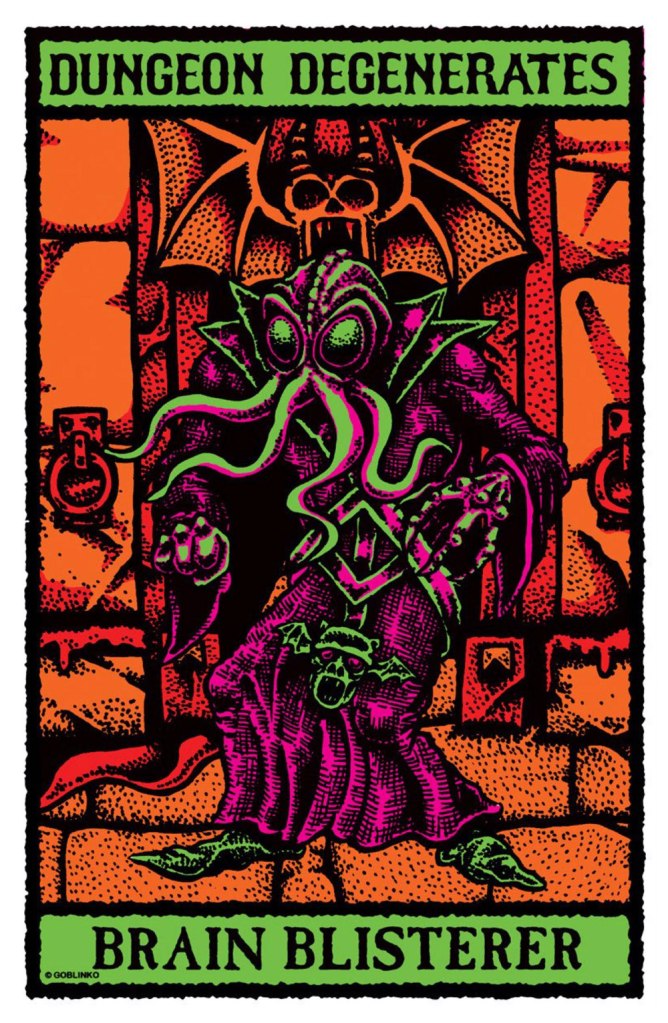
« Every Goblinko product is a seed of a better world. Better because it is built to last – built for relevance – built for survival – built for buttermilk – built for speed – built for living the chaos – built for you! Everything else sucks! Go Goblinko! »
My path to discovering Sean Äaberg‘s art was rather tortuous.
On one hand, I’ve liked Goblinko t-shirt designs for a while – co-admin RG is a big fan, and given my love for pickles, so am I. Somehow I was not aware of those was creating these designs, however.
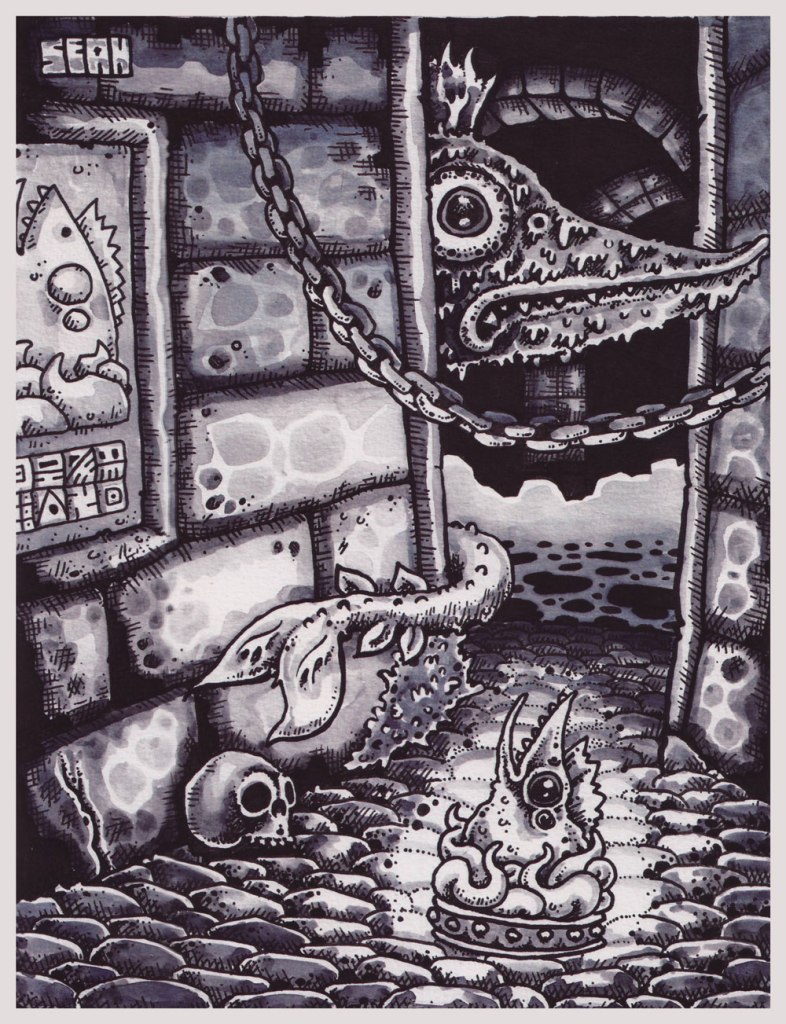
As for Äaberg art, it all began when I saw some very striking Tarot cards on some forum discussion – I have no interest in Tarot, but these were hitting all the right buttons, with their super bright green-magenta-yellow colour scheme and lush artwork. I looked up the artist, and landed on his Dungeon Degenerates on the wonderful Monster Brains blog.
As I am one of those silly people who want to own stuff on paper, I looked for a book and found Acid Vomit! The Art of Sean Äaberg on Kickstarter. When I received this (glorious, by the way) compendium, something clicked into place and suddenly I realized that Sean Äaberg = Goblinko!! (Well, to be fair, Sean’s wife Katie is part of it, too.) Nothing like one of those ‘well, that should have been obvious a long time ago…’ realizations to put one into a philosophical mood.
Another Kickstarter campaign is currently taking place, this time for a Halloween book (which this household is of course supporting, given that Halloween is our favourite holiday!) Please lend a much-needed (financial) hand to this worthwhile project!
« Crammed to the gills with real Street Rocker junk scraped from the mean streets of Porkland. » This is Pork no. 20. It was, indeed, free as the cover promises – you can admire the covers of other issues here. Yes, the tentacles are subtle, but they’re nevertheless lurking!
A cutie pie! Scanned from Acid Vomit! The Art of Sean Äaberg (Gingko Press, 2012).
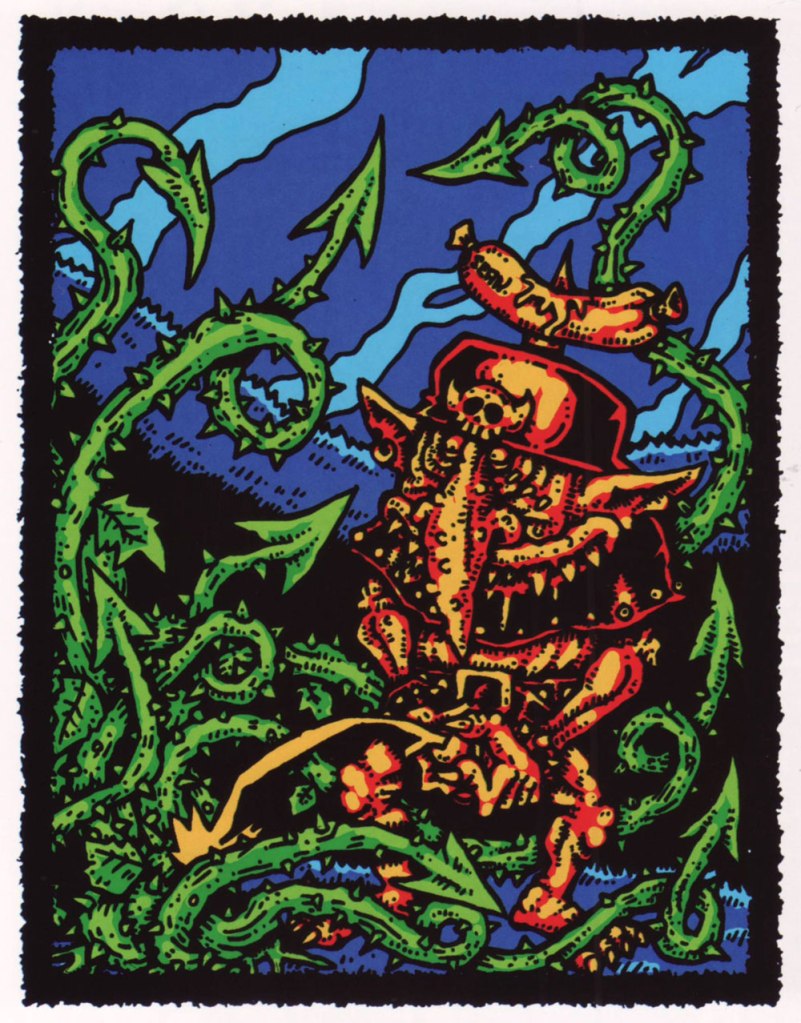
Some classic plant tentacles. Scanned from Acid Vomit! The Art of Sean Äaberg (Gingko Press, 2012).
Dark Horse seems to publish more mini-series heavily dependent on tentacles that you could shake a stick at, and enough spin-offs of spin-offs to make one’s head spin. Still, I have been dutifully saving the… shall we say, less ugly… tentacle-heavy DH covers I have come across, and since there is clearly little point in hoarding them, the time has come for a part III. Visit the previous instalments here: Tentacle Tuesday: Dark Horse, Pt. 1 and Tentacle Tuesday: Dark Horse, Pt. 2. Your mileage may vary!
I have to include at least a couple of things I actually somewhat like per post, whatever pleasure I may get from mocking the rest.
The first is the back cover of Madman Comics no. 4 (October 1994), with art by Dave Stevens, with well-defined, slimy tentacles and plenty of boobage. That’s Madman (created by Mike Allred) in the middle, but he surely ends up ending up in the background of his own adventure, courtesy of the cephalopod and skin-tight costumes of the damsels.
Continuing with the 90s, here are two Star Wars covers by Mark Schultz who’s, err, distinctly not at his best – though bringing one’s best to Star Wars would be a waste, anyway.
Classic Star Wars no. 8 (April 1993).
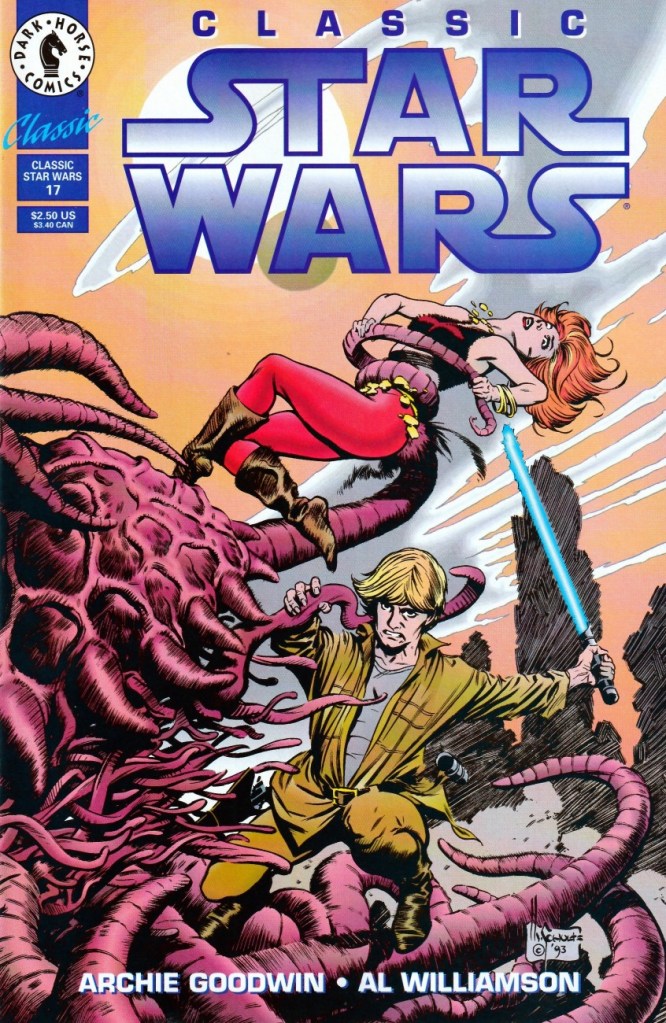
Classic Star Wars no. 17 (March 1994).
Continuing with the 90s…
Dark Horse Comics no. 15 (November 1993). Cover by John Higgins. The suggestive-yet-fuzzy shapes made me think that this woman is bare-bosomed and possibly vagina dentata-ed at first. The teeth belong to the tentacled monster, the nakedness is still a possibility.
This one I like far more:
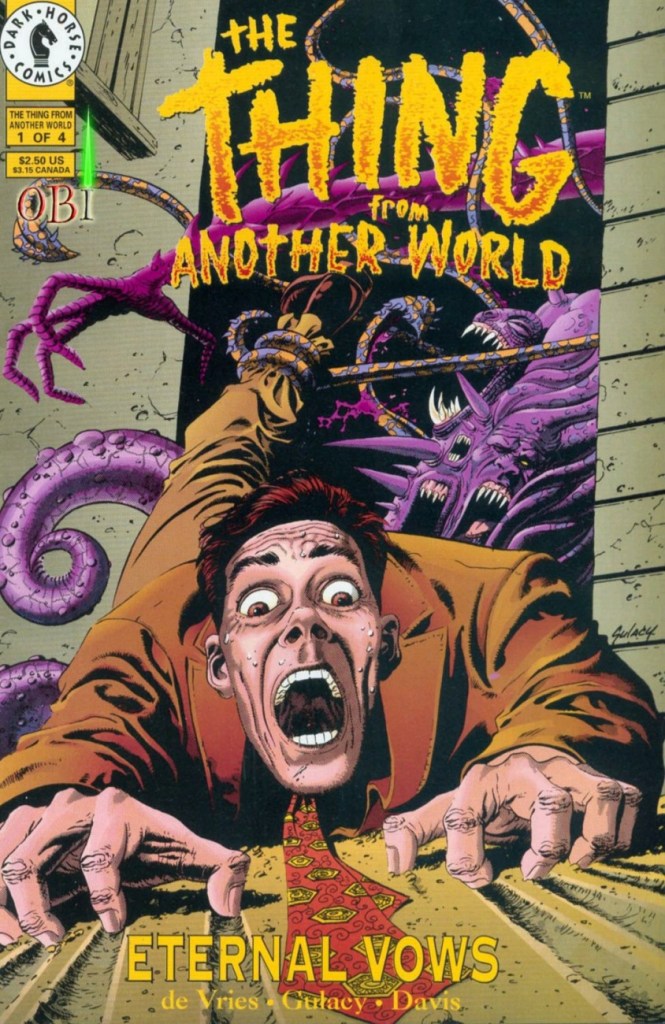
The Thing from Another World: Eternal Vows no. 1 (December 1993). Cover by Paul Gulacy. Upon seeing this, co-admin RG quipped ‘oh, what’s left of Gulacy‘ (after his run on Master of Kung Fu, that is).
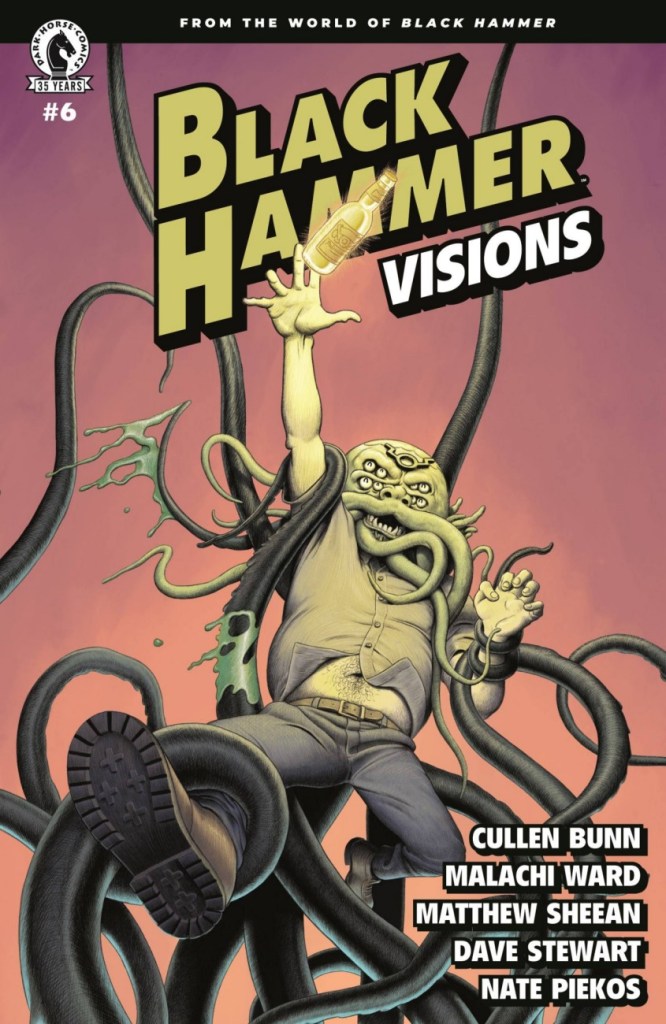
Finally, we have three Black Hammer-related covers, which made me look up this series since I didn’t even know of its existence before spotting these tentacles. Created by Jeff Lemire and Dean Ormston, it’s apparently doing quite well (given that it started in 2016, and is still ongoing with many spin-offs, awards received, and a possible TV show).
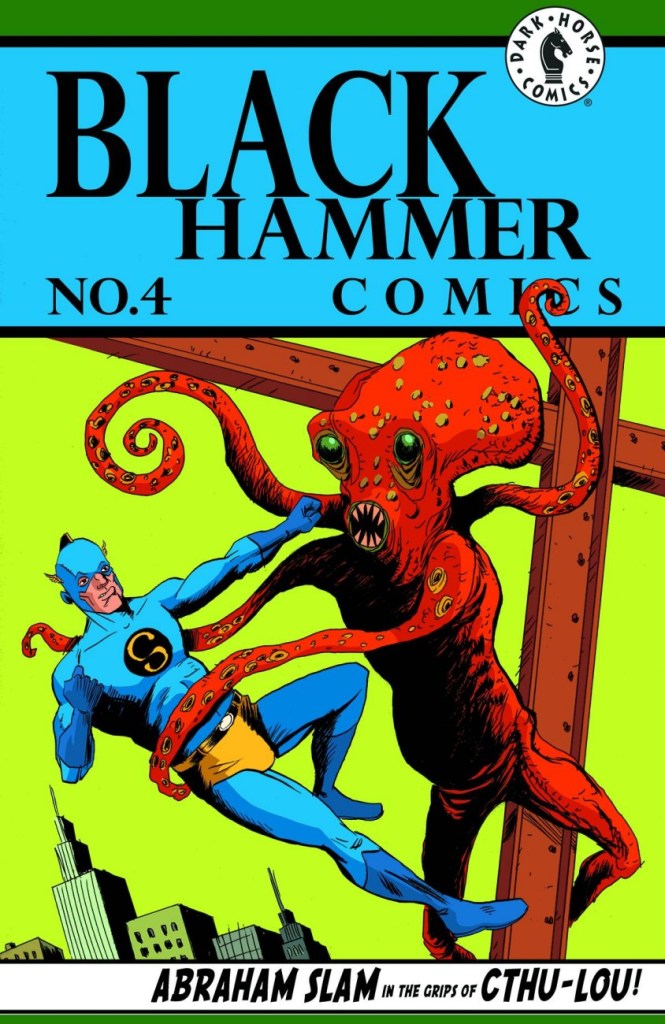
Black Hammer no. 4 (October 2016). Cover by Dean Ormston.
Black Hammer no. 4 (October 2016). Variant cover by Jeff Lemire.
Black Hammer: Visions no. 6 (July 2021). Cover by Malachi Ward.
No Dark Horse post about tentacles can avoid the elephant in the room, namely Hellboy and Mignola. If that’s what floats your boat, I covered that ground in Tentacle Tuesday Masters : Mike Mignola.
« Most of us will still take nihilism over neanderthalism. » — David Foster Wallace
“It’s become so quiet” “Yes“; from Galago no. 40 (1994, Atlantic Förlags AB)
Today, let’s dip a toe (at the risk of losing it) into the midnight domain of Swedish cartoonist and filmmaker Max Andersson (b. 1962). It’s a relentlessly-perilous scene, but like Kaz’s Underworld comic strip or Arnt Jensen‘s Limbo video game, I find it unexpectedly comforting in spite of (and thanks to) all the darkness, both thematic and in density of ink. In Andersson’s case, might it be owing to the author’s kindness to his protagonists? That’s a factor with odds I rather favour.
I don’t doubt that certain readers of a more sensitive cast will differ, but I posit that the cheerful lack of clemency the artist affords the callous, the cruel and the pernicious makes Andersson’s universe a profoundly moral one. Contrary to, say, your average American action blockbuster, such a purge of the villainous doesn’t restore the status quo… because here, malevolence is the status quo. Andersson’s put-upon little people are true outsiders, and his stories feel like Kafka, but blessed with dénouements far merrier yet merited.
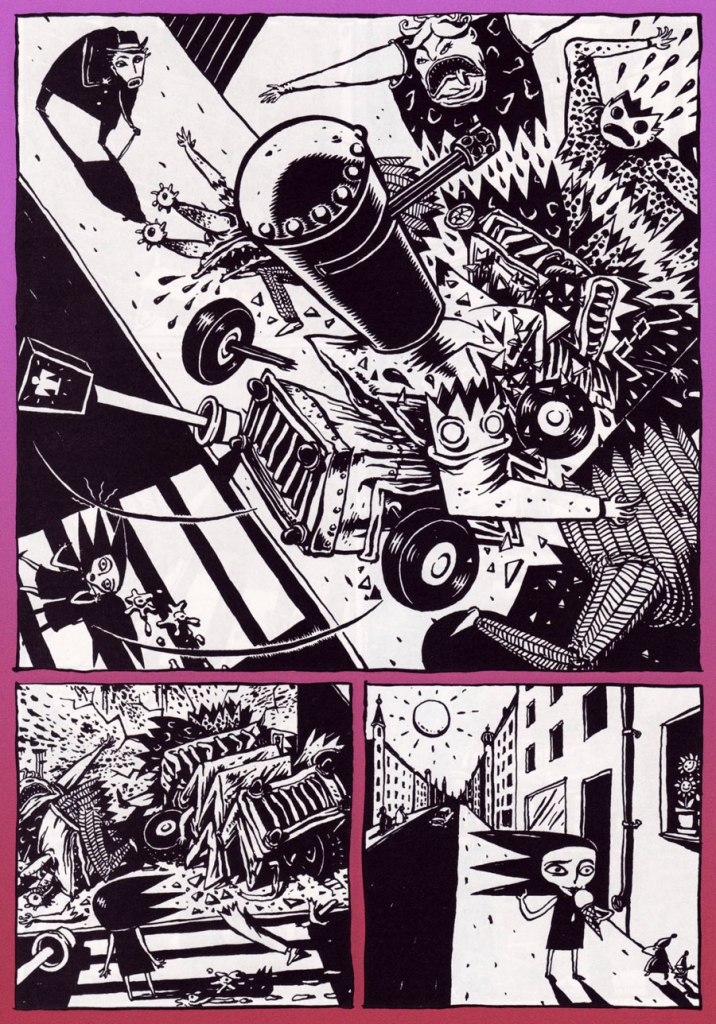
Jolly carnage! Lolita’s Adventures appeared in the third issue (July, 1995) of Fantagraphics’ outstanding anthology title Zero Zero (27 issues, 1995-2000).
See? A happy ending and all, and even a rare glimpse of daylight.
Soon after he began to publish his work, Gary Groth spoke with Andersson (The Comics Journal no. 174 (Feb. 1995, Fantagraphics):
Groth: What would you point to as your defining influences? How did you develop this approach, style and point of view?
Andersson: What I always have in my backbone is the style of classic comics, the stuff I read when I was a kid.
G: I don’t see much Tintin.
A: No, but it’s there if you look closely. The basic technique of how to tell a story well. I try to do that because I want the storytelling to work, to be easy to read.
G: Were you influenced by sources outside of comics — film, literature?
And don’t leave out old cartoons! Andersson’s thoroughly animist way dovetails neatly with early animation’s unhinged, anything-can-happen mode. By which I mean that anything and everything possessed motion and sentience, be they boulders or pebbles, thunderclouds, petals or creepers, sparks or flames, pantaloons or braces, blunderbusses or bassoons…
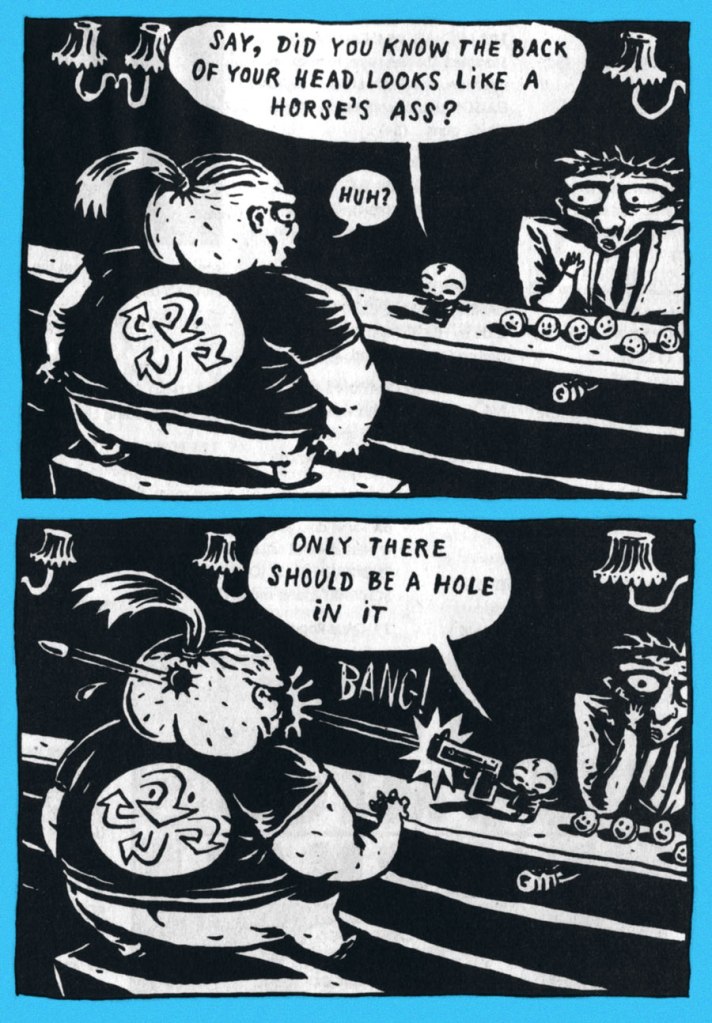
As a bonus, a sequence from Andersson’s breakthrough work, Pixy (1993). The title character is the fœtus with a pistol, and the happy little fellows on the counter are units of money. Highly recommended, and likely available in the language of your choice.
About Pixy, fellow dweller-in-darkness Charles Burns exulted: « So you think it’s a cold, creepy, world out there, huh? Hah! Just wait’ll you get a load of Max Andersson’s Pixy… safe sex suits, buildings that eat people, drunken fœtuses with bazookas, money that shits on you, recyclable bodies… hey, wait a minute, that’s not creepy, that’s fun. MY kind of fun. »
For more dope on this important creator’s endeavours, do sidle over to his official website!
« It’s a lot easier to draw rubble when deadlines hit. » — Guy Davis
Today, on his birthday, we seize the occasion to salute prodigious autodidact Guy Davis and to look upon his works, no despair necessary.
Born in Michigan on November 20, 1966, Guy Davis started out in comics in 1981 with a SF strip, Quonto of the Star Corps, published (he suspects his dad had something to do with it) in local newspaper The Clarkston News.
From there, he delved into sword and sorcery with The Realm (1986-1988, Arrow), then made significant strides toward his mature style with punk saga Baker Street (1989-1991, Caliber).
He then hit the majors, devoting most of the 90s to pencilling and inking the bulk of Sandman Mystery Theatre‘s quite respectable run (70 issues + 1 annual, 1993-1999, DC/Vertigo), Matt Wagner‘s darkly revisionist chronicles of Wesley Dodds, the Golden Age Sandman… pre-yellow-and-purple togs.
I must confess that I wasn’t, at this point, particularly fond of Davis’ style. His endearingly schlubby, potato-schnozzed characters had yet to work their charm upon me. But the writing was compelling, Davis’ storytelling was strong and clear, so I stuck around.
However, I’m not ambivalent at all when it comes to his subsequent work, wherein he ditched his often awkward cross-hatching, his inking improved by leaps and bounds in expressiveness, and he was at long last paired with a colourist that fully grasped his singular style.
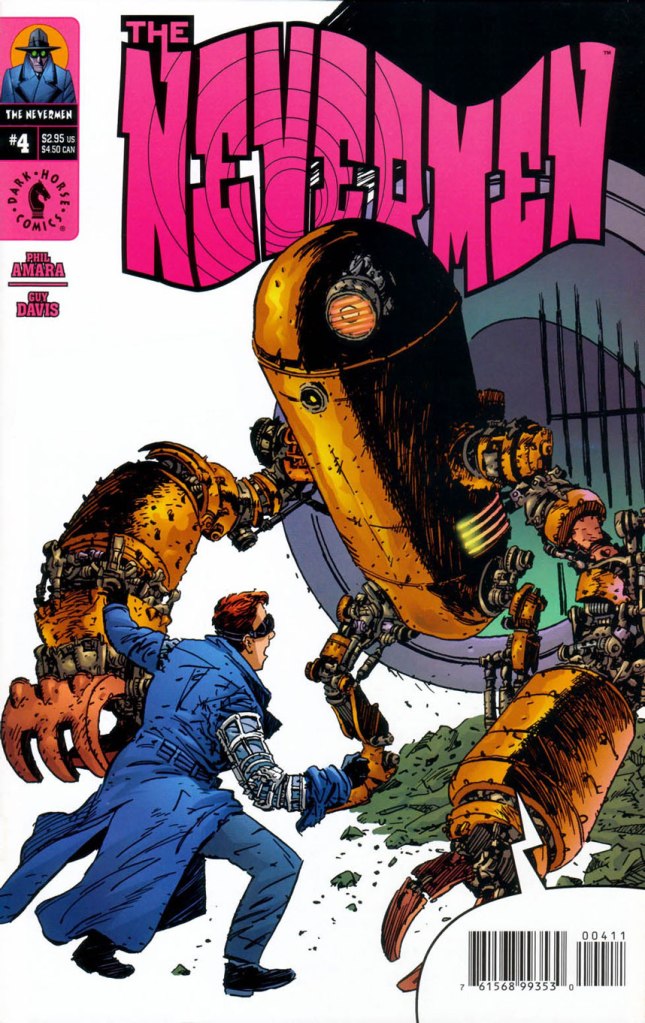
This is The Nevermen no. 4 (Aug. 2000, Dark Horse). Cover by Guy Davis.
Page 22 of Nevermen no. 1 (May 2000, Dark Horse). Written by Phil Amara, pencils and inks by Davis, colours by Dave Stewart.
Page 8 of The Nevermen no. 4 (Aug. 2000, Dark Horse). Same personnel…
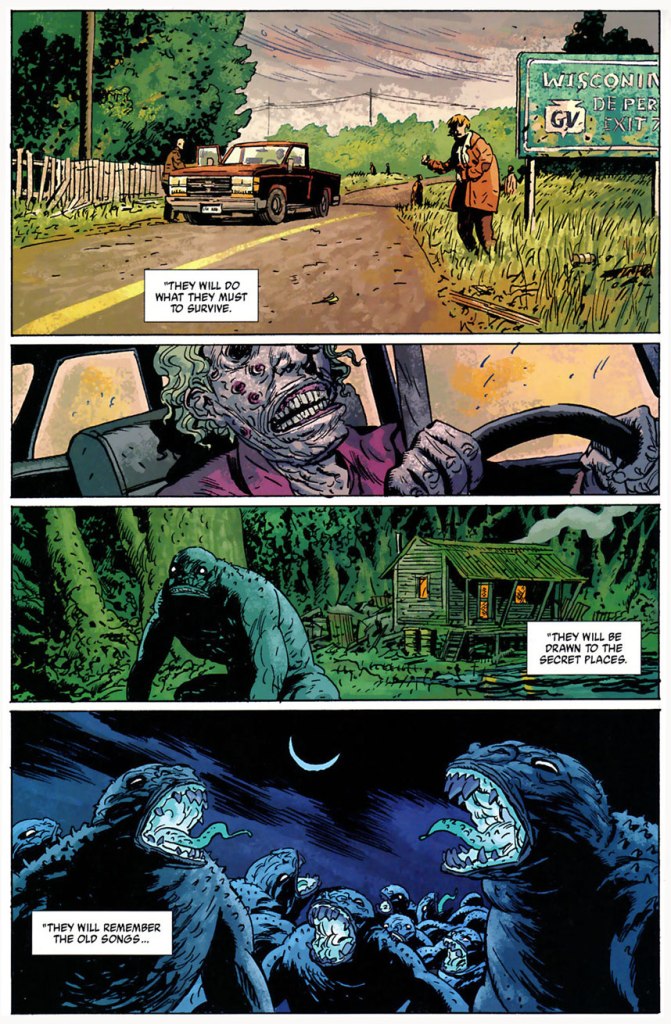
Page 15 of B.P.R.D. Plague of Frogs no. 1 (Mar. 2004, Dark Horse). Story by Mike Mignola, pencils and inks by Davis, colours by Dave Stewart.
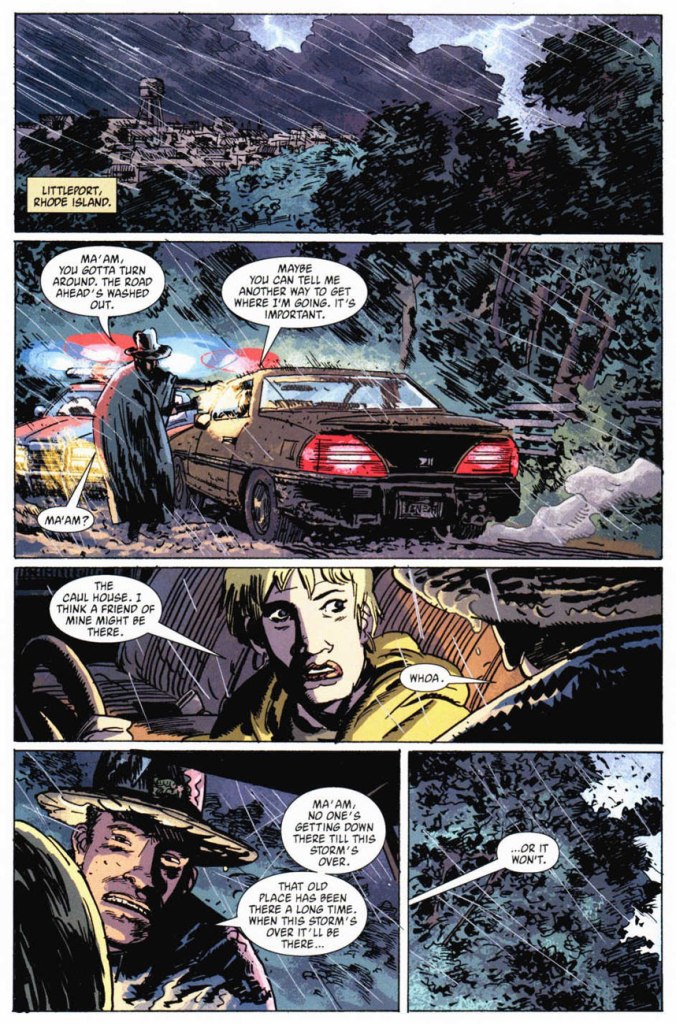
Page 22 of B.P.R.D. The Dead no. 3 (Jan. 2005, Dark Horse). Story by Mignola and John Arcudi, pencils and inks by Davis, colours by Dave Stewart. Shot from the original art, courtesy of, er… the author’s collection.
And in case you’ve ever wondered just what a good colourist can contribute to the finished product, let alone the finest colourist in the business. Ladies and gentlemen, Mr. Dave Stewart!
Guy Davis on his collaboration with Dave Stewart:
I was never never happy with my work in color — I hated the idea of it — until [ Dave Stewart ] started coloring me in B.P.R.D. He had this textured brush look that was just perfect for my linework. My linework is not clean, and before Dave, everybody who’d color me would do a standard house style. They wouldn’t adapt for each artist, and that’s what makes Dave so amazing is that he adapts his style for the art as opposed to trying to shoehorn one style of coloring — which a lot of colorists do — into every artist’s style.
(from an interview conducted by Eric Nolen-Weathington and published in Modern Masters Volume 24: Guy Davis, 2010, TwoMorrows)
Page 22 of B.P.R.D. The Dead no. 3 (Jan. 2005, Dark Horse), by the aforementioned.
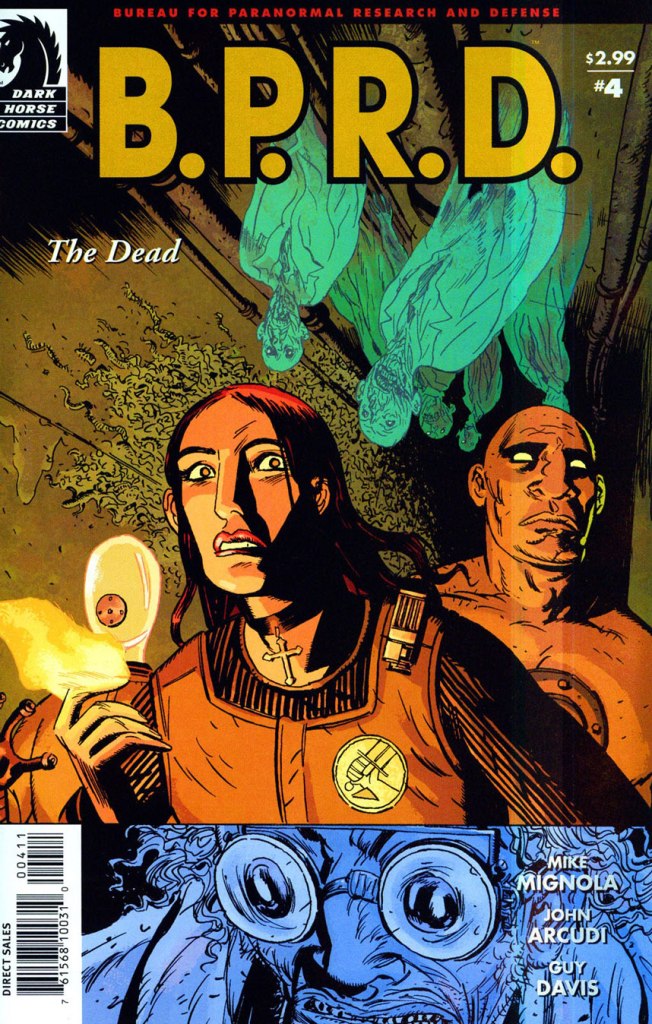
This is B.P.R.D. The Dead no. 4 (Feb. 2005, Dark Horse). Cover by Davis and Stewart.
Page 11 of B.P.R.D. The Dead no. 4 (Feb. 2005, Dark Horse). Note that Stewart doesn’t fall back on one go-to, characteristic colour palette; he has range. Muted, saturated, bright or dark… he uses what the situation calls for. That’s what a true artist does.
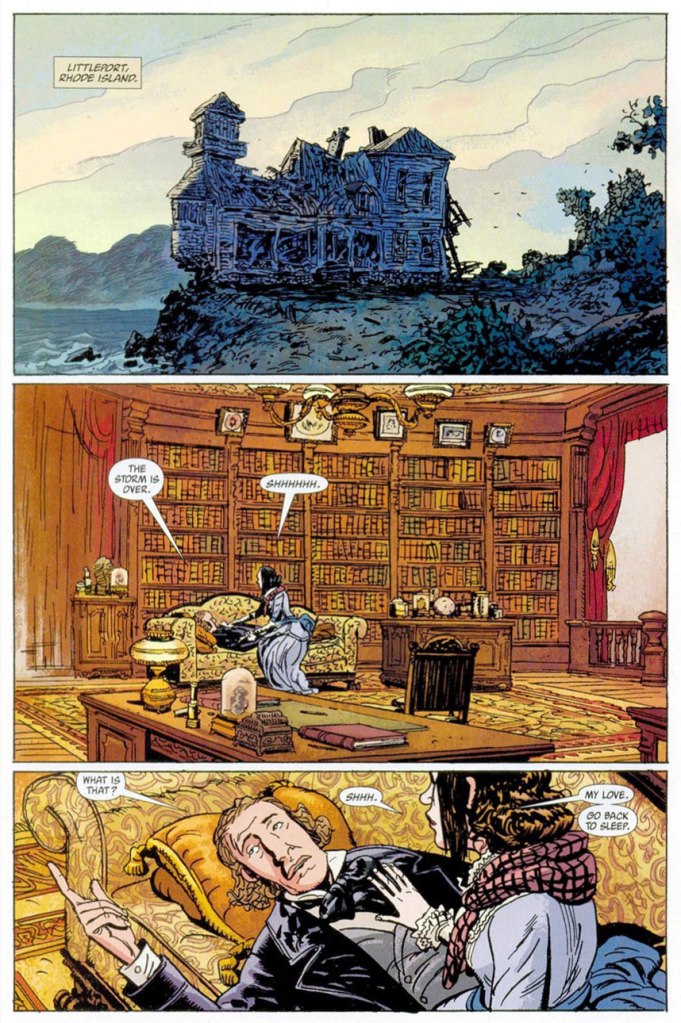
Page 18 of B.P.R.D. The Dead no. 5 (Mar. 2005, Dark Horse). Now *that* is a library.
With his love and mastery of period detail and the human proboscis, wouldn’t you say that Davis would have been the ideal candidate to depict legendary pulp hero The Shadow? A 2005 drawing excerpted from Guy Davis Sketch Macabre Volume 2 (Oct. 2006).
Frankly, I don’t think Mr. Davis ever received his due in comics; he remained an artist’s artist, reliable and productive, but relatively unsung. On B.P.R.D., he allowed Mr. Mignola to envision events and visions on a far, far grander scale than Hellboy’s creator could have realised by himself. After Davis resigned from the title and exited the comics field for challenges and well-earned success, artistic and financial, in the realms of film and video games, there simply wasn’t anyone able to fill the void he’d left.
Happy birthday, thanks for everything and all the best to you, Mr. Davis!
-RG
p.s. In selecting artwork for this essay, I forced myself to exclude any and all instances of tentacles, and trust me, there were plenty. We haven’t made it official yet, but if anyone ever deserved the title of Tentacle Master…
Back in August, I promised to follow Tentacle Tuesday: Dark Horse, Pt. 1 with another instalment of cephalopod material issued by this publisher. The time, as they say, has come! While I’m not always on board with the comics they opt to publish (rarely, I might even say), I do like today’s selections.
Dark Horse obtained the licence to produce James Bond comics in 1992. The result is a number of series and stand-alone comics – Serpent’s Tooth was the first, a three-part miniseries. The following two pages are from Serpent’s Tooth Part III: Mass Extinction, scripted by Doug Moench and illustrated by Paul Gulacy, published in James Bond 007: Serpent’s Tooth no. 3 (February 1993).
You decide for yourself which James Bond this is .
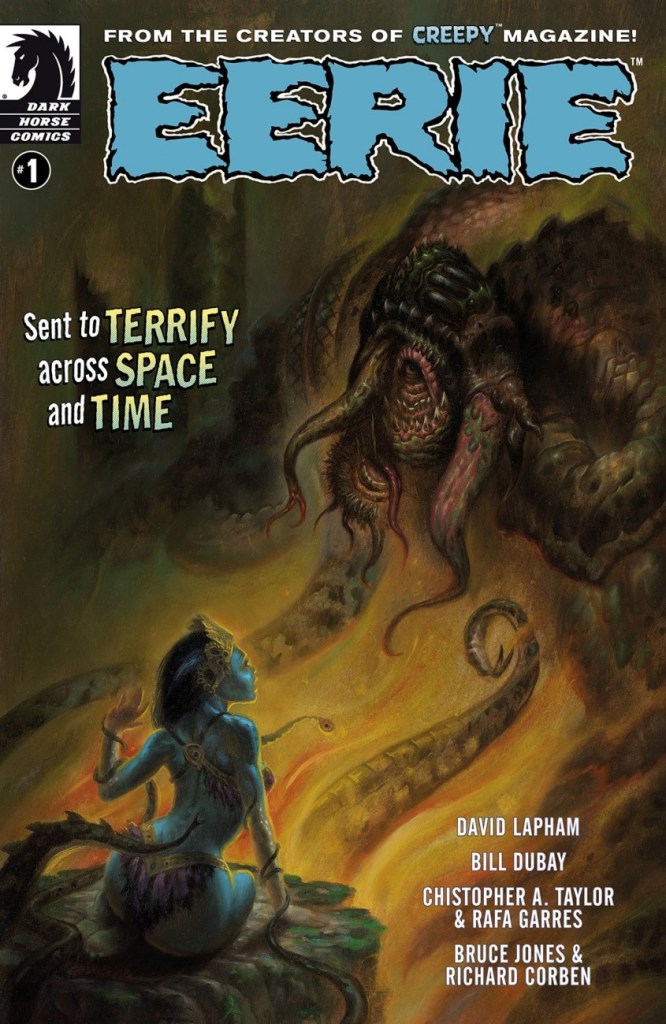
In 2007, Dark Horse stepped into a partnership with New Comic Company, who had earlier acquired from Warren the rights to Creepy and Eerie. The result was the gradual publishing of ‘archival’ hardcover collections of all issues of Creepy and Eerie magazines. In 2009, DH launched the ‘new’ Creepy Magazine, which mostly featured new stories, sprinkled with the odd reprint. A revived Eerie soon joined it.
Dark Horse’s revival of the classic Warren magazine is a mixed bag – this issue for instance, features several new stories and a reprint from 1970 (Life Species by Bill DuBay). This is Eerie no. 1 (July 2012). Cover by Jim Pavelec.
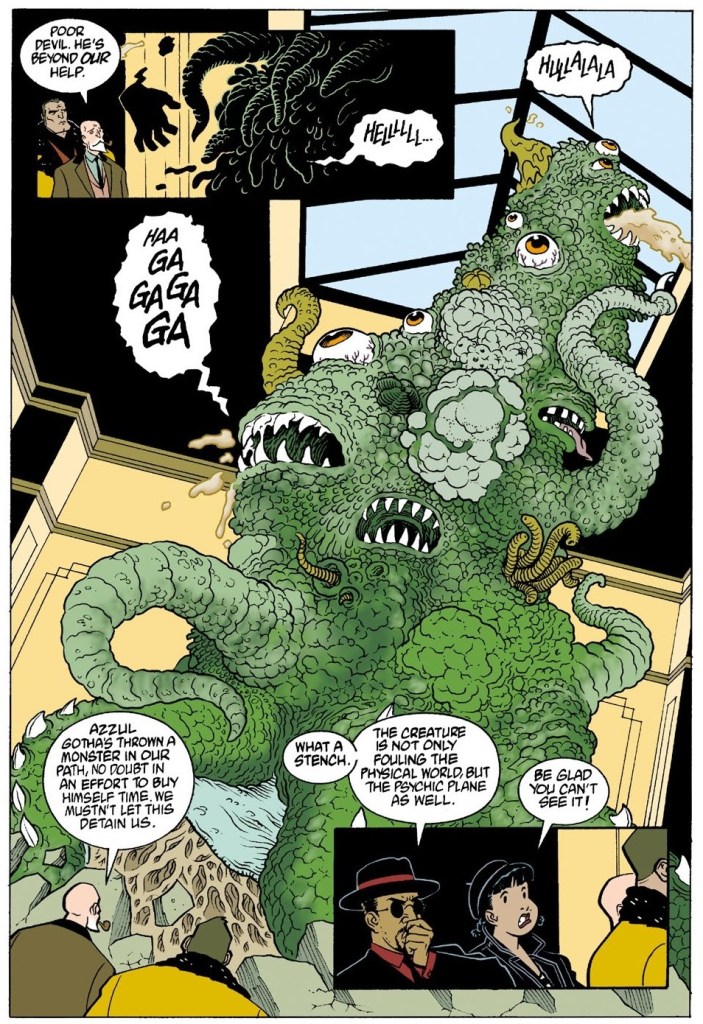
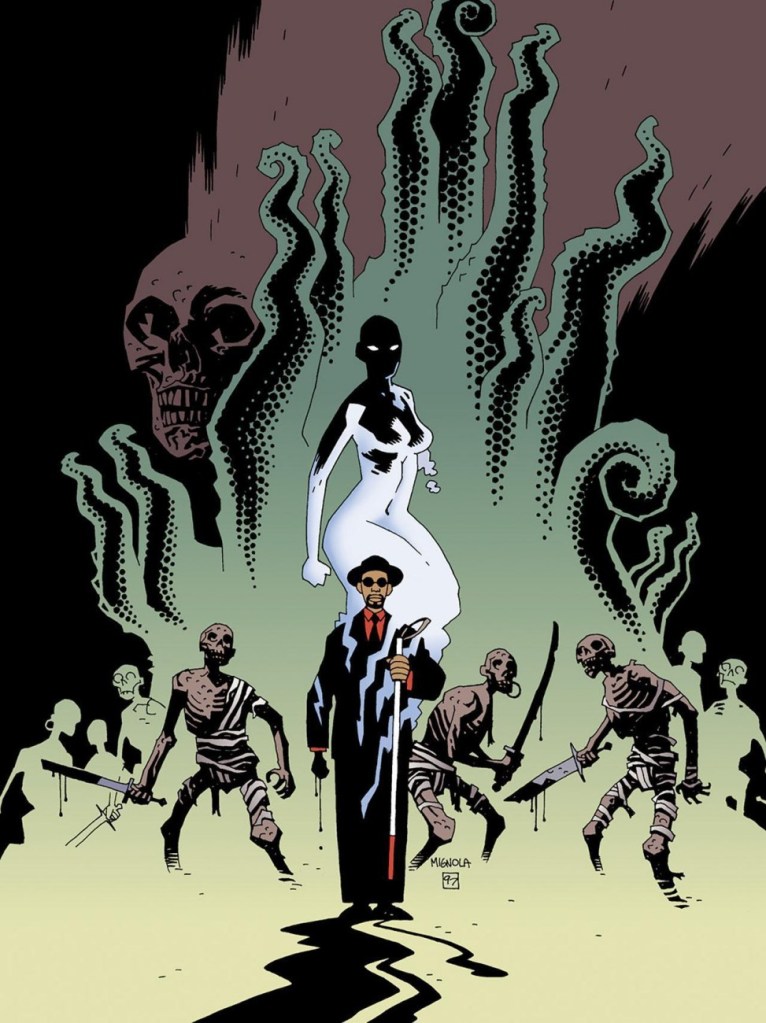
The next story is Tentacle Master Mike Mignola‘s ‘Champion of the Worms‘, which held my lazy interest for a few pages… until I found out that it’s actually quite good. What a pleasant surprise for one who had such low expectations! It also brims over with tentacles. The following three pages are from ZombieWorld: Champion of the Worms (October 1997), scripted by Mignola and illustrated by Pat McEown.
Not everybody can boast to such a classy octopus hat!
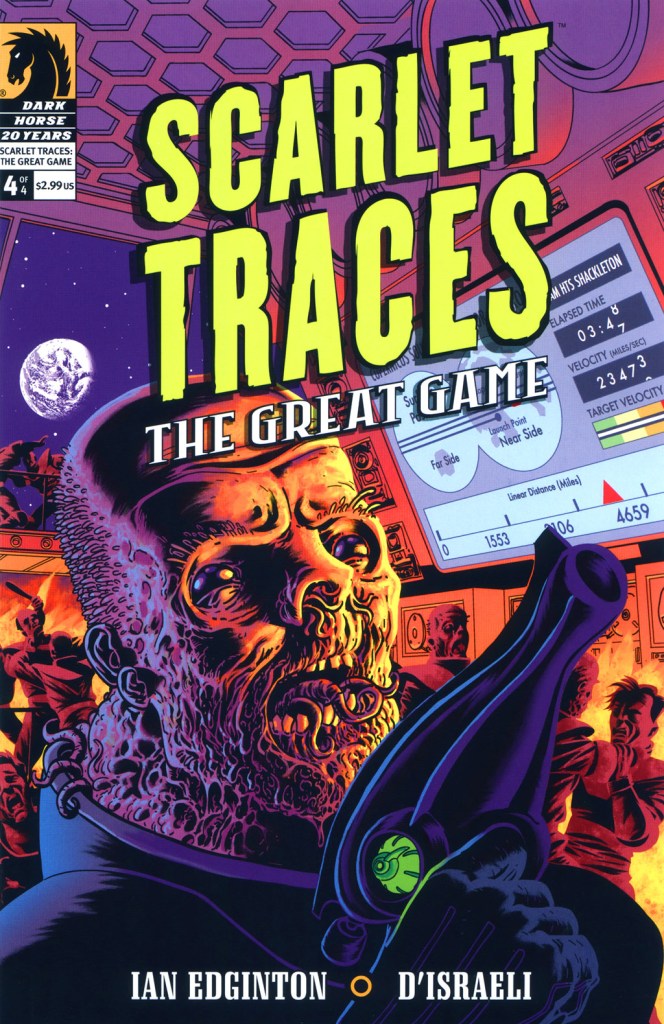
Last but not least… Scarlet Traces is a sort of sequel to Ian Edginton and D’Israeli‘s adaptation of H. G. Wells‘ The War of the Worlds, with heavy Dan Dare and Doctor Who references. This story wears its Englishness on its sleeve!
Scarlet Traces: the Great Game no. 4 (October 2006). Art by British artist D’Israeli, whose real name is actually Matt Brooker.
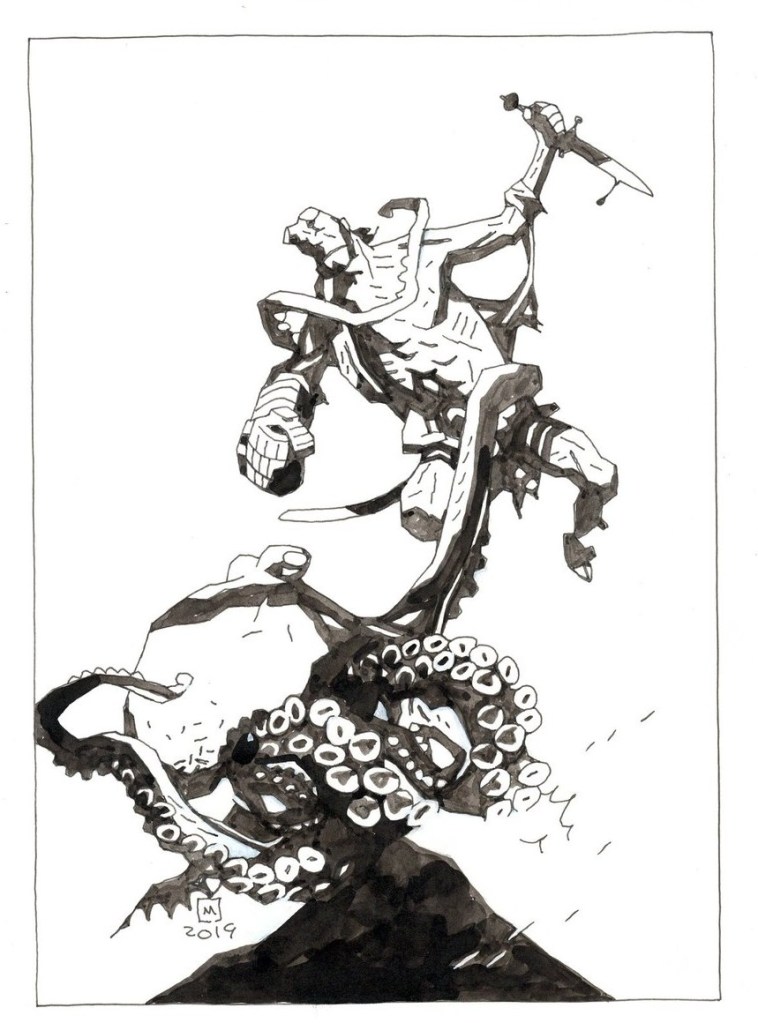
« Because sometimes, for whatever reason, you just want to draw an octopus. » — Mike Mignola, June 2019
I would say that this Tentacle Tuesday feature was started for a similar reason – sometimes one just needs to gather tentacled material, to share it more efficiently with like-minded weirdos.
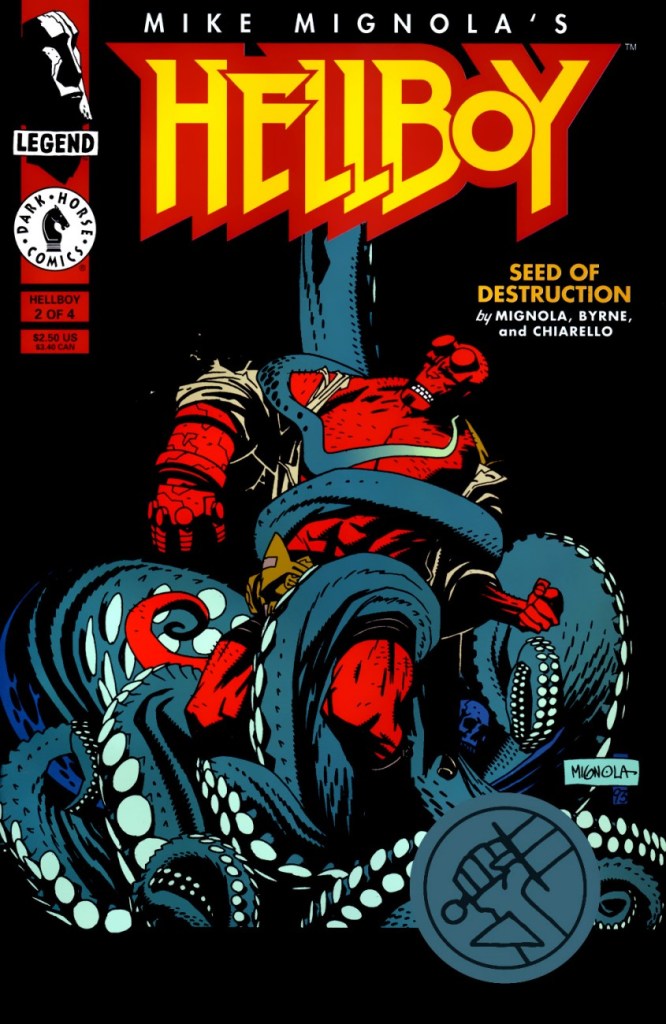
The back cover of Hellboy: Seeds of Destruction no. 2
I don’t imagine writer and comics artist Mike Mignola (most notably, creator of Hellboy and its spin-off B.P.R.D.) needs much of an introduction – he’s fairly ubiquitous in mainstream culture, and his style has been aped by many, which according to the proverb is the most sincere form of flattery. I was aware of this already, and yet was staggered by the sheer number of copycats I stumbled across while seeking out materials for this post.
I also started suffering from tentacle fatigue: as much as I love octopuses, seeing dozens upon dozens of fairly similar images made me weary. Mignola draws tentacles well, but he also draws them very, very often, and he also likes to revisit scenes already depicted. The result is a sprawling mess of sketches, variant covers and spin-offs of spin-offs… perhaps not inappropriate, come to think of it. This particular octopus has far more than just eight limbs!
Enjoy this barrage of Mignola tentacles, just make sure you’re in the proper mood for them 😉
Hellboy: Seeds of Destruction no. 2 (April 1994).
Page from Hellboy: Seeds of Destruction no. 3 (May 1994).
Sketch from June 2019.
ZombieWorld: Champion of the Worms no. 2 (October 1997)
No post of this nature would be complete without featuring, in some form or other, H.P. Lovecraft, arguably the father of our modern obsession with tentacles. On that topic, I am linking to an excellent article about Mignola’s relationship with the creator of the Cthulhu Mythos (be warned that it’s in French, sorry!)
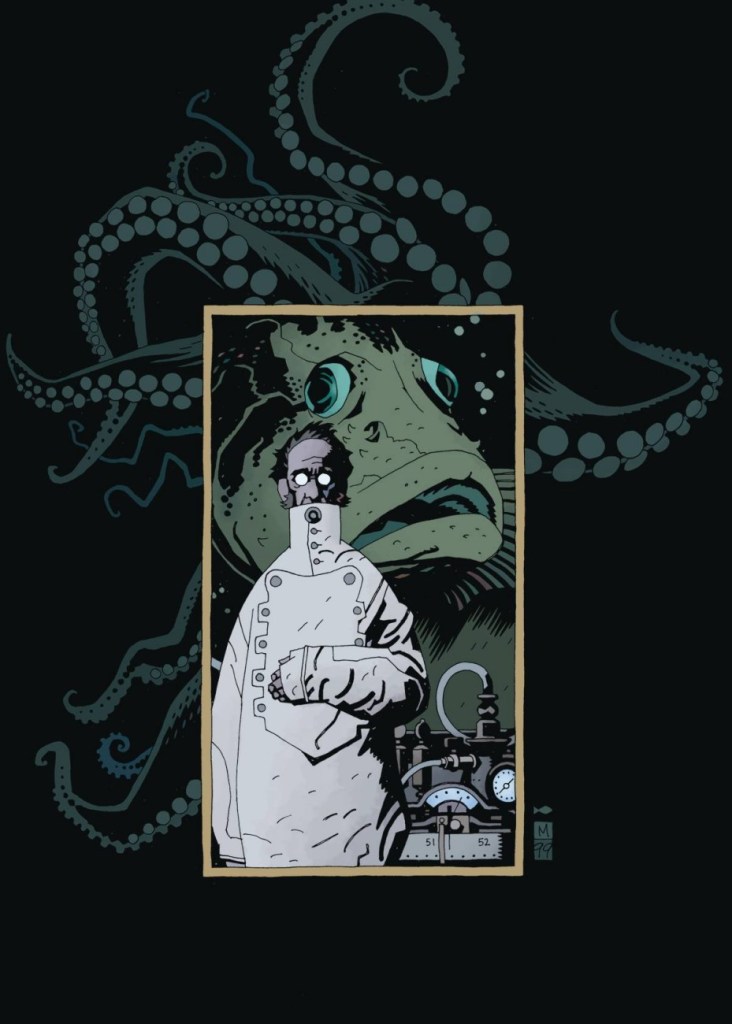
Art for the cover of Dark Horse Presents no. 142 (April 1999). Mignola made Lovecraft look downright dignified and borderline handsome, which is quite a feat, considering the latter’s unusual physiognomy.
Mignola revisited this very scene for his cover of Children of Lovecraft, and anthology of (non-comics) stories ‘inspired’ by Lovecraft (September, 2016). This was also published by Dark Horse.
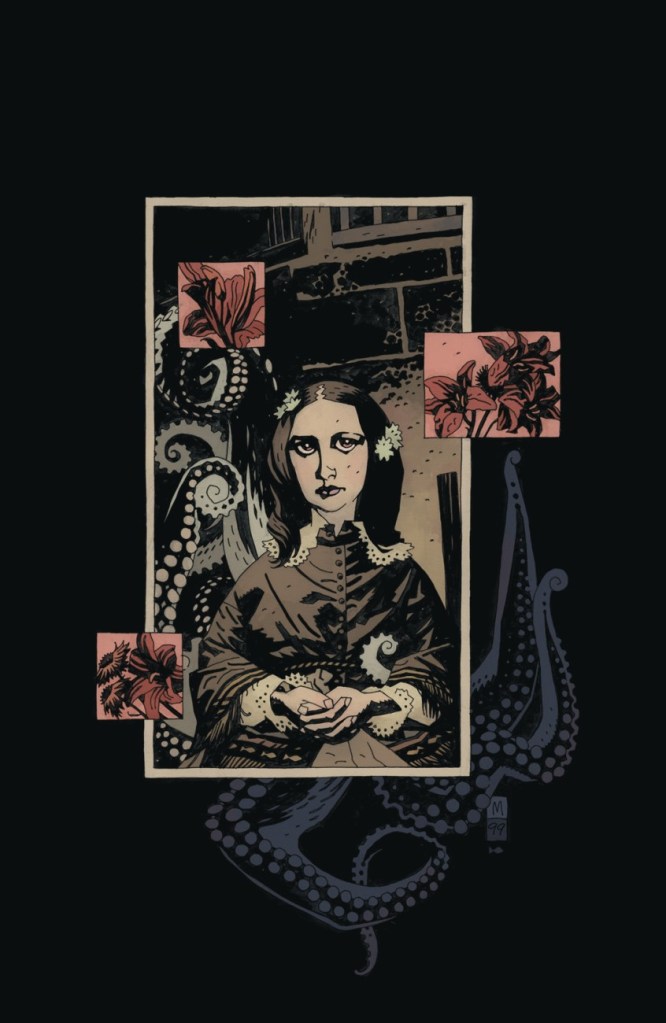
More Victorian England and Lovecraftian archetypes can be found within the pages of Jenny Finn:
Artwork for Jenny Finn no. 1 (June 1999).
Back cover artwork for Jenny Finn Messiah no. 1 (2005).
Even Batman, in Mignola’s hands, gets tentaclefied!
A page from Batman: Legends of the Dark Knight no. 54 (November 1993).
Batman: The Doom That Came to Gotham no. 2 (November 2000).
As a final note, I’d like to officially make a moue of distaste at people who share art without attribution, or without bothering to ascertain its source. To wit: a pair of images that are widely shared as Mike Mignola artwork… except that it isn’t by him at all, just by someone drawing in a similar style. Instagram and Pinterest are breeding grounds for such deplorable artistic credit robbery.
The following two illustrations are by Malaysian artist Daryl Toh.
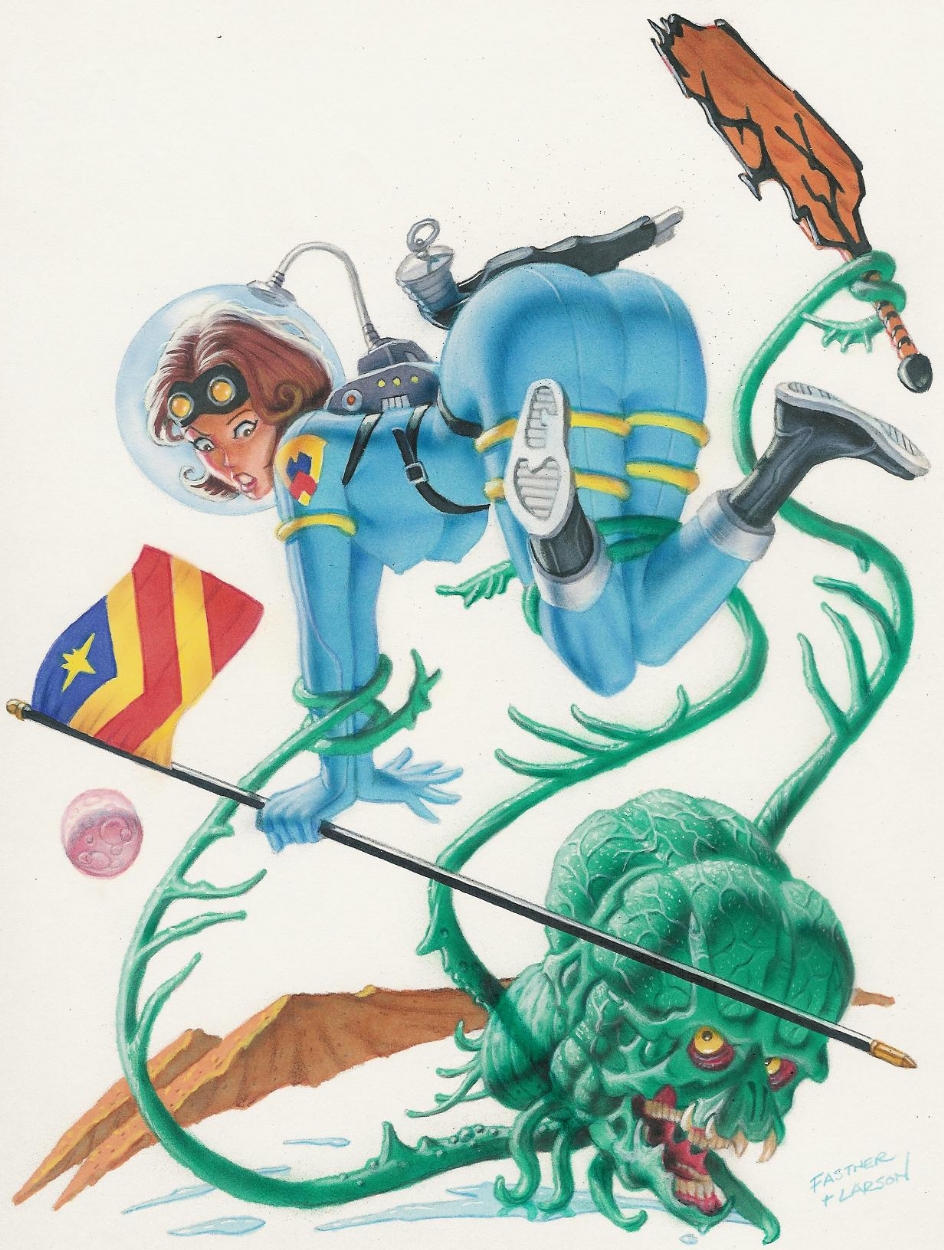
American artist Richard Larson has had his ink-smeared fingers in many pies. He has drawn ghost stories for Charlton Comics (see our posts dealing with that here and here), followed by some underground comics, followed by Marvel super-hero portfolios, followed by his own series Demon Baby, followed by…. He often works in tandem with other artists, most notably with Tim Boxell and with painter Steve Fastner (see a gallery of their collaborations here).
« Steve Fastner and Rich Larson have been working in concert since 1976, and together they create one entity of staggering abilities. Rich will lay down the structure of an illustration in pencil form, and then Steve will attack it with army of airbrushes – and when the dust clears – a magnificent painting stands proudly. For over a quarter of a century, they’ve been able to do this, working for comics, book publishers, advertising agencies, movies and television, and now the web. » (quote from Fastner and Larson Gallery, 2002)
Have you ever seen anybody looking so smug after having stabbed some creature to death?
Does the wild, groping beard of the old sea pirate count for tentacles? Indubitably. So does at least one of his hands.
This may be just a sea-serpent, but there are no pedants in this audience, right? Besides, those suckers are distinctly tentacle-like.
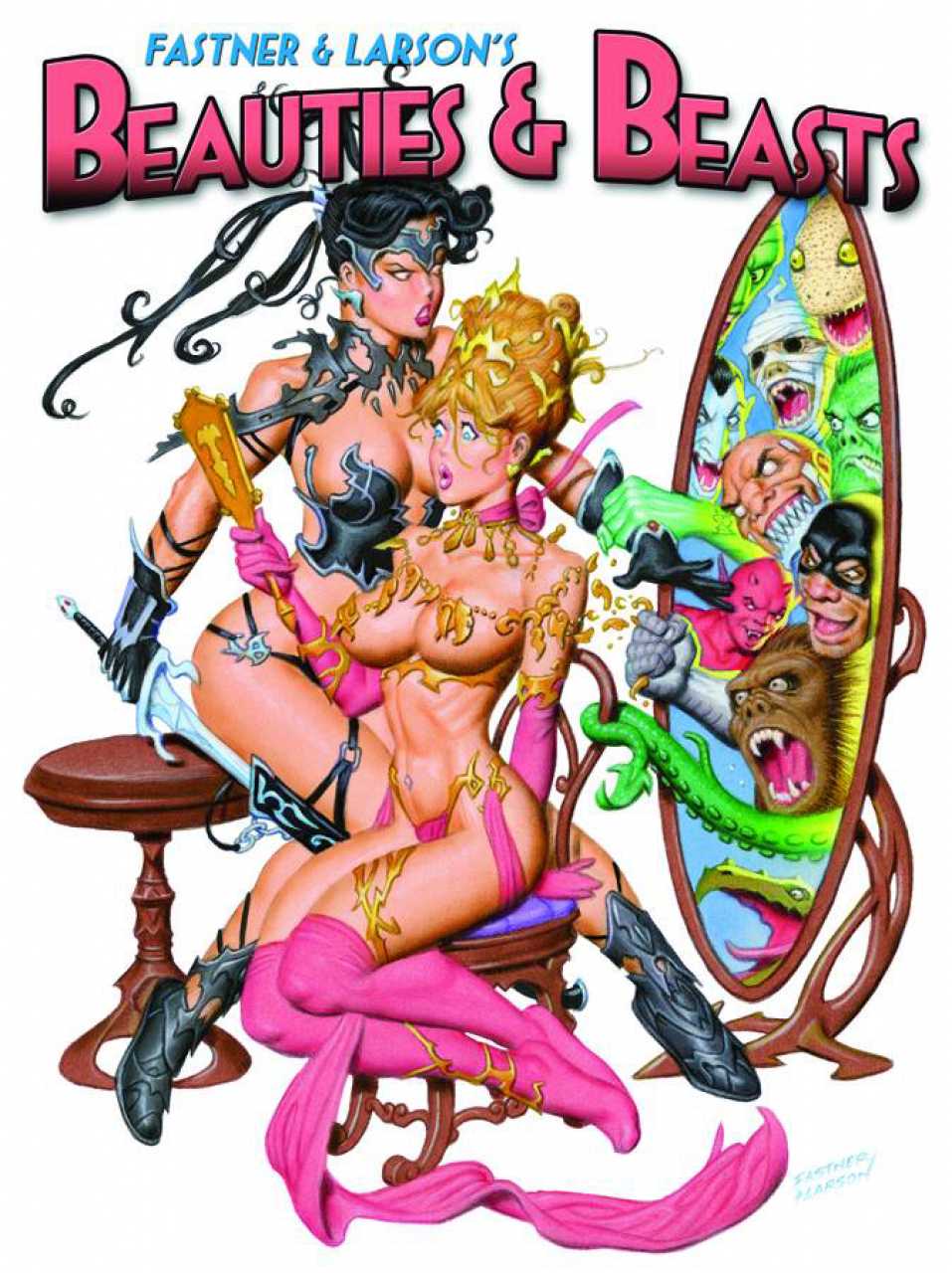
Fastner & Larson’s Beauties & Beasts (2010)
I would be remiss in not including a collaboration between Larson and underground comix artist Tim Boxell, whom I mentioned at the beginning of the post and then proceeded to neglect.
Art by Rich Larson and Tim Boxell
Speaking of beautiful women in varying states of undress… if I mention Haunted House of Lingerieto you, does it ring any bells? Does it sound like an intriguing concept? Then the first thing you should do is visit our Tentacle Tuesday: a Day at the Beach. Nothing like shameless self-promotion! But afterwards, you might want to seek out the three volumes published so far before the whole thing goes completely out of print.
Today’s Tentacle Tuesday is dedicated to Dark Horse Comics, one of the largest independent comic companies (the third largest, period, after Marvel and DC – at least according to their website). That being said, I’m not a huge dusky stallion fan – one of my gripes is that this publisher tends to reprint older comics (like the Harvey Comics Treasuries) on inappropriately glossy paper, as well as ramp up the contrast on the art until the background is so dazzlingly white you could probably blind yourself with it. On the other hand, a lot of mangas translated to English are published by their imprint, Dark Horse Manga – I am profoundly grateful for What’s Michael?, for instance (even though it’s not the first thing that comes to mind, manga-wise).
Throughout DH’s run (it was formed in 1986), it has housed the work of quite a few influential artists and writers, as well as published many long-running and award-winning series. Overall, this publishing house is a force to be reckoned with… and a lot of their pet series (like Hellboy) have tentacles galore. Shall we take a look-see?
Ragemoor no. 3 (May 2012), cover by Richard Corben.
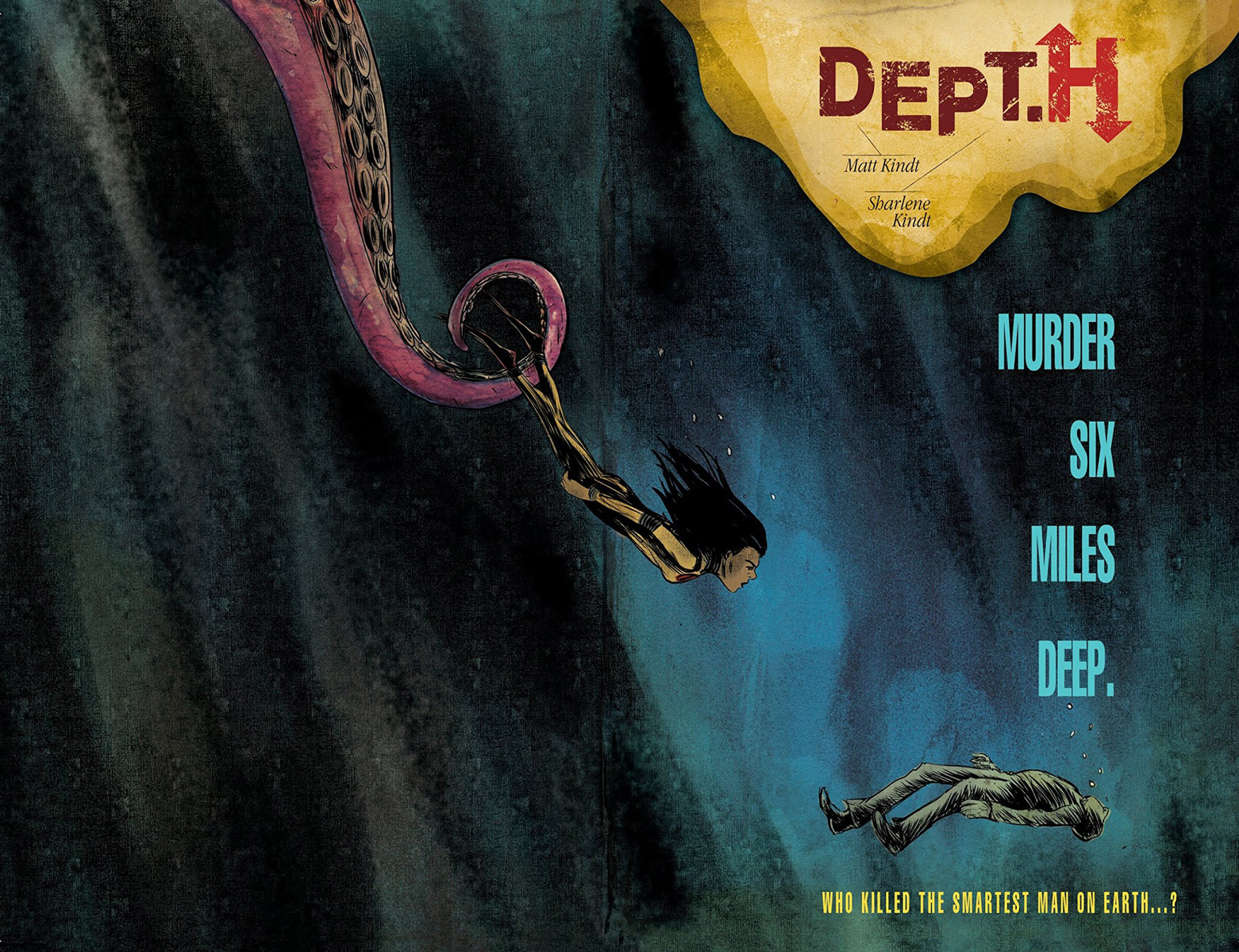
I’ll get around to reading Dept. H one of these days, but in the meantime, some tentacles from this suspenseful (or so say the reviews!) deep-sea who-dunnit:
Dept. H no.1 (April 2016), cover by Matt Kindt.
Dept. H no. 7 (October 2016), cover by Matt Kindt, colours by Sharlene Kindt.
Black Hammer / Justice League no. 1 (July 2019), a variant cover by Yuko Shimizu.
I mentioned Hellboy earlier – speaking of that, unsurprisingly, a large chunk of today’s post features covers from this ever popular series. But am I going to show you regular covers? Naah, too obvious.
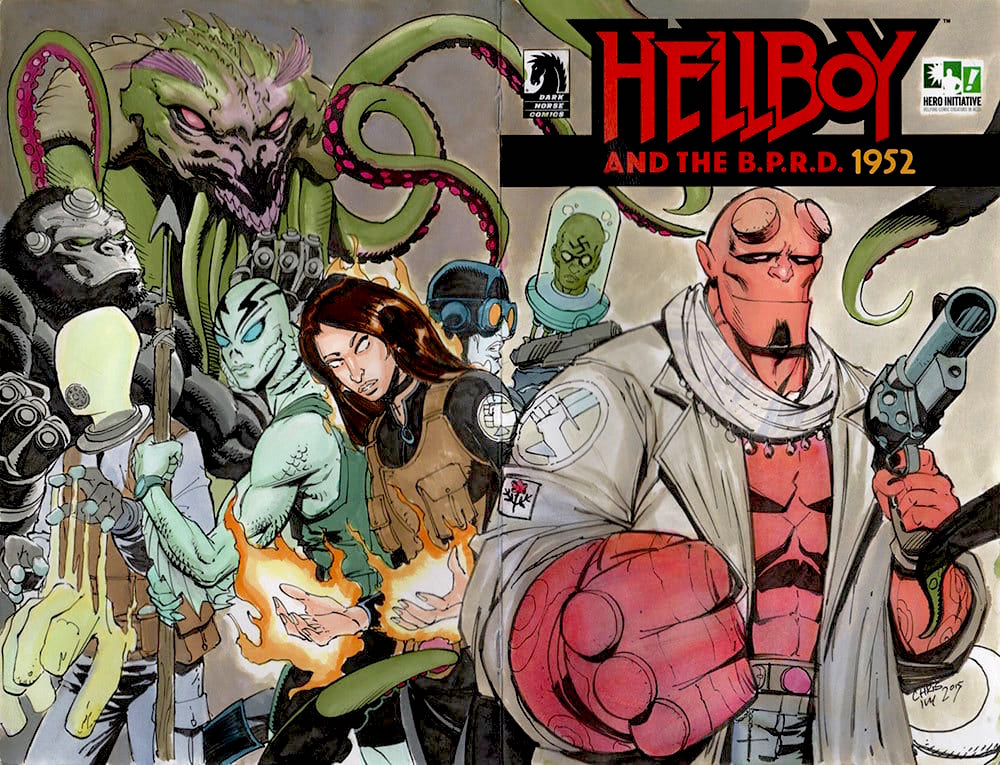
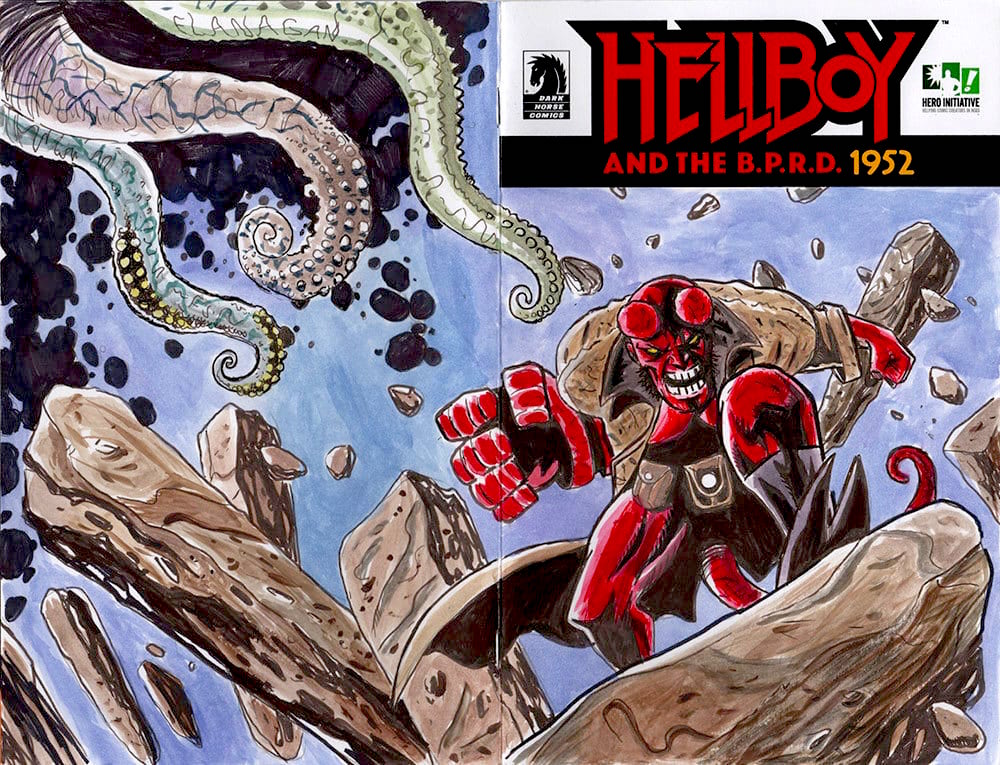
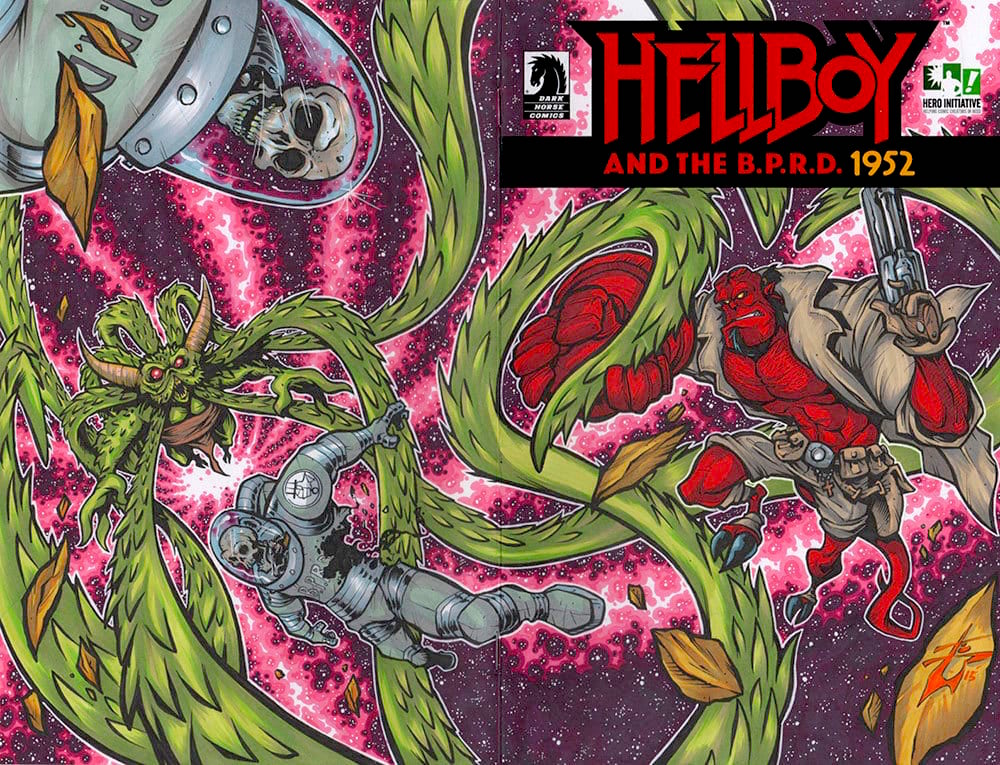
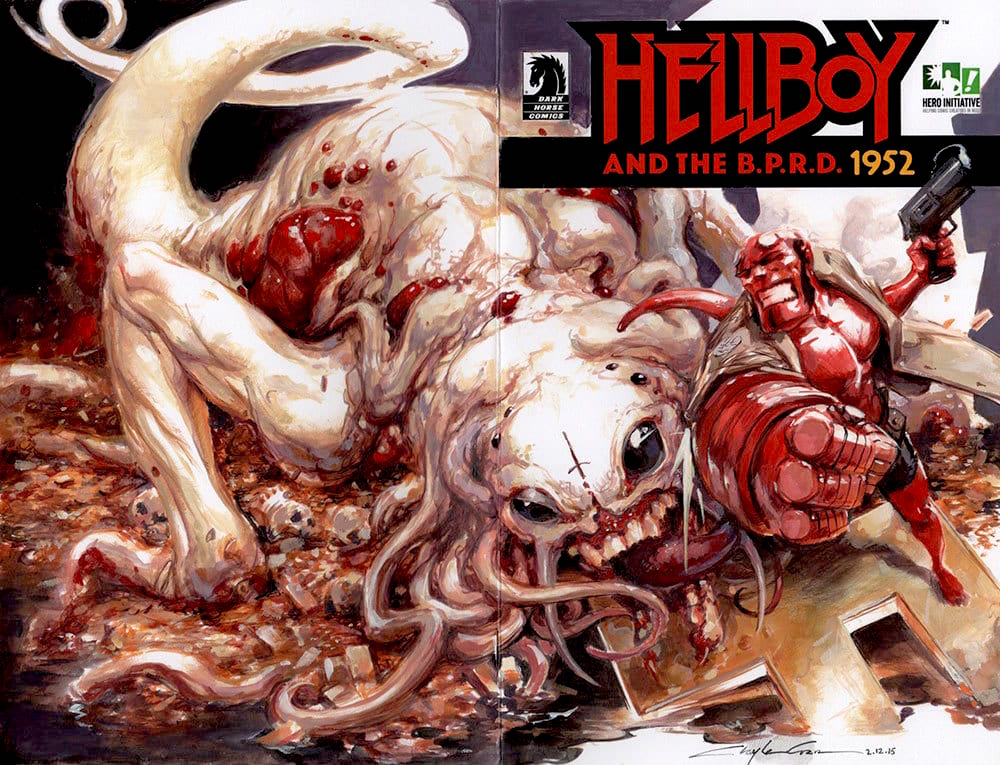
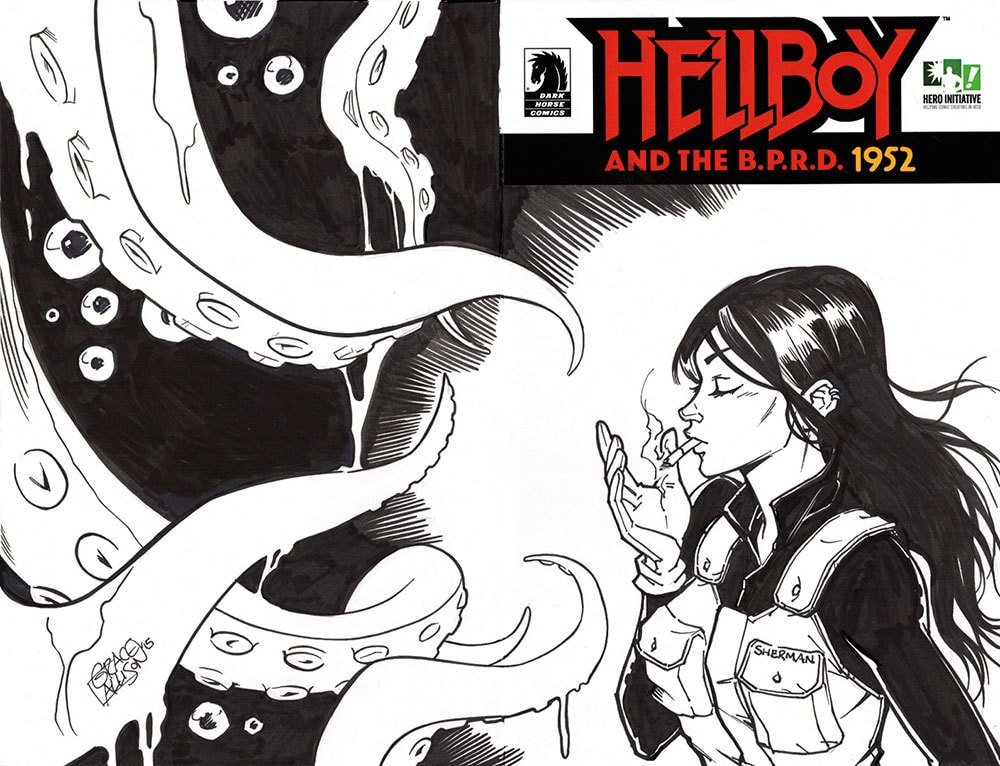
«Dark Horse Comics printed a precious few blank covers on the landmark Hellboy and the B.P.R.D. 1952 #1, and the Hero Initiative commissioned 100+ top artists to do an original drawing on each cover. Presented here is the gallery of ALL 109 original covers!» (See them here.)
I picked a few that I liked, but make sure you click on that link because about three quarters of those commissioned covers are awash in tentacles. Now that’s what I call good, nay, great commission art!
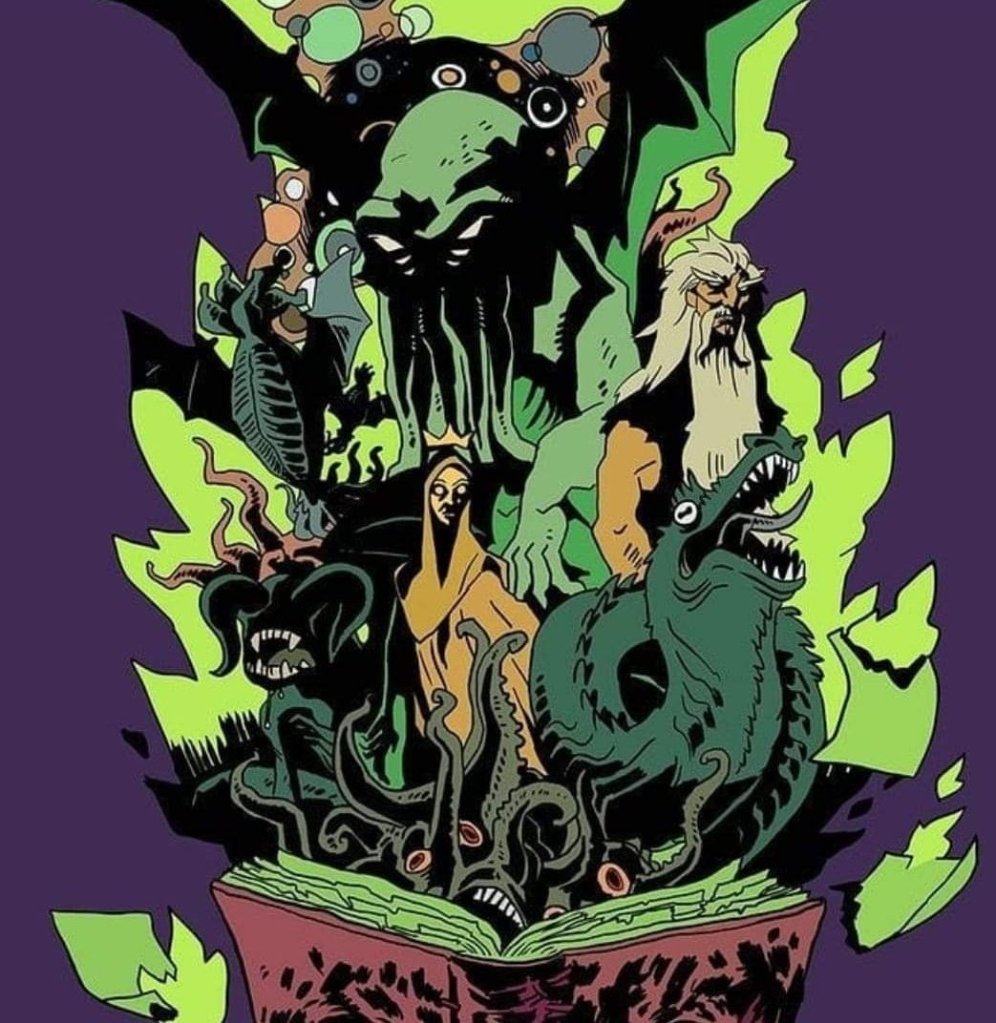
Cover by Chris Ivy. Chosen because despite the abundance of all manner of creatures, the eye is automatically drawn to the Cthulhian horror that’s politely waiting its turn for devouring and whatnot.
Cover by Walter Flanagan. They’re somewhat, shall we say, timid tentacles, but that’s what I like about ’em.
Cover by Ben Glendenning. Chosen because of the WTF factor of a creature with a dozen scaly, plant-like tentacle-arms.
Cover by Clayton Crain. Probably the most gruesome cover of today’s post, included for the blood and entrails and disquieting albino-ness of it all.
Cover by Allison Grace. I hope that cigarette isn’t implying anything… untoward has happened.
And a last cover, just to leave you on a quiet, peaceful note…
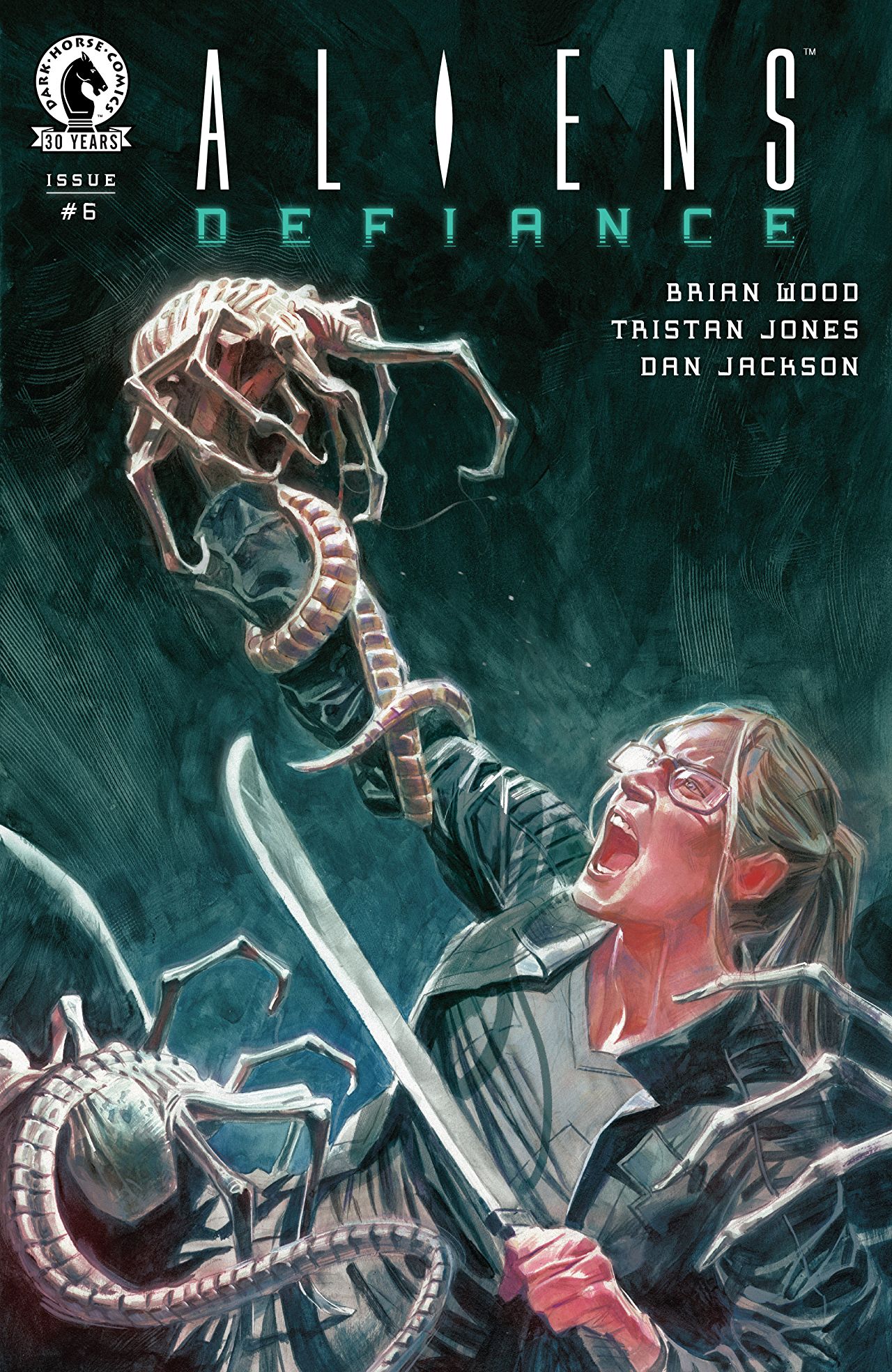
Aliens: Defiance no. 6 (October 2016).
This is, by no means, an exhaustive list – stay tuned for a Part 2, coming to your computer and cellphone screens sometime soon (when you least expect it!)
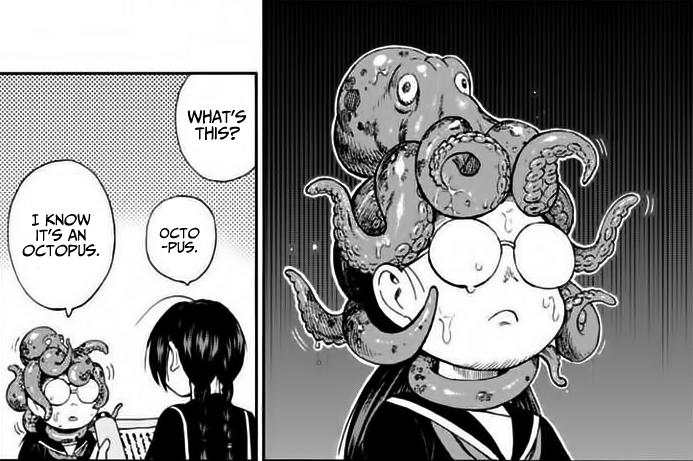
Last night, an octopus materialized into my office and reproached me for neglecting manga during my Tentacle Tuesday forays. I vowed to do better! As octopuses are impatient fellows, I decided not to tarry and complied immediately.
Panels from Shinobuna! Chiyo-chan, a comic by Kiyoto Shitara. Begun in 2017, it is still going and is being published by Tokyo-based Kadokawa Shoten. Read it here.
While the previous manga is about a schoolgirl trying to get her classmate’s attention (she’s also a ninja, not that it simplifies matters), the following concerns itself with a shy boy who falls instantly in love with a (male) student from his class and spends the rest of the story trying to get closer to him.
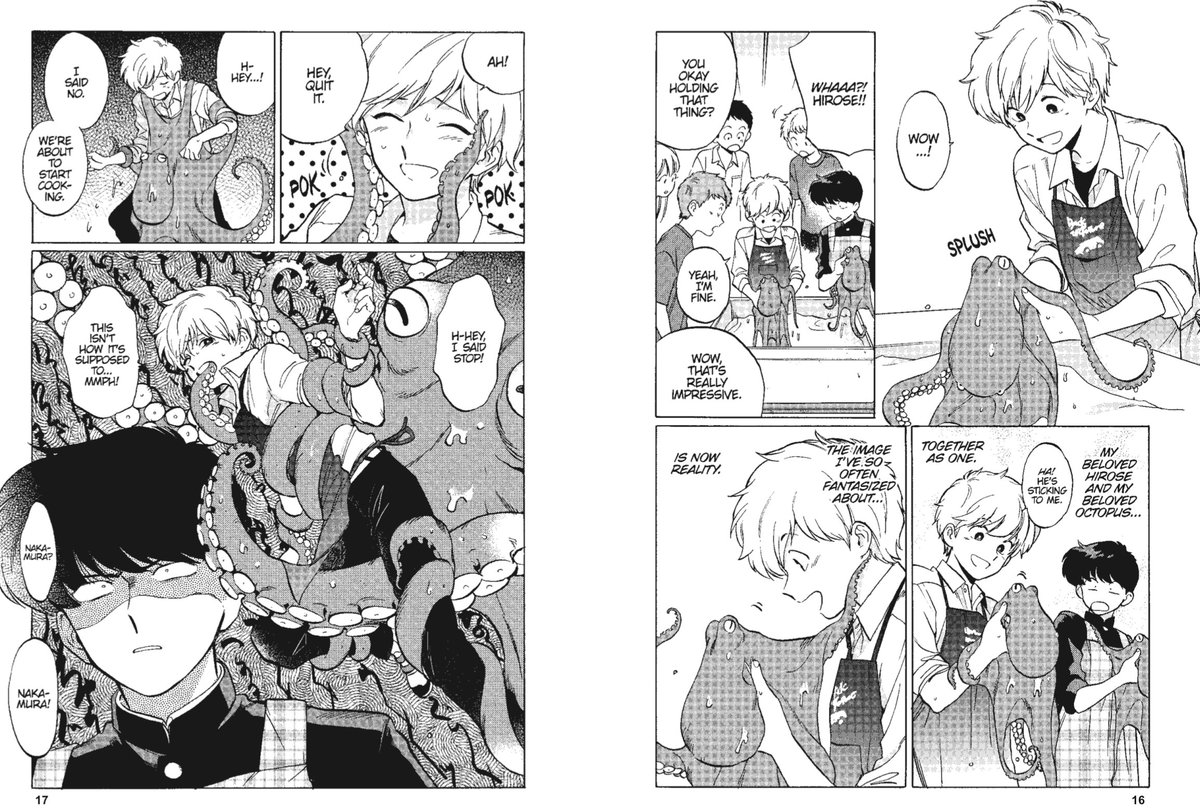
Go For It, Nakamura!, started in 2014, is written and illustrated by Syundei and published by Akane Shinsha.
That’s Nakamura’s pet octopus, Icchan. « Octopi like to go into crevices, don’t they?! Wow, look at how squishy it is! »
Adventures in Poor Taste’s Trevor Richardson wrote a slightly extravagant review of Go for It, Nakamura! that delves deep into this manga’s the cephalopod imagery. Just for the fun of all the octopus metaphors, I’ll quote:
« As a queer person, I couldn’t help but identify with that queer young man who doesn’t yet know how to use all the extra arms that queerness grants him. Who doesn’t yet know how to push his tentacles up against the metal lid of self-doubt and oppression and twist it off. Who isn’t yet able to expel all that confusion and rejection like a cloud of black ink and surge down to trenches where straight people never dare drift to join his fellow otherworldly, queer creatures in the dark. »
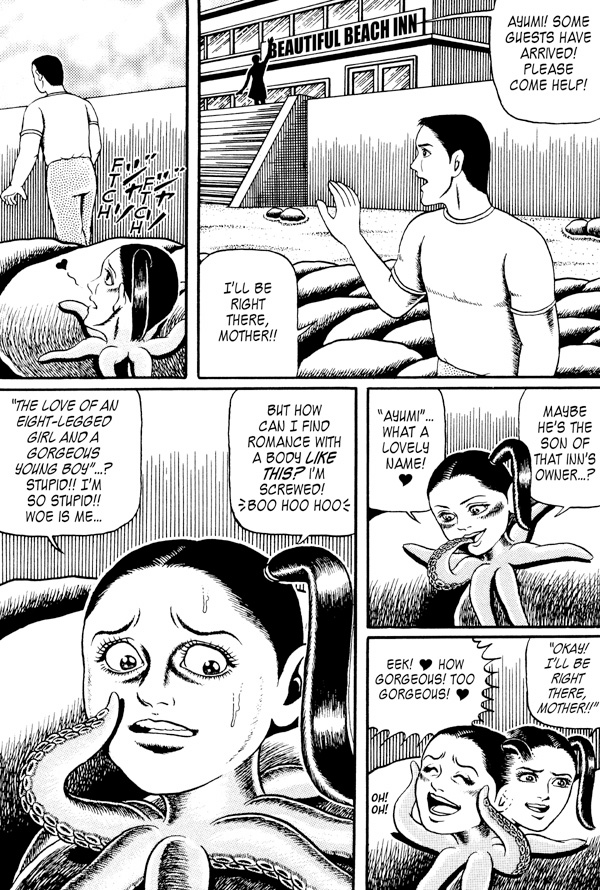
To those who aren’t into high school romance but prefer their manga on the side of the macabre and the bizarre, I propose Octopus Girl by Toru Yamazaki (1990), though the events still mostly take place at a school. Takoko, our main character, is bullied by her classmates and nearly killed by them when they decide to semi-drown her and then force her to eat a live octopus (to which, the story specifies, she is allergic, because eating a live octopus isn’t horrifying enough as it is). As a response to this ordeal, she turns into an octopus (with a girl’s head) and exacts terrible revenge on her bullies!
The English publisher describes it as “delightfully disturbing” – at any rate, I certainly agree with the “disturbing” part. Here, Takoko eats her own appendages for sustenance (don’t forget to read from right to left.)
« Teenage monsters lose their hearts and heads in a relentlessly gory collection of dark humor and horror! Carving a comical niche in modern horror manga, Toru Yamazaki’s Octopus Girl serves up the most disgusting dishes of heartbreak and revenge found on land or at sea. Have a side order of nervous laughter with your main course of bloodcurdling fear, some gore with your teen angst, and some killer instincts with your kawaii! These shocking vignettes will hypnotize fans of the macabre and the absurd, as intestines, eyeballs, and fluids of all sorts shoot enthusiastically across Yamazaki’s pages! »
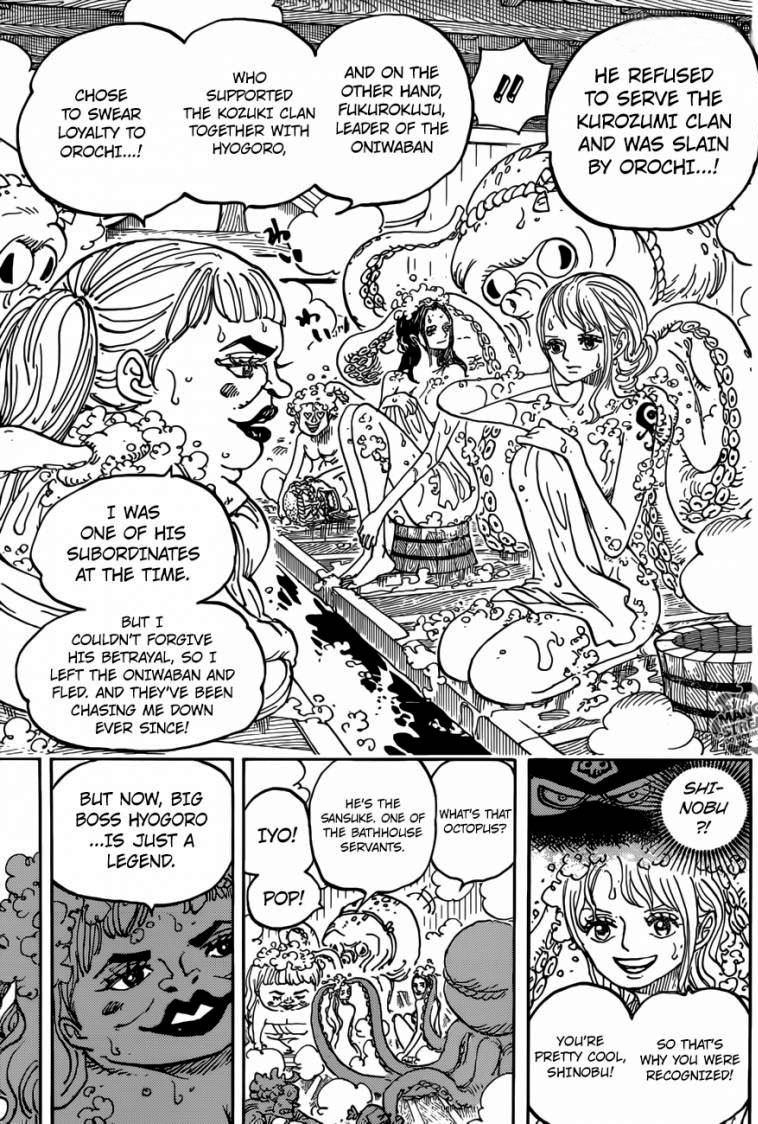
Page from One Piece, a humorous manga series by Eiichiro Oda, serialized in Shueisha‘s Weekly Shōnen Jump magazine since 1997. Read it here if you’re so inclined – in terms of posting copyrighted content, otakus seem every bit as bad as Russians. « The story follows the adventures of Monkey D. Luffy, a boy whose body gained the properties of rubber after unintentionally eating a Devil Fruit. With his crew of pirates, named the Straw Hat Pirates, Luffy explores the Grand Line in search of the world’s ultimate treasure known as “One Piece” in order to become the next Pirate King. »
Moving on to proper horror – in the sense of it being devoid of comedy -, two pages from Junji Ito’s Gyo Ugomeku Bukimi (Fish: Ghastly Squirming), published as a series between 2001 and 2002 in the Japanese weekly manga magazine Big Comic Spirits. I’m enough of an aficiona-Ito to own most of his work that’s been translated into English, and though a lot of his stories are rather hit-and-miss, Gyo is one of the genuinely gruesome ones.
Ito is quite adept at conjuring up quite far-fetched yet terrifying plots, with events spinning faster and faster out of control until… until he doesn’t quite know how to tie up the story. Having gone so deep into the utter destruction of the world, there’s no elegant dénouement available but sheer Armageddon. That is definitely a weakness, so I tend to prefer his short stories, where the conclusions are fast and hard-hitting. That being said, I definitely recommend reading Gyo (read it here, but remember to support the artist by purchasing!) and Uzumaki (another terrifying read likely to leave you with a phobia of spirals). For an excellent discussion of Junji Ito’s appeal, please consider the excellently written The Horrifying Appeal of Junji Ito.
Okay, a couple more horror comics!
Page from Devilman, written and illustrated by Go Nagai, published from 1972 to 1973 in Shōnen Magazine. This has very typical manga art, which is to say, art that doesn’t appeal to me. But a vicious female demon with tentacles *everywhere*? I wasn’t going to say no to that.
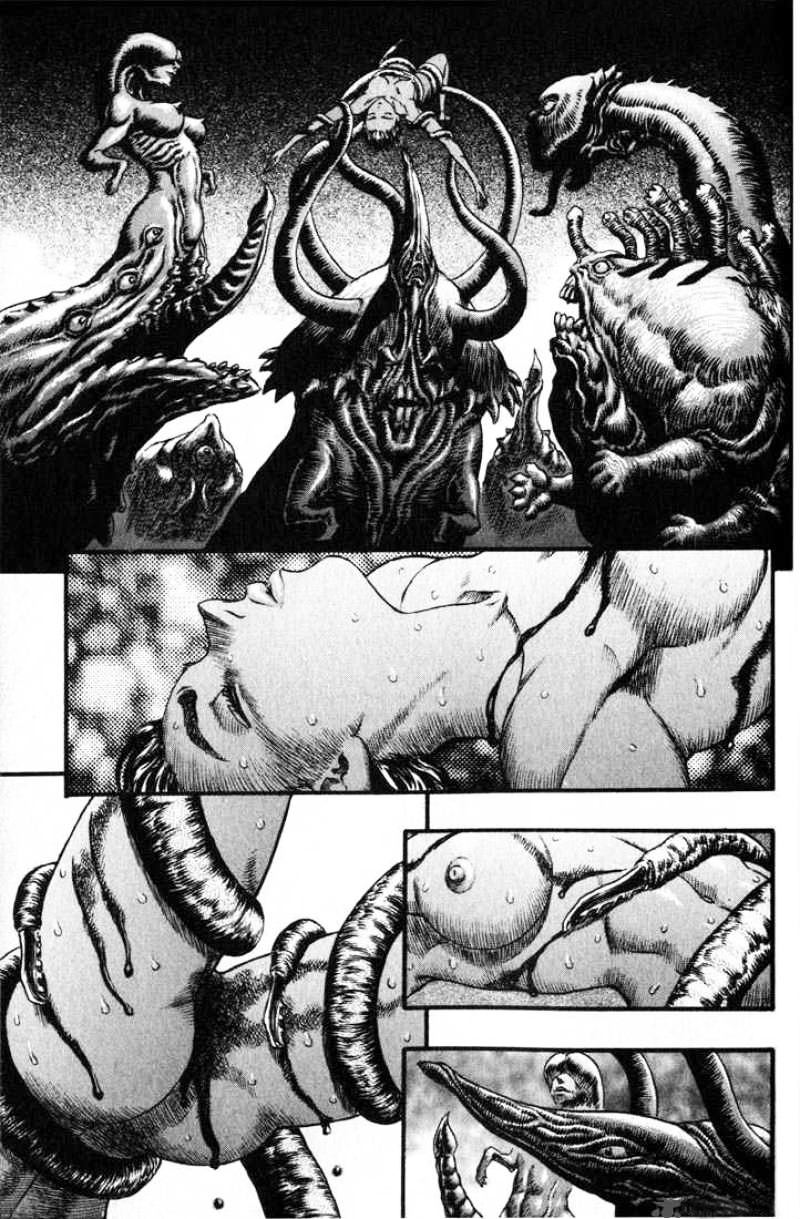
I’ll leave off on a somewhat… sexualized… note with two pages from the dark world of Berserk by Kentaro Miura, first published in 1988 and still going on. It’s been called one of the greatest literary works in all of manga… well, I can’t vouch for that, as I haven’t read much of it, but it does seem complex, at any rate.
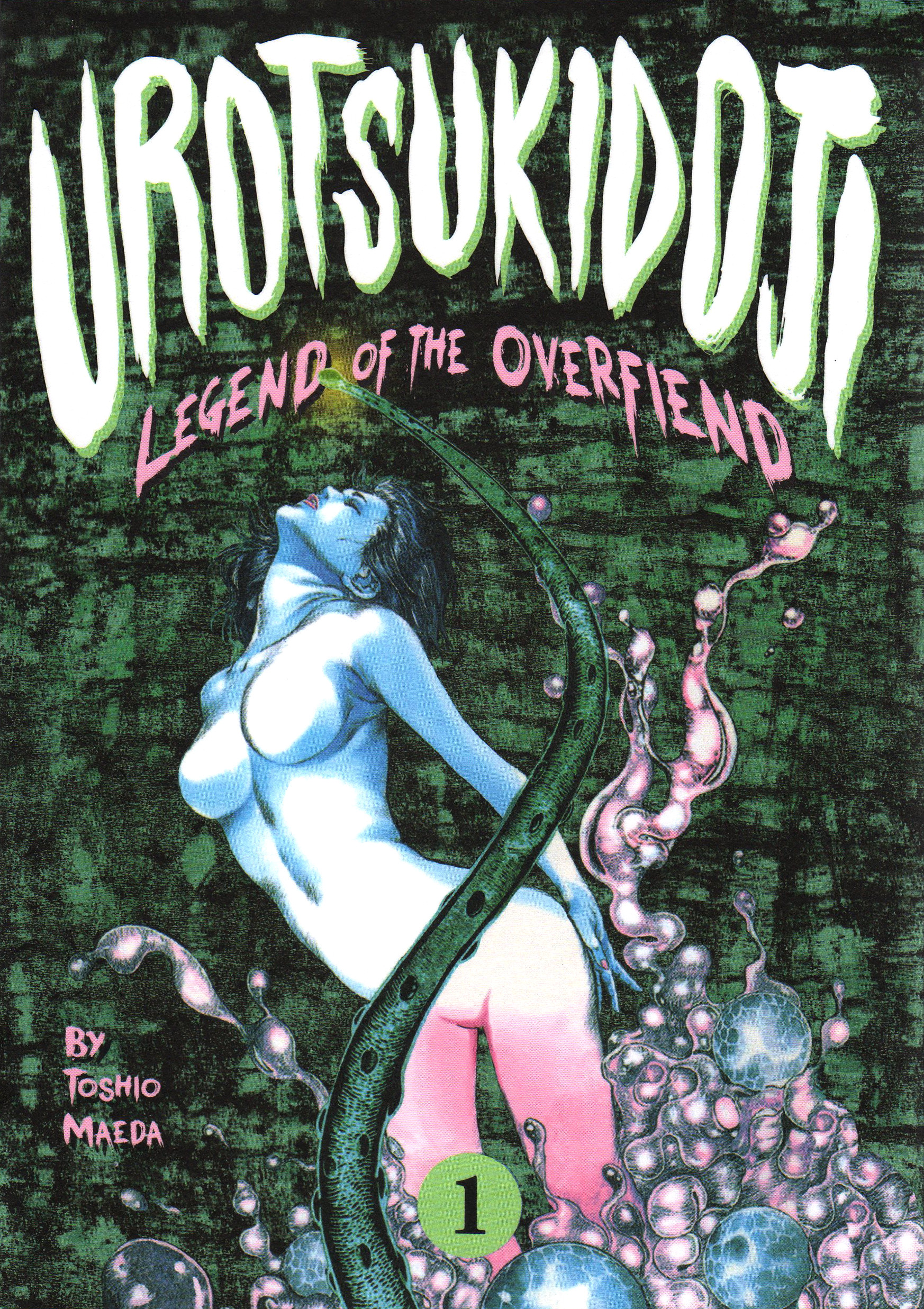
Oh, as long as we’re on the topic of probing tentacles, I’ll wrap up with some Toshio Maeda, an erotic manga artist and pioneer of hentai. His best known work is Urotsukidōji: Legend of the Overfiend which been credited with popularizing the trope of tentacle rape. Fellow tentacle lovers, are you for or against such a use of tentacles? Please let us know in the comments.
Urotsukidōji: Legend of the Overfiend by Toshio Maeda, serialized in Manga Erotopia from 1986 to 1989. Were nipples verboten, one may wonder, or is this just a demon of some kind?
Panel from Urotsukidōji: Legend of the Overfiend by Toshio Maeda. If you’re in the mood for further tentacles, visit The Tentacle Lounge, an aptly-named blog devoted to Maeda.



































 Who's Out There?