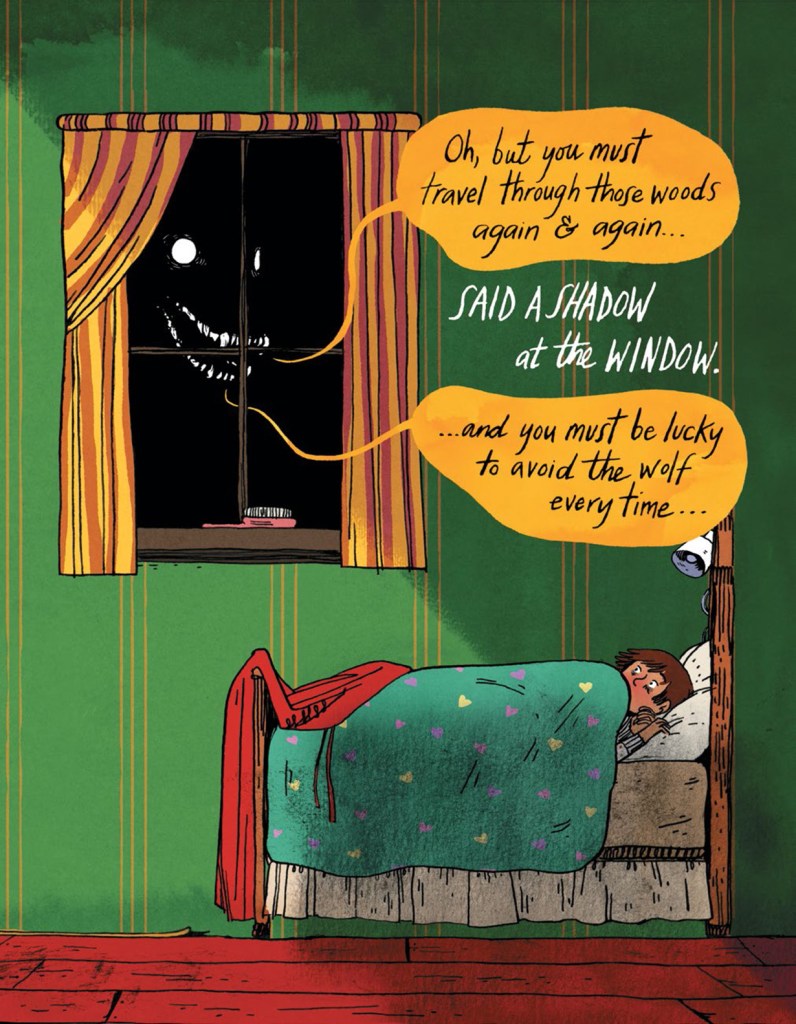
Hallowe’en Countdown VIII, Day 30

« New mysteries. New day. Fresh doughnuts. »David Lynch

Welcome to the bewitching burg of Blinsh, Pinksylvania, where vampires peacefully coexist with ‘normal-type Blinshites’, though the latter do exhibit a touch of grumpiness when suddenly bitten by their fanged neighbours. Put on your cape (surely you own a cape?) and follow us to this land of boiled turnip and sauerkraut doughnuts… but I would recommend not going on an empty stomach.
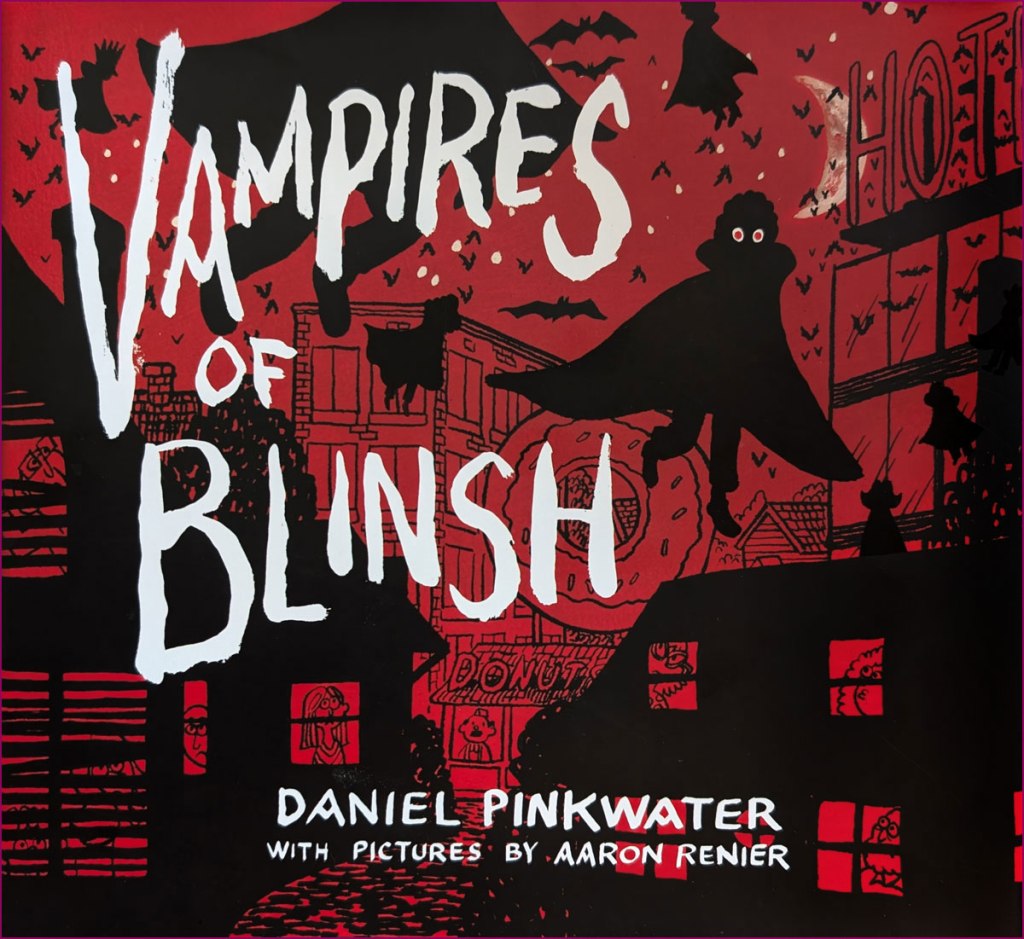
The pages of Vampires of Blinsh (Sept. 2020, Abrams Books for Young Readers) are positively overflowing with jolly vampires, promenading chickens, sneaky racoons, people tripping over bikes, floating basketball players, children munching doughnuts, janitors in eyepatches, and so on. In short, a typical Daniel Pinkwater creation, and I say this with the utmost delight.

This book was illustrated by Aaron Renier, whom I already knew from his young readers series The Unsinkable Walker Bean. The latter definitely has its heart in the right place, but failed to fully capture my interest, though I can confirm the art was great, so I was happy to see Renier’s drawing talent matched up with a story I could really sink my fangs* into. Not that Vampires of Blinsh has a story, per se – which seems to have baffled a few readers, some of whom, judging by their reviews, found it confusing and indecipherable. VoB is more of a quick dip into the non sequitur, somewhat absurd, always charming world of Pinksylvania, as readers are taken on a quick tour of Blinsh, its twin sister city Blorsh, as well as the capital of Pinksylvania, Farshningle. Many potential storylines are hinted at, but none are lingered upon, as Pinkwater effortlessly flings ideas (of which he clearly has an abundance) around and pirouettes on to the next vignette.
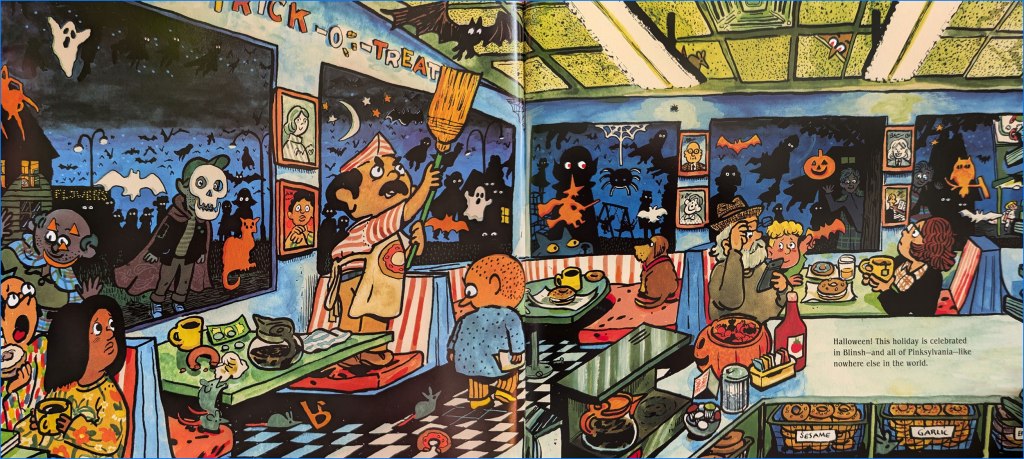
Hallowe’en in Blinsh!
« But there is no place like home, which is to say there is no place like Blinsh. »

It actually turns out that this book was in no way the result of a straightforward collaboration between artist and writer. Co-admin RG got the story from the horse’s mouth (the horse, naturally, being DP), and here I quote Pinkwater’s anecdote**:

« The book had a completely different text. It was one of those cumulative counting stories. […] The book was written before Covid, the illustrator did his thing, with no input from me at all. And when it was ready for publication, the editor, the illustrator and I all realized it would seem we were making sport of something that looked like going to be a worldwide catastrophe…making sport or trying to capitalize on an event that would cause millions of deaths. People would break our windows. So we decided to kill the book. For all I know the bound copies, (which may have already been on the boat), were dumped into the sea. I own two sets of proofs. I asked my colleagues if I could try to come up with a new text, not a single drawing to be changed. They let me do it. It was printed with my new words, and that’s the book you have. The three of us promised each other we would never tell the story I’ve just told you– (I am not to be trusted). Now I wish we had let the original version be published. We could have sent a copy to Donald Trump. If someone read it to him, he might have understood the nature of a pandemic, and lives could have been saved. »

Were Blinsh and Blorsh even part of the original tale? Who knows. Let’s chalk it all up to serendipity and wander off to procure Kat Hats (Sept. 2022, Abrams Books for Young Readers), another Renier-Pinkwater collaboration .

~ ds

* I used to have pointy canines, until my orthodontist decided to file them down without asking for my opinion first – and this is by no means a unique experience, as is evidenced from any discussion on social media about the delights of orthodontistry. Some of those ‘professionals’ are true ghouls.

** Pinkwater’s Anecdote is less known than, say, Occam’s Razor, Chekhov’s Gun or Russell’s Teapot, but maybe we can squeeze it into the pantheon of eponymous principles anyway, something like ‘entertaining stories can be found wherever Pinkwater goes‘.

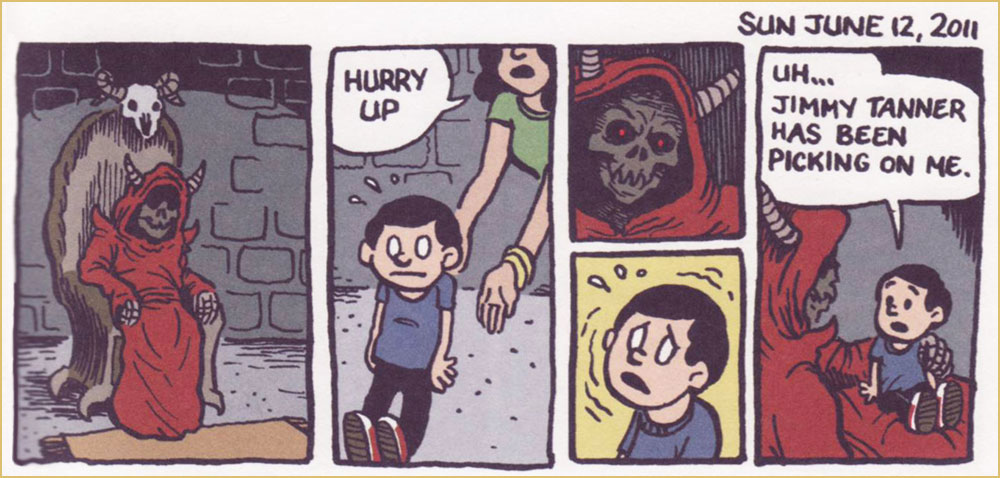
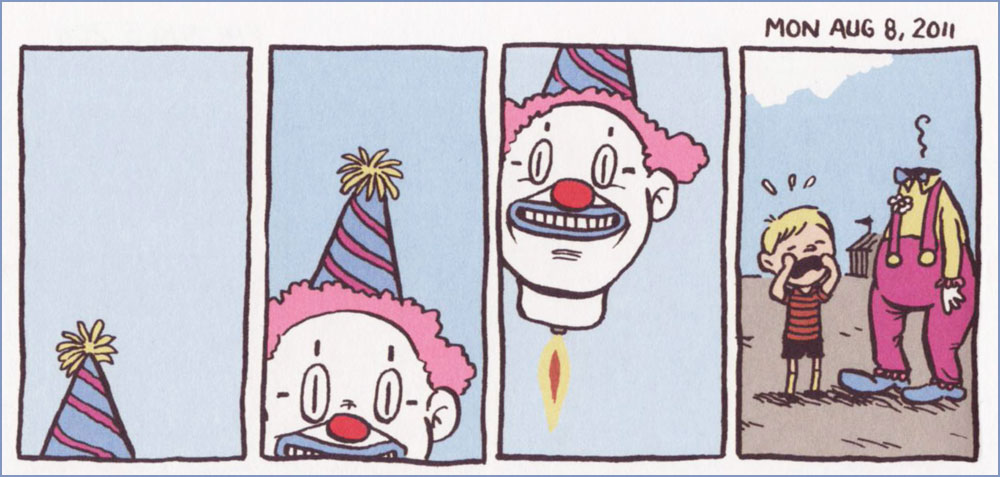
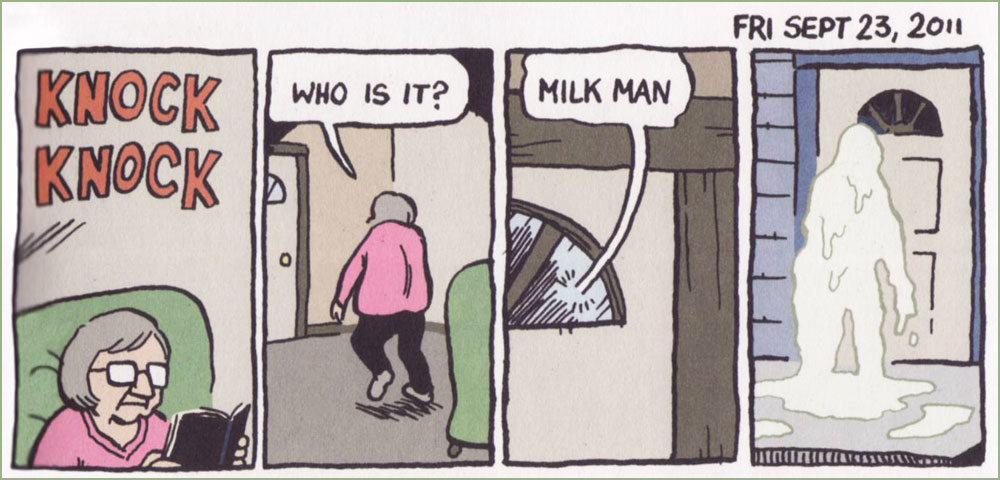
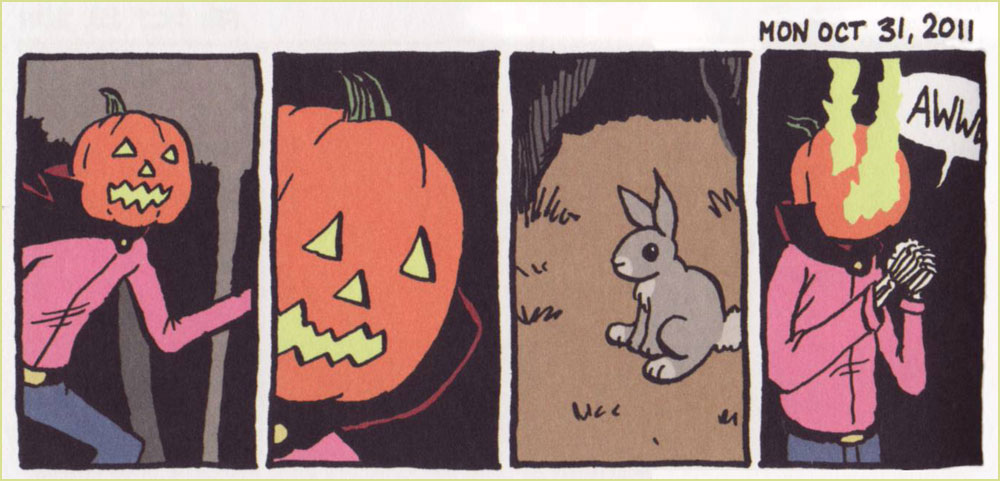
Hallowe’en Countdown VIII, Day 28

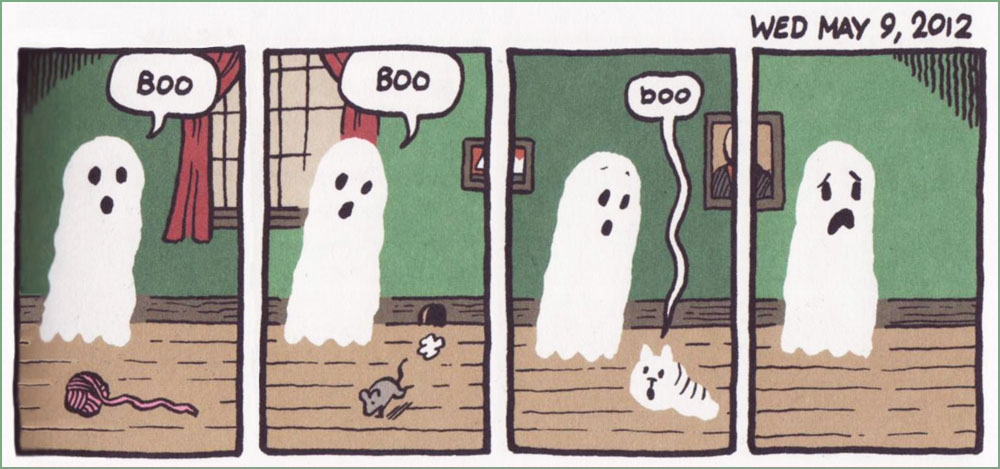
« You weren’t really supposed to see these comics… » — Dakota McFadzean

« And just who is this Mr. McFadzean? » you may ask.

« Dakota McFadzean is a Canadian cartoonist who has been published by MAD Magazine, The New Yorker, The Best American Comics, and Funny or Die. He has also worked as a storyboard artist for DreamWorks and Netflix. McFadzean is an alumnus of The Center for Cartoon Studies (2012).

He has three books available from Conundrum Press: Other Stories and the Horse You Rode in On (2013), Don’t Get Eaten by Anything (2015), and To Know You’re Alive (2020). McFadzean was a co-editor/co-founder of the comics and art anthology Irene, and distributes his own short stories in his ongoing minicomic series, Last Mountain. He currently lives in Regina, Saskatchewan with his wife and two sons. »

My chance encounter with Mr. McFadzean’s work came through the above-named 2015 collection, and while a daily webcomic is by design uneven, this one scales impressive heights far more often than the law of averages would predict. I’ll say this for him, he’s mighty skilled in conjuring up and expressing existential angst… adroitly melding the waggish and the distressing.

All strips excerpted from Don’t Get Eaten by Anything: a Collection of “The Dailies” 2011-2013 (Conundrum Press, 2015).

-RG

Hallowe’en Countdown VIII, Day 11

« … devolving into a downright National Socialist muck of murderous paranoïa, a Lord of the Flies for our new century… »

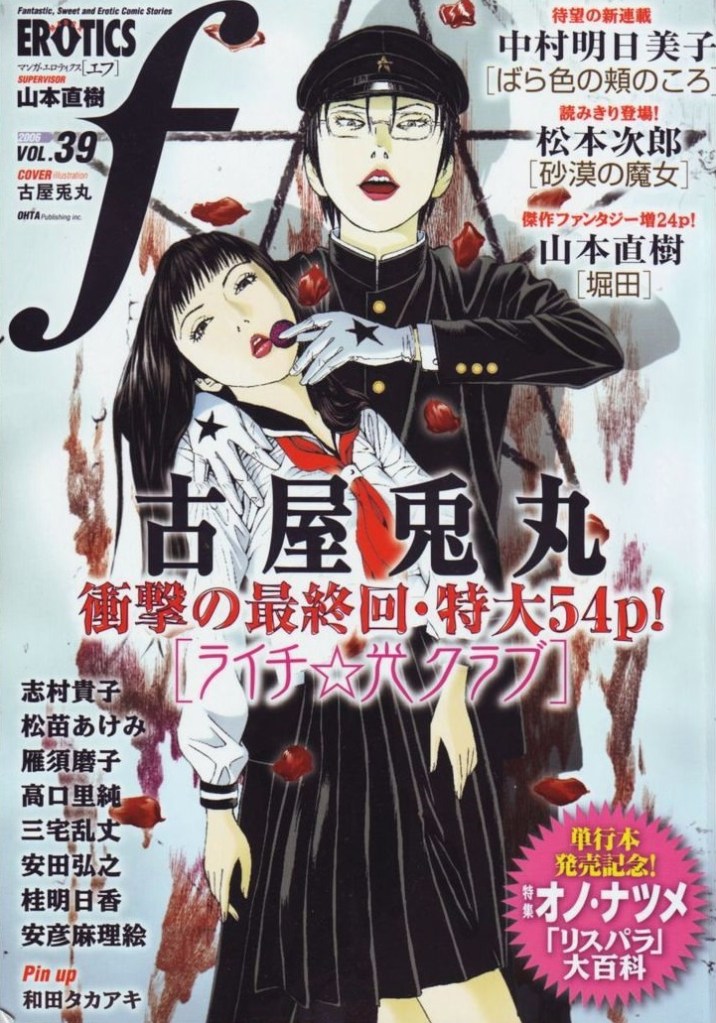
Lychee Light Club, aka Litchi Jirai Club (ライチ☆光クラブ), is a manga written and illustrated by Usamaru Furuya, who was smitten by a theatre play of the same name after watching it in 1985 as a high school student. Years later, he recreated it in manga form, albeit with a somewhat modified plot. It was serialized in Ohta Publishing’s Manga Erotics F* (May 7, 2005 – May 3, 2006). As for the play, it was directed by Norimizu Ameya** for the theatrical group Tokyo Grand Guignol (it’s funny to see the French ‘guignol‘ in this context).

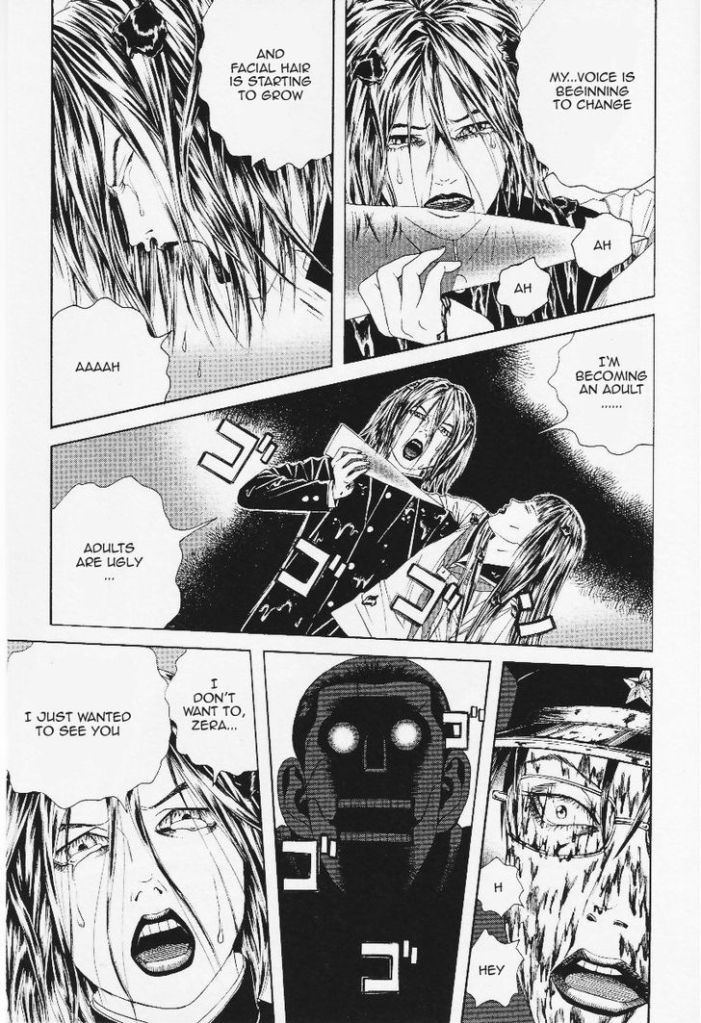
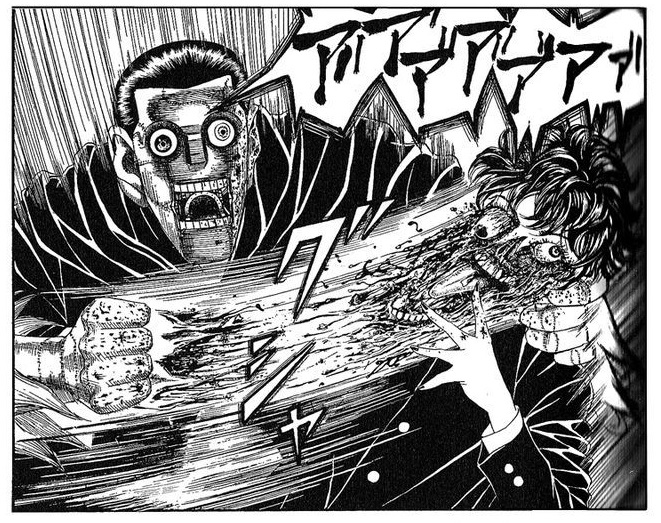
Lychee Light Club‘s over-the-top violence elicits the occasional chuckle (one of its characters dies from somebody pitching a toilet through his midsection), and more than one wince of discomfort, too, as its schoolkids maim, bash and burn their way through the story. The premise is simple – Lychee Light club (more of a cult, really) consists of eight barely-teenage boys who worship youth as the ultimate symbol of beauty (and, consequently, hate all things adult). They have nice digs where they spend all their time after school – an abandoned factory with plenty of dumped implements useful in their pursuit of the sadistic. They are led by the charismatic and cunning ‘Zera’ (actually, Tsunekawa from class 2), whose charm and fine features inspire blind devotion from his gang, not to mention occasional sexual favours.

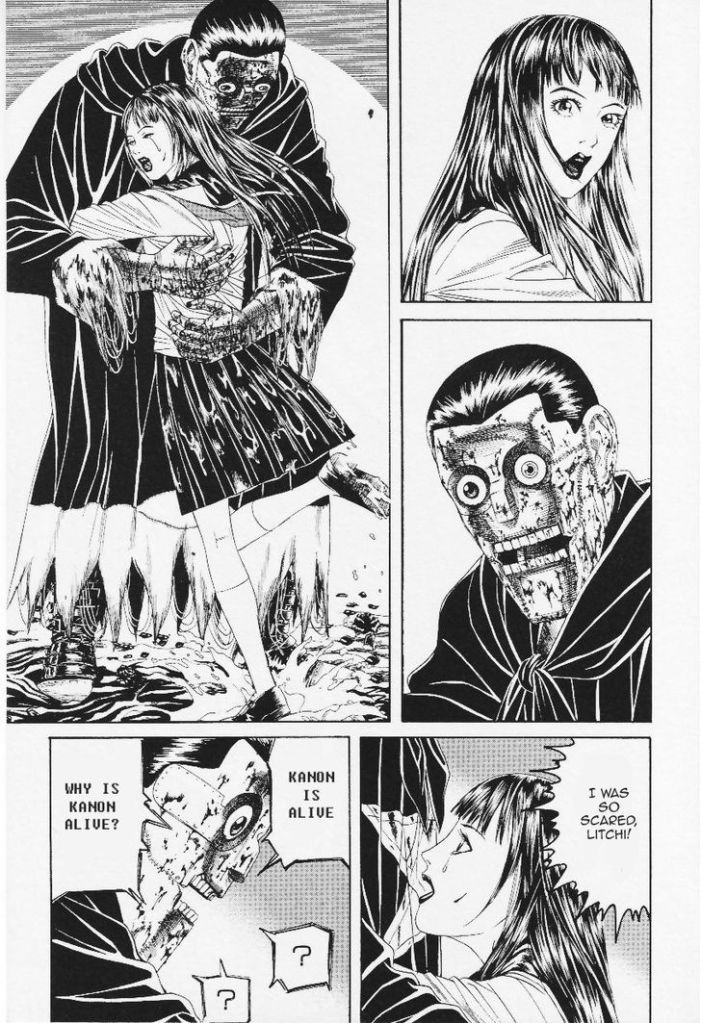
To pursue their vision of eternal youth and a universal, if unfocused, lust for power, the posse builds a mostly robotic ‘thinking’ machine-cum-Frankenstein-monster, all metallic parts except for a human eye ‘borrowed’ from Zera’s number Eins, Niko. Zera informs his crew that he planted lychee seeds in a landfill three years ago… and now they have a forest of trees heavy with fruit at their disposal as fuel for Lychee, their mechanical prodigy. Apparently Zera is also a brilliant agriculturist, for lychee trees are notoriously slow to bear fruit, and three years later he’d have a forest of greenery at best. ***

Lychee awakens! When questioned about why he is born, Lychee’s computer algorithm spits out that its mission is ‘to capture a girl’, so off he goes to kidnap many until he finds one beautiful enough to be their ray of light, eventually bringing Kanon, the female protagonist.

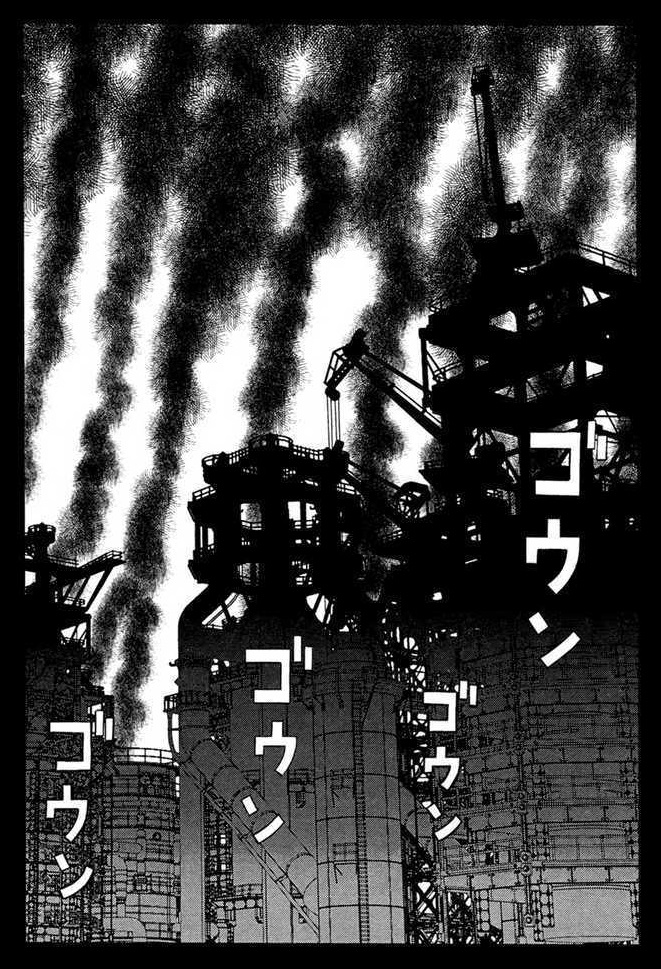
The story’s settings immediately plunge the reader into a kind of claustrophobia – filthy streets, a sooty factory, trashed cars — clearly an industrial town which doesn’t offer much hope for a better future. The boys’ lives outside the club are barely discussed, but the story hints that they all come from an uncomfortable family situation, though apparently they’re all ‘good kids’, as their maths professor incredulously notes before she is gleefully tortured and murdered.

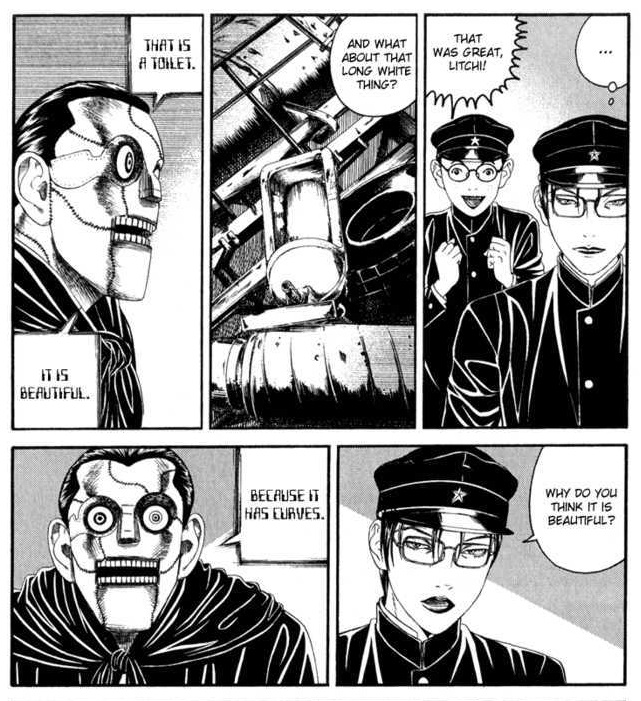
Don’t forget to read right to left! Much later, in a fit of poetic justice, Zera gets killed by a toilet with (doubtlessly) beautiful curves.

There is a strong current of body dysphoria running through Lychee Light Club, fitting for a set of characters so fixated by ‘beauty’. The megalomaniac Zera is obsessed with Elagabalus, a Roman teenage emperor known for his sexual decadence (apparently to the point of standing out for his outlandish vices among other Roman emperors centuries later, which is surely a feat of some kind, given what some of them got up to). 

In a sort of Peter Pan/Neverland situation, the boys are nauseated by the sight of an adult woman’s body (her breasts are qualified as ‘repulsive, swollen lumps of fat’), and horrified by her ‘ugly’ innards, wondering whether their own organs are ugly, too (plot spoiler: they are, indeed). They obsess over Kanon, the eventual heroine of the story, because she’s soft and beautiful (but hasn’t turned into a woman yet). Kanon herself doesn’t want to grow up because she’s worried Lychee (at that point ‘humanized’ by her love) will reject her adult self. 

All of them need to urgently get to therapy, but instead of that eyeballs are ripped out, innards (not to mention semen) are spilled, and the whole thing ends in an utter bloodbath, leaving the only ‘innocent’, Kanon, mourning Lychee, who is now more ‘human’ than the members of the Lychee Light club because he understands that murder is wrong. Reading this manga is a bit like observing a train wreck. Nothing in this story is nearly as profound as it pretends to be, and plot holes bloom much like lychee flowers — and yet its mostly naïve characters stick in one’s mind. Poor, poor children.

« …a mere plaything, having feelings! »

~ ds

* Speaking of the erotic… a quick perusal of blurbs quickly yields ‘Shocking, sexy and innovative, the Lychee Light Club is at the pinnacle of modern day Japanese seinen manga (young adult comics)‘, with which advertisement I have several bones to pick. ‘Sexy’ is an uncomfortable description of a manga with sadistic violence and heavily underage protagonists, though eroguro fans probably lap the former up. As for the ‘young adult comics’ bit, I’d like to submit a petition to stop assuming that stories about teenagers are meant to be necessarily read by teenagers. Should ‘old’ people read exclusively about the elderly? One can argue that adults aren’t so interested in reading about to-be-adults (my case in point, Wheel of Time book one, which I recently read, and whose adolescent protagonists were intensely annoying), but that speaks more to a lack of storytelling ability.

** Who’s had a wild enough (perhaps ‘unhinged’ would be a better description) life that he would merit an entire article by himself (see a summary here).

*** As far-fetched as this plot is is, the anime by the same name (loosely based on the manga) is hilariously goofy where the manga was highfalutin. Take the plot of episode number 6, in which ‘Some members of the club wonder if Lychee really only runs at lychee fruit and then offer him a peach. As he accepts it, they give various other foods and eventually Lychee develops culinary skills.’

Hallowe’en Countdown VIII, Day 3

« If men had wings and bore black feathers, few of them would be clever enough to be crows. » (source)

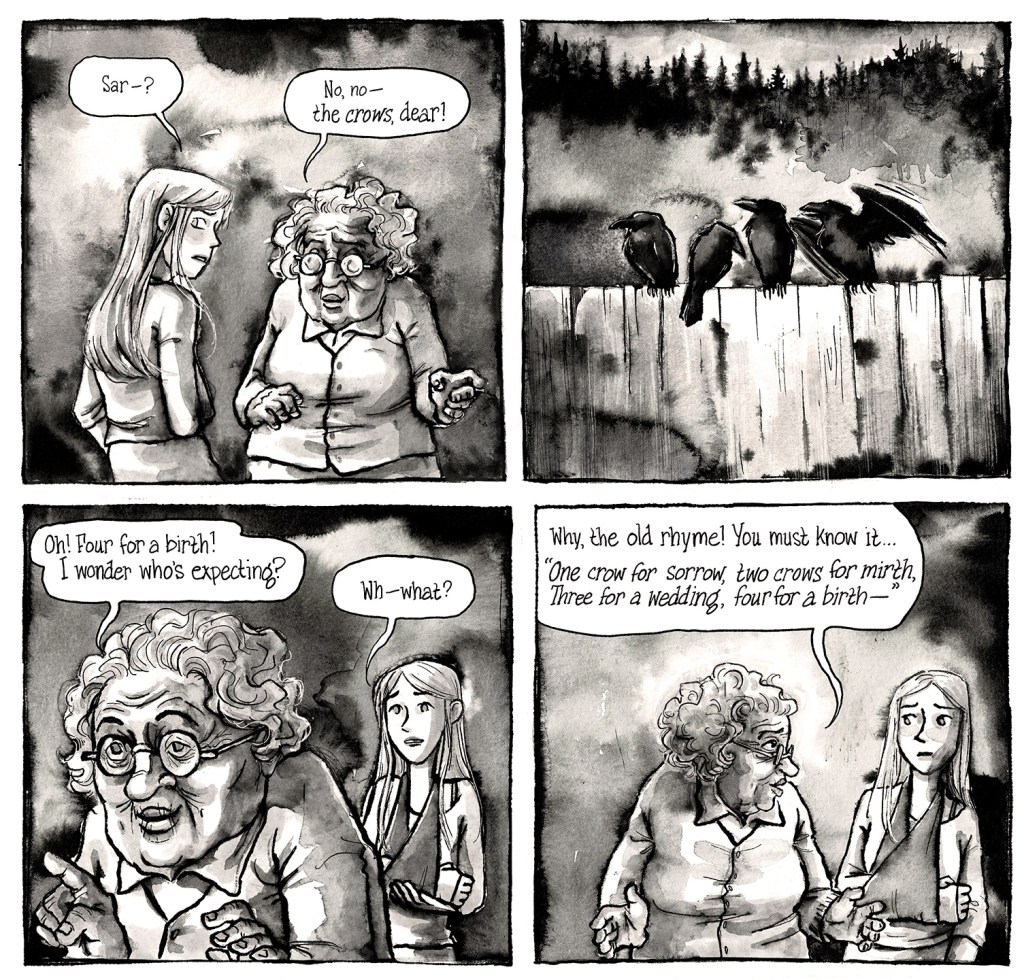
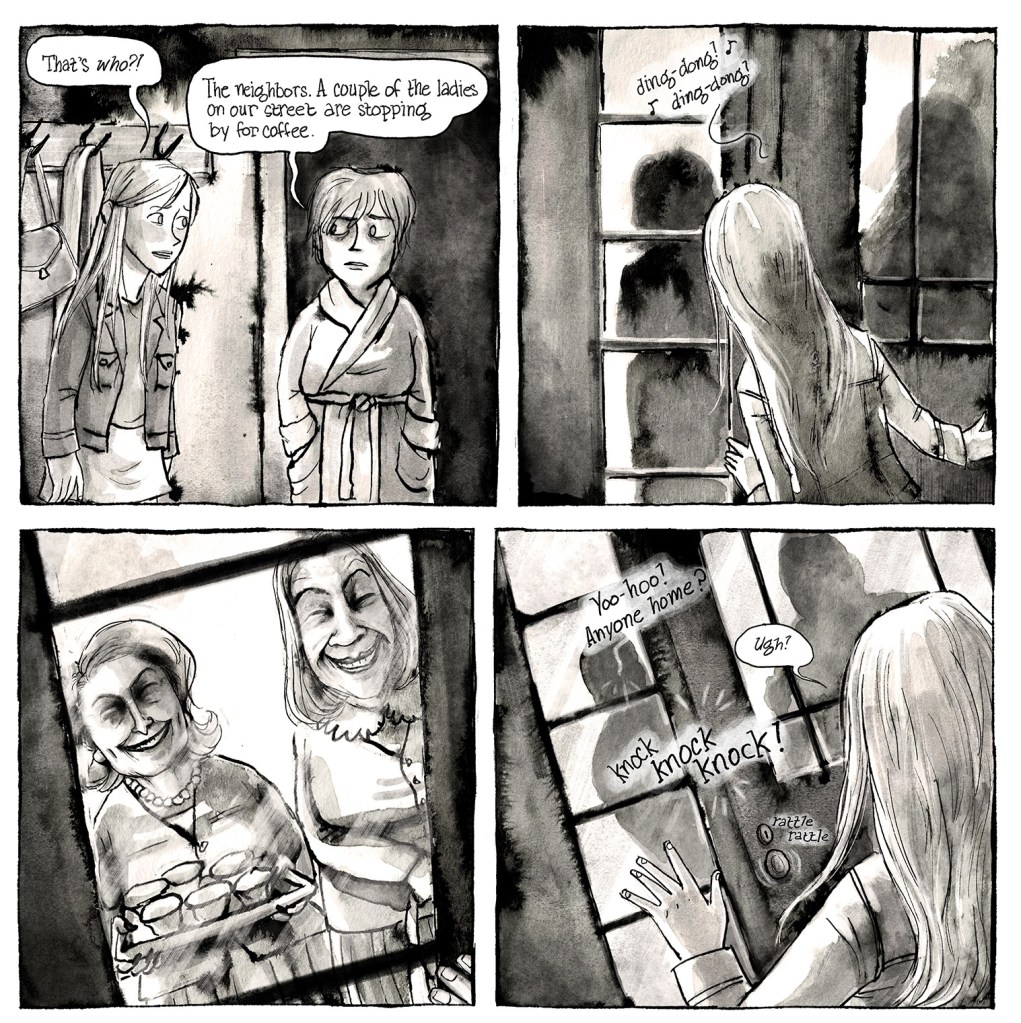
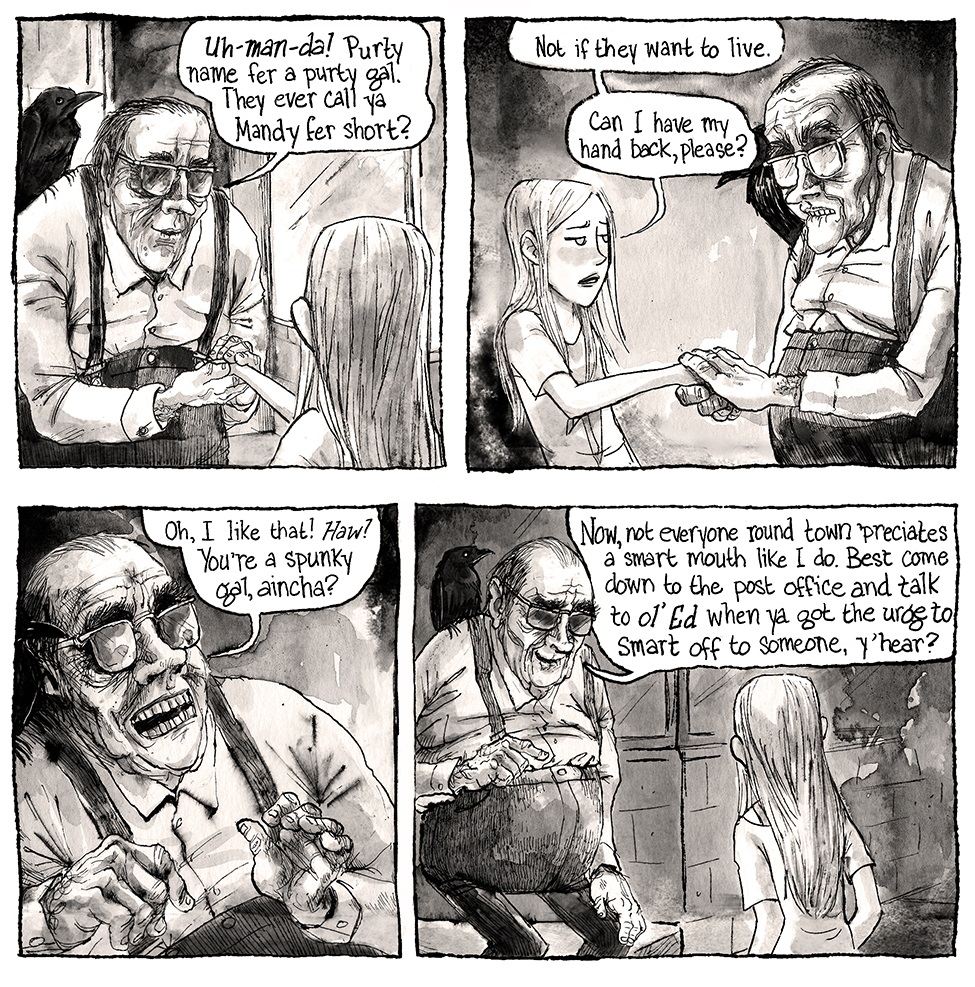
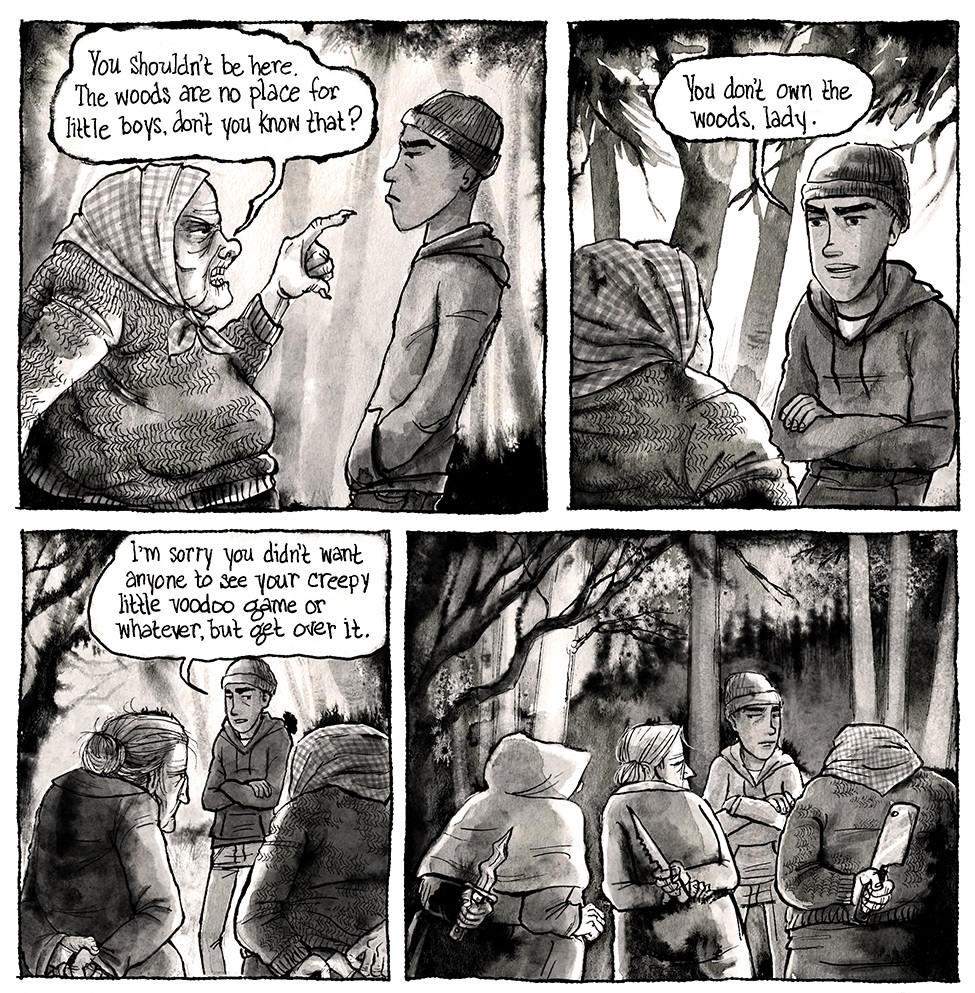
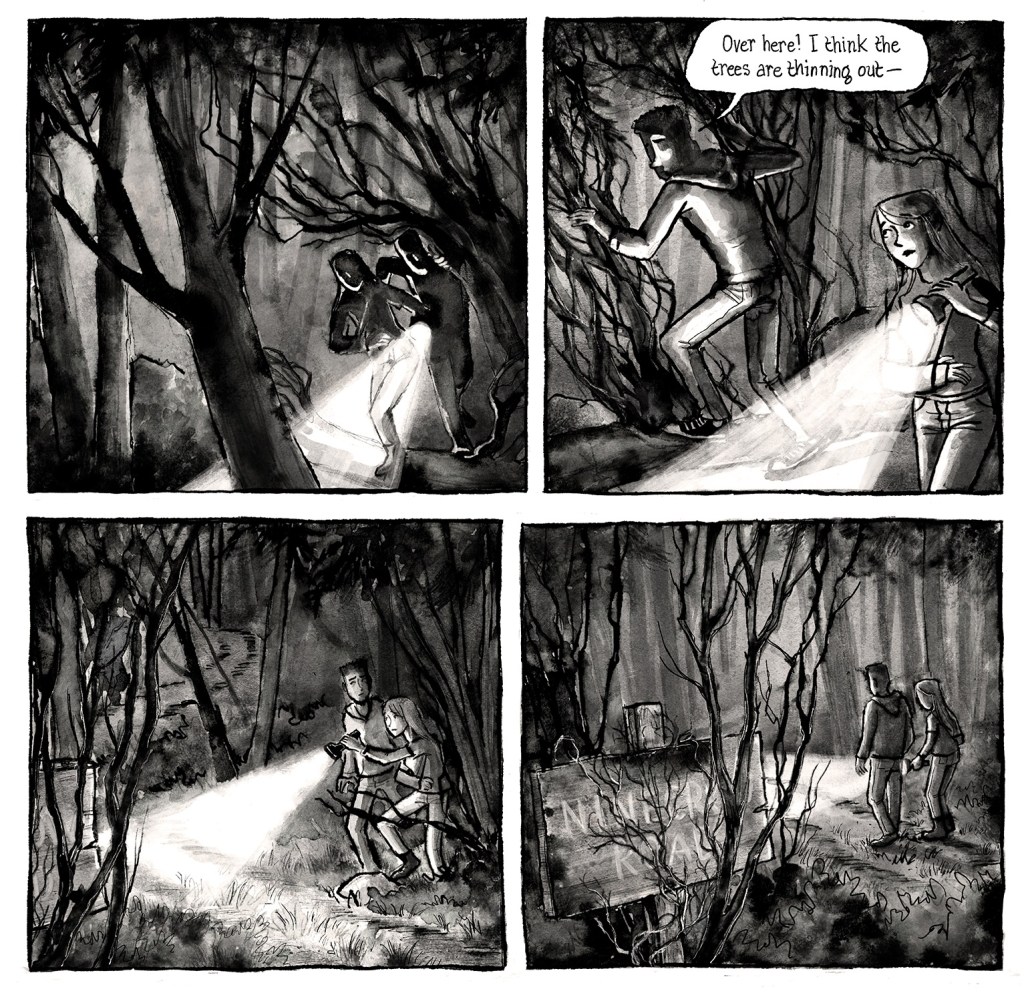
Today’s titillating offering deals in tropes that horror devotees will readily recognize – a Town with a Dark Secret ensnaring The Plucky Girl in its mysteries and underlying violence. Mysterious disappearances, the proverbial ageing small-town creep whose smile hides uncomfortable truths, oblivious locals… it’s been surely done before, yet the graphic novel Ninecrow by Dora M. Mitchell , initially posted as a biweekly webcomic that ran from 2020 to 2022, succeeds in creating an unnerving story out of these readily available narrative blocks.

Amanda, a teenager whose divorced mom relocates them to a town in the middle of nowhere (shades of Eerie Indiana et al.), does her best to adapt to her new life, but her new place of residence is, well… alarming in a number of ways.

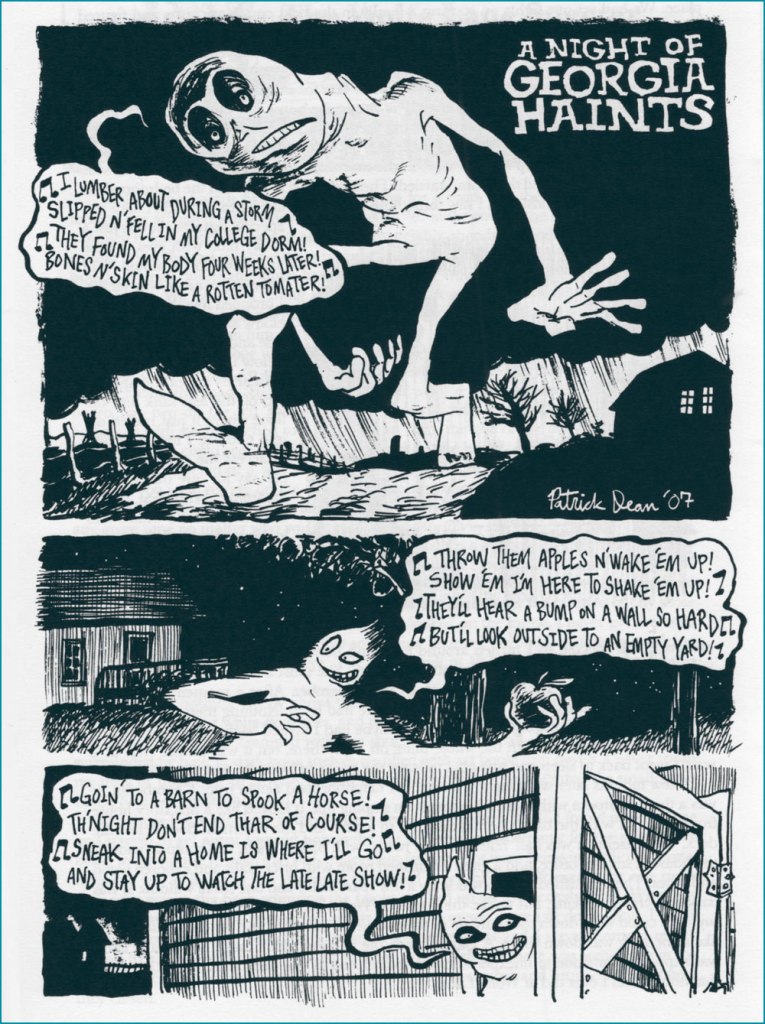
Lovingly drawn in mostly black-and-white watercolours, Ninecrow offers the reader plenty of visual enjoyment peppered with hair-raising details faintly glimpsed in shadowy corners. The hand-lettering is also worth a mention, especially given that modern graphic novels often dispense with this element in favour of a computer-generated font. Both art and letters remind me of the tragically departed Patrick Dean, especially some of his work like Underwhelming Lovecraft Monsters.

Aside from its crow population, the town is also abundantly stocked with disquieting old people in various stages of brain fog. Aside from Amanda and a couple of others, everybody seems to be middle-aged going on ‘soon dead’, and not of the pleasant fluffy-grandparent variety, either.

I bought the print version of Ninecrow on Kickstarter because I much prefer reading books in a physical format (you can still buy the deluxe version on the publisher’s Etsy page), but you can still read the full thing story online on the website: https://ninecrowcomic.com/

Enjoy the traipse through the woods!

~ ds

Brimstone Bureaucracy, Bah! Hyena Hell’s Demons

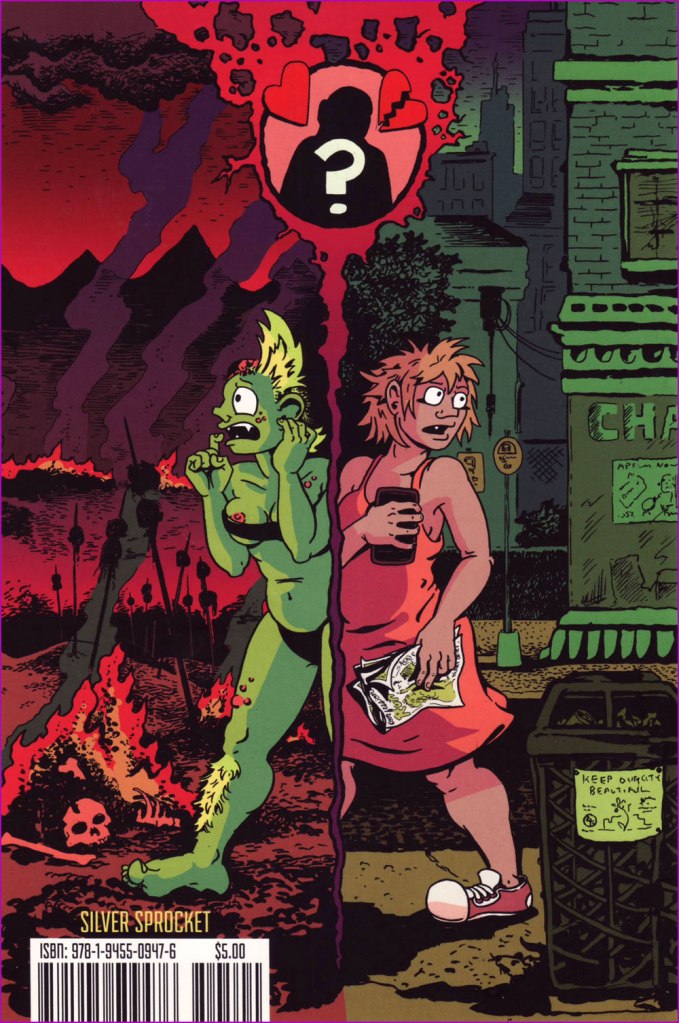
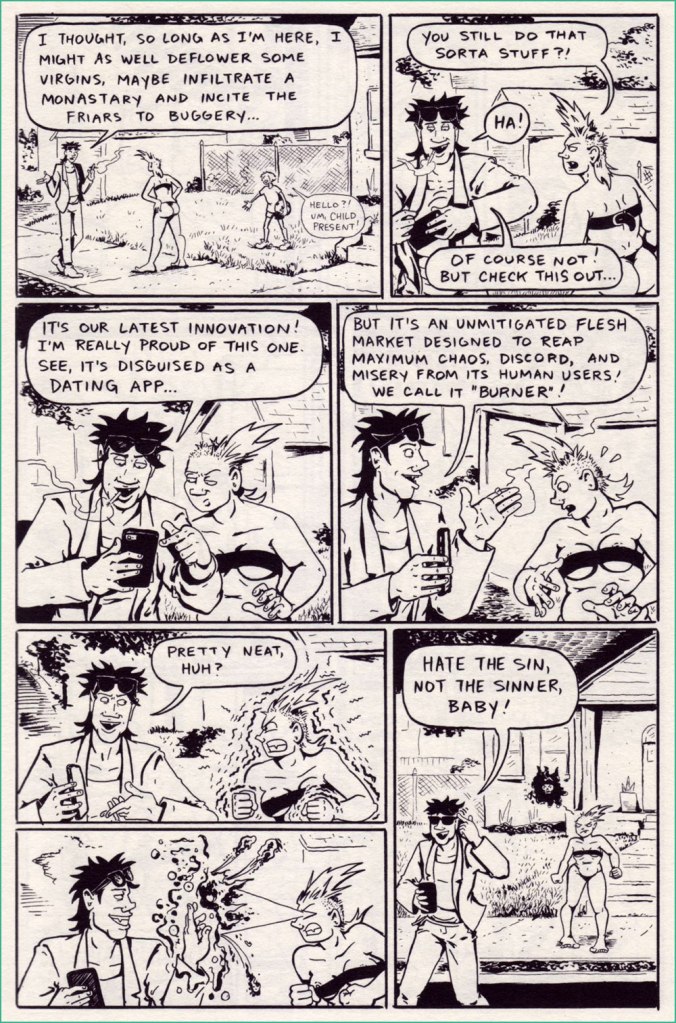
I was very excited to come across the comics of Hyena Hell. I don’t even remember where I got No Romance in Hell (2020), but it was cheap and intriguing. A funny comic about a cantankerous dick-driven demoness that also is excellently drawn? Well, sign me up, and pronto. Anyway, I read it, enjoyed it greatly, and stuck it on a shelf (after pursuing co-admin RG with it for a bit to get him to read it, which I’m still not sure he has done*). Recently, I discovered that there are two more instalments — Demons: To Earth and Back (2021) and Demons: Bloodlust (2022), and devoured them with great delight, one recent Sunday afternoon.

The transition from demon-girl to normal-girl and back again – back cover of No Romance in Hell.

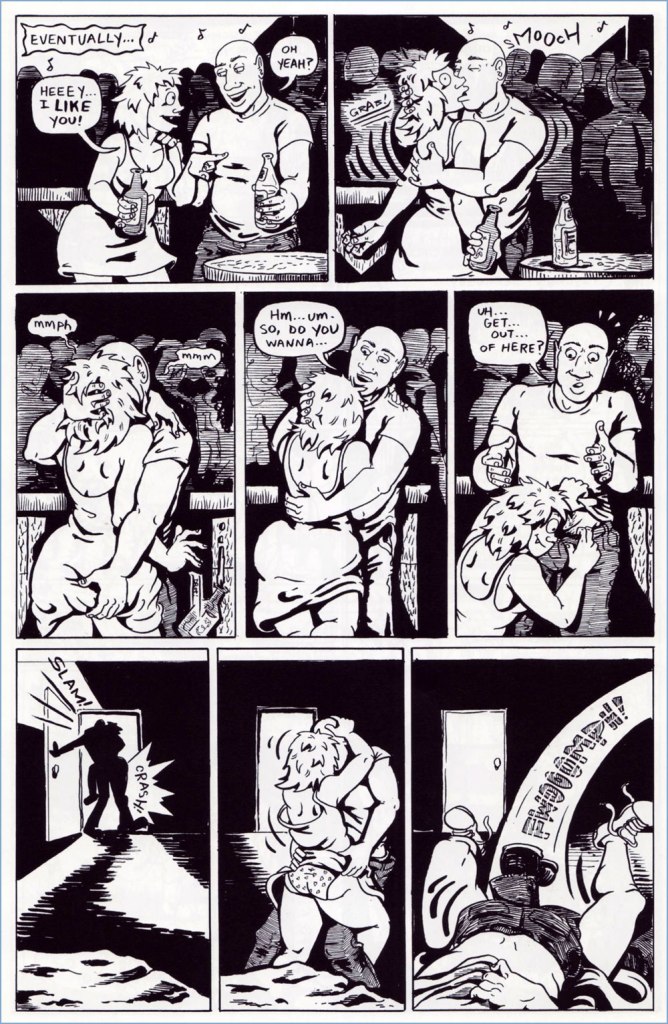
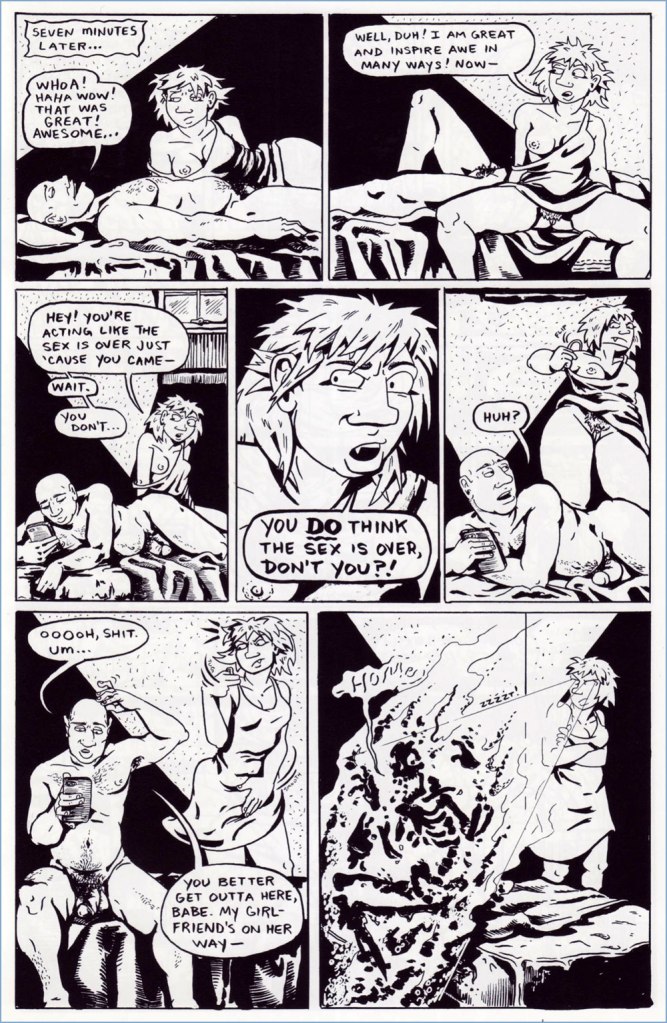
HH’s art is dynamic and convincing – bodies have real weight and a variety of shapes. There is also stuff happening in the background, so the reader feels like these are real… well, err, maybe not people, but real creatures walking on real streets (and equally tangible depths of hell). I love her main characters, fully-fleshed, quick-witted, and flawed in a way that makes one sympathise even when they’re being irrational. No Romance in Hell is a jaunty (if violent) romp with great social commentary on the state of the dating scene, happily skewering the endless parade of ‘nice’ guys who think life owes them.

If that’s how it is… Maybe I’ll just LEAVE then!‘ — and our heroine makes her way to the surface to see whether humans can give her satisfaction where the demon failed.

After a cavalcade of brief dates with men spouting the usual nonsense (distinctly not sex-worthy material), Bug finally comes across a contender…

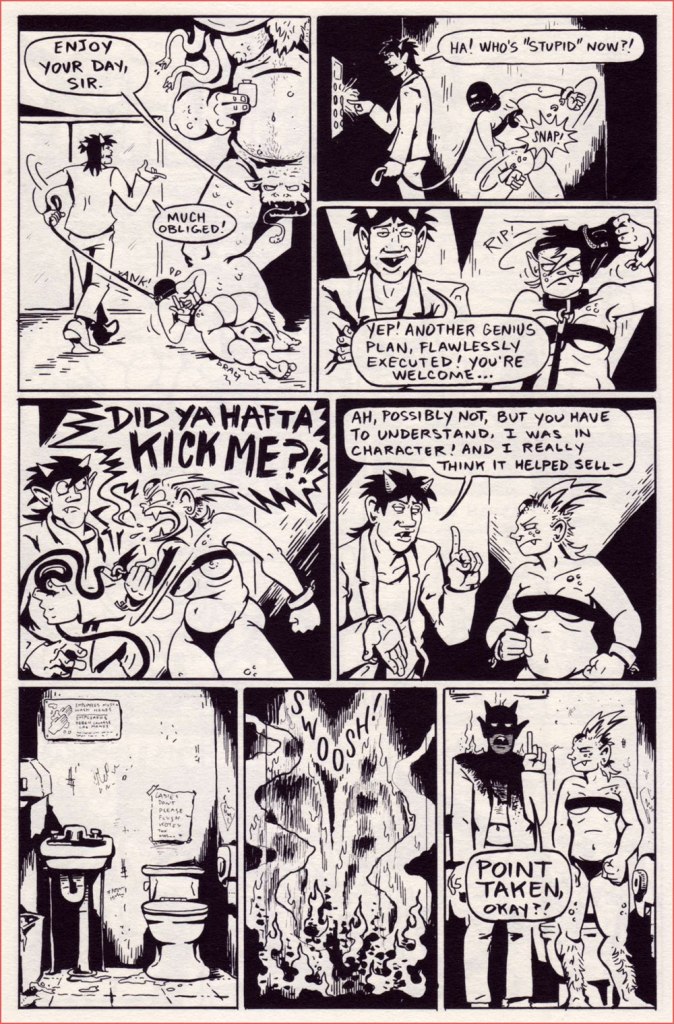
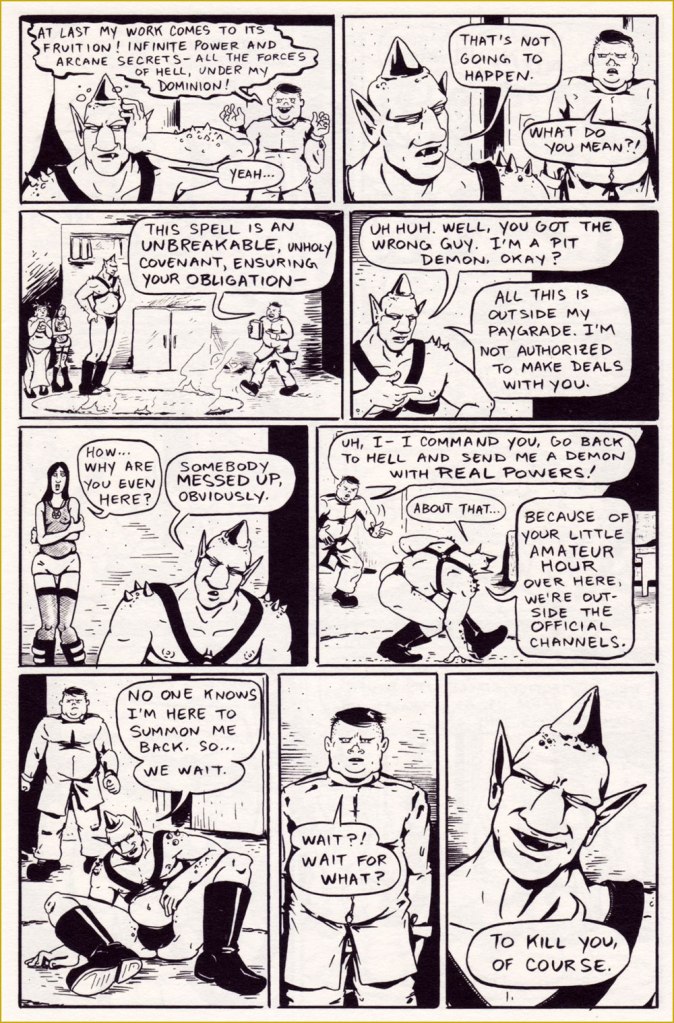
As much as I enjoyed No Romance in Hell, I was even happier to find that Demons: To Earth and Back featured a longer story and more glimpses into the organisation of the pits of Hell, home sweet home. When Bug needs to rescue her demon sweetie from his forced summoning to earth, Bug’s sibling Skud comes up with a plan to sneak her out of Hell, since obviously the former is built on the solid foundation of bureaucracy and endless pencil-pushing —

Hyena Hell says she has a tough time with spelling, but ‘monastery’ is the only typo I noticed.
This demon’s actually pretty bright-eyed and bushy-tailed, aside from badly wanting a cup of coffee. The pimple-faced fascist teenage jerk who summoned him, however, is in distinct danger of having his face smashed in.

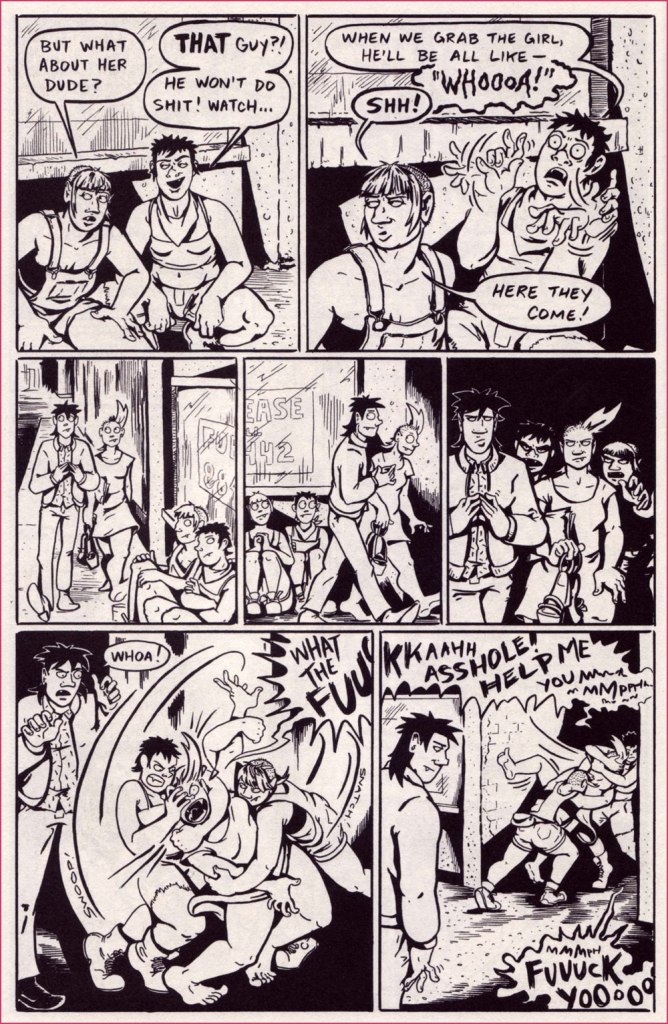
Demons: Bloodlust is even more ambitious, telling the gruesome (with many incinerations) tale of Bug and Skud embarking on a vampire-annihilating mission (and introducing a vampire trio of old friends whom I would love to hang out with).

Social anxiety, the vampire/demon edition.

At the end of the story, we are treated to a couple of ages of Cass, Marco and Baby Jay answering questions, which is possibly my favourite bit of the whole thing.

There is a fourth Demons book in production as we speak — follow HH on instagram to get a peek of the pages she’s working on. Also pay a visit to The Comics Journal for a sampling of the Fair Warning – Hyena Hell interview.

~ ds

* Given that he was kind enough to scan a bunch of pages for me, I’m sure he’s read some while scanning, at the very least.

Southern Ontario Gothic: Emily Carroll’s Forest

It came from the woods. Most strange things do.

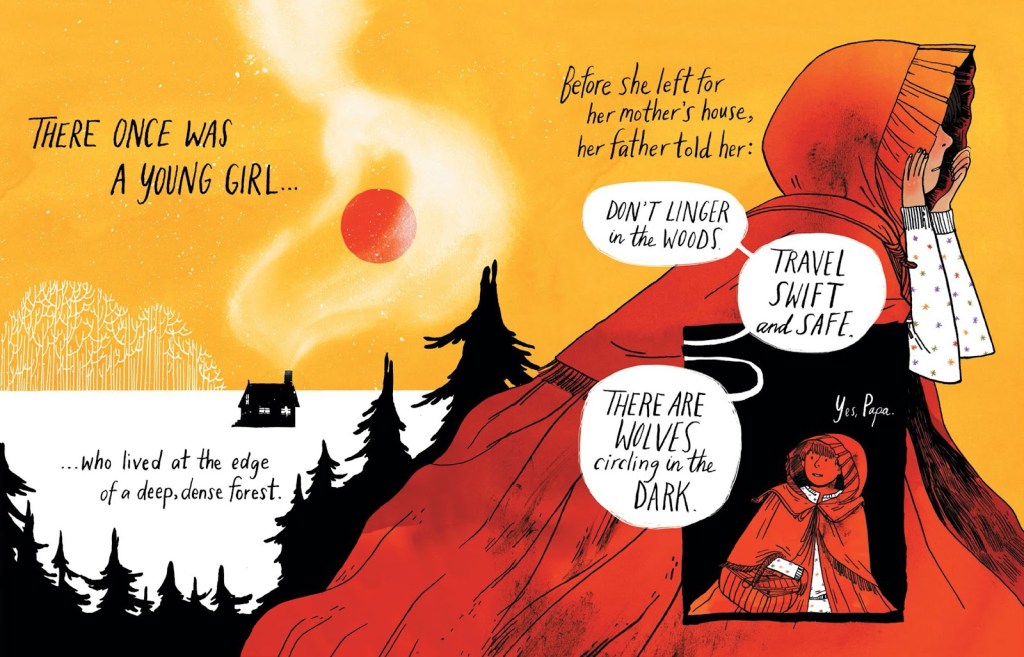
I’ve mentioned Canadian artist Emily Carroll before in Of Ducks, Russian Folklore, and the Mysterious Gamayun. While her illustrations for children’s series are quite lovely, I think her strength (and obvious interest) really lies in horror.

Today I’d like to feature a few selections from the 2015 collection Through the Woods, which received a few awards and a lot of compliments. While the stories within are generally lauded by critics and readers, I have seen a few reviews complaining that they’re not scary. I suspect that kind of reviewer is the same type of person who starts grumbling that there’s not enough action in Dostoevsky’s Crime and Punishment* (only one murder! gimme Midsomer Murders’ body count!)

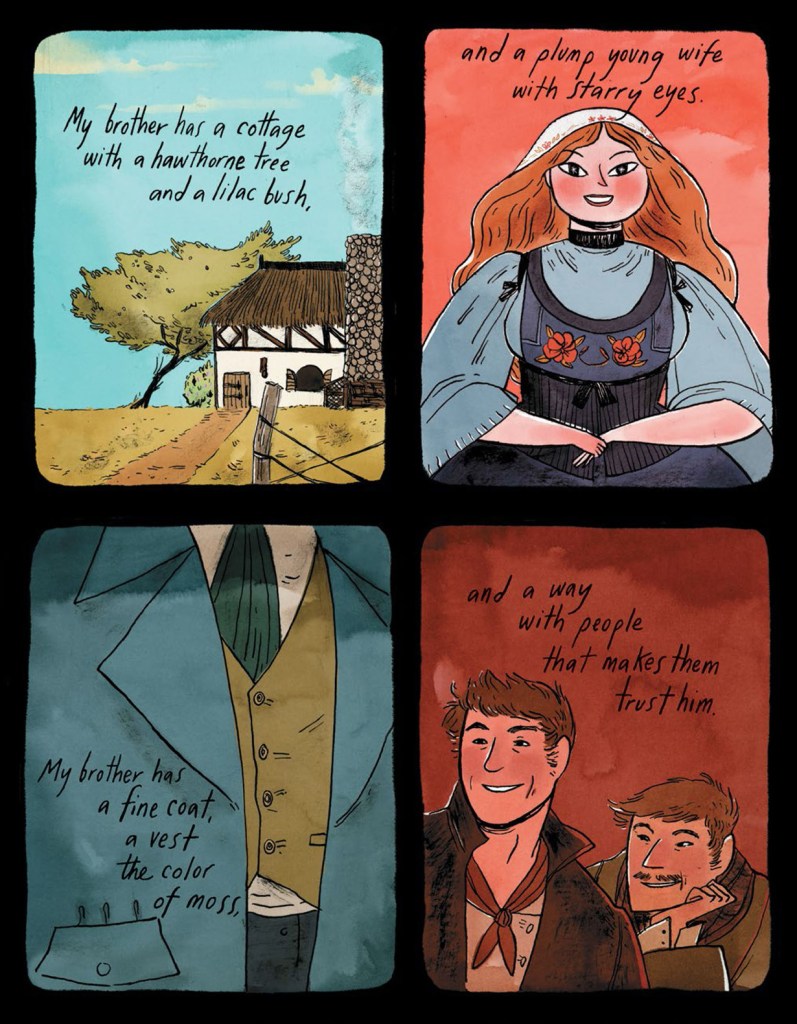
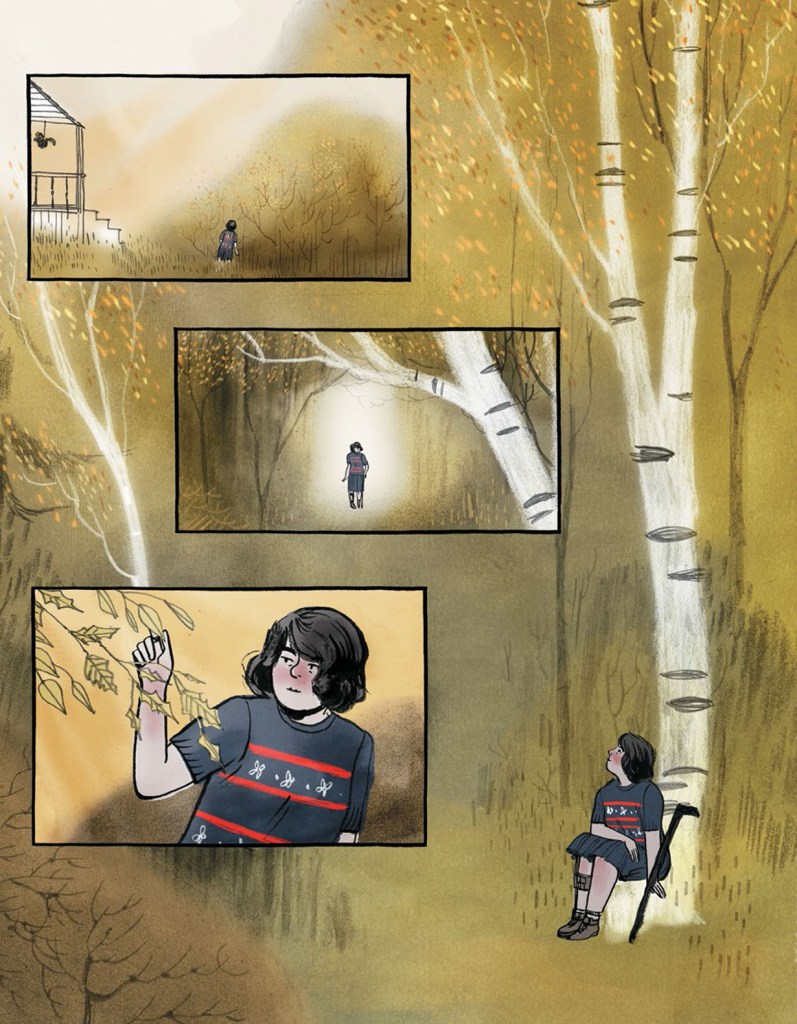
Emily Carroll is excellent at conjuring the kind of slow dread that makes one skin’s crawl (which is not to say that she shies away from gore). This is not horror where a serial killer is chasing his victim around with a chainsaw – I think the latter is a lot easier to set up than conjuring a fragile, haunting atmosphere of menace and stalking shadows. Carroll’s work can be visually stunning, with bright colours and swanky layouts, but it can also be sepia-coloured, quiet, intimate and unsettling. She combines these two settings to great contrast and advantage, sometimes within the same story.

A page from His Face All Red, arguably Carroll’s breakout comic that she posted online in October 2010 and which went viral. Read it here. In now occurs to me that her art is sometimes a bit Richard Sala-esque.
Page from A Lady’s Hands Are Cold. Carroll’s hand lettering contributes to a lot of the atmosphere. In a world of typeset speech bubbles that spoil the mood, it’s really nice to come across comics where the text is part of the design.
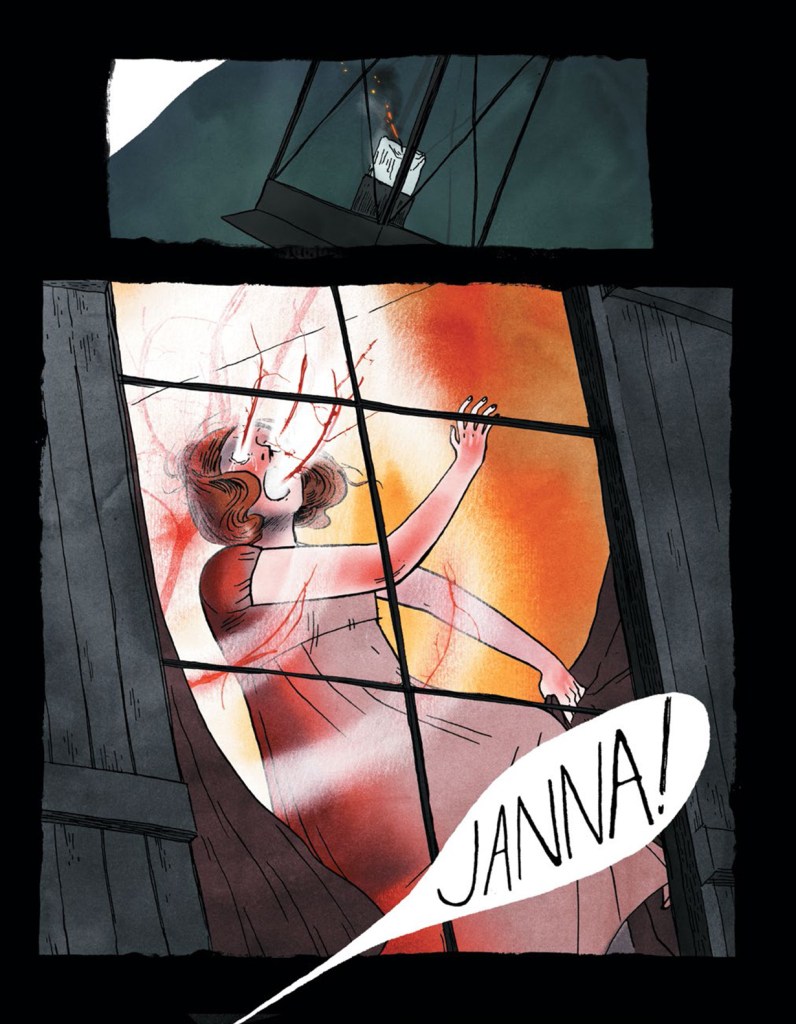
A page from My Friend Jenna, a story of two friends who conduct fake séances…
… and get a little, shall we say, embroiled in the lives of the dead. It was difficult to decide which pages to include, as I don’t want end up spoiling the plot.

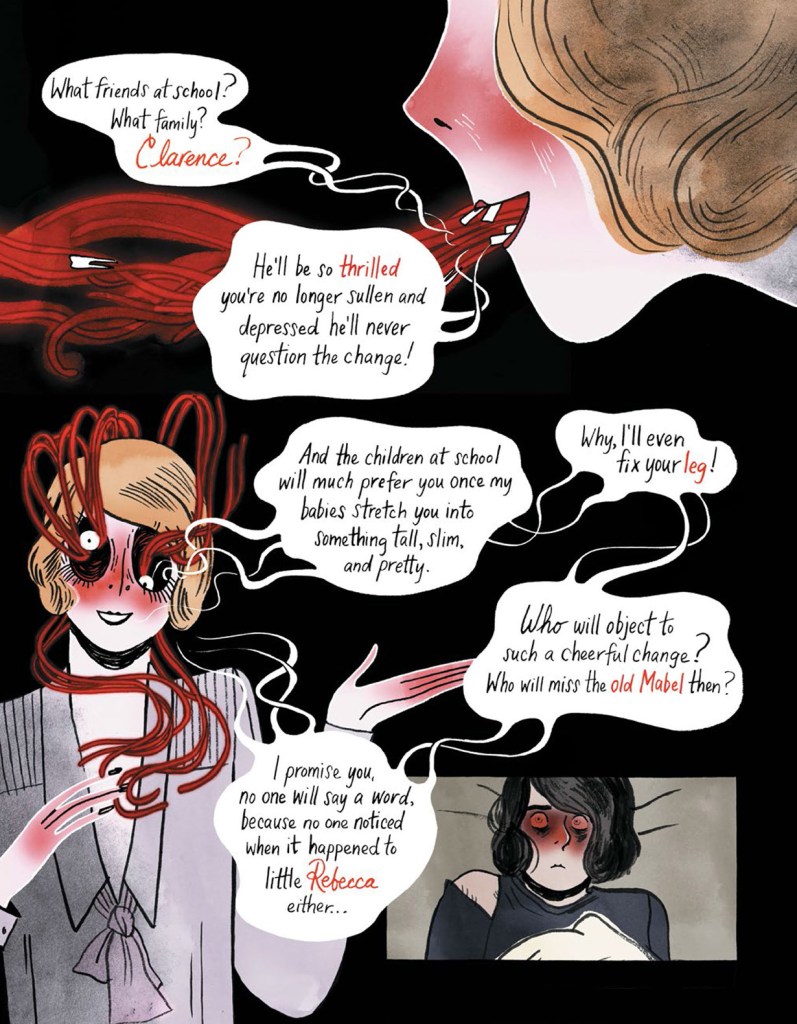
Nightmares about losing teeth are very common (apparently, they’re ‘one of the most universal dream themes‘), so perhaps that explains why The Nesting Place is especially unsettling. Here is a sample of a few pages:

Carroll’s tales often feature somebody who is not what they seem, the unusual or scary hiding behind the veneer of a normal human being. Those wiggling teeth are fucking creepy.
A definite plot spoiler, sorry.

Finally, two pages from In Conclusion, which wraps up this collection with a brightly coloured epitaph:

Don’t forget to visit her website, with plenty more comics to read. A lot of her work is accessible online only, and makes great use of this medium** – for example, in A Pretty Place, you can select the room you want to visit in a sort of Clue-ish set-up; in Margot’s Room, you can click on objects (a mirror, some dried flowers, the window…) to learn their story. Definitely read the sexy, creepy, gory Writhe*** – it’s available for free download. Read her smart interview with Sean T. Collins for The Comics Journal here, or check out her latest book (not yet published), A Guest in the House, here.

Self-portrait.

~ ds

* To be fair, I am no fan of Crime and Punishment, as I thought it was quite a slog to get through… but not because only one person gets killed. Have a gander at some entertaining reviews of it here.

** She talks at length about designing a comic to be read online in An interview with Emily Carroll: A Fairy-Tale Teller in the Digital Age.

*** When I Arrived at the Castle, published in 2019, strikes a similar vibe, featuring a blood-laden love/horror story between a sort of cat girl and a vampiric Countess, all of it wrapped up in the heavy, shifting logic of a dream you want to escape from but can’t.

Out of a Frying Pan and Into the Fire: Wonton Soup

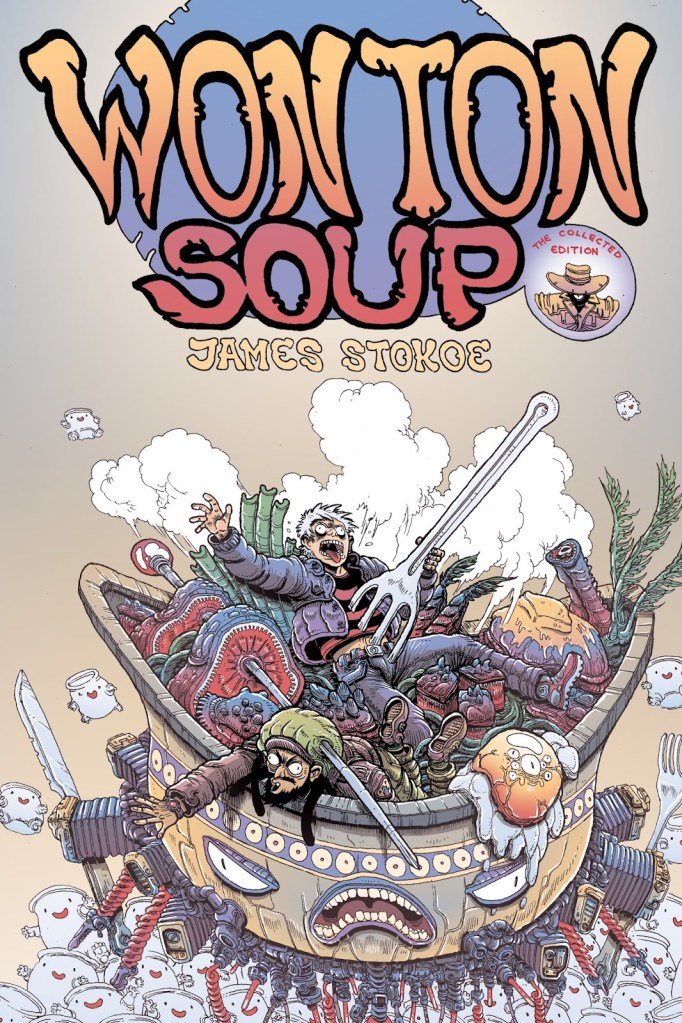
Today I’d like to feature a (chunk of) story by James Stokoe, a contemporary Canadian artist. As is the case in many instances, I discovered his work when I spotted Wonton Soup in an excellent comic book shop in Montréal (now, alas, permanently closed — we miss it and its kind owner). Wonton Soup is in black-and-white, which hides Stokoe’s strength (or weakness, depending on how you feel about this aesthetic) – his liberal use of bright colour gradients.

A splash page from Orc Stain, which currently stands at 7 issues, with more having been promised in 2015 and still eagerly awaited by fans of the series. It’s too bad, I’d love to know what happens to the protagonist…
Stokoe also often uses this combination of lime green and purple, anathema to some artists.

Unlike his close friend comics artist Brandon Graham, whose style is sort of graffiti-ish (not that all graffiti have the same art style, obviously), Stokoe favours tons of detail on everything. Given that he’s often drawing some sort of monster and colouring all of that in (what could be argued) rather garish fashion, the overall result often looks like somebody’s grotesque fever dream.

However, going back to his earlier work, one finds a more stripped-down style without the tons of cross-hatching. Case in point – the aforementioned Wonton Soup, published between 2007 and 2009, and collected into one book (Wonton Soup: Big Bowl Edition) in 2014.

The blurb on the back describes it as ‘[something] that can be pitched in high concept terms as Iron Chef meets John Carpenter‘s 70’s comedy Dark Star‘.

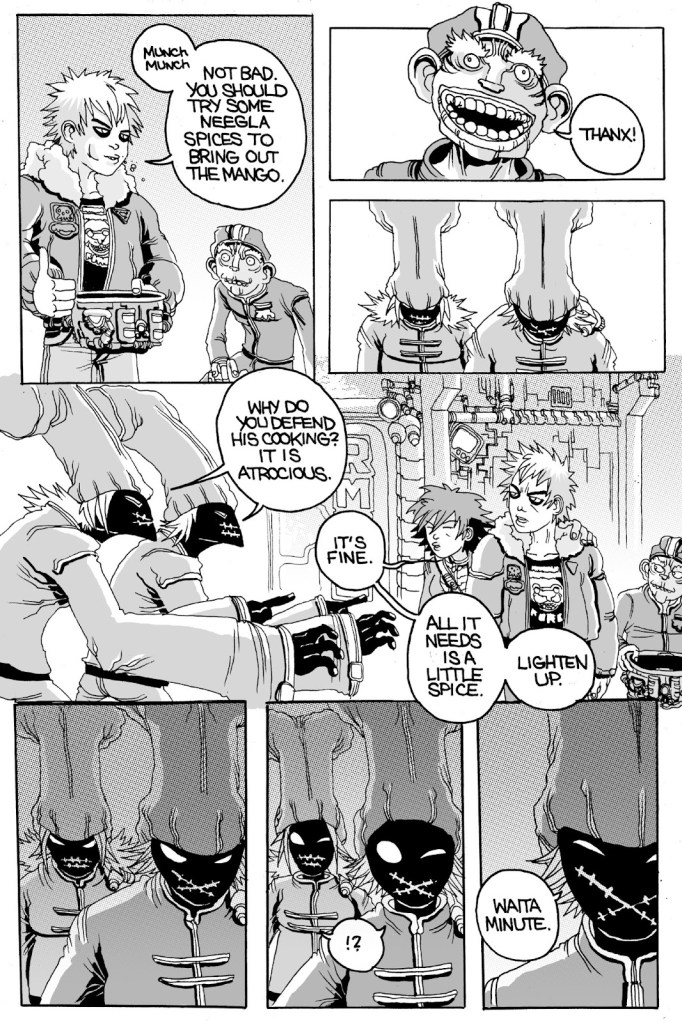
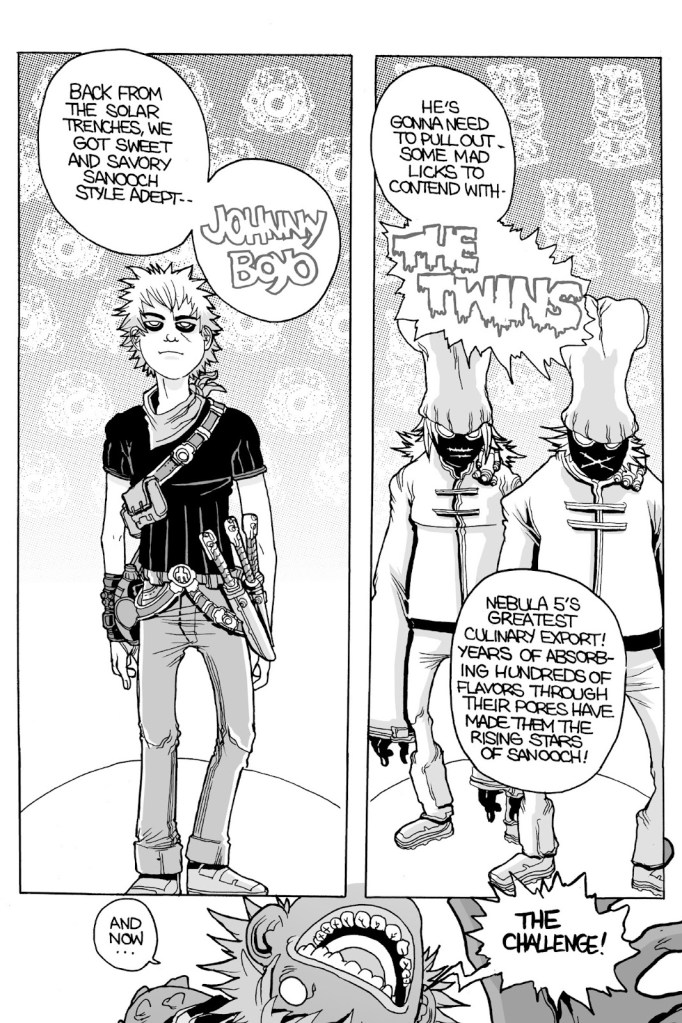
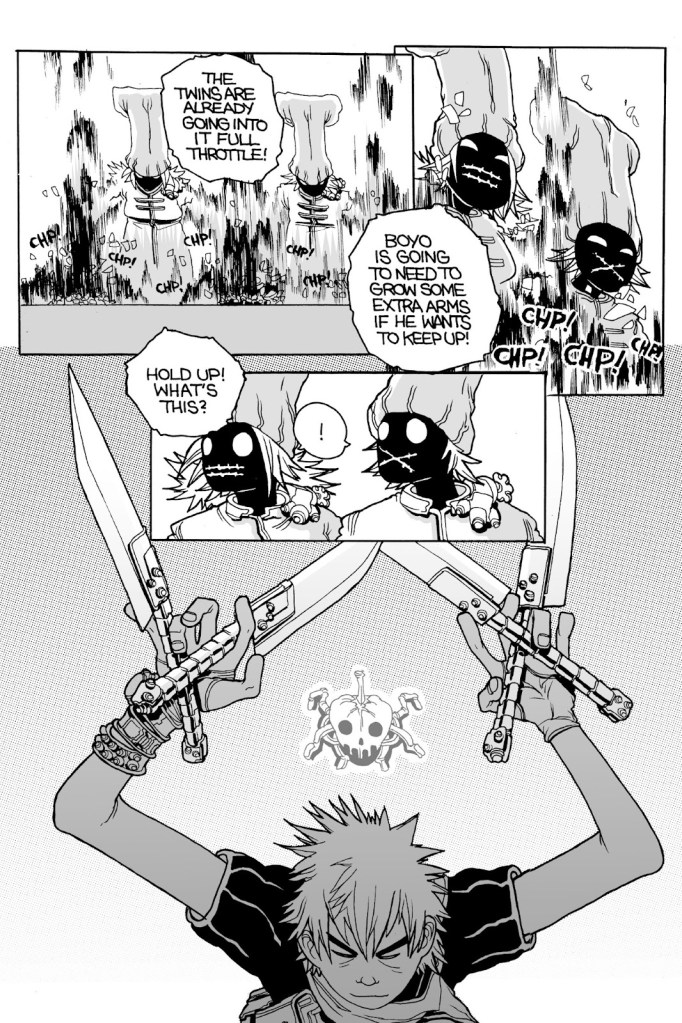
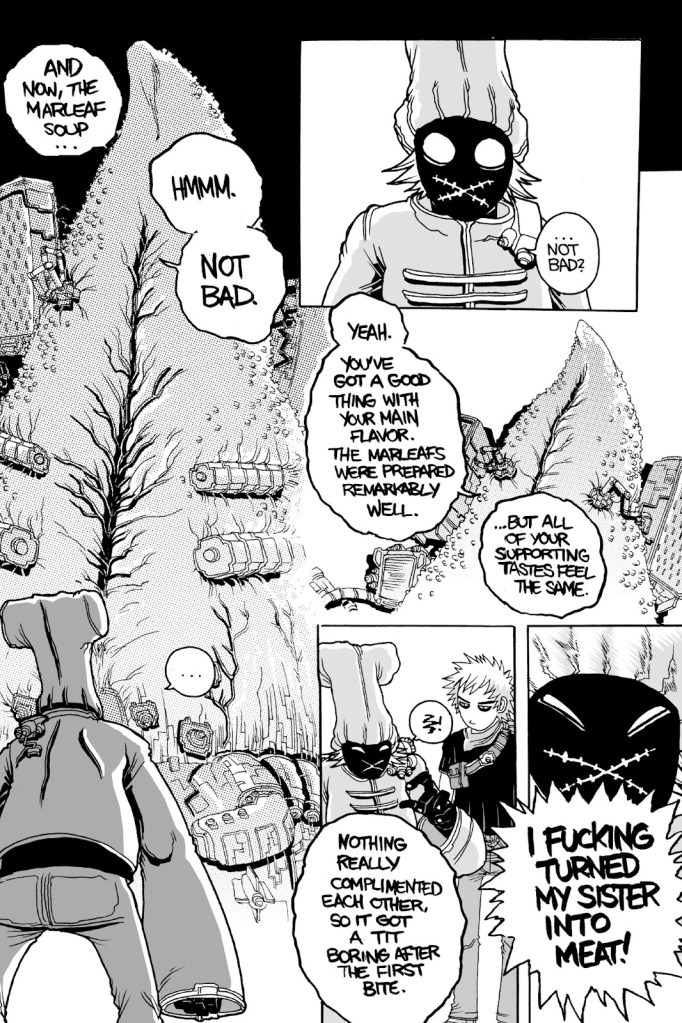
I love made-up food, which is something both Stokoe and Graham’s worlds are rich in, so of course this series was right up my alley of street snacks. Not all of it is great, and the sexual exploits of Deacon, the co-pilot of our ‘space trucker-cum-chef’ protagonist, can get weird, to say the least (I could live without the whole storyline about the sex bear, frankly), but it still makes for really fun reading. Here is my favourite chapter (quite abridged and subsequently summarized). Is this over-the-top? Absolutely. Having recently watched a few episodes of recent Iron Chef, though, I can say that the latter is more bombastic than a competition between a space trucker and hive mind Twingos from Nebula 5, with a giant omniscient tongue for a judge (a vast improvement over judges in Iron Chef, frankly — where do they find these people?)
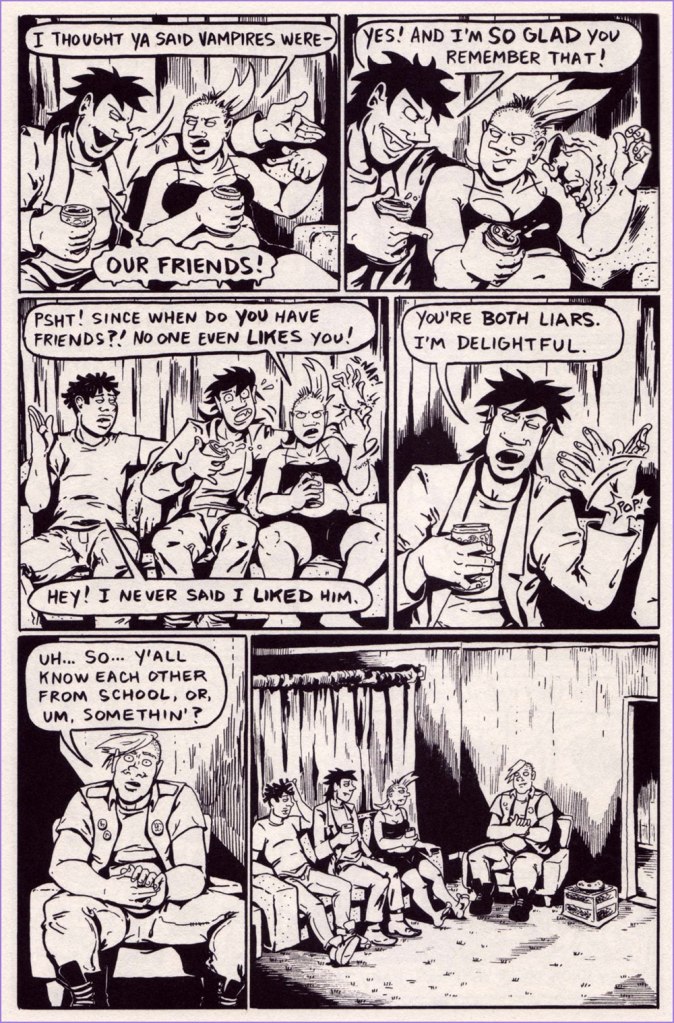
It starts with Johnny Boyo visiting his old school for chefs, which he quit a year ago to travel and get a taste of what’s out there on other planets….

When he comes upon a student forcibly evicted from one of the kitchens for having prepared a particularly lacklustre mango chutney chili. Jonny catches the bowl that’s flung after the body and tastes the chili —

“I remember you!” exclaim the Twins.

First refusing to participate in the challenge, Johnny reconsiders (after some encouragement from his old teacher).

The Twins are faster and fancier, but Johnny has some tricks up his sleeve (or in his holster, at any rate).

One of the twins decides to sacrifice his delicious sister (years of food absorption through pores marinated her deliciously!), but does this help him overpower his adversary?

And there you have it. If you’re of the cross-section of people who love food, comics, and are not averse to vulgarity, I recommend giving this collection a go.

~ ds

Hallowe’en Countdown VI, Day 3

« With such precautions the courtiers might bid defiance to contagion. The external world could take care of itself. » — Edgar Allan Poe, The Masque of the Red Death

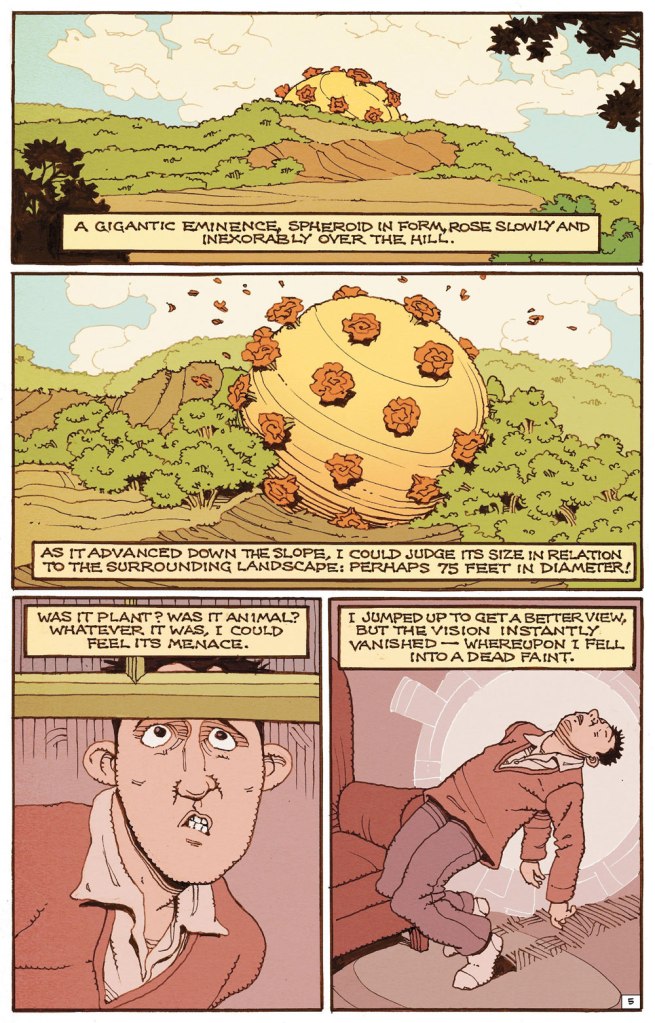
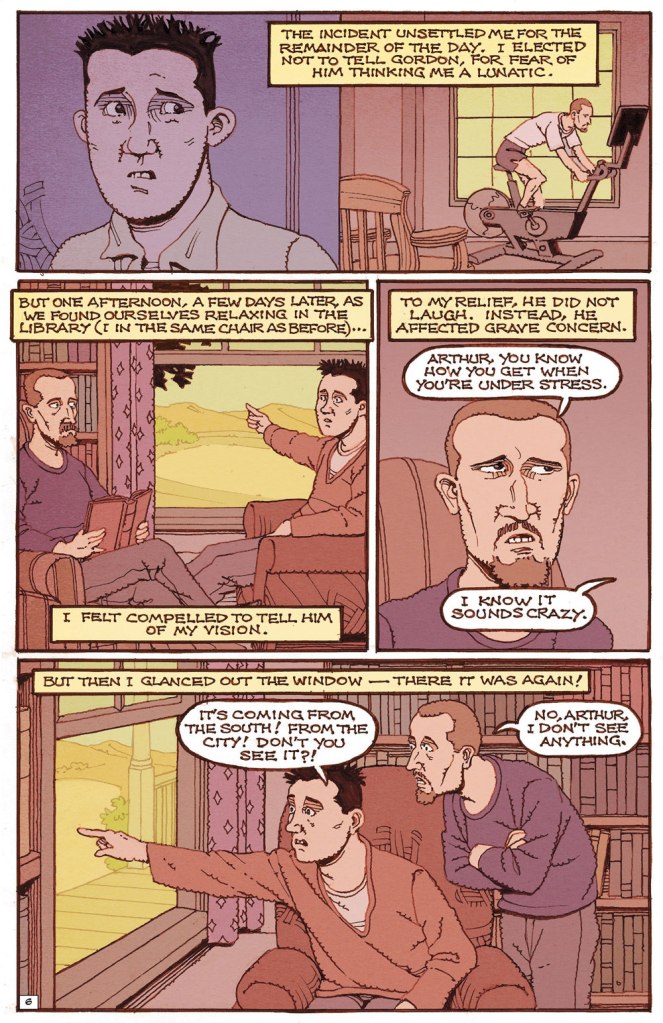
And now, a piece from — gasp — 2022! It’s at once most timely and a link to the dim past, with WOT? favourite Rick Geary drawing nimble parallels* to Mr. Poe’s famous tale of arrogant (and happy and dauntless and sagacious) Prince Prospero’s well-earned comeuppance. This other great plague, however, isn’t greeted with hubris by our everyman protagonists. While Poe provides the spirit and the starting point, Geary wends his own way, bless his soul.

Ahoy Comics‘ series of Poe-themed anthologies are of course uneven — such is their nature — but their peaks are joltingly, exceptionally good, and they make the whole enterprise quite worthwhile.

A Tale of The Great Plague appeared in Edgar Allan Poe’s Snifter of Death no. 4 (Jan. 2022, Ahoy Comics).

-RG

*and also, you might say, to The Fall of the House of Usher and perhaps even The Tell-tale Heart. Clever chap, this Geary.

Diggin’ Up the Bone Orchard: Beasts of Burden

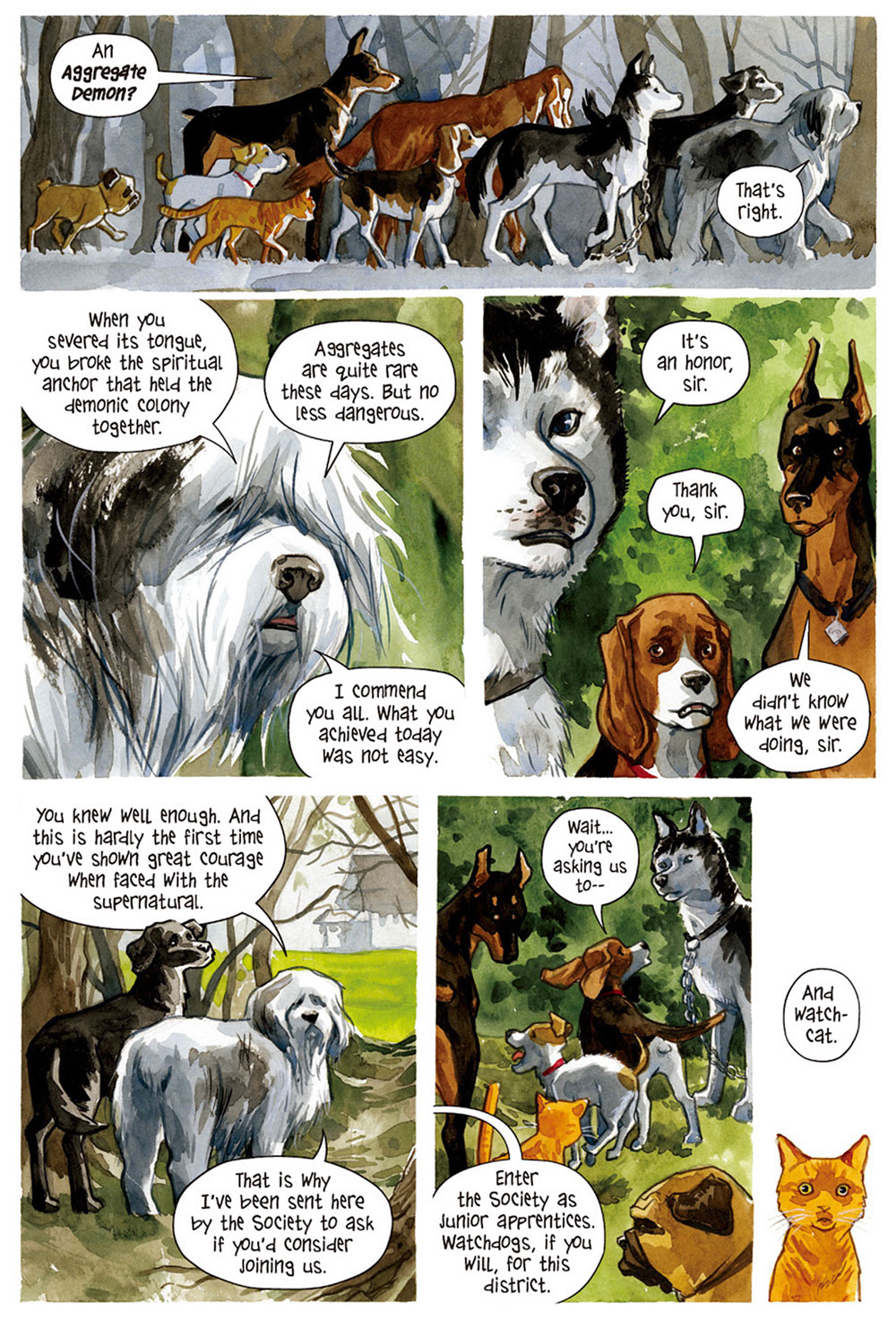
Our heatwave is nowhere as bad as the one afflicting Europe right now, but it’s a heatwave nevertheless, and to cool off I felt like traipsing down the icy corridors of horror. Evan Dorkin‘s series Beasts of Burden, the tale of a (predominantly) canine crew who fight the supernatural to keep their small town community safe, fits the bill: though including elements of adventure, mystery, and humour, it’s genuinely tense in places (and features enough blood and grue to keep the average gorehound satisfied). One expects a comic in which all protagonists are animals to evoke baby-talk sounds of endearment, not send chills down the spine of the more sensitive reader, and yet…

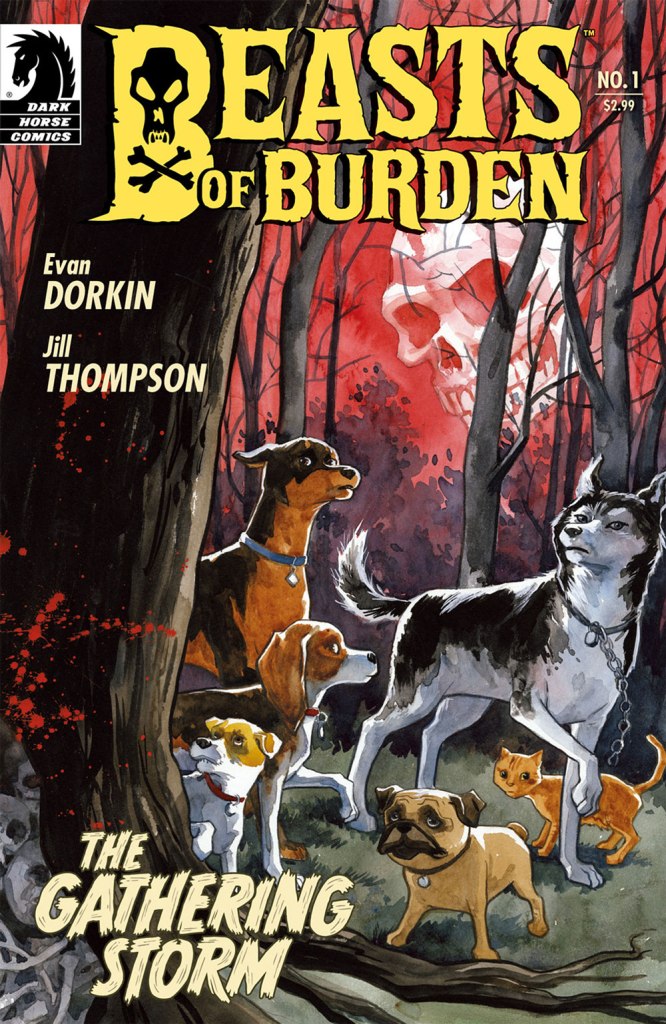
Beasts of Burden no. 1 (September 2009), cover by Jill Thompson.

However, I’ll warn you that a fondness for animals is a prerequisite for enjoying this comic, lest you miss the emotional punch to the gut of moments like a dog searching for her lost puppies, or animals mourning the loss of their friend. Despite the paranormal threats these pooches (and cat!) have to deal with, I would say that it’s that emotional horror that makes these stories memorable, especially to a modern reader well-versed in zombies, werewolves, and witchcraft (yawn, how cliché…) I am quite allergic to animals getting hurt in stories, but Beasts of Burden never feels manipulative in that regard: shit definitely happens, but is overcome through teamwork and courage.

This comic also features loving watercolours by Jill Thompson (according to the DC Comics website, ‘most well-known female comic book artist‘… not sure how they measured that), who’s not only great at evocative woodsy landscapes in all seasons, but also a deft hand at convincing portraits of animals. I have seen too many comic artists who cannot draw a convincing cat or dog (let alone a horse, a true test of artistry…) to take that for granted. This post only spotlights material from the collection Beasts of Burden: Animal Rites (2010, Dark Horse), as Thompson was later on replaced by Benjamin Dewey, whose art I suppose I could bear… if only the standard desaturated colouring job wasn’t the final nail in that coffin. It’s a bitter pill to swallow after Thompson’s bright, organic art.

All stories featured in this post are written by Evan Dorkin and illustrated by Jill Thompson.

A page from Stray, published in Dark Horse Book of Hauntings (August, 2003). This was the first Beasts of Burden story to be published; the characters got more fleshed out, both in writing and in art, later on.
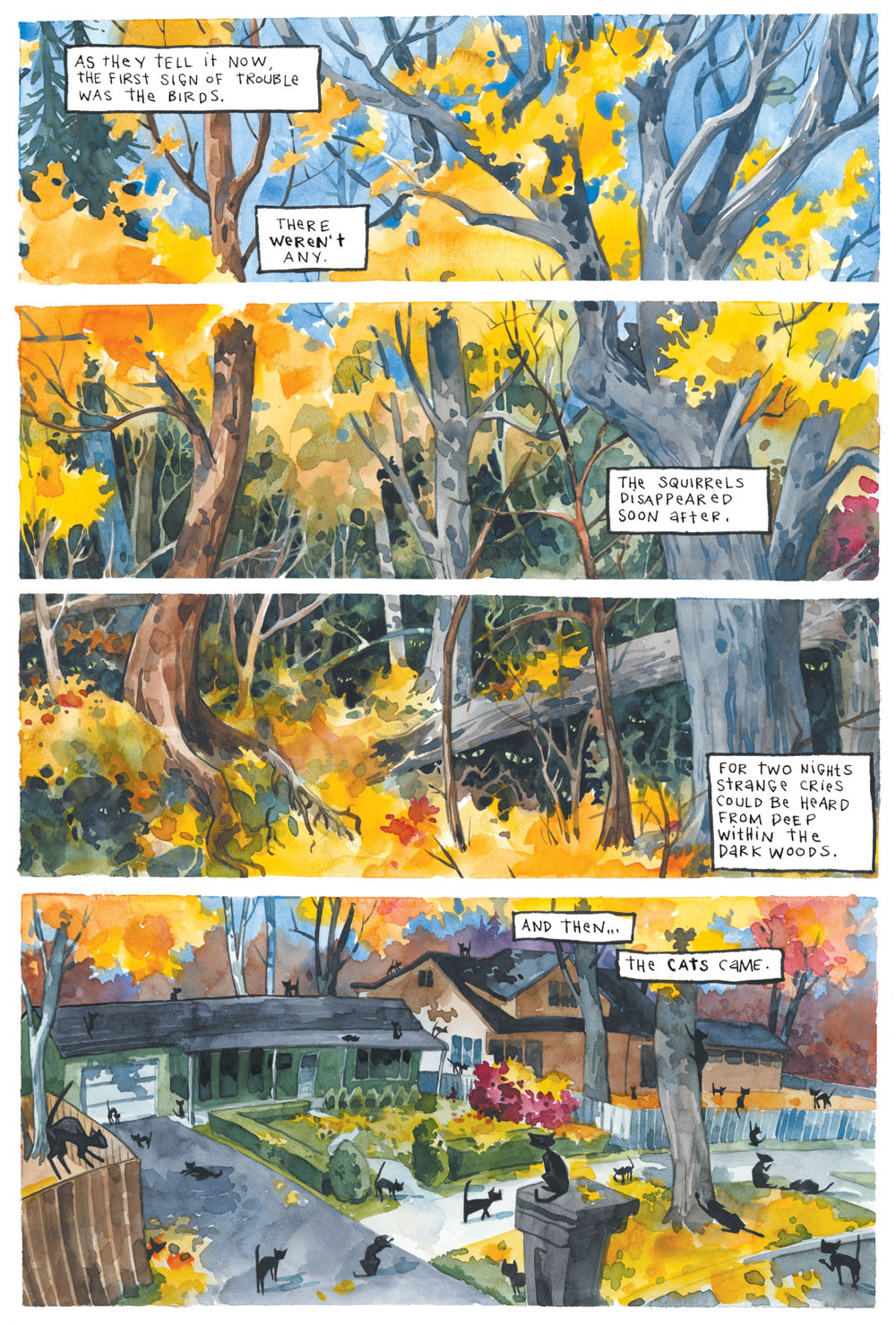
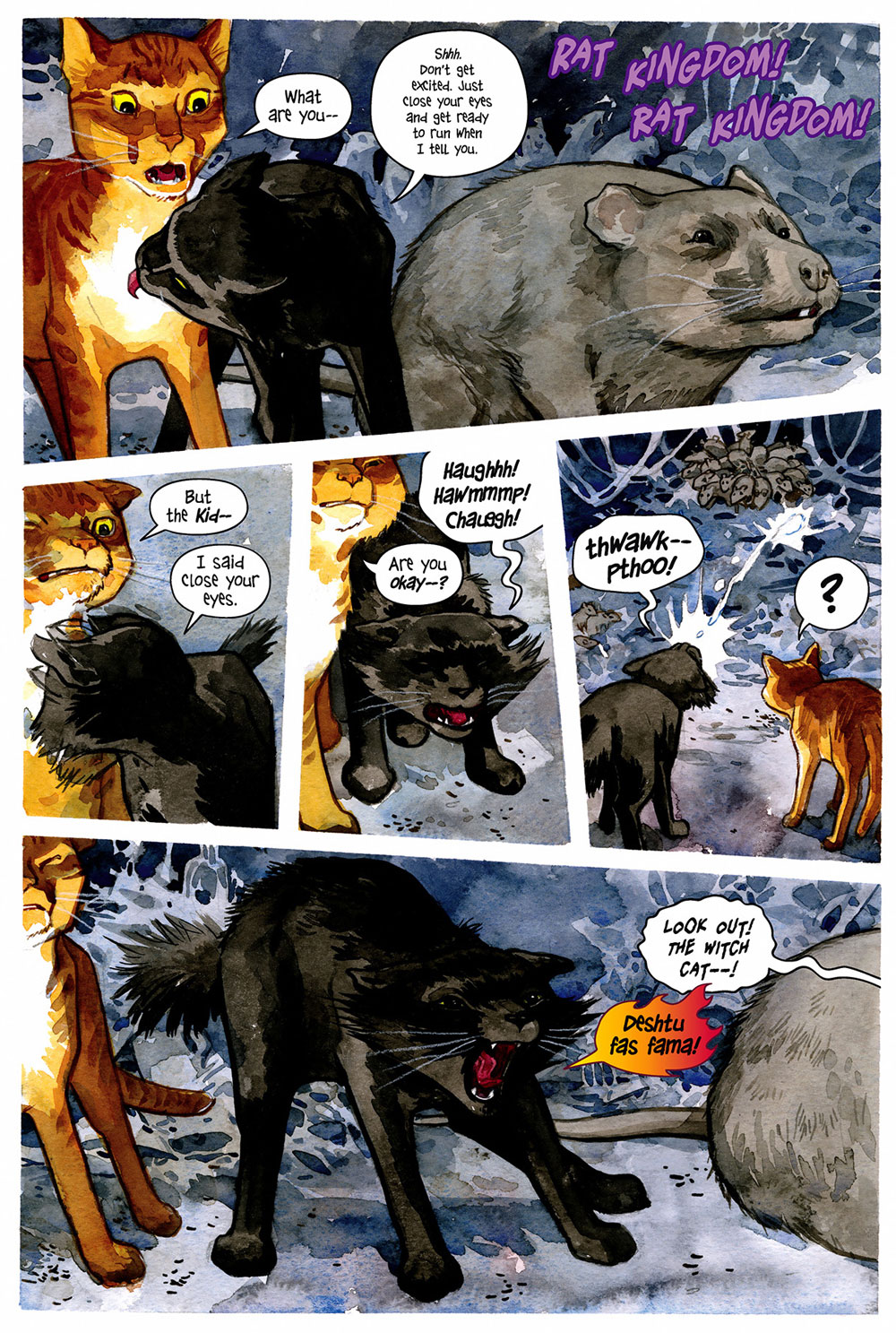
Page from The Unfamiliar, published in The Dark Horse Book of Witchcraft (July 2004). My favourite season is fall, so I couldn’t resist featuring a page of autumnal-blaze trees and black cats.
Another page from The Unfamiliar, published in The Dark Horse Book of Witchcraft (July 2004). The normally orange Orphan (who needs a better name, but at least he gets called ‘Orph’ a lot later on) gets dyed black as a subterfuge. This story is pretty goofy (two witches come to town to summon Sekhmet), and my least favourite of the early batch, but at least it has a lot of black cats.
Pages from Let Sleeping Dogs Lie, published in The Dark Horse Book of the Dead (June, 2005), in which Daphne (the black witch cat, who later becomes a part of the regular cast) returns with revenge on her mind.
Page from A Dog and His Boy, published in The Dark Horse Book of Monsters (December 2006).
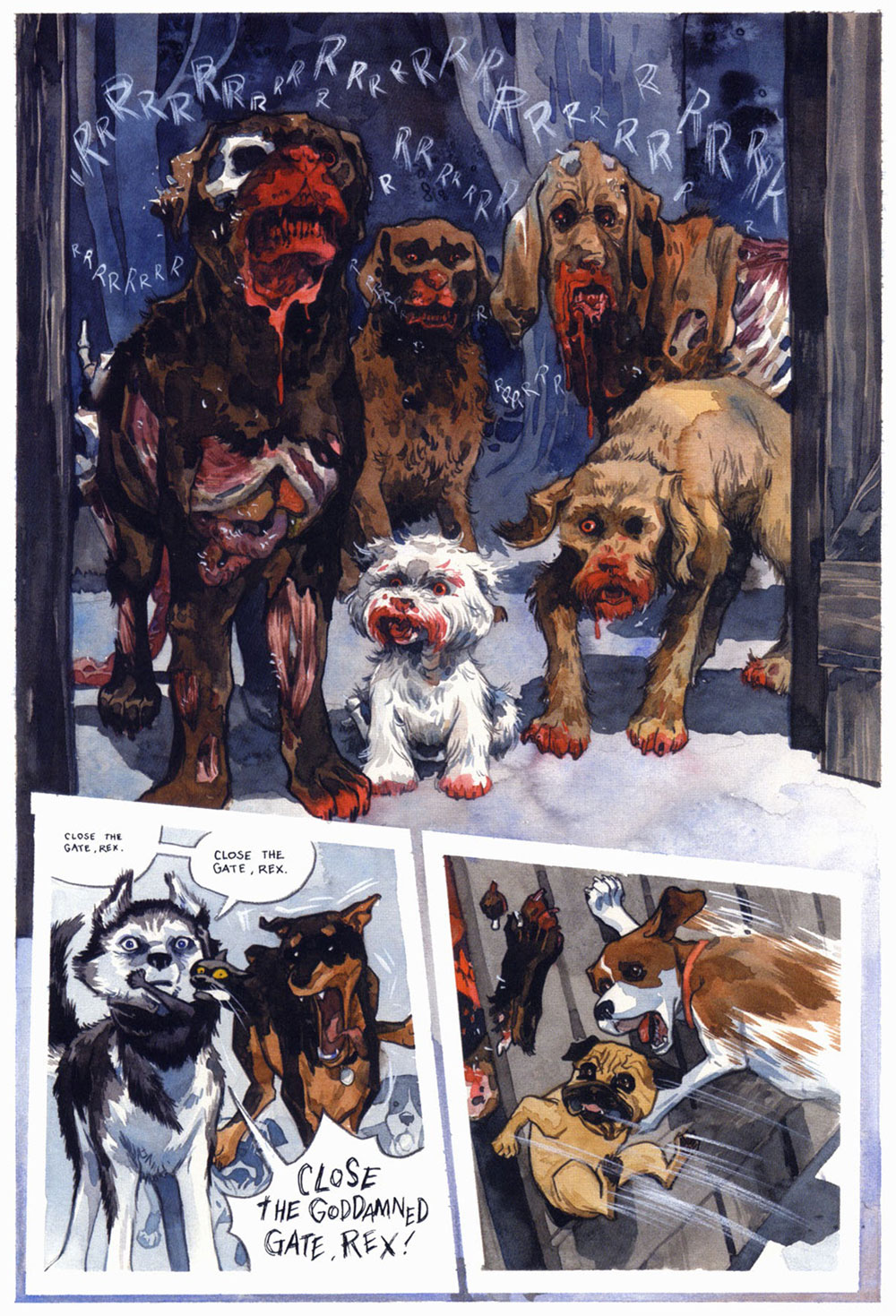
Page from The Gathering Storm, published in Beasts of Burden no. 1 (September 2009), the moment at which this became an official series, as opposed to a series of one-shot stories. The whole ‘plague of frogs’ thing is of course instantly reminiscent of B.P.R.D., a Dark Horse series that originally appeared in Hellboy.
Another page from The Gathering Storm, published in Beasts of Burden no. 1 (September 2009); the moment when the gang officially becomes watchdogs. Most of the dogs have collars, but can dash around with ease, barely ever running into humans.
Art for the cover of Beasts of Burden no. 2 (October 2009).
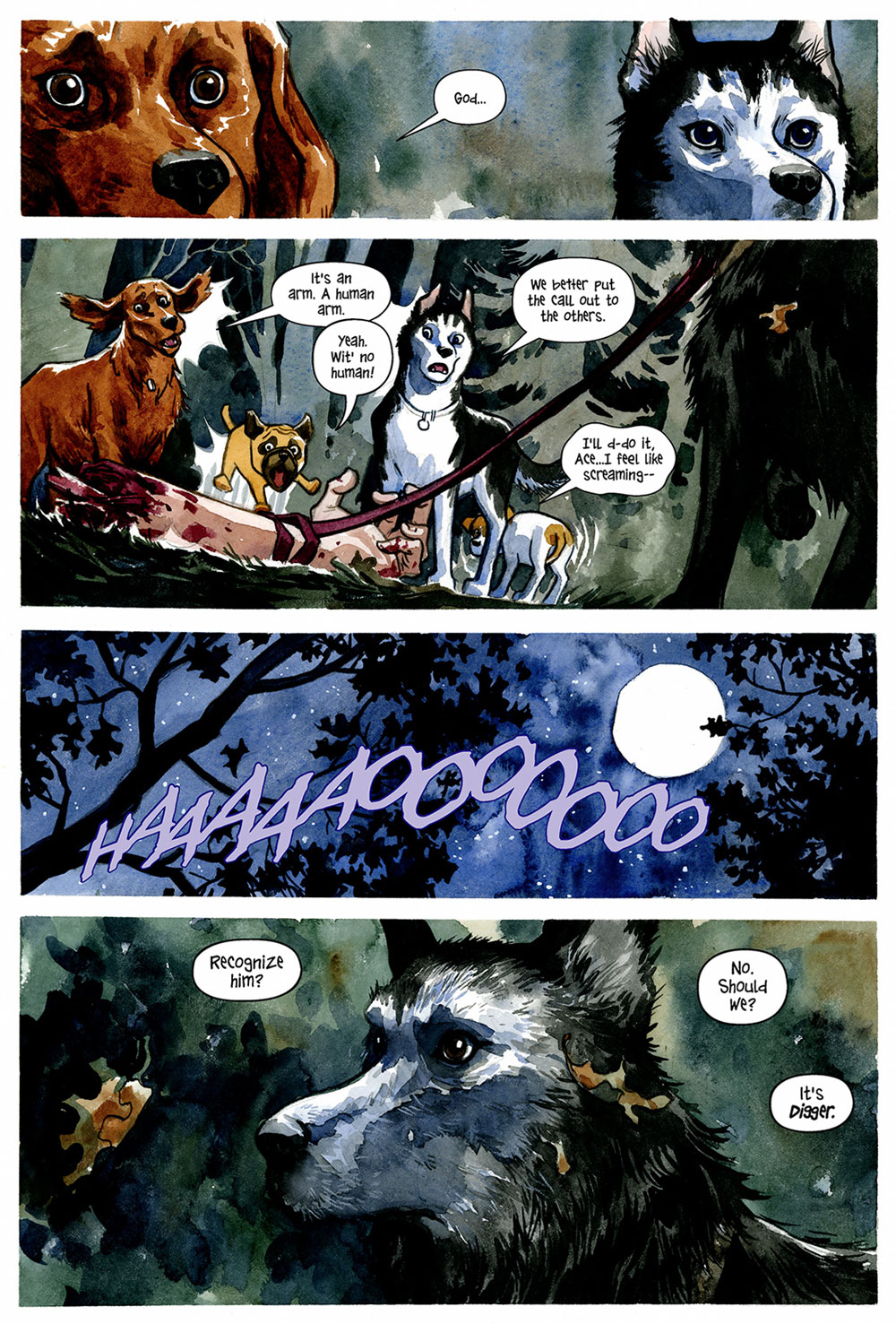
Pages from Lost, published in Beasts of Burden no. 2 (October 2009), a genuinely shocking moment – hurting a human goes against these dogs’ normal code.
Pages from Something Whiskered This Way Comes, published in Beasts of Burden no. 3 (November 2009). This story highlights the somewhat tense relationship between Orphan and his romantic interest/enemy Daphne, the black magic cat from an earlier story.
Page from Grave Happenings, published in Beasts of Burden no. 4 (December 2009).

Beasts of Burden is still ongoing, with the latest installment, Occupied Territory (illustrated by Benjamin Dewey, alas), published in July 2021.

~ ds

Hallowe’en Countdown V, Day 31

« Carve out a pumpkin and fill it full of cake mix and raisins and bake for half an hour and then write me and let me know how it turns out. » — one of Patrick Dean‘s ‘Party Tips’

I never met Patrick Dean in person, but I did consider him a friend. I became aware of his work when we both contributed to the second issue of Danny Hellman‘s Legal Action Comics anthology, back in 2003. Looking back, it strikes me that we were among the very few participants not going out of their way to offend.

We began to correspond. Geography aside, we had plenty in common, and so we kept in touch over the years. Then poor Patrick was diagnosed with ALS and fell victim to that relentless degenerative disease a couple of years later. But that’s a well-documented tragedy, so I won’t dwell on it.

I know I’ll always be thinking of Patrick when the leaves turn to red and gold, and I do believe he would have liked to be recalled in that fashion. His own countdowns to Halloween were always heartfelt and delightful.

My partner ds is also a fan, and she shared her own appreciation here.

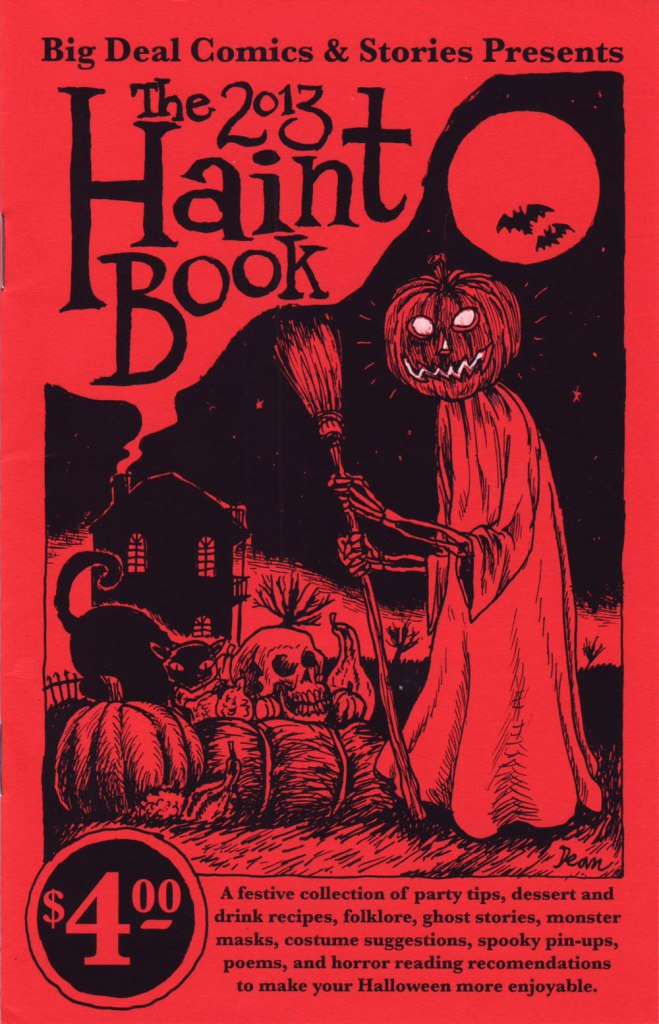
Patrick’s indispensable guide to all things Hallowe’en, The 2013 Haint Book (2013, of course).
An early-ish strip, from Big Deal Comics & Stories no. 4 (Winter, 2004).
Illustration for The Legend of the Jack-O-Lantern, from The 2013 Haint Book.
From Big Deal Comics & Stories no. 7 (Spring 2006).
From The 2013 Haint Book. If you must ask, a haint is « a type of ghost or evil spirit that originated in the beliefs and customs of the Gullah Geechee people, descendants of African slaves who live predominantly in the Low Country and on the barrier islands off the coast of the Carolinas, Georgia, and north Florida. » [ source ]
A brew only a witch could love, presumably. From The 2013 Haint Book.
With the passing years, Patrick’s work was just getting deeper and (yet) more emotionally layered. This is the opening page from Sometimes I Think About You at Night, the overlapping stories of two estranged couples, one living, one deceased, from Big Deal Comics & Stories no. 11 (2012).
Over the course of our correspondance, Patrick never failed to winningly personalise his mailings: this envelope features a shared favourite, Charlton Comics host Dr. M. T. Graves, he of the Many Ghosts.
A fitting coda to this (or any) edition of our Hallowe’en Countdown. See you next year, hopefully!

If you’ve missed any of our 154 previous instalments, here they are in handy and tidy fashion:

Hallowe’en Countdown I (2017);

Hallowe’en Countdown II (2018);

Hallowe’en Countdown III (2019);

Hallowe’en Countdown IV (2020);

and, bien sûr, Hallowe’en Countdown V (2021).

For the optimal Hallowe’en experience, you may kiss the Old Witch’s Finger (discovered on a beach while on vacation, earlier this month) and make a wish: a pox on your enemies or a tremendous candy bounty… you call it.

-RG