« As worthless a collection of crackpot notions and harebrained theories as I’ve ever seen in print! » — Graymatter McCogitator III, Chairman, National Academy of Very Smart Persons
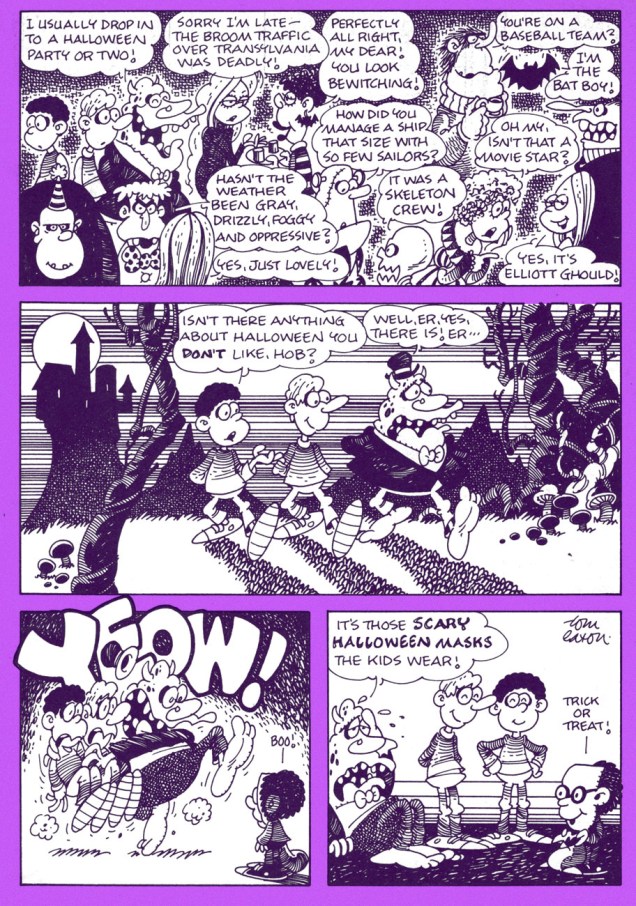
This Oliver Cool strip (we featured another one a couple years back) saw print in the October 1976 issue of Young World. While both strip and publication are just about forgotten, they’re worth a look… but then I have a soft spot for comics produced outside the comics industry proper (if you can call it that); in many cases the ‘product’ reaches a wider audience, but the tradeoff is that it’s a far more casual public.
I’ll readily concede that I’m pretty forgiving when it comes to the scripting of strips aimed at young readers, as the authors are forced to navigate a myriad of oft-needless and downright asinine hurdles in their efforts to amuse, entertain and, yes… even enlighten.
Apparently, though, if he’s to be remembered for anything, it may be for his extended stint as resident cartoonist of scouting magazine Boys’ Life (1984-2015), most significantly on The Wacky Adventures of Pedro, featuring the mag’s ‘mail burro‘, introduced in the 1950s. Take a gander at this (naturally) eye-opening article by R.C. Harvey on the subject.
This is Young World Vol. 13, no. 8 (Oct. 1976). Speaking of the Winchester Mystery House, you owe it to yourself to read Alan Moore‘s tour-de-forceGhost Dance (Swamp Thing no. 45, Feb. 1986, DC), illustrated by Stan Woch and Alfredo Alcala, the definitive WMH spooky tale. In the context of Moore’s American Gothic cycle, it felt a bit incidental, practically a non sequitur, but it’s damn powerful stuff. Psst: check it out here.
Bonus-wise, here’s a pair of recent-ish Pedro strips. At this point, Eaton’s crisp line and meticulous layout bring to my mind the qualities of another Midwestern cartooning wunderkind, Rick Geary.
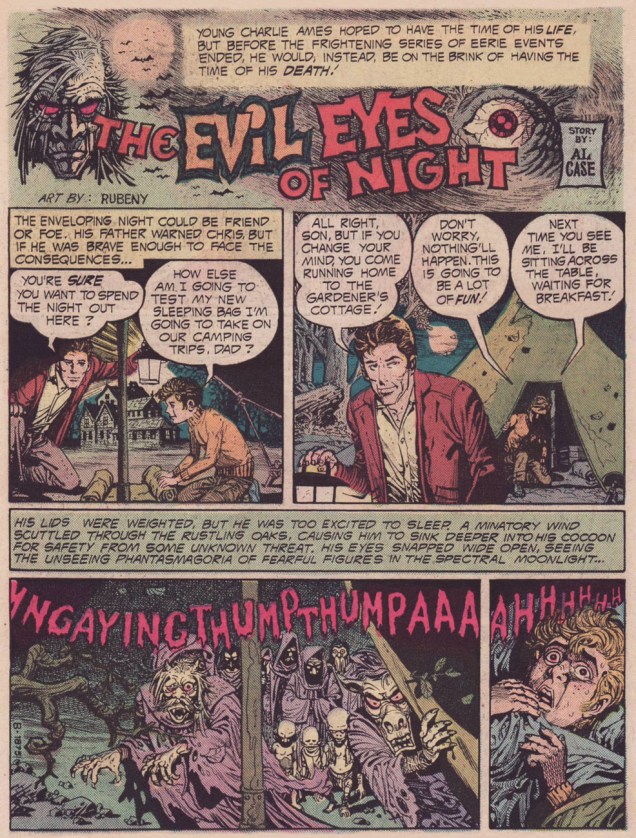
« You’re sure you want to spend the night out there? »
As an avid backyard camper, this effectively chilling cover by the versatile Argentine Luis Dominguez never failed to bring a pleasant tingle of dread. It has that quality of a silent, slow-motion nightmare. Barely-glimpsed but eerily tangible horrors shambling your way… and you can hardly move, helpless but with all senses on edge. Eek.
Though it came late in Carmine Infantino‘s tenure, one can safely assume that DC’s publisher and his adjutant, art director Nick Cardy, had a hand in the cover’s layout. It certainly does tick Carmine’s boxes of « Leave Room for the Kids » and « Make It More Mysterioso. »
DC’s The Unexpected no. 166, (July 1975). The moody featured story, The Evil Eyes of Night, scripted by Al Case (one of editor Murray Boltinoff‘s several noms de plume) and illustrated by an inspired Ruben Yandoc, doesn’t betray or squander the promise proffered by the cover, though it hardly proceeds as one might presume. This isn’t The Expected, after all…
I do believe that Yandoc did his own lettering, as it’s a consistent element across his American output. That’s always a plus, an added touch of personality. Love those sinister onomatopoeia!
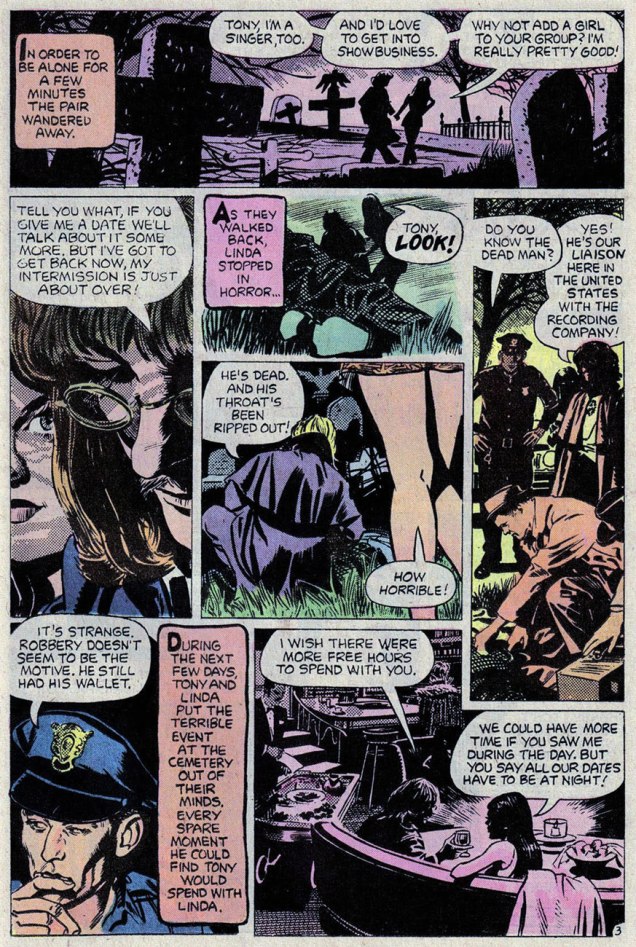
« Is it true your first concert is going to be at a cemetery? »
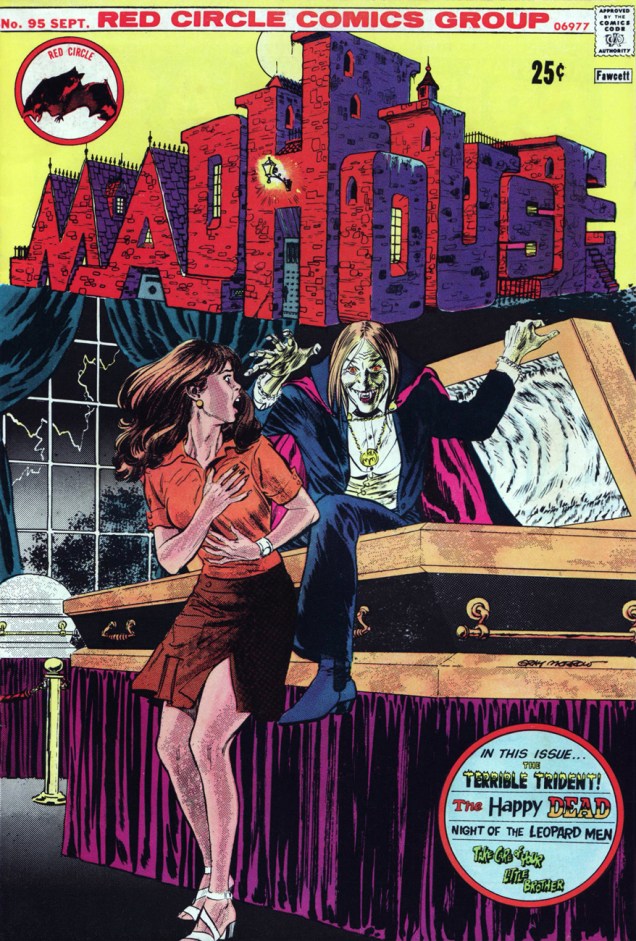
By the summer of ’74, the Archie brass was getting sick of those no-account Didit Brothers (You know, Dan, Dippy, Dick and Clyde) and their groupie Fran the Fan, so the Madhouse Glads were tossed out on their collective ear in favour of… a horror anthology. It made sense: in the 1970s, there was considerable overlap (largely female, but not exclusively) among readers of, say, The Witching Hour, Betty and Me, and Romantic Story.
The final fate of Fran the Fan? This is Mad House no. 95 (Sept. 1974, Archie); cover art by Gray Morrow. Read the issue here.
It’s fair to assume they were envisioning a companion title for their Chilling Adventures in Sorcery / Red Circle Sorcery. This was something different for Archie, all right: they sought out top talent, but in a fairly consistently sober visual style. Gray Morrow‘s photo-based approach was the baseline, and small wonder: he was the editor. The bulk of the stories was penned by Marvin Channing, and while the ‘twist’ endings weren’t exactly fresh, some of these tales were surprisingly nasty and nihilistic.
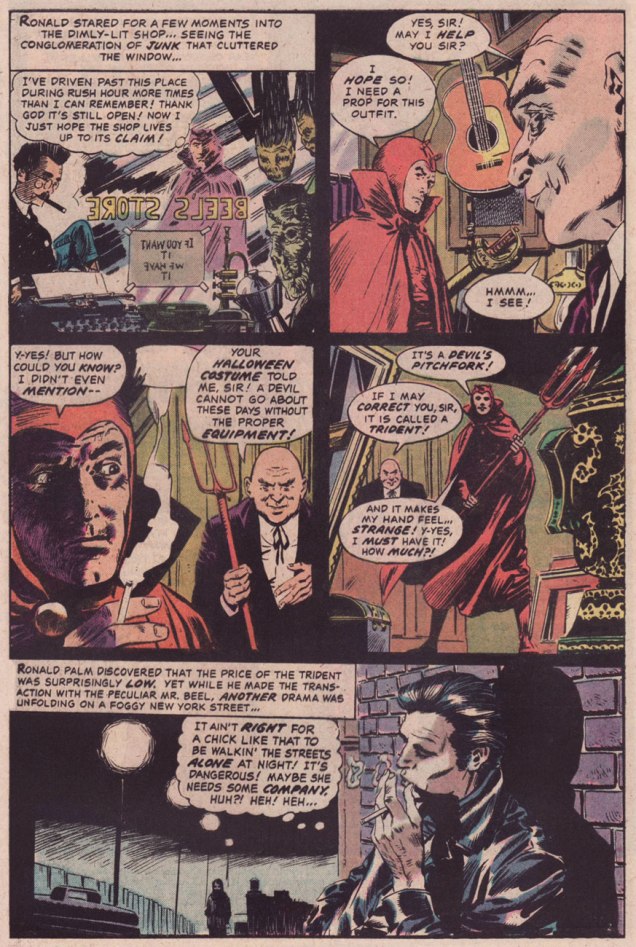
Page two from The Terrible Trident!, written by Don Glut and illustrated by Vicente Alcazar.Page three from the cover story, The Happy Dead. Written by Marvin Channing and illustrated by Doug Wildey. Whoever handled the colouring here was smart and discerning.
However, this version of Madhouse lasted but three issues before the book was returned to its original, pre-Glads format. Sorcery endured for nine issues, the first three done in the Archie house style, with narration by Sabrina, the Teenage Witch. By the end of 1974 (with a book cover-dated February, 1975), the experiment was over. But these things come in cycles, don’t they? Witness the recent Afterlife With Archie… which incidentally reprinted much of this material.
And in other media, amidst the current glut of Archie product, one finds a direct scion of a timid, decades-ago exploration, Netflix’s Chilling Adventures of Sabrina.
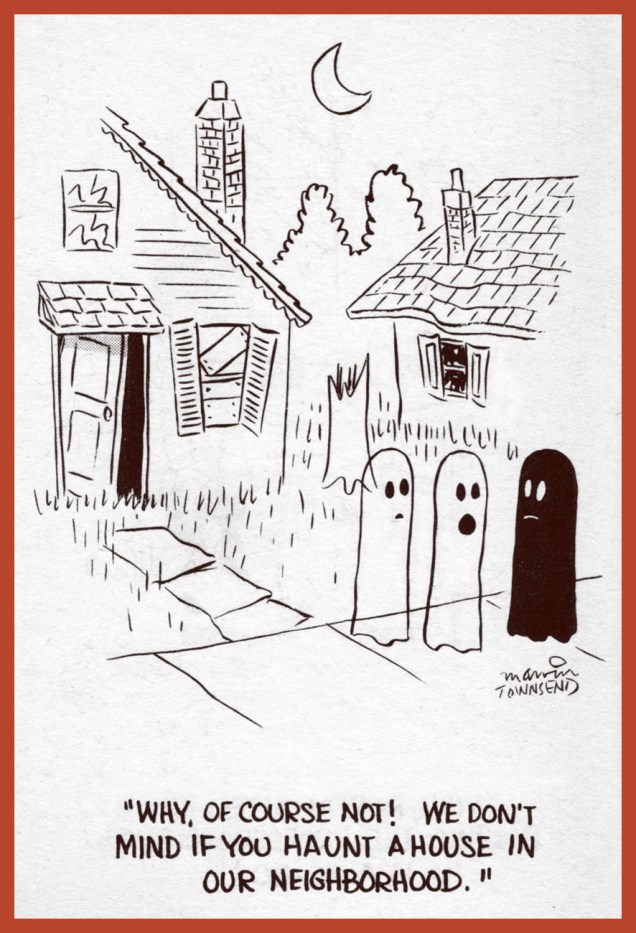
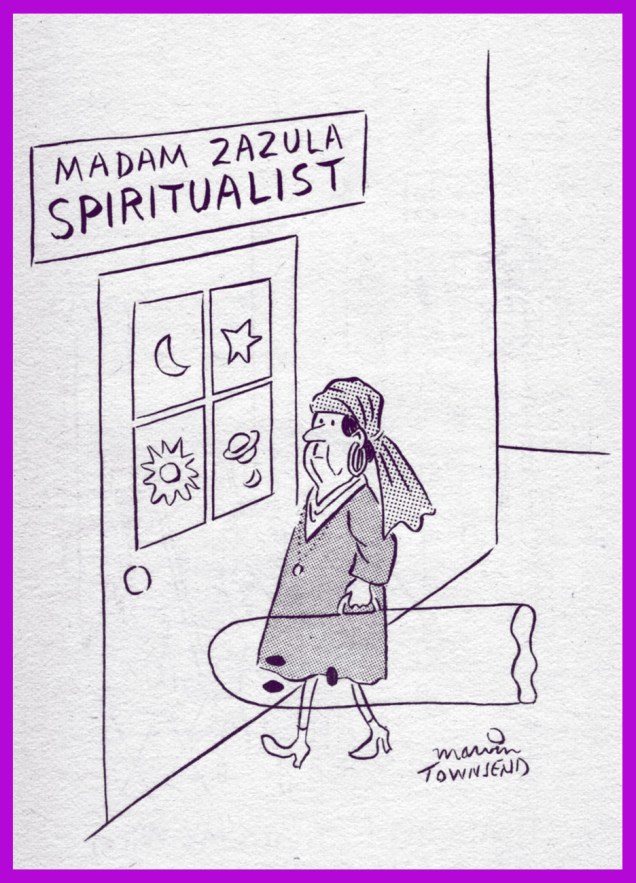
« I hear they’ve hired a skeleton crew to take over the night shift. »
Published in 1971 by, of all entities, the Xerox Corporation, under its Xerox Education Publications banner, this oddball little volume is pretty high on charm. Its author, Kansas City cartoonist Marvin Townsend (1915-1999), placed his gags all over the place, high and low, from slicks to religious publications to pulps (including Amazing Stories and Argosy), to girlie digests such as Charlton’s Cartoon Spice, created several running strips, including the Ali feature for the long-running (1946-72) Catholic comic book Treasure Chest (of Fun & Fact). Let’s not forget that Townsend was in fine company there: contributors to TC over the years include Murphy Anderson, Reed Crandall, Graham Ingels, Fran Matera, Jim Mooney, Joe Orlando and Joe Sinnott. In the lean years of the Silver Age, it was ‘any port in a storm’, and any reliable source of income and exposure was the freelancer’s boon. Same as it ever was.
It’s hard to imagine today’s church being this open to airing and considering the opposing view.All aboard for Noah’s Same-sex Ark cruise!
I love that kid’s steadfast nerve and adaptability.
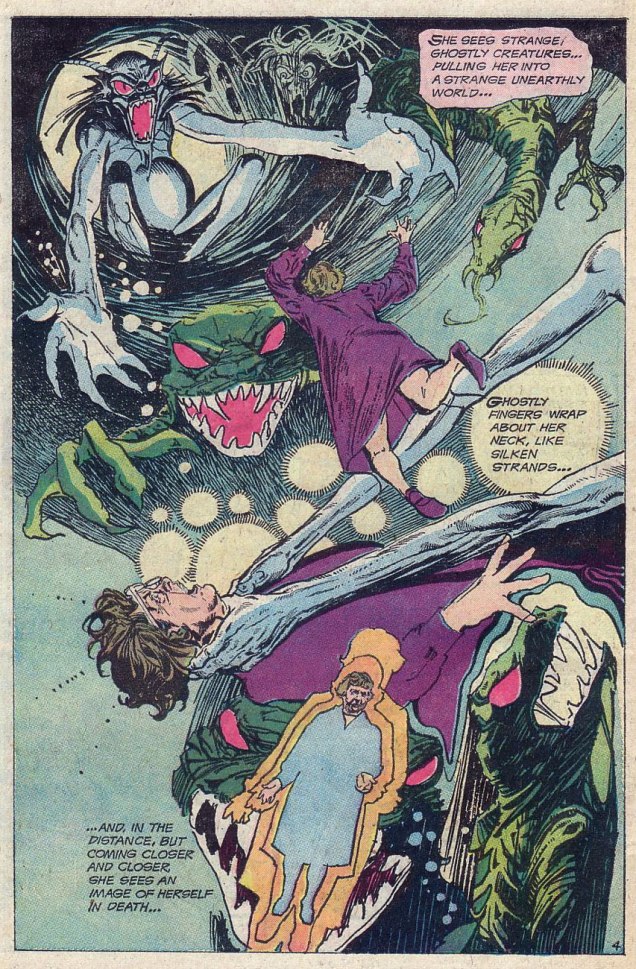
« ... and suddenly, an ordinary business day becomes a day of horrible visions… »
When he was introduced in 1951 (Star Spangled Comics no. 122), Dr. Terrance Thirteen was a perfect fit for the DC universe: a skeptic who, in the nominally-rational world he inhabited, got to elucidate and debunk all sorts of mock-supernatural shenanigans. When the ghost-breaker made his return in the late 60s (as a foil to his also-returning contemporary The Phantom Stranger), however, the world had changed. The editorial balance had shifted in favour of the mystical, and Dr. 13 wasn’t as fortunate as the kids from Scooby Doo: he now faced bonafide manifestations from the beyond, but he wouldn’t have any of it, becoming a blind, overbearing ideologue in the vein of filmic non-believers Dana Andrews in Night of the Demon (aka Curse of the Demon) or the fabulous Peter Wyngarde in Night of the Eagle(aka Burn, Witch, Burn… adapted from Fritz Leiber’sConjure Wife).
And things got worse and worse over the years; by now Dr. 13 is treated as a joke and a punching bag (even Matt Howarth blew it, a rare misfire), but that’s the general climate in the modern mainstream: most long-running characters, even the heroes, with a scientific background (Henry Pym, Reed Richards, Tony Starket al) are frequently depicted as arrogant, misguided and often downright insane.
For a brief time in the early 1970s, Dr. 13 was handled by a sympathetic and skillful writer who understood what the man stood for and what made him tick. For a full example, check out our earlier post on another Dr. 13 case, … and the Dog Howls Through the Night! (1974).
Scripter Skeates stated, a few years ago: « I quite like this story, especially the beautiful psychedelic scary artwork DeZuniga provided (an artist I very much enjoyed working with; he also illustrated a number of my Supergirl tales), plus the ending in which I somehow decided to treat this yarn as though it were a cautionary tale, the lesson learned being that one shouldn’t commit murder! For the longest time a copy of this comic wasn’t in my collection , but a couple of years ago I came upon a copy at a convention — the price-tag was a bit high due to the origin story that’s also in there! When I told my wife I had shelled out forty bucks for a comic with a story of mine in it that didn’t even have credits on it, she concluded that I was the one who was quite definitely insane!! »
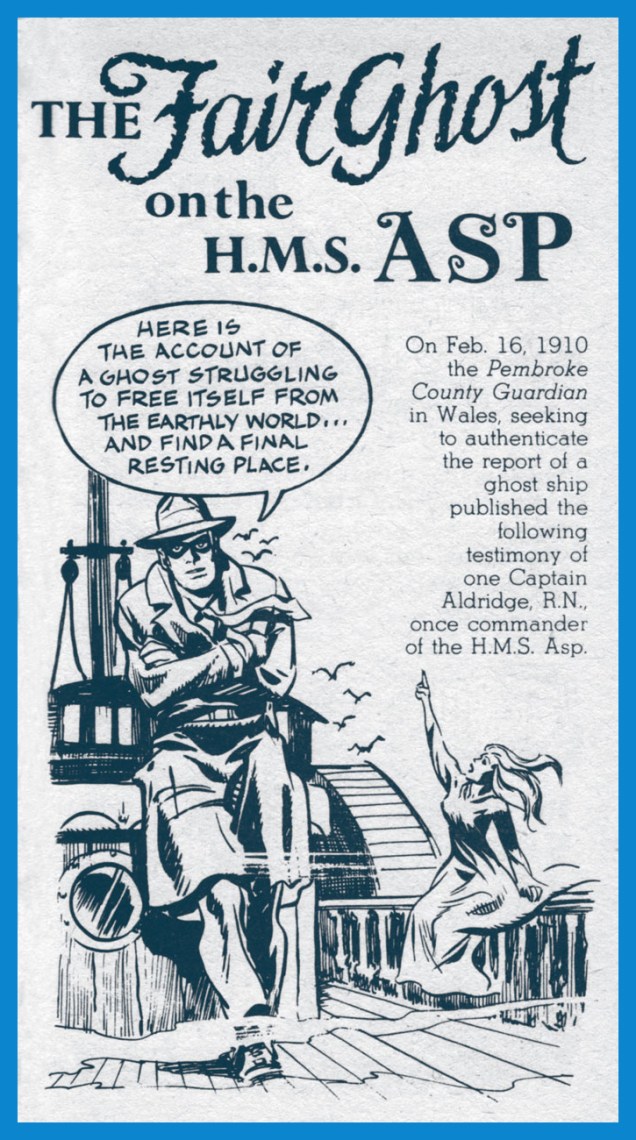
« In June, 1913, the family moved out in terror! … they simply abandoned the house in the Midlands. There is no record of successors. If you are looking to rent a house, cheap… it may still be there! »
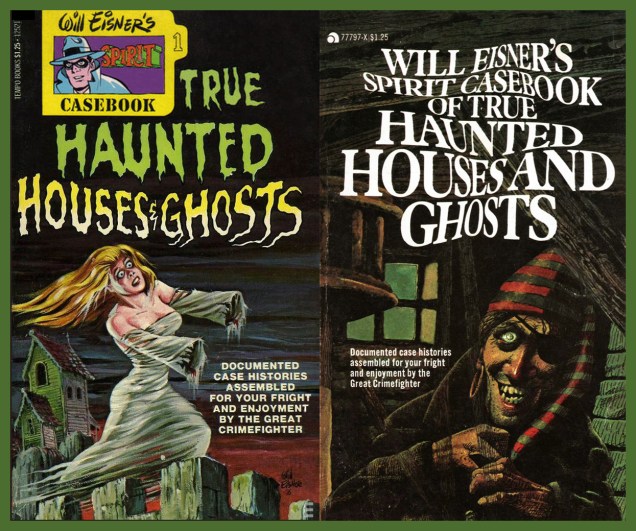
On this second day of our Hallowe’en countdown, let’s peer through the mists of time at 1976, when Will Eisner was still experimenting with marketing formats for comics-type material. This was still a couple of years before his A Contract With God and Other Tenement Stories (1978) appeared. During that period and beyond, Eisner was throwing a lot of material at the wall, in the finest exploitation tradition, hard on the heels of every bankable trend: Will Eisner’s Gleeful Guide to the Quality of Life, 101 Outerspace Jokes, Will Eisner’s Gleeful Guide to Communicating With Plants, Will Eisner’s Gleeful Guide to Living With Astrology, 300 Horrible Monster Jokes… and it wasn’t all good, as you can imagine.
This 160-page paperback from 1976 is arguably the cream of that crop; an easy choice for those of us who value Eisner’s expert hand at setting a shadowy mood.
Mr. Eisner’s original back cover.
Publisher Tempo Books seems to have had limited faith in the sales appeal (too gruesome?) of the original cover, as a variant edition was issued in short order, bearing a fine, but non-Eisner cover. Can anyone identify the artist?
« Gary Groth: You did — God help you — you did an Alice Cooper comic in ’79. Were you out of it or what?
Tom Sutton: I listen to Mozart. I don’t know. I guess Alice Cooper was a musician. Some kind of giant snake or some damn thing.
Gary Groth: So why the hell didn’t you do a Mozart comic?
Tom Sutton: Nobody asked me to. »
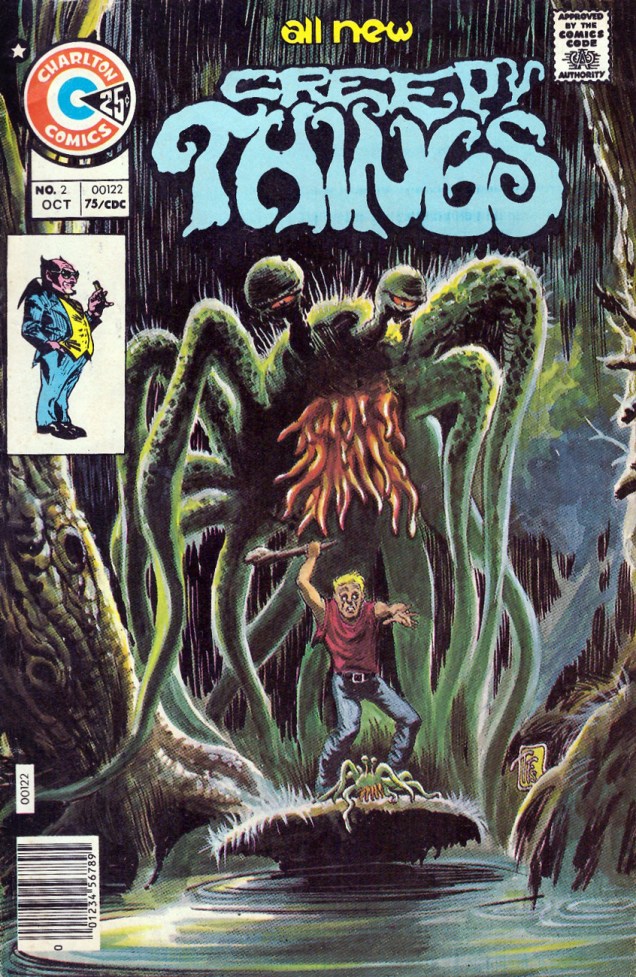
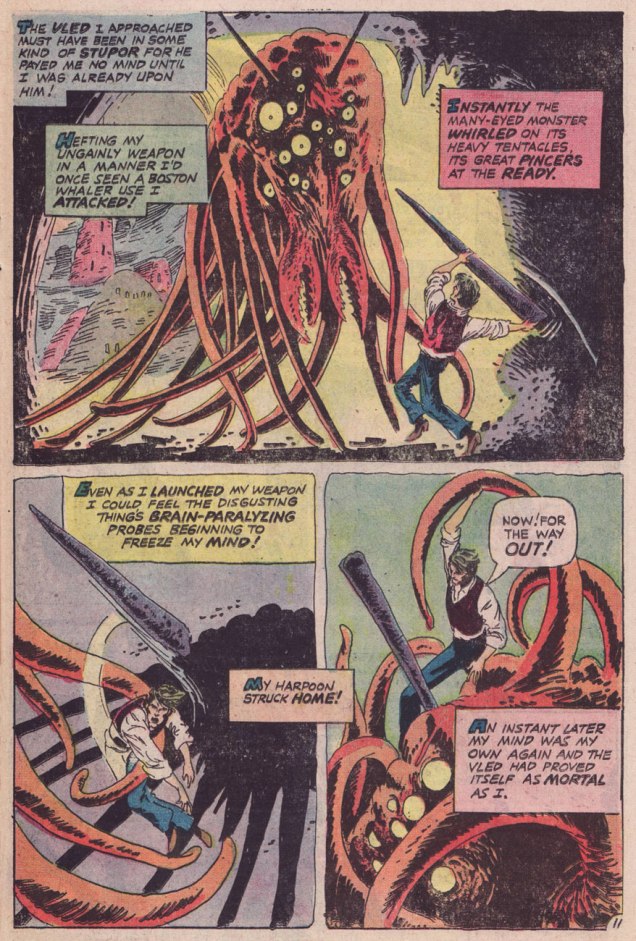
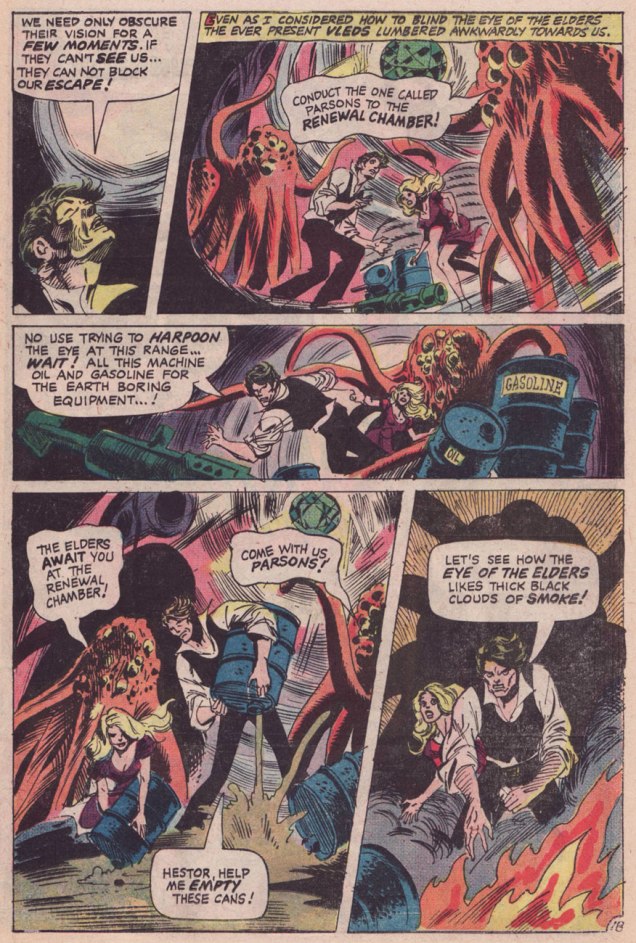
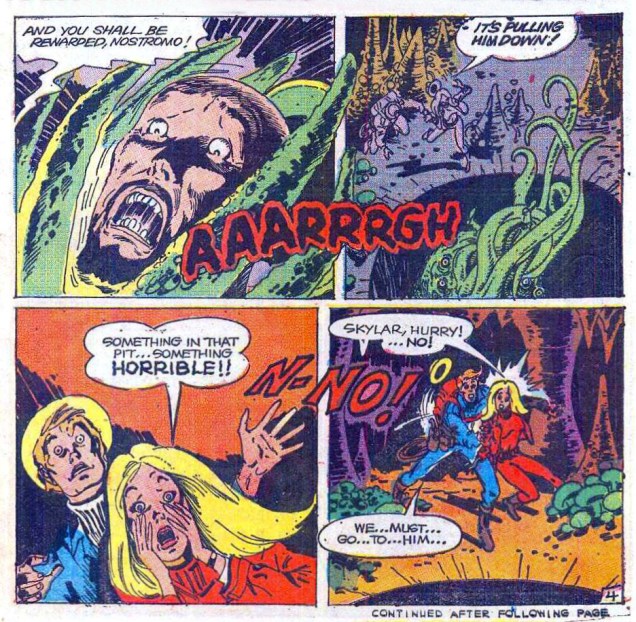
When I wrote Tentacle Tuesday: a Treasure Trove of Charlton Tentacles, I skipped Tom Sutton, vowing to return to him at a later date. If there was anyone deserving the title of Tentacle Tuesday Master (applause, please!), it is him. I don’t know what the appropriate cluster term for tentacles is, but Sutton has surely brought a, um, pandemonium (a terror? a trepidation?) of tentacles to Charlton‘s pages.
Even outside of his tentacles, Sutton is a truly interesting artist. I highly recommend An Odd Man Out: Tom Sutton,Gary Groth’s interview with him for The Comics Journal. Just read Groth’s introduction, if nothing else – he does an excellent job of summarizing Sutton’s singular career and the conflicting influences that shaped it. The interview is 11 web-browser pages long, and throughout Groth and Sutton’s conversation, one gets the distinct impression that Sutton is a witty, self-deprecating man, the kind you want to take to a bar or something to listen to his stories. At some point he mentions that the tape (to record the interview) is probably running out, and Groth responds with «There’s not enough tape in the world for you, Tom», which is, I think, a good example of their easy banter as well as obvious camaraderie.
Anyway, back to the topic at hand – the art and writing is by Tom Sutton, unless indicated otherwise. You know those over-the-top Russian buffets, where food is overflowing from the table? This post is like that, but with tentacles.
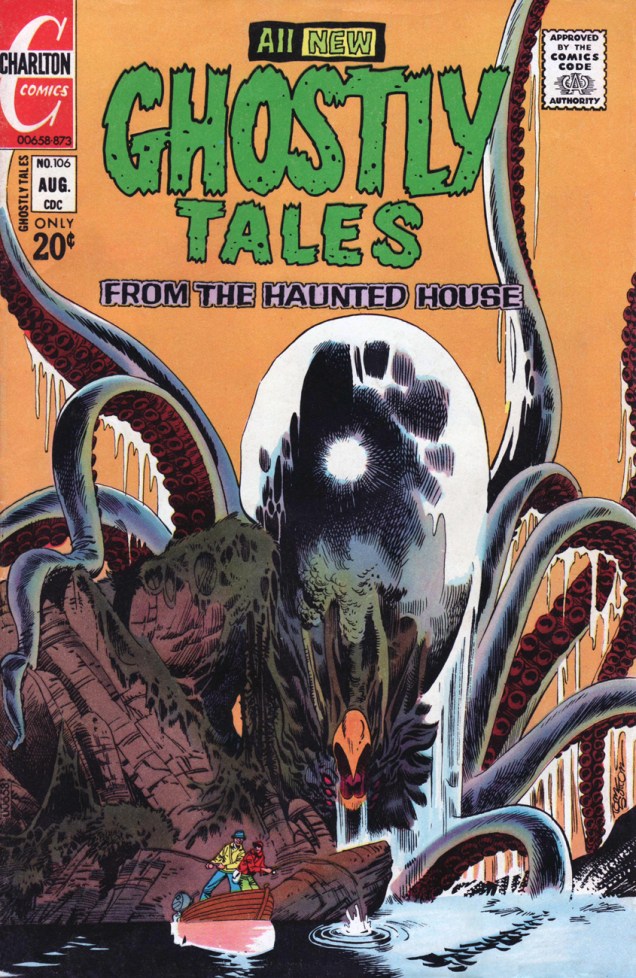
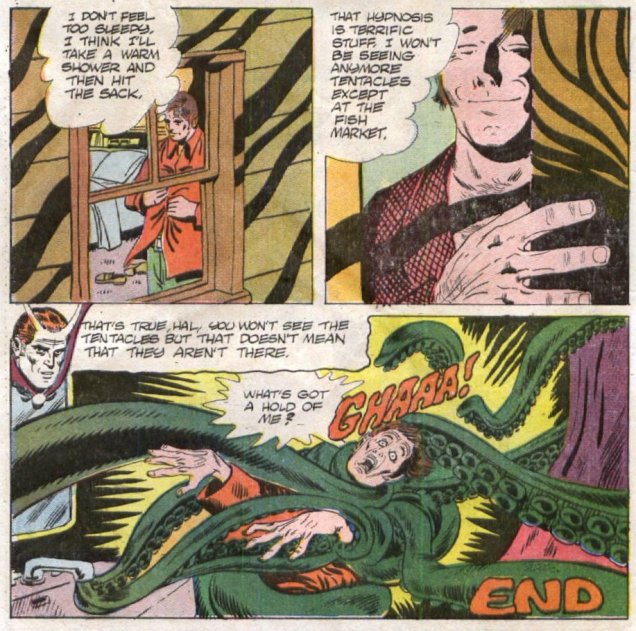
Ghostly Tales no. 106 (August 1973).This story, titled simply (and à propos) Those Tentacles!, scripted by Nicola Cuti and illustrated by Sutton, has already been mentioned in Tentacle Tuesday: Domesticated Octopus Seeks Soulmate, but I’ve never posted this page. Dang, gave away the ending.
This story was repurposed as a cover for Ghostly Tales no. 130 (May 1978):
Ghostly Tales no. 113 (February 1975). Isn’t it a beautiful cover?Page from Through a Glass Darkly, the (surprisingly, black and white; Sutton evidently knew it wasn’t feasibly colourable… and his publisher respected his wishes! As opposed to…) cover story of Ghostly Tales no. 113. Good thing we we treated to all those eye-pleasing blues and greens on the cover!Creepy Things no. 2 (October 1975). You can read the full issue here. This is my favourite cover of this lot, both for the parent creature’s sad, slightly sleepy expression, and for the crispness of greens against black.Creepy Things no. 4 (February 1976). I’ll bet that slug-thing glows in the dark.Page from Man’s Best Fiend, scripted by Joe Gill (as Tom Tuna) and illustrated by Sutton, printed in Creepy Things no. 4.Ghost Manor no. 27 (January 1976)Scary Tales no. 4 (February 1976). Scary Tales hostess Countess Von Bludd tackles tentacles! Now you can’t say this post doesn’t have any cleavage.Haunted no. 20 (February 1975). My second favourite cover, for the completely horrified, totally Sutton-esque faces of the creature’s victims. I also like the way his signature is hiding at the foot of the tentacles.Pages from Mountain of Fear, published in Haunted no. 20. This is likely the most Lovecraftian (and epic) of Sutton’s Charlton tales.
Page from Out of the Deep, published in Haunted no. 21 (April 1975). This panel was later used as the cover for Haunted no. 55 (May 1981). Read the full story here.Page from Fear Has a Name!, scripted by Nicola Cuti and illustrated by Tom Sutton, published in Haunted no. 22 (June 1975).Page from The Thing in the Hole, published in Ghostly Tales no. 111 (September 1974). Read the whole issue here.
For more Tom Sutton, head over to the great blog The Horrors of It All, where a fellow admirer has posted a bunch of his stories. I’m happy to say that Sutton aficionados are legion and they’re fairly rabid, so to speak.
Furthermore, you can read co-admin RG’s Mind the Quirks and Glitches: Petrucha & Sutton’s Squalor for one more, more modern, facet of Sutton’s varied career. And if you’d like a little piquant in your life, his post even includes links to Sutton’s erotic comics!
« Mom, my teacher, Mrs. White, has invited me to a slumber party at her house this weekend. She’s really nice. Can I go? »
« Sure, why not? » — from a Jack Chick tract, The Poor Little Witch (1987)*
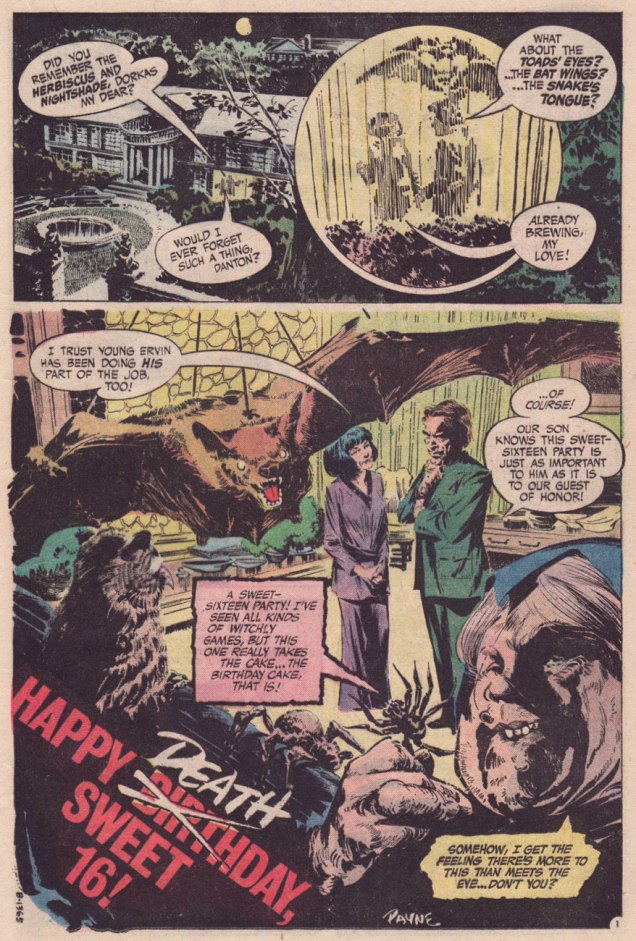
Today, we part the curtains and peek at the fair bosom of suburbia, circa 1972. In those gentle times of satanic panic, Tricky Dick’s political shenanigans, the oil crisis and all-around grooviness, the Manson ritual murders were recent history, Anton LaVey‘s The Satanic Bible (1969) and its sequel, The Satanic Rituals (1972) were all the rage, not to mention William Peter Blatty‘s The Exorcist (1971… the film another year away) and Ouija boards. DC Comics’ The Witching Hour (85 issues, 1969-1978) was well in keeping with the vibe of the times, and offered girls somewhat of an alternative to Archie, Little Dot and Young Romance. In fact, my recollection (and I’d welcome yours!) was that ghost and mystery comics overwhelmingly found favour with the ladies.
I’ve perhaps said it before, but DC’s mystery books were mostly well-drawn but mind-numbingly formulaic… but exceptions now and again slipped in.
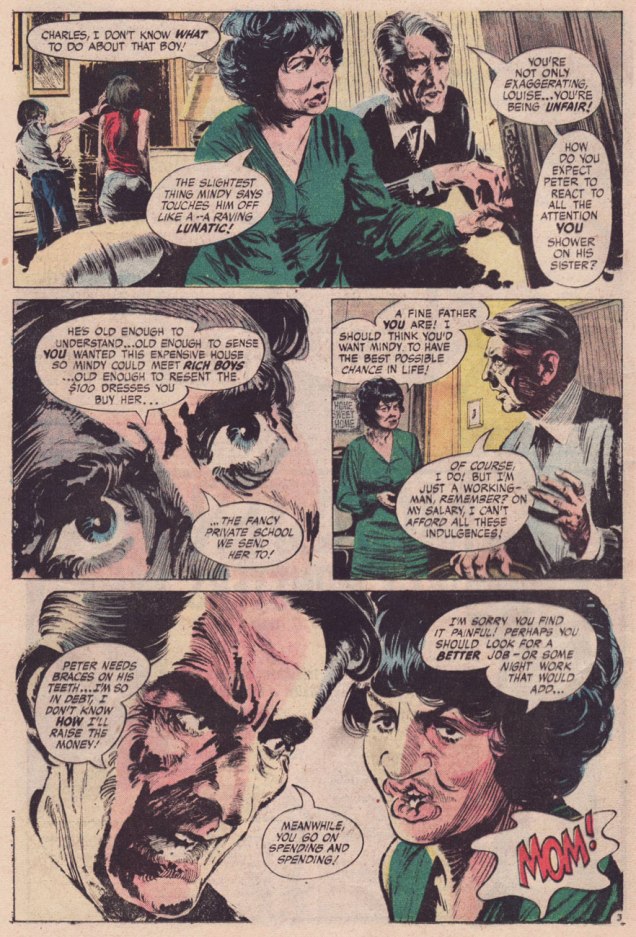
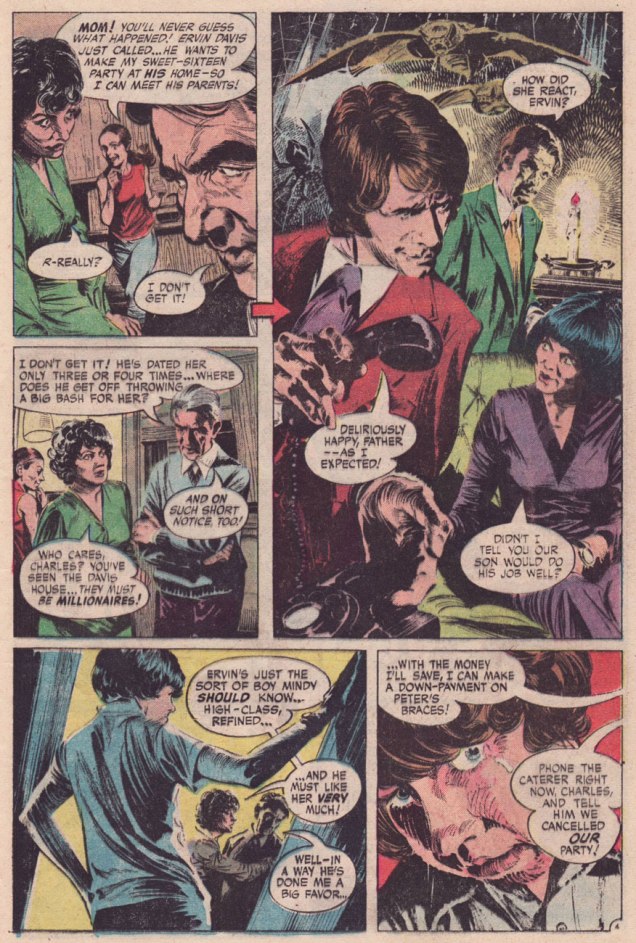
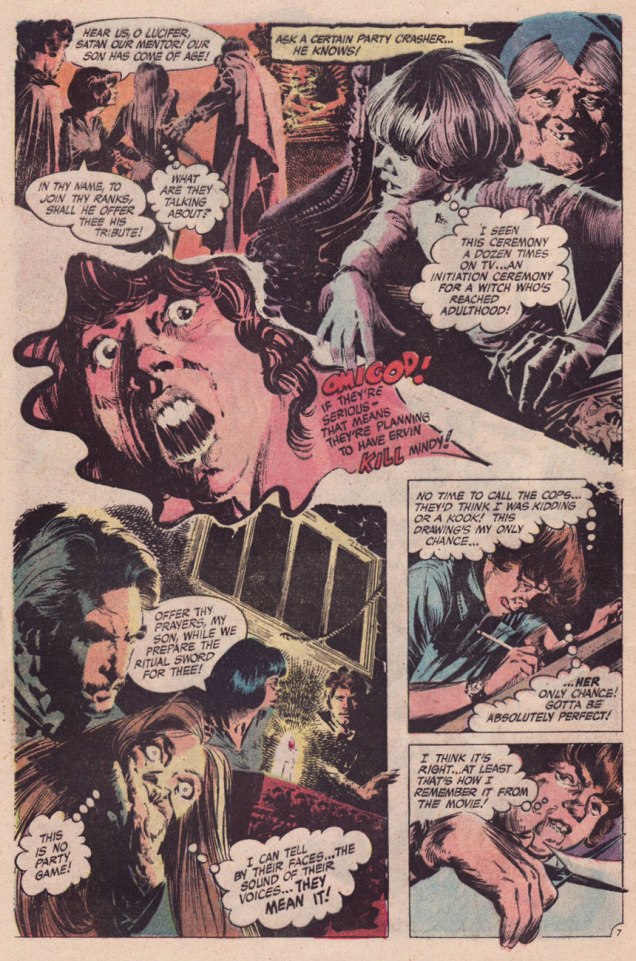
Happy Deathday, Sweet 16! was a bit of lightning in a bottle. It was illustrated by the hardly-prolific Canadian Bill Payne, who drew a dozen or so jobs for DC’s mystery and war titles, lettered a few more, then vanished. I suspect he had a day job in some advertising agency and did a bit of comics work on the side for kicks. If that’s the case, he certainly applied himself, bringing actual realism and a bit of the old ‘Ghastly’ Ingels grotesqueness to the table. The writer, however, is uncredited. The writing doesn’t quite feel like the work of any of DC’s workhorses… it’s markedly better, rising beyond the stock situations and packing in plenty of credible detail to flesh out the players in its scant eight and a half page allotment. Sibling rivalry, social aspirations**, marital and parental discord, class warfare… Lucky Peter, though: he somehow seems to have continual access to Shock Theater; for me, that’s the main cause for suspension of disbelief.
Nick Cardy‘s sweet ‘n’ sassy cover for The Witching Hour no. 25 (Nov. 1972). It’s fun to see one of his winsome romance cover girls put in a rather… perilous cross-genre appearance.
These days, I suppose the fundamentals haven’t changed, though with so-called Christians behaving in most unchristian fashion, and Satanists displaying a puckish (honestly, kind of adorable) sense of humour, things are… interestingly confusing.
-RG
*Read it here; but remember, it’s “available only in multiples of 10,000 at half-price.” ** Let’s keep in mind that, as Lori Loughlin has pointedly pointed out, “Any mother would have done the same if they had the means to do so.”
I also recommend reading Learning to Love Jack Kirby, an earnest and personal story of how the author (Chris Sims) came to appreciate Kirby and, at the same time, a pretty good overview of some of his most memorable characters and comics.
« I’m tempted to say that you don’t really get Kirby until you develop the ability to look beyond the surface of a story and see how much craftsmanship it takes to look as simple as his comics, but that’s really just covering up my own initial revulsion. There were plenty of kids who encountered Kirby at the same age I did and wound up loving him from the start; I’m just a slow learner.But I do think there’s something to the idea that it just has to hit you right for everything to make sense, and once you’re there, you’re there forever. And the good news is that Kirby’s contributions to the medium are so vast, so unavoidable even a quarter-century after his death, that even just scratching the surface of superhero comics means you’re encountering them all the time. »
Now that we have part over with, shall we continue to the tentacular part of today’s post? Kirby didn’t do anything in half-measures, so I’d like to think that we have some epic, larger-than-life, cosmic tentacles on offer. As it turns out, there’s quite a lot of ’em scattered throughout Kirby’s mind-boggling career, so today I am concentrating on Kirby’s work for DC Comics in the 1970s.
Seriously, there’s all kinds in here. A sea ball of yarn is our exhibit A.
Sequence from O’Ryan Gang and the Deep Six, scripted and penciled by Jack Kirby, inked by Vince Colletta, and published in The New Gods no. 4 (August-September 1971).
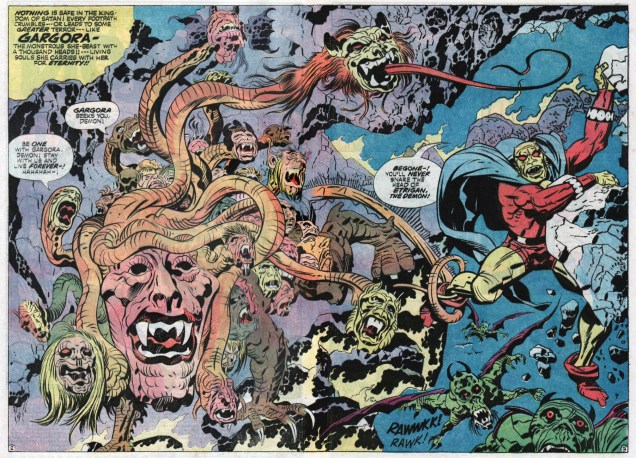
This may be a take on the old head-of-Medusa, but Gargora doesn’t mince words, and when she says someone can’t escape, well, she’ll deploy some tentacles to catch them:
Splash from Witchboy, scripted and penciled by Kirby, and inked by Mike Royer, and published in The Demon no. 14 (November 1973). Random fact of the day: Freud considered that the hair on Medusa’s head is often represented in form of snakes, because as snakes are penis symbols derived from the pubic hair, they serve to mitigate the horror of the female castration complex. …When someone tells me that are into Freudian theories, I back away slowly.
Some monsters crush you between their limbs – this is no different, but instead of two legs, there’s a “crushing mass of tentacles”. Don’t feel bad, Etrigan, no-one could break free of *that*.
Page from The One Who Vanished!!, scripted and penciled by Jack Kirby, and inked by William Stout and Mike Royer (don’t miss co-admin RG’s 3-part, exclusive interview with Mr. Royer!), published in The Demon no. 15 (December 1973).
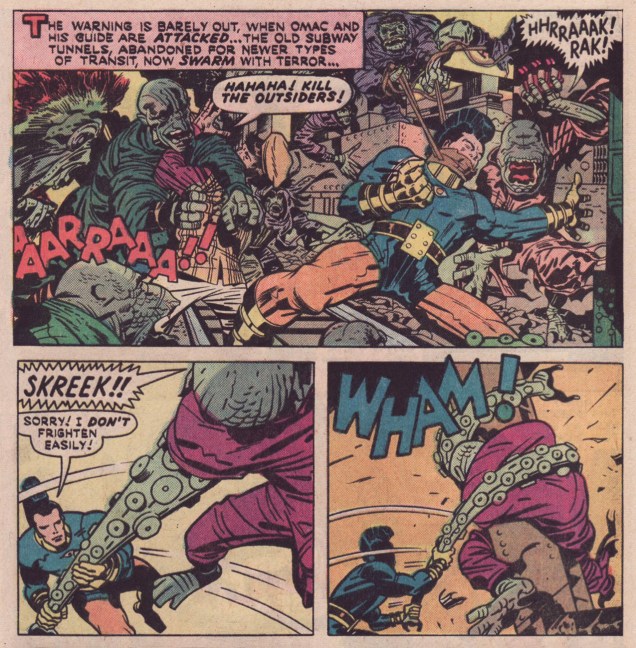
You might argue that these aren’t tentacles at all, but the creature is described as a “flying octopus”, and who am I to argue with Kirby’s description?
Page from The Busting of a Conqueror!, scripted and penciled by Jack Kirby, and inked by D. Bruce Berry, published in OMAC no. 4 (March-April 1975).Page from The Spy, scripted and penciled by Jack Kirby, and inked by D. Bruce Berry, published in OMAC no. 6 (July-August 1975).
One must have one proper sea monster in a Tentacle Tuesday, and this one’s a beauty:
Page from The Invasion of the Frog Men!, scripted by Michael Fleisher, penciled by Jack Kirby, inked by Mike Royer and published in The Sandman no. 5 (October-November 1975).
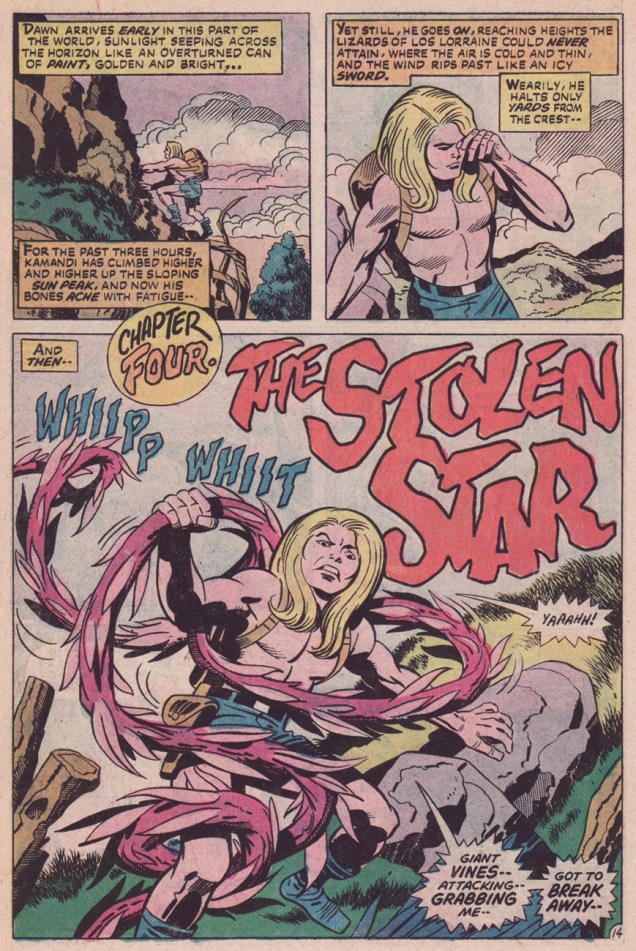
Last but not least, plant tentacles!
Page from The Lizard Lords of Los Lorraine!, scripted by Gerry Conway and Paul Levitz, pencilled by Jack Kirby, and inked by Mike Royer, published in Kamandi, The Last Boy on Earth no. 40 (April 1976). Kamandi was my first exposure to Kirby, and it bowled me over. It’s a good illustration of what he can do (and did over and over again), actually: create a universe with its own rules and a perfect internal logic. There are no boundaries in such a place, no limited number of characters – it just lives and breathes as it pleases, and one is but a passerby who gets to witness a few key scenes. Reading Kamandi teleported me into his world with such ruthlessness that I was quite disoriented when I’d have to stop reading.
« His incredibly unique art style and bombastic storytelling made him one of the most imitated creators in western comics history. Kirby Dots are named after the artist’s distinctive rendering of Battle Auras, also nicknamed, “the Kirby Krackle”. He died of heart failure in 1994 at the age of 76, or at least that’s what Galactus wants us to believe. Due to his speed in creating well-received comics, there exists something called the “Kirby Barrier”; breaking the barrier means that you’ve created a quality comic in under a week, a surprisingly difficult feat. » |source|
« Apparently he had never learned that a white man’s foot, though it wabble ever so, is given him wherewith to kick natives out of the road. » — John Russell
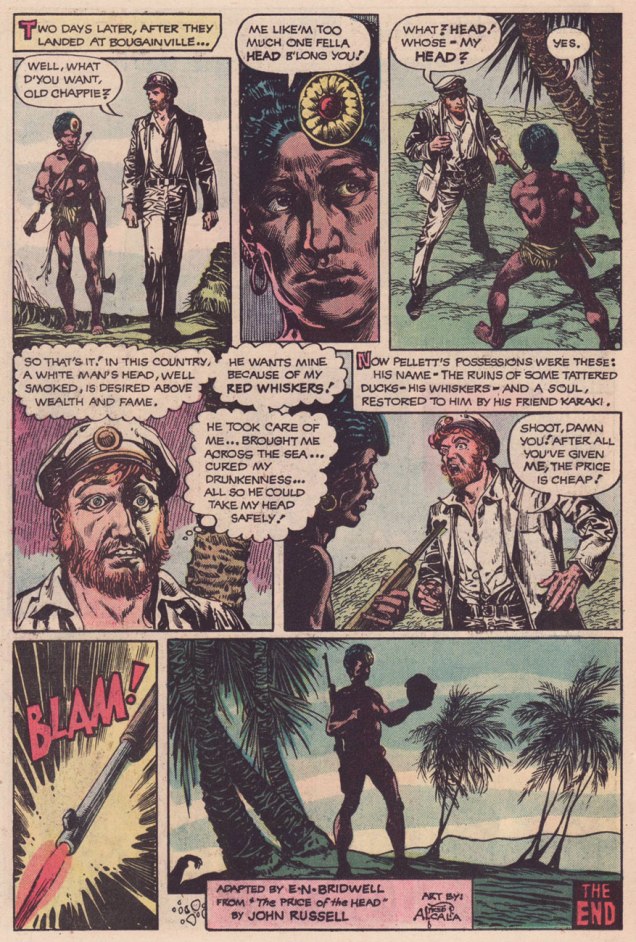
Welcome to another installment of Treasured Stories! This one’s a bit of a sequel, or rather a companion piece to an earlier entry, August Heat (from just about a year ago) as we’re featuring two of the same creators, namely scripter E. Nelson Bridwell (1931-1987) and penciller-inker Alfredo Alcala (1925-2000).
In this instance, we can surely witness judicious editorial sense at work, in terms of matching material to talent. While Bridwell likely selected the story, and though they’d worked together before, Alcala was a flawless choice to bring it to full visual bloom. A tale of the Pacific Islands illustrated by a Pacific Islander, and a masterful one at that… on both counts. Alcala’s expertly-paced, limpid, deliberate storytelling is a natural fit.
It’s easy to underestimate how daunting a challenge, in most cases, is the effective transition of material from medium to medium. In this instance, the source is a much-anthologized short story by John Russell, originally published in Collier’s, May 20, 1916. You can judge for yourself after reading the original text here.
Russell’s stories sharply veer from the usual civilisation vs savages colonialist tripe of the era in that the natives are depicted as oft-complex but subtle beings and the whites, as often as not, as pompously delusional savages; one sees the pattern emerge upon reading a few of Russell’s South Pacific tales (collected in Where the Pavement Ends, 1921); in my own case, I found a trio of these in Dennis Wheatley‘s excellent anthology Shafts of Fear (1964), an update and expansion of his earlier A Century of Horror (1935).
Still, I strongly suspect that Bridwell’s exposure to The Price of the Head came not from books, but rather from a radio play, as all three of his DC short story adaptations (TPOTH, August Heat and The Man and the Snake had received that particular treatment. To his credit, Bridwell went back to the source for his version.
You’ll note that the racism so refreshingly absent from Russell’s story has been painstakingly restored for the radio programmes. Now that’s dedication!
Quite recently, I was delighted to hear that Mr. Bridwell has not entirely been forgotten; indeed, he is to be bestowed, though posthumously of course, the Bill Finger Award for Excellence in Comic Book Writing on Friday, July 19 2019, during the Eisner Awards ceremony at this summer’s Comic-Con International in San Diego, CA. Bravo!
Read all about it on Mark Evanier’s fine blog. And thank you, Mark!






























 Who's Out There?