Dateline: Frontline – The Cary Burkett Interview, Part 2

« A reader has the right to ask for all the facts; he has no right to ask that a journalist or historian agree with him. » — Herbert Matthews

And we’re back with part two of our examination of Cary Burkett and Jerry Grandenetti‘s Dateline: Frontline (we’re not forgetting the famously-ambidextrous Ric Estrada, who took over illustrative duties in the second half of the series). In part one, Mr. Burkett graciously opened for us a window on the series’ genesis. In light of these privileged behind-the-scenes gleanings, as well as a reading of the series’ springboard text, Phillip Knightley’s The First Casualty, I formulated  a series of follow-up questions, of which we present the first half, along, of course, with Mr. Burkett’s insightful and modest responses, followed by chapter 2 of the first D:F trilogy.

Who’s Out There: Was there much deliberation on your part regarding the specific setting of the series?

Cary Burkett: I vaguely recall that in an early meeting with Paul Levitz we mentioned the possibility of setting the series during the Vietnam war. Or rather, I think he may have mentioned it. But I never had any interest in that from the beginning. That war was too close at the time, and I didn’t think I could do it. Research was a lot harder to do in those days, and I was too green as a writer to want to tackle that controversy.

If my memory is right, I think he left it up to me, and I very quickly settled on the World War II setting. There were a lot of reasons in my mind for that, including the wealth of research material available.

But the biggest thing was the fact that the U.S. started out as “neutral” in that war. I felt a story arc right away of a young reporter who began as a “neutral” observer, wanting to be an objective journalist, but over a series of events finding himself unable to keep from being drawn in and taking sides, despite his proclaimed neutrality.

At the time I didn’t know how long the series might last, but it was my intention to gradually move Wayne Clifford from a naïve journalist with laudable ideals into a conflicted character grappling with the very gray areas of war reporting and the messy questions of patriotism and propaganda.

WOT: In writing the series, did you ever find yourself at odds with the, er, ‘official record‘ of history?

CBI wouldn’t say that exactly. The truth is, I had only a sketchy knowledge of World War II history, and little idea of what the “official record” said. So I set about to educate myself.

One really good current documentary at the time was The World at War narrated by Laurence Olivier. I watched a number of episodes of that. What I realized from watching it was how much the history I had heard and read was centered on how the U.S. and England had won the war. This documentary was one of the first western pieces which really pointed out the importance of the Russian contribution.

That led me to other research and made me want to do a series of stories set in Russia. Of course, the insane difficulties of trying to report the truth during a war in the middle of Russia appealed vastly to me and provided a lot of opportunities for conflict on a lot of levels. I felt I barely scratched the surface in those Russia stories.

One thing about doing research; you start to get interested in all the little details. You want to include much more than you really can. You have to be careful to let the story reveal the details when it is important to the story, but not to let the research itself become the story.

I struggled with that in writing those Russia stories, because much of what I was finding out was really eye-opening to me. What I knew about the war in Russia I had learned mainly from watching Hogan’s Heroes. In that TV comedy, the Nazis all feared being sent to the Russian front, so you knew it was cold and terrible. But that’s about all I knew.

When I began to read about the scope of the tragedy and brutality of the war in Russia, I wanted to bring the reality of it into my stories. I wanted to shove it all in somehow. But my stories were a mere 6 pages long in each issue, so I had to just try to give little glimpses that implied a lot more.

Stephen King’s advice to writers is to “kill your darlings”, that is, to get rid of your pet favorite bits so they don’t bog down the story. Those Russia stories were ones where I felt I had to keep killing those “darlings” over and over.

WOT: Was there any friction with DC’s brass, or was the series too far under the radar for them to notice? If so, did that allow you more leeway?

CBWe were definitely way under the radar, but I don’t think that the stories would have caused any stir even if they had been noticed. I don’t think there was anything subversive or strongly controversial about them. They were different from the usual comic book war stories, but not in a way that would cause any issues.

The lead stories of the books featured Gravedigger, or later, The Unknown Soldier. These were the stories that were there to sell the book, and these would have gotten more scrutiny. They were the typical action-oriented comic book war stories, sometimes just a step away from fantasy. Sometimes not even a step.

With a long-running lead character in a war series, you have to be a bit looser with timelines in the war. I suppose it’s a convention of the genre that the character might pop up in Okinawa in one story, then many issues later have a story related to D-Day, even though D-Day would have happened well before Okinawa.

Maybe it’s because the main character was a journalist who was dedicated to getting the facts right, but I decided that my timeline was going to be accurate. The series would start with the U.S. as a neutral country, and we would later see the USA join the war, and all of the historical events would follow in the order they occurred.

WOT: Was the rotation of backup features decided from the start? Was it some sort of commercial compromise?

CBI don’t really know. I think the idea was mainly to have variety in the backups. It was a common template for older DC titles like Action Comics or Adventure Comics in the ‘60’s. One issue would have a Green Arrow backup, the next maybe Aquaman.

My own speculation is that as an editor, Paul was drawn to that kind of setup, and felt it gave the reader a little something extra. That’s just my own thought, he never told me that. But I know he was a comics fan, and I think he was glad to have a place where Enemy Ace could still fly through the pages of a DC Comic.

WOT: Given the wealth of material you dug up in the course of your research, it must have required considerable effort of concision to craft such spare chapters. Did you go through a lot of drafts?

I did struggle to find ways to get my stories into the six-page frame and did quite a few re-writes, trying to balance the pace so the story didn’t seem rushed but also had enough meat.

There were compromises, for sure. In what I considered to be one of the key stories, Clifford, still a neutral reporter, takes a rifle and kills an Axis soldier attempting to kill his English friend. I had been leading up to this decision since the beginning of the series. Here he is forced to admit that he is neither neutral nor objective as he thinks of himself.  I would have loved to have had a bit more room to let that sequence play out with more significance.

No doubt, I could have done a better job even in the space I had. In the end, I felt that it came out a bit weak and contrived.

WhoThereLogotype

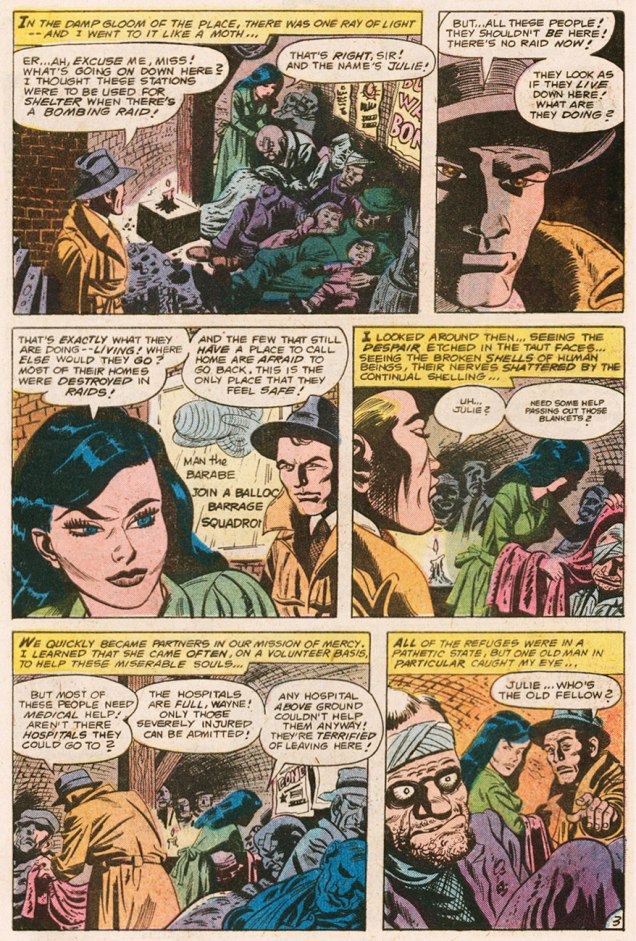
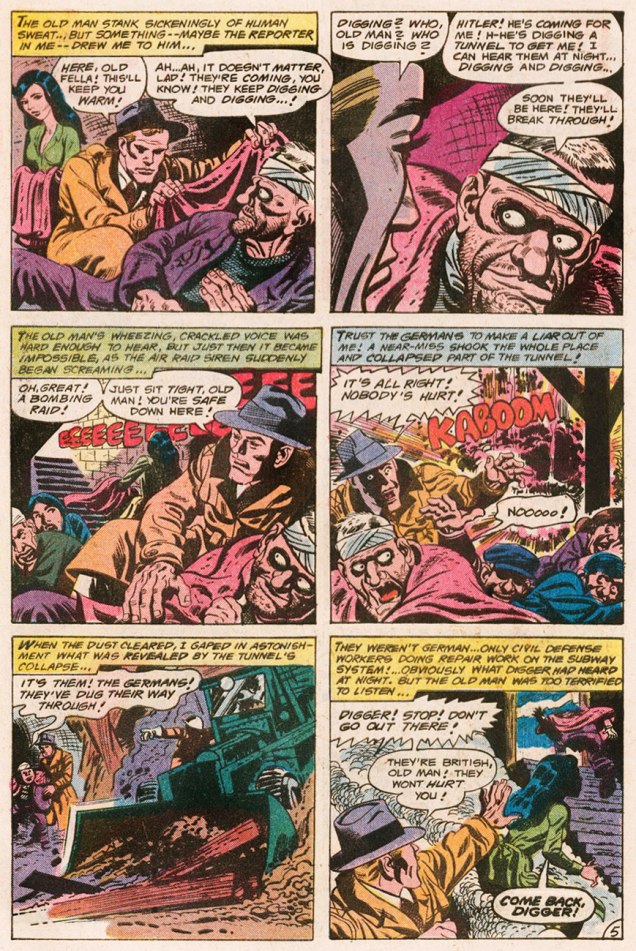
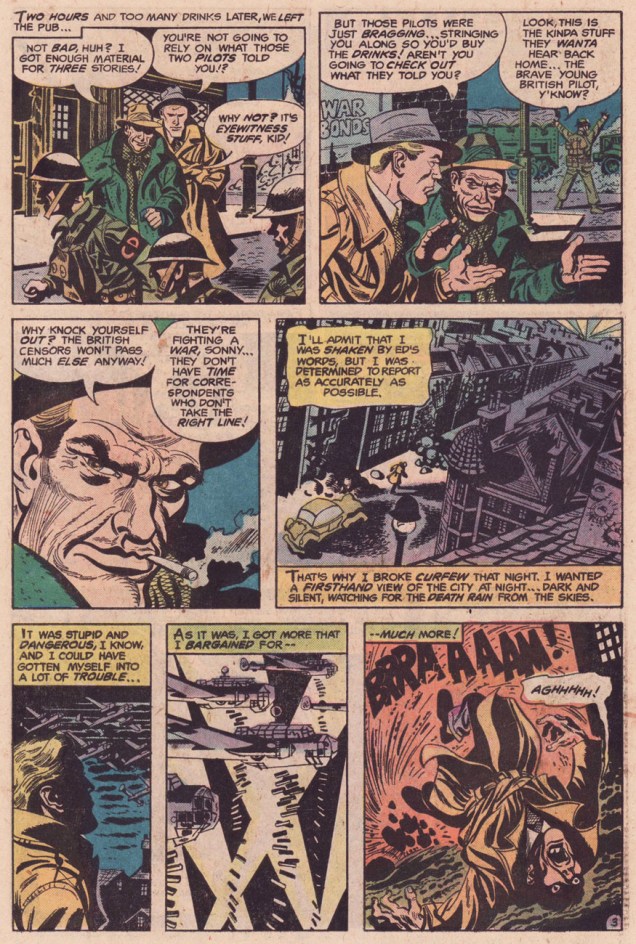
Now, let’s rejoin Wayne Clifford and his buddy Ed Barnes, who were, when we saw them last, off to the pub…
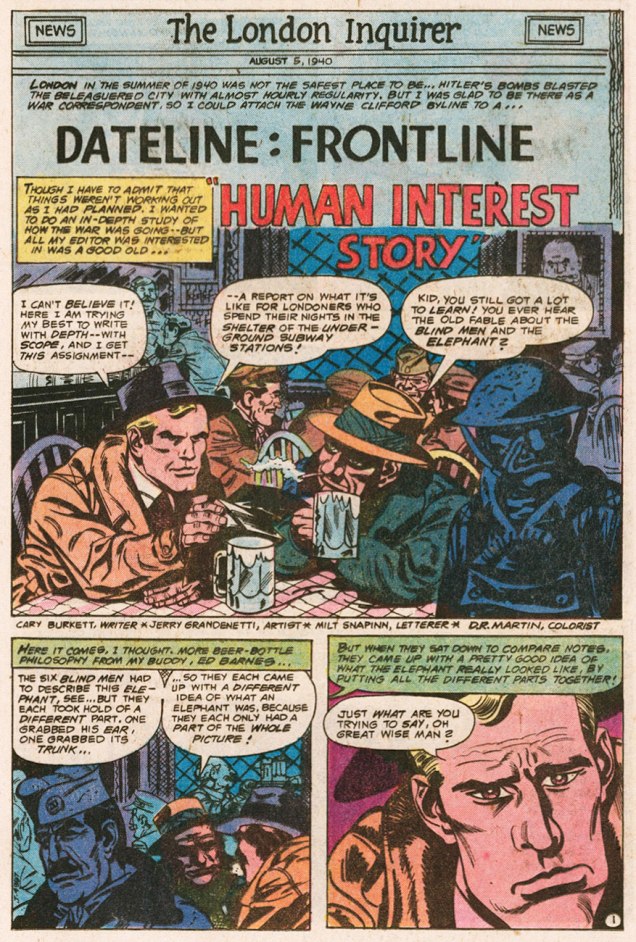
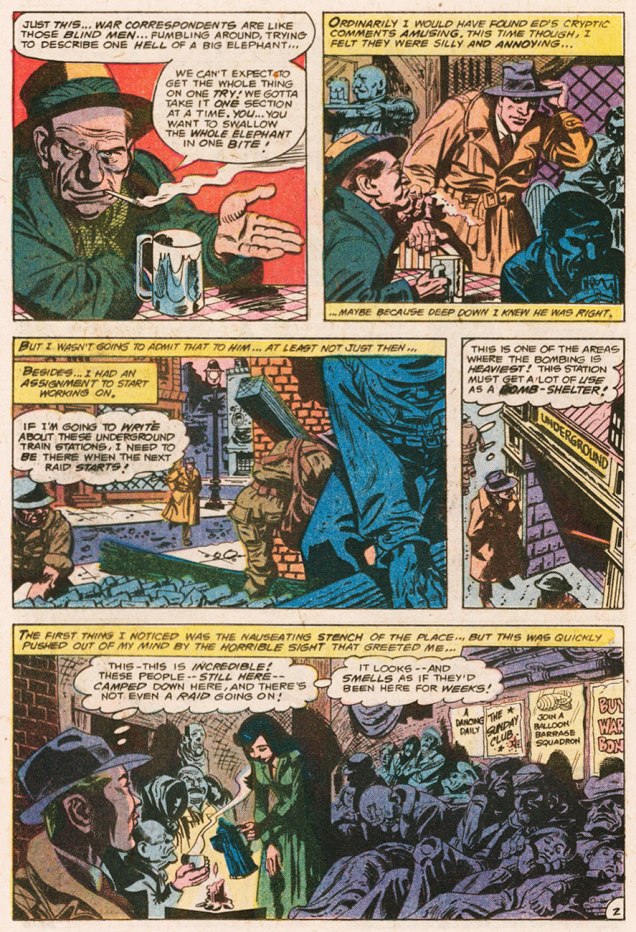
Dateline2London01ADateline2London02ADateline2London03ADateline2London04ADateline2London05ADateline2London06A

That’s it for now! Stay tuned for the conclusion of our talk with Cary Burkett, along with part three of Dateline:Frontline’s London trilogy.

-RG

Dateline: Frontline – The Cary Burkett Interview, Part 1

« All studies of propaganda tell what a powerful weapon it is; that since armies fight as people think, it is essential to control that thought. This means some form of managing the news, and the only question is the degree to which the news should be managed openly and the degree to which it should be managed subtly. » ― Phillip Knightley, The First Casualty: The War Correspondent as Hero, Propagandist, and Myth-maker from the Crimea to Vietnam

In most collectors’ lives, there’s a degree of more casual, automatic accumulation. Things you pick up for a song, just because the opportunity arises, and that you file away, planning half-heartedly to look them over when you find the time. As a devoted Jerry Grandenetti fan, I always pick up his work… but I favour some genres over others. Mr. G has crafted, for instance, a lot of war comics for DC over the years (1952-1984!), most of which I haven’t seen. For me, it’s always been about his horror/mystery work. So… I had picked up, somewhere along the line, a consecutive pair of issues of DC’s Men of War (26 issues, 1977-80), numbers 9 and 10, featuring the first two parts of a Dateline: Frontline backup sequence, « Bathtub Blues » and « Glory Soldier ». I was very, very impressed.

Now, most of DC’s war books were scripted by a small cadre of authors, namely the indefatigable Robert Kanigher, as well as Bob Haney, Ed Herron, Jack Miller… but mostly Kanigher. In the Seventies, things changed a bit, with solid help and variety coming from Frank Robbins and David Michelinie on The Unknown Soldier, for instance. I had encountered Cary Burkett’s name here and there, being a regular reader of Batman titles The Brave and the Bold and Detective Comics, where he scripted backups (Nemesis, Batgirl) and the occasional lead feature. But this was… different. Hard-hitting, quite free from convention, and damn well buried in the back of a second-tier war book.

I hunted down the rest of the D:F series, and my initial impression did not fade… quite the contrary, indeed. The third serial (MoW 21-23), set on the Russian front, actually brought some tears to my eyes. Why was this feature so little-known? Oh, I know… the usual reasons. But I wanted to find out more, and the next logical step was to reach out to the series’ surviving author, who was happy to oblige, to my delight. And so here we are. The stage is yours, Mr. Burkett.

Dateline: Frontline recollections, by Cary Burkett

« Paul Levitz was editor of a new war comic called ‘Men of War‘ featuring a character called ‘Gravedigger’.  He wanted to have backup stories in each issue, and he came up with the title ‘Dateline: Frontline‘ and the idea that it would feature a war correspondent as the main character. I was working as his assistant at the time (1976), and he asked me to do a series of 3 six-page stories.

He pointed me toward a book called ‘The First Casualty‘ by Philip Knightley. The title was inspired by a famous quote ‘The first casualty when war comes, is truth‘.  The book was a history of war correspondents from early days of reporting through the Vietnam War. It became a basis for the new comic series in terms of setting up the inner dilemma of the main character, which was how to report ‘the truth’ in time of war.

I chose to set the series in World War II and named the main character Wayne Clifford. My idea was that he would begin his career as a war correspondent being very idealistic and naïve. Over the series of stories, he would come face to face with wartime situations which challenged his assumptions about news reporting, war, ‘truth’ and about himself.

That, in a nutshell, was the core of the series.  I chose to set the narration in first person, which I guess is pretty much the standard in comics now, but was not common then.

After the first 3 stories, Paul asked me to continue the series. But we kept the idea that the series would be done in groups of 3 related stories.

I did a lot of research to depict true, historic wartime settings which I hoped would show more aspects of war than to just have the hero ‘fight the enemy’ and stop the Führer’s latest grand plan.

Paul had gotten Jerry Grandenetti to be the artist on the series from the very beginning. I admit, when I first heard this, it didn’t thrill me. I was not that familiar with Grandenetti’s work, but I had seen a few stories he had done and had been put off a bit by his strange, exaggerated style.

But when I saw his art for my first DF story, I realized why he was such a respected artist. His expressionistic kind of style emphasized certain qualities that gave a distinctive mood to the story.

But what I felt the most strongly was that Grandenetti understood how to make the story flow. If you could let yourself be drawn into the visual universe he created, it would come alive. The sequences of images he created would merge into one storytelling stream.

I didn’t know at the time that Grandenetti had worked on The Spirit with Will Eisner, but that strong storytelling aspect of his art was what I responded to most when I saw Jerry’s work on my stories.

My Dateline:Frontline stories were done ‘full-script’, meaning I wrote out full panel-by-panel breakdowns for the artist to follow. And I could see how Jerry would take my panel descriptions and make them flow into each other. If I was going for a specific kind of pace or mood with a sequence, Jerry immediately knew what I was after, and knew how to emphasize it visually.

I worked with very few artists who had Jerry’s instinctive grasp of this and his skill for executing it. »

DatelineLondon01ADatelineLondon02ADatelineLondon03ADatelineLondon04ADatelineLondon05ADatelineLondon06A

Each Dateline: Frontline episode was conceived to stand on its own, but be part of a larger trilogy. This London entry, the series’ introduction, appeared in Men of War No. 4 (Jan. 1978). In part two of our talk with Cary Burkett, we’ll feature the second London chapter, « Human Interest Story » and our guest will generously answer some of WOT’s questions.

Incidentally, but not coincidentally, one hundred years ago today, on the 11th  of November, 1918, the Armistice of Compiègne was signed, formally ending the First World War. The event is commemorated each November 11 as Armistice Day or Remembrance Day.

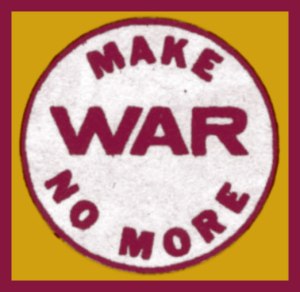
Make-War-No-MoreA
This eloquent little tag appeared at the end of DC’s war stories, at least those edited by Joe Kubert, in the early 1970s.

Continue to Part 2 of the Cary Burkett interview.

-RG

Russ Heath and The War That Time Forgot

« Look! An undersea monster!
Spearing that torpedo like it
was a sardine! It’s a nightmare! »

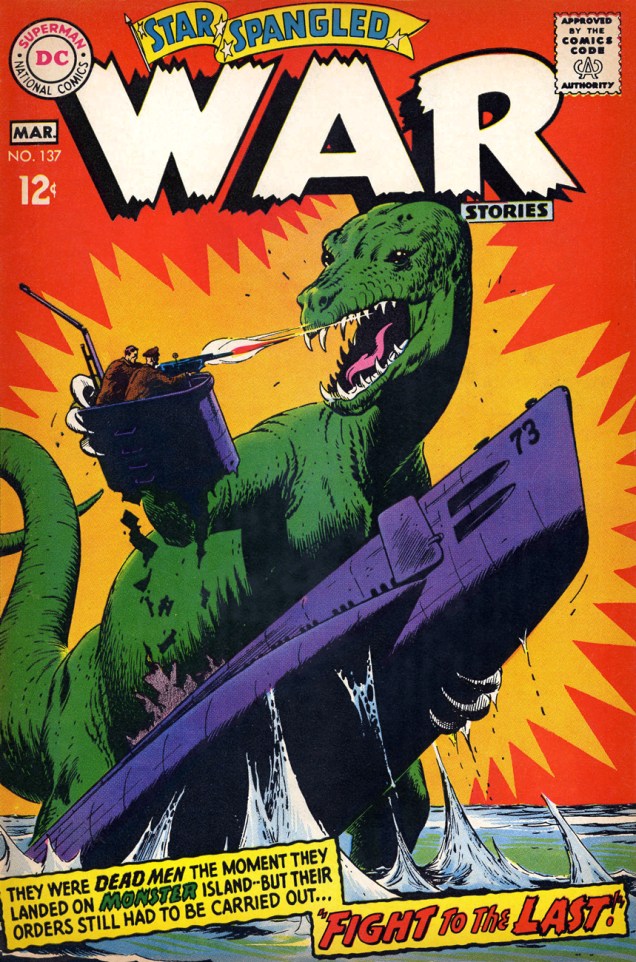
Writer-editor Bob Kanigher, flanked by artists Ross Andru and Mike Esposito, drew first blood in « The War that Time Forgot », chronicled in DC’s Star Spangled War Stories beginning with issue 90 (May, 1960). The idea was scarily basic, but it was an irresistible premise, at least where young boys were concerned: let’s face it… soldiers vs dinosaurs. How might a T-Rex fare against a bazooka charge? Well…

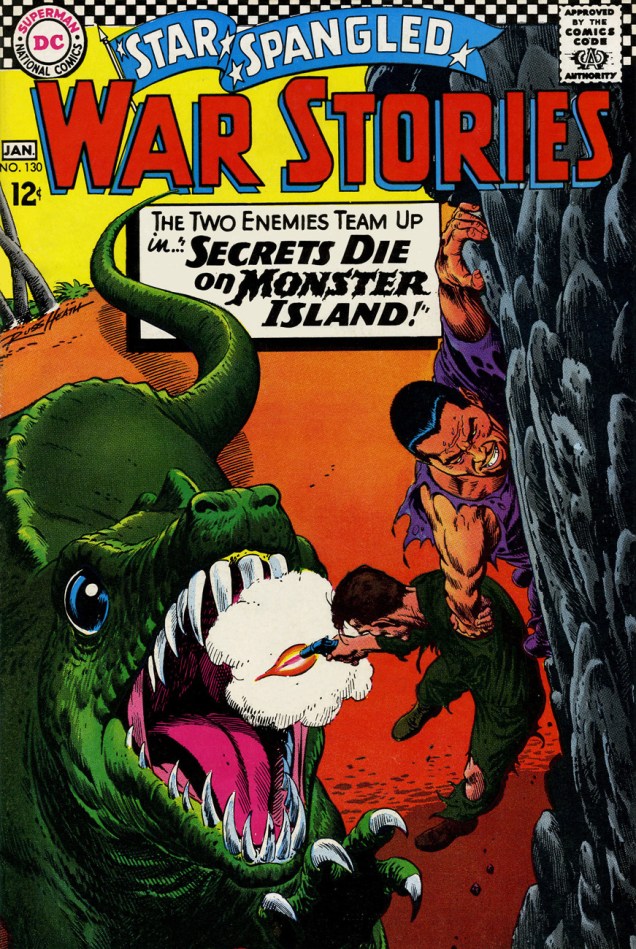
The only time the series (what I’ve read of it… Andru and Esposito are no dream team of mine) did anything for me was a tale about two soldiers, one American and the other Japanese, stranded together on « Monster Island » and having to save each other’s sashimi. And this was before Lee and Toshirô got together on their own little slice of Hell in the Pacific, yet! I enjoyed the human interest aspect of the tale.

While I, like pretty much any other kid, was fascinated by dinosaurs early on, I quickly soured on inaccurate and fanciful depictions of the beasts. The War That Time Forgot is just one long, tedious dino-butchering exercise, be they harmless herbivores or kill-frenzied carnivores. Piss-poor palaeontology, that. Give me King Kirby‘s Devil Dinosaur any old time instead: that series runneth over with surreal, freewheeling fun, with nary a claim to accuracy in sight or in mind.

Ahem. The WTTF ran its course in SSWS until issue 137 (February-March, 1968), and was replaced by the far more nuanced Enemy Ace by Kanigher and Joe Kubert. Their all-time high, arguably in the case of Kubert, and without the faintest shadow of a doubt in Kanigher’s case.

So why am I writing about this series if I care so little about it? Well, when Andru (meh) or Kubert (great, true to form) weren’t handling cover duties, Russ Heath was. And while I’m fairly unmoved by Heath’s skill as a storyteller (too static, too measured), he was a first-rate cover artist, most strikingly for DC’s 1960s war books (and hey, Sea Devils) and Atlas’ 1950s westerns and horror titles.

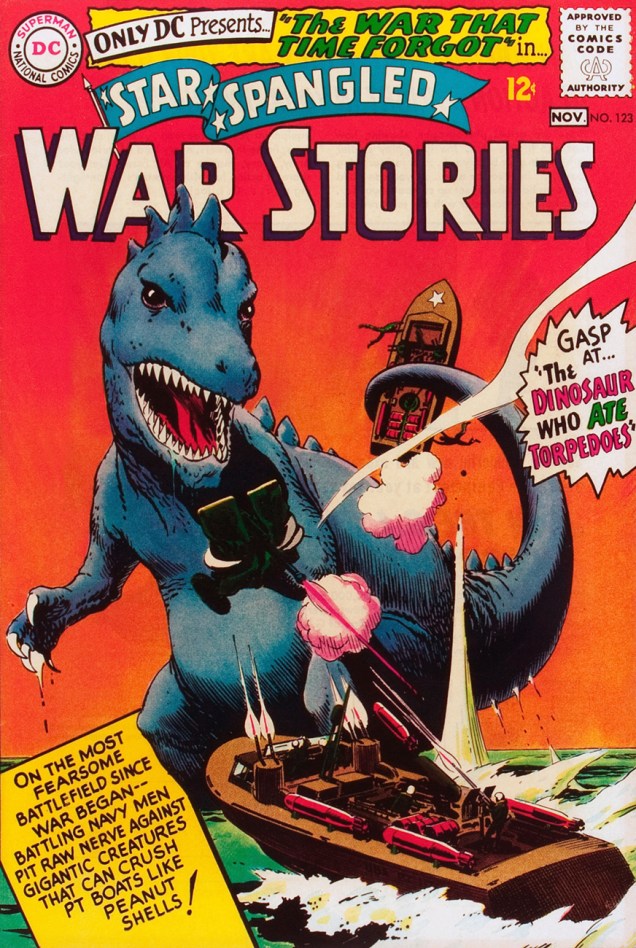
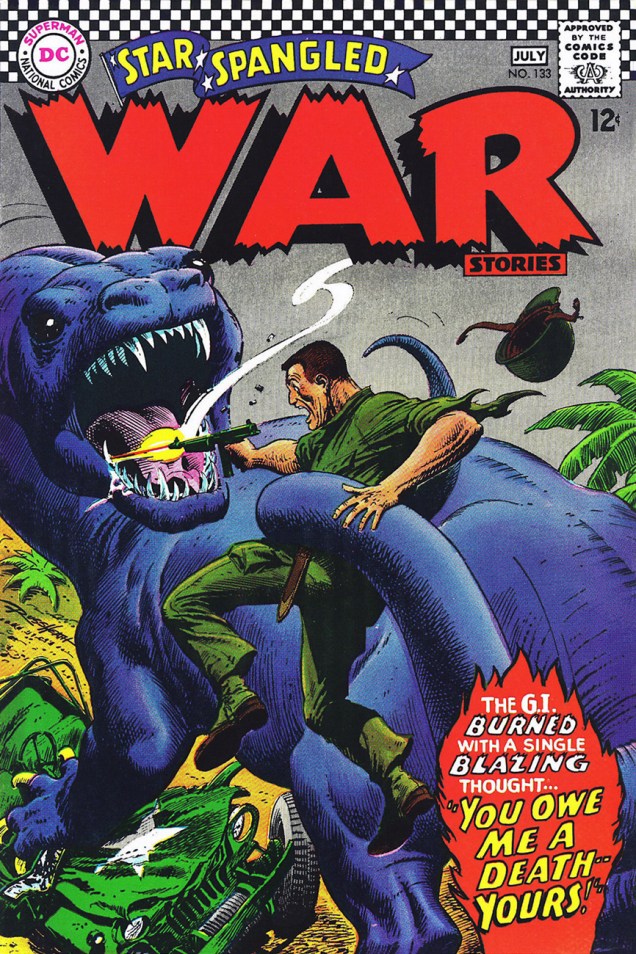
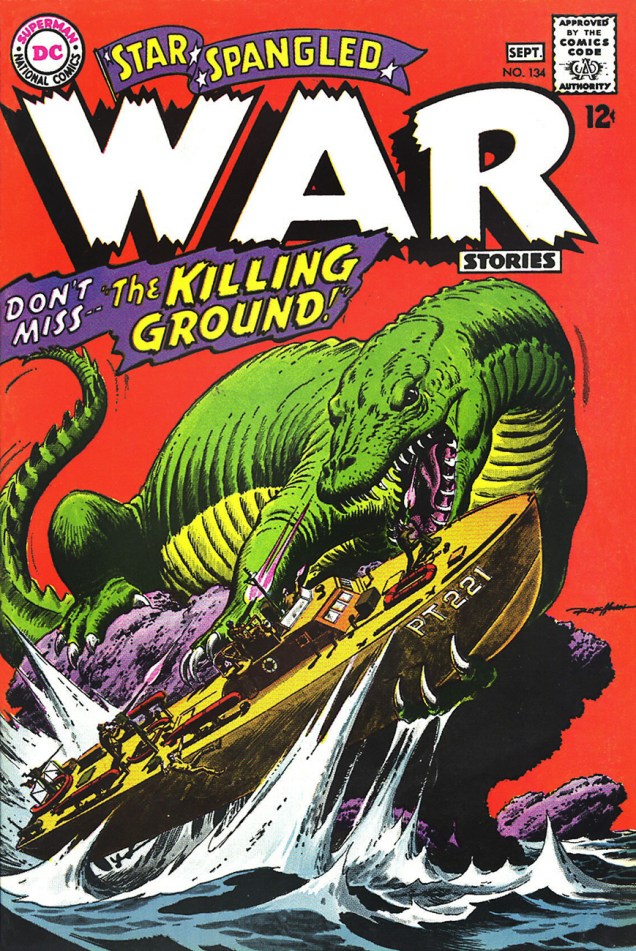
So, in fond remembrance of Mr. Heath, who left us last week at the age of ninety-one, here’s a gallery of his Star Spangled War Stories covers featuring The War That Time Forgot. Thank you, sir.

SSWS122A
Star Spangled War Stories no. 122 (Aug. – Sept. 1965). Grey toning and colour by Jack Adler.
SSWS123A
Star Spangled War Stories no. 123 (Oct. – Nov. 1965). Dinosaurs love those orange skies, which set off their scales to fine advantage.
SSWS130A
Star Spangled War Stories no. 130 (Dec. 1966 – Jan. 1967). The first Japanese-American “Enemy Mine” team-up, but the Japanese guy gets no redemption before dying. Grey toning and colour by Jack Adler… probably my favourite cover of the lot.
SSWS131A
The Bird-Man provides a new wrinkle to bloodthirsty war criminal Curtis LeMay‘s « Bomb them back to the Stone Age » pronouncement. Star Spangled War Stories no. 131 (Feb. – Mar. 1967).
SSWS132A
Star Spangled War Stories no. 132 (Apr. -May 1967).
SSWS133A
Star Spangled War Stories no. 133 (June – July 1967).
SSWS134A
Star Spangled War Stories no. 134 (Aug. -Sept. 1967). Once more, grey toning and colour by the indispensable Mr. Adler.
SSWS135A
Star Spangled War Stories no. 135 (Oct. – Nov. 1967).
SSWS137A
Last call! Star Spangled War Stories no. 137 (Feb. -Mar. 1968).

Addendum to SSWS 131: apparently, « Bird-Man » started a trend, as everyone and his distant ancestor soon was riding a Pteranodon of his own. To wit: Tomahawk #109 (Mar. – Apr. 1967… just a month later).

Tomahawk109A
What do dinosaurs care about the American Revolutionary War? And yet the poor, noble Pteranodons all perish in the end… « for the cause » . Tomahawk no. 109 (March-April 1967), cover art by Bob Brown.

-RG

Treasured Stories: “The Organist and the SS” (1972)

« They were bitter, war-weary men and the old woman’s music was comforting — perhaps too comforting… »

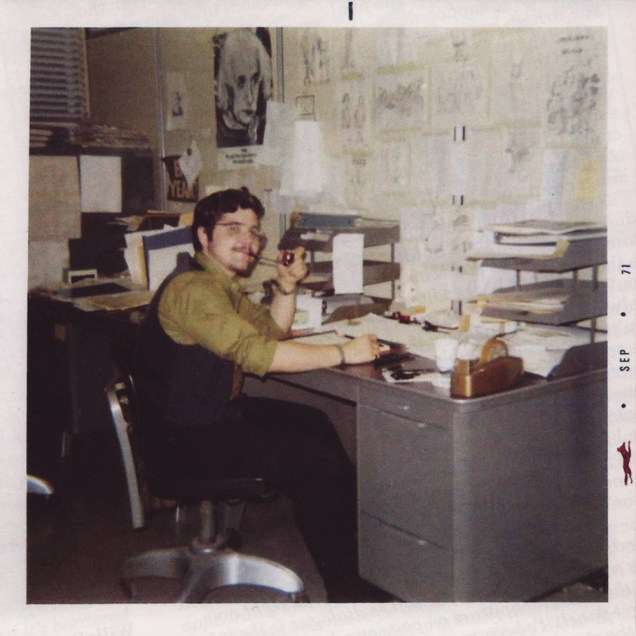
Writer and occasional penciller William ‘Willi’ Franz (born 1950) broke into the comics industry at the tender age of 15, selling his first script to Charlton editor Dick Giordano in 1966.

WilliPolaroidA
Will Franz, September 1971. A photo « …taken at the Manhattan insurance company where I worked as an accounting technician. My wall is covered with cartoons I made of various office friends and personnel. » Source: Will Franz and Charlton Spotlight.

While best known for his fruitful collaborations with his mentor, the great Sam Glanzman (1924-2017), namely The Iron Corporal, The Devil’s Brigade and most enduringly The Lonely War of Willy Schultz, Franz also scattered a few gems that the light has mostly missed.

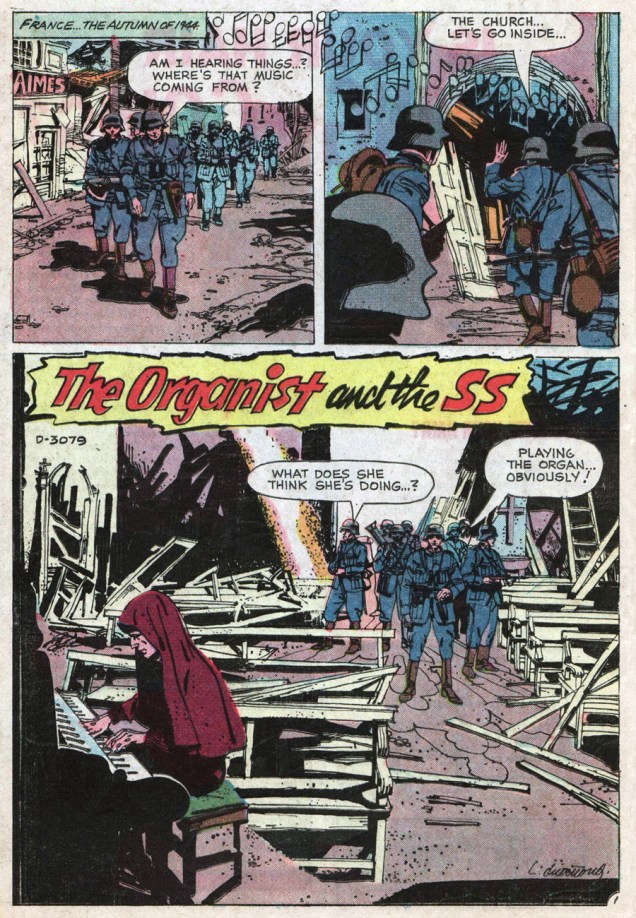
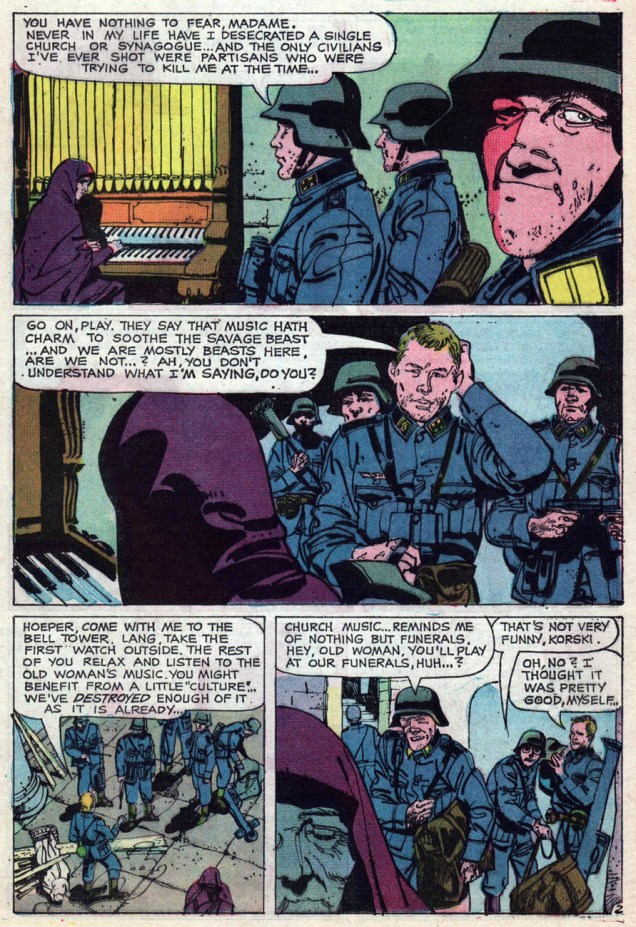
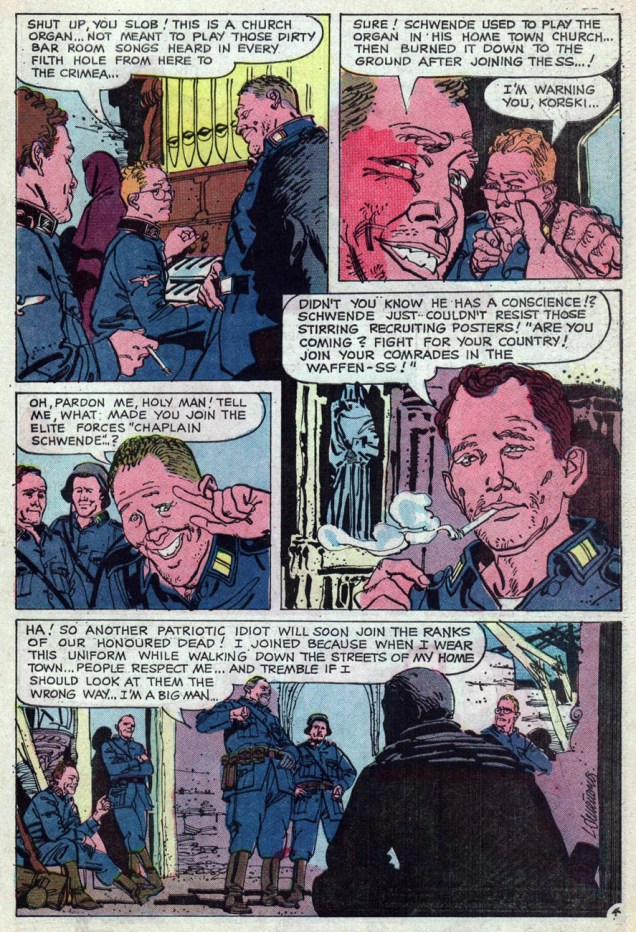
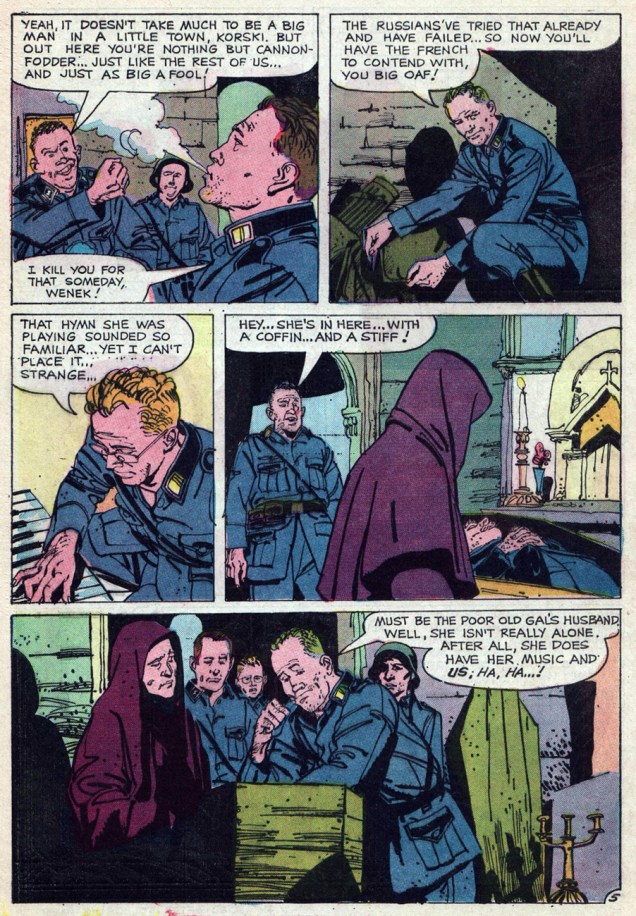
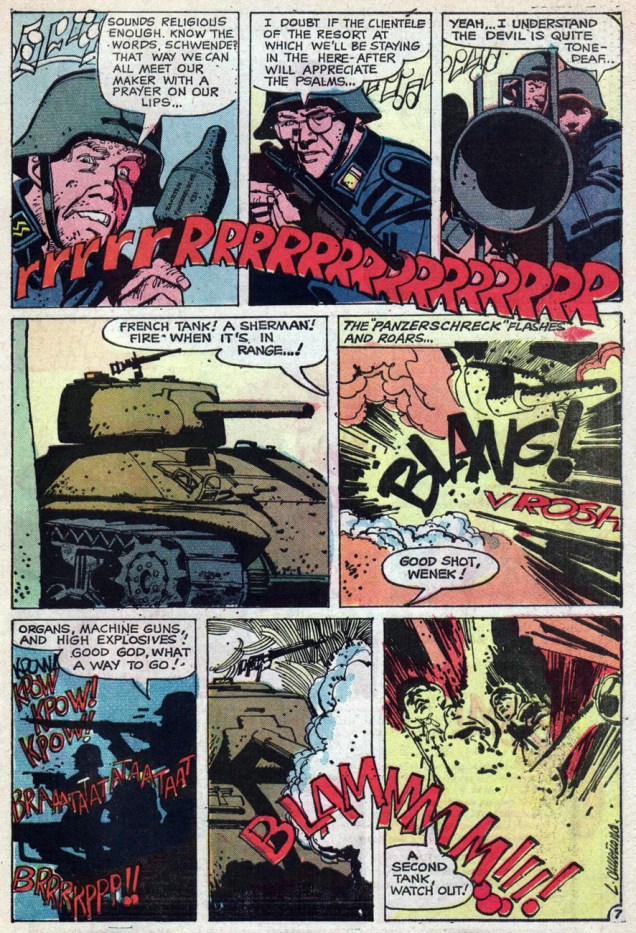
My favourite among these has to be his final story for Charlton, The Organist and the SS, published in Attack no. 8 (Nov. 1972). Franz’s bleak, nuanced and markedly pacifist tales had drawn the military’s ire, back in the late ’60s, and this somber little piece of doom might have, too, if anyone had been paying attention.

As Franz recalls in a 2015 interview with Richard Arndt, published in Charlton Spotlight no. 9 (Winter-Spring 2015-2016):

« I was told that a lot of Charlton sales were on military bases. They were a staple on Army bases. I, and my stories, were dropped in 1969, out of the blue. Things were heating up in Vietnam.

I was blacklisted at Charlton because a guy had put my name and stories down as one of the reasons he registered as a conscientious objector. I found out other people were throwing my name around. Someone in the army apparently said that my stuff, maybe like [Archie] Goodwin’s stuff, was too blood and guts. It was going to make soldiers *not* want to kill the gooks. The army can’t have that! »

Well, evidently Charlton (presumably managing editor George Wildman, bless his heart) let Will sneak back into the fold, if briefly, after the heat was off, otherwise I’d be writing about some other topic entirely.

Without further preamble, please savour this pitch-black, existentialist play of war and death, but mind the thorns.

OrganistSS01AOrganistSS02AOrganistSS03AOrganistSS04AOrganistSS05AOrganistSS06AOrganistSS07AOrganistSS08A

OrganistWilliLayout
Will’s layout for the opening splash of our story. It’s always a treat to see what liberties the illustrator takes… or doesn’t.

This issue is chock-full of arrivals and departures: it opens with a story from new recruit Warren Sattler, trying his hand at a few short mystery and war stories before he found his niche in excellent collaborations with Joe Gill on Billy the Kid and Yang; next up is Jack Keller, who was winding up his comics career, what with Charlton’s remaining pair of hot rod books, Drag ‘n’ Wheels and Hot Rods and Racing Cars, soon to be scrapped. He would move, appropriately enough, to making a living selling cars. Finally, Argentine ace Leo Duranoña (b. 1938) was just passing through Charlton, crafting a handful of finely-hewn tales before moving on to DC and Warren… among others.

-RG