« Octopuses have a lot in common with other species that are known to thrive in cities—not only can they use human-made structures for shelter, but they’re highly adaptable and good at problem solving. So maybe we’re justified in adding to our list of neighbours, next to the raccoon at the sliding glass patio door and the coyote in the halo of the street lamp, the octopus casting its appraising eye from under the sunken hull of a rowboat. » |source|
Octopuses in a mundane, urban setting? Address yourself to Gary Larson!
As promised a couple of weeks ago, we’re back with another Larson-copia of tentacles! Pt. 1 can be found here. Again, thanks to co-admin RG for all the scanning and colouring work.
If you think we’re somewhat stretching the definition of “tentacle”, I think the husband’s, err, feet definitely qualify.
Incidentally, one the world’s largest sea creatures is the lion’s mane jellyfish, whose tentacles are the longest of them all (they can attain lengths up to 37 metres or 120 feet).
Letting us know what we’re in for straight away, even the cover of the fourth Far Side collection features a tentacle.
∼ ds
Some content on this page was disabled on June 3, 2022 as a result of a DMCA takedown notice from Gary Larson. You can learn more about the DMCA here:
Many years after the fact, political caricatures are hard to appreciate properly, generally speaking – politicians’ names get forgotten, events become blurry in the collective memory, and what was surely witty and acerbic just seems incomprehensible. They’re of great historical interest, and often of considerable artistic merit, too, but it’s not something I’m particularly interested in. That being said, nothing rekindles my enthusiasm like an octopus, especially if he’s sprawled all over the map of Europe, or, heck, the whole world. Power is an aphrodisiac!
People far more erudite than myself have written about political cartooning and its historical usage of octopuses. For a good overview of the subject, head over to an article published in Never Was Magazine. If you just like looking at pretty pictures, for a more comprehensive gallery of images I recommend The image of the OCTOPUS: six cartoons, 1882-1909, which breaks down components of six historical political caricatures of the tentacled kind, and Cartography’s Favourite Map Monster: the Land Octopus, superbly informative and thoroughly illustrated. There’s a also this fascinating article, but alas, in French, so only our French-speaking readers (of which we have quite a few) will be able to partake.
I have no system – I tried including images that aren’t seen too often in articles of this kind, or ones that are stylistically striking.
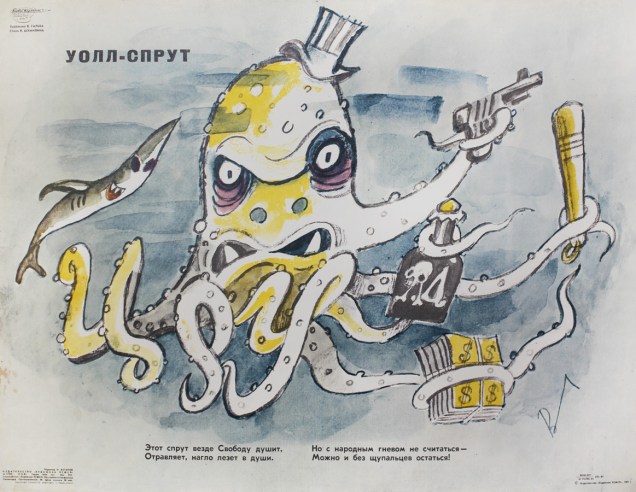
Does this look like an American tycoon to you? Nah, I didn’t think so. His name is Wall-Squid (some pun on Wall Street, I think), and he was published in a Russian magazine in the 80’s. The quatrain underneath doesn’t really rhyme, so it won’t lose much in translation: « Everywhere he goes, this squid strangles Freedom, poisons and recklessly pokes into people’s lives. But those who do not heed the People’s anger risk losing their tentacles! » Subtle.
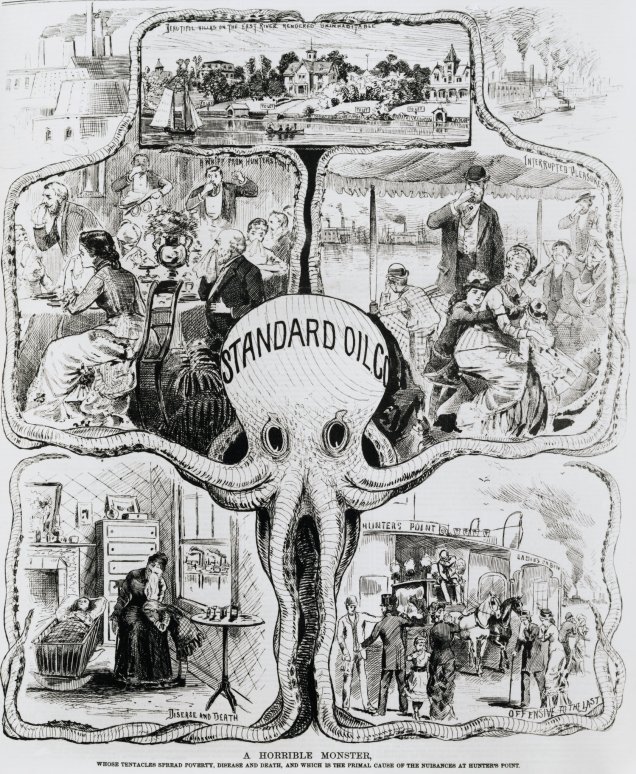
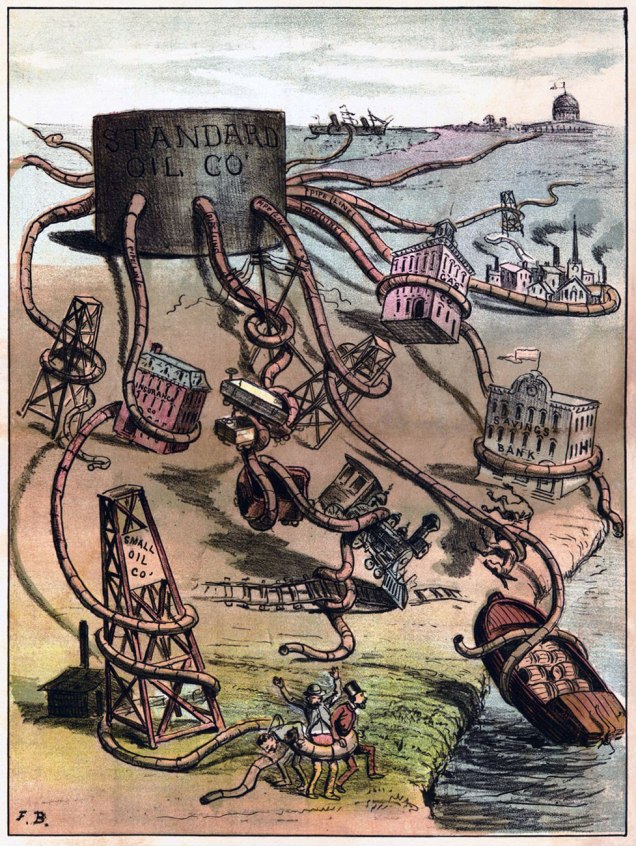
But let’s go back to the 19th century, seemingly the golden age of tentacled propaganda. The line between propaganda and social criticism is blurry, of course – with my environmentalist tendencies, I think of the following trio, all condemning stabs at Standard Oil, attacked for being an unlawful monopoly, as perfectly justified attacks drawing attention to a serious problem.
This one is from 1880, published in Daily Graphic. Standard Oil, “whose tentacles spread poverty, disease and death, and which is the primal cause of the nuisances at Hunter’s point“, is portrayed as an octopus with a somewhat vacant stare, as if it had no awareness of the havoc it’s wreaking.The Monster Monopoly by Frank Beard, a cartoonist who helped usher in the American Prohibition. This was published in Judge in 1884.And again in 1904. Next! was published in Puck Magazine. This octopus is considerably meaner – its intent is to destroy.
Another monopoly that was detrimental enough to warrant an octopus caricature was the Railroad Monopoly:
The Curse of California (I believe it has many more, now) by George Frederick Keller, “its many tentacles controlling such financial interests as the elite of Nob Hill, farmers, lumber interests, shipping, fruit growers, stage lines, mining, and the wine industry“.
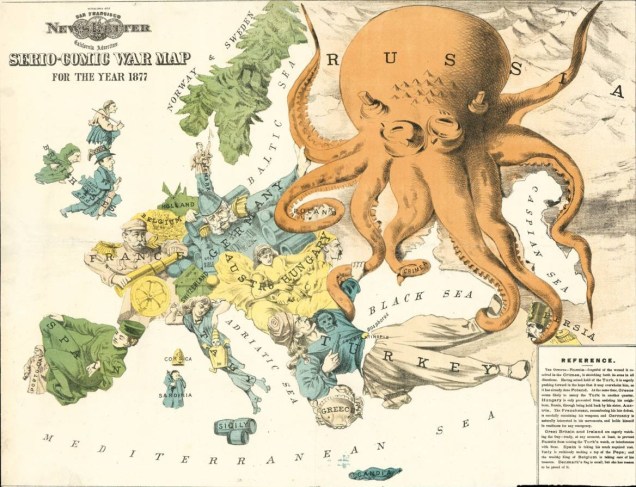
The following trio take on the same map, making for interesting compare-and-contrast material. The years may go by, but Russia continues to be grabby… Incidentally, as I am Russian, apparently these Tentacle Tuesdays of mine were pre-ordained by Fate.
The Japanese answer to the serio-comic octopus map of some decades past. created during the Russo-Japanese conflict of 1905.
Speaking of Russia…
Entertainingly, these days, one can purchase this image as a poster on Amazon or at Walmart.
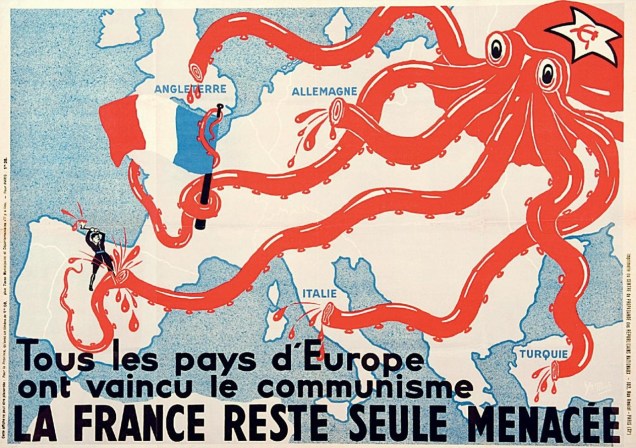
And speaking of communism…
« All European countries have vanquished communism – only France remains under threat. »
Lest I be accused of all this having no relevance whatsoever to today’s political climate… well, fortunately some traditions die hard, and tentacles as a representation of an all-encroaching evil are here to stay!
Illustration byMark Bryan. Painted in 2016, this is the artist’s vision of what a Trump presidency would be like.
I wasn’t going to let the other party off the hook… Or is it one and the same?
« Il vente — C’est le vent de la mer qui nous tourmente… »
Yesterday, I finished reading an excellent book by French author Pierre Mac Orlan, best known for Quai des brumes (Port of Shadows), written in 1927 and transformed into a movie in 1938. In other words, a while ago! The title of the novel I joyously devoured is Le chant de l’équipage (1918), and it’s a grand tale of swashbuckling adventure on the high seas. Well, actually it’s a lot more complex than that, and it’s beautifully written. As it’s in the public domain, you can read it online here (but in French only, I’m afraid). As I’m still digesting scenes from the novel, so to speak (no, the équipage did not encounter an octopus on its journey), my mind’s eye is focused on the far-away sea… so today’s Tentacle Tuesday has been rerouted from its original concept into everything nautical. Let’s spend a little time inhaling the healthy sea-breeze, in a world of handsome ships and the people who make them sail.
Perhaps the following story does not depict your standard encounter with an octopus… but it’s indubitably a seafaring tale. The Eyes, illustrated by Pete Tumlinson, was published in Astonishing no. 30 (February 1954, Atlas):
In the next page, the octopus-balls steal a lot of sunglasses (their discovery that ears are needed to wear glasses is off-panel, though).
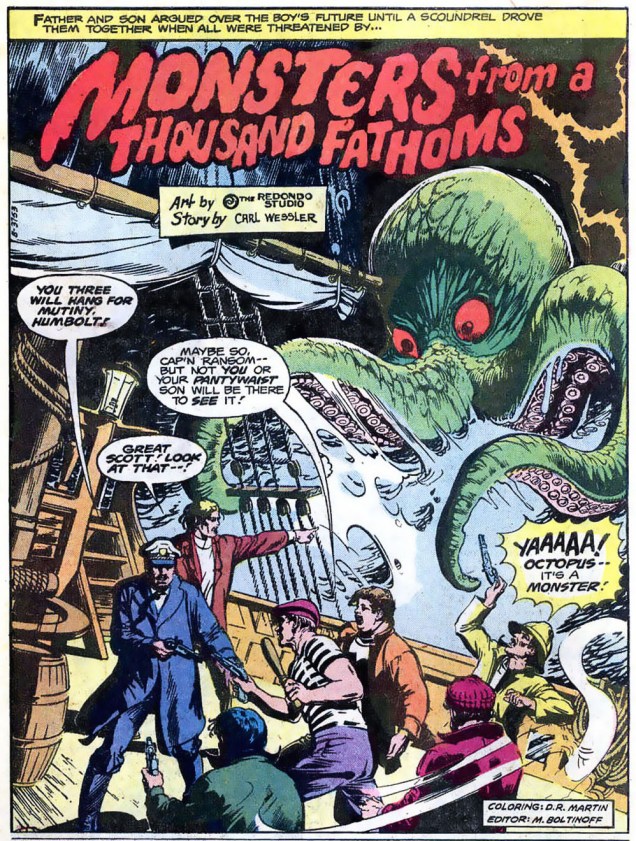
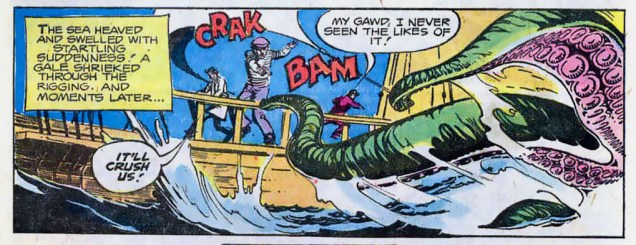
Monsters from a Thousand Fathoms, scripted by Carl Wessler and illustrated by the Redondo Studio (RG: with a heavy dose of E.R. Cruz), was published in The Unexpected no. 185 (May-June 1978, DC):
Ads endeavouring to put the viewer into the shoes of an action-type he-man to sell some nonsense is nothing new. And yet, through this hackneyed jungle, sometimes a glimmer of real excitement comes through:
An ad published in The Marvel Family no. 60 (June 1951, Fawcett). Never mind the Cola (it’s still around, incidentally), but that fight scene was pretty well orchestrated, if you ask me!
Those of us who like to dream of adventure, but preferably from the comfort of our own homes, I have this strip:
Since the aforementioned The Tracy Twins got its wings in a colour supplement of monthly scouting magazine Boys’ Life in 1952, I will now smoothly segue into a related topic, or a bit of warning, if you like.
If you start out as a wide-eyed kid in search of sea-faring thrills, and meet an octopus, just like this:
An issue of Adventures for Boys (December 1954, Bailey Enterprises).
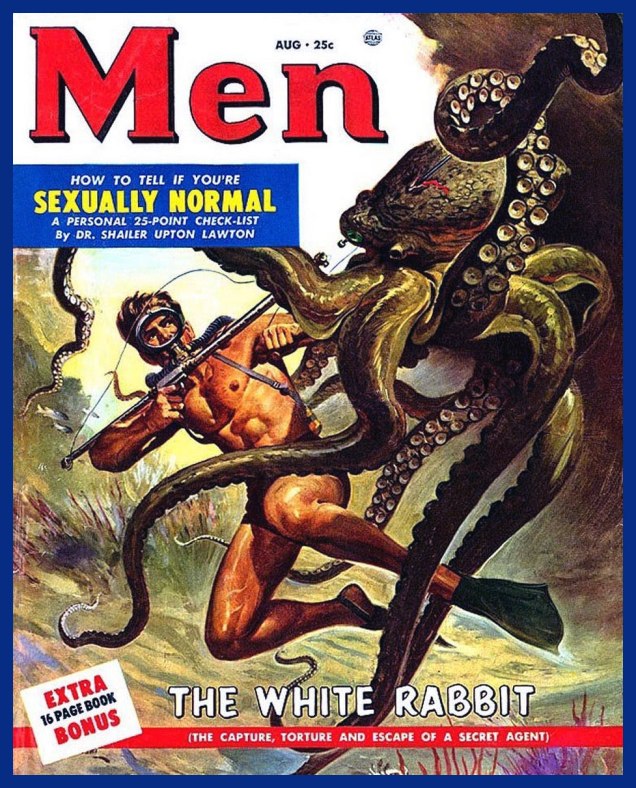
You might end up, many years down the road, growing up to be, well… a little peculiar, shall we say.
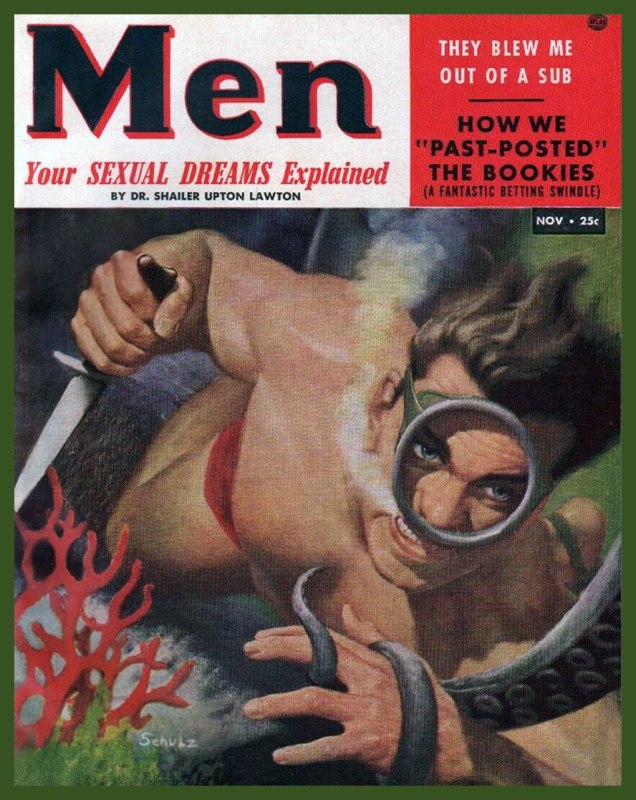
I’m sure several parts of that 25-point check-list for sexual normalcy involves cephalopods. This is Menvol. 2 no. 8 (Aug. 1953, Atlas). Cover by Robert Emil Schulz.
And if that wasn’t sufficient, the same doctor has further advice for his readers in this slightly subsequent issue:
Menvol. 2 no. 11 (Nov. 1953, Atlas). Cover by Robert Emil Schulz.
When I was in college, most of my professors could easily be divided into two categories: those who had good taste in comics, and those who did not. I don’t know who launched this tradition (is this something that’s universal to all post-highschool educators?), but somehow the majority of teachers were fond of clipping particularly pleasing items from newspapers and (usually messily) scotch-taping them to their office door. This usually included some brief newspaper articles, and definitely a cartoon or two.
I have to admit that I had a soft spot for panels that clearly had spent the last decade (or three) in that spot, and were little more than yellowed, warped, sometimes downright indecipherable relics of yesteryear. However, of greater interest were office doors tended as carefully as an prize-winning garden, proudly displaying a frequently renewed wall of cartoons, meticulously positioned and impeccably pasted onto the door’s surface.
I was lucky enough to know one professor who was passionate about Bizarro, and another one who harboured a similar fire for Gary Larson‘s The Far Side. At the time, I didn’t know that Larson had retired in 1995, and that new work of his was no longer published in newspapers. I was in college in 2004. Did the professor in question hoard large archives of cut-out The Far Side strips (these weren’t photocopies), and just cycle through them? Was there, in her office, some portal to an alternate reality? That mystery shall only deepen over time. I can only state that I would make sure to swing by first thing in the morning to enjoy that day’s offering.
Today we present you with a fairly complete collection* of Gary Larson tentacles. I give my gratitude to co-admin RG for his “eagle eye” – he spent an hour or two going through his paperback collections of the strip (and giggling maniacally) to spot anything cephalopodian. He then scanned ’em (and added colour frames, because that’s the kind of man he is), so this post has honestly been more work for him than for me.
*It turns out there’s quite a lot of them, so this shall be a two-part post.
Larson has been notoriously opposed to having his strips posted online by fans, but in December 2019, he has decided to start a The Far Side website, featuring a random selection of cartoons, some weekly selections organized by theme, and the occasional doodle or sketch. I have absolutely no wish to disrespect the opinion of the author, but I hope that now it’s okay to share our excitement about so much tentacle goodness with our readers. Besides, tentacles or not, most of these are hilarious and surreal, a combination that’s dear to my heart.
Without further ado…
« Controversy never seemed too far away from me, especially during my first year of syndication. I truly thought my career may have ended a number of times. I remember one I did of a couple dogs that were playing this game, where they were smacking around a cat hanging from a long rope attached to a pole. I called it “Tethercat.” To me, and I assume my editor, it didn’t cross any line because this was just a game dogs might play. But that one got people stirred up. Especially cat people. I’ll forever be grateful to fans, who in those early days often rescued “The Far Side” from cancellation, or campaigned to get it reinstated. » 〈source〉
« Among the massive fan base that The Far Side would eventually develop, interestingly scientists and academics were among the first to take to the comic, despite Larson’s frequent jabs at this very same group. The strip also had a tangible impact on the world of paleontology. In an 1982 comic, a group of cavemen are in lecture hall being shown a slide of a dinosaur. The caveman instructor is pointing to the spiky tail of a Stegosaurus while saying, “Now this end is called the thagomizer…after the late Thag Simmons.” As it turned out, in real life, no one had actually given that part of the Stegosaurus’ tail a name. Despite Larson’s fudging of the facts (in actuality, dinosaurs and humans missed each other by more than 140 million years), paleontologists adopted “thagomizer” as the official name of the spikes on a Stegosaurus. » 〈source〉
And, in glorious colour…
While there are cheap and abundant paperback collections of The Far Side in every self-respecting bookstore, in 2014, Andrews McMeel Publishing released a beautifully designed 3-volume The Complete Far Side. Oh, and it weights 20 pounds. For bonus value, some letters written to the newspapers by befuddled or angry readers are included. Few of us may feel the need to possess such a grand coffee table book (I’ve been pondering that myself ever since it got published), but its very existence is a lovely testament to the enduring nature of Gary Larson’s world.
±≠ ds
P.S. Those teachers with bad taste in comics I mentioned? They had Garfield and Cathy on their doors…
Some content on this page was disabled on June 3, 2022 as a result of a DMCA takedown notice from Gary Larson. You can learn more about the DMCA here:
My grandfather, born around 1920, used to tell me tales of what life used to be like in the 40s for a young man. He skipped the salacious adventures, of course, as that would have been inappropriate fodder for a child, but another thing he seems to have omitted is the presence of all manner of tentacles in everyday life… I cannot ask him about it, as he passed away many years ago, but I nevertheless dedicate this post to his memory.
Famous Funnies no. 83 (June 1941, Eastern Color), artist unknown. To be attacked by a sock puppet trying to pull you into the sea is tragic, not funny!Planet Comics no. 22 (January 1943, Fiction House), cover by Dan Zolnerowich. I somehow completely overlooked this cover when doing Tentacle Tuesday: Planet of Tentacles, courtesy of Fiction House.Air Fighters Comics no. 5 (February 1943, Hillman). Cover by Charles Biro.The United States Marines no. 3 (1944, Magazine Enterprises). Cover by Creig Flessel. I don’t know if fighting a Japanese head caricature attached to seven tentacles qualifies as an “authentic marine corps story”.Famous Funnies no. 157 (August 1947, Eastern Color). Cover by Stephen Douglas.
« In the spring, at the end of the day, you should smell like dirt. » – Margaret Atwood
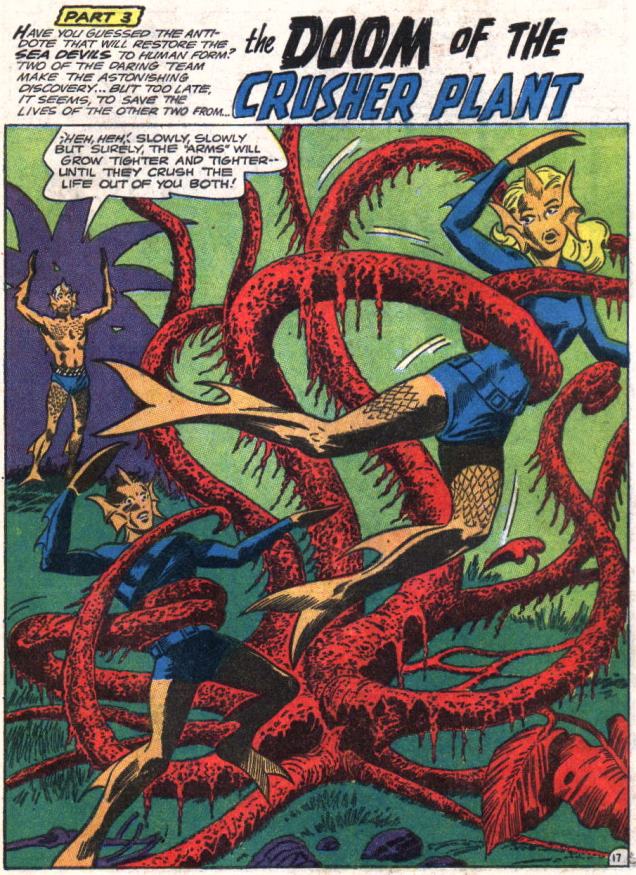
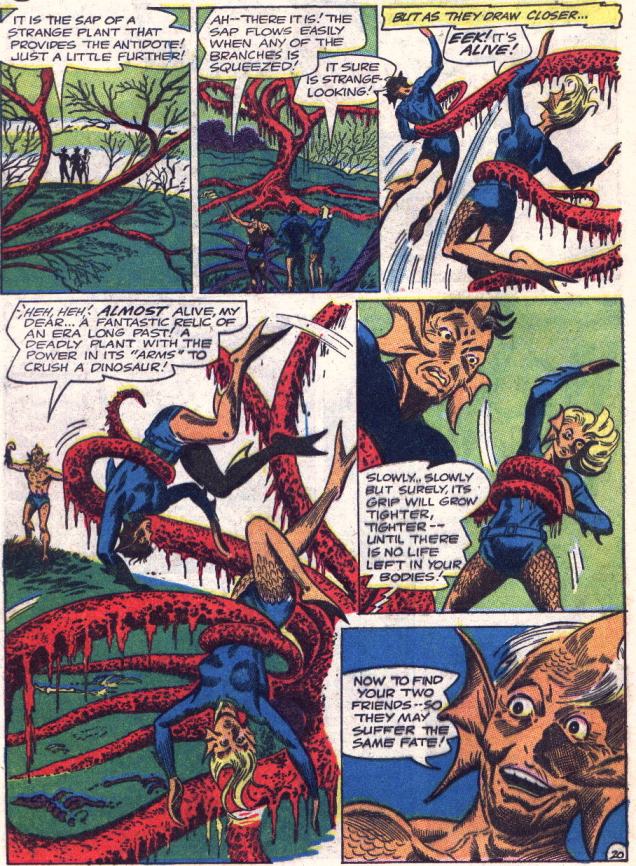
Our neighbours are certainly following this sage piece of advice, crawling out with shovels and rakes, clad in rubber boots and – a new development this year – face masks. As far as I’m concerned, the flu virus can’t be transmitted by plants, so one is quite safe in the garden or backyard, as far as that goes… but how about proper protection against plant-tentacles? ♪♪ Whether on land or under the sea, tentacles are coming for you and me… ♫♫ I promise to stay away from song-writing in the future. But now, for the comics!
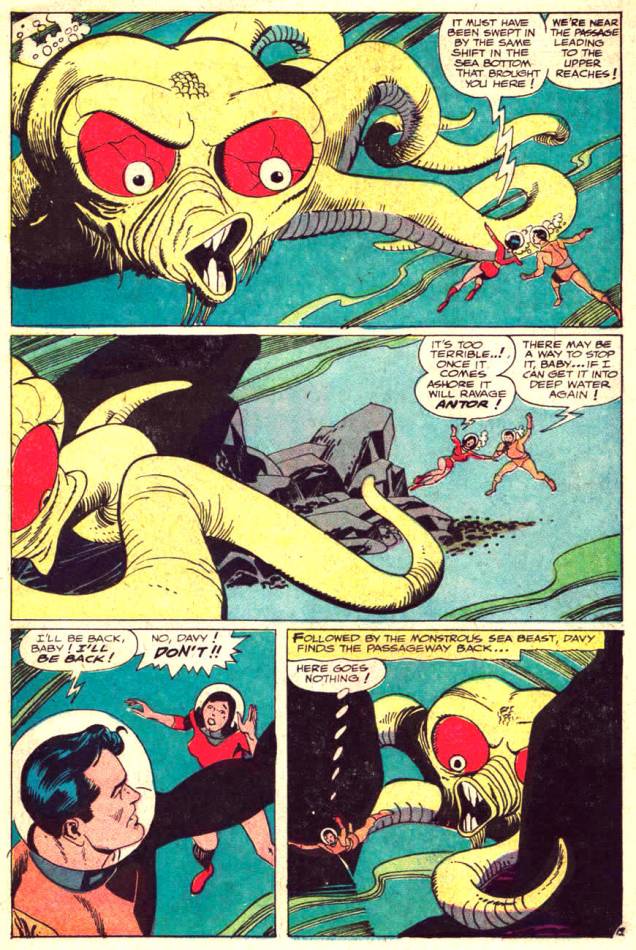
Sea Devils no. 18 (July-August 1964). Cover by Howard Purcell. The Sea Devils grapple with tentacles quite a lot, so they had a whole Tentacle Tuesday: Ahoy, Sea Devils! to themselves.
The art inside is quite nice, with pencils by Howard Purcell and inks by Sheldon Moldoff (read the whole issue here):
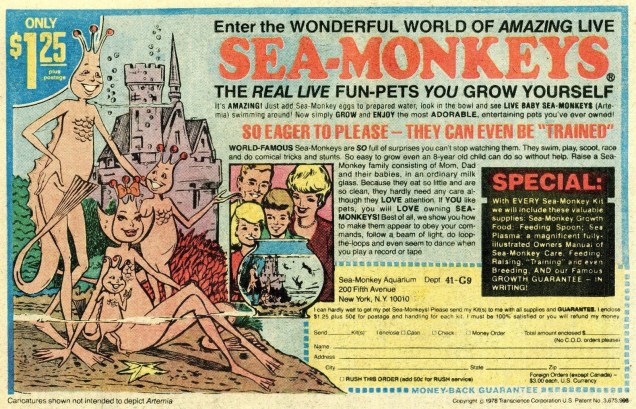
Incidentally, co-admin RG pointed out that the Sea Devils were basically turned into Sea-Monkeys – and minus the tail, he’s perfectly right!
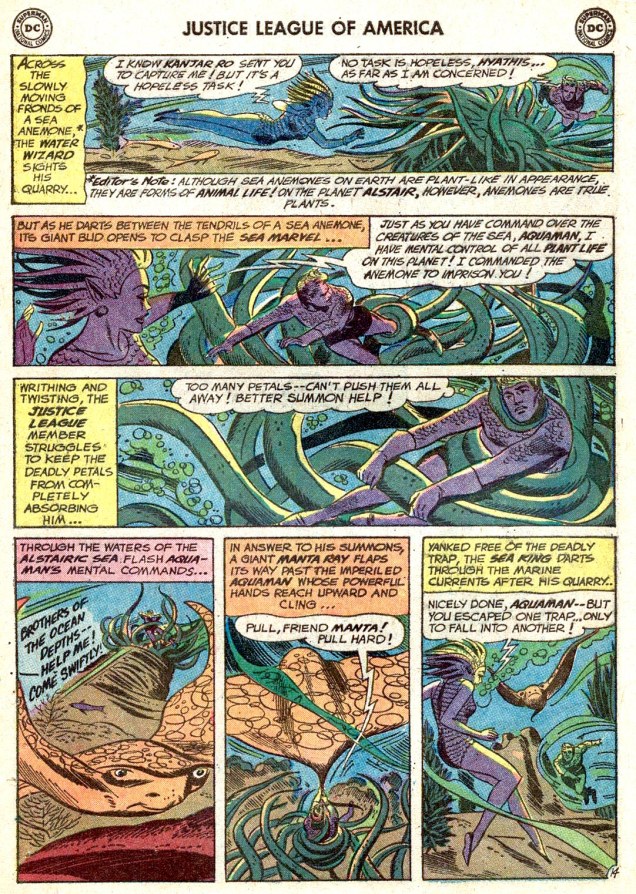
Many people are highly wary of seaweed – and this story proves them right. Remember, eat seaweed, but don’t let seaweed eat you!
Page from The Slave Ship of Space!, scripted by Gardner Fox, pencilled by Mike Sekowsky and inked by Bernard Sachs. This story was published in Justice League of America no. 3 (Feb-March 1961). I wonder why the author decided to make anemones into “true” plants, when he could have simply incorporated actual seaweed into this story.
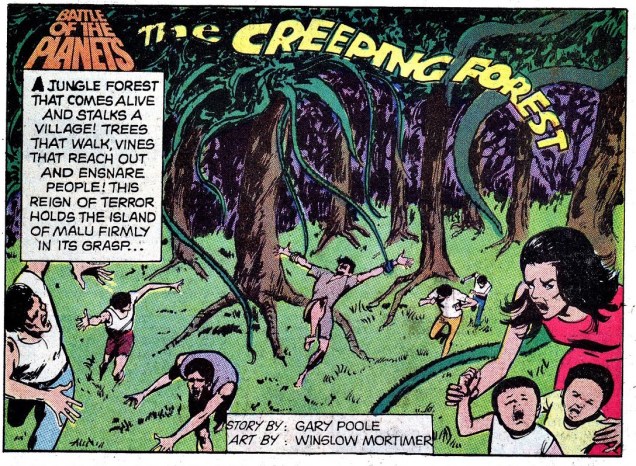
Back on land, and not even on a different planet, we have a story featuring hungry, hungry vines *and* the novel sport of “princess-tossing”:
Battle of the Planets no. 4 (December 1979), cover by Win Mortimer.
The Creeping Forest is scripted by Gary Poole and illustrated by Win Mortimer:
Of (relatively) recent vintage, a philosophical young man pondering the mysteries of life while held in the tender embrace of this, err, plant:
Fenrir no. 4 (Norvert Hethke Verlag, 1988).
Previous botanical Tentacle Tuesdays can be perused here.
« Challenge Merlin and be a fool! — Challenge a demon — and be destroyed! »
Suddenly having so much time on my hands (courtesy of COVID-19) is an eerie, though by no means unpleasant, experience. While I could crochet mini couches for my cats or enrol my partner’s help to re-create some favourite classic paintings, I prefer to catch up on books I’ve been meaning to read for a while. Case in point: in April, I’ve been joyously absorbing Jack Kirby’s Fourth World saga, reprinted in a handsome 4-tome omnibus (and to which I have easy access, thanks to co-admin RG’s vast library). That ended all too soon, and I moved on to a collection of Etrigan the Demon. It was a somewhat underwhelming experience, especially given the epic scope of Fourth World, but of course still worth a read.
The red-eyed, yellow-skinned creature called Etrigan came into existence in 1972. Mark Evanier, in his introduction to Jack Kirby’s The Demon, explains: « There was, at the time, a feeling around DC that perhaps superheroes were on the way out again. Ghost and mystery comics like House of Mystery and Phantom Stranger seemed to be selling, and some in the office felt the next trend was what Joe Orlando, who edited most of them, dubbed “weird adventure” comics. A few weeks later, [Carmine] Infantino asked Jack to whip up something in that category… »
Kirby accepted the challenge and, despite his lack of interest in horror, created The Demon, patterning his face on a a detail from Hal Foster‘s Prince Valiant strip as an inside joke.
As great a storyteller Kirby is, I think being asked to write about a subject he wasn’t particularly into had its repercussions. Although he clearly tried to give Etrigan a stimulating playground of supernatural rogues of varying degrees of viciousness to bat around, the overall result is rather underwhelming by Kirby standards. I’ve seen quite a few people in comic forums expressing their undying love for the Demon – if you’re one of them, I’m open to being convinced!
I actually first encountered Etrigan the Demon in a Swamp Thing issue written by Alan Moore. He first made an appearance in Swamp Thing no. 26 (July 1984) and then came back for the 14-issue storyline American Gothic that ran from June 1985 to July 1986. In Moore’s hands, Etrigan cut a dashing, mysterious figure, and he spoke in rhyme, which was a really nice touch. I admit I was disheartened to find out that he really wasn’t that exciting in his original form.
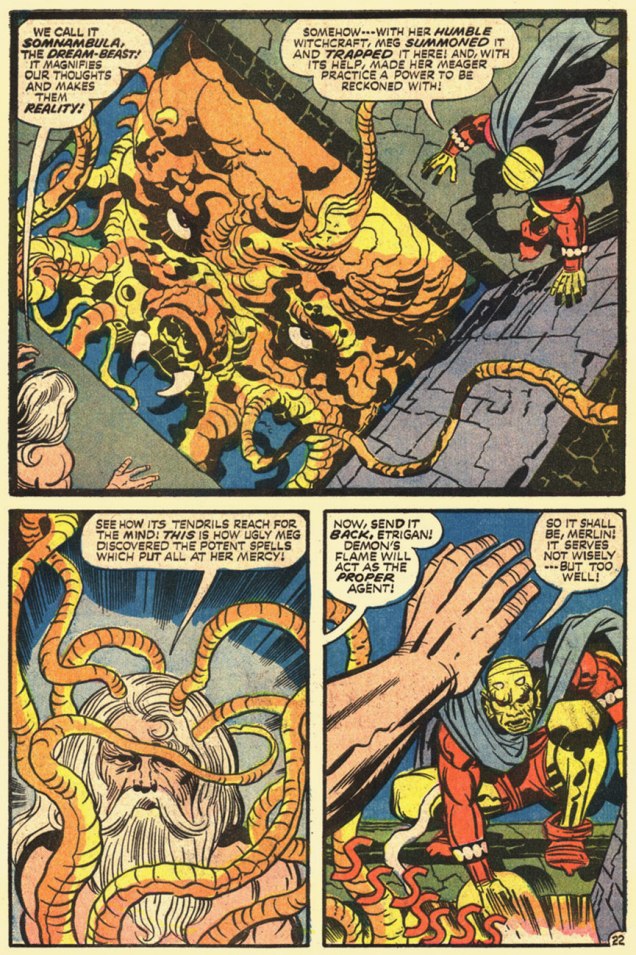
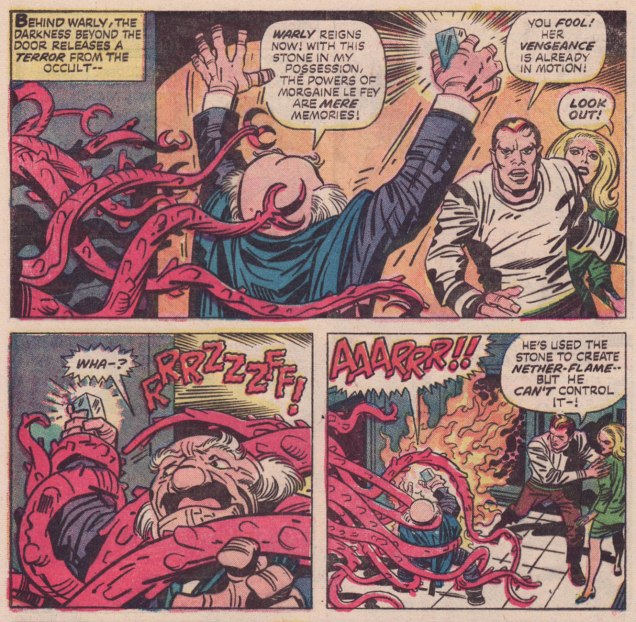
However, he *did* encounter tentacles, and more than once!
I was rather hoping the Somnambula would stick around, but it came and went in one page. Merlin’s Word… Demon’s Wrath! was published in The Demon no. 5, January 1973.The spoiled and malicious brat Klarion and his cat/pussycat-princess Teekl are my favourite characters of the series. The One Who Vanished!! was published in The Demon no. 15 (December 1973), the penultimate issue. This scene is reminiscent of a sequence from the 1961 movie Night Tide.In the following (and final) issue, tentacles reared their grabby suckers yet again. Immortal Enemy! was published in Demon no.16 (January 1974). One more complaint from me – Kirby’s use of the philosopher stone (which Warly is clutching on this page) as a sort of Deus ex machina, that can be used for accomplishing pretty much everything (some examples: it produces the ultimate cold or demon flame, shields the owner from thousand-volt electricity or brings people back form the dead, turns people into vultures or an Egyptian mummy or a chair into flowers, randomly makes objects levitate, etc.) This makes one wonder why Jason bothers running around at all, instead of elegantly waving the stone about and solving all problems instantly.
The three pages above are Etrigan’s encounters with actual tentacles, but we have an honorary mention of almost-tentacles-but-not-quite, which I wanted to include in the spirit of thoroughness.
Can the following creature’s beard tentacles be used to grab anything? We never learn if they’re prehensile or not, because the fear-monster doesn’t stick around long enough.
The Demon no. 3 (November 1972). This little baby is one of my favourite monsters of the series, despite just being part of Jason Blood/Etrigan’s nightmare – one can really felt its crushing weight. Besides, it’s probably a preview of the Kamara, a creature that becomes what the person fears most, and an awe-inspiring enemy.A panel from Reincarnators.
In case anyone is interested, I am currently re-reading Kamandi: the Last Boy on Earth, which was my first exposure to Kirby.
« Their bodies are mainly soft and pliant, with one major exception. In the centre of their web of tentacles lies a hard, sharp and murderous beak that resembles that of a parrot, is a tool for killing and dismembering prey… » (source)
When the story begs for an octopus intervention, artists can go the more-or-less realistic route, or take complete liberties with an octopus’ anatomy. Today I won’t talk about assorted tentacled zoological marvels one finds in comics – insert your choice of description into “… with tentacles”: dinosaurs, sharks, gorillas, robots, old hags, worms, bartenders, and so on. Yes, I can support my claims (email me if you want evidence… or just look through previous editions of Tentacle Tuesday).
Anyway, let’s say you want to draw a somewhat believable octopus – giant, sure, and plenty scary, but somewhat true to life. There’s a problem: frightening brutes generally have some sort of gaping maw, a set of incisors (preferably dripping with some revolting stomach acid), something they can visibly threaten the hero with. The octopus’ mouth is hidden under all that undulating mass of tentacles, pretty much where one would expect a normal creature’s anus to be, and definitely not next to his eyes. For that reason, in most octopuses sightings in comics, their mouths aren’t visible at all. But some artists, well, they want to have their cake and eat it, too. Here is a gallery of octopus mouths – we’ll start off with naturalistic ones, and make out way into that’s not how any of this works territory. I won’t include anything with a lamprey mouth, however.
Here’s the only clean attempt: the beast has a beak, there are no teeth in it, and the eyes are on the other sides of the octopus, where they’re supposed to be. Walter Simonson, you win this one!
Sword of Sorcery no. 5 (Nov-Dec 1973, DC), cover by Walter Simonson. Fafhrd, is that you?
In the next image, an attempt is made at something vaguely beak-like, but that dentition is definitely wrong. The octopus has some tiny teeth on its tongue which it uses to drill holes or scrape things out, and some razor-sharp hooks/teeth on its suckers, but nothing like normal teeth, which is why no octopus has ever needed dentures.
Doomsday In The Depths, scripted by Garder Fox and illustrated by Gil Kane, was published in Undersea Agent no. 6 (March 1967, Tower).
The other approach one could take is drawing something that looks like an especially irate parrot, but with tentacles. It is not entirely illogical, as the octopus’ mouth has been described as “similar to a parrot’s beak” by several people in the know.
Tentacles of Terror was published in Front Page Comic Book no. 1 (1945, Harvey). This page is drawn by Joe Kubert, at at least the signature attests to this – I admit I would have never guessed. There are much nicer Kubert tentacles over at Tentacle Tuesday Masters: Joe Kubert.
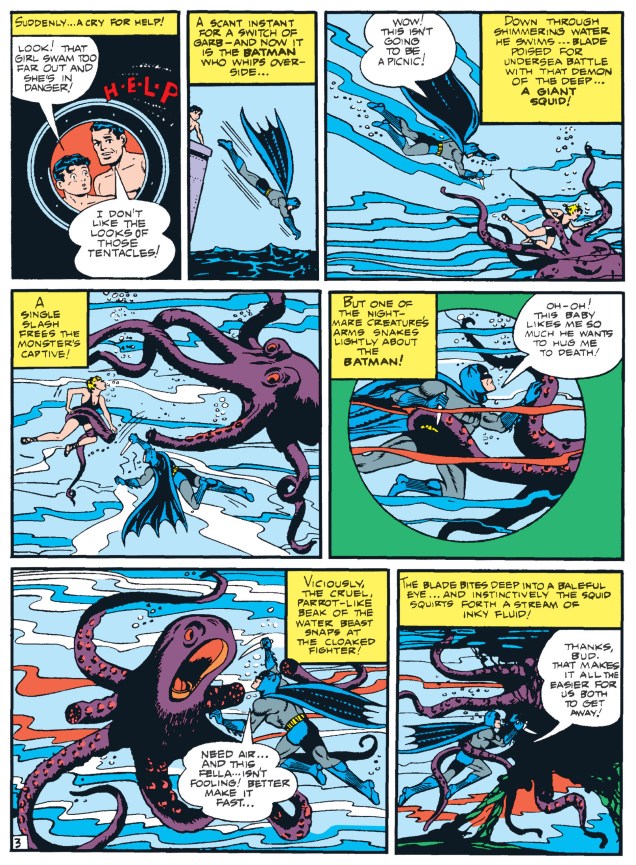
Batman recently had a whole Tentacle Tuesday to himself – here he is again, fighting a squid with very unsquid-like features. At first, he looks normal, but glance at the bottom of the left corner – how did he suddenly develop a beak where there was none to be seen several panels prior?
An excerpt from Four Birds of a Feather,Batman no. 11 (June-July 1942, DC), script by Bill Finger, pencils by Bob Kane (take that particular credit with a grain of salt), inks by Jerry Robinson, backgrounds and lettering by George Roussos.
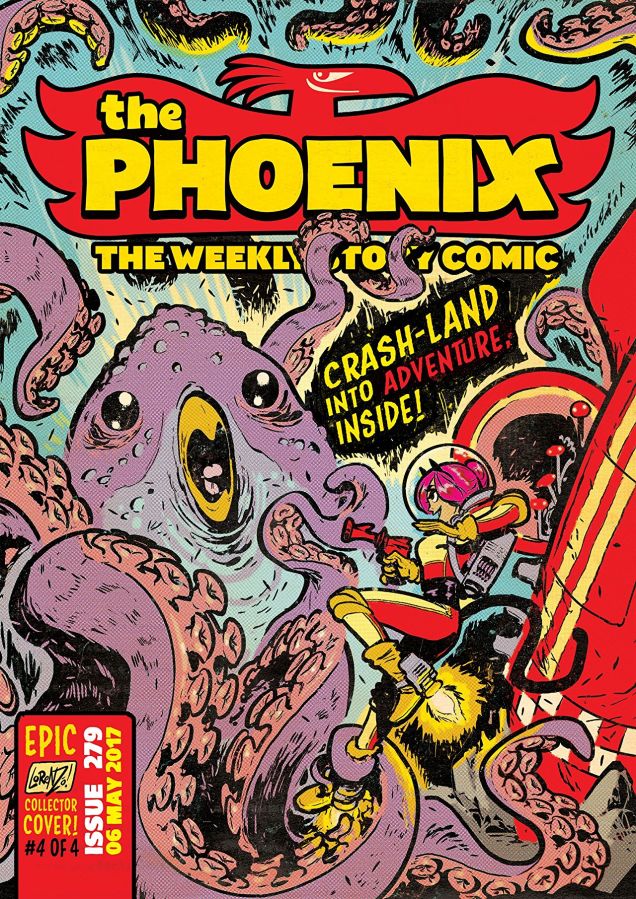
Continuing the beak-and-parrot theme…
The Phoenix no. 279 (May 2017). Can anyone identify the cover artist?
A final note to this conversation about octopuses’ mouths – should you locate an octopus, pleasedon’t put it on your face (or any other body parts).
« The tentacles of today reach out like an octopus to swallow yesterday. »
That’s a quote from Gladys Taber, columnist for Ladies’ Home Journal in the 19th century, and almost as good as “put your foot down with a firm hand”.
Another thing tentacles of today… or any day… do is reach out for women, preferably ones in skimpy outfits. ’nuff said.
By now, I’m completely confused about who Ms. Marvel is supposed to be, but here is some version of her battling an octopus with a heavy hangover or a bad case of conjunctivitis. This blondie is Carol Danvers, I believe, though, that her usually bare stomach has been wrongly coloured red… but I can’t muster enough interest to care.
Ms. Marvel no. 16 (April 1978, Marvel). Cover pencilled by Dave Cockrum and inked by Terry Austin.
The next one is a scene from a fantasy world, though pray note that the tentacle grabs the woman, not the guy who’s right behind her, nor the gorilla (?) who’s right in front of her.
In case anybody is wondering about the plot of this 6-issue series by Bo Hampton, « A wizard, an air force pilot, and a young woman on a mysterious quest, join forces on a “lost planet” accessible only through magic corridors. As Ambrose Bierce, a self-taught wizard who disappeared from Earth in 1914, tells them, when the evil Zorrin family conquered the planet Iriel, they killed off its scientists so it could be dominated by the Zorrins’ magic. Before they can return to Earth, the heroes have to destroy the lotus potion which subjugates the world’s populace to the Zorrins’ will. » (source)
Lost Planet no. 3 (September 1987, Eclipse), cover by Bo Hampton.
There’s very little science in these Thrilling Science Tales – and would you expect any from a story with a protagonist named Stormy Tempest? (any relation to Joey?) Trying to untangle her hair from the tentacle’s suckers/cilia is going to be horrendously painful, but I suppose she has more serious things to worry about.
Thrilling Science Tales no. 2 (1990, AC Comics). Cover pencilled by Mark Heike and inked by John Dell. The brown slime oozing from the tentacle’s embrace is profoundly disturbing, IMHO.
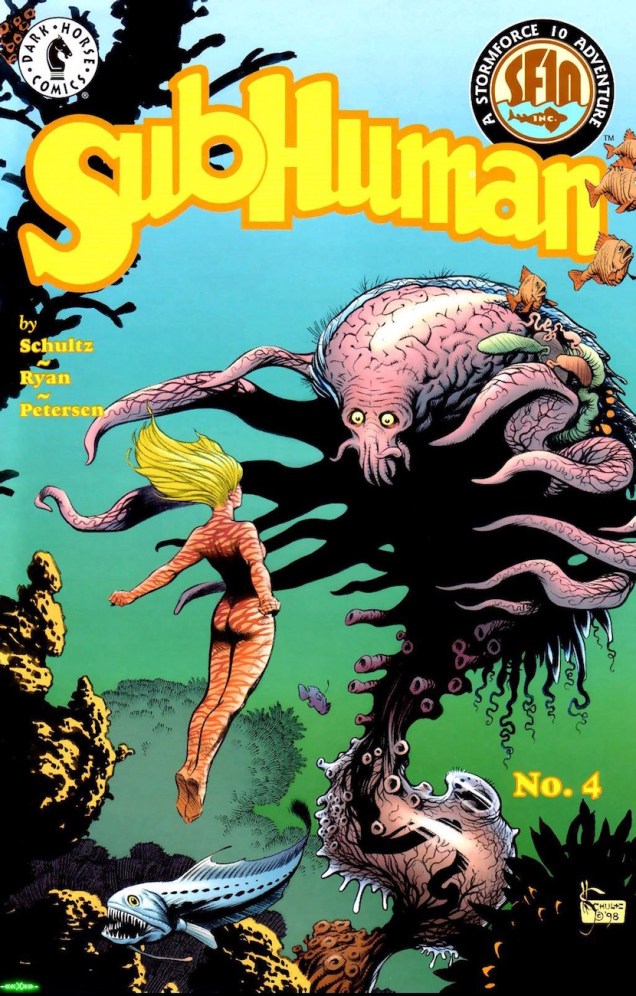
The following is not exactly a worthy use of Mark Schultz‘ talents, but at least it’s a nice, intriguing cover. The insides are not drawn by him, in case you’re wondering.
SubHuman no. 4 (February 1999, Dark Horse), cover by Mark Schultz.This Mexican science-fiction comics anthology was published in 2004. The cover is by Mexican cartoonist and illustrator Bernardo Fernández, who’s also the editor.
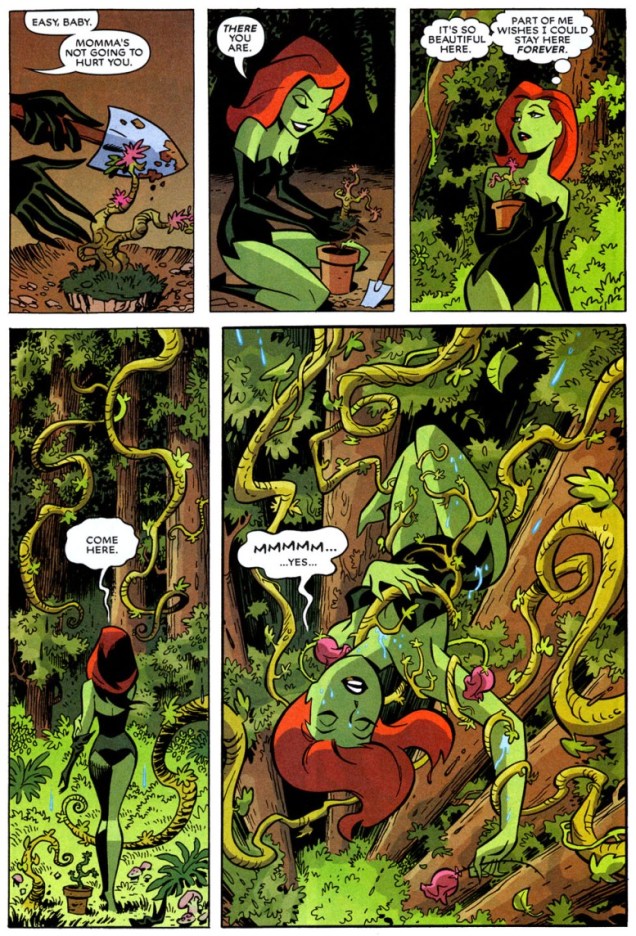
I’ll wrap up with some eye candy – I was pleasantly surprised to discover that it was actually drawn by Bruce Timm and not one of his many imitators. A Timm comic with tentacles and more than a subtle hint of seduction? I’m very pleased, indeed.
A page from Batman: Harley & Ivy no. 2 (July 2004, DC). Jungle Fever! is scripted by Paul Dini and drawn by Bruce Timm. I recommend reading the whole thing, if only for the art.
«... it was invariably his work that was given pride of place. His was emulated and imitated. By the end of the 1930s, he was the most respected and sought-after artist working for comics…»
And now guess who these lines were written about. My title was a dead giveaway, I admit! But if you’ve heard of Roy Wilson, you are, as it turns out, distinctly in the minority. He doesn’t have a Wikipedia page (surely that is a sign of success and fame in the modern world) in English, and a quick search for his name yields a lot of unrelated nonsense. But just add the word “comics” to your Google quest, and we’re in business!
Royston Warner Wilson was born in Northamptonshire, England just at the turn of the century, in 1900. He died young, at 65, but those years were enough for him to leave more than a lifetime’s worth of cartoons, humorous drawings and comic strips. For someone who has been widely credited as the most influential artist of British humour comics in what roughly corresponds to the Golden Age, which is to say the 1930s to the 1950s, his relative obscurity is downright criminal. While not particularly well-remembered by the world at large (even by the British public, it seems), at least he is beloved by legions of fans who were children during these decades and were irrevocably, and delightfully, marked by the antics of his characters.
In the 1930s, he was the leading artist for Amalgamated Press, which unleashed a variety of humour/comic titles, mostly weeklies, upon a delighted audience of pre- and post- pubescent children. Oh, a lot of these publications were around before he stepped in – but he revitalized them. As for the publisher, it had a long history with comics: as a matter of fact, it entered that particular market in 1890 with something called Illustrated Chips.
Because Roy Wilson was so talented and prolific and his artwork so lively, his style quickly became the house style and remained so for decades, which is why Wilson can be easily credited with having created what we can roughly call the “British humour style”, easily recognizable to this day.
He not only created and drew (and, often, redrew: like some super prolific artists who seem to have too many ideas to put down on paper, he was a perfectionist) the stories, he also lettered them himself. He had a great eye for colour, too! Which leads me to my next point – I’ve often seen him referred to as the « British Walt Kelly », but I’m not entirely on board with that comparison. Oh, there’s similarities – for instance, their common love of playful language and the ease with which both depict frisky, charismatic animals – but I think this monicker does both of them a grave disservice. Let’s appreciate artists on their own merit, shall we?
Only one Wilson monograph appears to have seen print: The Comic Art of Roy Wilson (1983), and it’s quite scarce nowadays. I recently purchased a copy. All images in this post have been scanned from it, courtesy of co-admin RG.
Roy Wilson was actually allowed to sign his paintings – I don’t know if that was a first, but it was certainly highly unusual in British comics. He was paid about eight guineas per painting.
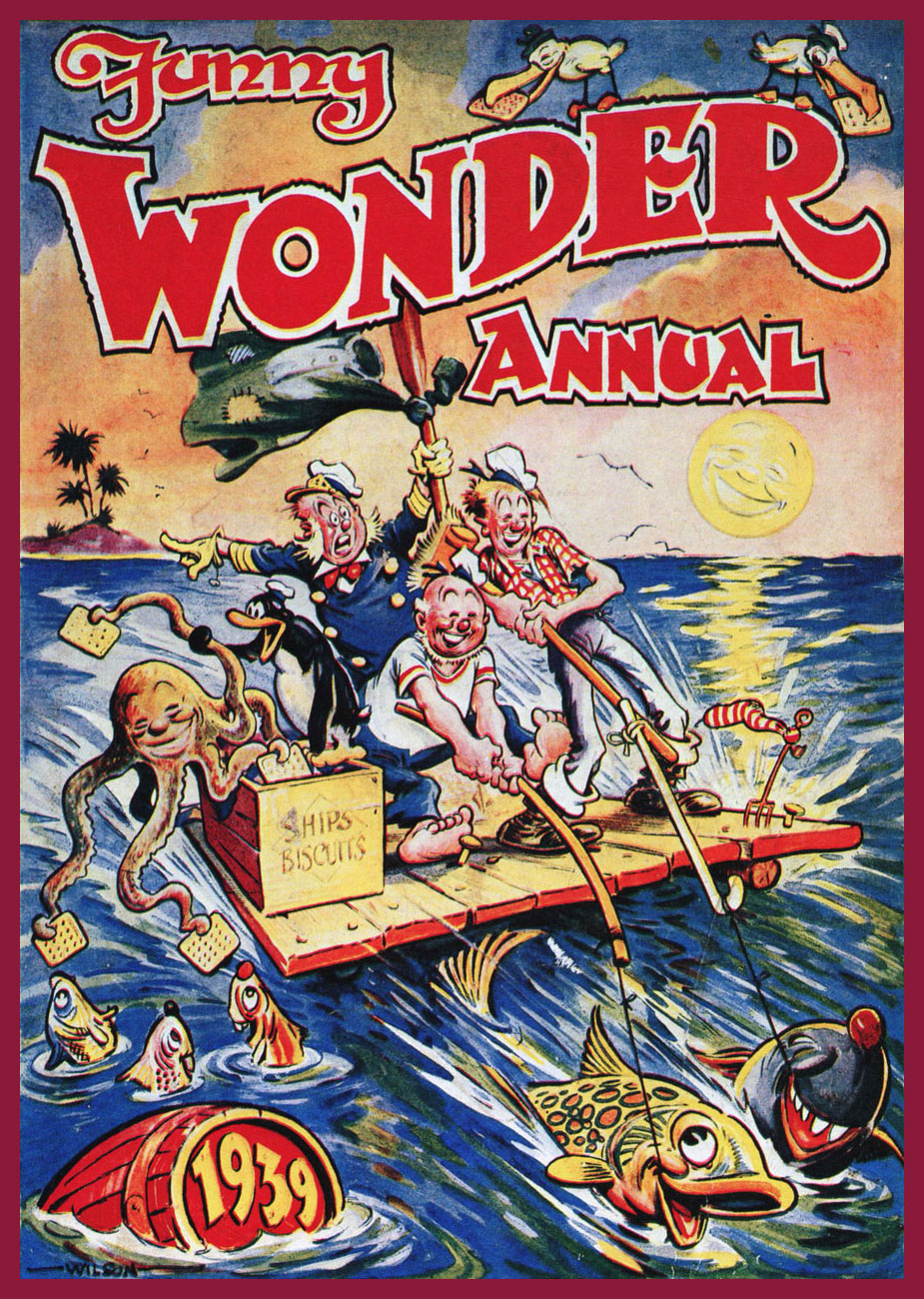
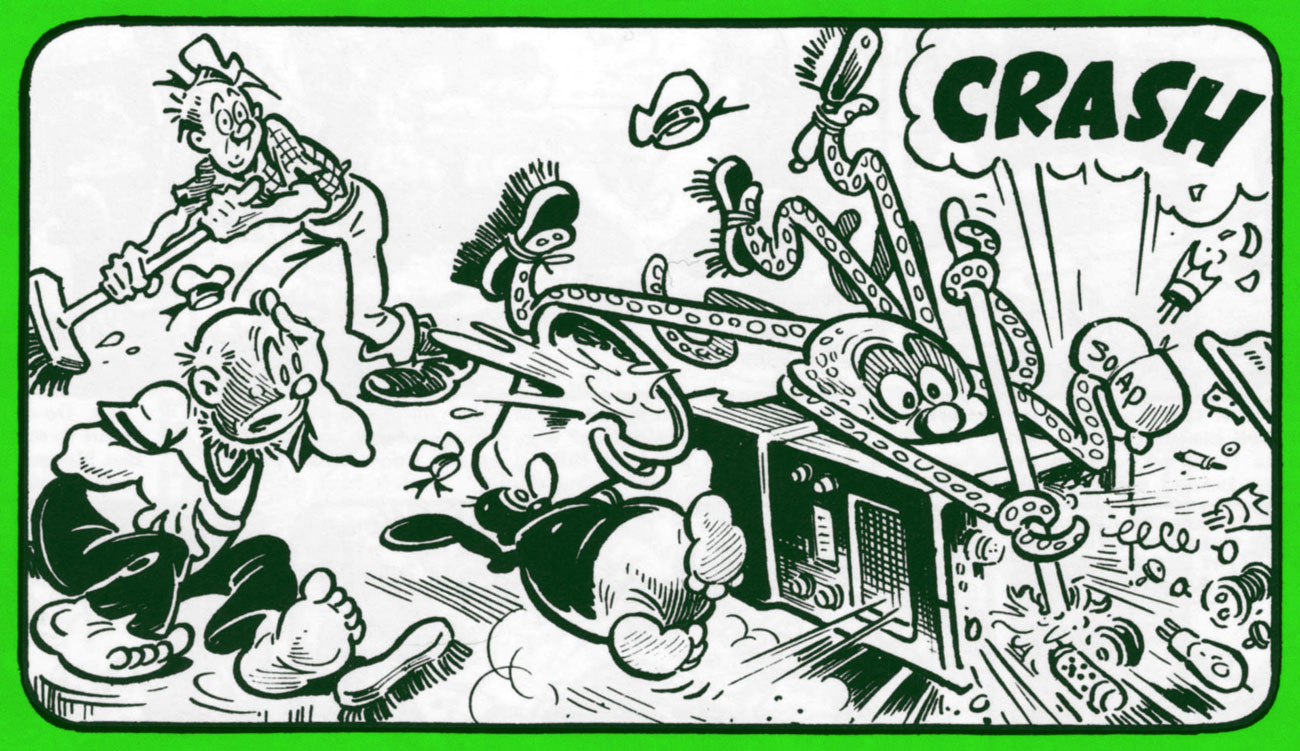
The reason for the re-occurring octopus, as you may be wondering – other than it being clearly fun to draw – is that he was a character in the stories of Pitch and Toss, published in Funny Wonder. To wit, Pitch and Toss Put On a Good Show and Show How to Make Good Money!:
Published in Funny Wonder, August 21st, 1937.
The above was the first appearance of Occy the Octopussie, who became a mainstay of the strip. Here are two (rejected) panels from another chapter in the saga of Pitch and Toss, this time for Pitch and Toss and Their Pets Get a Sub and Spend a Happy Whitsun, from March 30th, 1942.
« Roy Wilson’s art is still very much alive and, even in the comics of today, his influence can be seen. Britain’s foremost comic artist created a host of cheery and boundlessly zestful characters who still exist in the minds of the millions they entertained His art will not be forgotten. » (quote by Alan Clark and David Ashford from The Comic Art of Roy Wilson)






















 Who's Out There?