It’s boiling hot in this part of the world, so I’d like to concentrate on soothingly cool covers for this Tentacle Tuesday. If we end up taking a dip in refreshing waters in our quest for relief from balmy temperatures, so much the better. Today’s roster brings us fashionable dames and their splashy encounters with octopuses!
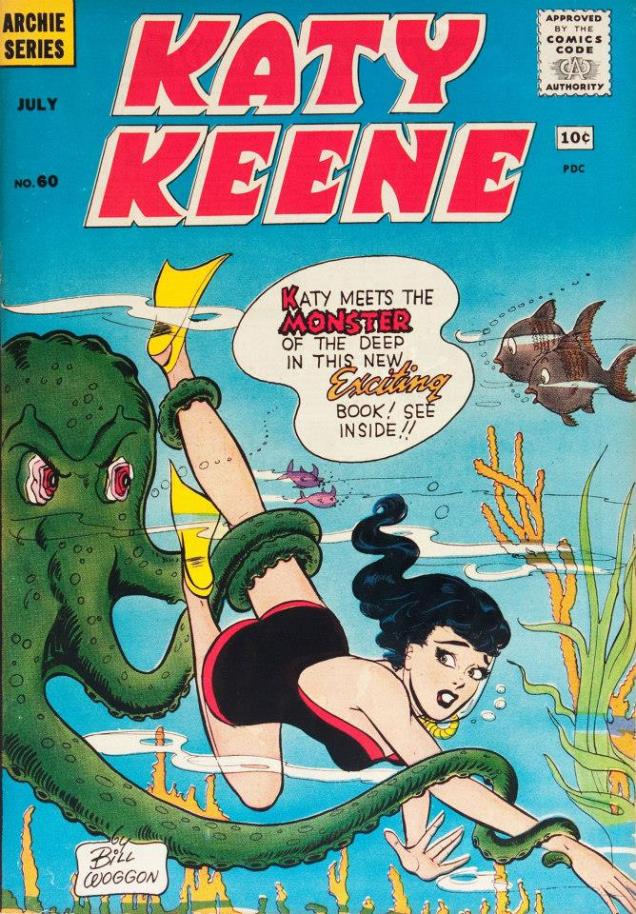
Here’s the Queen of Fashions (and right now, queen of tentacles), and for once the cover doesn’t focus on her outfit – I understand it’s hard to wriggle out of a swimsuit while an octopus is holding your leg.
Katy Keene was created by Bill Woggon, and introduced in Wilbur Comics no. 5 (1945). She was “America’s Queen of Pin-Ups and Fashions”, and readers were encouraged to submit drawings of outfits and other tralala such as designs for automobiles, boats, and whatever other method of transport Katy could glitter in. This is Katy Keene no. 60, July 1961, cover by Bill Woggon.
Mockery aside, I have nothing against Bill Woggon-era Katy – I like Woggon’s art, and the gentle humour of the stories is hard to dislike. After Katy Keene’s demise in 1961, she was eventually revived by Archie Comics in 1983. They should have let the dead rest in peace! Though several people were considered for the role of regular artist, that position went to John Lucas, whose style I abhor, recoil from and spit upon. I first saw his take on KK in those huge Archie digests you can get for pennies that reprint a bit of everything, giving readers a total pêle-mêle of different decades and different artists. I didn’t know who drew what at the time, but I quickly developed a preference for certain styles while finding others repellent… and John Lucas’ puerile art was top of my hated list, along with the half-arsed, anatomically asinine line-work of Al Hartley.
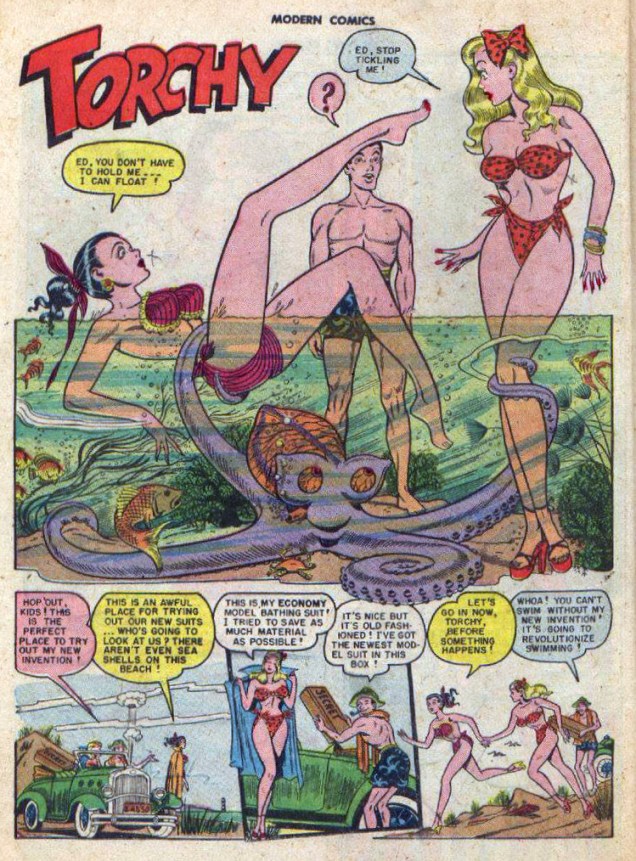
Next, we have another beauty queen, although this time the stuff is quite a bit more risqué. It’s not for nothing that cataloguing websites classify Torchy as “adult” material. As for the octopus, it has impeccable taste, having determined that there’s no need to decide between blonde or brunette when you can have both.
But Torchy, why are you wearing high-heel sandals in water? Modern Comics no. 97 (Quality Comics, May 1950). This is a page from « The Mermaid Gig », with scripted and art by Gill Fox. Fox took over from Bill Ward (Torchy Todd’s creator and writer) five years after her introduction, starting with Modern Comics #89 (1949). As far as replacement of Bill Ward, Fox did a truly excellent job, managing to preserve the mood and style of Ward’s stories. Read the mermaid tale (no more tentacles, sadly) here.
Sometimes octopuses catch little girls, but occasionally a feisty little girl captures an octopus. Little Dot is going to be a handful when she grows up… but of course she never will.
This polka-dotted octopus is a perfect catch for Little Dot in this soothingly green sea. Too bad the cephalopod fellow looks so disgruntled. He was probably in the middle of lunch or something. Little Dot no. 105 (June 1966); cover by Warren Kremer.
Those of you also inhabiting parts of the world where the weather has gone bananas (because it’s certainly hot enough for growing them in here), stay cool!
The topic of today’s Tentacle Tuesday is based on a plant-based mishap. I was walking along an alley, minding my own business, when some sort of climbing plant with especially long and vicious tentacle-vines, swinging from from a nearby fence, grabbed my arm. The result were scratches that felt like burns.*
So today’s gruesome offerings are mostly cousins of the Venus Flytrap, if the latter had tentacles to assist its quest for prey. (Let’s breathe a sigh of relief that it doesn’t.)
Midnight Tales no. 6 (November 1973), cover by Wayne Howard. I am a big fan of Midnight Tales and its blend of humour and adventure. Note the “created by Wayne Howard” announcement on the cover, which wasn’t exactly typical for its time – comic book companies didn’t use to acknowledge the creators of their “content” so openly and insistently.
Midnight Tales often offer moments of “wait, how did that get through the Comics Code?” Arachne (Professor Coffin’s undeniably attractive niece) is frequently more sexually provocative than one would expect from a kid-appropriate comic, crimes committed are nastier than surmised, and the plots go from morbid to surreal… with some comedy thrown in. Oh, sure, there’s some terrible clunkers, as every issue has three or four stories linked by a common theme and illustrated by different artists, but overall the quality remains high throughout its 18-issue run.
I’ve seen people online saying that Howard shamelessly plagiarized Wally Wood’s style – perhaps people more erudite than I see that, but I don’t. “Influenced” is one thing – but one can build on those beginnings to create a recognizable style of one’s own, right? Those who like Wayne Howard frequently classify him as a “guilty pleasure”, and proceed to insult his art while they’re explaining why they like it. To quote, for instance, from Atomic Avenue,who follow the unspoken rule – just mentioning Charlton Comics warrants a condescending tone, and any acknowledgement of their quality has to be tempered by mockery.
Creator Wayne Howard blatantly imitated the style of comic art great Wally Wood right down to his gothic signature, but at least he aimed high in his plagiarism. Consequently, Midnight Tales had the look of a seedy, off-register knock-off of an EC horror comic—putting it at the top of Charlton’s quality spectrum.
In my world of geek’n out over all this great art, Wayne Howard is one of my biggest guilty pleasures. He loves to draw like Wally Wood, but he’s no Wally Wood. His females usually look like Wally’s women after a really bad day, and his males are just plain fugly. His Wood machinery is close to the background machinery behind the awesome machinery, and everything shouts fan art VS pro art, but… Luvittopieces
Ah, well. I won’t be apologetic about liking Howard’s art, and Midnight Tales will be proudly presented as a favourite series on a need-to-know basis. Fortunately, there’s some nice articles about him, too – a sort of obituary for a great African-American artist who died at only 58.
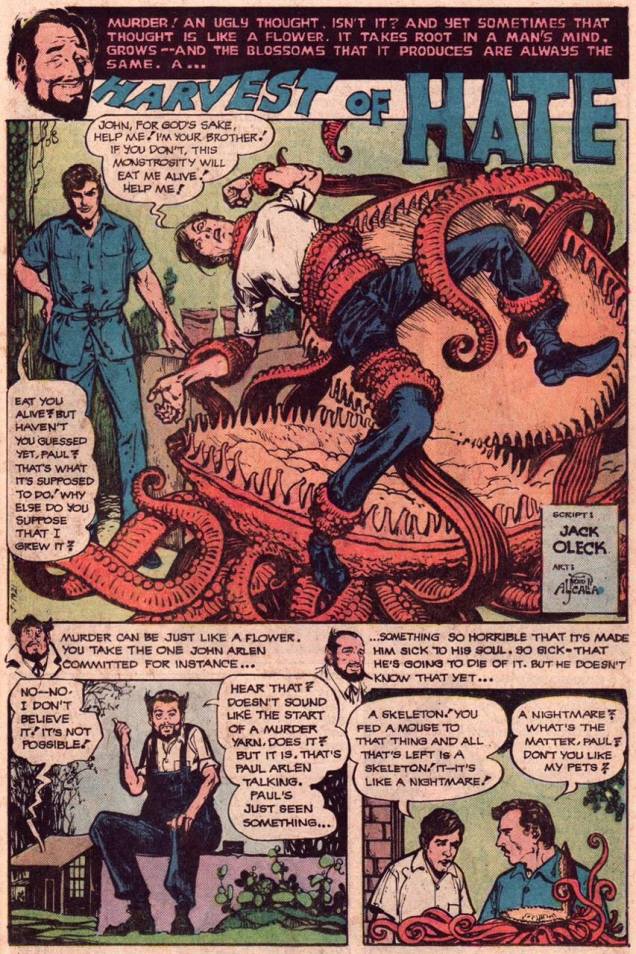
Another Flytrap for your enjoyment, in this tale of brotherly rivalry:
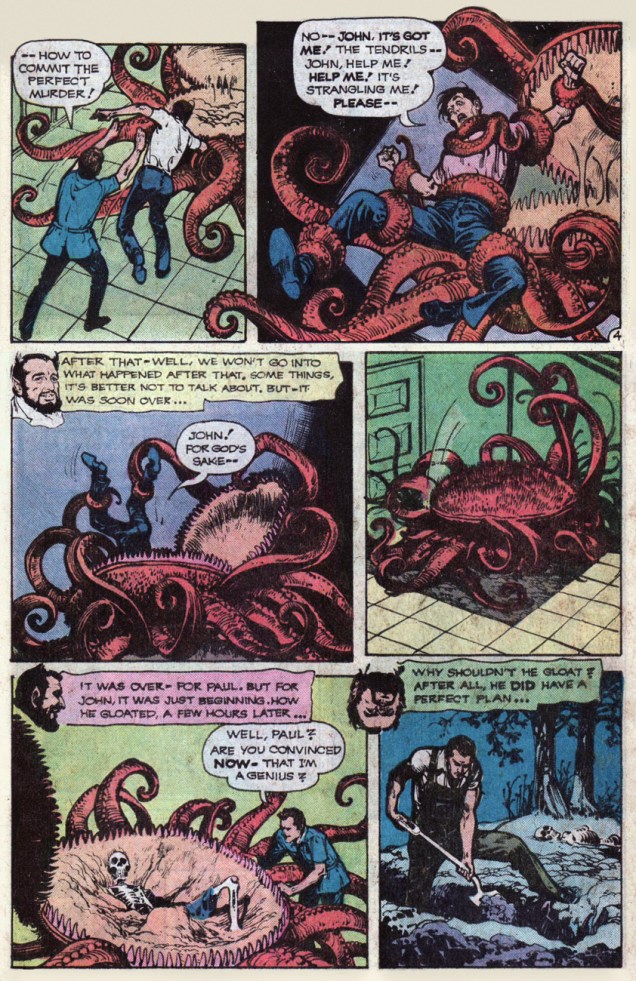
“Harvest of Hate” was scripted by Jack Oleck and drawn by Alfredo Alcala (speaking of whom, I still can’t get over how beautiful his signature is.) Page scanned from House of Mystery no. 251 (March-April 1977).Don’t worry, the “gardener” who fed his brother to this man-devouring monstrosity gets his comeuppance, all right.
The cover of this issue of House of Mystery is also a good exhibit of plant tentacles, even if the children are a superfluous addition:
House of Mystery no. 251 (March-April 1977), cover by Neal Adams.
Here’s something more recent – published on some almost-thirty years ago, instead of forty – the tentacular adventures of Doctor Gorpon! I hope these guys count as plants (even if they’re slightly more mobile) – they’re the right shade of green!
Doctor Gorpon no. 2 (July 1991) by Marc Hansen. The little guy in the right bottom corner is extra-cute – if only all children looked at their parents with the same sense of admiration and awe! It’s “Ooze Me, Baby!”
I only finished reading this three-issue series today, and I must say, it was an exciting ride. Highly recommended (if you can find it, that is).
A panel from the aptly-titled “Big Eyeballs!”, published in Doctor Gorpon no. 3 (August 1991).A page from “Big Eyeballs!”, published in Doctor Gorpon no. 3 (August 1991).
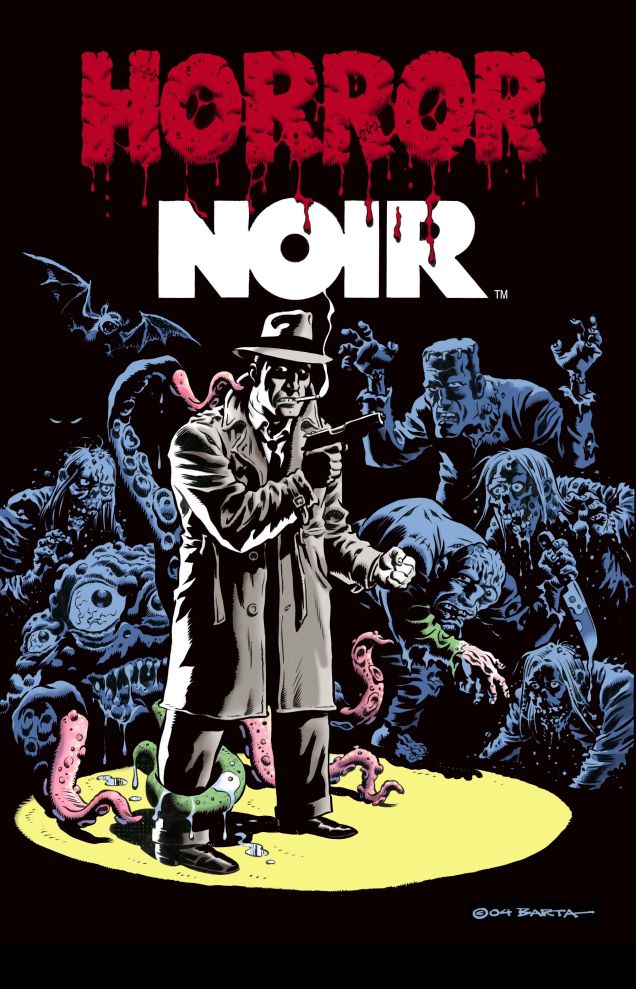
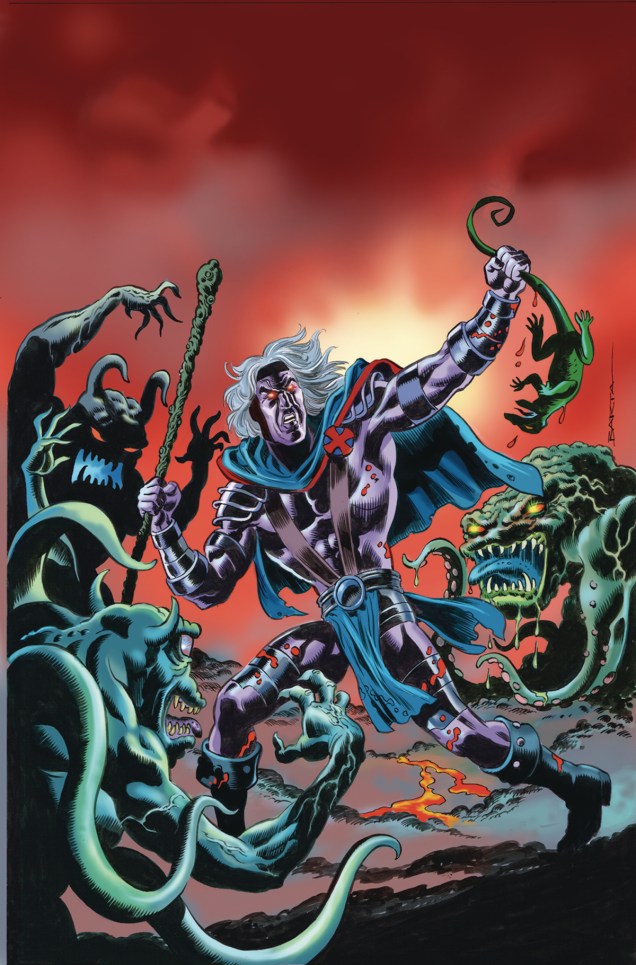
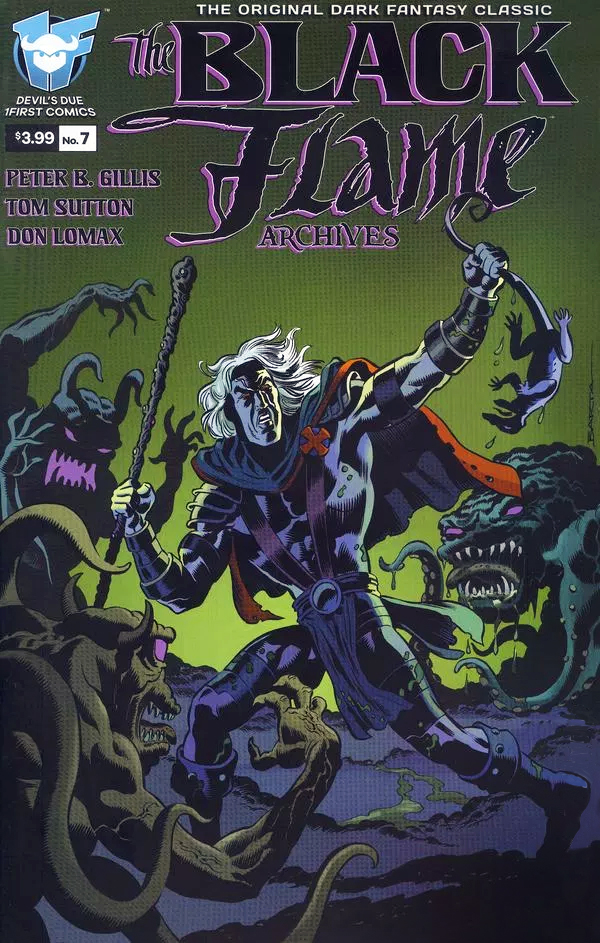
There are few things more satisfying than hitting two birds with one stone. Today’s Tentacle Tuesday almost, but not quite, coincides with the birthday of Hilary Barta, who was born on June 17th, 1957. As it happens, he is delightfully adept at depicting tentacles, and quite enthusiastic about it, too…. so it is my pleasure to combine tentacle festivities with a (hopefully) tantalizing sampling of a great artist’s work.
All I could find about this illustration is that it was meant as a cover to a book. To quote from Rhine’s website, « writer R.S. Rhine and illustrator Hillary Barta will collaborate on the graphic novel (release 2005) ». Was it ever released? It doesn’t seem so.Art for The Black Flame no. 7, 2017. Art by Hilary Barta. So Black Flame is getting attacked by a bunch of drooling monsters and he’s victoriously brandishing… a small lizard?The published version of The Black Flame no. 7. I think this colour scheme works much better, actually.
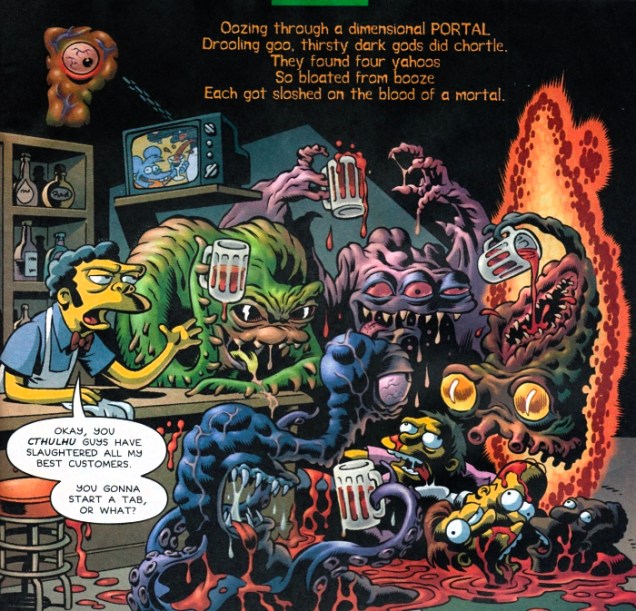
There’s no mentioning Barta without perusing some of his Simpsons’ work, especially under the umbrella of that tentacle-rich (my favourite!) manifestation of the Simpsons, the Treehouse of Horror.
P is for Portal! This « Lexicon of Lurid Limericks » was published in Treehouse of Horror no. 8, 2002. Art by Barta, colours by Dave Stewart. Moe is nonplussed, as usual… it’s going to take more than a few slimy tentacles and a big puddle of gore to shake him up.
So far, we’ve leaned heavily in the direction of the aggressive octopus, the hoggish, ill-mannered brute who grabs people without so much as a how-do-you-do. Even when the multi-tentacled beast has self-defence as an excuse, the gory results are often not for the weak-hearted. Yet, like any complex creature, it has many personality facets; let’s have a look at the friendly cephalopod, the octopus-next-door type, the one who’s willing to let you use its tentacles in lieu of swings and lend a feeler’d arm with your fishing.
In 1946, Belda Records came up with the concept of a “komic book & plastic record”. The series was called Talking Komics, promising (and delivering!) kids a “record-music-story-comic book” experience. There were 8 characters, one per book-cum-record, in all. Our friend the Lonesome Octopus is one, although he seems to be doing all right socially. The other 7 are Grumpy Shark, Happy Grasshopper, Chirpy Cricket, Flying Turtle, Blind Mouse, and in a slightly different vein, Enchanted Toymaker and Sleepy Santa.
The records were written & produced by Bob Bellem and narrated by Marvin Miller (a well-known voice actor – to name a few well-known shows, he was Robby the Robot in Forbidden Planet and in The Pink Panther Show he voiced the Inspector, Deux-Deux and the Commissioner), the music was composed & conducted by Frank Hubbel, and the comic was illustrated by Mel Millar, who may or not be Marvin’s brother. Cartoons were created for at least some of the records/comics (so it’s more like “record-music-story-comic-book-animation”) – some of them used to be findable on Youtube some time ago, but the years seem to have swept everything away.
Another octopus who kindly consented to let his tentacles be used as swings. He apparently sings, too!
Mutt and Jeff is a newspaper strip created by Bud Fisher in 1907, generally believed to be the first daily comic strip (or at least the first really successful one). It featured Augustus Mutt (the tall fellow swinging on the right tentacle), greedy and highly inventive (if not downright insane) with his parade of get-rich-quick schemes, and bald Jeff, his reluctant sidekick, whose sideburns would surely get him accepted as a hipster in these modern times. Go here to read an enthusiastic article about this cultural phenomenon, and here to read some comics.
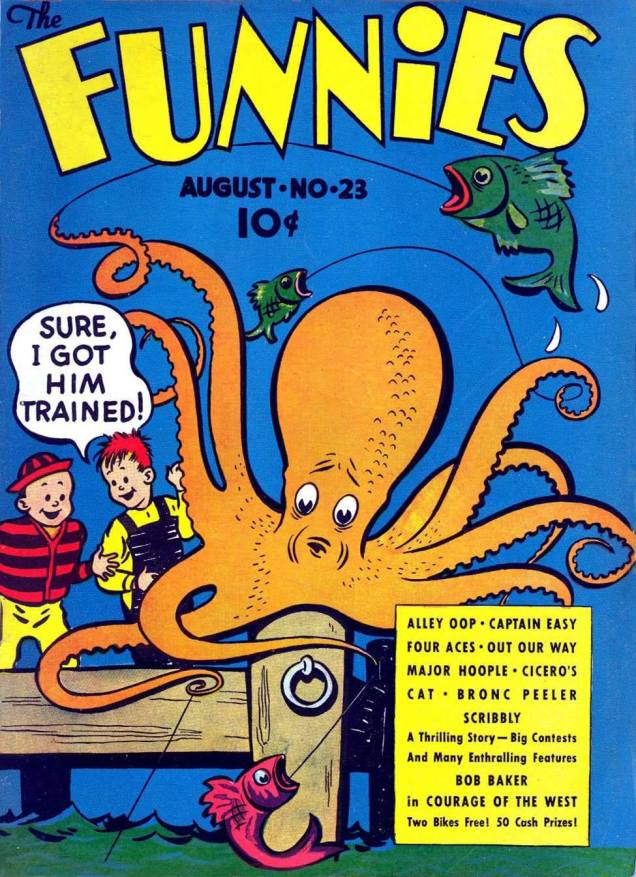
Little boys who over-work an octopus are going to end up as his dinner, I say. Still, for the time being, here’s a sweet scene of inter-species coöperation.
I sure hope that this octopus gets his share of fish at the end of the day! Also, wouldn’t it be more efficient to just grab the fish directly with tentacles instead of using man-made contraptions like fishing lines? This is The Funnies no. 23 (Dell, August 1938). Does anybody know the artist?
‘Orrible Orvie and Awful Annie will help us wrap up this Tentacle Tuesday. This octopus isn’t assisting the kids directly, but the kind smile on his, err, face radiates benevolence (well, not to the fishes, but one has to feed on *something*, right?)
This is The Little Monsters no. 41, 1977 – only three issues away from the series’ end (it ran from 1964 to 1978 for a total of 44 issues, plus a giveaway issue of March of Comics). Artist unknown.
Since Popeye’s a sailor, one would expect him to run into a lot of octopuses during his adventures. It doesn’t happen nearly as often as one would think, actually, but there’s still enough encounters for a decent-sized tentacle journey. Here we go!
Popeye: Danger, Ahoy! Big Little Book no. 5768 (Whitman, 1969). Does anybody know who painted this cover?
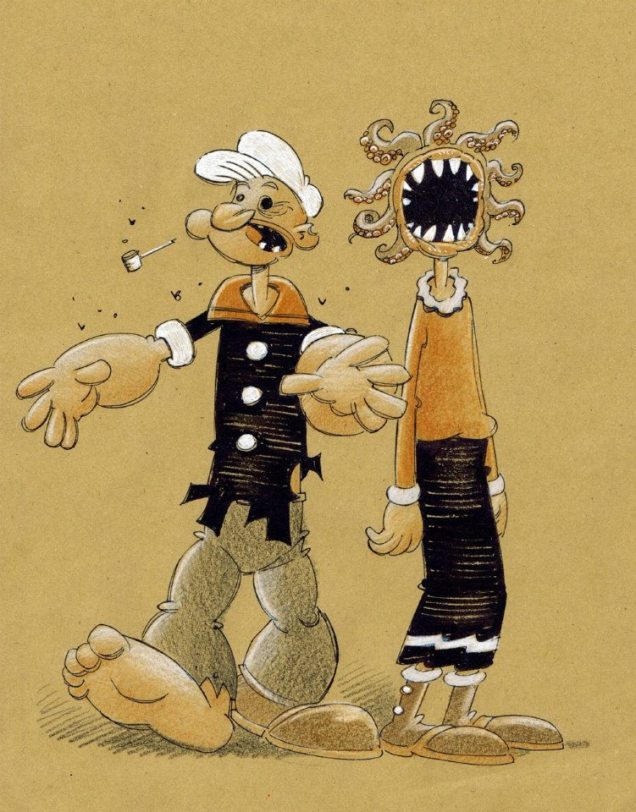
« Zombie Popeye » (and, more importantly for our current topic of discussion, Chtulhu-Olive!) by the talented Roger Langridge. He posted this so-called sketch (how detailed can a drawing be before it stops being a sketch?) on his website on September 2014… and the original is still for sale, I believe! Go here. This isn’t the first time Langridge tentacles slither into a blog post – for instance, go visit « Tentacle Tuesday: pirates and treasure, oh my».
A variant cover for Popeye Classics no. 48, July 2016. These Craig Yoe reprints of Bud Sagendorf’s Popeye are great fun, by the way, and I highly recommend them for the proverbial children-at-heart.
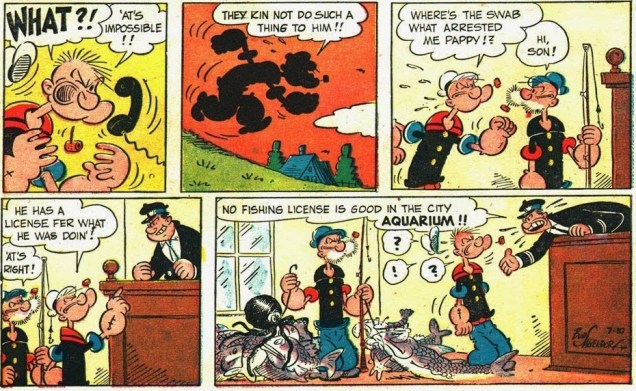
Original art for a Popeye Sunday, published on July 9th, 1958. The art is by Bela (Bill) Zaboly, who worked on Thimble Theater starting from 1939 and until Bud Sagendorf took over in 1959.
A chunk of story in which an octopus makes a very minor appearance… from a strip by Bug Sagendorf published on October 7th, 1960.
A panel from “Hitchhikers!” by Bug Sagendorf, published in Popeye Comics no. 19 (January-March 1952). Read the full zany story here. (Technically, this is a Sherm story, but let’s not split hairs.) I’m not surprised the octopus looks like a spy, wearing a hairpiece like that. Or is it just a nest for the birdies?
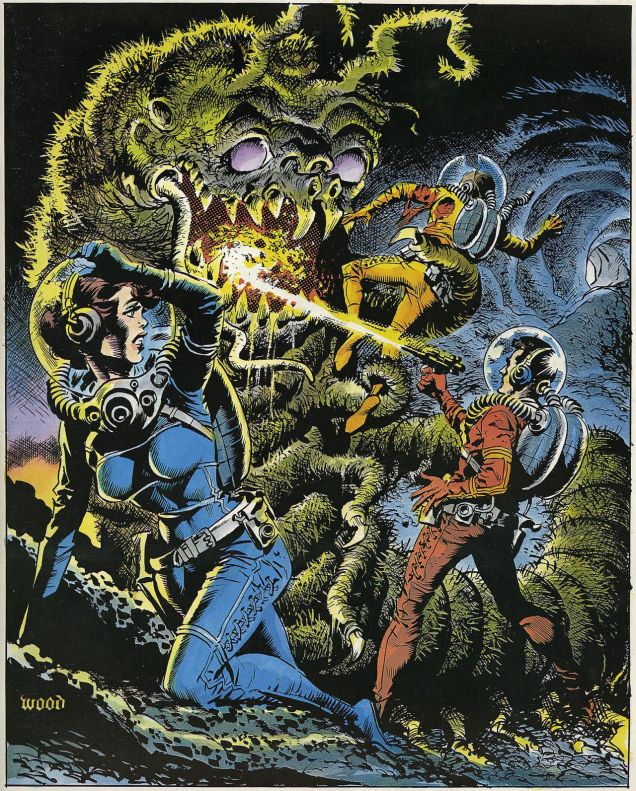
If your little heart desires babes with form-fitting clothing (or wearing nought but their birthday suits) and tentacled monsters with sad, expressive eyes, look no further than Wallace Allan Wood (1927-1981). Famously advising fellow cartoonists to “never draw anything you can copy, never copy anything you can trace, never trace anything you can cut out and paste up”, he would return to the beloved theme of buxom girl + tentacles again and again.
Without further ado, let’s take a gander at some of Wally Wood’s tentacled offerings.
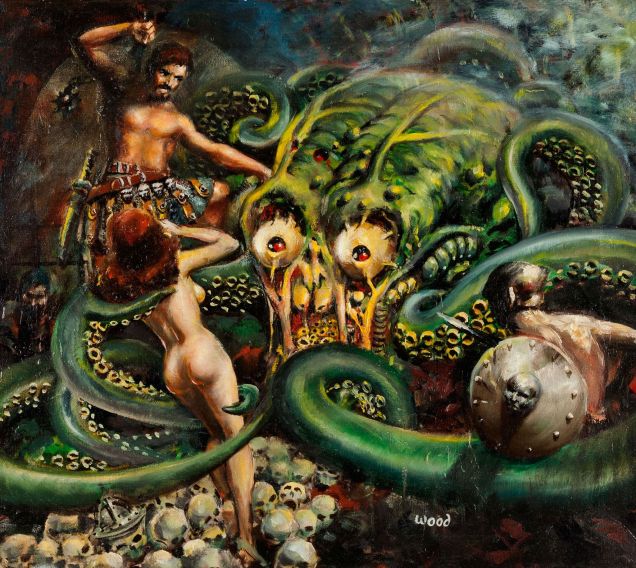
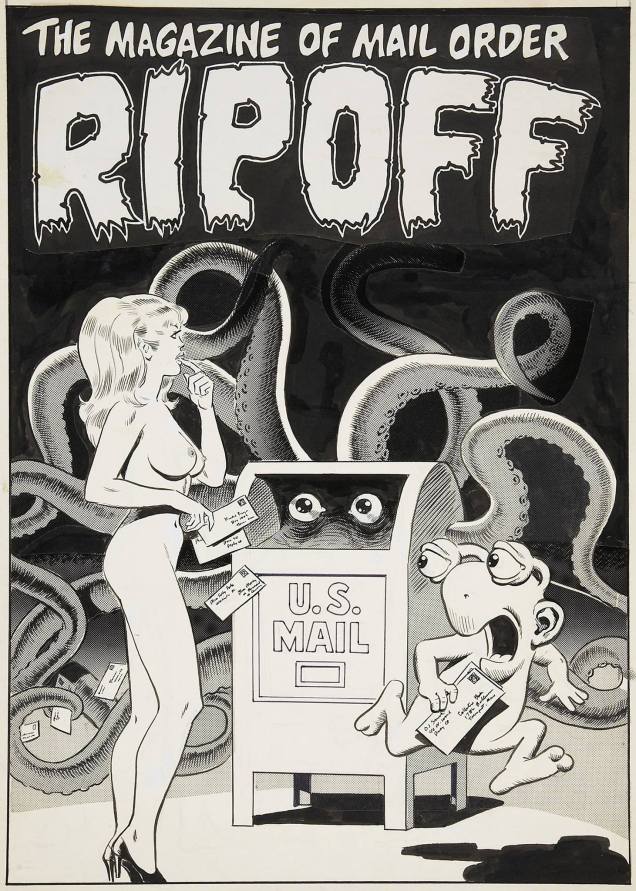
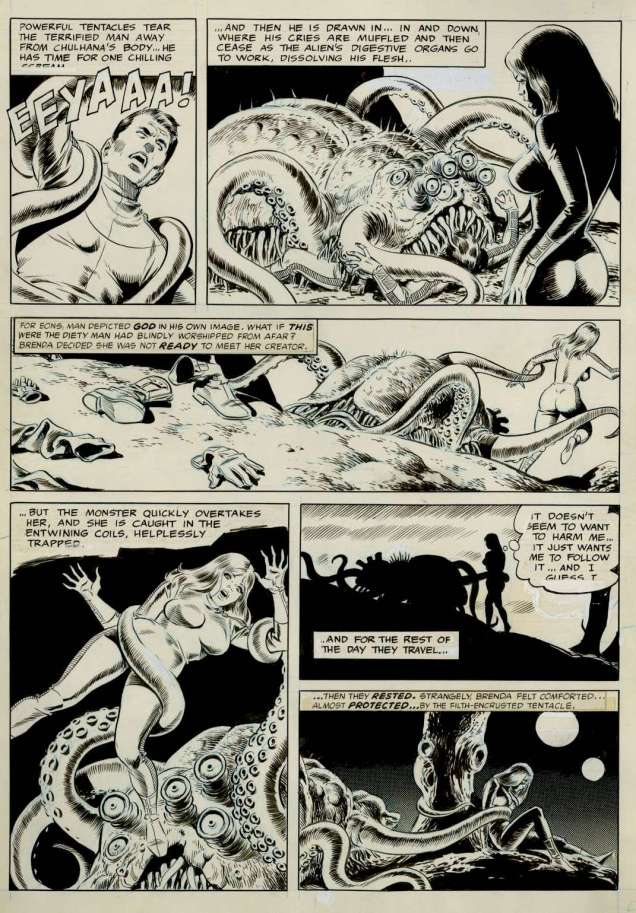
This opulent, splendi-tentacular painting has been spawned by Wally Wood in 1954. It’s called Dweller in the Dungeon, and was originally presented as a gift to EC publisher Bill Gaines. I don’t know about you, but I’m rooting for the cephalopod, who has unquestionably good taste in women.The cover Wally Wood drew for a mail order catalog (to be more precise, The Magazine of Mail Order Collector’s Press Newsletter no. 16, 1979. Phew, that’s a mouthful.)Original art from The Man Hunters (published in Eerie no. 60, 1974 – you can see this issue’s cover in our previous post.)
This theme is returned to again several years later:
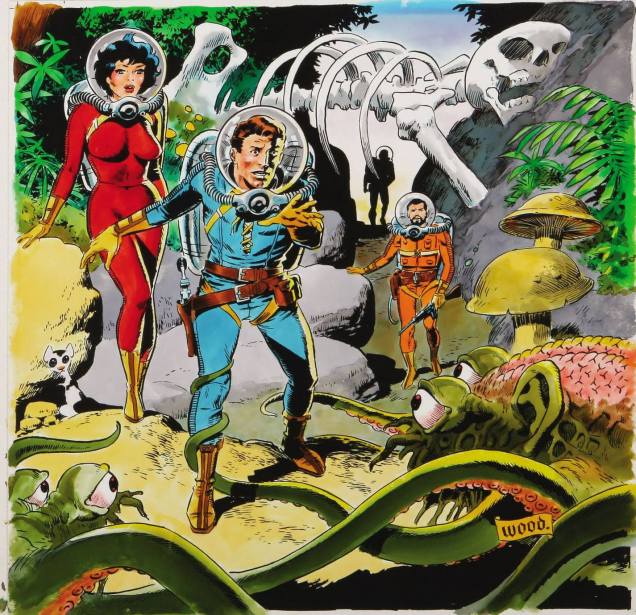
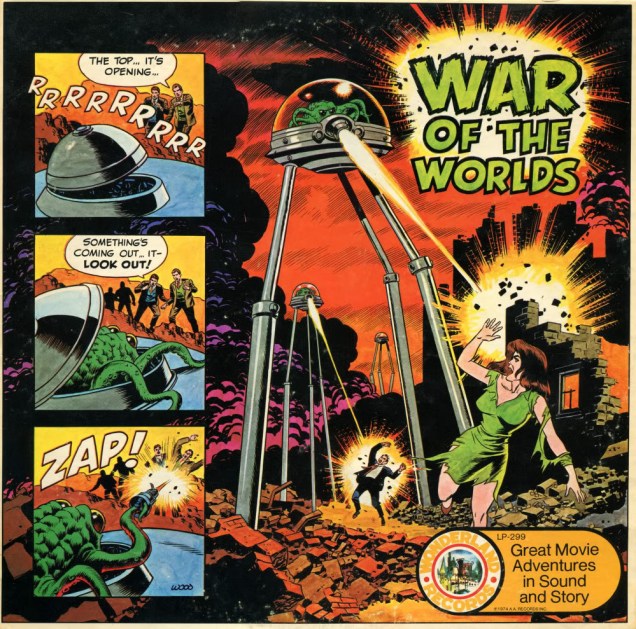
It may have reflected Wood’s mental turmoil, but his tentacled monsters have pleading eyes that just beckon to the viewer. Maybe it’s a form of hypnotism. You’re grabbing the wrong human, buddy! Go for the girl! This Wally Wood painting was used as the cover of The Comic Book Price Guide no. 9 (1979).Wood cover art for an LP (Bell Records, 1965). Here the green-brain-with-tentacles is almost unbearably cute.
There’s also this poignant scene…
Cover for EC Portfolio no. 5, 1974.
Wally Wood was a tremendous influence on artists who came after, and there’s a myriad of parodies, imitations, and derivations of his style… But I’ll wrap up this post with one well-executed hommage that fits in well with the theme, I think.
World of Wood no. 1 (Eclipse, April 1986). Cover by Dave Stevens.
Today’s Tentacle Tuesday honours Filipino artists who laboured in the comics industry in the 70s. To quote from Power of Comics: Filipino Artists (read the essay here),
« The Filipino talent began to arrive in 1970, when immigrant Tony DeZuñiga began to work for National Comics. DeZuñiga began with assignments on various romance, horror, western, and war anthologies—a combination that many Filipino artists coming after him would also follow—but he made a lasting mark when he co-created Western anti-hero Jonah Hex in All-Star Western #10 (1972). By then, DeZuñiga had convinced then National Comics publisher Carmine Infantino that other talented artists were awaiting discovery back in his nation of origin. With a stable of graying veterans working for him, Infantino was faced with a paucity of new talent in the early 1970s and had trouble finding gifted artists who could work for what the going page rate in American comics would pay at the time. DeZuñiga accompanied Infantino on a recruiting trip to the Philippines in 1971.
As noted, first among the Filipino artists to make a move were Redondo and Alcala. Among his works, Redondo turned in a memorable run on Swamp Thing, and the prolific Alcala picked up a considerable fan following for his work on series like Batman and Arak. Other Filipinos followed. Alex Niño brought a distinct style to Warren Publishing’s 1984 and 1994 series. Ernie Chan’s talent for composition led to his becoming National’s principal cover artist between 1975 and 1977. Gerry Talaoc enjoyed an extended run on The Unknown Soldier. »
Without further ado, let’s have a look at some of the tentacles the artists mentioned above have dreamed up. In no particular order…
I like the styles of all the artists mentioned in this post, but a couple of these names will make me do a little dance of joy when I encounter their art. Alfredo Alcala (b. 1925, d. 2000) is a definite favourite. He could draw anything he wanted, convincingly… at an amazing speed, and with the sort of detail that other artists would kill for.
Alcala drew for all genres in the early portion of his career, and developed the speed and work ethic for which he later become known amongst his fellow professionals. His fastest page rate was 12 pages in a nine-hour sitting, while in one 96-hour marathon he produced 18 pages, three wrap-around covers and several color guides. During the portion of his career where he worked solely for Filipino publishers, Alcala worked without assistants and did his own inking and lettering. “I somehow always felt that the minute you let someone else have a hand in your work, no matter what, it’s not you anymore. It’s like riding a bicycle built for two…” (source)
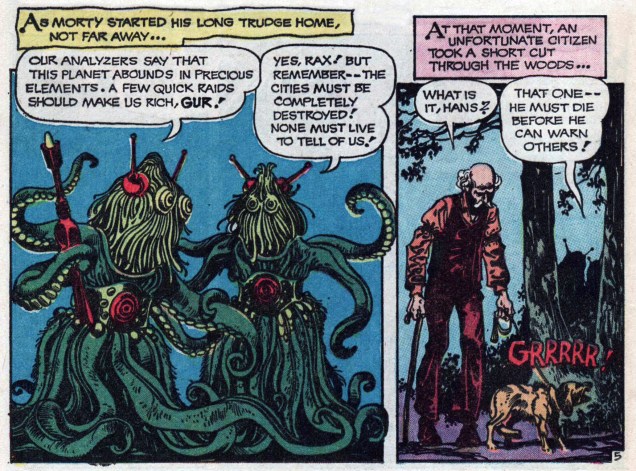
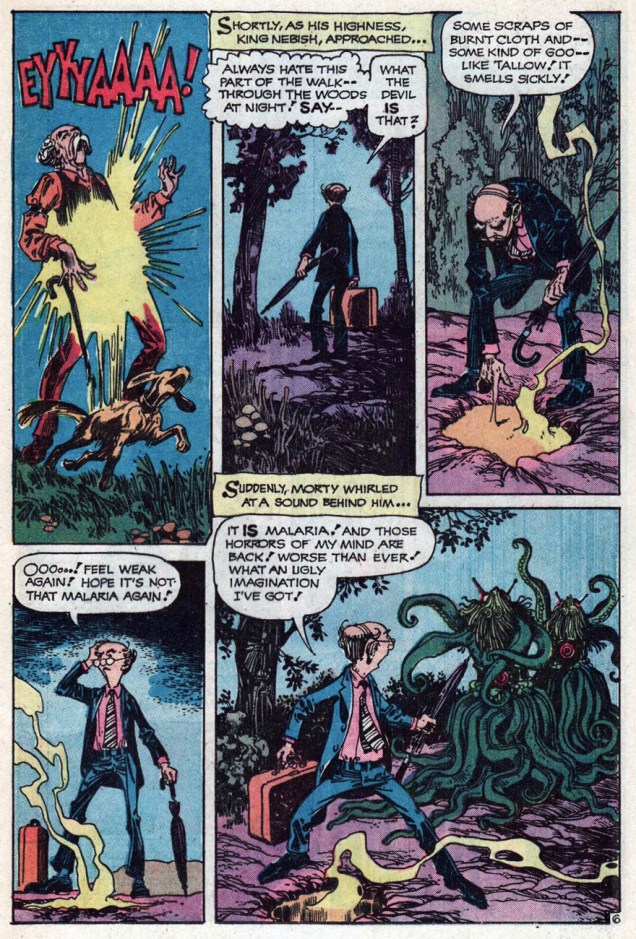
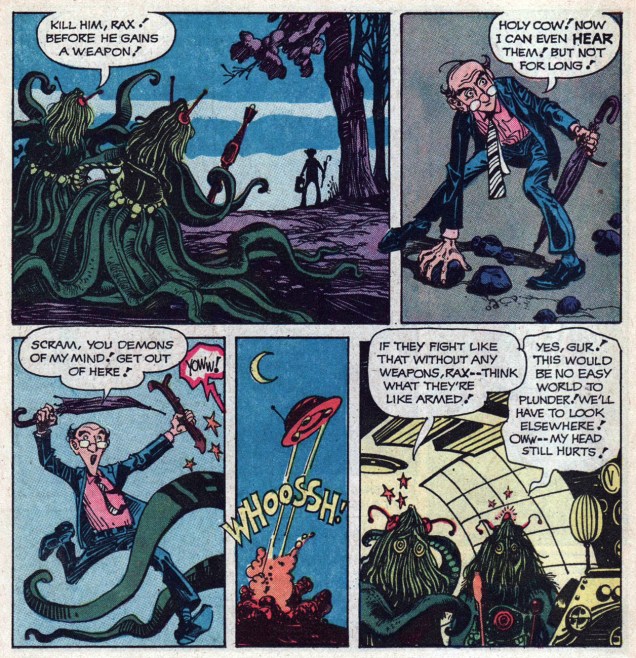
Here’s a gorgeous sequence from « The Night of the Nebish! », scripted by Arnold Drake and illustrated by Alfredo Alcala, published in House of Secrets #107 (April 1973).
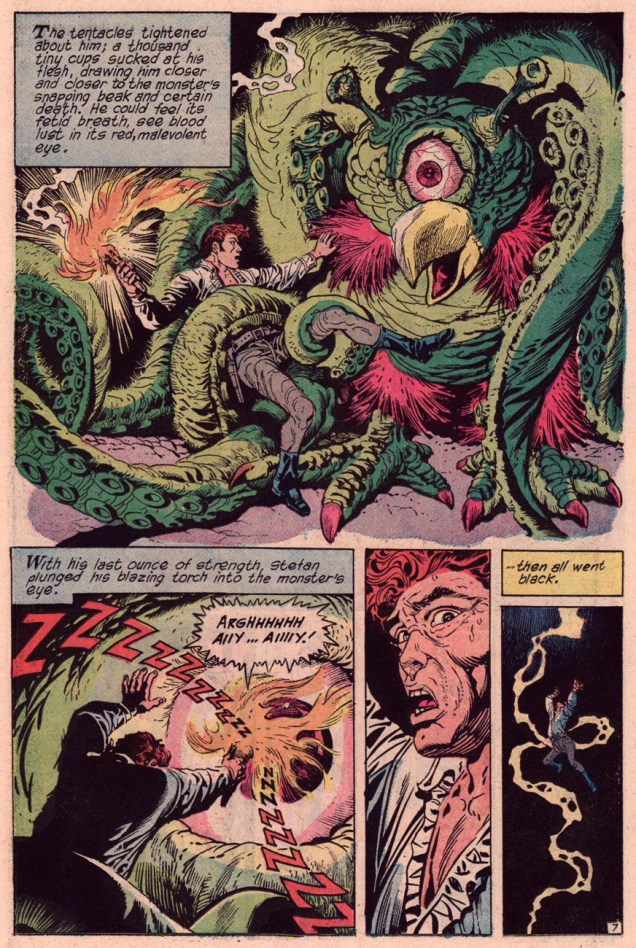
Ruben Yandoc (also known as Rubeny, 1927-1992) isn’t nearly as well-known as Alcala, yet he has a beautiful, half-decorative, half-sketchy style. He excelled at horror stories (published in DC’s Witching Hour, House of Mystery, Ghosts, House of Secrets..), and was a master at creating mood. His perfect grasp of architecture and anatomy enabled him to draw believable characters in incredible settings – none of this “figures floating about aimlessly” shit that you sometimes get from artists who can’t imbue their objects and subjects with mass. When Stefan gets grabbed by tentacles, you can feel their weight on his torso and feel the heat and painful brightness of the torch he’s holding, dammit!
« The Monster of Death Island », plotted by Maxene Fabe and illustrated by Ruben Yandoc. Published in Secrets of Sinister House no. 11 (April 1973).
Alex Niño’s art doesn’t give me butterflies. His stuff is quite weird, sometimes far too detailed, but his talent is nevertheless undeniable. For a good appreciation of his style (and more examples of it), go to this entry from Wizard’s Keep. As for me, I’ll limit myself to this humble, one-panel mass of tentacles, eyes, teeth, spikes, and god knows what else.
“Something on me”, indeed! A panel from « Evil Power », plotted by Jack Oleck and illustrated by Alex Niño from Weird Mystery Tales no. 9 (December 1973-January 1974). Niño was born in 1940, which makes him 78. He’s officially retired, but still holds art classes and takes commissions, as well as making the occasional appearance at conventions.
Redondo’s “memorable run on Swamp Thing” was mentioned at the beginning of this post. Well, we’ve already featured the tentacled robot who tries to finish Alec Holland off here, but rest assured – there’s more tentacles than just that in the career of Nestor Purugganan Redondo (1928-1995)! For example, this:
Original art for “Monsters From a Thousand Fathoms”, published in The Unexpected no. 185 (May-June 1978). You’ll note the art is attributed to the “Redondo Studio”; Nestor and his brother, Frank, often collaborated under that name.
By the way, he’s most assuredly another favourite in this household. His women are believably sexy, his monsters inventive and scary, his animals pitch-perfect… His style is realistic but lush, his nature almost prettier than in real life. And I like him much, much better than Bernie Wrightson, as far as Swamp Thing is concerned 😉
A perfect fit for any Tentacle Tuesday, here’s the requisite damsel-in-distress-with-tentacles:
Wench & Co. Book 1, a collection of drawings – of mostly naked women, what else? – by Ernesto Chan (1940-2012), born and sometimes credited as Ernie Chua. Published by Big Wow, 2005. Sadly, we will never get a Book 2.
We shouldn’t forget Tony DeZuñiga (1932-2012), who after all started all this. Among other accomplishments, he co-created Jonah Hex and Black Orchid, two pretty damn cool characters.
Page from “Home is the Sailor”, plotted by Len Wein and illustrated by Tony DeZuñiga, published in The Phantom Stranger no. 18 (March-April 1972).
I hope you enjoyed this (non-exhaustive) romp through Filipino-American tentacles! As historian Chris Knowles (1999) has noted about Filipino artists, « Here was a group of immensely talented and hard-working draftsmen who could draw absolutely anything and draw it well. They set a standard that the younger artists would have to live up to and that the older ones would have to compete with. » Amen to that!
Welcome to the entertaining world of science-fiction/fantasy of the 60s! If you’re an admirer of extravagant creatures with improbable anatomy, or a fan of twisted stories that take questionable leaps of logic to arrive to an implausible conclusion, willkommen.
However, if, like me, you tend to root for strange creatures (most of which didn’t want to be discovered in the first place), tread gently. If there’s one pattern in House of Mystery stories, it’s that the “monsters” (that fly in from space/emerge from the sea/crawl out of the depths of the earth/are born in fire/whatever else we can think of) get slain, more often than not, by well-meaning people… or not-so-well-meaning people who are afraid of anything that looks different. If they somehow manage to escape getting shot or bombed out of existence, they’re buried under a convenient avalanche or volcanic eruption.
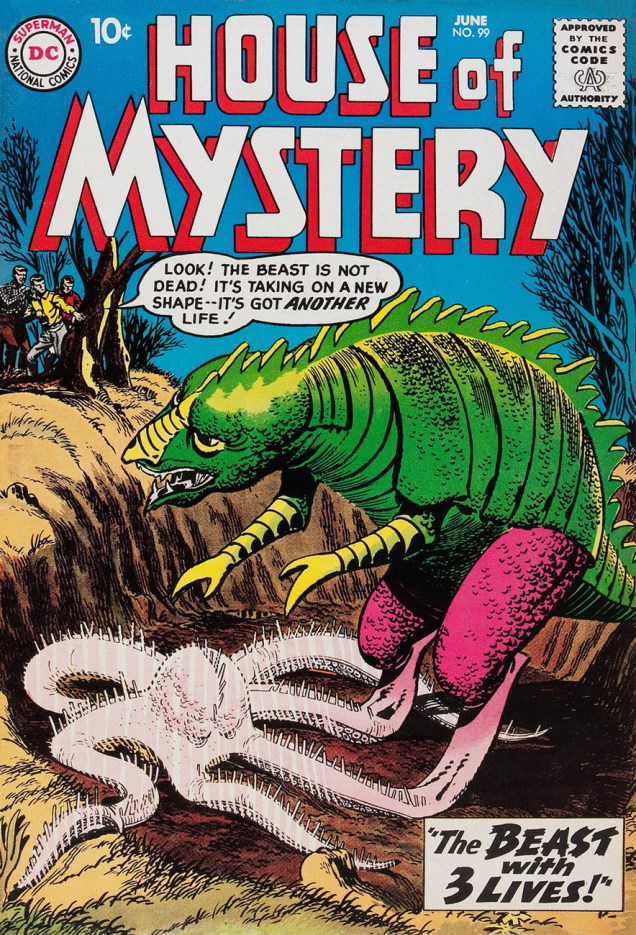
House of Mystery no. 99, June 1960. Art by Bernard Baily. Yep, the Beast gets killed by the military. It’s sad to think that our reaction to a friendly shape-shifting alien would be “kill first, ask questions later”… but it sadly rings true.
I know that it’s Tentacle Tuesday and everything’s possible, but… this? An octopus with spines on his tentacles (very conveniently placed, I might add) and the puffy eyes of a career alcoholic? A parrot-dragon with opposable thumbs?
House of Mystery no. 113 (1961), pencils by Dick Dillin, inks by Sheldon Moldoff and letters by Ira Schnapp. Err, guys… I don’t think either of these two monsters is all that interested in you, seeing as they both seem to be screaming in horror/pain. If the octopus is Water-Beast, the parrot must be Land-Beast – such wit! I would have gone with “pink thing” and “green bird thing”.
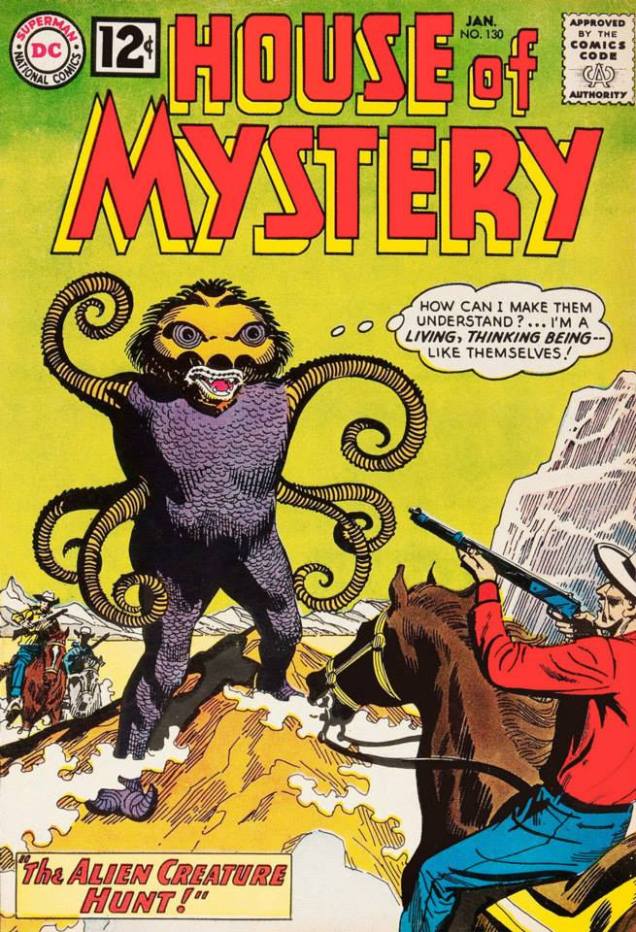
As Tentacle Tuesday continues, we are once again confronted with a situation where misunderstanding between species leads to needless conflict. Shoot first, sort it out later, is the mantra of any red-blooded man! I’m sorry, am I being a tad unsubtle?
House of Mystery no. 130, January 1963. Cover by George Roussos.
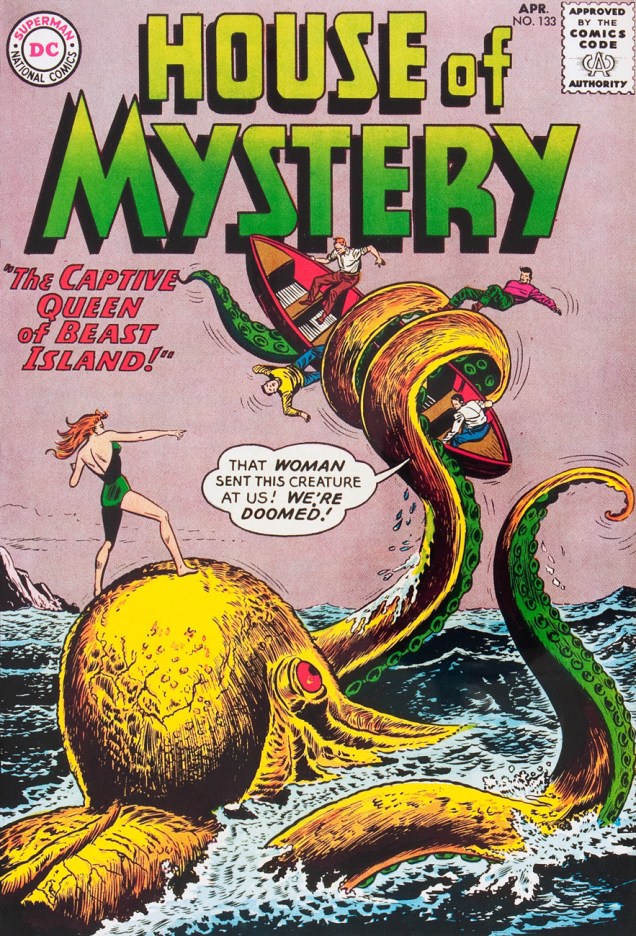
Some guys land on an island patrolled by creatures controlled by a beautiful woman. Well, there’s no need to quarrel, they can talk it out, right?
House of Mystery no. 133, April 1963. Pencils by Dick Dillin, inks by Sheldon Moldoff, letters by Ira Schnapp.
Okay, the woman seems to be friendly. So far, so good.
Art by Howard Sherman.
So perhaps everyone can go on their merry way and leave the island and its creatures alone? No, it’s not enough to just kill them. Oops! The whole fucking island explodes to smithereens when the guys detonate some explosives in a cavern and thus trigger an underwater eruption. I mean, the real threat to these “nice” people was the evil guy trying to gain control of the beasts, but do they try to attack *him*? Nah, they focus on killing the octopus, instead! And the giant armadillo! And the furry rhinoceros!
« And soon, Beast Island sinks beneath boiling, steaming waters… », the omniscient narrator tells us. « The island is gone now – and so are the terrible things that walked on it, flew over it — and swam around it! » The power-grabbing asshole is okay, though – he escaped just fine!
There’s plenty more tentacles in House of Mystery – to which we will no doubt return.
Today’s Tentacle Tuesday is home to that conventional, oft-seen beast, the comic strip. Without getting into the complexities of defining this term, I use “comic strip” here to refer specifically to the (syndicated) newspaper comic strip, although by now the newer ones may have never seen print in a newspaper, only online.
There’s one that doesn’t need an introduction. Go visit his website, though!
Most of these are available for perusal on one of the comics-clustering websites, such as gocomics.com, or sometimes directly on a strip’s own website (in which case it also becomes a webcomic strip, I guess). I’ve provided the links in the description.
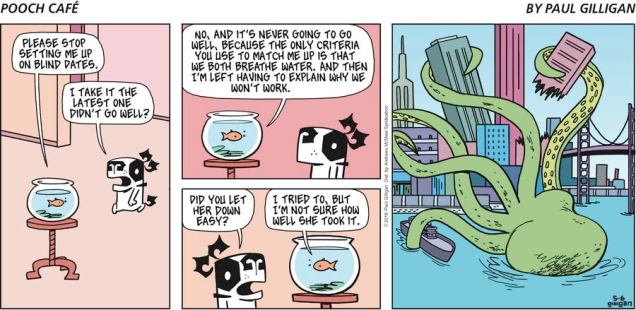
Overboard by Chip Dunham, July 3rd, 2010. Overboard’s been around for almost 30 years.Brevity, March 27th, 2011. This strip was created by by Guy Endore-Kaiser and Rodd Perry, and for the first couple of years (it’s been around since 2005), it was plotted and drawn by them. Dan Thompson took over at some point… around 2012 or something like it (I can’t find any hard and fast information online). The strip has a home here, but frankly it’s not really worth visiting (terrible art, dumb jokes).Once again, Poncho gets his fishy friend into trouble. Pooch Café, May 6th, 2018. I hate Poncho and think his owners should have kicked him out a long time ago, but there’s enough characters and surreal situations to tolerate his presence in this fun strip.Sherman’s Lagoon by Jim Toomey, 20th April 2016, also around for almost thirty years (it made its debut in 1991).Not to forget our classics! One of the nice things about Calvin and Hobbes is that it was never ghost-written – when Bill Watterson quit it in 1995, that was it. However, you can catch re-runs in many places, for instance here.Liō (not forgetting the accent!) by Mark Tatulli and distributed by the Universal Press Syndicate since 2006. This is the first appearance of Ishmael, Liō’s cephalopod best friend. Tatulli says that he at first wanted to make Ishmael into a mother figure for motherless Liō, but that’s not the way things worked out.Liō routinely encounters tentacles, so it would be a long list indeed, but here’s another favourite. Both strips were plucked from the collection Liō’s Astonishing Tales: From the Haunted Crypt of Unknown Horrors, 2009.
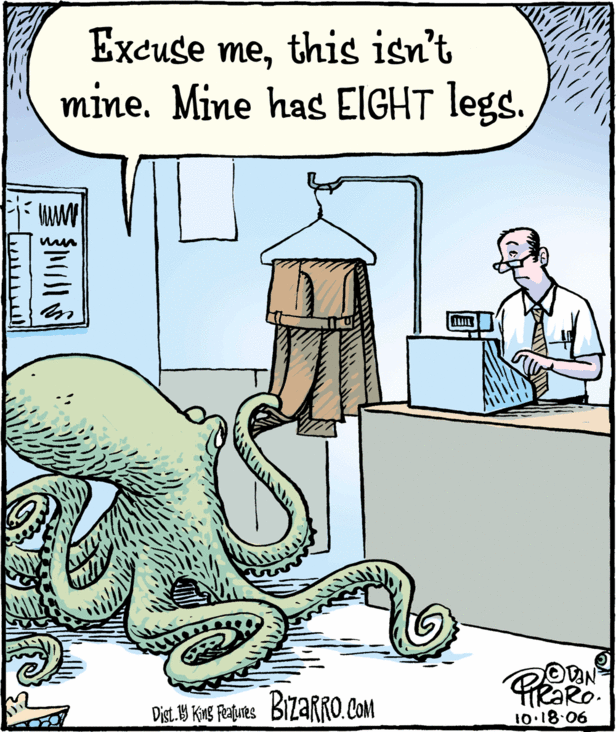
We started on a Bizarro note, so let’s wrap things up with another.
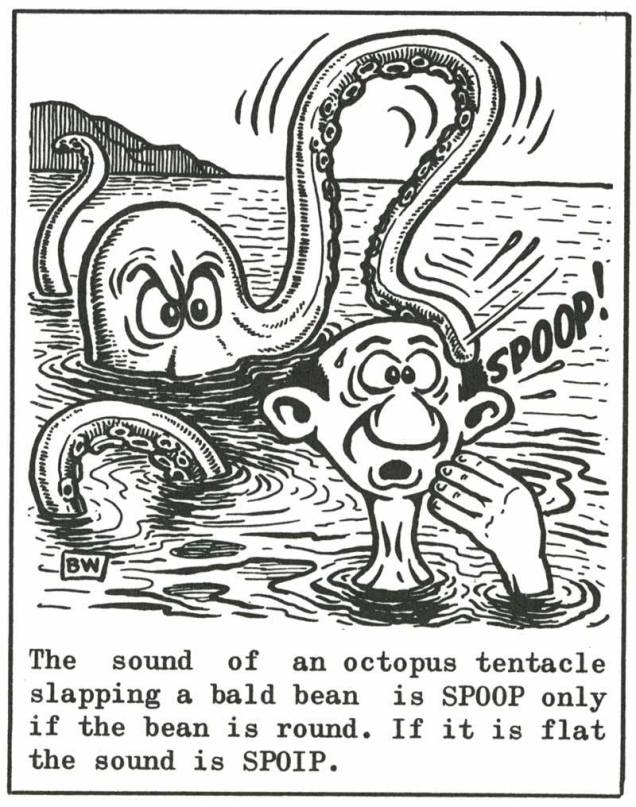
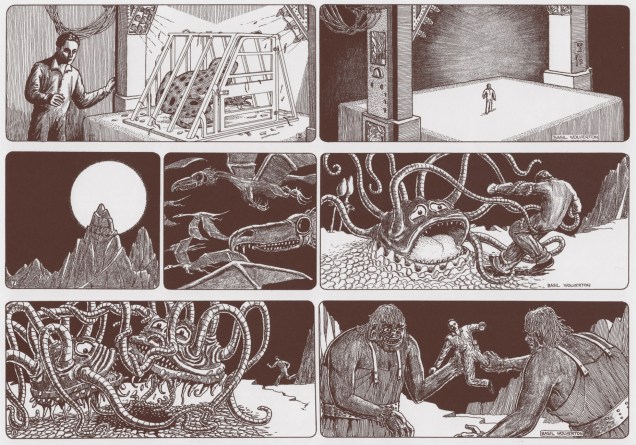
SPOOP! And a happy Tentacle Tuesday to you, too. Today’s feature is devoted to Basil Wolverton. A lot could be said about his sense of semi-slapstick, semi-surreal comedy and his unhinged-yet-meticulous drawing style, his delightful work in the realm of humour comics or his genuinely scary contribution to horror-in-pictures… but as I have a one-track mind, I’ll focus on his love of tentacles. No matter what sort of thing he was drawing, tentacles somehow managed to slip into it… and that’s understandable, for tentacles are both hilarious and fearsome. Without further ado, here’s your master of ceremonies and cephalopods… Basil Wolverton!
Here’s some more sounds you might like to know about, to be used indiscriminately to spice up humdrum conversations around the water cooler:
Hungry cannibal filing eyetooth: FWATCH! Man with calloused feet crossing rough linoleum: SKIRP! SKIRP! Thumb gouging eye: SPOP! Hot lava speweing on WCTU convention: FOOSK! Hot lava spewing on Elks’ convention: SSSCRISH! Person skidding on hot stove in bare feet: SCREESH! Beaver biting into wooden leg: CRASP! Car crashing into large vat of frogs’ eggs: SKWORP! False teeth falling through skylight: TWUNK! Sock in the face with Sears Roebuck catalog: PWOSH! Sock in the face with Montgomery Ward catalog: PWASH!
This mirth-inducing stuff is from an article that Basil Wolverton wrote for the Daily Oregon in 1948 called “Acoustics in Comics”. Here’s another excerpt of that article (which is definitely worth reading in its entirety, and is fortunately easily found online… here, for instance):
« ‘I want realism!’ he (my publisher) had bellowed. ‘No more of this wild imaginative stuff that’s causing some people to want to ban our comic books! From now on, get that realism in there, and your strips will be horribly funny! Then the readers will go into hysterics and laugh like crazy, and our books will be acclaimed the most laugh provoking on the stands!’ That meant that an imaginative word like CRANCH was taboo. It was up to me to get the real sound word. »
And, hoppin’ horse hocks, he did.
Enough of the rib-splitting stuff: this is a serious blog that discusses serious horror. *ahem*
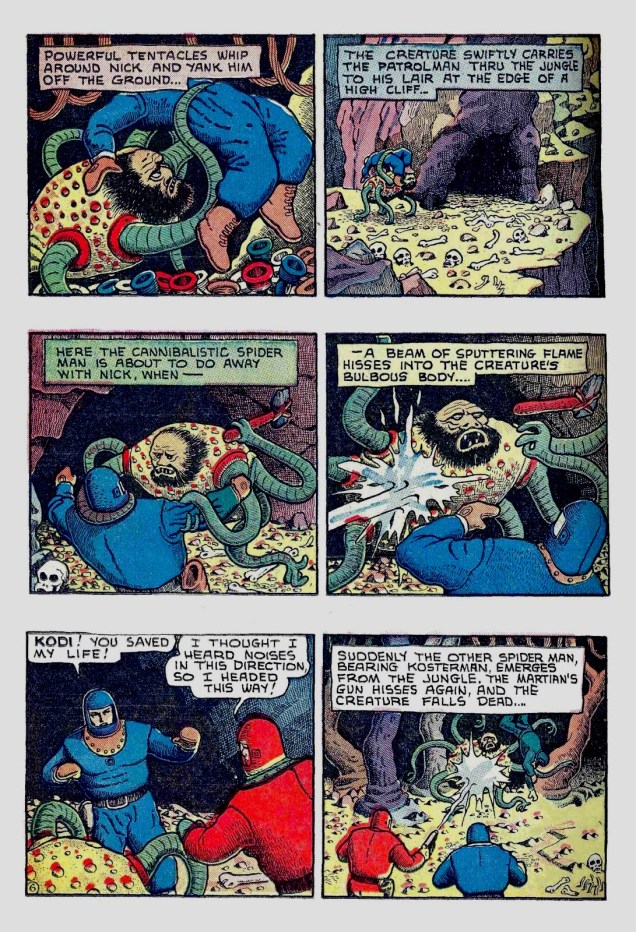
Page from Ethan Downing (1935), an early endeavour by Wolverton – unpublished.Amazing Mystery Funnies vol. 2 no. 12, December 1939. You may with to point out that this bandit is a cannibalistic spider, *not* a tentacled creature, but look at how he’s using his appendages, look me straight in the eye, and tell me that those aren’t tentacles. Besides, spiders have 8 legs, not 6, and this guy is definitely a 6-leg wonder… and they get called « tentacles », right from panel one.
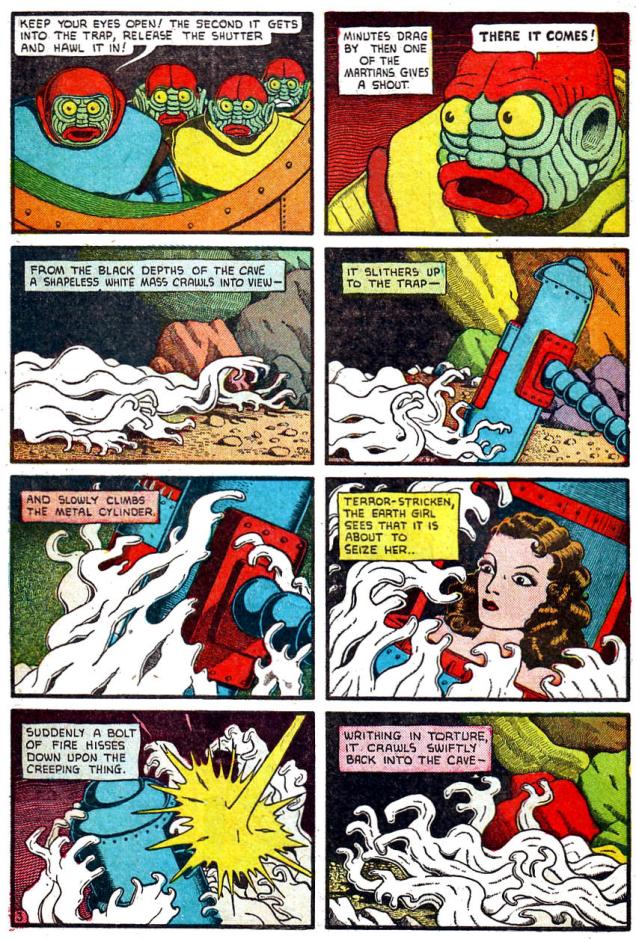
No inventory of Wolverton tentacles would be complete without the classic « Creeping Death from Neptune », first published in Target Comics vol. 1 no. 5 (June 1940), and reprinted many a time since, nearly as often the amazing Brain Bats of Venus (also quite heavy in quasi-tentacles. If aren’t familiar with it already, do yourself a favour and read it in full here.)
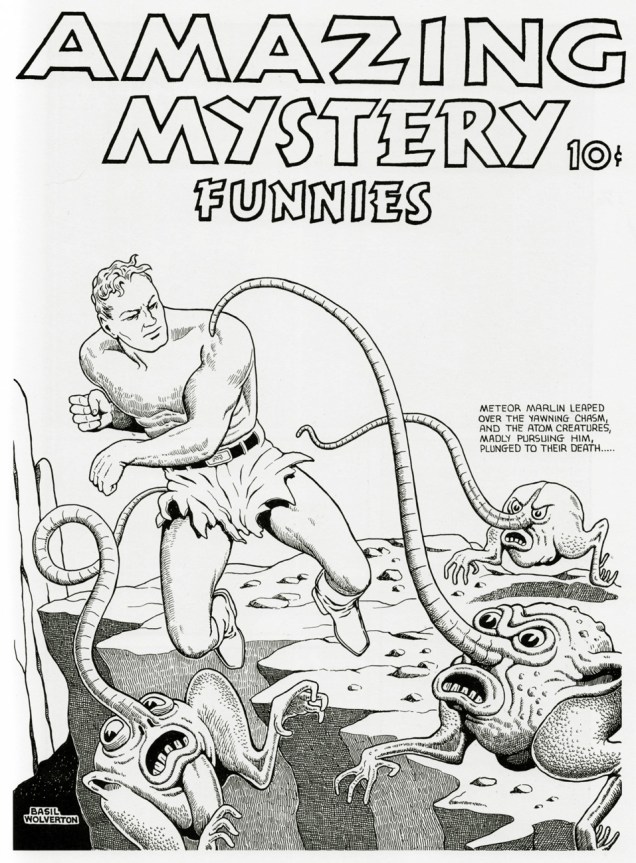
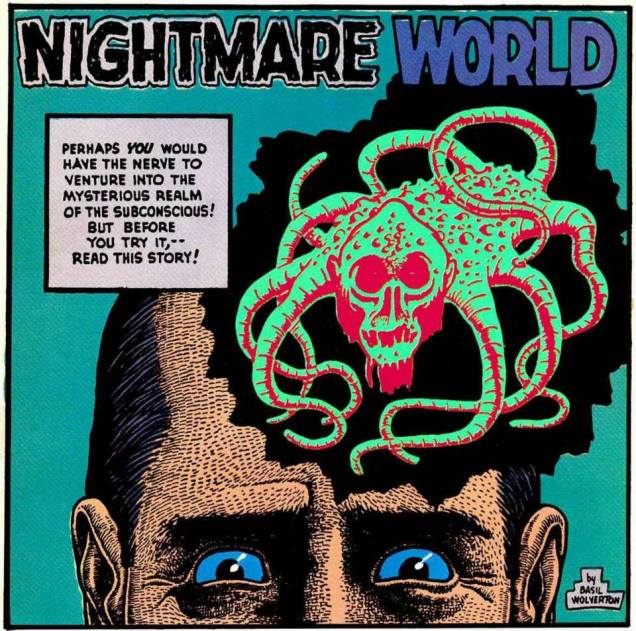
A page from Creeping Death from Neptune, first published in Target Comics vol. 1 no. 5 (June 1940). The earth-girl is interestingly deadpan about being consumed alive by some sort of slithering weirdness.This story also has « tentacle-like » metal arms. I’m telling you, pretty much everything’s a tentacle where Wolverton is concerned.Meteor Marlin, cover illustration for episode one, April 4th, 1940… never published. In this one, noses are tentacles!A panel from Nightmare World by Basil Wolverton that originally appeared in Weird Tales of the Future no. 3, 1952. This is a reprint from Mr. Monster’s Super Duper Special no. 8, 1987, re-coloured by Jeff Bonivert.
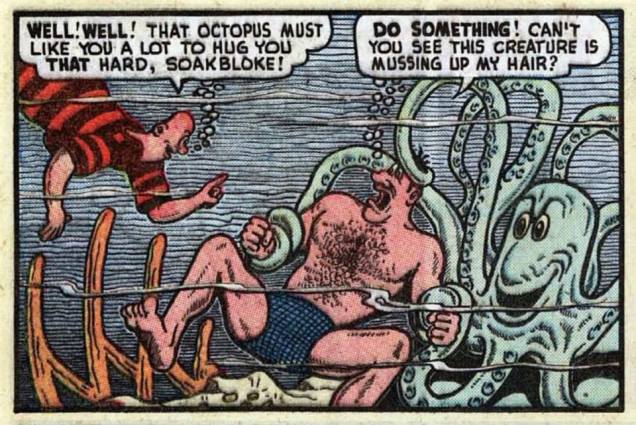
Phew! I’ll end this on a humorous note: octopuses evidently make fabulous hairdressers.
This is a panel from a Powerhouse Pepper story that doesn’t really have a title, being referred to as “Haw! Haw! Grab a good gander…” instead. Originally published in Tessie the Typist Comics no. 9, April 1947.
Sadly, Wolverton’s weirdly frightening villains did not always find favour with the powers-that-be. Back in 1940, Jim Fitzsimmons, assistant editor at Centaur, publisher of Amazing Mystery Funnies, wrote:
« Though the fantastic and weird are the essential selling point of this feature, we would advise that you keep away from the use of revolting characters such as Brain-Men. Some of these characters you have developed have actually sent shudders down my otherwise unconcerned vertebrae. »
Reading The Life and Comics of Basil Wolverton, Volume 1: 1909-1941 written by Greg Sadowski (2014, Fantagraphics), one gets the impression this brilliant master of spaghetti-and-meatballs* comics spent his artistic life trying to fit his imagination into the narrow guidelines imposed by editors, heads-of-companies and other pundits. He died in 1978, aged 69, but was active in the comics field until 1973 («Plop!») I’ll leave it for people more erudite than I to debate his success (or lack thereof) in the comics field…. I’m just happy to witness a resurgence of interest in this great artist, and enjoying the treasure-trove of material that’s available.




























 Who's Out There?