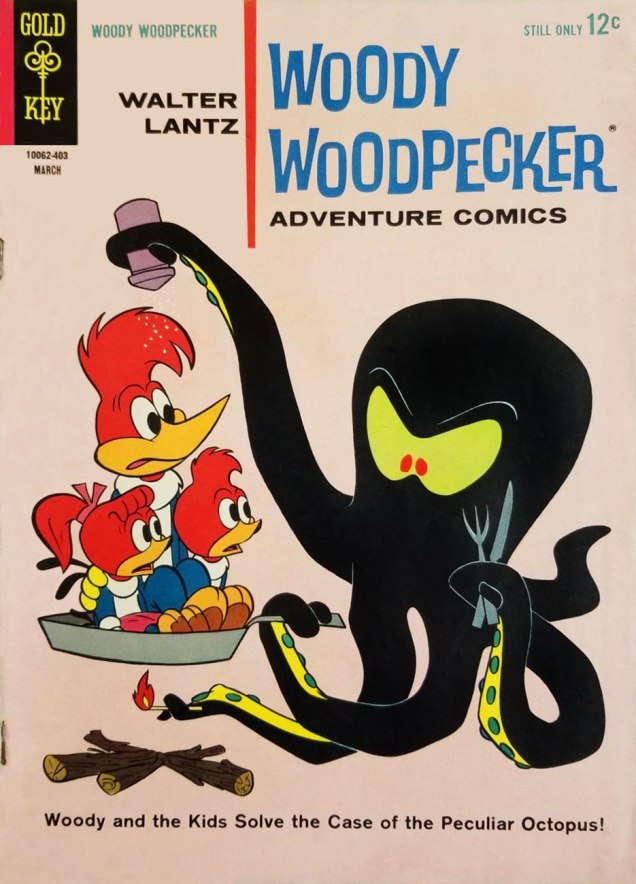
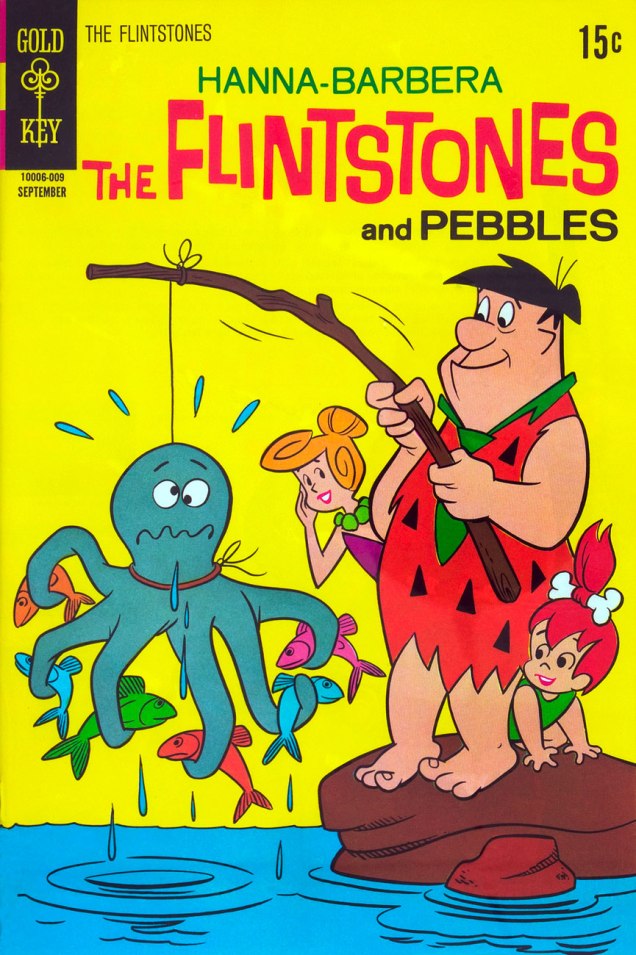
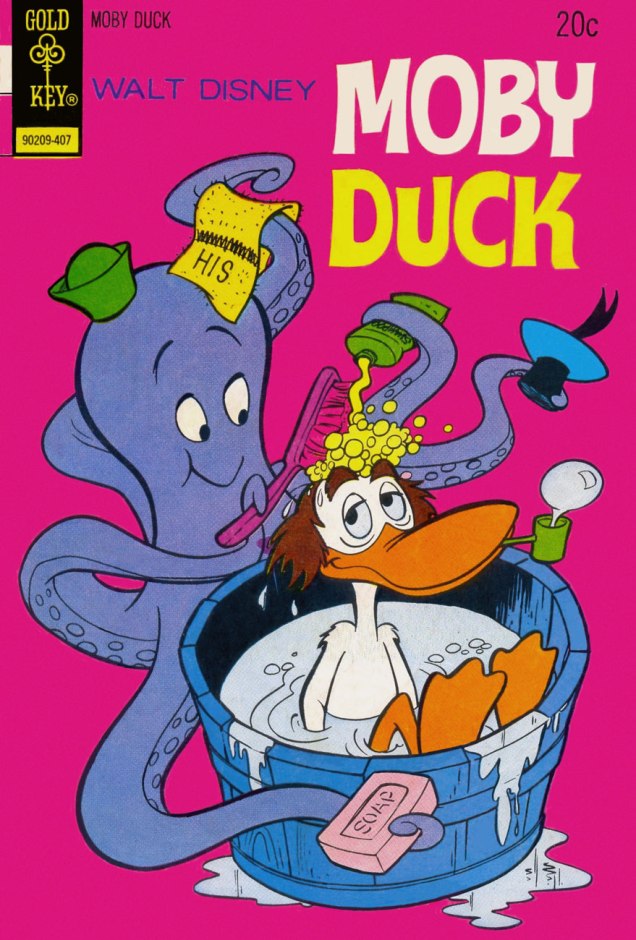
I’m on mini-vacation, away from all the big city violence, car noise and light pollution. One can actually see the stars out here! In honour of this mellow state of being, this Tentacle Tuesday is a friendly, gentle affair. It’s all about fishing and diving and, above all, chilling out with friends. (Sure, some folks almost get eaten, but it’s all in good fun.)
Oh, and my suggestion for summer reading (for people who are hard-pressed for time, but still want to impress others at the next cocktail party with their sparkling wit and erudition) is 20 Cool Octopus Facts.
Walter Lantz Woody Woodpecker no. 79 (March 1964), cover by Phil De Lara.The Flintstones no. 60 (September 1970).Tweety and Sylvester no. 28 (January 1973).Moby Duck no. 14 (July 1974). Pencils by Pete Alvarado, inks by Larry Mayer.Woodsy Owl no. 6 (February 1975). Pencils by Paul Norris, inks by Larry Mayer.Yosemite Sam no. 43 (April 1977).Yosemite Sam no. 67 (July 1980).
When you think of Aquaman, what is the first thing that comes to mind? Is he a brooding, tragic hero? A hapless sap whose prowess extends no further than throwing a starfish at his assailant? A talented swimmer, defender of Earth’s oceans?
« The image of the superhero riding on a chariot made of fish—sporting that classic orange top and green pants—sealed the depths-dweller in public memory as a doofy champion, despite defenders who insist there’s more to Aquaman than talking to fish and riding them places. While later depictions of the character emphasized his serious side, Aquaman jokes abounded especially in the 90s and 2000s—largely thanks to a school of young male animators, including Seth MacFarlane and South Park’s Matt Stone and Trey Parker, who couldn’t help but poke fun at Aquaman’s ineffectual reputation. »|source|
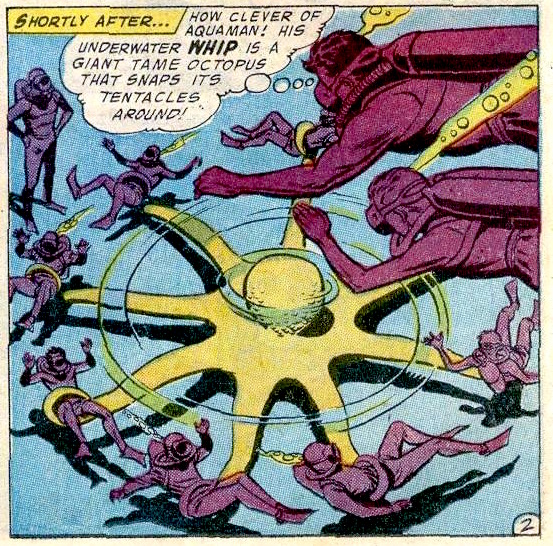
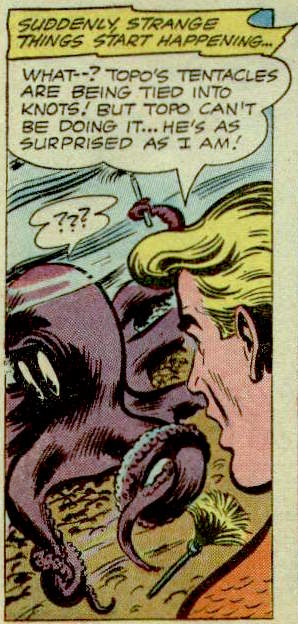
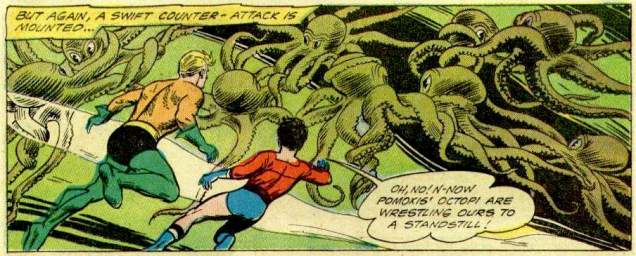
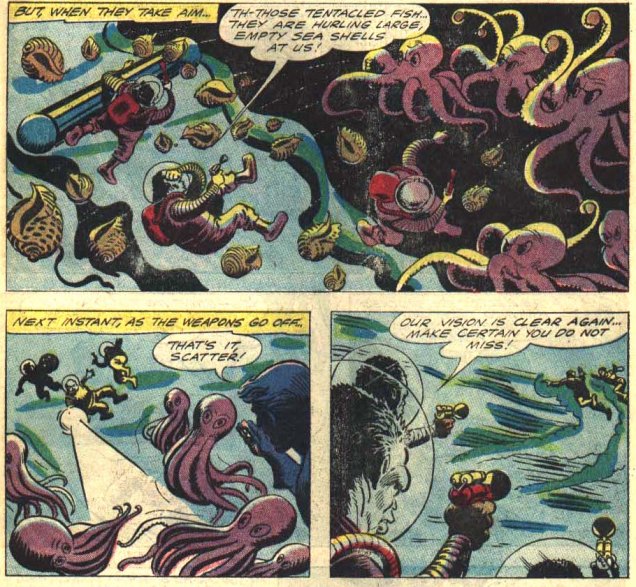
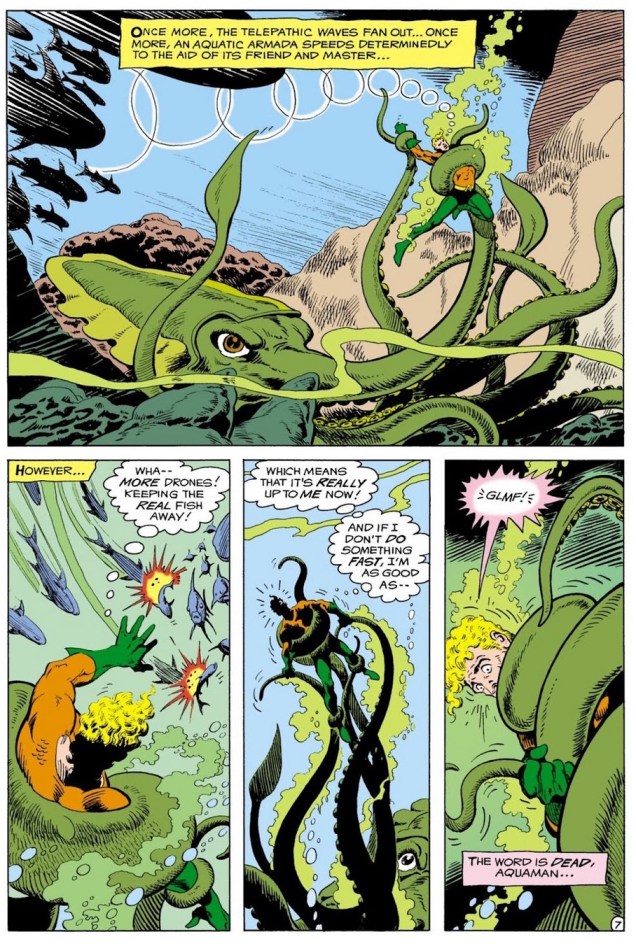
I believe the aforementioned Aquaman’s defenders are slightly missing the point. What’s wrong with catching a ride from a fish, or getting a helping hand from an octopus? In Aquaman’s world, octopuses play the role of indispensable helpers, using their tentacles as lassos, bludgeons and tourniquets, or forming acrobatic formations to give Aquaman a boost. Does this somehow make this superhero wimpy? Do we seriously still believe that treating animals with kindness, or collaborating with them, is emasculating? No wonder this world is going to hell in a handbasket. The audience for superhero comics sometimes seems to be quite devoid of imagination (or a sense of humour).
« Jokes about his wholesome, weak portrayal in Super Friends and perceived feeble powers and abilities […] led DC to attempt to make the character edgier or more powerful in comic books. Modern comic book depictions have attempted to reconcile these various aspects of his public perception, casting Aquaman as serious and brooding, saddled with an ill reputation, and struggling to find a true role and purpose beyond his public side as a deposed king and a fallen hero. » |source|
Okay, I’ve grumbled, and now I’ll move on to the tentacles. Take a seat astride your favourite jellyfish, strap in your fins, and let’s go!
Aquaman, the child of an undersea explorer who learned how to breathe and live underwater “by training and a hundred scientific secrets”, was created in 1941 by Paul Norris and Mort Weisinger. During the Golden Age of comics, he fought various evil guys (usually from water-related professions: sailors, marine biologists, pirates… and Axis villains, too). The whole thing started becoming really interesting (imho) in 1956 (coincidentally, with the advent of Silver Age), when Aquaman acquired his sidekick Topo the Octopus:
Topo’s first appearance! « Aquaman’s Undersea Partner », drawn by Ramona Fradon, published in Adventure Comics no. 229 (October 1956).
Ramona Fradon handled Aquaman from 1951 to 1959, when she became pregnant and had to temporarily withdraw from the comics field until 1963. She deserves a separate post, really, especially since I love her art. In the meantime, read The Woman Who Made Aquaman a Star. As for Topo, I don’t have to explain why I’m fond of the idea of an octopus sidekick.
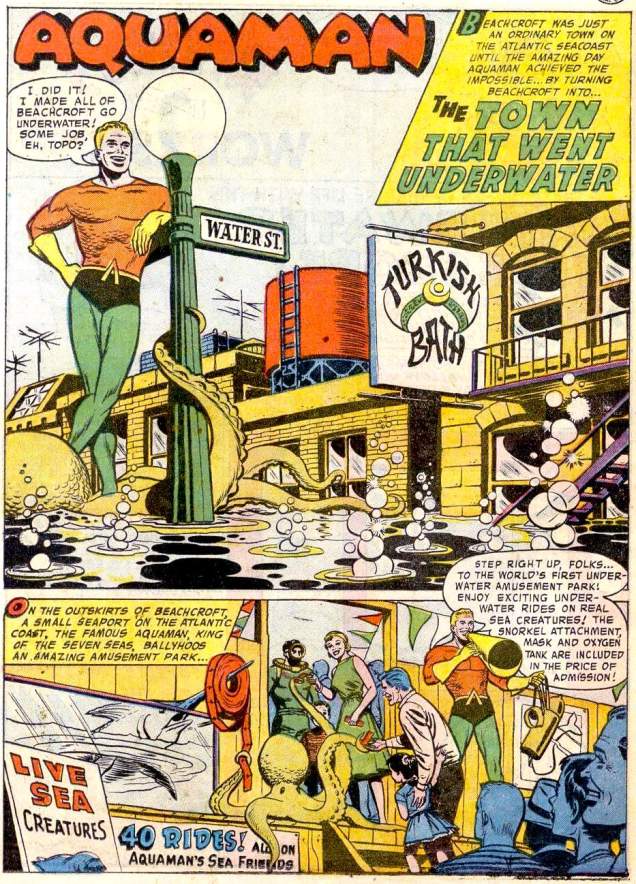
A few nice Fradon pages:
«The Town That Went Underwater», drawn by Ramona Fradon. It was published in Adventure Comics no. 246 (March 1958).Another panel from « The Town That Went Underwater ».A panel from « The Undersea Hospital! », scripted by Robert Bernstein and drawn by Ramona Fradon. This issue, Adventure Comics no. 262 (July 1959), has not one, but two fun animal stories: the other one – also lovable, imaginative nonsense – is « The Colossal Superdog », scripted by Otto Binder and drawn by George Papp.Another panel from « The Undersea Hospital! ». Don’t you love the idea of a seaweed stretcher with eel supports?
In 1961, Nick Cardy started working on Aquaman with Showcase no. 31 (March-April 1961). When the sea king got his own title in 1962, Cardy became the regular artist, drawing inside stories and covers until Aquaman no. 39 (May-June 1968), and staying as the cover artist until Aquaman no. 56 (April 1971).
« Cardy proved adept at drawing sea creatures; his fluid, swirling water currents helped create a captivating, eye-pleasing undersea world. He became a fan favorite, not only because of his superb story-telling ability, solid figure work and facile inking, but because of the way he rendered Mera, Aquaman’s girlfriend. Cardy’s women had curves, not angles, and seemed to exist in three dimensions on the two-dimensional page. He never stopped trying to elevate his work, until the later covers in the series were among the most striking and imaginative of the publisher’s entire line.» (source: Comics Journal’s eulogy for Nick Cardy)
Well, that’s high praise indeed, but is it deserved? I can confirm that Cardy covers were really inventive. As for the interior art, let’s take a peek, as these stories conveniently overflow with tentacles.
There’s tentacles getting tangled, the octopus equivalent on panties in a twist…
Panel from « The Invasion of the Fire Trolls », scripted by Jack Miller and drawn by Nick Cardy, published in Aquaman no. 1 (January-February 1962).Panel from « The Aquaman from Atlantis », scripted by Jack Miller and Nick Cardy, published in Aquaman no. 3 (May-June 1962).
An army of octopus fighters…
Page from « The Menace of Alien Island », scripted by Jack Miller and drawn by Nick Cardy, published in Aquaman no. 4 (July-August 1962).
I promised you acrobatics, so here are some octopuses doing a cheerleading routine (Aquaman forgot his pompoms at home):
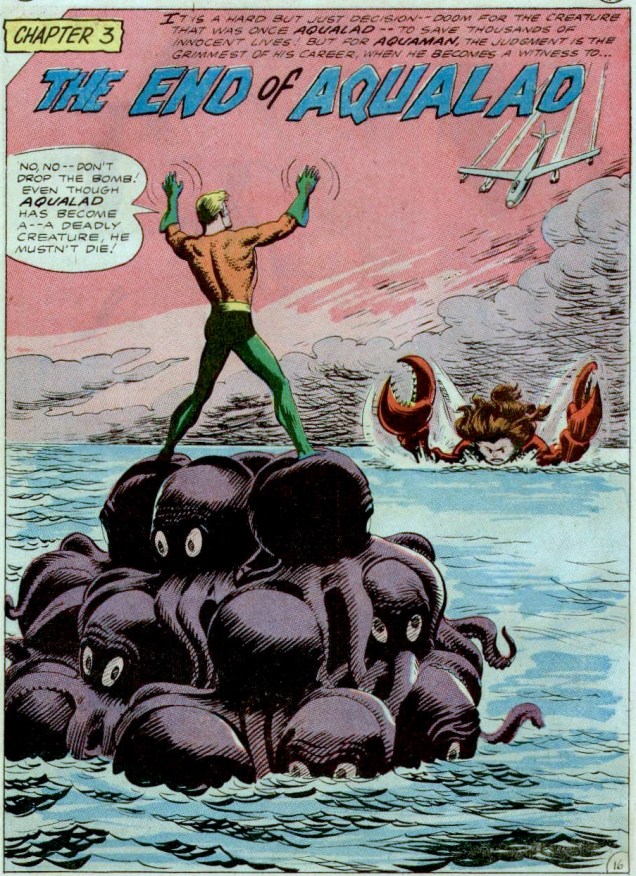
Aquaman no. 9 (May-June 1963). « The menace of the Aqualad-Creature » is scripted by Jack Miller and drawn by Nick Cardy.It’s not *all* octopus tentacles. Page from « The Secret Mission of King Neptune», scripted by Jack Miller and drawn by Nick Cardy, printed in Aquaman no. 9 (May-June 1963).
Continuing our tentacle shenanigans…
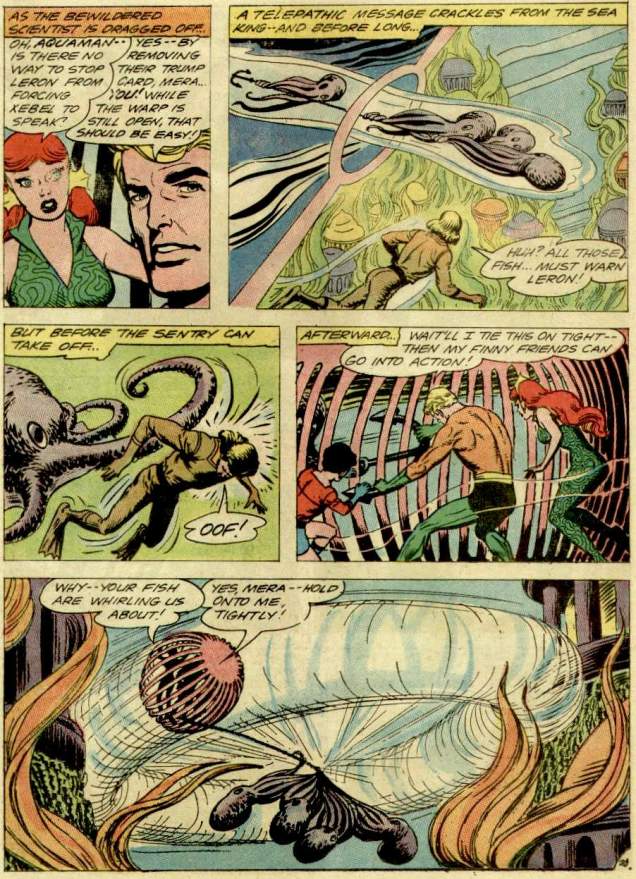
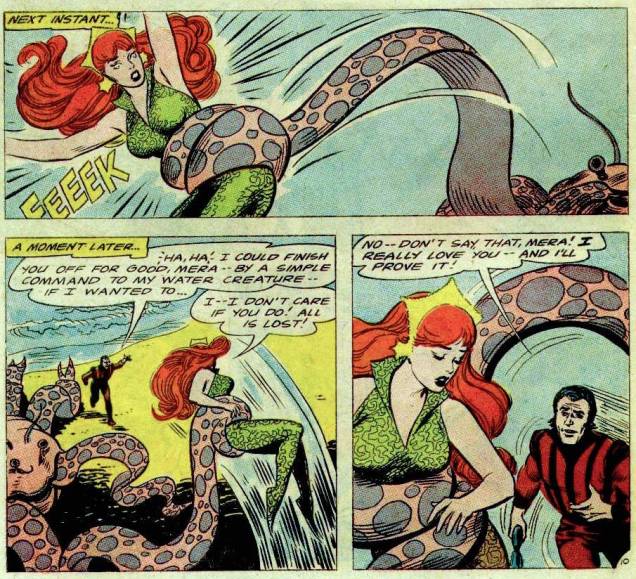
Any jerk who refers to an octopus as a “fish” deserves what’s coming to him. Page from « The Doom from Dimension Aqua », scripted by Jack Miller and drawn by Nick Cardy, published in Aquaman no. 11 (September-October 1963).As usual, mind fuckery rears its ugly head whenever romance is part of the plot. “I could kill you! But I really love you, actually!” An eye roll and a sigh. Panels from « The Wife of Aquaman », scripted by Jack Miller and drawn by Nick Cardy, published in Aquaman no. 18 (November-December 1964).Page from « The Wife of Aquaman », scripted by Jack Miller and drawn by Nick Cardy, published in Aquaman no. 18 (November-December 1964).
One of those Nick Cardy covers we were discussing earlier, so you can decide for yourself whether his women are all angles or all curves:
Aquaman no. 22 (July-August 1965), cover by Nick Cardy.« The Trap of the Sinister Sea Nymphs », published in Aquaman no. 22 (July-August 1965) art by Nick Cardy.
With Aquaman no. 40 (July-August 1968), Jim Aparo replaced Cardy on the inside art. Issues no. 40 to no. 47 (September-October 1969) were scripted by Steve Skeates (a definite favourite of this blog; read co-admin RG’S post “… and the Dog Howls Through the Night!”) and drawn by Jim Aparo. This creative team is a favourite of many an Aquaman fan. Voilà:
Page from « Return of the Alien! », scripted by Steve Skeates and drawn by Jim Aparo, printed in Aquaman no. 55 (January-February 1971).Panel from « Return of the Alien! », scripted by Steve Skeates and drawn by Jim Aparo, printed in Aquaman no. 55 (January-February 1971).
More Jim Aparo (sans Skeates):
« The Manta-Ray Means Murder! », scripted by Paul Levitz and Martin Pasko and drawn by Jim Aparo, published in Adventure Comics no. 446 (July-August 1976).Aquaman no. 57 (August-September 1977), cover by Jim Aparo. I’m angry at that stupid “you could be in the Superman movie” sign that’s far more distracting than it has any right to be.Page from « A Life for a Life », scripted by David Michelinie and drawn by Jim Aparo, published in Aquaman no. 57 (August-September 1977).Another page from « A Life for a Life ».Aquaman no. 63 (August-September 1978), cover by Jim Aparo.
You can read issues Aquaman issues no. 1 through to 63 here.
One last thing… I happen to be the proud owner of a piece of original art by Ramona Fradon (of fairly recent vintage), given to me by my sweetie. Lucky me!
Keep your octopus pals happy and you’re guaranteed a fulfilling relationship.
Cue in the taut, frantic jungle drums! Picture this: through a thick tangle of brush and tropical vegetation, prances a fair maiden who is quite unaffected by spiky plants or venomous insects. She’s the staunch defender of jungle animals, friend to jaguar or hippo (or whatever other animal the artist’s imagination conjures, even if it’s entirely inappropriate to a jungle… but who cares about zoological accuracy?) One creature this wild child is definitely not a friend to, however, is the octopus: anything with tentacles gets stabbed and killed, as expediently as possible. That’s little cause for concern, however – the real octopus, who lives only in oceans, has little use for a jungle… so whatever’s getting killed must be an impostor or a mutant.
I am amused by jungle comics, which perhaps require an even more dramatic suspension of disbelief than many an equally action-oriented genre. The female protagonists, usually clad in some sort of leopard/jaguar skin (which makes one wonder why big felines even want to hang out with someone wearing their relatives’ pelt), are usually portrayed as guardians of the wilderness… but some of them kill an awful lot of animals for supposed protectors of the feral kingdom. The blonde Sheena (first female comic book character with her own series), equally blonde Lorna the Jungle Girl (Atlas-published, a rival to Fiction House’s Sheena), Avon’s Taanda – White Princess of the Jungle, Camilla – Wild Girl of the Congo (a case of Fiction House knocking off their own Sheena)… the list definitely goes on. That’s quite a few jungle queens bouncing around, dealing with hostile tribesmen getting uppity, lethal white hunters up to no good and would-be Romeos perpetually being held hostage. Sometimes they even have cat fights and overthrow one another. Very amusing indeed. Pepper the dialogue with lots of bwanas, toss in an epic rescue of hapless natives, and you’re all set.
To be fair, however, some Golden Age jungle comics boast fetching art and compelling stories in which natives are their own agents and her Royal Highness gets to show off her wits (and her gams) to best advantage. It’s hard to dislike stories in which a strong, clever woman gets to save the day.
Without further ado, I present Jungle Queen vs Octopus!
First up, there’s Sheena, who has struggled with quite a few tentacles in her day:
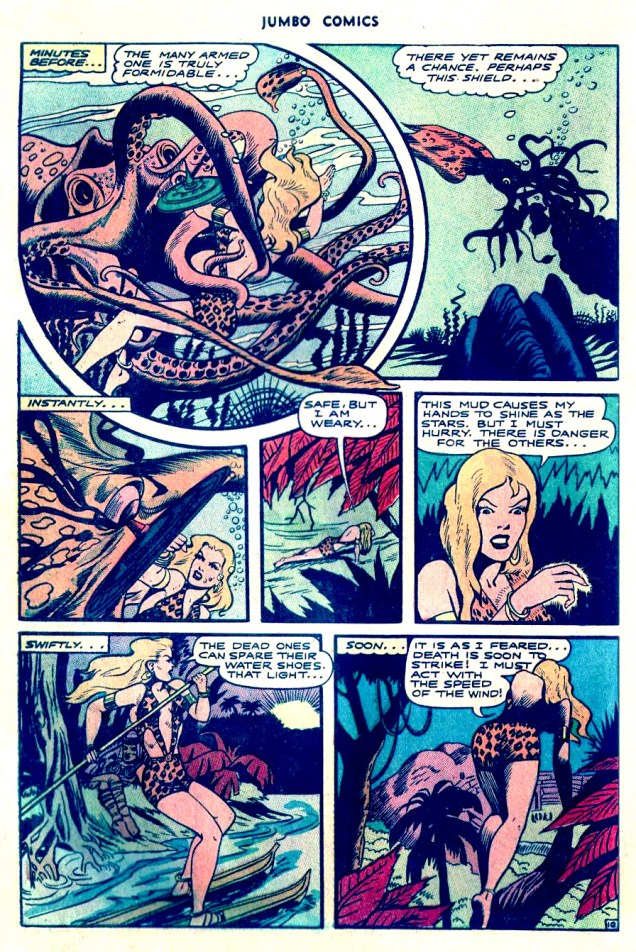
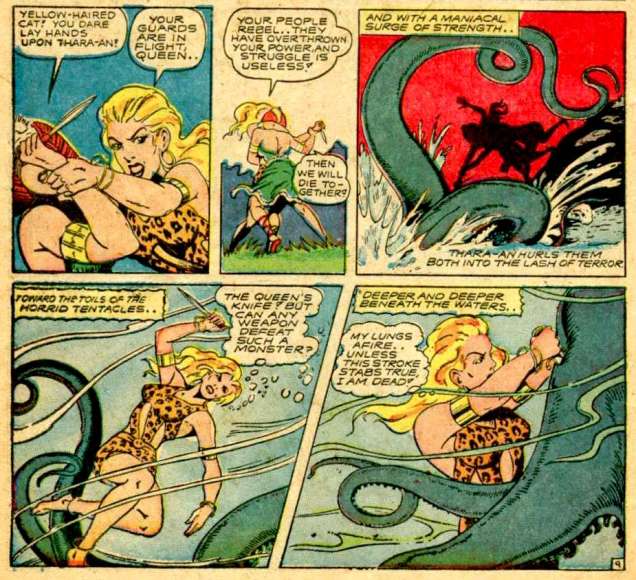
Page from «Voodoo Treasure of Black Slave Lake», scripted by W. Morgan Thomas, pencilled by Robert Webb, and inked by David Heames, published in Jumbo Comics no. 31 (September 1941, Fiction House).«Sargasso of Lost Safaris», pencilled by Robert Webb and inked by Ann Brewster, published in Jumbo Comics no. 87 (May 1946, Fiction House). What the heck does the Sargasso sea have to do with a jungle? I’d like to know.Untitled story from Sheena, Queen of the Jungle no. 5 (Summer 1949, Fiction House). Art by Robert Webb.Panels from «The Beasts That Dawn Begot!» drawn by Robert Webb, published in Sheena, Queen of the Jungle no. 12 (Summer 1951, Fiction House).
Time for other queens to borrow Sheena’s spotlight:
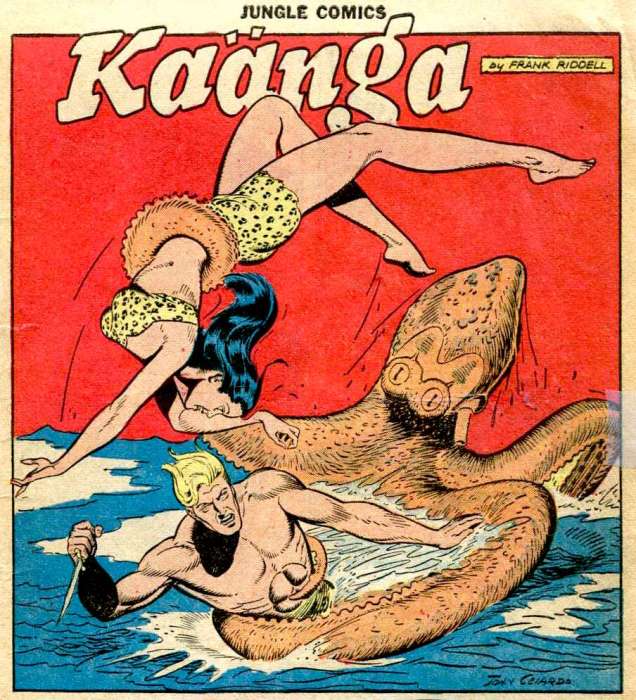
«The Red Witch of Ubangi-Shan», with art by John Celardo, published in Jungle Comics no. 105 (September 1948, Fiction House). Technically, this inclusion goes against my main theme – for Käanga has a very stupid mate who has to be rescued at every turn. She may wear a leopard bikini, but she’s nothing but a Damsel in Distress. Boo.
This Camilla story was scripted by Victor Ibsen and drawn by Ralph Mayo, and was published in Jungle Comics no. 144 (1951, Fiction House):
A raft full of musclebound men and Camilla has to be the one to stab the octopus. Her contempt is well justified, as Asheley is clearly a loser.
We’ve had a lot of blondes so far, how about a redhead?
White Princess of the Jungle no. 4 (August 1952, Avon), cover by Everett Raymond Kinstler.
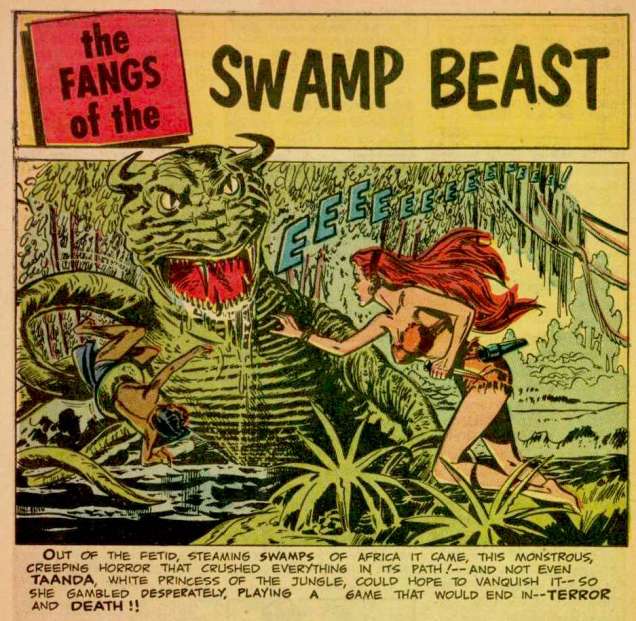
The cover story, «Fangs of the Swamp Beast»:
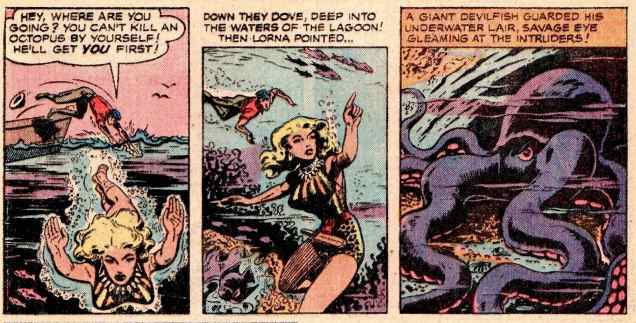
Back to our regularly scheduled blonde heroine! This is «The Devil’s Lagoon», scripted by Don Rico and drawn by Werner Roth, published in Lorna the Jungle Queen no. 4 (December 1953, Atlas):
Lorna has the talent of plunging into water boobs first, and using them to optimize buoyancy.Again with the bust-ridiculously-stuck-out pose in the first panel.
For a chuckle, read Stupid Comics‘ critique of Devil’s Lagoon here. Moving on, I have no wish to be unfair to brunettes, especially given that I generally prefer them:
All Top Comics no. 16 (March 1949, Fox). Cover by Matt Baker. Sure features plenty of top, doesn’t it? That’s Rulah, by the way – you guessed it, Rulah, the Jungle Goddess (well, at least she’s not a queen), one of those run-amok women who has no qualms killing animal or human.
Here’s a rather amusing explanation for Rulah’s raison d’être from Toonopedia: «One day, while piloting a small plane across Darkest Africa, she crash-landed where civilization had scarcely been heard of. Her clothes were damaged to the point of leaving her butt naked (“like Eve in the Garden,” she mused), modesty preserved only by shadows and strategically-placed vegetation — yet, her skin wasn’t noticeably scratched or abraded. Fortunately, her plane had whacked a giraffe on the way down, so she skinned it and skillfully fashioned a fetching bikini from the raw, uncured pelt. Her uncovered parts were no more bothered by thorns, rough bark, poison ivy and the like, than were her bare feet. Next, she saved a tribe from the local tyrant, a white jungle queen much like herself, and was proclaimed its ruler — provided she could prove herself by killing a starving leopard with nothing but a dagger, which she did.»
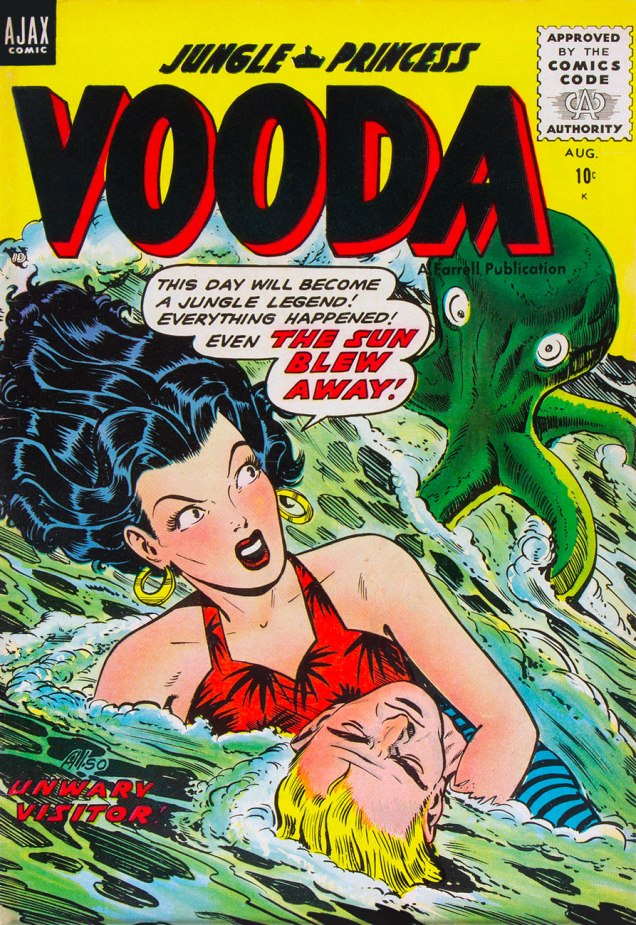
Another brunette! Vooda no. 22 (August 1955, Farrell). Note that Jungle Queens are only allowed to have hoop earrings, preferably gold.
Phew, that tromp through the jungle wore me out! Until next Tentacle Tuesday…
You know how women aren’t advised to go out after dark, or to go to parties in revealing clothing because they might get raped and/or murdered? (This is purely a comic blog and we play nice, so I’m not developing that line of thought any further.) In the comic world, until relatively recently, that sort of thing couldn’t really be shown, but aren’t tentacles a rather handy stand-in for more realistic (and far scarier) violence? The only point I wish to state is that a woman can’t even go for a fucking walk without encountering tentacles. Swimming? Just forgetaboutit. Sitting quietly on a log? As long as you’re female, the tentacles will still find you, it scarcely matters whether you’re clad in a swimsuit, a gunny sack, or a parka. If the monster finds you a tad overdressed, it will just rip your clothing off – problem solved!
Blackstone no. 1 (Fall 1947, EC). Blackstone, Master Magician was created in 1946 by Elmer Cecil Stoner (1897-1969; one of the first black comic book artists!) for Vital Publications. The comic had a remarkably short life – one issue published by EC Comics (the one you’re currently looking at), and three more issues published by Timely. Somehow this was enough to spawn a radio series that aired from 1948 to 1950.
Stoner, who worked for a plethora of golden age companies (Timely, Fawcett, EC, Dell…) attracted some pretty heavy criticism in recent years. « Stoner’s drawing is the visual equivalent of fingernails scraped across a slate, and whenever he had a chance to botch the perspective, the composition, or even the inking, he did so with brio », opines Ron Goulart in his Great History of Comic Books. One could make the point that the above cover demonstrates this: the characters seem to be floating, not connected at all with one another or the landscape. However, whatever one thinks of his art, it has to be admitted even by the staunchest critic that Stoner was a pioneer who carved out a path for other African-American artists.
« On December 16, 1969, Elmer Stoner passed away. Since then he has been largely forgotten by the comic book industry and overlooked as a trailblazer. He was no Jackie Robinson, his presence in the comic industry didn’t alter its course. He did, however, pave the path for Al Hollingsworth, Matt Baker, Ezra Jackson, Cal Massey and for every African-American artist who followed. Stoner’s life is worthy of further exploration and his story deserving of wider recognition. He should not remain invisible. » |source, an article by Ken Quattro that’s well worth reading!|
« Miriam and Hester were insane. They took the severed head of a dead man, and sewed it back onto his body. Then, they stripped away their clothes and conjured up a demon! » As usual, Vampirella stories make perfect sense. The Nameless Ravisher, scripted by Flaxman Loew and drawn by Leopold Sanchez, was published in Vampirella no. 40 (March 1975, Warren). Flaxman Loew, by the way, was the somewhat ridiculous nom-de-plume of British Mike Butterworth. His stories seemed to get criticized a lot in the letters’ section, so maybe he deliberately picked a moniker guaranteed to be misspelled. One thing’s for certain – he had a vicious streak, qualified by a fan as a “fizzy, nasty run”. Read the full issue here, if you must; I can’t recommend it.Thank you for underlining the VIOLATING in the narration, Mr. Script Writer (what can you expect out of a man named Flaxman Loew?) – otherwise we would have never figured it out. This story also contains awe-inspiring quotes like « Vampirella! Rend her! Rip her! Now! », and « the water comes… and comes… ravishment by water…! »
You know how I said that swimming is not recommended unless you want a tentacular encounter? Do keep that in mind, especially with summer just around the bend:
Alpha Flight no. 14 (Marvel, September 1984). Cover by John Byrne. Co-admin RG would like to inform everyone that Lake Ontario is not teal-coloured. I’d rather take my chances with the octopus rather than be rescued by that horrible-looking man, but that’s just me (or Byrne’s so-called art).
A closer look at Heather’s rescuer:
Puck is a dwarf, okay, but why does it seem like Byrne has never seen an actual dwarf in his life?
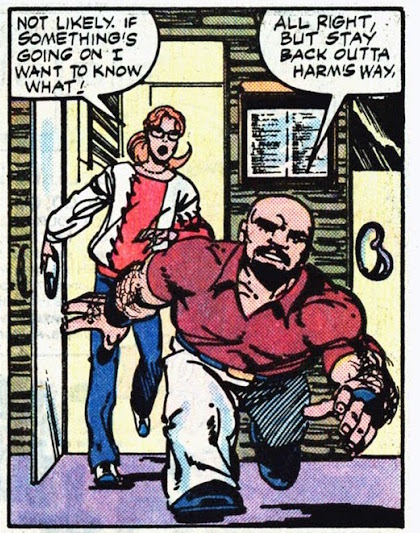
A page from « Biology Class », scripted and drawn by John Byrne. So why doesn’t the athletically-minded Puck jump into the water instead of Heather? She tells him not to: « Stop! You know you can’t swim worth spit! » (Err…?) Is it just me, or do the “deep and dark waters of Lake Ontario” look like a swimming pool?
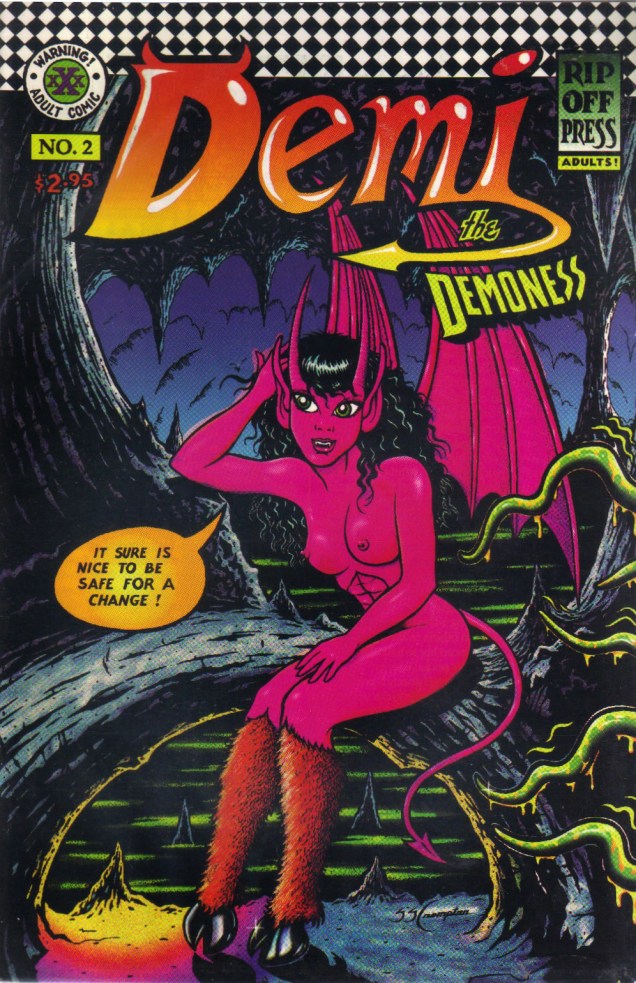
O, cute Demi with your gleaming hooves, beware of the quiet before the (sexy) storm! Demi the Demoness no. 2 (1993, Rip Off Press). The cover is by Demi’s Canadian creator, Steven S. Crompton.
Crompton’s art is not *great*, but it has definite charm: somewhat childlike and proudly cartoony, it underlines Demi’s innocence perfectly, her huge puppy eyes beckoning to the reader while she gets ravished by yet another toothy monster, well-endowed Pegasus, or frisky cat goddess. And I don’t mean to make it sound like she’s lying back and thinking of England, either – in most cases, she’s an enthusiastic participant in the sexy shenanigans.
« Over 35 different Demi the Demoness comics have been published. Numerous artists and authors have worked on Demi comics over the years, including Frank Brunner, Tim Vigil, Seppo Makinen, Philo, Ryan Vella, Gus Norman, Enrico Teodorani, Silvano, Diego Simone, Jay Allen Sanford, and many others. Demi has appeared in numerous comics crossovers with other characters, including Shaundra, Captain Fortune, Mauvette, Vampirooni, Cassiopeia the Witch, Djustine, Crimson Gash, and adult film stars Tracey Adams, Tabitha Stevens, Deja Sin, and Bonnie Michaels.» |source|
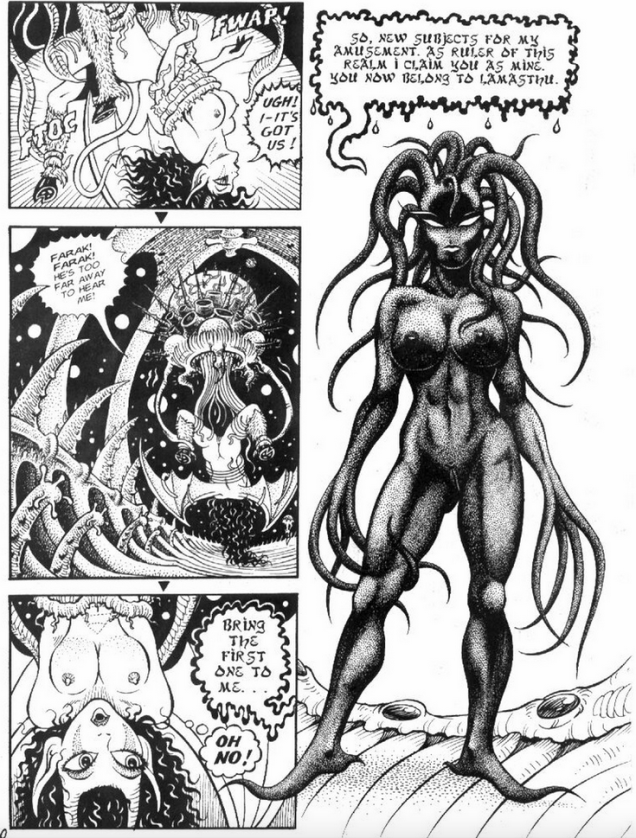
Page from « The cumming of Lamasthu », published in Demi the Demoness no. 4 (1994, Rip Off Press). Art by Steven S. Crompton.Page from « The Cumming of Lamasthu », published in Demi the Demoness no. 4 (1994, Rip Off Press). Art by Steven S. Crompton.
You can read a dozen Demi issues on My Hentai Comics… the link is very much not safe for work, unless you work for a sex-obsessed Lord Cthulhu or something. But I can guaran-damn-tee a lot of tentacles!
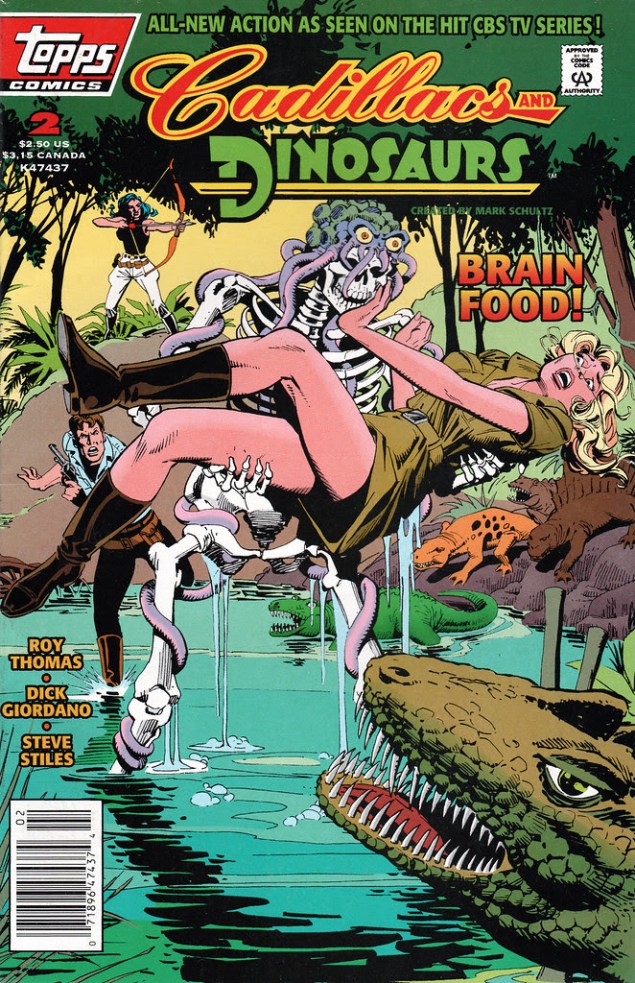
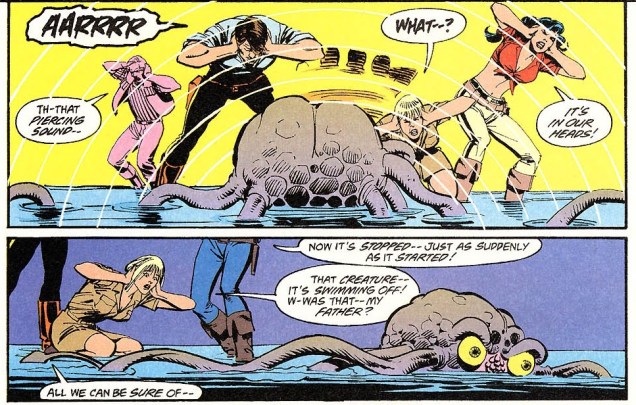
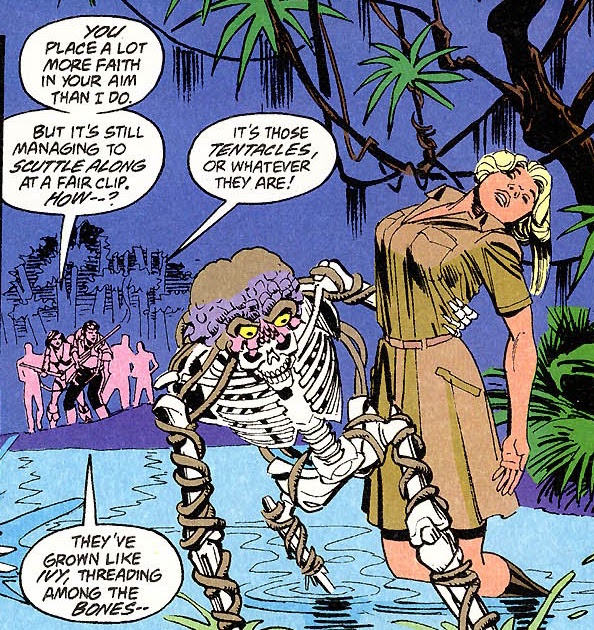
Cadillacs and Dinosaurs no. 2 (March 1994, Topps). Cover by Dick Giordano, who shouldn’t have been let anywhere near Mark Schultz’ characters. I see the lizard has decided to photobomb this romantic scene (the skeleton guy is clearly about to drop Felicia into the murky swamp water.. that’s teal-coloured for some reason… hardly swampy!)
Inside, we get Blood and Bones, Part II: Swamp Things (scripted by Roy Thomas and drawn by Dick Giordano), a Mœbius 2-pager, a couple of pages of captioned Schultz dinosaur illustrations, and – just in time to save this issue from being thoroughly dreadful – Sailor, Take Warning!, scripted by Roy Thomas and drawn by Steve Stiles.
See? Definitely tentacles. Every self-respected brain has ’em.Felicia’s pose looks distinctly unnatural, but she’s doing a good job of letting everyone know she has an impressive bust (a girl has priorities, even while unconscious). Giordano doesn’t seem to know that human hands curl up when at rest.
You know what Blood and Bones, Part II: Swamp Things has, aside from a suspiciously blue and limpid swamp? Dinosaurs. More specifically a T-Rex skeleton controlled by a brain with tentacles, who’s actually the father of one of the characters! It takes a Roy Thomas to cobble up such classic plots.
Maybe, instead of Brainosaurus Rex, he should have been called Daddysaurus, or maybe even Papasaurus Rex?
I hope I have impressed upon you the absolute necessity of caution when taking a stroll – whether your path lies next to a large body of water or leads through a forest. Above all, do not perch on a log when you need a rest, or lean against a tree. Hanging out with magicians is also not recommended.
Until next Tentacle Tuesday, I remain tentacularily yours…
« Les artistes, c’est comme les pieuvres: ils crachent de l’encre pour se cacher. » — Julos Beaucarne*
It is time (again) for some French tentacles! (Upon closer inspection, a lot of these actually prove to be Belgian, but my point still holds.) We have all kinds in today’s post: tentacles merry and frightening, realistic or cartoony. There’s even an octopus in a bra (but don’t skip ahead)!
Created for Le journal de Tintin in 1963 by Raymond Reding, Vincent Larcher was a professional football player who often used his athletic prowess to defeat evil guys (he also occasionally played football). The first Vincent Larcher story had no supernatural elements, and didn’t seem to make much of a ripple amidst Tintin’s audience. After a 4-year hiatus, Reding re-introduced Vincent Larcher, this time throwing him into a three-part tale with a mad scientist (as usual, hellbent on world domination) and scary aliens. This was later christened the Olympio Trilogy in honour of Olympio, Larcher’s telepathically gifted friend, who was an important figure in these stories. The pages below are from Le zoo du Dr. Ketzal, part three of the aforementioned trilogy, published in Tintin Magazine issues 1039 to 1059 (1969).
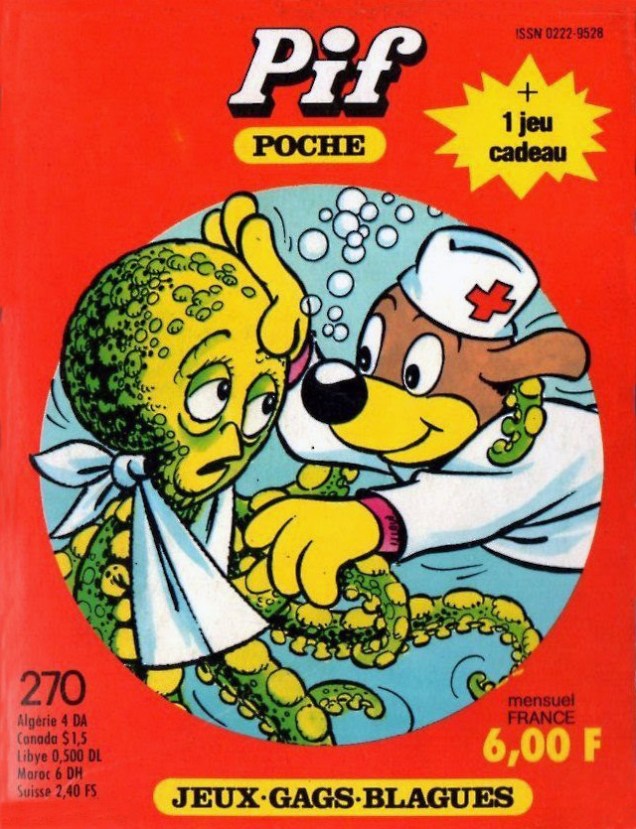
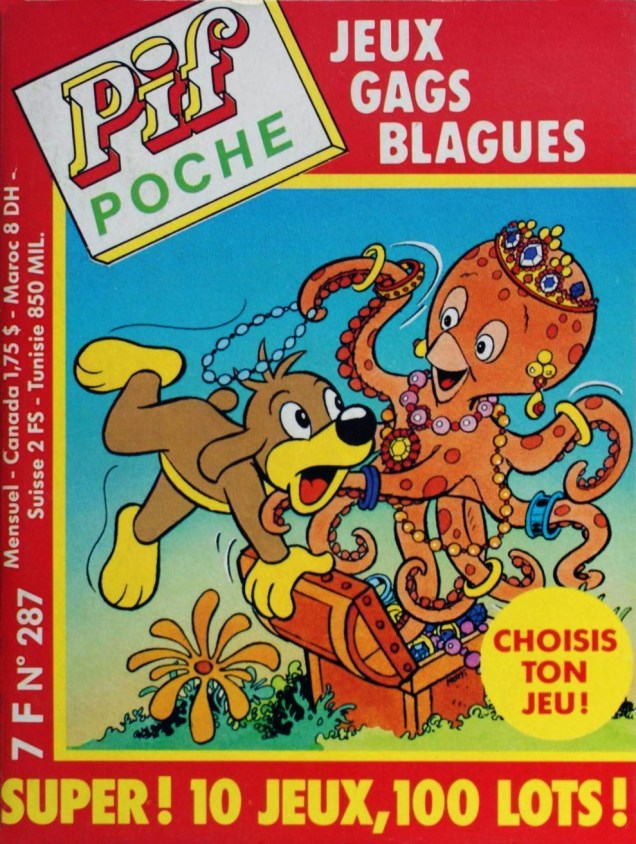
The friendly pooch fraternizing with octopuses is Pif, the mascot of Pif Gadget (« gadget » referred to the fact that each issue of the magazine was accompanied by some thingamajig to amuse the youngsters). Pif Poche were pocket-sized collections of short Pif strips (“poche” means pocket in French), meant to be easily carried to trips, picnics, and probably school as well. Pif was created by José Cabrero Arnal in 1948, who gradually abandoned the strip by the 1960s while other artists took over.
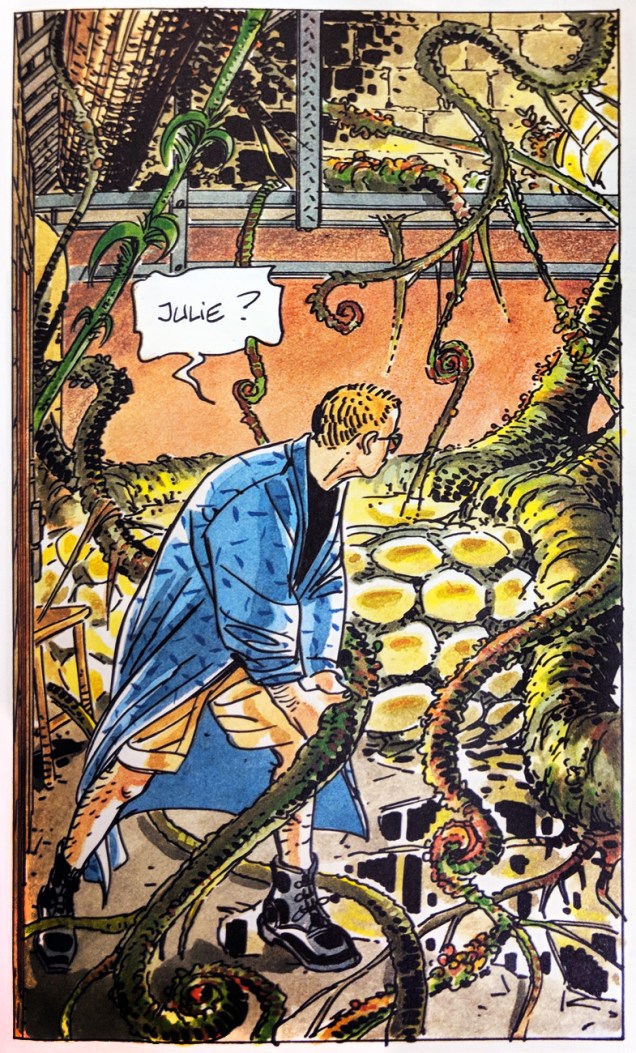
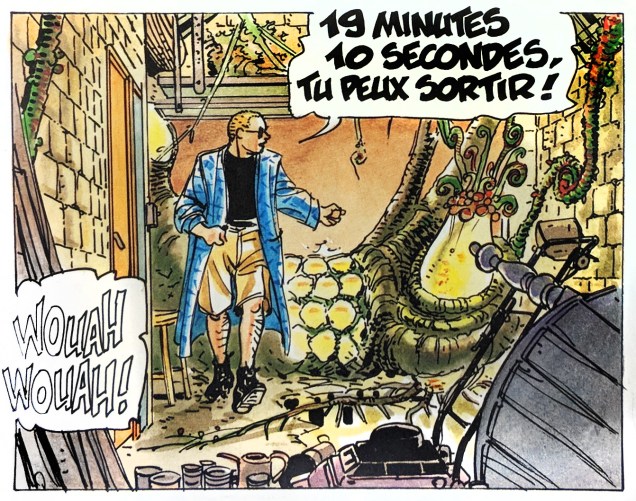
The following panels are from the series Tropique des étoiles by Christian Lamquet, more precisely from volume 4, Le réveil des poussières (1996, Claude Lefrancq).
« 19 minutes, 10 seconds, you can come out! » Experiments performed on a young woman seldom turn out as intended.
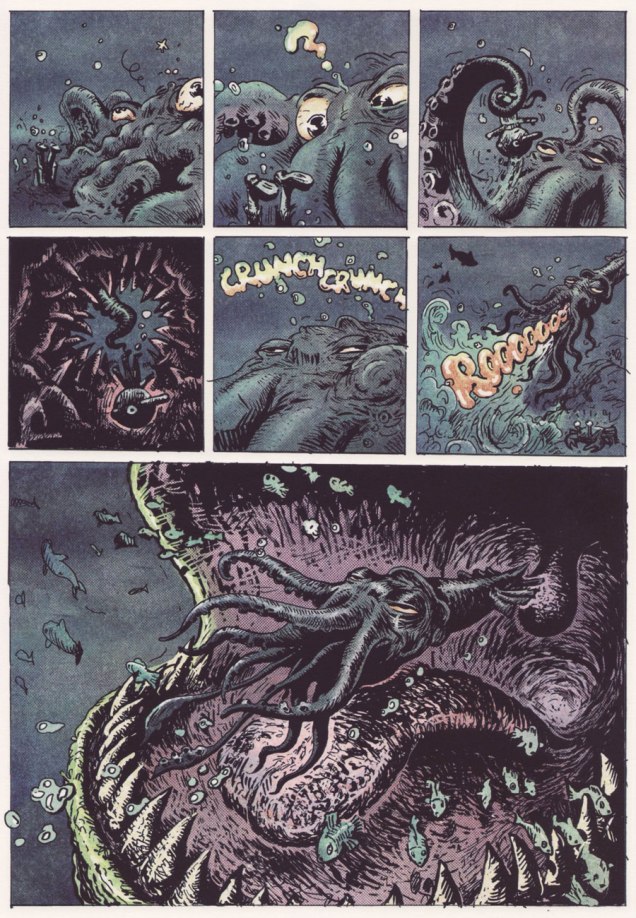
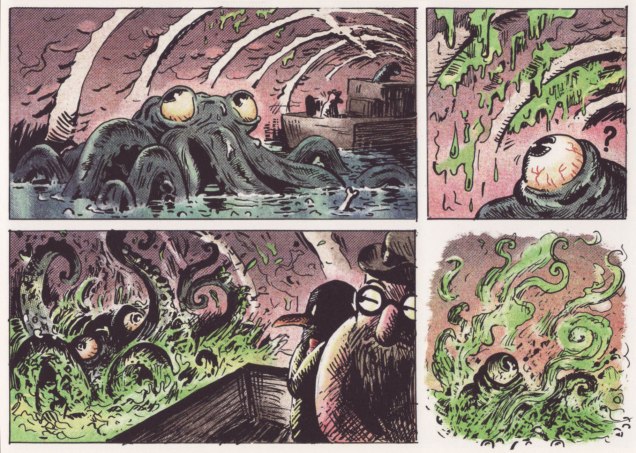
My next peace offering to the cephalopod gods comes in the form of a very loose interpretation of Carlo Collodi‘s Pinocchio, imagined by French artist Winschluss (real name Vincent Paronnaud) and executed with the help of some friends, most notably Cizo on colours. Winschluss’ art can be quite nice, but it gets a massive boost from the first-rate colouring job, so I’d like to emphasize that Cizo deserves a lot of credit for that (the tentacle pages are actually rather dark, as the action occurs undersea, but just take my word for it).
This graphic novel received a few prizes and has been lauded by many parties, but somehow I’ve managed to be quite unaware of its existence until recently. (Frankly, I am somewhat tired of picking up comics that are supposed to be superb and end up being just mediocre, so I don’t tend to pay much attention to awards and other plaudits.) A friendly comic book store clerk pointed it out to me, explaining that it was brought in by an older gentleman whose granddaughter had presented the book to him as a gift, but it wasn’t his thing at all. I was quickly won over by the art, and the story, well… it’s not for the faint-hearted or easily offended, but it’s a good one.
Winschluss’ Pinocchio was originally published in 2008 by Les Requins Marteaux, but has been reprinted several times in French (in increasingly fancier editions) as well as translated into English in 2011.
« French comics artist Winshluss leaves his robot child hanging beneath a giant lollipop on a hill for a good quarter of his largely dialogue-free adaptation, as regimes fall, fake prophets rise and a pizza delivery girl is saved from torture at the hands of seven dwarves. It’s a grim, puerile and rather brilliant update, combining chaotic, inked panels and gorgeous full-colour paintwork to great effect. Pinocchio, designed as a killing machine, is plunged from crisis to crisis by a series of greedy men and women, his story interrupted by a tortured detective, a grieving couple and Jiminy the cockroach. » |source|
Actually, don’t take my word for anything, you can admire the colours in this preview:
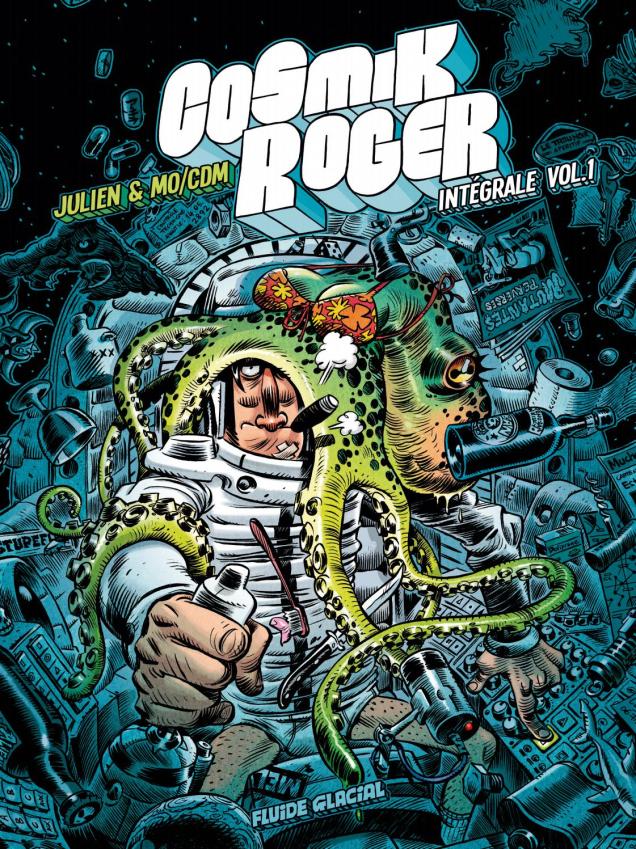
Cosmik Roger is a sci-fi/humour comic series scripted by mo/CDM (no, seriously, that’s his nom de plume, and no, I don’t know what it stands for) and drawn by Julien/CDM (real name Julien Solé – they used to go to school together, which apparently led them to adopting the same stupid monicker). This is the cover of the collected Cosmik Roger (volume 1), published in 2018 by Fluide Glacial.
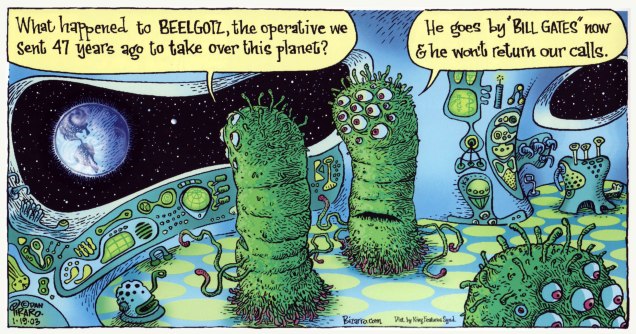
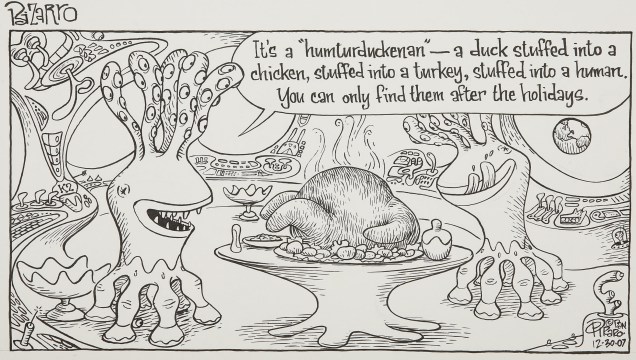
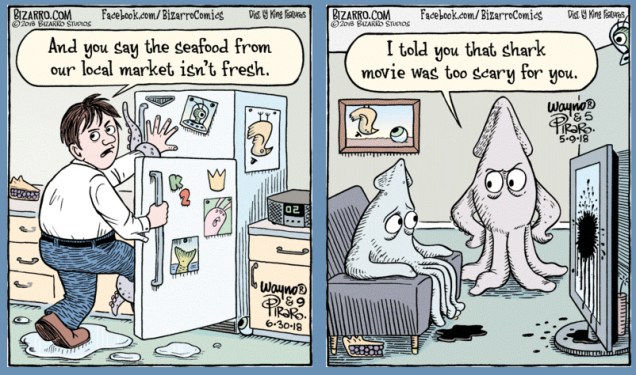
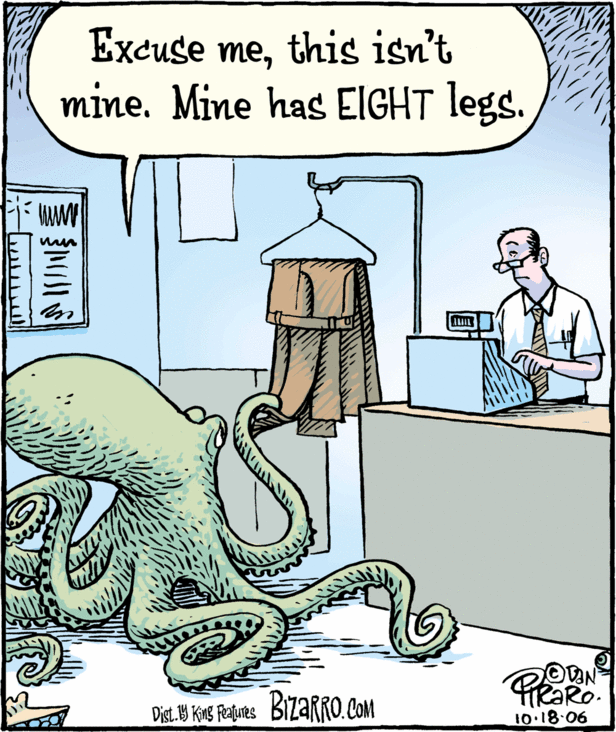
Dan Piraro‘s Bizarro is a ubiquitous newspaper comic that usually doesn’t need much in the way of introduction. Favourite strips are widely shared by fans – cut out or photocopied from newspapers (or, more recently, printed from a website) to be pasted on office doors, cubicle walls and school binders. As a matter of fact, that’s where I spotted my first Bizarro strip: scotch-taped to the office door of my college English teacher. Oh, I’ve seen them before, of course, but this was the first time I consciously noticed one of them. Teachers of all stripes seem to have a thing for Bizarro – I had a university psychology professor once who actually collaborated with Piraro on some strips, an achievement of which he was justifiably proud.
As usual, one can rely on the intrepid Tom Heintjes of Hogan’s Alley to conduct a worthwhile interview with whichever artist one is interested in. Read it here: Mondo Bizarro: The Dan Piraro Interview. I’m not going to compete with Heintjes’ ability to summarize, so I’ll just quote:
« Since Bizarro’s January 22, 1986, debut, Piraro has taken his panel in directions simultaneously surreal and topical. In a comic universe where world-weary talking dogs exist alongside nihilistic housewives, Piraro gives his cartoons heft by skewering his own bêtes noires: wasteful consumerism, environmental destruction, corporate greed and sheeplike people, to name a few. Though his humor is never didactic, Piraro’s work is remarkable in its unwillingness to pander, even when the occasional panel borders on the inscrutable. For example, he once used the Etruscans as a punchline; if you skipped history class that day, tough. Since sustained excellence like Bizarro‘s is rare in any medium, his willingness to shepherd his panel into its third decade is great news for comics fans and for the more than 200 papers that carry the strip. Though Piraro maintains that Bizarro is a comic strip for people who don’t read comic strips, we all know better: Bizarro is a comic strip for people who love comic strips. »
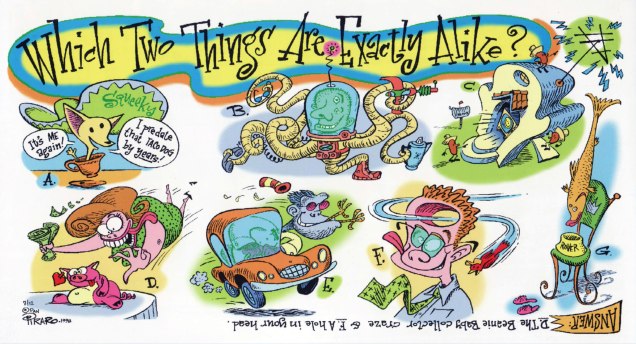
Piraro is not the only cartoonist spoofing social conventions, endowing animals with the gift of human speech or forging surreal situations out of everyday occurrences… but he does it consistently well. His easily recognizable, flowing art style is the frosting on the cake, and very nice frosting it is, too. Yet who can grasp the scope of such prodigious output? Bizarro collections (there have been thirteen of them – fitting number, isn’t it?-, all quite out of print) generally end up in the discount bin of bookstores (often neighbours to disheveled anthologies of Gary Larson‘s The Far Side, another omnipresent yet somehow underappreciated strip). For all my affection for Piraro’s goofy world, I only own Bizarro and Other Strange Manifestations of the Art of Dan Piraro (Harry N. Abrams Publisher, 2006). Some of the strips in this post have been scanned from it (others were found in the trackless depths of the Internet.)
Pleasantly, Piraro wears his politics, heart and sympathies on his (rather accommodatingly large) sleeve:
Most Bizarro cartoons feature a recurring object or creature (added value for a comic strip that’s already rich in detail). Some of my favourites: the Eyeball of Observation, the Pie of Opportunity (a piece of pie – blueberry, I think), the Dynamite of Unintended Consequences, or Firecracker of Pop (a dynamite stick), the Fish of Humility (or at least its tail), and my very favourite, the Bunny of Exuberance. One can just tell that Piraro enjoys his work. What kind of jerk still enjoys drawing the same strip after 30 years*?!
« Yet another bloodthirsty alien invasion, led by a mad dictator with a brain harvested from a 60 year-old corpse. I get one of those every third Thursday… »
D’you know what today is? Well, Tentacle Tuesday, obviously. It’s also Radio Day. More relevantly to this post, however, May 7th is also the birthday of one Michael Terry Gilbert, confidant to the formidable Mr. Monster (a.k.a. Strongfort “Doc” Stearn) and fellow tentacle lover (at least judging from how many cephalopod-shaped creatures appear in his stories).
We’ve briefly mentioned Mr. Monster in Tentacle Tuesday: Superheroes Redux; now is the time to joyfully gallop through some more tentacle offerings from the merry crew of psychotic artists led by that sagacious shepherd, Michael T. Gilbert. Many happy returns, Sir!
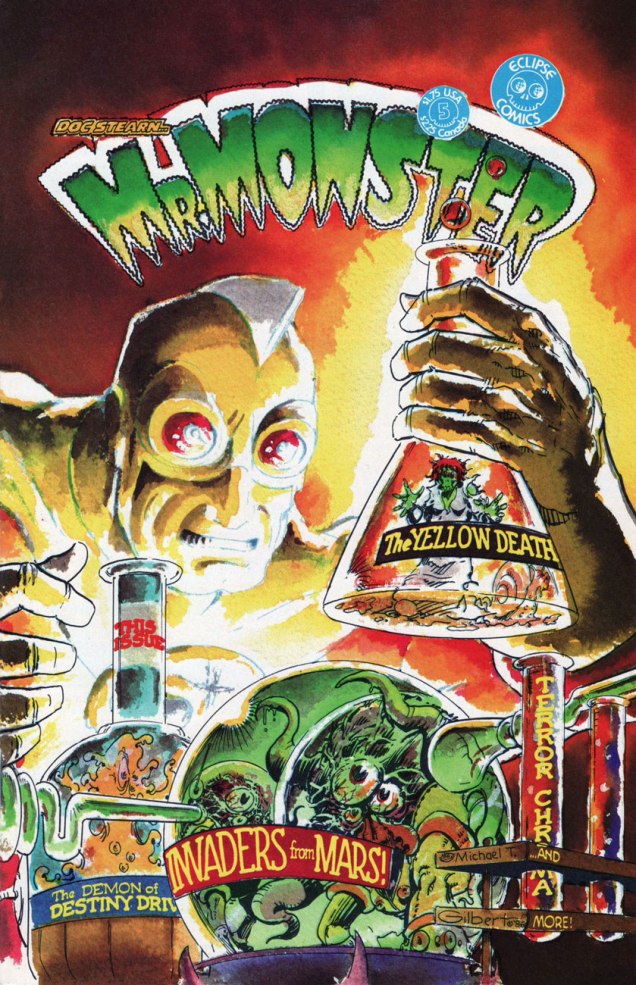
Doc Stearn… Mr. Monster no. 1 (Eclipse, January 1985). Cover by Michael T. Gilbert.Doc Stearn… Mr. Monster no. 5 (Eclipse, February 1986), cover by Michael T. Gilbert. The unwritten rules dictates that Mars inhabitants *must* have tentacles, and Gilbert clearly has respect for venerable traditions. Plus, they’re much cuter this way. Coochie-coochie-coo…
« The original Doc Stearne was a two-fisted adventurer along the lines of pulp hero Doc Savage, of whom he may have been intended as a knock-off. He was created by cartoonist Fred Kelly, whose other known credits are somewhere between sparse and nonexistent. Kelly did him for a small, virtually unremembered Canadian publisher called Bell Features (probably not related to Bell Syndicate, distributor of Mutt & Jeff, Don Winslow of the Navy and more). When Gilbert was asked to contribute to Vanguard Illustrated, the apparent purpose of which was to develop new properties for Pacific Comics to exploit, he drew on Kelly’s character as inspiration. The first new Mr. Monster story appeared in the seventh issue, which came out in 1984 without a specific cover date. Gilbert’s version was a fanatical monster hater, extreme not only in his attitude, but in his design and in every move he made. » |from Don Markstein’s Toonopedia|
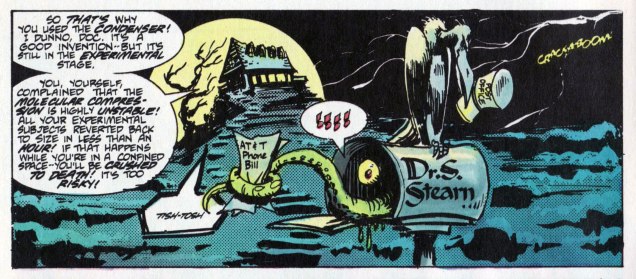
« The Demon of Destiny Drive », art by Michael T. Gilbert, published in Doc Stearn… Mr. Monster no. 5 (Eclipse, February 1986).« Mr. Monster’s Atomic Condenser » by Michael T. Gilbert was published in Doc Stearn…Mr. Monster no. 10 (Eclipse, June 1987).Is that an Oculothorax, by any chance? « Terror in 6-D », with script and layouts by Michael T. Gilbert and pencils and inks by Don Simpson, was published in Doc Stearn…Mr. Monster no. 10 (Eclipse, June 1987). Read the issue here.
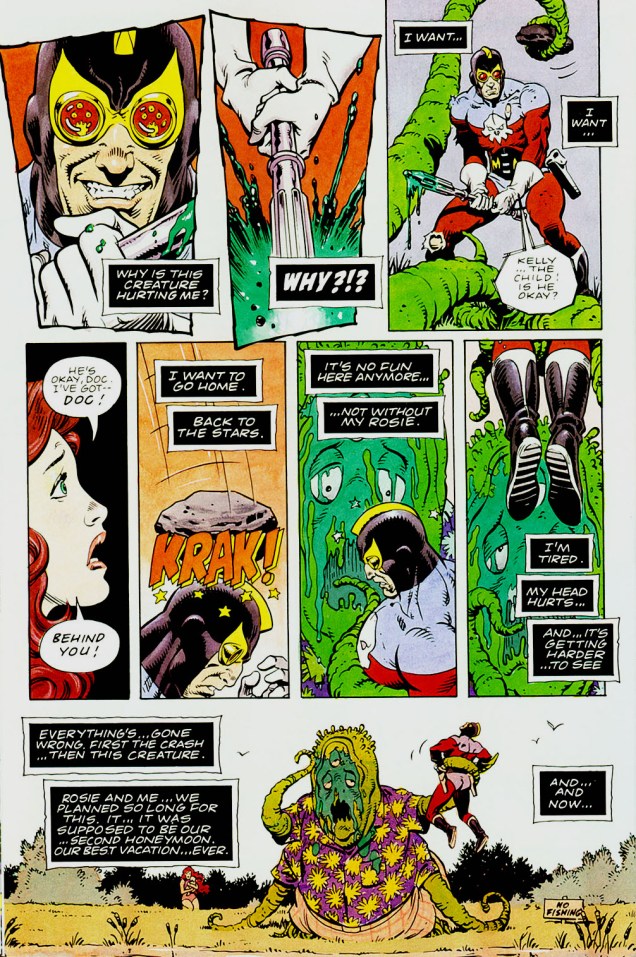
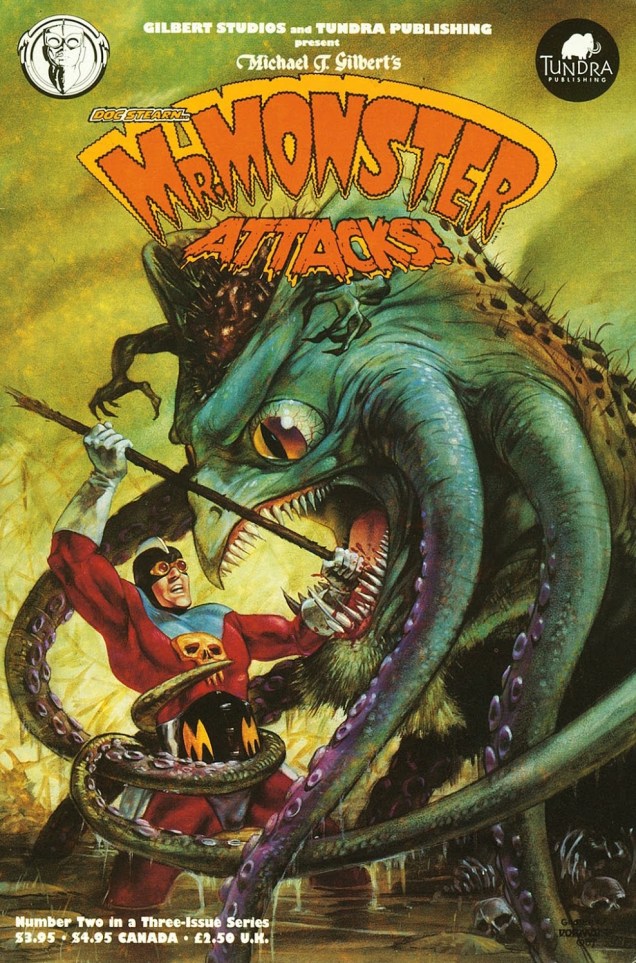
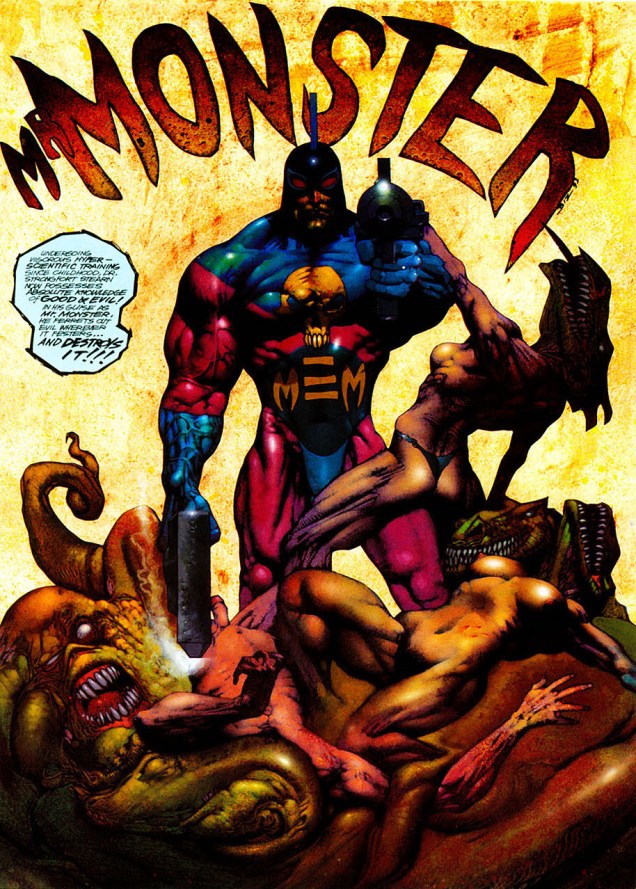
« Wish You Were Here », script and layout by Michael T. Gilbert, inks by Dave Gibbons, was printed in Mr. Monster Attacks! no. 1 (Tundra, August 1992).Want to know whether Mr. Bulletproof Monster ever gets back with Rosie? Read Mr. Monster Attacks! no. 1 (Tundra, August 1992) here.Mr. Monster Attacks no. 2 (Tundra, September 1992), cover pencilled by Michael T. Gilbert, and painted by Dave Dorman.Back cover of Mr. Monster Attacks no. 2 (Tundra, September 1992), drawn by Bernie Wrightson and Michael T. Gilbert. Read the issue here.« Lair of the Lizard Ladies », written and laid out by Michael T. Gilbert, and pencilled, inked and coloured by Simon Bisley, was printed in Mr. Monster Attacks! no. 3 (October 1992).Kelly, Mr. Monster’s Girl Friday, has been touched by his noodly appendage in this story featuring murderous tentacle spaghetti. « Just Desserts », scripted by Janet Gilbert (wife of Michael T. Gilbert) and drawn by Tom Buss, was printed in Mr. Monster Attacks! no. 3 (Tundra, October 1992). Read the full issue here.
« Ulp! That reminds me. I’m late for my 4:00! There’s a giant man-eating eyeball about to devour Cleveland! So if you’ll excuse me… »
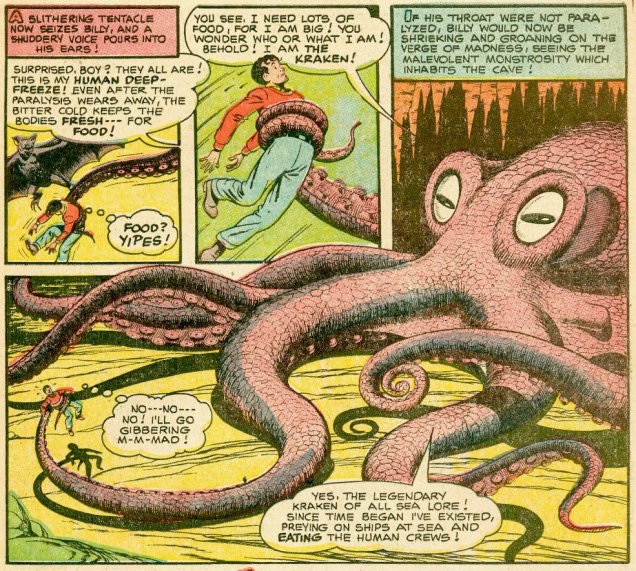
« A slithering tentacle now seizes Billy, and a shuddery voice pours into his ears! »
Previously, we’ve talked about Captain Marvel (the original, the best, the… dare I say, unique!) in a post about his co-creator C.C. Beck. Today, I’ll concentrate on the World’s Mightiest Mortal’s exploits with all manner of tentacled monsters.
All C.C. Beck quotes in this post come from An Interview with C.C. Beck conducted in the late 1980s (shortly before Beck’s death in 1989) by the talented Tom Heintjes of Hogan’s Alley.
« When I looked at the first Captain Marvel story, I knew at once that here was a story worth illustrating. It had a beginning, a carefully constructed development of plot and characters leading to a climax and an ending, and nothing else. There was no pointless flying around and showing off, no padding, no “Look, Ma, I’m a superhero!” Out of 72 panels, Captain Marvel appeared in 18, or one-fourth. »
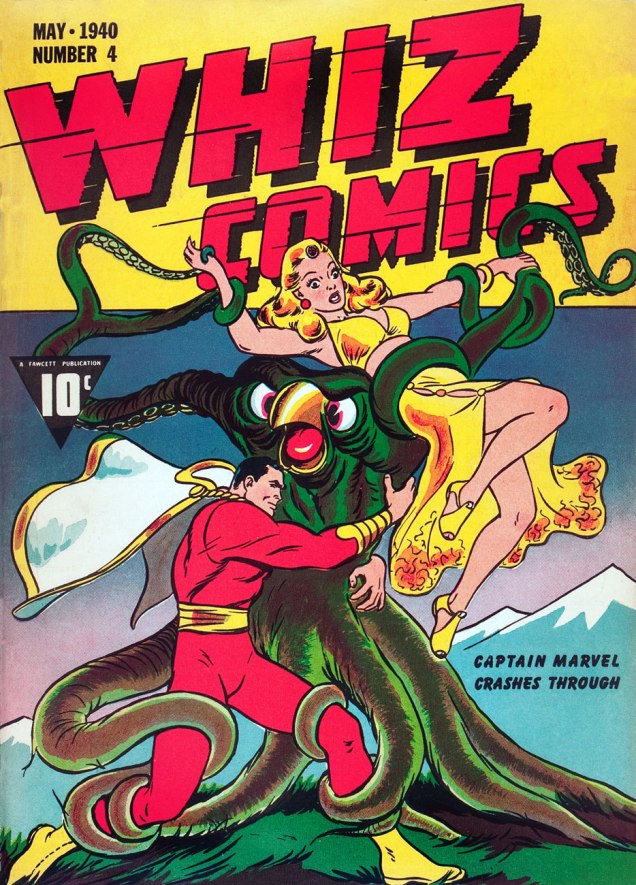
« March, ye scalliwag, or I’ll curdle yer giblets! » Follow Captain Marvel’s fine example – don’t forget to hug a tree, folks! Although it will be better if you can find one without spines and prehensile appendages. This is Whiz Comics no. 5 (May 1940), cover by C. C. Beck. Captain Marvel may “crash through”, but the cover story, « Beautia for President », contains no tentacles whatsoever… just a hypnotically beautiful woman, that some may settle for (not me). You may note that the cover has « number 4 » written on it, but 5 was the number reported to the Copyright Office, so go figure.Whiz Comics no. 60 (November 1944), cover by C. C. Beck. Paper tentacles? I think they count! The main story is adorably goofy, in the best Otto Binder tradition… but unfortunately comicbookplus.com has only a seriously blurry scan of this issue (read it here, but it may cause headaches).Whiz Comics no. 146 (June 1952), cover by Pete Costanza. Speaking of the latter and quoting (again) from C.C. Beck, « Pete Costanza was the first artist hired to assist me when Fawcett’s comic department started to expand in the latter part of 1940. We later went into partnership, and Pete was in charge of our studio in Englewood, New Jersey, while I operated out of our New York City office. Pete was an established illustrator at an early age, and I learned as much from him about story illustration as he learned from me about cartooning. »
The green, proudly toupée-d fellow appears in the opening panel of Terror Stalks the World’s Fair, but as it turns out, he has nothing to do with the rest of the story, really.
Terror Stalks the World’s Fair is scripted by Otto Binder and drawn by Kurt Schaffenberger.« A sinister mystery hangs over the city! Each night, screams are heard… human screams that gurgle away into deathly silence! » Whiz Comics no. 155 (June 1953), the final issue of Whiz Comics, cover by C.C. Beck.
The cover story features an actual kraken with evil, myopic eyes! I rejoiced.
Page from Captain Marvel Battles the Legend Horror, scripted by Otto Binder and drawn by Kurt Schaffenberger.
In an interesting plot twist, it is revealed that gigantic vampire bats and the Kraken (who has the gift of speech, sounding like somebody’s rather eccentric uncle) have struck up a partnership.
Poor Kraken must get cold, consuming all those frozen bodies…
While we’re at it, Captain Marvel Battles the Legend Horror is a perfect demonstration of a point C.C. Beck made well:
« Billy Batson was the real hero of all the Captain Marvel stories, from the first issue until the last. Without Bill Batson, Captain Marvel would have been merely another overdrawn, one-dimensional figure in a ridiculous costume, running around beating up crooks and performing meaningless feats of strength like all the other heroic figures of the time who were, with almost no exceptions, cheap imitations of Superman. In fact, I have always felt that flying figures in picture form are silly and unbelievable, and I would much sooner have never drawn them, but the publisher insisted on them. Most of the time Captain Marvel’s ability to fly had little or nothing to do with the plots of the stories in which he appeared. Billy Batson started every story and ended every story. In between, Captain Marvel appeared when he was needed, disappeared when he was not needed. The stories were about Billy Batson, not about the cavortings of a ridiculous superhero for whom the writers had to concoct new and more impossible demonstrations of his powers for each issue. »
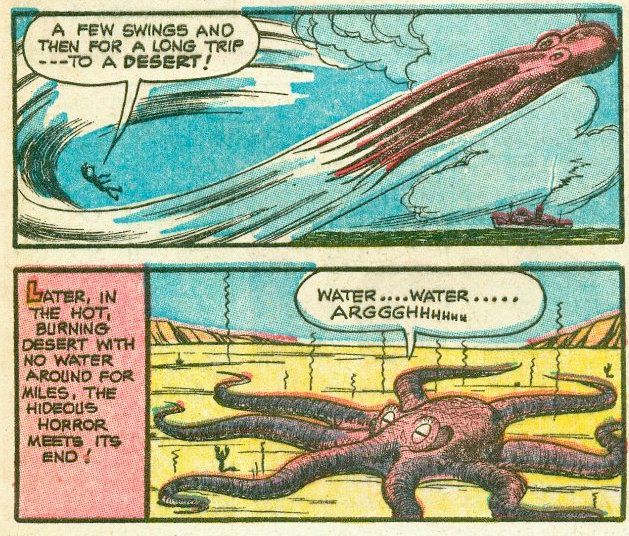
A terrible end for any creature, even a malevolent one.
And our last encounter with tentacles for today…
Captain Marvel Adventures no. 65 (September 1946), cover by C. C. Beck.
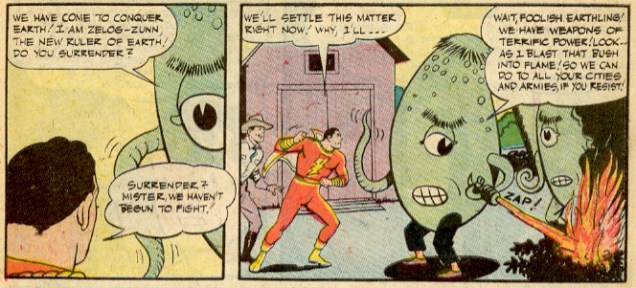
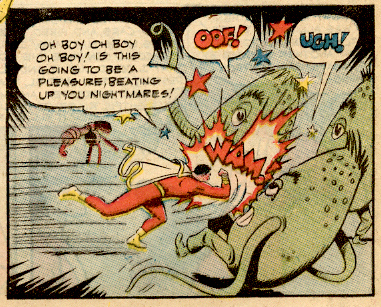
The Invasion From Outer Space, plotted by Otto Binder and drawn by C. C. Beck, offers us lots of cute little alien guys:
As usual, they wanna take over the world, but they’re cute, anyway. There’s that toupée again, this time (alien) flesh-coloured! That’s a mighty suggestive tentacle wiggle, Zelog-Zunn Sir.
Death rat·tle (/ˈdeTH ˈˌradl/), noun: a gurgling sound heard in a dying person’s throat.
Greetings! Today we explore Kitchen Sink‘s mostly-black-and-white horror anthology (drum roll, please) Death Rattle, which ran between 1972 and 1996 in three distinct “volumes” (please don’t forget your professional spelunking gear, things might get messy). For the pedants in the audience (and let’s be honest, that’s probably the majority of us comic-loving freaks), the break-down goes like this:
Volume 1, 3 issues published between June 1972 until June 1973 under the Krupp Comic Words imprint; volume 2, 18 issues published between October 1985 and October 1988 under Kitchen Sink Comix; finally, volume 3, five issues published between December 1995 and June 1996, also under Kitchen Sink Comix. I must admit that that my favourite period is Volume 2, and it’s from these issues that most material presented below has been drawn.
There is already a Tentacle Tuesday devoted to Kitchen Sink (see Tentacle Tuesday: The Kitchen Sink Touch) featuring, among other things, two splendid Death Rattle covers. We have also previously ogled some DR inside art in Tentacle Tuesday Masters: Rand Holmes. Today we take a longer peek into the stories promulgated by this fantabulous anthology. Get ready for some nasty fun!
(Man, I’ve got to tone down my build-ups…)
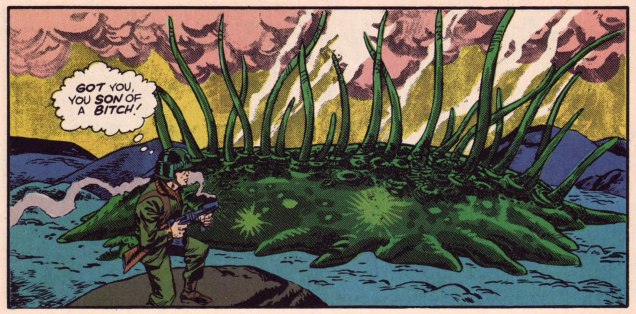
Panel from Mind Siege! by Steve Stiles, published in Death Rattle no. 3 (February 1986). The “my god!! so BIG!!” alien has the power to telepathically send mind-shattering hallucinations, eventually driving (nearly) everyone on earth insane. This issue also provides the first installment of Jaxon’s epic series Bulto… the Cosmic Slug (collected as Secret of San Saba: A Tale of Phantoms and Greed in the Spanish Southwest in 1989, for those interested).The last soldier on earth killed it! …Or did he? Panel from Mind Siege! by Steve Stiles, published in Death Rattle no. 3 (February 1986).
The first 5 issues of Death Rattlevolume 2 appeared in glorious colour, after which the series reverted to its standard black-and-white (financial hurdles). Issue 7 came out proudly bearing the slogan “too gruesome for color!” Issue 5 gave more details of the change to come:
« It will still be printed on quality paper, so you archivists out there won’t have trouble preserving disintegrating, rotting, putrid copies that look like they’ve just risen zombified from a Graham Ingels story. We’ll still be printing atmospheric stories of the unusual, the eerie, the — dare we say it — ghastly. So let’s rejoice, not mourn. »
I remember being vaguely disappointed for just a little while (it was nice to have colour), but the high quality of (most) stories made it easy to get used to the switch, and I really liked the unapologetic way Kitchen Sink confronted their audience, making a good thing out of a bad thing.
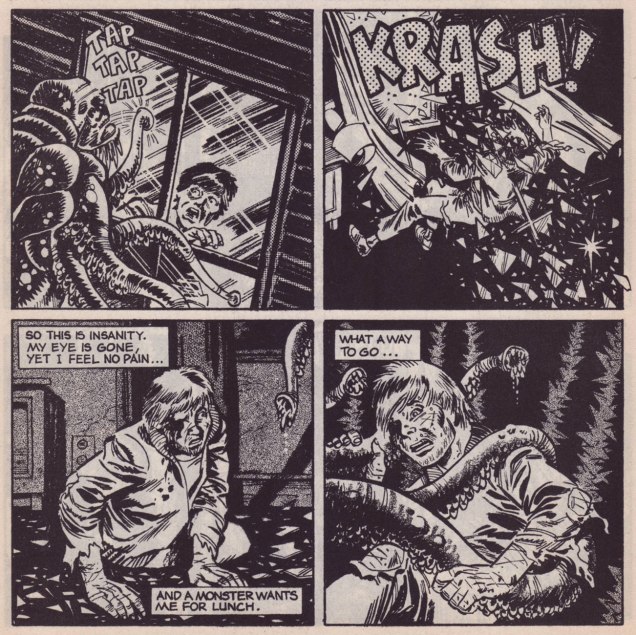
Polite monsters knock before smashing noisily through the window. Page from Old House, scripted by Kenneth Whitfield and drawn by Steve Stiles, published in Death Rattle no. 7 (October 1986).Page from Old House, scripted by Kenneth Whitfield and drawn by Steve Stiles, published in Death Rattle no. 7 (October 1986).
I didn’t realize it immediately, but this post ends up being some sort of cephalopod love song to Steve Stiles. Speaking of the latter, I’d like to mention that he doesn’t get enough credit for his work on Mark Schultz’s Xenozoic Tales, even though he drew Schultz-scripted back-up stories for no fewer than 13 issues of XT – and, frankly, did an excellent job. Instead of getting interrupted smack in the middle of an intoxicating story, Xenozoic Tales could have continued to thrill us if Schultz scripted and Stiles illustrated. ‘Nuff said. Visit Stiles’ website – it has tons and tons of stuff.
If I may be allowed a slight digression, here are two examples of Stiles’ recent (and computer-coloured, I’m afraid) work taken from his Tumblr blog – I think tentacles still prey heavily upon his mind! 😉
Okay, no more distractions. Back to our regularly scheduled program:
Last Exit by Steve Stiles, published in Death Rattle no. 8 (December 1986). Comics *definitely* teach us that guns are useless against tentacles.« Savoring my growing fear and horror… the crawl and prickle of my flesh.. waiting to feel the rapid feather-flutter or antennae… the clammy weight of tentacles… the jolt of pain as mandibles grip with steady pressure…» Panel from Mirrors by Eric Vincent, published in Death Rattle no. 11 (June 1987).Page from Bulto – The Cosmic Slug (part 5) by Jaxon, published in Death Rattle no. 12 (September 1987). There simply isn’t anything Jaxon can’t ace: a lot of artists have no trouble depicting curvy vixens, few artists can draw an anatomically correct horse, and even fewer would be able to create a blood-curdling scene with a manic priest and a convincing Elder God.Panel from The Arrivals by Steve Stiles, published in Death Rattle no. 12 (September 1987). Watch who you’re calling filthy, kid – soon you’ll be one of them.A bit of comic relief: panel from Dr. Stodge Rimperton, Otologist by Tony Millionaire, published in Death Rattle no. 2 (volume 3), December 1995.
« Yes, you may find yourself raving in the aisles when you read Death Rattle, although we sincerely hope not. We hope it will thrill, chill, slice, dice and possibly even amuse you. » (introduction from Death Rattle no. 4)
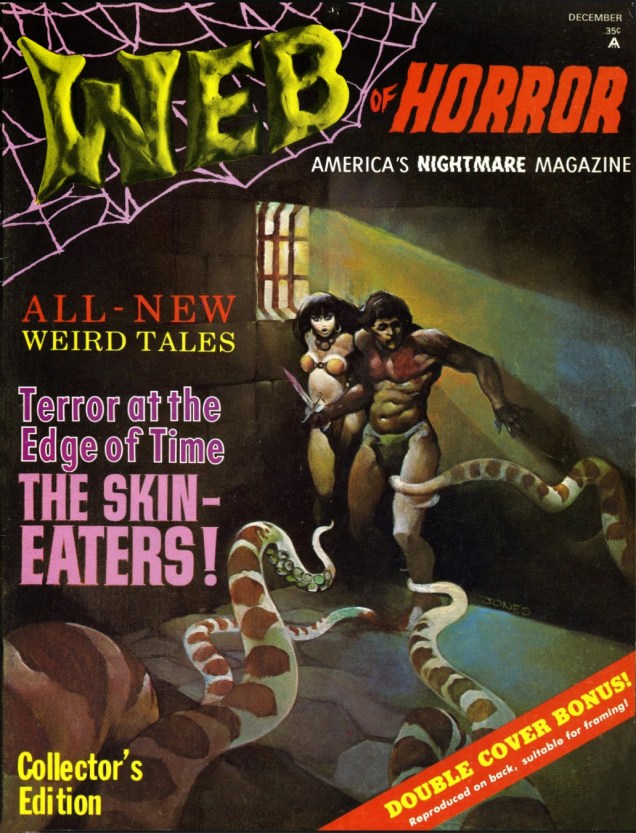
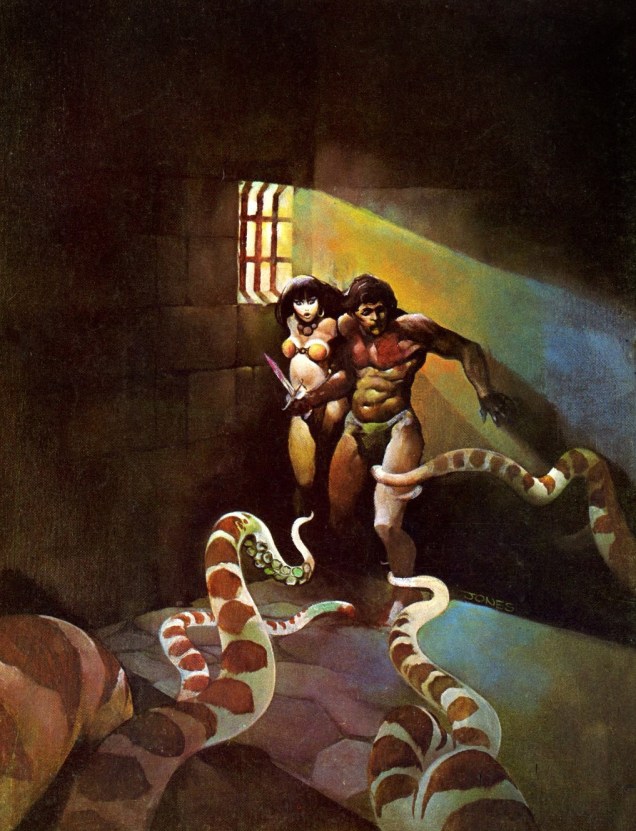
Web of Horror no. 1 (Major Magazines, December 1969). Painting by Jeff Jones.
I understand that the artist left quite a lot of empty space on purpose – to be filled with pointless text – but still, was it necessary to plaster nearly every inch of the image with captions yellow, red and purple? (I do like how the WEB seems to be made out of plasticine… and likely was.) Here’s the cover without all that wordy fluff:
The Rook no. 4 (Warren, August 1980). Cover by Nestor Redondo.
The Rook couldn’t quite kill the fishy brute’s whole family in #4, so he had to confront its slightly more colourful cousin in issue 7:
The Rook no. 7 (Warren, February 1981). Cover by Jordi Penalva. It’s nice to see that men (not exclusively Doc Savage) get strategically ripped shirts, too, sometimes. Eye candy!
Co-admin RG suggested I check Eclipse Magazine‘s tentacular offerings for this post, and he was correct, there was one issue involving an octopus used as a coffee table.
Eclipse Magazine no. 4 (Eclipse, January 1982). Cover by Carl Potts. I went snorkeling a few months ago and the scene was not dissimilar (minus, sadly, the mermaid).
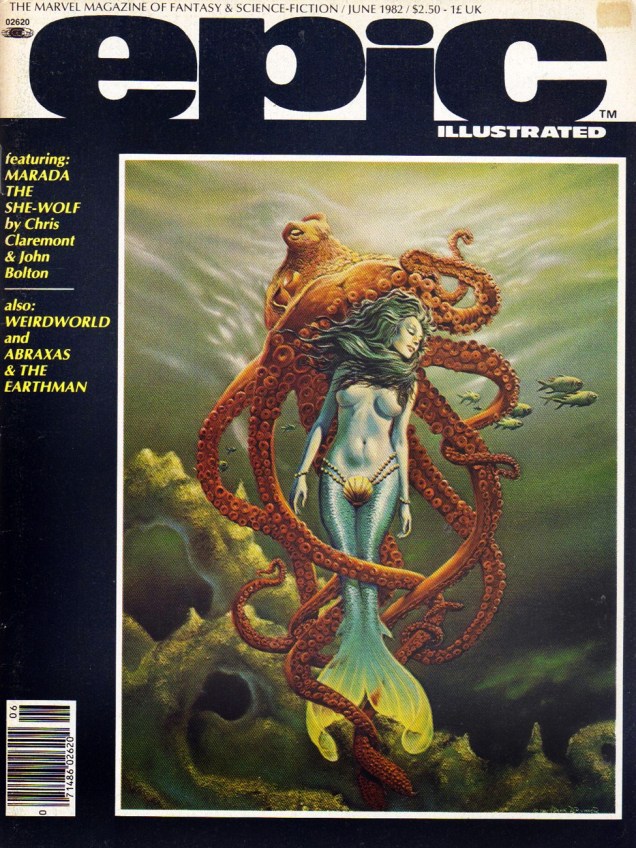
Marvel’s Epic Illustrated, with its 70-odd pages per issue, surely offered something for everyone. The aforementioned offerings were quite hit-or-miss, but the occasional presence of Stephen Bissette, Rick Veitch, Basil Wolverton (in reprints), Berni Wrightson, Ernie Colón, P. Craig Russell, et al. makes it worthwhile to go through its 34 issues (okay, maybe not all in one sitting, unless you have quite a few thermoses of tea prepared – or something stronger).
Epic Illustrated no. 12 (Marvel, June 1982), cover by Frank Brunner. You can read the whole issue here.
Brunner’s painting is rather nice – the mermaid and her friendly octopus both look so serene! – that here it is again. And read an interview with him while you’re at it: Legendary Feathers: Interview with Frank Brunner. (I apologize for linking to a website titled Fanboy Nation, though. Erk.)
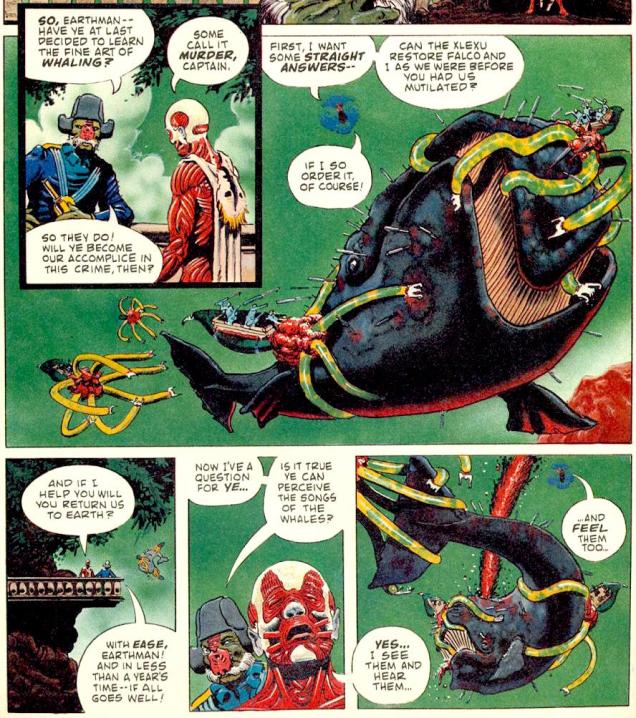
Issues 10 to 17 of Epic Illustrated featured Rick Veitch’s Abraxas and the Earthman, a purported retelling of Moby Dick (although frankly, aside from a vengeful squid, the similarities are not striking). Naturally, tentacles abound. Really freaky, creepy tentacles, much like the rest of the story.
Page from “The Hunt: Chapter Three”, written and drawn by Rick Veitch, printed in Epic Illustrated no. 12.Epic Illustrated no. 17 (Marvel, April 1983), cover by Tim Conrad. Read it here.
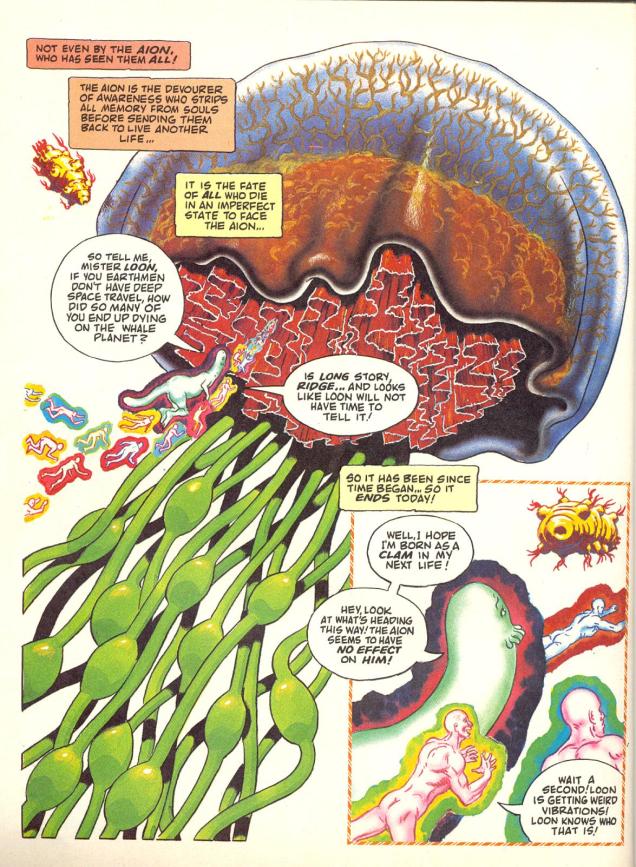
Veitch’s fucked-up (I mean that as a compliment), imaginative tale continues with “Man and Whale (Chapter Eight)”, the final installment. Alongside a plethora of sea-creatures (no longer in the sea), there’s this Devourer of Awareness, Bearer of Tentacles:
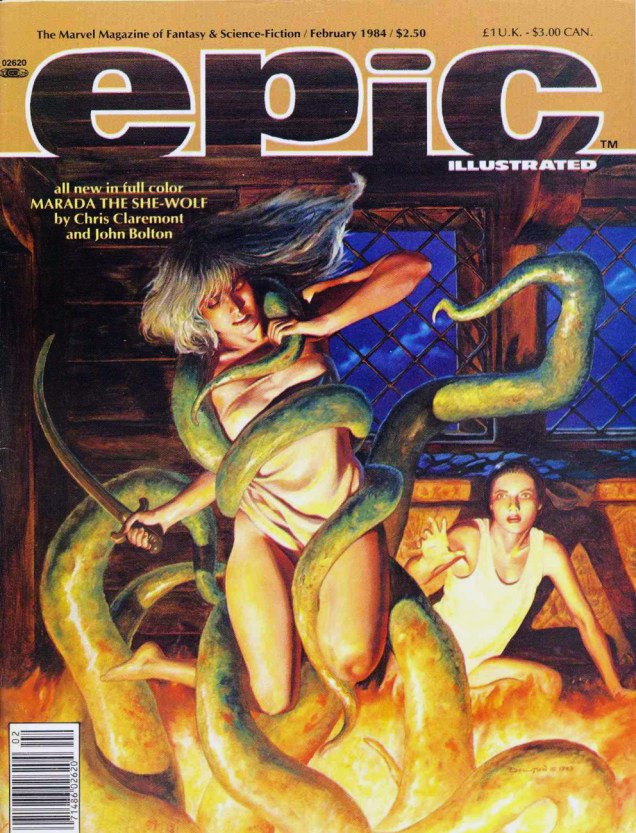
Epic Illustrated no. 22 (Marvel, February 1984). Cover by John Bolton. Read the issue here. It’s a bad, unconvincing cover, but hey, this is an inclusive post.
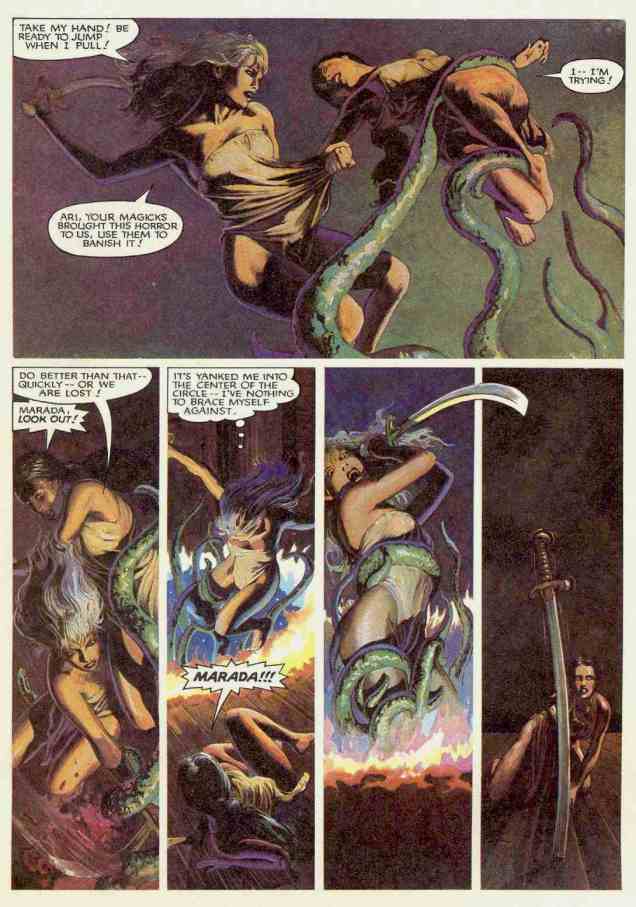
Speaking of Bolton, he drew “Wizard’s Masque” (another chapter in the cycle of Marada the She-Wolf), a story scripted by Christopher Claremont.



















































 Who's Out There?