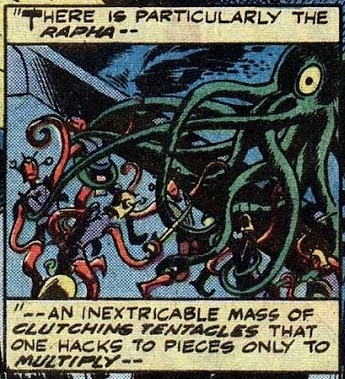
Tentacle Tuesday Dabblers: Gil Kane

When digging through comics in quest for tentacled material, one soon notices that Gil Kane‘s name tends to crop up again and again. Despite this seeming ubiquity, I’ve never specifically concentrated on his art, though he certainly has appeared in Tentacle Tuesdays before (quite a lot in Tentacle Tuesday: Conan-O-Rama, for instance).

I can’t quite put my finger on it, but one of the things that seems to bug me is that Kane, whose real name was Eli Katz and who was born in Latvia, threw himself with such vigour into American culture. It’s an unfair reproach, I realize – one can hardly expect a four-year old child to hang on to a quickly-receding memory of his parents’ motherland to the detriment of whatever culture he’s growing up in, not to mention that this would be unhealthy.

The crux of the matter is that I don’t grasp that je-ne-sais-quoi that people seem to find appealing about Kane’s art. Where others see “dynamic storytelling, emotionally charged characters, and innovative [sic] staged fight scenes“, I see overly busy, hard-to-parse scenes and stiff anatomy. It doesn’t help that the bulk of his oeuvre is concerned with a subgenre of comics I have strong misgivings about, namely superheroes.

To answer the question of what is it that makes Kane so special, I have naturally turned to Gary Groth:

GaryGroth-GilKane

That is certainly well argued, but I’ve read a few Kane interviews and his intellectualism is just clearly not on my wavelength at all. There’s no doubt that he was the analytical kind (this interview with him published in Alter Ego no. 10 (1969) calls him « the comics’ most articulate artist »), but what he says often strikes me as stilted (much like his art). Take this, for instance: « Craft is merely the springboard. It’s the ability to give wings to your expression; otherwise your expression bangs around in an inarticulate way and comes out thick and untutored; you’re just throwing away range and scope. » Let’s just say that Kane was a very opinionated man, which does him credit. Yet I get the impression that his inclination to pick at himself veered towards self-destructiveness, as if he were ever striving for some lofty heights he was aware he would never reach.

In that process of self-improvement (let’s call it that), he often slagged other artists who were operating on a different level from his. Even as he flattered them, his compliments felt incredibly back-handed, bringing to mind those people who never smile, trying to get their atrophied mouth muscles to do the job and achieving merely a sort of pained rictus. For instance, I’m a little sore about his description of Will Eisner, who « did little morality stories, which were very moving, but they had the quality of reading a children’s picture book; he could be quite dramatic, but always on a kind of innocent level. He never had complex, subtle characterizations…» or, again, « Eisner is a writer until you start talking about literature, and talking about the great writers of literature. Then Eisner is only a cartoonist. »

You can read the full interview over at Destination Nightmare.

All this being said, I do like *most* of today’s crop… save for the last two Kull the Destroyer covers, instances of the messy, rigid mises en scène I was carping about earlier. The best cover (imho) is inked by Tom Palmer, not so coincidentally. Co-admin RG has been heard to posit that Gil Kane should never have been allowed to ink himself.

And now I’d better stop displaying my ignorance and move on to the tentacles!
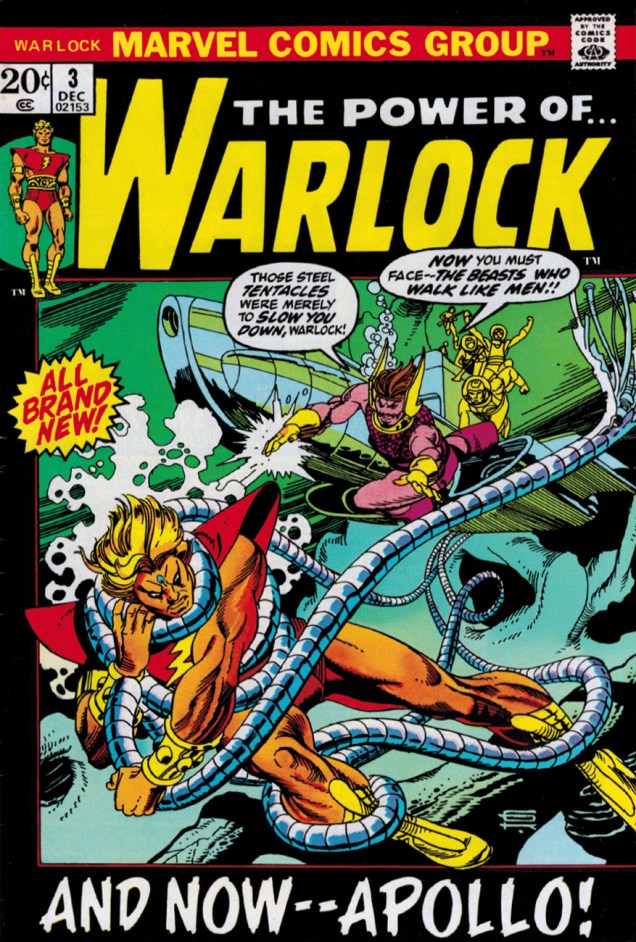
Warlock3-GilKane
Warlock no. 3 (December 1972). Cover by Gil Kane.
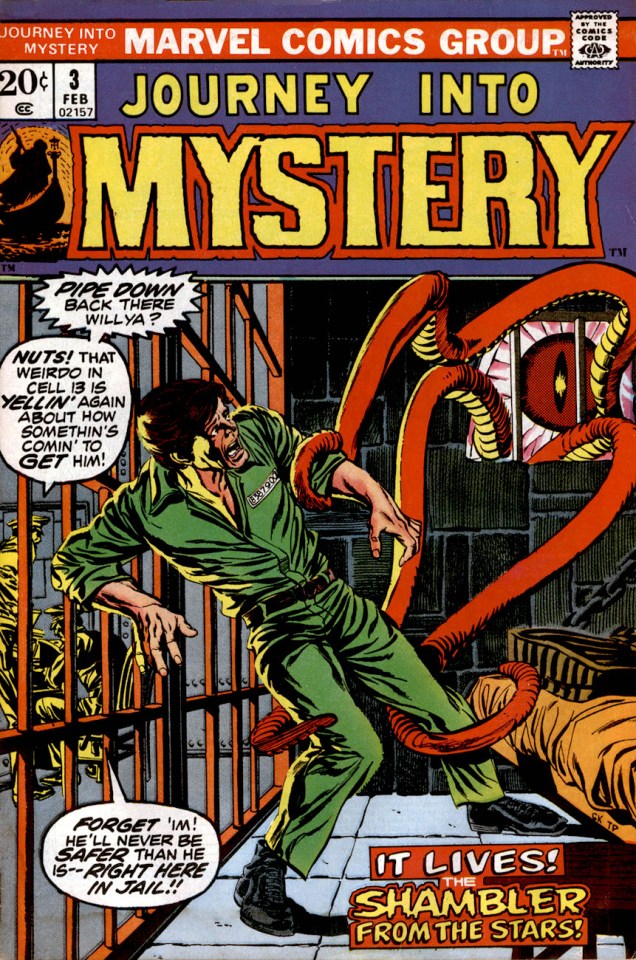
JourneyintoMystery3-GilKane
Journey into Mystery no. 3 (February 1973). Pencils by Gil Kane, inks by Tom Palmer.

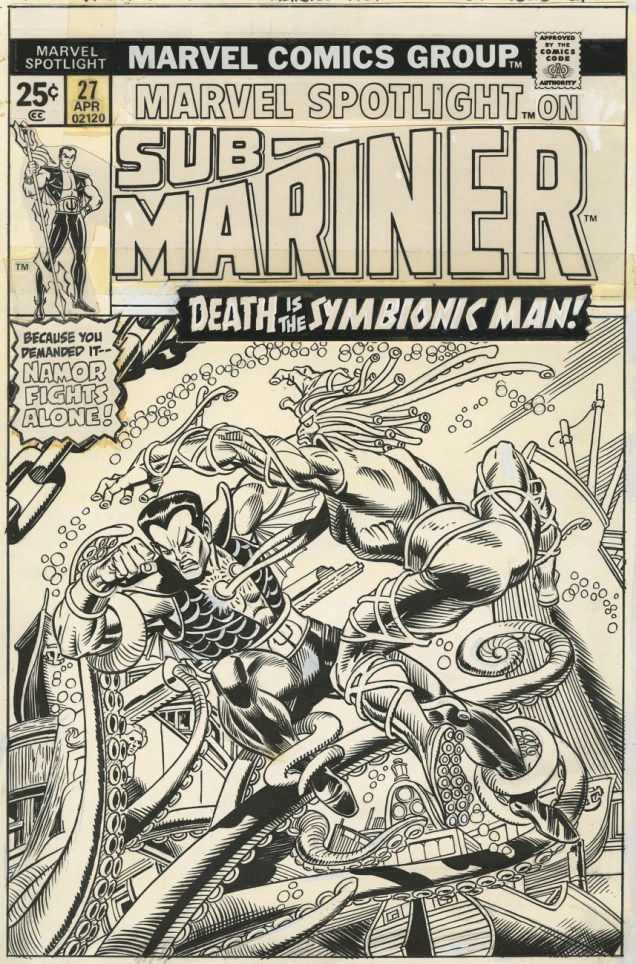
GilKane-MarvelSpotlight27.

The original art for Marvel Spotlight no. 27 (April 1976). Pencils by Gil Kane, inks by Frank Giacoia.

KulltheDestroyer17-GilKane
Kull the Destroyer no. 17 (October 1976). Pencils by Gil Kane, inks by Klaus Janson.
Kull heDestroyer21-GilKane
Kull the Destroyer no. 21 (June 1977), cover by Gil Kane.

~ ds

Tentacle Tuesday: Duck Feathers!

« I read some of my stories recently and thought, ‘How in the hell did I get away with that?’ I had some really raw cynicism in some of them… » – Carl Barks

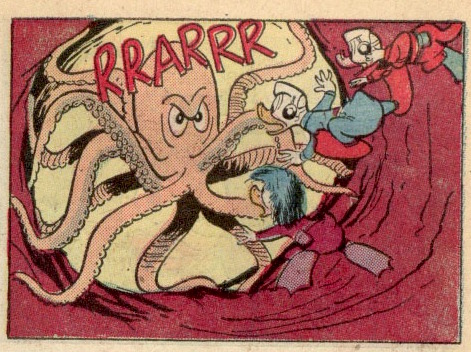
Like so many kids, I owe a lot of my interest in comics to Carl Barks, even though at the time I had no idea who he was – embarrassingly, up until today I’m not great at spotting his art. So much depends on what is available when one is growing up – and I used to enthusiastically dig through discarded piles of books at garage sales and whatnot, in quest for (among other things) for issues of Super Picsou Géant. Picsou is Uncle Scrooge’s French name, meaning something like “penny pincher”. These (true to their name) giant anthologies, just like pocket-book sized Archie compendiums, offered their readers pêle-mêle reprints of comic book stories both relatively new and also quite old, mixing prime Barks material with shitty European knock-offs with offerings by decent Barks disciples (see co-admin RG’s take on the latter).

UncleScrooge68-CarlBarks-HalloftheMermaidQueen2

Just like a Picsou Géant, this post has a few Barks covers and stories, and a few submissions by other folk… all viewed through my usual tentacle-specific lens. Dive in!

DonaldDuck109
Donald Duck no. 109 (September 1966), cover by Larry Mayer. Minimal tentacles, but that clock was just too cute not to share.
UncleScrooge68
Uncle Scrooge no. 68 (March 1967), cover by Carl Barks.
UncleScrooge68-CarlBarks-HalloftheMermaidQueen
Hall of the Mermaid Queen is by Carl Barks.

Somewhat off topic, but I was quite amused by the ending of this story. Is this was Barks meant when he talked about raw cynicism? 😉

UncleScrooge68-CarlBarks-HalloftheMermaidQueen3

UncleScrooge70-Carl-Barks
Uncle Scrooge no. 70 (July 1967), cover by Carl Barks.
UncleScrooge70-Carl-Barks-TheDoomDiamond
The Doom Diamond, the cover story, is also by Carl Barks.

No Tentacle Tuesday post would be complete without mechanical tentacles:

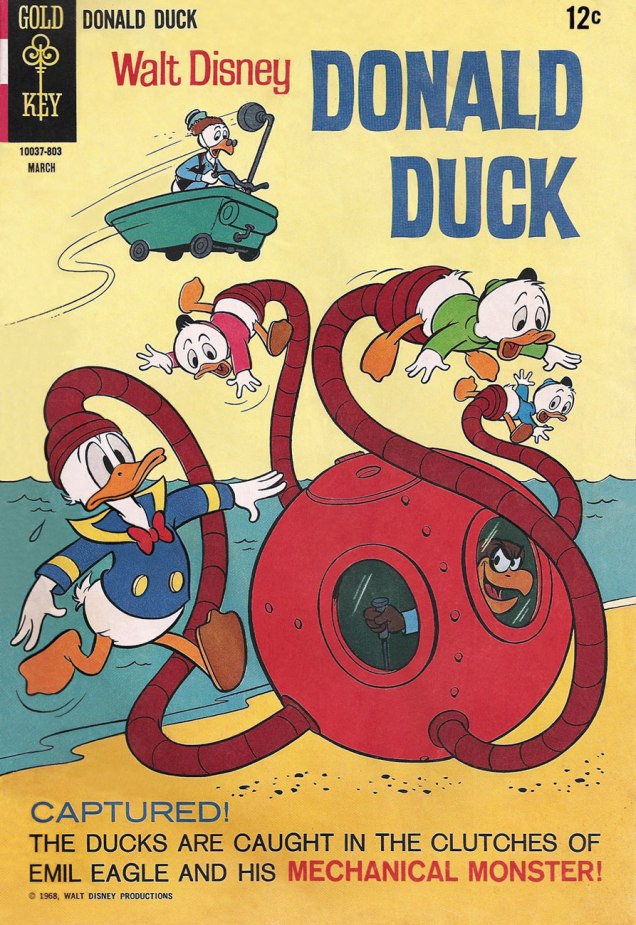
DonaldDuck118A
Donald Duck no. 118 (March 1968), cover by Tony Strobl on pencils and Larry Mayer on inks.
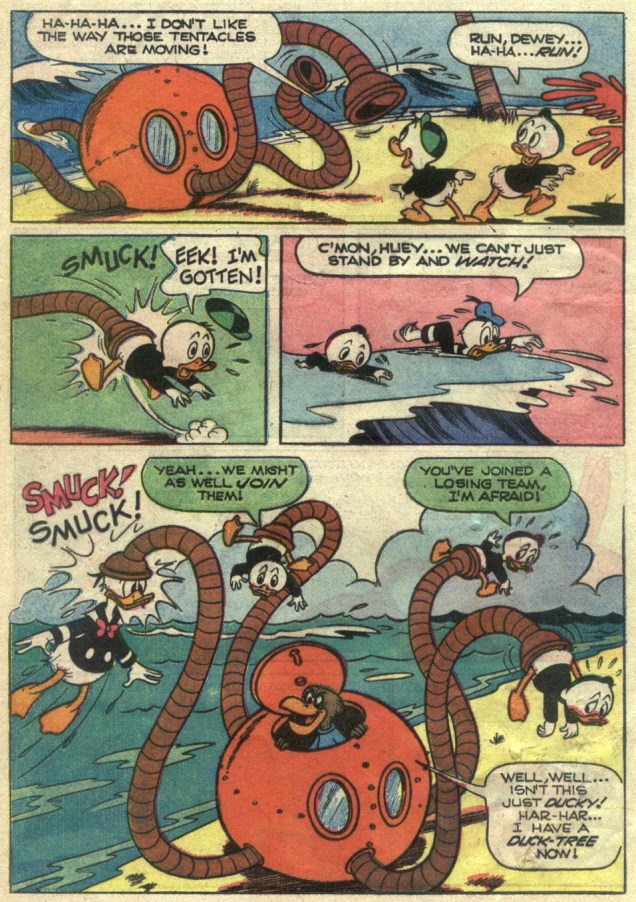
DonaldDuck118-MechanicalMonster-VicLockman
The Mechanical Monster is scripted by Vic Lockman, which is almost an iron-clad guarantee of inventive goofiness. Penciled by Tony Strobl and inked by Steve Steere.

DonaldDuck118-MechanicalMonster-VicLockman-2

Donald-Duck141
Donald Duck no. 141 (January 1972), cover by Larry Mayer.
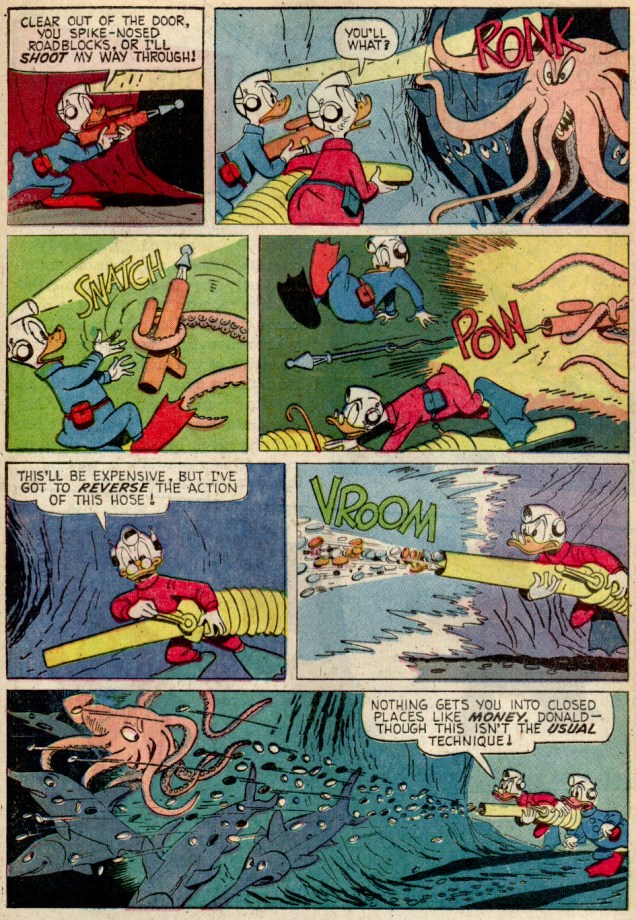
Donald Duck141-LarryMayer- The Tall-Tale Trail
The Tall-Tale Trail is penciled by Tony Strobl and inked by Larry Mayer.

Donald Duck141-LarryMayer- The Tall-Tale Trail-2

For this post, I wanted to concentrate on Gold Key publications, but at a later date there will be a follow-up post covering some other material.

~ ds

Tentacle Tuesday: Ugly Stickers Uglify the World

I say, the year’s first Tentacle Tuesday is a big responsibility! That’s why I’d like to start with some slimy or furry,  squirming or pitter-pattering, whimsical or gnarled, skittish or spine-chilling, drooly woolly creepy crawlies with toupees and bloodshot eyes. After all, the 2020s decade is sadly guaranteed to be full of ’em… but  of a significantly less cute variety than the lot that I’m featuring today.

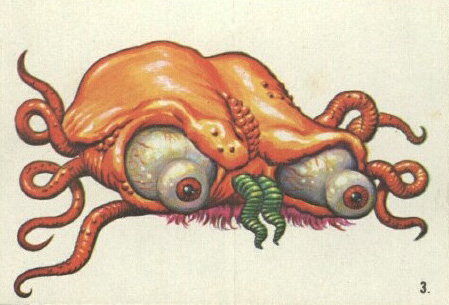
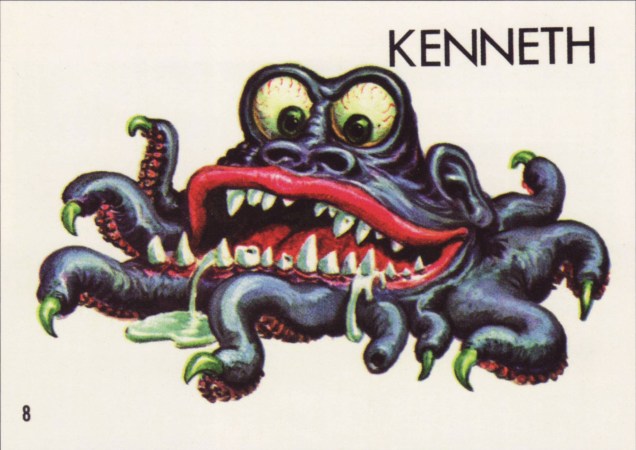
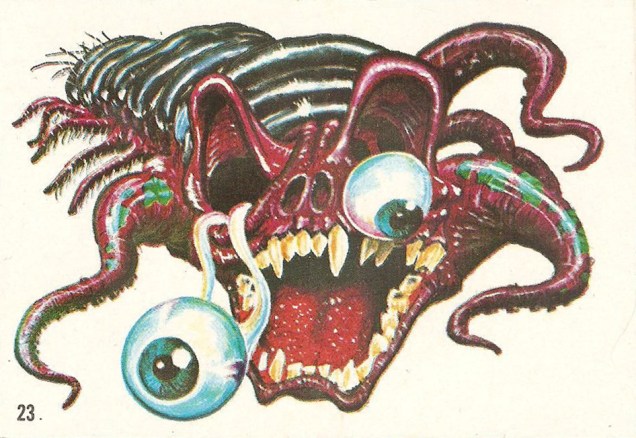
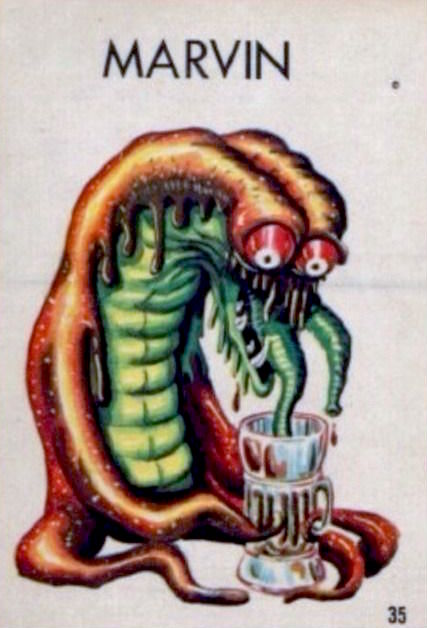
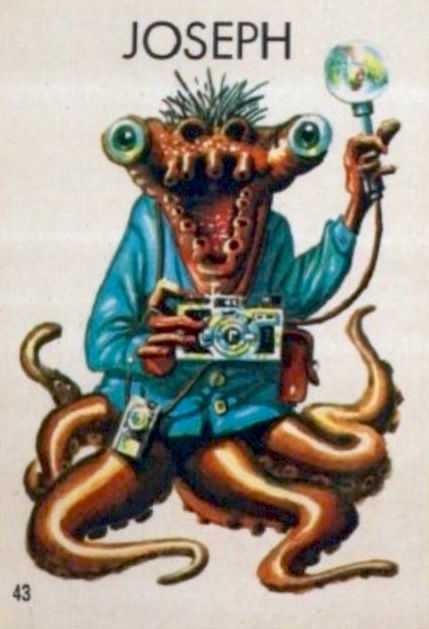
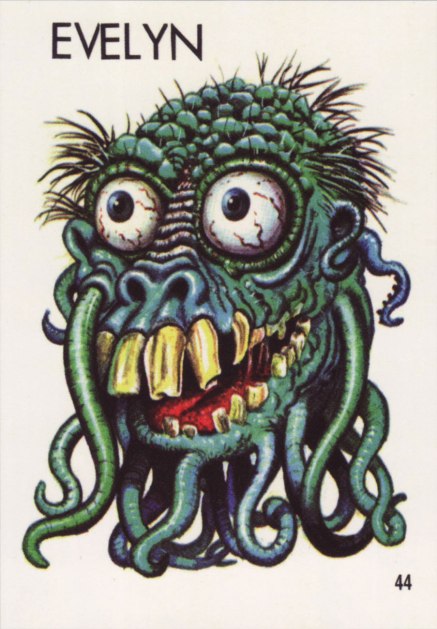
ToppsUgly Stickers have a lot going for them: excellently drawn, tongue-in-cheek monsters in various states of putrefaction. If there’s one commonality between them, it’s that most of them showcase teeth any dentist would be thrilled to drill through. Many of them have far more appendages that a regular creature needs… and a lot of these appendages are distinctly tentacular, which is of course where we come in! And they’re all cute as a button.

David Saunders, Norman Saunders’ son, explains in the latter’s biography (Illustrated, 2009):

«In 1965 Topps released Ugly Stickers. This set was initially based on the grotesque drawings of Basil Wolverton, but when he demanded copyright control, he was paid off for his first twelve images and then fired. The rest of the creatures in the set were designed by Norman Saunders and Wally Wood.

The creatures that appear on the display box, the wax wrapper, and the giant twelve-piece puzzle were all designed by Saunders. He also painted all 44 Ugly Stickers. These were so popular they were reissued in four later versions and even spawned a line of rubbery toys called Teacher’s Pets.»

So what’s the break-down? Out of the original 44 stickers, Wolverton designed 10. The rest were the handiwork of Wally Wood and Norman Saunders. The total set numbers 164. Not all cards were repeated in the re-runs, which is why the numbers don’t compute, for those of you who multiplied 44 cards by 4 versions and obtained 176, not 164; there were 4 groups of 40 cards + 4 non-repeated cards.

Monster Mash- The Creepy, Kooky Monster Craze In America
A page from Monster Mash: The Creepy, Kooky Monster Craze In America, 1957-1972 (Two Morrows Publishing, 2015), which you can read here.

In some print runs, the creatures did not have names, doubtlessly leaving that part to the reader’s imagination. Most cards, however, do have names, with genders shamelessly swapped, making guys into gals and back into guys again. Take a peek at the full list of name changes over at this very instructive website, Bubble Gum Cards.

ToppsUglyStickers3

Does s/he look like a Jacqueline to you? Or maybe an Edward? I vote for the former; such an elegant name for a bug-eyed, displeased brain-thing, Just look at the flair with which she wears that pink tuft of fur underneath.

Number3-UglyStickers-NamesA

SaundersWoodKennethA

ToppsUglyStickersIris

ToppsUglyStickersJames

ToppsUglyStickersMarvin

Joseph and Evelyn (or Stanley and Renée, or…) were previously used by my co-admin RG in his Hallowe’en Countdown III, Day 24 post, but they distinctly have tentacles, so I believe it’s worth running them again.

ToppsUglyStickersJoseph

SaundersWoodEvelynA

As a little bonus, here’s a lady from Topps’ 1966 Ugly Name Stickers series who asked to be included. Her name was… Donald, Sylvia, Angelo, Phyllis, Barney, or Rosemary. “Barney” is really pushing it!

Toppsno6uglystickers

Teacher'sPet-UglyStickers
A little friendly critter from the Teacher’s Pets series (probably…. these things are veiled in a shroud of mystery), which was a rubbery spin-off from Ugly Stickers.

~ ds

Tentacle Tuesday: Goodbye, 2019

This feels like a portentous occasion: the last Tentacle Tuesday of 2019. The mind boggles at the sheer number of tentacles we have released into the wild this year! As far as the splendour of this moment is concerned, there’s no reason for me to fight this feeling. Yet my general tendency at the year’s end – to throw in a lot of women fighting off tentacles (witness last year’s TT – “Foul as Sewer Slime!”) – is slightly one-track-minded, and it’s probably going to be my new year resolution to curtail that. Nah, just kidding.

Still: what *is* good is saying goodbye to the year in colour. So enjoy these not-quite-good, garishly coloured tentacle fiestas, and Happy New Year!

paintedEstebanMaroto-german Ehapa MOTU comic (
A painting by Esteban Maroto, a Spanish comic book artist whom you might know for his large body of work for Warren Publishing. He drew a hundred-and-one (presumably because that sounded good!) stories for Creepy, Eerie and Vampirella, which is a record only beaten by José Ortiz, another Spanish illustrator.
paintedEstebanMaroto-thing
Another one by Esteban Maroto. Are either of these fetching lads Dax the Warrior? I honestly have no clue. Anyone? (I’m told it’s the Masters of the Universe’s He-Man)

You know how I said, earlier, that I was one-track-minded? I’m not the only one. Yikes. This is a tame image, but the… wilder… ones were in black and white, and I had to stick to my theme. See the sacrifices I make?

EstebenMaroto-Druuna-TentaclesA
Maroto’s hommage to Serpieri’s Druuna (see Tentacle Tuesday: tentacles that get in your face.)

Do visit Maroto’s website, tentacles abound (generally revolving around naked women).

paintedNestor Redondo Painted Fantasy Cover Original Art
Is it redundant to have yet another illustration by Nestor Redondo? (I featured one in last week’s Tentacle Tuesday). Perhaps. But it has many intriguing details: the octopus is both scarily human and quite alien (also, in bad need of braces!), the young maiden looks far too young to be subjected to the lascivious caress of a tentacle, and the old witch’s breasts are… a strange combination of realistic and anatomically suspect.
paintedSanjulian
Illustration by Manuel Sanjulián, a Spanish painter and fellow Warren alumnus. Hey, this is shaping up into some sort of celebration of Spanish art. That’s all right with me.
JeffSlemon
Cover for Robot 13 no. 1 (cover variant B), July 2009, art by Jeff Slemons.

While we’re at it, from the same artist, here’s his Elvis‘n’tentacles:

JeffSlemons-Elvis
Distinctly in the category of “why the hell not?”
Rocket Girls by Don Marquez
A Frazetta-ish painting titled Rocket Girls by Don Marquez, in which, as per the official description, “the girls meet the Tentacle Thing!” The Tentacle Thing has a bloodshot eye because he’s had too much bloody champagne.

…. preceded by “The Rocket Girls run into a thing that is all tentacles and eyeballs.

rocket-girls-watercolor-painting-don_1_4767bcb96df9be3d4328cfa7497c6767
The girls all look like clones… except for varying bust sizes. Marquez really went overboard with the one on the left, if you ask me – I’m surprised she can hold up a gun at all. The gals seem to be consumed in increasing order of bra size… that monster is a connaisseur.

And on that fitting note, happy celebrating!

~ ds

Tentacle Tuesday: Inky Black and Snowy White

It’s not every day that Tentacle Tuesday lands on Christmas Eve! I hope you have pleasant plans for the night, if not involving an epic Christmas tree and impeccably-wrapped presents, then at least a lot of booze. In the meantime… I present you with this short and sweet gallery of classy black and white images by some quite well-known illustrators (with one foot, or more, in the comic world, this being, after all, a blog about comics).

BruceTimmSonjaA
Bruce Timm‘s portrayal of Red Sonja. Has he made her into a blonde? It’s possible. Blondes do have more fun… grappling with tentacles.
ArtofNestorRedondo
Illustration from The Art of Nestor Redondo (Auad Books, 2016). I can’t guarantee that these are indeed tentacles, and not sea serpents or something… but hopefully the spirit of festive generosity will ensure my audience forgives me.
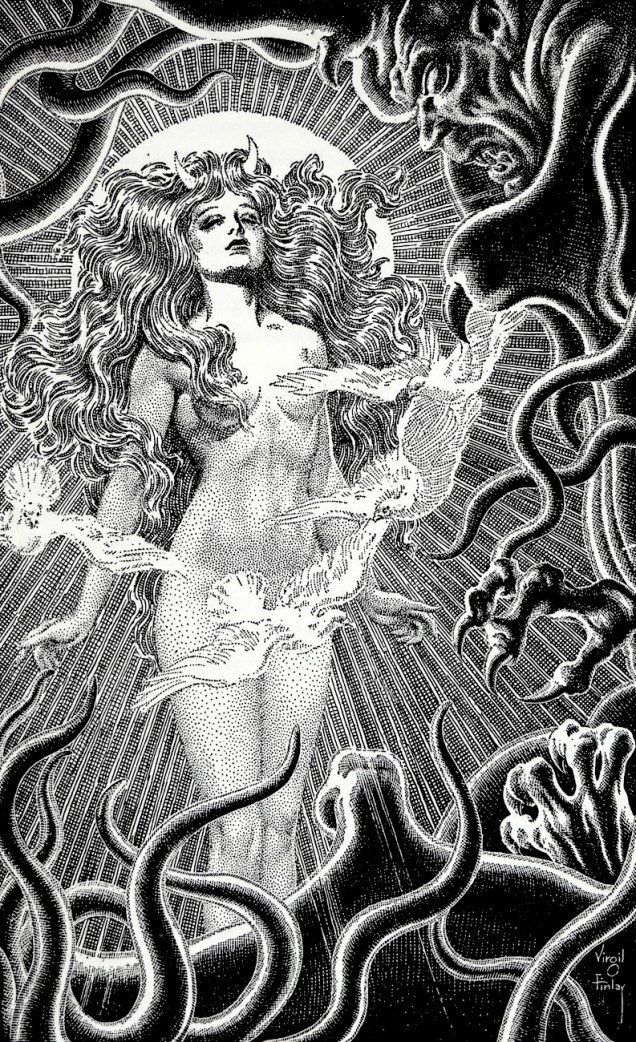
Art by Virgil Finlay for the 1949 Memorial Edition of "The Ship of Ishtar" by A. Merritt
Including a Virgil Finlay damsel-with-tentacles in this post isn’t as much of a stretch as one could think – he has done *a few* comic stories, and besides surely influenced more than a generation of cartoonists and illustrators. This is a vision he created for the 1949 memorial edition of Abraham Merritt’s The Ship of Ishtar.
VirgilFinlay-octopus-tentacles
Another Virgil Finlay illustration with adorable octopuses (whose gills make them look rather like mushrooms with tentacles – not unheard of; this link, though awesome, is not for the faint-hearted*).
zak-17-cent-sss«Luxúria no fundo do mar», n.º 7, 15 junho 1976
Zakarella, a comics magazine launched in 1976 in Portugal, mostly re-published choice stories from Warren’s Creepy.  Zakarella herself was the Portuguese version of Vampirella, but considerably more twisted… or, rather, put into some rather fucked up situations and subjected to the perverted sexual whims of monsters from Hell and whatnot. Her stories were drawn by Roussado Pinto (under Ross Pynn) and illustrated by Carlos Alberto Santos. Please visit the blog Almanak Silva for a wittily-written history of Zakarella… or, if you don’t read Italian (personally, I used Google translate), just ogle the images. This is a panel from Luxúria no Fundo do Mar, published in Zakarella no. 7 (June 1976).

~ ds
*The article I linked to also contains this not entirely tentacle-related, but amazing (especially if, at heart, you’re a kid who’s into creepy things) explanation:

Dog Vomit Slime Mold: This creature isn’t technically a plant or a fungus, but it is one of the most fascinating creepy-looking things in nature. “It’s basically a giant amoeba,” Hodge says. “Usually, you can’t see an amoeba with the naked eye. But the dog-vomit is the size of a dessert plate.” She adds that she gets a lot of phone calls about the dog vomit slime mold, which often turns up in people’s garden mulch. “They look weird, and they freak people out.” she says. Even creepier, this huge single-celled blob can crawl. “They ooze around for a while, and then they convert themselves into spores,” Hodge says. “Although it’s not really a spore,” she adds, “because it hatches like an egg and a little amoeba crawls out.” That’s the point when I almost dropped the phone. But Hodge was nonplussed. She teaches a summer course about fungi, and she gives her students slime molds to take home and raise. “You can watch them just cruising around on the petri dish, eating oats.” Some of the students really bond with their slimy little pets, she says: “It’s my campaign to convert people to lovers of stinkhorns and slime molds.”

Tentacle Tuesday: le mardi des tentacules, parbleu!

In my ceaseless quest for tentacles, once in a while, I return to a previous theme – in this case, the Franco-Belgian tradition of comics. To start at the beginning, visit Tentacle Tuesday, Franco-Belgian edition parts 1 and 2, and Tentacle Tuesday: Tentacules à la mode.

We start some 70-some years ago, with an issue of Bob et Bobette, a Belgian feature created by Willy Vandersteen in 1945. Well, to be more precise, the latter created Suske en Wiske — when the strip became popular in its native De Standaard (a Flemish daily newspaper), it was picked up by Tintin magazine, after Vandersteen agreed to modify it somewhat according to Hergé (who was the magazine’s artistic director) and his Ligne claire guidelines. The main characters were renamed – far from the last time that happened: in Britain, they were known as Spike and Suzy, and as Willy and Wanda in the United States.

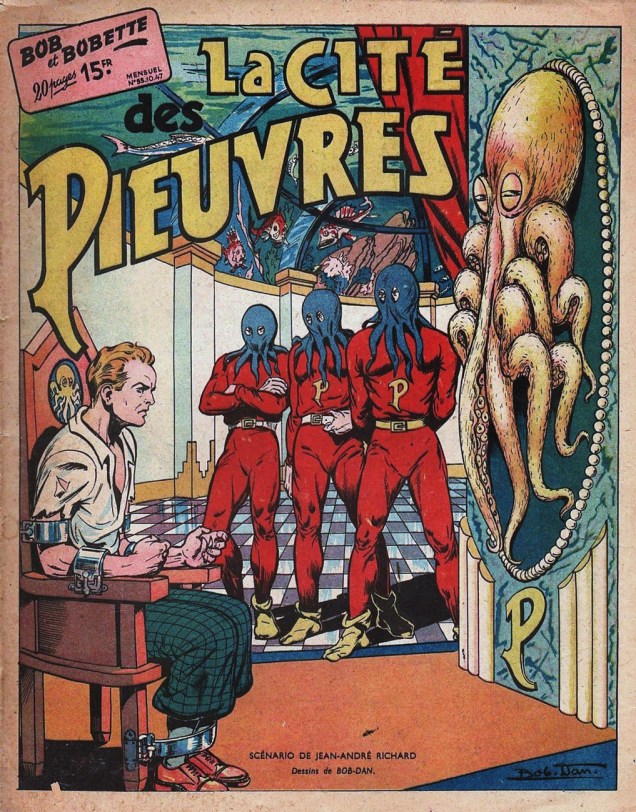
BobetBobette-Lacitédespieuvres
Bob et Bobette no. 55: La cité des pieuvres (1947). Scripted by Jean-André Richard and illustrated by Robert Dansler, who was often known as Bob Dan. That lovely sepia paper… I can just smell it.

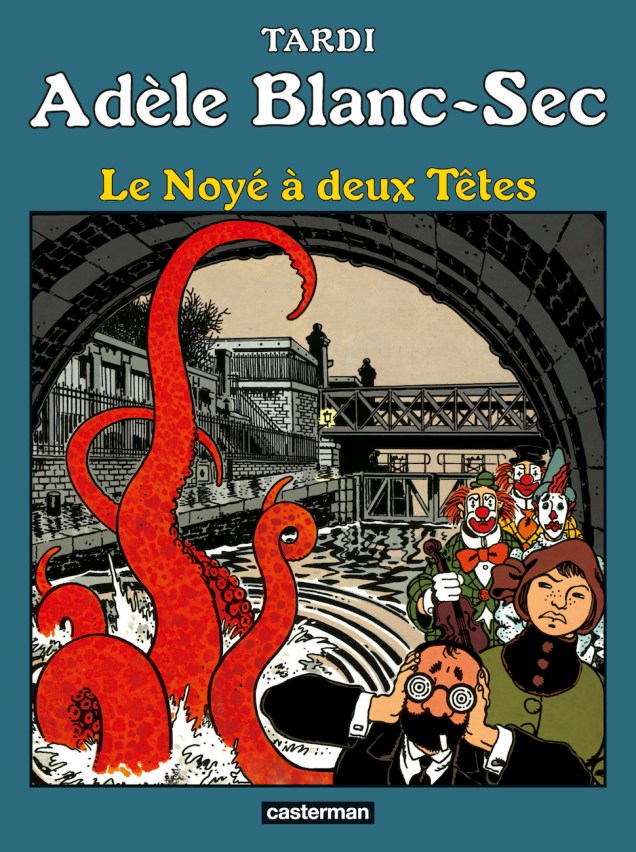
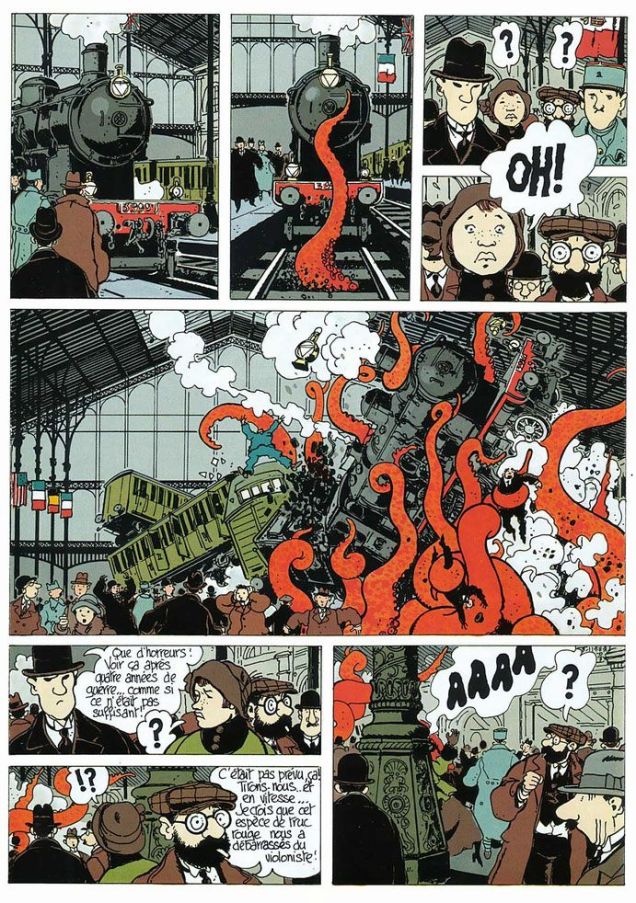
I’ve never read a whole album of The Extraordinary Adventures of Adèle Blanc-Sec, though I like its premise (an intrepid, independent héroïne? yes, please) and Jacques Tardi‘s art (depending; sometimes I love it, sometimes I’m indifferent, but it’s certainly good enough for purposes of following a story). Chalk it down to something I never got around to, I guess. Irritatingly, in 2010 we have been *ahem* ‘blessed’ with a movie based on this comic, directed by the ever sharp-witted Luc Besson (who royally fucked up a movie adaptation of Valérian et Laureline in 2017, so he seems to be making this into a specialty).

French-Tardi-lenoyeradeuxtetes
Le Noyé à deux têtes is the sixth volume of Les Aventures extraordinaires d’Adèle Blanc-Sec, a series by Jacques Tardi. In 1984, it was serialised in À suivre, a Franco-Belgian magazine, and collected as an album a year later (both by Casterman).
French-Tardi-lenoyeradeuxtetes-tentacules
A peek at the tentacles within.

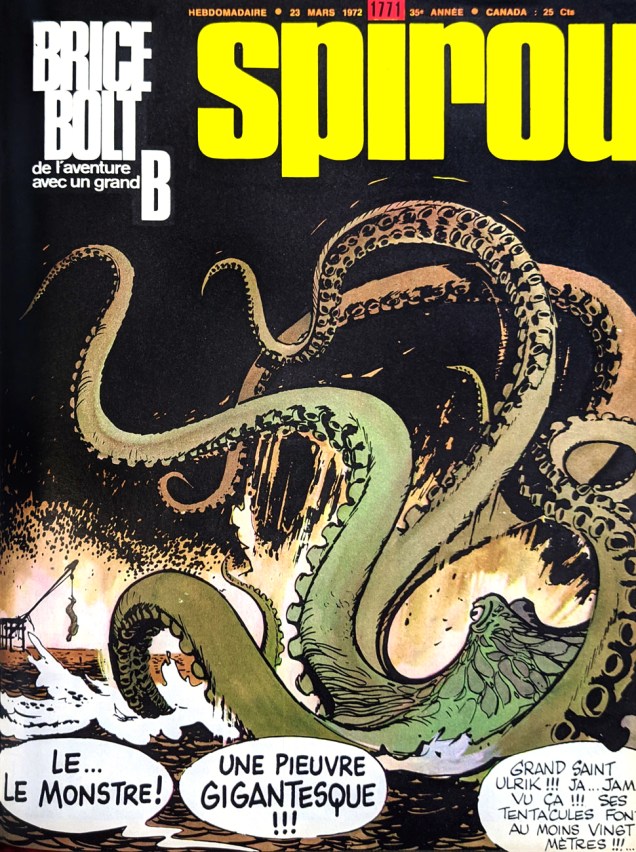
I mentioned the comics magazine Le journal Tintin earlier – here’s a cover from its competitor, Spirou (Le journal de Spirou), published by Éditions Dupuis since 1938. The respective publishers (Raymond Leblanc for Tintin, and Charles Dupuis for Spirou) of these magazines had a gentleman’s agreement: an artist’s work could only be published in one or the other, never both. Incidentally, there was an interesting exception in the case of André Franquin, who moved his wares from Spirou to Tintin after a quarrel with its editor – and, contractually obligated to work for Tintin for five years, simultaneously continued to provide Spirou with stories.

Spirou1771BriceBoltA
Spirou no. 1771 (march 23rd, 1972), art by Puig. Brice Bolt, a feature launched in 1970, was soon abandoned after but two episodes (although to be fair, they were lengthy – the strip lasted until 1972)… from the sound of it, for being a little too modern for its time. After the publication of the first chapters, letters came in complaining that the story was too scary, the animals too monstrous, the illustration style too realistic. The “monstrous animals” included an army of giant crabs, a behemoth squid (just up our street!), colossal vampire bats, and ginormous Komodo dragons.

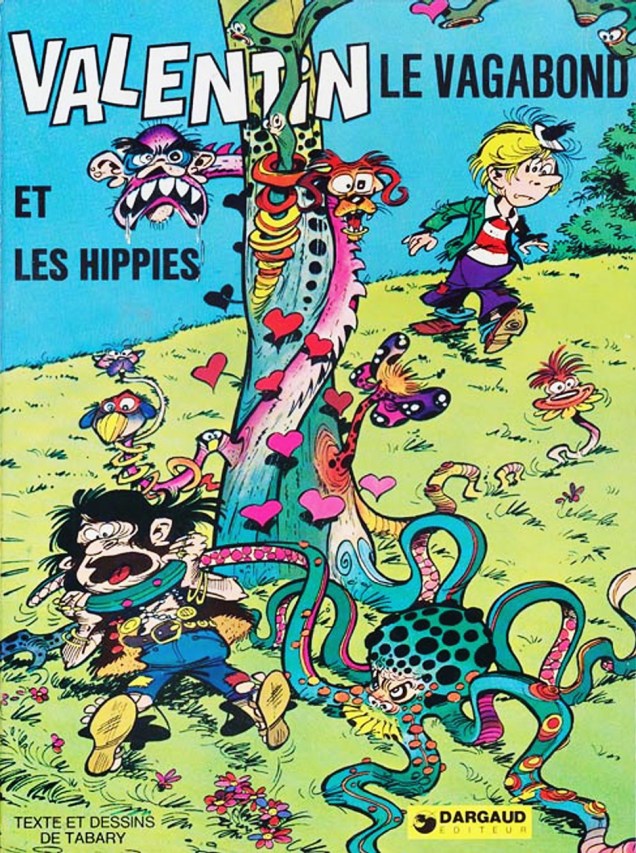
Valentin le vagabond was created by René Goscinny et Jean Tabary in 1962 for publication in Pilote. After 1963, Tabary carried on alone, scripting and illustrating all by his lonesome, Goscinny having his hands full with other projects. Valentin le vagabond et les hippies is the final story of this series, originally serialised in issues 709 to 719 in 1973.

Valentinlevagabond-Valentinetleshippies
Valentin le vagabond: Valentin et les hippies (Dargaud, 1974). Story and art by Jean Tabary.
ValentinHippiesA
An excerpt from Pilote no. 719 (1973). The tree is a hippie tree, as it was treated with LSD… now it’s got tentacles. Naturally.

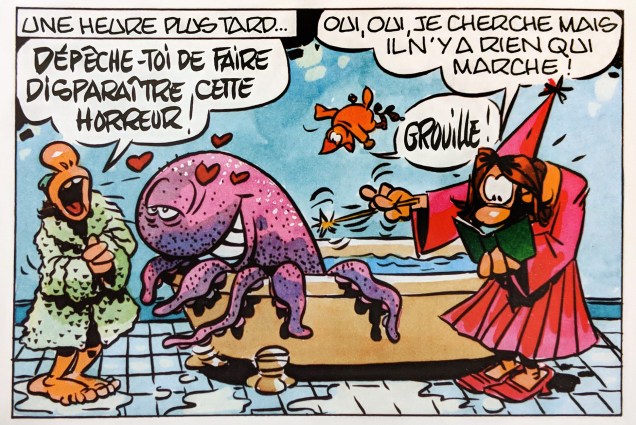
The French are surely not immune from scatological humour. The Kaca fairy (I’ll give you three guesses for what “kaca” means in French) is a rather inept witch. She accidentally conjures up an octopus who’s a little too intent on being liked, and the rest of the comic deals with the attempts to whisk him away again.

FeeCaca-1
« Hurry up and make this monstrosity disappear! » « Yes, yes, I’m looking, but nothing works! » Panels from La fée Kaca (Humanoïdes Associés, 2007) by Florence Cestac.
FeeCaca-2
The octopus tries to convince everybody that they should allow him to stick (ha, ha) around – « for instance, I stick myself to the wall and leave you with all the room you need! ».

~ ds

Tentacle Tuesday: Won’t Someone Think of the Children!?

« Make it a rule never to give a child a book you would not read yourself. » ― George Bernard Shaw

Indoctrinating children has to start early – if you want to make sure the aforementioned little ones will share your obsessions and spend their lives in a futile quest for the same peccadilloes you wasted your youth on, it’s best if you start proselytizing even before they can read. To that effect, quite a few authors of children’s comic books made sure to focus on cephalopods. I am happy to provide you with this abridged list of where to start when you need to convince some tot in your care that 1. octopuses are cool and 2. that they are entirely too intelligent and fascinating to ever be eaten.

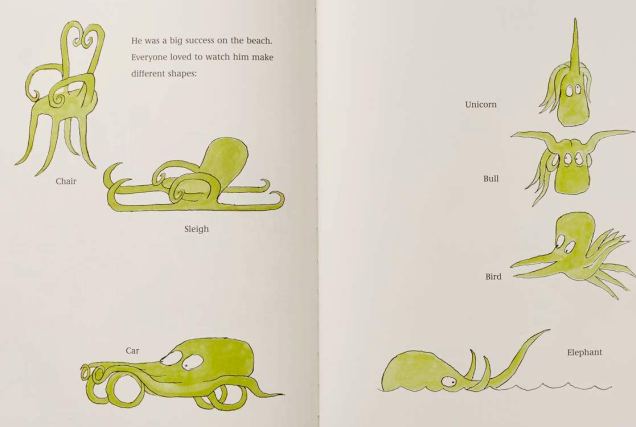
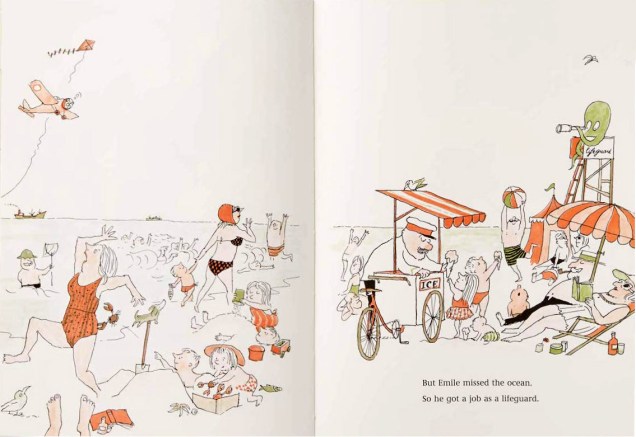
Pages from Tomi Ungerer‘s Emile: The Helpful Octopus (first published in 1960):

EmileTheHelpfulOctopus-TomiUngerer

EmileTheHelpfulOctopus-TomiUngerer2

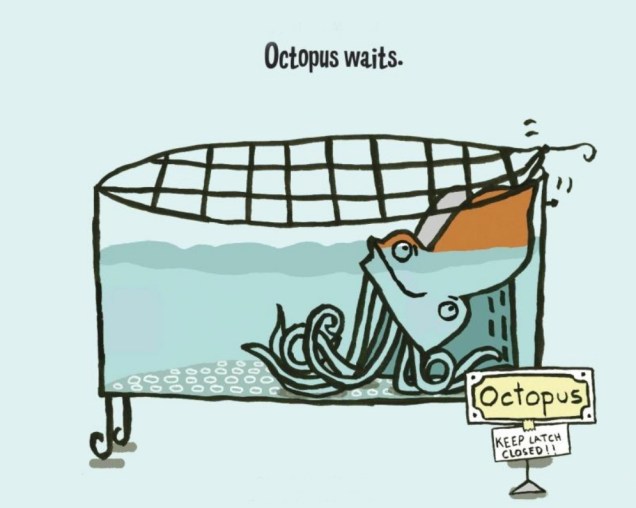
Pages from Octopus Escapes! (2018), written by Nathaniel Lachemeyer and illustrated by Frank W. Dormer:

OctopusEscapes--Nathaniel-Lachenmeyer2

OctopusEscapes--Nathaniel-Lachenmeyer

A page from Also an Octopus (2016), written by Maggie Tokuda-Hall and illustrated by Benji Davies:

AlsoAnOctopus

Page from Touchy the Octopus Touches Everything (2019), written by Amy Dyckman and illustrated by Alex Griffiths:

Touchy the Octopus Touches Everything

Before someone complains that this post doesn’t include any “real” comics (what kind of pedant are you, bubba?):

Dexter'sLaboratory16
Dexter’s Laboratory no. 16 (December 2000), pencilled by Genndy Tartakovsky and inked by Bill Wray.
Dexter'sLaboratory16-DeeDee'sPonyTale
Splash page from Dee-Dee’s Pony Tale, scripted by John Rozum, pencilled by John Delaney and inked by Jeff Albrecht. Did children really need to see a unicorn pony transformed into a three-headed Slavic dragon with tentacles? Well, yeah.
CartoonCartoons23
Cartoon Cartoons no. 23 (December 2003), cover by Bill Wray.
CartoonCartoons23-SunkenLeisure
Page from Sunken Leisure, scripted by Robbie Busch, pencilled by Stephen DeStefano and inked by Bill Wray.

Finally, as a treat for the adults in the audience, I’ll end on an uplifting note (quite necessary after all that carnage by Dexter et al.): a cartoon by Jüsp (who ist tot, which is to say is dead – he died in 2002), published in Die Woche, an German illustrated weekly newspaper published from 1898 to 1944.

OctopusHandshakeA

~ ds

Tentacle Tuesday: A Child’s Garden of Carnivorous Plants
« Drosera’s snap tentacles — which can sense moving prey — catapult insects directly onto the glue tentacles at the plant’s center, where the prey is digested. What’s more, the catapult system is very effective—the insect almost never escapes. » (source)

Which child hasn’t passed through a temporary fascination with Venus flytraps in particular, and carnivorous plants in general? From there it only takes a tiny shift of the imagination to arrive at man-eating plants, which grab their victims with murderous tentacle-like tendrils, crawling vines and grabby creepers. Today we delve into one of my favourite sub-categories of tentacle obsession: plant tentacles.

This spine-chilling greenery often deploys its lethal vines in some remote corner of the Earth (well, in comics, at any rate). This, I firmly believe, is far scarier than the idea of other planets harbouring these carnivorous forms of life. After all, our chances of landing on Mars or somesuch are slim, and we’re a lot more (though not very) likely to wind up in some mysterious jungle.

But first, we deal with that old trope about a power-mad scientist breeding some man-devouring monstrosity in a pot, garden or greenhouse.

ShadowV2No8
Shadow Comics v. 2 no. 8 (November 1942, Street & Smith), cover by Vernon Greene.
ShadowComicsV208-HorrorHouse
Page from Horror House, the cover story, scripted by Walter Gibson and illustrated by Jack Binder.
BlueRibbon19
The Botanist of Death, scripted by Joe Blair and illustrated by Lin Streeter, was published in Blue Ribbon Comics no. 19 (December 1941, Archie)
Geschichten geschichten550
 Gespenster Geschichten no. 550. One would think that a vampire getting restrained by a carnivorous plant is actually a *good* thing, but the lady seems unimpressed. Maybe she wanted to get bitten?

When I was a wee girl, my dad would give me piles of adventure books to read. Quite a few of them involved some intrepid explorers discovering (or literally falling into) a jungle (often hidden in some volcanic crater) in which prehistoric creatures had somehow survived (among the novels I remember reading were Sannikov Land and Plutonia by Vladimir Obruchev, The Lost World by Conan Doyle, Journey to the Center of the Earth by Jules Verne, The Land That Time Forgot by Edgar Rice Burroughs, etc.) Cue dinosaurs and woolly mammoths! As I loved dinosaurs, I didn’t mind this recurring theme, which by now seems a little, shall we say, hackneyed.

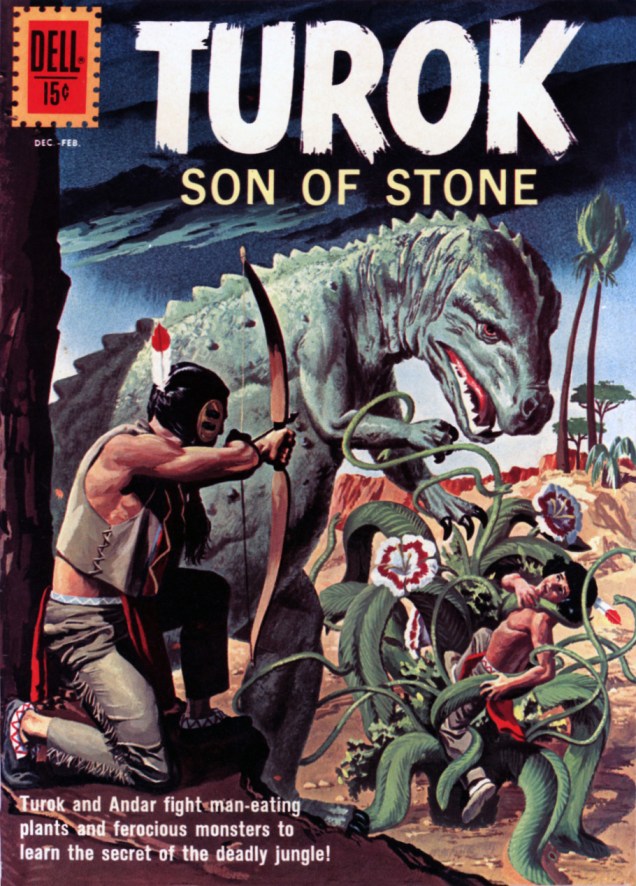
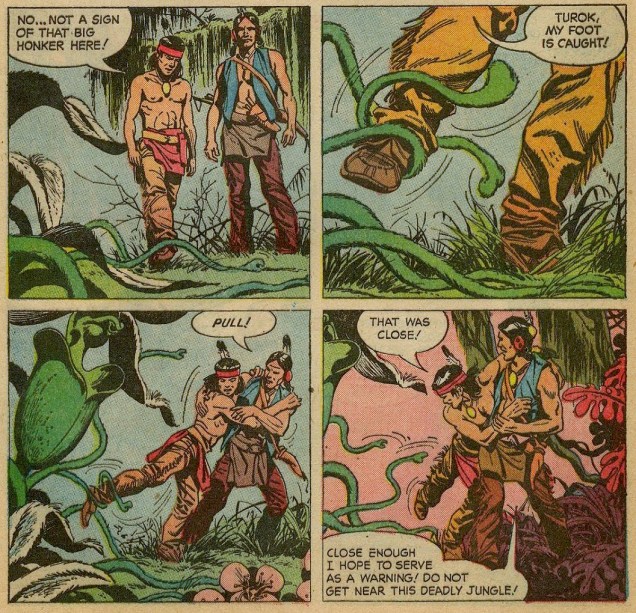
Turok,-Son-of-Stone#26
Turok, Son of Stone no. 26 (Dec. 1961-Feb. 1962, Dell), cover by George Wilson.

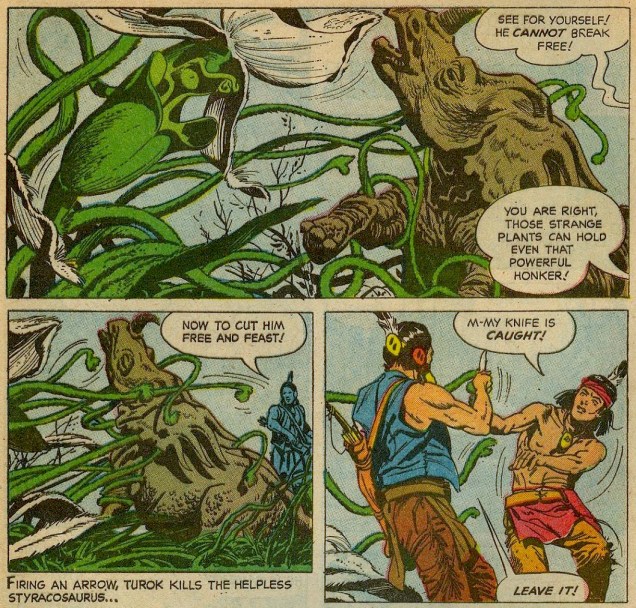
The cover story, The Deadly Jungle, is scripted by Paul S. Newman, penciled by Giovanni Ticci and inked by Alberto Giolitti.

Turok, Son of Stone no. 26-TheDeadlyJungle

Turok, Son of Stone no. 26-TheDeadlyJungle2

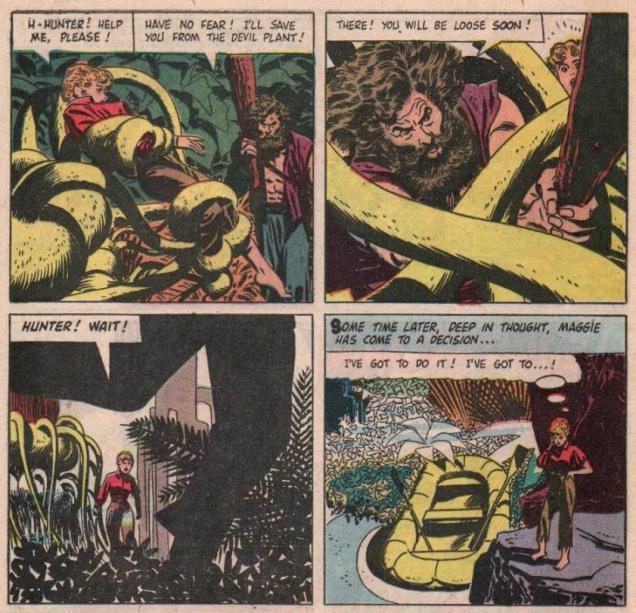
Very much on topic is this installment of Land Unknown (a comic adaption of the 1957 science fiction movie), scripted by Robert Ryder and illustrated by Alex Toth, published in Four Color no. 845 (August 1957, Dell).

Colour845-AlexToth

Colour845-AlexToth2

I shall doubtlessly return to this topic again. In the meantime, visit Plants sometimes have tentacles too and The Hungry Greenery.

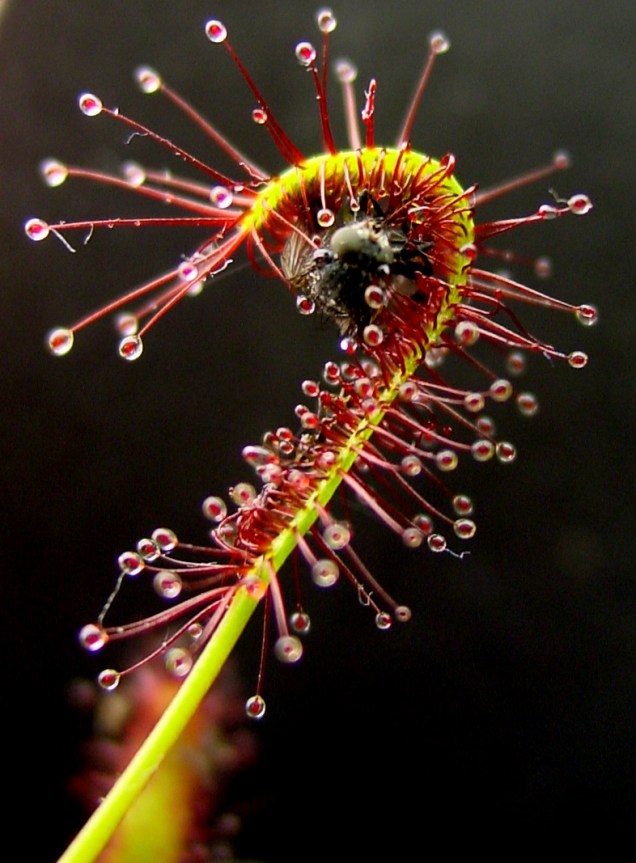
By the way, the Drosera plant (more precisely, a genus that includes about 152 species) – called Sundew in common parlance – is not only lethal, but beautiful, too.

Drosera_capensis_bend
A real-life plant tentacle in action – goodbye, little insect.

~ ds

Tentacle Tuesday Masters: Tony Millionaire

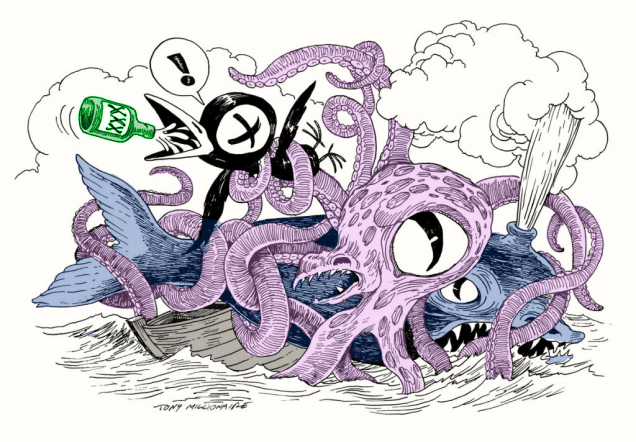
Once upon a time, in a kingdom beyond the seven seas, a little boy lived under the name of Scott Richardson in a seaside town (let’s call it Gloucester and pretend it’s in Massachusetts). His whole family were artists, and he would watch his grandparents paint the sea, the ships that sailed it and the people who commanded the ships. It must have come as no surprise at all when the boy, too, started to draw. Eventually, he grew up, moved around a lot, almost started a major war and somewhere along the way, acquired the nom de plume of Tony Millionaire (which, according to him, « comes from Old French. It means a person who owns a thousand slaves. Serfs, not slaves. »

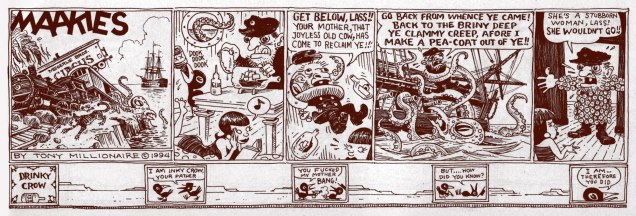
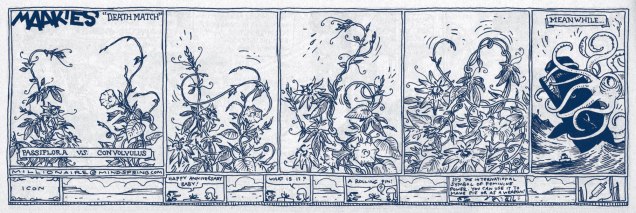
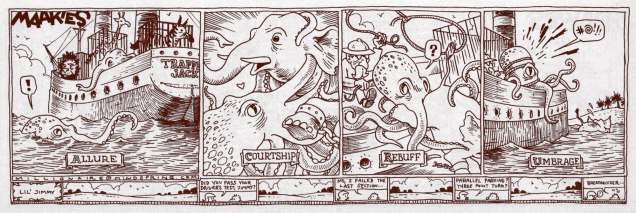
How’s that for a little fairytale? You will forgive me for the jejune introduction, but something about Millionaire’s art is magic. It is easy to underestimate how good an artist he is because his art is so cartoony, and his characters so outlandish: his award-winning, syndicated strip Maakies, for instance, concerns itself with a perpetually blotto stuffed crow (Drinky Crow) and his best pal, a sock monkey (Uncle Gabby). Both were TM’s childhood toys. All children make up stories about their playthings. What’s magic isn’t that he was able to create a world for his toys to inhabit, it’s that he was able to pull us, the audience, in with him.

TonyMPortrait

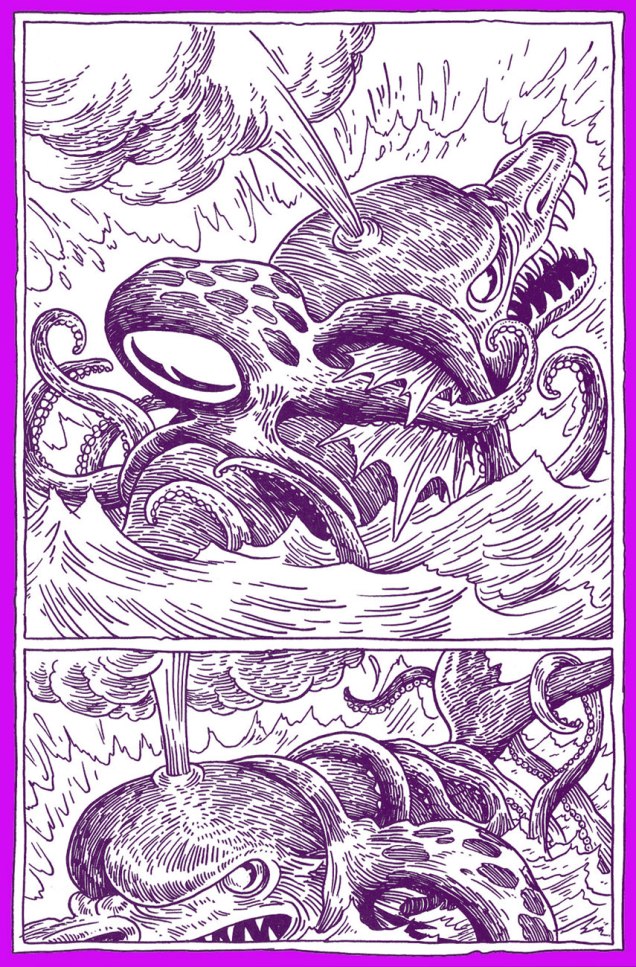
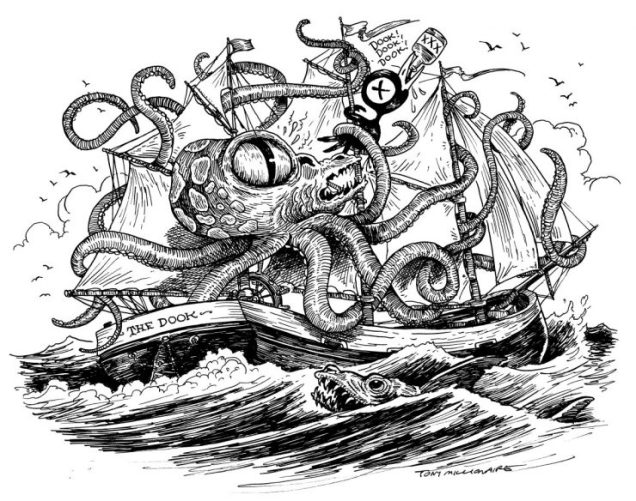
His art is also stunning on a purely technical level: the impeccable geometry of his Victorian houses, the zest of his epic battle scenes (often between a whale and a kraken, it should be noted), the lushness of the gardens inhabited by fairies, gossiping insects having tea, and mice with puritanical sensibilities.

A couple of other things about Tony Millionaire: he’s really funny (or “drunkenly charming”, if you prefer; read his interview with John F. Kelly from 1999), and he clearly loves drawing tentacles, gleefully sticking them hither and tither. He’s clearly long overdue for an inauguration into the elite hall of Tentacle Tuesday Masters. I’m not here to provide you with hard facts about when and how, either about the newspaper strip Maakies or about the comic series Sock Monkey. You can get that from elsewhere. But I do believe that this is the only website where you can get your tentacle fix *and* your TM fix all at once (courtesy of co-admin RG who did all the scanning work!)

Anyway, enough of this chit-chat, and let the tentacles abound!

Maakies01A

Maakies02A

« Maakies is me spilling my guts… Writing and drawing about all the things that make me want to jump in the river, laughing at the horror of being alive. »

Maakies03A

Maakies04A

Maakies05A

Maakies06A

Maakies07A

As fun as Maakies are, I find that one gets weary of them quickly – they’re like chips that burst with flavour to the point of causing desensitization. I believe that Sock Monkey is where Millionaire really gets to shine; I fondly remember being bowled over by Sock Monkey: the Inches Incident, in which TM really put his nautical sensibilities to use. The other books from this series only reinforced this impression – the art was so much lusher, and the moral complexity of these stories made each tale bittersweet. The artiste himself summarized it well, stating that « Sock Monkey is me trying to rise above all that bullshit, to be more poetic, looking at the bright side, remembering the things that used to delight me as a child. At the same time, the main theme to all the Sock Monkey books is the crashing of innocent fantasy into bone-crushing reality. »

SockMonkeyInches01A

Fantagraphics published a full collection of Sock Monkey strips, but you can also read three of them right here online. I would of course strongly suggest supporting the publishing house and the author by purchasing the book, but what kind of high moral ground can it be if one is not offered a choice?

sea-Octopus-getting-Drinky-Crow-740x584

tumblr_pmpz7ov3pF1qg5msoo1_1280

~ ds

Tentacle Tuesday: We’re Off to the Moon!

I think the most disappointing scientific discovery of recent years is that there appears to be no octopuses on the moon. Not one teensy-weensy tentacle was spotted by the lunar rovers (that we dispatched to the Moon for that very purpose, of course). But comics had led us to expect otherwise!
KaneMIS51A
 Mystery in Space no. 51 (May 1959), cover by Gil Kane.
The inside offers us even more tentacles:
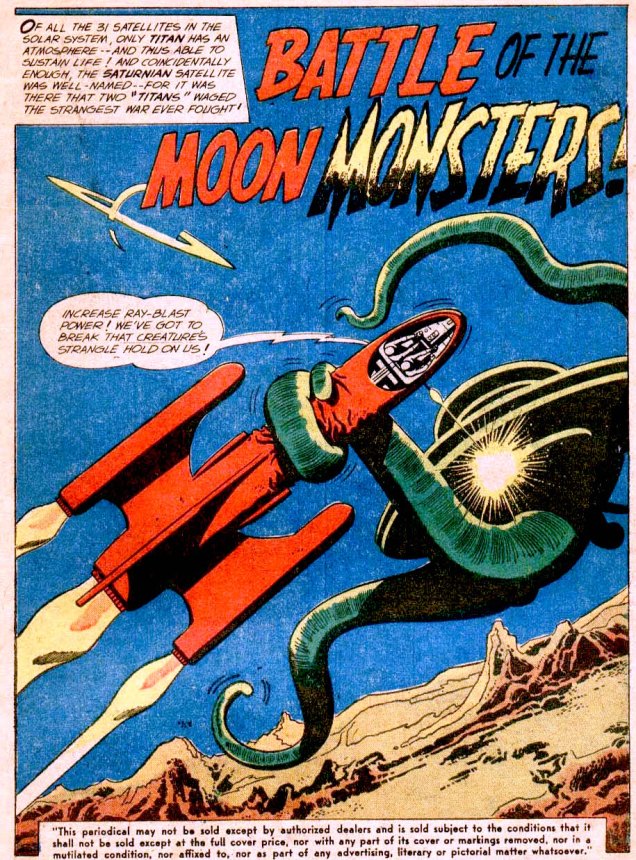
MysteryInSpace51-Battle of the Moon Monsters
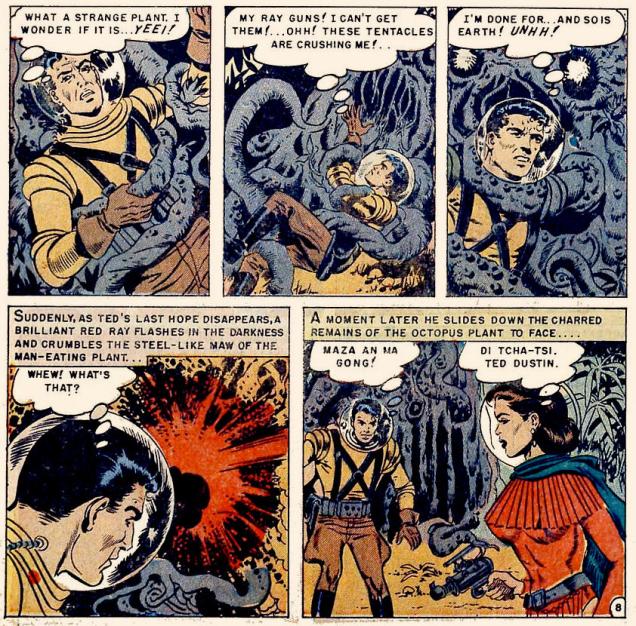
Battle of the Moon Monsters! was scripted by Gardner Fox, pencilled by Carmine Infantino and inked by Joe Giella.
MysteryInSpace51-Battle of the Moon Monsters2
In the end, our protagonists realize that the tentacled monster is actually a spaceship, and one manned by humans, at that… after which both parties have a good laugh about having almost annihilated one another. A peculiar sense of humour, those astronauts.
A bit of comic relief…
Archie'sMadhouseAnnual3
Panels from the one-pager Outer Space with art by Bob White, printed in Archie’s Madhouse no. 21 (September 1962)
And back to our scheduled program of lethal, tentacle-sprouting monsters that attack the moment anyone sets foot on the moon.
moonStrange Planets #12.
« Traveling at an incredible speed, the rocket reaches the moon in twenty three hours and lands in the gigantic crater… » And what is waiting for our hero, freshly stepped from his rocket? Funny you should ask… Page from Rocket to the Moon (1951 one-shot, Avon) scripted by Walter Gibson and illustrated by Joe Orlando.
Here’s a good instance of the good folks at Marvel getting quite confused. The First Men in the Moon, published in 1901, was written by H. G. Wells. From the Earth to the Moon was written in 1865 by Jules Verne. Which one is this supposed to be an adaptation of, then? I can confirm that the vaguely ant-like creatures with tentacles are H. G. Wells’ creation. His Selenites are described as following: « They are vaguely similar to quasi-humanoid ants, about five feet tall, with a light physical constitution enclosed in an exoskeleton from which slender jointed limbs and whip-like tentacles protrude. »
WeissMarvelClassics31MoonA
Marvel Classics Comics no. 31 (1978), cover by Alan Weiss.
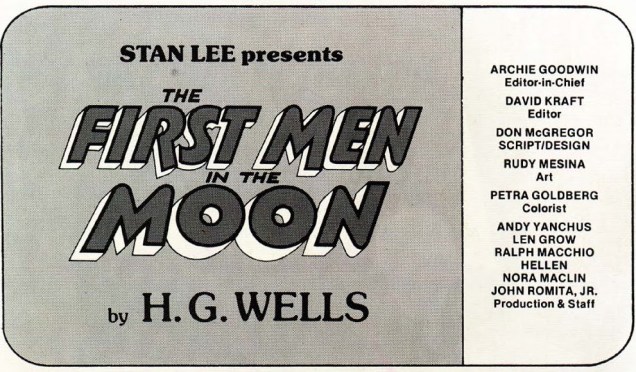
However, the first page of this comic informs us that…
MarvelClassicsComics31-inside
So I guess whoever laid out the cover screwed up. The insides, scripted by Don McGregor and drawn by Rudy Mesina, are considerably better drawn, and an unqualified tentacular treat.
MarvelClassicsComics31-HGWells-FirstMenintheMoon
I think the artist just wanted to draw tentacles, and this post is clearly not the place where he is likely to be judged for that little peccadillo.

Did this adaptation succeed in being faithful to and respectful of Wells’ influential novel? Well, not really, although an honest attempt was made. But I found that it focused far too much on the fight scenes, and left out quite a few complex nuances as well as skewing the philosophical underpinnings of The First Men in the Moon. That being said, if you like tentacles, I heartily recommend reading this issue. I cringe at the very idea of recommending something from the Marvel Classics line, but honestly must prevail. Really, it’s good fun. Take a look —

MarvelClassicsComics31-HGWells-FirstMenintheMoon2

Did the artist go into tentacle overdrive? Oh boy, did he ever!
MarvelClassicsComics31-HGWells-FirstMenintheMoon6
MarvelClassicsComics31-HGWells-FirstMenintheMoon5
Thanks for traveling with us today! If you want more tentacles in space, visit Tentacle Tuesday: Have Tentacles, Will Space Travel, or perhaps Tentacle Tuesday: Entangled in Tentacles with Adam Strange. As for me, I’m waving my tentacle (I do have one on a bookshelf) and bidding you adieu until next Tentacle Tuesday!
~ ds
MarvelClassicsComics31-HGWells-FirstMenintheMoon4