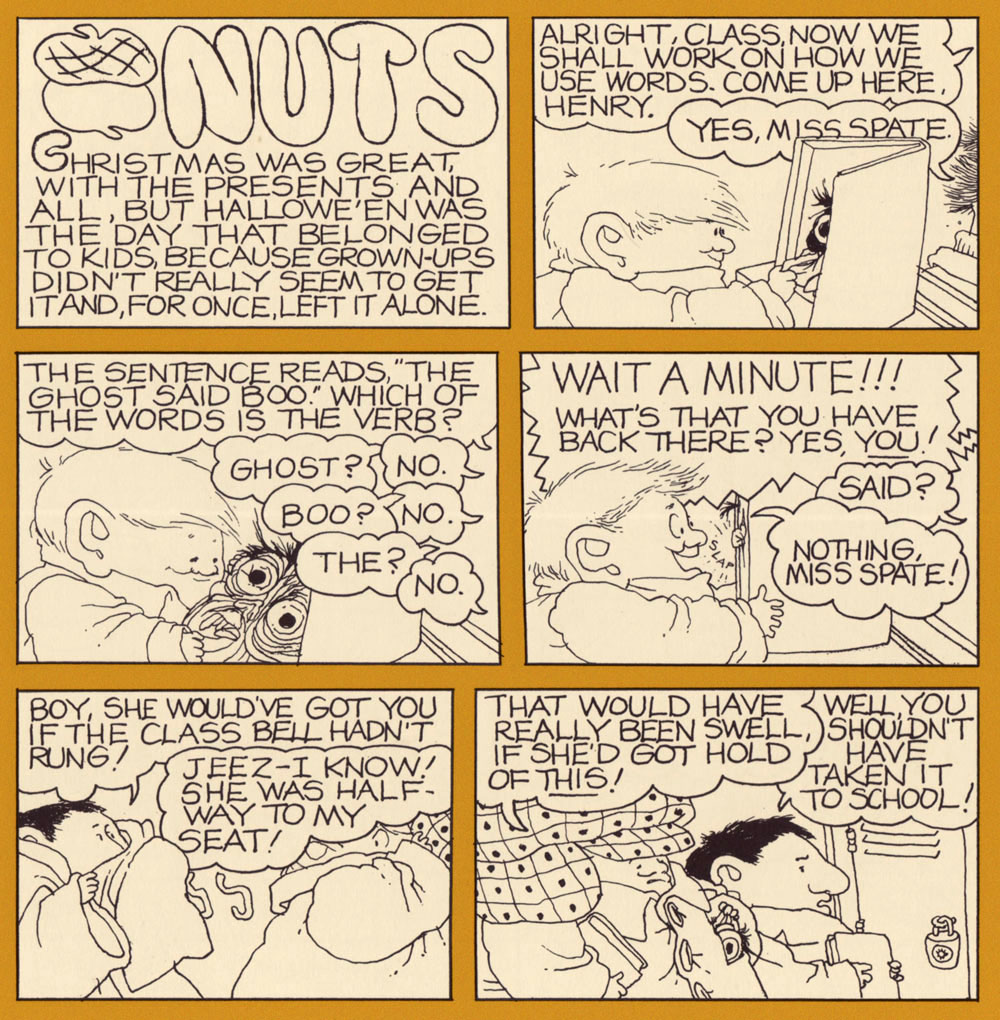
« They wanted me to do something that would be absolutely horrific, and so I was thinking silly monsters and putting all kinds of political twists on it. Then I began thinking, what is really, really scary and hasn’t been faced? I thought of being a kid. » — Gahan Wilson
Gahan Wilson (1930-2019), who else? I’ll gladly confess that it’s always a bit daunting to pick the opening and closing salvos of a countdown… especially the opener.
I’m fairly confident there’ll be no controversy as to my decision to bestow the inaugural spot to one of Mr. Gahan Wilson’s creations.
After all, Gahan was truly one (along with colleagues Addams and Gorey, to name but an obvious pair) of those gnarly souls — bless and/or curse them all — who made each day Hallowe’en… in the finest way.
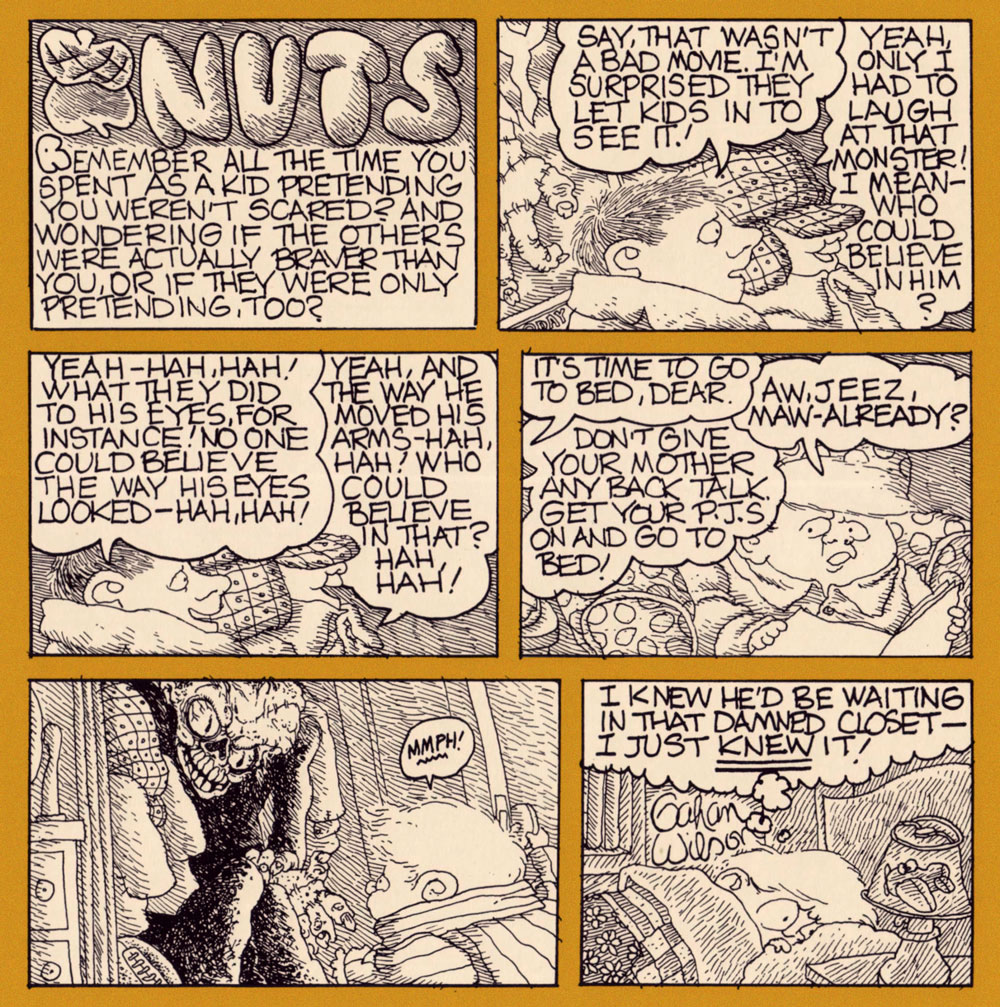
« Remember how confusing it was, being a little kid? Remember trying to make sense of the weird rules grownups always made you follow, and how you always guessed wrong and which ones they’d figure were really important?Remember how small you were and how brave you had to be to get through it all? »
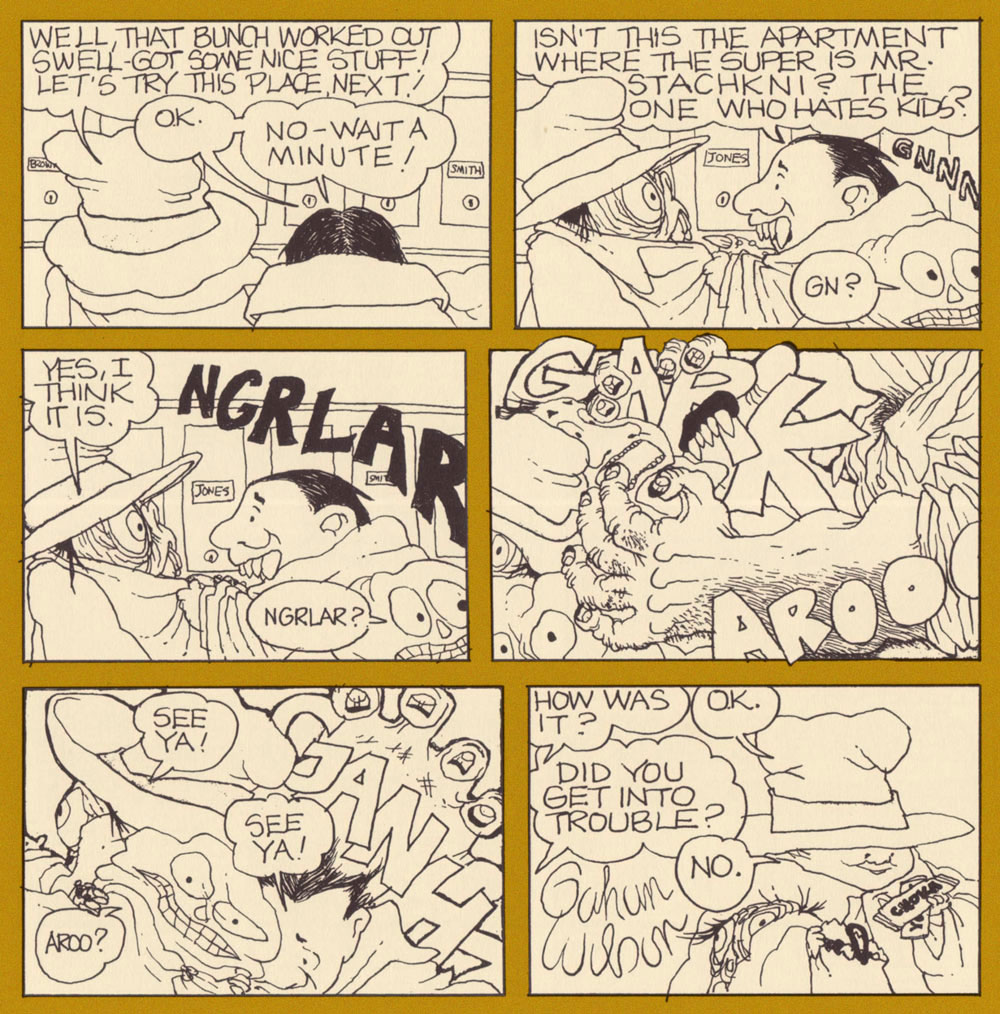
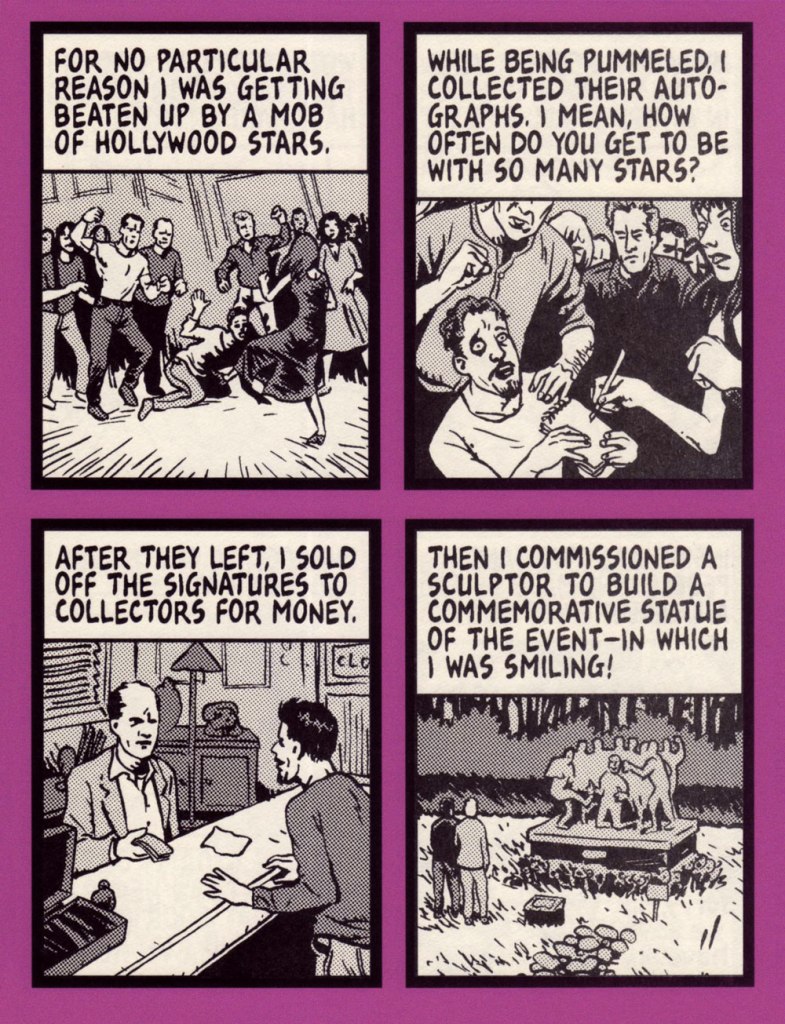
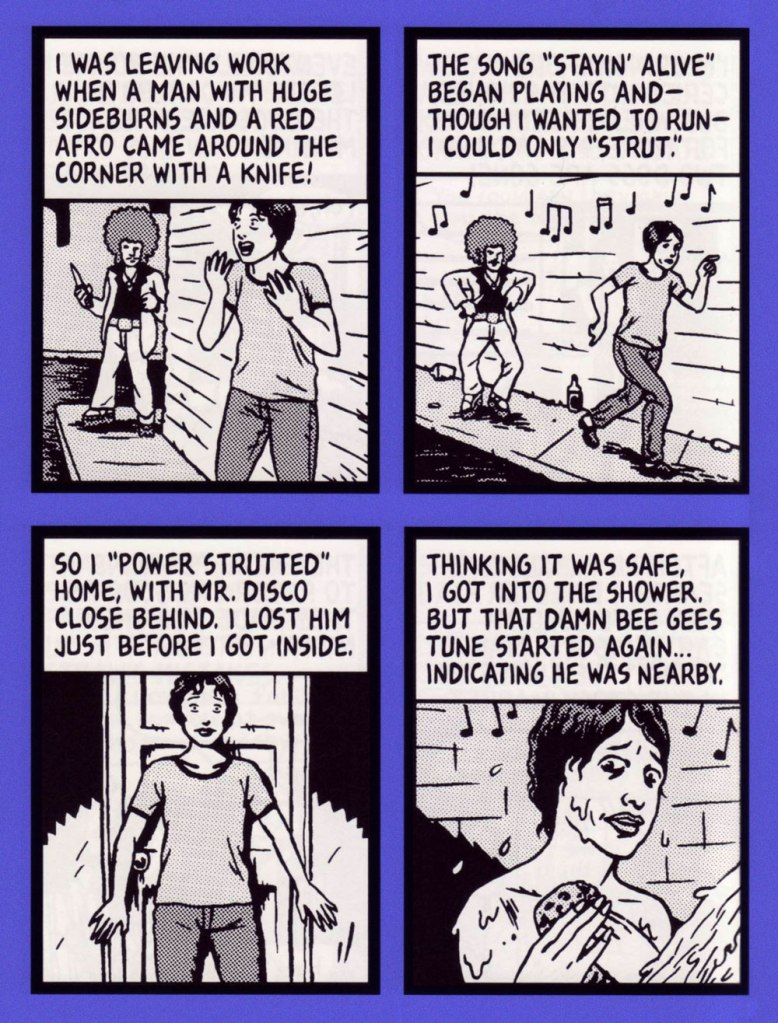
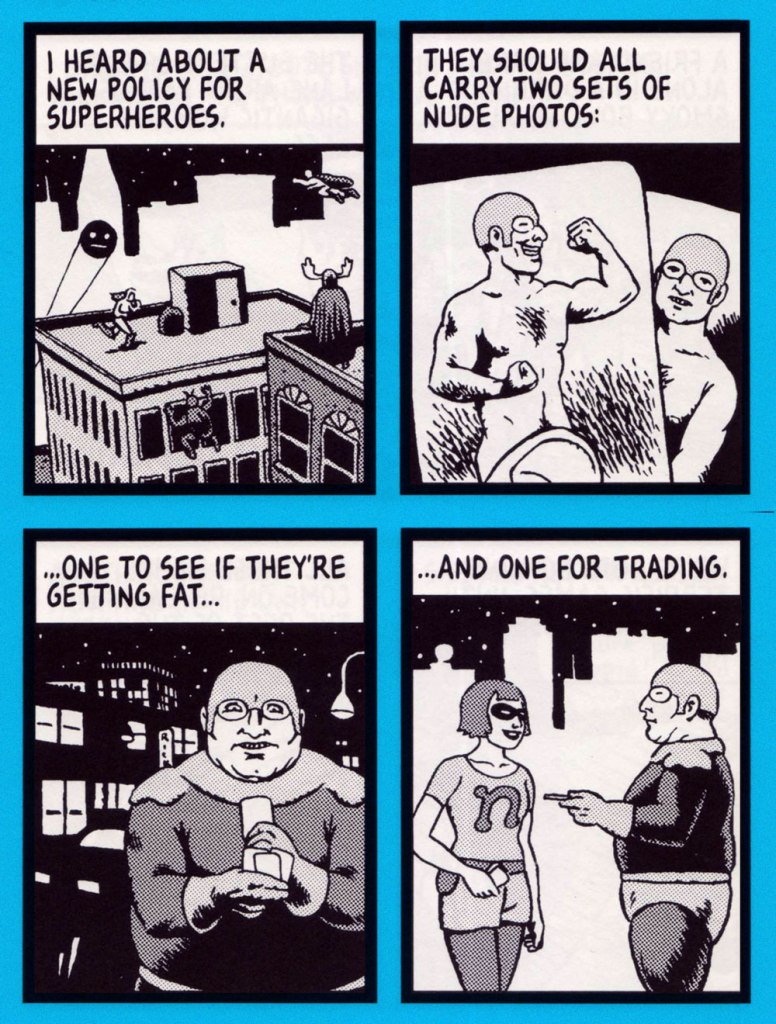
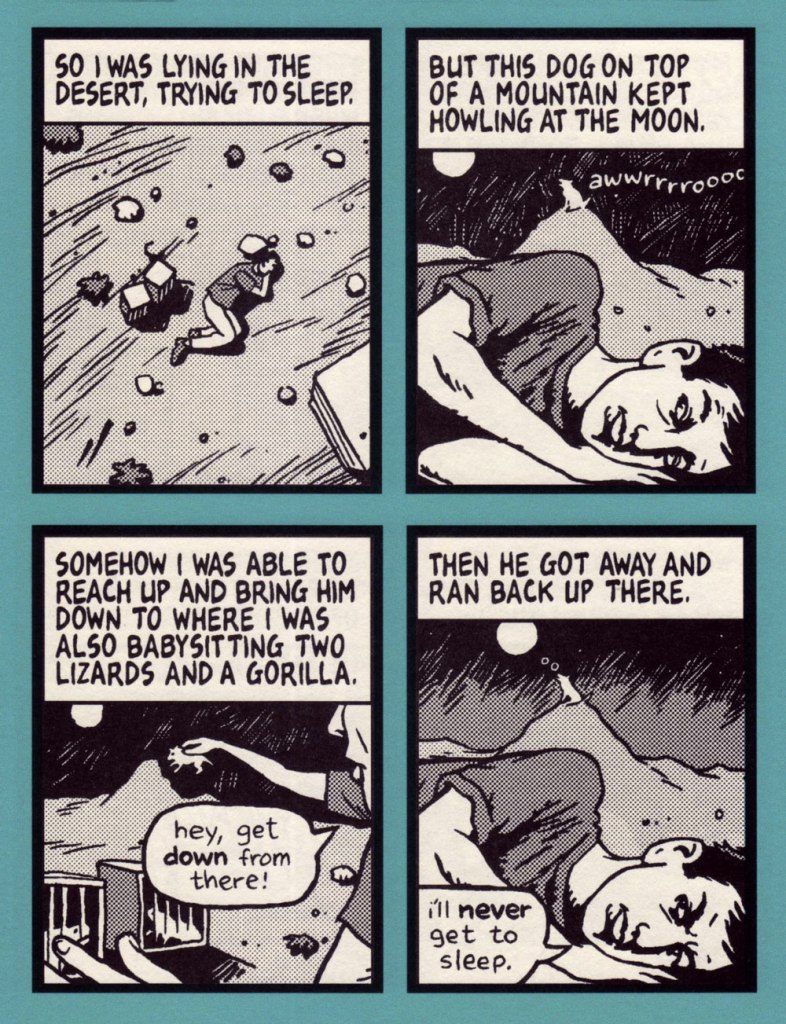
Oh, what the heck. Here’s a bonus strip, still a perfect fit for the occasion:
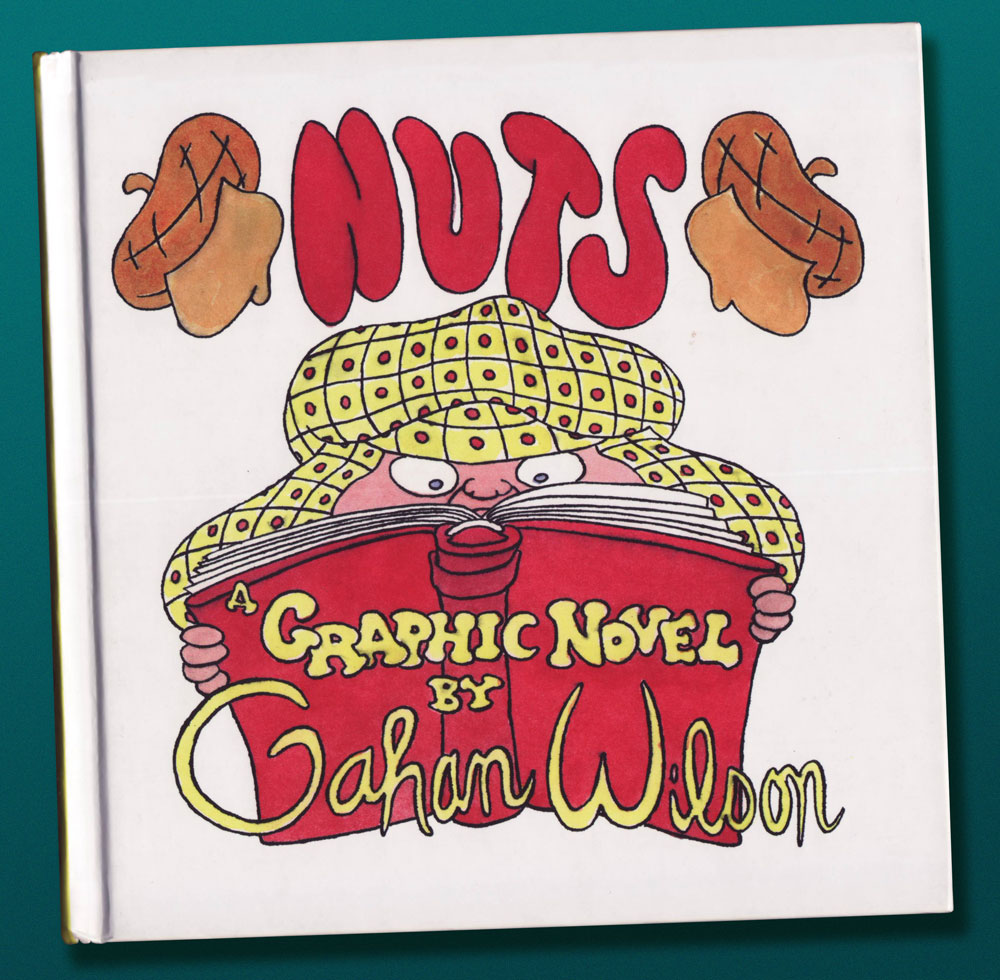
Incidentally, for those entirely unfamiliar with it, Nuts was Mr. Wilson’s first sequential strip, and it was published in the pages of The National Lampoon between 1972 and 1986.
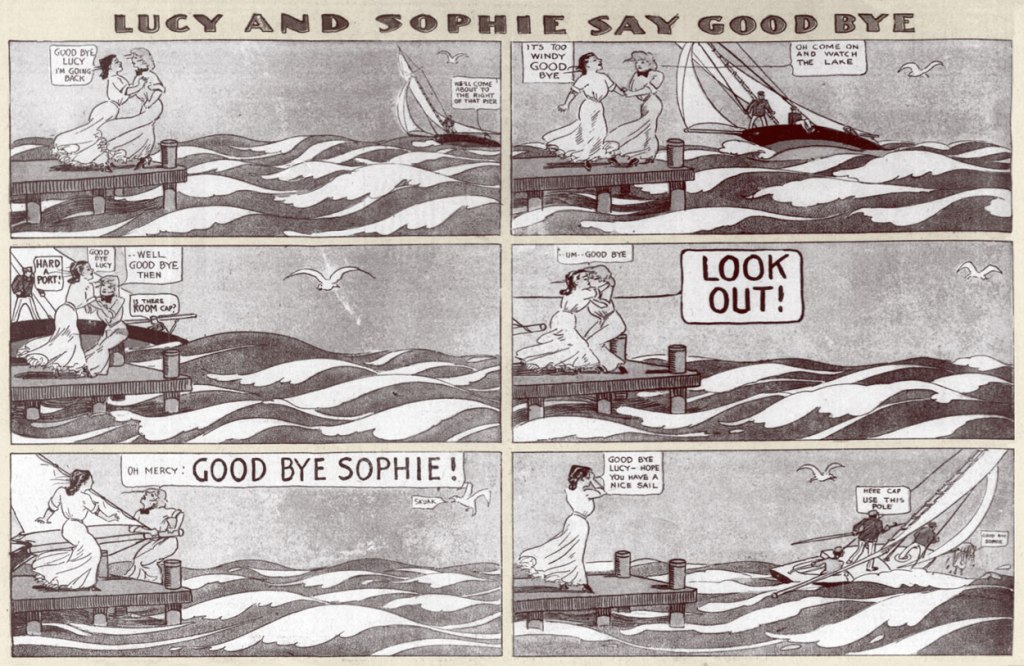
I hesitated about doing a post about Lucy and Sophie Say Good Bye because it seemed too obvious. Then I thought, obvious to whom? Surely a comic from 1905 can’t be all that widely recognized, a century hence. Besides, there’s a cool little bonus: the mystery surrounding the artist of this strip.
Some think that this mystery has been solved. Case in point, in 2021, the intrepid Eddie Campbell and Ron Evry of Mister Ron’s Basement made great use of their eagle eyes and spotted the similarity between Lucy and Sophie Say Goodbye and Cholly Cashcaller, both strips running almost concurrently in The Chicago Tribune. When Campbell pinged Barnacle Press, its sleuthing team (after some tracking down signatures, styles, and historical details) decided that the heretofore anonymous author was Robert James Campbell (1873-1938)*. Read the story here.
Chapter closed? Not quite. Kevin Cooley argues (and quite persuasively**) that this was a hasty and incorrect assumption, and that the artist is actually George O. Frink (1874? – 1932). Given that people far more erudite than I have spent years studying this topic, I’m resolutely staying away from having an opinion on the subject, but it’s all rather fascinating. Suffice it to say that Cooley has written a highly perceptive analysis of this strip and I highly recommend reading it (here)…. but that I tend to trust Campbell’s judgment, given that he’s not only an excellent cartoonist, but also a comics historian.
Has this strip gained traction and garnered interest in recent years because lay people (as opposed to comic historians) are titillated by the idea of two women kissing in a newspaper strip from the very early 20th century? That goes without saying. Yet this historical importance doesn’t take anything away from the art or humour of this strip. Besides, most people will be able to relate to the feeling of being s̶o̶ ̶i̶n̶ ̶l̶o̶v̶e̶ such close friends that the outside world fades into nonsignificance, even as horses collide, waves crash, and a crowd gathers.
I picked some of my favourites, but you can see more of these over at Barnacle Press.
*
**
*
*
*
As you may have noticed, Lucy is often bodily torn away from her companion by some passing contraption, be it a boat or a montgolfière . As mentioned earlier, Cooley wrote a detailed analysis on the subject, from which I will now quote:
« Lucy and Sophie’s fears are not in vain. One of these threats is ultimately carried out, and it cannot be dodged, ignored, or avoided. In the strip’s final installment on October 15th, 1905, the lovers are carted off by sinister mustachioed men in brown trench coats. “Say we got two crazy ones send the wagon,” says one. The women are wrestled into separate streetcars and held apart as they say their final goodbye. A young man in typical newsboy hat, papers and bell tucked under his arm, says “Gee dats der finish.” »
~ ds
* I don’t know how many Campbells are running around this world, but presumably quite a few.
** Speaking of being persuasive, I’d be remiss in not including part of Campbell’s rebuttal, at least in part — read the full thing in the comments section of The Lucy and Sophie Cartoonist – Another Look (Updated with Part Two – A George Frink Profile). Co-admin RG (himself a cartoonist) has often argued that artists have a different, deeper perception of other artists (as compared to those not at all versed in the craft/art of comics), enabling them to recognize someone’s style, even if it’s, say, subtle pencils buried under someone else’s forceful inking. Campbell’s point is similar, I think.
« I’ve been thinking about this strange affair today and it occurs to me now that K. Cooley doesn’t understand that there are some who are well versed in the study of cartoon art who can recognize an artist’s voice, or personality, by looking at a comic, the way one recognizes a friend’s voice on the telephone. Being told a more or less persuasive story doesn’t change the situation that the Frink comic he shows, with its depth of field and crackly angles and energy, all typical of Frink, is incompatible with the balloony lines and easy-going patterns of the Lucy and Sophie compositions. There are two distinct artistic personalities at work, one of whom is Frink and the other of whom shares a multitude of qualities with Robert Campbell, who drew many pretty ladies adorning the Sunday magazine pages of the same issues of the newspaper, all of whom had a tendency to look exactly like Lucy and Sophie. “One” does not ascribe works according to artists’ complicated backstories, or at least not until the primary issue of the looks of things have been analyzed. »
« If you take drawing seriously, you never quite feel you’ve arrived. » — Ed Sorel
This time out, I’m pinch-hitting for my co-admin ds, who’s burning the midnight oil these days.
Just about a month ago, when I wrote a piece about Seymour Chwast (b. Aug. 18, 1931), it occurred to me that I should also devote post-haste (just in case) some column space to his fellow surviving Push Pin Studios co-founder, Edward Sorel (b. March 26, 1929). Let us celebrate the living while we can. The dead don’t appreciate nearly as well such gestures .
Opting for a freelancing career, Sorel left Push Pin, just a few years after its founding. He made it, all right, becoming one of the greatest caricaturists of the century. But he was every bit as accomplished a writer, which elevates his work above the ‘merely’ visual.
I’ve always been blown away by how deceptively easy he makes it all look, and that’s what’s so impressive: very loose on the surface, but with an underlying, laser-sharp precision. I could easily go on at some length, but Sorel’s career and art are well-documented themes. Check out, for instance, The Enigmatic Edward Sorel(From The Comics Journal), or this fine New York Times review of his recent memoir (circa 2021), Profusely Illustrated.
And now, some of the man’s work:
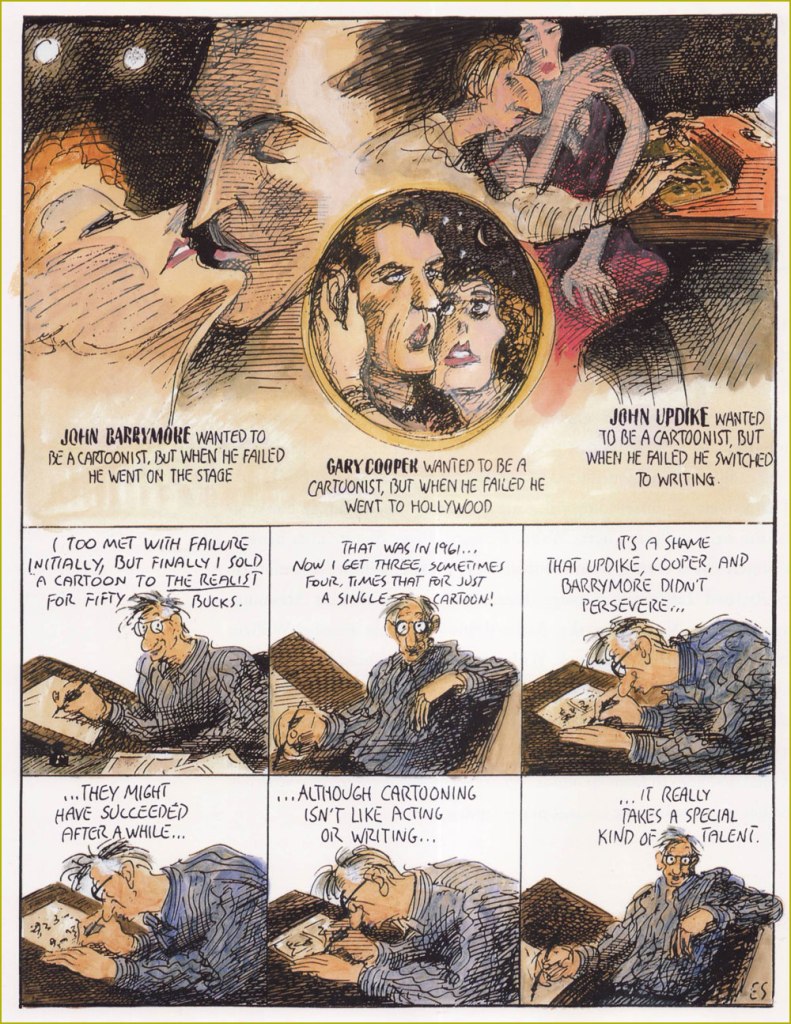
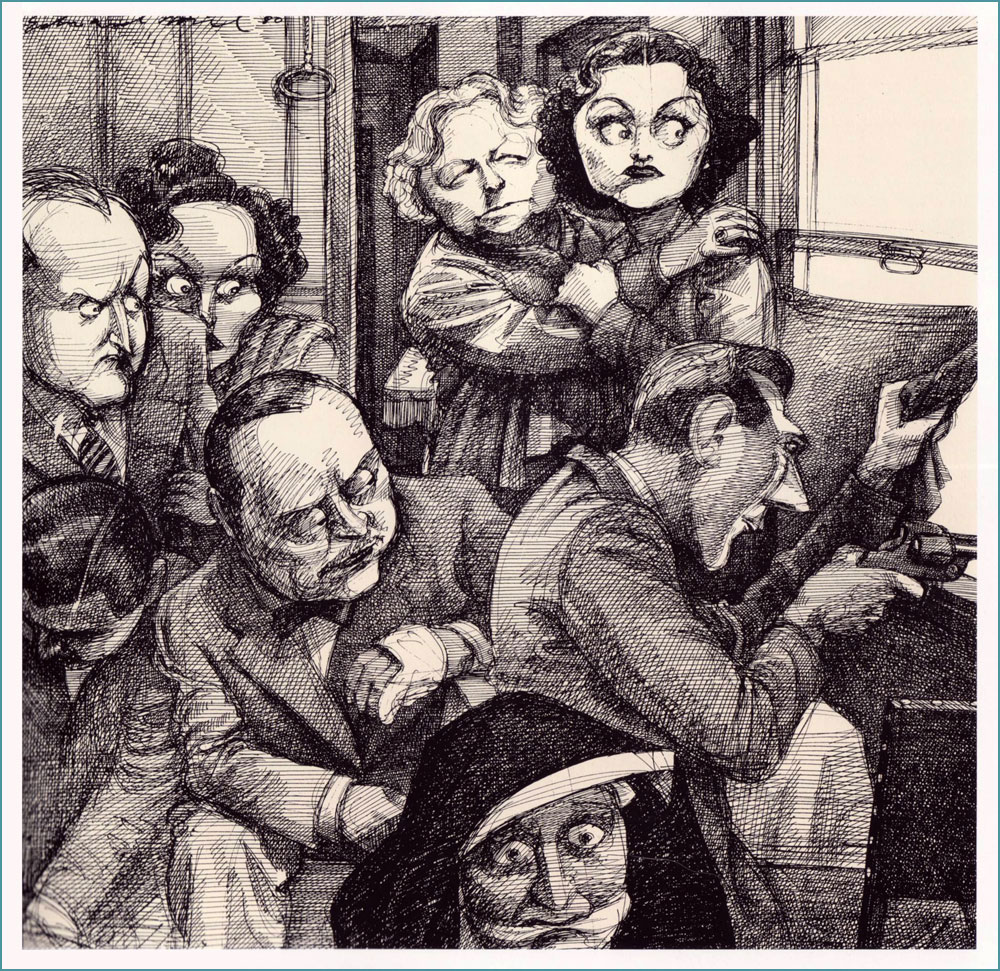
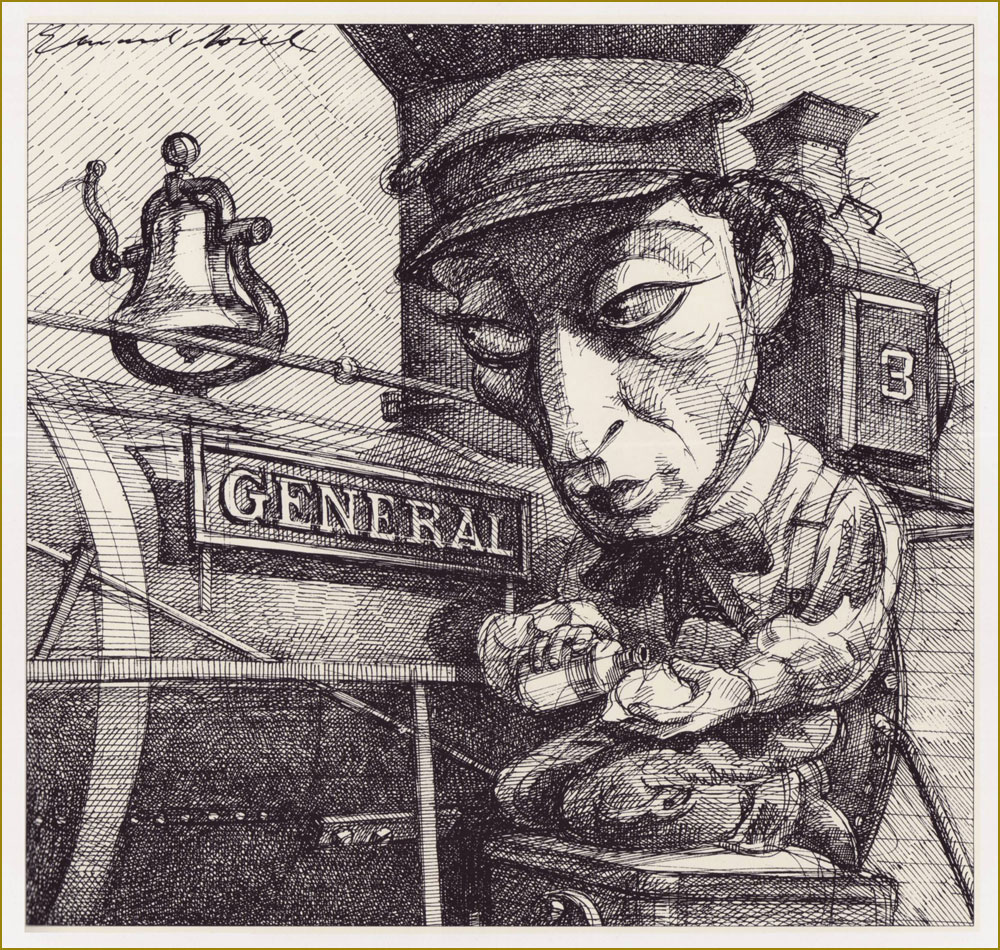
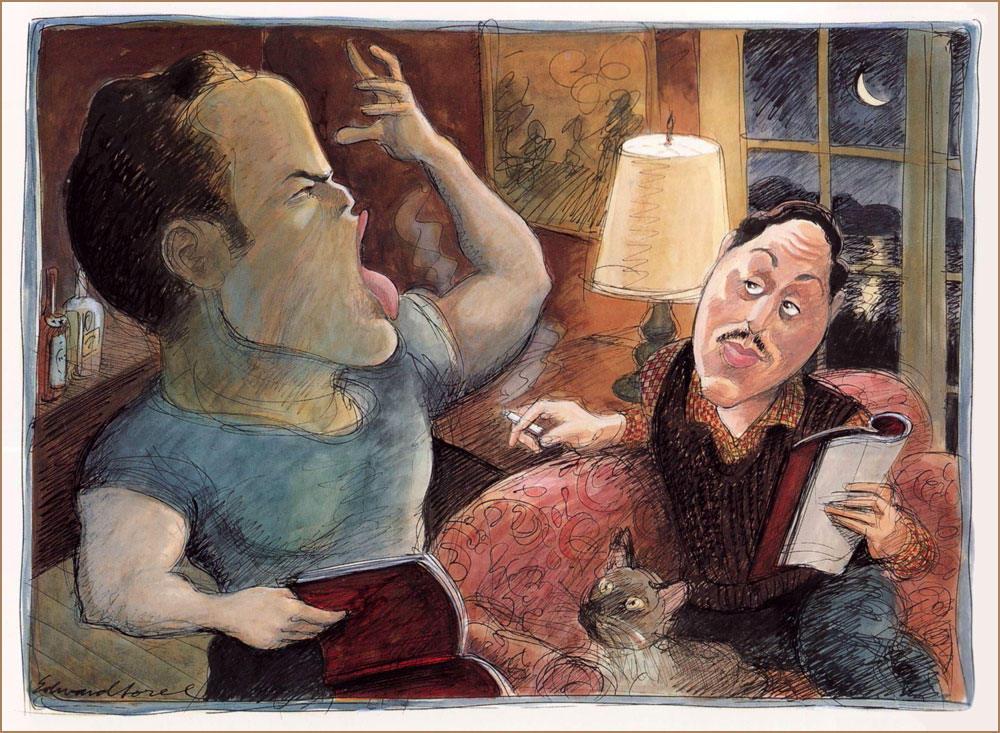
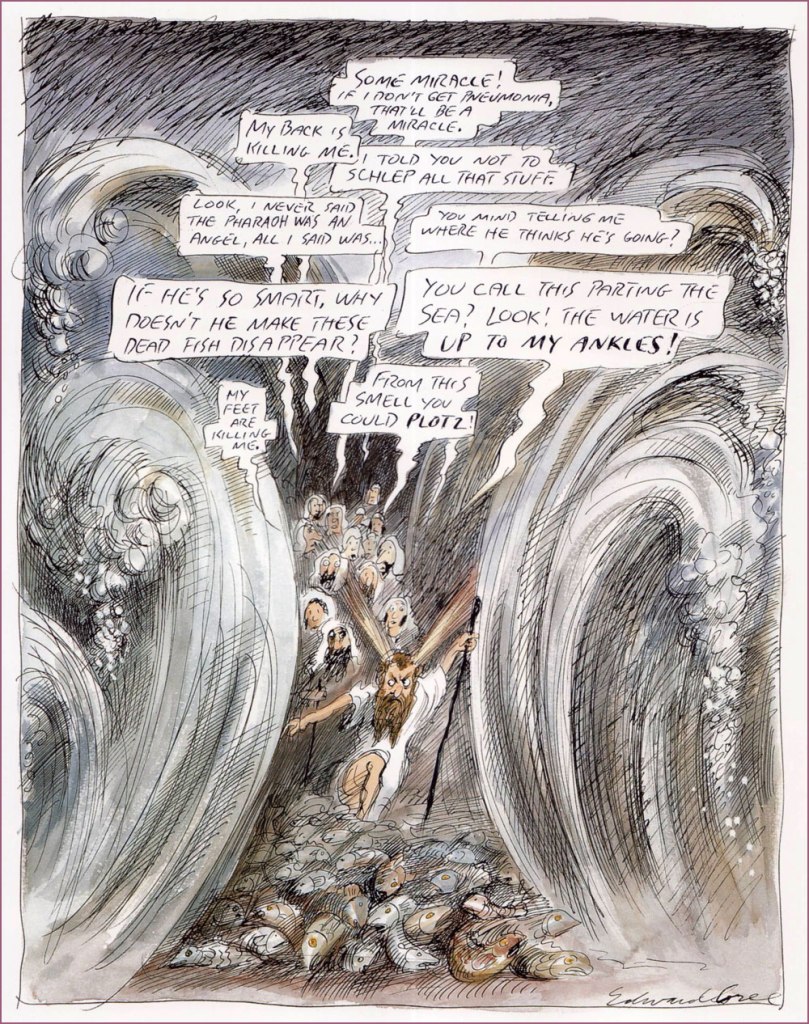
« My long association with Penthouse was unique. They bought every idea I submitted to them, and never changed anything except my spelling. This solipsistic strip appeared in 1990. »He can draw *anything*! This one appeared as The New Yorker‘s Jan. 31, 1994 cover illustration.I suppose every cinephile has his favourite Hitchcock film; mine’s The Lady Vanishes (1938). An entry in Sorel’s “Movie Classics” series, published in the March, 1981 issue of Esquire. « The General, starring Buster Keaton, is the only silent movie I included in my “Movie Classics” series. Based on an actual incident in the Civil War, it often has the look of a Mathew Brady photograph. » From Esquire, Dec. 1980.« Tenor Enrico Caruso is a guest at the St. Francis Hotel when the 1906 earthquake hits San Francisco. He vows *never* to return to a city “where things like this are permitted”. From Sorel’s pictorial essay “Keyhole History” (GQ, Oct. 1984).More rollicking blasphemy for Penthouse (Dec., 1992). Ah, yes. « The 1973 Academy Awards are remembered for Marlon Brando’s refusal to accept his Oscar for The Godfather. His emissary, Apache tribe member Sacheen Littlefeather, explained that Brando’s rejection of the award was to protest Hollywood’s depiction of Native Americans. Backstage, John Wayne was apoplectic. As John Lahr wrote in his article “The Birth of the Oscar“, “The Duke, who had dispatched many an Apache on film, didn’t take kindly to Brando’s protest… Wayne had to be restrained by six men from yanking Littlefeather off the stage.” From The New Yorker, March. 21, 1994. And speaking of Brando… « Marlon Brando is sent up to Cape Cod to read the part of Stanley Kowalski in A Streetcar Named Desire for Tennessee Williams‘ approval. First he fixes the nonfunctioning electricity and plumbing, then he auditions. His performance was stellar in every role. From Sorel’s “First Encounters” series, this entry appeared in Atlantic Monthly‘s July, 1994 issue. Note the kitty’s rapt expression.« Exodus revisited: an educated guess as to what Moses endured as he led his people through the Red Sea. A cartoon for Penthouse, the only mass-circulation magazine to welcome my blasphemy. » Penthouse (like the man said), Apr. 1995. Oh, and Plotz: To burst from strong emotion; often used humorously to express minor shock or disappointment (פּלאַצן, platsn, ‘crack’; cf. German: platzen;) and Schlep: To drag or haul (an object); to walk, esp. to make a tedious journey (שלעפּן, shlepn; cf. German: schleppen;).« Another of my egocentric ramblings, this one a rationalization for not becoming a great artist. » It appeared in the Aug. 21/28 issue of The Nation.« How Was I Supposed to Know? », from The Nation, Sept. 24, 1990. Oh, the sequels just write themselves.Here’s a rather famous one: « Back in the mid-sixties, my friend George Lois had an idea for an Esquire cover that couldn’t be done with photography. He asked me to do it, and I panicked — i.e. I tightened up. When I handed him my finish, he rolled his eyes and said he’d give me until the next morning to do it over. I went beyond panic, but nevertheless did a drawing we were both happy with. » It appeared on the cover of Esquire’s April, 1966 issue, with the caption of “The problems of power for Frank Sinatra”.« Director Michael Blakemore, at a rehearsal of Woody Allen’s one-act contribution to Death Defying Acts, watches in horror as Allen scribbles copious stage directions for him to execute. (Caricaturing Woody Allen is so easy that after drawing him, many an amateur comes to think of himself as a pro.) » From The New Yorker, June 3, 1996. Look at that pen move!
Today’s featured strip was once immensely popular in its native Germany, but who now remembers the name of Erich Ohser (1903 – 1944) or his nom de plumeE. O. Plauen*? Sic transit gloria mundi, alas.
Cartoonist and illustrator Ohser belonged to a set of three Erichs, the other two being Erich Kästner, a satirist and journalist, and Erich Knauf, a newspaper editor and poet. The three met in Leipzig and found in each other sympathetic souls with a common aesthetic and worldview. The Erich trifecta moved to Berlin at the end of the 1920s, where Knauf became the editor of publishing house Büchergilde Gutenberg, which published Ohser’s cartoons and illustrations as well as volumes of Kästner’s poetry.
All Erichs were ardently opposed to the emerging scourge of Nazis, but Ohser’s caricatures were particularly biting and ‘depicted [HItler and Goebbels]’ cohorts as gangs of dull-witted thugs, employing all the weapons of caricature: exaggeration and distortion, one-sided emphasis and intentional grotesquerie‘**. When Hitler came to power in 1933, Ohser’s work opportunities dried up completely as he was not admitted to the Reich Chamber of Culture, which meant that he couldn’t work at all. Fortunately, the editor of Berliner Illustrirte Zeitung finagled a special permission from the Ministry of Propaganda – Ohser could continue working, as long as he used a pseudonym and stayed firmly away from political material. Such was the birth, in 1934, of the weekly strip Vater und Sohn and the sobriquet ‘e.o.p.’, later expanded more officially to E. O. Plauen.
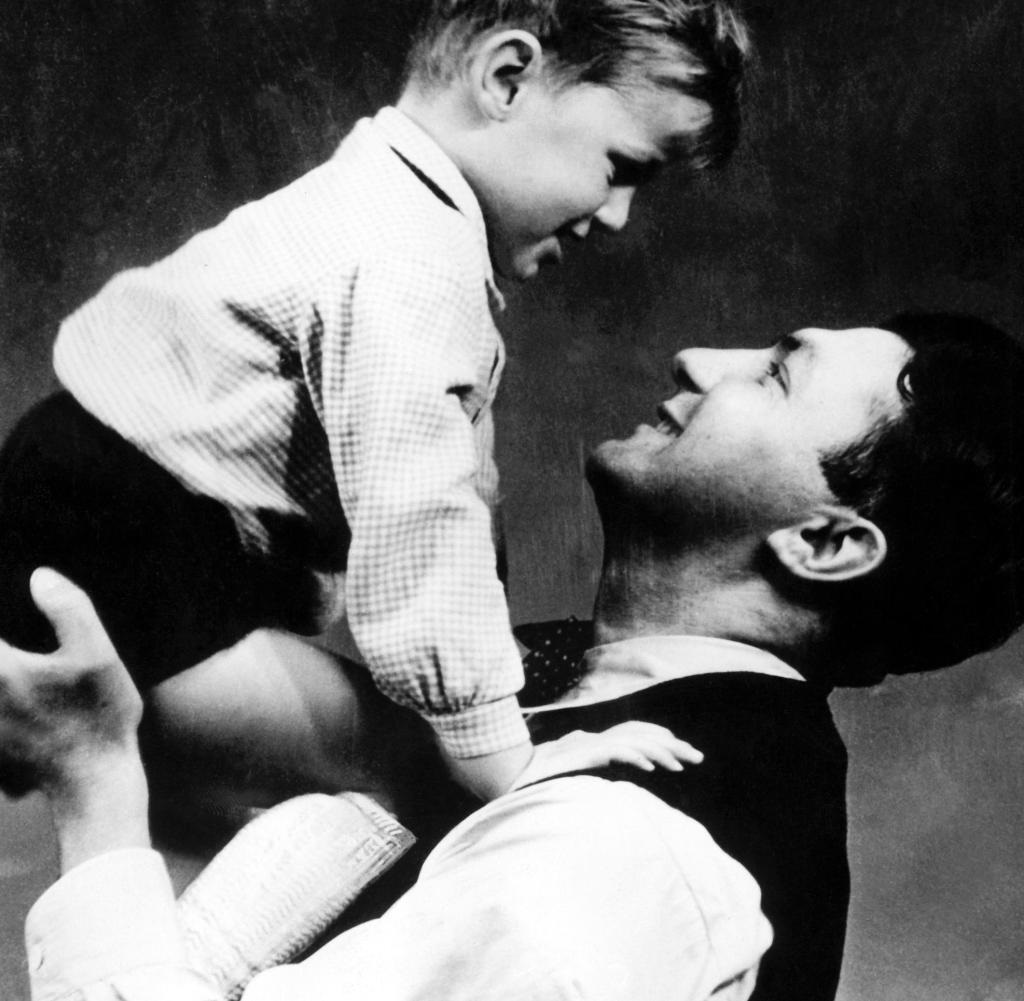
Ohser and his son Christian, who was surely an inspiration for the strip.
Father and Son won Ohser public acclaim, as well as financial success, but also many copycats and some inevitable appropriation – to Ohser’s chagrin, the strip’s characters were used to advertise Nazi charity drives and political events. Ohser ended the strip in 1937, probably because he felt that his creation was being misused by other hands, but he continued to work on cartoons and illustrations under the same pseudonym. He also had to put his talent at the service of the reviled enemy to survive, producing caricatures of anti-Nazi figures such as Churchill and Roosevelt for Nazi weekly newspaper Das Reich.
«‘I draw against the Allies – and not for the National Socialists’: This is how Ohser justified his disturbing caricatures of the 1940s to a friend of his, the writer Hans Fallada. He drew Russia as a murderous bear beast, America as a greasy, greedy capitalist, England as a bloodthirsty colonial ruler – it’s hard to believe that the same man gave the world the touching ‘Father and Son’ picture stories. » [source]
This uncomfortable position of living a sort of double life screeched to a halt when Ohser and Knauf were arrested in 1944 after being denounced by their roommate for anti-Nazi sentiment. Ohser committed suicide in his cell the night before the hearing. Knauf was killed a month later after being sentenced to execution by the court.
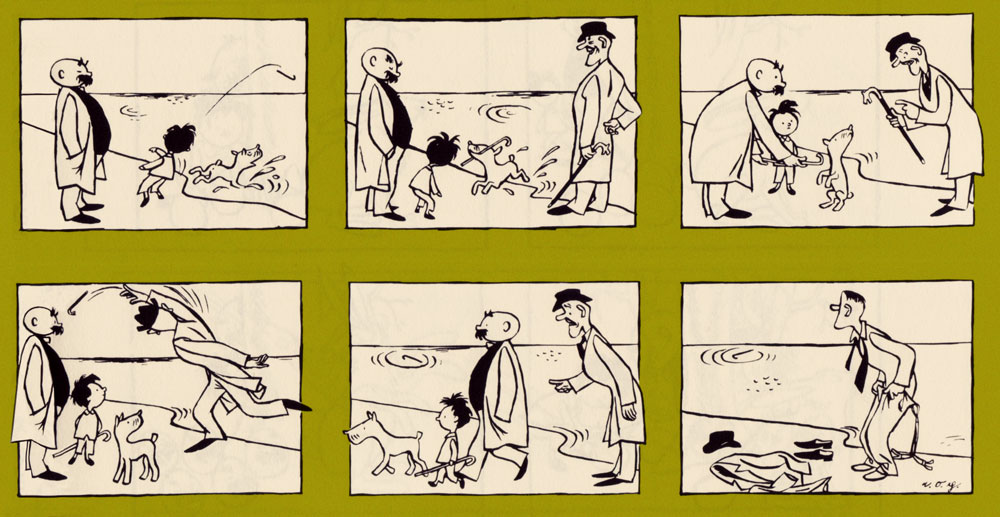
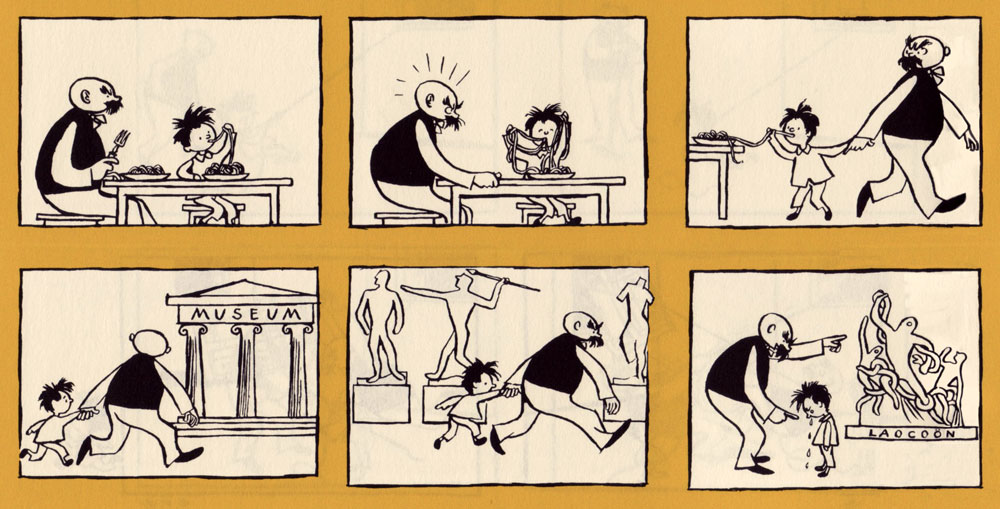
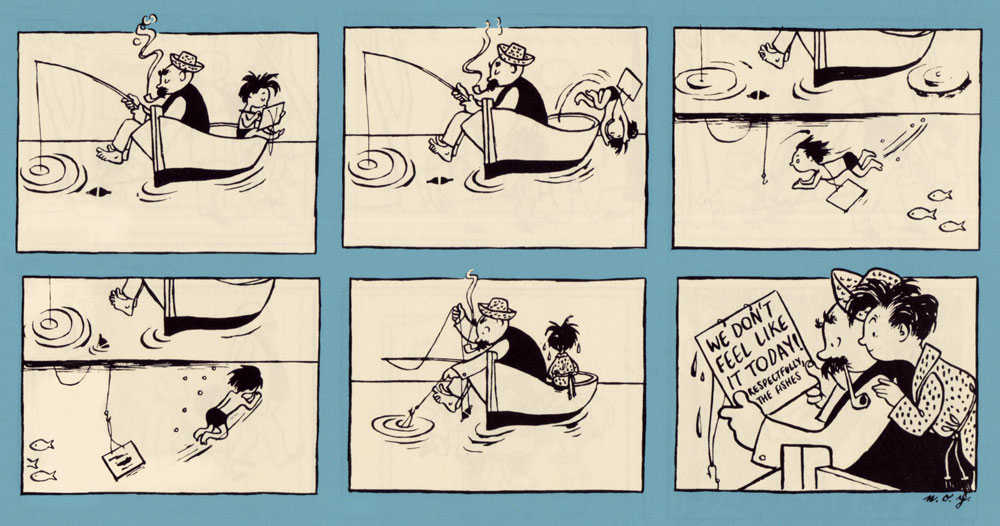
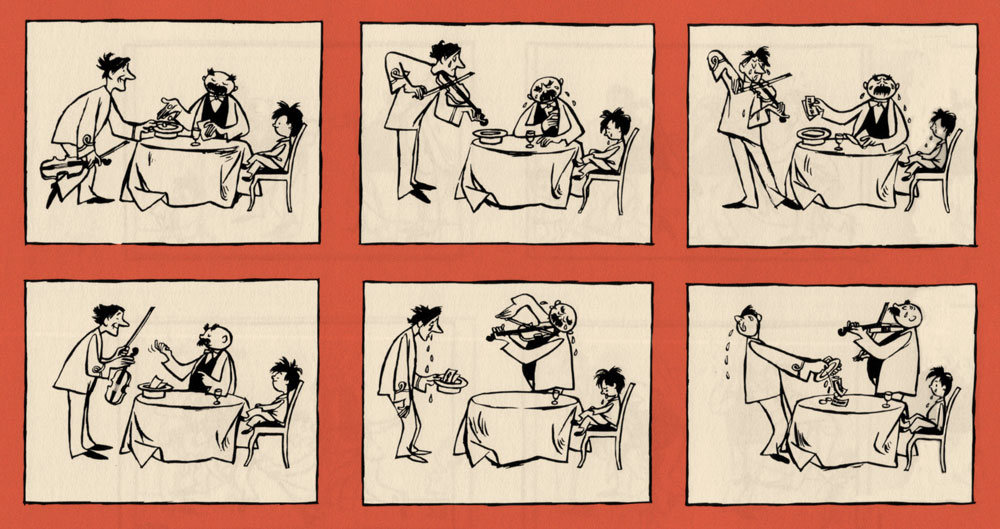
There are a few collections in various languages drifting about, but the definitive English-language one was published in 2017 by New York Review Comics. Here are a few excerpts from the latter, lovingly colorised (as is often the case around here) by co-admin RG. I also limited my selections to one-pagers, which leaves out (for example) the pleasantly surreal episode spanning many weeks when Father and Son get stranded on a desert island.
« Resemblance ».Ohser and his son Christian were regulars at the Berlin Zoo, which is reflected in a lot of strips, as is Ohser’s clear love and respect for animals.
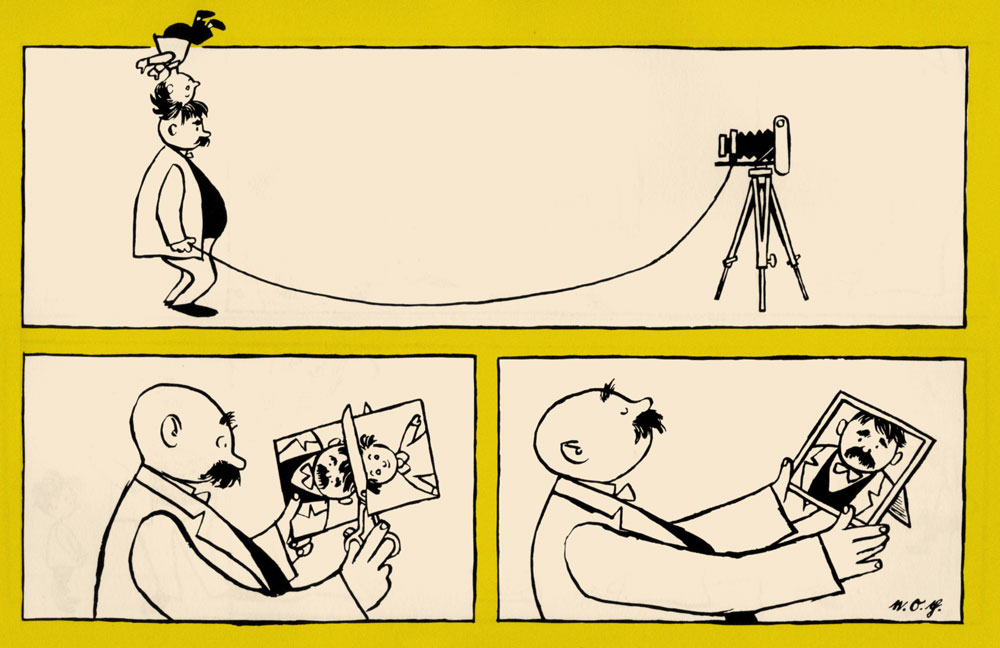
« Nicely cropped»
« Unsuccessful overture »
« Too bad!»
« Cautionary example »
« A letter from the fishes »
« The birthday surprise »
« Trading sobs »
« Occupation: inventor »
Ohser’s son Christian holding a collection of Father and Son strips.
~ ds
*Plauen is the name of the town where Ohser grew up.
** From the afterword to Vater und Sohn (2015) by Elke Schulze, translated to English.
« The man who never dreams, goes slowly mad. » — Thomas Dolby
Jesse Reklaw‘s Slow Wave* (1995-2012) was both an early webcomic and a syndicated strip that ran in about a dozen alt-weeklies.
Here’s a historical rundown that Reklaw provided in 2005, musing on the feature’s genesis and its initial decade:
« While I was an undergraduate at UC Santa Cruz (1993-1995), website technology wobbled out into the world. Entrenched in the DIY zine community that had been liberated by cheap photocopies and desktop publishing, I became obsessed with this new independent media opportunity. With help from Ranjit Bhatnagar, I learned how to code HTML, and started an online art gallery at UCSC. I was juggling a double major in art and computer science, so it seemed like a natural fit.
Between classes (and math tutoring, and being an RA, and band practice), I was drawing comics. In order to focus on my drawing, I stopped writing my own material and instead asked friends for stories to draw: they could be anecdotes, fiction, dreams, whatever. All the stories were fun to draw, but I felt an immediate connection to the dreams. They had compelling imagery, their own logic, and a natural dada-like humor. Drawing them was like being there in the dream, experiencing the mind of the dreamer, but also realizing my own perceptions through theirs. It was like floating in that infinite reflection between two mirrors.
In 1995 I moved across the country to icy New Haven, Connecticut for graduate school. I also continued to draw comics, now exclusively dreams that I got from friends and family. I started posting the Slow Wave strip because I wanted regular, updated content for my personal website (called nonDairy.com back then). At the time, everyone was saying “Content is king.” I coded my pages in simple programs like notepad and simpletext (which I still use), building my site in secret, often in the empty hours between midnight and morning. I led a double life as a computer scientist and a cartoonist. Along with the site, I put up a website form to solicit more dream material. A few trickled in at first, but as the Web grew, this became the major source of dream submissions. After I’d drawn about twenty strips, I got the idea to submit them to weekly publications. I found the website of the Association for Alternative Newsweeklies, and discovered a wealth of newspaper addresses and contact info. They seemed to be served from a database, and you could view the records one screenful at a time. Not content to just copy down the information, I wrote a web-spider that downloaded every page, parsed the text from the HTML code, and “reverse engineered” the database for my own use. I sent out about sixty submissions, and was totally surprised to get picked up by two papers: The Rocket in Seattle (now out of business) and the Philadelphia Weekly (who dropped me after a month). It was encouragement enough to keep me going. I probably would have gotten bored with the web-only comic strip after a couple years. The internet had moved on from content anyway, and designers were more interested in animated GIFs and other dancing baloney.
I continued to self-syndicate, and was picked up by enough papers that it seemed possible to make a career out of it. I dropped out of grad school in 1998 (didn’t really like being a Yalie anyway), and started cartooning full time. I also had enough strips now that I thought there should be a Slow Wave book collection. I proposed the idea to a lot of comic book publishers, but had little luck there. I complained on my website about not being able to find a publisher, and within a week was contacted by Kendra Crossen Burroughs, an editor at Shambhala. Kendra had apparently been reading the strip online for a while, and convinced Shambhala there should be a book. Dreamtoons came out in 2000, collecting about two-thirds of the strips I’d drawn so far (not including the one above). Dreamtoons is currently out of print, but there’s lots of used copies floating around out there**. »
An example of how Reklaw sollicited thematic contributions to Slow Wave. It’s safe to suppose that none of the contact details are still relevant, except in dreams.
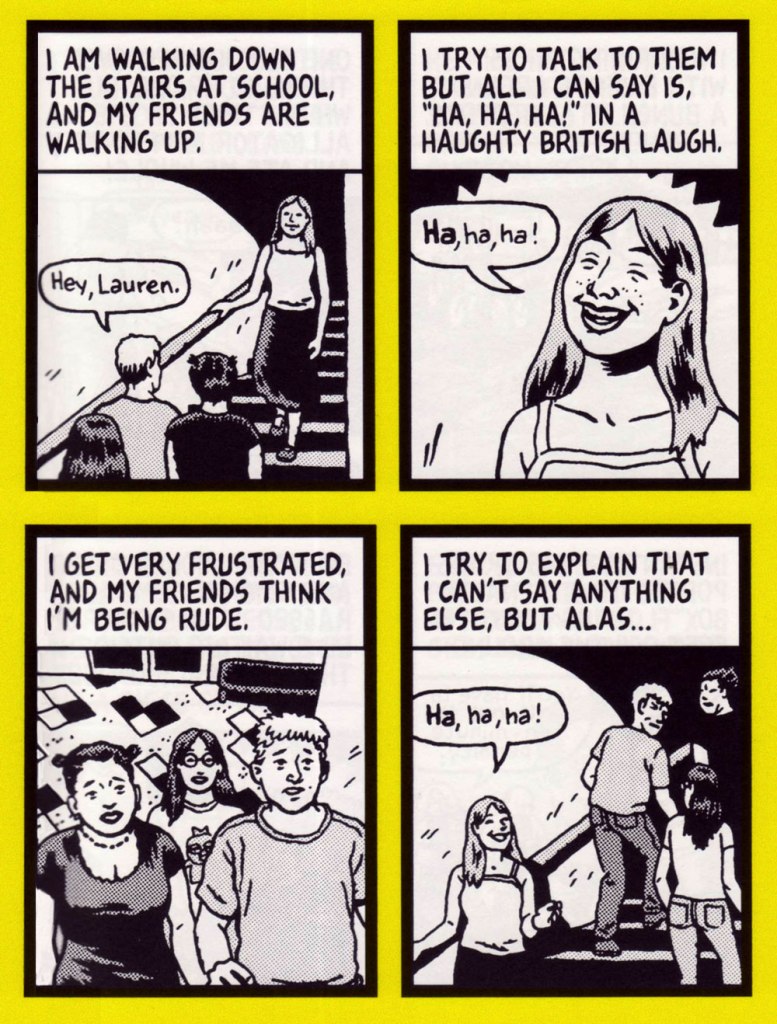
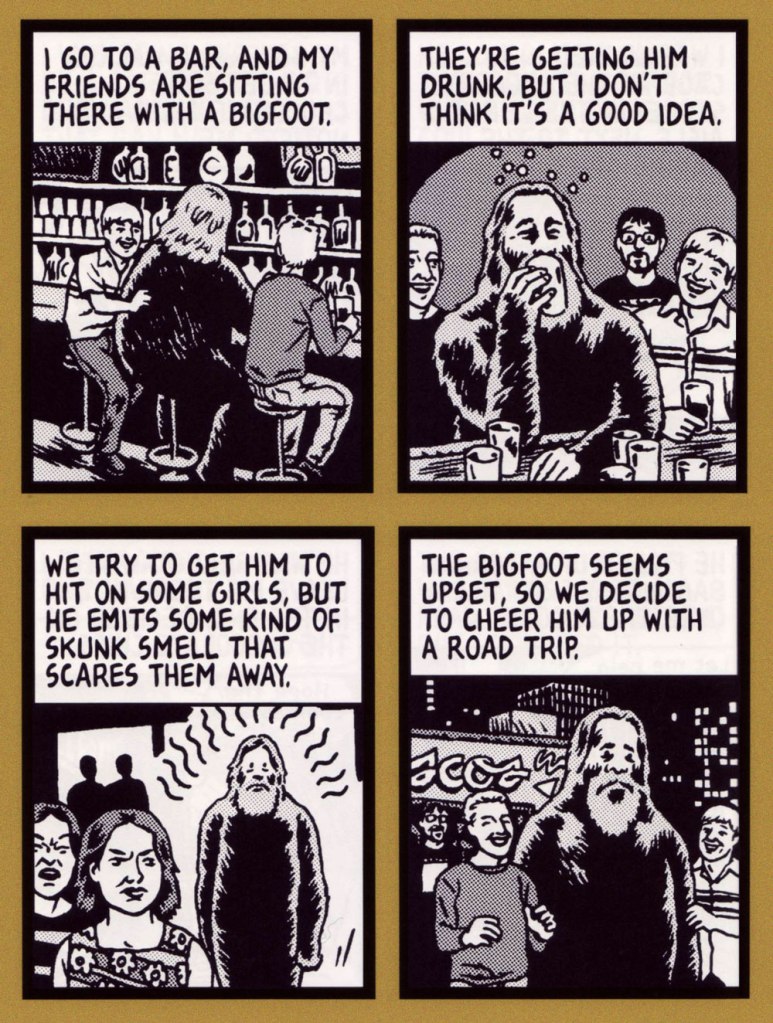
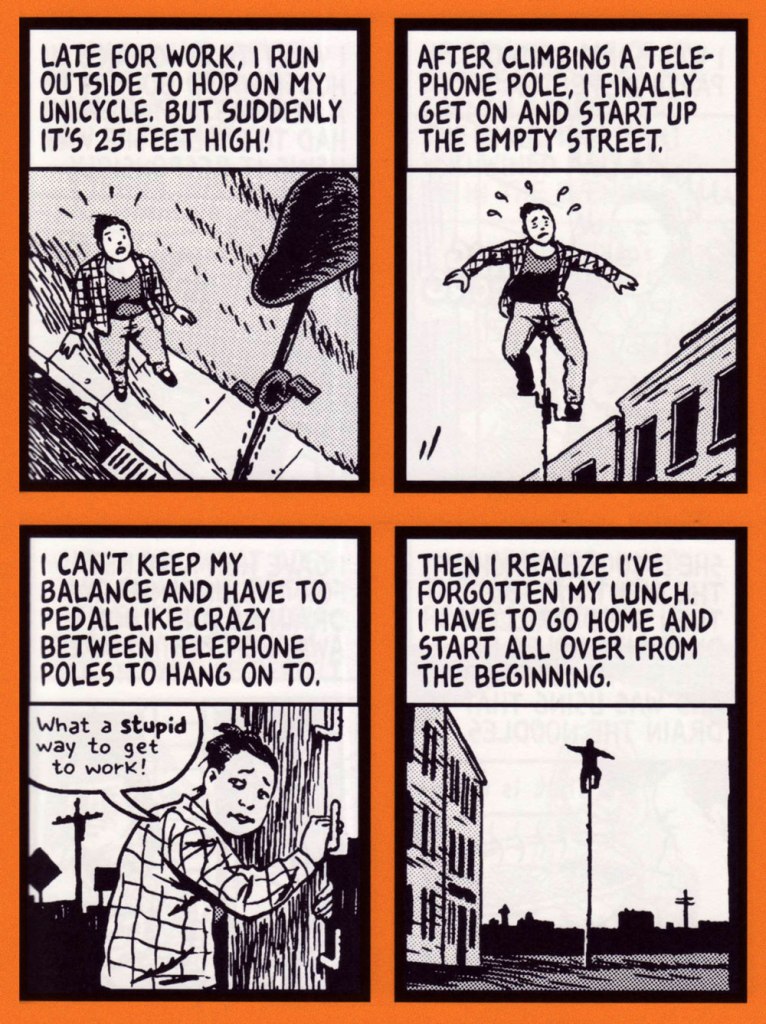
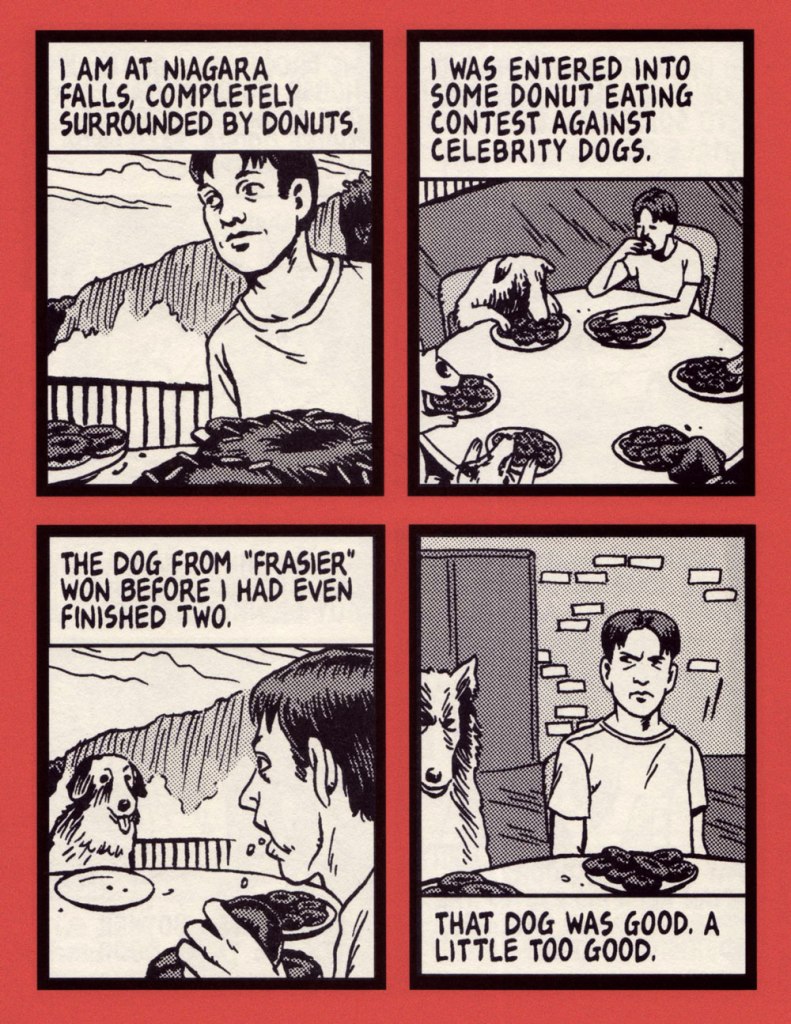
From a dream by Lauren Fowler.From a dream by Connie Liu.From a dream by DW Wissinger.From a dream by K. L. Wanlin.From a dream by Paul J. Lurie.From a dream by Pierre Dalcourt.From a dream by Isaac Cates.From a dream by Liz Kuzmeski.From a dream by Eli Bishop.From a dream by Sinnicam NodNarb.From a dream by Zach Archer.From a dream by Ryan Budge.
In the ensuing years, poor Jesse’s had, even by cartoonist standards, a terrible time of it, besieged as he was by both physical and mental health challenges. It’s not much of a stretch to surmise that cartooning saved his life, and he’s hardly alone in this. Check out this sobering Comics Reporter interview, (circa 2014) and you’ll get some sense of what I’m alluding to.
-RG
*Slow-wave sleep (SWS) refers to phase 3 sleep, which is the deepest phase of non-rapid eye movement (NREM) sleep, and is characterized by delta waves (measured by EEG). Dreaming and sleepwalking can occur during SWS. SWS is thought to be important for memory consolidation [ source ]
**Nearly twenty years on, cheap copies are still bountiful.
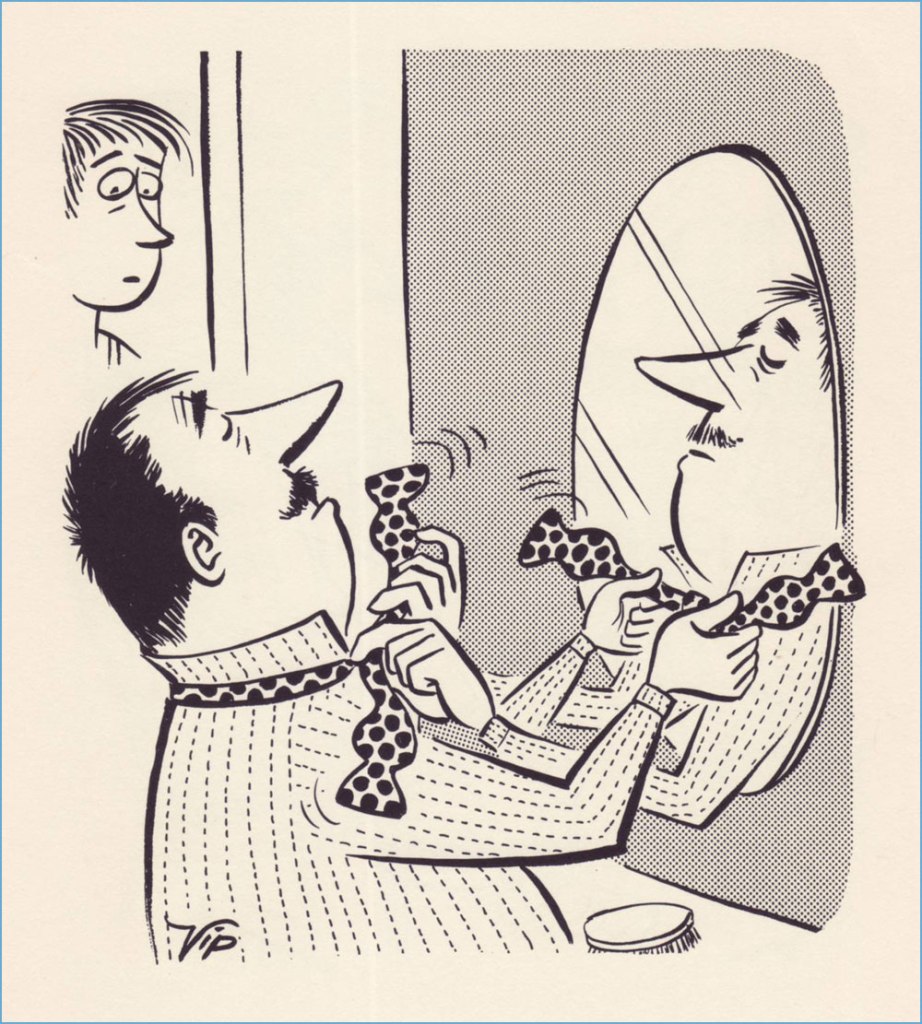
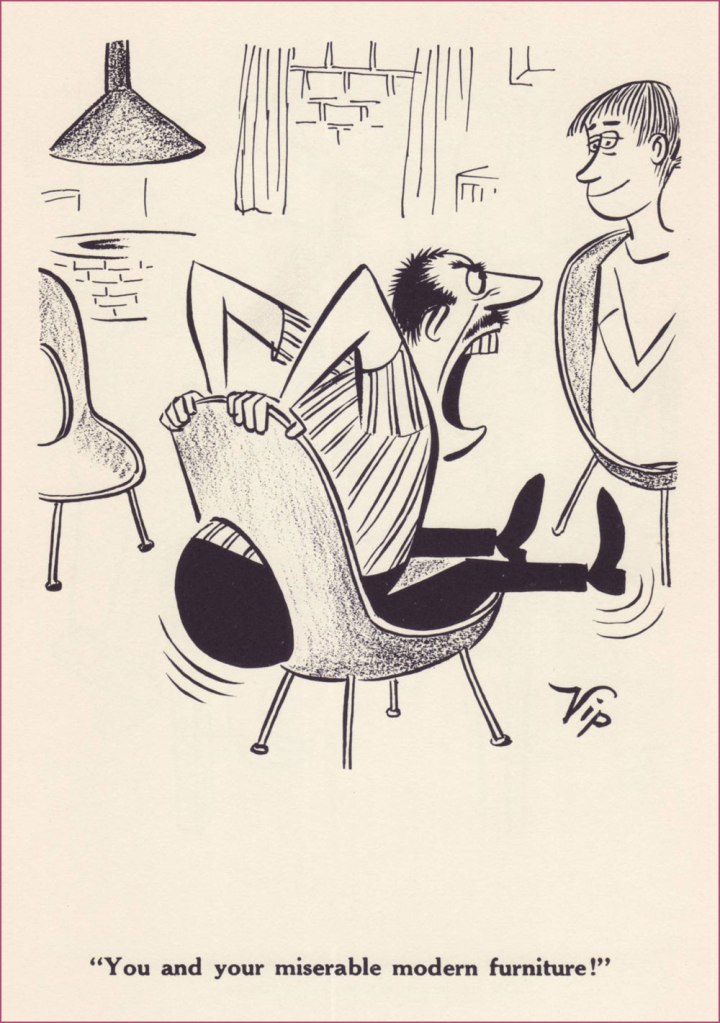
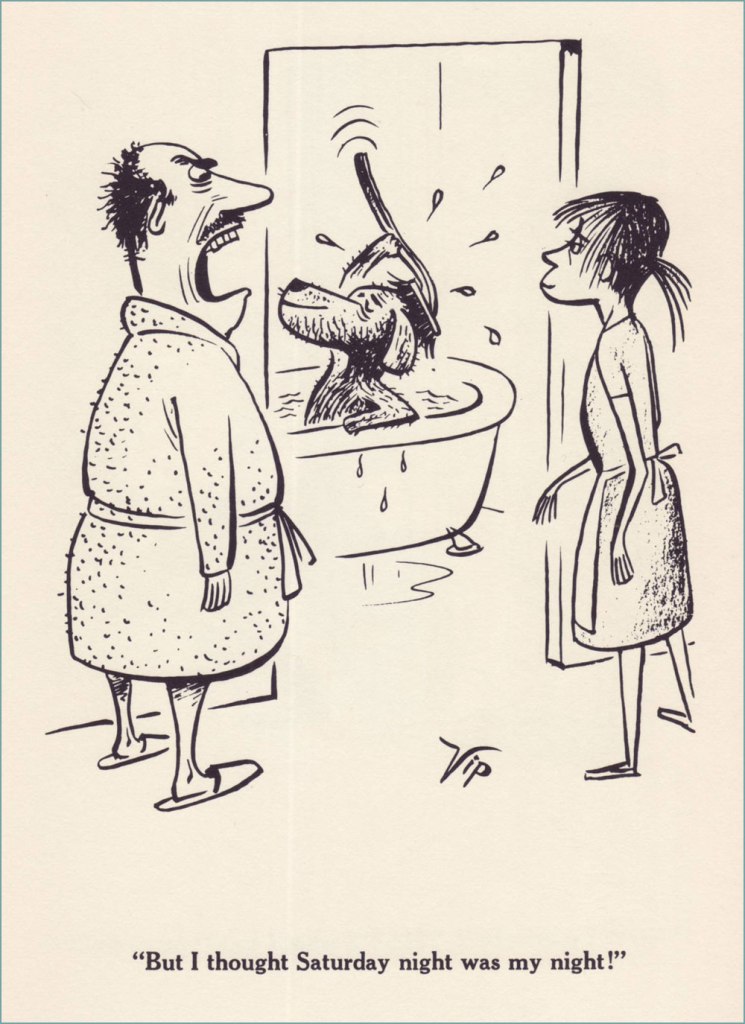
Virgil Partch is such a bright, shining figure in the cartooning world, his sense of humour so zany and impertinent, that I can understand a certain lack of interest in his newspaper strip Big George, which was designed to be family-friendly and as such is far more comfortable and conventional than VIP’s elegantly absurd output during his halcyon days.
Like the previously discussed Captain’s Gig (see Virgil Partch’s Captain’s Gig), Big George, who strutted into existence in 1960 in daily cartoons and a month later in Sunday strips, was syndicated by Field Enterprises. The strip did not break any sales records, but maintained itself at a respectable level of popularity for an impressive number of years, even living on beyond the death of its creator, thanks for VIP’s habit of working far ahead of the deadline – he died in 1984 in a car crash, but he had created enough surplus strips to last until either 1986 or 1990 (the sources on this are somewhat conflicting).
That being said, cantankerous and girthy family man George Filstrup, walking collection of many flaws typical for cartoon (and real-life) husbands, lived through many surreal moments. Oh, he had but 5 fingers on each hand, and did ordinary things like go to work (to get humiliated by his boss) or swagger proudly around his barbeque, last refuge of manliness in this uncertain world, but his life often took a turn for the bizarre. Case in point, his very anthropomorphized and malicious pooch, great fun to watch in action. For a few first-class examples of this, head over to The Fabulous Fifties blog for Ger Apeldoorn’s always reliable newspaper scans.
Frankly, VIP’s art is arresting even when he’s illustrating mundane subjects… I don’t even need a touch of the surreal to enjoy it.
Speaking of scans, here are some Sunday strips from our own collection of newspaper cut-outs from sometime between 1968 and 1970:
George is not a likable character. As a matter of fact, I am overjoyed when something goes wrong for him, as it usually does. If he does something for his family, it’s either because the neighbours are watching and he’s concerned about appearances, or he’s been roped into it with some low-key chantage from his wife. He is vain, full of bluster, and easily manipulated. Frankly, I get the distinct impression that VIP’s sympathies lie entirely on the wife’s side – it’s unclear why she puts up with her lug of a husband at all, given how much smarter (and physically stronger, as Partch delights in pointing out frequently) she is. He does perhaps have one redeeming characteristic – his frequent flights of fancy, which is there VIP’s propensity for the surreal gets a chance to shine.
Sadly, there is no complete collection — not even close! — of Big George, and only two small ones – a hardcover from 1962, and a paperback from 1977. The following are scans from the former, published by Meredith Press.
« Time and space intertwined / Elegance, simple lines / Scandinavian Design »
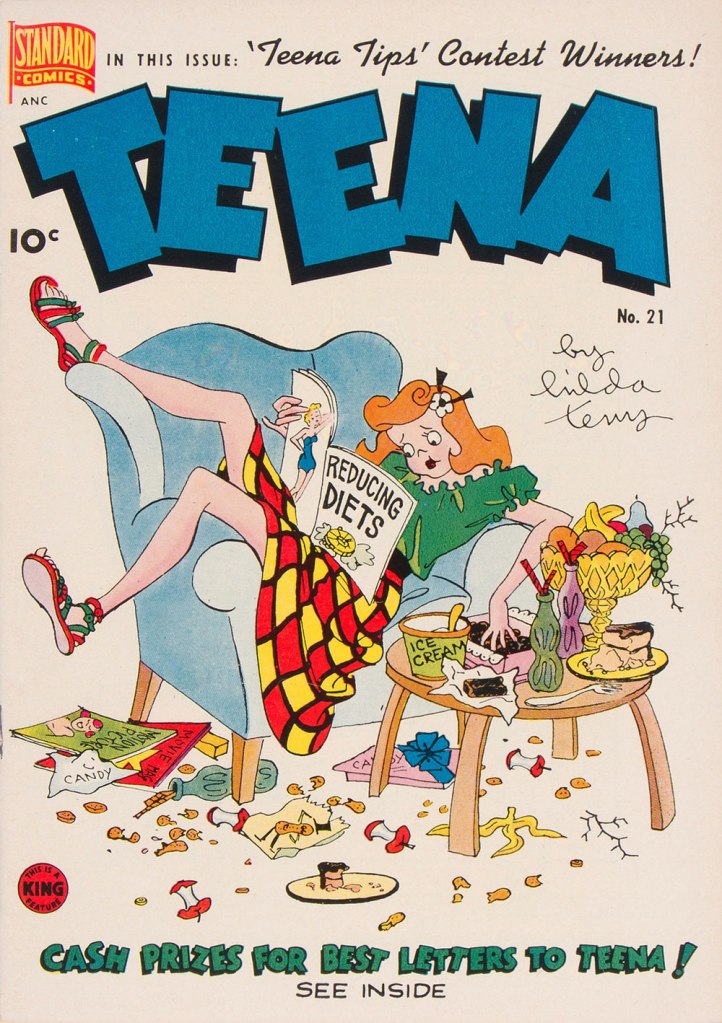
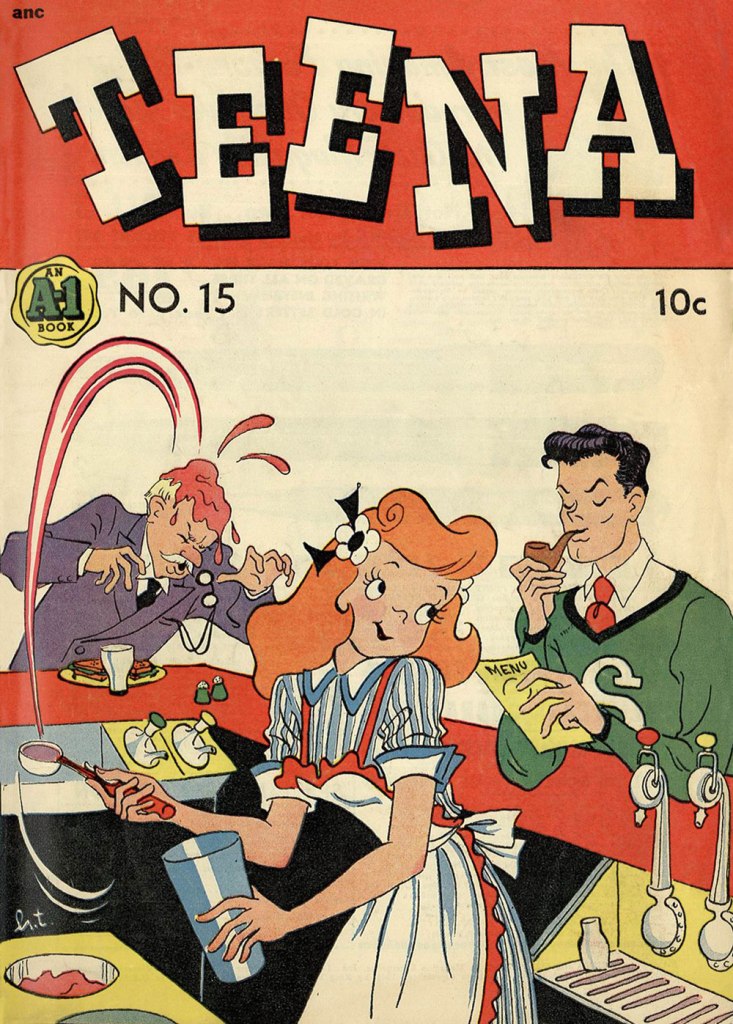
Theresa Hilda Fellman, later Theresa Hilda D’Alessio after marriage, generally known as Hilda Terry (1914-2006), holds the historical footnote of being the first woman to be accepted into the National Cartoonists Society. When her nomination was submitted in 1949 (by her husband Gregory D’Alessio, himself a cartoonist), the organization offered great resistance to the idea – apparently they were worried that men wouldn’t be able to curse if ladies were present. They eventually relented, even though it took a year of discussions as well as the loquacious support of a few male cartoonists like Milton Caniff and Al Capp. Terry was inducted, along with Edwina Dumm and WOT favourite Barbara Shermund, in 1950.
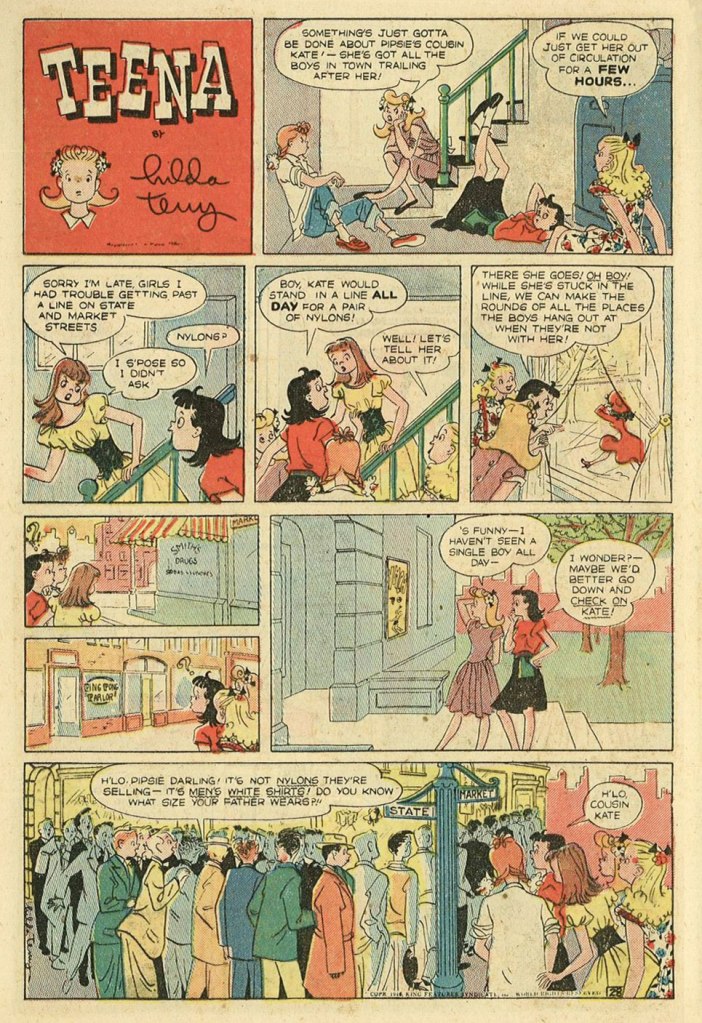
And so Terry tends to get mentioned in articles about female cartoonists because of her ground-breaking inclusion in the NCS. She proceeded to nominate yet more female cartoonists as soon as she got in, so this was a good demonstration of the foot-in-the-door being used for good. Obviously that deserves praise, but focusing on the aforementioned trail-blazing tends to overshadow Terry’s main comic strip Teena, which is genuinely fun – a point that might not be obvious, given that it’s about teenage girls and written for teenage girls.
Teena evolved from a newspaper Sunday feature (It’s a Girl’s Life) that got renamed as one of its protagonists grew in popularity. It was distributed by King Features Syndicate, and ran from 1944 until 1964.
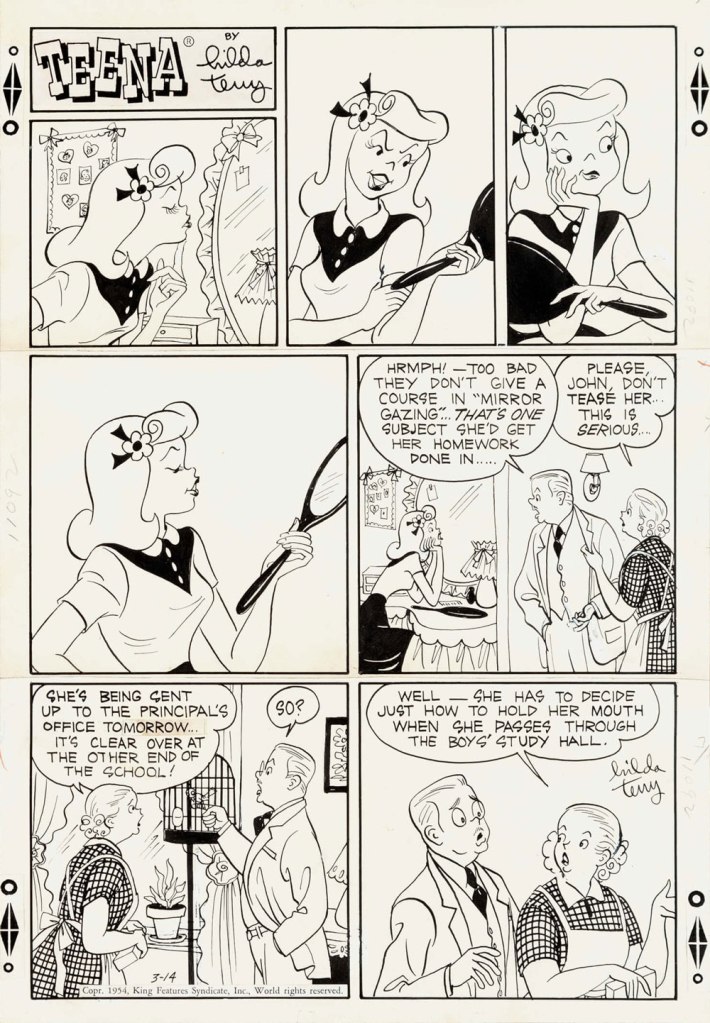
Original art for the Sunday strip from March 14th, 1954.
Teena no. 21 (November 1949), published by Pines. These comics books featured mostly newspaper strip reprints.
Teena’s girls are skinny, leggy creatures in motion, always perched in a peculiar manner on benches, draped over chairs (or trees), or lying cross-legged on beds. They may not have the manic savagery of Bonnie and Pepsi of Trots & Bonnie, but their sense of restlessness and a kind of misdirected lust give a similar, true-to-life, vibe (except that thanks to a three-decade difference in mores, while Pepsi is deciding on the optimal length and girth of her next beau’s appendage, Bonnie is planning the height and neck measurement of her future husband – it’s six and two threes). A lot of stories are based on (stereo)typical teenage behaviour – an obsession with clothing and appearance and general ne’er-do-wellness – but conversations often take place while something else is occurring in the background. Unlike a lot of similar comics, Teena feels like it’s set in a real world where people have to sleep and eat (and not just for the sake of a punchline). The dialogues are often staid, but the frame they’re in is dynamic, with art that may seem a bit sketchy at first, but reveals a wealth of detail upon inspection. For an analysis I really liked, head over to the Mike Lynch Cartoons blog.
Original art from the July 23rd, 1961 Sunday strip.
Teena no. 15 (August 1948), published by Magazine Enterprises.
Terry went a bit (or is that a lot?) off her rocker in her later years, seemingly harbouring a conviction that she was the reincarnation of a Salem witch (I am not sure whether she thought the latter was an actual witch, or just an innocently executed woman).
For more Sunday strips in colours, visit the Ragged Claws. You can also read a bunch of scans of comic books over at Comic Book + – the scan quality leaves something to be desired, but I still went though a couple of issues with great enjoyment. We really need a proper Teena collection!
I also highly recommend this amazing article about powder etc. compacts marketed for teenage girls with a great gallery of designs.
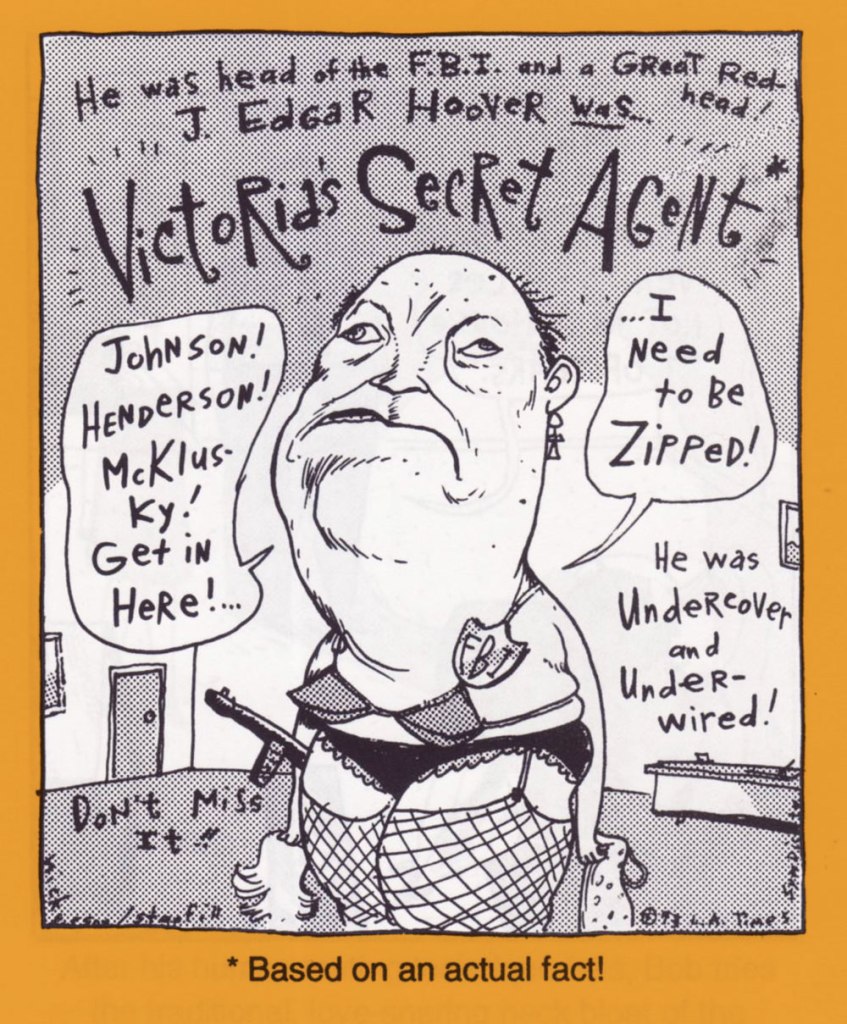
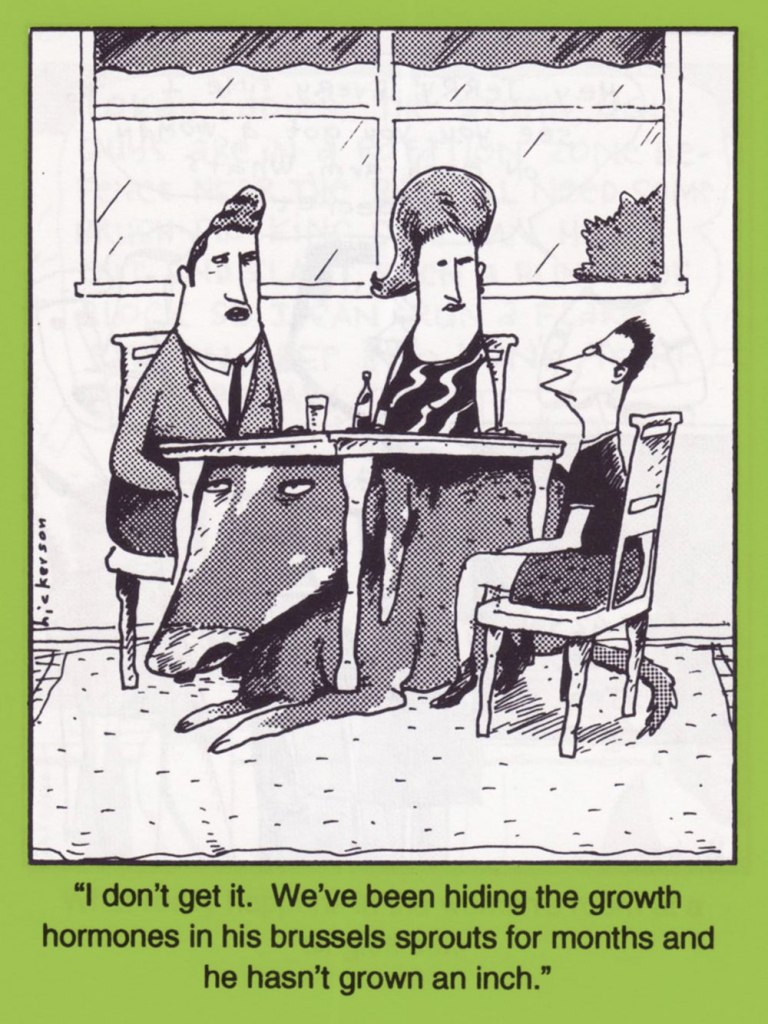
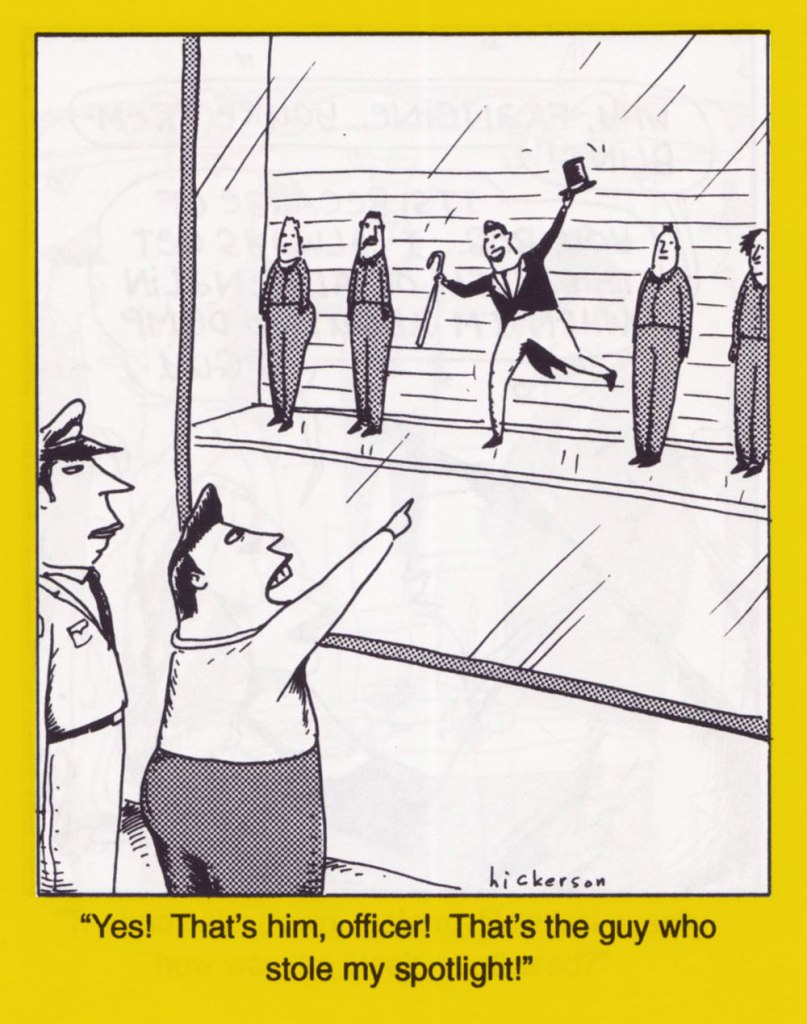
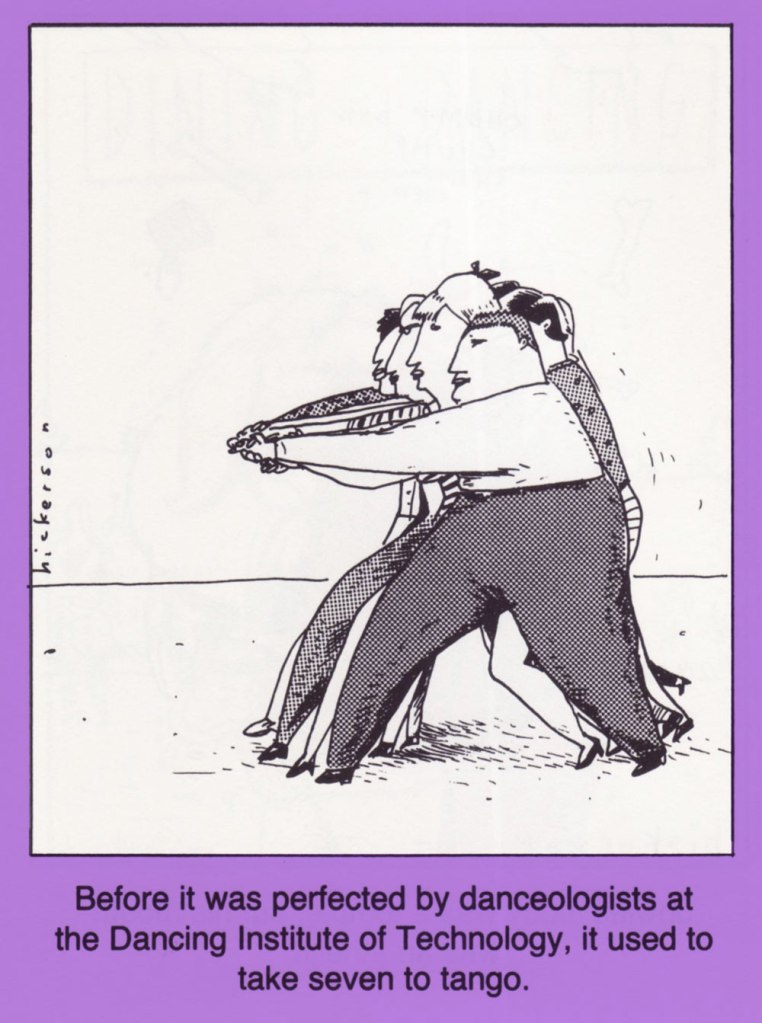
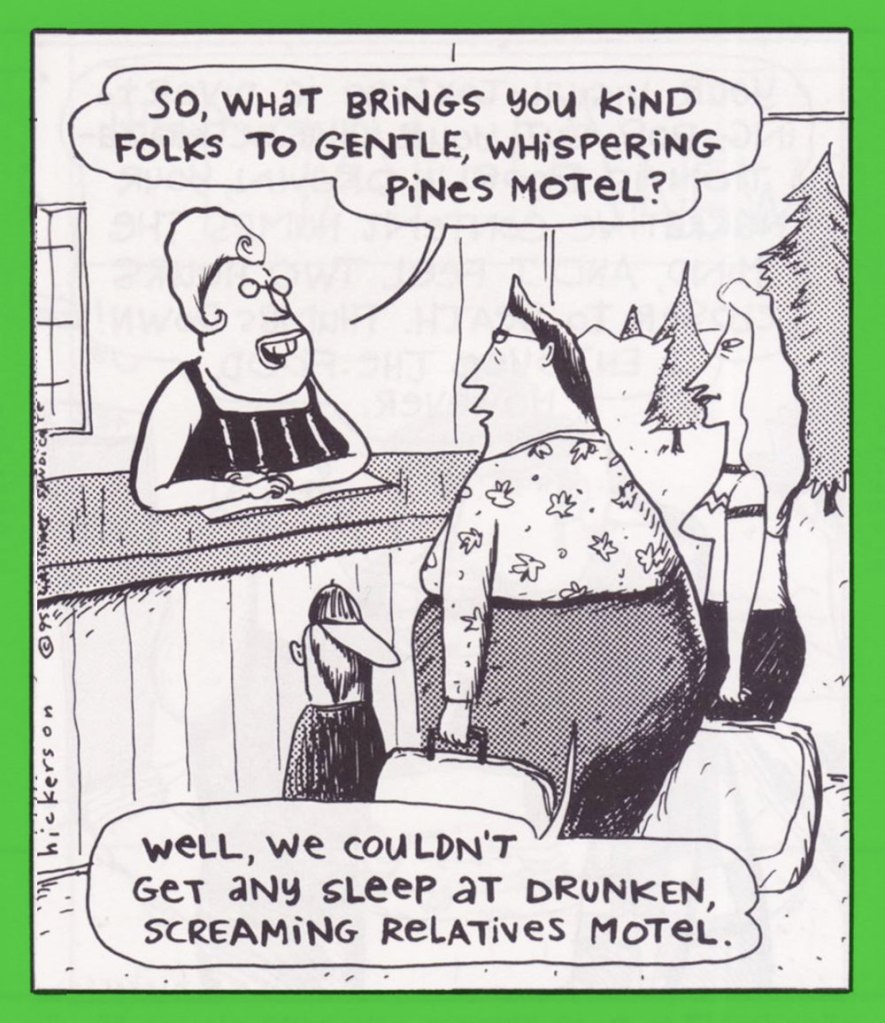
« And what can you say about Buddy Hickerson that hasn’t already been confessed in court? » — a 1992 blurb
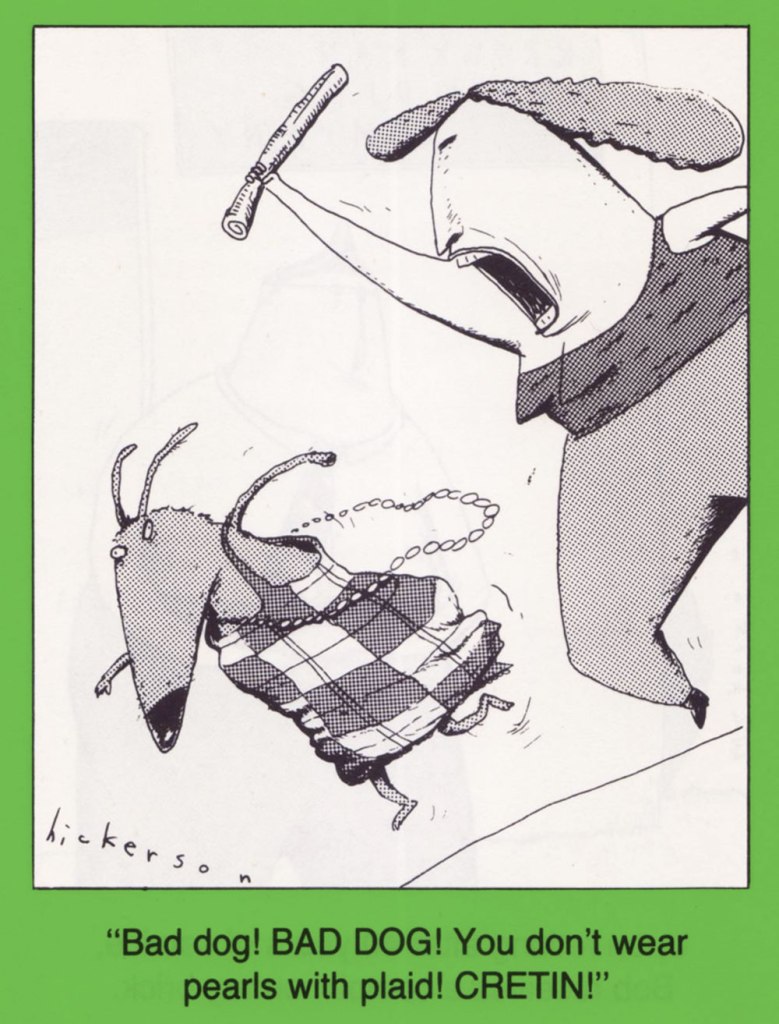
While the 1980s mega-popularity of Gary Larson’s The Far Side (1979-1995) led to a plague of mostly feeble imitations, it more significantly contributed to the acceptance of a greater range of humour (and drawing styles*) in a staid syndicated strip industry sorely in need of a vigorous shakeup. While Dan Piraro‘s Bizarro (1985–) is the clear winner among those that followed Larson’s path — no small thanks to an original vision and drawing chops to kill for — I’ve always had a soft spot for one of the also-rans, Buddy Hickerson’s The Quigmans.
While Hickerson wasn’t a consistent gagman to rank with the cartoon gods, he scores points aplenty for trying and the intermittent spark of genius. And I dug his ‘melted in the sun’ aesthetic, echoes of which seeped into the mainstream. I mean, consider the likes of Beavis and Butthead (1993) and Duckman (1995), merely to skim the greasy surface.
Anyhow, here’s a sampler of my favourite Quigman misadventures.
Four Quigmans collections have, to my knowledge, been issued:
The Quigmans (1992, Tor Books) The Quigmans (1990, Harmony Books) Love Connection! (1992, Harmony Books) and Tunnel of Just Friends (1996, Four Walls Eight Windows).
I’m happy to say he’s still active and has remained true to his vision; check him out at (of course) his official website.
-RG
*though we can’t not mention such trailblazers as Lynda Barry, Matt Groening, Gary Panter and even David Lynch in such a context. The 1980s weren’t altogether a cultural wasteland, after all.
«The kind of guy you’d love to have at your next cocktail party, he’s got a million hilarious anecdotes and he’s more than happy to tell them. »
In the early days of this blog, we talked about American cartoonist Arnold Roth (see « All cartoonists are geniuses, but Arnold Roth is especially so. »). But this was some 6 years ago, and back then I wasn’t too generous with images. Roth has now made it to the venerable age of 94, and hopefully with us for many years to come! Even without dipping into his contributions to Harvey Kurtzman‘s Humbugand (unfortunate name association aside) Trump magazines, there is plenty of material to showcase and giggle at.
Did you know Roth not only illustrated many jazz LP covers, but was also a sax man himself? Check out this awesome gallery of some of these covers on Drew Friedman‘s blog!
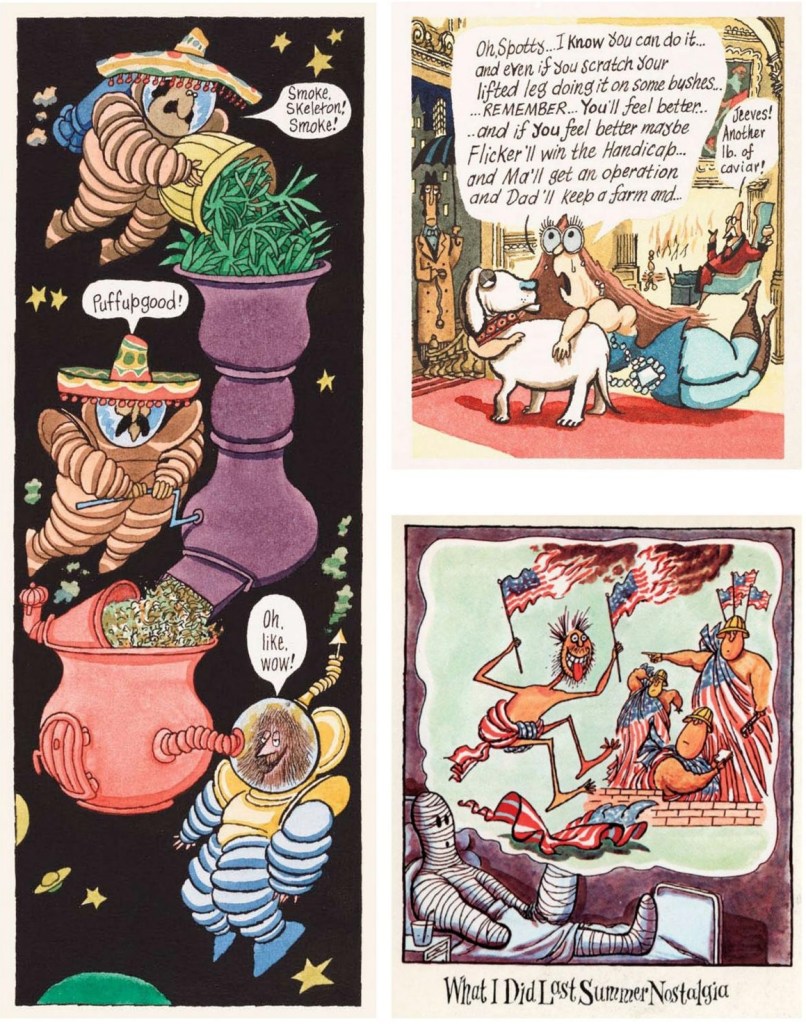
A collage of pages from 1970-1971 issues of National Lampoon published in Rick Meyerowitz‘s Drunk Stoned Brilliant Dead (2010), a massive hardcover gathering highlights from The National Lampoon and interspersed with interviews and biographies of its stable of cartoonists and writers. The bottom right, from a series of cartoons titled ‘Nostalgia is Goodstalgia‘ from NL’s November 1970 issue, feels uncomfortably on the ball for the current political climate (ouch).
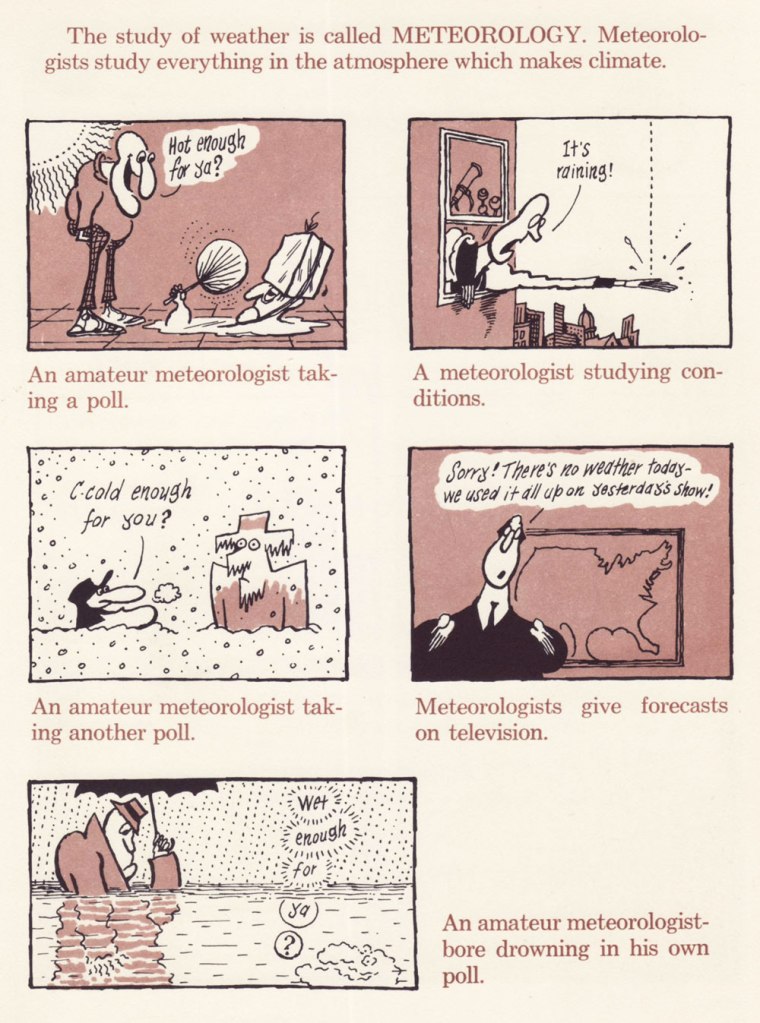
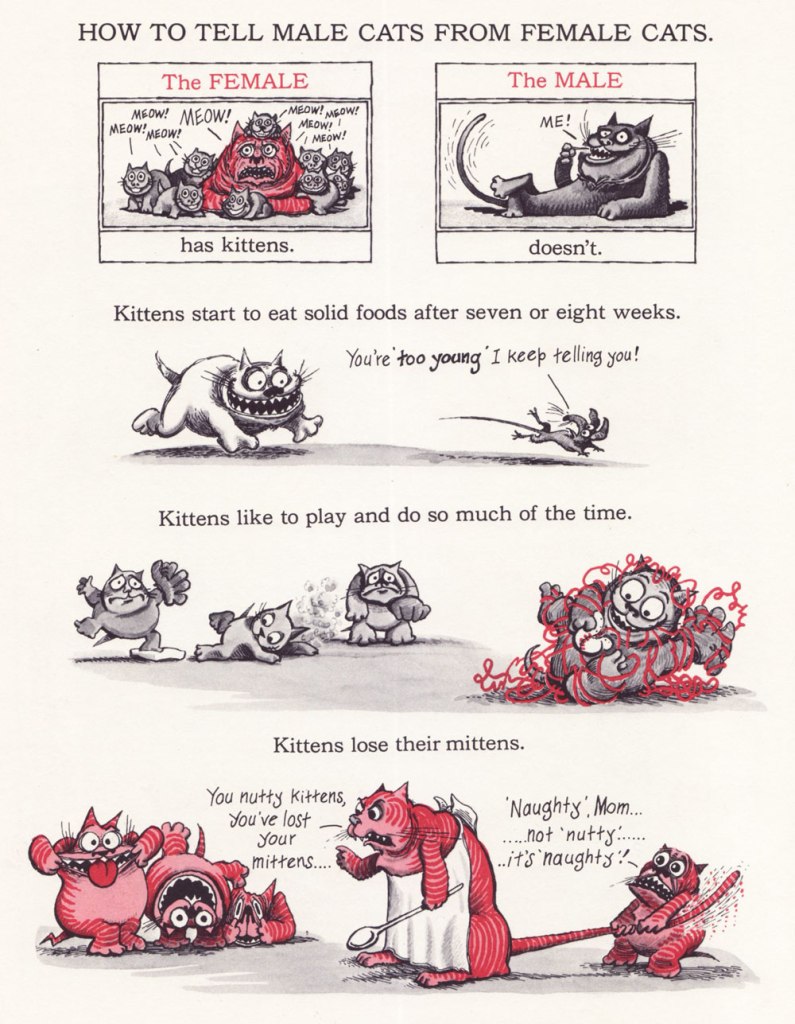
Here are a few pages from Arnold Roth’s Crazy Book of Science (1971), which offers a few suitably madcap pages:
Meteorologists have been the butt of jokes for at least over a hundred years (at least Jerome K. Jerome‘s Three Men in a Boat from 1889 pokes fun at them), but whether the recent weather forecasts have been worse than usual is up for debate.
Then there’s my beloved Comick Book Of Pets (1976) – ‘found, raised, washed, curried, combed, fed and cared for in every way‘.
Co-admin RG was swearing a bit while scanning this for me, so please make sure his sacrifice was not in vain by looking at the details.
Read his fascinating interview with Gary Groth here.
«Babies of course are not human — they are animals, and have a very ancient and ramified culture, as cats have, and fishes, and even snakes: the same in kind as these, but much more complicated and vivid, since babies are, after all, one of the most developed species of the lower vertebrates. » — Richard Hughes
I am fairly neutral about children, and prefer to stay away from them for the most part (although there are some pleasant exceptions to this rule). However, I enthusiastically dig through children’s books when given half a chance, and greatly enjoy comics about ankle biters of the ‘wise far beyond their years’ variety. Some authors’ worlds are so compelling that one wishes to be teleported into them. Who wouldn’t love to hang out with Sugar and Spike, or Cul de Sac’s Alice, or Daniel Pinkwater’s Robert Nifkin?
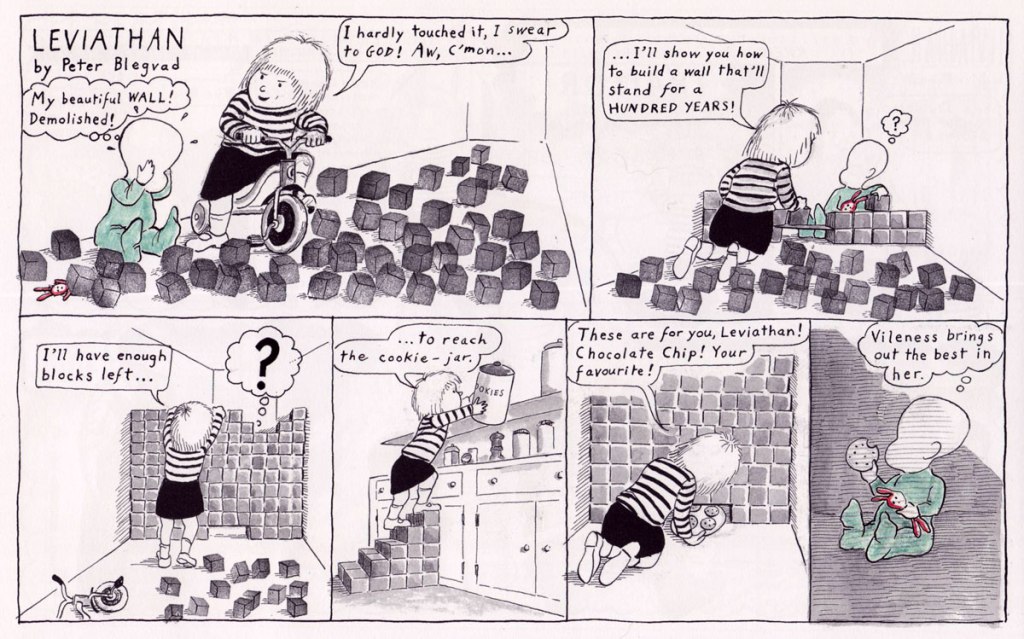
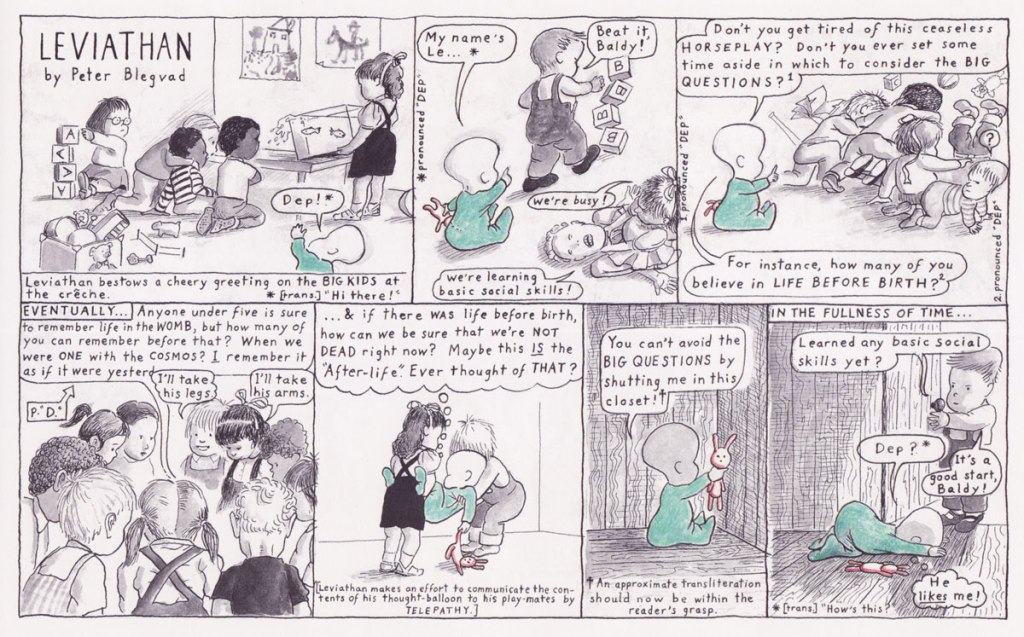
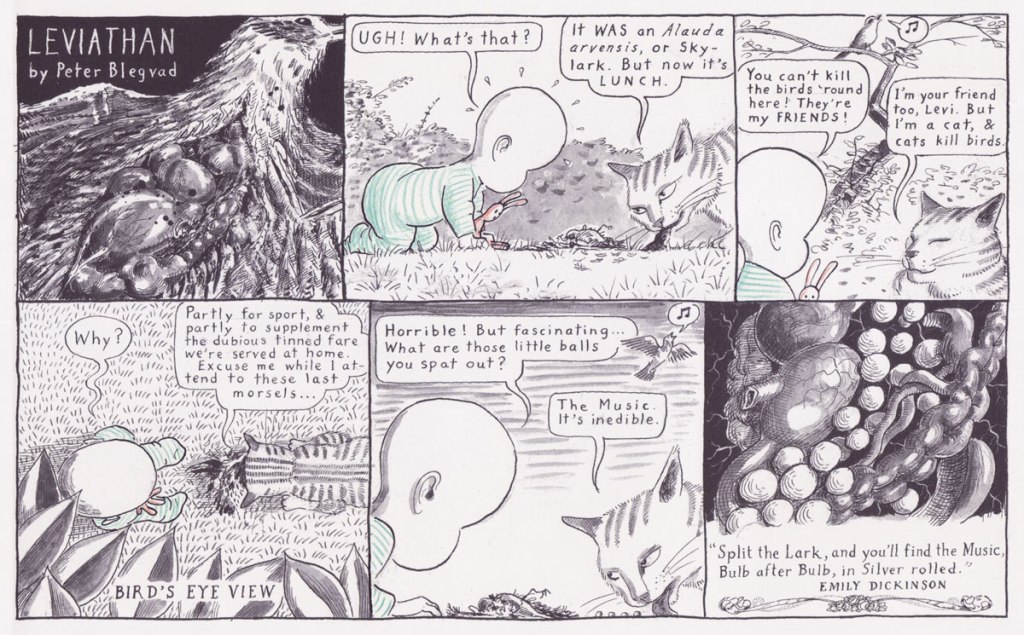
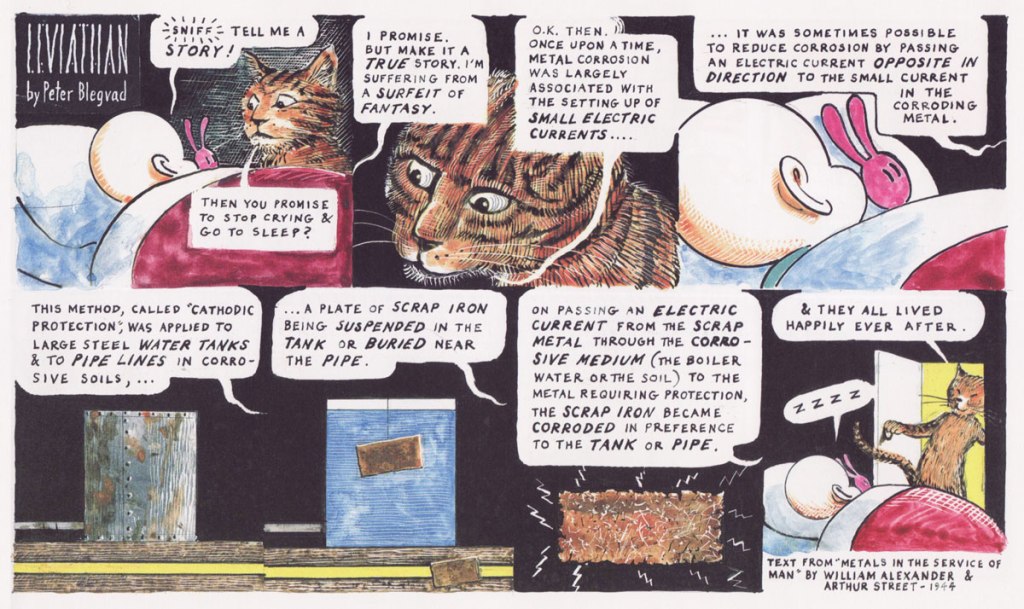
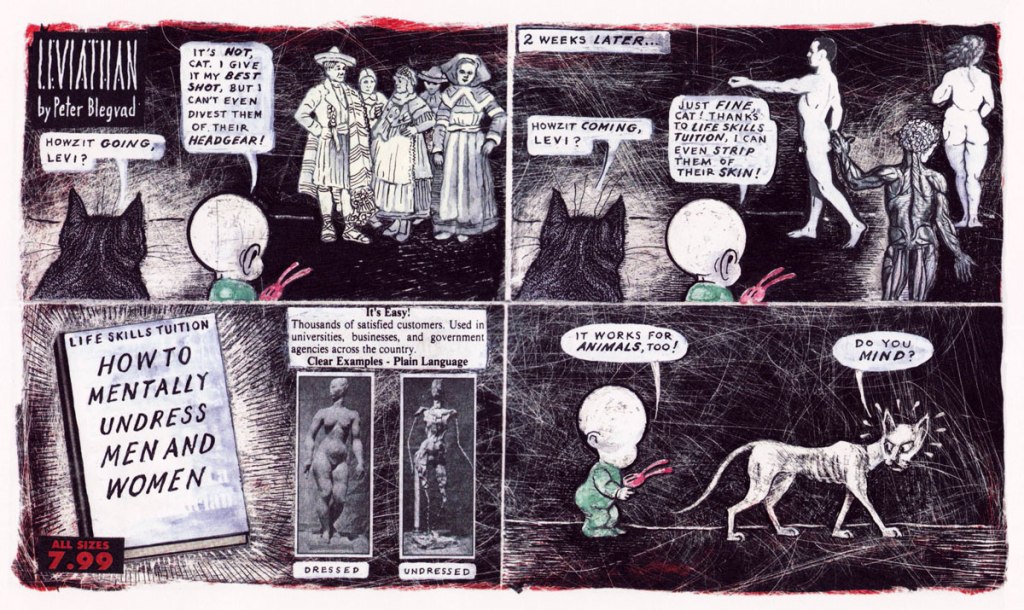
Though I have no such desire to rub elbows with the faceless, introspective Leviathan, his perambulations are great fun to watch. As per his name, he’s more than a little bit of a megalomaniac – as one can argue that all children are. Bred from a long line of ‘more or less faceless neotenic grotesques‘, such as Crockett Johnson’s Barnaby or Walter Berndt’s Smitty, Levi is an infant trying to make sense of the world around him through philosophical musings, an occasional break through the fourth wall, and conversations with his feline companion, Cat.
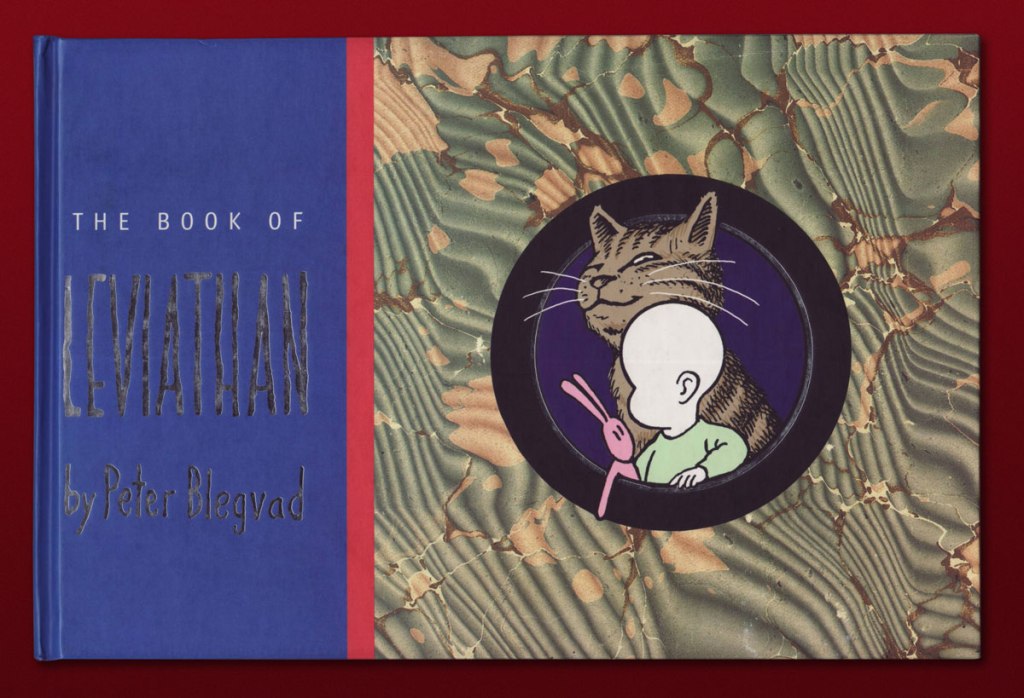
His patriarch is American Peter Blegvad, son of Danish illustrator Erik Blegvad (which accounts for the hard-to-pronounce family name that I tend to misspell as ‘Blevgrad’, since ‘grad’ is a common suffix for a city in Russian*), more known for his musical career than remembered for his cartooning one. Leviathan was published in the Sunday section of British newspaper The Independent** from 1992 to 1999, and some of the strips were collected in The Book of Leviathan, issued in 2000 by The Overlook Press. The latter is how I came across this strip, in the apartment of a friend kind enough to give me his copy when he saw how absorbed I was.
Levi’s big sister Rebecca is a habitual tyrant, though not without a certain charm.
In case you’re wondering re: snow vocabulary, some have disputed this claim as false and stemming from a misunderstanding of Eskimo-Aleut languages, which are agglutinative, and can form new words by combining other words. Here’s a quick article if you’re curious about the specifics.
Like all great observers of children’s rituals, Blegvad clearly had some children around to inspire him.
Q: How did you get the idea of naming a tiny baby Leviathan?
A: From my own kids: they’re both, you bring them home and they’re bigger than anything else in your life.
Q: Why did you switch from Levi’s parents to the Cat?
A: The Cat was easier to draw.
Leviathan seems to invite a hate-or-love kind of response from readers; as Rafi Zabor notes in the introduction to the collection, ‘I have met a few intelligent, literate, artistically sophisticated people who just don’t get it, and their non-response to what is obviously just for starters a classic of its kind, assuming it has a kind, has always puzzled me. ‘ As somebody who belongs in neither camp, I would suggest that this strip sometimes has its head up it arse, and goes so far into self-indulgent metaphysics that it loses its anchor for the sake of willful obfuscation – and sometimes it’s brilliant and very funny. As if to demonstrate the former, Zabor finishes his introduction with ‘Words fail. Times change. Cats meow. Leviathan swims in its native deep, glistening through serial sea-green waters, sending off spectra of intelligible light as it steers with ribbed and radiant fins.’ Nevermind such dubious metaphors – I posit that it’s Leviathan’s playfulness, juggling as it does quotes from long-dead philosophers, questionable puns and surreal vignettes flavoured with Freudio-biblical mythology, is worth the occasional muddle through a high-concept strip that didn’t quite pan out.
~ ds
* I keep misspelling his name as ‘Blevgad’, which would be very unmelodic to Russian ears, as ‘blev‘ means ‘puke’ and ‘gad‘ is sort of like ‘bastard’. I did in fact misspell it several times in this very blog post, until co-admin RG set me straight. Very embarrassing.
** Was this because Leviathan was too erudite and weird for American audiences? Blegvad was born in NYC in 1951, but was raised in England, spent some years in Germany, then returned to NYC in 1977. Given his proclivity for quoting British authors, I think his sensibilities lie more with Albion.





































 Who's Out There?