I also recommend reading Learning to Love Jack Kirby, an earnest and personal story of how the author (Chris Sims) came to appreciate Kirby and, at the same time, a pretty good overview of some of his most memorable characters and comics.
« I’m tempted to say that you don’t really get Kirby until you develop the ability to look beyond the surface of a story and see how much craftsmanship it takes to look as simple as his comics, but that’s really just covering up my own initial revulsion. There were plenty of kids who encountered Kirby at the same age I did and wound up loving him from the start; I’m just a slow learner.But I do think there’s something to the idea that it just has to hit you right for everything to make sense, and once you’re there, you’re there forever. And the good news is that Kirby’s contributions to the medium are so vast, so unavoidable even a quarter-century after his death, that even just scratching the surface of superhero comics means you’re encountering them all the time. »
Now that we have part over with, shall we continue to the tentacular part of today’s post? Kirby didn’t do anything in half-measures, so I’d like to think that we have some epic, larger-than-life, cosmic tentacles on offer. As it turns out, there’s quite a lot of ’em scattered throughout Kirby’s mind-boggling career, so today I am concentrating on Kirby’s work for DC Comics in the 1970s.
Seriously, there’s all kinds in here. A sea ball of yarn is our exhibit A.
Sequence from O’Ryan Gang and the Deep Six, scripted and penciled by Jack Kirby, inked by Vince Colletta, and published in The New Gods no. 4 (August-September 1971).
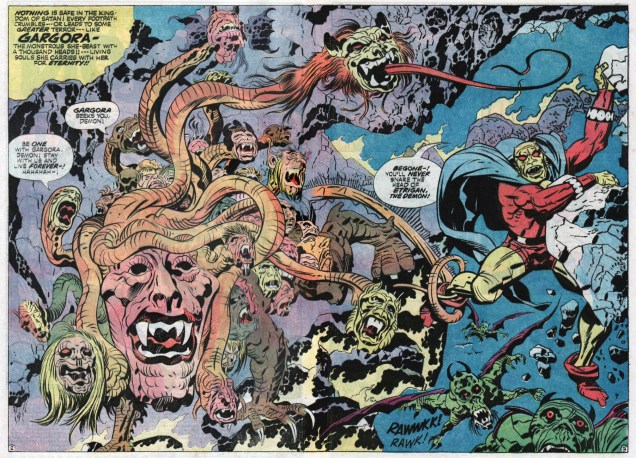
This may be a take on the old head-of-Medusa, but Gargora doesn’t mince words, and when she says someone can’t escape, well, she’ll deploy some tentacles to catch them:
Splash from Witchboy, scripted and penciled by Kirby, and inked by Mike Royer, and published in The Demon no. 14 (November 1973). Random fact of the day: Freud considered that the hair on Medusa’s head is often represented in form of snakes, because as snakes are penis symbols derived from the pubic hair, they serve to mitigate the horror of the female castration complex. …When someone tells me that are into Freudian theories, I back away slowly.
Some monsters crush you between their limbs – this is no different, but instead of two legs, there’s a “crushing mass of tentacles”. Don’t feel bad, Etrigan, no-one could break free of *that*.
Page from The One Who Vanished!!, scripted and penciled by Jack Kirby, and inked by William Stout and Mike Royer (don’t miss co-admin RG’s 3-part, exclusive interview with Mr. Royer!), published in The Demon no. 15 (December 1973).
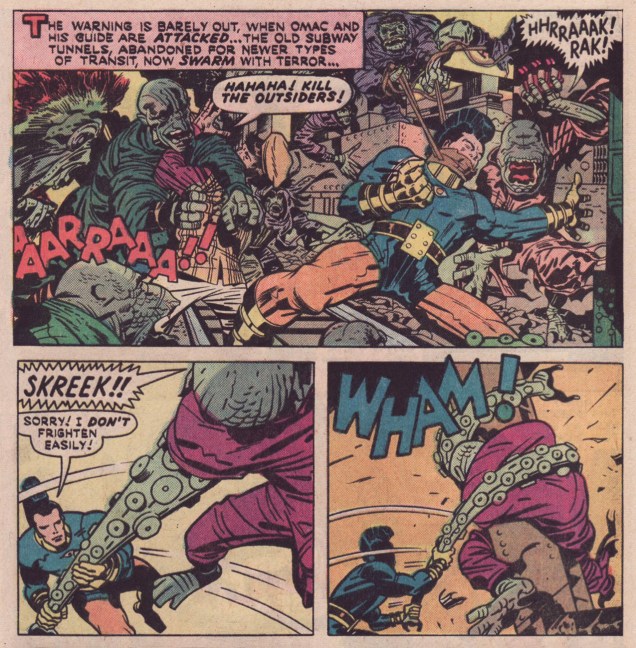
You might argue that these aren’t tentacles at all, but the creature is described as a “flying octopus”, and who am I to argue with Kirby’s description?
Page from The Busting of a Conqueror!, scripted and penciled by Jack Kirby, and inked by D. Bruce Berry, published in OMAC no. 4 (March-April 1975).Page from The Spy, scripted and penciled by Jack Kirby, and inked by D. Bruce Berry, published in OMAC no. 6 (July-August 1975).
One must have one proper sea monster in a Tentacle Tuesday, and this one’s a beauty:
Page from The Invasion of the Frog Men!, scripted by Michael Fleisher, penciled by Jack Kirby, inked by Mike Royer and published in The Sandman no. 5 (October-November 1975).
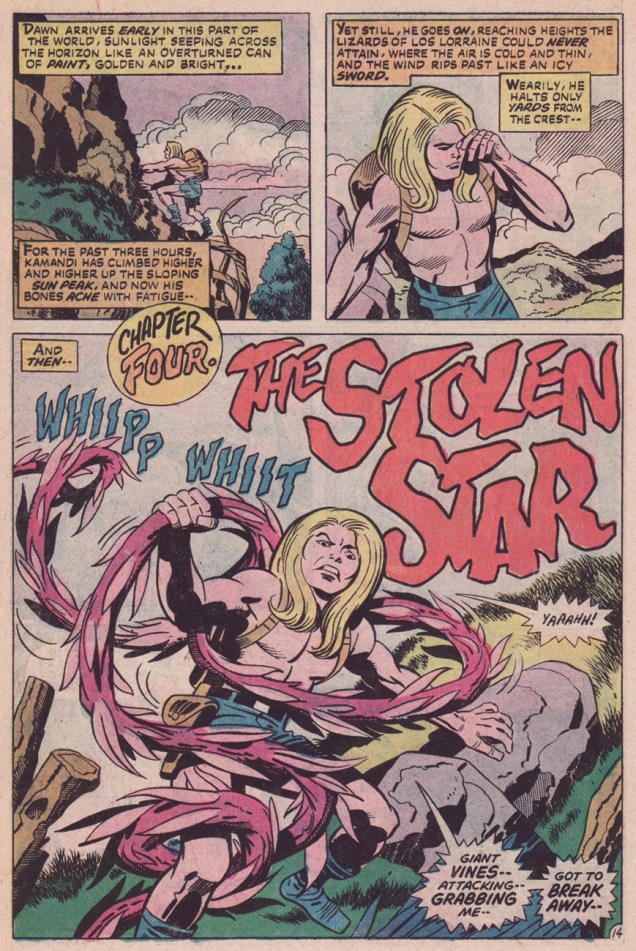
Last but not least, plant tentacles!
Page from The Lizard Lords of Los Lorraine!, scripted by Gerry Conway and Paul Levitz, pencilled by Jack Kirby, and inked by Mike Royer, published in Kamandi, The Last Boy on Earth no. 40 (April 1976). Kamandi was my first exposure to Kirby, and it bowled me over. It’s a good illustration of what he can do (and did over and over again), actually: create a universe with its own rules and a perfect internal logic. There are no boundaries in such a place, no limited number of characters – it just lives and breathes as it pleases, and one is but a passerby who gets to witness a few key scenes. Reading Kamandi teleported me into his world with such ruthlessness that I was quite disoriented when I’d have to stop reading.
« His incredibly unique art style and bombastic storytelling made him one of the most imitated creators in western comics history. Kirby Dots are named after the artist’s distinctive rendering of Battle Auras, also nicknamed, “the Kirby Krackle”. He died of heart failure in 1994 at the age of 76, or at least that’s what Galactus wants us to believe. Due to his speed in creating well-received comics, there exists something called the “Kirby Barrier”; breaking the barrier means that you’ve created a quality comic in under a week, a surprisingly difficult feat. » |source|
« It was like plunging deeper and deeper into a growing nightmare! »
A powerful (what else?) Jack Kirby piece, one of his last before decamping to DC. He actually gets a full writer/artist credit (a telling tail end turning point of that Marvel residence) on this tale, … and Fear Shall Follow!. The lush cover inks are provided by fellow Golden Age titan Bill Everett (1917-1973), a far cry from the miserable Vince Colletta « finishes » he would be saddled with at DC for the next couple of years (at their insistence!)
I was planning on featuring the entire story, but others have long ago preceded me down that primrose path. Why fight it? Just pay Diversions of the Groovy Kind a visit, where you’ll receive, as a bonus, Kirby’s other solo outing for the House of (mostly his) Ideas, The Monster!, from the previous issue of Chamber of Darkness (no.4, April, 1970). Both are sympathetically inked by Marvel’s production manager at the time, the underrated and gone-too-soon John Verpoorten (1940–1977). Again, several notches above “Valiant” Vince Colletta’s casual sabotage.
Plot-wise, … and Fear Shall Follow!, while another variant in the Carnival of Souls tradition, is enriched by its unusual setting and whiff of incense and philosophy. Reminds me of a possibly apocryphal exchange between Watchmen editor Len Wein and its writer Alan Moore: « Alan, that ending’s already been done on The Outer Limits! »; (in thick Northampton accent, dripping with sarcasm) « Yes, Len, but it’s never been done by me! ». With all due respect, it’s not as if Mr. Wein had any moral lessons to dispense regarding originality.
« And by the way, did I see you without a Pookie Snackenberg button? »
Concluding our exclusive conversation with Mr. Mike Royer, picking up the thread from where we left off in Part Two. And don’t forget to begin with Part One.
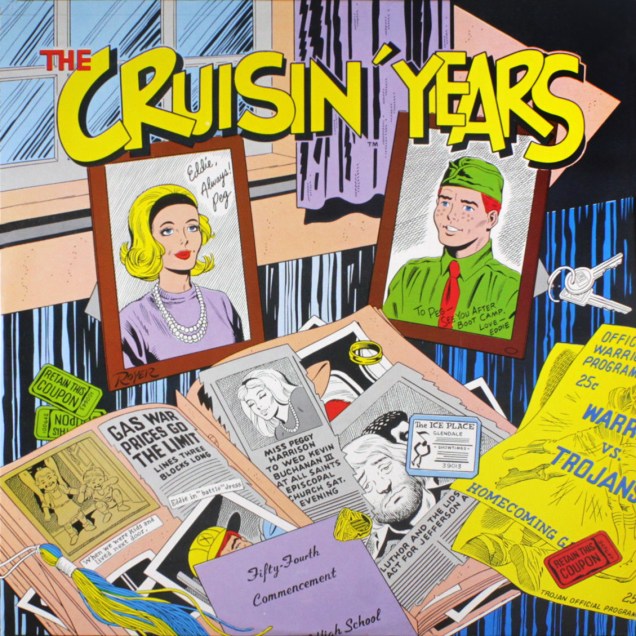
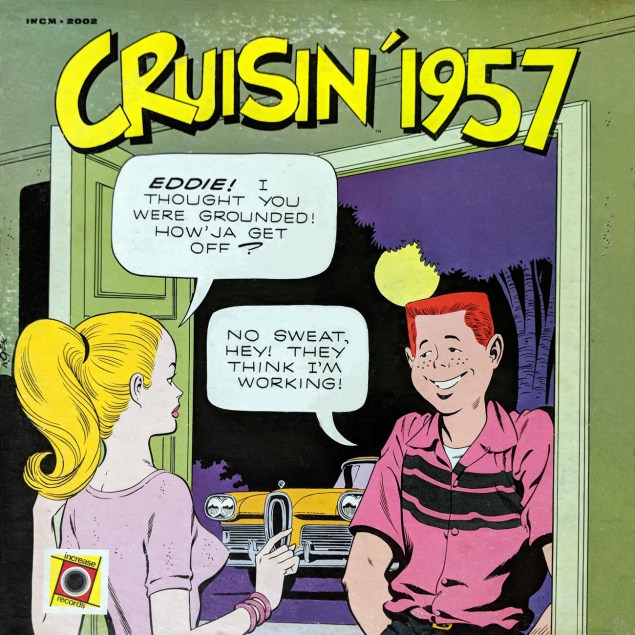
This illustration served double duty, first as a sampler released with the second batch of Cruisin’ albums in 1972, then on a box set collecting Cruisin’ 1955-56-57.Historical research in those days wasn’t as tidy and simple… and so here, either Peggy’s lying or… Elvis Presley’s third and final appearance on Sullivan’s show was on January 6, 1957. And The Blob wasn’t released until September 10, 1958. Well, Peg?Royer’s new illustration for the third and final box set, the one gathering Cruisin’ 1961-62-63, issued in 1992.
WOT: Are you happy with the overall work?
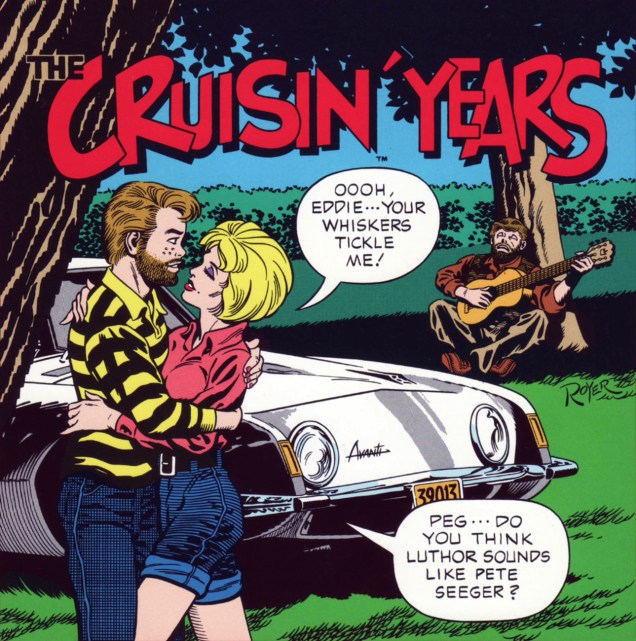
Michael Royer: I would say… two-thirds of the covers, I’m really pleased with. I can look at them and pickle the living daylights out of them. The Cruising’ Years… I look at it, and some of the proportions bother me. The scrapbook is too small, compared to the photo on the desk, and other little things that, if I were gonna do that again, I would adjust those sizes. But then again, that’s the impression I get, I guess, that’s important.
WOT: True.
MR: The one where Peggy sees Eddie behind her in a car at the drive-in is my least favorite of all of them.
WOT: Do tell.
MR: Because Paul had given me an impossible thumbnail. To make it work, so that they were all on the same planet… Ah, it’s really easy to lay out something and have two cars and the drive-in theatre lot, and not worry about if they’re on the same plane, if they’re seen from the same point of view… and so to do that and make it work… I still look at that and I get disappointed.
MR: I really like the one where he’s outside and it’s snowing.
WOT: And he’s with a black lady? That’s 1966.
MR: The black lady is looking at him… kind of suspiciously, and it may have something to do… because he’s in her neighborhood. I’m trying to remember if his early career at the law firm was dealing with…
WOT: Social issues?
MR: And I can’t remember, every tv screen’s got the same thing on it. Is it the Batman logo?
WOT: Confirmed. You were right on the money.
MR: Here we are, all the Cruisin’ cds. They have changes on them. Okay, let’s see. ’55 was the first one.
WOT: Actually, from what I’ve read, ’55 was actually done later, part of the second batch produced [in January, 1972].
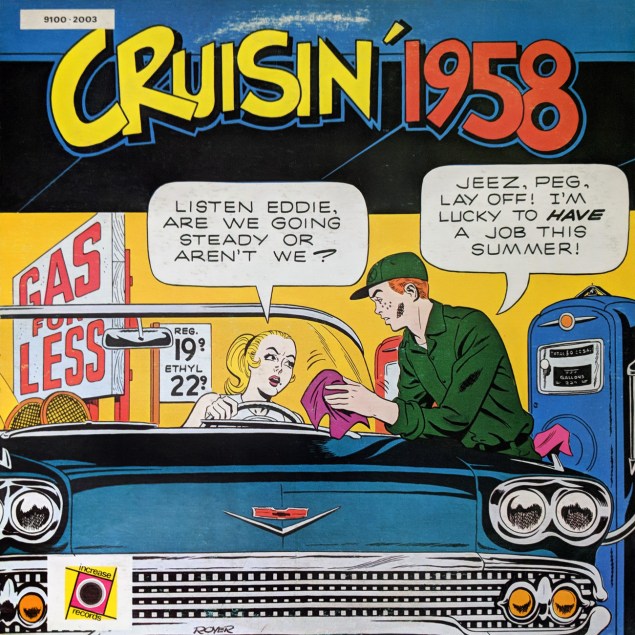
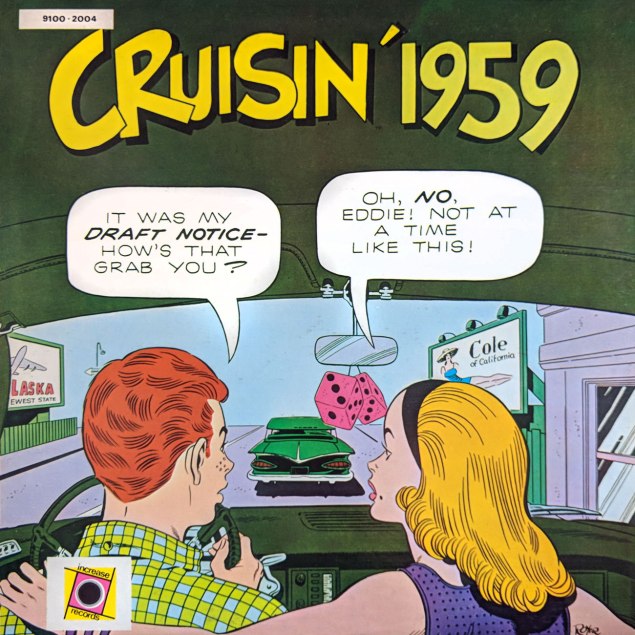
MR: Yes, it was added in, and I don’t care for that one. I really like ’56, only because in retrospect, I look at it and it speaks to me. ’57, okay. ’58, only because of the subject matter and Paul’s layout… ’59 is the one where I went to South East Los Angeles, to the car lot that had the dashboard. It had to be that, after so many years, if anybody had one, they just had to go “heyyy!“, you know.
MR: 1960 is… not as bad as I remember! At least I made his layout work…
WOT: That’s good news.
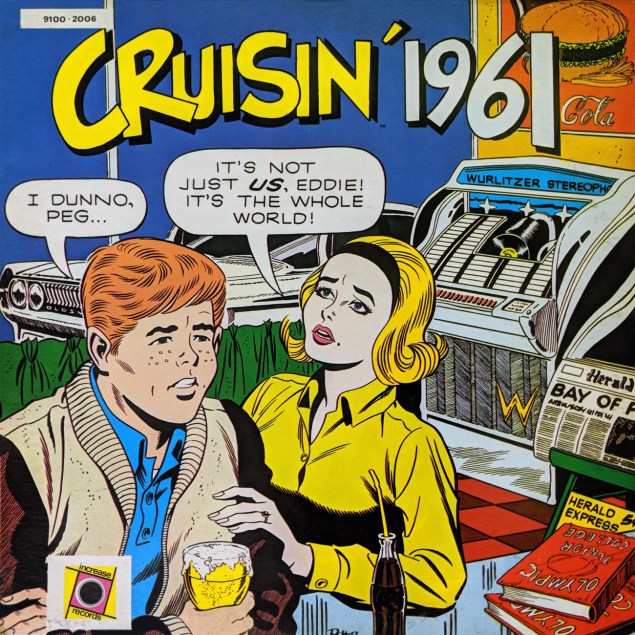
MR: And ’61, is, yeah, they’re about the break up. And Cruisin’ ’62 is.. ha. They *are* breaking up. No, I guess it was a three year breakup, okay?
WOT: (laughs) Okay!
MR: ’63, they’re in the coffee shop, and that’s the Studebaker… now waitaminit, what’s the one on… that’s not a Studebaker on ’61, that’s an Olds, so the Studebaker’s on ’63.
MR: ’64, there’s the announcement: “to wed Kevin Buchanan III…” And ’65 is ten years later, and it’s the same girl that was working at the library, but she’s gotten a little prettier.
WOT: No kidding? Subtle bit of continuity.
MR: And there’s Luthor on the board in the background… his concert, “New York Blacked Out” headlines, Up the Down Staircase… okay, ’66: oh yeah, “What this community needs is economic improvement and self-help!” Ah, yeah, all the TVs except one had Batman, and one of ’em has Luthor on it, singing.
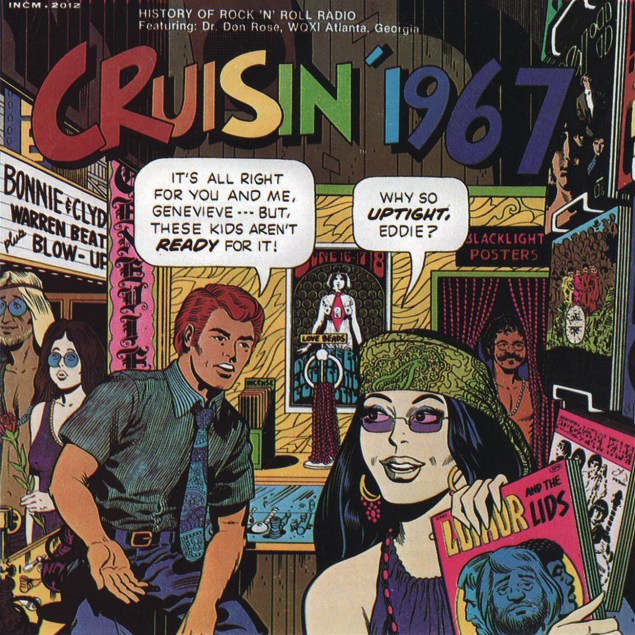
MR: And ’67, that’s the one with Ron Jacobs coming out of the… through the beads in the back. And golly, it’s Genevieve again. Mmm!
WOT: The librarian from ’55!
MR: That’s her.
MR: And ’68 was the first one *after* The Cruisin’ Years. Ah, there it is; I should have them in the order they were released. So we redid 1968, “Vietnam Widows for Peace“, and I kinda liked the way that turned out. It was fun researching all of the fashions and things!
WOT: Good, because research wasn’t always a simple task.
MR: Ah, ’69, on their honeymoon, Niagara Falls Retreat; Newspaper headline: “Beatles to Split” “Eddie, I might want a career of my own“… I just sold the comp to that, I think in Charlotte.
WOT: Oh, wow. So I am being timely here.
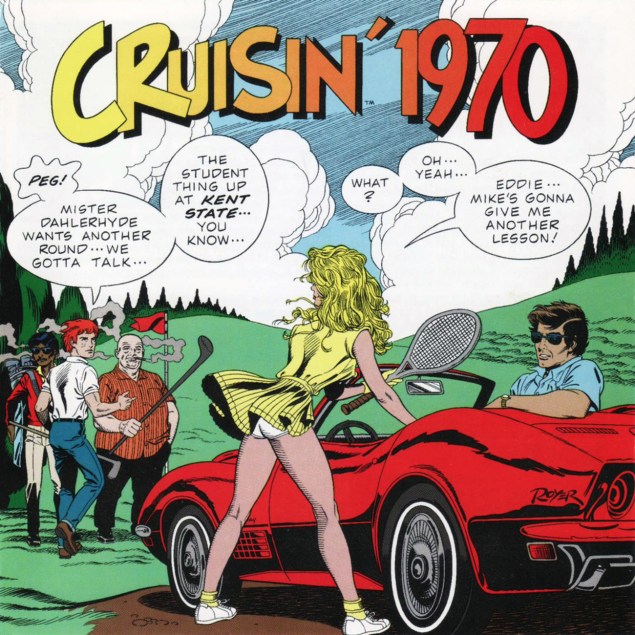
MR: 1970: “Mike’s gonna give me another lesson”. I put myself in there, uh… idealized.
WOT: (laughs) So that’s what it is, then?
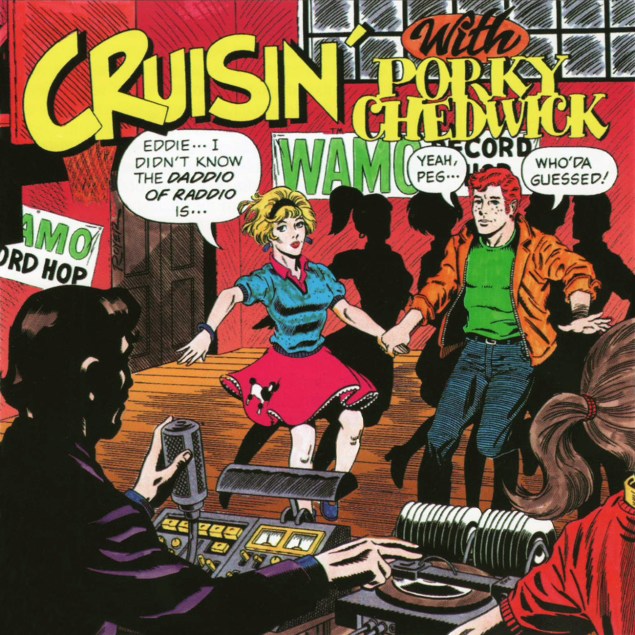
MR: And then there’s the Porky Chedwick, and somewhere in here… the Cruisin’ boxes. Whoa! There are… three of them.
WOT: What are they?
MR: The first box set has ’55, ’56 and ’57, and has the Cruisin’ Years cover, with the Peg and Eddie photographs, and the scrapbook, and the concert tickets and so on. The next one is ’58, ’59 and ’60, and that one is, Eddie is next to his Chevrolet with the tire kit on the bumper, and he goes “Come on, Peg! The Blob starts at 7:15!” “Eddie… we can’t go! Elvis is on Ed Sullivan tonight!”
WOT: Poor girl’s chained to her TV!
MR: And the last box set was ’61, ’62 and ’63, and Eddie’s got the beard that he’s wearing in the college one, and Luthor’s leaning against a tree, and she says: “Oooh, Eddie… your whiskers tickle me!” and he says: “Peg… do you think Luthor sounds like Pete Seeger?”
WOT: These two were always moving in separate directions.
MR: Always! And so I wrote ’68, ’69, ’70, The Cruisin’ Years, and Porky Chedwick. And if I could the long box artwork, and one of the last ones I did, which I believe was gonna be another Cruisin’ Years, and it’s probably the sexiest Peg I ever did…
WOT: Aw…
MR: It’s Peg and Eddie… oh my God… *two* of them. I might have done another big box, because they’re at the beach, she’s in a bikini, and it’s another tension-filled thing…
WOT: Her bikini?
MR: Oh, he’s saying: “Who’s this Buchanan the third?“, so that fits in the chronology somewhere. And the last one would precede their wedding, it’s where they’re on a bridge, in New York City, it’s a big closeup, they’re dressed to the nines, he’s in… could have been a tux, she’s in a sexy evening gown. And leaning on the rail, exposing her… attributes. The program was for a big Broadway hit of ’69, and he’s got his finger under his collar, kinda saying something to the effect of: “You know, Peg, there’s something I should have asked you… a long time ago“. It’s the proposal cover, you know.
Now I don’t know if that was ever produced. I also did another cover, which I know was not produced, and it was a Cruisin’ Christmas Album.
WOT: Whoa.
MR: And I actually drew my living room, in the house I had in Simi Valley [California] and Eddie, in his Santa Claus outfit is putting presents under the Christmas tree in the center of the room. And Peg is coming down the stairs in her sexy négligé, with her robe blowing open…
WOT: That’s his present.
MR: ’twas drafty in the house that night. And she’s got a plate, and she’s saying: “Oh, Santa… don’t forget your milk and cookies!” So it’s the only cover in the series without any tension.
WOT: Or the most tension, depending on how you look at it.
MR: I think we discussed doing ’71, but figured that there wasn’t enough happening that year to make an interesting cover, or the songs were too new in the late ’80s to get clearances or rights on them, you know.
WOT: Things have changed quite a bit… even the cd reissues are significantly different from the LPs. Reissuing certain pop-song heavy tv shows has proven quite a financial ordeal in some cases because of astronomical increases in the cost of music rights.
For that reason, the Cruisin’ LPs each have a few more songs than the cds, even if the opposite should be true, if only in terms of storage capacity.
MR: They lost rights, and stuff like that.
WOT: People didn’t know back then what was to come, obviously. The Cruisin’ series came out at just the perfect time, and I think it was quite visionary to decide to preserve, or recreate, what must have seemed at the time a very recent piece of the past.
MR: I wish that I had not given all of my vinyl discs to my first… son-in-law… and replaced them all with the CDs before I realized that there were the differences.
WOT: Not to mention the size of the artwork and quality of reproduction.
MR: Once the series was over, I sold Ron Jacobs all of the originals. And I kind of regret that in a way, because I could sell them for a lot more today than I did, in the early ’90s, to him.
WOT: Sigh. They’re heirlooms.
MR: I don’t know why I didn’t think to pull these things off the shelves and look at them before we talked.
WOT: Ah, it’s okay. In fact, it’s probably better: I got your spontaneous responses out of it.
MR: Actually.. overall, I’m more proud of them than I am disappointed. And the things that disappoint me, I can point out why and it doesn’t necessarily mean that it excuses the problems…
MR: Oh, and there was also a full-page ad… that was in Billboard. Peg and Eddie are sitting in the front seat of… probably a 1955 or 56, I think Ford convertible. I cannot remember.
WOT: On the contrary, you clearly remember plenty! (laughs)
MR: I’ve got it somewhere out in the garage, in one of the custom filing cabinets I had made that I call “Mike’s Life in a File Cabinet“.
The ad in question, from the July 11, 1970 issue of Billboard Magazine. Make a wish!
WOT: I think that I think this series is a great artistic success. When people see these volumes individually, they work as snapshots… but put them together, and you realize that there’s so much happening between the panels.
MR: Yeah, it does tell a story!
WOT: It’s beautiful storytelling, and I think, one of your crowning achievements.
MR: You know, it’s funny: the early covers were put into two books. The first one was a… I don’t know if it was a hardcover, it was a oversized, glossy trade paperback called The Album Cover Album [original edition 1977], and it says: “Paul Gruwell, art director, art by Mike Noyer“.
WOT: Oh, lovely. They got one name right.
MR: And the second book they were in, which I didn’t bother to buy, because all they listed was the Art Director. I wasn’t even listed.
WOT: This kind of thing, which I’ve noticed also, is what prompted me to get in touch with you. And I think we’ve done our bit here to help set the record straight. Thank you so much, Mr. Royer!
MR: You’re welcome, Richard. Have a great day!
WOT: You’ve certainly done your part in it!
Read the liner notes, or hear Cruisin’ 1967 in its entirety here!Read the liner notes, or hear Cruisin’ 1968 in its entirety here!Read the liner notes, or hear Cruisin’ 1969 in its entirety here!Read the liner notes, it’ll have to do for now; regrettably, Cruisin’ 1970 isn’t currently available on YouTube! What is this world coming to?At this time, Cruisin’ With Porky Chedwick would appear to be the final entry in the series (1995). Listen to the whole platter right here.
Today, Michael Royer (born June 28, 1941), who surely needs no introduction around these parts, celebrates birthday number seventy-seven, and on this special occasion, we have a treat, both for the great man and for the rest of us: part one of an interview Mr. Royer granted us, conducted just a few days ago.
As you can imagine, Mr. Royer has spent decades answering the same queries about his work with Jack Kirby and with Russ Manning, so that’s quite a well-trod line of investigation. We like to approach things a bit differently here at WOT; having long been intrigued by Mr. Royer’s evocative series of LP covers for the Cruisin’ anthology series, beginning in the late 1960s, and frustrated by the lack of solid information concerning said contribution, I figured I’d take a hand, and reached out to Mr. Royer.
If you’re unfamiliar with the Cruisin’ Series, here’s the pitch: « Cruisin’ is a year-by-year recreation of pop music radio during the years 1956 through 1962 [the years of 1955 and 1963-1970 were produced later]. Each album is not just a collection of the top pop music of a particular year, but a total recreation by a top disk jockey (of that year) doing his original program over a major pop music station. That means actual commercials, promotional jingles, sound effects, newscast simulations and even record hop announcements in addition to the original records themselves. »
« Cruisin’ producer Ron Jacobs monitored thousands of feet of tape, travelled over 10,000 miles and rooted through forgotten files and cluttered basements for old commercials, station promos and jingles. »
« What’s so special about these album covers? », you may ask. I’d posit that they’re unique in the sense that, while they each work as standalone pieces, together, they form a quite impressive comic strip, one in which a year or so elapses between panels. Just about every detail has its place, imparting information plainly or quite subtly. Characters come and go, years apart, sometimes entirely offstage, often never speaking a word. It’s graphic storytelling at its finest. And the LPs are pretty spiffy too.
Now that you’re up to speed, shall we begin? Mr. Royer and I spoke on Tuesday, June 26, 2018, and he was most generous with his time and his recollections. I assure you that the minutes simply fly in such gracious company.
Read the liner notes, or hear Cruisin’ 1955 in its entirety here!Read the liner notes, or hear Cruisin’ 1956 in its entirety here!Read the liner notes, or hear Cruisin’ 1957 in far less that its entirety here. Sorry!Read the liner notes, or hear Cruisin’ 1958 in its entirety here!Read the liner notes, or hear Cruisin’ 1959 in its entirety here!For this entry’s cd reissue, the cover artwork was inadvisably cropped, quite obscuring the political differences between Kevin Buchanan III (front) and Eddie (in uniform). Mr. Royer’s least favourite cover, incidentally. Read the liner notes, or hear Cruisin’ 1960 in its entirety here!Read the liner notes, or hear Cruisin’ 1961 in its entirety here! And remember, « If you say ‘Woo Woo Ginsburg’ with your order, you get another Ginsburger free of charge! »
Who’s Out There: Mr. Royer, How did you happen to be selected for the job in the first place?
Michael Royer: In 1966, I was working for Grantray-Lawrence Animation on the Marvel Superheroes limited animation cartoon series. And I believe that a man named Paul Gruwell… If you look at the record album, he’s listed in there as the art director… I’m listed as the artist and they misspelled my name.
WOT: Of course. We’ll set that straight.
MR: Paul was one of the guys working on the series and I did some work with him on an outside project he was doing, where he was doing… I guess you could call them slide shows, on the history of the Mormon church.
I was working on these things, and he knew someone at the record company who had this idea for the history of rock ‘n’ roll. And for the life of me, I can’t remember what the young man’s name was. But he’s the cover of one of the records, where he’s coming out of the backroom, through the beads [Cruisin’ 1967]. It’s like a head shop, or something…
WOT: Would that be Ron Jacobs? He was the producer.
MR: Yeah, yeah.
MR: So, anyway, the first batch of covers that went through, I believe, 1968… and the last cover had Peg and Eddie, who were reunited, with her little boy from her fist marriage. And they’re in the front seat of a van, in a traffic jam leaving Woodstock. That cover was never printed.
WOT: No wonder I’ve never seen it!
MR: Anyway, the covers that I did, how many was it? ’54 through…
WOT: Fifty-five. ’55 through ’70, plus one that’s “The Cruisin’ Years”…
WOT: How much latitude/wiggle room were you given? Were research materials provided or not? Were specific cultural signifiers specified, or did you get to pick (or a mix of both)?
MR: Anyway, on those ones that I did in the late Sixties, early Seventies, Paul Gruwell gave me little three-or-four square inch thumbnails… on the covers that he wanted me to do. All I got was his, in my opinion, so-so little thumbnails, which I guess gave him the reason to call himself ‘art director’…
WOT: I was going to ask if he could draw.
MR: I had to do all the research. Each cover had to feature certain items that definitely said that it was that year. Like newspaper headlines, magazine covers…
WOT: Movie marquees…
MR: … automobiles, and I had to look up all that. I went to the library, as we didn’t have “online” then. Ah, on one of the covers where I need the dash, I believe, of a ’57, or ’58 Chevy, I had to go to a used car lot in South East Los Angeles, and with my Polaroid camera, I asked these two big guys in their double-breasted suits if I could, uh, photograph the interior of one of their cars, and they looked at me like… « Okay, white boy, you’re crazy if you wanna shoot it, but we’ll let ya, you know. »
WOT: People do like those odd requests.
MR: It was very interesting researching the cars, and making sure that, even if they were shown from the basement [Cruisin’ 1963], out parked at the curb…
WOT: They had to be accurate.
MR: … you could still tell that it was a Studebaker. You know, and the jukebox had to be, I believe the Wurlitzer that was in places in that year [Cruisin’ 1961]. And so I did all of that. So all of the research materials were not provided by anyone other than me, and the special cultural signifiers had to be newspaper headlines, uh, I think the one where Peg and Eddie are in the basement [Cruisin’ 1963] café, and the Studebaker’s up on the street, there’s a newspaper that says something about “Cuban Missile Crisis” [Cruisin’ 1961 and The Bay of Pigs. 1963’s headline was the Profumo Scandal]…
MR: It’s so long since I’ve looked at these, Richard.
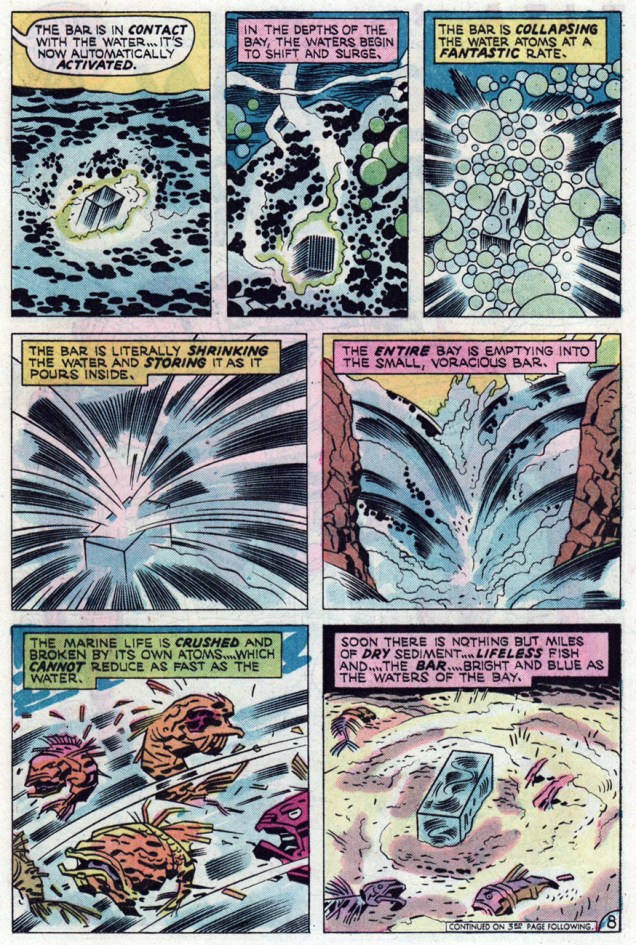
« The marine life is crushed and broken by its own atoms — which cannot reduce as fast as the water. »
I’ve been sitting on this particular entry awhile, having realized that the most opportune time to share it would be today, March 22, which happens to be World Water Day*.
In comics, few if any creators have generated so many explosive, pulse-pounding images as did Jack Kirby (1917-1994). And yet… this solemn, understated scene has likely haunted me most of all. The visuals are splendid, sure, but it’s the nature of the situation, the conceptual ramifications of the thing, that make it stick.
This splash appeared near the opening of OMAC’s final adventure, one that pitted him against Sandor Skuba, a rogue genius seizing and hoarding the planet’s water in view of controlling humanity. Threat-wise, all the adversaries that the One Man Army Corps had tangled with were mere preludes to this impressive madman. As Kirby left DC before he could wrap up the storyline as he intended, no-one walks away from this skirmish**, notwithstanding the final panel, subsequent revivals and reboots and corruptions of Kirby’s ideas by (inevitably) lesser hands and minds (and conversely bigger egos).
This is OMAC no. 7 (Sept.-Oct. 1975) and « The Ocean Stealers! », scripted, pencilled and edited by Jack Kirby, inked and lettered by D. Bruce Berry.Could that unseen appendage be Adam Smith‘s « invisible hand of the market » ?And here’s how it’s done.
In light of the current practices of certain corporations, notably the Swiss transnational Nestlé, Kirby was sadly prescient and clear-eyed again. As evidenced by recent events, given the technological means, today’s robber barons would not hesitate.
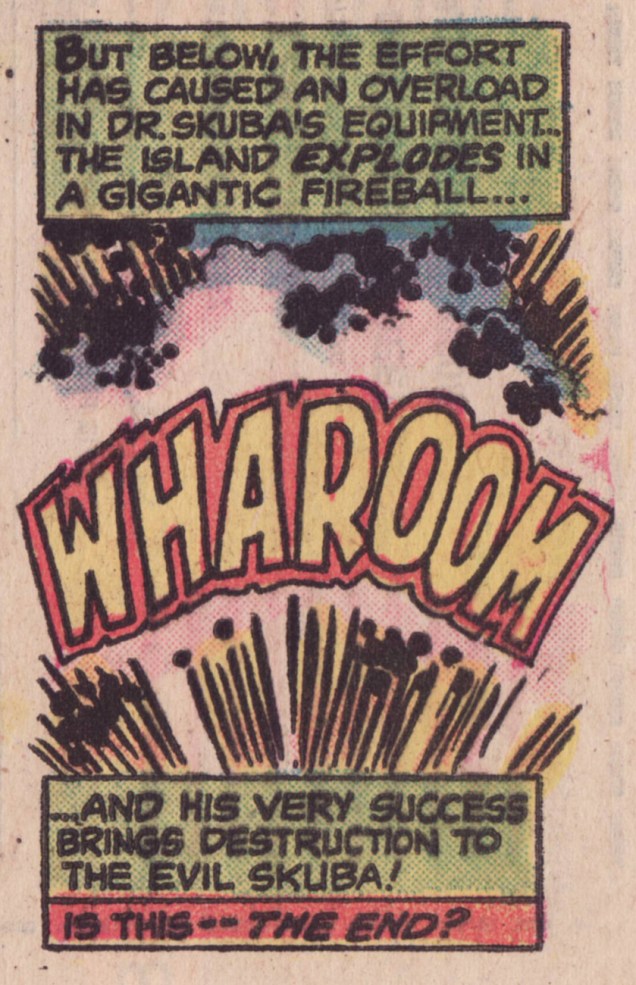
Writer and comics historian Mark Evanier, who spent some years as Kirby’s assistant in the ’70s, writes, in his foreword to the DC’s exemplary reprint collection Jack Kirby’s OMAC: One Man Army Corps (2008): « So consider this fair warning: the last issue comes to a whiplash-inducing sudden stop. Jack had been setting up something big for number 9, but since he was gone and there wasn’t going to be a number 9, a new last panel (not by Kirby) was inserted to remove the immediate cliffhanger.» … a panel created, at that, with the finesse of 10-year-old unburdened by a sense of pacing. “Wharoom” to you too.
-RG
*Don’t buy the duplicitous hype, though! A perfect example of the fox guarding the henhouse.
Today is birthday number ninety-five for Stanley Lieber, aka Stan Lee. He was hatched on December 28, 1922. Have a good one, Stan.
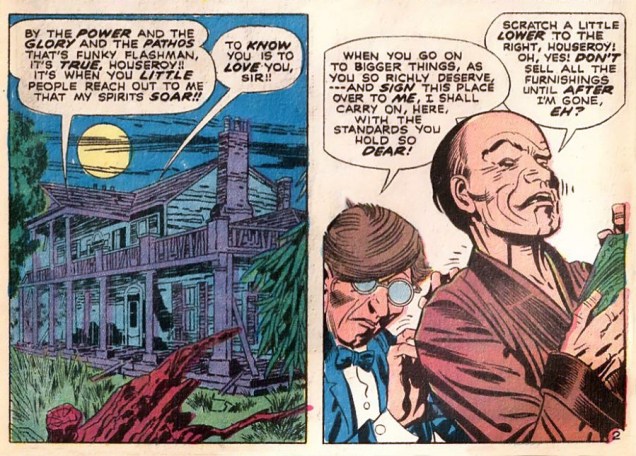
Jack Kirby recalls with fondness his former editor and his toady, in “Funky Flashman!” (Mister Miracle no. 6, January-February 1972, DC).
On this momentous occasion, let’s hear about Stan from some of his colleagues, who knew The Man and obviously loved the experience:
Wally Wood:
« Did I say Stanley had no smarts? Well, he DID come up with two sure fire ideas… the first one was ‘Why not let the artists WRITE the stories as well as draw them?’… And the second was … ‘ALWAYS SIGN YOUR NAME ON TOP… BIG’. And the rest is history… Stanley, of course became rich and famous … over the bodies of people like Bill [Everett] and Jack [Kirby]. Bill, who had created the character that had made his father rich wound up COLORING and doing odd jobs. »
EC legend Bernie Krigstein, who collaborated with Stan at Atlas, and whose « Suppressed Desire » is featured in Spellbound no. 17 (September 1953) , with a glorious cover by the above-mentioned Bill Everett.
In the course of a 1960s interview with comics scholar John Benson, Krigstein responded to Benson’s statement of « I guess you know that Stan Lee has been the spearhead of the so-called current revitalization of comics »:
« I’m delighted to learn that. Twenty years of unrelenting editorial effort to suppress the artistic effort, encourage miserable taste, flood the field with degraded imitations and non-stories have certainly qualified him for this respected position. »
Then Gil Kane, who was Marvel’s principal cover artist for much of the 70s, and who collaborated with Lee on The Amazing Spider-Man in some of its most popular years, including the infamous, comics-code unapproved “drug” issues (nos. 96-97, May-June 1971), on the respective creative roles of Stan and Jack Kirby:
« On each page, from 1964 – 1970 next to every single panel Jack wrote extensive margin notes explaining to Lee what was taking place in the story. It took Jack about 2 weeks to do a single story, it may have taken Lee as little as 4 hours to add text to Jack’s art. »
And Steve Ditko, in a letter to the editor of Comic Book Marketplace, published in the magazine’s 63rd issue in 1998, on his and Stan’s respective roles in crafting an issue of Spider-Man:
« The fact is we had no story or idea discussion about Spider-Man books even before issue no. 26 up to when I left the book. Stan never knew what was in my plotted stories until I took in the penciled story, the cover, my script and Sol Brodsky took the material from me and took it all into Stan’s office, so I had to leave without seeing or talking to Stan. »
The local fauna is gathered in this splash from Destroyer Duck no. 1 (Eclipse, 1982). In case you didn’t know, “the book was published as a way to help [Steve] Gerber raise funds for a lawsuit he was embroiled in at the time, in which he was battling industry giant Marvel Comics over the ownership of the character Howard the Duck, which Gerber created for the company in 1973.” It was an alarming account of the (not-fictional-enough) Godcorp conglomerate’s incalculable greed, its unchecked power, and how « It’s Got the Whole World… in Its Hand! », which, as true as it was then, is discouragingly even truer now.
« You all right in there, Walt? … say, what happened to all my beer? »
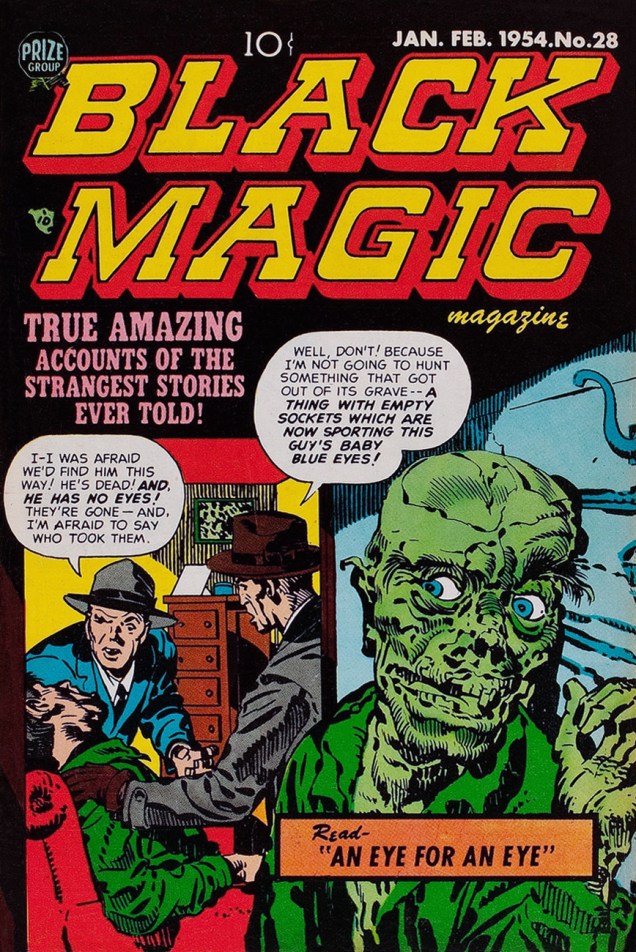
« Within the hour, Roger Parris’ eyes had been removed from his still warm corpse! »
Some specimens of walking corpse are kind enough to just snap your neck or rip out your throat, but not old Roger Parris… he was, and remains, a spiteful coot.
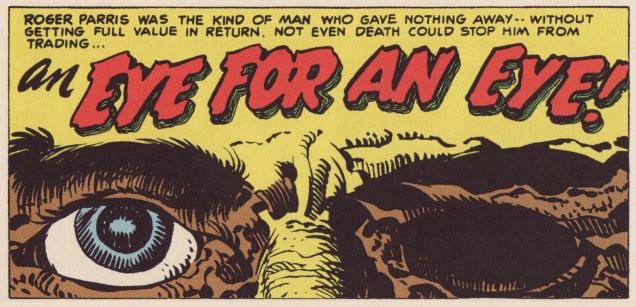
This is Black Magic vol. 4 no. 4 (#28, Jan.-Feb. 1954, Prize), illustrating “An Eye for an Eye”. Pencils by Jack Kirby, inks by Joe Simon and/or Kirby.
The story’s opening panel. For my money’s S&K’s Black Magic offered the scariest ride in 50s horror… often with unlikely, seemingly innocuous topics, and without showing much in the way of gore or gratuitous imagery. They took the Val Lewton high road, if you will.I’m reminded of another old dear who was inordinately attached to her earthly possessions (in her case, a ring) even after kicking the bucket. Well… not quite, it turned out. From Mario Bava‘s 1963 omnibus film, “I tre volti della paura” (aka “Les trois visages de la peur”, or “Black Sabbath”)’s most spine-tingling segment, “La goccia d’acqua” (“The drop of water”).

















 Who's Out There?