Panning the murky old print stream for the odd glimmering nugget
Hallowe’en Countdown 2020
What, October again? Good. For the fourth time, Who’s Out There? will subject its fearful faithful to a parade of hopefully diverse variations on a spooky theme… sometimes somber, sometimes light, occasionally eye-searing.
« Take our advice, at any price, a gorilla like Magilla is mighty nice. Gorilla, Magilla Gorilla for sale! »
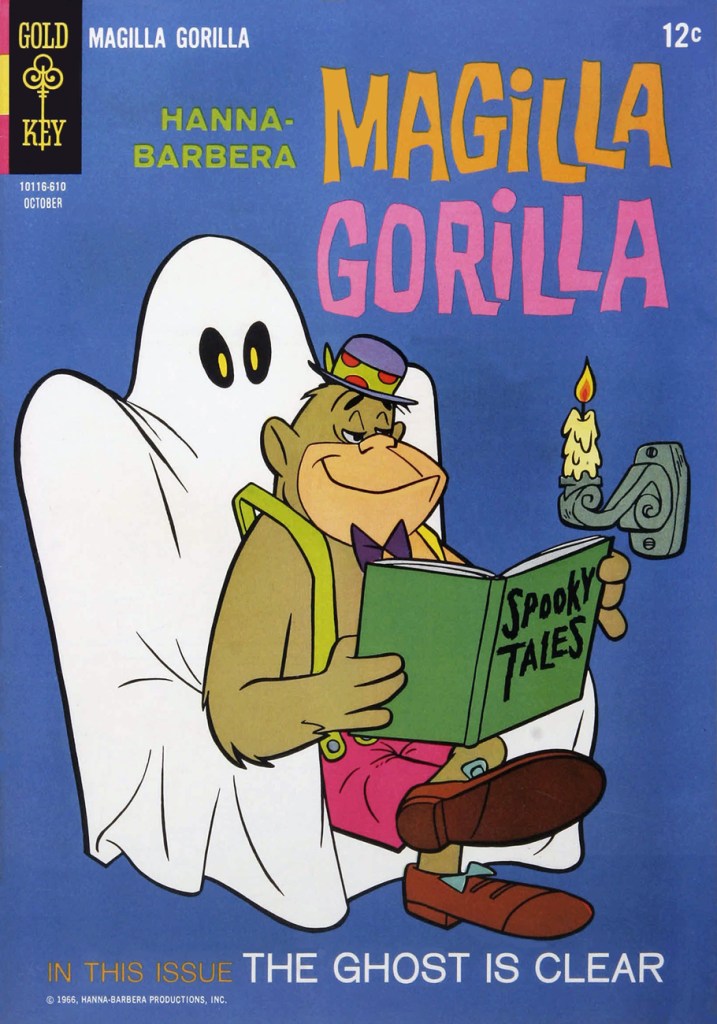
Seems you just can’t unnerve a guy (let alone an ape) who takes fright fables so lightly. I mean, look at that blasé expression! Perhaps he needs some spookier tales.
This is Magilla Gorilla no. 9 (Oct. 1966, Gold Key). Cover artist unknown…certainly a ghost.
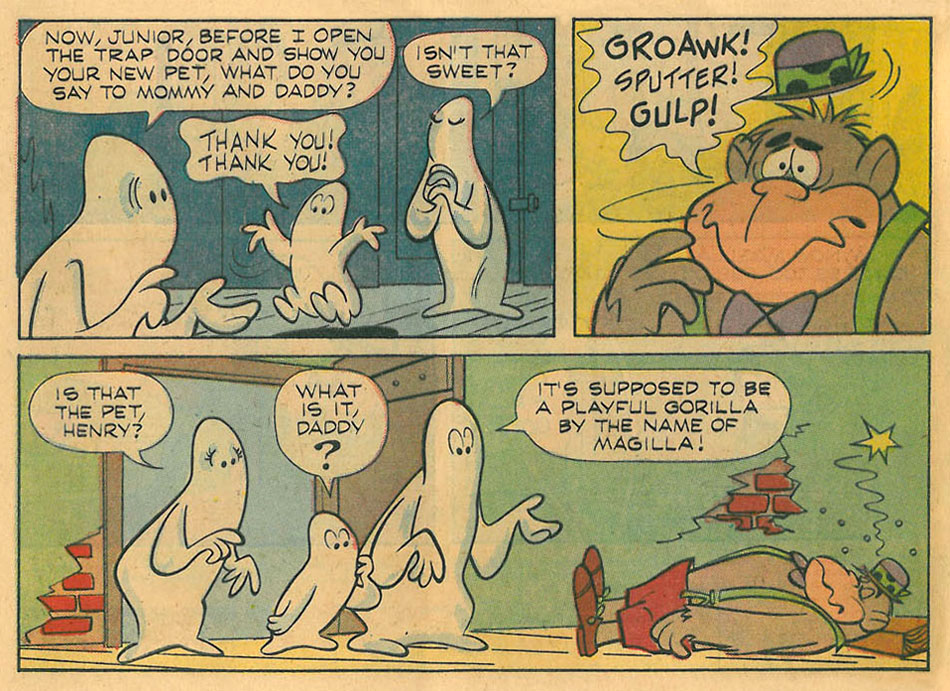
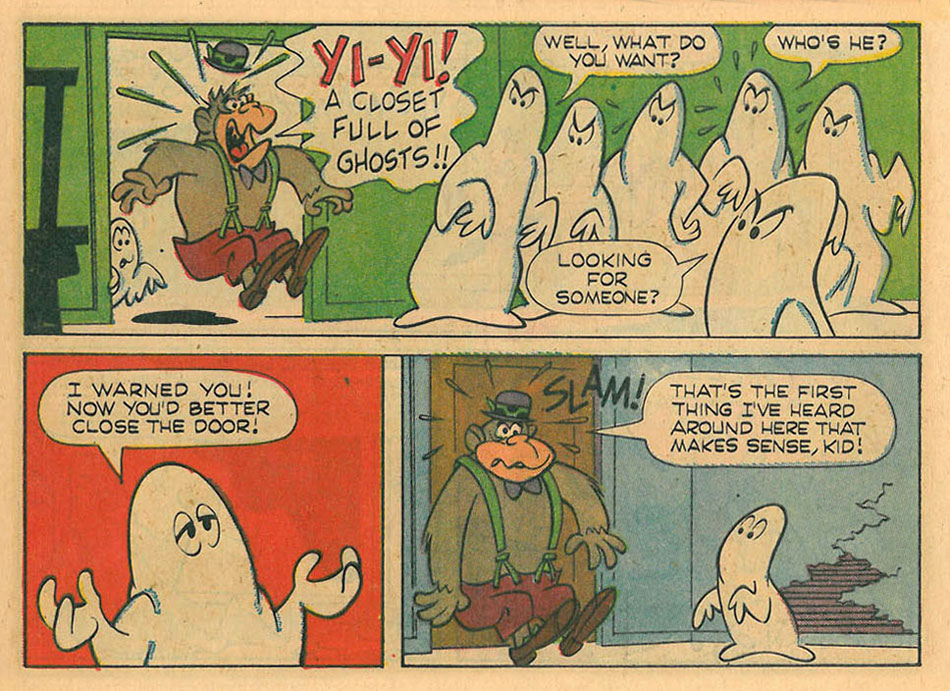
Unfortunately, the title story — and the rest of the issue — are nothing to get excited about. Nicely flowing, on-model animation-style artwork, but the stories…
Still, here’s the highlights reel. Strictly kid stuff… but did it truly need to be? A little subversion goes a long way.
In Yiddish, a megillah is a long tedious or embroidered account, from the Hebrew megillah, a story written in a scroll. One episode has Magilla saying, “Such a megillah over a gorilla.“ [ source ]
« We’ll try again next week. »
In other, loosely-related news, and in the spirit of the seemingly undying nature of pop culture icons (even minor ones)…
José Adílson Rodrigues dos Santos (born September 2, 1958), is a retired Brazilian heavyweight boxer. He scored 61 knockouts with 43 of those coming under 5 rounds. Rodrigues currently resides in São Paulo, São Paulo, where he is being treated for Alzheimer’s disease originating from dementia pugilistica. His nickname in Brazil, Maguila, comes from the cartoon Magilla Gorilla.
The gajo should have really sold the concept, and fought in a too-small bowler hat and green suspenders.
« Ghosts! Haunted house! … wow! I’m glad we don’t have to investigate around a joint like that! » — Woozy Winks… who else?
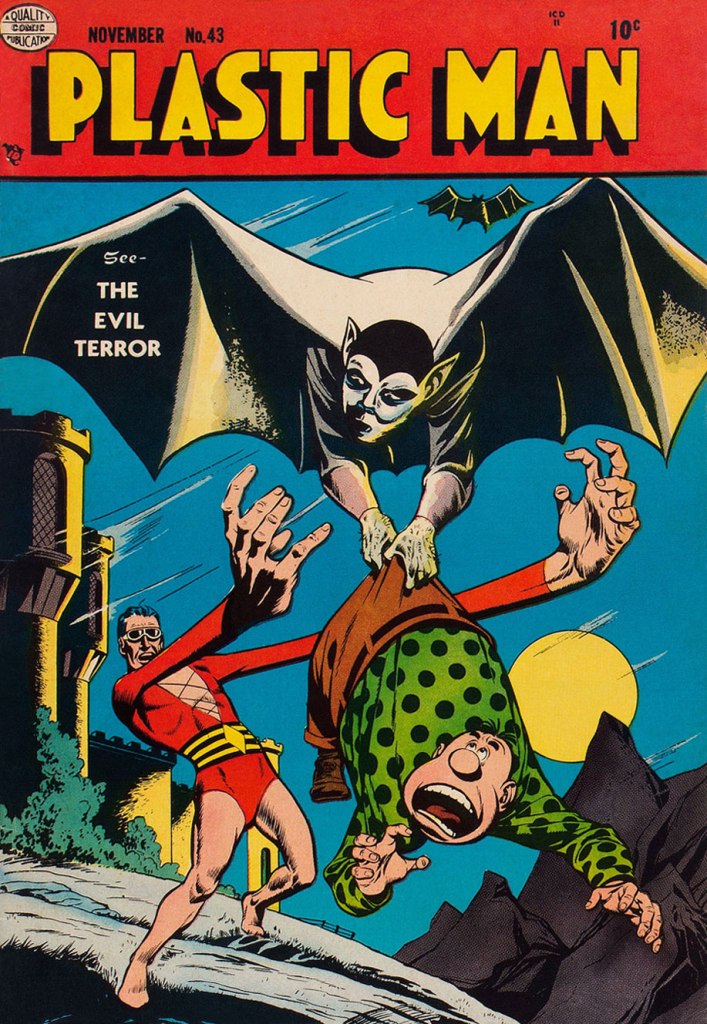
How about some Golden Age Plastic Man Hallowe’en goodness? I thought as much. All this and Woozy Winks too!
This lovely splash opens Murder in Maniac Mansion, from Police Comics no. 17 (March 1943, Quality), edited by John Beardsley. Script, pencil and inks by Jack Cole.
Mr. Cole’s splashy splash from another spooky Plas yarn, The Ghost Train, from Police Comics no. 23 (Oct. 1943, Quality). Read it here: https://comicbookplus.com/?dlid=37425
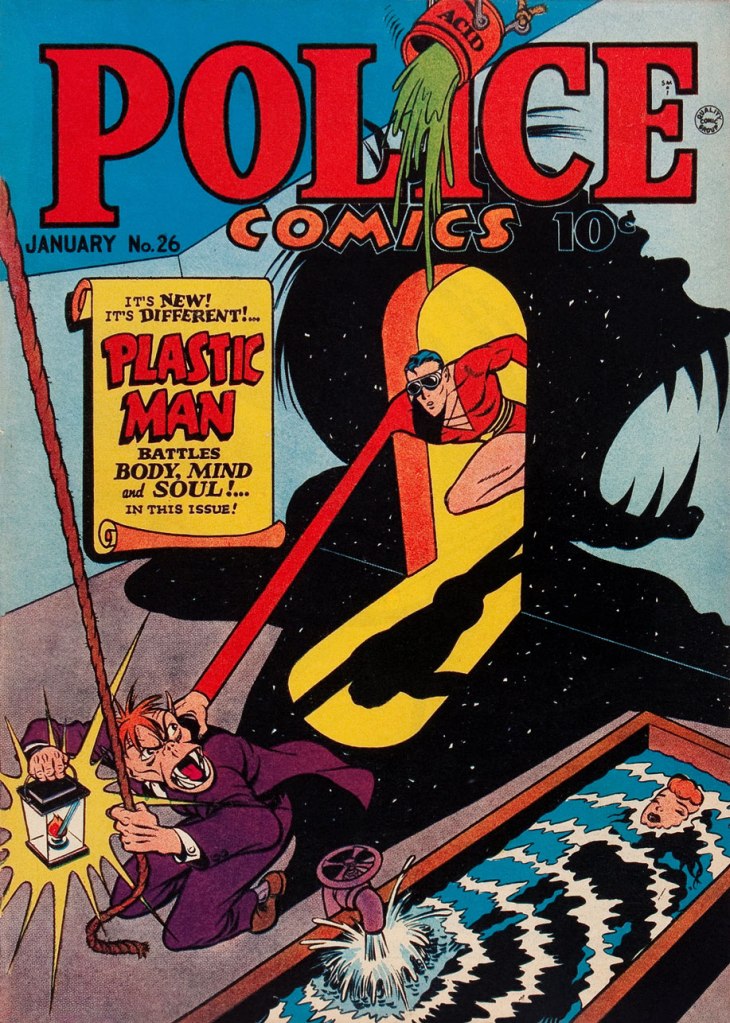
The supremely versatile Jack Cole could always be counted on to inject a bit of sinister ambiance (or over-amped sensuality, depending on his mood) to mix up the generally humorous proceedings of the stretchy exploits of the former Patrick “Eel” O’Brian. At times, things got pretty grand-gignolesque, as in the following case.
This is Police Comics no. 26 (Jan. 1944, Quality). Cover art by Jack Cole.
By the 1950s, Jack Cole had moved on to other pastures and projects, but Plastic Man kept right on stretching, one of the few superheroes flexible enough to withstand the horror boom. But not without a few alterations to fit the times, as evidenced by the following pair of samples.
This is Plastic Man no. 38 (Jan. 1952, Quality); cover art by Alex Kotzky. You have to appreciate that boney Monk Mauley hung on to his lucky belt even as his pants lost their corporeality. That’s commendable dead-ication! (sorry); Oh, read all about it: https://comicbookplus.com/?dlid=30201
This is Plastic Man no. 43 (Nov. 1952, Quality); cover pencils by Dick Dillin, possible inks by Chuck Cuidera.
It must be stated that, even without the masterly Jack Cole, Plastic Man clearly brought the best out of the rest of Quality’s admittedly admirable bullpen, so his adventures remain worth reading… which is certainly not the case with most subsequent revivals, with the exceptions of DC’s 1976-77 mostly-ignored Ramona Fradon run and Kyle Baker‘s award-winning 2004-06 outing.
« It was the spookiest horror ride anywhere! Mr. Awrus… a charming little old man, really… made it that way, because he liked to entertain people! But then the snake-thing arrived… and the others… heh-heh… and people went in… and didn’t come out… » — Horror Beasts Dine Tonight
First out of the gate was Irwin Stein’s Magnum Publications, with Monster Parade (four issues). It was soon followed by Monsters and Things (two issues).
As for the magazine’s grimy guts, there’s regrettably nothing outstanding: a couple of reprints of pre-Code material that was pedestrian to begin with… Curse of the Living Crossbones, illustrated by Ken Rice (a retitled Spectres of the Jolly Roger and True Tales of Unexplained Mystery #44, a one-pager about vengeful German gargoyles, illustrated by Sy Grudko, both plucked, minuscolour, from Web of Mystery no. 22 (Jan. 1954, Ace Magazines).
The issue does contain a couple of fun wash illustrations, including this one by the esteemed Mr. Powell, also (along with the cover), accompanying the main feature, Horror Beasts Dine Tonight. “And will that be your usual table, sirs?“
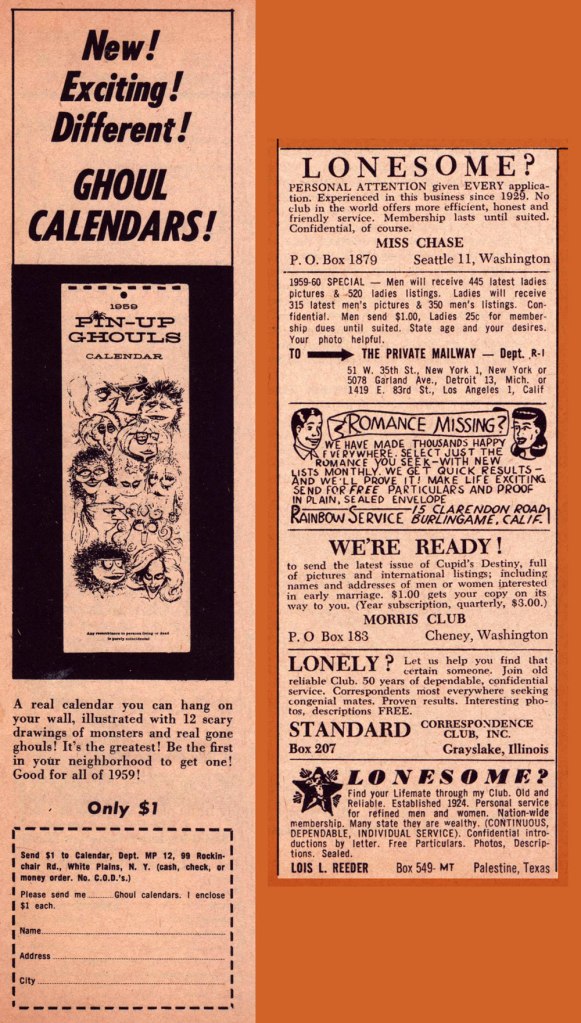
A sample of the classifieds. Do I, er… detect a certain pattern? One clear advantage of the Pin-Up Ghouls calendar is that you can reuse it next in 2026, so keep an eye out for gently-used copies!
Still, it must be said that the dank, meandering back alleys of sleaze magazine publishing of the era are oddly fascinating, if decidedly disreputable places.
« Superstition, the mother of those hideous twins, fear and faith, from her throne of skulls, still rules the world. » — Robert G. Ingersoll
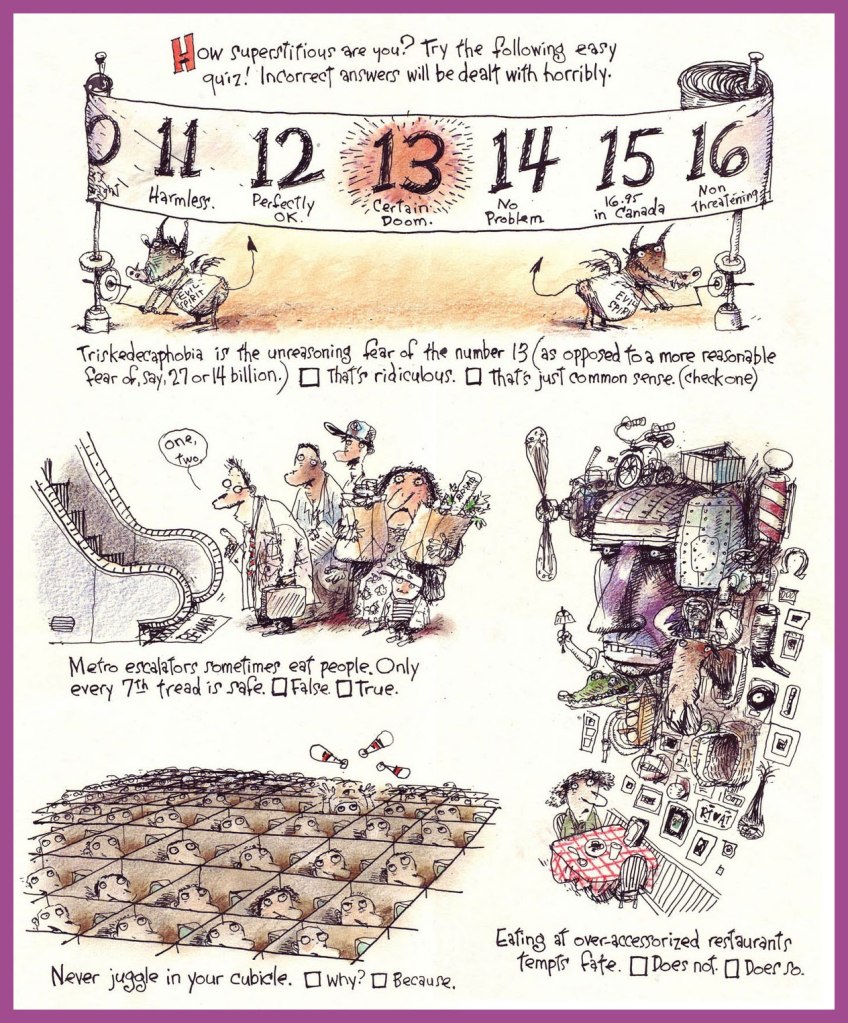
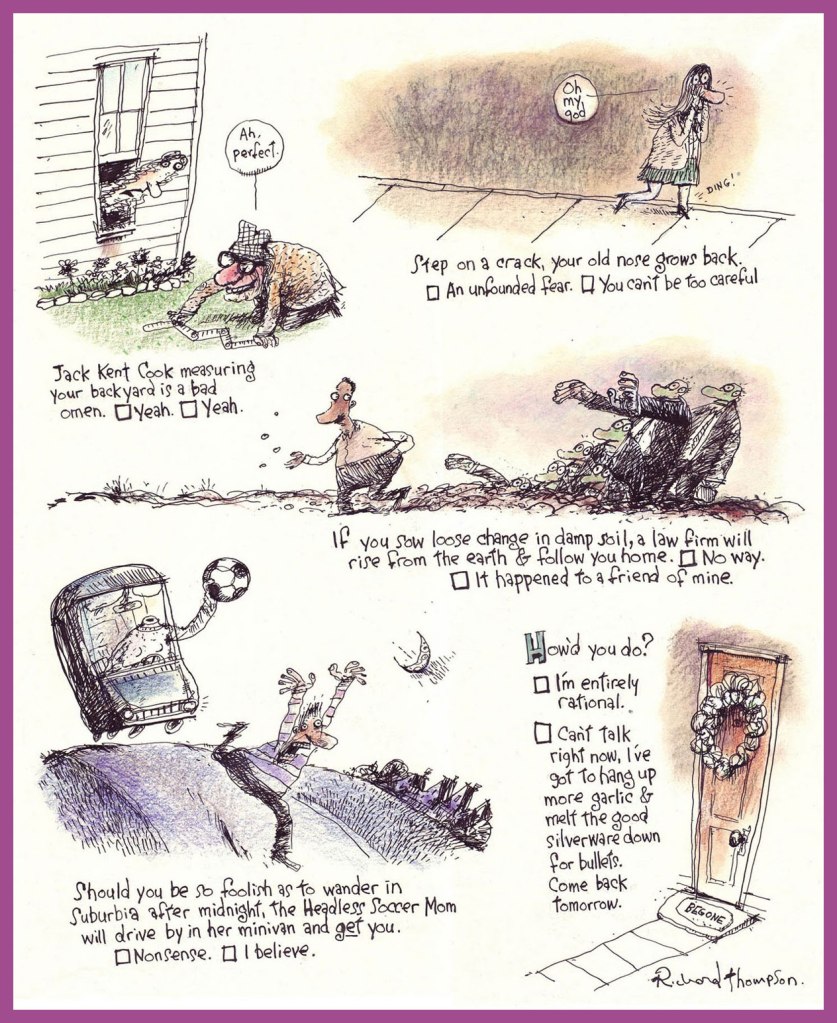
Feeling a tad superstitious? Today, as it also happens to be Richard Thompson’s birthday (coïncidence? hardly!), we combine two fabulous flavours into this confection of sheer frightful delight. Careful you don’t bite your tongue or deal yourself a case of whiplash.
Thompson « drew it for the Washington Post Weekend section back in September of 1996 and it appeared on Friday the 13th. » I believe!
Take the quiz and quell, at least for a time, those vicious neighbourhood rumours concerning you. For further such priceless resources, do take a gander at our prior Thompson posts, including this Hallowe’en-themed goodie and this fair sampling from Richard’s Poor Almanac.
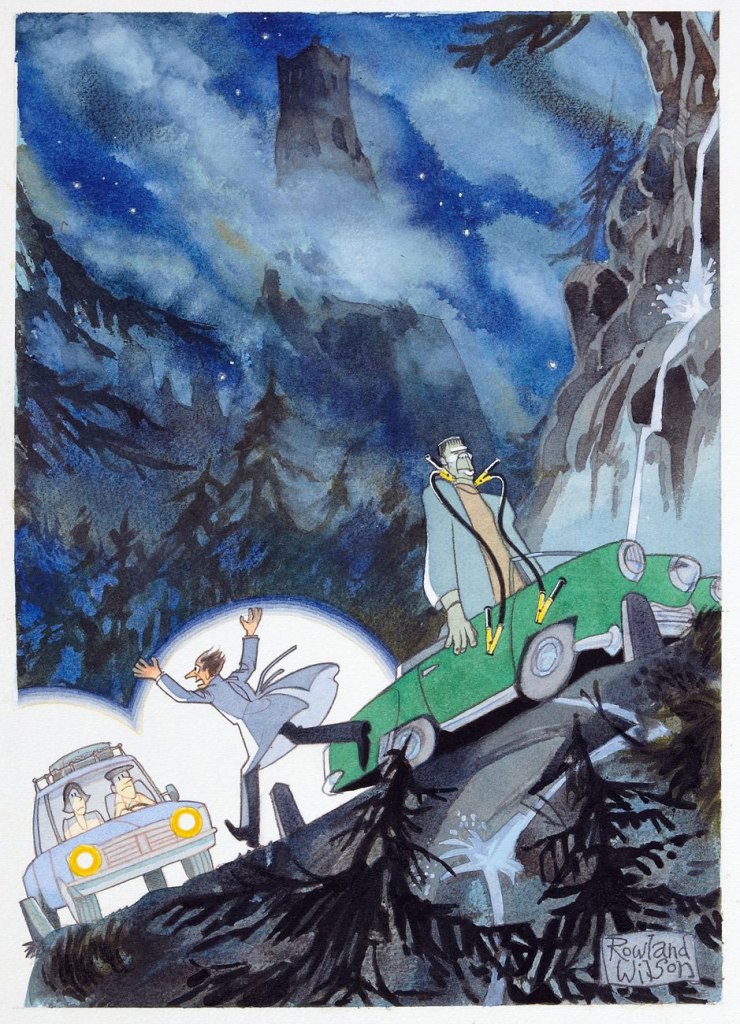
« Stop! Please, I need a jump start! » — the good doctor F.
From the pages of Playboy (Oct. 1990), a seasonal (well, soon to be!) cartoon by Texan Rowland Bragg Wilson (1930-2005).
You have to expect these things whilst motoring through the Carpathians.
In addition to his magazine work (the cream: Playboy, Esquire, The Saturday Evening Post, Collier’s, The New Yorker), Wilson made his mark in the animation field with Schoolhouse Rock! (with Phil Kimmelman & Associates) then as a concept designer with Disney Studios (The Little Mermaid, The Hunchback of Notre Dame, Hercules, Tarzan…). Quite the impressive waybill.
One more, on the same classic theme? Sure.
This one goes: « If I can bring this lovely creature to life, she will bring me lasting immorality! », and it appeared, of course, in Playboy (Nov. 1981). Ah, the difference one letter makes!
« And with that awakening, an insane sovereign once again asserts his rightful dominion over a night of madness — as the Halloween God! »
For years after Bernie Wrightson’s career path took him away from DC Comics, cover illustrations purchased by the publisher but left unused gradually trickled into print. Some were too specific and puzzling to be published tel quel, so new stories were written to order. Such a case was Batman no. 320 (February, 1980). This is another, which yielded The Halloween God, written by Gary Cohn and Dan Mishkin, illustrated by Ading “Adrian” Gonzales, and edited by Dave Manak.
This is Secrets of Haunted House no. 44 (Jan. 1982, DC). Cover created by Mr. Wrightson way back in… 1972!
And here’s an interesting twist: Wrightson’s original drawing didn’t quite look that way. As co-writer Gary Cohn told me, a few years ago, « When [editor] Dave Manak showed me this cover, the figure being thrown had a head much like the other goblins. I said, “Can someone change that to a Jack o’lantern head? Then we can write a story called, ‘The Halloween God.’ And so… »
I then asked Mr. Cohn whether he had any recollection as to who might have drawn said Jack o’lantern, as Wrightson was unlikely to be available. He responded: « My recollection might be wrong, but I think it was Dave Manak himself, who is no slouch as an artist. » That light effect on the ground really integrates the change, sells it, so to speak. Kudos to all involved.
« Merchant and pirate were for a long period one and the same person. Even today mercantile morality is really nothing but a refinement of piratical morality.» — Friedrich Nietzsche
This charming rogue doesn’t look like he’s going to share his pretties with just anyone, so be sure to ask nicely.
Stanley P. Morse ran a rather fly-by-night operation, even by funnybook industry standards, but someone in there had some taste, as evidenced by the classic material produced under its various dodgy banners (Aragon, Gilmor, Key Publications, Media, S.P.M., Stanmor, Timor…) by such notables as the aforementioned Mr. Baily, Basil Wolverton (including his enduring The Brain Bats of Venus) and a fledgling Steve Ditko.
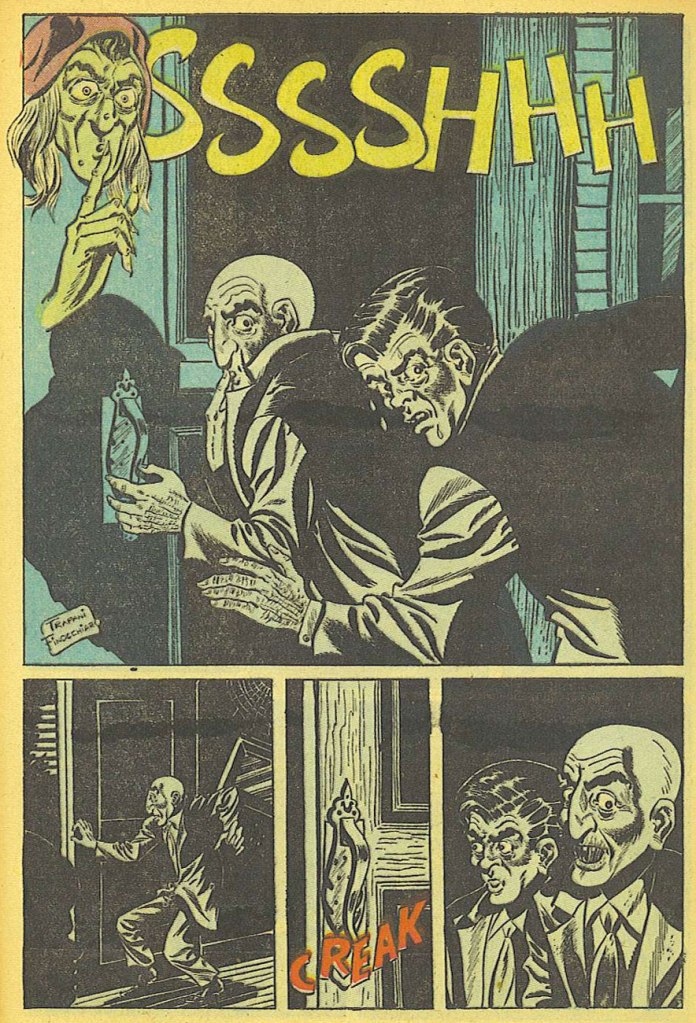
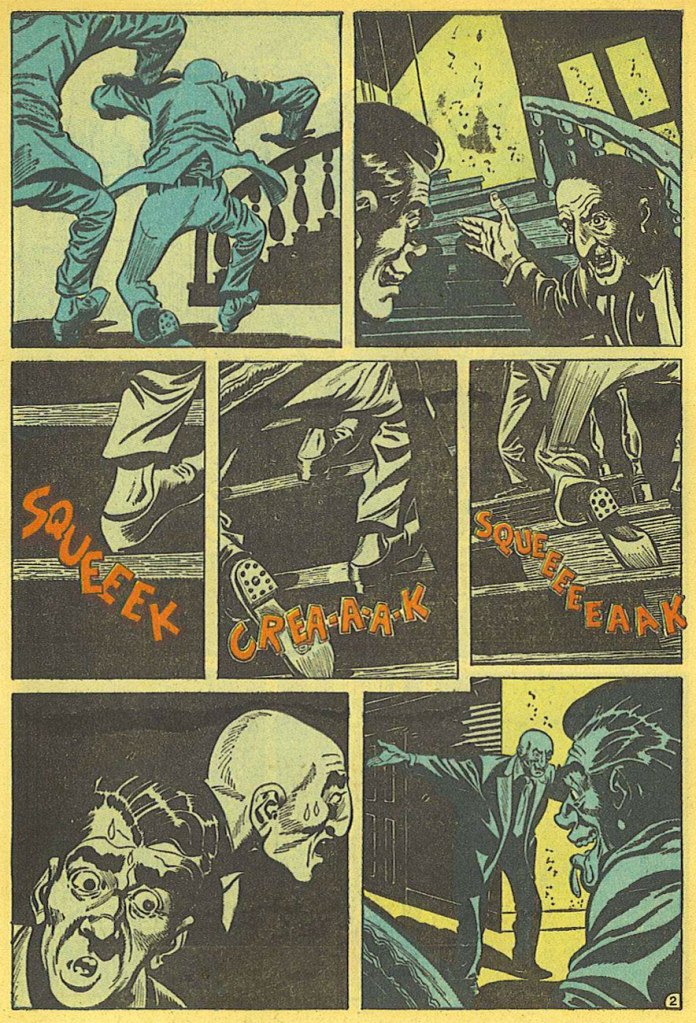
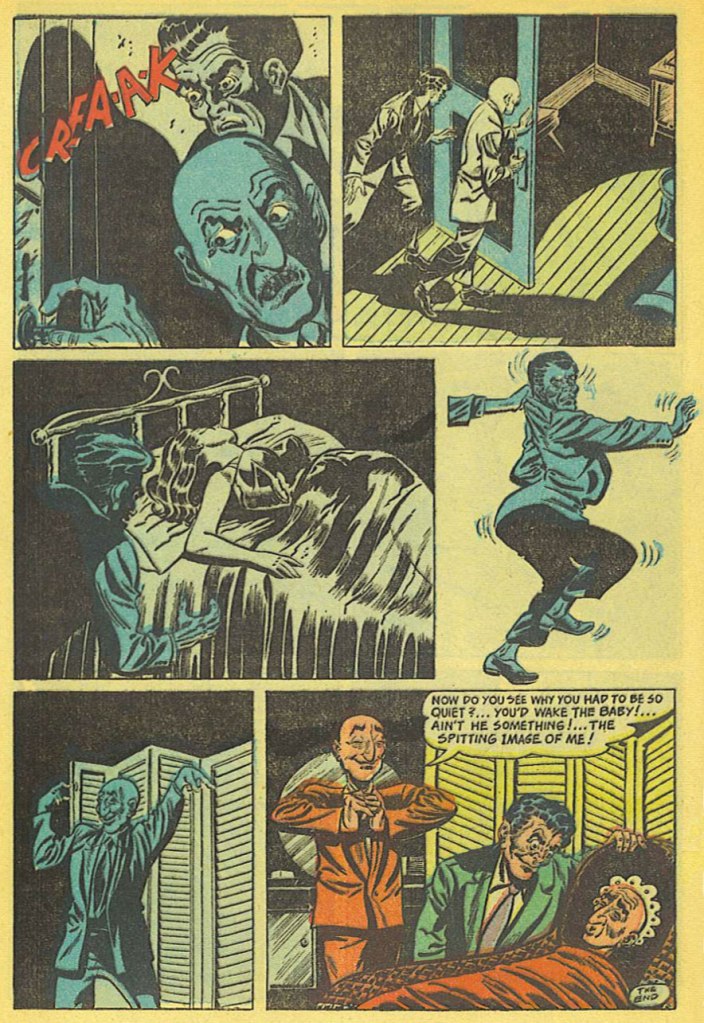
Still, the highlight of the issue has to be a brilliantly idiotic short tale intriguingly entitled… Sssshhh. Here it is:
Scripter unknown, with pencils by Sal Trapani, with inks by S. Finocchiaro. I have to say that this is my favourite-ever work by Trapani, a hack if there ever was one, whose inking jobs (his specialty in later years) generally did no favours to anyone’s pencils. And he had quite a prolific career, which was surely not hindered in the least by his being Dick Giordano‘s brother-in-law. For the defence, one of my close pals and colleagues holds that Trapani’s inks over Herb Trimpe‘s pencils on The Incredible Hulk (issues 156-166) were the finest of Trimpe’s lengthy run on the title. As far as that goes, I’ll stick with John Severin, but I do concede that Trimpe and Trapani did mesh well.
« Things are never quite as scary when you’ve got a best friend. » — Bill Watterson
Hey, it’s our 500th post!
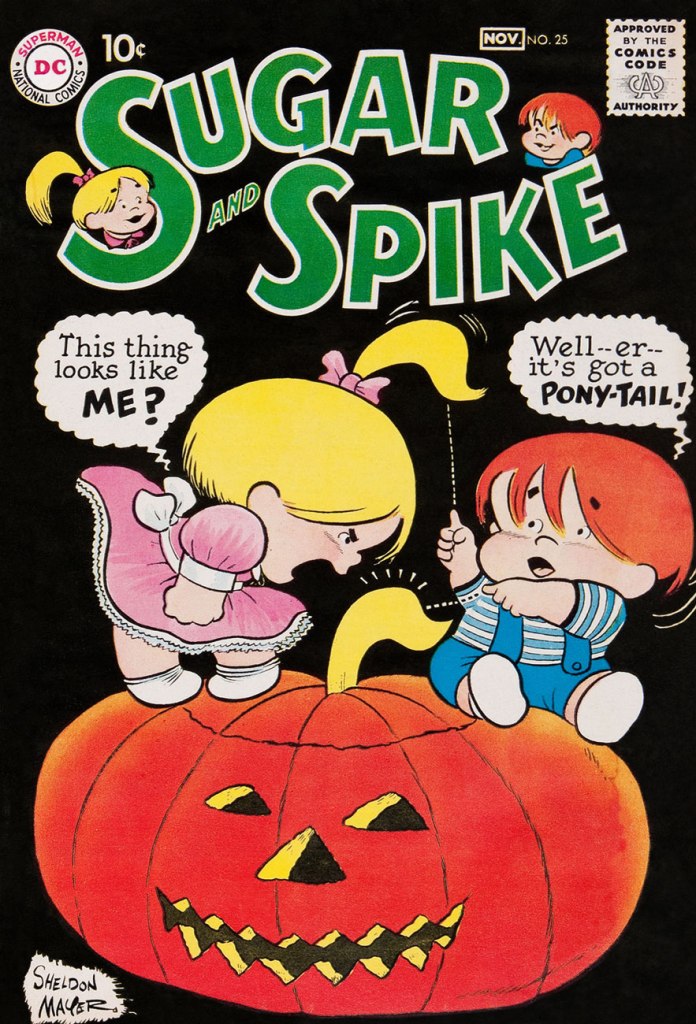
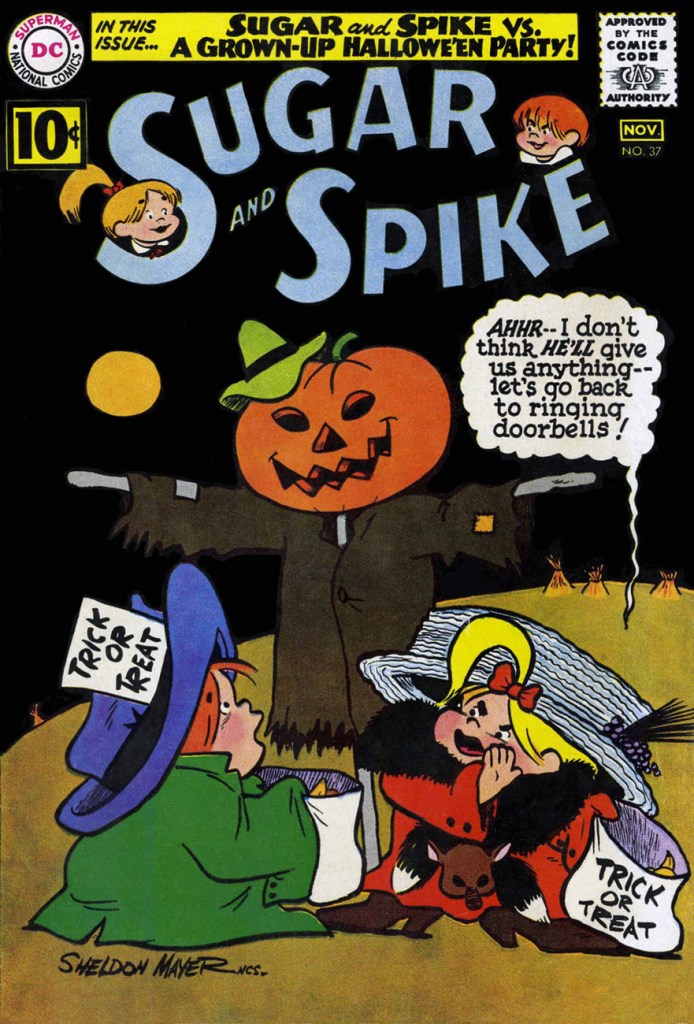
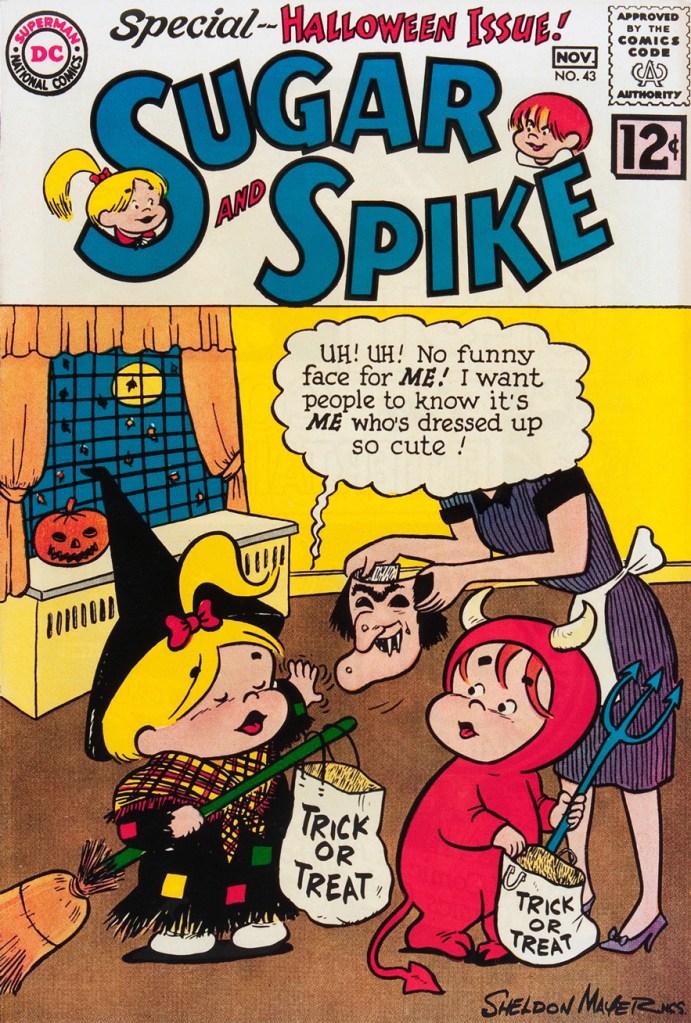
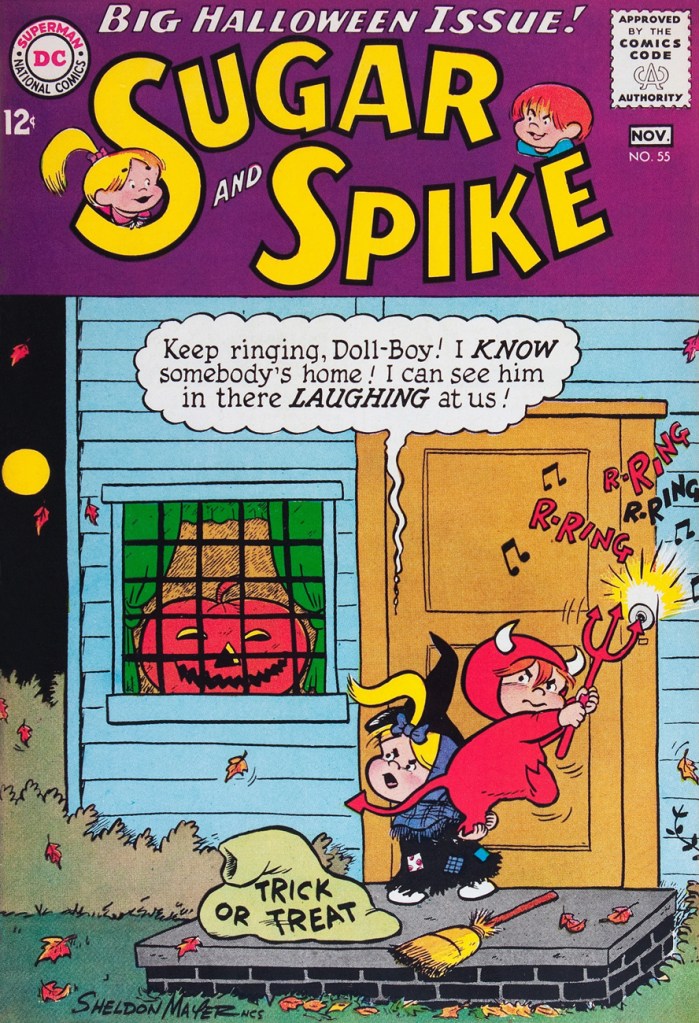
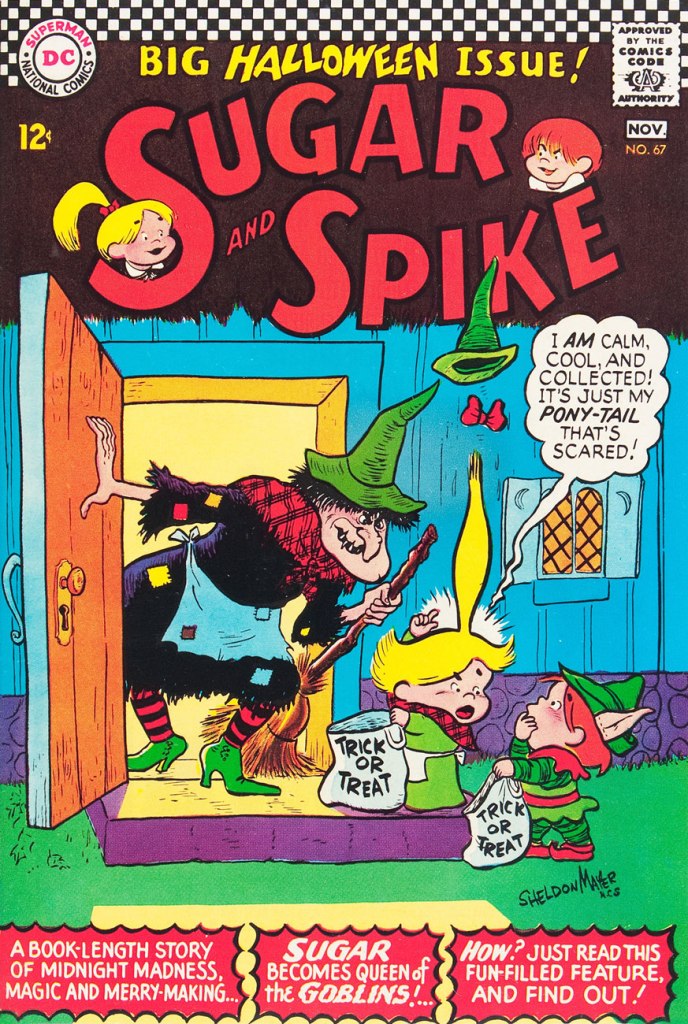
Who’d have the heart to resist Sheldon Mayer’s adorable toddlers (profiled here last year) if they came around trick or treating at your door? Even if you did resist, they’d be sure to get their grabby little mitts on the goods… some other way.
This is Sugar and Spike no. 25 (Oct.-Nov. 1959, DC).
This is Sugar and Spike no. 31 (Oct.-Nov. 1960, DC). Definitely my favourite of this splendid lot, largely thanks to that meticulous, understated colouring job. Jack Adler‘s doing, I’ll wager.
This is Sugar and Spike no. 37 (Oct.-Nov. 1961, DC).
This is Sugar and Spike no. 43 (Oct.-Nov. 1962, DC).
This is Sugar and Spike no. 49 (Oct.-Nov. 1963, DC).
This is Sugar and Spike no. 55 (Oct.-Nov. 1964, DC).
This is Sugar and Spike no. 61 (Oct.-Nov. 1965, DC).
This is Sugar and Spike no. 36 (Oct.-Nov. 1966, DC).
A reprint? Not quite. This cover scene, which originally appeared back in issue 55, was reprised (redrawn, not reprinted) for the series finale, Sugar and Spike no. 98 (Oct.-Nov. 1971). I’d hate to take part in a contest announced in the last issue of a series. There *was* a no. 99, but it was a one-shot that only followed… 21 years later.
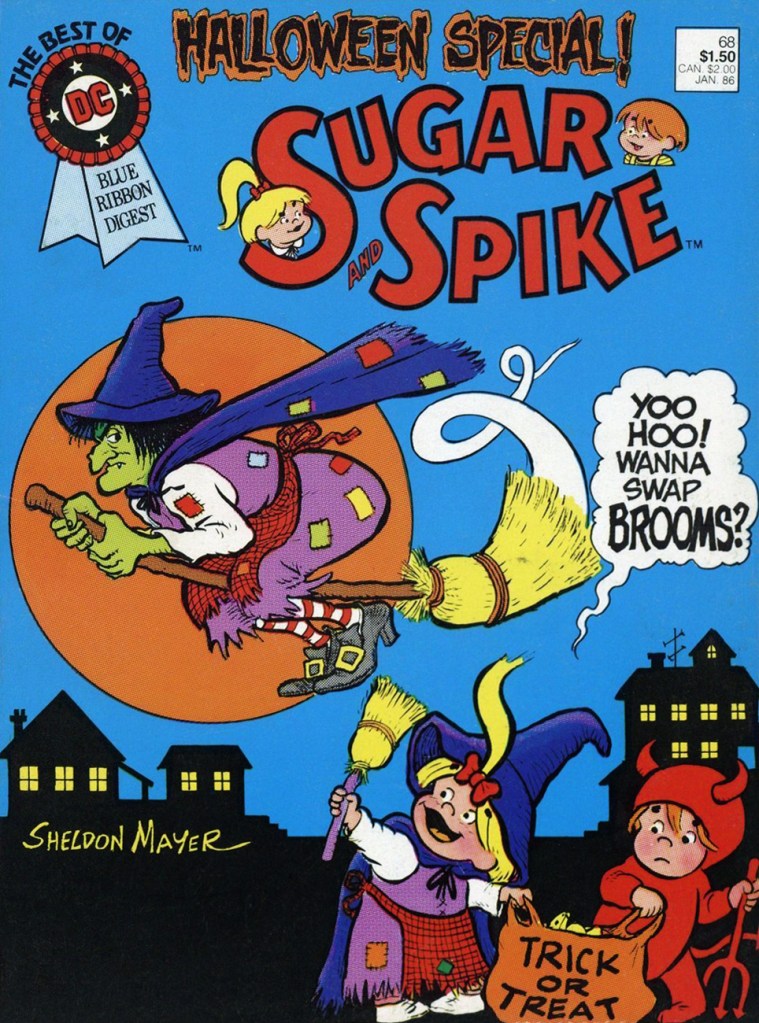
This is The Best of DC no. 68: Sugar and Spike (Jan. 1986). Edited by Nicola Cuti, and with a new cover by Mr. Mayer. Mostly reprints, but with material of this calibre, who’s to quibble?
I was initially set to feature just a couple of Sugar and Spike Hallowe’en covers, but in the end, it seemed unfair to play favourites.
Clearly, some cravings die awfully hard. This is Strange Tales no. 28 (May, 1954, Atlas), featuring a most claustrophobic… cuddle. The rest of this scarce issue contains artwork by Pete Tumlinson, Jack Katz (who recently — just last week! — turned 93), Bob Forgione, Don Perlin (who recently turned 90) and Tony DiPreta.
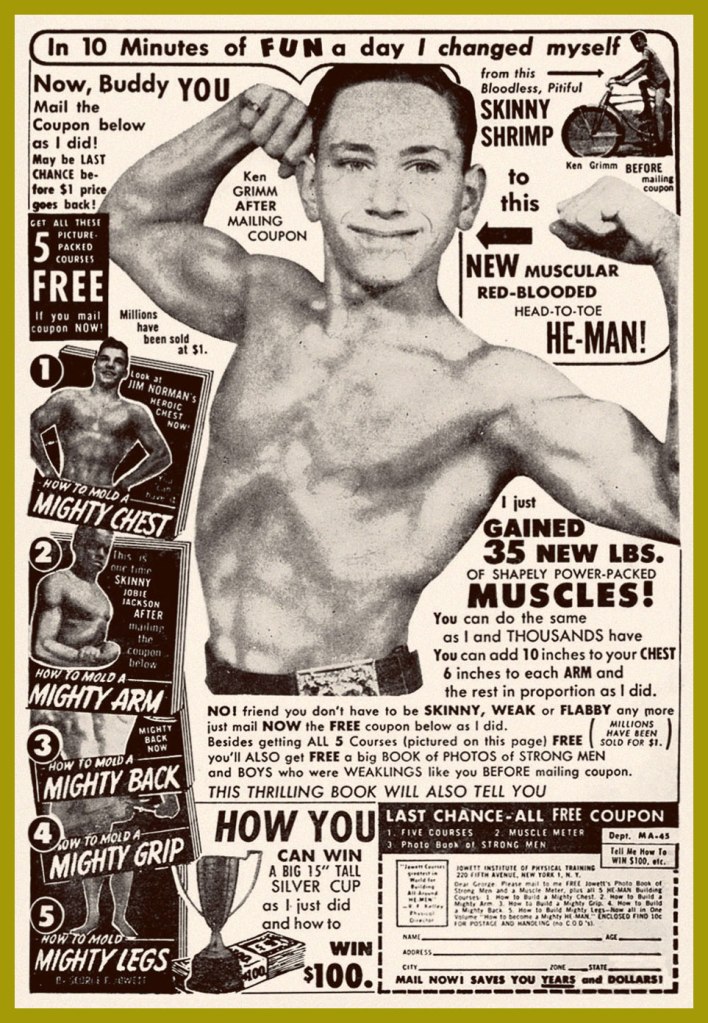
*Ken* Grimm, eh? Speaking of horror, they sure didn’t mince words to reel in the rubes, did they? This gentle, understated pitch appeared on the inside back cover of this issue of Strange Tales. « Mail the damn coupon with your shekels already, you bloodless, pitiful, skinny shrimp! », bellowed the bellicose drill sergeant.
« What is this ‘witch’s brew‘? Oh, that’s a special! It’s a squirt of everything! » — Pop Tate divulges one of his culinary secrets
A little while back (okay, quite a while back!), upon reading an article written by cartoonist Seth (John Stanley’s Teen Trilogy, The Comics Journal no. 238, Oct. 2001), this passage especially piqued my interest: « I have to admit right now that I like Archie comics quite a bit and I have hundreds of issues of Archie and its various spin-off titles. I can even tell you which years are the good years (1959 to ’65, incidentally) ».
As it happens, I’m in full agreement with the gallant Mister Gallant : this was when Archie’s Mad House and Tales Calculated to Drive You Bats came along, when Bob White (and Samm Schwartz, and Orlando Busino) were producing scads of wild and wooly covers featuring ghouls and bug-eyed critters, mole men and mad (though I’m told they prefer ‘eccentric’) scientists and sundry extraterrestrials and witches. The line’s cover layout was also nicely open, affording the artists plenty of latitude to indulge themselves. Here are some samples from the aforementioned creators at the peak of their formidable powers, before the end-of-recess bell rang and stifling homogeneity was henceforth imposed.
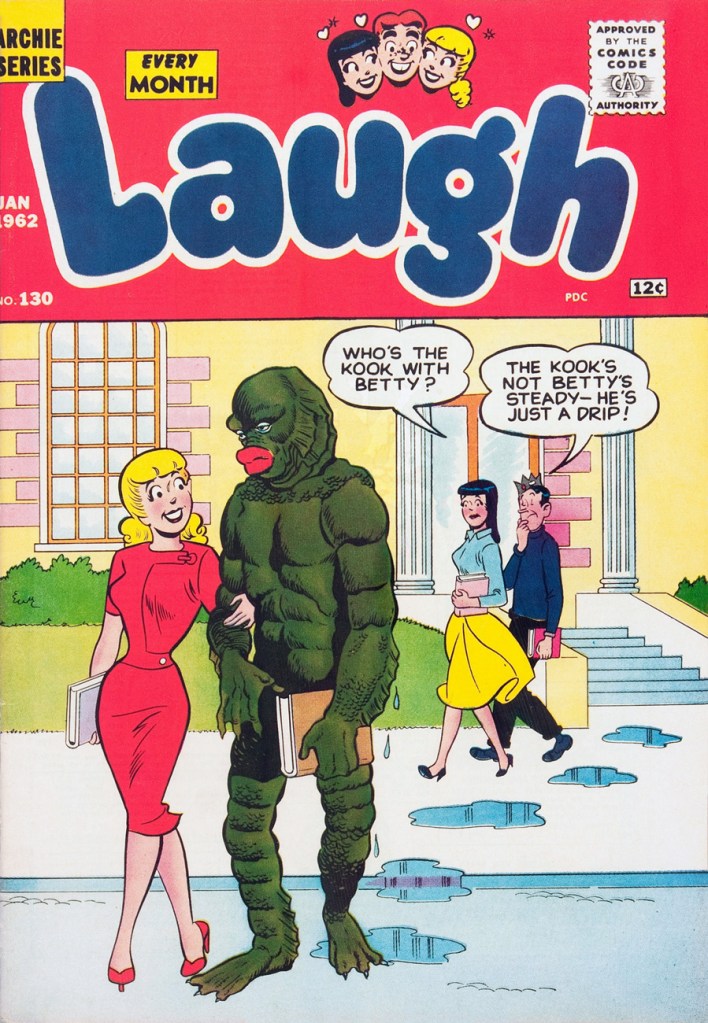
This is Laugh no. 130 (Jan. 1962, Archie); cover by Samm Schwartz. Looks like our friend Ricou Browning is slumming it in Riverdale, with Betty happily showing him the sights. Honestly, he’s more of a gentleman that Archie ever was.
This is Tales Calculated to Drive You Bats no. 2 (Jan. 1962, Archie); cover by the incomparable Orlando Busino, still with us and nearly 94 years young! I strongly suspect that these witchy younglings mean mystical business!
This is Archie no. 125 (Feb. 1962, Archie); cover by Harry Lucey, one of the crucial classic Archie artists. Regardless of what you’ve heard, look at the actual sales figures for 1969, with Lucey drawing every issue of Archie. Readers voted with their wallet.
Here’s a swell example: Pep Comics no. 158 (Oct. 1962). Spooky cover art by local favourite Bob White. I wouldn’t have pegged Archie as a skeptic, to be honest.
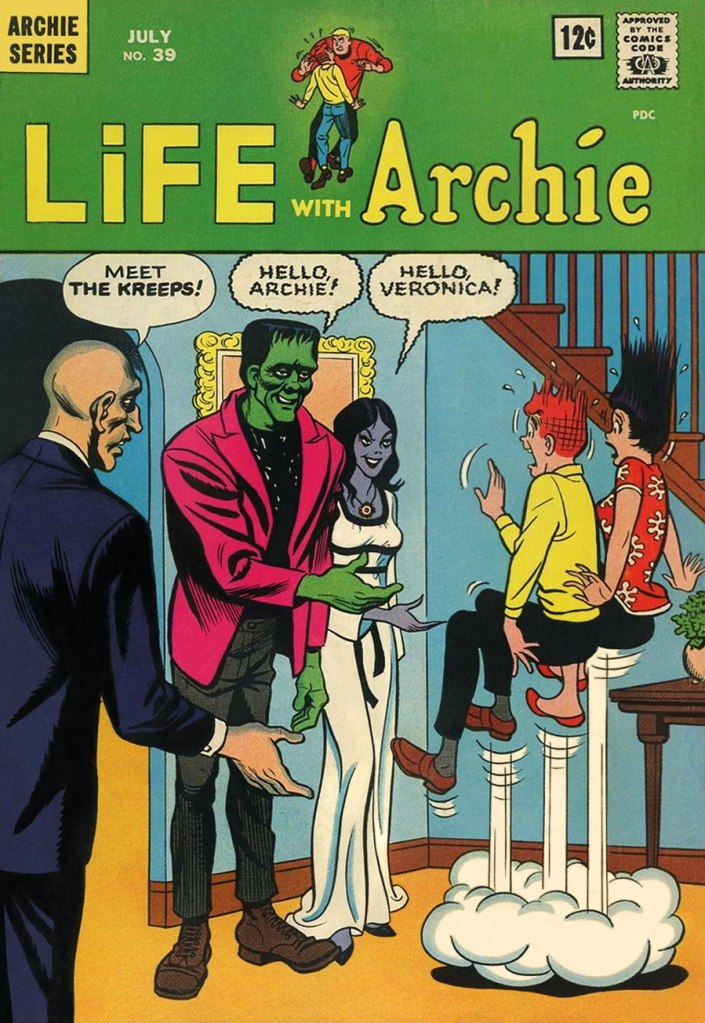
This is Life With Archie no. 39 (July 1965, Archie); cover, again, by Mr. White. The previous year had seen the TV arrival of The Addams Family and its imitators, The Munsters. So what’s one carbon copy more or less?




















 Who's Out There?