Hallowe’en Countdown III, Day 21

« Mama threw out my Hooded Cobra and Black Widow! »

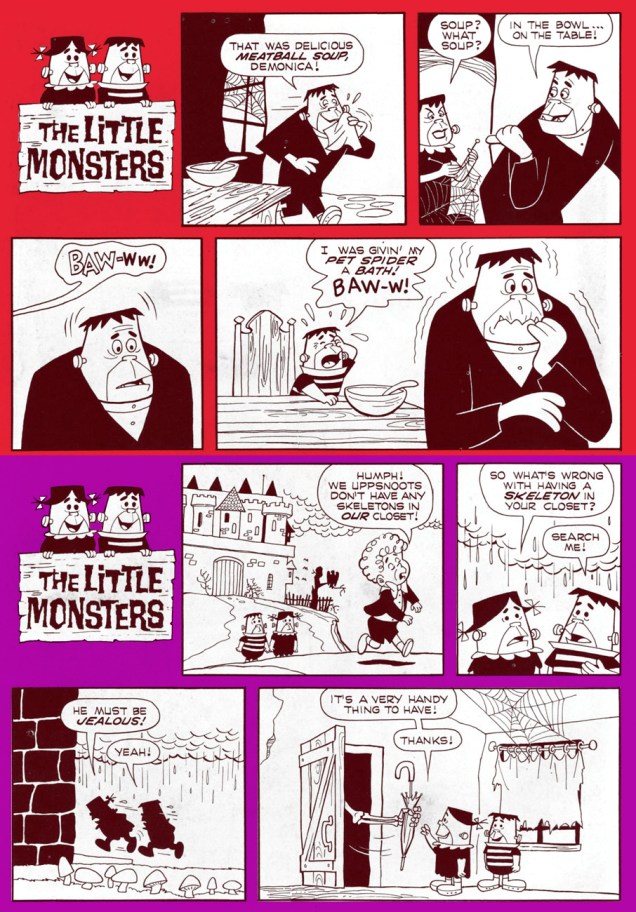
A delightful entry in the 1960s monster craze, Gold Key’s anonymously-created The Little Monsters first reared their fetchingly homely heads in the back pages of The Three Stooges no. 17 (May, 1964), predating by several months the near-simultaneous (just a week apart!) arrival on the tube of both The Addams Family and The Munsters. Now this ghastly family unit, assembled in the laboratory of kindly mad scientist Dr. Frankenfurter, comprised Papa Mildew, Mama Demonica, and their titular kids, ‘orrible Orvie and Awful Annie. The Little Monsters enjoyed a quite respectable rampage in comics, running amok for 44 issues between 1964 and 1978, outlasting by some years the craze that spawned them.
LittleMonstersA

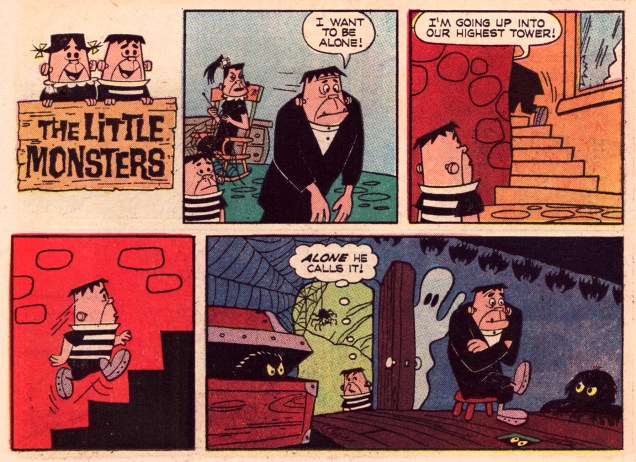
In this half-pager is from Little Monsters no. 7 (Dec. 1966, Gold Key), Papa Mildew essays Greta Garbo’s immortal line. Writer and artist unknown and uncredited, for shame. Pete Alvarado has been proposed as a possibility, but the man’s chameleonic versatility complicates identification somewhat.
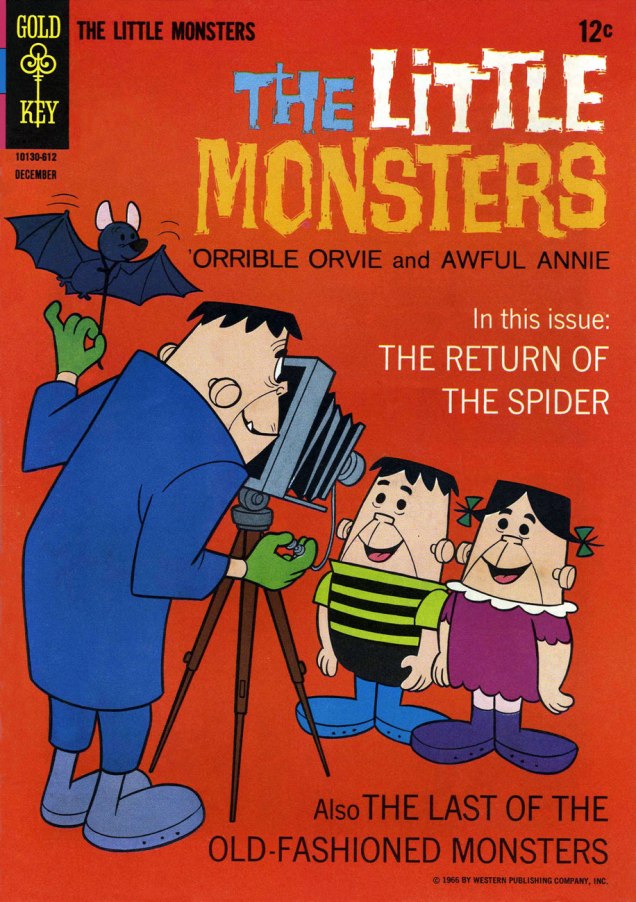
LittleMonsters07A

Ah, why be stingy? Let’s have a few more short pieces from the same issue.

LittleMonsters06VersoALittleMonsters06RectoA

– RG

Hallowe’en Countdown III, Day 20

« Eeeeeeeeeee! A horrible monster! He wants to… to eat me! »

With the coming of Hallowe’en, you have to get all the bases covered: an ungodly hoard of candy, a pumpkin to carve and assorted decorations to array about the house. Thank your lucky stars for the lightness of your burden: the average Balkan peasant also has to polish his pitchfork, sharpen and set out wooden stakes, gather sprigs of wolfsbane, and round up the requisite number of torches.

GrandeMonsterA
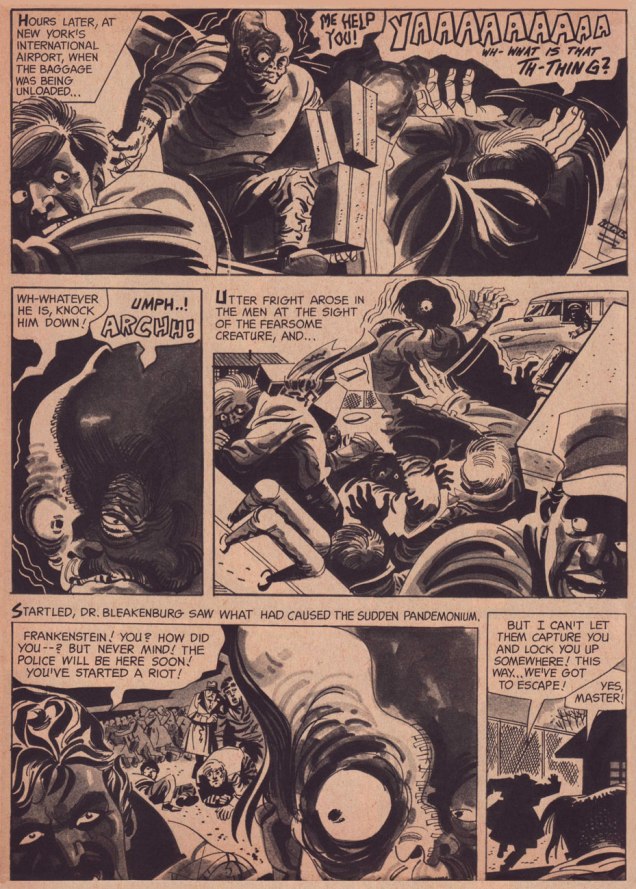
A detail from page eight: Grandenetti at his late-period finest, each page crackling with nervous energy and brimming with shadowy ambiance.

This merry nocturnal chase is brought to you by the team of Otto Binder, writer, and local favourite Jerry Grandenetti, illustrator. It comes from the sixth issue (January, 1969) of Cracked‘s go at a Warren-style Monster mag, For Monsters Only (10 issues… plus a  best-of “annual”, sporadically published between 1965 and 1972). This was Frankenstein ’68, the first of three entries in Binder and Grandenetti’s The Secret Files of Marc Vangoro*, featured in issues 6, 7 and 8 of the mag. Well worth hunting down.

GrandenettiFrank_10A

While this material has never, to my knowledge, been reprinted, and as copies of these long-neglected mags are getting scarcer and naturally pricier, fear not… for some kind souls have taken the considerable trouble of scanning, and more to the point, sharing them. In this particular case, look here.

FMO6CoverA
Here’s the cover you need to keep an eye for. This is Cracked’s For Monsters Only no. 6 (Jan. 1969). That handsome fella is said to be the creation of the renowned wildlife painter Charles Fracé, of all people.
FraceFMO6A
It’s heartening to know that the original art still exists and is in presumably caring hands.

– RG

*perhaps a knowing wink at Grandenetti’s (with fellow Eisner Studio acolytes Marilyn Mercer and Abe Kanegson) 1949-51 classic The Secret Files of Dr. Drew, blessedly available in an exemplary edition, thanks to the sterling efforts of cartoonist-scholar Michael T. Gilbert.

Hallowe’en Countdown III, Day 19

« Since man cannot live without miracles, he will provide himself with miracles of his own making. He will believe in witchcraft and sorcery, even though he may otherwise be a heretic, an atheist, and a rebel. » — Fyodor Dostoyevsky

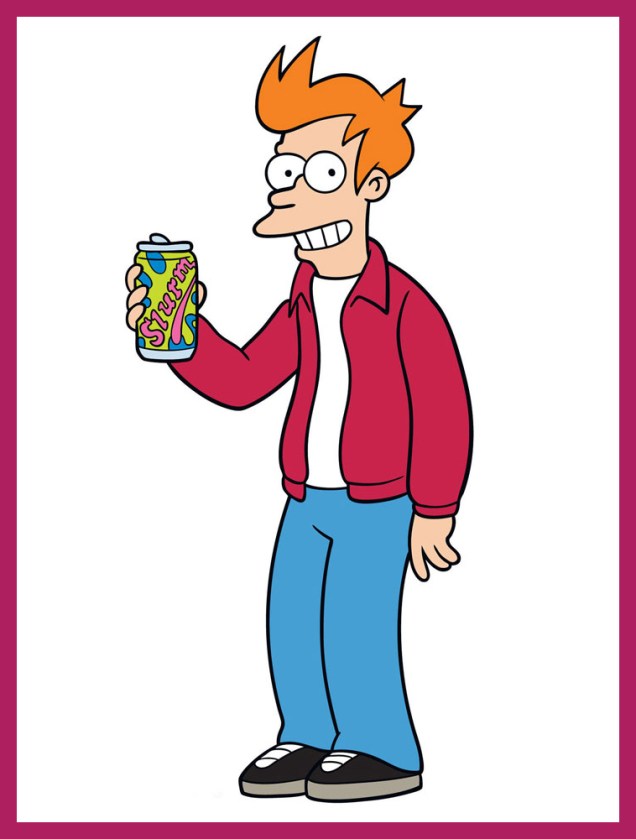
Here’s the earliest recorded appearance of Futurama’s Phillip J. Fry, and it would appear that he’s in for a heap of trouble… voodoo trouble! Fortunately, world-class sleuth Ellery Queen is on the case and on his side. That’s him discreetly crouching behind a gravestone.

ElleryQueenOriginalA

This once-upon-a-midnight-dreary George Wilson beauty served as the cover of Dell’s Four Color no. 1243 (Nov. ’61 – Jan. ’62), the tale of The Witch’s Victim, featuring interior art by Mike Sekowsky, with inks by, from the look of it, George Roussos.

I wonder what Fry had done to get a coven so howling mad at him? I mean, just look at that innocent face…

FrySlurmA

FC1243A
Here’s how the painting fared in print.

SekowskyVictim01A

SekowskyVictim05A
A couple of sample pages from the story…. interesting to see the tension between the staid-by-design Dell style and a bit of an iconoclast like Sekowsky. It’s impressive that Mr. S. could find the time, between pencilling the rollicking monthly adventures of Snapper Carr, to moonlight for the competition… but here we are.

Has your interest been piqued ? Enjoy the tale in its entirety, courtesy of Karswell’s fine blog, The Horrors of It All.

– RG

Hallowe’en Countdown III, Day 18

« There is nothing new under the sun but there are lots of old things we don’t know. » — Ambrose Bierce

Here’s an unusual specimen: a two-headed, twin-gendered Australian cartoonist. Beryl Antonia Yeoman (1912-1970, b. Brisbane, Queensland) formed, in 1937, a cartooning partnership with her brother, Harold Underwood Thompson (1911-1996, b. West Kirby, Cheshire) when they adopted the nom de plume of Anton.

AntonGhostStoryA

From the sound of it, Beryl was the power behind the throne, as she produced the Anton cartoons on her own during Harold’s active duty in the Royal Navy during WWII. The pair reconvened after the war and created wonderful cartoons for such publications as Punch, Lilliput, Men Only (ha!), Tatler, The Evening Standard (solo Harold!) and Private Eye. Beryl was the only female member of Punch’s exclusive Toby Club.

Today, a charming bistro named in honour of the artful siblings still operates in Wells, Somerset; it features Anton’s art on its walls. How’s that for posterity?

This slyly cozy cartoon made the cut for the splendid 1952 anthology The Best Cartoons From Punch.

And while we’re on the subject of ghostly radio stories, give one of these a try.

– RG

Hallowe’en Countdown III, Day 17

« I may turn up as flies on your ceiling. »

From the earliest issues of  Love & Rockets (circa the early 1980s), it was quite evident that Jaime Hernandez was a cartoonist of the first order.

At first, he kept the tone of the proceedings fairly jovial; but gradually, a little darkness crept into the ambiance. Not systematically, mind you: it was just the natural course of things. For all that, he didn’t sacrifice one bit of his light touch; he was just expanding his range, the simple process of his artistic maturation.

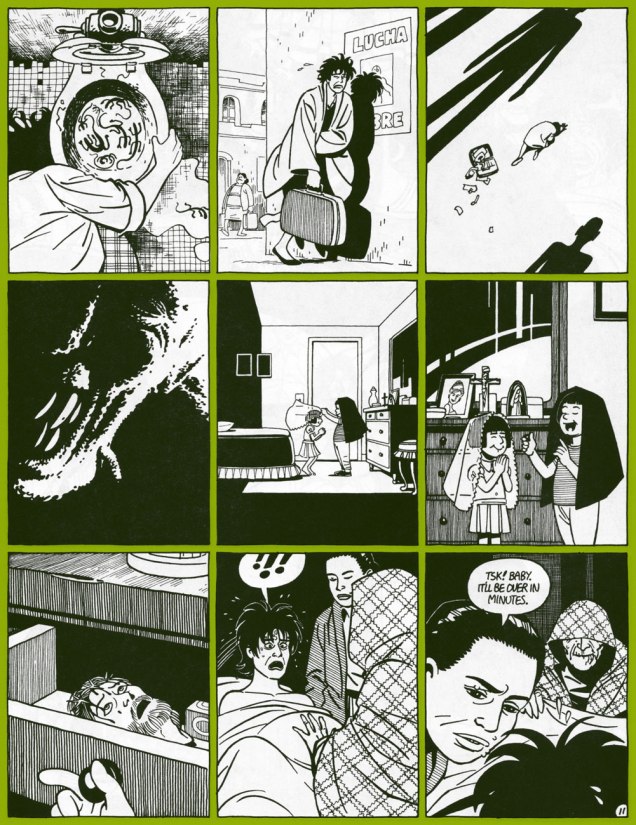
The first time he fully demonstrated that he could evoke the texture and the essence of terror… was a milestone. In 1989’s Flies on the Ceiling, he stunned readers with a dizzying, yet understated tale that lifted the veil on a murky chapter of Izzy’s past. In the telling, he adroitly looses a startling panoply of techniques and ingredients that this reader wasn’t nearly prepared for. A true brain-singer.

JaimeFlies11A
Roman Catholic iconography, traditional Mexican beliefs and rituals, dead-on psychology, awful things hinted at in the margins. An excerpt from Flies on the Ceiling: the Story of Isabel in Mexico (Love & Rockets no. 29,  Fantagraphics) [ Read it here. ]
Jaime occasionally returns to the realm of the uncanny (we’ve featured him in a past countdown entry), but never treads the same path twice. A few further samples, if you will:

JaimeRayNightmareA
Poor Ray has a singularly vivid nightmare. Hopefully, that’s all it is. This ghoulish entry appeared on the back cover of Penny Century no. 3 (Sept. 1998, Fantagraphics). Story and art by Jaime Hernandez, colours by Chris Brownrigg.

JaimeLaBlanca01A

JaimeLaBlanca02A
La Bianca: a True Story appeared in the Gilbert Hernandez-edited all-ages anthology Measles no. 2 (Easter 1999, Fantagraphics.)
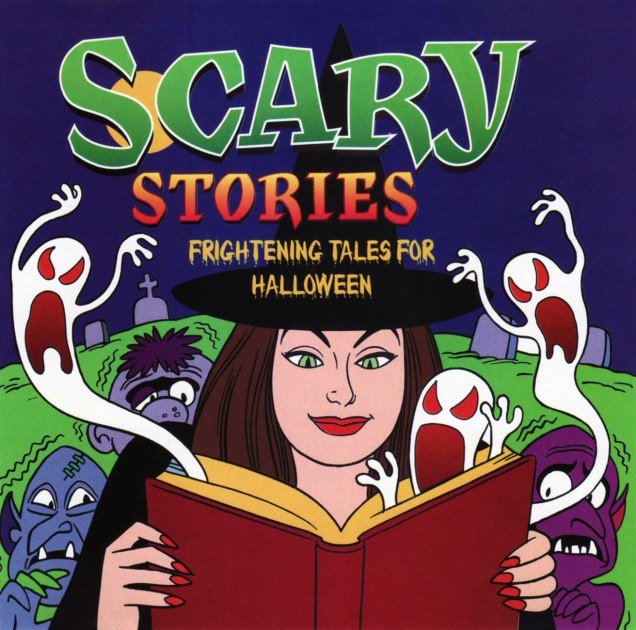
JaimeScaryStoriesA
Jaime in a spooky-lite register, for a 1994 Rhino Records spoken-word anthology featuring such titans of the macabre as Boris Karloff, Brother Theodore and Nelson Olmsted.

– RG

Hallowe’en Countdown III, Day 16

« Mirrors toins things in revoise! Everything in Mirrorland is opposite! So naturally I’m a tough ghost and you’re a sissy spook! » — Poil in Through the Looking Glass (Spooky no. 121, 1970… read it here)

The Harvey Comics line, in its peak years (from the late Fifties to the mid-seventies, say) was essentially a collection of monomaniacal characters. As Daniel Clowes deemed in his classic lampoon of the Harvey cast, theirs is a Playful Obsession (read it here.)

Richie Rich had his moolah, Little Lotta wolfed down everything in sight, Little Dot found stimulation in… dots, and so on. Casper the Friendly Ghost’s uncouth counterpart, the 30s kid gang-inspired Spooky (complete with Brooklyn accent and « doiby » hat), loved to, well, scare people (and things!) with a hearty « Boo! », Hot Stuff raised the temperature wherever he went. On the other hand, Casper and Little Audrey’s adventures didn’t rely on such gimmicks, possibly from predating the rest of the Harvey gang, originating in animation in Casper’s case, and… folklore in Audrey’s:

« One day, Li’l Audrey was playing with matches. Her mother told her she’d better stop before someone got hurt. But Li’l Audrey was awfully hard-headed and kept playing with matches, and eventually she burned their house down.

“Oh, Li’l Audrey, you are sure gonna catch it when your father comes home!” said her mother.

But Li’l Audrey just laughed and laughed, because she knew her father had come home early to take a nap. »

The Harvey line’s covers were by far its most precious asset: endless riffs on a character’s particular motif, granted, but spun out in well-designed, nimbly-executed and brightly-coloured scenes… virtually the work of a single creative whirlwind, art director-illustrator Warren Kremer (1921-2003).

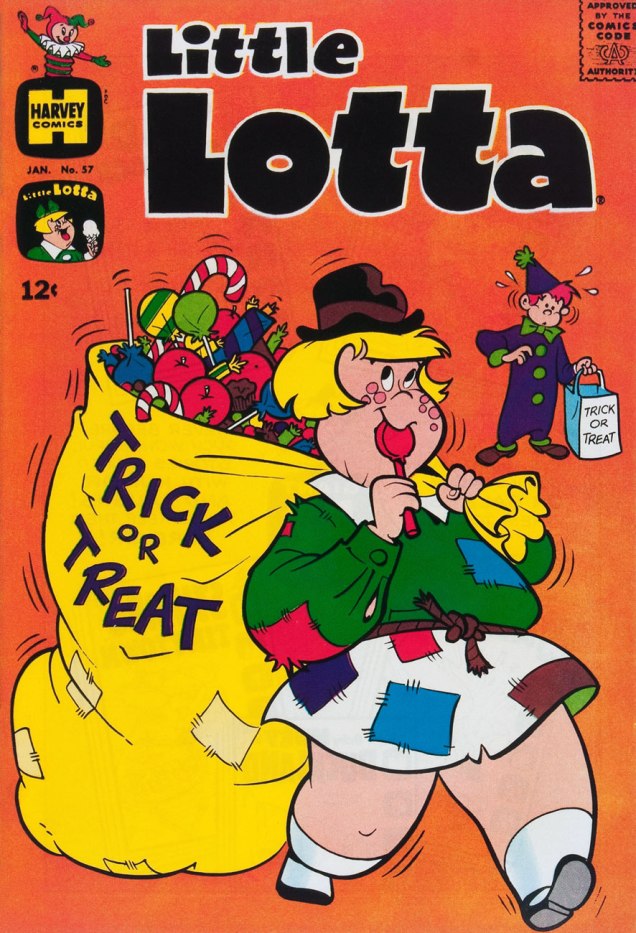
LittleLotta57A
This is Little Lotta no. 57 (Jan. 1965). Lotta may have been a glutton, but she was also super-strong.
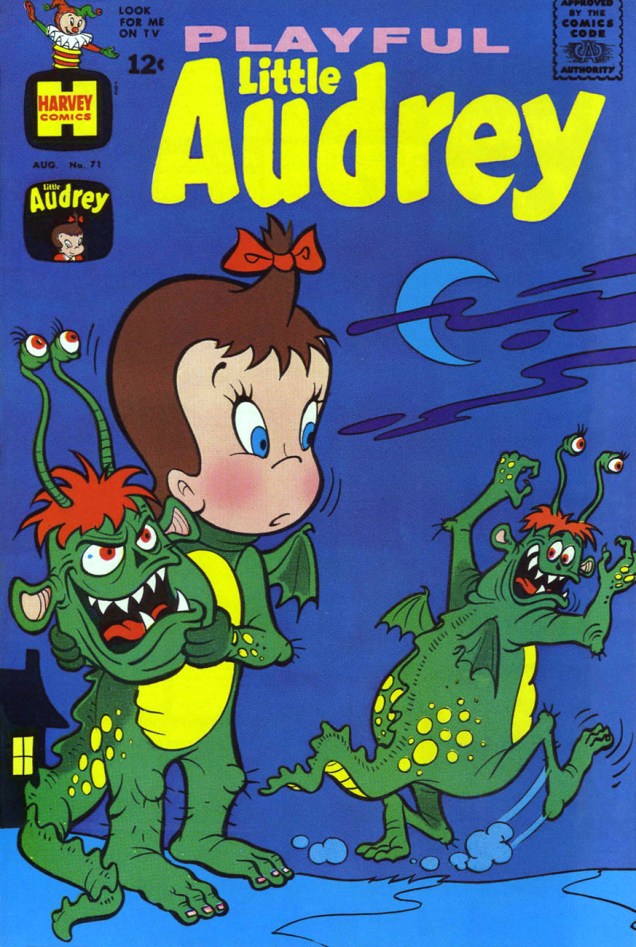
LittleAudrey71A
This is Playful Little Audrey no. 71 (Aug. 1967).
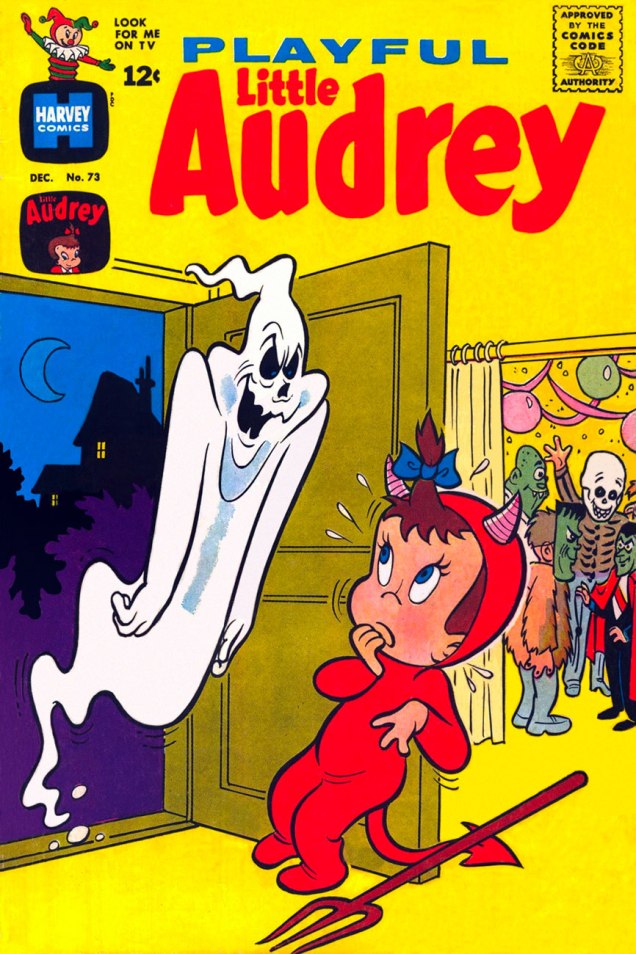
LittleAudrey73A
This is Playful Little Audrey no. 73 (Dec. 1967).
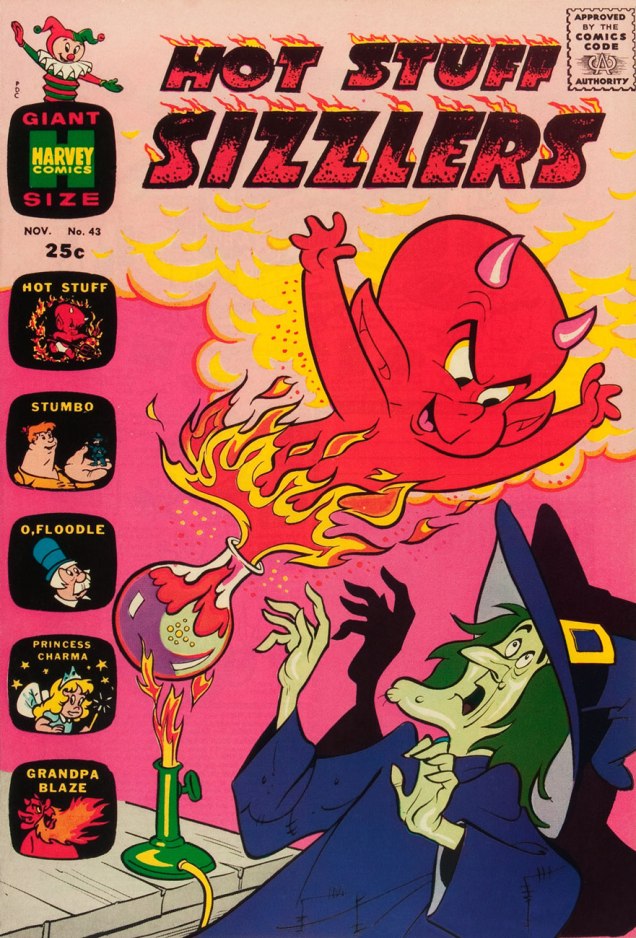
HotStuff-Sizzlers43A
This is Hot Stuff Sizzlers no. 43 (Nov. 1970).
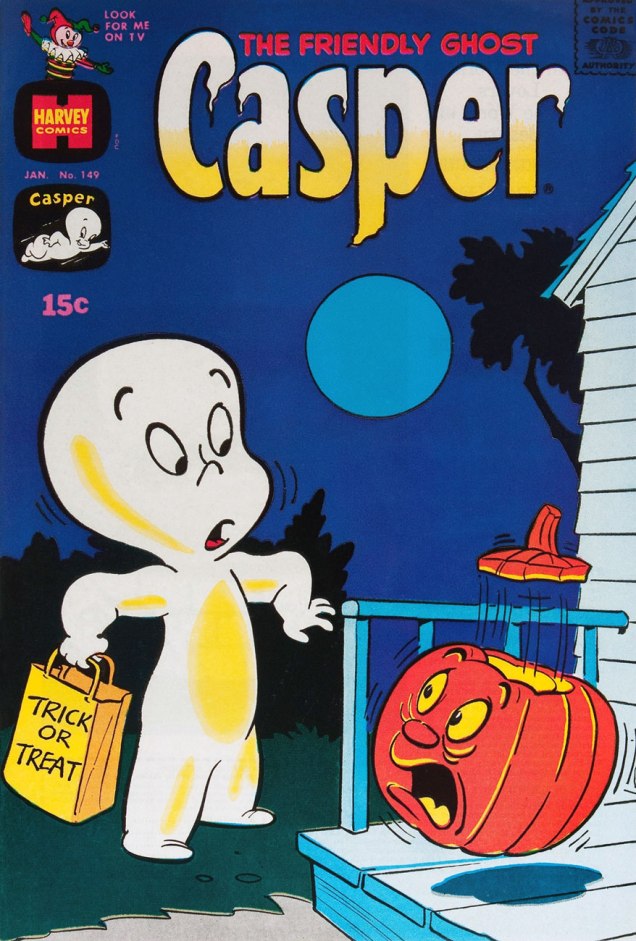
Casper149A
This is Casper the Friendly Ghost no. 149 (Jan. 1971).
SpookyHaunted9A
This is Spooky Haunted House no. 9 (Feb. 1974). Note that Spooky’s girlfriend’s actual name is ‘Pearl’… he just pronounces it ‘Poil’. Upon occasion, the ‘tuff little ghost’ essays the rôle of the spookee rather than his usual spooker (or is that “spookist”?)
LittleDot156A
This is Little Dot no. 156 (Dec. 1974). I’m not sure what the kid’s so terrified of… maybe he’s never had the measles?

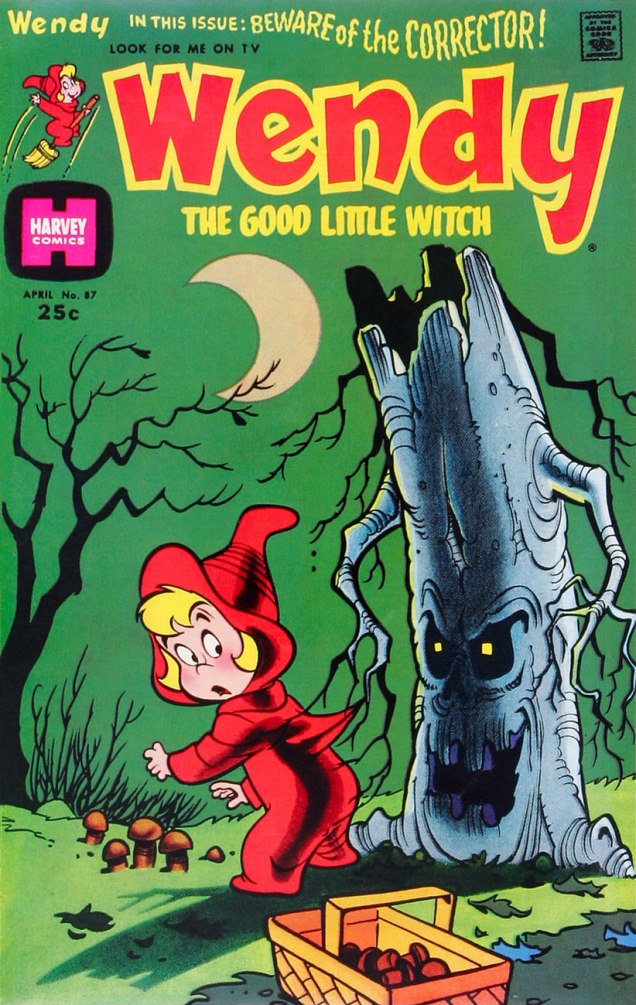
WendyWitch87A
This is Wendy, the Good Little Witch no. 87 (Apr. 1975). [ds: these just might be edible mushrooms.]
In all cases, artwork by the legendarily prolific Warren Kremer. As we demonstrated last year, the Harvey house style hardly was the only range he could draw in.

– RG

Hallowe’en Countdown III, Day 15

« Each time I enter this fog, it feels as though icy fingers were clutching at me! »

Étrange aventures, a squarebound quarterly digest (roughly 5 x 7 inches, 164 pages), was one of many titles published in France by Arédit / Artima between 1966 and 1984 through its Comics Pocket imprint. Étranges aventures was one of the collection’s flagship titles, with a healthy run of 79 issues from July, 1966 to March, 1984. Its contents were mostly repackaged and reformatted translations of various DC and Marvel (and the odd Charlton) comics in black and white, but with fun painted recreations of the original covers for the twenty-or-so issues. At under fifty cents a pop, they presented a bargain to the cash-strapped aficionado, thrifty access to scarce and/or pricey items.

ÉtrangesAventures12A
This is Étranges aventures no. 12 (April 1969); the issue is rounded out with The Challengers of the Unknown, Rip Hunter… Time Master, and The Doom Patrol.

This issue was a relative exception, cover-featuring an original work (or at least not an American one), the sort of material the publisher usually reserved for its more “serious” titles. These were often comics adaptations of horror or suspense novels issued earlier by mother company Les Presses de la Cité under its Fleuve Noir imprint. Graphic novels? Exactly.

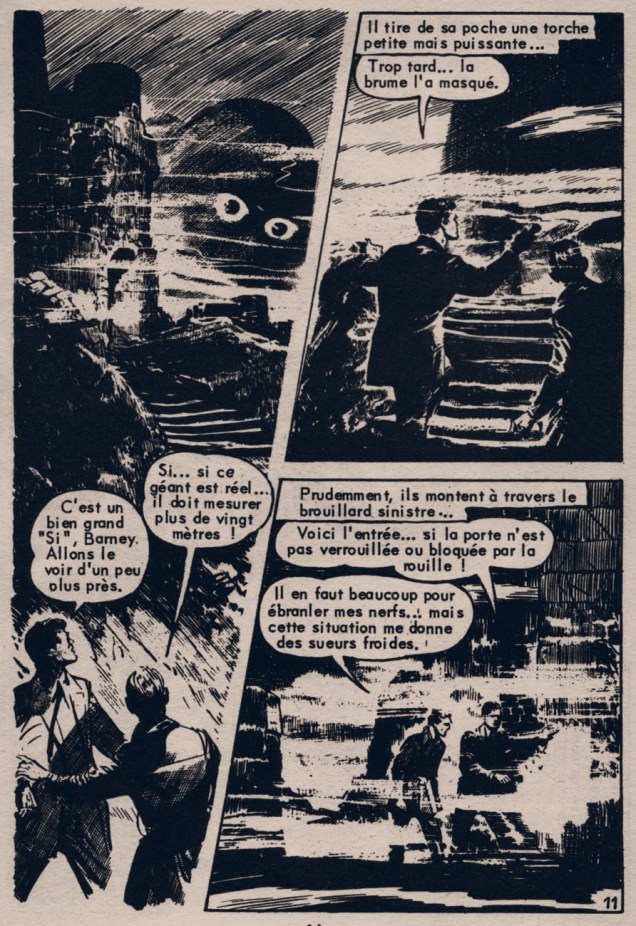
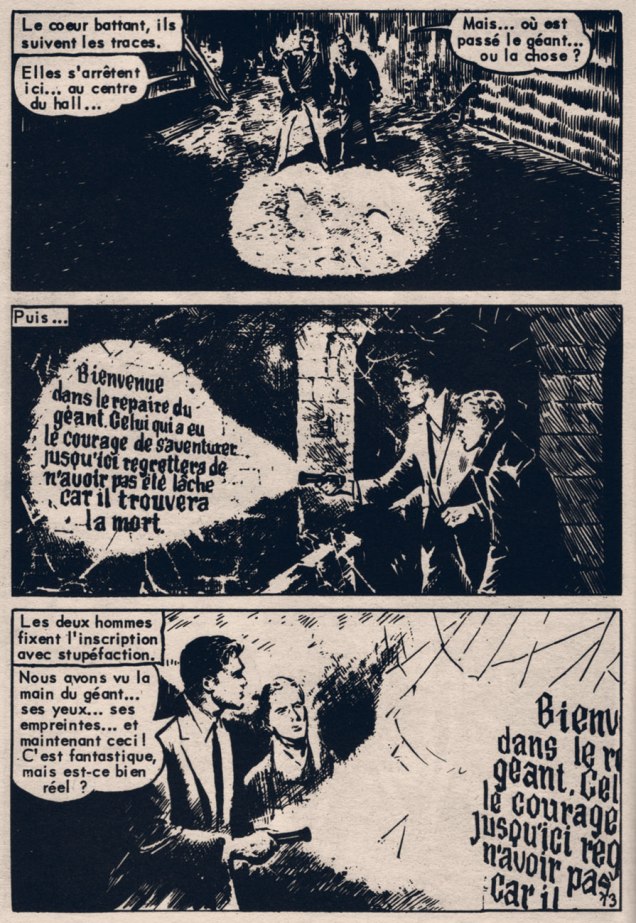
Gipsy-Hill_11A
« If… if this giant is real…it must stand over twenty meters high! »
« That’s a mighty big ‘If’, Barney. Let’s take a closer look at him. »
He pulls from his pocket a small but powerful flashlight…
« Too late… the mist has hidden him. »
Cautiously, they climb through the sinister fog…
« Here’s the entrance… if the door isn’t locked or blocked by rust! »
« It takes quite a bit to frazzle my nerves… but this situation has given me cold sweats! »
Gypsy-Hill13A
« Welcome to the giant’s lair. He who has had the courage to venture this far will regret not having been cowardly, for he will find death. »
Gypsy-Hill49A
Prosaically, the whole affair turns out to be the work of unscrupulous special effects experts, vulgarly after some jewels. All this imaginative and diabolically elaborate work and expense for some shiny baubles!  Still, it’s all about mood.

Writer and artist unknown. And nationality, for that matter. In places, the artwork has clearly been resized and adjusted, and switches back and forth between halftone and line art reproduction. So the lasting mystery lies not in the story, but in its provenance.

– RG

Hallowe’en Countdown III, Day 14

« It’s well we cannot hear the screams we make in other people’s dreams. » — Edward Gorey

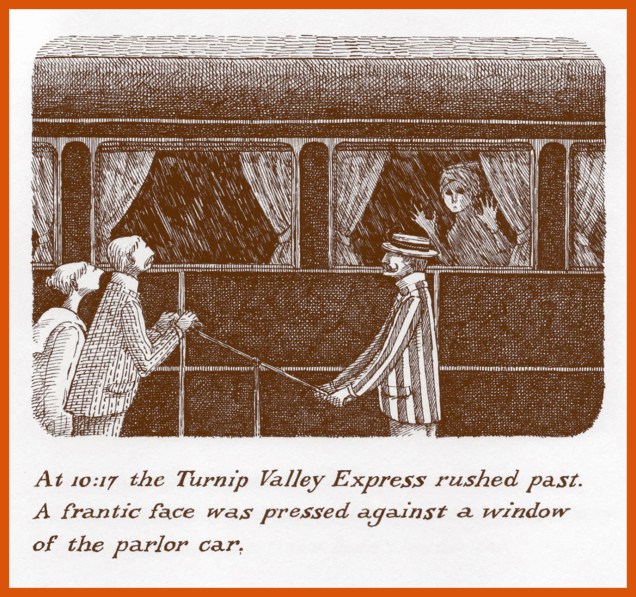
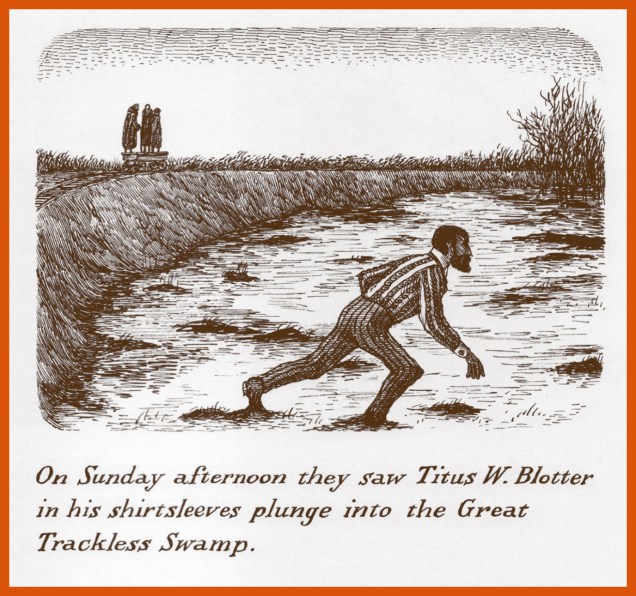
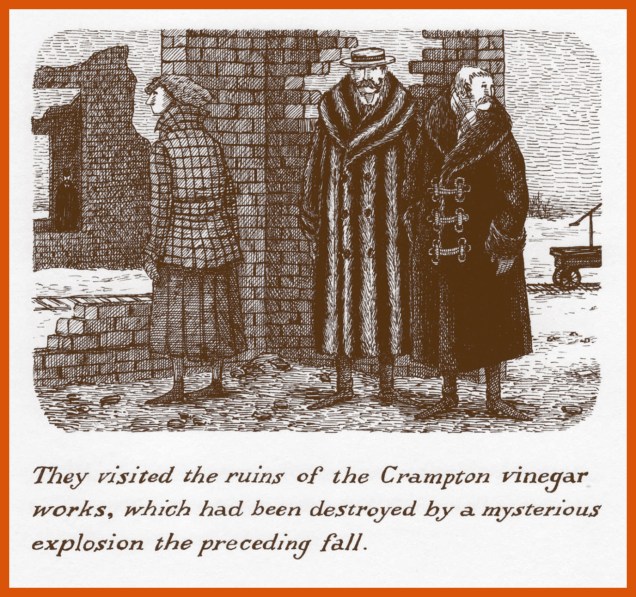
It was inevitable that the eminent Edward St. John Gorey (1925 – 2000) would grace my Hallowe’en countdown… but surely I deserve credit for holding out until midway through the third edition. Instead of the excellent but overexposed The Gashlycrumb Tinies, here’s an excerpt from what is, to my mind, his most ominous tale, The Willowdale Handcar or The Return of the Black Doll (1962), « In which three Pilgrims find mystery abort peril and partake of religious community. And the discerning Reader discovers Meaning in their Progress. » Last February, when I noted Mr. Gorey’s birthday (see that post here), I pledged to return to this specific work, and I wasn’t speaking with a forked tongue… at least not that time.

Gorey’s work largely remains open to interpretation, whether it’s stating something of import or just being coy. Still, not wishing to deprive anyone of the thrill of discovery, I’ve excluded the tale’s beautiful concluding panel. The entire story (I’ve provided seven of its thirty illustrations, not counting the cover) is available separately or as part of the classic 1972 collection Amphigorey (in the company of fourteen of his other works).

GoreyHandcarFrontAGoreyHandcar01AGoreyHandcar02AGoreyHandcar03AGoreyHandcar04AGoreyHandcar05AGoreyHandcar06AGoreyHandcar07A

In closing, a quote from the man that sums up the essence and appeal of this « at once deeply vexing and utterly hilarious, darkly mysterious and amusingly absurd* » yarn:

« All the things you can talk about in anyone’s work are the things that are least important…. You can describe all the externals of a performance – everything, in fact, but what really constitutes its core. Explaining something makes it go away, so to speak; what’s important is what’s left over after you’ve explained everything else. »

And if you should find yourself in Cape Cod, Massachusetts, don’t pass up the chance to visit Gorey’s house! http://www.edwardgoreyhouse.org/

– RG
*sez his publisher, accurately.

Hallowe’en Countdown III, Day 13

« Here’s to the thugs and maniacs who fill each book with concepts so damnable, so putrescent, that they make the EC horror magazines of yore seem like mere cocktail napkin doggerel. I salute you. Now I’m going to take a bath in quicklime. » — Harlan Ellison toasts Death Rattle (1986)

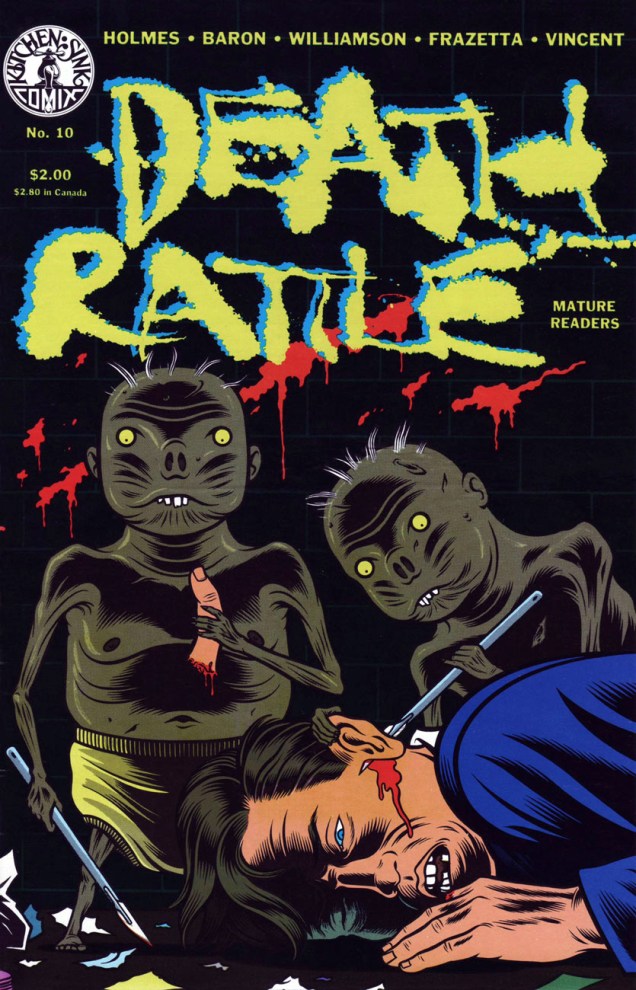
In the 1980s, with the Comics Code Authority in its death throes, you’d think horror comics would have made a massive comeback. Well, they did… and they didn’t. Since there had been plenty of black and white magazines to operate outside of the Code’s restrictions, bringing bloodshed and mayhem to colour comics made the much-anticipated liberation a bit of a non-event. For my money, the truly interesting horror material opted for different approaches, now more experimental, then rather whimsical, at times clinical, sometimes abstract. Underground comix publisher Kitchen Sink, surviving thanks to its eclectic spirit, revived its early 70s horror anthology in 1985, an adventure that this go-round lasted eighteen issues and unleashed cutting-edge, nostalgic, shiver-inducing, thought-provoking and gut-busting efforts by such talents as Richard Corben, Rand Holmes, P.S. Mueller, Jack Jackson, Stephen Bissette, Mark Schultz (his Xenozoic Tales were introduced in Death Rattle 8, in 1986), and, on this unsettling cover, Charles Burns.

BurnsRattle10A
This is Death Rattle no. 10 (April 1987, Kitchen Sink). Cover by Charles Burns, coloured by Pete Poplaski.

Before this cover, and speaking of clinical horror, Burns had earlier provided one of Death Rattle’s most harrowing gut-punches in issue one’s Ill Bred: a Horror Romance. I wouldn’t want to give away too much, but here are a few samples from this queasy masterpiece of gender fluidity, body horror and (justified) insect fear, seemingly inspired in equal parts by David Cronenberg films, Japanese art prints and Burns’ personal demons. Not for the queasy, but peruse it here if that ticks any of your happy boxes.

BurnsIllBred01ABurnsIllBred02ABurnsIllBred03A

– RG

Hallowe’en Countdown III, Day 12

« Egad! This looks like it’s straight out of a horror movie! »

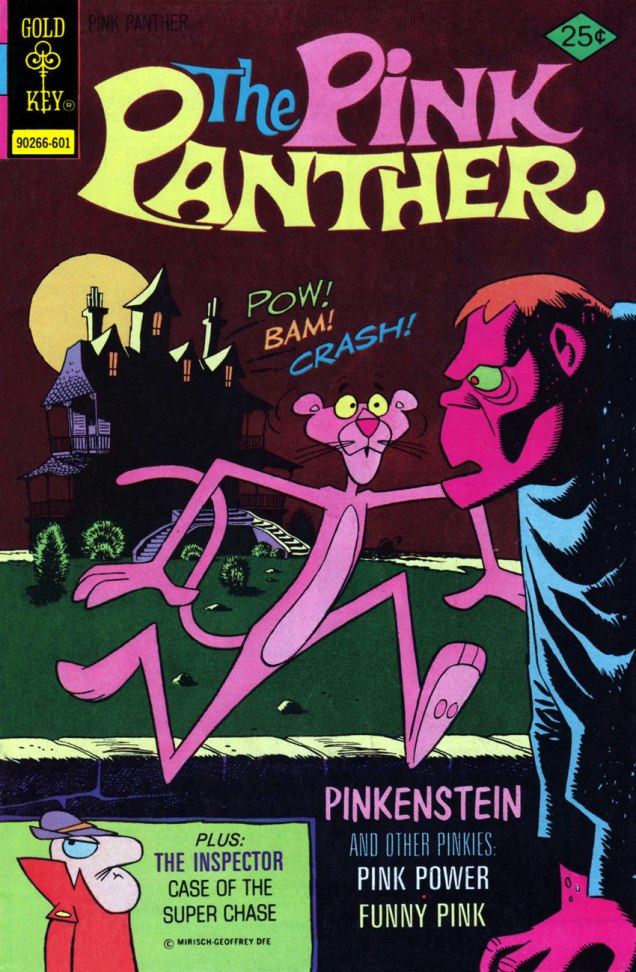
How deep and searing a trace the Universal Monsters cycle has left on popular culture: you see its mark on everything from literature to breakfast cereal. It’s nothing new in the cartoons, of course: Warner Bros, with the Looney Tunes, had their lugubrious fun with, for instance, Boris Karloff and Peter Lorre archetypes. So it’s no great shock to eventually witness DePatie-Freleng‘s The Pink Panther getting in on the monstrous act.

PinkensteinA
Nice bit of mood setting, isn’t it? This hails from The Pink Panther no. 31 (January, 1976). This being Gold Key, writer and artist uncredited and unknown. Any ideas?
PinkPanther31A
The issue in question… interesting colouring touch, most likely accidental: the only white space on the entire cover is the “PINK POWER” title.

Incidentally, we’ve checked out The Inspector in an earlier post.

– RG