« It’s astonishing how terrible people can be. » – Gahan Wilson
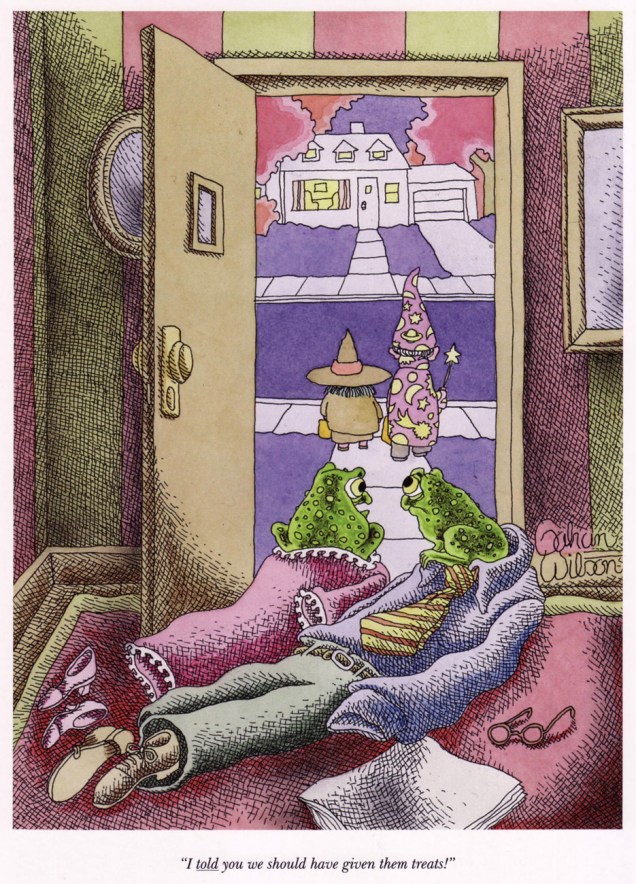
Chez Gahan Wilson (as with his esteemed colleagues Charles Addams and Edward Gorey, for instance), it’s always Hallowe’en! Here’s a trio of particularly fitting cartoons published over the years in Playboy magazine, always one of the finest homes for wayward cartoonists. Gahan was pretty much the only guy Hugh Hefner didn’t encourage to draw buxom females.
Playboy, October 1959.Playboy, November 1967.Playboy, October 2005.
Early in the magazine’s existence, Hef was looking for a Chas. Addams to call his own (the man himself was under exclusive contract with The New Yorker), and he found him. Yet, as Hefner said in his introduction to Fantagraphics’ extraordinary collection, Gahan Wilson: Fifty Years of Playboy Cartoons: « I don’t think I could have imagined before the fact how Gahan was going to grow. What one saw in the beginning was only the promise. »
« I don’t like mushrooms! We’ll find a way out yet! » – John Agar as Dr. Roger Bentley
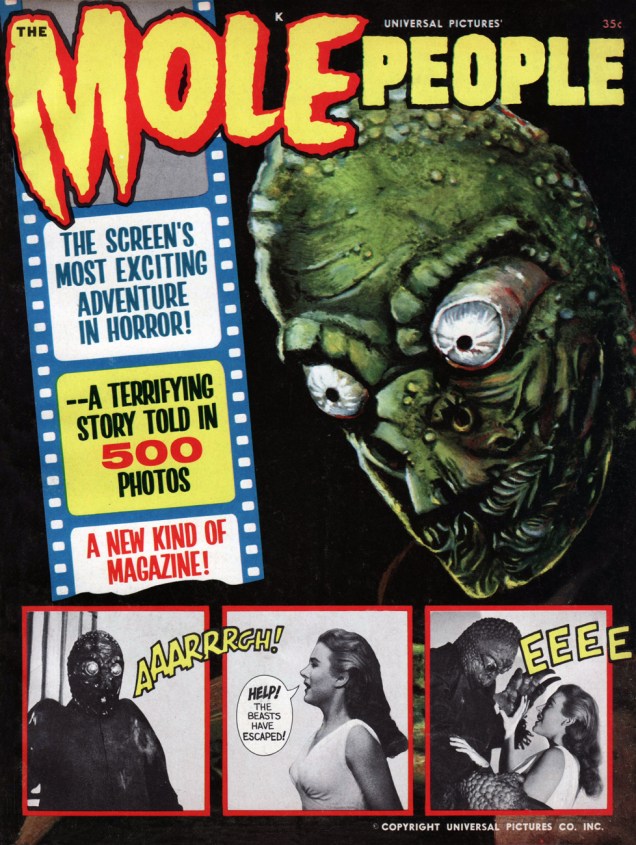
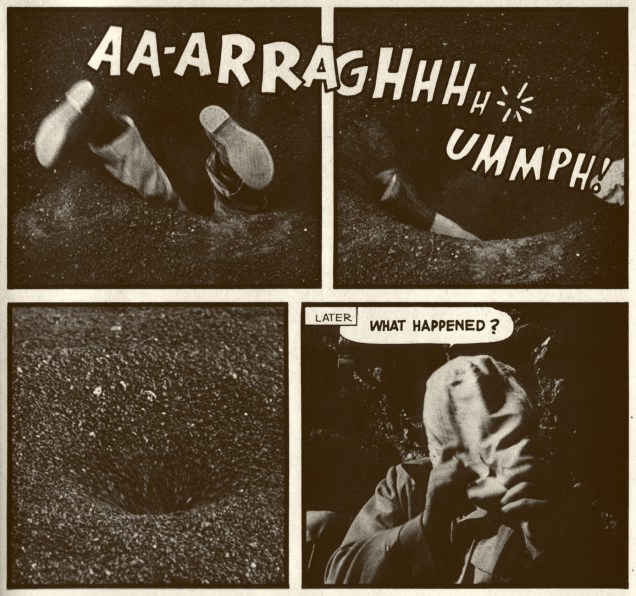
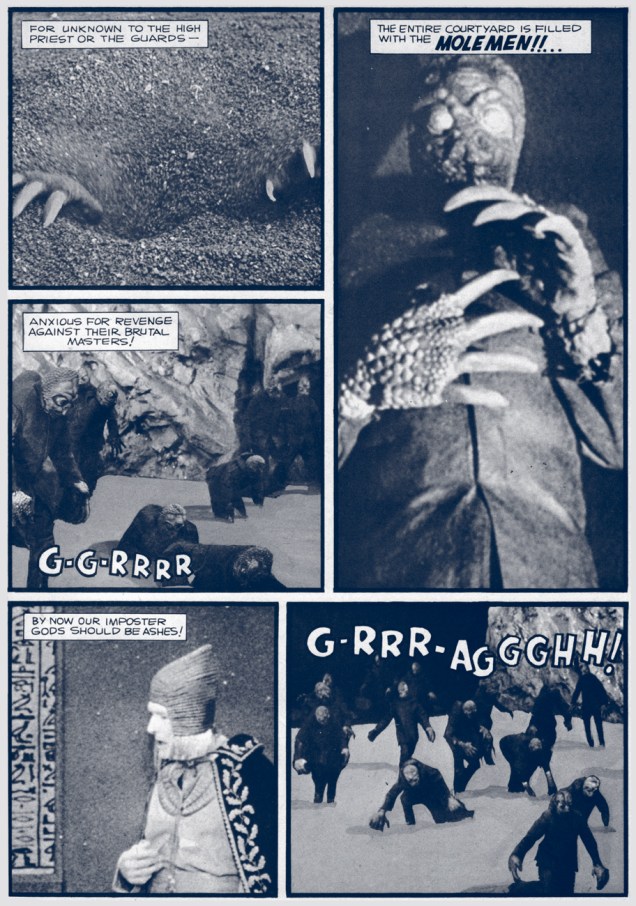
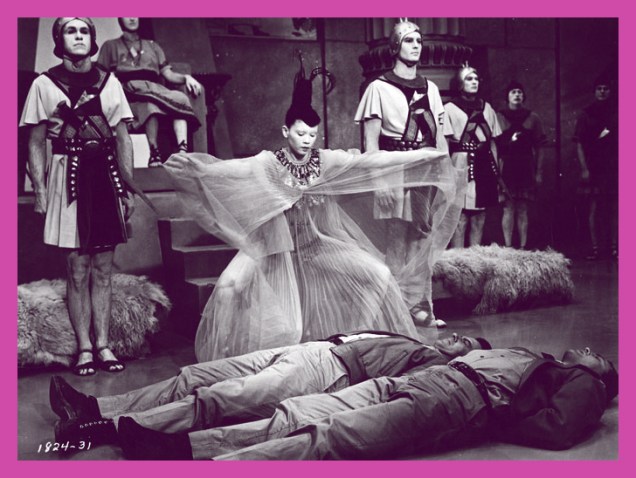
Fumetti: from the italian, it means « little smoke », describing the word balloons as they emanate from characters’ mouths. It’s comics, in other words. In English, it has come to denote comics created using photos instead of illustrations, also known as Fotonovela or, in French, photo-roman. Confused? No need to be. Here’s a rare American specimen of the beast, issued by Warren Publications, home of Famous Monsters of Filmland, Creepy, Eerie and Vampirella, in MCMLXIV (hey, that’s what the indicia says!).
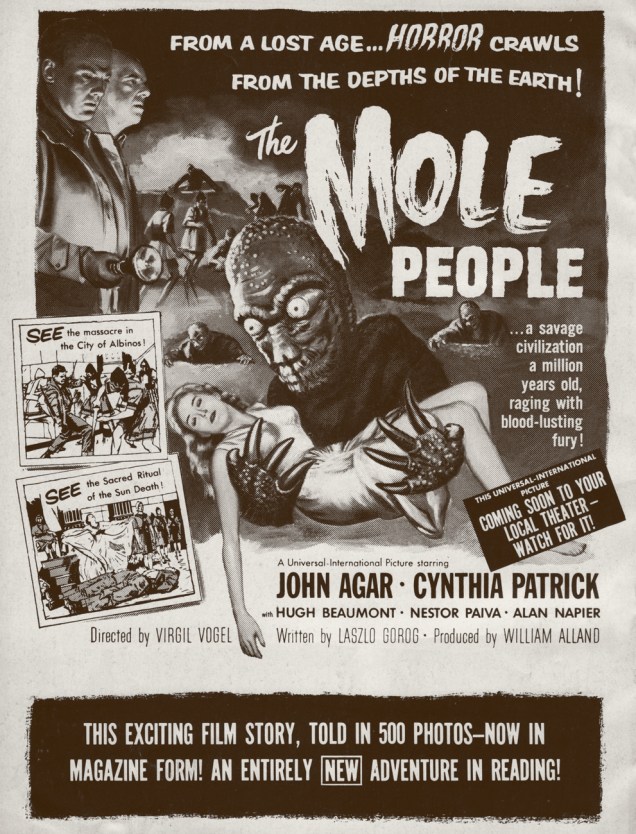
The back cover image, featuring the film’s wacky poster art.
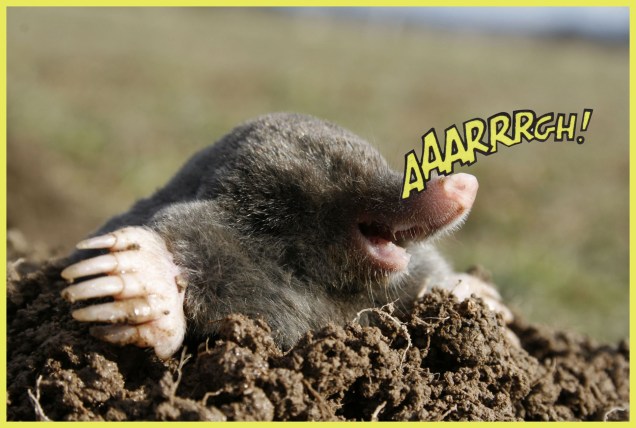
We’re dealing with the familiar (but welcome) scenario, in the worthy tradition of Herbert George Wells‘ The Time Machine… of the Normals turning out to be evil pricks and the presumed Monsters really being sweet if you treat them with any kind of basic decency.The human prisoners are treated to an exclusive semi-musical number by a young Björk Guðmundsdóttir.This Captain Company ad from the 1970s always made these titles seem so mysterious and enticing. The Mole People are first in the middle row. Dan Clowes was a big fan of that first Screen Thrills cover.The far scarier real-life version.
« But dreams come through stone walls, light up dark rooms, or darken light ones, and their persons make their exits and their entrances as they please, and laugh at locksmiths. » ― Sheridan Le Fanu, Carmilla
This splendid piece comes from the pen of legendary Belfast (Ireland, of course, Eire for you purists) artist Rowel Friers (1920-1998). I unearthed it from a lovely volume ambitiously, but not unjustifiably, titled Best Cartoons from Abroad – 1955, edited by Lawrence Lariar and Ben Roth (Crown Publishers, 1955). It first saw print in Dublin Opinion, a monthly Irish satirical magazine (1922-1968). DI was founded by a pair of cartoonists, Arthur Booth and Charles E. Kelly, and a writer, Thomas J. Collins.
As Hallowe’en is Celtic in origin, it stands to reason that we salute the vital Irish contribution to this most awesome of holidays. For those needing a little refresher, here’s a most helpful précis on the subject, from irelandeye.com:
« Hallowe’en is a remnant of Ireland’s pagan, Celtic past. Samhain was an important Celtic feast celebrated on the last day of October, marking the beginning of winter and the New Year. This fire festival was celebrated at night with ritual sacrifice by the druids of animals. The Celts feasted on the fruits and harvests of the autumn. Ireland’s conversion to Christianity absorbed this Celtic festival and established two significant feast days, All Saints’ Day on 1 November and All Souls’ Day on 2 November. Ireland has always had a special reverence for the dead. Even into the twentieth century, many people in rural Ireland believed that dead family members returned to the fireside on All Souls’ Night. Families went to bed before midnight and left the fire lit. Chairs were arranged around the fireside for the dead family members who returned to the house. »
Another Friers piece published in 1955 in Dublin Opinion. I can vouch for it, Ireland is as green as it gets, but its landscape is also undeniably steeped in soulful melancholy, and I can also attest to that.
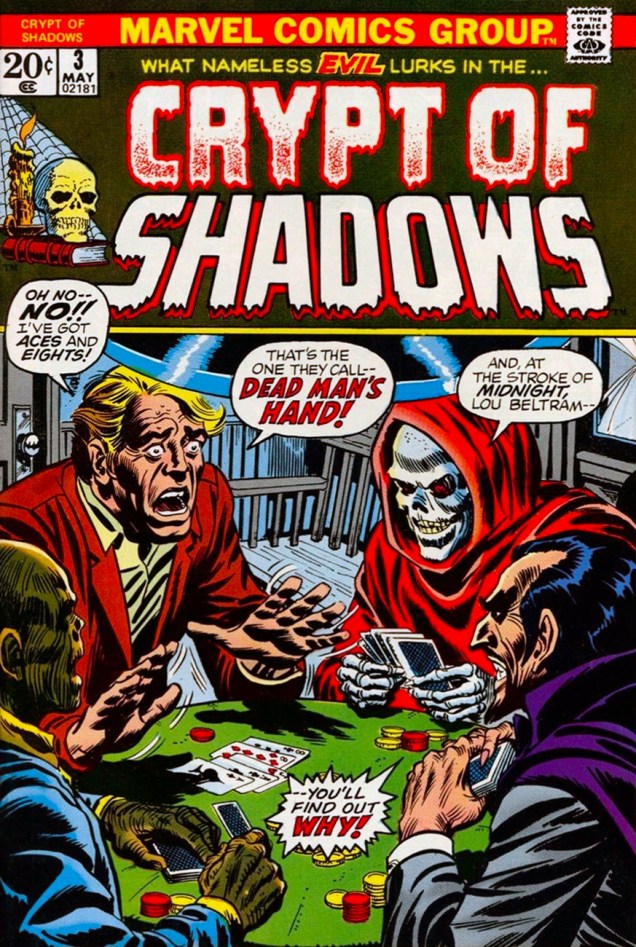
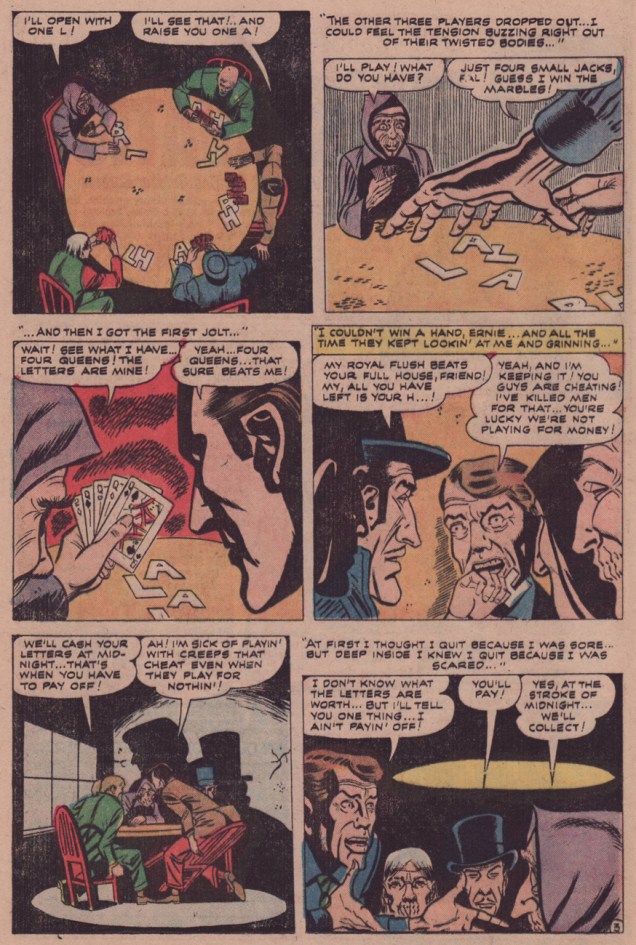
« The other three players dropped out… I could feel the tension buzzing right out of their twisted bodies… »
Poor, naïve Lou Beltram!
I first laid eyes on this one when I visited, in the fall of 1976, a tabagie (a tobacco shop) at a recently-opened shopping mall. For some reason, they had a batch of comics dating from 1973. This was one*.
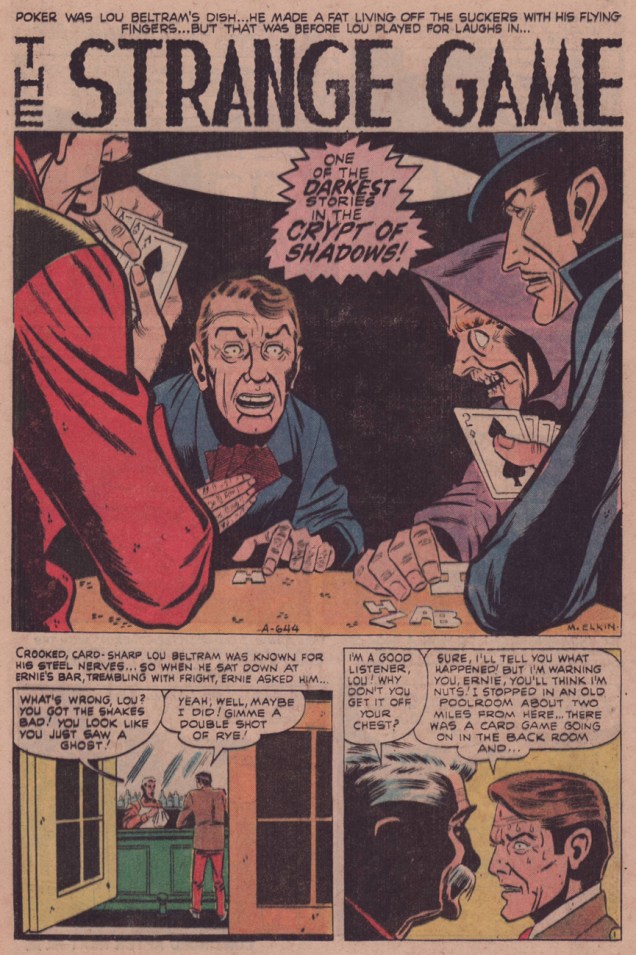
The cover feature, « The Strange Game », is a typical product of the early 1950’s horror boom: it doesn’t make a lick of sense, but it is fairly irresistible stuff, at least from the perspective of an 11-year-old. This wacky cover art, from this May 1973 issue, is the work of company man supreme John Romita Sr., Marvel’s heavy-handed art director of the period.
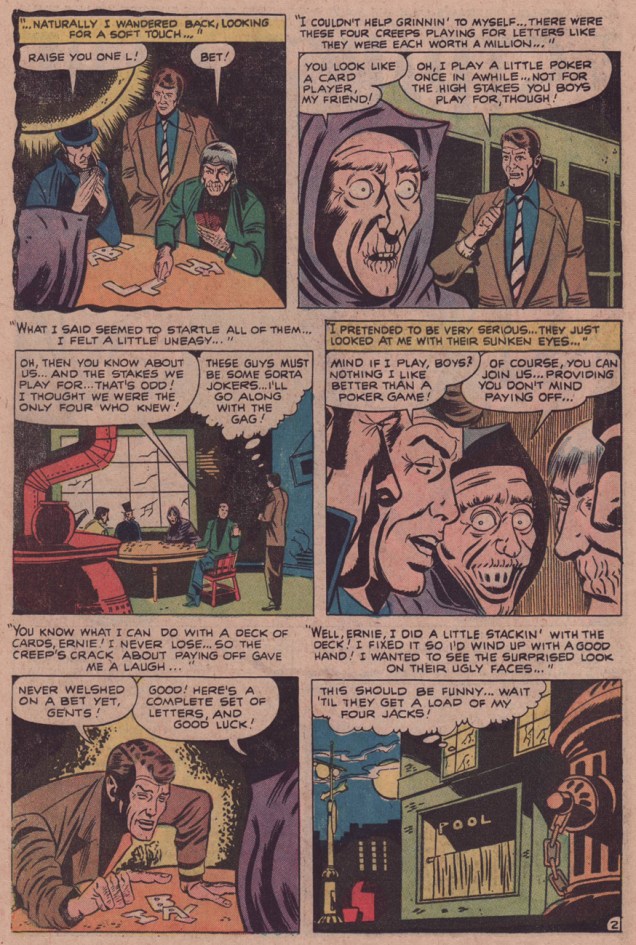
This time (sorry!) you’re getting the story right here, since… who else would get interested in such a boneheaded piece of claptrap, badly drawn to boot? (technically speaking… I do, however, find its primitive ineptitude quite charming). Suspend all disbelief and critical sense, and enjoy!
The tale in question, scripted by an unknown writer and illustrated by Marty Elkin (reportedly Gil Kane‘s cousin!), was reprinted from Atlas’ (what Marvel Comics were called back in the day) Strange Tales #9 (August, 1952).
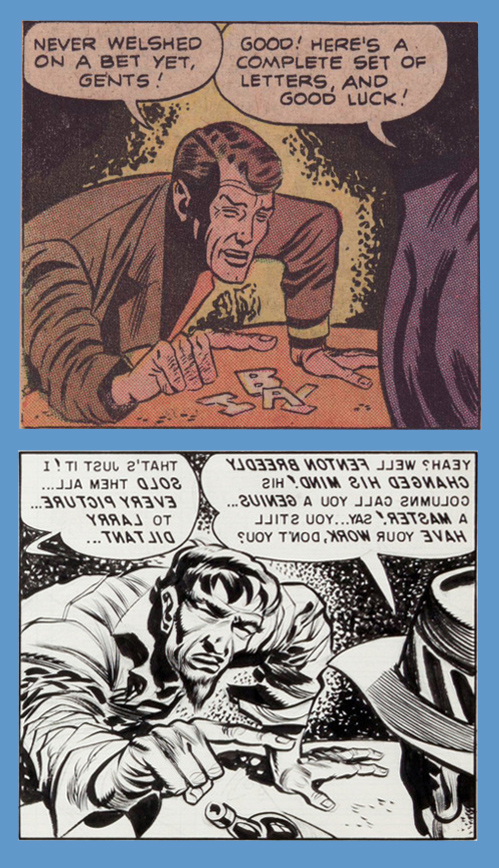
Oh, and something was nagging at me about a particular panel… so I did a little digging, here’s what I found: while swiping from Jack Davis has long been a national pastime, here’s one of the earliest infractions not perpetrated by Howard Nostrand (who’s fine in his own right, but he did have that singular, corner-cutting vice).
It’s a flipped (how devious!) steal from page 2, panel 6 of « Drawn and Quartered! » (script by Al Feldstein, art by Jack Davis), Tales from the Crypt no.26 (Oct.-Nov. 1951, EC Comics). Marty seems a bit hazy on the general concept of hands.
I also suspect page 2’s second panel to be an early EC Joe Orlando or Wally Wood swipe, but I can’t quite nail it down… yet.
-RG
*The Unexpected 146 and The Demon 8 (both cover-dated April 1973) were the others I picked up. What else was there? An issue of The Cat I didn’t buy, but otherwise, I’m drawing a blank. 😉
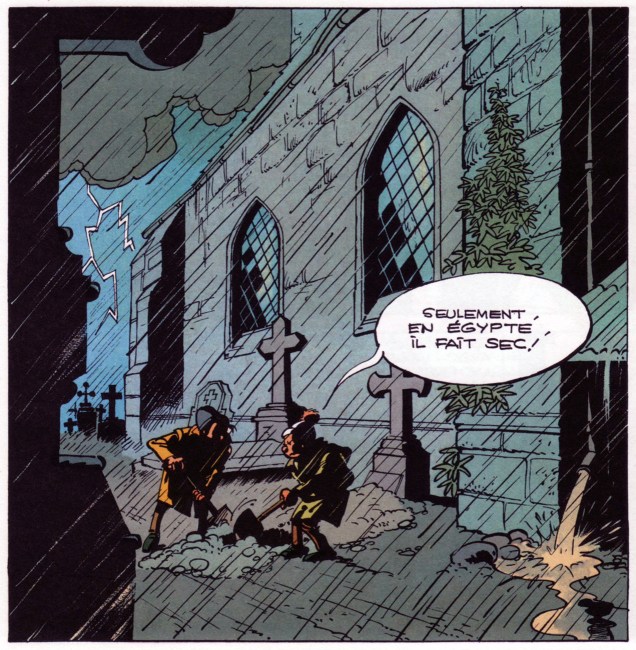
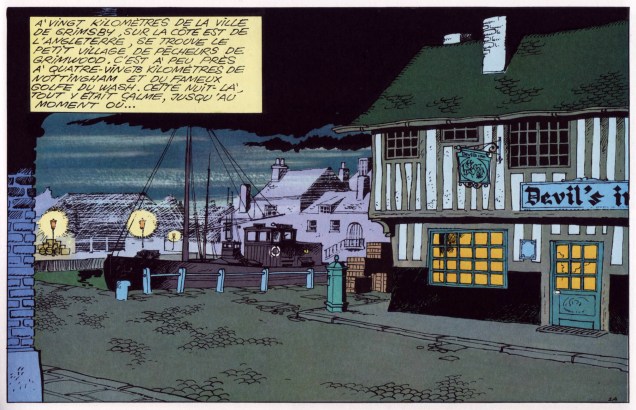
« Why do four skeletons and a coffin cross a small fishing village? The question has been asked! »
How’s this for setting the mood? Here’s a quintet of panels from Belgians Maurice Tillieux (script) and Willy Maltaite (aka Will, pencils and inks) gently ripped from the exploits of Tif et Tondu, a series that ran in the weekly bandes dessinées magazine Spirou from 1938 to 1997.
This standalone illustration originally saw print on the cover of Spirou no. 1789, in 1972. Incidentally, the guy on the left is just a passing acquaintance, a soap salesman who also found himself stranded in Brittany, some foggy night.« In Egypt, at least it’s dry! »« There’s still a cottage beyond the old castle. Let’s give it our last shot. » « Talk about a nest for ghosts. He’s straight out of a Perrault fairy tale, that one. »
These three come from the Les Ressuscités (‘The Resurrected”), Tif et Tondu’s 54th adventure overall, but no.20 in the album series), as only the post-1954 stories (when the series’ tone gained some gravitas, as well as its first significant scripter in Rosy) are considered, shall we say… canonical.
Panels from Le retour de la bête (“Return of the Beast”), serialized in issues 1988 to 1999 of Spirou magazine in 1976, sort-of sequel to 1971’s Sorti des abîmes (“Out of the Abyss”).
This is drawn from the 59th Tif et Tondu story (but no.25 in the collection). We’ve already been introduced to the Beast in question, as well as to Tif et Tondu, one misty Tentacle Tuesday last October.
Regrettably, nothing supernatural occurs, but talk about atmosphere! The series does veer into some pretty dark science-fiction at times, especially under Tillieux’s watch (1968-1978, his death).
The mysterious events are set in the fictive village of Grimwood, near the actual town of Grimsby, which is dear, perhaps sarcastically, to Sir Elton John.
« Gosh! I never knew you had a school for monsters! »
« There are a lot of things about Transylvania that you American tourists do not know! »
Archie Comics’ earliest foray into monster humour was its long-running, in one form or another*, Mad House series (1959-82).
It doesn’t get any better than Samm Schwartz‘s cover for Archie’s Mad House no. 16 (December, 1961). The early issues featured Archie and the gang in slightly more surreal settings than usual, then they were phased out, with the noteworthy exception of Sabrina the Teenage Witch, who was introduced in AMH 22 (October, 1962). The title was a fine showcase for Archie’s best and most idiosyncratic stylists, Schwartz, Orlando Busino and Bob White in particular.
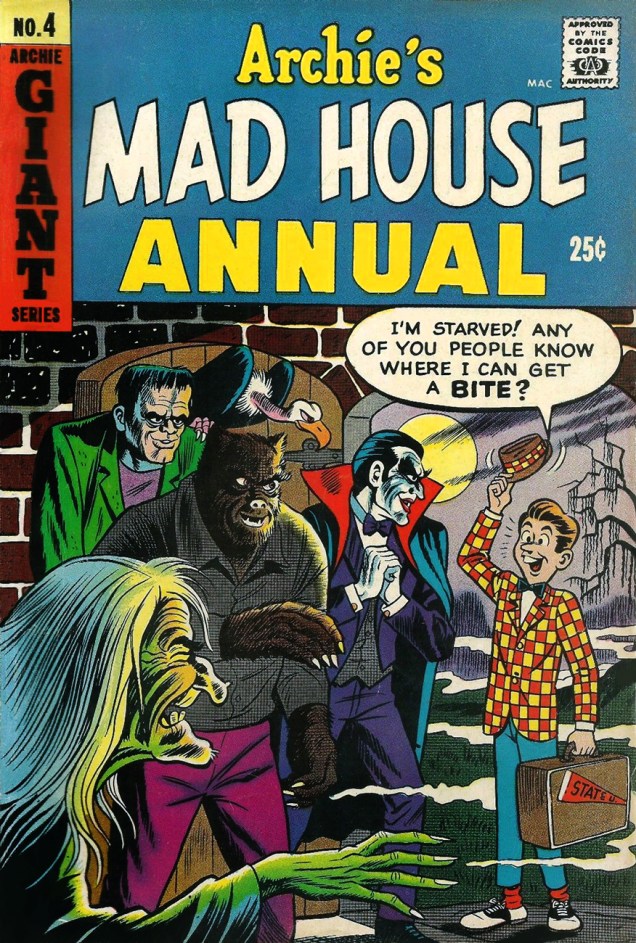
An idea they liked so well they used it (at least) twice. Bonus points for bothering to redraw it! This was Archie’s Mad House Annual no. 4 (1966-67), cover art by the aforementioned Bob White.
-RG
*It was called Archie’s Mad House (issues 1-60), then simply Mad House (61-65), then Madhouse Ma-ad Jokes (66-70), Mad House Ma-ad Freak-Out (71-72), The Mad House Glads (73-94), Madhouse (in a non-cartoony horror format, featuring the likes of Gray Morrow and Vicente Alcazar, 95-97), then finally Mad House Comics (95-130).
« Got to get into my pajamas… quickly! Got to… oh, Lord… NO! »
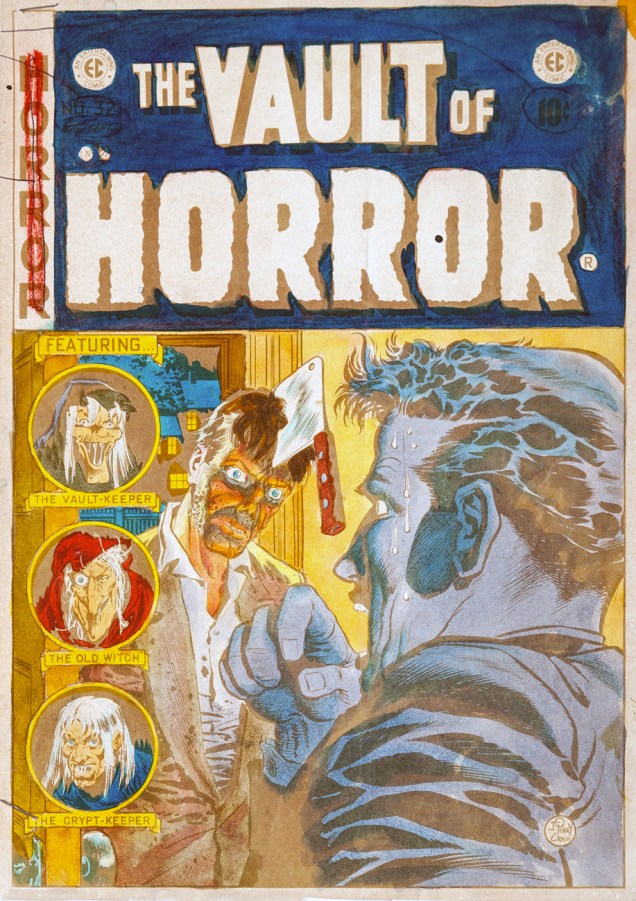
High time for some grue! I couldn’t reasonably be expected to shy away from EC’s 50s horror line, now could I? Of Entertaining (formerly “Educational”) Comics’ infamous/legendary trio of “New Trend” horror anthologies, The Vault of Horror surely was the finest. The deciding factor? The meticulous editorship, writing and artwork of Johnny Craig. While Tales From the Crypt and the The Haunt of Fear fed us a steady diet of Jack Davis, ‘Ghastly’ Graham Ingels and *choke* Jack Kamen (grandfather of the Segway, incidentally), with the fourth tale generally handled by Reed Crandall, Joe Orlando or George Evans, or if you got *really* lucky with your dime, Bernie Krigstein, things got stale. It didn’t help that the writing of the Bill Gaines / Al Feldstein duo, despite sporadic excellence, was quite formulaic and oh-so-verbose. Things got kind of claustrophobic for the artists. The Vault of Horror was different enough: Johnny Craig took care of the opening story, and wrote it himself, sparely and with great intelligence. A true breath of fresh air, though I’ll admit it’s an odd thing to say about EC’s gory tales.
This particular cover (depicting a scene from Al Feldstein and Jack Davis’ « Out of His Head ») wasn’t originally slated for publication this way: EC’s attorney wisely insisted that it be toned down. The original version had appeared in house ads, so astute readers knew what they were missing.
To give you a sense of how far along things went before the punch was pulled, here’s the original, circa 1953, Silverprint cover proof in its original version, before being altered for publication. The proof was shot from the original negatives, with the image area reduced to printed size. Marie Severin used watercolours to specify the ink colours to be used.
Finally, the version below was recoloured (from cool to warm!) for Russ Cochran‘s deluxe hardcover reprint set of the 1980s and retained for subsequent Gladstone and Gemstone reprints.
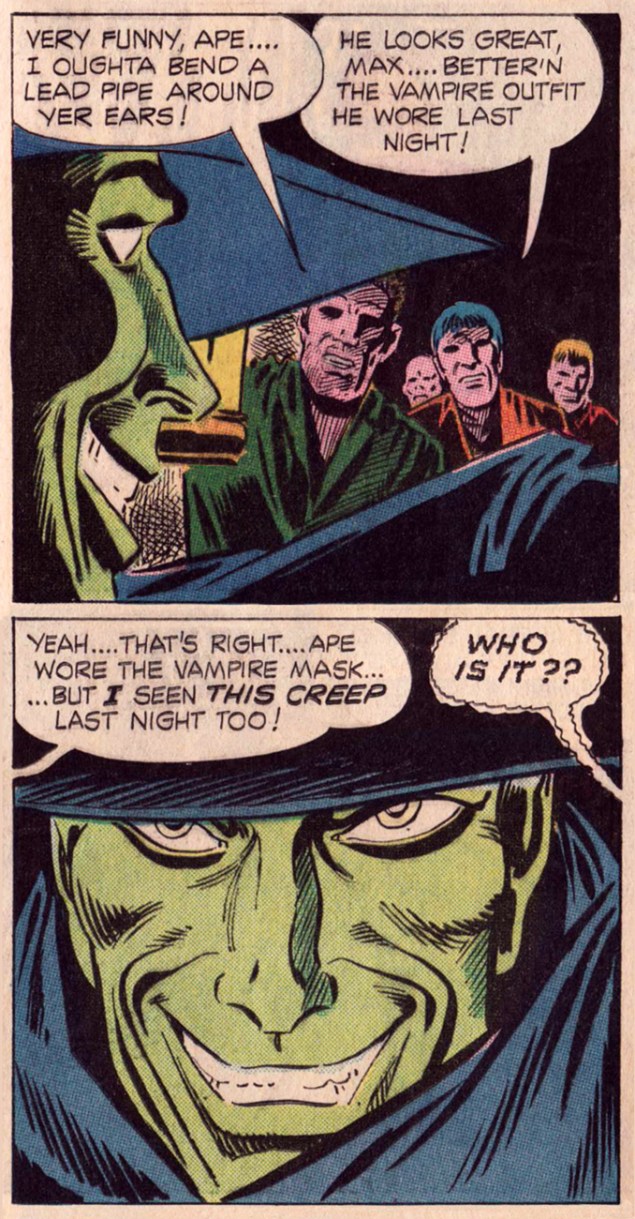
« Ape is real spooked, guys! He’s always imaginin’ he sees someone in there! »
Here we have an evocative Steve Ditko cover, solid evidence of his tremendous design chops, from Charlton’s Ghost Manor (no. 7, second series, October 1972). A collaboration between Joe Gill and Ditko, « The Monsters Ride at Night » is an elegant bit of storytelling legerdemain, a fairly basic yarn that retains its mystery past the conclusion and whose deliciously dusty mood lingers in the mind. Well, in mine, at any rate. Back in the late ’70s, I traded a copy of Amazing Spider-Man 121 (acquired at a garage sale in a two-for-five-cents deal) for this one. I know I came out ahead in the deal*.
Again, I had every intention of providing the whole spooky shebang right here, but seeing as how I was preceded in this particular enthusiasm by a sinister confrère, it seems unnecessary. Just dim the light, settle in, point your browser to Destination Nightmare, pour yourself a noggin of your preferred poison, and savour this fine vintage.
I’m particularly fond of the mid-tale interlude, where our esteemed host, Mr. Bones, seizes the occasion to poke around the cobwebs a bit, a narrative game that the Gill-Ditko duo excelled at. DC and Warren’s hosts (with the obvious exception of Vampirella) never got to play such an active rôle in their respective recitals.
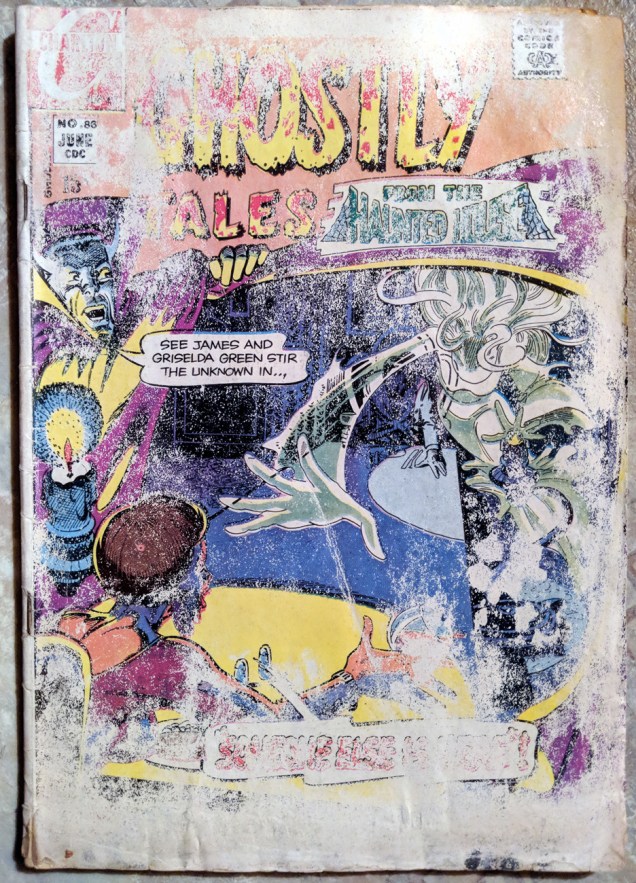
Oh, and since we’re on the topic of early 70s Charlton ghost books, here’s one I picked up just this afternoon, in the 50 cents box of the local comic book shop in Wolfsville, NS. It clearly had been through such hardships, I couldn’t resist giving it a home.
This is (or used to be) Ghostly Tales no. 86 (June, 1971), featuring three Joe Gill tales: « Return to Die » (illustrated by Pete Morisi), « Ghost Town » (illustrated by Pat Boyette), and « Someone Else Is Here! » (illustrated by Steve Ditko.) If books could speak…
« It was like plunging deeper and deeper into a growing nightmare! »
A powerful (what else?) Jack Kirby piece, one of his last before decamping to DC. He actually gets a full writer/artist credit (a telling tail end turning point of that Marvel residence) on this tale, … and Fear Shall Follow!. The lush cover inks are provided by fellow Golden Age titan Bill Everett (1917-1973), a far cry from the miserable Vince Colletta « finishes » he would be saddled with at DC for the next couple of years (at their insistence!)
I was planning on featuring the entire story, but others have long ago preceded me down that primrose path. Why fight it? Just pay Diversions of the Groovy Kind a visit, where you’ll receive, as a bonus, Kirby’s other solo outing for the House of (mostly his) Ideas, The Monster!, from the previous issue of Chamber of Darkness (no.4, April, 1970). Both are sympathetically inked by Marvel’s production manager at the time, the underrated and gone-too-soon John Verpoorten (1940–1977). Again, several notches above “Valiant” Vince Colletta’s casual sabotage.
Plot-wise, … and Fear Shall Follow!, while another variant in the Carnival of Souls tradition, is enriched by its unusual setting and whiff of incense and philosophy. Reminds me of a possibly apocryphal exchange between Watchmen editor Len Wein and its writer Alan Moore: « Alan, that ending’s already been done on The Outer Limits! »; (in thick Northampton accent, dripping with sarcasm) « Yes, Len, but it’s never been done by me! ». With all due respect, it’s not as if Mr. Wein had any moral lessons to dispense regarding originality.
« … it was a balled-up thing… like an empty wrapper thrown carelessly aside… but somehow still recognizable as having once been human… »
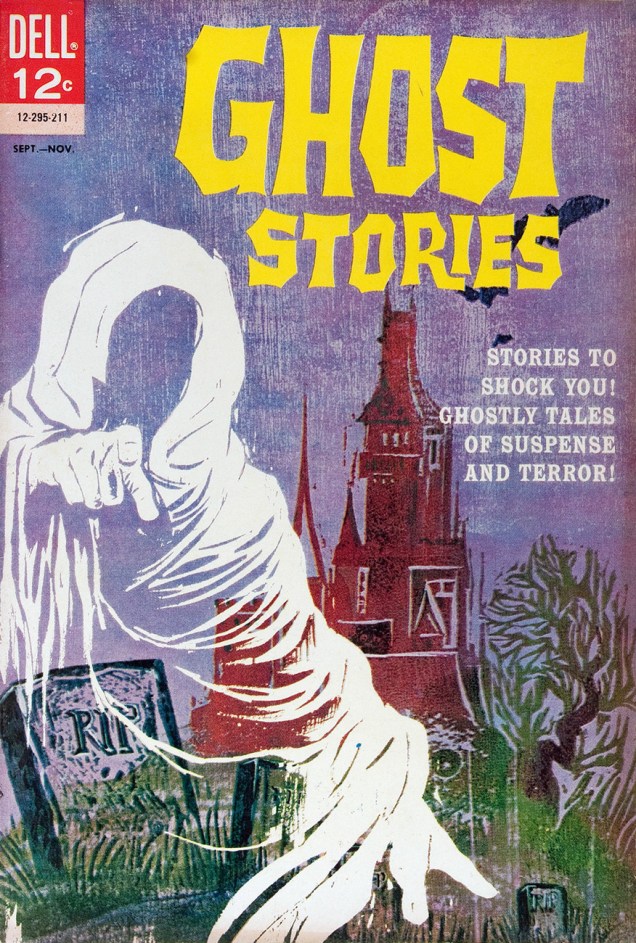
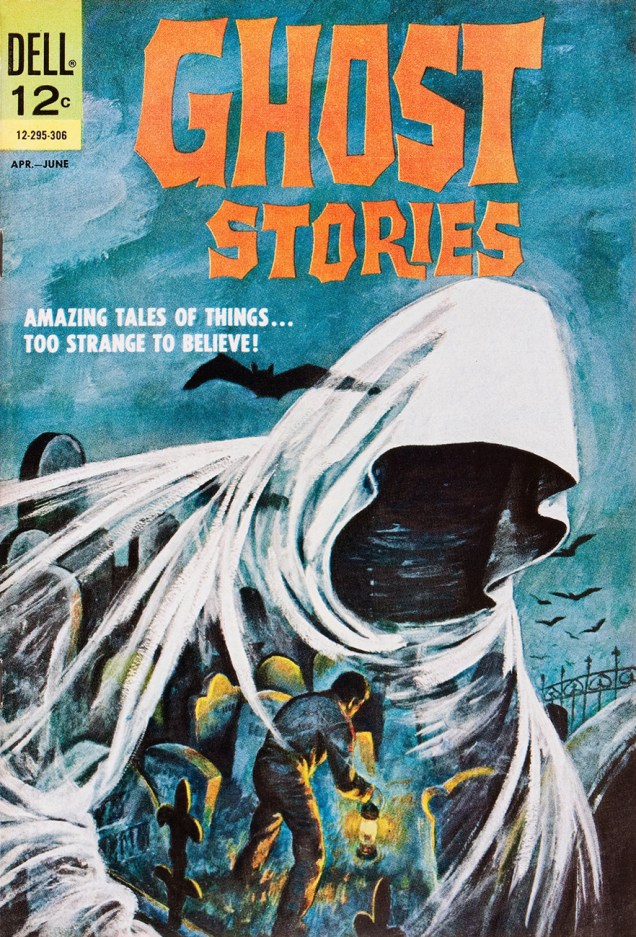
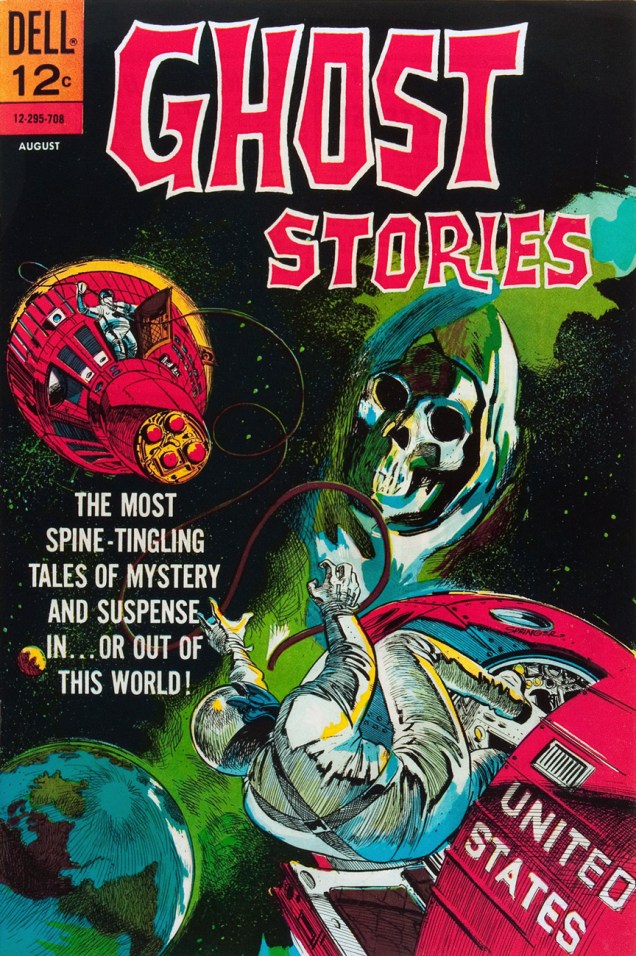
Dell’s Ghost Stories (1962-1973, with issues 21 to 37 lazily and straight-up reprinting numbers 1 to 16… with a single, perplexing exception, the all-new, surprisingly decent issue 35, late in 1972) were quite tame, trifling stuff, with one notorious bright spot: the première issue, entirely written by John Stanley (1914-1993) and comprising, amidst other excellent short pieces, what’s possibly the most nightmarish tale to see print up ’til then in American comics (particularly all-ages comics!), « The Monster of Dread End ». It represented the kind of material few comics publishers could have gotten away with at the time, save, ironically, one of the squeaky-clean stalwarts (Dell, Gilberton, Gold Key…) that opted out of the industry’s recently-instituted governing censorship board, the Comics Code Authority. Their reasoning was that, having never published anything objectionable to begin with, they were unlikely to head down that sordid path in the future.
Journeyman cartoonist Frank Springer (1929-2009) provided some decent artwork through most of the book’s run, but as he didn’t have much to work with, script-wise (Carl Memling was no substitute for Mr. Stanley), the end result remains underwhelming. Looking at the bright side, he did provide a couple of quite alluring covers, the final, non-painted entries in our select little gallery.
If you haven’t already made its acquaintance, treat yourself to the nerve-tingling Number One, available gratis under the auspices of the fine folks at comicbookplus.com. Love the semi-woodcut technique used on the cover by the Unknown Artiste.Ghost Stories no. 3 (April-June 1963). Cover artist unknown.Ghost Stories no. 10 (April-June 1965). Cover artist unknown.Ghost Stories no. 19 (August 1967). Cover and interiors by Frank Springer.Ghost Stories no. 31 (January 1972). Cover and interiors by Frank Springer, price and indicia aside, a facsimile of issue 11 (July-September 1965). My own tepid introduction to the series.










 An idea they liked so well they used it (at least) twice. Bonus points for bothering to redraw it! This was Archie’s Mad House Annual no. 4 (1966-67), cover art by the aforementioned Bob White.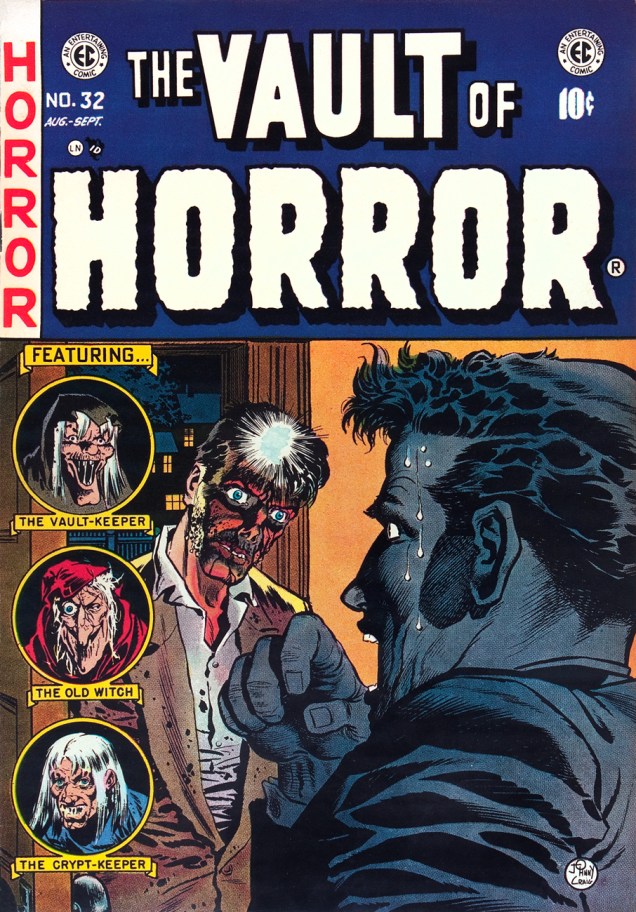
 -RG
-RG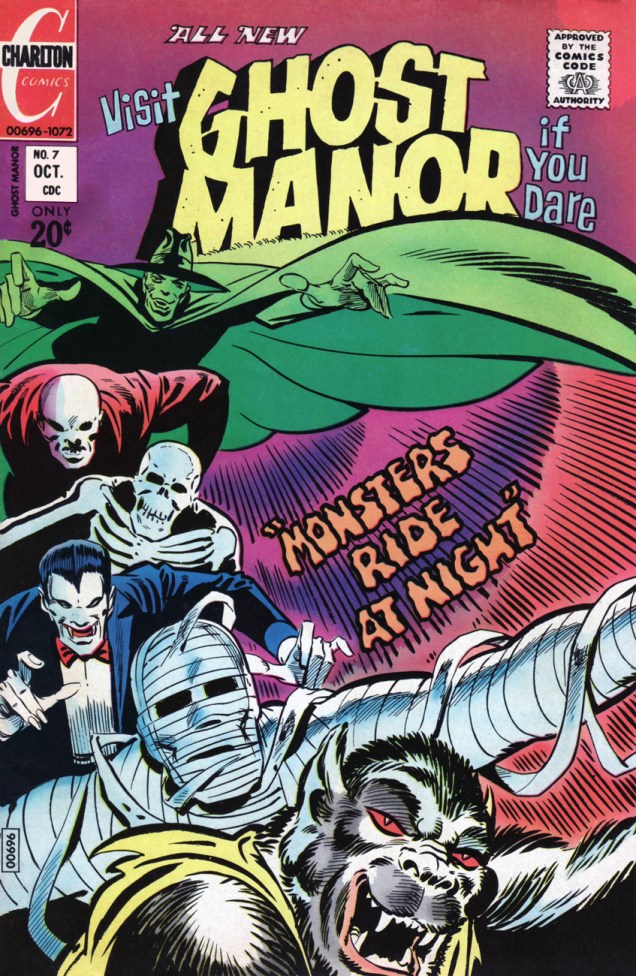



 Who's Out There?