Tentacle Tuesday: Matchboxes and Woodblocks

Much like fish painstakingly climbed out of the water and became mammals aeons ago, humorous representations of life, artists’ flights of whimsical fancy or taut fight scenes from centuries gone by morphed, over time, into something that resembled more and more what everyone now recognizes as comics. Me, I like blurred lines, the point at which several trees become a forest. What fun is it to live in a world where everything is well-defined, sorted into tidy little piles? Today’s Tentacle Tuesday stretches this blog’s comics-bound raison d’être just a teensy-weeny little bit. But I believe that the kinetic energy hidden within the following illustrations, the jump-off-the-page personality of these octopuses makes them close cousins to their more modern counterparts who dwell in the seas of sequential panels and images.

Just mentally add a speech bubble or two, if you must!

First of all, I have three woodblock prints, all three from the Edo period (Edo being the old name for Tokyo). The latter term refers to the period between 1603 and 1868 in the history of Japan, and is of interest  because it was characterized, among other things, by a flourishing interest in culture, be it music, poetry, theatre, or, more relevantly to the current post, art. That famous woodblock print, the Dream of the Fisherman’s Wife, which I have no need to include because of its ubiquity, was not the first painting featuring a woman in the embrace of an octopus. Yet it’s probably the most influential one, precursor of the hentai now so entrenched in popular culture…. and it was created during the aforementioned Edo era by Katsushika Hokusai (who, incidentally, also brought into existence the ever-popular The Great Wave off Kanagawa, ensuring the relative immortality of his art.)

Collectively, the work crafted during the Edo era (not necessarily woodblock prints, although these seemed to predominate, but also paintings) is referred to as Ukiyo-e, which in Japanese vaguely means something like “images of a floating world”. Poetic as usual, the Japanese.

The fist woodblock print is entitled “Ryuko tako no asobi“, or The Fashionable Octopus Games. The British Museum (which seems to currently own this piece) describes it as « Octopuses re-enacting human amusements, such as the fight between Ushiwakamaru and Benkei on Gojo Bridge (top left) and sumo wrestling (bottom centre), dance, sword play, music, acrobatics, and other activities. » The artist is Utagawa Kuniyoshi.
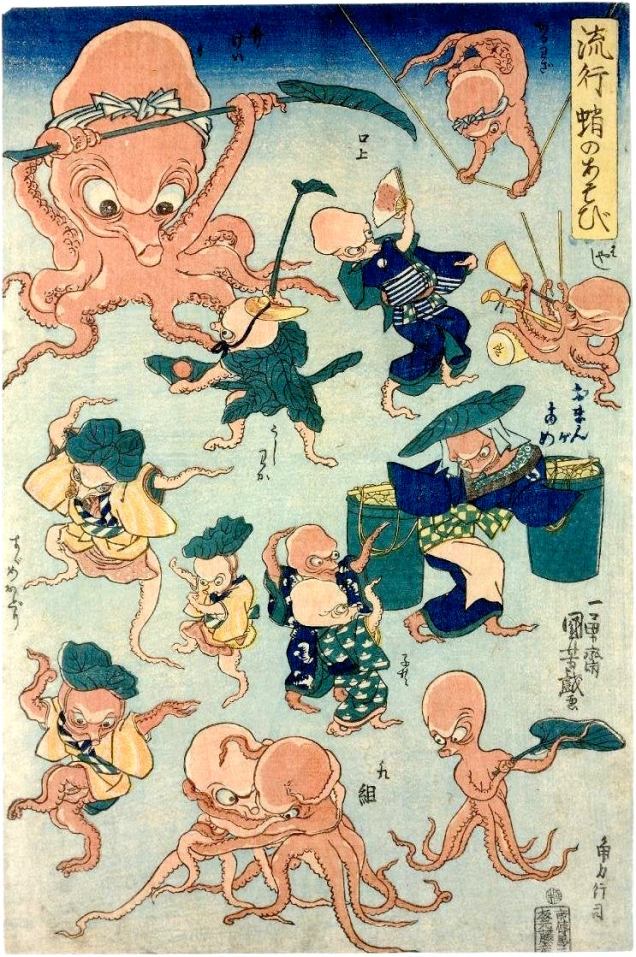
Utagawa Kuniyoshi-OctopusGames

The second one, a triptych, is called One Hundred Turns of the Rosary and belongs to the One Hundred Wildernesses series, which shows « a procession of demons who appear throughout the night, offering a spectacular visual encyclopedia of supernatural creatures of premodern Japanese folklore » (description from the website of The Metropolitan Museum of Art). The artist is Kawanabe Kyosai.

Kawanabe Kyosai-one-hundred-wildernesses

My favourite is the following woodblock print by Utagawa Kuniyoshi, who had a great fondness for cats and inserted them seemingly everywhere. Visit this gallery of his cat-themed art over at the Great Cat blog, from which I’ll quote a paragraph for those who aren’t inclined to follow links:

« Utagawa Kuniyoshi was a great cat lover, and it was said that his studio was full of them. Often he could be seen working with a kitten snuggled up in his kimono. An apprentice, Yoshimune, reported that when one of Kuniyoshi’s cats died, he would have it sent to a nearby temple, and a Buddhist altar for his deceased cats was erected in his home. There he kept tablets with the cats’ Buddhist names on the altar. Kuniyoshi’s love of his felines spilled over into his art. Cats fill many of his compositions and he even began to give Kabuki actors cat faces. Kuniyoshi’s Ume no haru gjusantsugi was performed in 1835. A cat has shape-shifted into an old woman while a cat wearing a napkin dances while a cat licks the lamp. The cloth on the cat’s head represents the folk belief that cats would steal napkins and would dance together and howl “Neko ja!” (We are cats!). Cats often times licked Japanese lamps of the period because they were fueled with fish oil. »

A_cat_dressed_as_a_woman_tapping_the_head_of_an_octopus

I’ll doubtlessly howl “Neko ja!” at the next available opportunity.

Moving on, we have two illustrations from Japanese matchboxes.

First, a Japanese matchbox from around 1920s-40s. This little guy comes from a collection posted by Jane McDevitt, who’s passionate about matchbox art. I also really enjoyed her Eastern European matchbox label collection, which you can admire here.
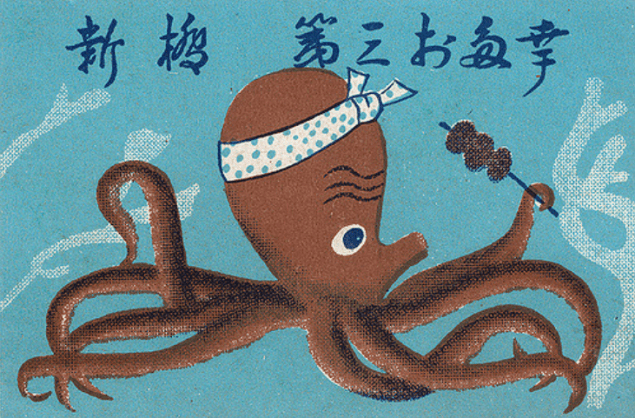
Japanese-Matchbook-Tentacles

Of further interest on this topic is this comic strip by Roz Chast about her predilection for collecting matchbox art, published in the April 4, 2016 issue of New Yorker Magazine. As it turns out, Chast rejects the hassle of actually owning them, preferring to keep her collection as digital files. I suppose I am a collector, for I definitely prefer “owning” the physical version of things that interest me, but to each her own!

And another matchbox octopus from the 1950s:

Japanese-matchbox-1950

And it’s « goodnight from me »!

– ds

Tentacle Tuesday: Duck Feathers!

« I read some of my stories recently and thought, ‘How in the hell did I get away with that?’ I had some really raw cynicism in some of them… » – Carl Barks

Like so many kids, I owe a lot of my interest in comics to Carl Barks, even though at the time I had no idea who he was – embarrassingly, up until today I’m not great at spotting his art. So much depends on what is available when one is growing up – and I used to enthusiastically dig through discarded piles of books at garage sales and whatnot, in quest for (among other things) for issues of Super Picsou Géant. Picsou is Uncle Scrooge’s French name, meaning something like “penny pincher”. These (true to their name) giant anthologies, just like pocket-book sized Archie compendiums, offered their readers pêle-mêle reprints of comic book stories both relatively new and also quite old, mixing prime Barks material with shitty European knock-offs with offerings by decent Barks disciples (see co-admin RG’s take on the latter).

UncleScrooge68-CarlBarks-HalloftheMermaidQueen2

Just like a Picsou Géant, this post has a few Barks covers and stories, and a few submissions by other folk… all viewed through my usual tentacle-specific lens. Dive in!

DonaldDuck109
Donald Duck no. 109 (September 1966), cover by Larry Mayer. Minimal tentacles, but that clock was just too cute not to share.
UncleScrooge68
Uncle Scrooge no. 68 (March 1967), cover by Carl Barks.
UncleScrooge68-CarlBarks-HalloftheMermaidQueen
Hall of the Mermaid Queen is by Carl Barks.

Somewhat off topic, but I was quite amused by the ending of this story. Is this was Barks meant when he talked about raw cynicism? 😉

UncleScrooge68-CarlBarks-HalloftheMermaidQueen3

UncleScrooge70-Carl-Barks
Uncle Scrooge no. 70 (July 1967), cover by Carl Barks.
UncleScrooge70-Carl-Barks-TheDoomDiamond
The Doom Diamond, the cover story, is also by Carl Barks.

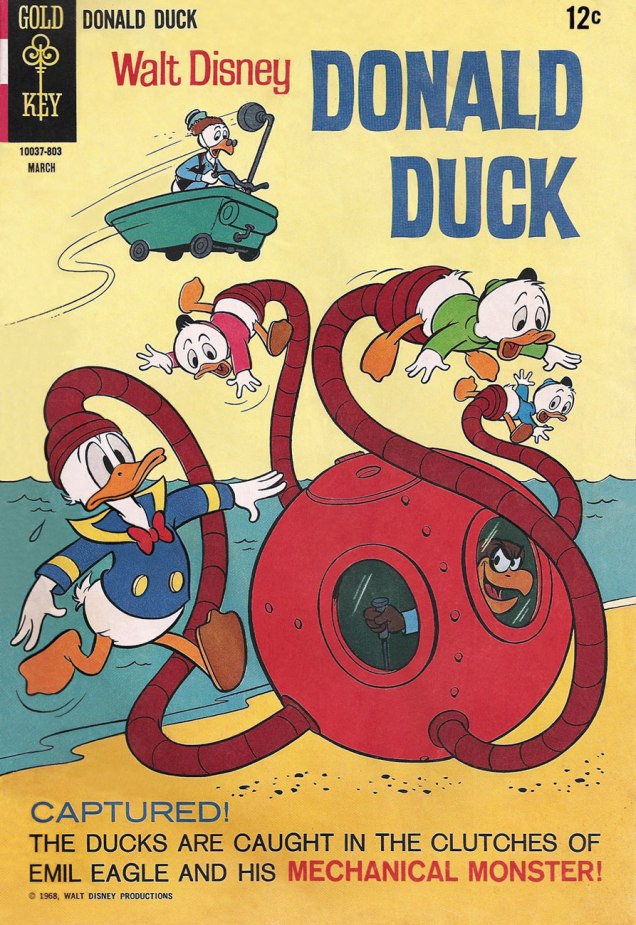
No Tentacle Tuesday post would be complete without mechanical tentacles:

DonaldDuck118A
Donald Duck no. 118 (March 1968), cover by Tony Strobl on pencils and Larry Mayer on inks.
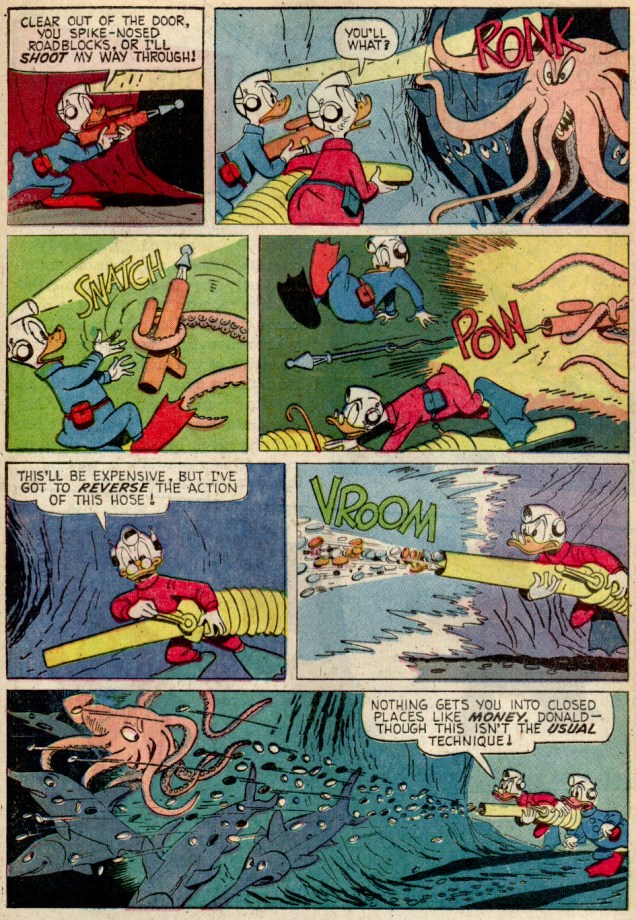
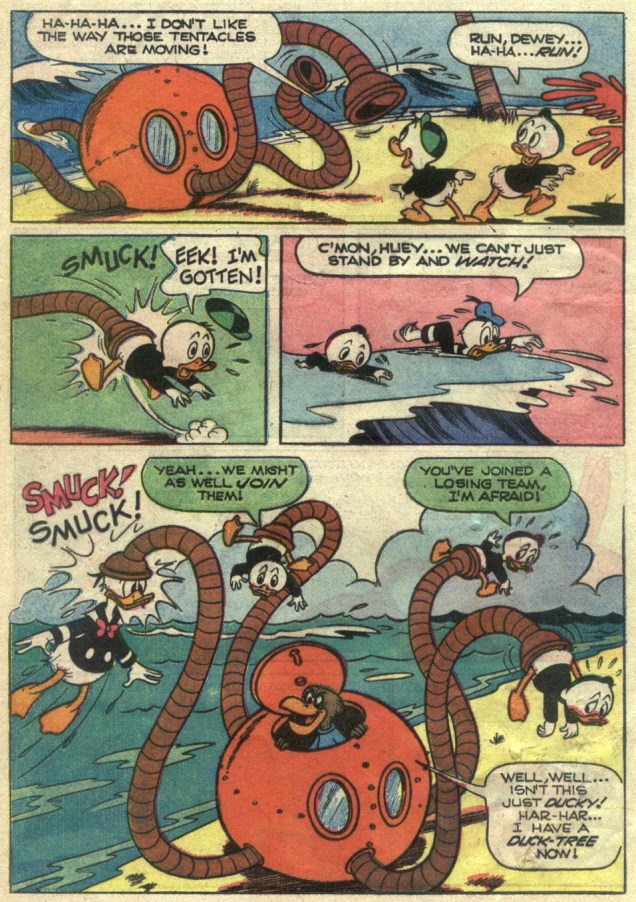
DonaldDuck118-MechanicalMonster-VicLockman
The Mechanical Monster is scripted by Vic Lockman, which is almost an iron-clad guarantee of inventive goofiness. Penciled by Tony Strobl and inked by Steve Steere.

DonaldDuck118-MechanicalMonster-VicLockman-2

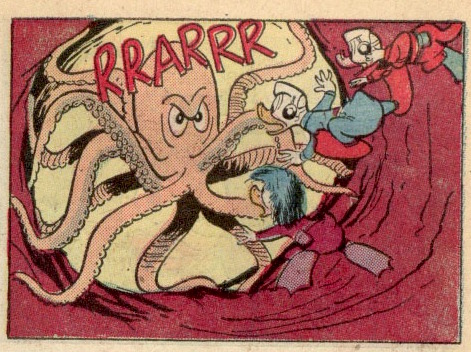
Donald-Duck141
Donald Duck no. 141 (January 1972), cover by Larry Mayer.
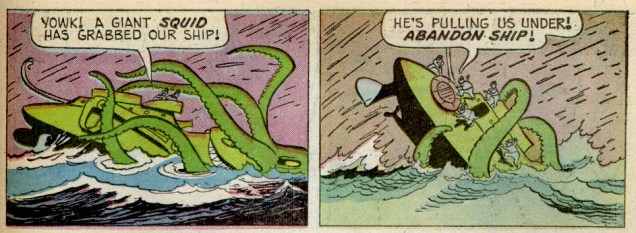
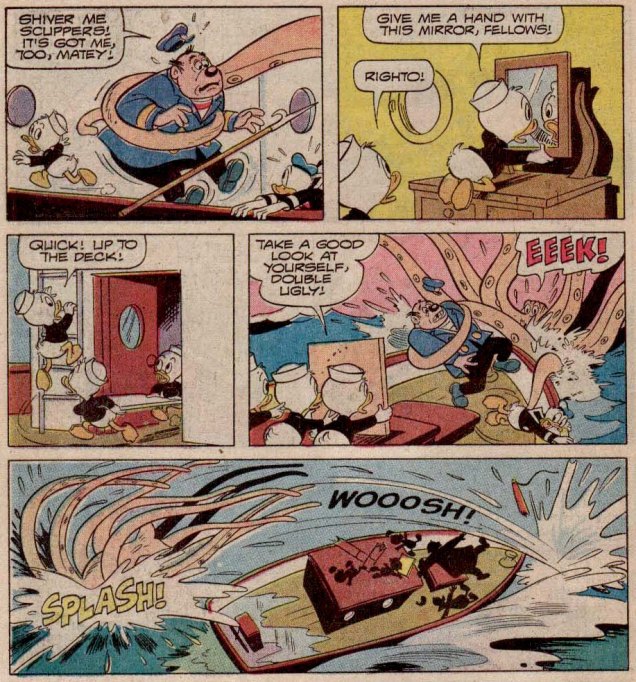
Donald Duck141-LarryMayer- The Tall-Tale Trail
The Tall-Tale Trail is penciled by Tony Strobl and inked by Larry Mayer.

Donald Duck141-LarryMayer- The Tall-Tale Trail-2

For this post, I wanted to concentrate on Gold Key publications, but at a later date there will be a follow-up post covering some other material.

~ ds

Tentacle Tuesday: Won’t Someone Think of the Children!?

« Make it a rule never to give a child a book you would not read yourself. » ― George Bernard Shaw

Indoctrinating children has to start early – if you want to make sure the aforementioned little ones will share your obsessions and spend their lives in a futile quest for the same peccadilloes you wasted your youth on, it’s best if you start proselytizing even before they can read. To that effect, quite a few authors of children’s comic books made sure to focus on cephalopods. I am happy to provide you with this abridged list of where to start when you need to convince some tot in your care that 1. octopuses are cool and 2. that they are entirely too intelligent and fascinating to ever be eaten.

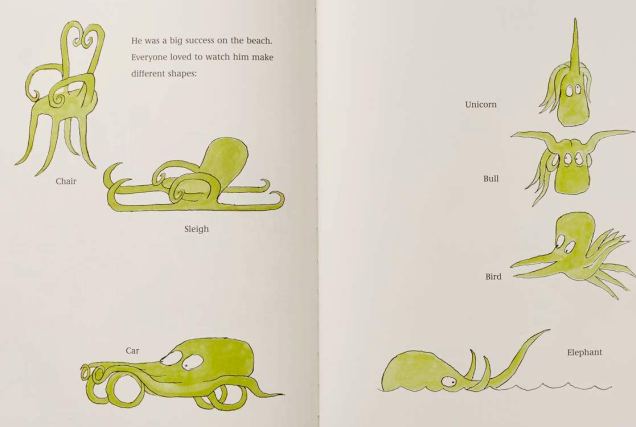
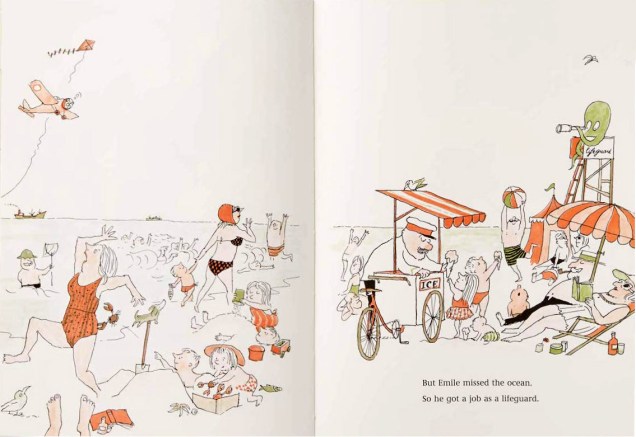
Pages from Tomi Ungerer‘s Emile: The Helpful Octopus (first published in 1960):

EmileTheHelpfulOctopus-TomiUngerer

EmileTheHelpfulOctopus-TomiUngerer2

Pages from Octopus Escapes! (2018), written by Nathaniel Lachemeyer and illustrated by Frank W. Dormer:

OctopusEscapes--Nathaniel-Lachenmeyer2

OctopusEscapes--Nathaniel-Lachenmeyer

A page from Also an Octopus (2016), written by Maggie Tokuda-Hall and illustrated by Benji Davies:

AlsoAnOctopus

Page from Touchy the Octopus Touches Everything (2019), written by Amy Dyckman and illustrated by Alex Griffiths:

Touchy the Octopus Touches Everything

Before someone complains that this post doesn’t include any “real” comics (what kind of pedant are you, bubba?):

Dexter'sLaboratory16
Dexter’s Laboratory no. 16 (December 2000), pencilled by Genndy Tartakovsky and inked by Bill Wray.
Dexter'sLaboratory16-DeeDee'sPonyTale
Splash page from Dee-Dee’s Pony Tale, scripted by John Rozum, pencilled by John Delaney and inked by Jeff Albrecht. Did children really need to see a unicorn pony transformed into a three-headed Slavic dragon with tentacles? Well, yeah.
CartoonCartoons23
Cartoon Cartoons no. 23 (December 2003), cover by Bill Wray.
CartoonCartoons23-SunkenLeisure
Page from Sunken Leisure, scripted by Robbie Busch, pencilled by Stephen DeStefano and inked by Bill Wray.

Finally, as a treat for the adults in the audience, I’ll end on an uplifting note (quite necessary after all that carnage by Dexter et al.): a cartoon by Jüsp (who ist tot, which is to say is dead – he died in 2002), published in Die Woche, an German illustrated weekly newspaper published from 1898 to 1944.

OctopusHandshakeA

~ ds

A Sausage or a Can of Beer? The Goodies in Comics
« Slap him up and down upon the floor
Tickle his feet and hear him giggle
Then unzip him down the middle
Give that gibbon what he’s hollerin’ for! » — Stuff That Gibbon (words and music by Bill Oddie)

Back in the late 1970s, before I had even heard of Monty Python’s Flying Circus, nor even of Benny Hill, for that matter… I discovered The Goodies, thanks to the CBC’s belated programming of their exploits*. While The Goodies do share a *lot* of DNA with the Monty Python gang (they were school chums, close friends, collaborators and friendly competitors practically all along the way), this trio’s comedic format veers sharply away from the Pythons’ methods: Graeme, Bill and Tim play ‘amplified’ versions of themselves, and use the skit format sparingly, reserving it for mid-show intermission ‘blackouts‘.

While the trio was formed in 1970, it only made its comic strip début (and bow) in 1973**, where they held a weekly feature in the pages of Cor!!, also making an appearance in the magazine’s 1974 annual and The Goodies Annual, the whole lot hitting kiosks in ’73.

« Apparently licensed for just the one year, The Goodies were unique in the fact they were the only adapted characters featured with the comic’s pages with copyright credit being given to Bill Oddie, Tim Brooke Taylor (sans hyphen) and Graeme Garden. According to Robert Ross’ book The Complete Goodies, the strips were all authorised and approved by The Goodies prior to publication and Tim still displays an original Cor!! strip in his study. »

Scans (and detailed synopses!) of The Goodies’ Cor!! shenanigans are helpfully provided by their fan site, goodiesruleok.com.

And now, some introductions from the aforementioned The Goodies Annual 1974 (the only one of its kind, poor thing):

GoodiesGraemeA
The Goodies’ brainbox, Graeme Garden, born in Aberdeen, Scotland, on Feb. 18, 1943. « He lists his hobbies as painting, drawing, playing the guitar and banjo, apologising for playing the guitar and banjo, trying not to travel in cars and, of course, being a Goodie. »
GoodiesBillA
The Goodies’ resident singer-songwriter and ornithologist, Bill Oddie, born in Rochdale, Lancashire, on July 7, 1941.
GoodiesTimA
« Tim Brooke-Taylor was born very suddenly in Buxton on July 17th, 1940, among those dark, satanic hills of Derbyshire. » I like the sound of that… very Luke Haines. He was The Goodies’ conservative type, and the one who greatly relishes essaying the cross-dressing roles. And he was, after all, the fair one without any of that pesky, telltale facial hair.

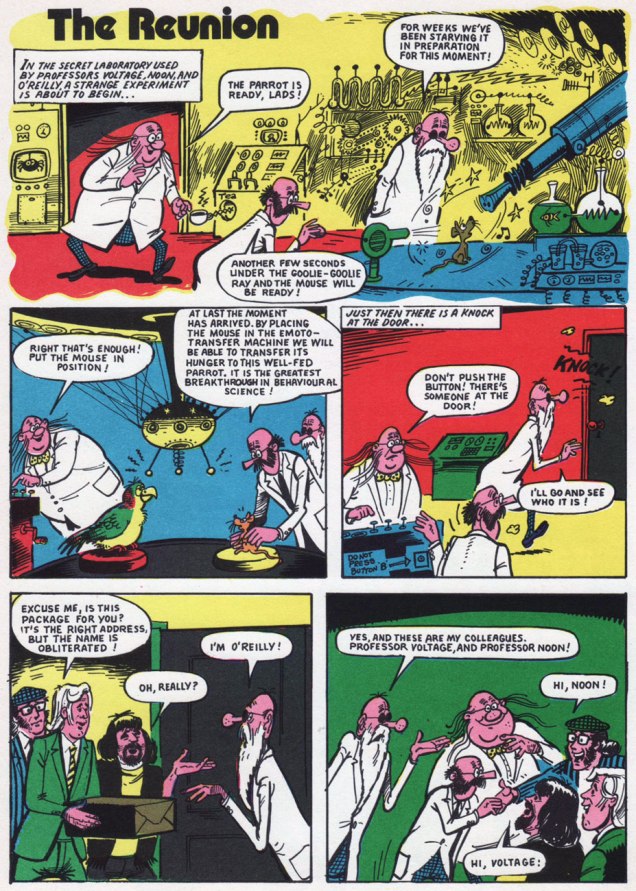
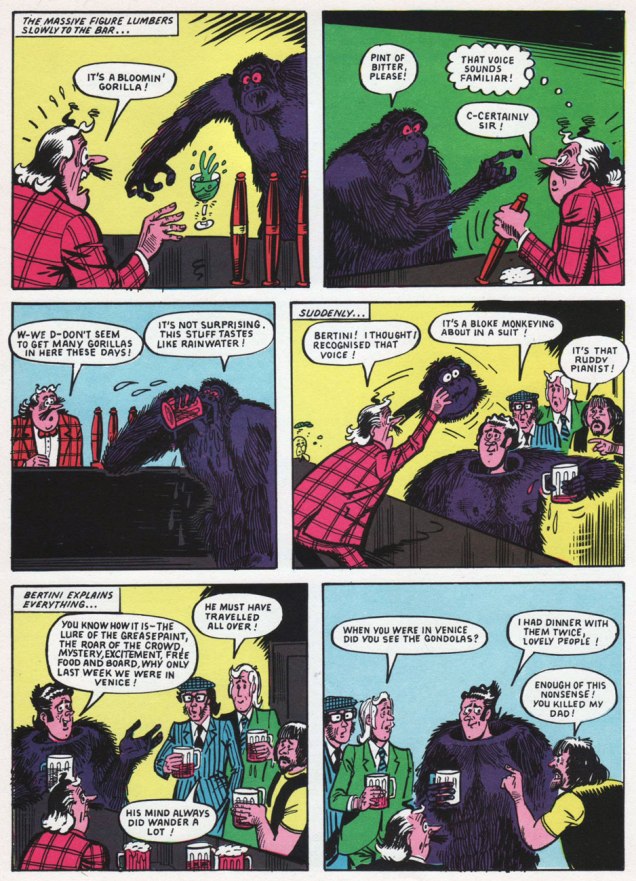
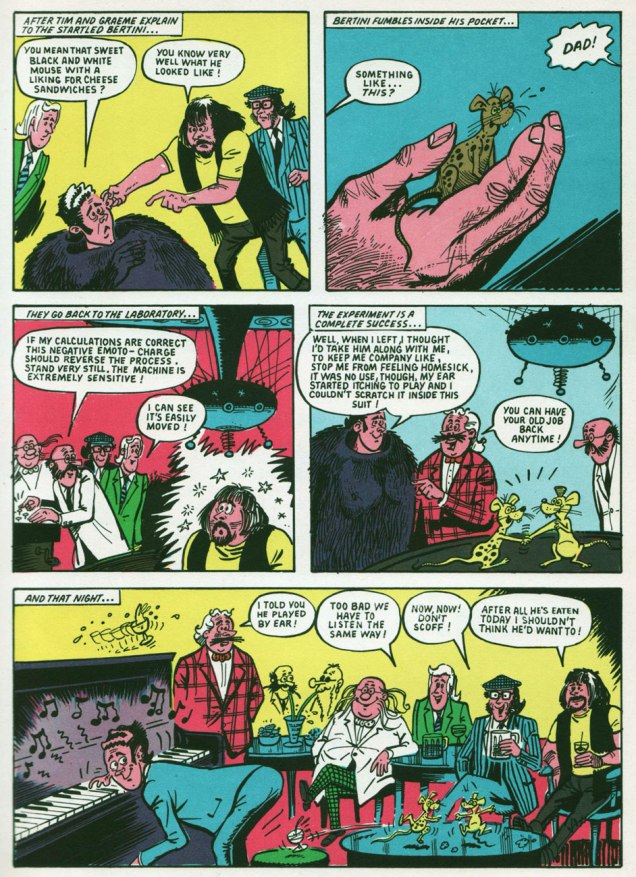
GoodiesReunion01AGoodiesReunion02AGoodiesReunion03AGoodiesReunion04AGoodiesReunion05A

GoodiesReunion06A
Among other, er, goodies, the annual contains a whopping 33 pages of comics. However, as it was fairly typical for UK comics of the period, no creator credits appear anywhere.
GoodiesAnnual74A
« The comic strips form a large part of the official Goodies Annual, although “none of us had anything to do with the design or stories”, explains Graeme, “but we were very happy with the results.” »

Goodies, Goodies

Take a little good advice, try a trip to paradise
It’s not hard to find, you’ve got it on your mind
Can’t pretend it wouldn’t be nice
It’s whatever turns you on, Goodies

A circus or a seaside pier, a sausage or a can of beer
A stripper or a clown, prices going down
You can make it happen here
Fun for all the family, Goodies

Goodies, goody goody yum yum

Goodies are coming for you and you and you and you
It’s anything you want it to be, a record or an OBE
A four minute mile, a policeman with a smile
I know you won’t believe what you see.

(The first Goodies Theme; words and music by Bill Oddie.)

-RG

*« In Canada, the series was shown in on the CBC national broadcast network during the late 1970s and early 1980s, in the traditional “after school” time slot, later a Friday night 10 pm slot, and occasionally in a midnight slot. Several episodes were also shown on the CTV Television Network. In the mid-1970s it was shown on TVOntario on Saturday evenings, repeated on Thursday evenings, until being replaced by Doctor Who in 1976. » [ source ]

**I hear they’ve turned up in The Beano, circa 1994.

Tentacle Tuesday Masters: Tony Millionaire

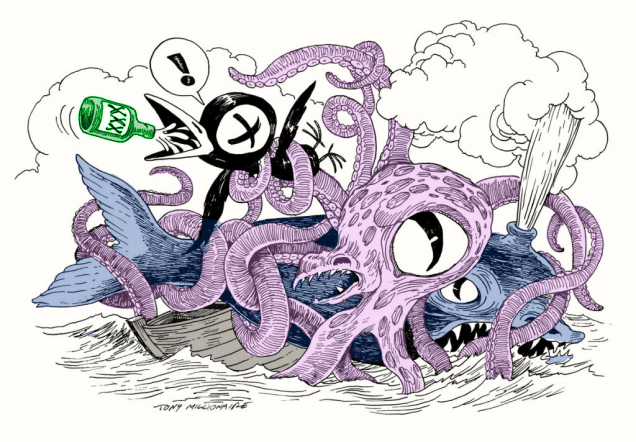
Once upon a time, in a kingdom beyond the seven seas, a little boy lived under the name of Scott Richardson in a seaside town (let’s call it Gloucester and pretend it’s in Massachusetts). His whole family were artists, and he would watch his grandparents paint the sea, the ships that sailed it and the people who commanded the ships. It must have come as no surprise at all when the boy, too, started to draw. Eventually, he grew up, moved around a lot, almost started a major war and somewhere along the way, acquired the nom de plume of Tony Millionaire (which, according to him, « comes from Old French. It means a person who owns a thousand slaves. Serfs, not slaves. »

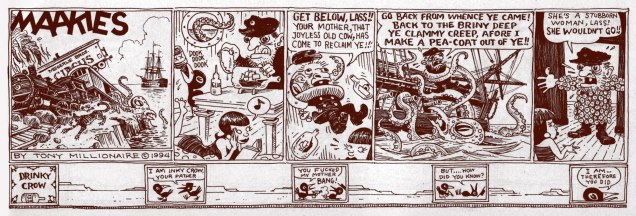
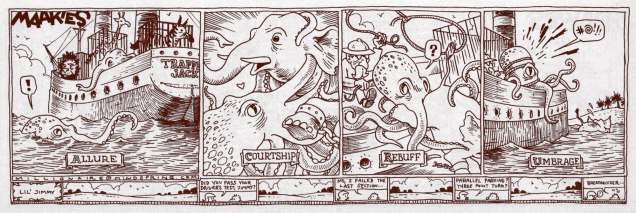
How’s that for a little fairytale? You will forgive me for the jejune introduction, but something about Millionaire’s art is magic. It is easy to underestimate how good an artist he is because his art is so cartoony, and his characters so outlandish: his award-winning, syndicated strip Maakies, for instance, concerns itself with a perpetually blotto stuffed crow (Drinky Crow) and his best pal, a sock monkey (Uncle Gabby). Both were TM’s childhood toys. All children make up stories about their playthings. What’s magic isn’t that he was able to create a world for his toys to inhabit, it’s that he was able to pull us, the audience, in with him.

TonyMPortrait

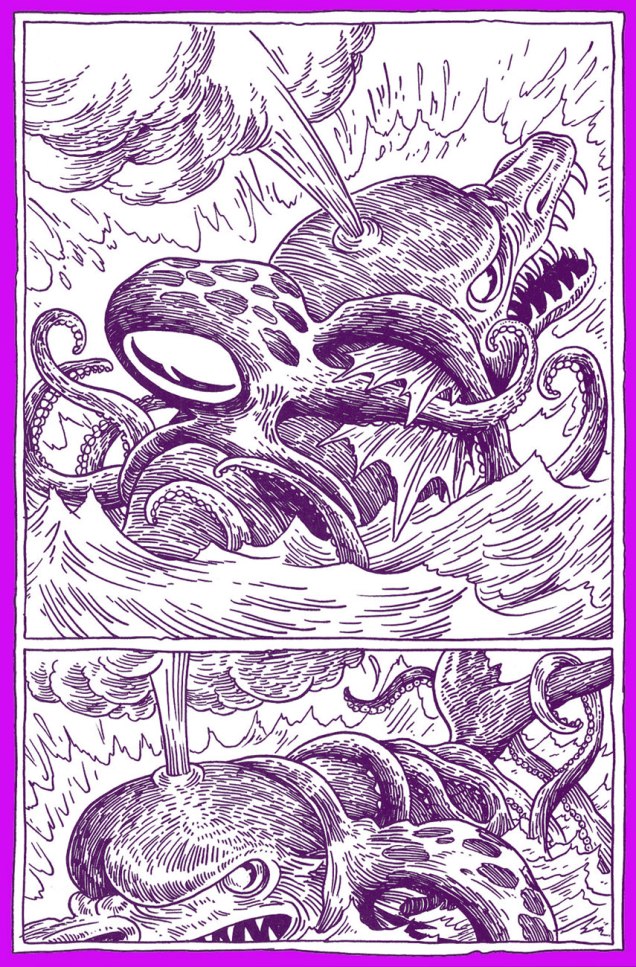
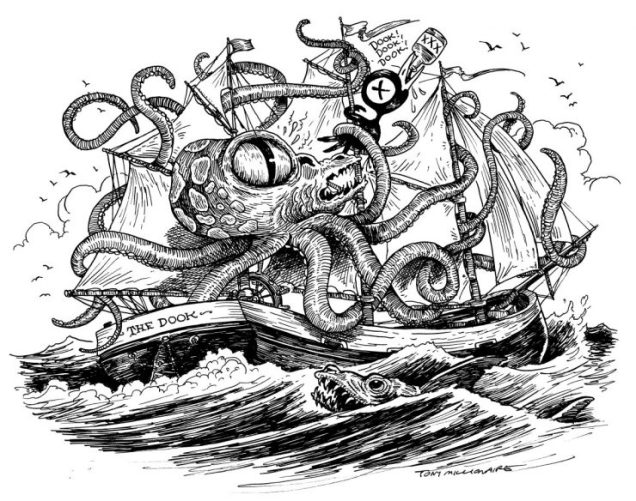
His art is also stunning on a purely technical level: the impeccable geometry of his Victorian houses, the zest of his epic battle scenes (often between a whale and a kraken, it should be noted), the lushness of the gardens inhabited by fairies, gossiping insects having tea, and mice with puritanical sensibilities.

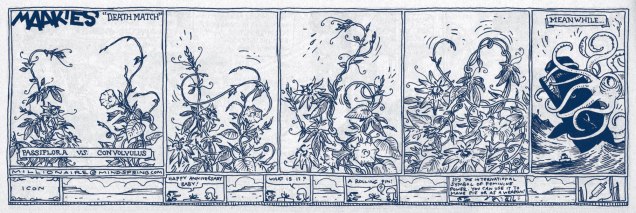
A couple of other things about Tony Millionaire: he’s really funny (or “drunkenly charming”, if you prefer; read his interview with John F. Kelly from 1999), and he clearly loves drawing tentacles, gleefully sticking them hither and tither. He’s clearly long overdue for an inauguration into the elite hall of Tentacle Tuesday Masters. I’m not here to provide you with hard facts about when and how, either about the newspaper strip Maakies or about the comic series Sock Monkey. You can get that from elsewhere. But I do believe that this is the only website where you can get your tentacle fix *and* your TM fix all at once (courtesy of co-admin RG who did all the scanning work!)

Anyway, enough of this chit-chat, and let the tentacles abound!

Maakies01A

Maakies02A

« Maakies is me spilling my guts… Writing and drawing about all the things that make me want to jump in the river, laughing at the horror of being alive. »

Maakies03A

Maakies04A

Maakies05A

Maakies06A

Maakies07A

As fun as Maakies are, I find that one gets weary of them quickly – they’re like chips that burst with flavour to the point of causing desensitization. I believe that Sock Monkey is where Millionaire really gets to shine; I fondly remember being bowled over by Sock Monkey: the Inches Incident, in which TM really put his nautical sensibilities to use. The other books from this series only reinforced this impression – the art was so much lusher, and the moral complexity of these stories made each tale bittersweet. The artiste himself summarized it well, stating that « Sock Monkey is me trying to rise above all that bullshit, to be more poetic, looking at the bright side, remembering the things that used to delight me as a child. At the same time, the main theme to all the Sock Monkey books is the crashing of innocent fantasy into bone-crushing reality. »

SockMonkeyInches01A

Fantagraphics published a full collection of Sock Monkey strips, but you can also read three of them right here online. I would of course strongly suggest supporting the publishing house and the author by purchasing the book, but what kind of high moral ground can it be if one is not offered a choice?

sea-Octopus-getting-Drinky-Crow-740x584

tumblr_pmpz7ov3pF1qg5msoo1_1280

~ ds

Tentacle Tuesday: In Your Neighbourhood and Mine

Today’s post may step a bit outside my usual purview, which is to say that the octopuses I am introducing do not come from the pages of comics per se. They’re used for mercantile purposes, to attract public to a concert, sell a book or deliver a message. But though they are octopuses in advertising, their artists still clearly have their hearts (and fingers) in the cartooning world.

Exhibit A is this cover for Centipede Press’ edition of Masters of Science Fiction: Fritz Leiber. This edition was limited to 500 numbered copies, so it will surprise no-one when I state that it’s quite sold out (See? Tentacles sell.) The cover is by Jim & Ruth Keegan, a wife-and-husband team, also the authors of the comic The Adventures of Two-Gun Bob.

Masters of Science Fiction-CentipedePress

Next, we have two music-related scenes, both from the Spanish side of things. ¡Fíjate!

The Roctopus Tea Party Festival takes place in Toledo, Spain. (Due to language constraints, I’m not exactly sure how many editions of it there have been.) Each poster features an octopus, but this is my favourite of the lot.

Roctopus Tea Party Vol . 3 by RoctopusT.P.Records
Whoever designed the festival’s logo knew how to harness the power of a lone octopus eye.

This Mardid “lunch box restaurant & tiki room” (now sadly defunct) held a series of “Galician lunches with DJ” splendidly named Día del Tentáculo. With a little Google Translate magic, I came up with this description: « Imagine a restaurant where you can eat hamburger with shiitake and jalapeños, drink the mythical Mai Tai cocktail or enjoy Tentacle Day with the best Galician octopus. And all while listening to good music in an environment inspired by the 50’s America. Sounds like an explosive mix, right? » The hamburger sounds good, but it’s really the Galician octopus that draws one in!

diadeltentaculo
As the Spanish artist Roberto Argüelles held a few exhibitions of his art at Lunch Box, I’m going to assume this is his artwork.

This one I spotted plastered over some other poster in my neighbourhood. It states something like « Ultimatum: provide wages for all internships at all levels, or we go on strike. »

IMG_20190107_105708

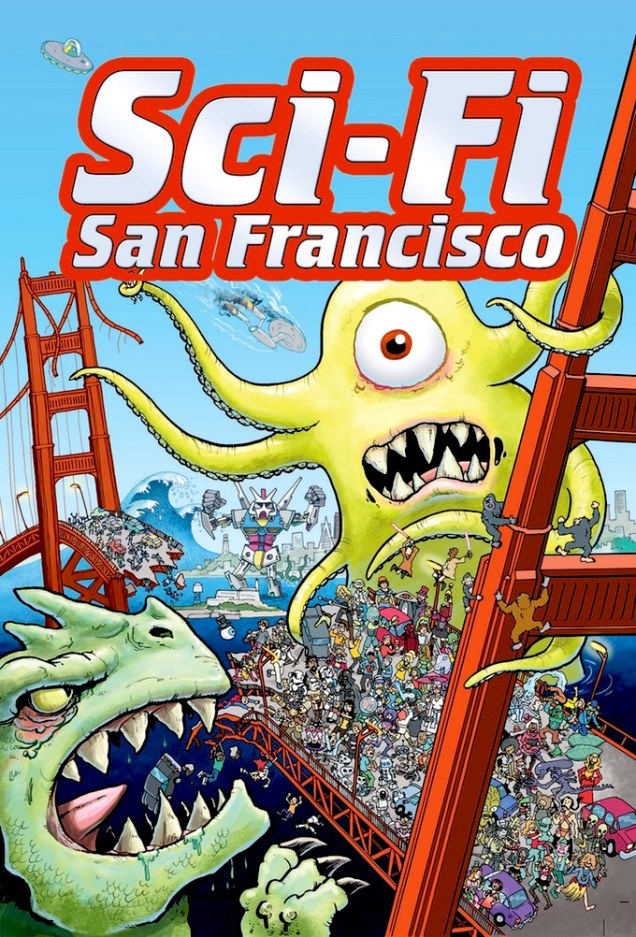
At first I assumed this was poster for a sci-fi convention in San Francisco, but it turned out to be the cover of a comics anthology published by Skodaman Press.

Chuck Whelon0ScifiSanFransisco
Art by Chuck Whelon.

~ ds

Hallowe’en Countdown III, Day 12

« Egad! This looks like it’s straight out of a horror movie! »

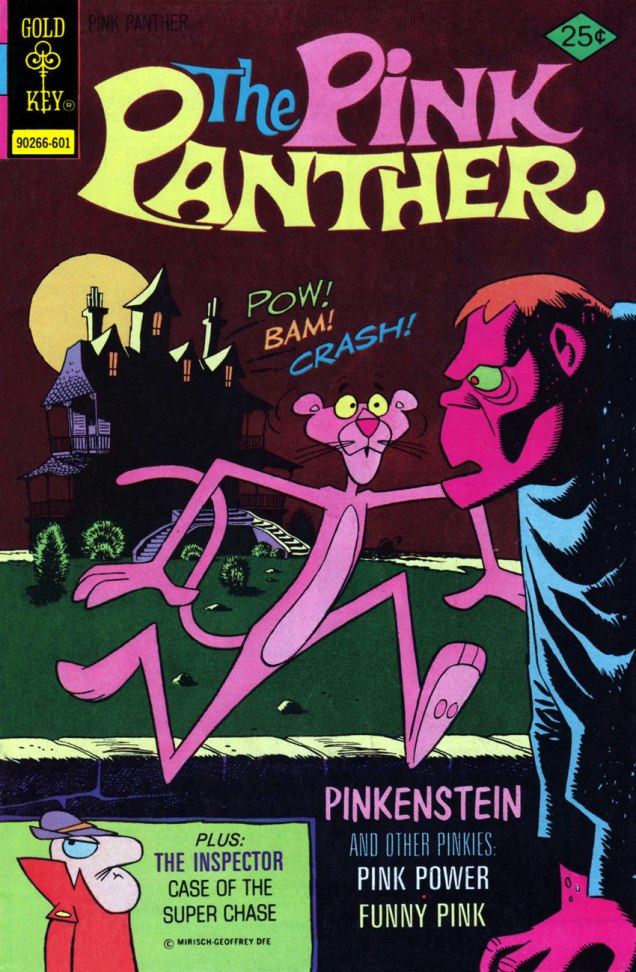
How deep and searing a trace the Universal Monsters cycle has left on popular culture: you see its mark on everything from literature to breakfast cereal. It’s nothing new in the cartoons, of course: Warner Bros, with the Looney Tunes, had their lugubrious fun with, for instance, Boris Karloff and Peter Lorre archetypes. So it’s no great shock to eventually witness DePatie-Freleng‘s The Pink Panther getting in on the monstrous act.

PinkensteinA
Nice bit of mood setting, isn’t it? This hails from The Pink Panther no. 31 (January, 1976). This being Gold Key, writer and artist uncredited and unknown. Any ideas?
PinkPanther31A
The issue in question… interesting colouring touch, most likely accidental: the only white space on the entire cover is the “PINK POWER” title.

Incidentally, we’ve checked out The Inspector in an earlier post.

– RG 


Hallowe’en Countdown III, Day 7

« Phooey on trick or treaters! This year I’M going to have all the fun — play the tricks and eat the candy myself! » — foolish words from Donald

Whoa, lots of action for poor Unca Donald this Hallowe’en, some of it possibly malevolent. Best hand out the treats and be generous, to be on the safe side.

BarksHalloweenDuckburgA

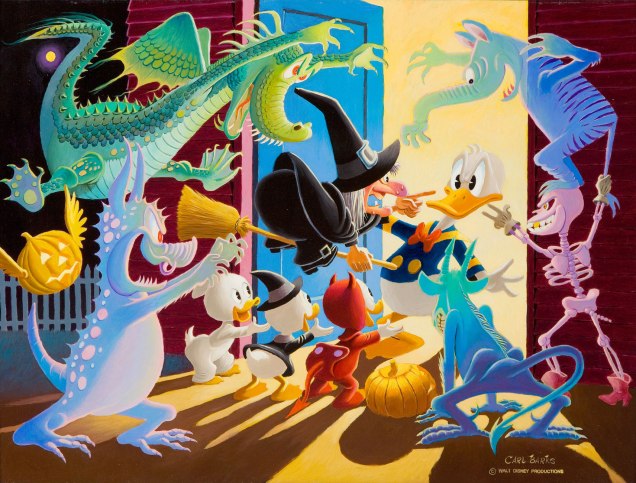
This lovely painting entitled Halloween in Duckburg was created in 1973 by the incomparable Carl Barks, aka The Good Duck Man. It’s based on his cover for Walt Disney’s Donald Duck no. 26 (Dell Comics, Nov. 1952), which in turn was based upon the Disney cartoon short Trick or Treat.

BarksDonaldDuck26A

Watch it here… while you still can.

As a bonus, here’s a nice Donald mask (not that Donald… right colour, but too scary) for your trick or treating purposes, from the same issue’s back cover.

DonaldDuckMaskA

– RG

Tentacle Tuesday: Won’t You Have a Cuppa With Me?

« I say let the world go to hell, but I should always have my tea. » — Fyodor Dostoyevsky

A colleague at work labelled me a “tea whore” the other day. I don’t think that’s an official expression (though apparently one can purchase tea mugs with this message), but I’ll take that as a badge of honour. And therein lies my similarity to my beloved octopods: they never say no to a nice cup of tea, either. Evidence, you may ask? I’ve a-plenty of it. Pour yourself a steaming cup of oolong and join me!

DonaldDuck200A
Donald Duck no. 200 (October 1978), cover by Larry Mayer. Incidentally, he has already been part of a Tentacle Tuesday.
Vortex9TentaclesA
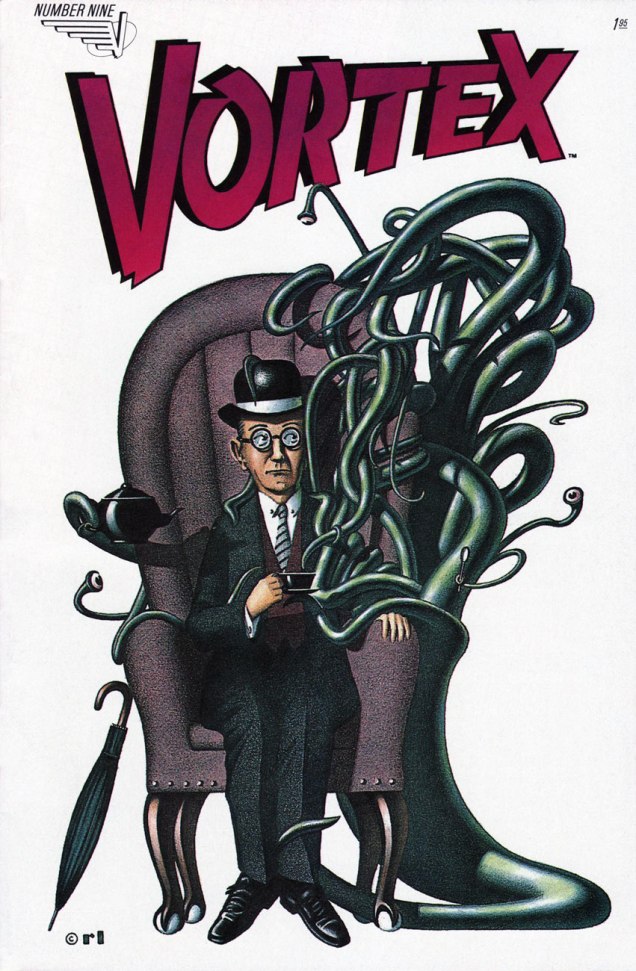
Surprise: this quintessentially British scene (an umbrella, a cup of tea and a suitably meek accountant) is brought to you by a Canadian comic! This is Vortex no. 9 (May 1984), cover by Ron Lightburn. Vortex was one Canadian Vortex Comics’ titles. Some interesting stuff was published by these guys: Matt Howarth’s Those Annoying Post Bros and Savage Henry, Los Bros Hernandez’s chunk of Mister X, Ted McKeever’s Transit, Chester Brown’s Yummy Fur

tentacletuesdayicon

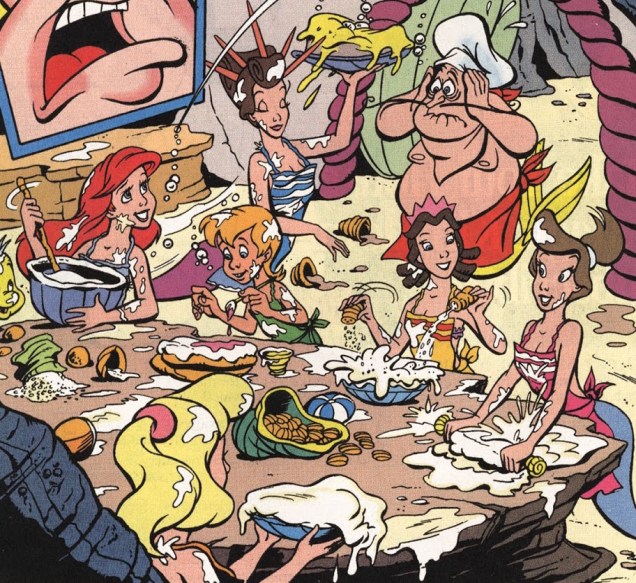
The following pages are from Disney’s The Little Mermaid no. 10 (June 1995). No, no, stick around, it’s worth it. You can read the full issue here.

Disney's The Little Mermaid Issue #10

Disney's The Little Mermaid Issue #10-2

So far so good, even though this begs some questions (such as “how do you pour a cup of tea underwater?”) But the following dialogue suggests that things other than tea-drinking were on the mind of *this* octopus:

Disney's The Little Mermaid Issue #10-3

You know how all this ends, don’t you? That’s right:

LittleMermaid#10-pudding
I tried to make this a purely innocent post, but things didn’t pan out.

tentacletuesdayicon

Gahan Wilson is always, always good and ready for tentacles. (By the way, he is financially struggling and has dementia, which is both stupefying and depressing. I never cease to be amazed at how someone with such a wide-ranging and fruitful career can end up impoverished… His family raised enough money on GoFundMe – for now – to take care of him, but you should still visit that page for recent pictures and updates about his health.)

GahanPlayboyAug06A
Cartoon by Gahan Wilson, published in Playboy’s August 2006 issue.

tentacletuesdayicon

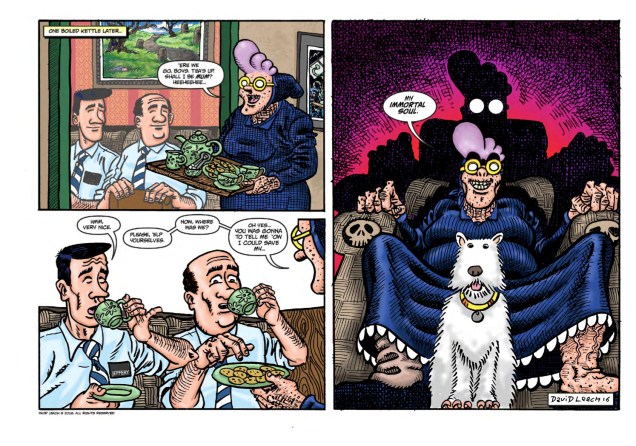
In 1986, British cartoonist David Leach unleashed Psycho Gran upon an unsuspecting world. The « five-foot high, mauve-haired, bespectacled psychotic granny with a pan-dimensional, sentient handbag called Percy, a flying dog called Archie and a pathological loathing of rudeness » first appeared in British children’s comic Oink!, where she lingered for 15 issues, pummeling purse snatchers, clobbering office workers and disciplining  rampaging monsters until 1988. In 2011, she came back – her hair more purple than ever, her lust for authoritarianism unabashed – and is currently involved in a four-part mini-series.

tea-David Leach-PsychoGranny
And she’s drinking tea with Mr. Cthulhu. I’m jealous.

« We all have grannies. I think there’s something wonderfully exciting, mischievous and dangerous about them, or was that just mine? They’re old and they’re the mum of your mum, plus they spoil you rotten, but they can also tell you what to do, like your own mum does! That seemed so strange when I was a kid, the idea that they could boss not only you but also your mum or dad around. And I think we’re all a little scared of the elderly, no one likes to think that one day they’ll be old themselves, I think we resent them for showing us what we’re going to become. Psycho works because she looks frail and yet she’s super strong and batty. She’s the classic sheep in wolf’s clothing. And there’s something funny about an old granny being lethal and crazy to boot, especially since usually the elderly are portrayed as figures of fun to be mocked and laughed at. » (Look Out, Britain! Psycho Gran is Back!)

And by the way, I wasn’t exaggerating about Psycho Gran’s passion for control (and tea).

PsychoGran-ImmortalSoul

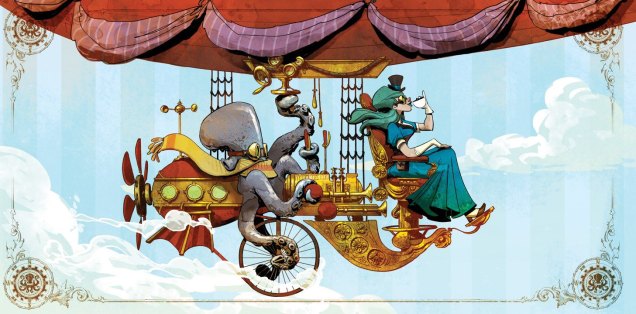
Drink tea with your octopus today… and if you don’t have an octopus, borrow one from a friend. I don’t have a dirigeable (that would be a zeppelin for younger people in the audience) , but I manage. Toodle-oo!

Brian-Kesingers-Otto-and-Victoria-2016-calendar
The cover for the 2016 calendar of Otto and Victoria, an adorable steampunk couple created by Brian Kesinger. These two were featured earlier in Tentacle Tuesday: Adopt an Octopus Today!

~ ds

Poise and Prudence: Tove Jansson’s The Moomins

I think it safe to surmise that pretty much everyone is familiar with the light-coloured, pleasantly plump creatures collectively referred to as the Moomins. Even if you’ve never heard of Tove Marika Jansson, their creator, you’ve surely glimpsed a Moomintroll mug, a Snork Maiden tote, or a Little My t-shirt.

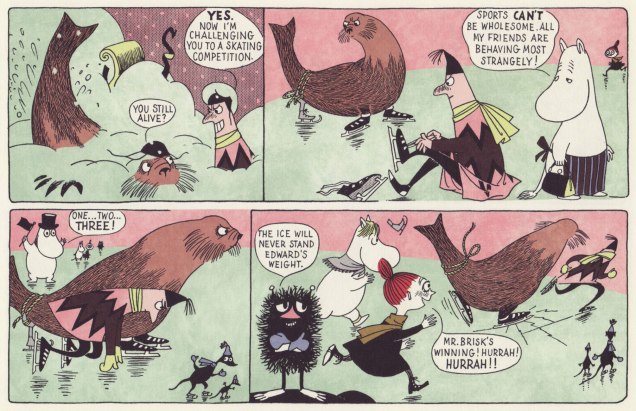
Tove Jansson (1914-2001) was a multi-faceted soul: comic strip artist, of course, but also novelist, painter and illustrator (one might argue that these all are related: point taken). She published her first Moomin book in 1945 (The Moomins and the Great Flood) to (eventual) great success; the eight books that followed were equally popular. All have been translated into forty-four languages. The Moomin comic strip, first designed for publication in the children’s section of Swedish newspaper Ny Tid, ran from 1947 to 1975, and was syndicated in 120 countries. (Here’s a detailed timeline of Moomins’ creation and development.) To Anglophone audiences, the strip is known thanks to The London Evening News, which picked it up in 1954.

The commercialization of the Moomin family, the ubiquity of Moomin merchandise overshadow the rest of Jansson’s career – but also cheapen the darling Moomins. (I should talk; I have two favourite Moomin mugs from which I drink kefir.) As with the best writing for children, Moomin stories are fun and easy to follow on the surface – but beneath that cheerful and cute exterior, complex themes are tackled, moral dilemmas remain unresolved, and the world is a confusing, unfair place.

Montréal’s Drawn and Quarterly is currently « reworking classic Moomin stories in full colour, with a kid-proof but kid-friendly size, price, and format » (to quote from their website) for their Enfant collection. « Enfant » means « child », but I think any adult with a sense of humour and just a pinch of childlike innocence will enjoy these stories. Drawn and Quarterly have heretofore published collections of London Evening News strips in black and white; and though the art is beautiful, I really like the way the strips came out in colour.

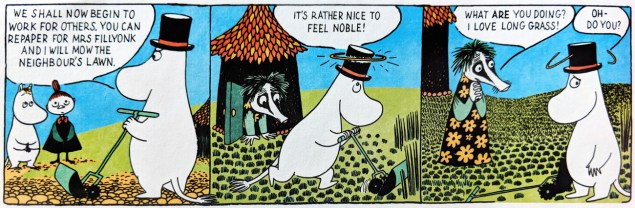
As little of this stuff is findable online, I’ve selected a few (well, quite a few) favourite pages to whet your appetite – a selection of goofy characters, hard life lessons and good old madcap fun.

MoominWinter01A
Pages from Moomin’s Winter Follies

MoominWinter02A

MoominHouseA
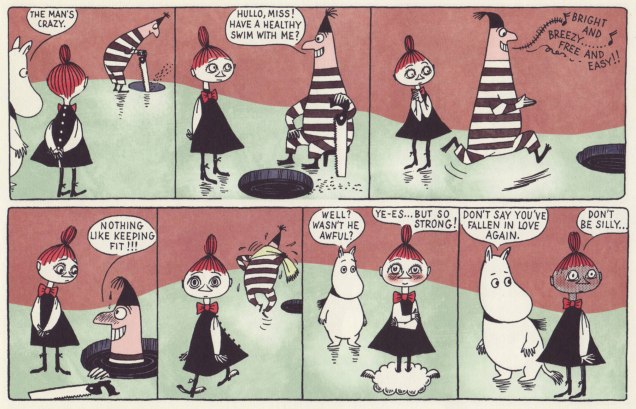
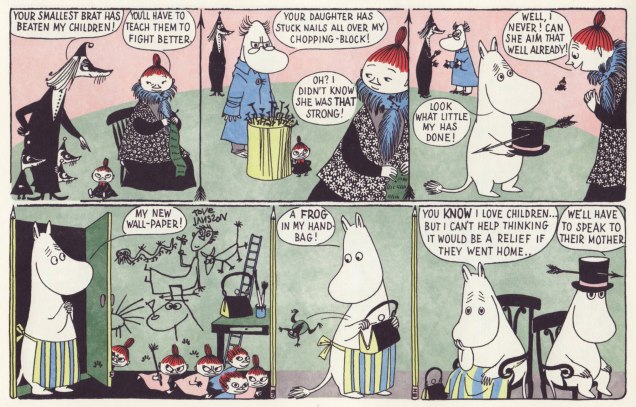
Moomin Builds a House. Little My makes her first appearance in this story. Some parenting advice from Elder Mymble, the mother of this red-haired hoarde: « I don’t like to keep scolding them. I just… pour some water over them. …Or lemonade. »

« Born in 1914, at the onset of World War I, Tove’s childhood and early adulthood took place in a time of intense political upheaval. Artists themselves, her parents were a part of the Swedish-speaking minority in Finland and in those first few years, when the world was at war, Tove and her mother stayed in Stockholm while her father remained in Finland, going on to fight in the Finnish civil war in 1918. That experience, some literary analysts say, is reflected in the missing Moominpappa, who appears only as an allusion in the first chapters of the first book. » (How Tove Jansson’s Moomins conquered readers’ hearts)

ToveJansson-MoominontheRiviera-1
« As springtime dawns in Moominvalley and the first northern crocus opens, Moominpappa and Snorkmaiden, glamorized by the prospects of movie stars and gambling, insist the whole family take a trip down to the Riviera. Reluctantly Moomin and Moominmamma agree to go along, and the Moomins set off on a grand adventure, complete with butlers, luxury shops, indoor swimming pools, and duels at dawn. » Pages from Moomin on the Riviera.

ToveJansson-MoominontheRiviera-2

« Following art school and travels abroad, Jansson drew cartoons for different outlets, including, for fifteen years, the satirical political paper Garm. (“Do as you like,” the editor told her. “Just make sure you hit them in the mouth.”) This is where the Moomins first surfaced publicly. Originally meaner-looking and troll-like creatures called Snorks, they began mostly as marginalia, a kind of signature, and might even be found loitering in a cartoon about the German Army’s evacuation of Lapland. » (The Hands That Made the Moomins)

MoominSeaA
Page from Moomin and the Sea.
MoominMaid01A
Misabel the maid is, as her name suggests, miserable. Afraid of any kind of non-conformist behaviour, scared of enjoying anything, she is anathema to Moomins’ approach to life. Pages from Moominmamma’s Maid.

MoominMaid02A

« Tove’s entire life was filled with bold decisions: selling satirical cartoons mocking Hitler; opposing war; choosing not to marry or have children; and turning down Walt Disney’s offer to buy the Moomin brand. She was the writer, illustrator, designer and controlled the business side of her creation, not trusting anyone else to do it justice. » (Tove Jansson’s Feminist Legacy)

ToveJansson-MoominandtheMartians-1
This sequence with a somewhat indignant cow is one of my favourite moments. Pages from Moomin and the Martians.

ToveJansson-MoominandtheMartians-2

« In like spirit, Moomin hospitality excludes no one—except those prone to electrify the furniture or freeze Moominmamma’s roses. Guests include shrewish Fillyjonks addicted to cleaning; large graceless Hemulens obsessed with classifying and organising; and a philosophical Muskrat who believes only in the pointlessness of everything. » (Tove Jansson, Queen of the Moomins)

MoominNewLife01A
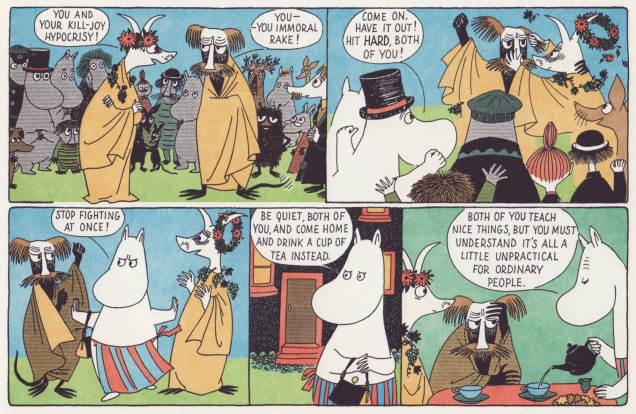
« When a charismatic prophet comes to town, the residents of Moominvalley are easily convinced to follow his doctrine for true happiness. Intrigued by their friends and neighbors’ lifestyle changes, the impressionable Moomins find themselves attempting to adopt the teachings of their new spiritual leader. But the freer they get, the more miserable they feel. Moominvalley’s state of divine chaos is further complicated by the prophet’s well-intentioned decree to free all of the jail’s inmates. » Moomin Begins a New Life.

ToveJansson-MoominStartsaNewLife-2

MoominNewLife02A« Over time, Jansson came to feel exhausted by the Moomins and that their success had obscured her other ambitions as an artist. In 1978, she satirized her situation in a short story titled “The Cartoonist” about a man called Stein contracted to produce a daily strip, Blubby, which has generated a Moomin-like universe of commercial paraphernalia—“Blubby curtains, Blubby jelly, Blubby clocks and Blubby socks, Blubby shirts and Blubby shorts.” “Tell me something,” another cartoonist asks Stein. “Are you one of those people who are prevented from doing Great Art because they draw comic strips?” Stein denies it, but that was precisely Jansson’s fear. » (Tove Jansson: Beyond the Moomins)
ToveJansson-MoominandtheBrigands-1
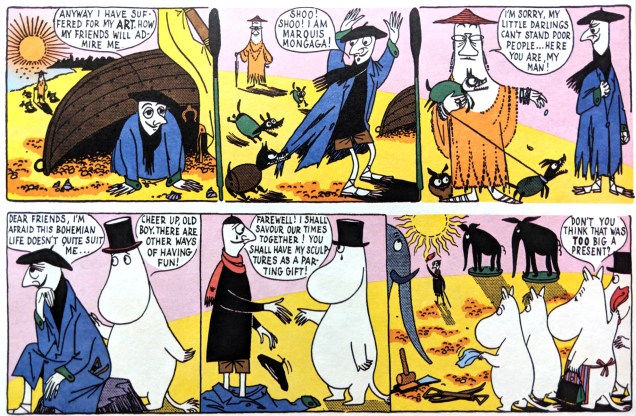
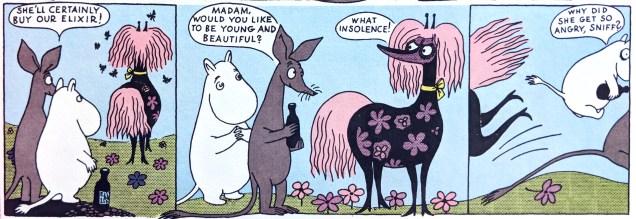
« Moomin’s pushy relations have come to stay, and in the process of getting them out, he unwittingly embarks on a quest for fame and fortune with his sly friend Sniff. But it’s much harder to get rich than either of them expects, whether it’s through selling rare creatures to the zoo, using a fortune-teller to find treasures, or making modern art. » Moomin and the Brigands.

The only (other) thing I’ll add is that Tove Jansson was a lesbian, which tends to get glossed over by (bad) biographies of her. You can read an excellent essay about Jansson and her lifelong partner Tuulikki Pietilä here.

ToveJansson
Tove Jansson photographed by her brother Per Olov.
ToveJansson-partner
Jansson and Pietilä. Sweet!

~ ds