Maurice Henry: Make Way for Surrealism

« The man who cannot visualize a horse galloping on a tomato is an idiot. » ― André Breton

What is one to do, in a mere blog post, with a polymorphous artist such as Maurice Henry (1907-1984)?

Here’s a handy bit of compressed biography, from his Lambiek page:

Henry was a French painter, poet, filmmaker, as well as a cartoonist. Between 1930 until his death, he published over 25,000 cartoons in 150 newspapers and a dozen books. His cartoons were generally surrealistic and satirical.

In 1926, he co-founded the magazine Le Grand Jeu with René Daumal, Roger Gilbert-Lecomte and Roger Vaillard, with whom he formed the “Phrères simplistes” collective. Henry provided poems, texts and drawings, while also making his debut as a journalist in Le Petit Journal.

He left Le Grand Jeu in 1933 to join André Breton’s group of Surrealists and their magazine Surréalisme au service de la Révolution. He also worked with the artist and photographer Artür Harfaux on the screenplay of twenty films, including ones starring the comic characters ‘Les Pieds Nickelés’ and ‘Bibi Fricotin’. Maurice Henry spent the final years of his life making paintings, sculptures and collages. He passed away in Milan, Lombardy, in 1984.

The answer? My default solution, which is to focus on some small parcel of the much greater whole. A number of Henry’s works bear revisiting (for instance, Les métamorphoses du vide [1955], a truly groundbreaking picture book about the world of dreams; À bout portant [1958], a collection of literary portraits; or Les 32 positions de l’androgyne [1961, also issued in the US in 1963], a chapbook of… gender recombinations) and deserve a turn in the spotlight.

To quote co-anthologists Jacques Sternberg and/or Michael Caen in their indispensable Les chefs-d’oeuvre du dessin d’humour (1968, Éditions Planète, Louis Pauwels, director):

Surrealism — he was part of the group before 1930 — left its mark on him and it’s because he was already well-cultured as he launched his career that he was among the first, in the desert that was the publishing world of the 1930s, to attempt unusual drawings calling upon often startling ingredients, such as poetry, black humour, the fantastic and the absurd. He caused no less of a surprise by doing away with captions, at a time when bawdy jabbering was the fashion all over. In short, Maurice Henry was indisputably a pioneer of that grey and stinging brand of humour that would explode like an H-bomb some fifteen years later.

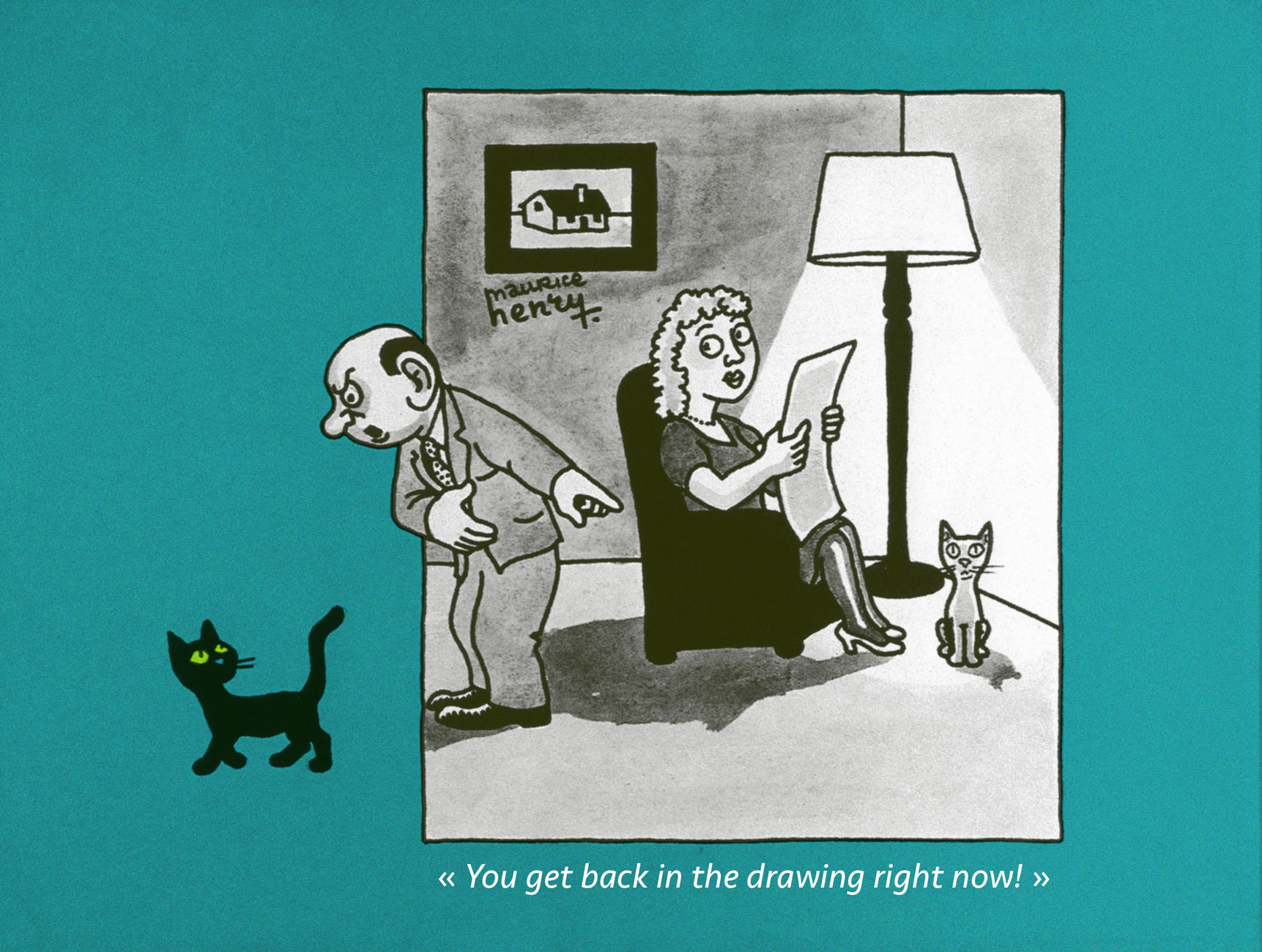
HenriEscapeeA
A lovely bit of conceptual humour from 1938. A rare one bearing a caption, but the joke called for it. At this early stage, you won’t be wrong to point out a certain stylistic debt (it’s the roundness and simplicity of line!) to his contemporary and compatriot Jean Effel. Henry was indeed a fan. Do check out my co-admin ds’ fine post spotlighting the good Monsieur Effel.
HenryMinotoréadorA
An example of what enlightened creators such as Henry were fighting for: making room for cartoons that weren’t just about the cheap chuckles. Consider, for instance, the existential plight of the Minotoreador . Published in K. Revue de la poésie no. 3 (“De l’humour à la terreur”, May 1949).
HenriGendarmeA
The Military, Government, Constabulary and Clergy were favourite targets, naturally. When it was (barely) tolerated. It helped to be ambiguous, even if one wasn’t ambivalent (1951).
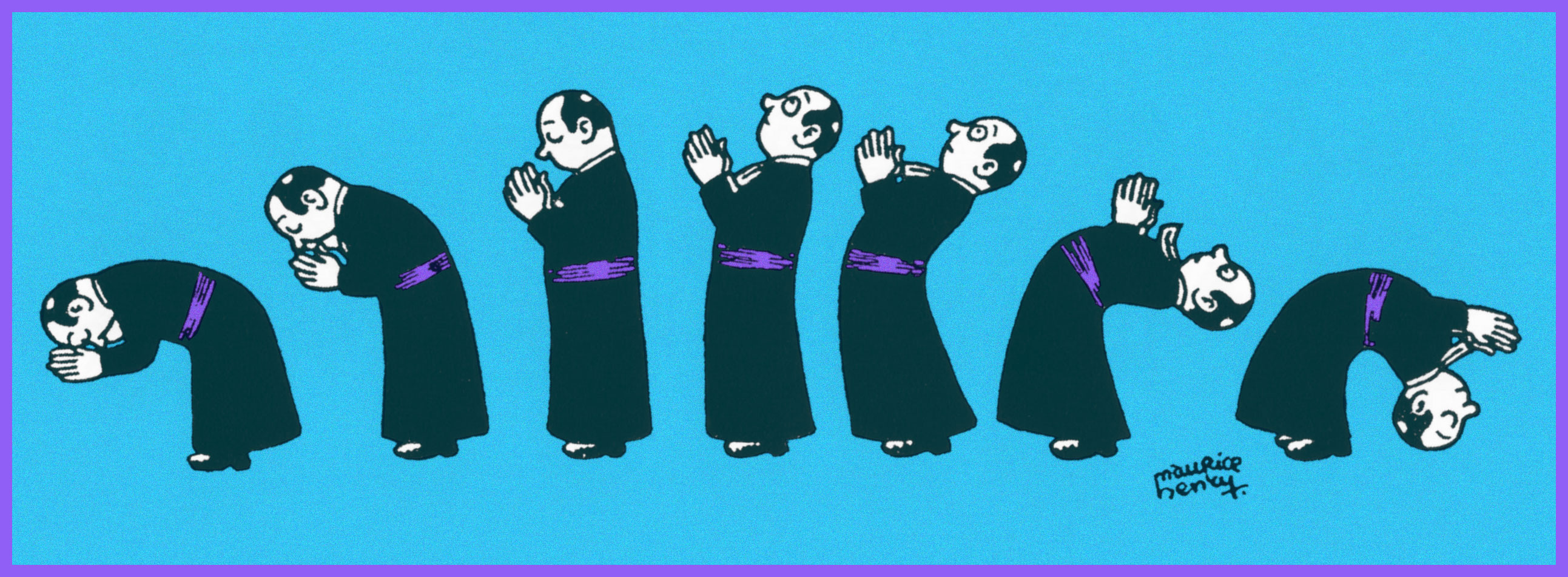
HenryPrieurA
Here’s one for the clergy; though mocking, it’s hardly what you’d call hostile. From the first issue of epochal surrealist magazine Bizarre (1955-1968).
HenriCèneA
Yes, it’s Card Sharp Jesus entertaining, confounding (and possibly fleecing) his disciples. Note the ace up his right sleeve (1941).
HenriSkiNautiqueA
Walking on water was clearly just the beginning (1948).
HenriJesusMuscleA
Henry’s Jesus seems like a swell fellow, really. A bit on the roguish side, which is fine by me (1958).
Easter'sCancelledDarkness
See? A case of a joke’s that’s more than a half-century old still finding echoes in the present day. Cover from The Darkness‘ prophetic 2019 album, Easter Is Cancelled.
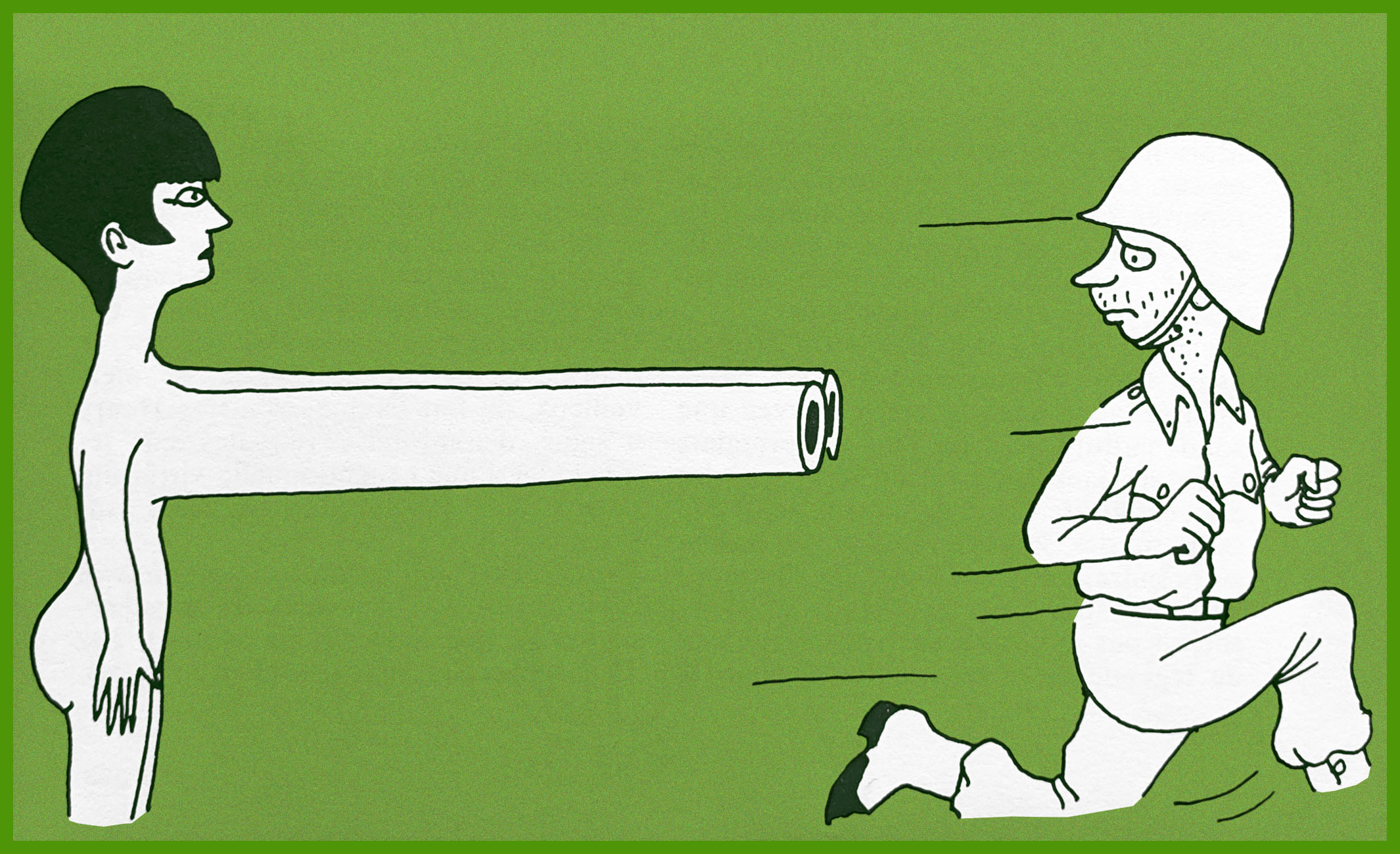
HenryCanons02A
That soldier’s scared yet dismayed expression brings to mind Futurama’s hapless Philip J. Fry.
HenryCanons01A
That’s one relaxed elephant.
HenryPoursuiteA
Another illusion shattered.

HenryVoitureA

HenryAutophageA
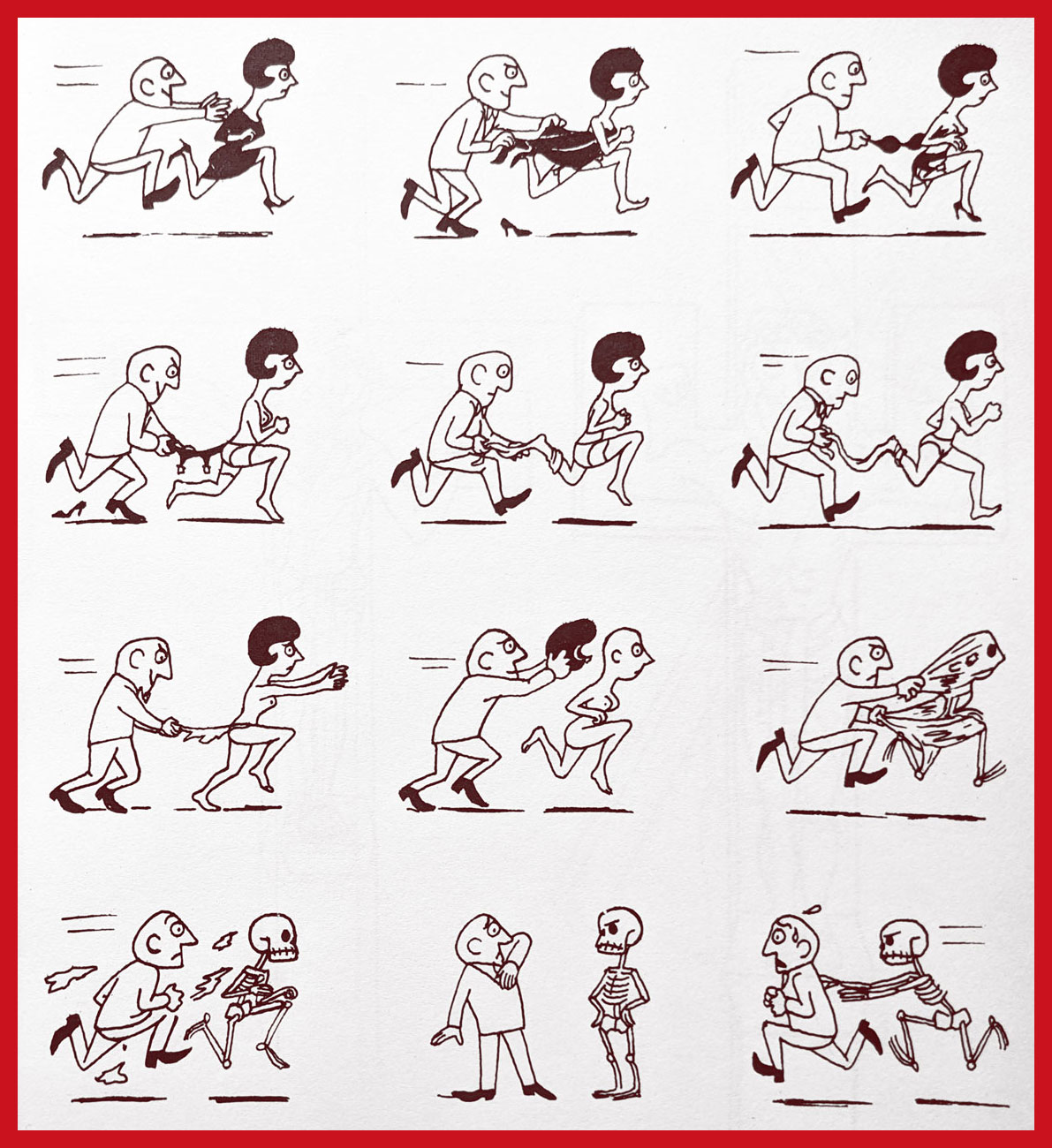
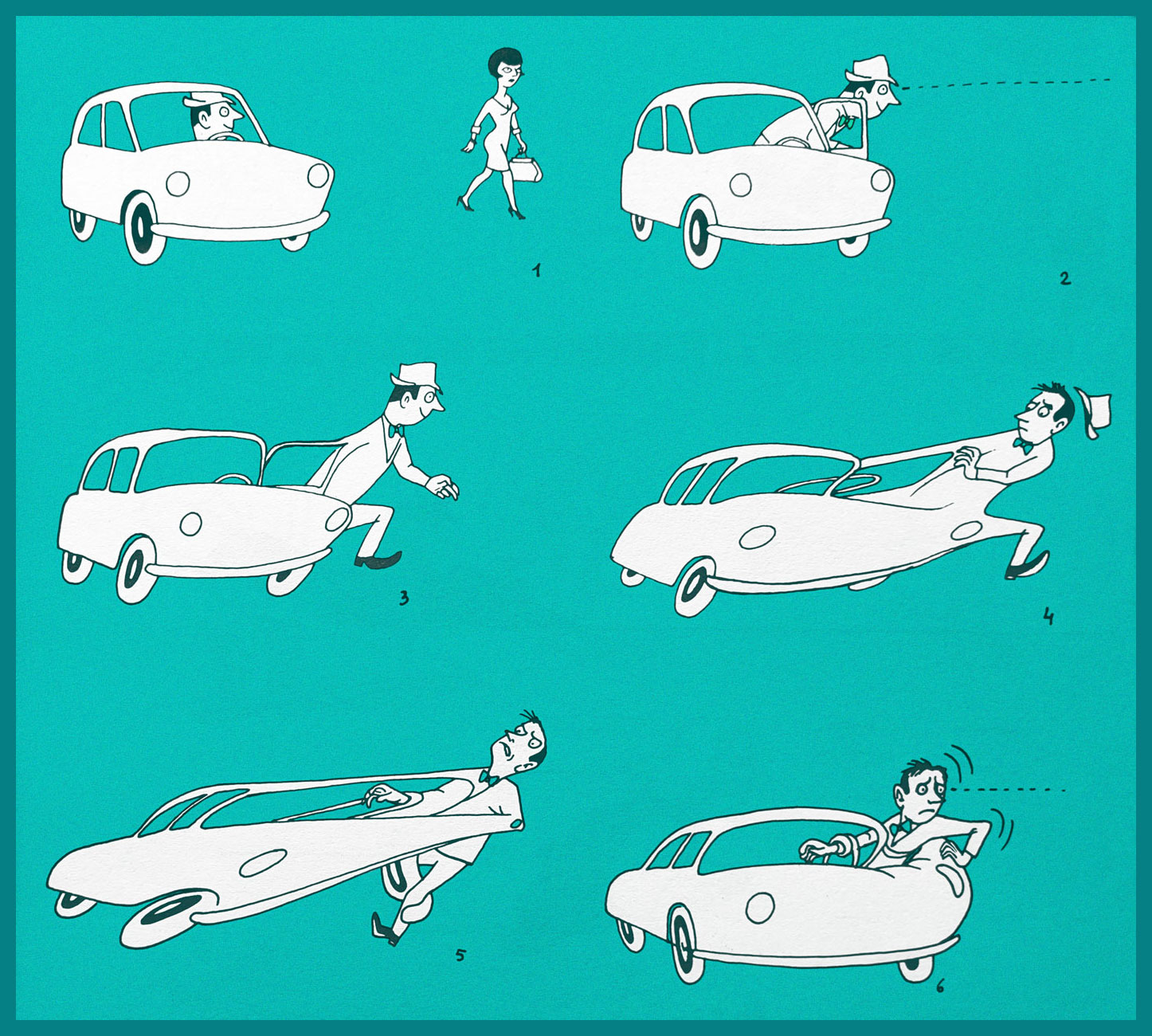
The little hand wave at the end really makes this one.
MauriceHenryLoupeA
The artist in 1935, photographed by his friend and frequent co-conspirator Arthur Harfaux.

-RG

Tentacle Tuesday: Rahan to the Rescue

« Rahan n’a plus peur de la nuit, ni du feu, ni du tonnerre du ciel, ni des fleuves sans fin… »

(Rahan no longer fears the night, nor fire, nor the sky’s thunder, nor endless rivers…)

Even non-European readers will probably have some familiarity with handsome troglodyte Rahan, one of the heroes of the Franco-Belgian bande dessinée.

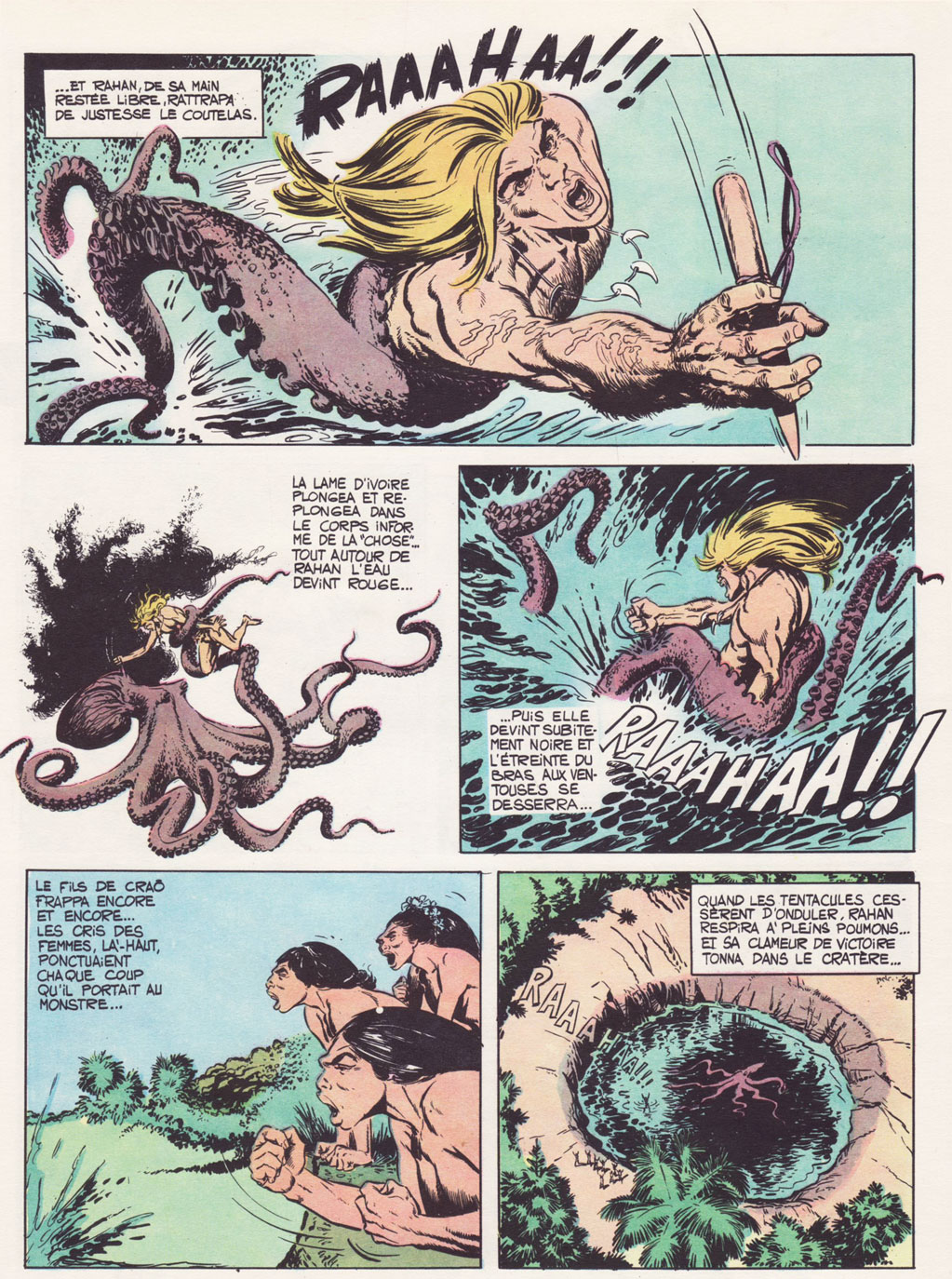
In 1969, Rahan made, to general acclaim, his début in the inaugural issue of Pif Gadget: apparently his escapades appealed to both male and female audiences. The series was created by writer Roger Lécureux and artist André Chéret, both seasoned comic pros by then. His adventures spanned years upon years of publication and spawned legions of rabid fans. To give you an idea of what “many years” implies, the last album – with new material! – came out in 2012; the collected series, which gathers material between 1969 and 1999 (30 years of the Lécureux – Chéret team), took up 26 handsomely-printed hard-cover volumes.

The following sequence is from La flèche blanche, originally published in Pif Gadget no. 90 (Nov. 1970), and reprinted in colour in Rahan no. 7 (Oct. 1973).

RahanPieuvre01A

RahanPieuvre02A

RahanPieuvre03A

RahanPieuvre04A

I first encountered Rahan on his home turf, which is to say in some old issues of Pif Gadget. I am not a big fan of the prehistoric genre, as it demands a more momentous suspension of disbelief on my part than I can provide. (The endless parade of clean-shaven blonde hunks accompanied by female nubile savages is a little too much for me.) Besides, Pif Gadget offered far more fascinating strips to focus on, so I happily skipped over the adventures of Rahan, just as I would gleefully ignore Les pionniers de l’espérance (same writer as Rahan) or the boringly handsome Docteur Justice (not the Marvel one).

However, I have to (grudgingly) avow that Rahan doubtlessly had great things going for it. Its strengths are also what seems to provoke some modern readers into dismissing Rahan with a patronizing hand-wave: aligning itself with the communist nature of Pif Gadget, Rahan espoused such values as justice and equality. He was also an immensely curious young man with a scientific mindset, which led him to discovering/creating useful tools, helped him to solve problems and shielded him from the superstitious nonsense others believed. One doesn’t often run into a caveman whose leitmotif is Humanism.

I did not grow up with Rahan, having only come to Pif Gadget in the last ten years or so (through the influence of co-admin RG), but these values are well known to me from growing up on Soviet science-fiction (Russian has a nicer word, fantastika, which is much more encompassing and also includes any forays into fantasy, prehistoric or otherwise). That, too, often gets thrown under the train of « childish, naive and simplistic », the holy trinity of a jaded cynic that’s currently en vogue as a role-model.

This seems especially unfair given that the series did not shield its mostly young readers from some harsh truths about life. Death and violence accompanied our hero wherever he went, and a lot of characters he encountered were, frankly, colossal assholes, as disinterested in fairness or egalitarianism as some modern poo-pooing readers. Not to mention Rahan’s curse of solitude – orphaned twice, he is never really accepted by the tribes he bumps into during his travels. He’s either rejected as an intruder… or venerated as a sort of a god, once he creatively extricates himself (and frequently the tribe) from some predicament. Oh, and this being a French comic, there are also bare-breasted women like it’s no big deal (and even some breast-feeding).

RahanIntegrale16A
Original cover art from Rahan – L’intégrale Tome 16 (2019, Soleil).

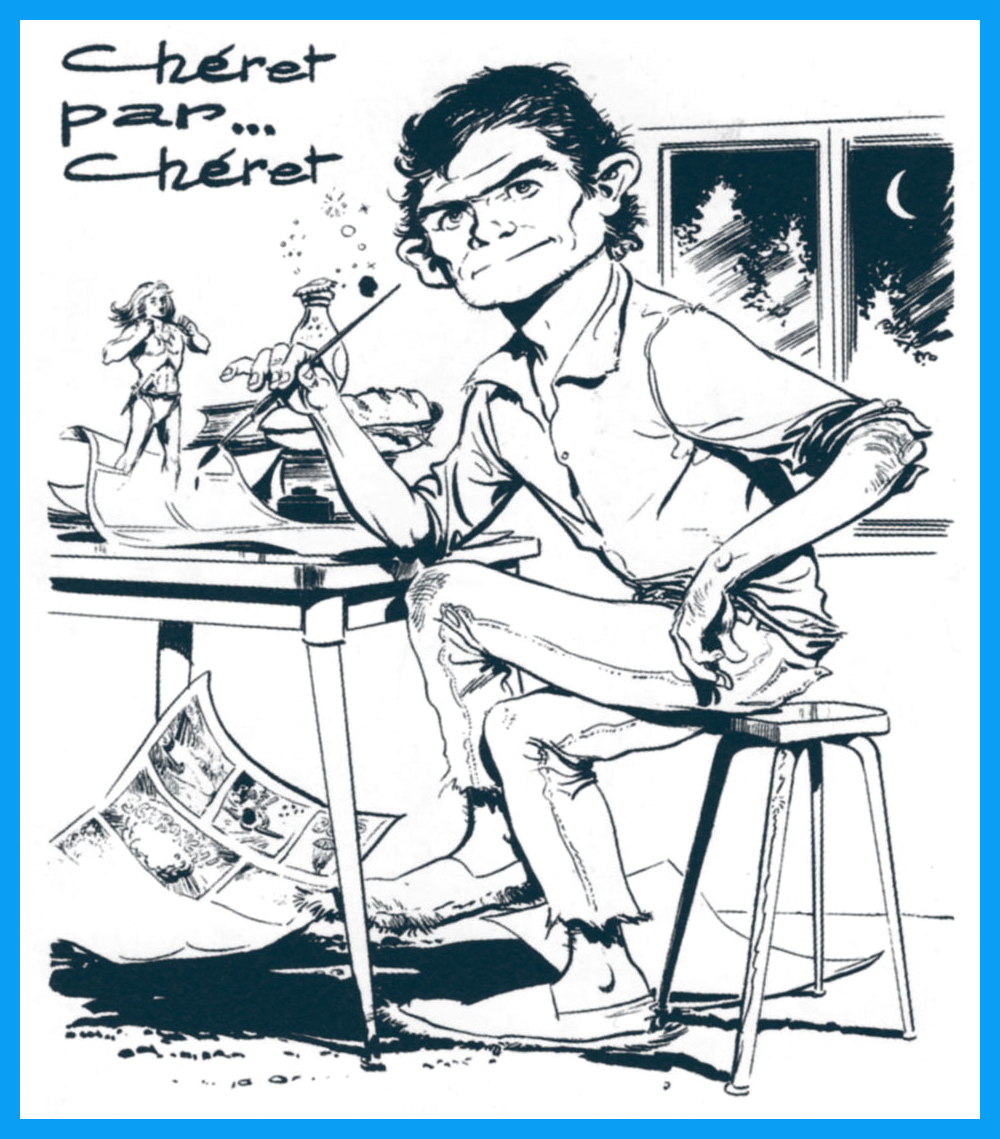
Today’s post is dedicated to André Chéret, who died less than a month ago, on March 5th. He was 82.

CheretAutoportraitA
A self-portrait of the artist, which originally saw print in Pif Gadget no. 81 (Sept. 1970).

You can read some Rahan stories here.

∼ ds

Robert Gring’s Wits-Sharpening Fun

« We do not stop playing because we grow old. We grow old because we stop playing. » — G. Stanley Hall

Despite the ubiquity of his work over several decades, very little is known of Robert Gring, at least online. Ah, but thankfully, ‘one reads books‘… and so I turned to Richard Medioni‘s indispensable ouvrage on the history of Mon camarade, Vaillant and Pif Gadget, L’histoire complète 1901-1994. About Mr. Gring (likely born in 1922 and died in 1995), we discover that he was for several years a press illustrator for centrist daily newspaper France-Soir, that he spent some time in a work camp during WW2, that, post-war, his work appeared in L’Almanach Vermot, Paris Match, Télé 7 Jours, La vie parisienne… and so forth.

That he was a reserved, bashful man who treasured his work above all else. And most admirably, that he was a man of great personal integrity and principles, as evidenced by the following anecdote, recounted by Mr. Medioni: « In parallel to his intensive work with (Pif-Vaillant), he occasionally works for Le journal de Mickey, but it ends on a sour note! In 1980, it is gently brought to his notice that his collaboration to a periodical associated with the French communist party is incompatible with his presence within the pages of Mickey. He must choose! Gring, who does not appreciate this type of pressure and has lofty ideas of honour, does not dither the slightest bit: he opts for fidelity. » I’m strongly reminded of Howard Prince’s valiant words to the House Un-American Activities Committee in The Front (1976).

GringFrancsJeux390A
Francs-Jeux was a long-lived kids’ magazine published from 1946 to 1979… 777 issues!), and Gring provided a number of its covers and several interior illustrations and strips. This is Francs-Jeux no. 390 (Sept. 15, 1962). See: even then, you had a couple of kids in black hoodies skulking to class.
GringFrancsJeux393A
This is Francs-Jeux no. 393 (Nov. 1st, 1962). The title feature, Le coucou qui ne voulait plus dire ‘coucou’ is the touching tale of a clock birdie who decides to make a dash for freedom, only to discover that life on the outside is intolerably uncertain and perilous. This is a France straight out of Jacques Tati‘s Mon oncle.
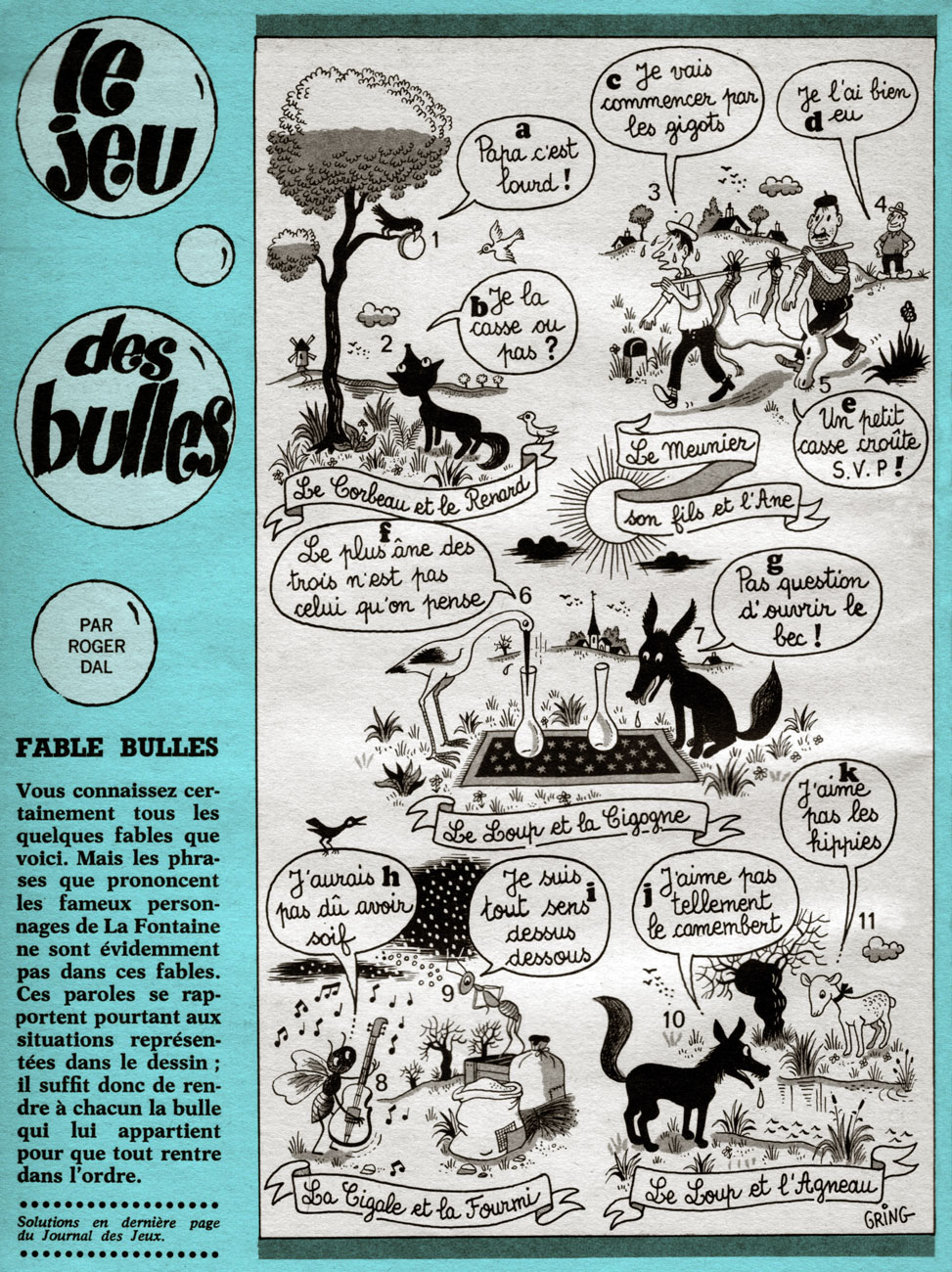
GringFablesA
Another Gring specialty: Le jeu des bulles, wherein errant word balloons must be restored to their proper speaker. If you must know: 1-g, 2-j, 3-a, 4-f, 5-i, 6-d, 7-b, 8-e, 9-k, 10-c, 11-h; Published in Pif gadget no. 33 (Oct. 1969, Vaillant). Plots from the fables of Jean de la Fontaine, script by Roger Dal.
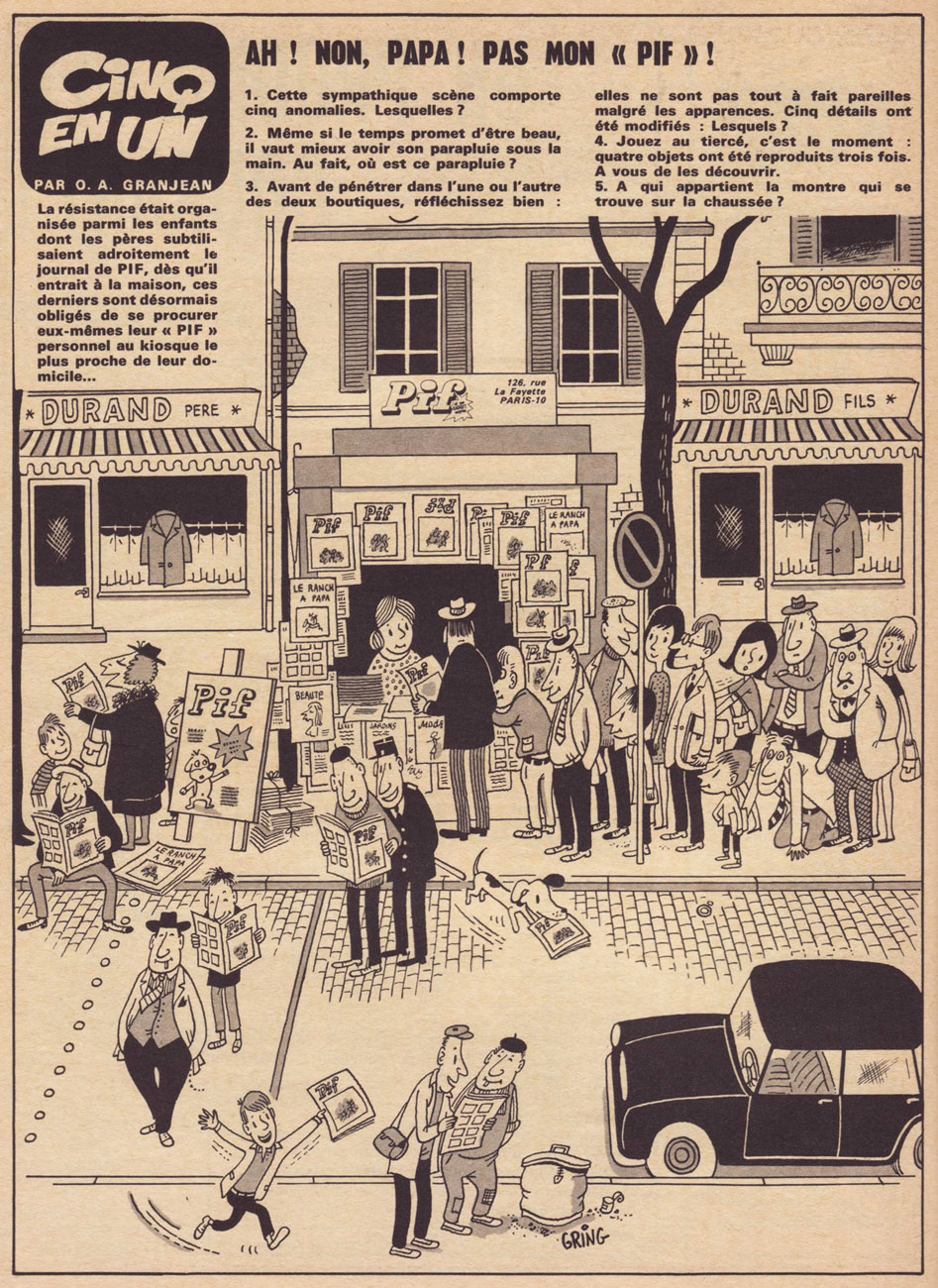
GringKiosqueA
Gring could always be counted on to compose and depict complex but lucid crowd settings, and this is a fine example. It’s also a 5-in-1 game: 1) Find the five anomalies; 2) Find the hidden umbrella; 3) Spot the five differences between the nearly-identical Durant Père and Durant Fils boutiques; 4) Four objects appear three times apiece. Find them; and 5) To whom does the stopwatch on the pavement belong? Published in Pif gadget no. 71 (June 1970, Vaillant); game conceived by Odette-Aimée Grandjean.
GringPasdeclientsA
No customers! « The café is deserted and the barman leans forlornly on his bar counter. This is abnormal, of course, but certains things are even more abnormal. » During our current state of all-around home confinement, it seemed sadly à propos. From Pif gadget no 143 (Nov. 1971, Vaillant).
GringSculptureA
From Pif gadget no. 185 (Sept. 1972, Vaillant). You wouldn’t see this sort of thing in an American kids’ publication, that’s for certain. The object of the game: find the anomalies.
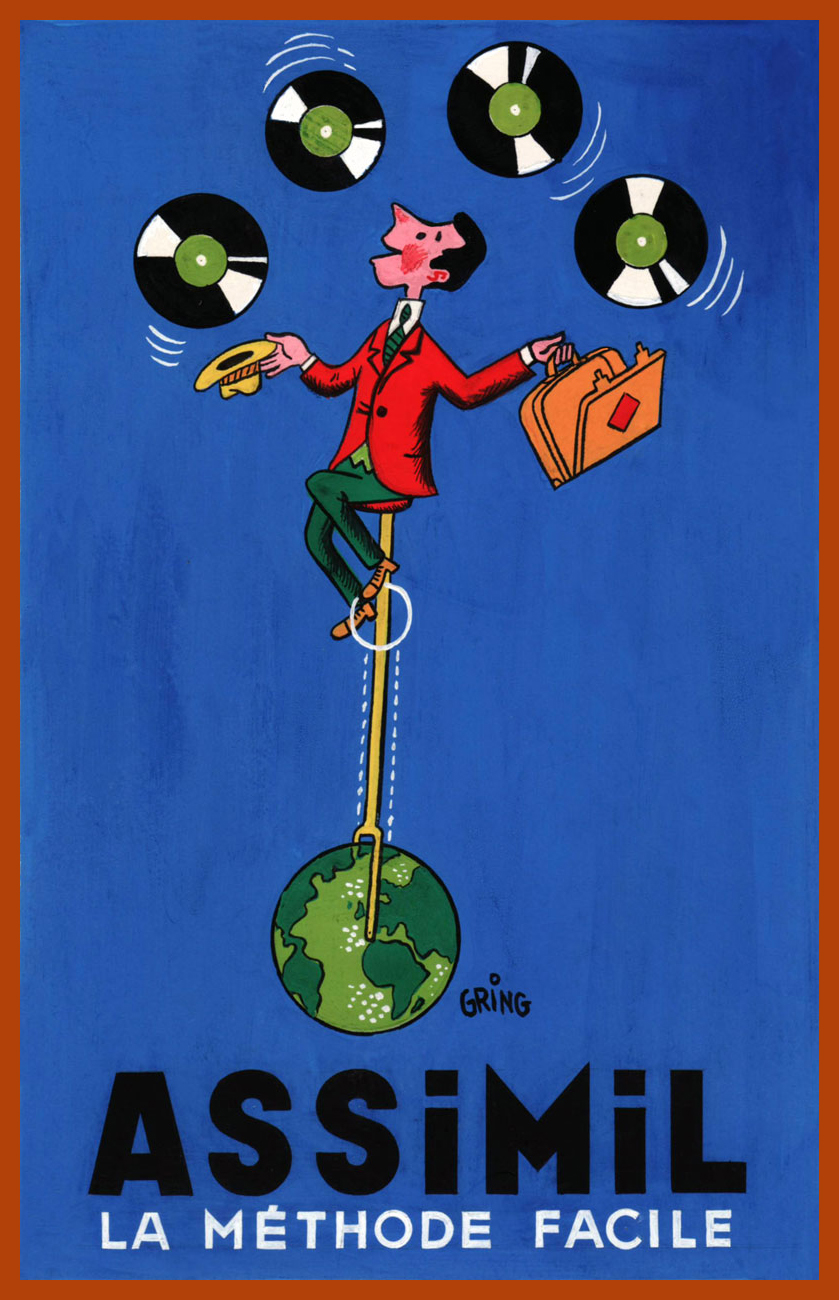
GringAssimilCouleurA
« But he would attain fame in most unexpected fashion. In order to enliven the austere pages of the Méthode Assimil, he is called upon to illustrate a variety of idioms for the manuals. Not only does his drawing prove itself effective for the learning of English, German or Spanish, but it makes these volumes funny and user-friendly. » This undated gouache illustration Gring created for Assimil is scanned from the original, a prized part of my collection.

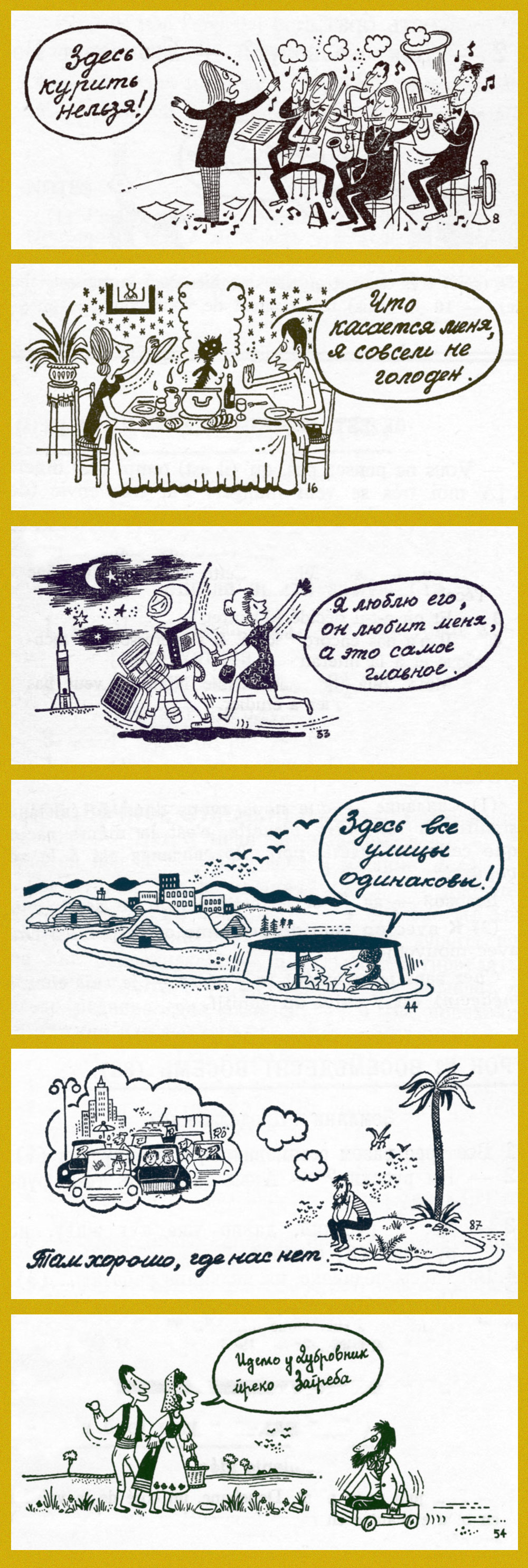
Here, then, are some excerpts from a couple of Assimil guides from my shelves:

GringAssimilA
1) « No smoking is allowed in here. » 2) « Personally, I’m really not hungry at all. » 3) « I love him, he loves me, and that’s what matters most. » 4) « All streets are exactly alike in these parts. » 5) « We’d always rather be where we’re not. » — from Le russe sans peine (1971, Assimil) and 6) « We’re headed to Dubrovnik by way of Zagreb. » — from Le serbo-croate sans peine (1972, Assimil). Thanks to Darko Macan for confirming that last translation!

GringTemoignage01A

GringTemoignage02A
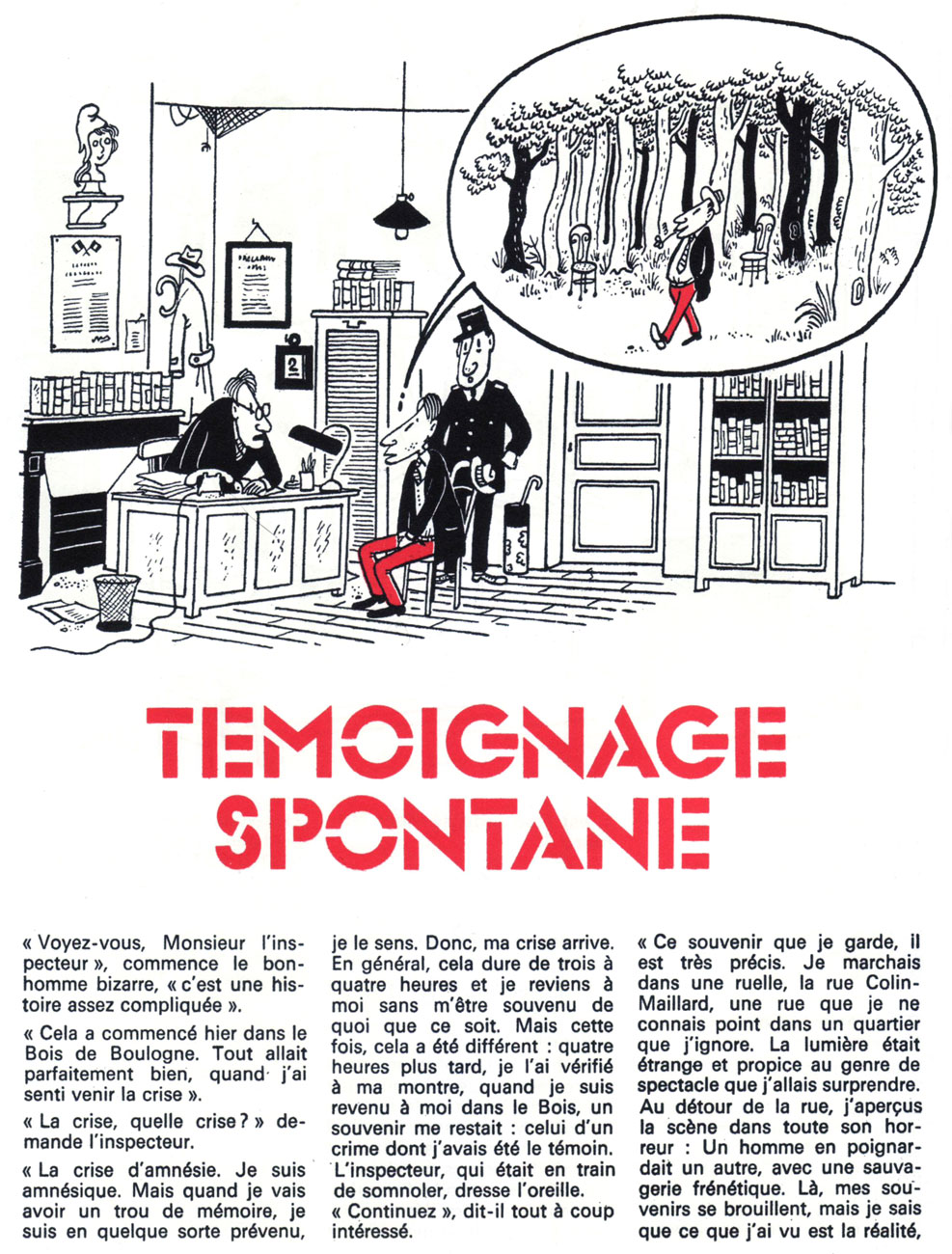
Gring was also a regular contributor to Ludo, Le journal des amateurs d’énigmes. If you can read this, here’s the solution, which I’m afraid requires prior knowledge of Paris in the 1970s: « Pendant sa crise, le bonhomme a sans doute marché jusqu’aux studios de Boulogne. La scène qu’il a surprise se déroulait dans les décors de cinéma. » Incidentally, a quality hardbound collection of this material was published in 2013 by Les Éditions Taupinambour. under the title of Les énigmes de Snark & autres mystères.
GringVirluxA
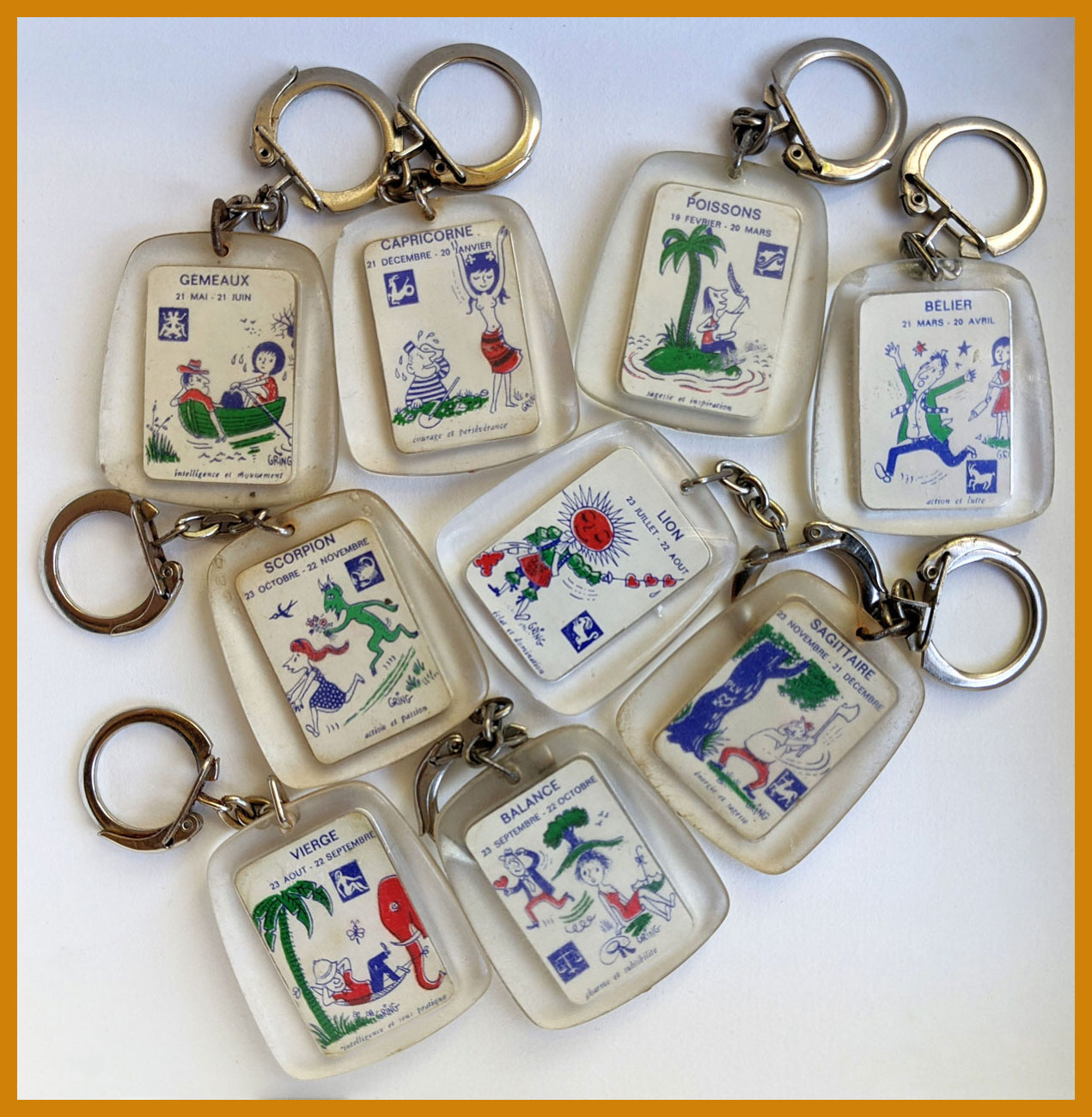
In the 1960s, Gring illustrated a popular series of keychains for Norman dairy company Virlux, featuring the signs of the Zodiac. I’m still missing Taurus, Aquarius, and Cancer (thanks, Matt!) as you can see.
RobertGringRogerDalA
A rare photograph of Monsieur Gring (left), and one of his writing partner, Roger ‘Dal’ Dalméras, date unknown.

-RG


Tire la chevillette: Jean Ache’s Little Red Riding Hood Variations

« … Out behind a tree
there jumped a great big hungry wolf
‘Pardon me’, he said, real cool

‘Why make the scene alone?
A crazy chick like you should have
a handsome chaperone’ » — Ridin’ Hood (The Coasters, 1962)

It could be quite convincingly claimed that Jean Ache (1923-1985,  Jean-Baptiste Huet in Le Havre, France) was the most versatile, chameleonic artist of his generation. Not only was he able to accurately adopt any style he chose, “high” or “low”, but he also wielded a panoply of styles of his own devising. To support my claim, take a peek at noted historian Henri Filippini‘s comprehensive survey of Ache’s career (in French), which includes a generous gallery of his multifaceted art. [ Part One ] and [ Part Two ]

From 1971 to 1973, near the end of René Goscinny‘s enlightened regime (his Astérix compère Albert Uderzo ably serving as art director), French bédé periodical Pilote featured a high-calibre series of “high art” pastiches. It was entitled Le Musée Pilote.

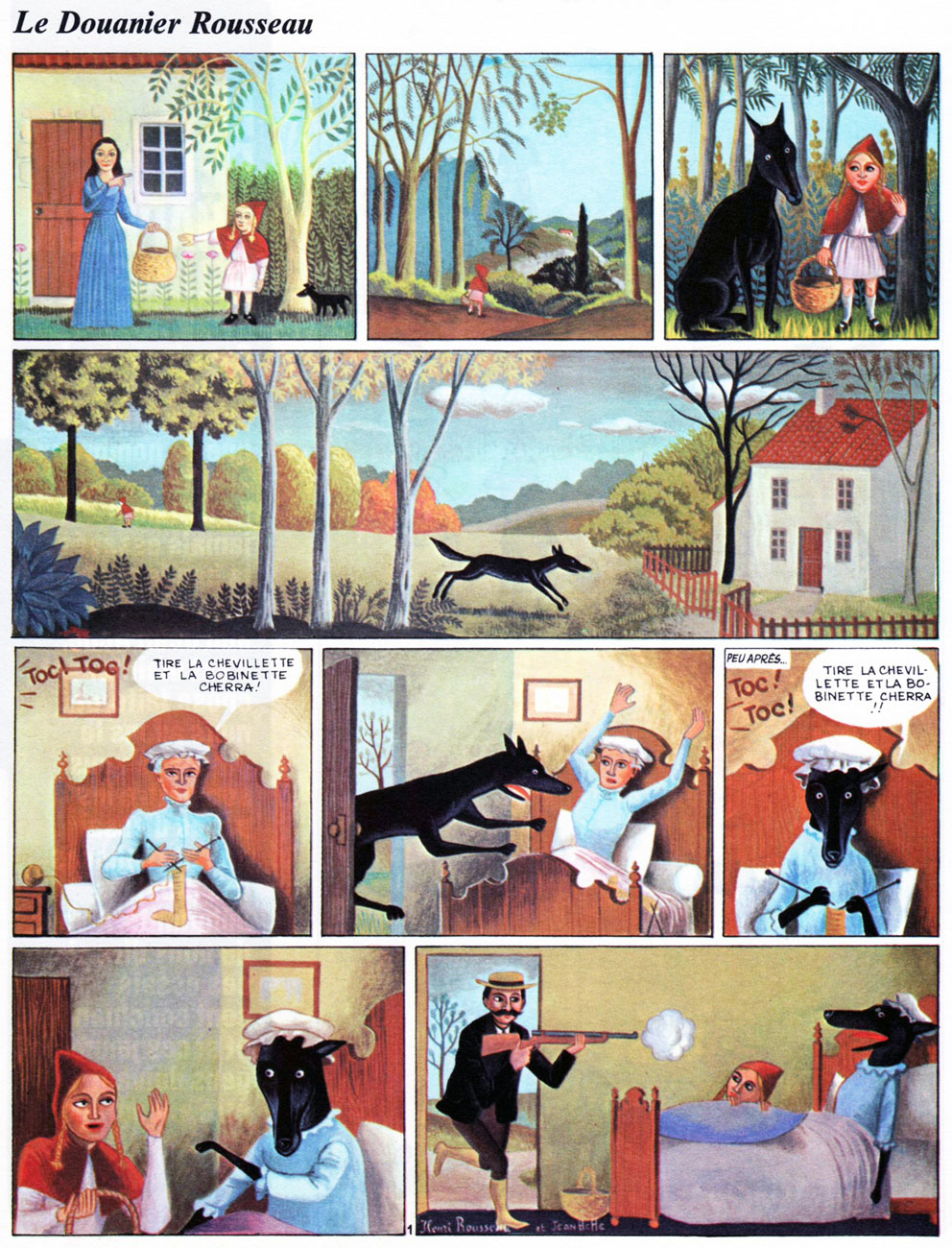
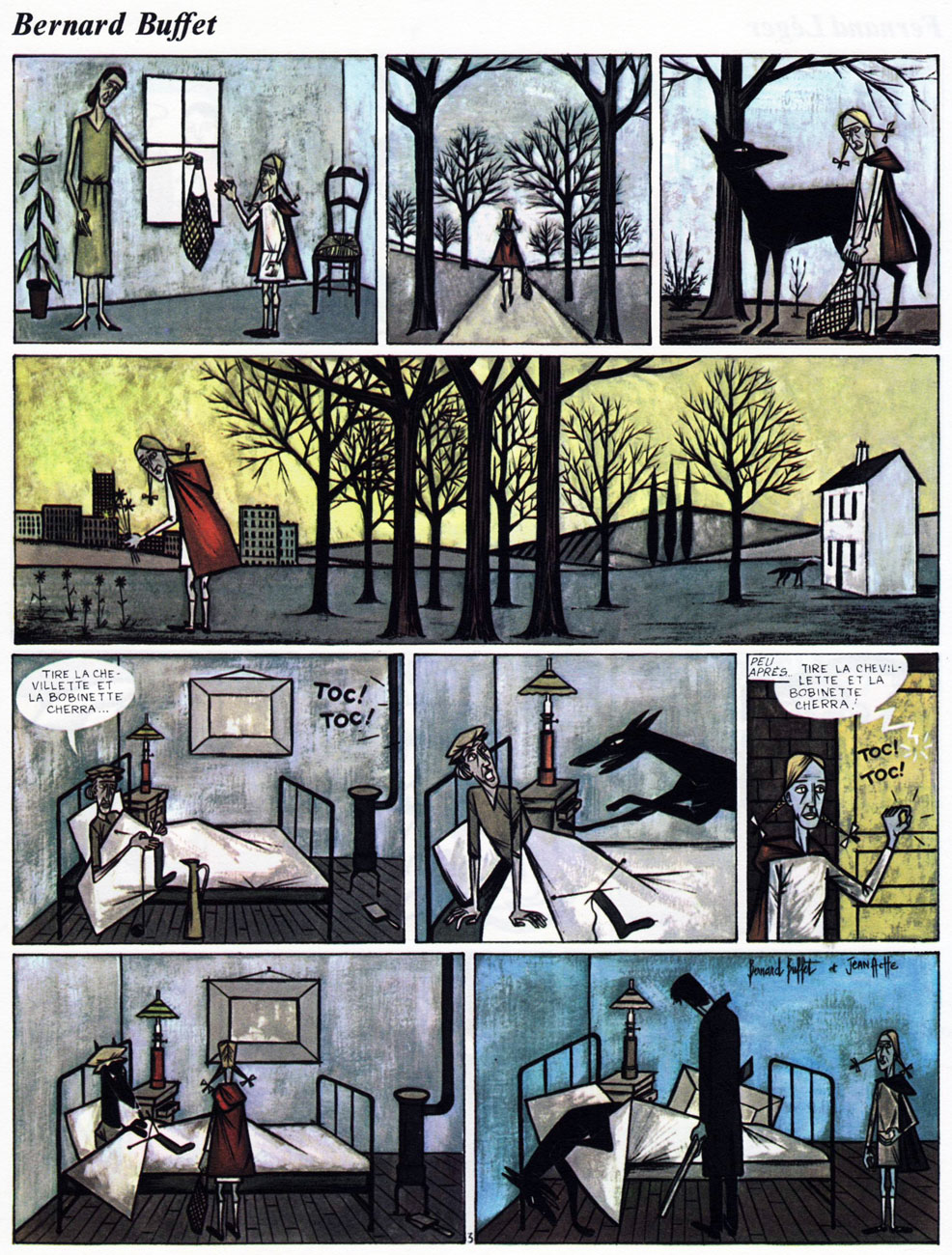
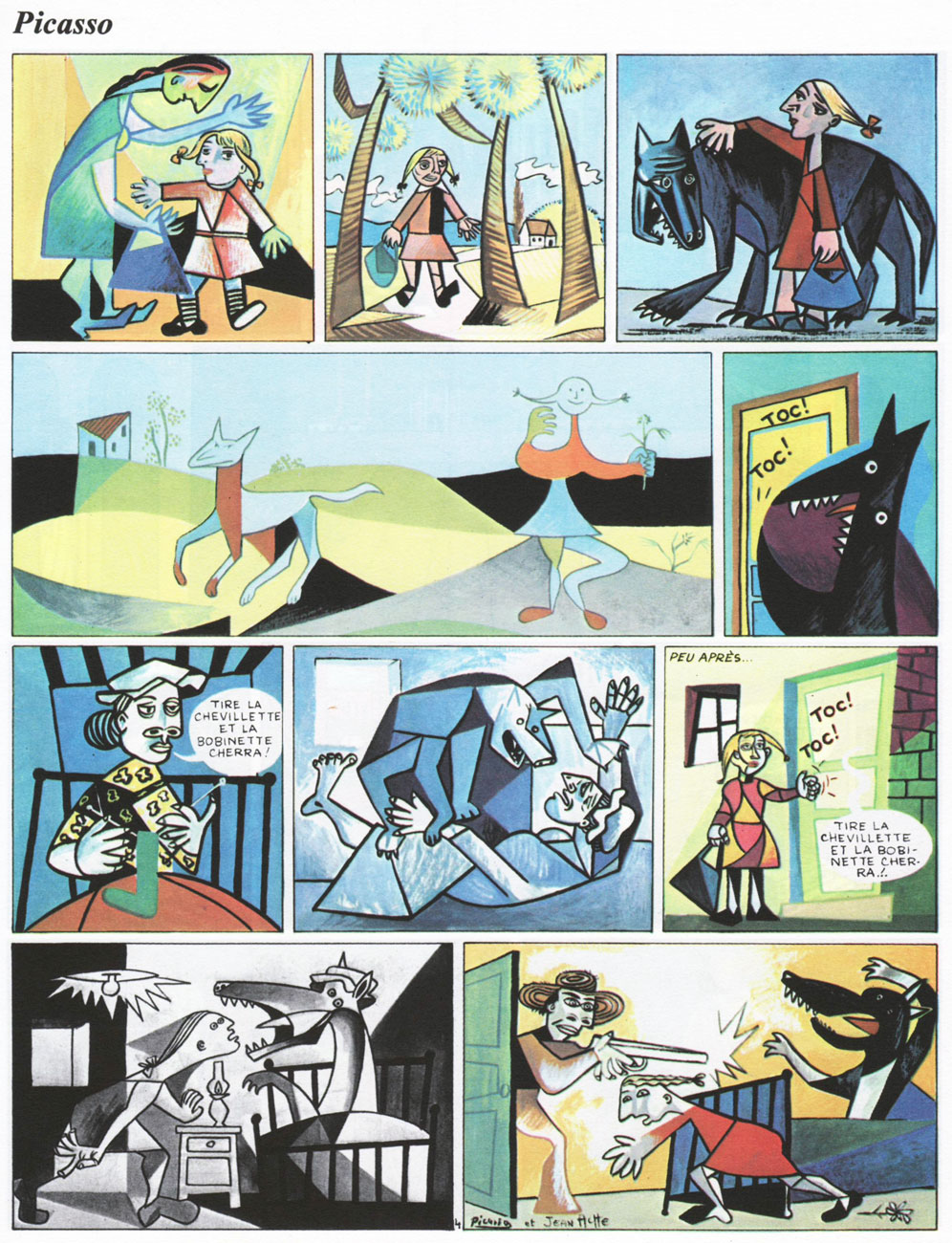
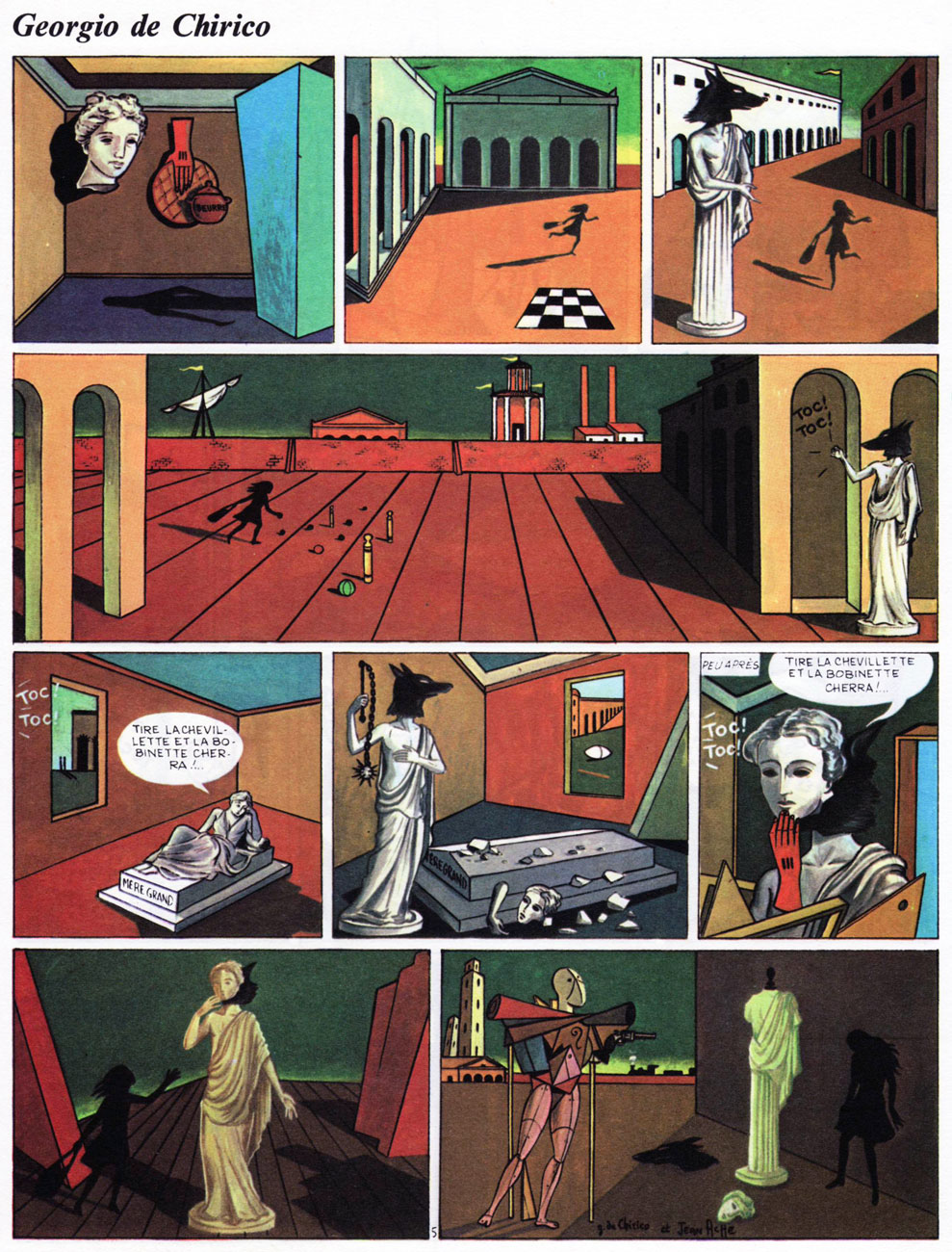
The pages of 1973’s Pilote Annuel revealed an Ache tour de force, wherein he retold the classic tale of Little Red Riding Hood in comics format *and* in the style of a number (seven, to be exact… but not *the* Group of Seven) of famous painters. The set bore the following cheeky introduction: « Within the scope of the Musée Pilote, we came to realise that numerous artists had never tried their hand at comics. Thanks to our friend Jean Ache, it is now a done deal, and we are pleased to present the tryout pages crafted by these illustrious beginners. It is for you to decide whether these attempts are conclusive, and if these young people’s efforts should be encouraged. »

Here we go!

AcheRousseauA
After Henri Rousseau (French, 1944-1910). Incidentally, « Tire la chevillette, la bobinette cherra » means « Pull the bobbin, and the latch will go up. »
AcheLégerA
After Fernand Léger (French, 1881-1955).
AcheBuffetA
After Bernard Buffet (French, 1928-1999).
AchePicassoA
After Pablo Picasso (Spanish, 1881-1973).
AcheDeChiricoA
After Giorgio de Chirico (Italian, 1888-1978).
AcheMiróA
After Joan Miró (Spanish, 1893-1983). My first encounter with Miró came through this item; if I’d been hipper, it might have been this instead… but I was only six years old at the time.
AcheMondrianA
After Piet Mondrian (Dutch, 1872-1944).
PiloteAnnuelA
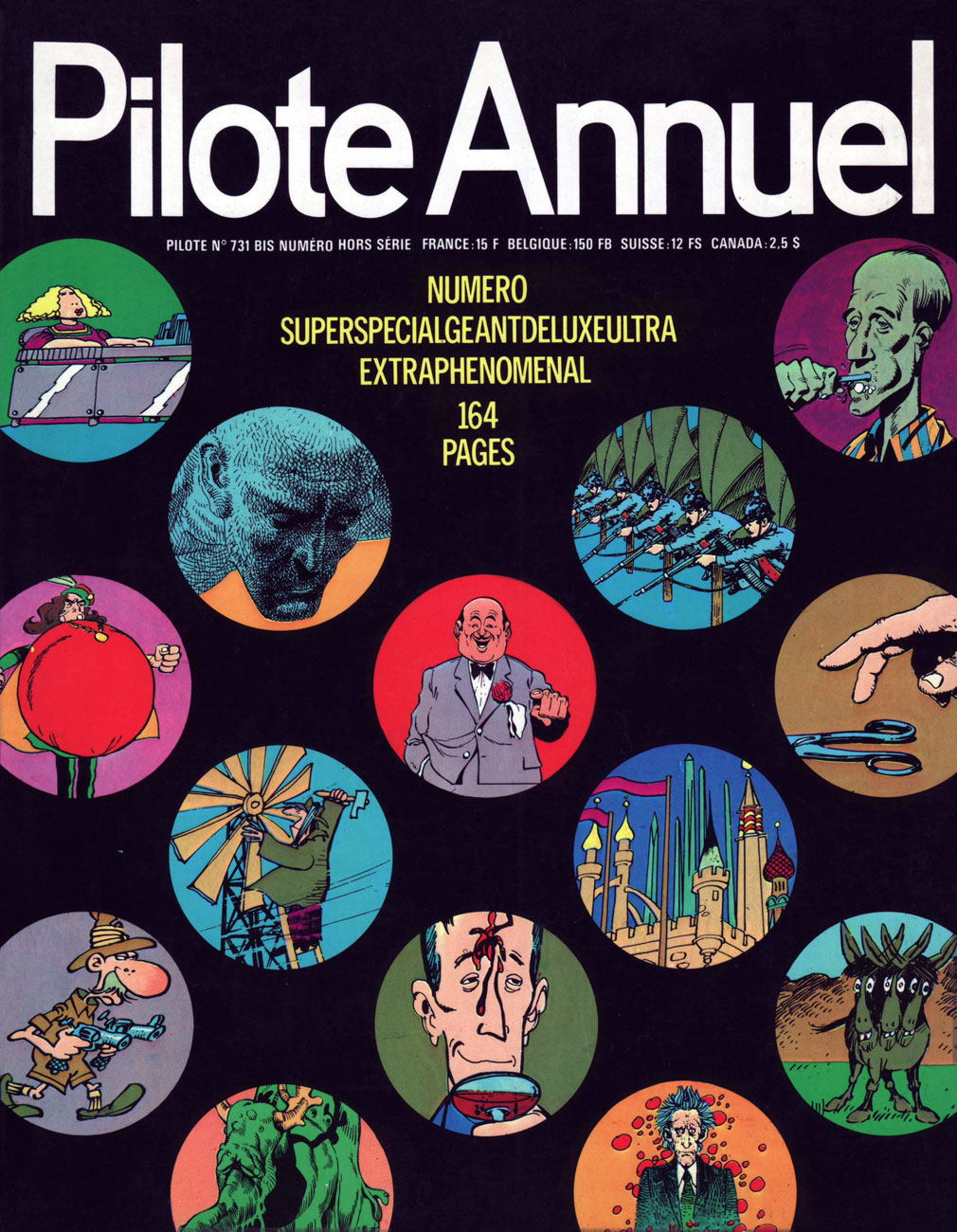
And here’s the cover. This is Pilote Annuel 74 (no. 731 bis, Nov. 1973). It comprised, in roughly equal measure, a selection of the past year’s best work and new material.

My initial brush with Ache came in the early 1970s and his short-lived Pastec (1968-70, 9 issues, plus one album). I only ever got my hands the album (« L’Agent secret chante à minuit », 1971), but I never forgot. Like many a childhood fascination, it came out of nowhere, then vanished.

AchePastecA
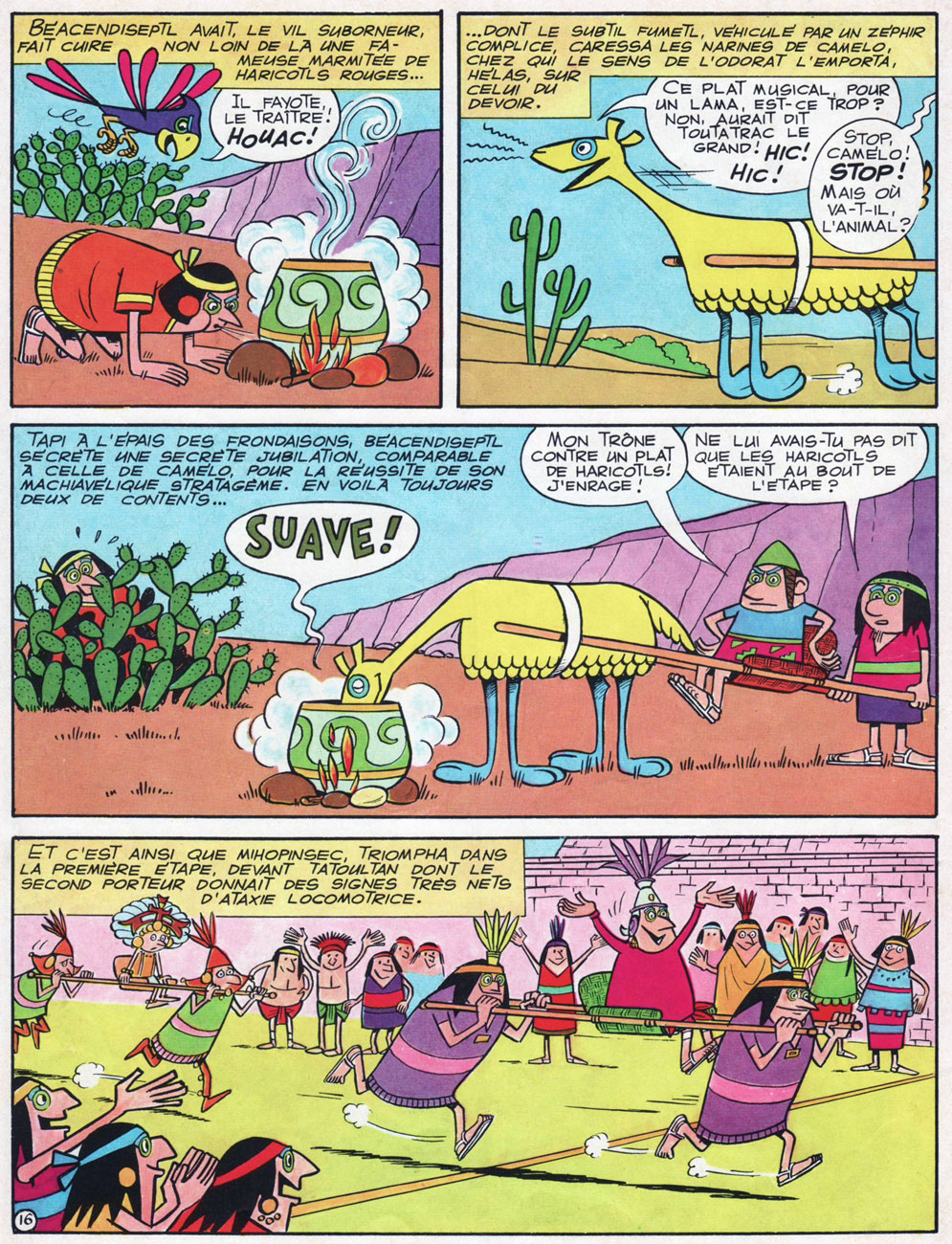
A sample from Pastec no. 4 (January 1969, Société française de presse illustrée). The birdie is Psitti, Pastec’s loyal Ara; the Llama is Camélo; and Pastec himself is the displeased fellow with the green hat in the middle tier.

I honestly hadn’t planned to write two consecutive posts about nearly-forgotten French artists named Jean, but something else fell through… and here we are. Sorry!

-RG
Jean Mad’s Enigmas and Anomalies

« A good puzzle, it’s a fair thing. Nobody is lying. It’s very clear, and the problem depends just on you. » — Erno Rubik

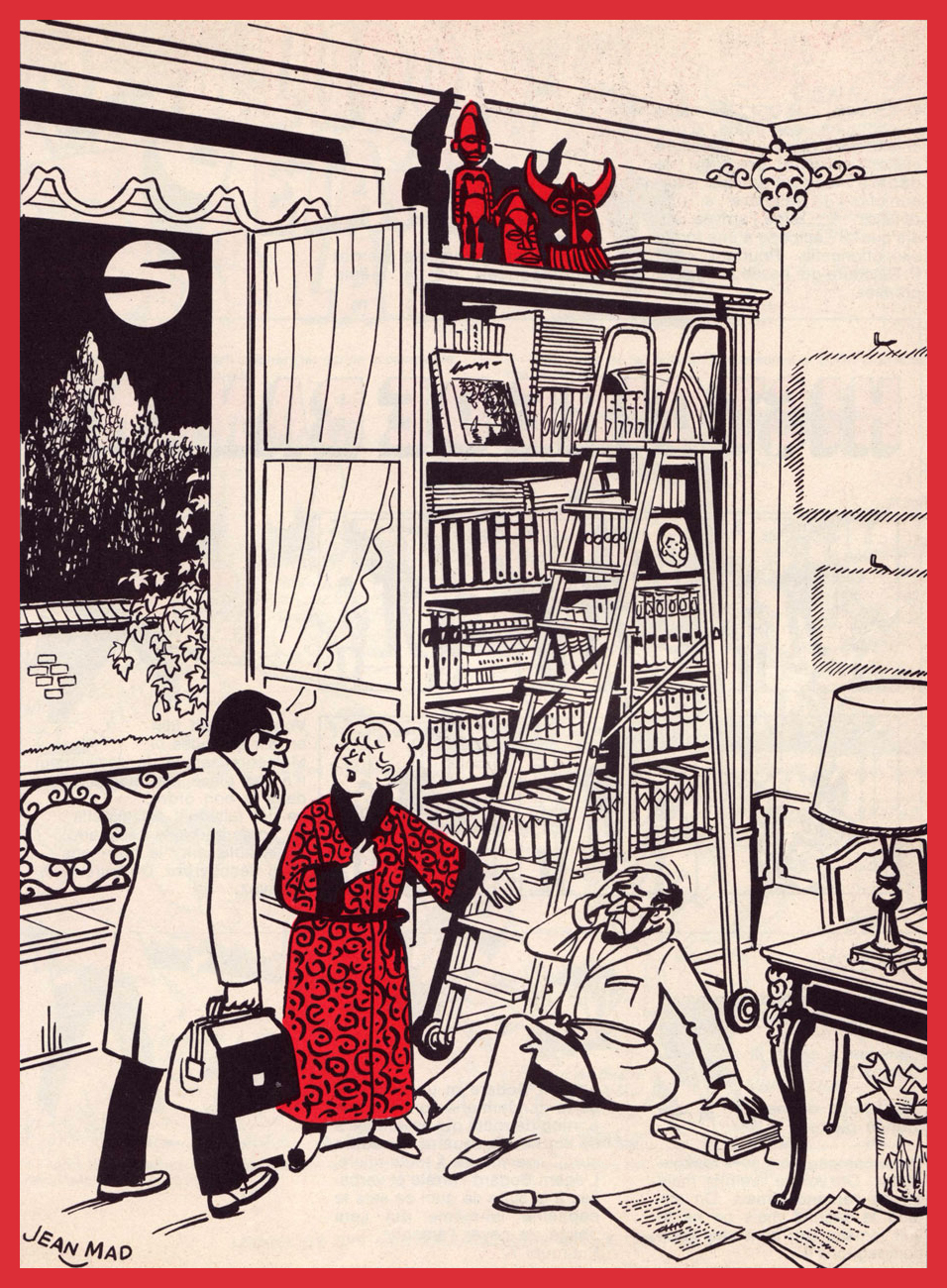
Jean Mad… now who’s he? A once-popular and prolific French cartoonist and illustrator, largely forgotten today, in part because his body of work appeared, frequently unsigned, in ephemeral periodicals… and hardly any of it was ever collected or reprinted. So he isn’t a household name, if he ever was, but his distinctive style will ring a bell among francophone readers of a certain age.

Now for a little context: in 1959, Belgian publisher Marabout launched a wildly popular series (nearly 500 titles between 1959 and 1984!) of pocket books called Marabout Flash, and the little tomes’ handy format (11,5 x 11,5 cm) and low cost “inspired” French publisher Vaillant, in 1962, to borrow the idea (at a size of 11,5 x 12 cm… to sidestep legal repercussions) for cheap reprint collections of José Cabrero Arnal‘s Pif le chien strips, which had been running in communist newspaper L’humanité since 1948. The format decided upon was 100 gags – 100 jeux (« 100 gags – 100 games »). It was an instant hit (quickly reaching 150 000 copies sold per issue), and soon generated numerous spinoffs. But the games half of the equation was, for a long time, rather shoddily-illustrated. By the turn of the decade, though, thanks to several judicious additions (Jean-Claude Poirier, Jean Marcellin and Henri Crespi, to name but a few) to the production staff, the product looked pretty spiffy. Which brings us to Mr. Mad, who first turned up in 1969… and came and went throughout the 1970s.

JeanMadAnimauxVF_A
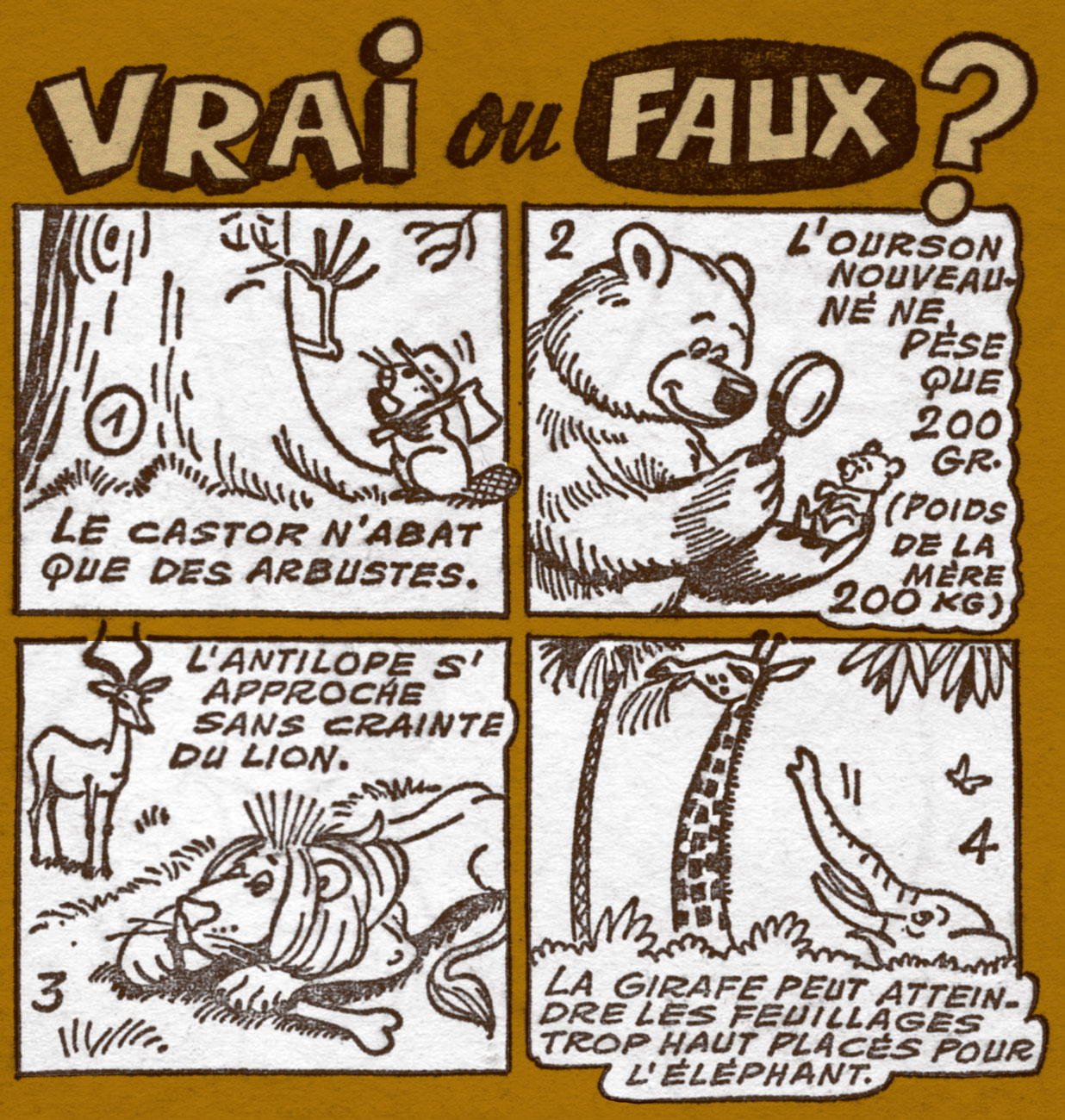
True or False? 1) The beaver only fells small trees 2) A newborn bear cup weighs a mere 200 g; its mother weighs 200 kg; An antelope can approach a lion without fear; A giraffe can reach foliage beyond the reach of an elephant. (1)-False: beavers have to known to drop trees up to 30 m high and 2 m in diameter; (2)-True; (3) True, when he’s full; (4) False: an elephant can just lean against a tree, bending it to reach the foliage it seeks.) From Pif Poche no. 71 (July, 1971, Vaillant).
JeanMadCostumeRobotA
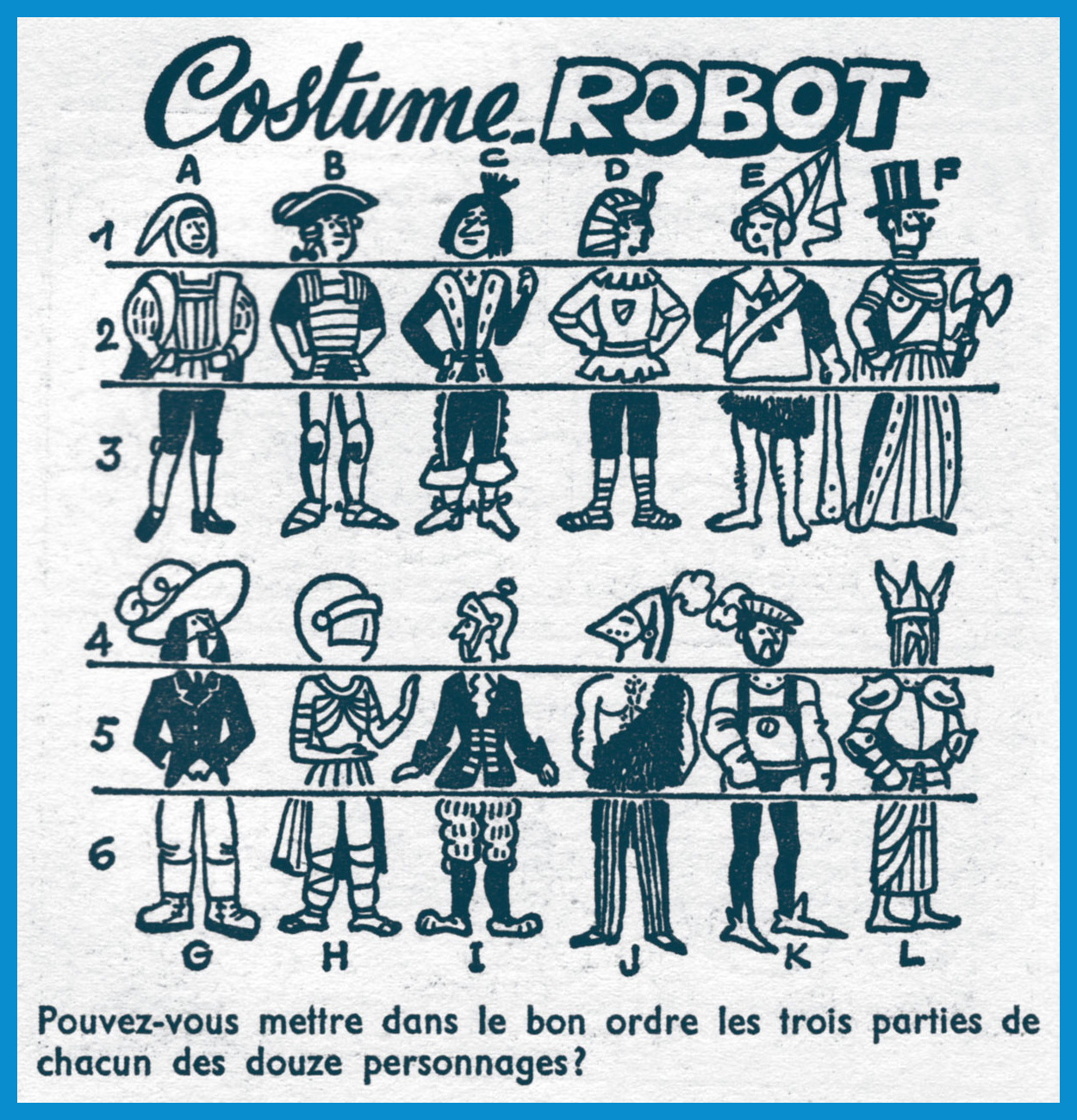
Mad was a master of historical detail. A1-D2-R6 (Middle Ages); B1-I5-A3 (Louis XV); C1-J5-E3 (Prehistory); D1-H5-L6 (Ancient Egypt); E1-C2-F3 (Lady of the manor); F1-G5-J6 (1900); G4-E2-C3 (Musketeer); H4-R5-G6 (Cosmonaut); I4-B2-D3 (Roman); J4-L5-B3 (Knight); S4-A2-I6 (Renaissance); L4-F2-H6 (Gaul). From Pif Poche no. 71 (July, 1971, Vaillant).
JeanMadArbrePerchéA
Mad’s economical, chiaroscuro style came to mind when I later encountered Joseph Mugnaini‘s classic illustrations for Ray Bradbury’s The October Country. In this one, you have to find the hidden crow from Aesop’s timeless fable. From Pif Poche no. 70 (June, 1971, Vaillant).
JeanMadÀTableA
« While observing these odd guests, try to find the six idioms that each one evokes and that all have to do with the table. » (1) Manger son pain blanc le premier; (2) Mettre de l’eau dans son vin; (3) Mettre les pieds dans le plat; (4) Mettre les bouchées doubles; (5) Tourner la cuillère autour du pot (“beat around the bush”); (6) Couper la poire en deux; From Pif Poche no. 70 (June, 1971, Vaillant).
JeanMadDiableA
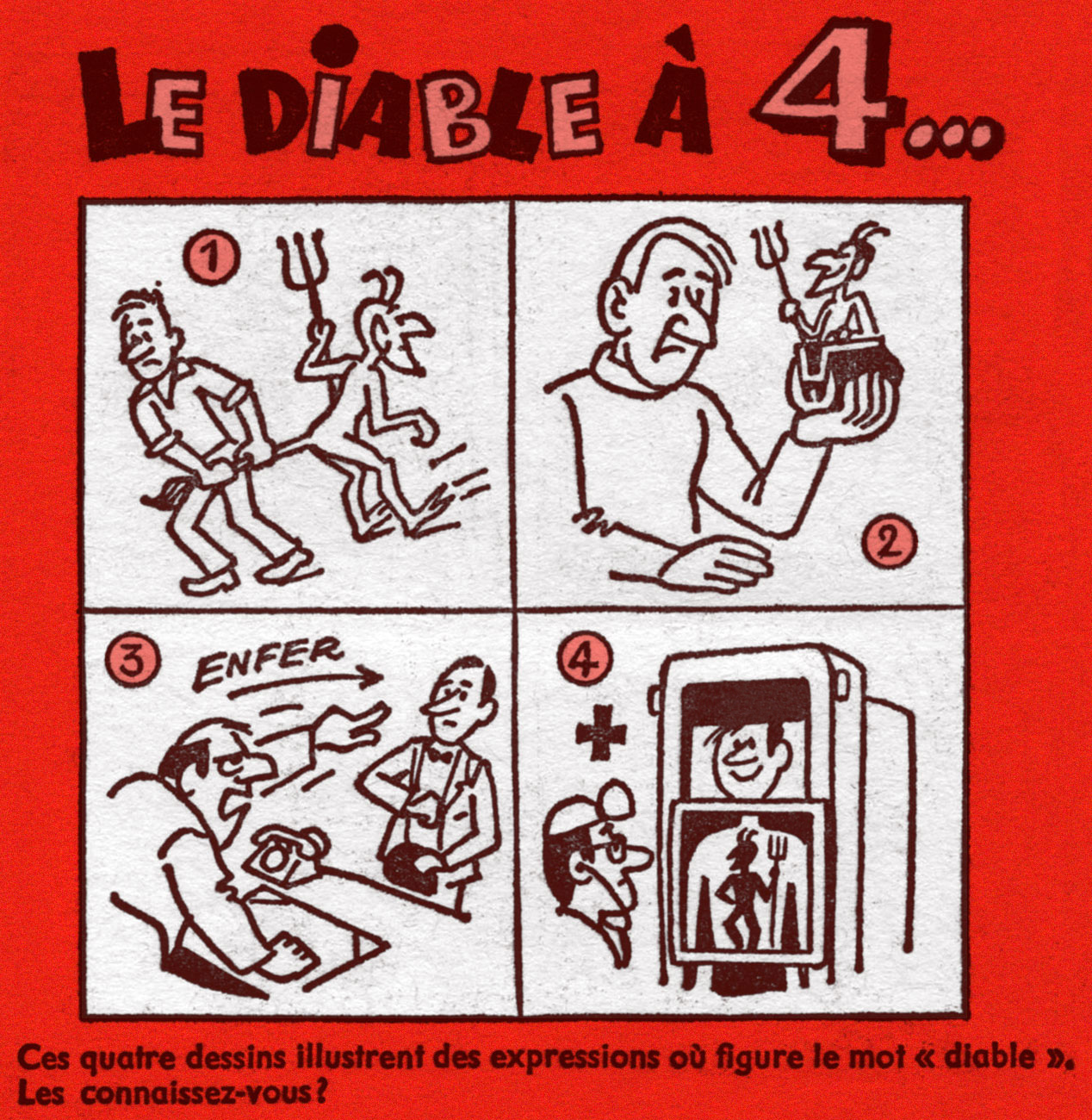
« These four drawings illustrate idioms featuring the word ‘devil’. Do you know them? » (1) Tirer le diable par la queue; (2) Loger le diable dans sa bourse; (3) Envoyer quelqu’un au diable; (4) Avoir le diable au corps. From Pif Poche no. 68 (April, 1971, Vaillant).
JeanMadBandesA
A cute demonstration of Mr. Mad’s versatility, from Ludo, le journal des amateurs d’énigmes no. 3 (Oct. 1973, Vaillant). « These four drawings are excerpted from different strips, but all have one detail in common. Which one? » The solution was to be provided in the following issue, which I only acquired decades later… but I’m sure you can suss out the answer to this one.
JeanMadMauvaiseChuteA
Prior to encountering this piece in Ludo, le journal des amateurs d’énigmes no. 1 (Feb. 1973, Vaillant), I had no clue as to the identity of the mystery artiste. I guess this piece was large and elaborate enough to warrant a signature.
JeanMadEnfinVoitureA
« A car at last! » « Where? » A bit of a cheat, that one. How was I to know, at age six, that a “DS” was a French car, even one as lovely and classic as the Citroën DS? We didn’t have those around where I grew up, and that’s a shame. From Pif Poche no. 70 (June, 1971, Vaillant).
JeanMadGaffeA
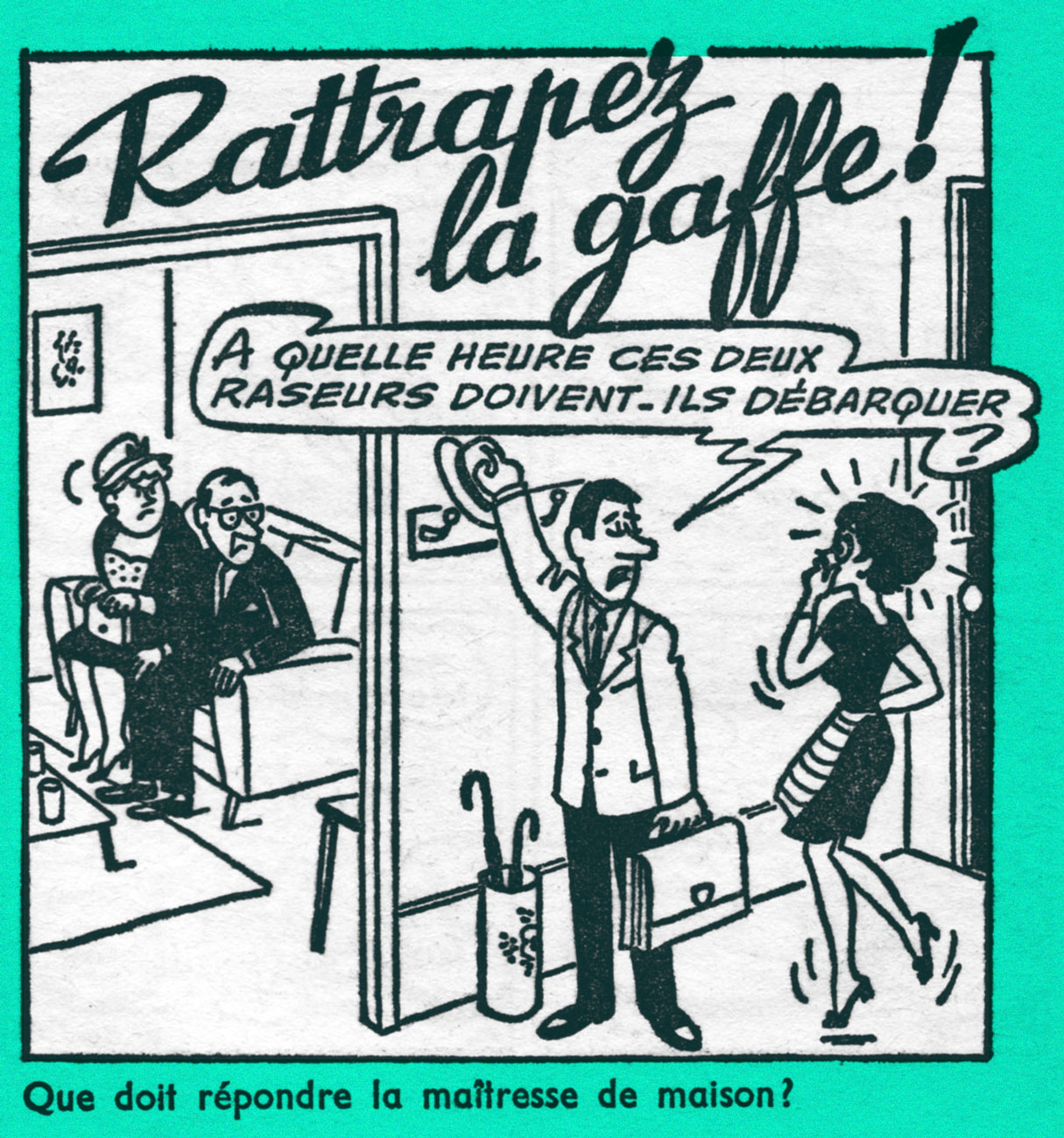
A surprisingly adult situation, given the audience. Catch the gaffe!: The man of the house, having queried his spouse: « At what time are those two drips due to drop in? », what should be her reply, to salvage the situation? « They had to cancel. But our friends, X… have just arrived. » From Pif Poche no. 71 (July, 1971, Vaillant).
JeanMadMonturesA
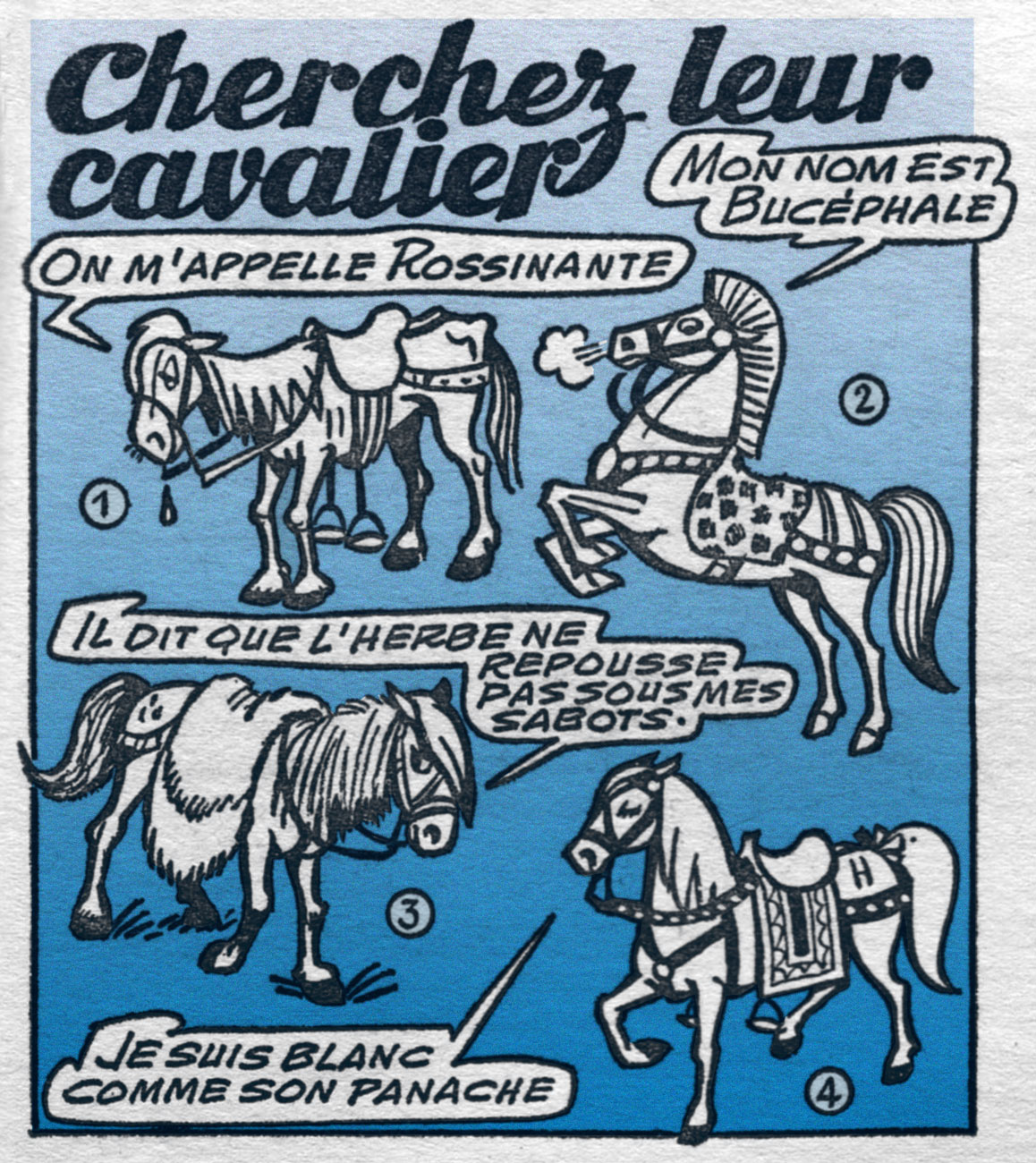
An artist who can not only draw steeds, but depict various equine types and personalities… now, that’s skill. From Totoche Poche no. 20 (March, 1971, Vaillant). Name Their Cavalier: (1) Don Quixote; « I am called Rossinante » (2) Alexander the Great; « Bucephalus is my name » (3) Attila the Hun; « The grass never grew back where I trod » (4) Henri IV (Henri de Navarre); « I am white, as is his panache ».
JeanMadProdigesA
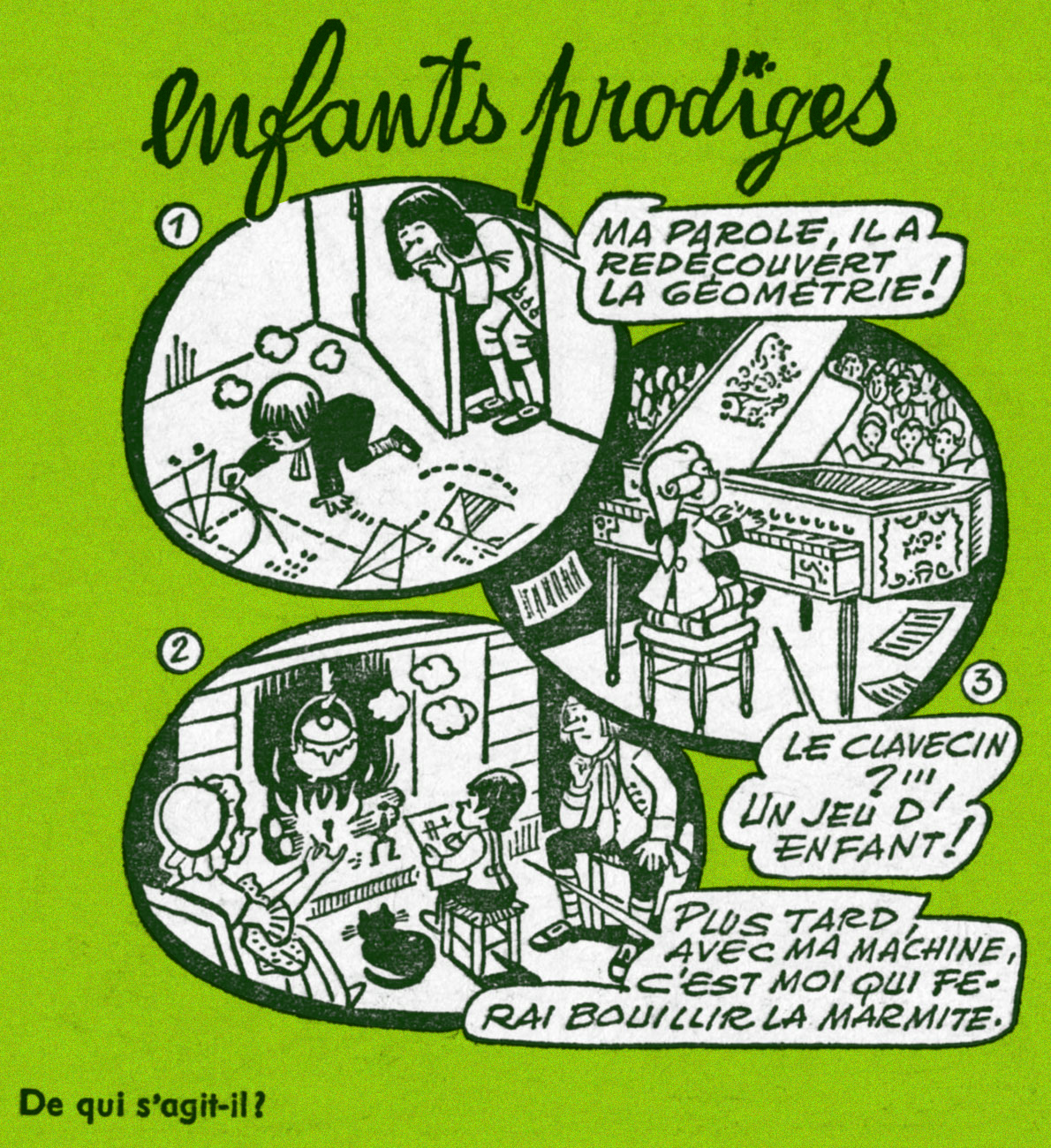
Child Prodigies: (1) « My word, he’s rediscovered geometry! » (Little Blaise Pascal) (2) « Later on, with my machine, I’ll be making the pot boil. » (Little Denis Papin) (3) « The harpsichord? Child’s play! » (Little Wolfgang Amadeus Mozart). From Pif Poche no. 68 (April, 1971, Vaillant).

I suppose I didn’t think twice about it when I was a kid, but it seems to me, in hindsight, that kids in those days were expected to possess quite a baggage of eclectic knowledge pertaining to history, geography, language, architecture, logic, observation… As an omnivorous, voracious reader, that state of affairs suited me to a T, and so these dense little volumes nourished me considerably at a time when I was most receptive to such gleanings. Inevitably, both the comics and the puzzles were soon dumbed down, but I had moved on by then.

-RG
Tentacle Tuesday: le mardi des tentacules, parbleu!

In my ceaseless quest for tentacles, once in a while, I return to a previous theme – in this case, the Franco-Belgian tradition of comics. To start at the beginning, visit Tentacle Tuesday, Franco-Belgian edition parts 1 and 2, and Tentacle Tuesday: Tentacules à la mode.

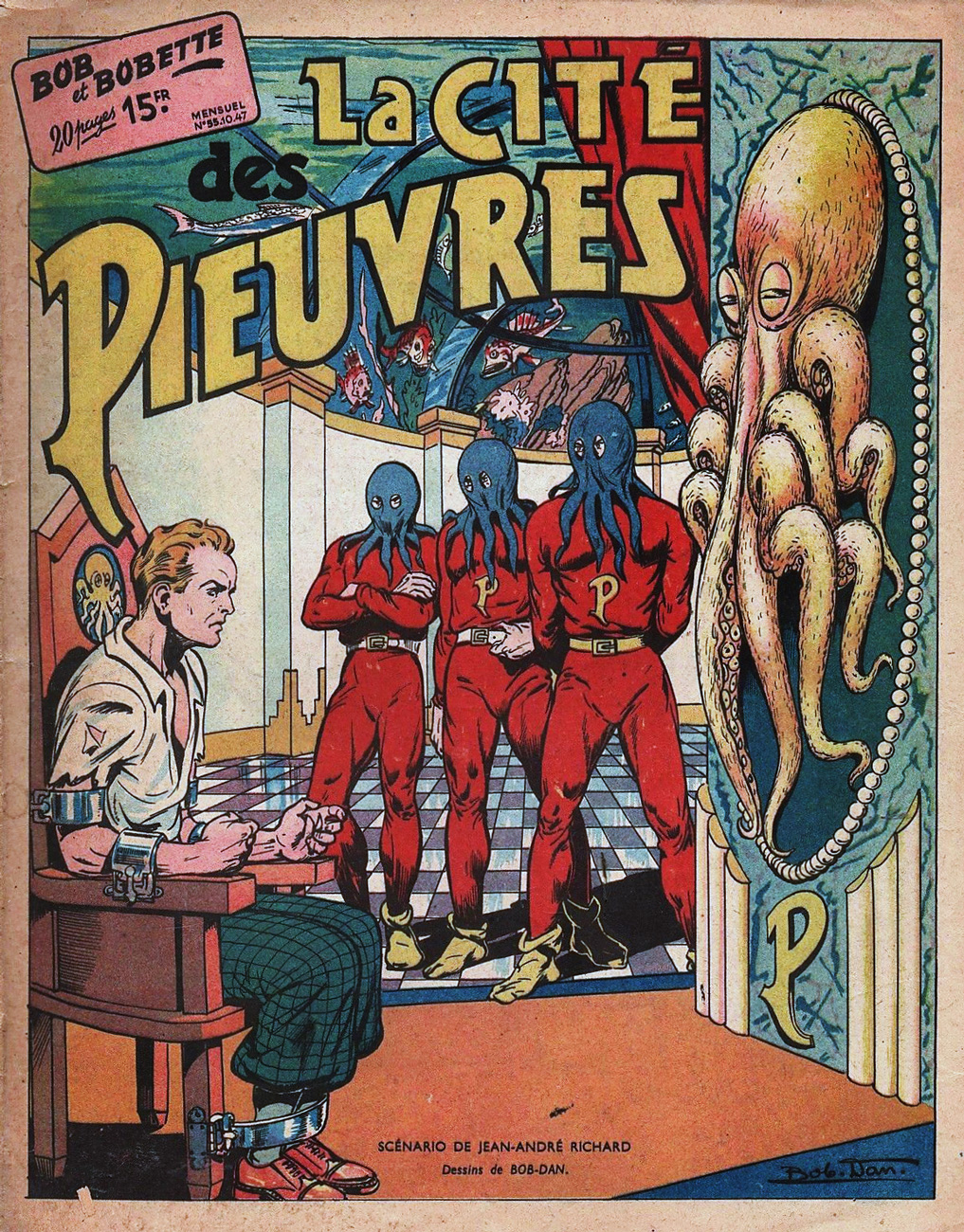
We start some 70-some years ago, with an issue of Bob et Bobette, a Belgian feature created by Willy Vandersteen in 1945. Well, to be more precise, the latter created Suske en Wiske — when the strip became popular in its native De Standaard (a Flemish daily newspaper), it was picked up by Tintin magazine, after Vandersteen agreed to modify it somewhat according to Hergé (who was the magazine’s artistic director) and his Ligne claire guidelines. The main characters were renamed – far from the last time that happened: in Britain, they were known as Spike and Suzy, and as Willy and Wanda in the United States.

BobetBobette-Lacitédespieuvres
Bob et Bobette no. 55: La cité des pieuvres (1947). Scripted by Jean-André Richard and illustrated by Robert Dansler, who was often known as Bob Dan. That lovely sepia paper… I can just smell it.

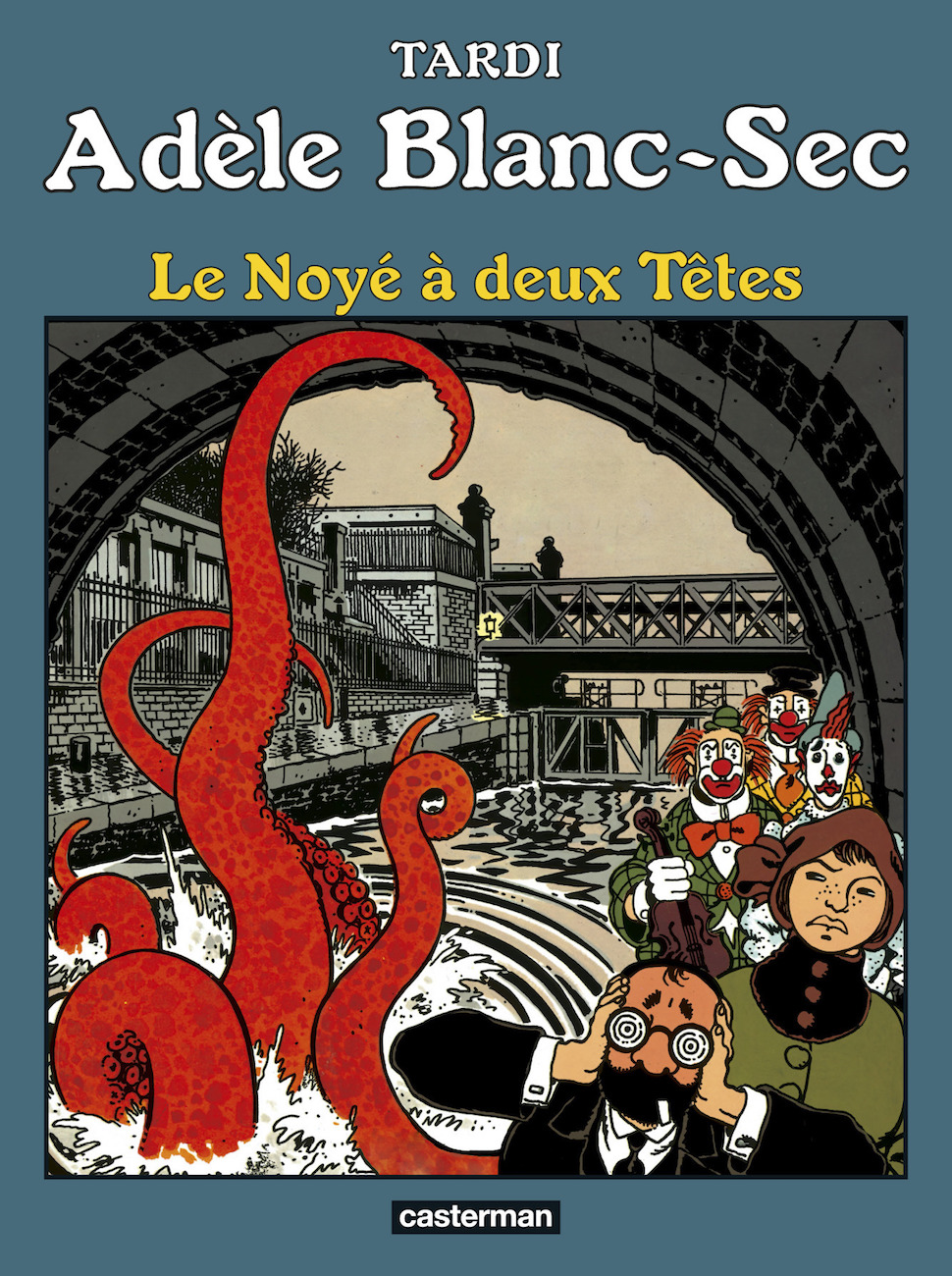
I’ve never read a whole album of The Extraordinary Adventures of Adèle Blanc-Sec, though I like its premise (an intrepid, independent héroïne? yes, please) and Jacques Tardi‘s art (depending; sometimes I love it, sometimes I’m indifferent, but it’s certainly good enough for purposes of following a story). Chalk it down to something I never got around to, I guess. Irritatingly, in 2010 we have been *ahem* ‘blessed’ with a movie based on this comic, directed by the ever sharp-witted Luc Besson (who royally fucked up a movie adaptation of Valérian et Laureline in 2017, so he seems to be making this into a specialty).

French-Tardi-lenoyeradeuxtetes
Le Noyé à deux têtes is the sixth volume of Les Aventures extraordinaires d’Adèle Blanc-Sec, a series by Jacques Tardi. In 1984, it was serialised in À suivre, a Franco-Belgian magazine, and collected as an album a year later (both by Casterman).
French-Tardi-lenoyeradeuxtetes-tentacules
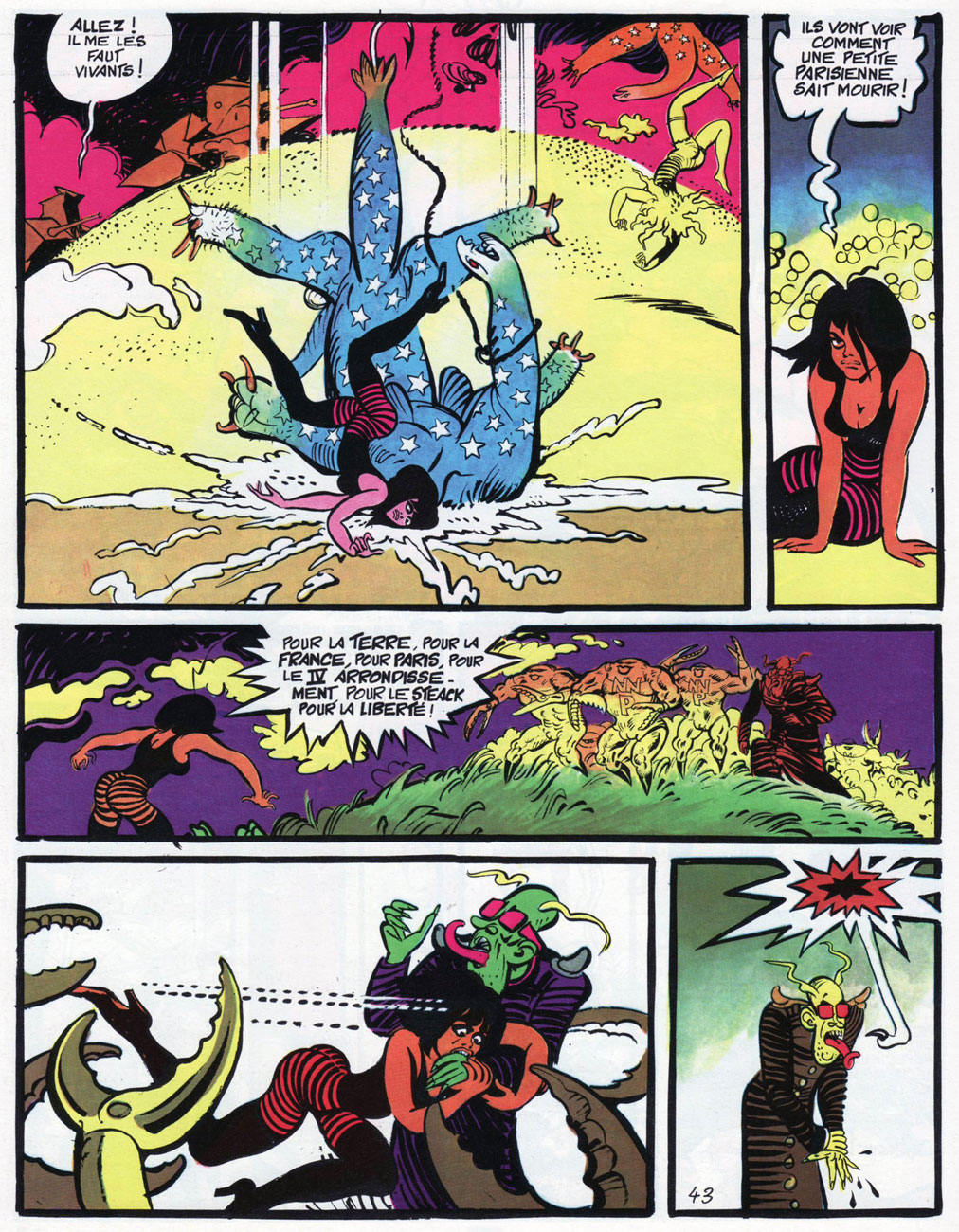
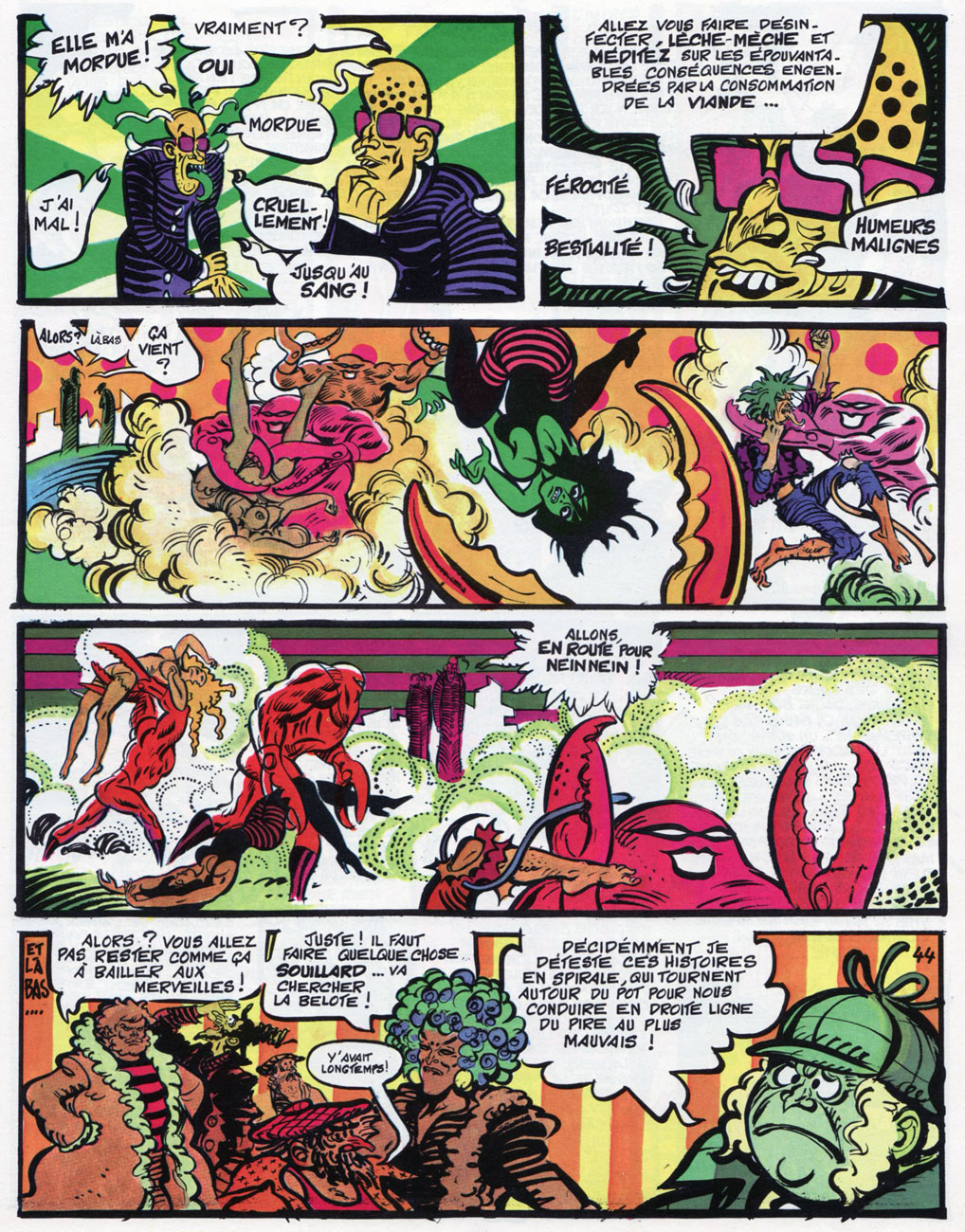
A peek at the tentacles within.

I mentioned the comics magazine Le journal Tintin earlier – here’s a cover from its competitor, Spirou (Le journal de Spirou), published by Éditions Dupuis since 1938. The respective publishers (Raymond Leblanc for Tintin, and Charles Dupuis for Spirou) of these magazines had a gentleman’s agreement: an artist’s work could only be published in one or the other, never both. Incidentally, there was an interesting exception in the case of André Franquin, who moved his wares from Spirou to Tintin after a quarrel with its editor – and, contractually obligated to work for Tintin for five years, simultaneously continued to provide Spirou with stories.

Spirou1771BriceBoltA
Spirou no. 1771 (march 23rd, 1972), art by Puig. Brice Bolt, a feature launched in 1970, was soon abandoned after but two episodes (although to be fair, they were lengthy – the strip lasted until 1972)… from the sound of it, for being a little too modern for its time. After the publication of the first chapters, letters came in complaining that the story was too scary, the animals too monstrous, the illustration style too realistic. The “monstrous animals” included an army of giant crabs, a behemoth squid (just up our street!), colossal vampire bats, and ginormous Komodo dragons.

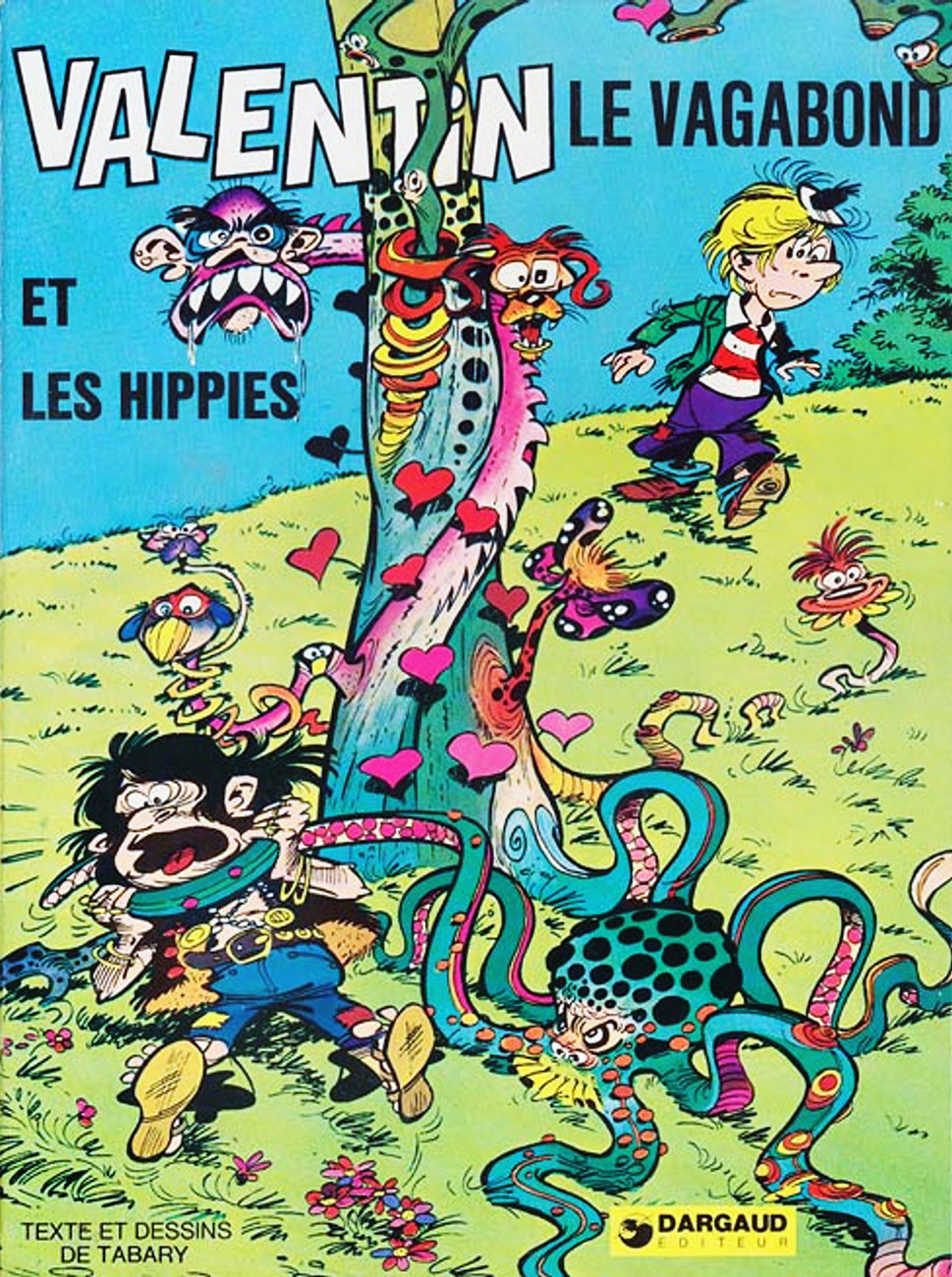
Valentin le vagabond was created by René Goscinny et Jean Tabary in 1962 for publication in Pilote. After 1963, Tabary carried on alone, scripting and illustrating all by his lonesome, Goscinny having his hands full with other projects. Valentin le vagabond et les hippies is the final story of this series, originally serialised in issues 709 to 719 in 1973.

Valentinlevagabond-Valentinetleshippies
Valentin le vagabond: Valentin et les hippies (Dargaud, 1974). Story and art by Jean Tabary.
ValentinHippiesA
An excerpt from Pilote no. 719 (1973). The tree is a hippie tree, as it was treated with LSD… now it’s got tentacles. Naturally.

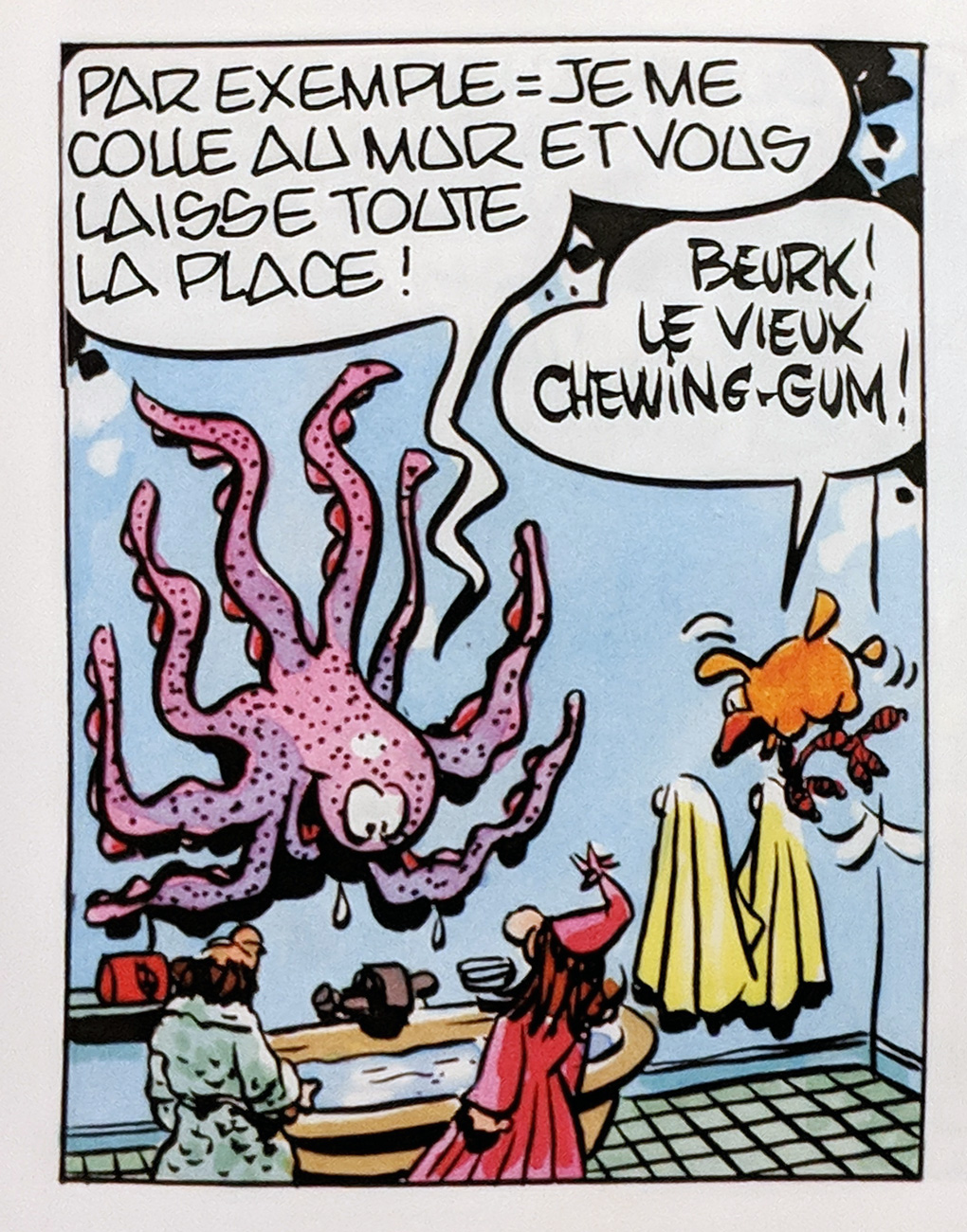
The French are surely not immune from scatological humour. The Kaca fairy (I’ll give you three guesses for what “kaca” means in French) is a rather inept witch. She accidentally conjures up an octopus who’s a little too intent on being liked, and the rest of the comic deals with the attempts to whisk him away again.

FeeCaca-1
« Hurry up and make this monstrosity disappear! » « Yes, yes, I’m looking, but nothing works! » Panels from La fée Kaca (Humanoïdes Associés, 2007) by Florence Cestac.
FeeCaca-2
The octopus tries to convince everybody that they should allow him to stick (ha, ha) around – « for instance, I stick myself to the wall and leave you with all the room you need! ».

~ ds

Jean-Claude Forest, ‘Father of Adult Comics’

« J’fais dans la bande dessinée, qu’est bien plus pop que le ciné!* » — J.C. Forest (Une chanson, 1973)

On the eighty-ninth anniversary of his birth, let’s salute in passing one of the great pioneers of French comics, namely Jean-Claude Forest (Sept. 11, 1930 – Dec. 29, 1998), Barbarella’s creator, the man who, in the early 1960s, ushered strictly-for-kids bandes dessinées into decidedly more risqué and adult realms of eroticism, fantasy and fun.

Born on September 11, 1930 in the Parisian suburb of Le Perreux-sur-Marne, he passed away in 1998 at the age of 68, but not before leaving behind a body of work of breathtaking depth and variety. Barbarella aside (sorry, miss): Le Copyright (the springboard for Nikita Mandryka‘s Le Concombre masqué), Hypocrite, Mystérieuse matin midi et soir (his wild riff on Jules Verne’s L’île mystérieuse), Bébé Cyanure, Les Naufragés du temps (illustrated by Paul Gillon), Enfants c’est l’Hydragon qui passe… « et j’en passe », as they say.

Here are a few highlights to give you a sense of the man’s imagination, versatility and tremendous draftsmanship, in chronological order.

BarbarellaA
An excerpt is from Les colères du mange-minutes (1965-66), the second volume of Barbarella’s adventures. Yes, there was a film adaptation, but it’s, well, pretty vapid. Director Roger Vadim was kind of the Gallic John Derek; both were fair-to-middling directors whose chief talent was womanizing. Though one has to admit it *was* quite a talent.
GiffWiffMarieMathA
« No, you mustn’t love me… » Detail from the cover of giff wiff, revue de la bande dessinée no.22 (Dec. 1966), previewing its article on Forest’s 1965 experimental tv cartoon Marie Mathématique, which you can watch here. It features the dulcet tones of Le beau Serge, certainly one of the most overrated artistes of the 20th century. Too much competition to call the race to the bottom, though. 😉
ForestMystérieuseA
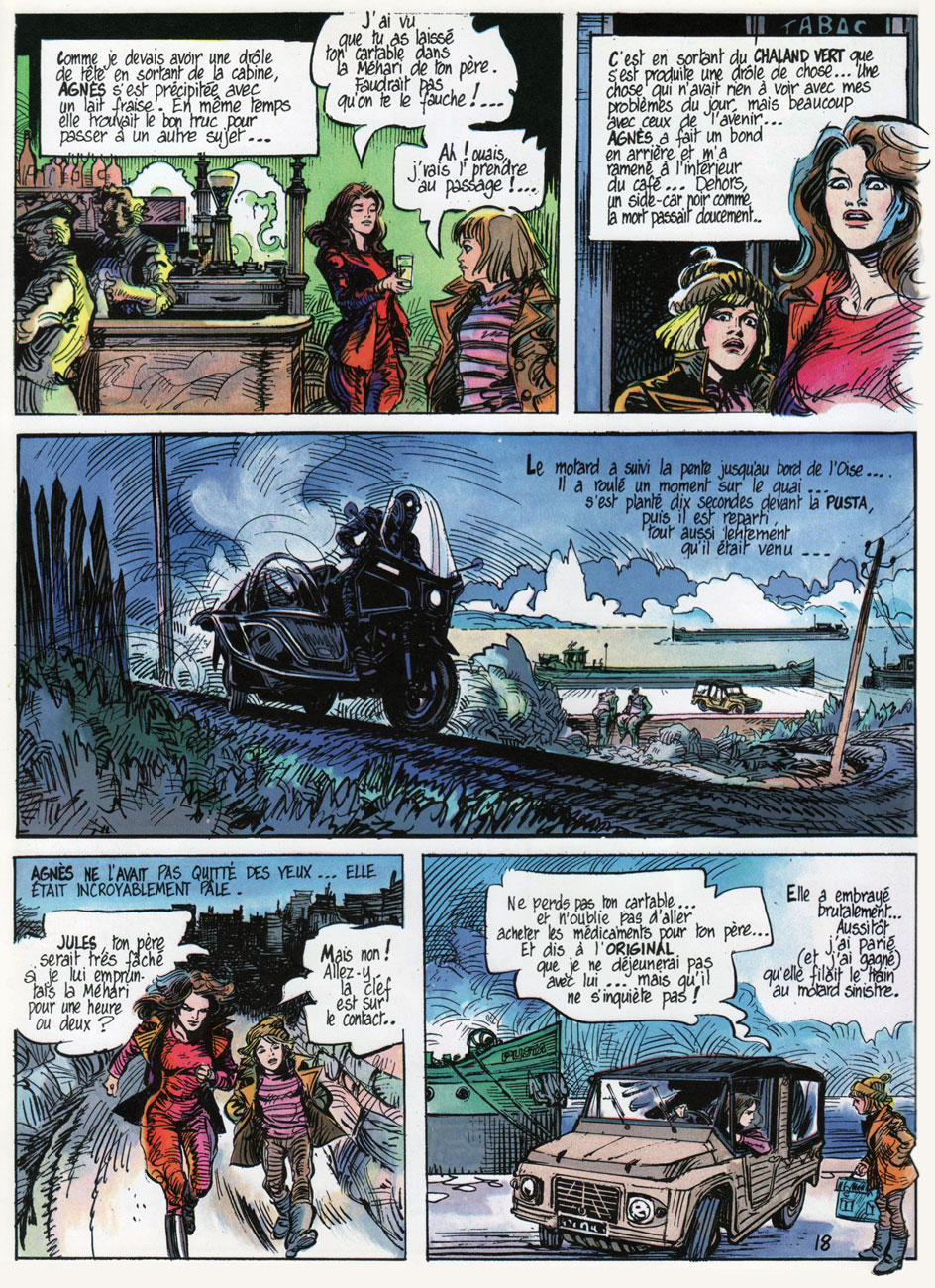
Born out of a misunderstanding between the editorial team of Pif Gadget and Forest, Mystérieuse matin midi et soir proved too labyrinthine for the magazine’s young readership, cost the publishers a bundle, and only two of its three parts appeared in Pif. Fear not, it was collected in album form the following year. This is a page from part 1, which saw print in Pif Gadget no. 111 (April, 1971).

ForestHypoCheval01A

ForestHypoCheval02A
A sequence from the rollicking N’importe quoi de cheval…, featuring Hypocrite, another of Forest’s spunky heroïnes. From Pilote Mensuel no. 6 (Dargaud, Nov. 1974).

A pair of pages from the melancholy, elegiac Enfants, c’est l’Hydragon qui passe « Children, there goes the Hydragon » (Casterman, 1984).

ForestHydragon18A

ForestHydragon02A
I’m sure it’s mere coincidence, but the boy, Jules, seems to be modelled after yet another Gainsbourg “muse”, pop nymphette Vanessa Paradis.

– RG

*I make comics, they’re far poppier than movies!

Nikita Mandryka’s Ailleurs

« If you don’t want to be idolized by the masses, you don’t become an author, you become a plumber-welder! » — Entretien avec Mandryka, Les cahiers de la bande dessinées no. 28 (1975), conducted by Numa Sadoul

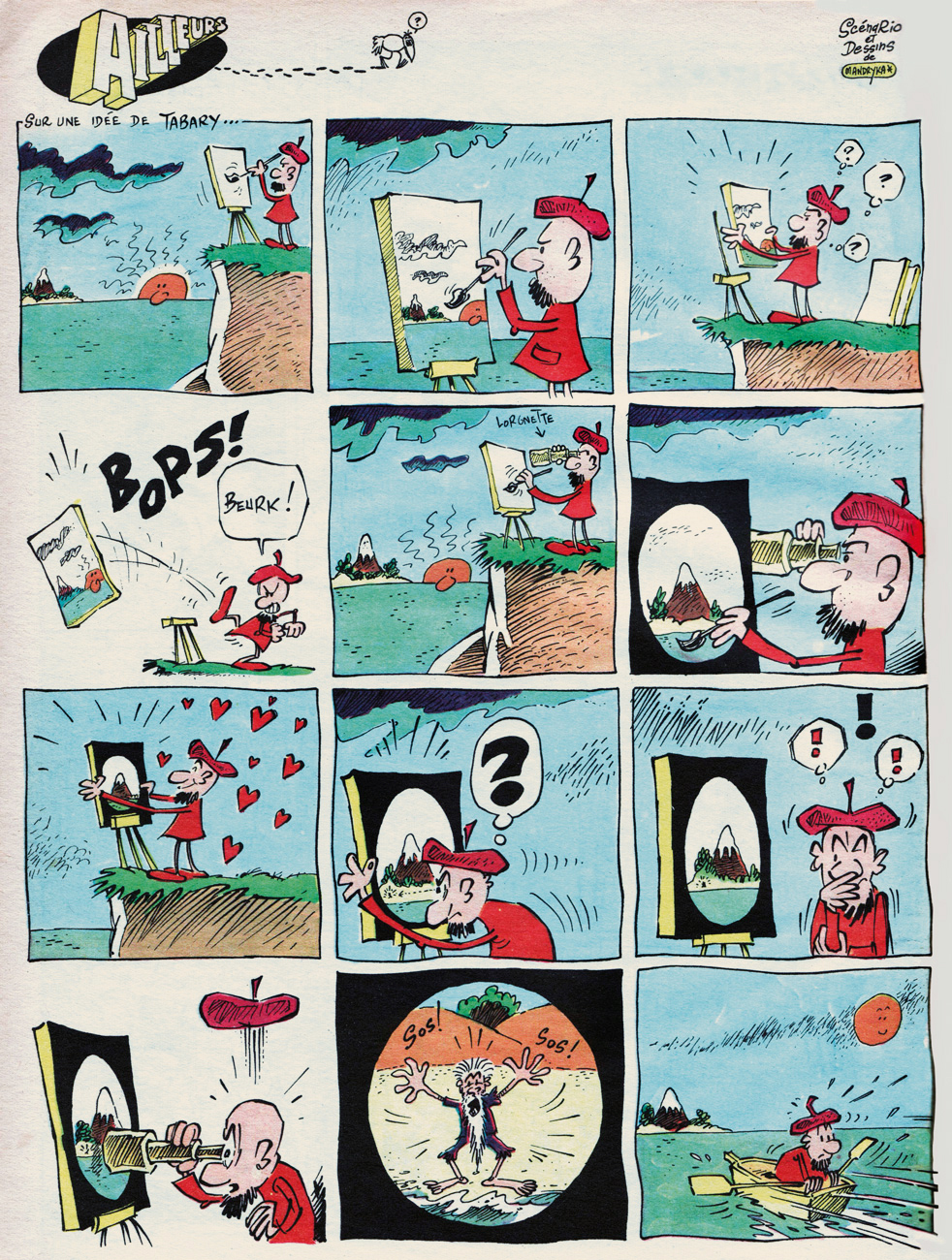
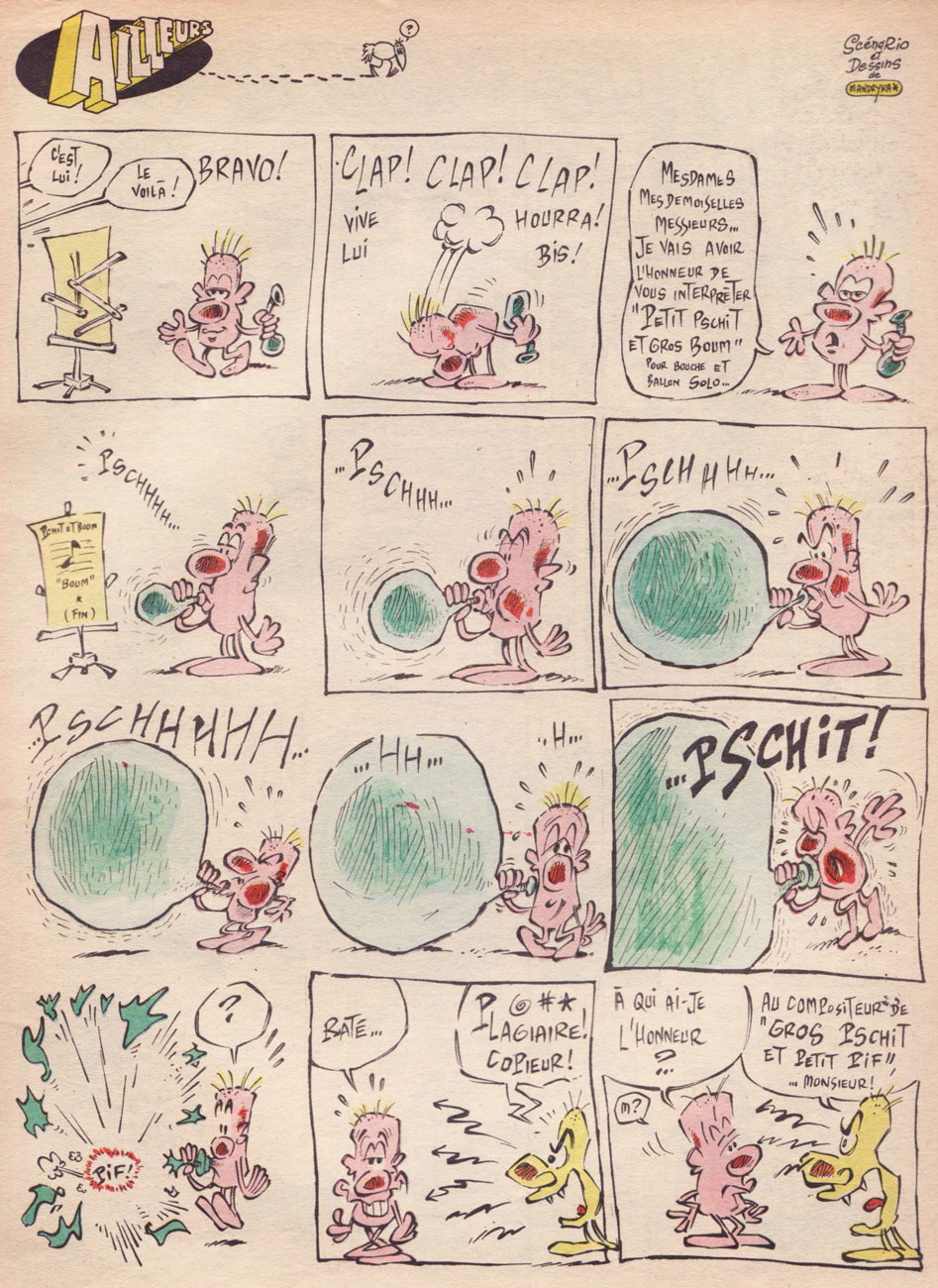
Nikita Mandryka was born October 1940 in Bizerte, Tunisia, to Russian émigré parents. His grandfather had fled the Russian Revolution in 1921 aboard a warship he was commanding. Nikita’s first professional strip appeared late in 1964 in Vaillant (Boff, in Vaillant no. 1024, Dec. 27, 1964), soon renamed Vaillant, le journal de Pif , then Pif Gadget in 1969. While he’s best known for his loquacious, dominoed cucurbit, Le Concombre Masqué, today we’re going to harvest the riches of his somewhat less familiar, but equally absurdist creation, the free-form strip Ailleurs (“Elsewhere”). The feature debuted with the inaugural issue of Pif Gadget and made its bow with issue 35, a few months down the line.

Mandryka left Pif Gadget on good terms (and returned over the years), and with a solid reason: while Pif’s editorial team rightly adored his work, its left-field humour left the majority of Pif’s young readership quite baffled, and sometimes infuriated. Mandryka’s place in the magazine may have been secure, but he yearned for an audience that actually understood him. This he would find at Pilote, with its teenage readership, and all the more so with L’Écho des Savanes (which he cofounded, in 1972, with Claire Bretécher and Marcel Gotlib).

Pif’s was an unusual case: its most singular, daring, arguably most valuable strips were those least appreciated by the kids. And that slice of the readership, you’ll have guessed it, tends to express its opinions more freely and vehemently than their elders, who did love (but more quietly) the somewhat abstract, second degré (offbeat, ironic) features, such as Marcel Gotlib and Henri Dufranne‘s Gai-Luron*, the recently-departed Massimo Mattioli‘s M. Le Magicien or Henri Crespi‘s Nestor. Still, the savvy editorial team, who after all had made the magazine a massive hit, keenly grasped the import of editorial balance and trusted its collective taste and instinct over the “wisdom” of the accountants and marketers… who, at the height of the magazine’s popularity, pulled a mutiny and… sank the ship. So, in hindsight, Mandryka was right to leave.

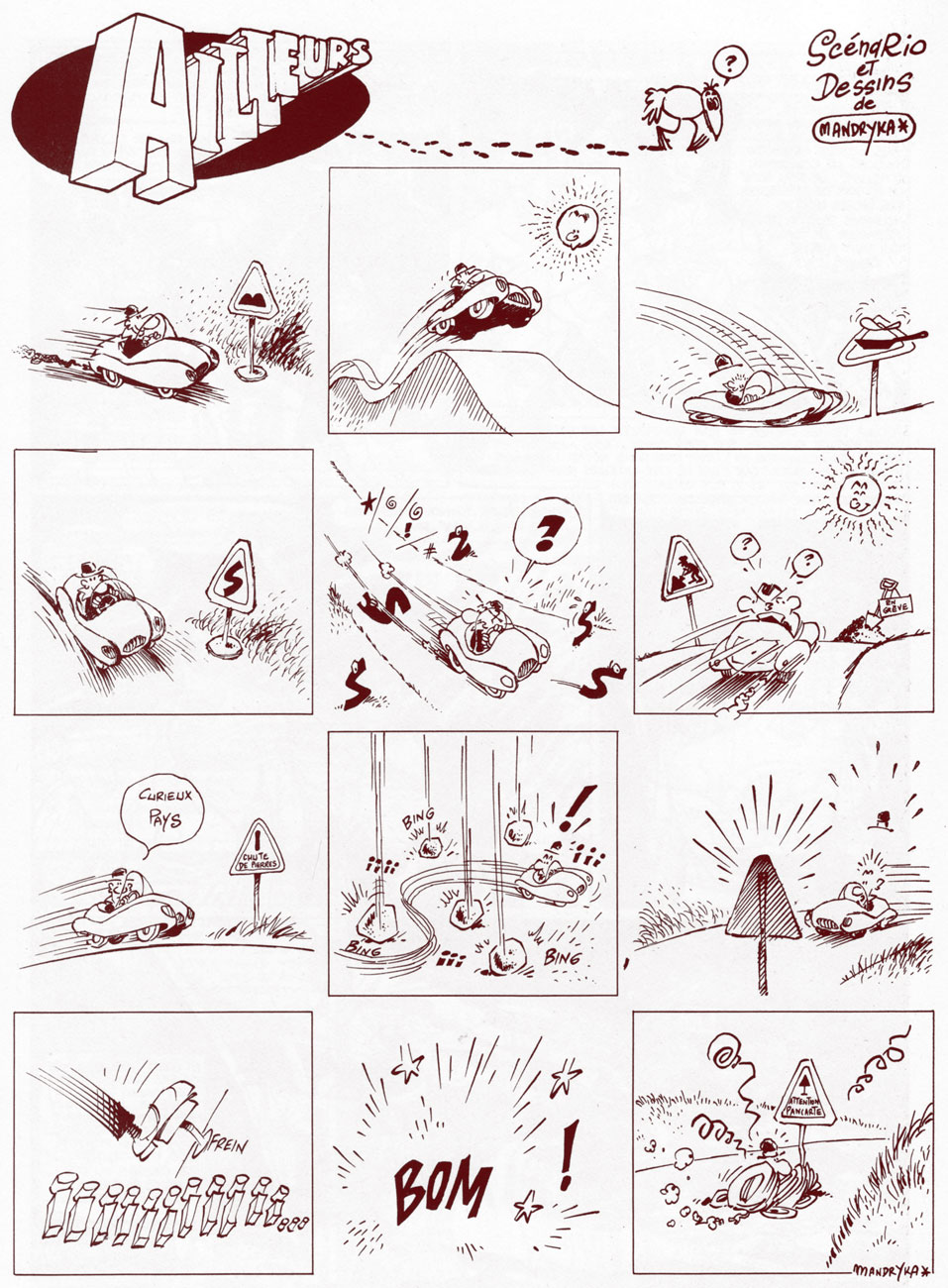
MandrykaAilleursZgonkA
Ailleursdébut, from the inaugural issue of Pif gadget / Vaillant no. 1239 (March 1st, 1969); If it goes “zgunk”, it’s not a zgonk, it’s a zgunk.

MandrykaAilleursArbresA

MandrykaAilleursRouteA

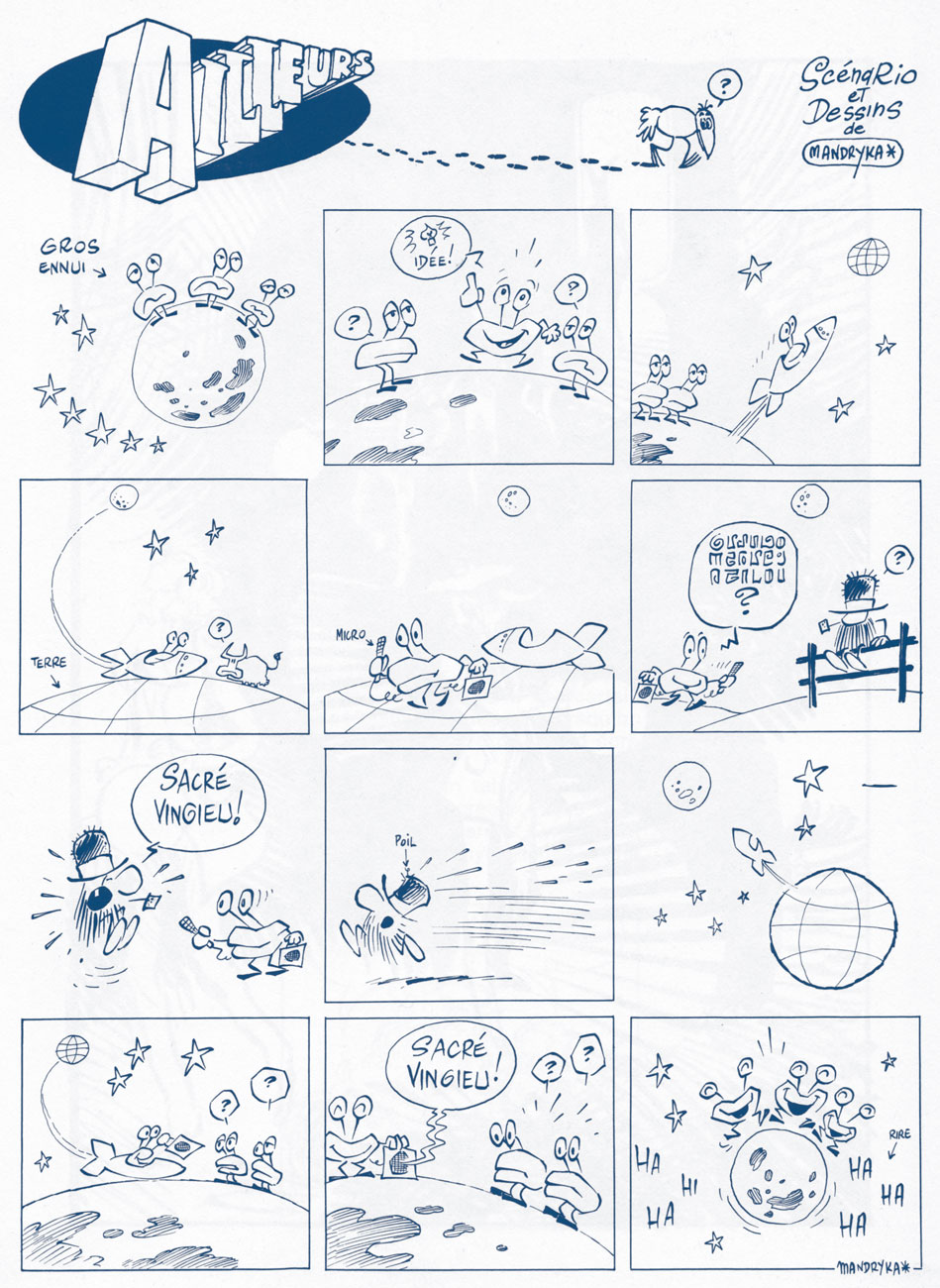
MandrykaAilleursVingnieuA
As an english equivalent to « Sacré vingieu! », I propose « Dagnabit! »
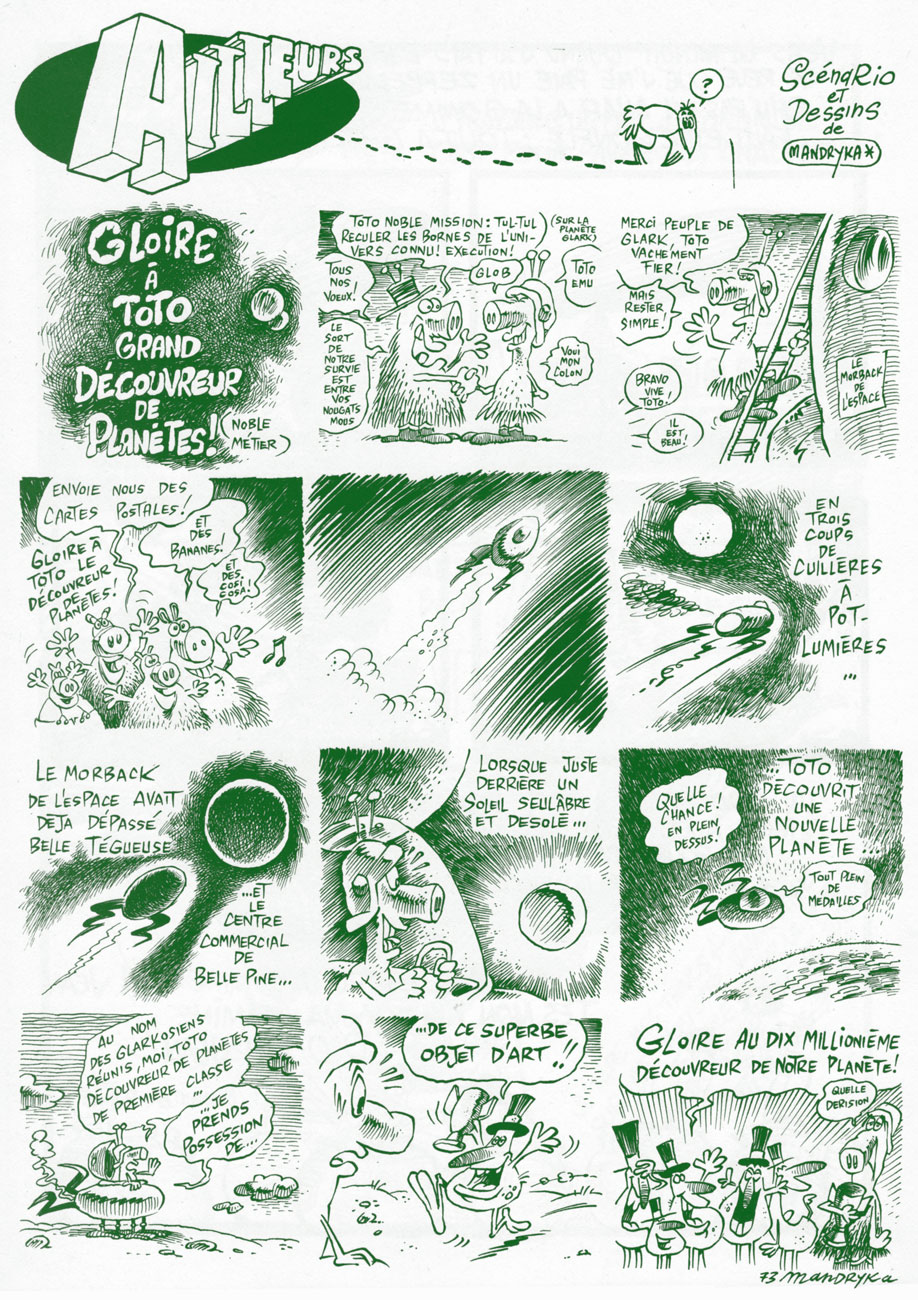
MandrykaAilleursTotoA
Ends with a sarcastic « Glory to the ten millionth discoverer of our planet! »
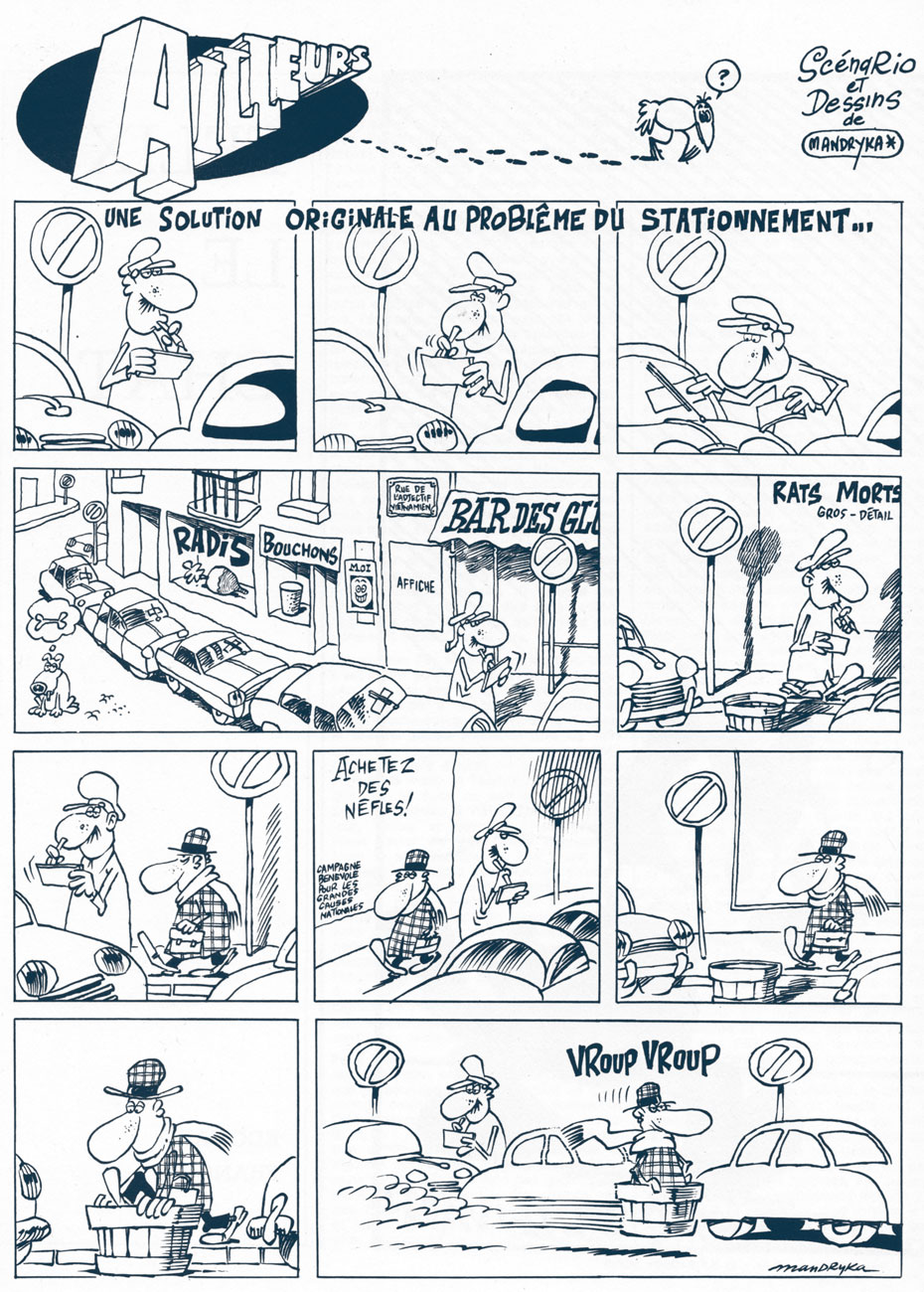
MandrykaAilleursPanierA
« An original solution to the parking problem. »
MandrykaAilleursBeefA
From Pif gadget no. 23 / Vaillant no. 1261 (July 1969); now you know what the legendarily stoic members of The Queen’s Guard do whilst at leisure.
AilleursPeintreA
From Pif gadget no. 33 / Vaillant no. 1271 (Oct. 1969); idea provided by Tabary (Jean or his brother/ghost Jacques? We may never know).
MandrykaAilleursPetitPifA
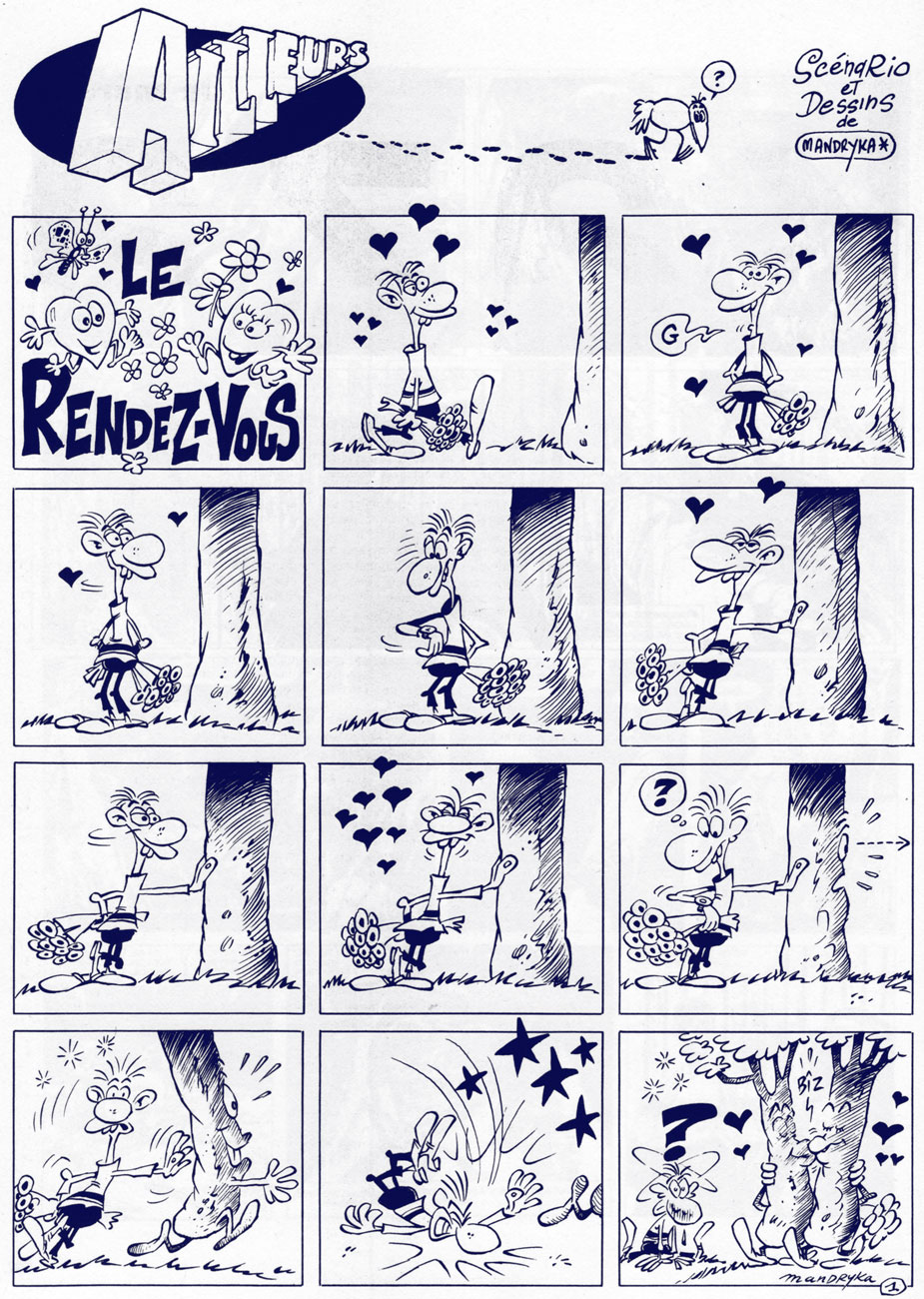
The final Ailleurs strip, from Pif gadget no. 35 / Vaillant no. 1273 (Oct. 1969). This would have made a great skit for Jacques Tati‘s peerless Mr. Hulot.
MandrykaPortraitA
Nikita’s just heard a really good one during this photoshoot for a L’Écho des Savanes advert.

To my knowledge, Ailleurs has never been collected or comprehensively reprinted, save for nine of the strips turning up in Claude Moliterni‘s** excellent scholarly Phenix, revue internationale de la bande dessinée (nos. 31-31-32) in 1973.

-RG
*I’d even argue that Dufranne does a better Gotlib than Gotlib ever did.

**Among many notable achievements, he was co-founder of the Festival international de la bande dessinée d’Angoulême (Angoulême International Comics Festival).

Love and Romance and Enrique Nieto

« The precious hours seemed to hurtle by, as if we were in some kind of vicious time machine! »

Today’s birthday number seventy-six for one of Charlton Comics’ most singular and hardest-working artistes, namely Enrique Nieto Nadal (born August 15, 1943, in Tangiers, Morocco, to Spanish parents), who injected some edgy excitement into the Charlton Comics line, handling with equal aplomb and virtuosity tales of romance, horror, war, adventure… and every combination thereof.

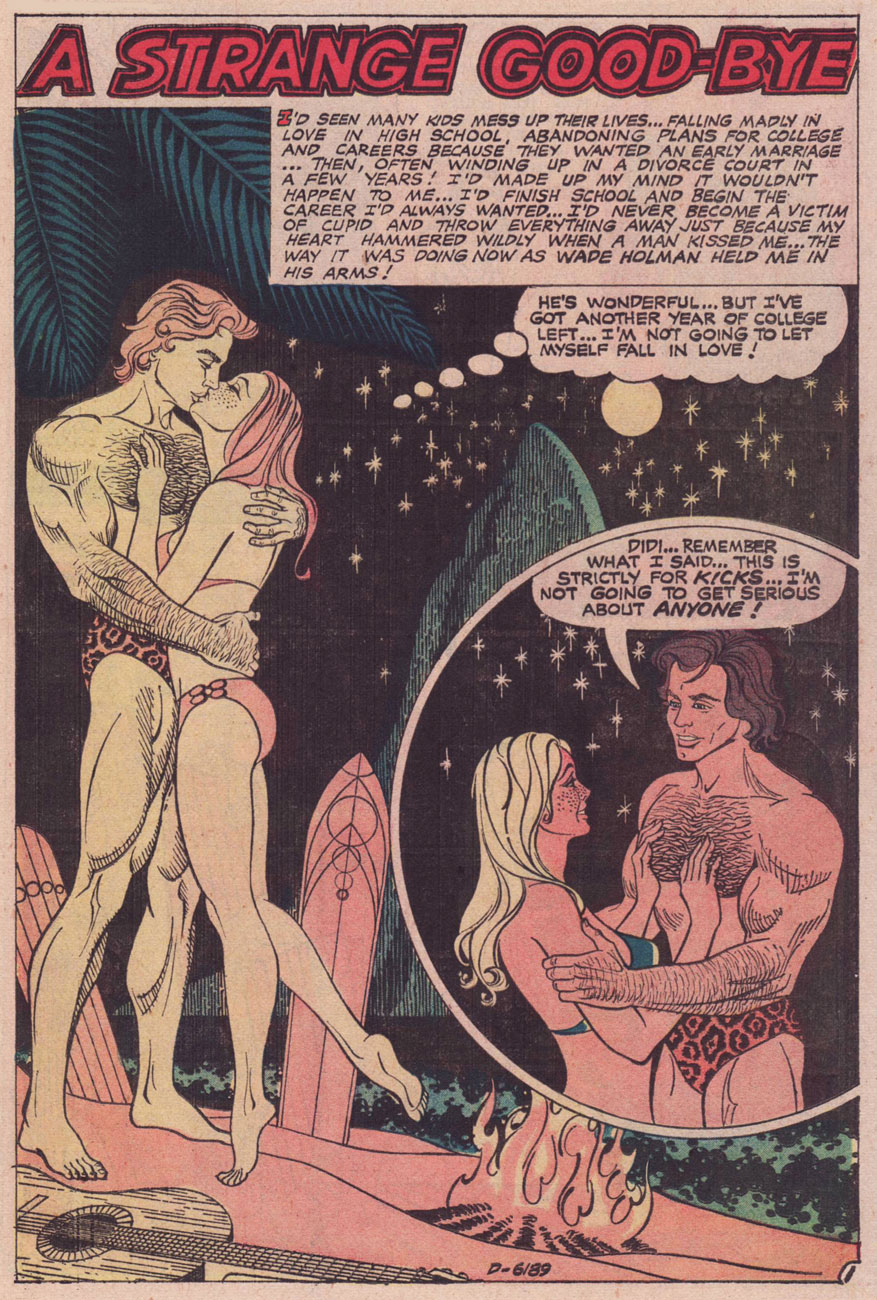
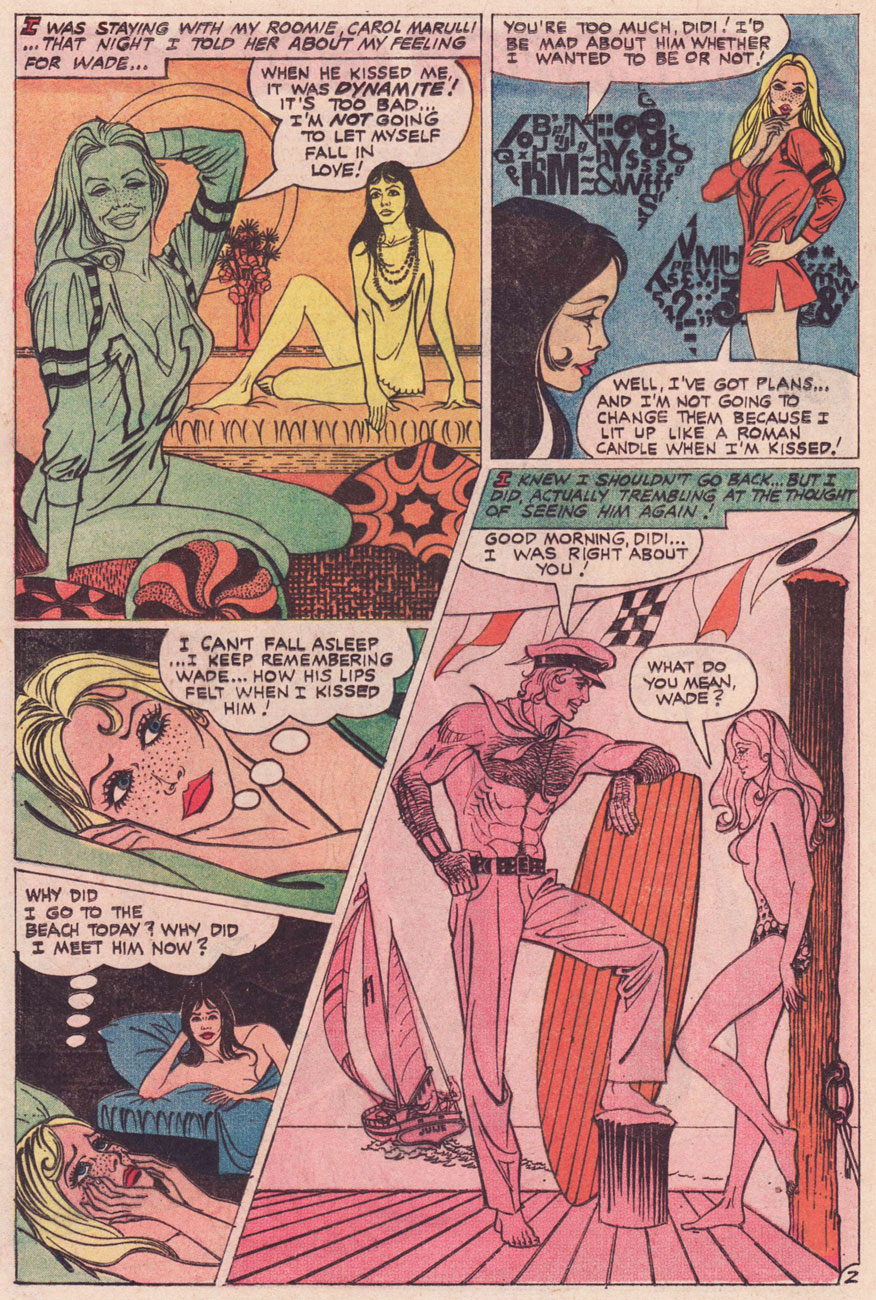
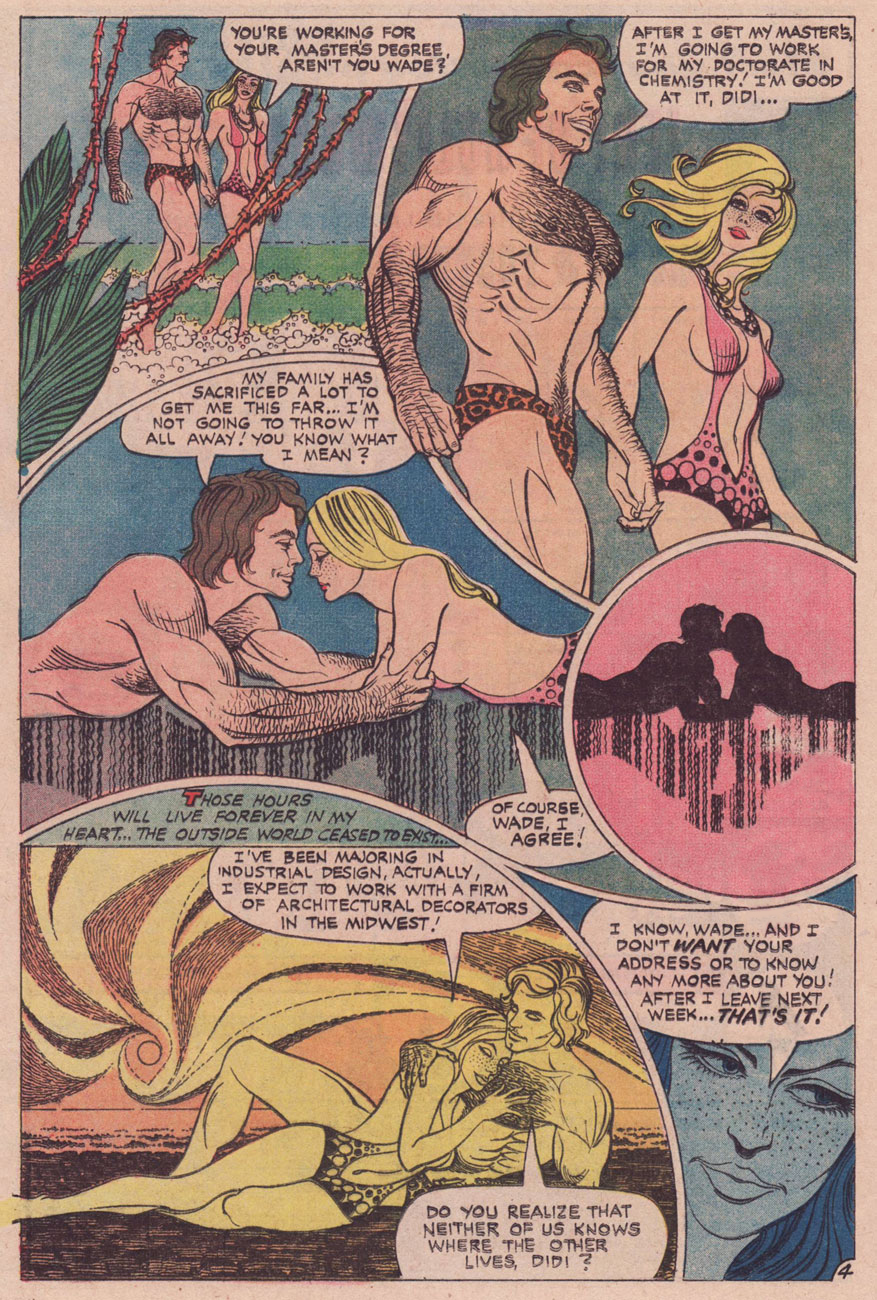
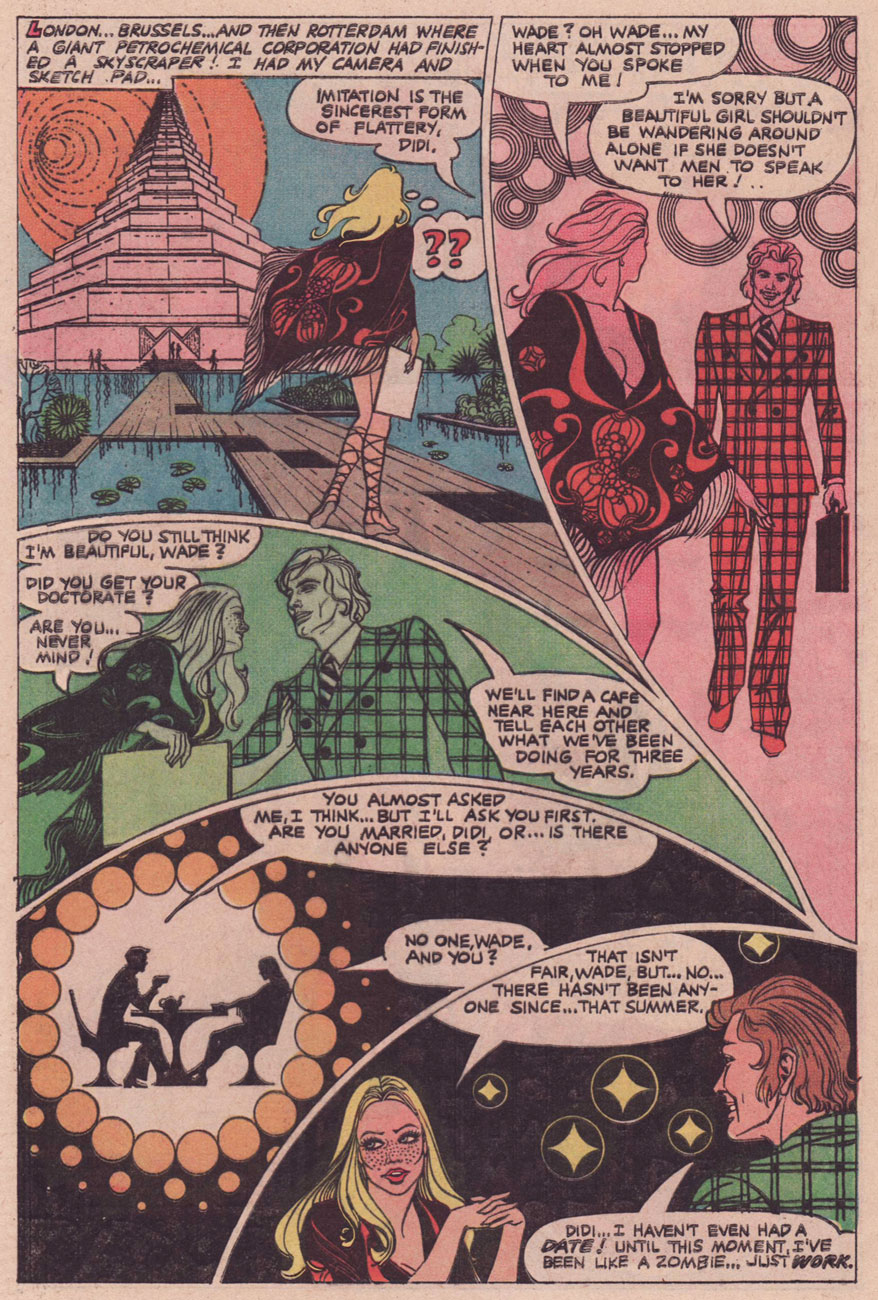
To mark this special occasion, I’ve picked out the lovely tale of A Strange Good-Bye from Love and Romance no. 20 (January, 1975); it provides a sterling showcase for his remarkable design chops and, as my dearest co-admin ds has earlier pointed out, Enrique’s tales provide, as a rule, beefcake and cheesecake in equally generous shares. Is anyone else that fair-minded?

NietoStrangeBye01ANietoStrangeBye02ANietoStrangeBye03ANietoStrangeBye04ANietoStrangeBye05ANietoStrangeBye06ANietoStrangeBye07ANietoStrangeBye08ANietoStrangeBye09A

I’m particularly fond of this yarn because of its unusual avoidance of most romance clichés: there are no scheming rivals, no duplicitous so-called friends, no disapproving parents, no melodrama… just two serious-minded, intelligent young people who are *really* into each other, but don’t lose their heads over it. And they may be yuppies, but  success wasn’t just handed to them. Call me a sap, but I can’t help but sincerely root for Wade and Didi.

Oh, and let’s face it, can you think of any other US romance comics that pack such an erotic charge? It may be subjective, but I’ve rarely seen such convincing depictions of tenderness and affection, physical and otherwise, between two characters… and in mainstream, comics-code approved funnybooks yet. Full marks to Mr. Nieto and his masterful understanding and depiction of body language… male and female.

While he’s not credited, it’s still obvious to me that Joe Gill is the writer; my favourite facet of his romance tales is how he grounds what could be stock situations in the everyday, endowing his characters with actual, credible occupations, as opposed to soap opera ones. When a character describes a business deal or an industrial process, it makes perfect sense. I suspect this to be a by-product of Gill’s authorship of a 1973 series of promotional career-choice Popeye-branded comic books. The research clearly fed his subsequent work, which is just as it should be.

Love&Romance20A
A Strange Good-bye was the cover feature of Love and Romance no. 20 (Jan. 1975). Blast that puzzle page!

Well, once more… ¡feliz cumpleaños, Enrique!

-RG

Jean Effel’s Gentle Blasphemy

Despite his father’s insistence on a commercial career, French illustrator Jean Effel (1908-1982) pursued studies in music, art and philosophy. When his attempts to become a theatrical writer failed, he switched gears and started working as a caricaturist for newspapers in the 1930s. By the 1940s, his work was widely known and widely published, mostly in socialist/communist newspapers sponsored by the French Communist Party. After the second World War, he also branched out into book illustration (his work on Fables de la Fontaine is quite charming). Today, he’s mostly remembered (if barely) for his La création du monde (The Creation of the World).

I learned about Jean Effel (a nom de plume; François Lejeune was his true name) from a couple of books my parents had lying around when I was growing up. He was, I believe, my first exposure to cartoons, and the warm place his work holds in my heart is partly dictated by nostalgia. Only in part, however; few would deny that Effel’s animals and humans, his God, his Devil and his various angels are charming in that plump, childlike way that young animals are irresistibly cute. Some grouchy contrarians might get annoyed by that cuteness; the rest of us will enjoy his kind world. Oh, vexations and sarcasm are part of its tapestry, but nobody stays angry for long, pranks are witty but inoffensive, and problems are creatively resolved. Effel was an atheist, but his God was so kind and paternal that even priests didn’t object to their parishioners reading his work.

JeanEffel-divine
“How was it?” “Divine!” Even Effel’s handwriting/lettering is adorably rounded, childlike.
JeanEffel-Adam-and-Eve
“Leave my tools alone! It’s a sacred thing…” Note Adam’s scar, mute testimony to his missing rib.

To come back to my childhood, the twist in the story is that the books were in Russian: Soviet translations from French. The main collection of Jean Effel’s work was published in 1963 by the Hermitage Museum’s publishing press. The introduction calls him a « sincere friend of the Soviet Union », pointing out that Effel even learned to use Russian letters. In 1967, he was awarded the Lenin Peace Prize, which was mostly reserved for non-Soviets, foreign prominent Communists and supporters of the Soviet Union (Nelson Mandela also had one, as did Linus Pauling and Pablo Picasso).

JeanEffelAmisA
Jean Effel’s present to the U.S.S.R.: a detailed map of France, with a hand-lettered dedication – “to my Soviet friends, with all my heart”.

It’s odd, but I can’t give you the exact date of the conception or publication of The Creation of the World: the Soviet book mentions that it was begun in 1950, English Wiki gives the date as 1945, French Wiki says 1953, Encyclopaedia Universalis (a French site) posits 1937, etc. Rather absurdly, there are a lot more detailed articles about Effel in Russian than in French, so for once I actually tend to trust the Russian side of things. It was clear that Effel genuinely liked Russians, and admired what he saw on his many visits to the U.S.S.R. I assume he only saw what he wanted to see (or what he was shown by his tour guides); still, he was clearly an idealist, a kind and gentle man by all accounts who believed in pacifism and loved animals.

A few pages from my 1963 Soviet edition:

EffelChiensA
Dog meteorology: “He’s raising his paw: now water will pour down…”
JeanEffelLoupsA
To each his own fairy tale: “But the poor wolf was so stuffed after eating grandmother that he had no appetite left for Red Riding Hood!”

EffelAnge01A

EffelAnge02A
The desk caption says “found objects”.
EffelAdamEveA
141: “He’s making projects for something…” 143: “How hilarious! If this keeps up, I’ll lose a rib from laughing too hard…” 144: “This is but a sketch. Just wait ’til you see the 3D version…”

A few years ago, I found another Russian edition in some Canadian (how books travel..) second hand bookstore, a collection in four volumes:

JeanEffel-CreationduMonde
Clockwise, left to right: Adam and Eve, Sky and Earth, Plants and Animals, and People.

The back covers are also worth a look:

JeanEffel-2

Oddly, Animals and Plants is marked as costing 75 kopecks, and the other three are 80 kopecks each, though this was clearly sold as a set with a slipcase.

JeanEffel-1

JeanEffel-3

JeanEffel-Devil
There can be no god without a devil! The charming Lucifer is probably my favourite character. This is a page from the Russian-Estonian edition. 173: “He likes us: he’s wagging his tail!” 174: “My name is Lucifer, but you can simply call me Lulu!” 175: “Oh, Mister Lucifer! You’re just the devil!” 176: “Perhaps I can tempt you with an apple?”
JeanEffel-CreationduMonde1997
The most recent edition of La création de l’homme, published in 1997.

A few other odds and ends from Effel’s multi-faceted career…

JeanEffel-Sylvain
Sylvain is inviting you… to visit the PROTECTION OF NATURE exhibit at the Paris Fair.

JeanEffel-egyptien

The French Postal Service issued a stamp in 1983 to celebrate Jean Effel and his sweet version of Marianne, a cheerful young woman with a red cap who symbolized the new French Republic.

Timbre-JeanEffel

~ ds