Ninety-three years ago today (January 3, 1924, that is), master bédéisteAndré Franquin was born in Etterbeek, Belgium.
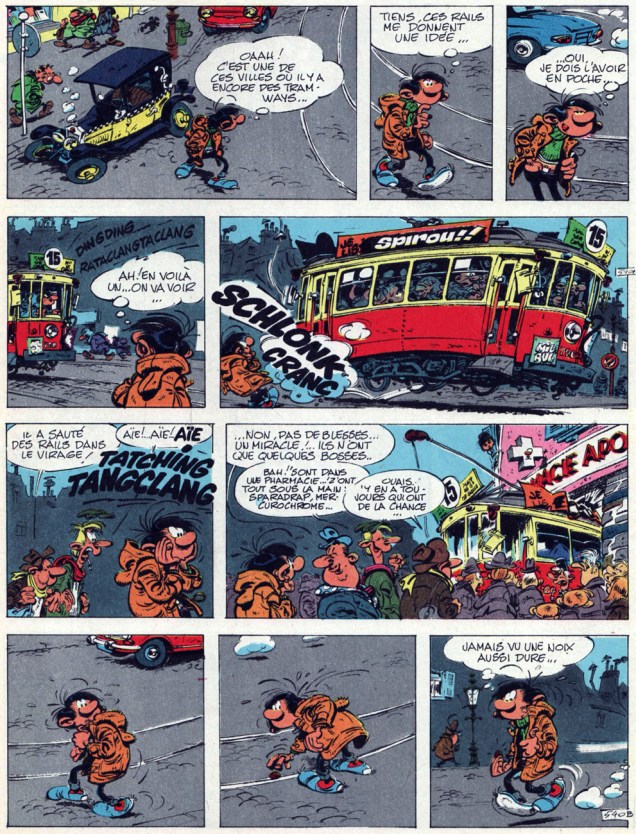
His œuvre is an embarrassment of riches, but heck, here’s a diabolically ingenious Gaston Lagaffe strip whose mise-en-scène is so solid and visually limpid that the only dialogue needed to truly “get it” is the punchline: « Never seen such a tough nut… »
Originally published in Spirou no. 1599 (Dec. 5, 1968, Éditions Dupuis.)
It would be unfair and inaccurate to single anything out as André Franquin’s «masterpiece», given the consistently high calibre of his output. Let’s settle for stating that Gaston was in all likelihood his most popular creation, as luck would have it.
The legendary gaffeur first messed up in a two-panel cameo in the Spirou et Fantasio adventure Le voyageur du Mésozoïque in 1957. Later S&F tales were dotted with Gaston cameos, and the accident-prone office boy soon (crash-) landed his own half-page strip, which ran from the late 50s to the late 90s, though mostly consisted of reprints after the early 80s.
Gaston’s second strip collection, issued in 1963 in the original “landscape” format, deemed an oddity at the time.
As for translations, Gaston’s popular in a bevy of languages, but not, of course, in English. Fantagraphics’ Kim Thompson was a huge fan, and translated a handful of strips, which were published (as Gomer Goof) in issues of the anthologies Prime Cuts and Graphic Story Monthly.
Speaking of Gomer, Anglophone readers are in for a treat: UK publisher Cinebook has, just last October, issued a collection (only 48 pages, but you have to start somewhere… and perhaps small) entitled Mind the Goof! Check it out here.
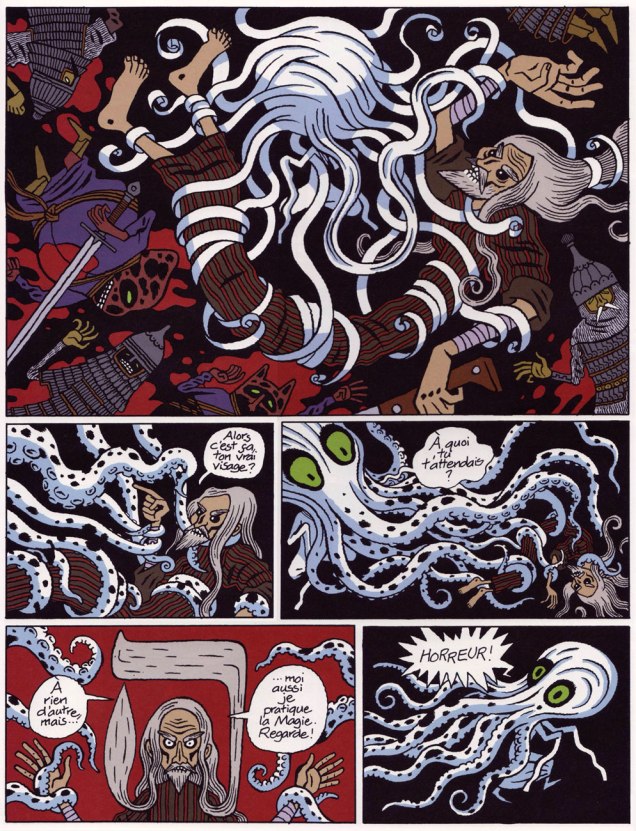
Today’s Tentacle Tuesday comes to us courtesy of France and its long-suffering neighbour, Belgium. There’s an easy joke one could make about the reputation Frenchmen possess of having hands like grabby tentacles, but instead I’ll concentrate on their wonderful comic writers and artists and the classic bande dessinée. Let’s gracefully step over all the obscene connotations of a “French edition” and delve into exhibit A:
“So that’s it, your real face?” asks the old man. “What were you expecting?” asks the emerald-eyed cephalopod. This is a page from Les chercheurs de trésor, volume 2: La ville froide, David B. (2004, Dargaud).
David B. is the nom de plume of Pierre-François David Beauchard. Non-Francophone audiences might know him from Epileptic, an autobiographical graphic novel that won accolades and awards from an international audience. And yet it’s not his most interesting œuvre, as far as I’m concerned. Although Epileptic is full of imagery and allegories, it’s when David B. lets his imagination soar without the constraints of real life that he creates his most dazzling worlds and astonishing stories. He’s one of those rare comic artists whose art is as accomplished as their storytelling.
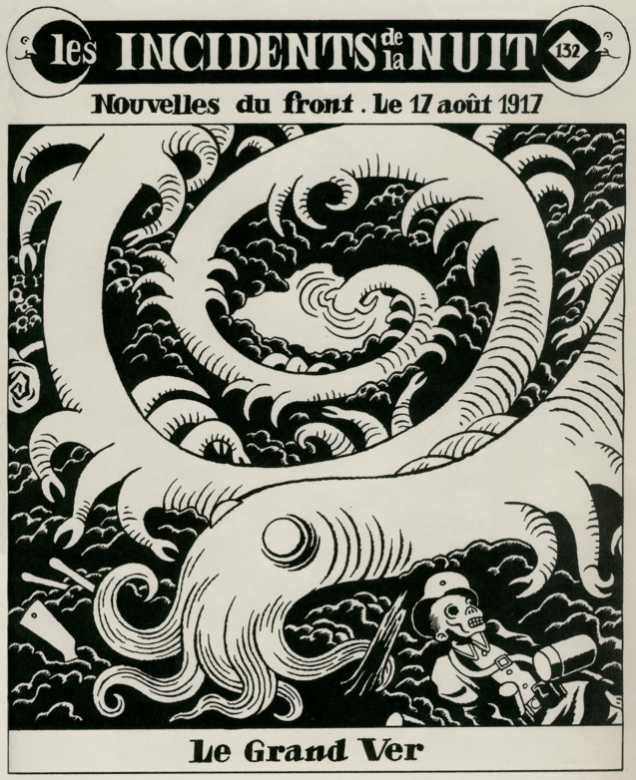
Here’s a bonus “tentacle” from Monsieur B.:
La lecture des ruines was published by Dupuis in 2001. (It loosely translates to “reading the ruins”, “study of the wreckage”.) It’s the story of a mad scholar who tries to find a mathematical equation for violence in the decayed rubble that war has left behind. Excerpted material from an imaginary periodical is appended, Les incidents de la nuit (Incidents of the Night). This tentacled worm – Le Grand Ver, the Great Worm – is one of the creatures that lurk within…
Give a hand of applause, ladies and gentlemen, to David B., and let’s move to our next topic.
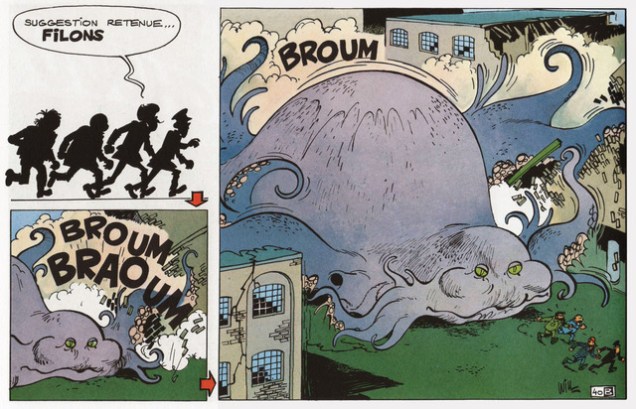
“Sorti des abîmes” translates to something like “Risen from the abyss” – and what sort of thing rises from an abyss? Why, tentacles, of course!
Tif et Tondu: Sorti des abîmes (1972)
Tif and Tondu, an intrepid team of private investigators, were originally created by Fernand Dineur, but their most popular incarnation is by writer Maurice Tillieux and artist Willy Maltaite (who mostly went by the nickname Will), which is what you’re currently admiring. The strip saw birth in 1938 in journal Spirou and lasted a whopping number of years, ending in 1997, one year short of its 60th birthday.
Things are a bit tricky with the numbering, because Tif et Tondu are popular enough to have been anthologized several times. Sorti des abîmes appeared as the series’ 19th entry (1972), after being serialized in Spirou no. 1746 (September, 1971) to no. 1764 (February, 1972).
A closer look at the creature from the abyss: not exactly an octopus, but in distinct possession of tentacles. “Armed and dangerous”, as they say! The poor thing is dissolved at the end of the story by some infrared rays.
Incidentally, “Tif” is slang for hair in French, and “Tondu” means “shaven, sheared”. Naturally, Tif is the bald guy, and Tondu is the hairy one.
Now that we’ve had our fill of scary, destructive tentacles, I’ll move on to something friendlier.
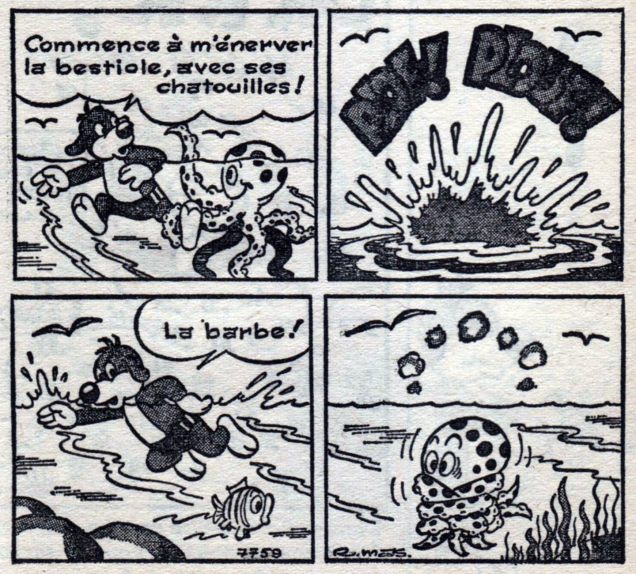
Pif Pocheno.72 (Aug. 1971) The last panel says “Paws off… Don’t touch! You’ve got cold hands!”Pif Poche no.72 (Aug. 1971) “This creature is starting to annoy me with its tickling!”
Pif the dog was the mascot of the kid’s magazine Pif Gadget (« gadget » referred to the fact that each issue of the magazine was accompanied by some thingamabob to amuse the youngsters). Pif Poche were pocket-sized collections of short Pif strips, as well as jokes, games and such. The character was created by José Cabrero Arnal in 1948, who gradually abandoned the strip by the 1960s while other artists took over.
Pif Pocheno.72 (Aug. 1971) “Even in a can… I adore seafood! Ripoff… it’s octopus!” Story and art by Arnal’s immediate and worthiest successor, the prolific Roger Mas (1924-2010)
Borborygmi [bawr-buh-rig-mahy] a rumbling or gurgling sound caused by the movement of gas in the intestines. Did you know you could have a whole conversation in borborygmese? But don’t take my word for it:
This page, entitled “Les pois chiches” (Chickpeas), comes from a comics collection called “Tourista”, published in 1984, about, what else? Tourists and their behaviour in foreign climes.
Claire Bretécher is a socio-satirical cartoonist from France, best known for her comics dealing with women and gender-related issues (Les frustrés, Aggripine…) Lots of them have been translated into English. A quick rundown of her career: her work has been published in Spirou and Pilote in 1972, and she co-founded the Franco-Belgian comics magazine “L’écho des savanes” (Echoes of the Savannah) together with Marcel Gotlib and Nikita Mandryka. She also has a pretty good handle on Weird Body Things and how people react to them.
And speaking of odd stomach noises, this pertinent little gem comes to mind:
From Cul de Sac, an awesome comic strip (February 3, 2009) by the tragically deceased and much-missed Richard Thompson (1957-2016).
« How do you know you’re facing a tough mosquito? You slap him and he slaps you back! »
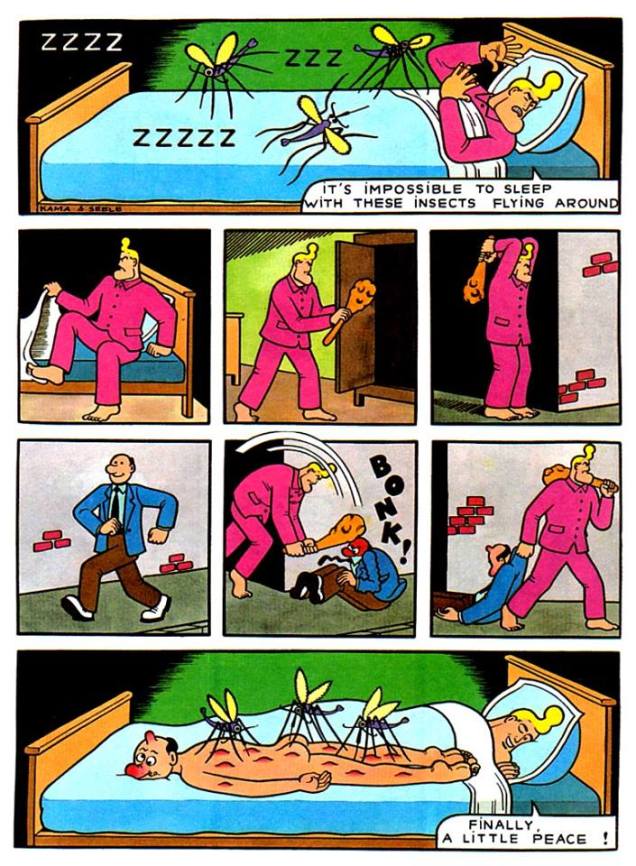
We’re in October, and I’m still getting mosquito bites. I have no polite words to say about that (not in mixed company, anyway). However, the blood-sucking buggers did make me think of a colourful, frequently violent (but also quite funny and oftentimes charming) strip, Cowboy Henk.
What, you don’t keep a drumstick-shaped club in *your* closet?
Written by Belgian cartoonist Kamagurka (a.k.a. Luc Zeebroek) and illustrated by Flemish cartoonist Her Seele (real name Peter van Heirseele), Cowboy Henk ran in the weekly Flemish magazine Humo from 1981 to 2012 (and, once this strip was translated to English, it also appeared in Art Spiegelman’s Raw.)
The strips have been collected in “King of Dental Floss” published by Scissor Books in 1994, which is a tad difficult to find, but quite worth it, in my opinion. Me, I’m lucky to have an anthology in French (published by FRÉMOK in 2013), easier to acquire than the English version. Of course if you speak Dutch, there’s many collections available to you that the rest of us have sadly no use for!
A man in a movie theater noticed what looks like a mosquito sitting next to him.