« Poison’s not bad. It’s a matter of how much. » — Keith Richards
Regular readers of this blog will perhaps recall my fondness for those little Peter Pauper Press books of Mount Vernon, NY — at least those of the publisher’s halcyon years (1928-1981). I’ve cast a light on their edition of Ambrose Bierce’s The Devil’s Dictionary and, in the course of last year’s countdown, their Comic Epitaphs From the Very Best Old Graveyards.
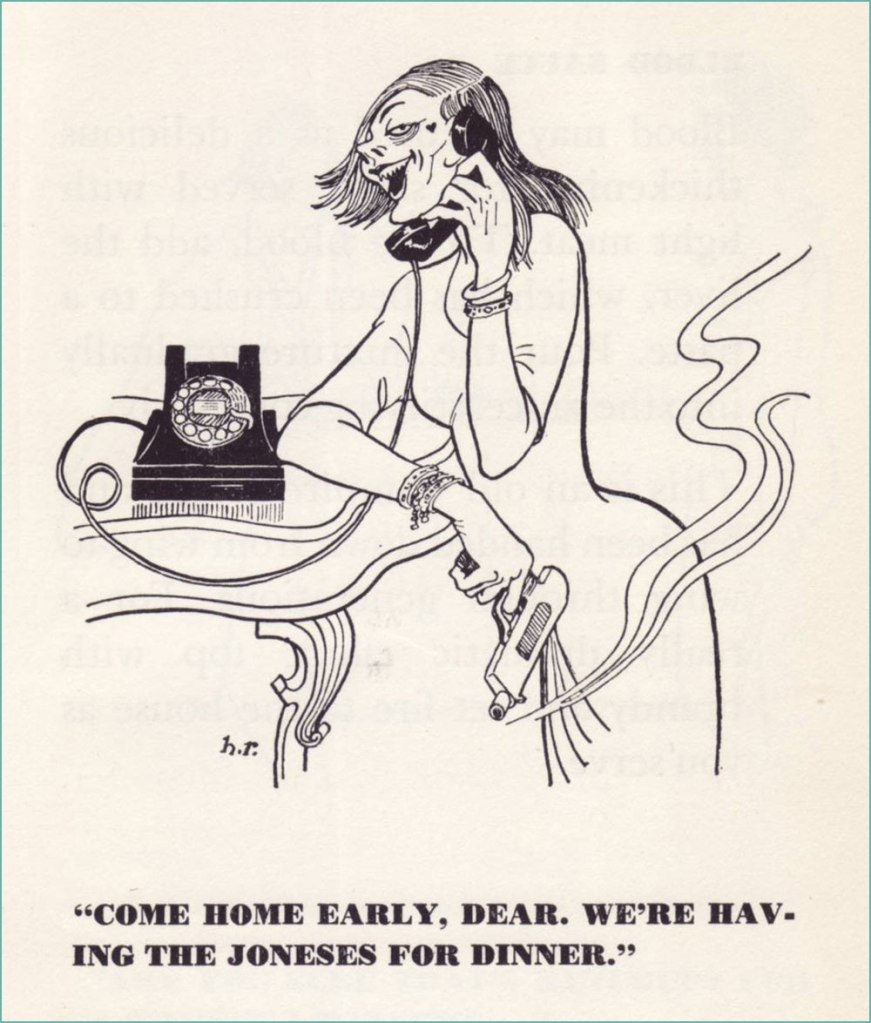
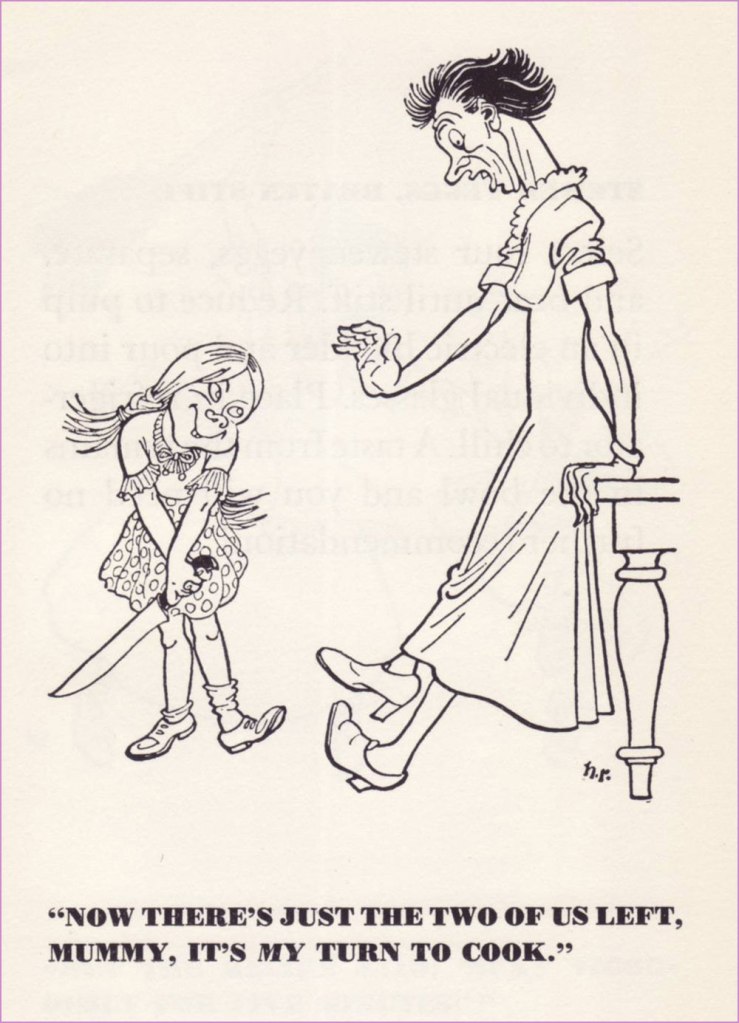
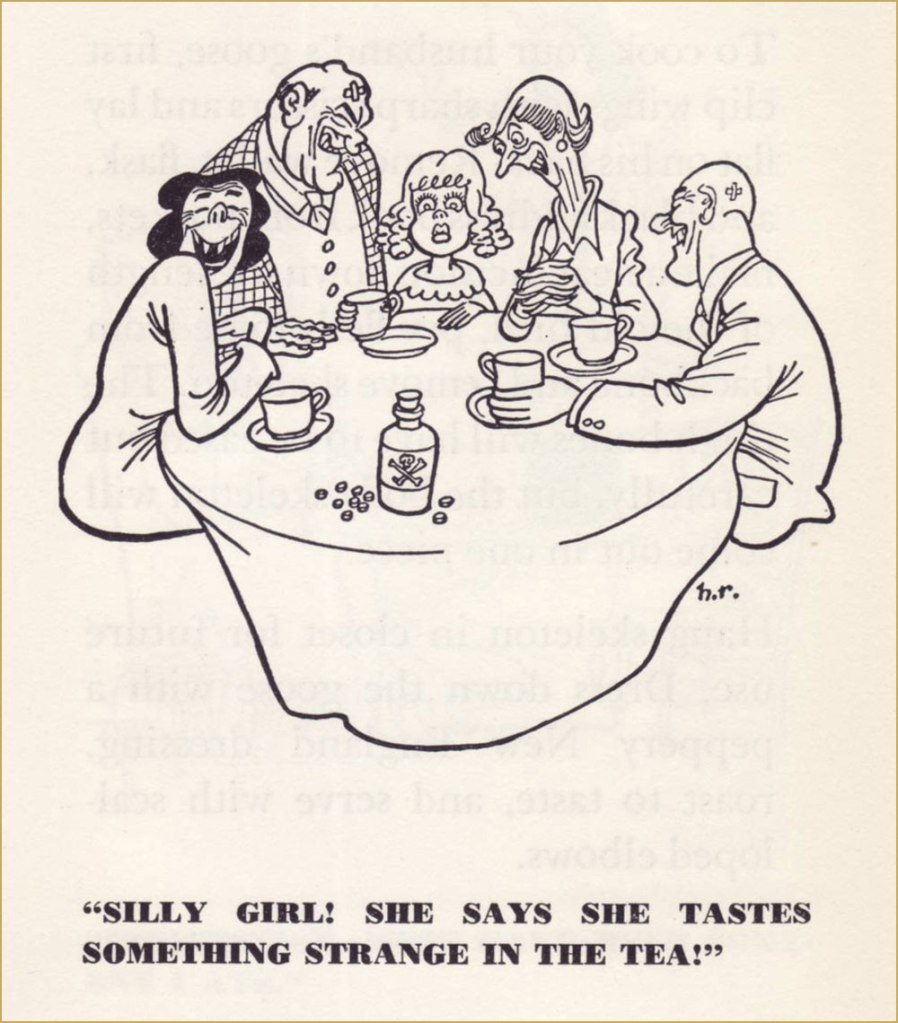
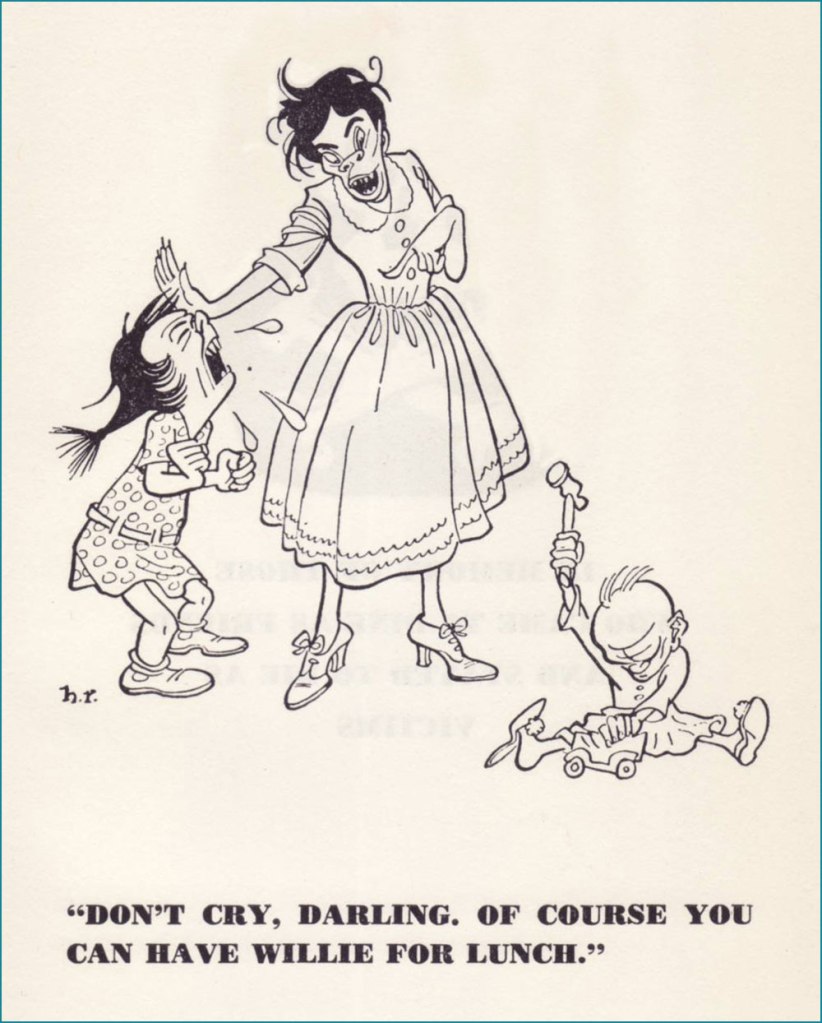
This time around, I’m tackling one of the rare and fairly expensive ones* — that I’m aware of — Cooking to Kill: the Poison Handbook (1951), which proposes « Comic recipes for the Ghoul, Cannibal, Witch & Murderer. Stewing and potting mothers-in-law. Tested recipes for spoiled brats, business rivals, and strayed lovers. »
« Anybody can kill vulgarly. But we should be above the brutal, the direct, the unappetizing approach. This little book will teach you to tickle the palates of your guests so that they will be happy to linger at your table, charmed to malinger, and grateful to take off for the Great Adventure with the taste of your superlative cooking still on their lips! » — from Prof. Ebezener Murgatroyd’s preface to his ‘gentle reader’.
The book is magnificently illustrated by Herb Roth (1887-1953), who spent much of his career toiling as H.T. Webster‘s assistant and ghost. Roth enjoyed a long association with the Peter Pauper Press, illustrating its very first two books, Faithless Sally Brown and Faithless Nellie Gray.
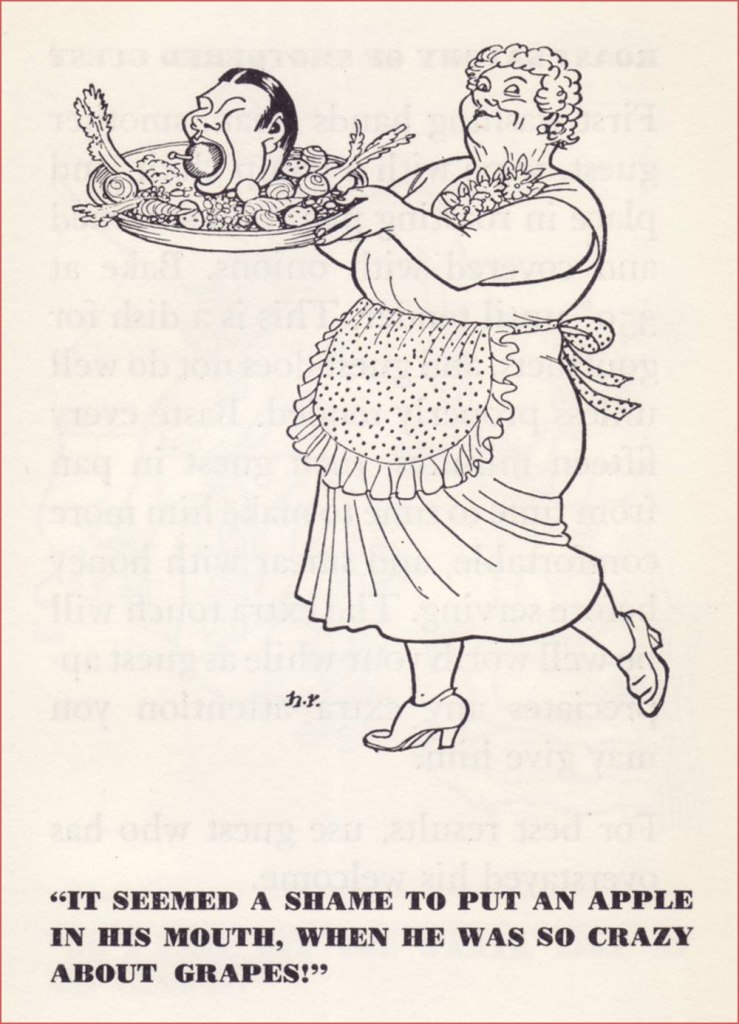
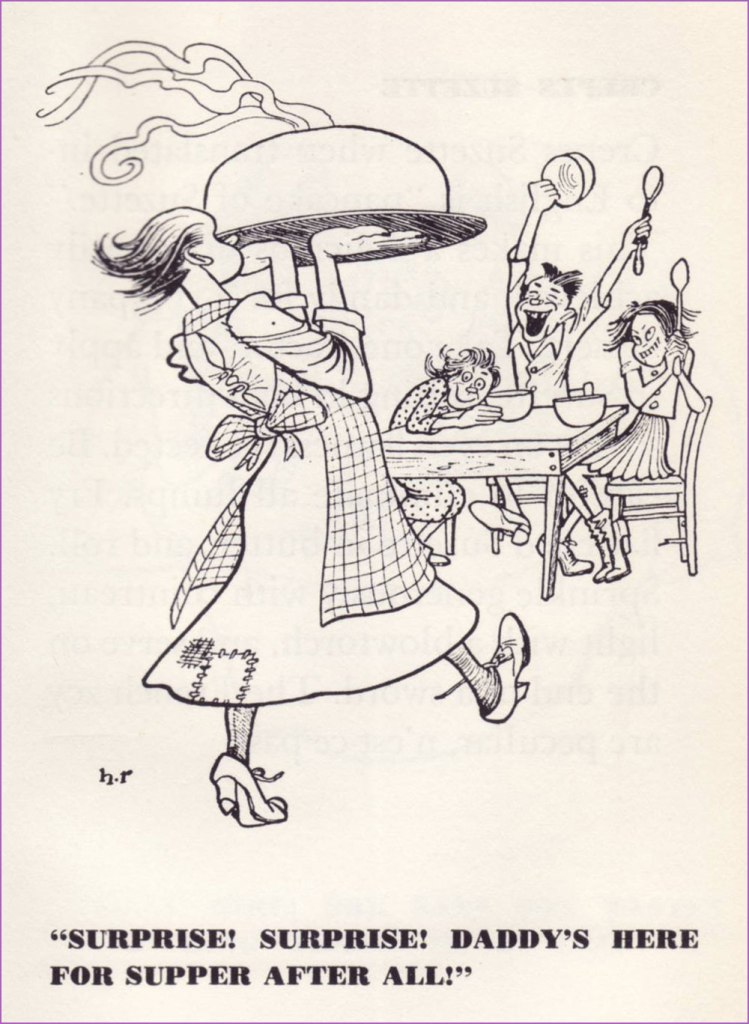
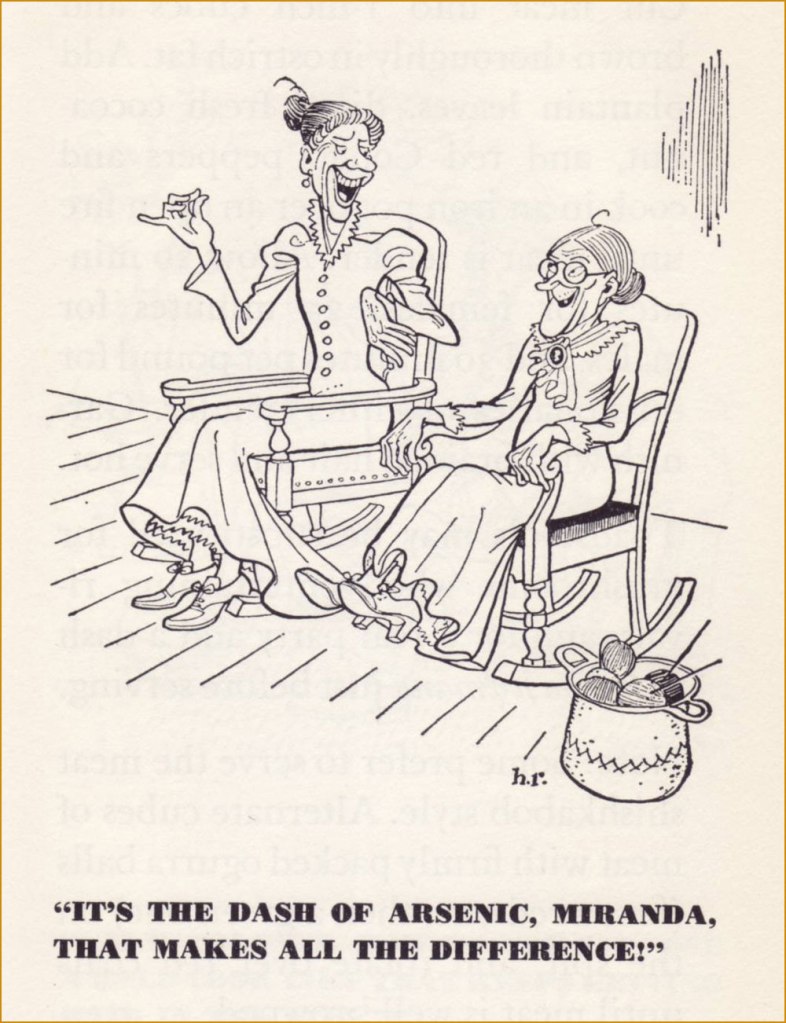
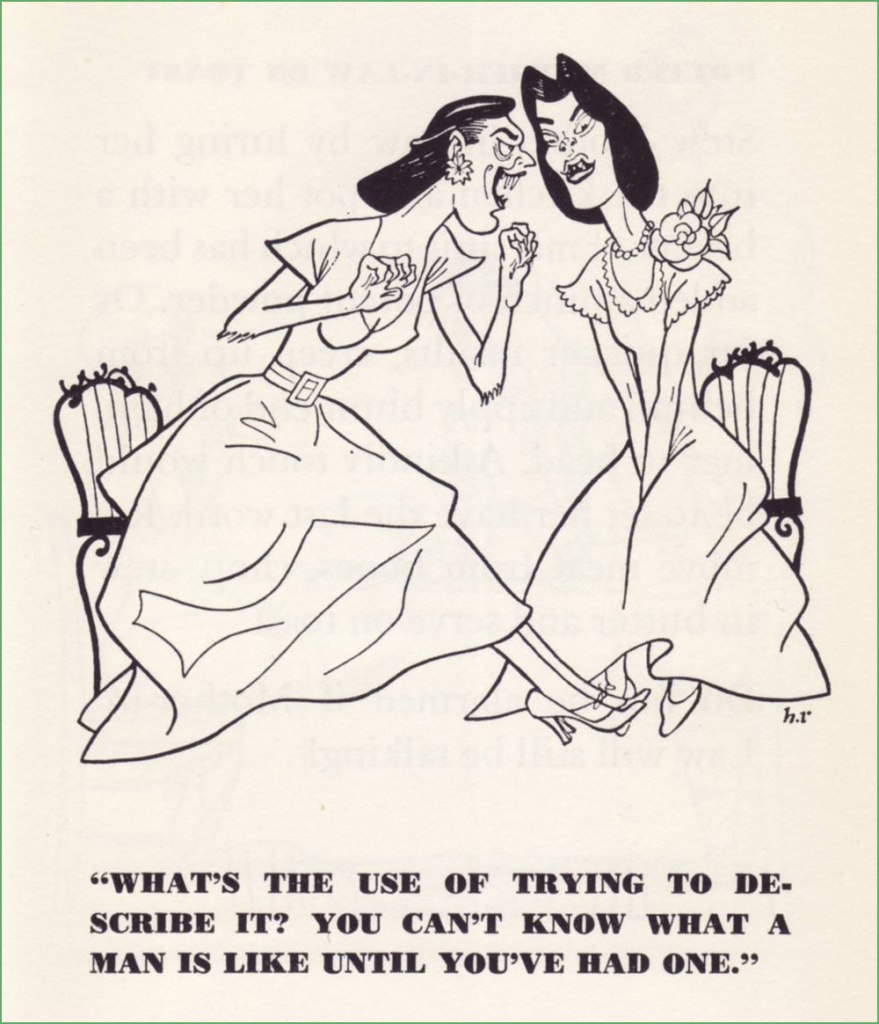
« Head Cheese garni à la Salomé » « Tomato Surprise (Asp in the Grass): this luncheon delicacy should be served only to ladies, as you will find their charming soprano shrieks particularly rewarding. »It’s hard to not think of Joseph Kesselring’s fabled Arsenic and Old Lace, written in 1939.« Walnut Balls: smash nuts with a hammer, fashion into balls and fry in deep fat until a golden brown. Delicious withcoq au vin. »« Chocolate Noose… will help you to execute a crime of considerable chic, and will add a je ne sais quoi to the court proceedings. »« Stuffed Spoiled Brat: select a fine specimen which has been spoiling for a good long time, and capture at opportune moment. » « Crêpes Suzette: take one tractor, and apply to Suzette, rolling in both directions so that an even flatness is achieved. Be careful to eliminate all lumps. Fry flattened Suzette in butter, and roll. Sprinkle generously with Cointreau, light with a blowtorch, and serve on the end of a sword. The French zey are peculiar, n’est-ce pas? »« Marinated Leeks: take a leek, marinate in French dressing, and combine with tender green peas. Serve with asparagus for a very special flavour. Sprinkle with cyanide for that final touch! »« Potted Mother-in-Law: stew Mother-in-law by luring her into the kitchen and pot her with a beaker of martinis to which has been added a pinch of potent powder. Or for quicker results, creep up from behind and apply blunt end of hammer to head. A kindly touch would be to let her have the last word. Remove meat from bones, chop, stew in butter and serve on toast. »This brings to mind those gleefully morbid rhymes about Little Willie, essentially the original Gashlycrumb Tiny. A sample: Willie saw some dynamite/Couldn’t understand it quite/Curiosity never pays/It rained Willie seven days.Why, some enterprising soul has even created these exclusive earrings! Just don’t sport them during the investigation and/or trial. Nobody likes a braggart.
-RG
*the single most sought-after PPP entry is without question Kathryn Paulsen‘s Witches’ Potions and Spells (1971). Just try getting your hands on a cheap copy!
« Daddy had an argument on Friday night, with a man from outer space. Daddy said, ‘I don’t care where you’re from, you’re in my parking space!’ » — Colin McNaughton
Here we are, against all odds, at the beginning of yet another edition of WOT?’s annual Hallowe’en Countdown… hope you enjoy the bumpy — that’s the spirit! — ride.
This time, our opening salvo comes courtesy of British illustrator-poet Colin McNaughton (born 1951). Though I’ve been known to haunt used bookstores whenever the occasion arises, I’ve but once encountered a single one of Mr. McNaughton’s productions, a couple of decades ago at that… which is odd, given his rather prodigious output: over seventy books! That said, my mama having raised no fool (my brother notwithstanding), I unerringly grabbed it.
As it happens, Wikipedia claims — though without any context or evidence — that « His most notable book is perhaps There’s an Awful Lot of Weirdos in Our Neighbourhood »… but I’ll accept it unless a stronger claim comes along. It’s a truly splendid tome.
Oh, and here’s the requisite snatch of (auto?) biography: « Growing up in his native England, the young Colin McNaughton had little indication that he would one day become an author-illustrator. There were no books at all in his parents’ home, he recalls, but there were always comics. These were his formative literature, and their slapstick humor has been a lasting influence. “I’ve been talking about the comic format for years,” he says. “It’s the modern way of telling stories for today’s children; it’s about movement, the step between film and the book.” »
I can live with that. enjoy!
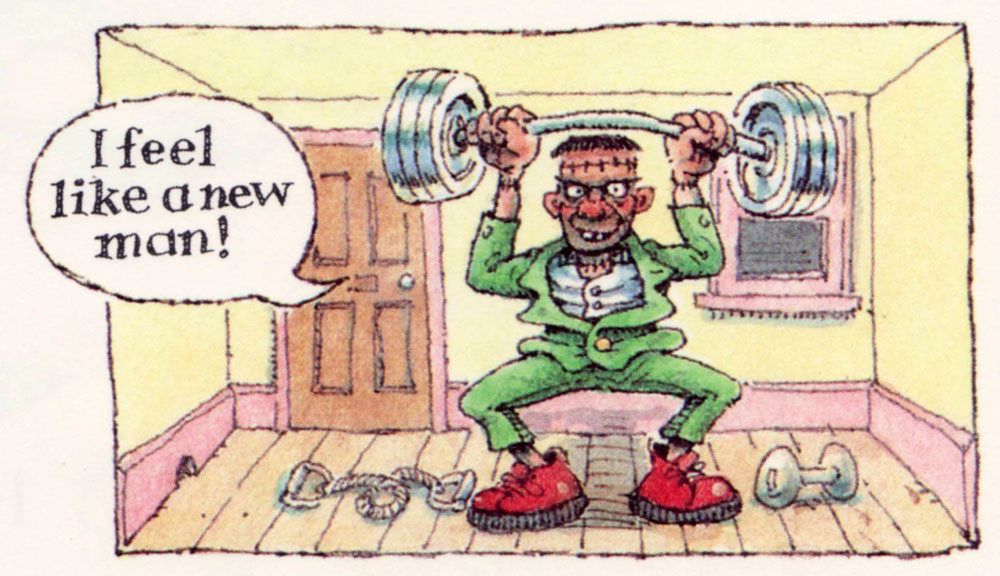
There’s an awful lot of weirdos in our neighbourhood! Yes, there’s an awful lot of weirdos in our neighbourhood!I know this physical wreck, who has a bolt through his neck! There’s an awful lot of weirdos in our neighbourhood!And in an upstairs room, an old lady rides a broom! There’s an awful lot of weirdos in our neighbourhood.A man lives on the square, when he’s in he isn’t there! There’s an awful lot of weirdos in our neighbourhood.And that woman down the block, whose snaky hair’s a shock! There’s an awful lot of weirdos in our neighbourhood.We’ve a strange old feller, with horns, down in the cellar! There’s an awful lot of weirdos in our neighbourhood.There’s a guy who’s green and scaly, has webbed feet and sells fish daily! There’s an awful lot of weirdos in our neighbourhood.And someone near the dairy, when the moon is out gets hairy! There’s an awful lot of weirdos in our neighbourhood.Think I’ll leave this miscellanea, and return to Transylvania, ’cause there’s an awful lot of weirdos in our neighbourhood!
How about one more? One more it is!
Mum! The garden’s full of witches! Come quick and see the witches. There’s a full moon out, and they’re flying about, come on! You’ll miss the witches.
Oh, Mum! You’re missing the witches. You have never seen so many witches. They are casting spells! There are horrible smells! Come on! You’ll miss the witches.
Mum, hurry! Come look at the witches. The shrubbery’s bursting with witches. They’ve turned our Joan into a garden gnome. Come on! You’ll miss the witches.
Oh no! You’ll miss the witches. The garden’s black with witches. Come on! Come on! Too late! They’ve gone. Oh, you always miss the witches.
This is a post I didn’t want to write — or rather, a post I didn’t want to write under the present circumstances. While I’ve known Bernie Mireault (June 27, 1961 – September 2, 2024) for a long time, I couldn’t presume to call him my friend. We were never particularly close, but we ran in similar circles for a time. Then our paths split, many years ago. But I always liked him and greatly admired and followed his work.
I remember him as a kind, generous, humble man, with a soothing voice and manner. And blessed — and cursed, I suppose — with massive, multifaceted talent. Now that he’s left this world, his memory and his work linger. Allow me to showcase a couple of my most treasured Mireaults.
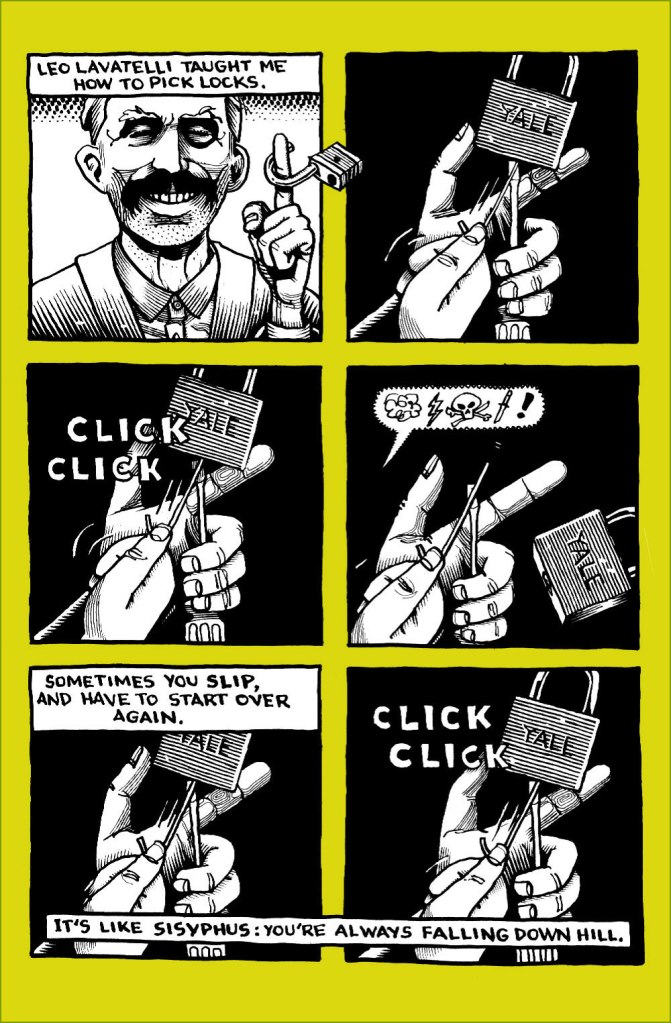
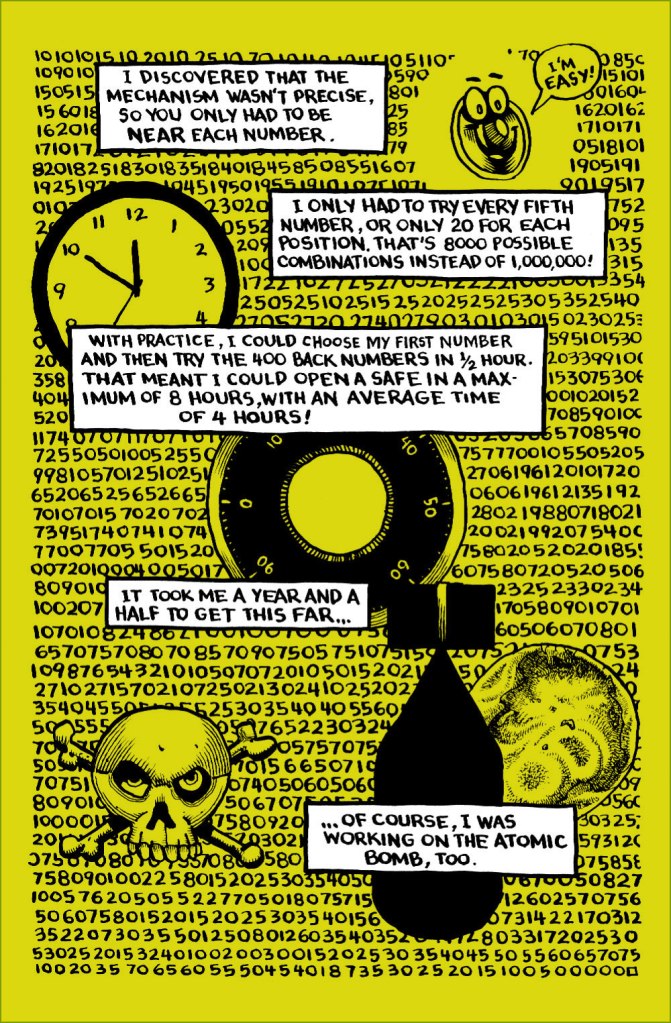
« Though this is fictionalized science, it’s not science fiction. We’ve imagined some of the details, but the characters existed, and did and said (most of) the things you’ll read. » Two-Fisted Science: Safecracker (1997, General Tektronics Labs). Published in advance of the Two-Fisted Science anthology, in order to promote it. However, Bernie’s piece outshines everything else, if you ask me. For good or ill, cheap copies of the comic book are still handily acquired.
This is only (most of) a single chapter of Bernie’s contribution — which totals 30 pages! — but it’s fully enjoyable on its own. Script by Jim Ottaviani, pencils, inks and lettering by Mr. Mireault.
A bit of background about Mr. Lavatelli (1917-1998)…Pray note Bernie’s clever nod to the great Harvey Kurtzman (top left). Of course, working on a story starring genial genius Dr. Richard Feynman already gives you an edge, but Bernie was one of the few cartoonists who could breathe life into the drabbest of narratives. Non-fiction seems especially daunting for today’s cartoonists, for some reason.
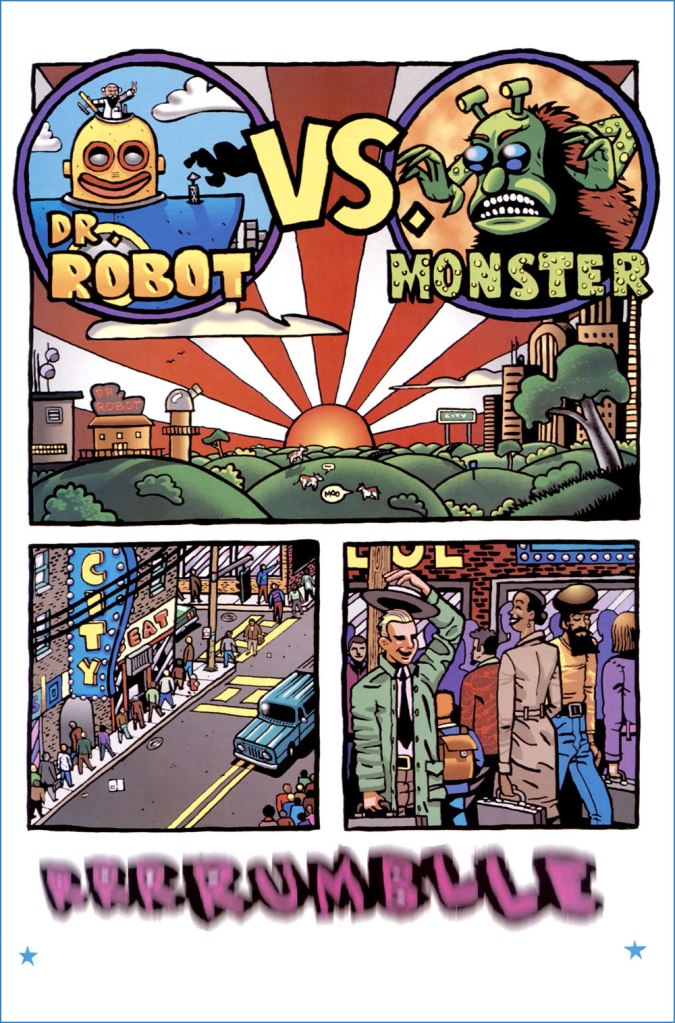
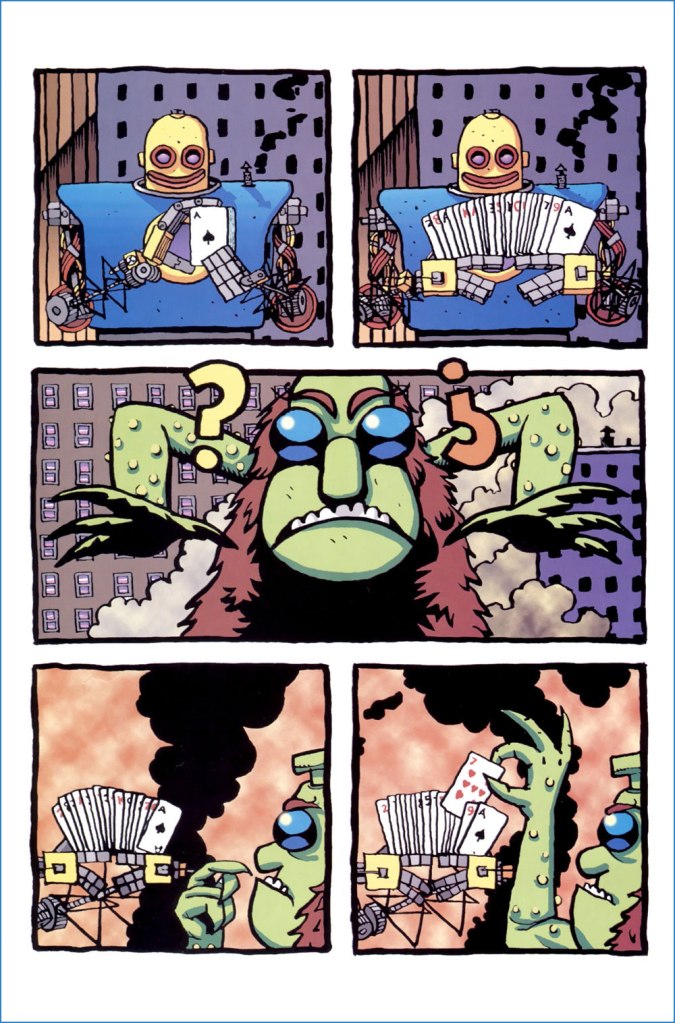
For another facet of Mireault’s talent, and to highlight his peerless colouring chops, here’s my favourite of his too-few Dr. Robot stories, written, pencilled, inked, lettered *and* coloured by Mireault. To this day, insultingly cheap copies are plentiful. Less than the original cover price, for Pete’s sake.
Thanks, Bernie. I’m truly sorry things didn’t work out for you.
I was going to post something very brief this month, telling you what to expect from us in September, which is… nothing else. We’re busily preparing this year’s edition of our Hallowe’en Countdown — which will include some more Mireault, that’s all I can tell you for now. See you soon!
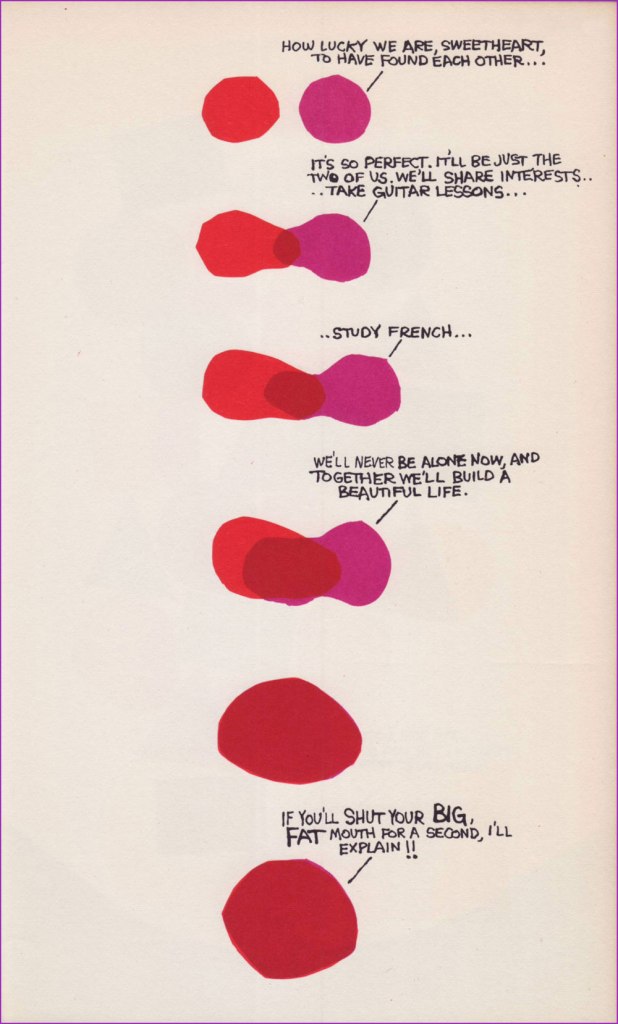
Inhabiting the same topography and timeline as Jules Feiffer‘s Village Voice strips, Bill Manville’s Saloon Society, and, dare I say, even Rod McKuen’s youthful reminiscences, The Conformersby Jack Wohl* (‘who has been, at various times, a child, a larger child, a musician, a composer and creative consultant and art director for our advertising agencies‘, helpfully notes the blurb on the back) is a charming little book with colourful squares and circles for characters. Like many other publications whose existence I previously ignored, I found it in a used bookstore that assigned it the somewhat random price of seven dollars, 41 cents, which was pretty good, considering that the employees probably didn’t know what it was or how to price it.**
Published in 1960, the book consists of ‘shapes cut out of colored paper with scissors‘, cheekily described in the introduction by Roger Price*** as Wohl’s psychiatrist’s idea. These blobs may be firmly situated in NYC’s Greenwich Village, but no matter how technologically advanced we get, most human preoccupations are the same some 60+ years later… so most readers will be able to effortlessly recognize themselves in the lives of Harriet (red circle), Howard/Herbie (purple square) or Arthur (green square).
** No shade is intended towards used bookstores in general, which are places I love being in, but this particular bookstore has staff that seem to wildly overprice most things without consideration for their condition or the simple question of ‘who in their mind would buy this at that price?‘.
*** As the author of Droodles, Price was particularly well positioned to write an introduction to The Conformers.
« Advertising – A judicious mixture of flattery and threats. » — Stephen Leacock
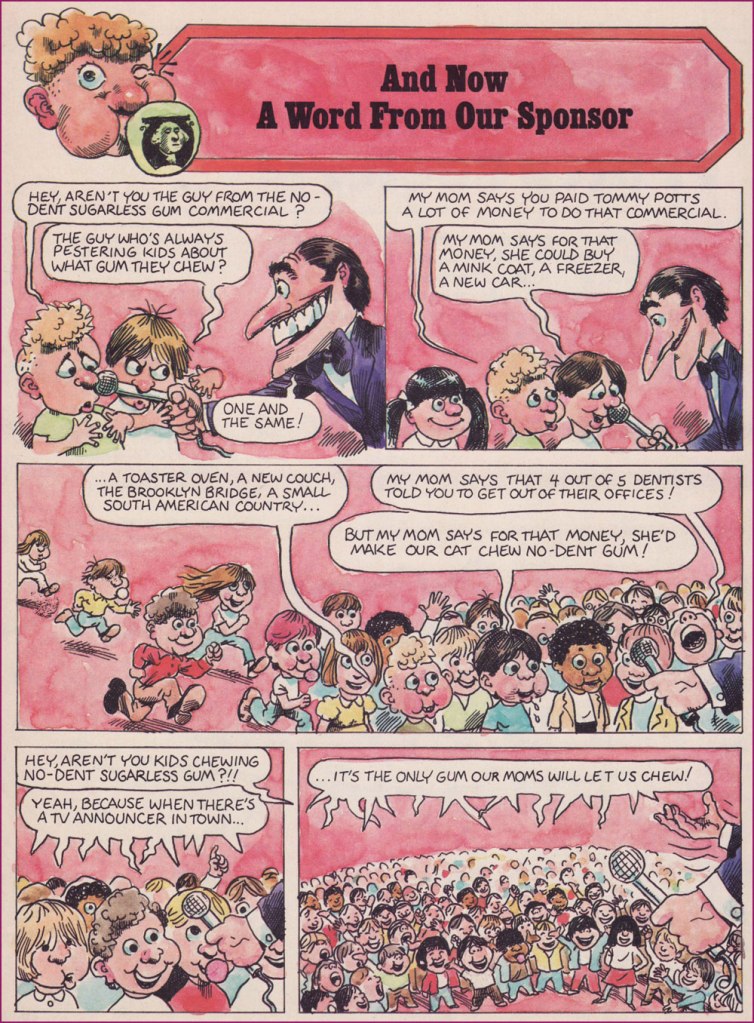
It’s long been established that one can scarcely be too skeptical in the face of advertising, and the sooner one starts questioning its wooly claims, the better. In the early 1950s, Harvey Kurtzman‘s Mad shone the giddily harsh light of truth on, well, just about everything, but Madison Avenue‘s tactics were a favourite and frequent target, and for good reason. In 1956, Kurtzman heatedly left his creation after a mere 28 issues; while it retained much of its cultural influence as its reach increased, it degenerated into rigid formula in the hands of his too-cautious successor at the helm, Al Feldstein.
Fast-forward to 1974, and Dynamite Magazine‘s sixth issue. Readers presumably too young for Mad could now receive their monthly inoculation against the advertising industry’s tainted baloney.
From 1974 to 1981, the feature was illustrated by Calvin Sanford “Sandy” Huffaker, Sr. (1943 – 2020); then the reins were passed into the able paws of future Mad art director (small world!) Sam Viviano. But that’s a tale for another day.
Since Huffaker was only credited for illustrating the feature, it stands to reason that it was written in-house, and that narrows it down to two main candidates: editor Jane Stine or Linda Williams Aber (aka “Magic Wanda”); my money’s on Aber, who also wrote Count Morbida’s Puzzle Monthly Puzzle Pages.
As Dynamite’s ‘Inside Stuff’ table of contents always billed it, here’s « A Dynamite look at BADvertising »!
The feature’s inaugural entry, from Dynamite no. 6 (Dec. 1974, Scholastic). The voracious oldster lampooned here is Euell Gibbons, who shilled for Post Grape-Nuts (which contain neither grapes nor nuts!) in this vintage commercial.From Dynamite no. 7 (Jan. 1975, Scholastic). You might recognize Nancy Walker, aka Rhoda’s mom Ida, and future director of Can’t Stop the Music! (trigger warning: Steve Guttenberg); here she is, pre-orange hair, in a Bounty Paper Towel spot from the Me Decade.From Dynamite no. 9 (Mar. 1975, Scholastic). Here’s a 1971 Bufferin vs. Aspirin ad. Place your bets!From Dynamite no. 19 (Jan. 1976, Scholastic). You just may be familiar with the object of this parody.From Dynamite no. 25 (July 1976, Scholastic). Here’s another ‘wonderful, quick‘ Jell-o recipe from those gelatin-happy days.From Dynamite no. 26 (Aug. 1976, Scholastic). Remember Morris? Here’s the famously fussy feline in a 1974 Nine Lives ad.From Dynamite no. 27 (Sept. 1976, Scholastic). Here’s a Hamburger Helper commercial of the corresponding vintage.From Dynamite no. 28 (Oct. 1976, Scholastic). Here’s our pal Poppin’ Fresh in a 1972 commercial.From Dynamite no. 37 (July 1977, Scholastic). On that topic, here’s our look at the 1970s bubble gum explosion!This subscription ad appeared in Dynamite no. 26. I suspect it was a draft for issue 28’s more focused Laverne and Shirley cover, which had been previewed in ads as a photo cover.From 1971, young Sandy wears his Ed Sorel influence a little heavily, but he was learning fast and from the best! For those who may not know — or who’ve forgotten — David Frye was possibly the nation’s premier Tricky Dick Nixon imitator. Was he? Listen here and judge for yourself!
Thanks to his versatility and ability to nail a likeness, Huffacker was among the most sought-after illustrators of the 1970s. Quoting from the Chattanoogan.com’s obituary:
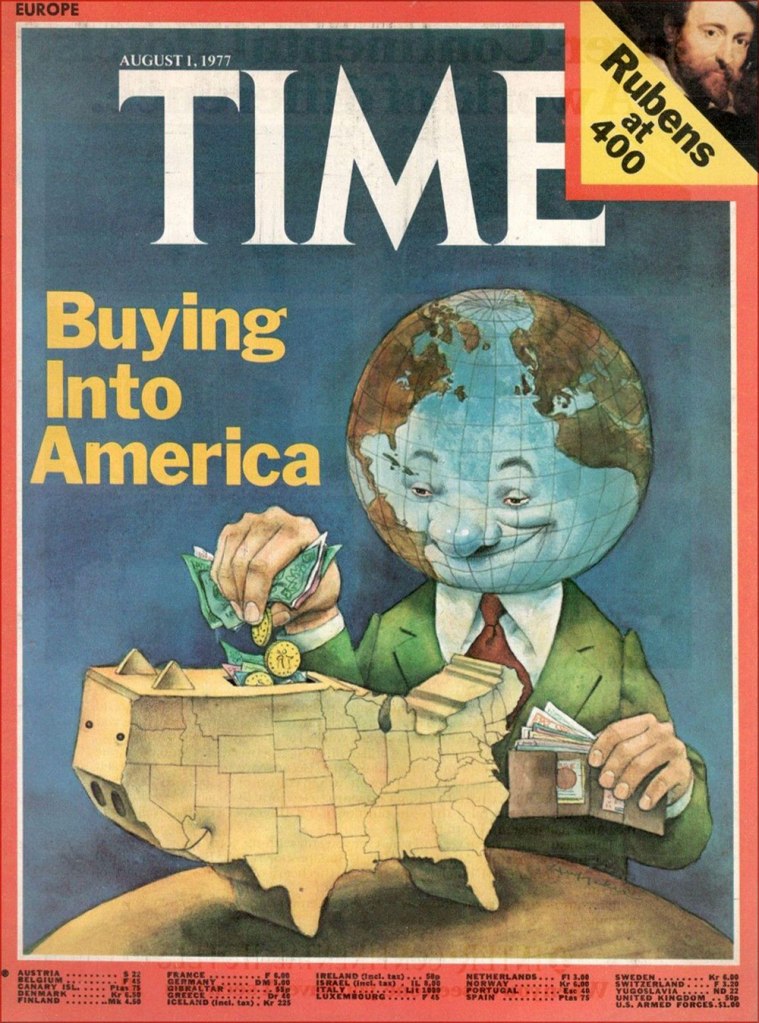
« Huffaker was a highly acclaimed political cartoonist who started his career with The Birmingham News and the Raleigh News and Observer. He later moved to New York City and illustrated covers and articles for such publications such as Time Magazine, The New York Times, Sports Illustrated, Businessweek, People and Fortune Magazine. Some of the accolades awarded for his artwork include two Page-One Awards from the New York Newspaper Guild, three nominations for Cartoonist-of-the-Year by the National Cartoonists Society, A Desi Award of Excellence (Graphic Design Magazine), 20 Award of Merit citations from the Society of Illustrators, and was twice nominated for a Pulitzer Prize for illustration. »
Here’s one of his aforementioned Time covers.
In a 2012 interview, he recalled those halcyon days: « During one week at the peak of his career as an illustrator, Sandy Huffaker had assignments from Time, Sports Illustrated and Businessweek. He had to turn down a fourth assignment that week from Newsweek. “I just didn’t have time.” »
« A merry Christmas to all my friends except two. » — W. C. Fields
I was in the middle of writing a post on another topic, getting bogged down in its complexities, and then it dawned on me that Christmas was fast approaching, and I’d better switch gears pronto.
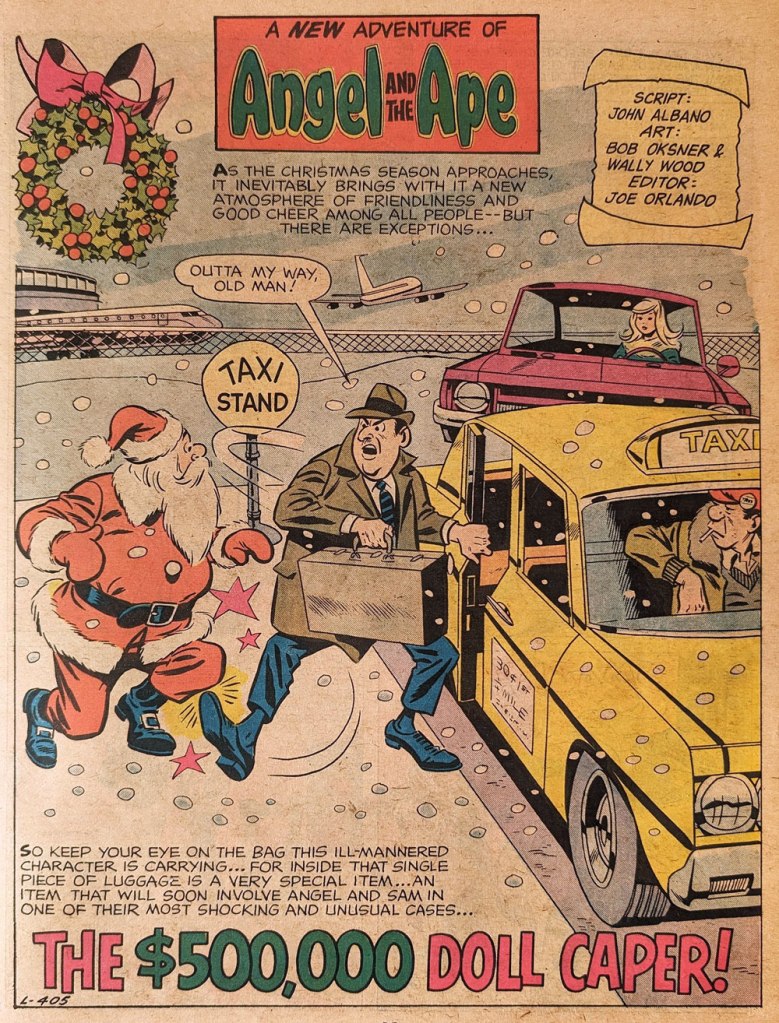
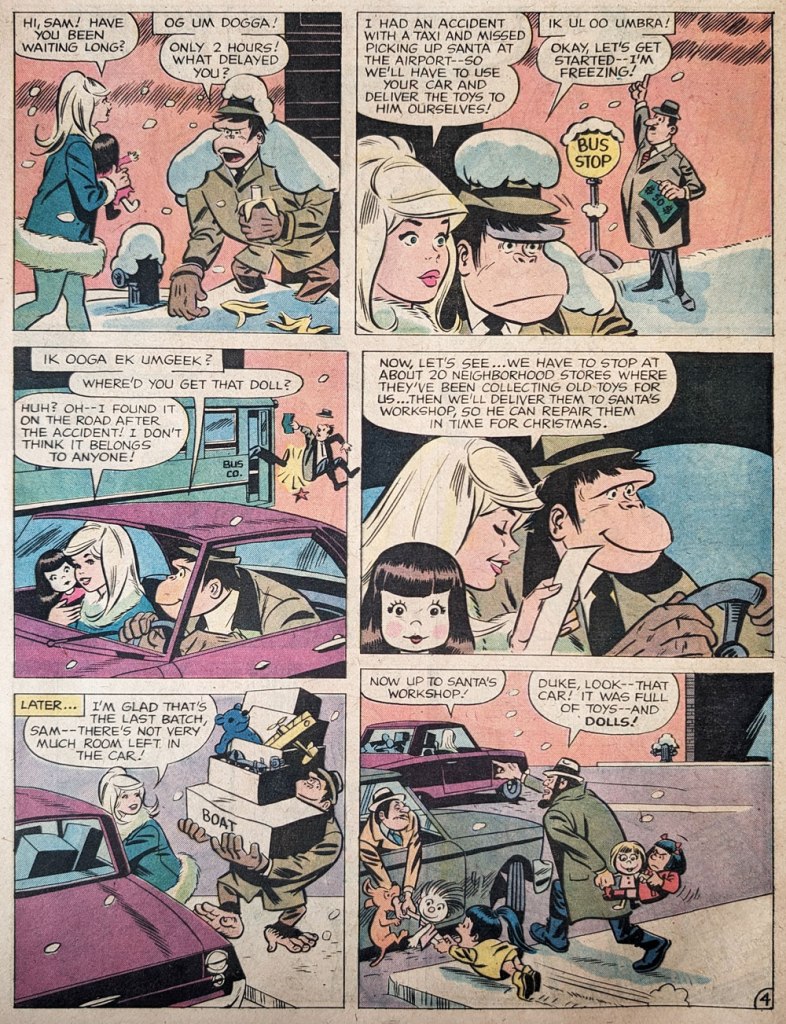
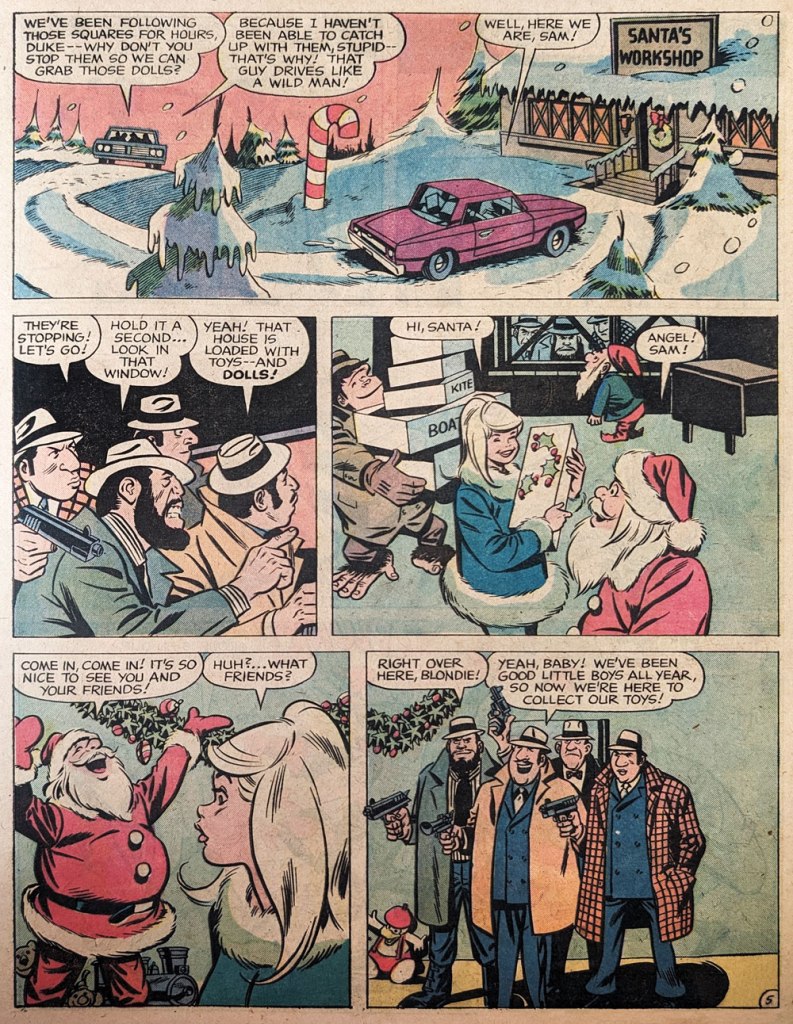
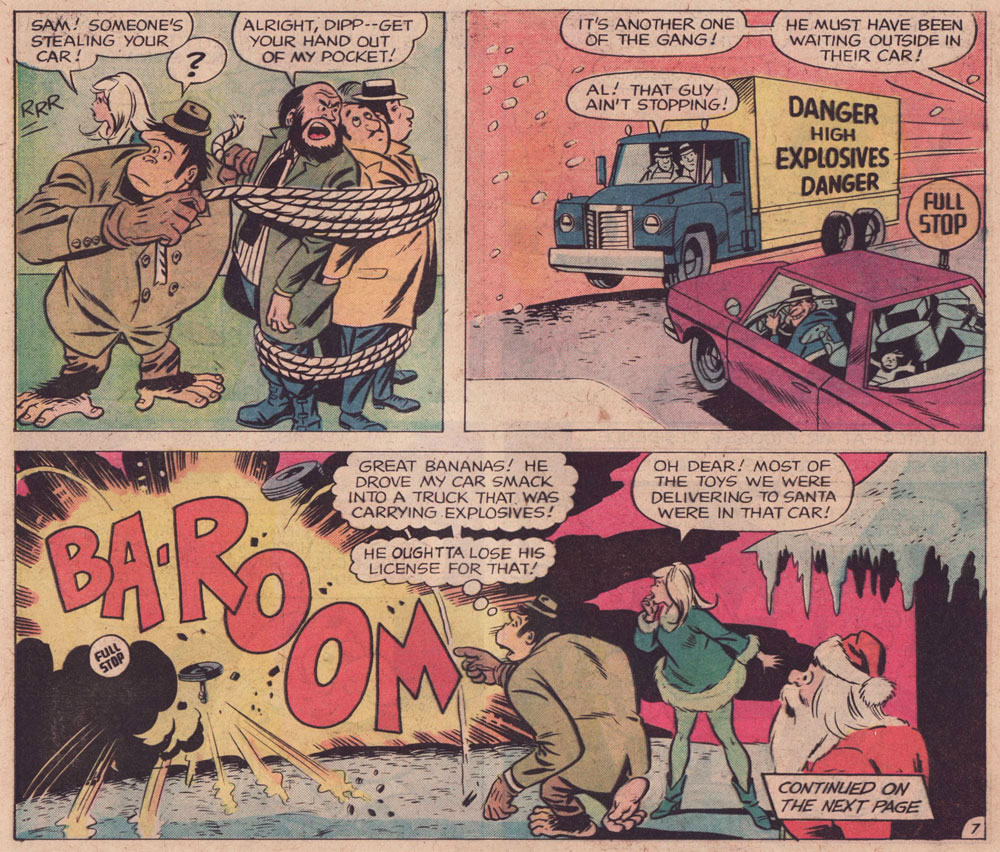
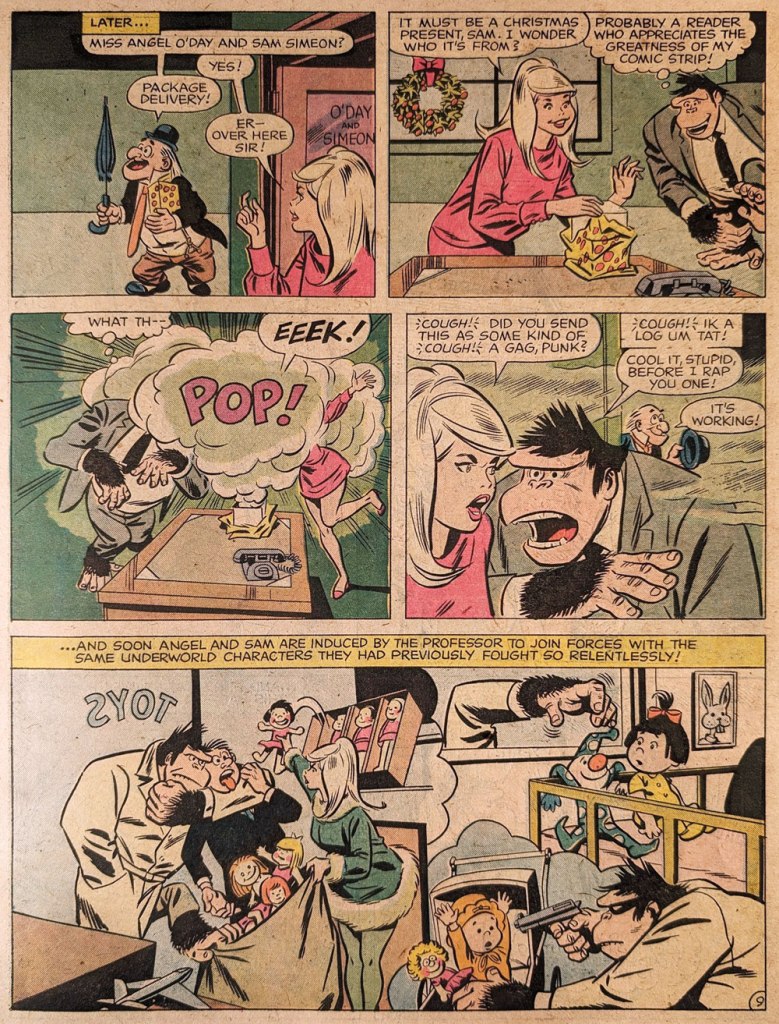
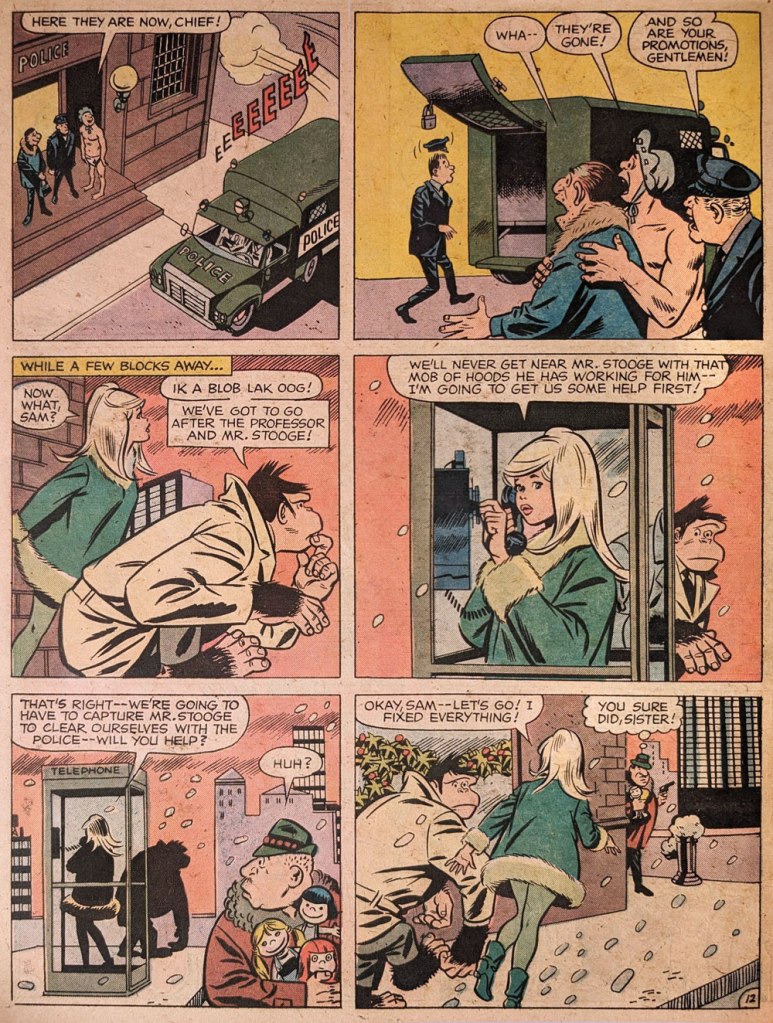
Thankfully, I had something in mind: an Angel and the Ape tale initially produced in the late 1960s but orphaned with the book’s cancellation. It was half-heartedly released from limbo –shall we say buried? — in one of those awkward tabloid format volumes, Limited Collectors’ Edition C-34: Christmas With the Super-Heroes (Feb.-Mar. 1975, DC) and not even advertised on the front or back cover… which is why it took me decades to learn of its existence.
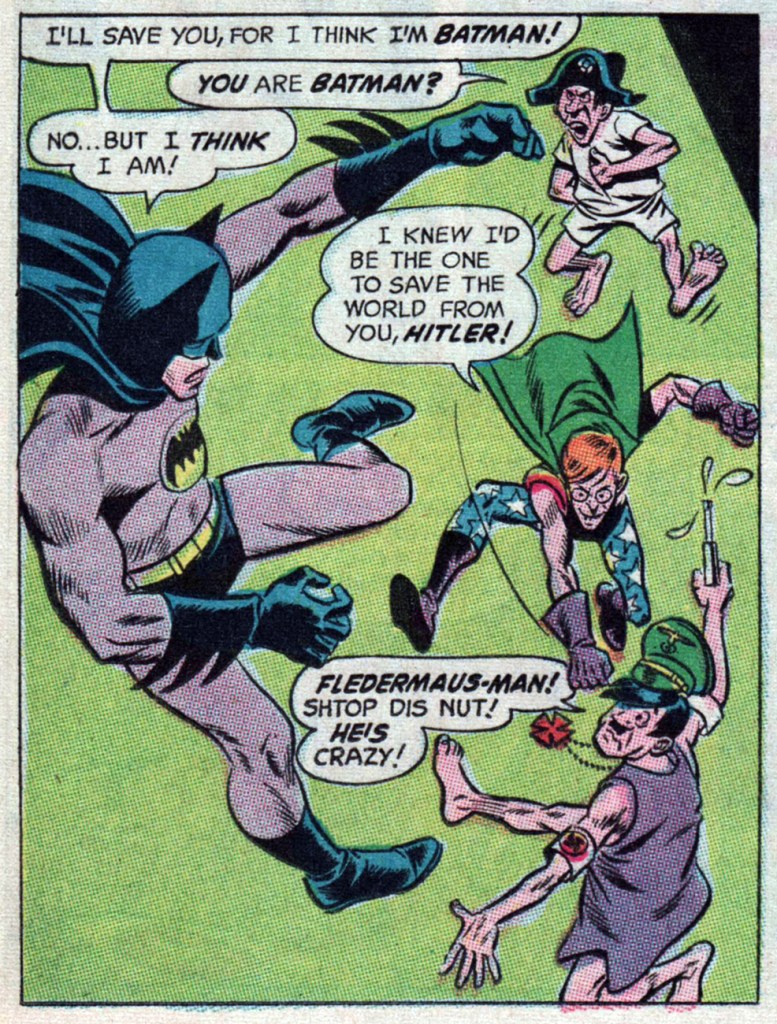
On average, Angel and the Ape was only marginally funnier than the rest of DC’s humour books (save of course for Shelly Mayer’s consistently hilarious Sugar and Spike), but still leagues ahead of Marvel’s painful Not Brand Ecch et al. A&A was, imho, at its peak when E. Nelson Bridwell wrote it, lobbing some choice barbs at the esteemed competition.
To briefly illustrate my point, here’s a relevant panel from Angel and the Ape no. 3 (Mar. 1969, DC).
Script by Bridwell, pencils by Oksner, inks by Wood. The redhead in the green cape and star-spangled tights is Stan Bragg, editor-in-chef at Brainpix Comics, a clever amalgam of the Smilin’ One and his Rascally subordinate. “When you write good stories and do good artwork, don’t I sign it?“
« I’m going to Boston to see my doctor. He’s a very sick man. » — Fred Allen
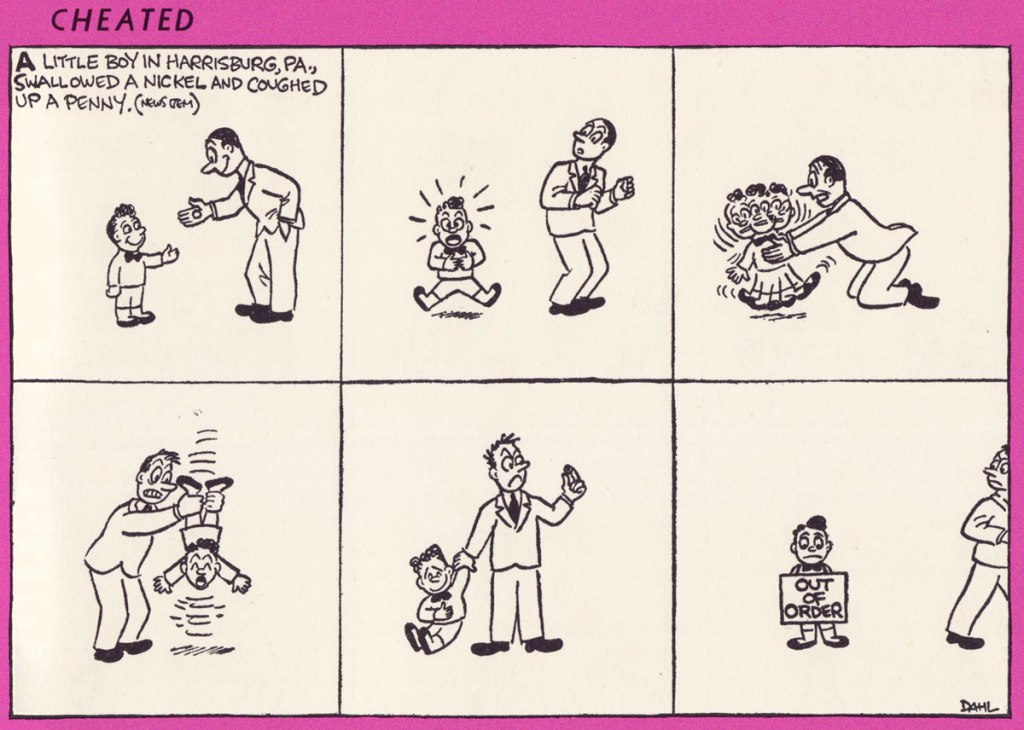
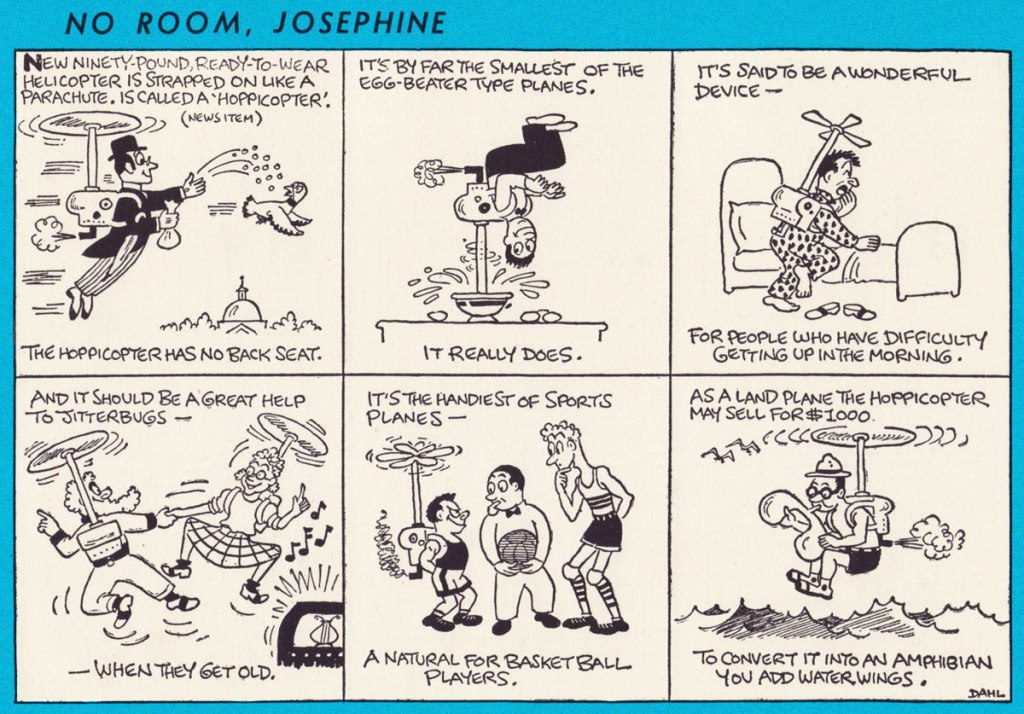
My turn to spotlight a recent find: last month, during a fruitful visit to Ellsworth, ME’s The Big Chicken Barn, I spotted — among others — an item of interest in the humour section: a hardcover volume entitled Dahl’s Brave New World, published 1947. Spare but effective cartooning, plenty of imagination and wit. See what you make of it.
Replace ‘miniature plane’ with ‘drone’ and you’ve got a cartoon for these here times.While the ordinary citizen has been waiting for his long-promised, personal jet pack for decades on end, a ready-to-wear helicopter would be, it seems to me, a reasonable substitute.
I love knowing that there’s a world of talented folk I’d never gotten wind of. Even if a lifetime is too short, even if I’ll miss out on some great art, both capital A and lower-case, I prefer to hold the optimistic view and raise the half-full glass in a heartfelt toast.
By way of biography, Mr. Dahl (1907-1973) thankfully rated an obit in the New York Times on May 7, 1973. Allow me to quote liberally from it:
« Francis W. Dahl, Boston’s best‐known cartoonist, whose works have appeared in newspapers here for 45 years as well as in a series of books, died today at his home in Newton. He was 65 years old.
Mr. Dahl’s cartoons focused on Bostonians and their politics, customs, costumes and foibles, with most of his subjects growing out of local news items.
From 1928, when he began his newspaper career as an $20‐a‐week illustrator, until last June, Mr. Dahl drew his cartoons for The Boston Herald and its successor, The Herald Traveler. When the paper was purchased by The Record‐American last June, he joined The Boston Globe.
Collections of the cartoons also appeared in a number of books, including “Left Handed Compliments,” “Dahl’s Cartoons,” “What, More Dahl?” “Birds, Beasts and Bostonians,” “Dahl’s Boston” and “Dahl’s Brave New World.”
Stories about Mr. Dahl have become part of Boston’s journalistic legends. Once, for example, a Herald engravers’ plate broke just before deadline and 144,000 copies were printed without his cartoon. A printed box asked readers if he was missed, and 4,000 letters were sent to the editor saying yes.
On another occasion, Mr. Dahl broke his right arm — his drawing arm — but rather than miss a day the paper had him draw left‐handed for six weeks. »
While the NYT piece itself draws heavily from a 1946 Time Magazine profile of Dahl, it left out the juiciest part of the anecdote: « Since draftsmanship is the least of Dahl’s assets, the switchover didn’t show much. »
It’s refreshing to see — especially in light of the era it was produced in — the lady take the amorous initiative.I couldn’t pass this one up: I mean… mushrooms, bats, moles and skinks!
And here’s some insight into Dahl’s relative obscurity: « Because he concocts his cartoons out of local news items, and refuses to change his ways, mild-mannered Francis Dahl has never been syndicated. But for his collections of reprints, he would be unknown outside New England. » [ source ]
« If anything, I consider myself non-violent. I’m from the hippy era, peace, love, groovy. » — Rick James
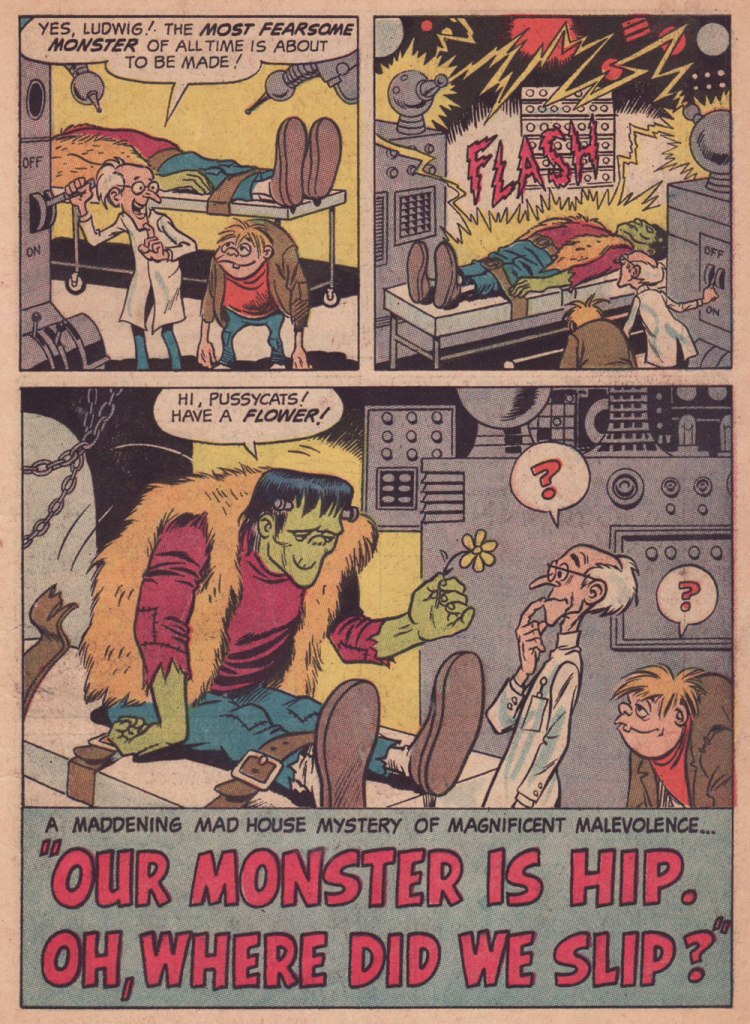
1968 wasn’t exactly a banner year for Harry Shorten and Wally Wood‘s Tower Comics (1965-69); Wood’s flagship title, T.H.U.N.D.E.R. Agents, was down to running a mixture of reprints and inventory, and a mere two issues were cover-dated 1968. A final number, the 20th, limped onto newsstands a full year after its predecessor.
So it’s understandable that Wood started casting around for plan B. He gave Archie a try. It didn’t take… surely his fellow Tower editor and Archie refugee Samm Schwartz must have tried to warn him. Oh well.
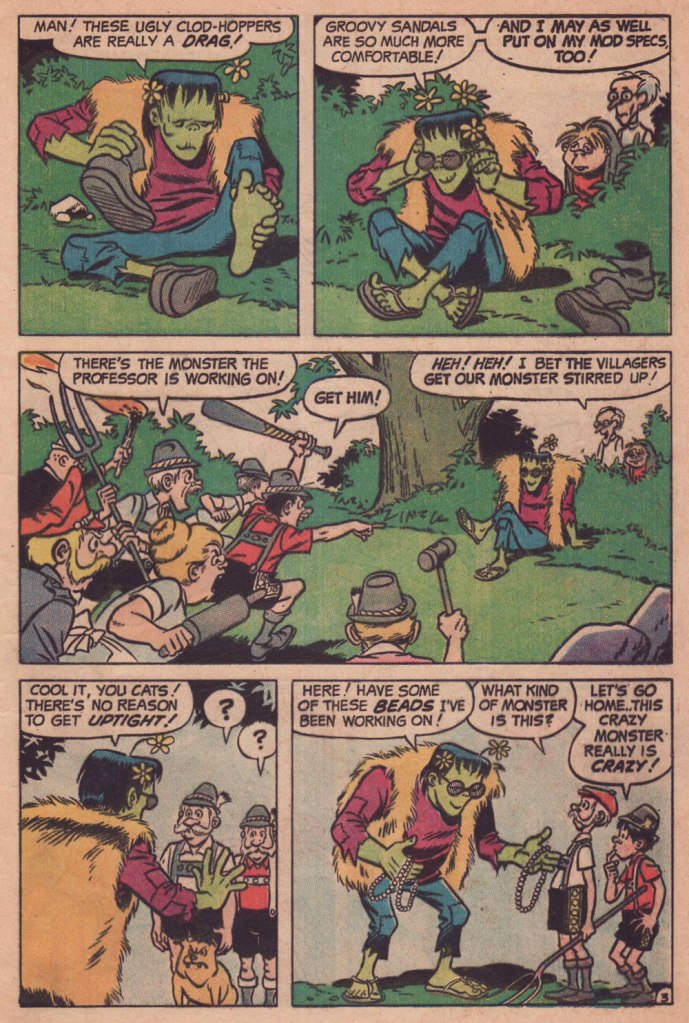
« Our Monster Is Hip. Oh, Where Did We Slip? », most likely scripted by Archie mainstay George Gladir (1925-2013), appeared in Archie’s Madhouse no. 64 (Oct. 1968).
As far as I know, this was the only story Wood drew for Archie Comics, at least in their usual humorous mode. In the ’70’s, he would provide finishes over Jack Abel‘s pencils on one story (« Devil Rider », Red Circle Sorcery no. 10, Dec. 1974) for the interesting but short-lived, Gray Morrow-directed Red Circle Comics Group, a more ‘mature’ Archie offshoot… and that’s it.
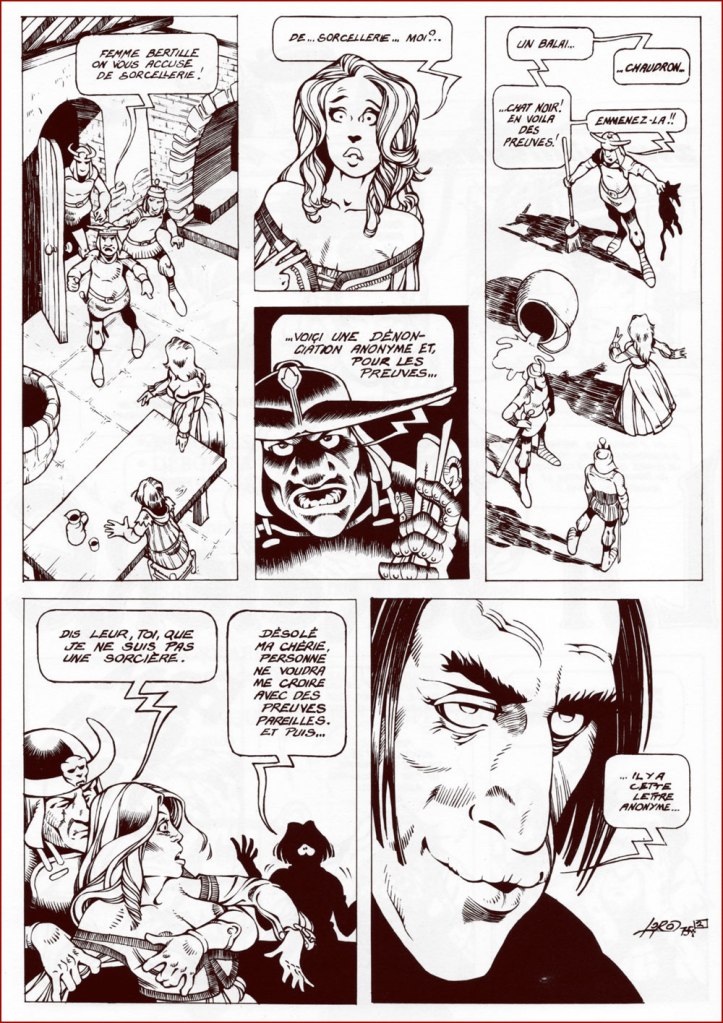
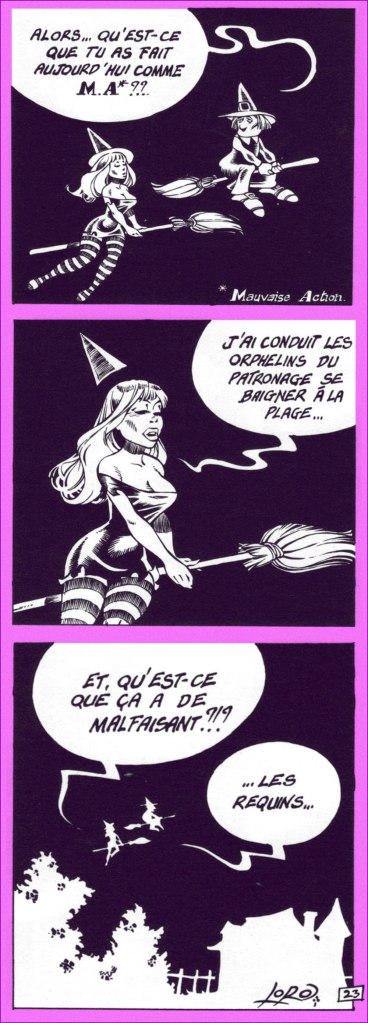
To be honest, while Loro’s artwork was often inspired, Déboires’ gags mostly fell flat; I presume that the creators had no idea how hoary these monster jokes had become, not having been exposed to the likes of Famous Monsters of Filmland, Topps’ ‘You’ll Die Laughing‘ card set, Mad, Cracked, Sick… and all the glut of parody mags. However, Loro was for a time — and right from the start — editor of the French edition of Warren’s Creepy, which was, imho, superior to the original thanks to better printing and, most significantly, its brand-new, first-rate documentary material created by Midi Minuit Fantastique alumni, replacing Warren’s cool, but repetitive in-house Captain Company adverts.
Here are the strips I consider standouts. Just a few years on, Loro would attain his peak with the early cases of gumshoe Abel Dopeulapeul, whom we’ve featured a few years back. Contrast and compare!
Volume one of Déboires d’outre-tombe (1981, Éditions du Cygne).Volume two of Déboires d’outre-tombe (1982, Éditions du Cygne).« You can tell a good workman by his tools!!! »Loro was clearly catching a lot of Hammer films of the era.The plot, in a nutshell: Bertille constantly henpecks her husband because of his general rakishness and lack of gainful employment. Oh, but he’s found a job, he claims. Just then, she’s anonymously denounced as a witch. « I told you, Bertille. You see… I’ve found some work. »« So, what have you done today as a bad action? » « I took the orphans from the youth club to the beach for a swim… » « And what’s so evil about that? » « The sharks… »
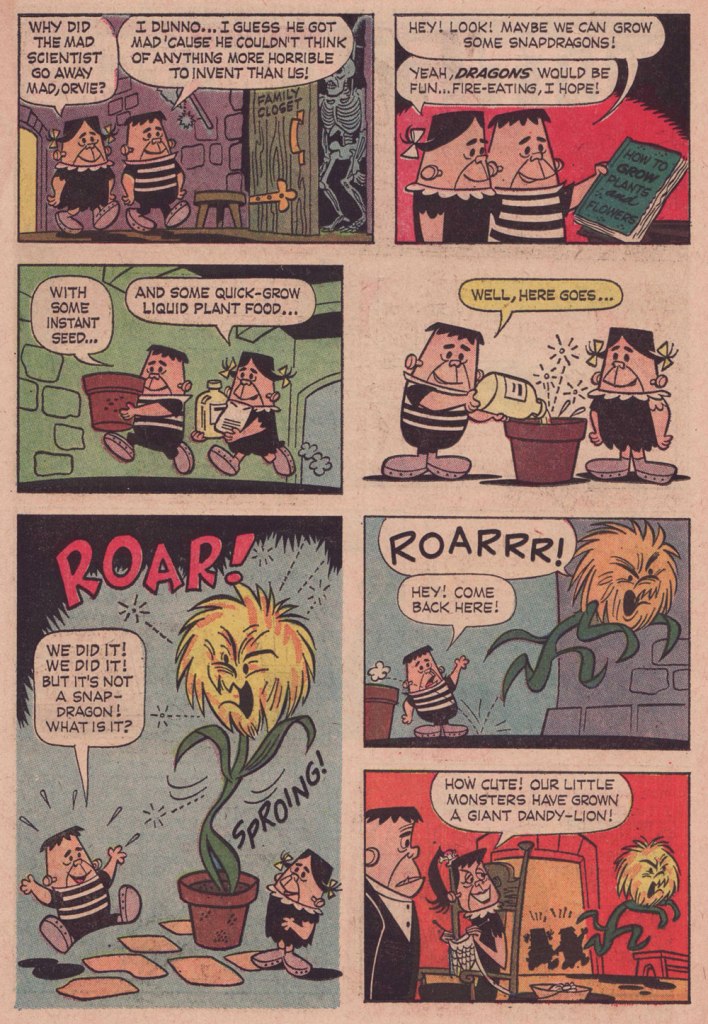
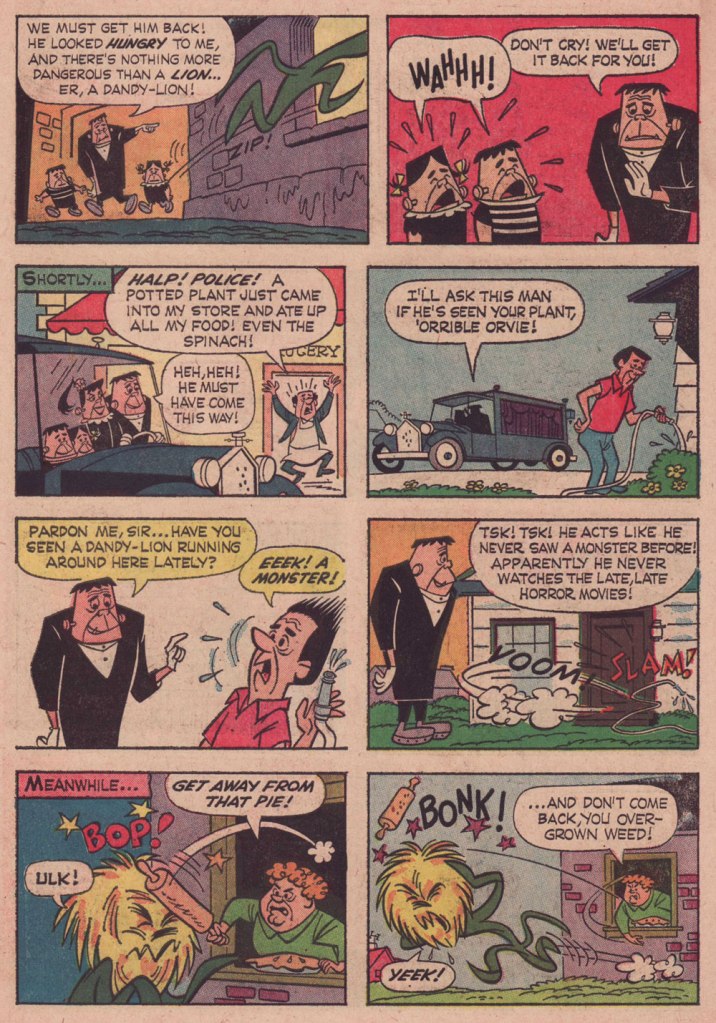
Few things evoke Hallowe’en so vividly to me as Gold Key’s The Little Monsters, one of the publisher’s relatively scarce non-licenced properties…
The series had its unlikely début as a backup feature in The Three Stooges no. 17 (cover-dated May 1964 — meaning it hit the stands in January) — months before The Addams Family (Sept. 18) or The Munsters (Sept. 24) reached television. Which is meaningless, of course, since the source for all of these fiends was Charles Addams’ New Yorker cartoons, wherein the clan did not even bear his name. Monsters everywhere! There must have been been something in the water.
Oddly enough, while Orvie, Annie, Demonica and Mildew soon (Nov. 1964) earned their own book, they remained loyal to Moe, Curly and Larry, retaining their backup slot to the very end of the Stooges’ run (no. 55, June 1972). And while the regular Little Monsters title often comprised reruns — as early as 1971’s issue 13 — the Stooges-sponsored backups never were reprinted.
I was all set to run with a furry little yarn from 1965, but then, just a few days ago, my nice mail lady fatefully handed me a box of comics that included The Little Monsters’ titular inaugural appearance.
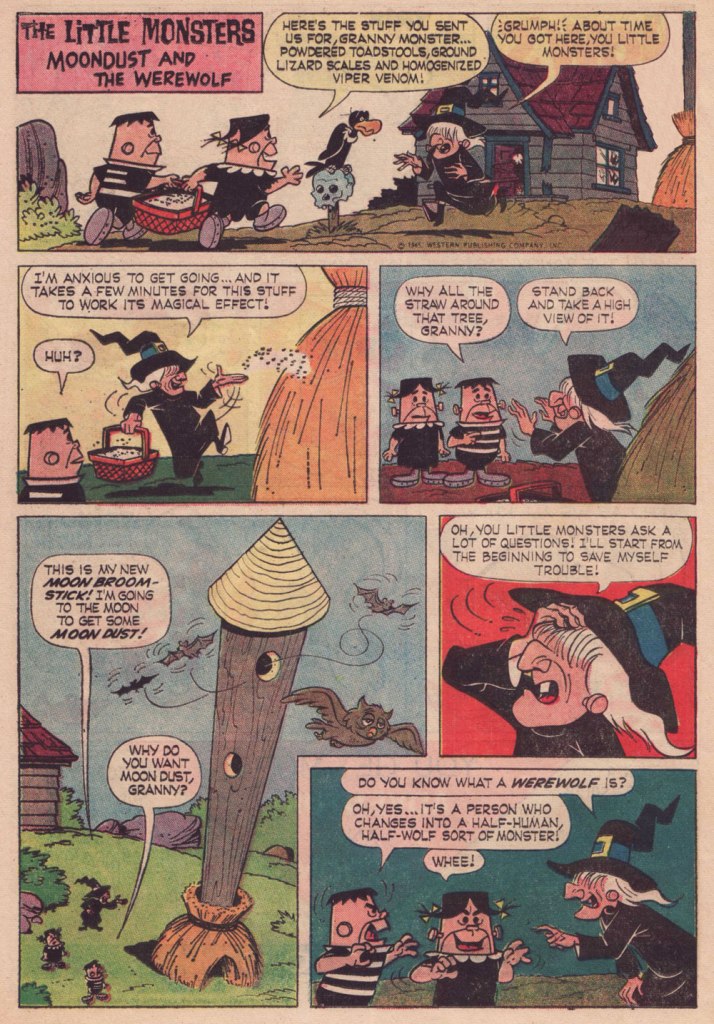
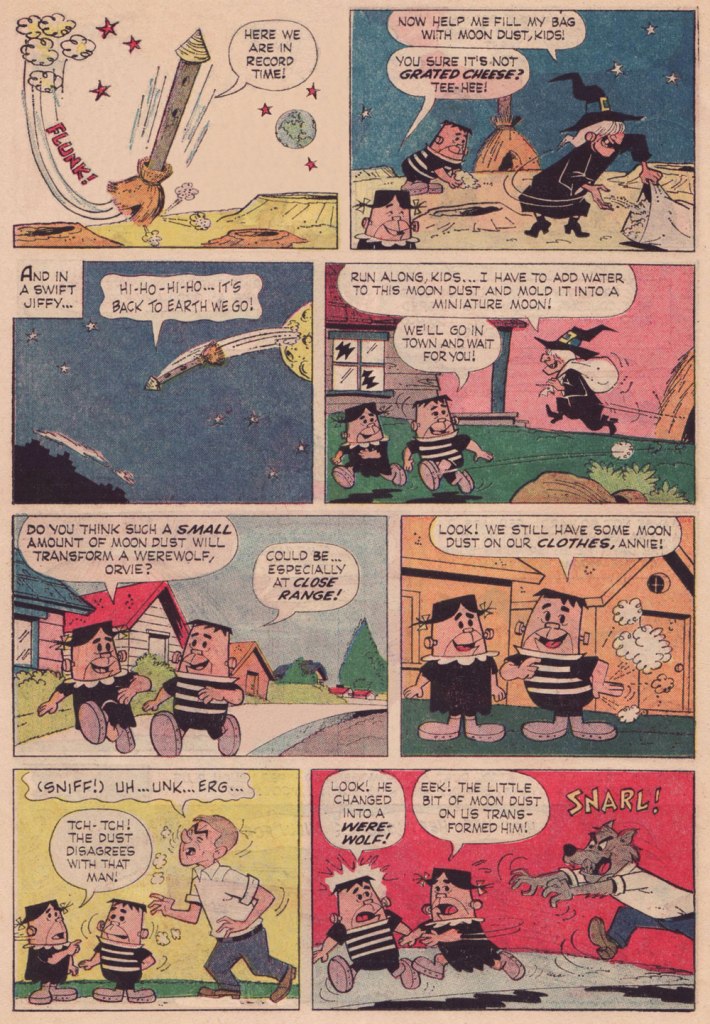
And, having mentioned it, here’s the story I had originally slated for this post: Moondust and the Werewolf from The Three Stooges no. 26 (Nov. 1965, Gold Key).












































 Who's Out There?