« On New Year’s Eve the whole world celebrates the fact that a date changes. Let us celebrate the dates on which we change the world. » — Akilnathan Logeswaran
Earlier this month, as we showcased Justin Green’s Musical Legends, I mentioned that I was reserving one of the strips for a special occasion, and it has come.
Originally published in the December, 2001 issue of Pulse!
« Shedding light on past and present musicians — and there are countless possibilities — is a real challenge. But when it works, the comic vision can change the listening experience. » Justin Green, from his Authoroonist Acknowledgements & Apologies (2004).
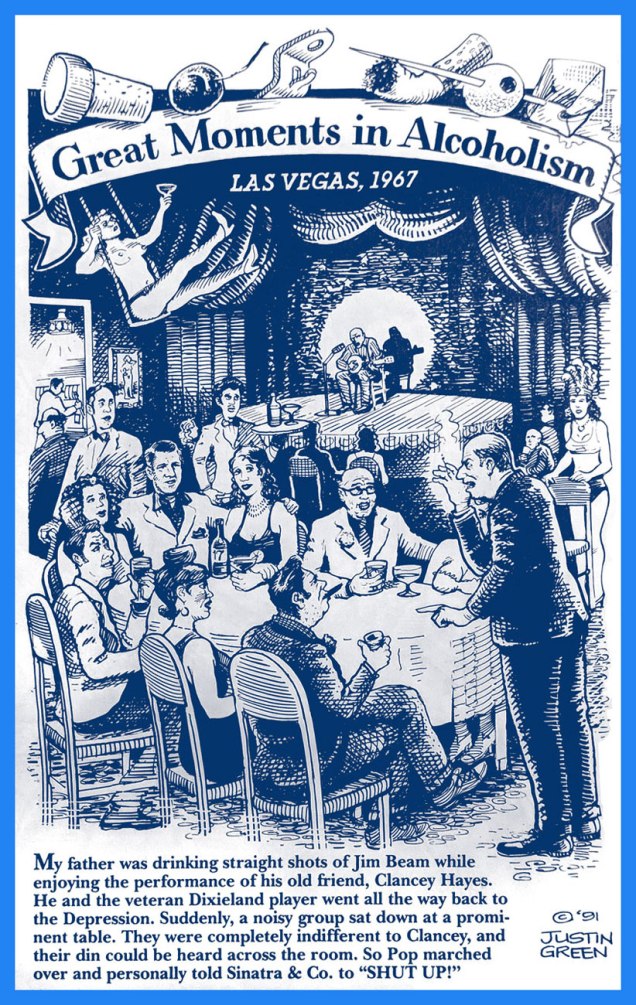
This entry stands out from its brethren in that the artist was personally involved in, or more precisely a witness to, the events depicted. In addition, no famous or semi-famous musical figure occupies the spotlight; instead, we get a gentle, low-key, soulful anecdote.
Who’s Out There has had a good year, and so we thank all of you readers around the world (and I do mean around the world: according to WordPress’ statistics, comics fans visited us from a whopping eighty-three countries these past twelve months) and wish each of you a wonderful, or at the very least better, year 2019.
« My father had a lifelong interest in helping musicians. I even encountered his presence when reading the autobiography of Anita O’Day. She said that there was a real estate man in Chicago who always made sure her band had a place to stay. That was Pop. » – Justin Green
How did Justin Green, one of the Founding Fathers of the Underground Comix movement, wind up holding down a regular feature for a decade (1992-2002) in Tower Records‘ in-house magazine, Pulse!? The whole chain of events began with a strip about his dad’s drinking. Of course.
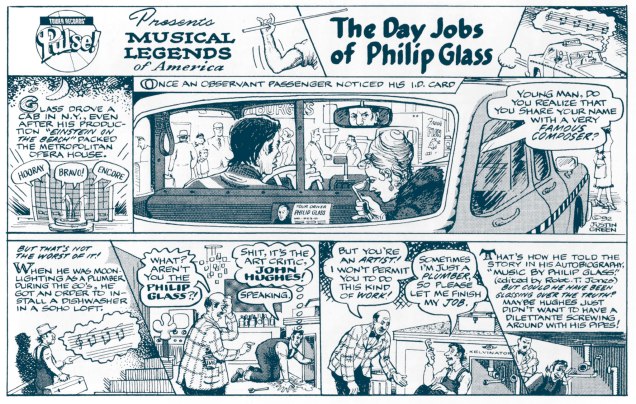
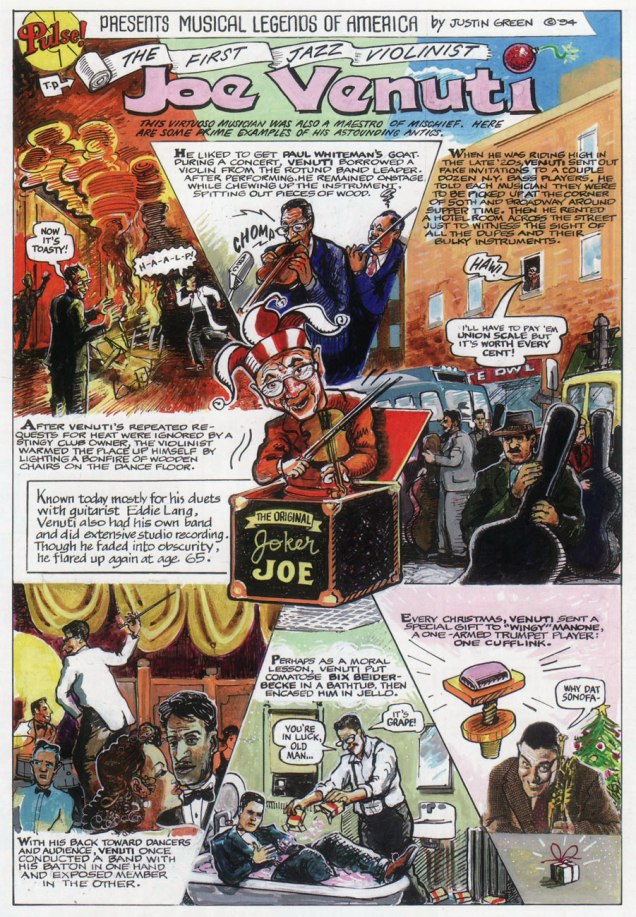
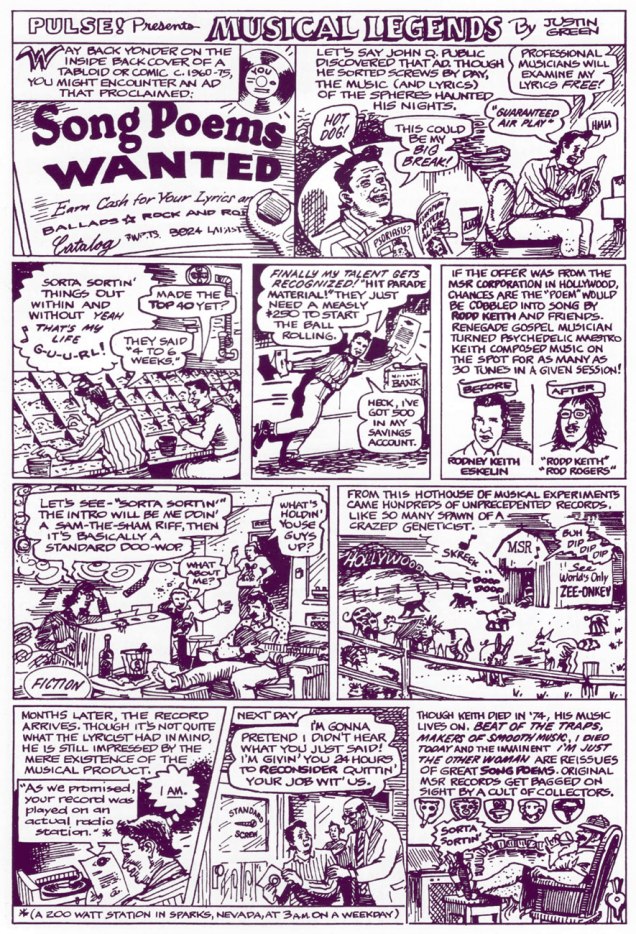
« It was my father’s spirit that instigated this cartoon project…. this was ’91 (Blab No.6, Summer 1991, Kitchen Sink Press), and I was living in Sacramento. Mark Weidenbaum was then an editor at Pulse! Magazine, published and distributed by Tower Records, which had its headquarters in West Sacramento. He had just seen the piece when he found out I lived nearby. He wanted to explore the idea of an ongoing musical biography cartoon feature. »The second instalment (April, 1992). A little Einstein on the Beach, anyone?August, 1992. Elvis certainly had his faults, but racism or ingratitude were not among these.My own introduction to the Reverend’s music came, as it surely came to many others, through Jackson Browne‘s fine cover of his Cocaine (Running on Empty, 1977). « I was talking to my doctor down at the hospital. He said, ‘Son, it says here you’re twenty-seven, but that’s impossible — you look like you could be forty-five’. »The strip frequently appeared in colour. Here’s my favourite example, from April, 1994. And here’s a fine Venuti performance. No, he wasn’t *always* joking.Ah, Rodd Keith, the main man behind those infamous Song Poems ads, comic book fixtures in the 1970s. The weren’t a scam… not in the traditional sense. November, 1996. Lend your ear to his Ecstasy to Frenzy.
While Green isn’t a native virtuoso draftsman like, say, R. Crumb or Rick Griffin, and he’s only fair-to-middling when it comes to likenesses, he *is* a born storyteller, and that’s really what’s most needed for an endeavour of this nature. Compressing a lifetime, or at least a career, into a single-page strip (two at the most!) is remarkably tricky and demanding, and if it looks deceptively easy here, he’s succeeded.
In selecting strips for this post, I didn’t lean towards my own favourite musicians, opting instead for what I felt were the strongest pieces, regardless of topic. However, I’m reserving my very favourite for a special New Year’s Eve post. Hope you enjoyed these musical time capsules! If you did, you’ll be happy to learn that the fine folks at Last Gaspcollected the set in 2003.
« Here, plainly, was a guy for whom cartooning held no mysteries. He was more than a master; he was a virtuoso, a source, an innovator whose style was completely natural and original and flexible enough to embrace dashed-off vulgarity and painstaking elegance, often in the same panel. » — Jim Woodring on Jack Davis
Here we are, coming to the end of our countdown (or count-up, depending on your point of view), and who better to convey the magic of Hallowe’en than the late, great Jack Davis (1924-2016)? Don’t answer that. 😉
Detail from Monster Rally (1959).
A 1959 collection of humorous horror songs by Alice Pearce and Hans Conried, Monster Rally (LPM/LSP-1923) sports a classic Davis painting – blending horror and humor into what amounts to a cutely-weird piece of art. Davis has mentioned that this scene is one he really enjoying doing and that he was quite pleased with. An ad for this album in issues of Famous Monsters of Filmland from back then read:
An insane and fantastically entertaining album featuring Hans Conried and Alice Pearce, singing and screaming ghoulish new songs like ‘Monster Rally’, ‘The Thing‘, ‘The Invisible Man‘, ‘Not of This Earth‘ and others. The album cover by Jack Davis is a masterpiece – suitable for framing.
[ Excerpted from Dick Voll‘s article Just for the Record: The LP Cover Art of Jack Davis (Fanfare no. 5, Summer 1983; edited and published by Bill Spicer). ]
And here are a mittful of extras, since I’m more inclined to treat than to trick on this special day.
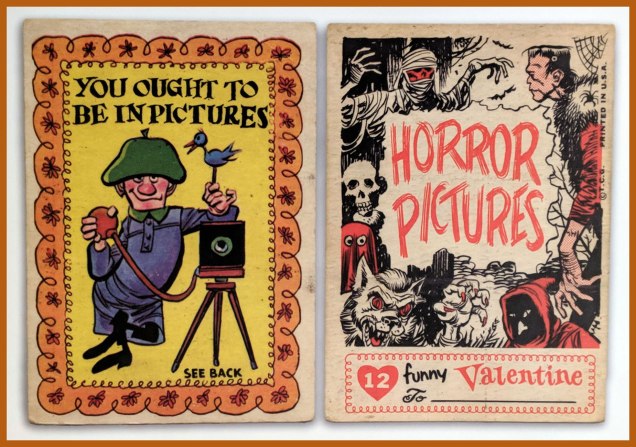
« From approximately ’59, Davis did a huge quantity of work for Topps Gum Co. Over the years, he did ‘Funny Monster Cards’, ‘Wanted Posters’, ‘Funny Valentines’, ‘Batty Book Covers’, ‘Wacky Packs’, ‘Silly Stickers’ as well as standard baseball and football tradings cards. » — Hank Harrison, The Art of Jack Davis (1986, Stabur Press). This, incidentally, is one of the ‘Funny Valentines’.
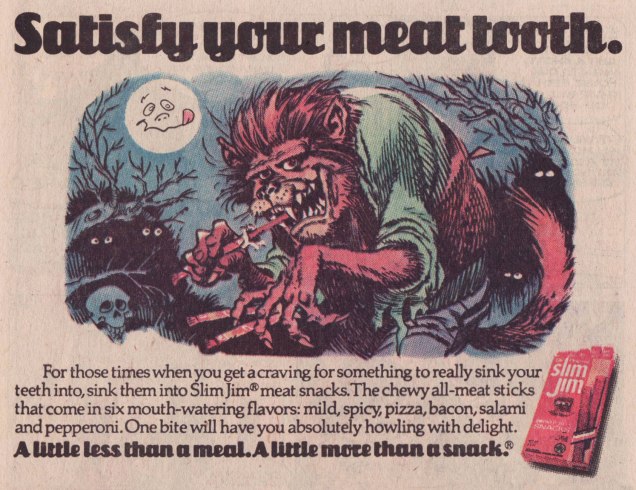
Davis’ classic Slim Jim commercials of the late 1970s. Of course. Can you believe they ran these earlier… with the bold-type, all-caps slogan of WHAT TO SINK YOUR TEETH INTO WHEN YOU’RE HUNGRY AND YOU’RE NOT A WEREWOLF… but sans Davis art? Thankfully, some bright kid at the ad agency saw the opportunity and managed to be convincing enough.
In closing, thanks for bearing with all my divagations through this second edition of WOT’s Hallowe’en Countdown, and let me wish you a most spooky Hallowe’en, one and all!
« Unless you’re some kind of masochist, I would imagine that you’d like to begin your plant experience with the easy, almost impossible-to-kill group. »
A sunny reminder of some of the plant world’s myriad of virtues, from 1973’s Mother Earth’s Hassle-free Indoor Plant Book by Lynn and Joel Rapp, a terrific little tome that bears the probably unique distinction of having yielded its own soundtrack. Not only that, but its own *excellent* soundtrack, Mother Earth’s Plantasia by Canadian-born songwriter, producer and electronic music pioneer Mort Garson. The LP was distributed through one of the wackiest marketing schemes I’ve ever encountered: it was given away with the purchase of a Simmons mattress from Sears. Uh?
« A green thumb is simply a positive state of mind about growing things. »
I see Plantasia’s even been reissued a few years back on fancy 180 gram vinyl (along with other formats and impressive ancillary products). But you can hear it in its entirety without making the considerable financial investment, thanks to this lovely tribute on the Music Is My Sanctuary blog.
The book (and LP booklet) are illustrated by « Marvelous » Marvin Rubin… who quite deserves the sobriquet, if you ask me.
« I was first introduced to Bromeliads by a 75-year-old semi-retired mechanic named Rafe ‘Frenchy’ DeLago. At least I thought I was. It turns out that I was actually first introduced to Bromeliads by my mother and the Dole Company, but neither my mother nor I knew it at the time. Truth is, my mother still doesn’t. You see, all pineapples are Bromeliads. In fact, all Bromeliads are pineapples! »
As confirmed by George Orwell’s sole comic novel, Keep the Aspidistra Flying.« Those plants will grow in your house, all right, but they’d grow better if you lived in a greenhouse. »« It is well known that plants grow best to classical music, but we have been told about a hip Dieffenbachia who loves The Rolling Stones. »« As people in the plant business, take it from us: the worst pest when it comes to killing plants is Homo sapiens. »
The Old Underground Hall of Legends took some bad hits in 2017, with the losses, within less than a couple of weeks, of Jay Lynch (January 7, 1945 – March 5, 2017) and Mervyn “Skip” Williamson (August 19, 1944 – March 16, 2017). Skip, in fact, would have turned seventy-four today.
Again, we’re dealing with an artist with a long and nomadic career, so it’s best to think small. There’s plenty of excellent, in-depth biographical material on the subject already out there, so I’ll scare up a few scarce items that reflect Skip’s lifelong love of (and involvement with) music.
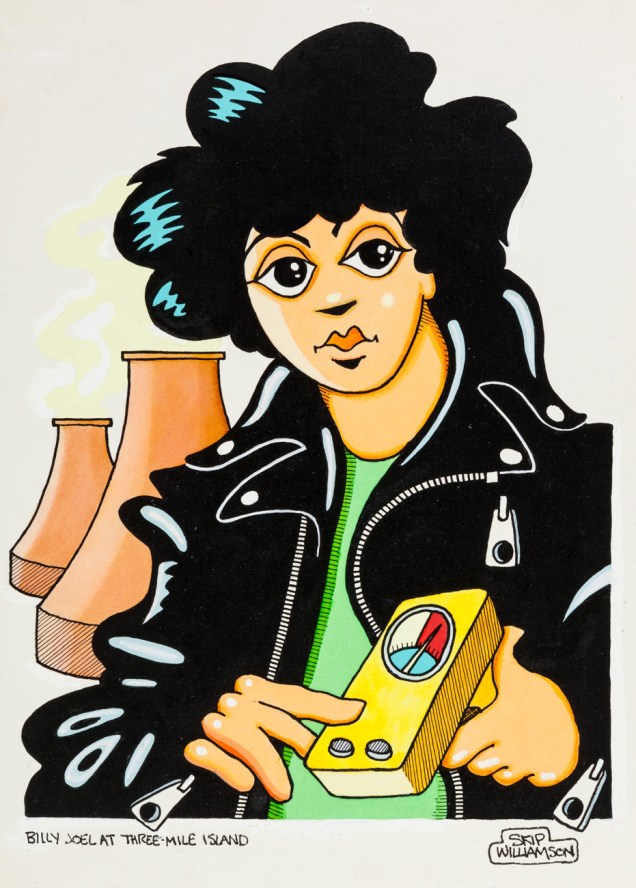
« Right now I’d like to do an original composition which deals with the basic existentialistic thought and parallels between the works of Kafka, Tillich, and Buber in relation to the ‘I-Thou’ concept, and which has just been covered by the Rolling Stones…» Underground comix provocateur Mervyn “Skip” Williamson (born 1944 in San Antonio, TX) takes a witty jab at noted self-mythologist Robert Allen “Bob Dylan” Zimmerman. From the March, 1967 issue of Escapade (incorporating Gentleman!), likely a Charlton Publications product (“Second class postage paid at Derby, Conn.”), a factoid that may someday help you win a bet.« Snuk Comix no. 1 (Skip Williamson, 1970). Extremely rare comic book created for the band Wilderness Road, by Underground Comix artist Skip Williamson. The story is that the printer objected to drug references, and would not deliver the printed comics; Skip managed to grab a few copies before the run was destroyed. As of 2003, only two copies were known to exist; while there have been a few more found since that time, the number of existing copies is staggeringly small… » Typical boorish behaviour on the part of the printer. Most people are unaware of the power that printers held and frequently abused before the salutary advent of digital print. Guys, *first* you nail the printing job (you call that registration?), *then* you indulge in moral grandstanding.1979 original art for a piece Williamson produced for Playboy magazine. « Now what », you may ask « Do Billy Joel and Three Mile Island have to do with one another? » Here’s one account: « Anne had a couple of his 8-tracks, and made plans to see him live at the Hershey Arena during his 1979 tour … plans that were thwarted by a little incident at a nuclear reactor near my home, Three Mile Island. See, when the accident happened, in March of ’79, people had to be evacuated. And those people had to go somewhere. And there just weren’t a whole lot of large buildings suitable for holding thousands of radioactive refugees in the area at that time, so The Hershey Arena had to be put to use, even if it meant canceling a few Hershey Bears games and a Billy Joel concert »
I was too young and in the wrong small town for Underground Comix to reach me back in the 1970s, but when Skip put together the « Playboy Funnies » section (featuring the likes of Bobby London, Jay Lynch, Chris Browne, Art Spiegelman…) for Mr. Hefner’s magazine, I in due course discovered his work since I read Playboy for the cartoons. I immediately took to Williamson’s stylish, bouncy, clean and friendly visuals, paired with his unflagging subversiveness. Not that I got much of said subversiveness at the time… but that’s how it works.
Happy birthday, Skip!
-RG
*Class War (Bijou Funnies no. 3, 1969 The Print Mint)
« It was a fanatic’s world, and I was one of the fanatics » – Gene Deitch
Say, for a bit of a twist, let’s pay tribute to a living* legend. I’m referring to none other than Gene Deitch (born ninety-four years and change ago: August 8, 1924 in Chicago, Illinois).
A recent self-portrait of the master.
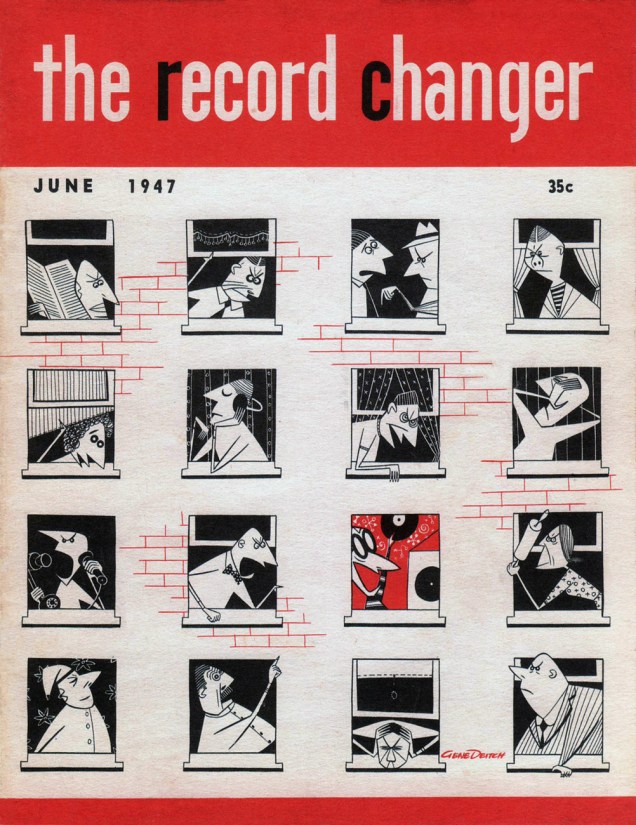
This fascinating man has led a life of such distinction, achievement and all-around coolness that I’m tripping all over myself trying to boil it down to a few highlights. Art director of legendary jazz mag The Record Changer, animator-director-scenarist for UPA, Terrytoons, MGM… Academy Award winner for his direction of his animated adaptation of Jules Feiffer‘s Munro (watch it right here), creator of Sidney the Elephant, John Doormat, Clint Clobber, Gaston Le Crayon… and co-creator of Simon, Seth and Kim Deitch. Some fine artistic genes, to be sure!
The stylish young Master Deitch.
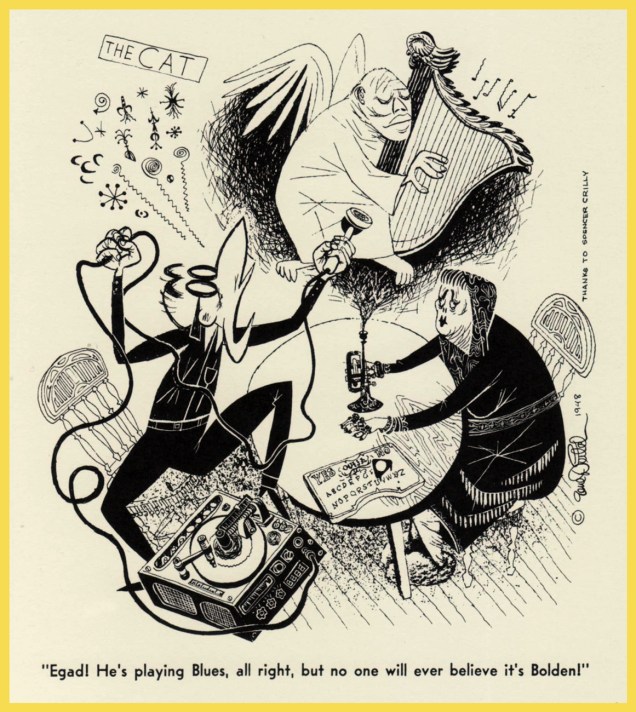
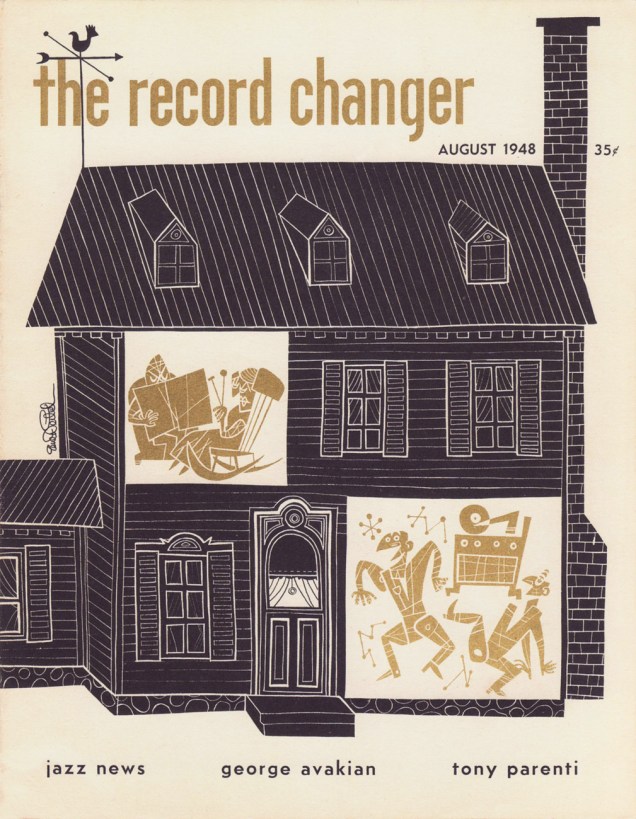
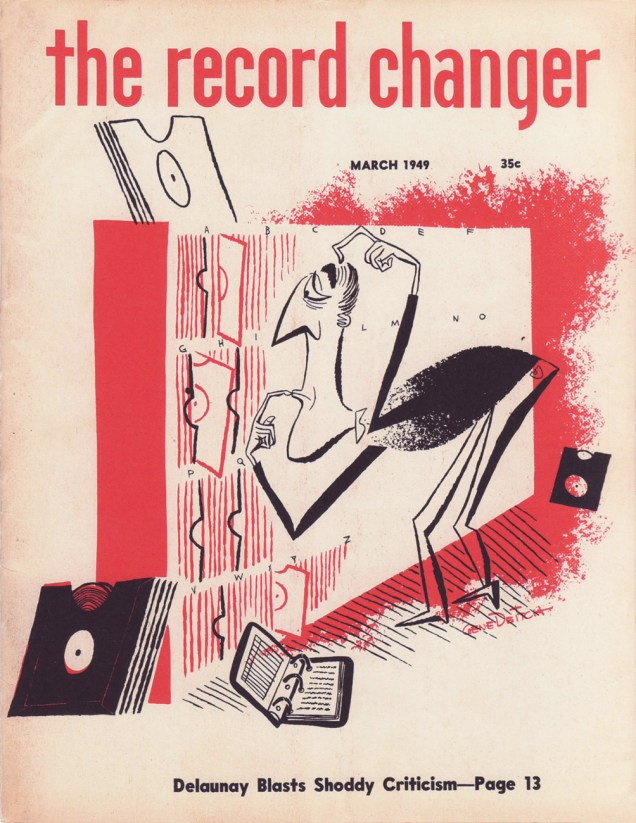
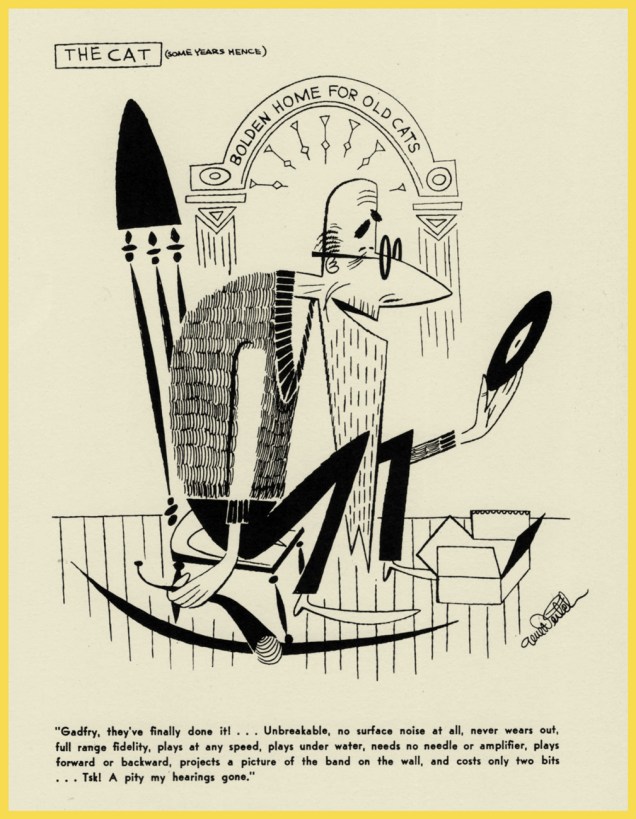
If you don’t terribly object, I’ll sidestep the pitfall of ambition and restrict this post to a single facet of Mr. Deitch’s orbit, namely his jazzy cartoons of the 1940s and 50s. Incidentally, these succulent needles have been collected, in their usual, exemplary fashion, by the Fantagraphics team. If you dig these, and the odds are good, you’ll need to acquire, dentro de poco, their The Cat on a Hot Thin Groove (2013).
« I had just recently, for the first time, heard the magnificent pipe organ recordings of Fats Waller and imagined a portly black church janitor setting down his mop and bucket and rolling out some mighty blues in the midnight of an empty church on an elaborate organ most likely sanctified for an entirely different kind of music. This drawing was reproduced many times over the years without anyone ever asking permission, and I was tickled to find it once on an actual Fats Waller album cover!** »« The cover shows that having a loud, jazz-playing Cat as an apartment house neighbor is not all that rosy. »« My cover show the devoted bass player protecting his beloved instrument from the pouring rain by covering it with his own coat and hat. If a musician’s livelihood depended on his instrument – often expensive or hard to come by – he did everything possible to keep it from harm. »From The Record Changer (August, 1948). « The search for a recording by the legendary pioneer New Orleans trumpeter Buddy Bolden has never subsided. In this issue, The Cat has actually managed to record him from the Great Beyond, but egad, he’s playing a harp instead of a horn! »« The cover design suggests the unlikely coexistence of a quiet elderly couple and a jazz record maniac within the thin walls of a single boarding house. »« The cover showed that even with the most careful cataloging it was still mainly guess work to find the record you were looking for. »« Earlier that year I moved from Hollywood to Detroit, to take up an offer from a commercial film studio there that would give me a chance to become a director. My cover for July was inspired by the hazards of moving the most precious commodity of all. OK, I had two kids, but I let my wife arrange their things for the moving, and the moving men could do what they wanted with our furniture. But I didn’t let them touch my record collection! I schlepped every box full of discs myself, and carefully placed them in the safest positions. I was proud that my entire collection arrived in Detroit unscathed. »From The Record Changer (August, 1949). « This may be the very best Cat-toon of all. It says everything I ever wanted to say about this character. What is a mere soul in comparison to a 100% complete jazz record collection? Spencer Crilly, wherever you are, I thank you for suggesting this gag! » Perhaps the proverbial catch in the Faustian deal is that, without his soul, a cat can’t appreciate jazz any longer. You can never win.From The Record Changer (January, 1950). « The Cat, seen as a dodderer in the Buddy Bolden Home for Old Cats, basically predicts the CD and DVD records to come 50 years hence! »
« And by the way, did I see you without a Pookie Snackenberg button? »
Concluding our exclusive conversation with Mr. Mike Royer, picking up the thread from where we left off in Part Two. And don’t forget to begin with Part One.
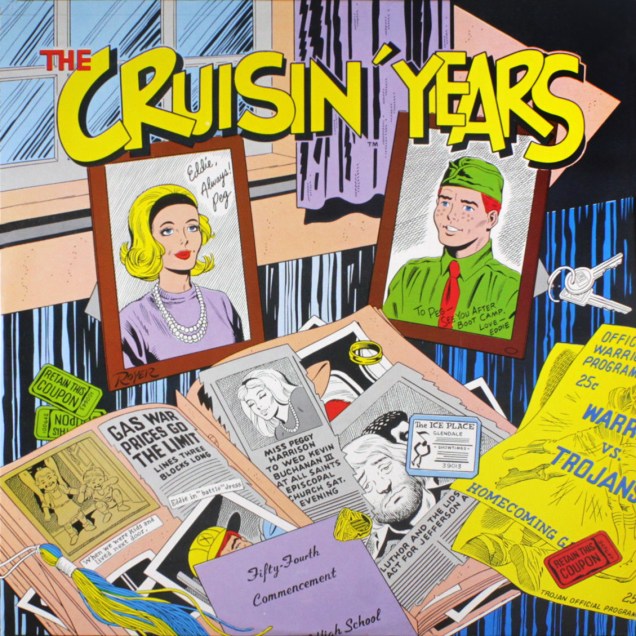
This illustration served double duty, first as a sampler released with the second batch of Cruisin’ albums in 1972, then on a box set collecting Cruisin’ 1955-56-57.Historical research in those days wasn’t as tidy and simple… and so here, either Peggy’s lying or… Elvis Presley’s third and final appearance on Sullivan’s show was on January 6, 1957. And The Blob wasn’t released until September 10, 1958. Well, Peg?Royer’s new illustration for the third and final box set, the one gathering Cruisin’ 1961-62-63, issued in 1992.
WOT: Are you happy with the overall work?
Michael Royer: I would say… two-thirds of the covers, I’m really pleased with. I can look at them and pickle the living daylights out of them. The Cruising’ Years… I look at it, and some of the proportions bother me. The scrapbook is too small, compared to the photo on the desk, and other little things that, if I were gonna do that again, I would adjust those sizes. But then again, that’s the impression I get, I guess, that’s important.
WOT: True.
MR: The one where Peggy sees Eddie behind her in a car at the drive-in is my least favorite of all of them.
WOT: Do tell.
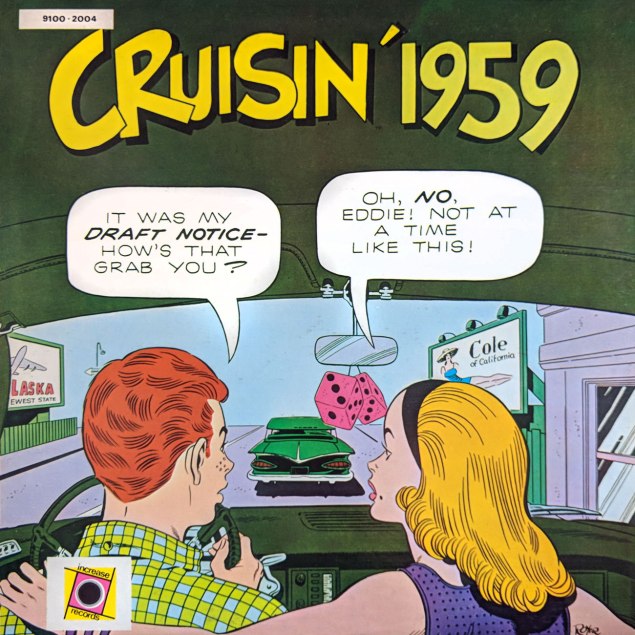
MR: Because Paul had given me an impossible thumbnail. To make it work, so that they were all on the same planet… Ah, it’s really easy to lay out something and have two cars and the drive-in theatre lot, and not worry about if they’re on the same plane, if they’re seen from the same point of view… and so to do that and make it work… I still look at that and I get disappointed.
MR: I really like the one where he’s outside and it’s snowing.
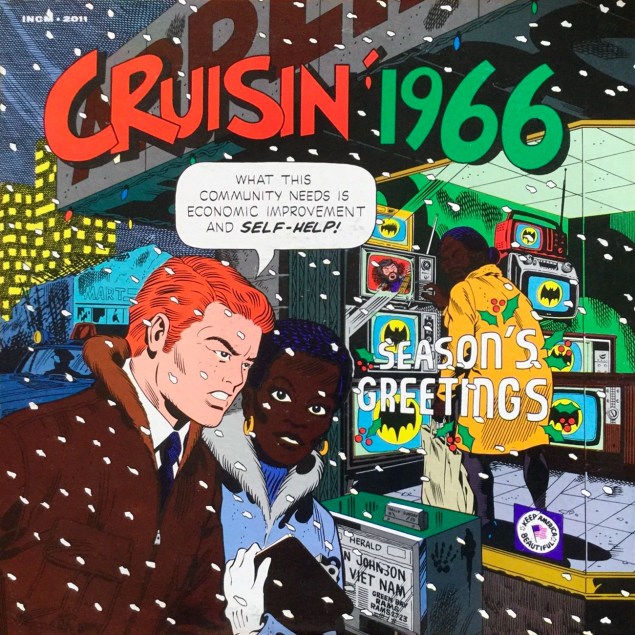
WOT: And he’s with a black lady? That’s 1966.
MR: The black lady is looking at him… kind of suspiciously, and it may have something to do… because he’s in her neighborhood. I’m trying to remember if his early career at the law firm was dealing with…
WOT: Social issues?
MR: And I can’t remember, every tv screen’s got the same thing on it. Is it the Batman logo?
WOT: Confirmed. You were right on the money.
MR: Here we are, all the Cruisin’ cds. They have changes on them. Okay, let’s see. ’55 was the first one.
WOT: Actually, from what I’ve read, ’55 was actually done later, part of the second batch produced [in January, 1972].
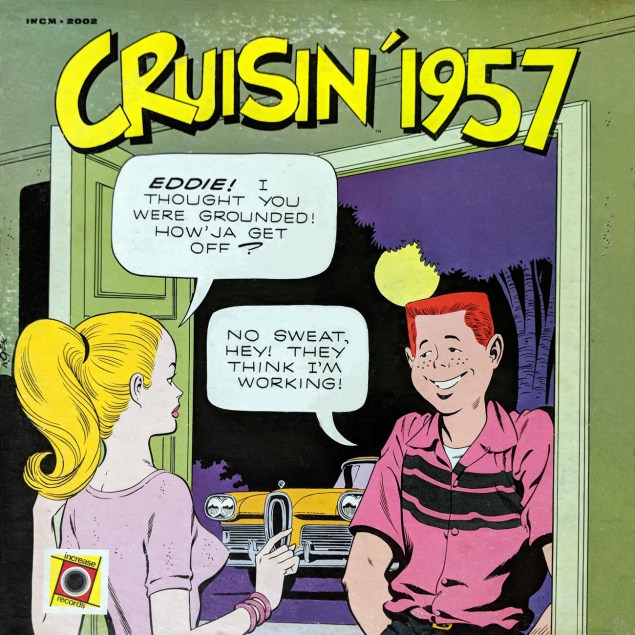
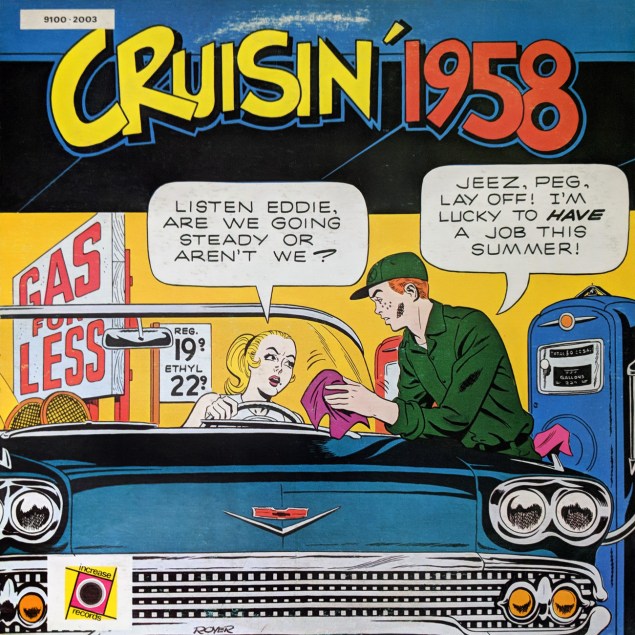
MR: Yes, it was added in, and I don’t care for that one. I really like ’56, only because in retrospect, I look at it and it speaks to me. ’57, okay. ’58, only because of the subject matter and Paul’s layout… ’59 is the one where I went to South East Los Angeles, to the car lot that had the dashboard. It had to be that, after so many years, if anybody had one, they just had to go “heyyy!“, you know.
MR: 1960 is… not as bad as I remember! At least I made his layout work…
WOT: That’s good news.
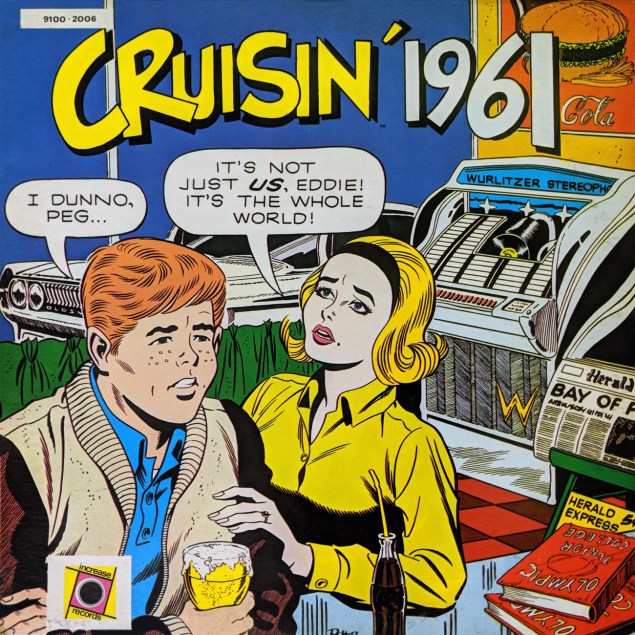
MR: And ’61, is, yeah, they’re about the break up. And Cruisin’ ’62 is.. ha. They *are* breaking up. No, I guess it was a three year breakup, okay?
WOT: (laughs) Okay!
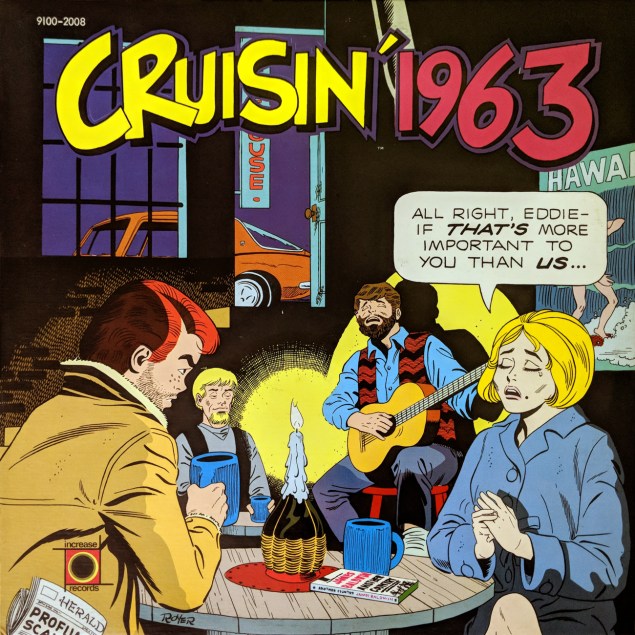
MR: ’63, they’re in the coffee shop, and that’s the Studebaker… now waitaminit, what’s the one on… that’s not a Studebaker on ’61, that’s an Olds, so the Studebaker’s on ’63.
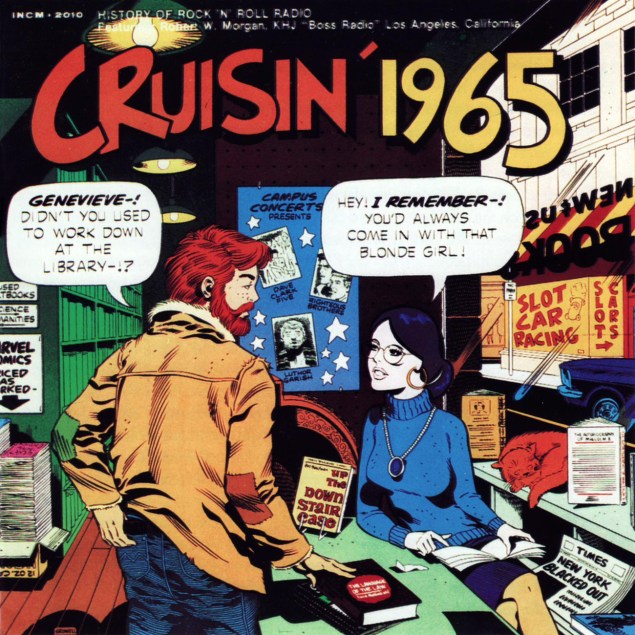
MR: ’64, there’s the announcement: “to wed Kevin Buchanan III…” And ’65 is ten years later, and it’s the same girl that was working at the library, but she’s gotten a little prettier.
WOT: No kidding? Subtle bit of continuity.
MR: And there’s Luthor on the board in the background… his concert, “New York Blacked Out” headlines, Up the Down Staircase… okay, ’66: oh yeah, “What this community needs is economic improvement and self-help!” Ah, yeah, all the TVs except one had Batman, and one of ’em has Luthor on it, singing.
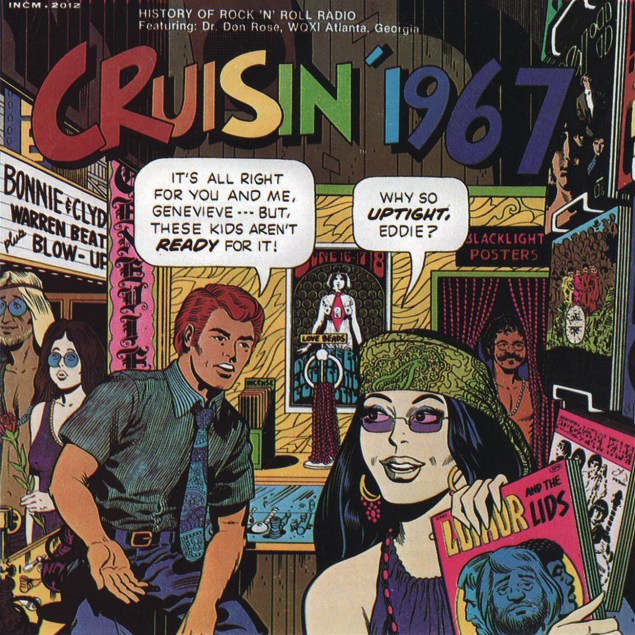
MR: And ’67, that’s the one with Ron Jacobs coming out of the… through the beads in the back. And golly, it’s Genevieve again. Mmm!
WOT: The librarian from ’55!
MR: That’s her.
MR: And ’68 was the first one *after* The Cruisin’ Years. Ah, there it is; I should have them in the order they were released. So we redid 1968, “Vietnam Widows for Peace“, and I kinda liked the way that turned out. It was fun researching all of the fashions and things!
WOT: Good, because research wasn’t always a simple task.
MR: Ah, ’69, on their honeymoon, Niagara Falls Retreat; Newspaper headline: “Beatles to Split” “Eddie, I might want a career of my own“… I just sold the comp to that, I think in Charlotte.
WOT: Oh, wow. So I am being timely here.
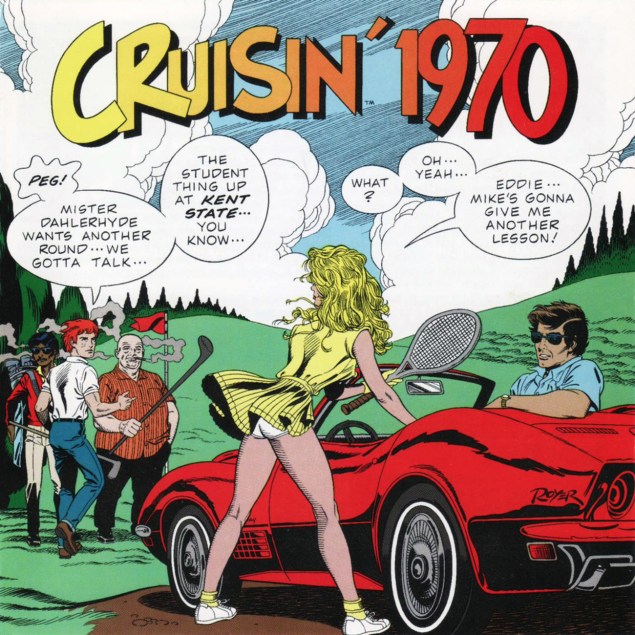
MR: 1970: “Mike’s gonna give me another lesson”. I put myself in there, uh… idealized.
WOT: (laughs) So that’s what it is, then?
MR: And then there’s the Porky Chedwick, and somewhere in here… the Cruisin’ boxes. Whoa! There are… three of them.
WOT: What are they?
MR: The first box set has ’55, ’56 and ’57, and has the Cruisin’ Years cover, with the Peg and Eddie photographs, and the scrapbook, and the concert tickets and so on. The next one is ’58, ’59 and ’60, and that one is, Eddie is next to his Chevrolet with the tire kit on the bumper, and he goes “Come on, Peg! The Blob starts at 7:15!” “Eddie… we can’t go! Elvis is on Ed Sullivan tonight!”
WOT: Poor girl’s chained to her TV!
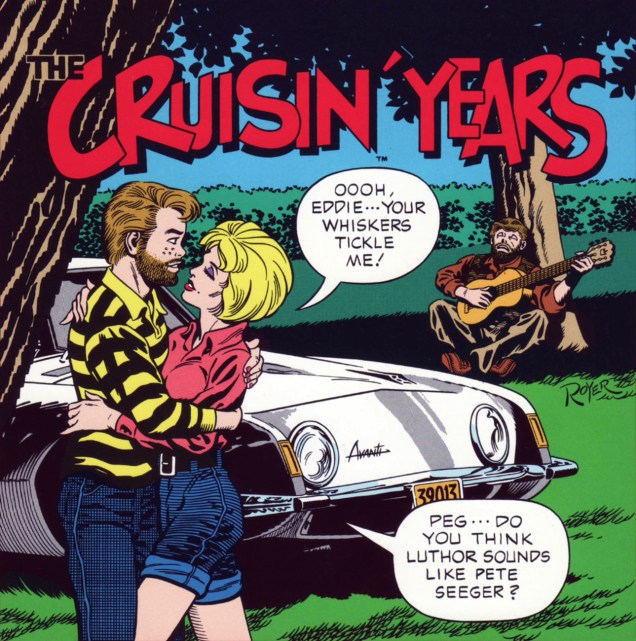
MR: And the last box set was ’61, ’62 and ’63, and Eddie’s got the beard that he’s wearing in the college one, and Luthor’s leaning against a tree, and she says: “Oooh, Eddie… your whiskers tickle me!” and he says: “Peg… do you think Luthor sounds like Pete Seeger?”
WOT: These two were always moving in separate directions.
MR: Always! And so I wrote ’68, ’69, ’70, The Cruisin’ Years, and Porky Chedwick. And if I could the long box artwork, and one of the last ones I did, which I believe was gonna be another Cruisin’ Years, and it’s probably the sexiest Peg I ever did…
WOT: Aw…
MR: It’s Peg and Eddie… oh my God… *two* of them. I might have done another big box, because they’re at the beach, she’s in a bikini, and it’s another tension-filled thing…
WOT: Her bikini?
MR: Oh, he’s saying: “Who’s this Buchanan the third?“, so that fits in the chronology somewhere. And the last one would precede their wedding, it’s where they’re on a bridge, in New York City, it’s a big closeup, they’re dressed to the nines, he’s in… could have been a tux, she’s in a sexy evening gown. And leaning on the rail, exposing her… attributes. The program was for a big Broadway hit of ’69, and he’s got his finger under his collar, kinda saying something to the effect of: “You know, Peg, there’s something I should have asked you… a long time ago“. It’s the proposal cover, you know.
Now I don’t know if that was ever produced. I also did another cover, which I know was not produced, and it was a Cruisin’ Christmas Album.
WOT: Whoa.
MR: And I actually drew my living room, in the house I had in Simi Valley [California] and Eddie, in his Santa Claus outfit is putting presents under the Christmas tree in the center of the room. And Peg is coming down the stairs in her sexy négligé, with her robe blowing open…
WOT: That’s his present.
MR: ’twas drafty in the house that night. And she’s got a plate, and she’s saying: “Oh, Santa… don’t forget your milk and cookies!” So it’s the only cover in the series without any tension.
WOT: Or the most tension, depending on how you look at it.
MR: I think we discussed doing ’71, but figured that there wasn’t enough happening that year to make an interesting cover, or the songs were too new in the late ’80s to get clearances or rights on them, you know.
WOT: Things have changed quite a bit… even the cd reissues are significantly different from the LPs. Reissuing certain pop-song heavy tv shows has proven quite a financial ordeal in some cases because of astronomical increases in the cost of music rights.
For that reason, the Cruisin’ LPs each have a few more songs than the cds, even if the opposite should be true, if only in terms of storage capacity.
MR: They lost rights, and stuff like that.
WOT: People didn’t know back then what was to come, obviously. The Cruisin’ series came out at just the perfect time, and I think it was quite visionary to decide to preserve, or recreate, what must have seemed at the time a very recent piece of the past.
MR: I wish that I had not given all of my vinyl discs to my first… son-in-law… and replaced them all with the CDs before I realized that there were the differences.
WOT: Not to mention the size of the artwork and quality of reproduction.
MR: Once the series was over, I sold Ron Jacobs all of the originals. And I kind of regret that in a way, because I could sell them for a lot more today than I did, in the early ’90s, to him.
WOT: Sigh. They’re heirlooms.
MR: I don’t know why I didn’t think to pull these things off the shelves and look at them before we talked.
WOT: Ah, it’s okay. In fact, it’s probably better: I got your spontaneous responses out of it.
MR: Actually.. overall, I’m more proud of them than I am disappointed. And the things that disappoint me, I can point out why and it doesn’t necessarily mean that it excuses the problems…
MR: Oh, and there was also a full-page ad… that was in Billboard. Peg and Eddie are sitting in the front seat of… probably a 1955 or 56, I think Ford convertible. I cannot remember.
WOT: On the contrary, you clearly remember plenty! (laughs)
MR: I’ve got it somewhere out in the garage, in one of the custom filing cabinets I had made that I call “Mike’s Life in a File Cabinet“.
The ad in question, from the July 11, 1970 issue of Billboard Magazine. Make a wish!
WOT: I think that I think this series is a great artistic success. When people see these volumes individually, they work as snapshots… but put them together, and you realize that there’s so much happening between the panels.
MR: Yeah, it does tell a story!
WOT: It’s beautiful storytelling, and I think, one of your crowning achievements.
MR: You know, it’s funny: the early covers were put into two books. The first one was a… I don’t know if it was a hardcover, it was a oversized, glossy trade paperback called The Album Cover Album [original edition 1977], and it says: “Paul Gruwell, art director, art by Mike Noyer“.
WOT: Oh, lovely. They got one name right.
MR: And the second book they were in, which I didn’t bother to buy, because all they listed was the Art Director. I wasn’t even listed.
WOT: This kind of thing, which I’ve noticed also, is what prompted me to get in touch with you. And I think we’ve done our bit here to help set the record straight. Thank you so much, Mr. Royer!
MR: You’re welcome, Richard. Have a great day!
WOT: You’ve certainly done your part in it!
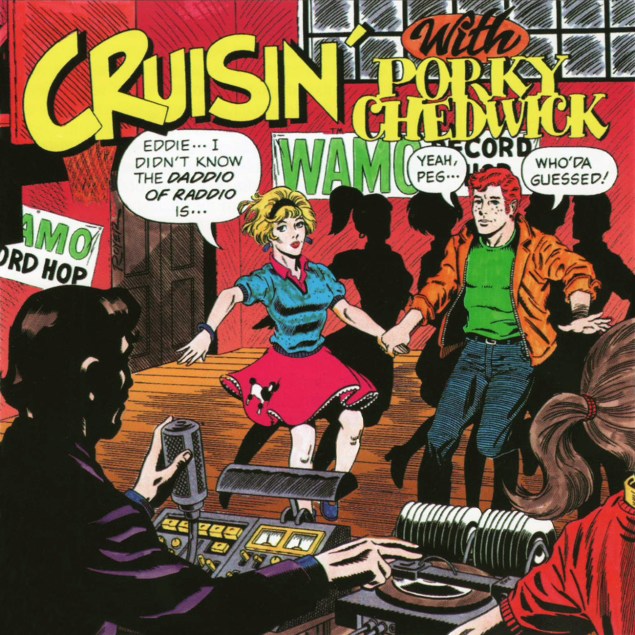
Read the liner notes, or hear Cruisin’ 1967 in its entirety here!Read the liner notes, or hear Cruisin’ 1968 in its entirety here!Read the liner notes, or hear Cruisin’ 1969 in its entirety here!Read the liner notes, it’ll have to do for now; regrettably, Cruisin’ 1970 isn’t currently available on YouTube! What is this world coming to?At this time, Cruisin’ With Porky Chedwick would appear to be the final entry in the series (1995). Listen to the whole platter right here.
« Speaking of winners, I’ve got Zwellyn Zablow of 11 West Second Street in Freeport, New York, who saw me at the Rockefeller Center dance. I want you to check in at Murray Hill 85-700. Anyway, MU-700 within the next ten minutes… »
Read the liner notes, or hear Cruisin’ 1962 in its entirety right here… while you can!Read the liner notes, or hear Cruisin’ 1963 in its entirety here!Read the liner notes, or feast your ears on Cruisin’ 1964 pronto… here!Read the liner notes, then grind your teeth in frustration at Cruisin’ 1965‘s absence on YouTube. Happy update: here is it now for your listening pleasure! Read the liner notes, and/or listen to Cruisin’ 1966 in its entirety here!
Now then, here’s part two of our exclusive conversation with Mr. Mike Royer, picking up the thread from where we left off in Part One.
Michael Royer: Richard, you asked « How were you selected? » Well, I’d been working with Paul, and apparently he liked what I did on the Mormon history slides, so he asked me if I would do the ‘final art’ and all the research and everything on the covers, and the last time I saw Paul, before the second batch, that started with The Cruisin’ Years, that had the tickets on the table, and the picture of… I don’t know if it was Eddie in uniform or not… but whatever, that was when Howard Silver of Increase Records decided to do more for the line. And continue the series.
WOT: Right.
MR: And from that point on, all of the writing, and all the ideas, were totally mine.
WOT: I figured it would happen at some point…
MR: I think the ideas might have been a collaboration between Jacobs and Gruwell, but one of the reasons Howard Silver asked me « Do we need to contact Paul Gruwell? », and I said « Nope, you have no reason in the world to contact Paul. »
WOT: Cut out the middleman!
MR: I’m the guy who Paul used to introduce at parties as « This is the man who *inked* my Cruisin’ covers. »
WOT: Oh, boy. Okay.
MR: “Up yours, pal!”
WOT: Oh, this is gold, thank you!
MR: So I said « We don’t need him! », you know, and so all the rest of the albums after that were mine. And there are two covers that were done for a packaging, done for big box stores, that would have had either two or six cds in a tall case…
WOT: I remember those. ‘Longboxes’, shoplifting deterrents of the early cd era.
MR: … and one of them, Eddie is saying « We’ll be late for something at the theater » and Peg is saying « … but, but, the Beatles are on Ed Sullivan tonight! » So they were done to fit in the chronology of the covers. When he said « I’d like to start over with 1968 », and I said, « Well, I don’t wanna do the Woodstock. »
MR: « I don’t want Peg to have a kid from her serviceman, who obviously… died in service. »
WOT: Right.
MR: So I, and you’ve probably seen it, the cover is in front of a theater showing 2001: A Space Odyssey. Eddie discovers Peg there, as one of the Vietnam Widows for Peace. So now we know what happened to the serviceman that she ultimately married.
MR: ’cause I think, uh, the shot of Eddie and the musician with the beard…
WOT: Luthor, yes.
MR: … in college, and he’s got a newspaper clipping taped to his lamp that says « Peg marries… » somebody.
WOT: « Kevin Buchanan III » … he appears to be a society boy.
MR: I don’t know if you have all of them…
WOT: As far as I know.
MR: And of course, I continued, on all of the covers, to introduce a little bit… of tension.
WOT: Do tell.
MR: ’cause there’s some in every cover, sometimes it’s subtle, sometimes it’s overt. But I believe I did through… what year is the Kent State thing?
WOT: Let’s see… 1970. Eddie’s talking with his boss about it.
MR: Peg says « That’s okay, because Mike wants to give me another tennis lesson. »
WOT: Well, another “lesson”, at any rate. Whether it’s tennis remains to be seen. She’s got the racket, but…
MR: So… I can say all those new covers were made… the one previous to that is where they’re at Niagara Falls, and he’s talking about things could happen at his firm, and she’s saying « But Eddie, *I* might want a career! » And I enjoyed doing that cover, because I just wanted to do her standing there at the little motel sink in her slip.
MR: … and of course, being male and having to draw female forms, I made sure that her skirt was blowing in the wind… and in her little tennis outfit in the next year.
MR: We did, uh, let’s see: there was The Cruisin’ Years, which re-established the whole series. And then, starting with ’68 through ’70.
MR: Okay, I did two ‘Cruisin’ With‘… the second one, I guess it was never published…
WOT: Ah, right.
MR: … or produced, or released. And it was just another… let’s see: Porky Chedwick has got her in a poodle skirt and they’re dancing, right?
WOT: Yeah, that’s it.
MR: Okay, the next one was outside on a city street, and in the brick building behind them you see the silhouette of a disc jockey, and the broadcast booth at a radio station, I think the sign is on the roof. And Peg is protesting something. She’s got a banner, and Eddie and she are arguing about something. Ah, I only have a copy of my rough on that, or my comp. And of course there’s more detail on her than on him. I enjoyed drawing her. That last ‘Cruisin’ With’ I thought was much better than the first one I did, for cover art.
WOT: (laughs) exactly.
WOT: Is Cruisin’ a frequently-evoked topic by your fans?
MR: Every once in a while, it’s funny… for years, once in a blue moon, somebody would say something about Cruisin’. But I was in Charlotte, just… less than two weeks ago.
WOT: Right.
MR: … and I swear, a dozen or more people talked to me about the Cruisin’ covers at my table. Maybe that’s because there’s a new series of Cruisin’ albums… with art that I don’t like.
WOT: Oh, I don’t like it either: it looks like, and likely is, clip art.
MR: I don’t know who’s producing it. I don’t think it’s Howard Silver.
WOT: It’s called “The Cruisin’ Story“, it’s out of England, and it’s just a series of run-of-the-mill compilations, without the defining radio program concept.
MR: Howard Silver ran Increase Records. I don’t know if he bought out Increase and that was [Ron] Jacobs’ company or not. He’s in Hawaii now, last I heard. Jacobs [Indeed he was, but Mr. Jacobs passed away in 2016].
Today, Michael Royer (born June 28, 1941), who surely needs no introduction around these parts, celebrates birthday number seventy-seven, and on this special occasion, we have a treat, both for the great man and for the rest of us: part one of an interview Mr. Royer granted us, conducted just a few days ago.
As you can imagine, Mr. Royer has spent decades answering the same queries about his work with Jack Kirby and with Russ Manning, so that’s quite a well-trod line of investigation. We like to approach things a bit differently here at WOT; having long been intrigued by Mr. Royer’s evocative series of LP covers for the Cruisin’ anthology series, beginning in the late 1960s, and frustrated by the lack of solid information concerning said contribution, I figured I’d take a hand, and reached out to Mr. Royer.
If you’re unfamiliar with the Cruisin’ Series, here’s the pitch: « Cruisin’ is a year-by-year recreation of pop music radio during the years 1956 through 1962 [the years of 1955 and 1963-1970 were produced later]. Each album is not just a collection of the top pop music of a particular year, but a total recreation by a top disk jockey (of that year) doing his original program over a major pop music station. That means actual commercials, promotional jingles, sound effects, newscast simulations and even record hop announcements in addition to the original records themselves. »
« Cruisin’ producer Ron Jacobs monitored thousands of feet of tape, travelled over 10,000 miles and rooted through forgotten files and cluttered basements for old commercials, station promos and jingles. »
« What’s so special about these album covers? », you may ask. I’d posit that they’re unique in the sense that, while they each work as standalone pieces, together, they form a quite impressive comic strip, one in which a year or so elapses between panels. Just about every detail has its place, imparting information plainly or quite subtly. Characters come and go, years apart, sometimes entirely offstage, often never speaking a word. It’s graphic storytelling at its finest. And the LPs are pretty spiffy too.
Now that you’re up to speed, shall we begin? Mr. Royer and I spoke on Tuesday, June 26, 2018, and he was most generous with his time and his recollections. I assure you that the minutes simply fly in such gracious company.
Read the liner notes, or hear Cruisin’ 1955 in its entirety here!Read the liner notes, or hear Cruisin’ 1956 in its entirety here!Read the liner notes, or hear Cruisin’ 1957 in far less that its entirety here. Sorry!Read the liner notes, or hear Cruisin’ 1958 in its entirety here!Read the liner notes, or hear Cruisin’ 1959 in its entirety here!For this entry’s cd reissue, the cover artwork was inadvisably cropped, quite obscuring the political differences between Kevin Buchanan III (front) and Eddie (in uniform). Mr. Royer’s least favourite cover, incidentally. Read the liner notes, or hear Cruisin’ 1960 in its entirety here!Read the liner notes, or hear Cruisin’ 1961 in its entirety here! And remember, « If you say ‘Woo Woo Ginsburg’ with your order, you get another Ginsburger free of charge! »
Who’s Out There: Mr. Royer, How did you happen to be selected for the job in the first place?
Michael Royer: In 1966, I was working for Grantray-Lawrence Animation on the Marvel Superheroes limited animation cartoon series. And I believe that a man named Paul Gruwell… If you look at the record album, he’s listed in there as the art director… I’m listed as the artist and they misspelled my name.
WOT: Of course. We’ll set that straight.
MR: Paul was one of the guys working on the series and I did some work with him on an outside project he was doing, where he was doing… I guess you could call them slide shows, on the history of the Mormon church.
I was working on these things, and he knew someone at the record company who had this idea for the history of rock ‘n’ roll. And for the life of me, I can’t remember what the young man’s name was. But he’s the cover of one of the records, where he’s coming out of the backroom, through the beads [Cruisin’ 1967]. It’s like a head shop, or something…
WOT: Would that be Ron Jacobs? He was the producer.
MR: Yeah, yeah.
MR: So, anyway, the first batch of covers that went through, I believe, 1968… and the last cover had Peg and Eddie, who were reunited, with her little boy from her fist marriage. And they’re in the front seat of a van, in a traffic jam leaving Woodstock. That cover was never printed.
WOT: No wonder I’ve never seen it!
MR: Anyway, the covers that I did, how many was it? ’54 through…
WOT: Fifty-five. ’55 through ’70, plus one that’s “The Cruisin’ Years”…
WOT: How much latitude/wiggle room were you given? Were research materials provided or not? Were specific cultural signifiers specified, or did you get to pick (or a mix of both)?
MR: Anyway, on those ones that I did in the late Sixties, early Seventies, Paul Gruwell gave me little three-or-four square inch thumbnails… on the covers that he wanted me to do. All I got was his, in my opinion, so-so little thumbnails, which I guess gave him the reason to call himself ‘art director’…
WOT: I was going to ask if he could draw.
MR: I had to do all the research. Each cover had to feature certain items that definitely said that it was that year. Like newspaper headlines, magazine covers…
WOT: Movie marquees…
MR: … automobiles, and I had to look up all that. I went to the library, as we didn’t have “online” then. Ah, on one of the covers where I need the dash, I believe, of a ’57, or ’58 Chevy, I had to go to a used car lot in South East Los Angeles, and with my Polaroid camera, I asked these two big guys in their double-breasted suits if I could, uh, photograph the interior of one of their cars, and they looked at me like… « Okay, white boy, you’re crazy if you wanna shoot it, but we’ll let ya, you know. »
WOT: People do like those odd requests.
MR: It was very interesting researching the cars, and making sure that, even if they were shown from the basement [Cruisin’ 1963], out parked at the curb…
WOT: They had to be accurate.
MR: … you could still tell that it was a Studebaker. You know, and the jukebox had to be, I believe the Wurlitzer that was in places in that year [Cruisin’ 1961]. And so I did all of that. So all of the research materials were not provided by anyone other than me, and the special cultural signifiers had to be newspaper headlines, uh, I think the one where Peg and Eddie are in the basement [Cruisin’ 1963] café, and the Studebaker’s up on the street, there’s a newspaper that says something about “Cuban Missile Crisis” [Cruisin’ 1961 and The Bay of Pigs. 1963’s headline was the Profumo Scandal]…
MR: It’s so long since I’ve looked at these, Richard.
« I find television very educating. Every time somebody turns on the set, I go into the other room and read a book. » ― Groucho Marx
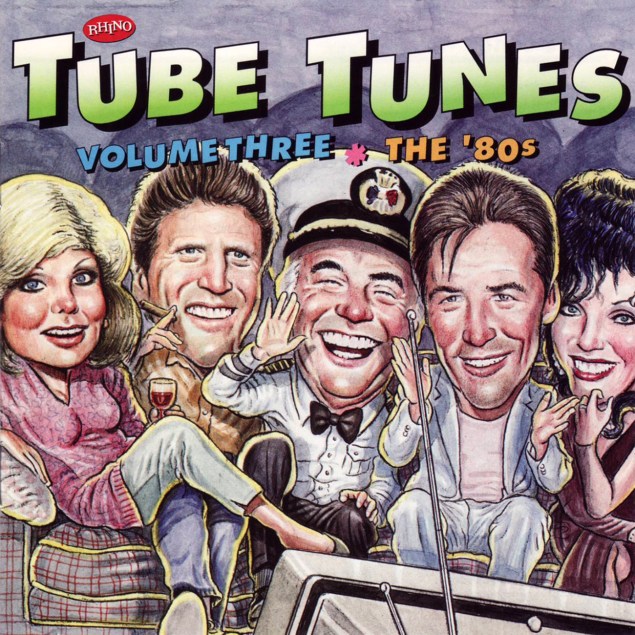
In the mid-90s, the always-discerning masterminds* at Rhino Records (they had, after all, picked William Stout to design their logo, back in 1974) called upon master satirist, caricaturist and of course pointillistDrew Friedman (1958-) to gather some perennial favourites on his old couch for the purposes of a three-volume compilation.
In this second entry in the trilogy, Mr. Friedman seems a bit out of his element, as drawing purdy gals and conventionally handsome men is hardly his forte. But he aces Gabe Kaplan, as you’d hope and expect. Judging from his expression, Gabe appreciates it.
This time, our artiste ably succeeds where he faltered earlier: he has no difficulty capturing the likenesses of Ms. Anderson and (5x so far) Mrs. Collins.
From volume 3’s liner notes: « The 1980s may well be remembered as the final decade of the television theme song. The disturbing trend of the ’90s seems to be the elimination of the title song in preference of an additional minute of commercial airtime – a sad state of affairs for fans of the opening anthem. »
Maybe it’s all for the better: I’d rather have an additional hour of commercial airtime than be subjected again to the opening jingle of, say, Charles in Charge. You have been warned.






























 Who's Out There?