Urban Legend Fun: The Spider in the Hairdo

« We are all susceptible to the pull of viral ideas. Like mass hysteria. Or a tune that gets into your head that you keep humming all day until you spread it to someone else. Jokes. Urban legends. Crackpot religions. Marxism. No matter how smart we get, there is always this deep irrational part that makes us potential hosts for self-replicating information. » — Neil Stephenson
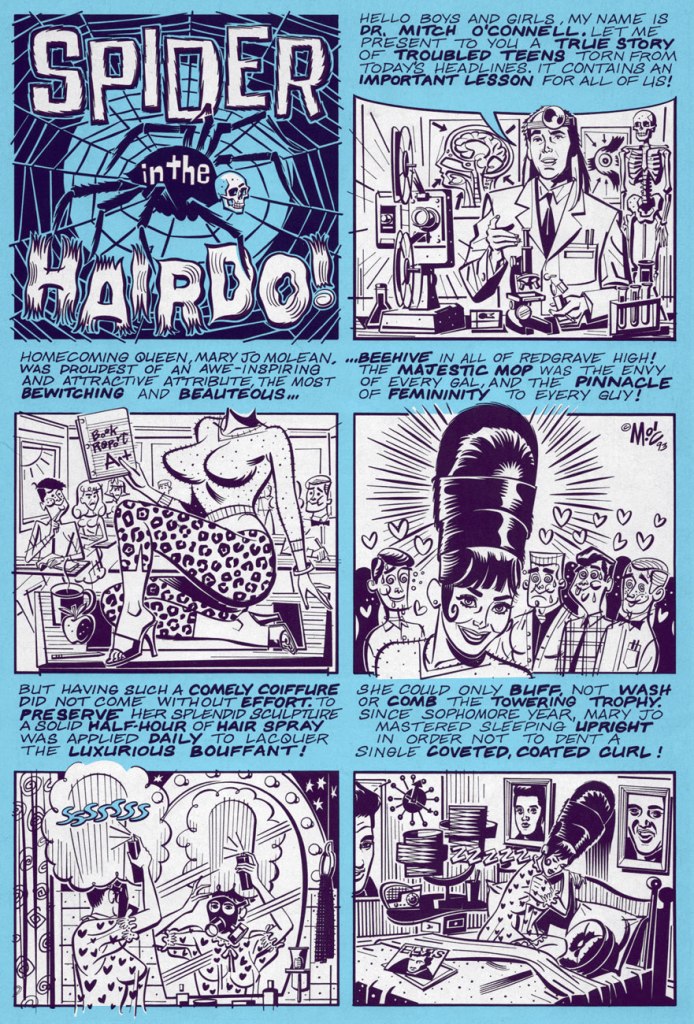
True story! It happened to a friend of a friend of a relative of an acquaintance of the hairdresser of the nephew of the uncle of the garage mechanic of the girdle maker of a cousin of a U.F.O. abductee ex-classmate of my brother’s. Or so he obliquely claimed under hypnotic regression.

Apparently, this tale gave rise (I know, I know) to a variant called The Cucumber in the Disco Pants.

And remember, always check with Snopes.com before propagating dubious claims.

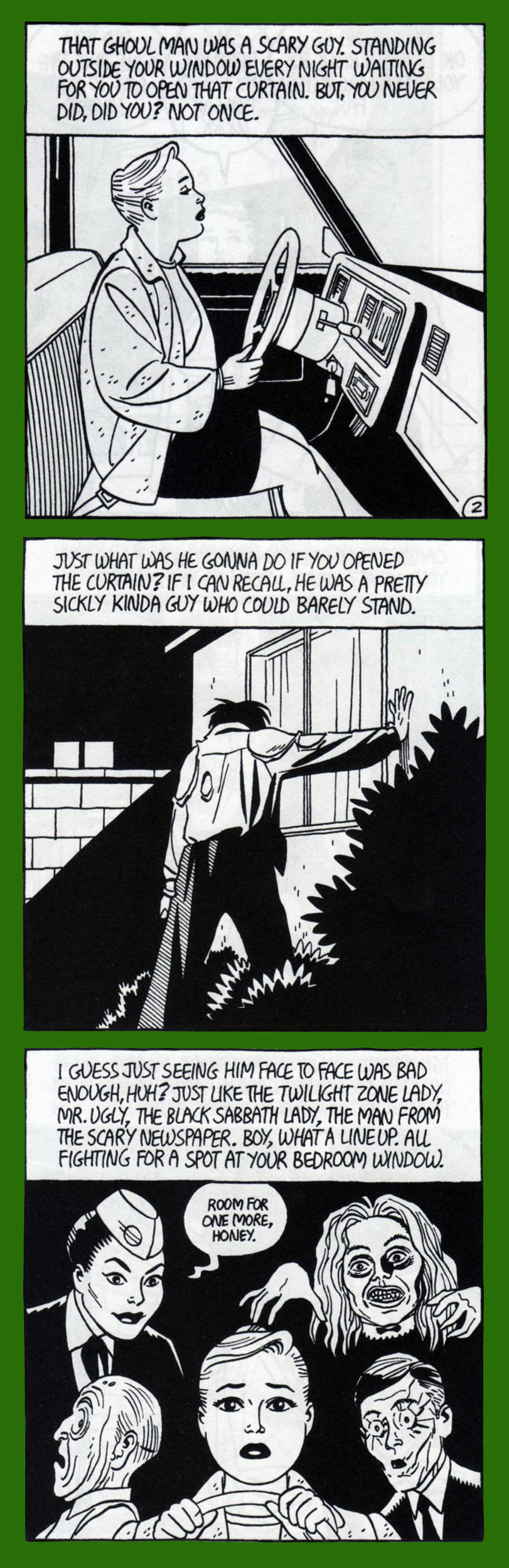
Spider in the Hairdo! is a juicy excerpt from Dark Horse’s one-shot Urban Legends no. 1 (June, 1993). Adaptation by the self-proclaimed « World’s Best Artist », Mitch O’Connell. I can think of far less worthy candidates for the position.

Should you be craving more from Dr. Mitch, here’s where to go for your fix: www.mitchoconnell.com.

And if, like me, you can’t get enough of such urban folklore, check out any of Jan Harold Brunvand’s score of splendidly compelling books on the subject. When it comes to urban myths, Dr. Brunvand is the authority.
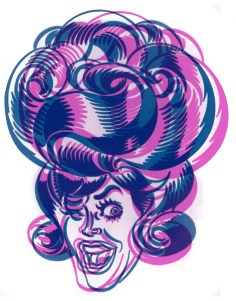
MitchGirl'sHeadA

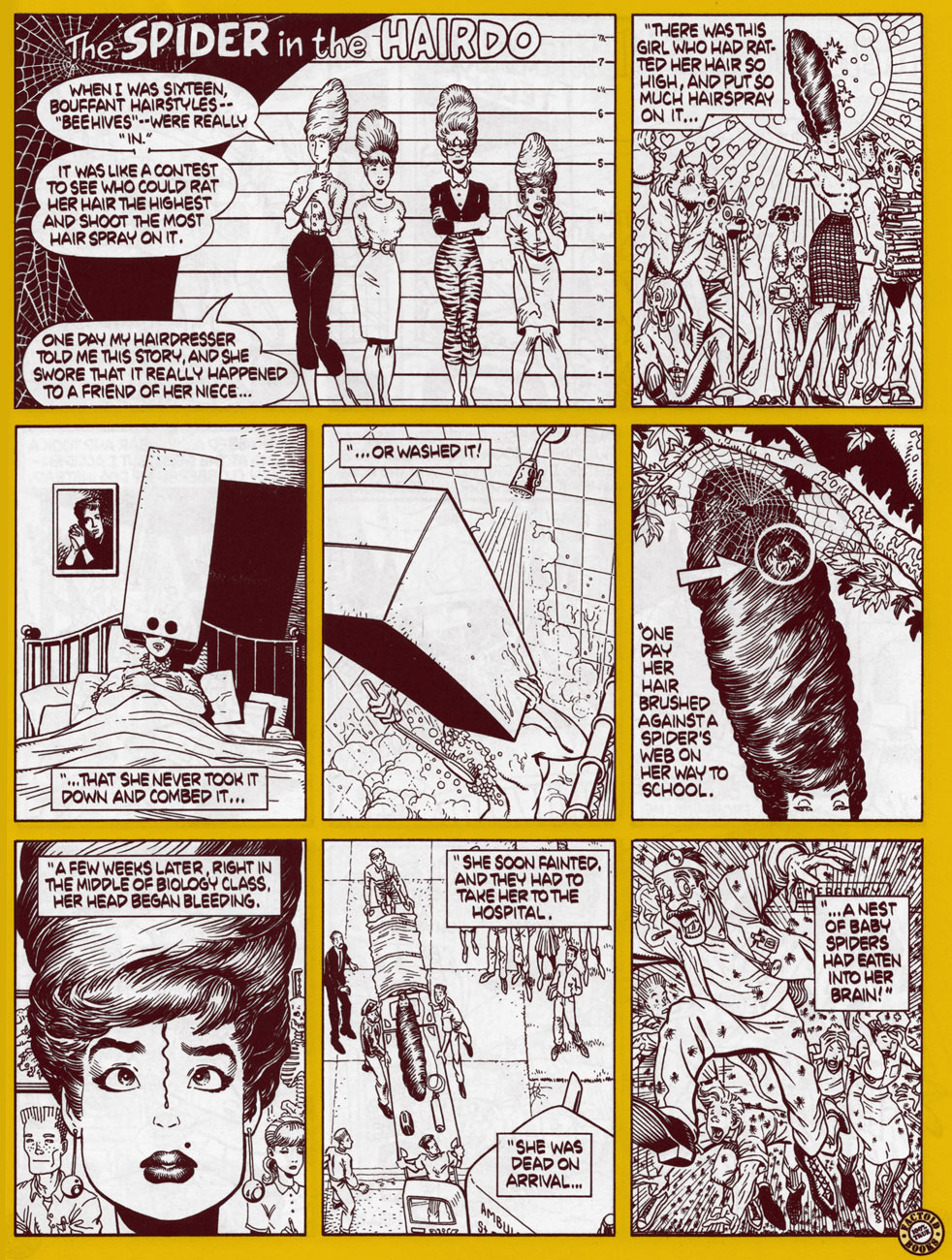
As a bonus, here’s Arthur Adams‘ slightly subsequent take on the same myth, published in DC/Paradox Press’ inaugural entry in its ‘Big Book of…’ series, The Big Book of Urban Legends (1994).
SpiderHairdoArtAdamsA

By their very nature, the Big books (seventeen in all) tended to be pretty hit or miss, not, for once, because of the writing, but chiefly due to the evident paucity, in the current comics industry, of artists versatile enough to credibly depict low-key, quotidian, humorous or historical situations. Is it counterintuitive, or fitting, that artists on the cartoonier end of the scale (Rick Geary, Roger Langridge, Gahan Wilson, Hilary Barta, Ty Templeton, Danny Hellman, Sergio Aragonés…) tended to fare best in producing this type of « documentary » work? I haven’t quite made up my mind. All I know is that the superhero specialists and photo tracers just brought embarrassment upon themselves *and* the unfortunate reader.

– RG

“Reality is an illusion, albeit a persistent one”*

« Once there was a fellow and his name was Buzz
He was just a rookie cop, just a baby Fuzz
He patrolled the Sunset Strip
in the land of the free
and the home of the hip
He protected you and me
until he met a girl called Alice D

Alice was the girl that all the hippies dread
And they called her Sweet Alice the Head
Alice it was plain to see was full of pot and STD
She’d attract a great big crowd
because her inner peace was much too loud »
Biff Rose, “Buzz the Fuzz” (1968)

This day in history: On April 16, 1943, the hallucinogenic effects of LSD were discovered.

Here’s an account of the event, from the folks at History.com:

In Basel, Switzerland, Albert Hofmann, a Swiss chemist working at the Sandoz pharmaceutical research laboratory, accidentally consumes LSD-25, a synthetic drug he had created in 1938 as part of his research into the medicinal value of lysergic acid compounds. After taking the drug, formally known as lysergic acid diethylamide, Dr. Hofmann was disturbed by unusual sensations and hallucinations. In his notes, he related the experience:

« Last Friday, April 16, 1943, I was forced to interrupt my work in the laboratory in the middle of the afternoon and proceed home, being affected by a remarkable restlessness, combined with a slight dizziness. At home I lay down and sank into a not unpleasant, intoxicated-like condition characterized by an extremely stimulated imagination. In a dreamlike state, with eyes closed (I found the daylight to be unpleasantly glaring), I perceived an uninterrupted stream of fantastic pictures, extraordinary shapes with intense, kaleidoscopic play of colours. After some two hours this condition faded away. »

After intentionally taking the drug again to confirm that it had caused this strange physical and mental state, Dr. Hofmann published a report announcing his discovery, and so LSD made its entry into the world as a hallucinogenic drug. Widespread use of the so-called « mind-expanding » drug did not begin until the 1960s, when counterculture figures such as Albert M. Hubbard, Timothy Leary and Ken Kesey publicly expounded on the benefits of using LSD as a recreational drug. The manufacture, sale, possession, and use of LSD, known to cause negative reactions in some of those who take it, were made illegal in the United States in 1965.

AlbertHofmann
The genial Dr. Hofmann.

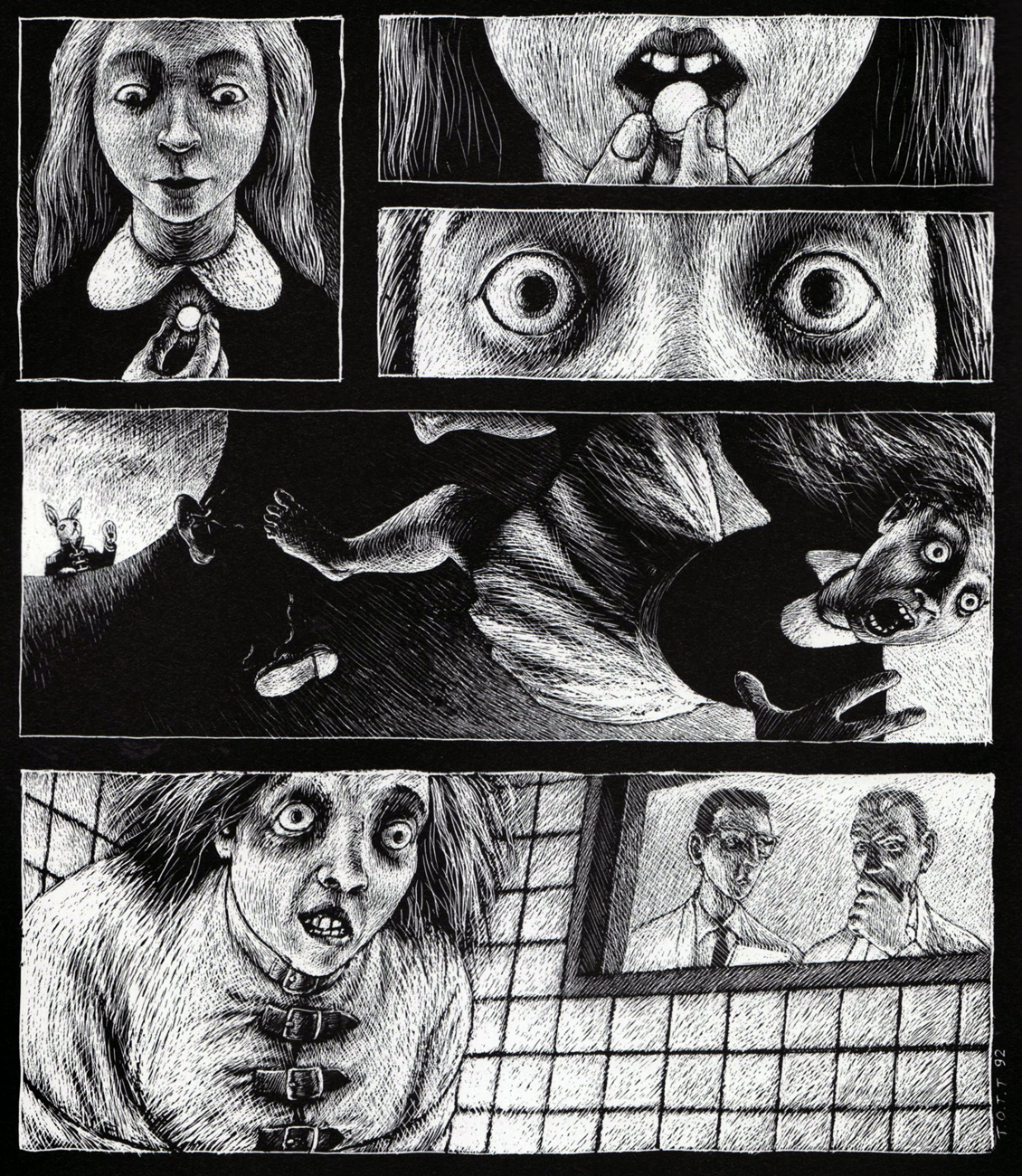
As a little digestif for the history lesson, here’s a poisoned bonbon from Thomas Ott (b. 1966, Zurich… a mere 76 km from Basel!), a proven meister of both comics storytelling and of the singularly exacting technique of scratchboard. This is Ott’s highly condensed and updated version of Lewis Carroll’s Alice’s Adventures in Wonderland, “Alice”, from 1992. I wouldn’t advise its use in preparing a book report.

OttAliceA

Just this once, inquisitive English-speakers won’t be left out in the cold or reaching for their translation dictionaries, as Ott’s work is mostly mute, the only text appearing incidentally on newspapers, signs and assorted objects, and in English at that.

Ott’s chosen milieu is the perpetual nighttime of American film noir (which in turn comes from the French roman noir, a term first used in the 1700s to describe British gothics, becoming synonymous, in the 20th century, with bleak crime novels), so the headlines and billboards are in Inglés. In addition to the classic noir recipe, the Swiss artisan injects a discreet but usually lethal dose of his quite sardonic wit.

– RG

*another fine quip from Albert Einstein.

Golly, a pop quiz?

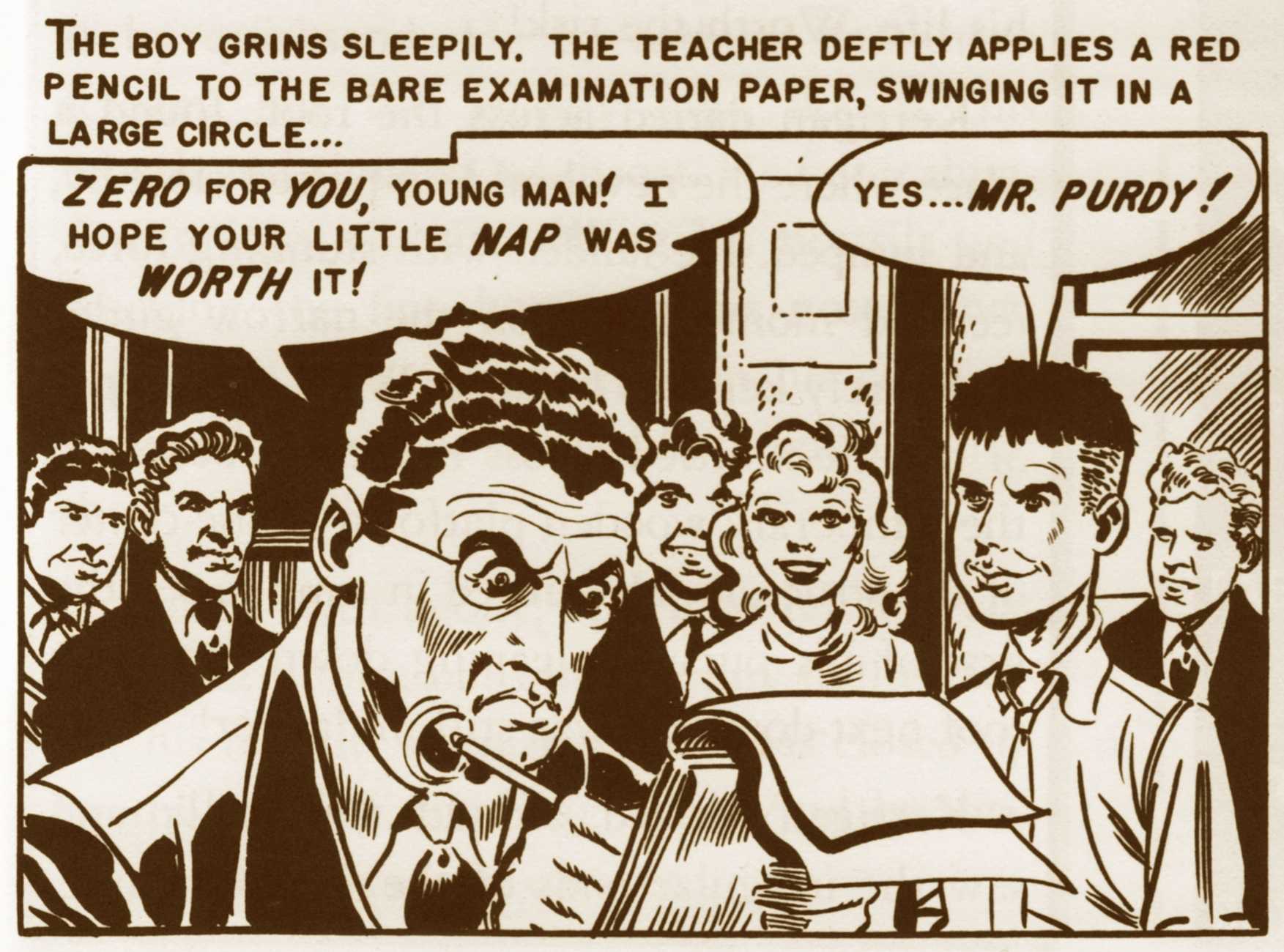
« Have a nice nap, young man? »

OrlandoZeroforYouA.jpg

The punchline to the EC story “Pleasant Screams!”, written by the usual Bill Gaines / Al Feldstein combo, with art by Joe Orlando. From Tales From the Crypt no. 37 (August, 1953) Can anyone in the class tell me where this panel was swiped and quoted (to hilarious effect) in the eighties? The answer follows…

cropped-outthereicon.gif

Here it comes… pencils down, everyone!

ChesterInnuitA
Poor Fifi. He hardly seems to be the right breed of pooch for the Canadian Arctic, not to mention its special precipitations. Reprinted several times since, this edifying tale of poetic justice first saw print in the final issue of the Yummy Fur mini-comic (no. 7, Sept. 1985, Tortured Canoe).

ChesterFuckOff
Chester’s closing argument in the case.

Ah, for a return to the days when we didn’t know way too much about Chester Brown, when he was a mysterious, self-published cartooning genius and Châteauguay‘s finest son. I remember how awestruck I was upon encountering his brilliant Yummy Fur minis, available at Toronto’s gone-but-not-forgotten Dragon Lady comic book store in the early-to-mid 1980s. What a surreal breath of fresh air they were!

A cat’s meow and a cow’s moo
I can recite ’em all

Just tell me where it hurts yuh, honey
and I’ll tell you who to call

Nobody can get no sleep
There’s someone on ev’ryone’s toes

But when Quinn the Eskimo gets here
everybody’s gonna wanna doze.

QuinnEskimo
The source of Bobby Zimmerman‘s inspiration: Anthony Quinn as “Inuk” in The Savage Innocents (1960). Back then, people dressed like this where and when it was actually cold; nowadays, it may be sunny and well above freezing, but those fierce, dauntless Polar explorers roam the streets in great numbers, clad in their fashionable down-filled, fur-lined hooded coats…  

-RG

Tentacle Tuesday: Carmine, Scarlet, Crimson Red

You’ve likely noticed it already, but people getting attacked by tentacles tend to be dressed in red. Now, red will not make a bull enraged (as a matter of fact, bulls are colour-blind to red – there, you learned something new today), but what effect would it have on an octopus? None at all, as it turns out, as red light does not reach ocean depths. One might want to wear red to become near-impossible to spot at a depth of a hundred metres or more, but that doesn’t explain why tentacles would persistently seek out red targets. Crap, there goes my theory.

Nevermind; we can still feast our eyes on some fetching mam’zelles and monsieurs clad in red, theories be damned.

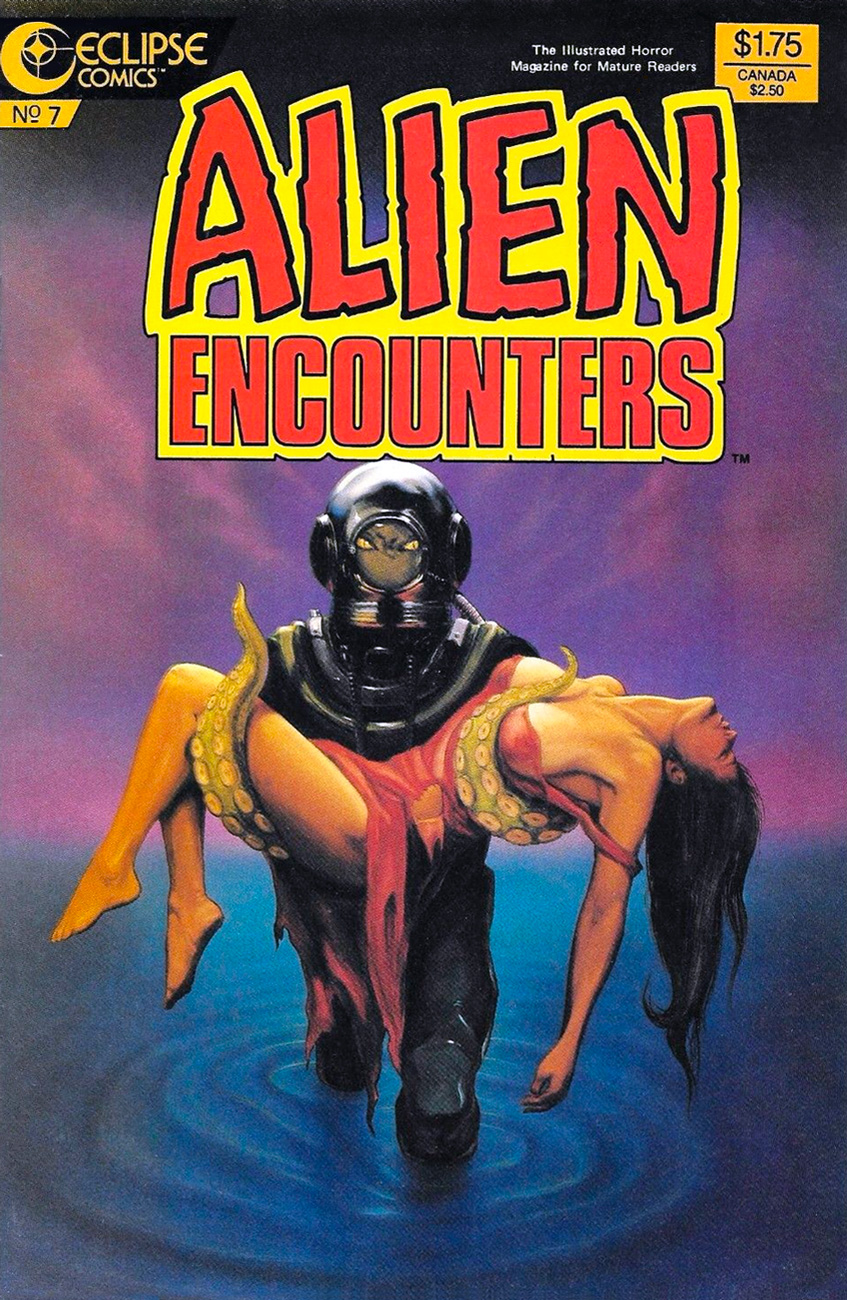
AlienEncounters7B
Alien Encounters no. 7 (June 1986, Eclipse Comics). Painted Cover by Corey Wolfe.

Music aficionados will notice that this cover is a tribute to something quite outside the comic field, namely this album art:

10ccDeceptiveBends
Cover of 10cc’s Deceptive Bends album, designed by Hipgnosis, 1977. Where are the tentacles?! The girl’s dress is also somewhat more demure (though not by much).

TentacleTuesdayIcon

After Alien Encounters, we naturally move on to Alien Worlds. Admire the, err, tentacles on this cover:

AlienWorlds4
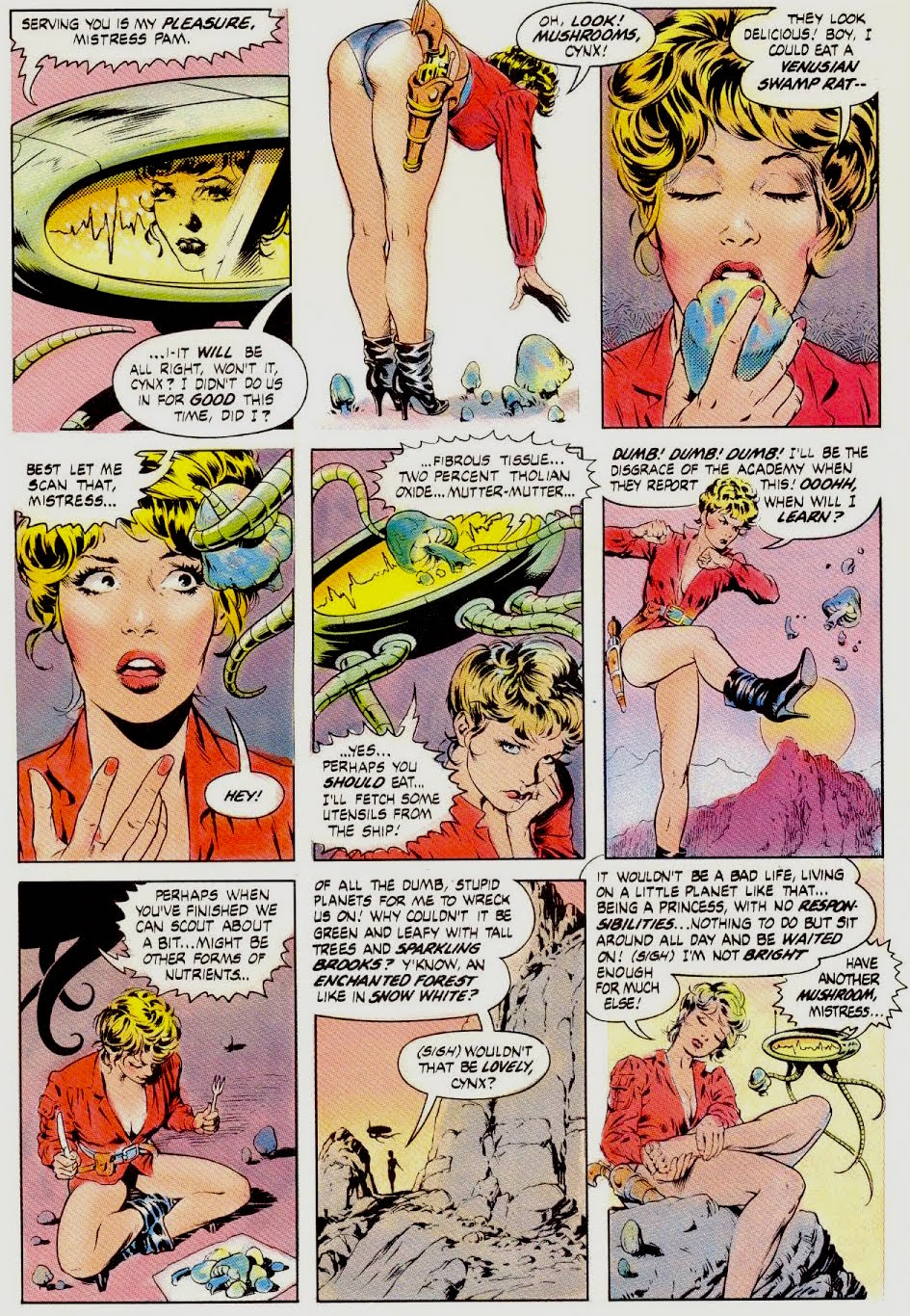
“If he had been watching his mistress as usual, if he had been at the controls instead of giving himself a lube job, the accident might have been prevented.” Moral of the story: no lube jobs at the wheel! That tentacled thing behind Princess Pam is actually Cynx, her guardian. The science-fiction comic anthology Alien Worlds, first published by Pacific Comics and then by Eclipse after Pacific went bankrupt, was edited by Bruce Jones, who wrote the bulk of the stories, and April Campbell. This is Alien Worlds no. 4 (Pacific Comics, September 1983), cover by Dave Stevens, with colours by Joe Chiodo.

AlienWorlds4Page
Mushrooms *and* tentacles *and* some pretty gams? Sensory overload! At first glance, the story (scripted and pencilled by Bruce Jones, inked by Dave Stevens, coloured by Joe Chiodo and lettered by Carrie McCarthy) is nothing but gratuitous cheesecake – a pretty, half-naked girl wandering around with her robotic servant – but it’s actually surprisingly touching. Check it out here. Fittingly, mushrooms save the day.

TentacleTuesdayIcon

It’s not just women who like to sport flashy red outfits, by the way. The men’s costumes might cover considerably more skin, but the vermilion remains!

Frogmen2
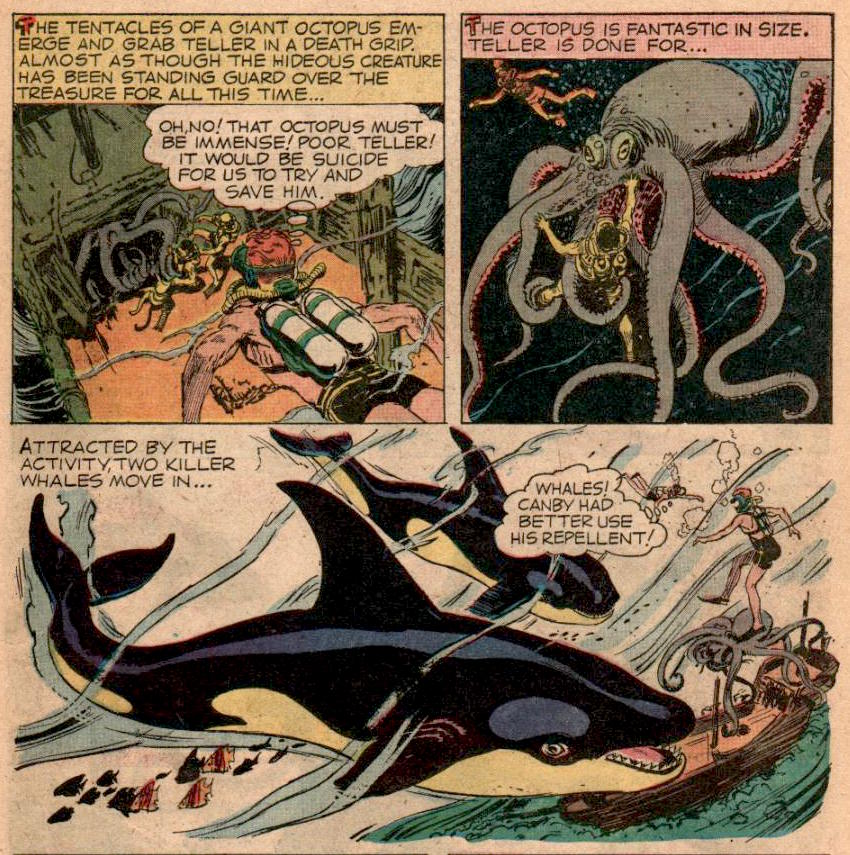
« The tentacles of a giant octopus emerge and grab him in a death grip. Almost as though the hideous creature has been standing guard over the treasure for all this time… » Of course it has! Any self-respecting octopus takes his job seriously. The Frogmen no. 2 (May-July 1962); the cover is by Vic Prezio, and the sumptuous inside art is by George Evans.

Frogmen2Panel
There’s (also) an epic battle between a killer whale and the octopus in this issue (witness the aforementioned George Evans art).

Frogmen2RedUnderwear
Of course he wants you, silly – who can resist a man in red swimming trunks? Nor octopus nor man. I retract my comment about men being more covered up. Do they have to tell their families, though?

TentacleTuesdayIcon

One more for the road and I’ll conclude this vernissage…

WeirdThrillers4
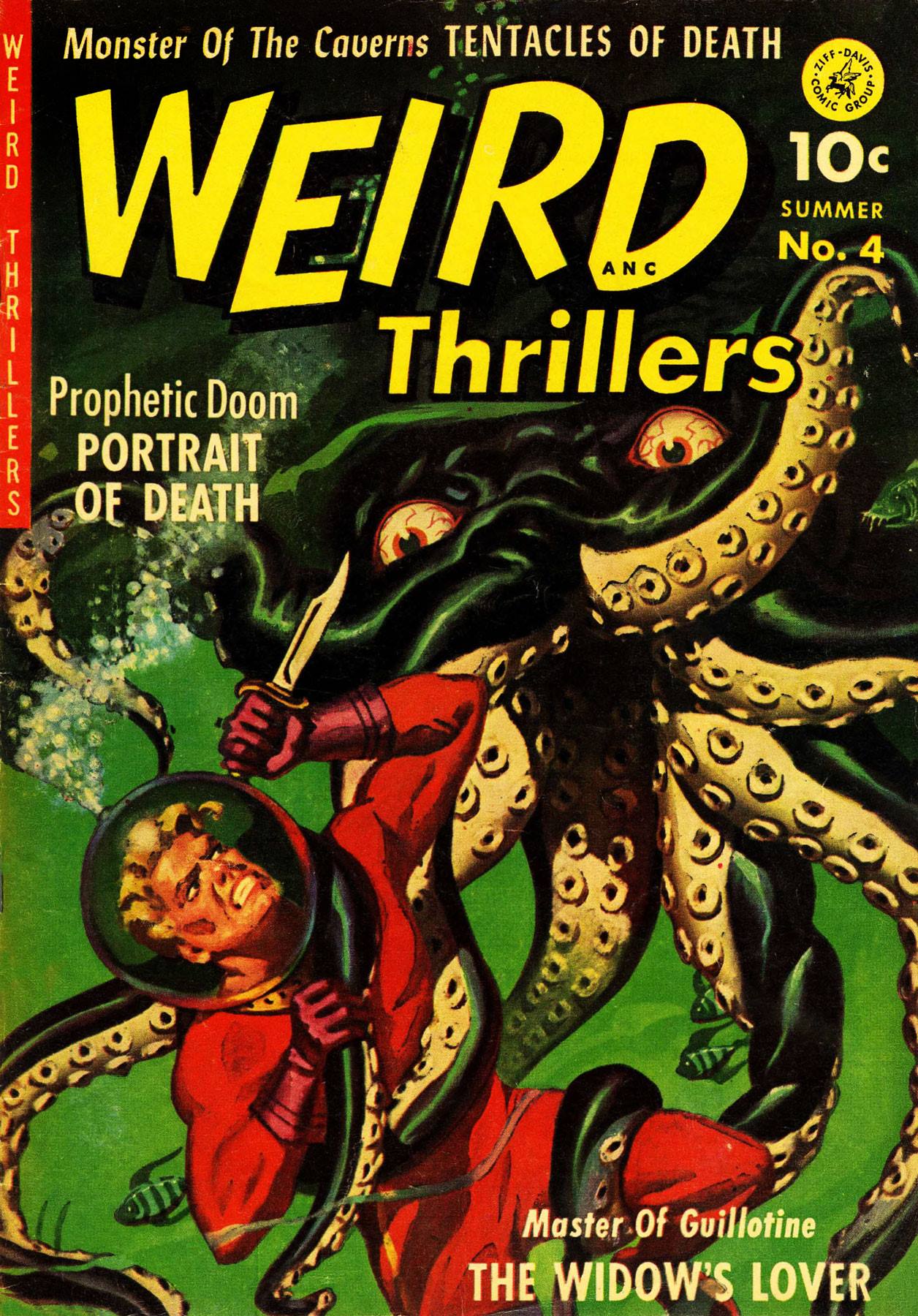
“The bolts of current are merely absorbed by the rubber flesh of the octeel, which is part octopus and part electric eel!” Oh, for the love of puns. Weird Thrillers no. 4 (summer 1952, published by Ziff-Davis), with painted cover by Norman Saunders.

You’ll no doubt want to see what an electric octopus looks like, so here you go:

WeirdThrillers4Page
“Tentacles of Death”? Sign me up, please! The gruesome cover story is drawn by George Tuska.

~ ds

“I never wore a studded leather jacket, y’know. Ne-va!”*

Brooding pretty boy (is that you, Brian Setzer?) is about to get a pleasant shock in this Dave Stevens (1955-2008) cover featuring a “punk rocker” in the well-scrubbed tradition of, say, Lea Thompson in the infamous Howard the Duck movie. Still, it’s a dazzler, as you’d be right to expect from Mr. Stevens.

TrueLove1A

This is True Love no. 1 (Eclipse Comics, January, 1986), featuring reprints of 1952-54 Standard romance tales, boasting artwork by Alex Toth (two stories), Nick Cardy, and, er… Vince Colletta. Edited by Catherine Yronwode.

Setzer1981
Stray Cat-in-chief Brian Setzer, circa 1981.

HowardBev
What passed for Howard the Duck and his ‘hairless ape’ companion Beverly Switzler (1986).

« True love leaves no traces 
If you and I are one 
It’s lost in our embraces 
Like stars against the sun »
Leonard Cohen (1977)

– RG

*Johnny “Rotten” Lydon

He’s Just Back-dated: Roger On, Mr. Daltrey!

« We tend to think of age only in time, but I don’t think it has much to do with time at all; there’s a whole load of other things. I’ve met 16-year-olds who are old and 90-year-olds who are young. » — Roger Daltrey

DaltreySimpsons
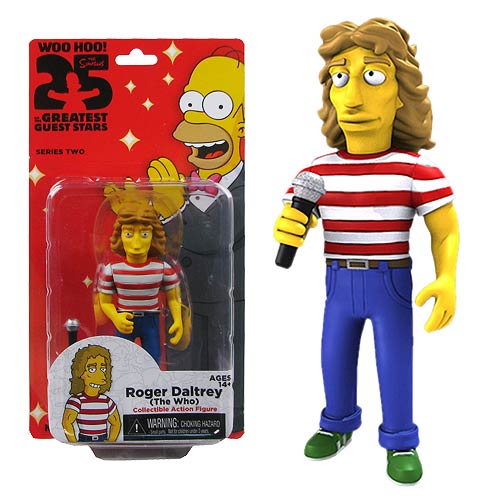
Truly a master of all media, Roger is.

Today’s birthday number seventy-four for Sir Roger Harry Daltrey (born in London, England, on March 1st, 1944), Commander of the Most Excellent Order of the British Empire, noted thespian and lead vocalist of The Who. « And what’s this got to do with soddin’ comics? », the more boorish among you may ask. Well, thanks to the efforts of the genial Michael Kupperman, Sir Roger, and his unceasing quest for birds, have been duly immortalised in comics. Read on!

RogerDiaryA
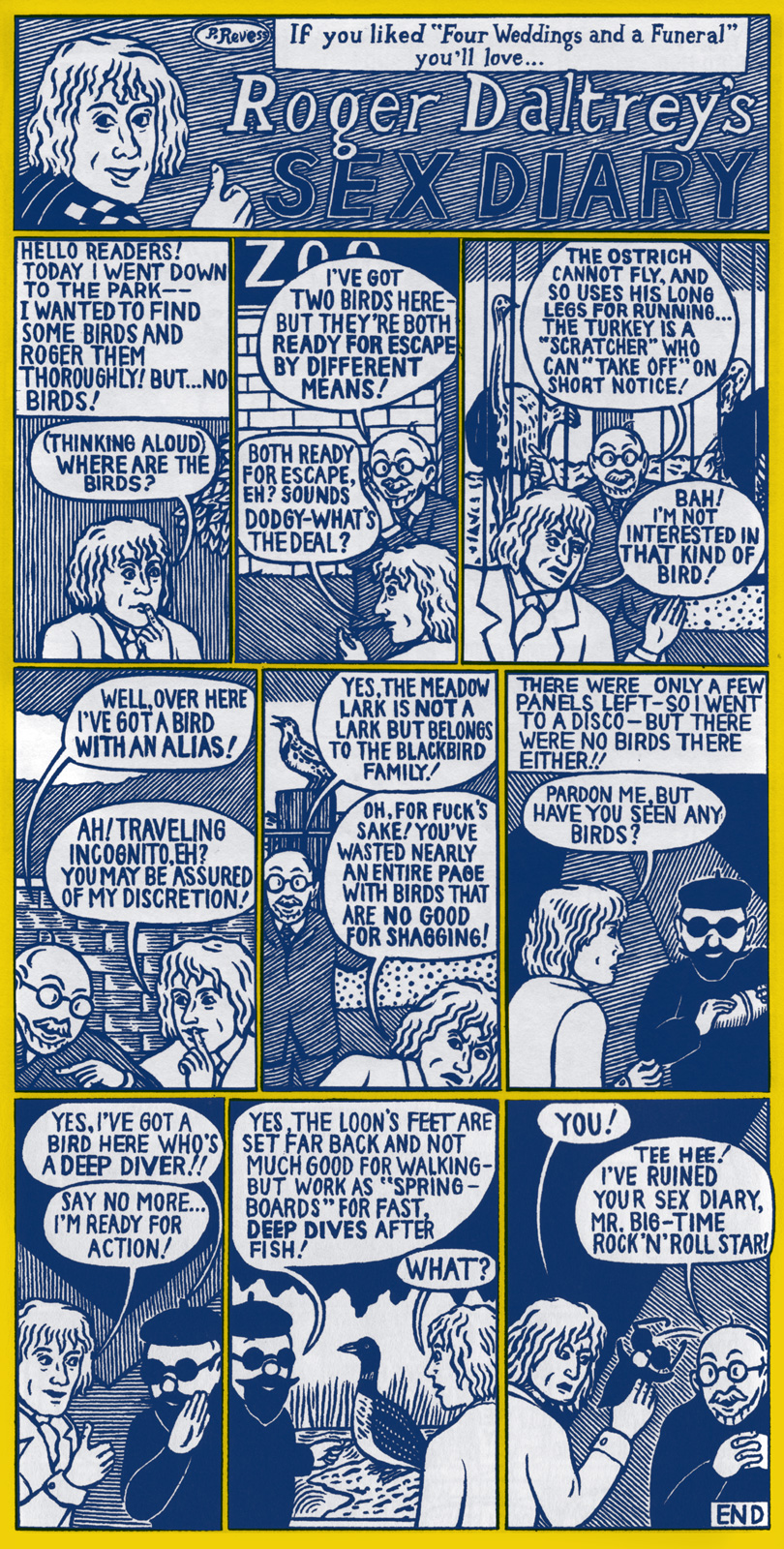
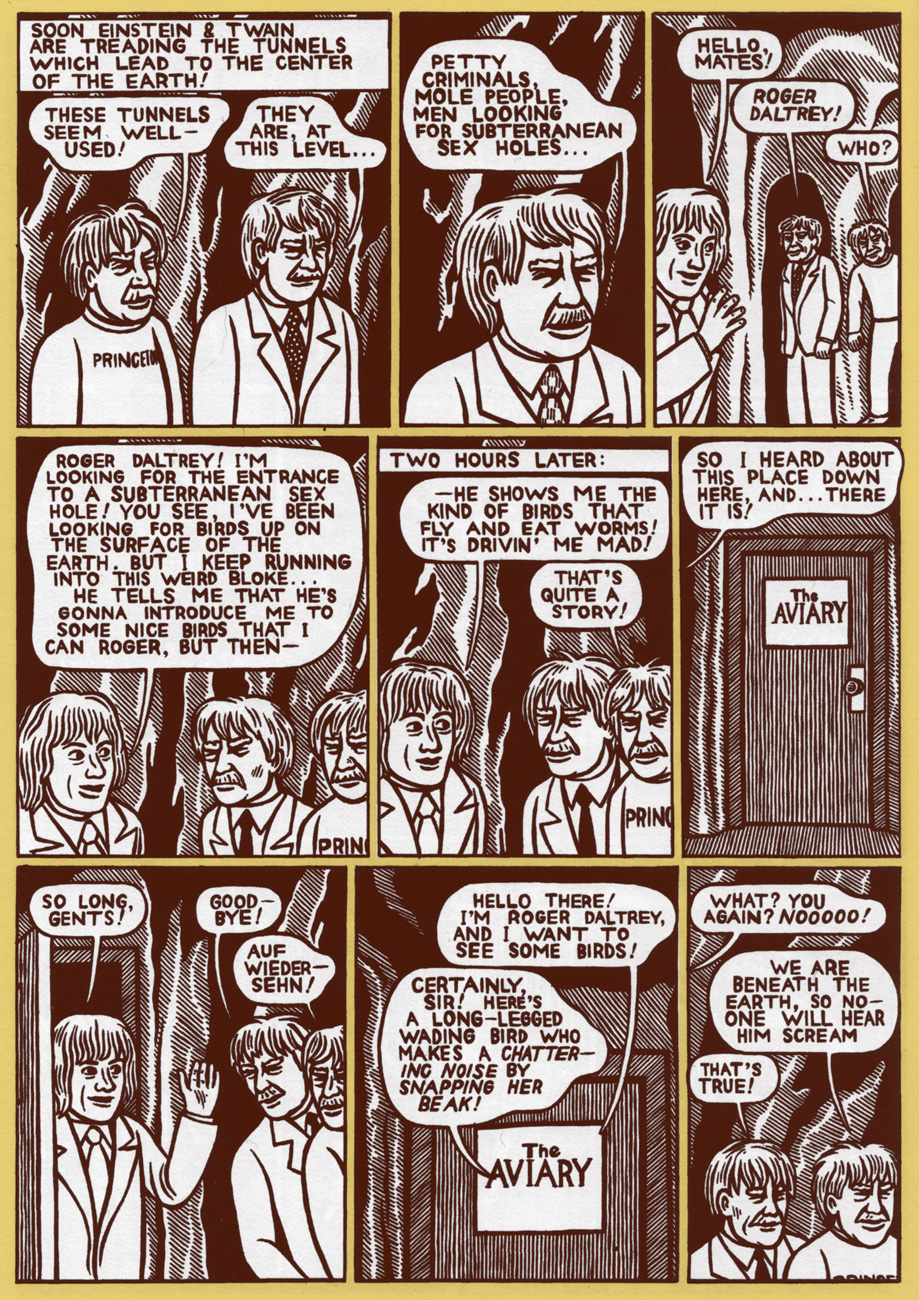
« Roger Daltrey’s Sex Diary », from Snake ‘n Bacon’s Cartoon Cabaret (2000, HarperCollins.) Story and art by Michael Kupperman, under his “P. Revess” nom de plume.

Farther along, having taken his quest below ground, our intrepid bird-rogerer encounters the dauntless duo of Mark Twain and Albert Enstein (of course!).

DaltreyTwainEinsteinA
« SPECULATIVE PICTO-FICTION: What Might Happen if… Mark TWAIN and Albert EINSTEIN Were to TEAM UP to DIG a HOLE to the CENTER of the EARTH? », from Snake ‘n Bacon’s Cartoon Cabaret (2000, HarperCollins.) Story and art by Kupperman,

I’ve looked under chairs
I’ve looked under tables
I’ve tried to find the key
to fifty million fables

They call me the Seeker
I’ve been searchin’ low and high
I won’t get to get what I’m after
Till the day I die

tumblr_mvdlmhhWXt1sa0ud0o2_500.gif
Roger as he appears in Ken Russell’s Lisztomania (1975.) Don’t miss Paul Nicholas’ sensational turn as Richard Wagner!

Happy birthday, Roger. Here’s a helpful shortcut to some of these fabled birds you seek:

https://designyoutrust.com/2019/08/birds-of-britain-photographer-john-d-green-captured-the-beauties-of-london-in-swinging-sixties/

-RG

Once More Around the Sun, Rick Geary!

« Hey — if you’re looking for that curly machine, I saw some beasts run off with it. »

Missouri native Rick Geary, born 72 years ago today, on February 25, 1946 (in Kansas City, which isn’t in Kansas, despite its name) is in a classe à part: a true iconoclast, he’s quietly, steadfastly carved out for himself (and his fans) a varied and consistently strong œuvre, seemingly free from petty compromise.

GearySelf85A
A 1985 self-portrait.

He first gained notice in the mid-70s through his fanciful contributions to National Lampoon and Heavy Metal, and just kept up the pace from there. These days, he mostly concentrates on his true crime graphic novels series, published by NBM. One gets a sense of a man who works in comics because he’s passionate about the possibilities the form offers. A 1994 recipient of the National Cartoonist Society’s Magazine and Book Illustration Award, he certainly doesn’t need to work in the comics industry.

GearyPetMiraclesA
This charming one-pager saw print in the anthology Animal Confidential (May 1992, Dark Horse.)

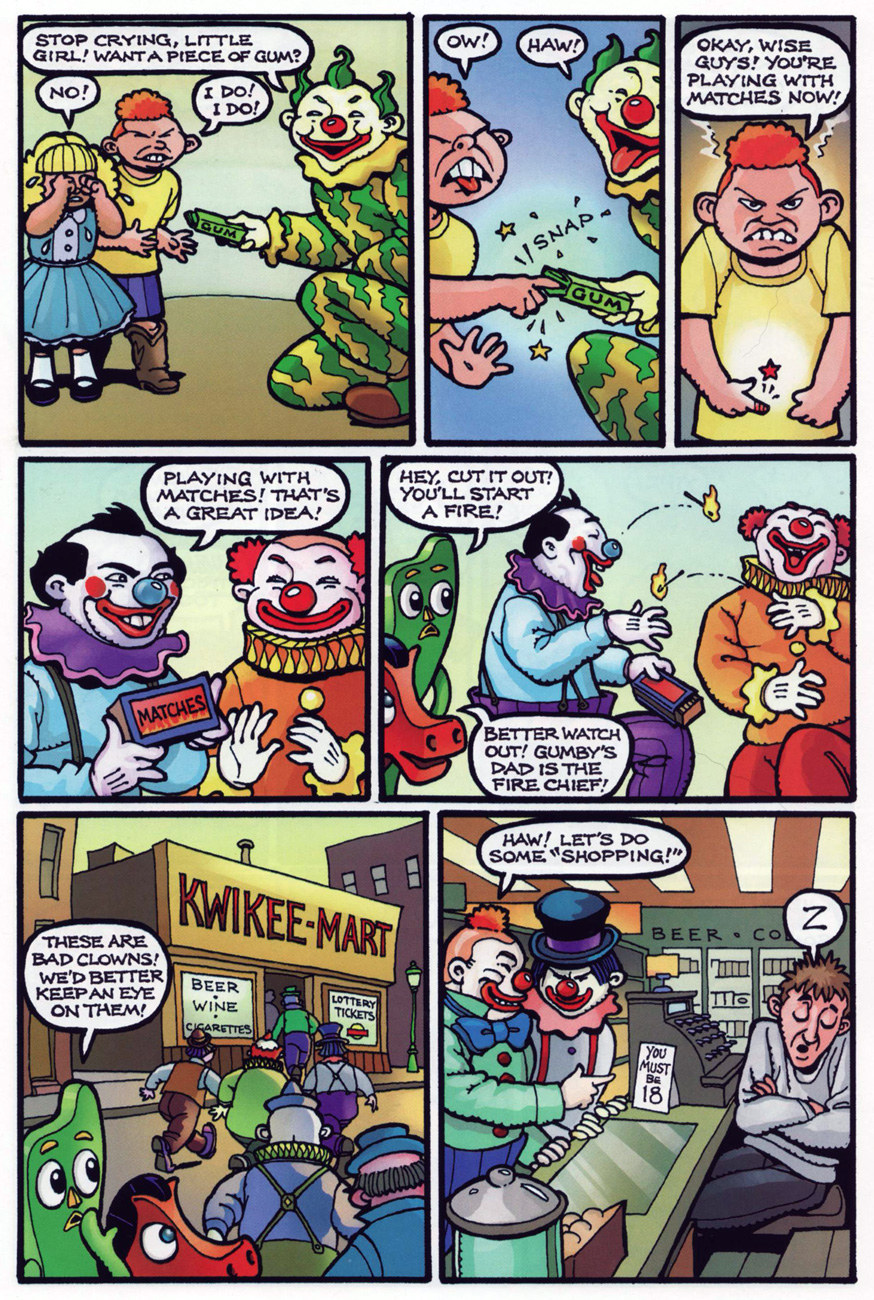
He’s collaborated with fellow oddball genius Bob Burden, of Flaming Carrot fame, a dream pairing that manages to surpass the lofty expectations it implies. Their take on Art Clokey‘s legendary claymation characters Gumby and Pokey manages to be true to its source and to espouse both Burden and Geary’s respective slants.

Here’s a sequence from Gumby no. 1 (July 2006, Wildcard Ink.) Story by Burden, art by Geary, and let’s not forget the contribution of hue ace Steve Oliff. When it comes to Gumby comics, however, mind your step: don’t settle for anything less than Burden (whether with Arthur Adams or Rick Geary). A recent revival fumbles the childlike mood of infinite possibility and mires itself in mere childishness instead.

GearyGumby1AGearyGumby2AThe Exploits of the Junior Carrot Patrol (2 issues, 1989-1990) was a solo Geary endeavour, but  « based upon characters and concepts created by Bob Burden ». Pictured here is #2. From left to right: Dusty, Ethel and Chuck.

JuniorCarrot2A

GearyStampA
Perhaps the ultimate bonafide as a Geary-head: I am the proud possessor of a rubber stamp designed by the great man himself. Furthermore, I have it on good authority that one of our regular readers proudly wields a genuine Geary rubber stamp of his own, albeit a different one. For this particular print, I took advantage of the vegetable world’s finest provider of ink: a slice of beet.

Happy birthday, dear Mr. Geary!

– RG

From off the streets of Cleveland comes…

« What kind of people are these?
Where do they come from,
what do they do? What’s in a name? »

Coming out of nowhere (well, “From off the streets of Cleveland“, as it happens) in 1976, Harvey Pekar’s American Splendor was one of comics’ truest and most bracing alternatives. It wasn’t part of the Underground Comix movement, despite the participation of Pekar’s old friend and fellow record collector Robert Crumb, and it wasn’t like anything pushed out by the mainstream comics industry.

JournalPekarA
This is The Comics Journal no. 97 (April, 1985). Cover by Crumb and Pekar.

Crumb’s introduction to Doubleday/Dolphin’s 1986 anthology of early AS strips describes Pekar’s appeal better than anyone else is likely to:

« Yeah, Harvey is an ego-maniac; a classic case… a driven, compulsive, mad Jew… it’s something to see. But how else could he have gotten all those comics published, with almost no money; in total isolation from any comic-publishing ‘scene’ such as exists here in California, or in New York; constantly brow-beating artists to illustrate his stories; handling the distribution himself… only an ego-maniac would persist in the face of such odds. »

« The subject matter of these stories is so staggeringly mundane, it verges on the exotic! It is very disorienting at first, but after awhile you get with it. Myself, I love it… Pekar has proven once and for all that even the most seemingly dreary and monotonous of lives is filled with poignancy and heroic struggle. All it takes is someone with an eye to see, an ear to hear, and a demented, desperate Jewish mind to get it down on paper… there is drama in the most ordinary and routine of days, but it’s a subtle thing that gets lost in the shuffle… our personal struggles seem dull and drab compared with the thrilling, suspense-filled, action-packed lives of the characters who are pushed on us all the time in movies, tv shows, adventure novels and… those *other* comicbooks.

What Pekar does is certainly new to the comicbook medium. There’s never been anything even approaching this kind of stark realism. It’s hard enough to find it in literature, impossible in the movies and tv. It takes chutspah to tell it exactly the way it happened, with no adornment, no great wrap-up, no bizarre twist, nothing. Pekar’s genius is that he pulls this off, and does it with humor, pathos, all the drama you could ever want… and in a comic book yet! »

And here’s an atypical example of Mr. Pekar’s storytelling art, a rare but eloquent pantomime vignette. It originally saw print in DC Comics’ run of American Splendor comic books (no. 1, Nov. 2006, published under the Vertigo imprint and edited by Jonathan Vankin.) The symbiosis at play here between writer and artist makes ‘Delicacy’ my very favourite story by Hilary Barta, who somehow never gets matched with a script worthy of his tremendous talent, even when he’s working with Alan Moore (Moore can be very funny, but superhero parodies, even his, seldom are… and Splash Brannigan wasn’t exactly side-splitting). This is a wonderful oddity, one of two times that Barta and Pekar collaborated. Bon appétit!

PekarDaVinci1APekarDaVinci2A-RG

“How Much You Gettin’ Paid for This Gig?” Scott A. Gilbert’s True Artist Tales

« I have moss for brains, so I can keep my cool »

It’s kind of sobering to chance across some regional comics… sometimes they’re of such high quality that I tend to wonder at, and regret, the vast bounty cast aside and left in the dust. How much more similarly fine stuff is out there is anyone’s guess. It makes me long for the days of greater cultural variety on a smaller scale, of humble local stations, local stardom and the unpredictable crazy quilt of regional popularity.

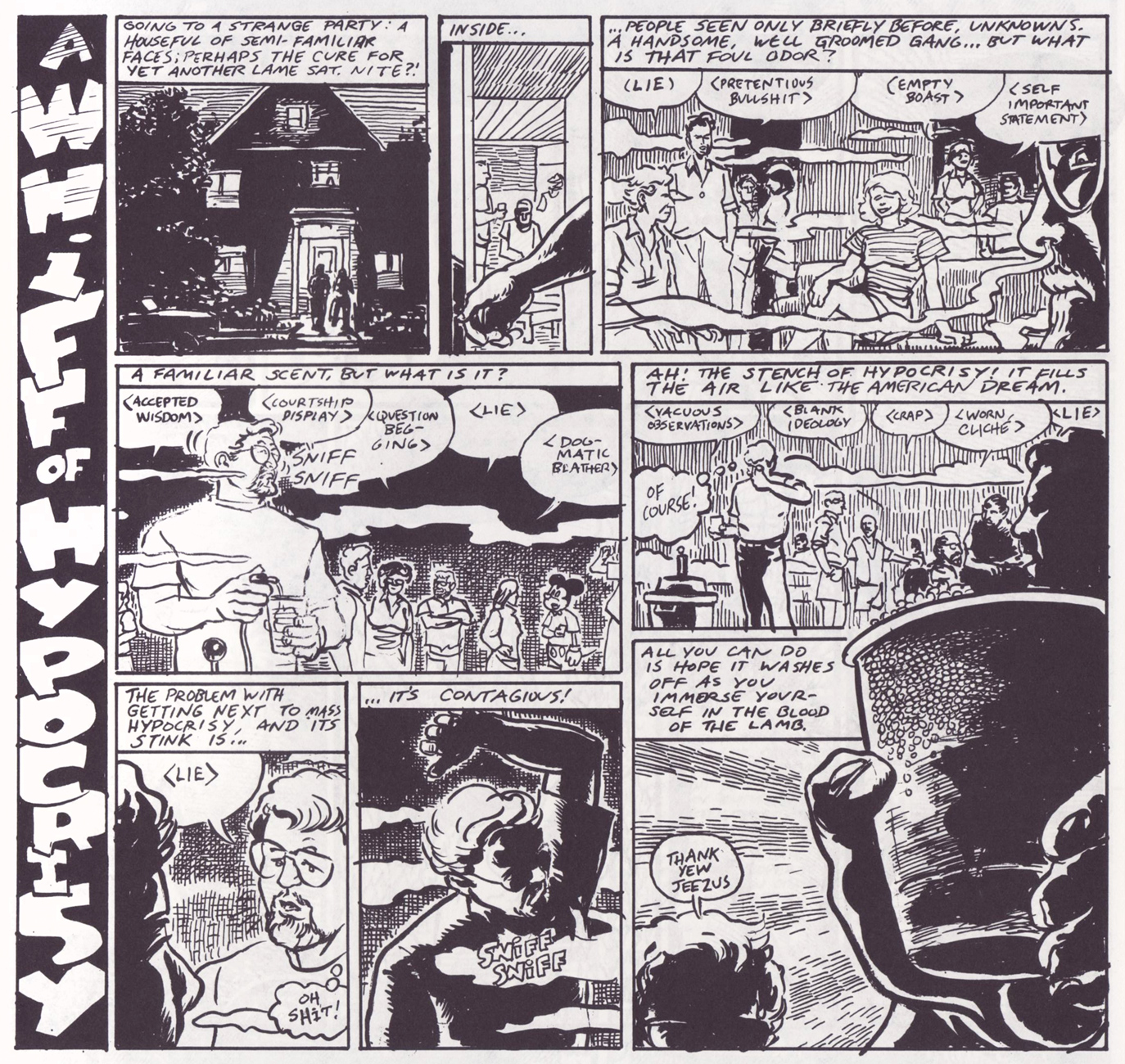
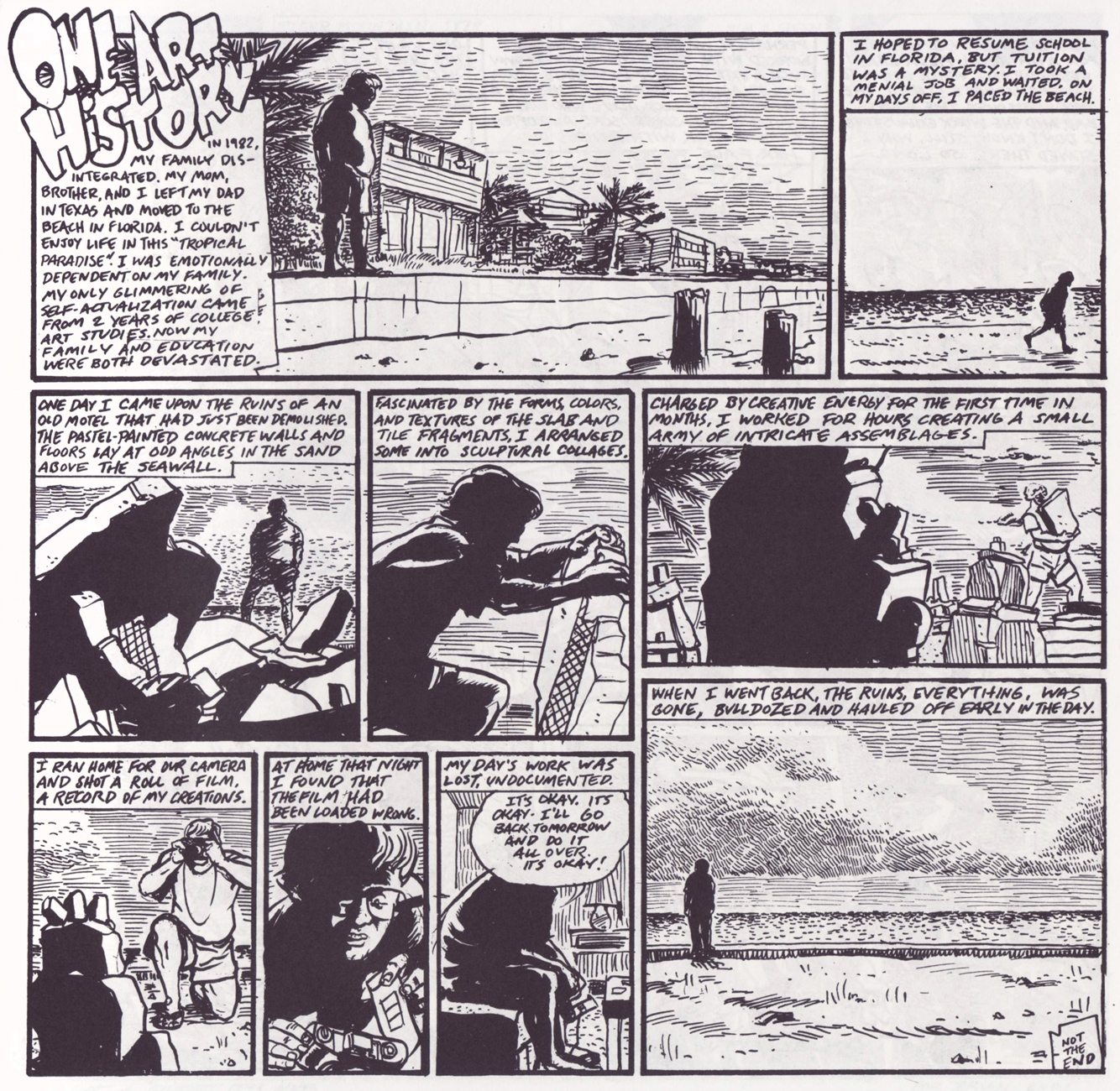
Houston, Texas’ Scott A. Gilbert is a prime example. If not for his being awarded a Xeric Grant in 1995, which financed the publication of It’s All True!, a concise 52-page collection of his favourite True Artist Tales, even fewer of us would have been exposed to his freewheeling talent. Without further ado, here are some of my picks from the booklet.

GilbertStenchA
A Whiff of Hypocrisy (1992)

GilbertArtHistoryA
One Art History (1993)

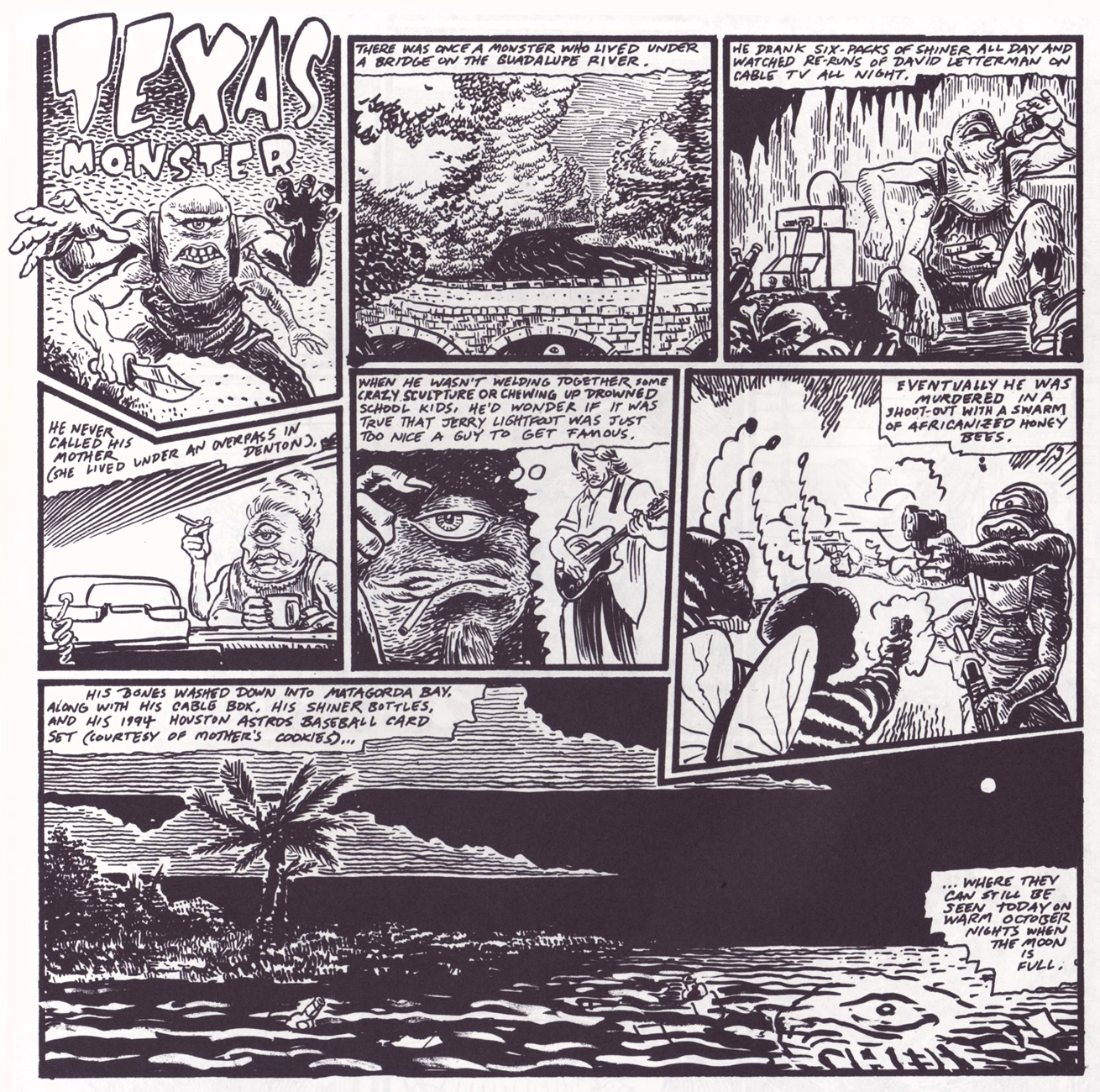
GilbertTexasMonsterA
Texas Monster (1994)

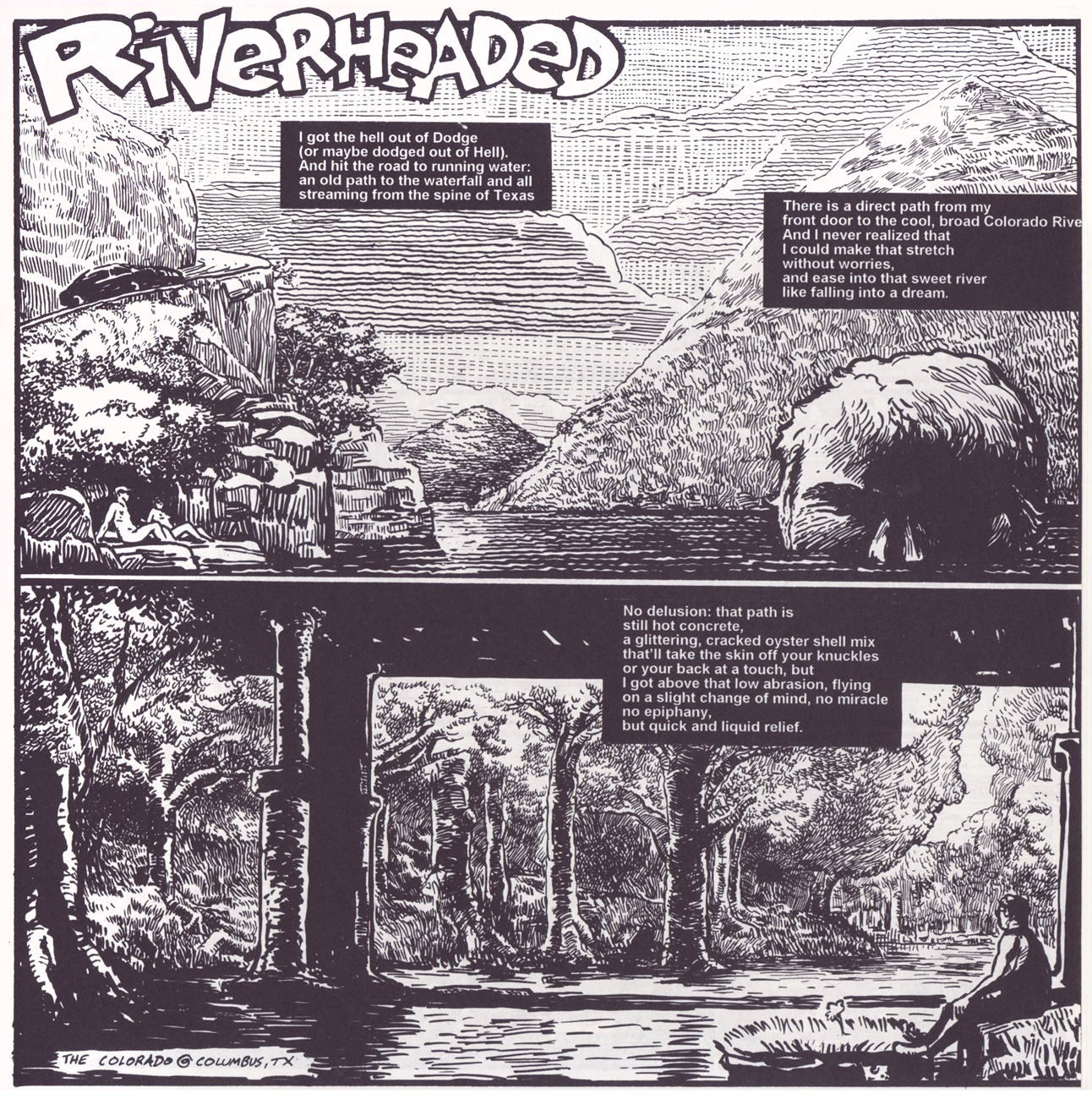
GilbertRieverheadedA
Riverheaded (1994)

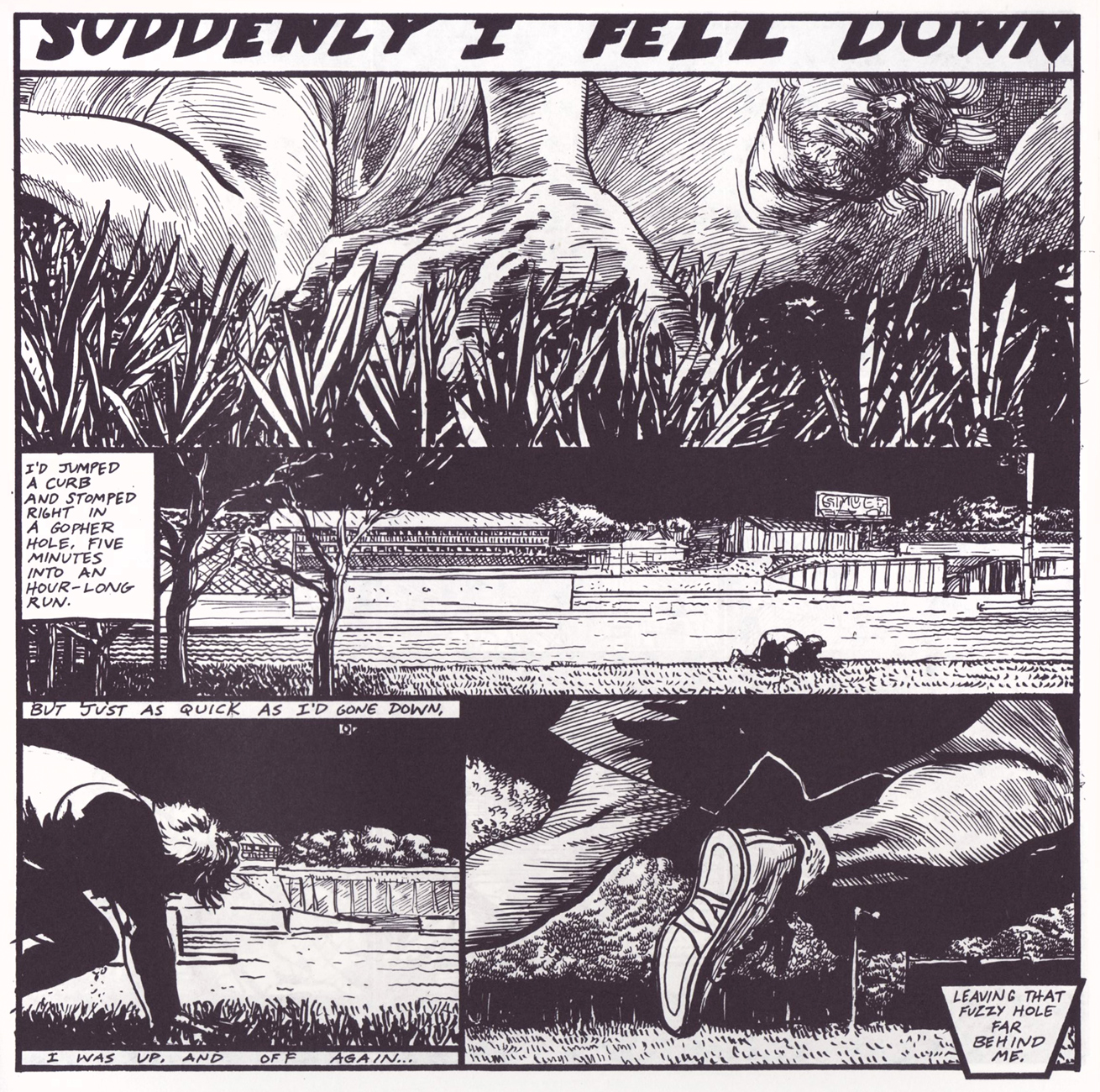
GilbertGopherA
I Fell (1994)

Gilbert’s True Artist Tales was published in rival alternative weeklies Public News (1988-97), and Houston Press (1997-2000). To answer our opening question, Gilbert got $25 a strip at Public News and $30 at Houston Press.

And for a bit more context, here’s an illuminating presentation that former Comics Journal managing editor Robert Boyd gave last year during a retrospective of Gilbert’s art Boyd was curating (now there’s something you don’t often see these days: the use of “curating” in its proper context!)

http://www.thegreatgodpanisdead.com/2016/11/true-artist-tales-talk.html

-RG

Hallowe’en Countdown, Day 16

« Oh, it’s just one of those endless dark roads where ghoul men seem to lurk at night. »

Gee, thanks, Penny. At least it’s a shortcut. Jaime Hernandez makes sparing usage of the explicitly supernatural in his work, and he still likes to keep you guessing… but the goosebumps are real, all right.

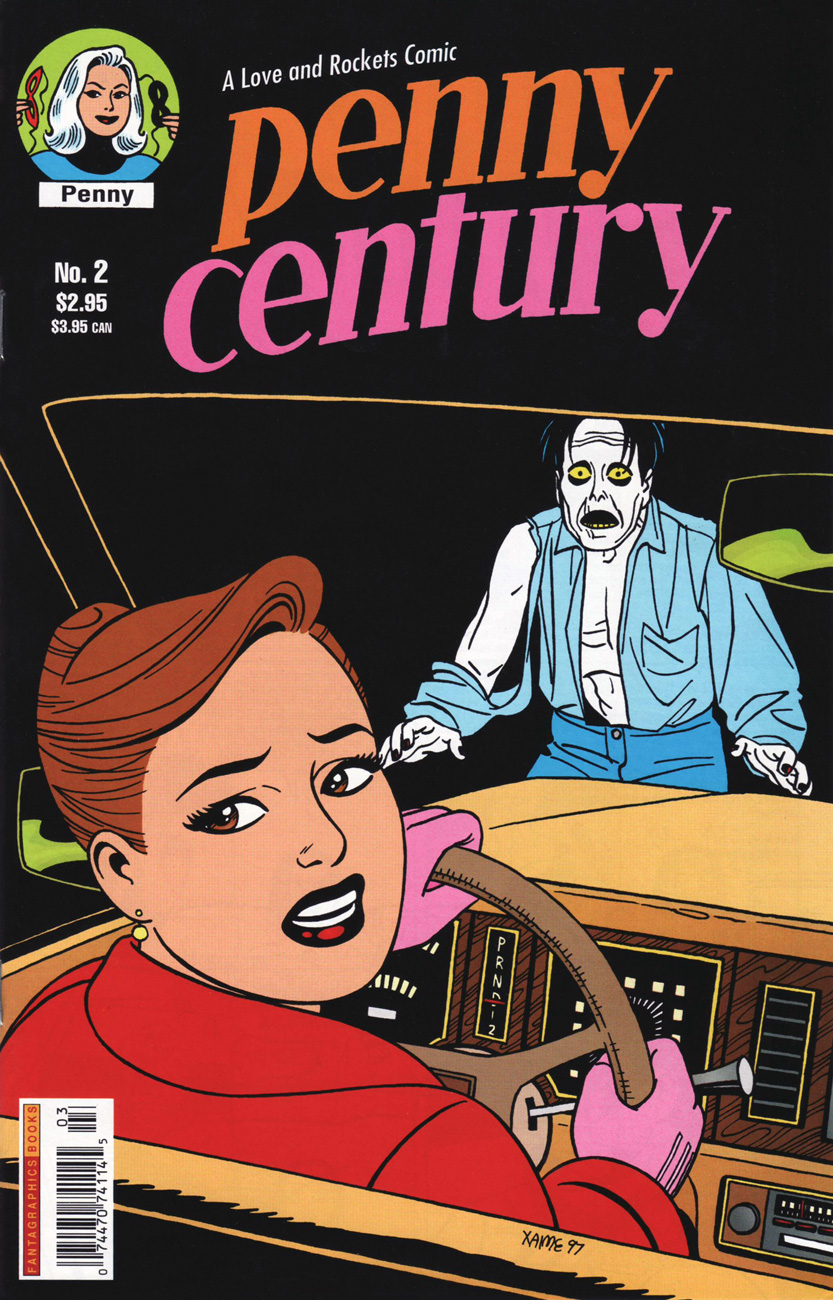
In « Chiller! », Maggie lets her imagination run wild while driving home on the 696, « The Horror Highway », as Penny Century flippantly puts it.

Penny2A
This is Penny Century #2 (Fantagraphics Books Inc., March, 1998.) Cover and just about everything else by Jaime Hernandez; “Computer colorist: Chris Brownrigg.

GhoulManA
Maggie and the Ghoul Man go way back, thanks to those spine-tinglers Izzy told her when they were lil’ kids. And hey, there’s that lady from Black Sabbath again! A taste of our cover tale, the aptly-titled « Chiller! »

– RG