Tentacle Tuesday: Tentacles That Get in Your Face (literally)

Tentacles gleefully probing various orifices, that’s what my mind is on this Tentacle Tuesday. We well know that octopuses not only tend to strangle their victims, but also get close up and personal with their anatomy.

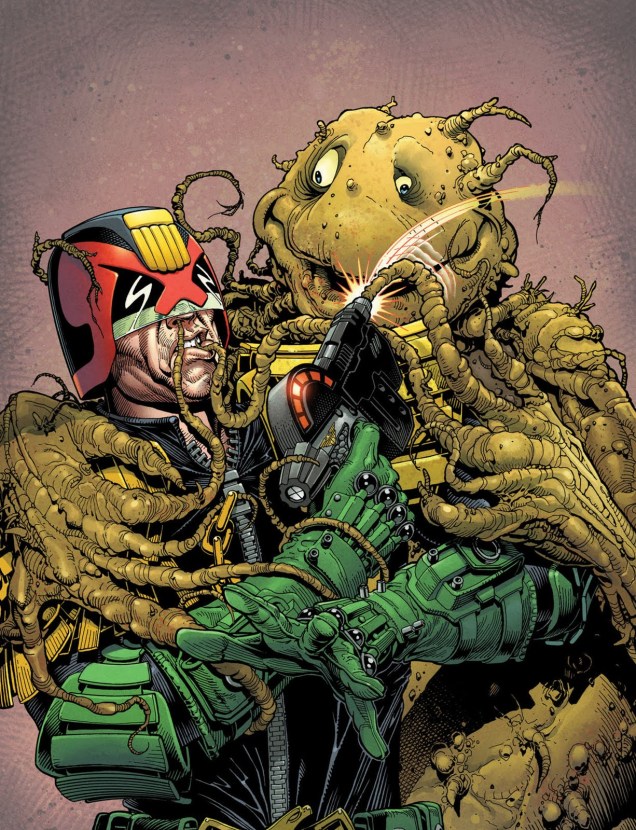
Just look at this adorable (did I say “adorable”? Maybe I meant “horrifyingly ugly”? I always get these two mixed up) cutie wrap Judge Dredd in his affectionate embrace.

Couch Potato Cover Line _art flat
I’ll let Pete Wells, owner of the « 200 A.D. Covers Uncovered » blog, explain the Couch Potatoes: « Behold, the god-like Cliff Robinson’s fantastic cover for Prog 1726, which features the welcome return of the Couch Potatoes. Another crazy Mega-City fad, the couch potatoes were lovable humanoid/vegetable lifeforms that sat in front of the Tri-D, repeating common phrases to its owner – think of a Little Britain fan and you’ll get the idea. The creatures were outlawed by the Justice Department when it transpired that they were super-evolving and feeding on their owners! »

Head over to Wells’ blog to watch this cover evolve from a preliminary sketch into a full-blown vision of tentacular glory.

TentacleTuesdayIcon

Heavy Metal magazine, in the special issue Son of Heavy MetalMay 1984paolo-serpieri-children-of-the-future-excerpt
A page from « Children of the Future », drawn by Paolo Eleuteri Serpieri, published in a special edition of Heavy Metal called « Son of Heavy Metal », May 1984.  Looks like the children of the future shall be some unholy octopus-human breed. Amusingly, the lecherous multi-tentacled sleazeball is still named Octo despite having many, many more appendages than just 8.

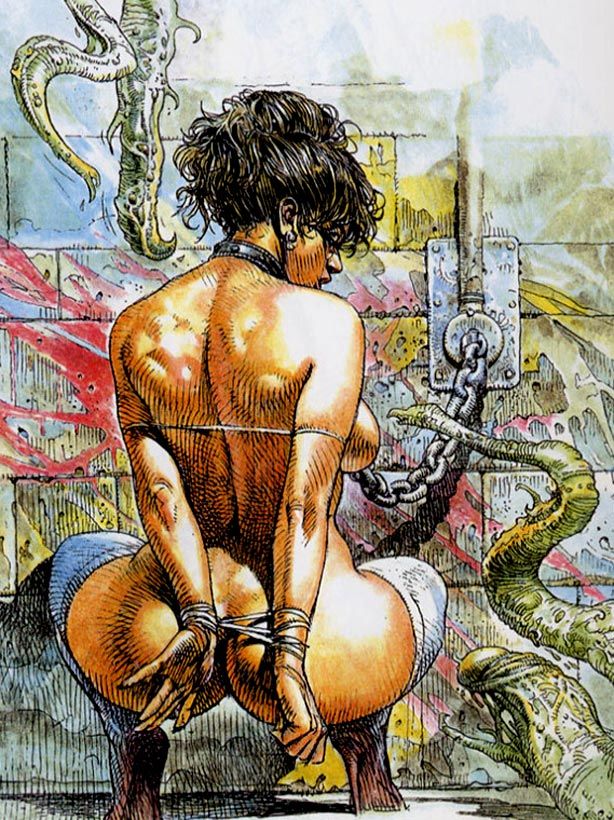
Serpieri is an Italian comic book writer and artist whose main interest is erotica. (His style is not really my thing, but hey, tentacles unite all.) He’s quite well-known for Druuna, a sci-fi/fantasy comic, which is more like an excuse to draw as many accouplements as possible.

DruunaSerpieri
Bonus image: Druuna and tentacles! Art by Paolo Eleuteri Serpieri. At least this ass-and-boob shot makes *some* anatomical sense – Druuna’s spine is still in place.

Lambiek Encyclopedia laconically notes that “Serpieri’s highly detailed portrayals of well-endowed heroines have earned him the undisputed title of “Master of the Ass”. Now Serpieri clearly has a huge interest in women’s asses, and he draws them lovingly, but so do a lot of other artists. Undisputed by whom? History is silent on this topic.

You can see more of his stuff here, which is definitely NSFW, unless you work in a brothel.

TentacleTuesdayIcon

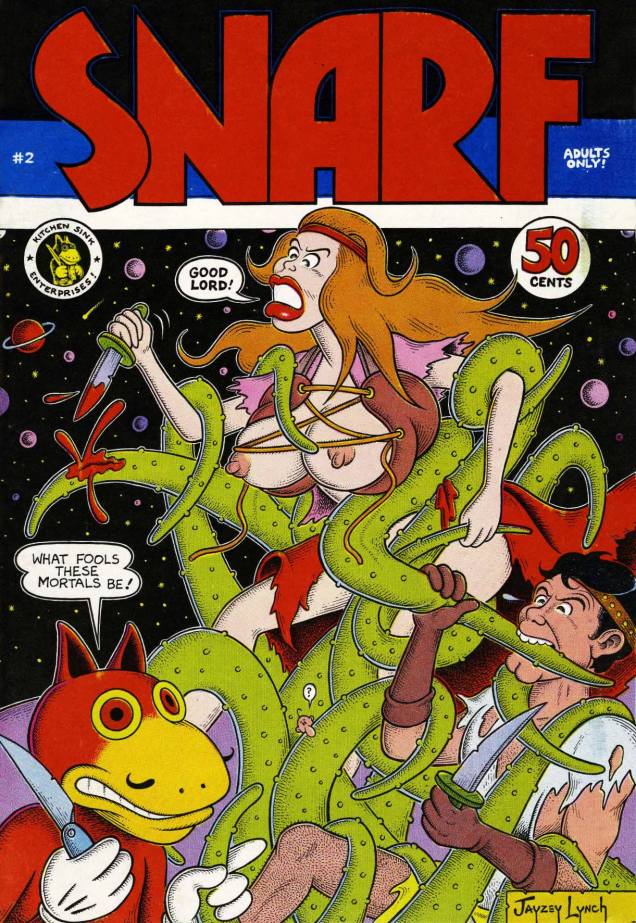
Snarf2JayLynch
Sometimes you’re just minding your own business, and suddenly something green and scabrous sticks itself into your mouth. Jayzey Lynch is of course Jay Lynch, the artist of this cover (Snarf no. 2, August 1972). “Good lord!”, indeed.

M. Steven Fox of Comix Joint wrote a riveting (as usual) review of Snarf no. 2. Read it here.

~ ds

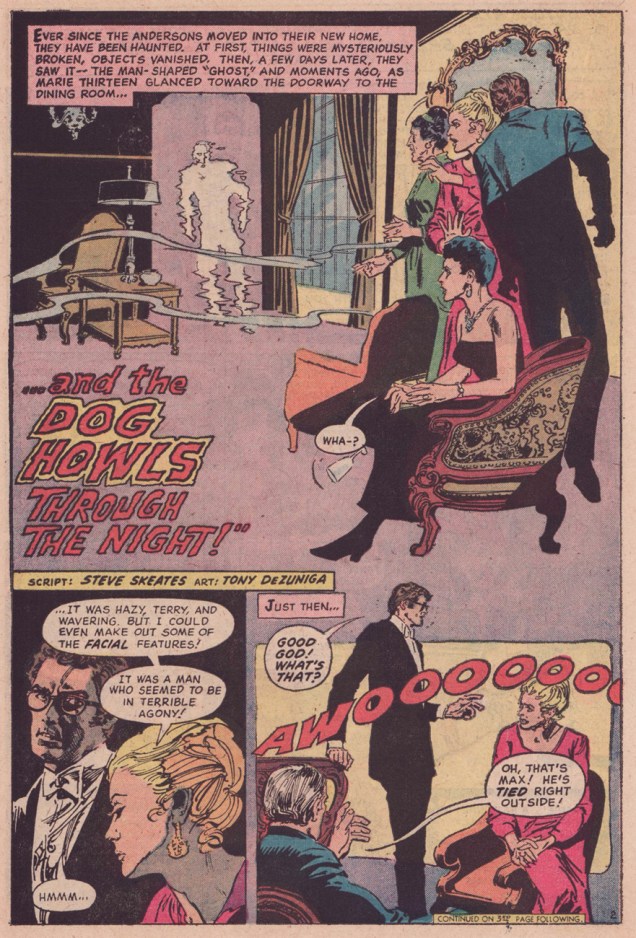
Steve Skeates’ “… and the Dog Howls Through the Night!” (1974)

« Who’d ever believe a story like that? »

On this fine day, we pay tribute to shifty scribe Chester P. Hazel (who sometimes goes by the unlikely nom de plume of Steve Skeates). It is whispered that Stephen, along with his nefarious twin Warren Savin, first invaded this plane of existence on January 29, 1943. That would make him/them/it seventy-five earthly rotations old, should these windblown tattles hold any credence.

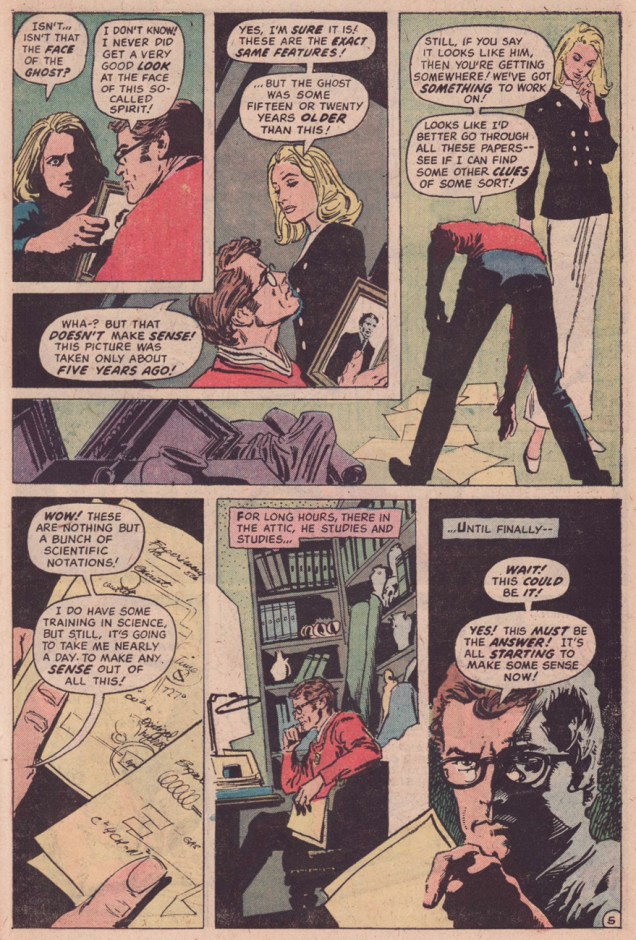
Happily, in this case, picking out a Skeates favourite to share was no ordeal: I’d been meaning for some time to shine a light on one of his neglected gems, one that salt-rubbingly ran without proper attribution in The Phantom Stranger no. 34 (Dec. 1974-Jan. 1975, DC Comics.)

The cases of Dr. Terrance Thirteen, ghost breaker, must have been easier to write back in the 1950’s, when DC Comics’ default setting in its mystery titles was to explain away the supernatural element before the curtain call. DC’s resident skeptic first shared his insights in Star Spangled Comics, his feature lasting from issue 122 (November, 1951) to issue 130 (July, 1952). He then moved to The House of Mystery for a handful of appearances, then faded away. He returned to action, along with his also long-dormant colleague  and foil The Phantom Stranger, in 1969’s Showcase no. 80. In the Supernatural Seventies, all poor Dr. Thirteen could do is vainly and stubbornly play the cards of reason and logic against a house deck stacked to inevitably favour the uncanny and the unreal. He was doomed to be a comic book version of The X-Files’ Dana Scully, Fritz Leiber‘s Norman Saylor (Conjure Wife, 1943) or Night of the Demon‘s Dr. John Holden, all skeptics coming off as hopelessly obdurate and clueless in light of the “facts”.

Sounds like today’s so-called post-fact world… in which we need true skeptics (as opposed to deniers) and cool, rational minds more than ever.

Anyway, it wasn’t the first time wily Skeates had faced such a storytelling impasse: he’d had to ring the changes on pacifist character Dove (of Steve Ditko’s eternally squabbling Hawk & Dove) within a universe of hard-slugging super vigilantes.

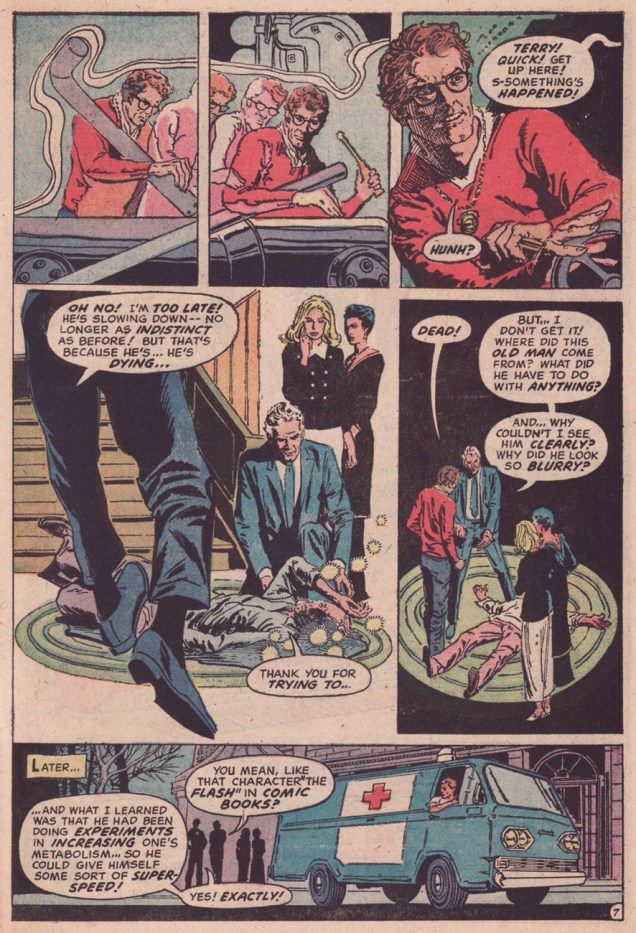
Dr. Thirteen bounced around various DC titles in the early-to-mid 70s. This is the series’ last bow in the back pages of The Phantom Stranger, and ironically its finest hour, alongside the penultimate entry, The Ghosts on the Glasses, which ran in Adventure Comics no. 428 (August, 1973.) In both cases, the inspired artwork is that of Filipino master Tony DeZuñiga (1932 – 2012), who was clearly in his element.

DrThirteen1ADrThirteen2ADrThirteen3ADrThirteen4ADrThirteen5ADrThirteen6ADrThirteen7ADrThirteen8A

A character likens the dead scientist’s ill-fated velocity experiments to comic book character The Flash… but it’s a cinch that what the impish* Mr. Skeates really had in mind was Virgil “Guy” Gilbert, aka Lightning, whose début, The Deadly Dust! he had scripted back in 1965 (T.H.U.N.D.E.R. Agents no. 4, April 1966). Here’s a relevant excerpt, featuring art by Mike Sekowsky and Frank Giacoia.

LightningA

In closing, a biographical blurb from DC’s T.H.U.N.D.E.R. Agents Archives, circa 2002: « A native and longtime resident of the Empire State, Steve Skeates began his work in comics as an assistant editor at Marvel Comics in 1965 – a job which he quickly abandoned in favor of writing comics as a full-time freelancer. Over the next twenty years he did work for nearly every major comics publisher, including DC, Marvel, Charlton, Tower, Warren, and Gold Key. Since leaving mainstream comics in the mid-1980s, he has worked as a reporter, bartender, and Zamboni operator, as well as publishing his own comics titles, which he continues to do from his home base in Fairport, New York. »

Happy birthday, Mr. Skeates, and thanks for everything!

-RG

*I mean to refer to Mr. Skeates’ undisputed status as King of the unofficial inter-company crossover. Naughty!
Buon compleanno, Gianni De Luca!

« Though this be madness, yet there is method in’t. »

On the ninety-first anniversary of his birth, we take the opportunity to salute fumetti gran maestro Gianni De Luca (b. January 25, 1927; d. June 6, 1991)… and to share some of the striking images he crafted. In comics, the term « innovative » has been applied far too liberally, all too often in ignorance. In the case of of Mr. De Luca, no hyperbole is involved, I assure you.

I first came upon his work in the mid-70s, through my parent-sponsored subscription to the québécois catholic youth magazine Vidéo-Presse (1971-1995), which was kind of didactic, I suppose, but still quite fun. The publisher had licensed much of its comics content from Italy, and it was definitely high-toned stuff, such as adaptations of Jules Verne novels. I recall « L’Île mystérieuse » being among them. Accustomed as I was to the madcap and hyperkinetic tone of the dominant Franco-Belgian and American schools, the Verne stuff, while clearly well-executed, seemed a bit languid and wan.

However, this feature was followed by, as fate would have it, the bane of any schoolboy*, Shakespeare adaptations. But wait… these were MIND-BLOWING. Decades later, I became fast friends with another cartoonist roughly my age, and he’d had the very same epiphany with De Luca’s Hamlet. Other than that, I’ve never really met anyone familiar with the work. Even locating a copy was a bit of an ordeal, but I managed to snag, a few years ago, a handsome volume gathering Hamlet and La tempête (The Tempest), published by Les Humanoïdes Associés in 1980.

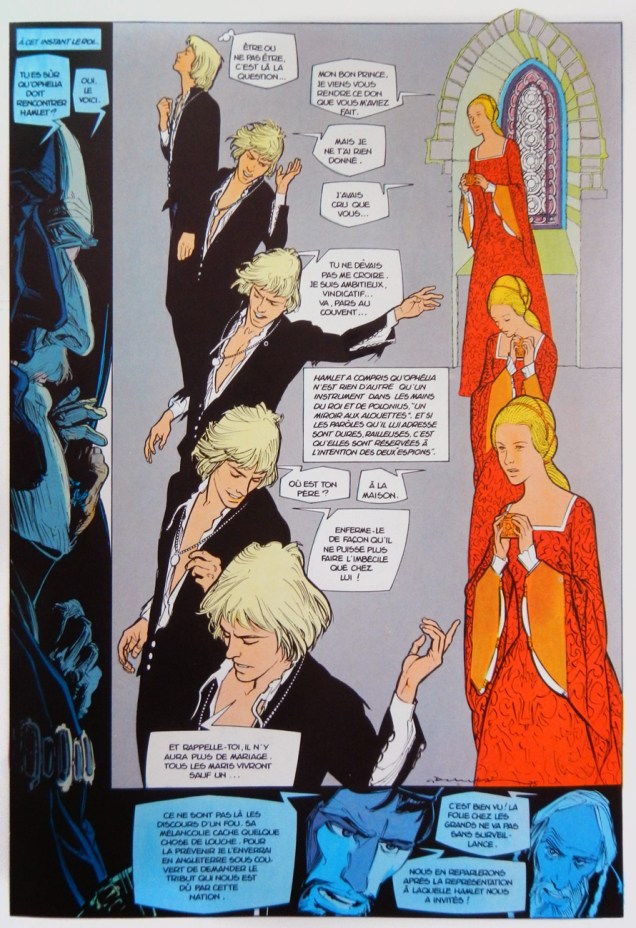
Hamlet19A
Hamlet, page eighteen. Adaptation by Barbara Graille and lettering by Roberto Roquemartine. Colours presumably by De Luca himself, as the credits are mute on that point.
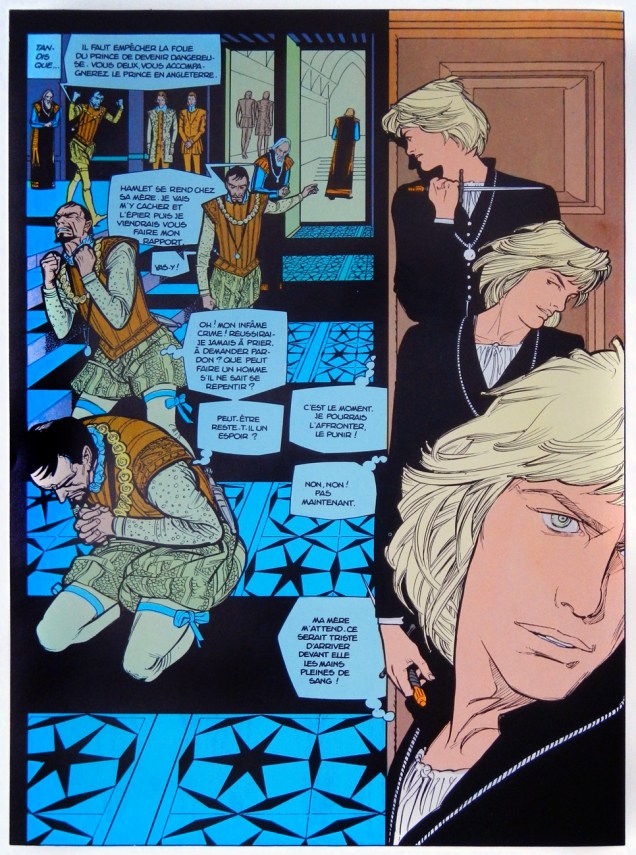
Hamlet22A
Hamlet, page twenty-three.
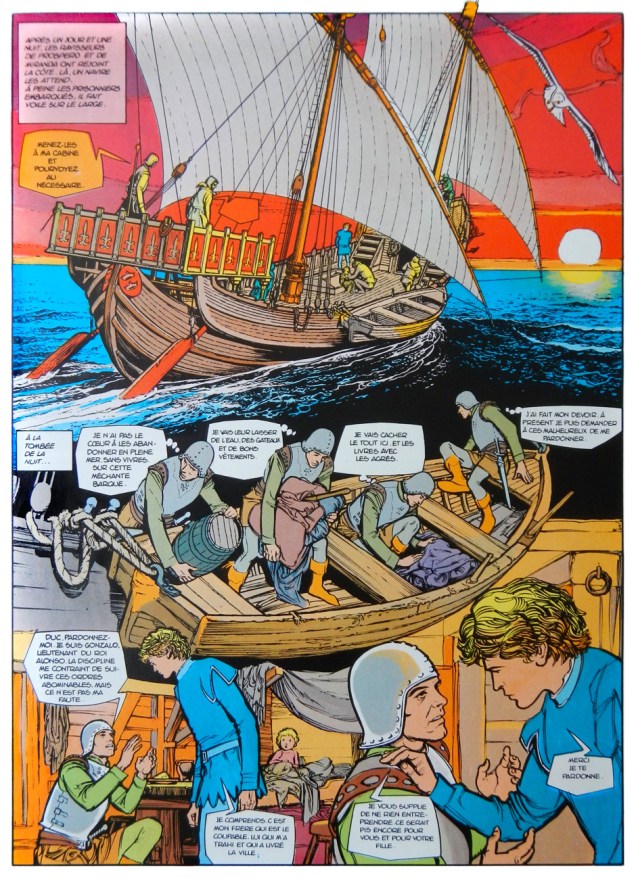
Tempête57A
La tempête, page five.
Tempête64A
La tempête, page twelve.

I don’t believe there’s any De Luca out there in the English language… save for one happy exception: UK publisher Running PressThe Mammoth Book of Crime Comics, discerningly edited by critic Paul Gravett**, contains « Strada », a superior entry in writer Gian Luigi Gonano and De Luca’s ‘Il Commissario Spada‘ series (1970-1982). « The series was groundbreaking in many ways, since it introduced subjects like violence, organized crime, satanic sects, terrorists and murderers to the pages of a Catholic magazine for young readers, that was at the time mainly distributed in parishes. »

*To be fair, we never studied Shakespeare in school.

**Speaking of Mr. Gravett, he happened to write an illuminating essay on De Luca’s Hamlet: http://www.paulgravett.com/articles/article/gianni_de_luca_hamlet

-RG

Faites gaffe, monsieur Franquin!

Ninety-three years ago today (January 3, 1924, that is), master bédéiste André Franquin was born in Etterbeek, Belgium.

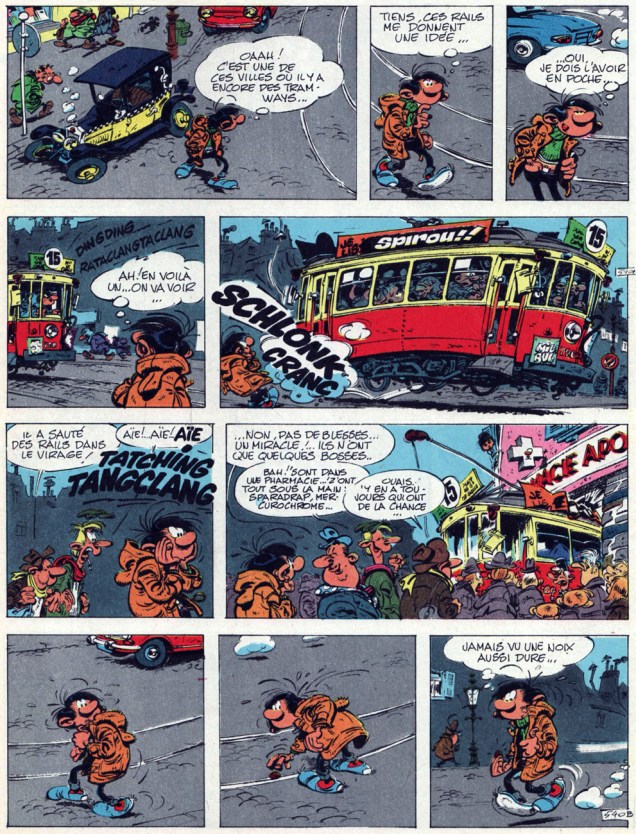
His œuvre is an embarrassment of riches, but heck, here’s a diabolically ingenious Gaston Lagaffe strip whose mise-en-scène is so solid and visually limpid that the only dialogue needed to truly “get it” is the punchline: « Never seen such a tough nut… »

GastonNoixA
Originally published in Spirou no. 1599 (Dec. 5, 1968, Éditions Dupuis.)

It would be unfair and inaccurate to single anything out as André Franquin’s «masterpiece», given the consistently high calibre of his output. Let’s settle for stating that Gaston was in all likelihood his most popular creation, as luck would have it.

The legendary gaffeur first messed up in a two-panel cameo in the Spirou et Fantasio adventure Le voyageur du Mésozoïque in 1957. Later S&F tales were dotted with Gaston cameos, and the accident-prone office boy soon (crash-) landed his own half-page strip, which ran from the late 50s to the late 90s, though mostly consisted of reprints after the early 80s.

GaladeGaffes
Gaston’s second strip collection, issued in 1963 in the original “landscape” format, deemed an oddity at the time.

As for translations, Gaston’s popular in a bevy of languages, but not, of course, in English. Fantagraphics’ Kim Thompson was a huge fan, and translated a handful of strips, which were published (as Gomer Goof) in issues of the anthologies Prime Cuts and Graphic Story Monthly.

Speaking of Gomer, Anglophone readers are in for a treat: UK publisher Cinebook has, just last October, issued a collection (only 48 pages, but you have to start somewhere… and perhaps small) entitled Mind the Goof! Check it out here.

-RG

(27178) Quino*

Today we talk about an artist who had an asteroid dedicated to him! (27178) Quino was discovered in 1999.

Quino is the nom de plume of Joaquín Salvador Lavado, an Argentine cartoonist born in 1932 and still with us today (currently 85 years old, for those in the audience who aren’t too good at mathematics). He’s best known for his character Mafalda (heroine of a self-titled comic strip), a lively and precocious 6-year old girl who sought to change the world for the better (but hated soup – how can anyone improve the world without soup?) This comic strip, which ran from 1964 to 1973, is said to have been influenced by Schulz’s Peanuts – for instance, Umberto Eco made that comparison in 1968 – but it makes me think more of Bushmiller’s Nancy. Comparisons aside, I heartily recommend it.

You won’t be surprised to find out that Quino wrote in Spanish – being Argentine and all – but some of his strips, notably Mafalda, have been translated into a variety of languages… by which I mean mostly French. I was harbouring the hope that this great artist had been able to reach many countries with his art, but it seems that his non-Mafalda cartoons (and he’s done quite a few after he quit Mafalda in 1973) aren’t really available in languages other than Spanish or French. As consolation, it seems that at least Mafalda was a big hit in not only Latin America, France and Québec, but also Asia, even meriting a translation into Chinese.

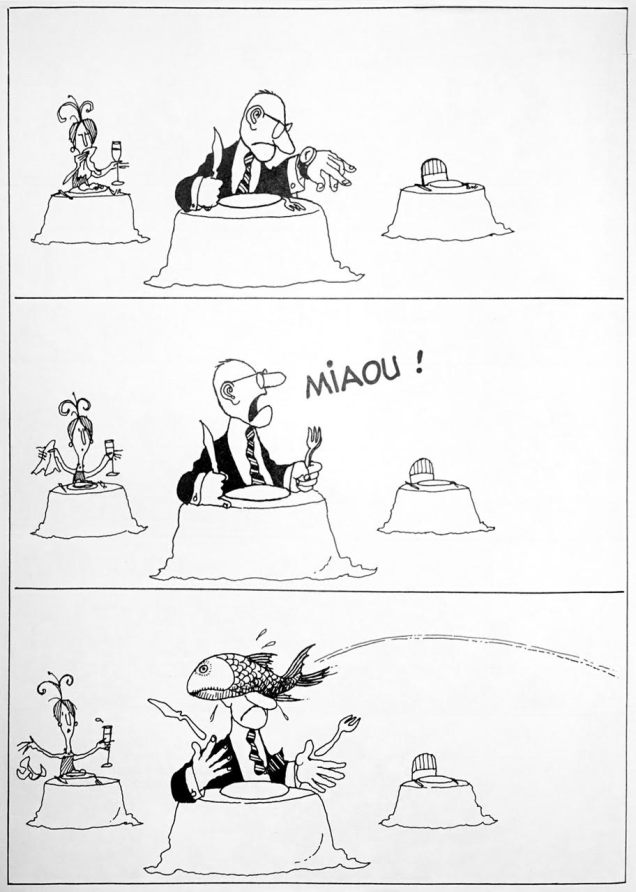
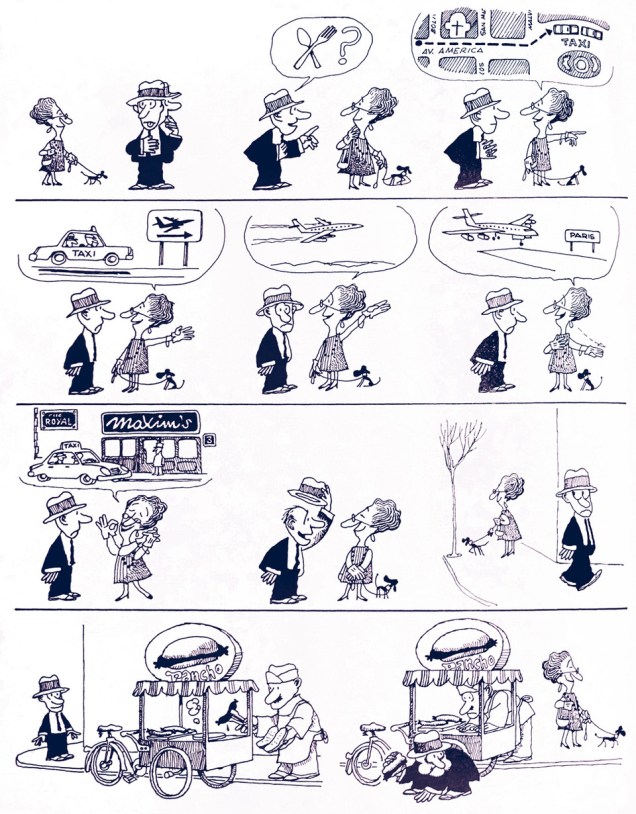
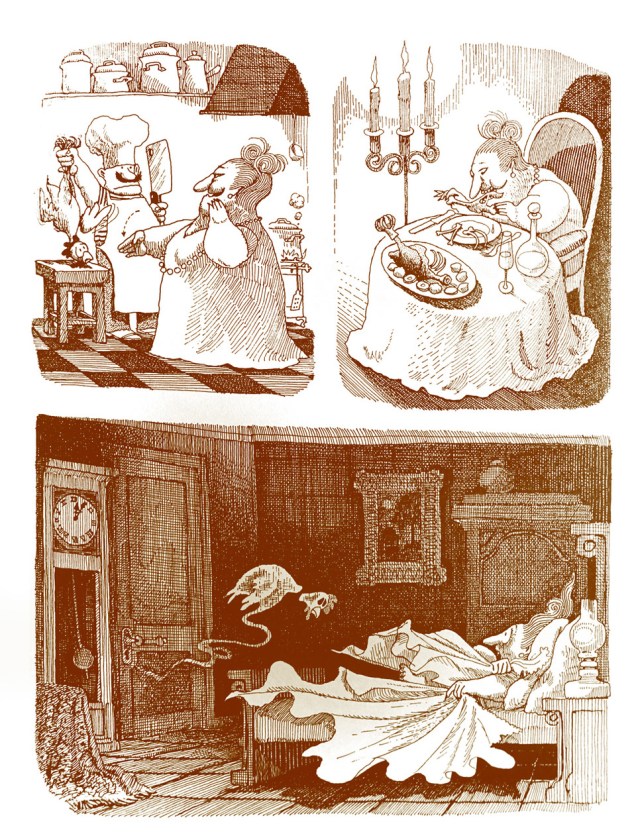
The following three comics were scanned from Manger, quelle aventure! (eating, what an adventure) published in 2016 by Glénat. I was looking for something mute but amusing to sidestep linguistic barriers, and I hope that these qualify. Check out Quino’s beautifully squiggly, decorative lines!

MiaouQuino

QuinoRestoA

ChickenGhostBR~ ds

*part of our galaxy’s main asteroid belt

Tentacle Tuesday, Franco-Belgian Edition

Today’s Tentacle Tuesday comes to us courtesy of France and its long-suffering neighbour, Belgium. There’s an easy joke one could make about the reputation Frenchmen possess of having hands like grabby tentacles, but instead I’ll concentrate on their wonderful comic writers and artists and the classic bande dessinée. Let’s gracefully step over all the obscene connotations of a “French edition” and delve into exhibit A:

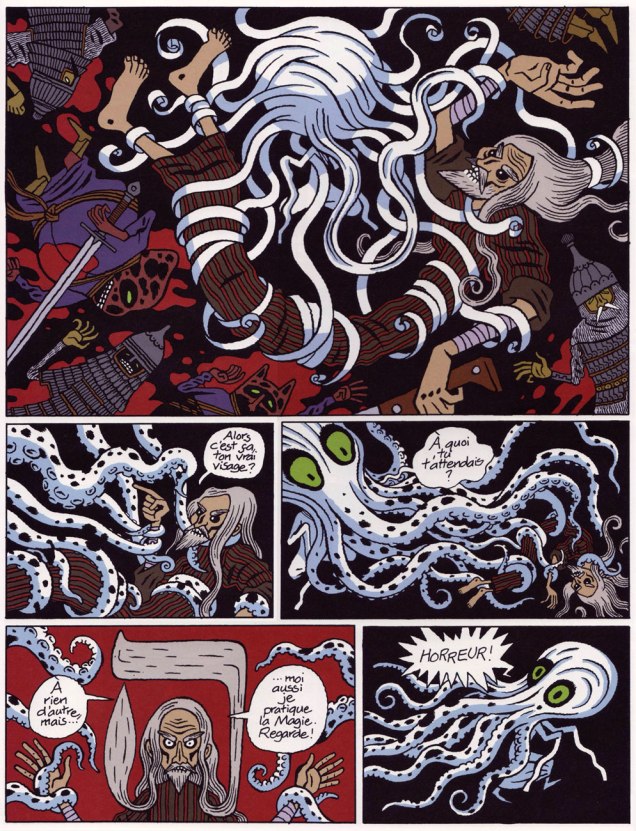
DavidBFroideA
“So that’s it, your real face?” asks the old man. “What were you expecting?” asks the emerald-eyed cephalopod.  This is a page from Les chercheurs de trésor, volume 2: La ville froide, David B. (2004, Dargaud).

David B. is the nom de plume of Pierre-François David Beauchard. Non-Francophone audiences might know him from Epileptic, an autobiographical graphic novel that won accolades and awards from an international audience. And yet it’s not his most interesting œuvre, as far as I’m concerned. Although Epileptic is full of imagery and allegories, it’s when David B. lets his imagination soar without the constraints of real life that he creates his most dazzling worlds and astonishing stories. He’s one of those rare comic artists whose art is as accomplished as their storytelling.

Here’s a bonus “tentacle” from Monsieur B.:

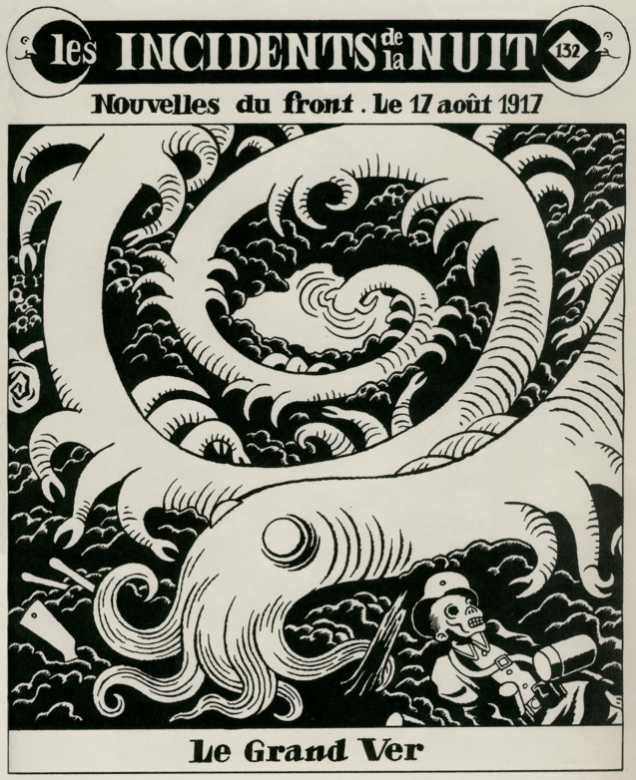
DavidBLesIncidentsdelaNuit
La lecture des ruines was published by Dupuis in 2001. (It loosely translates to “reading the ruins”, “study of the wreckage”.) It’s the story of a mad scholar who tries to find a mathematical equation for violence in the decayed rubble that war has left behind. Excerpted material from an imaginary periodical is appended, Les incidents de la nuit (Incidents of the Night). This tentacled worm – Le Grand Ver, the Great Worm – is one of the creatures that lurk within…

Give a hand of applause, ladies and gentlemen, to David B., and let’s move to our next topic.

“Sorti des abîmes” translates to something like “Risen from the abyss” – and what sort of thing rises from an abyss? Why, tentacles, of course!

TifTonduSortiDesAbimes
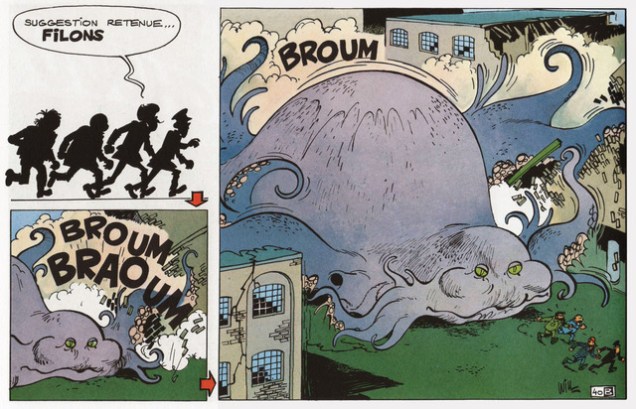
Tif et Tondu: Sorti des abîmes (1972)

Tif and Tondu, an intrepid team of private investigators, were originally created by Fernand Dineur, but their most popular incarnation is by writer Maurice Tillieux and artist Willy Maltaite (who mostly went by the nickname Will), which is what you’re currently admiring. The strip saw birth in 1938 in journal Spirou and lasted a whopping number of years, ending in 1997, one year short of its 60th birthday.

Things are a bit tricky with the numbering, because Tif et Tondu are popular enough to have been anthologized several times. Sorti des abîmes appeared as the series’ 19th entry (1972), after being serialized in Spirou no. 1746 (September, 1971) to no. 1764 (February, 1972).

TifTonduSortiA(1)
A closer look at the creature from the abyss: not exactly an octopus, but in distinct possession of tentacles. “Armed and dangerous”, as they say! The poor thing is dissolved at the end of the story by some infrared rays.

Incidentally, “Tif” is slang for hair in French, and “Tondu” means “shaven, sheared”. Naturally, Tif is the bald guy, and Tondu is the hairy one.

Now that we’ve had our fill of scary, destructive tentacles, I’ll move on to something friendlier.

Pif2
Pif Poche no.72 (Aug. 1971) The last panel says “Paws off… Don’t touch! You’ve got cold hands!”
Pif3.jpg
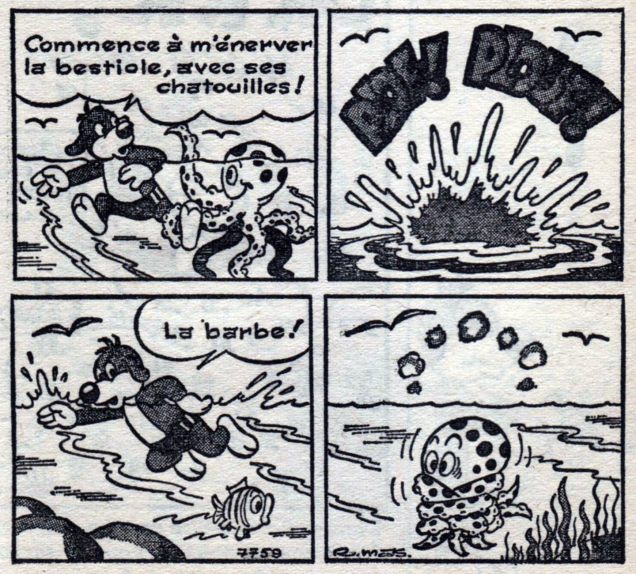
Pif Poche no.72 (Aug. 1971) “This creature is starting to annoy me with its tickling!”

Pif the dog was the mascot of the kid’s magazine Pif Gadget (« gadget » referred to the fact that each issue of the magazine was accompanied by some thingamabob to amuse the youngsters). Pif Poche were pocket-sized collections of short Pif strips, as well as jokes, games and such. The character was created by José Cabrero Arnal in 1948, who gradually abandoned the strip by the 1960s while other artists took over.

Pif1
 Pif Poche no.72 (Aug. 1971) “Even in a can… I adore seafood! Ripoff… it’s octopus!” Story and art by Arnal’s immediate and worthiest successor, the prolific Roger Mas (1924-2010)

~ ds

Satirical socio-cultural commentary from the Old Master

Alphonso Wong (also known as Wong Chak) is fondly remembered as the creator of Old Master Q, a truly long-running series that first appeared in newspapers/magazines in Hong Kong in 1962, was serialised in 1964, and is still in publication today. When Mr. Wong retired from his strip in the 90s, his son, Joseph Wong, took over the company, and he’s been managing the licensing ever since, as well as directing the team of artists writing and drawing the strip. Wong Chak passed away in 2017, at 93.

I’m no expert (the language barrier doesn’t help!), but people’s love for Old Master Q and Wong Chak is evident. To quote from Lambiek Comiclopedia,

[The strip] inspired its own magazine (“Old Master Q’s Crazy Comics”, 1965), toys, stationary, electronic scales, LED lamps, insulated cups, umbrellas and lunch boxes, as well as seven live-action film adaptations, four animated ones and two TV series. Copies of ‘Old Master Q’ can still be found in many Chinese hairdresser shops or doctor’s waiting rooms. Its success spread to the rest of Asia and translations in Europe, Latin America and Japan. Along with other well-known comic book characters, Old Master Q has his own statue in the “Hong Kong Avenue of Comic Book Stars” in Kowloon Park, Hong Kong. In August 2016 an Old Master-themed café opened on Nathan Road in Prince Edward, Hong Kong.

I prefer the art from the earlier days of OMQ, although I am glad that the strip is still around. (It’s a national institution!) To illustrate:

Please don’t forget to follow the numbers and read these top to bottom, right to left, as appropriate for a Chinese strip:

OldMasterQ1970aliens
“Space Monster”, 1970. In panel number 4 , Old Master Q is saying “I am the first person to land on Mars! Hee, hee!”. In panel 5, he says “Friend!” to the aliens; despite his attempts at friendliness, they flee in panel 6, alarmed by “the strange beast that comes from space”.

Judging how often jokes about mermaids crop up, Wong Chak had a thing for them.

Reminder-of-Love_1970
“Reminder of love”, 1970.

Wong Chak was impressively ambidextrous and could (and would) draw with either hand!

OldMasterQ1974

Here’s a strip from more recent days. As you can see, the reading order of the panels has been adapted to the Western palate, and there are English captions translating the Chinese text.

OldMAsterQSmallPersonBigGhost

There’s as many collections of these strips as one would expect from a series so popular, including special-theme collections released for various holidays.

OldMasterQCover

I eagerly await the day I’ll be able to read Old Master Q strips without having to painfully pore over a dictionary over every third character. (Especially given that I’m learning simplified characters, and Old Master Q uses traditional characters. Oof…) If that day ever comes, there’ll be a lot of material to dig into!

Old master Q

You can follow the modern-day strips by visiting the official website, https://www.oldmasterq.com/

~ ds

Enormous Ectoparasites vs Enterprising Young Man

« How do you know you’re facing a tough mosquito? You slap him and he slaps you back! »

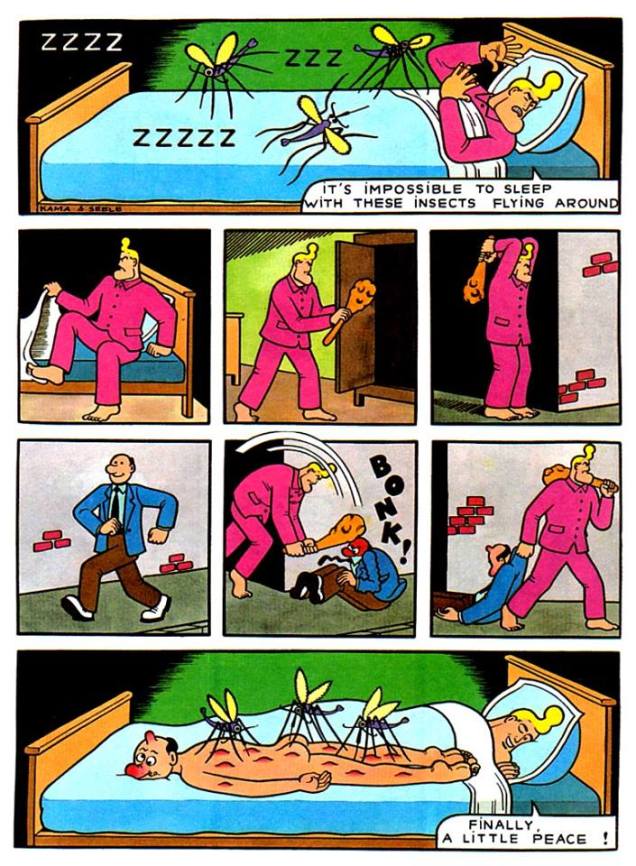
We’re in October, and I’m still getting mosquito bites. I have no polite words to say about that (not in mixed company, anyway). However, the blood-sucking buggers did make me think of a colourful, frequently violent (but also quite funny and oftentimes charming) strip, Cowboy Henk.

KamagurkaCowboyHenk.jpg
What, you don’t keep a drumstick-shaped club in *your* closet?

Written by Belgian cartoonist Kamagurka (a.k.a. Luc Zeebroek) and illustrated by Flemish cartoonist Her Seele (real name Peter van Heirseele), Cowboy Henk ran in the weekly Flemish magazine Humo from 1981 to 2012 (and, once this strip was translated to English, it also appeared in Art Spiegelman’s Raw.)

The strips have been collected in “King of Dental Floss” published by Scissor Books in 1994, which is a tad difficult to find, but quite worth it, in my opinion. Me, I’m lucky to have an anthology in French (published by FRÉMOK in 2013), easier to acquire than the English version. Of course if you speak Dutch, there’s many collections available to you that the rest of us have sadly no use for!


WhoThereLogotype

 A man in a movie theater noticed what looks like a mosquito sitting next to him.
“Are you a mosquito?” asked the man, surprised.
“Yes.”
“What are you doing at the movies?”
The mosquito replied, “Well, I liked the book.”

~ ds