Herluf Bidstrup: The Goal of Satire Is to Speak the Truth

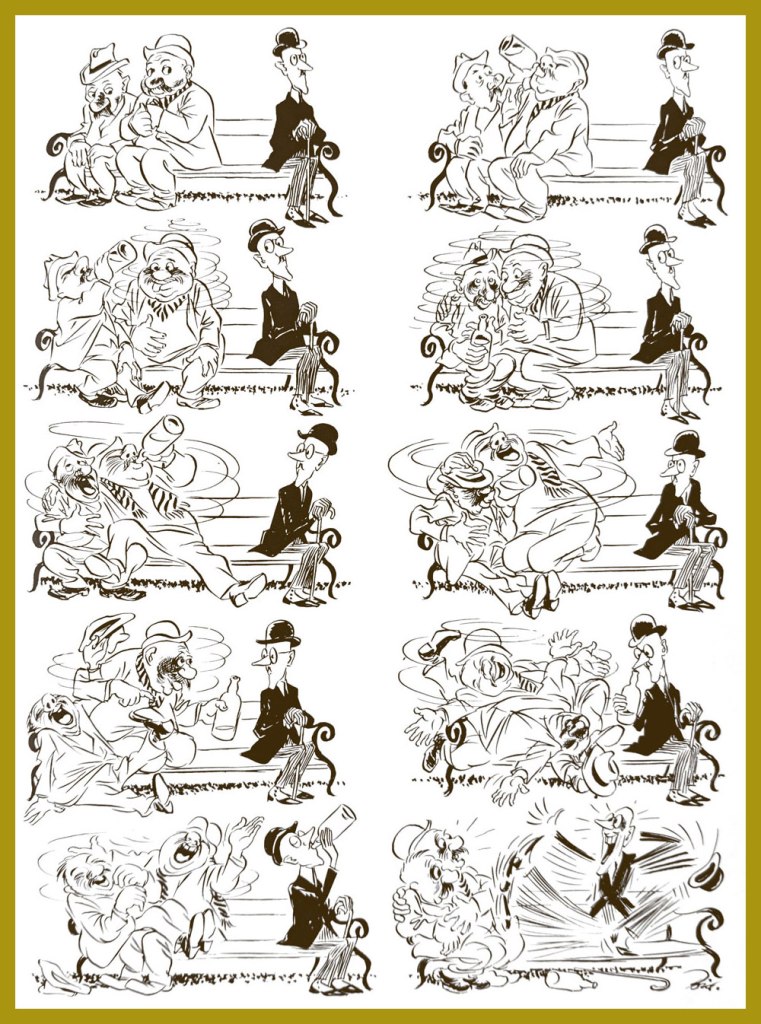
I’d like to talk about Danish Herluf Bidstrup (1912 – 1988), yet another talented artist of some renown during his lifespan, but who soon sank into the oblivion of time. His wild popularity in the Soviet Union at the height of his artistic prowess not only resulted in honourable mentions in various works of Russian literature, but also in the printing of a bevy of collections both old and new. He has also received numerous awards from the USSR (most notably, the Lenin Peace Prize – a bit of a contradiction in terms – and the Order of the Red Banner of Labour). Now he’s forgotten by most everyone… except by Russians, who still carry a torch for his cartoons, and publish new collections of his work to this day. He produced around five thousand cartoons during his lifetime, so there’s certainly plenty of material to collect!

In Moscow, circa 1953.

The openly anti-fascist Bidstrup had been contributing humorous drawings to various publications since 1935, but he truly found his voice in the underground (and illegal) newspaper, Land og folk, the offshoot of Denmark’s (also illegal) Communist party, which Bidstrup joined in 1943. While his work was also appreciated and published in East Germany, his obvious political stance significantly limited the scope of what could be printed. It even affected his career in his home country, as Denmark was economically dependent on then-Fascist Germany. Bidstrup himself considered that he was most accurately represented in the Soviet press, not only before and during WWII, but also after the war. In 1953, in a letter to his friend Soviet journalist Mikhail Kosov, translator of his work and main enthusiast, he wrote that « all Soviet anthologies which we have prepared together are a hundred times better than collections published in other countries… in the German version, I become more and more of a harmless humourist, and a completely toothless satirist. »
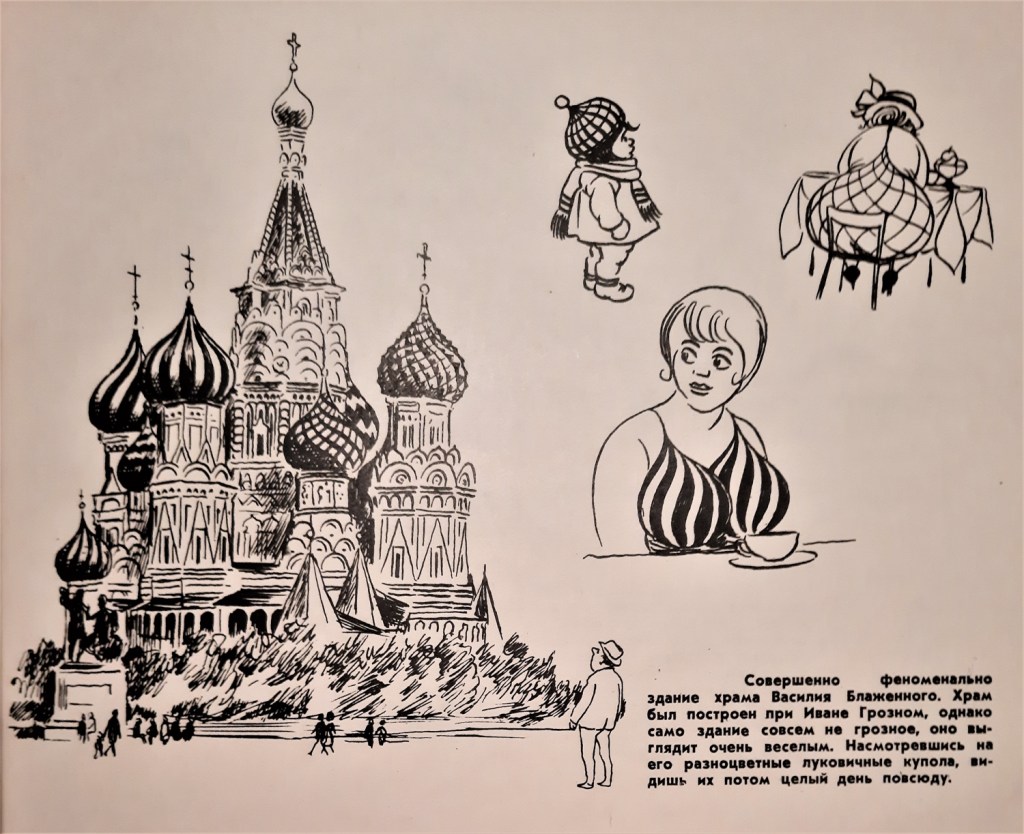
Bidstrup’s sketch of the Cathedral of Vasily the Blessed.

In a sense, Bidstrup can be compared to his contemporary, French artist Jean Effel (also a favourite of Soviet citizens): both were openly communists whose work confronted social injustice and inequality. But at the end of the day, artists aren’t much remembered for their ‘social conscience’: it’s their keen eye for everyday detail and sense of humour that allows cartoons to pass unscathed through decades, to touch and amuse us some seventy years on. In that sense, Bidstrup’s cartoons are arguably more ‘dated’, more tied to his politics than Effel’s, which perhaps explains why one encounters mentions of the latter a little more often. Still, there’s plenty there to admire and chuckle at.

Bidstrup Herluf: Drawings (2017, Mesheriakov Publishing House); such a nice shade of green.

The following images have been selected from the collection seen above and kindly scanned and framed by co-admin RG.
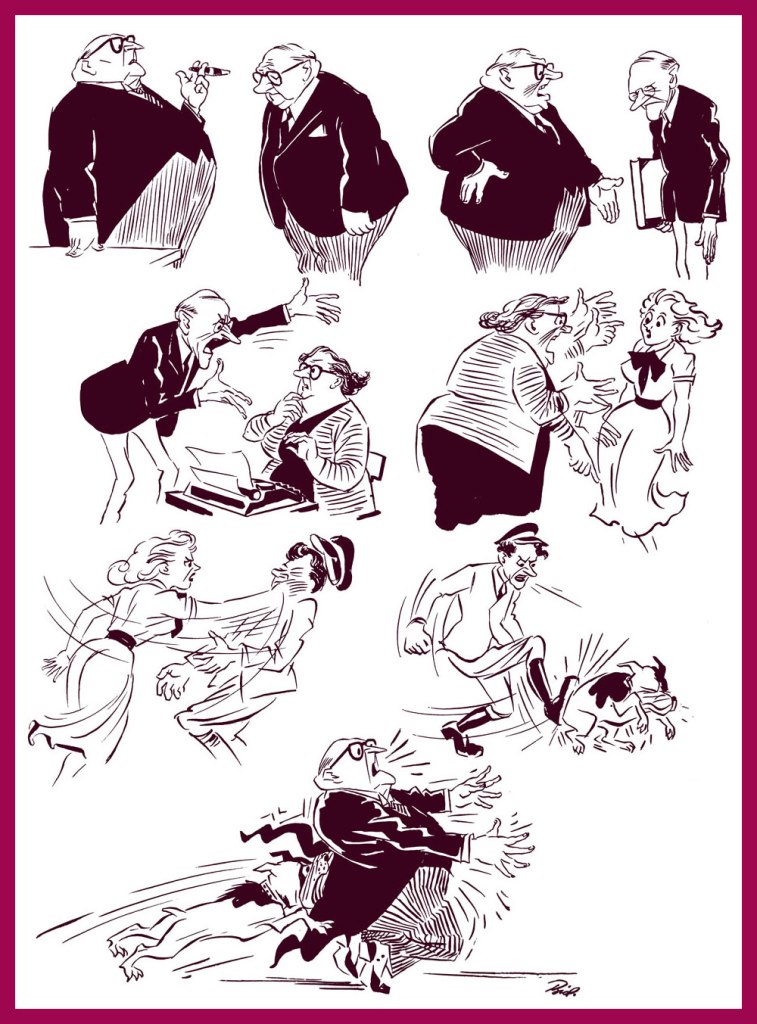
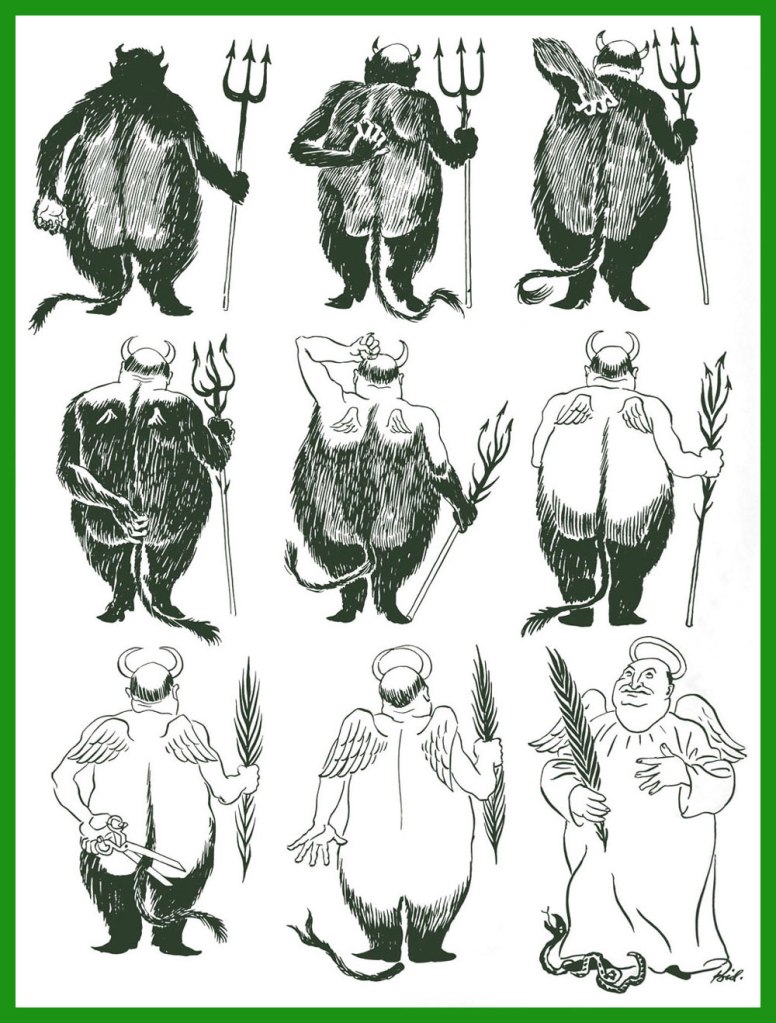
«The circle closes.»
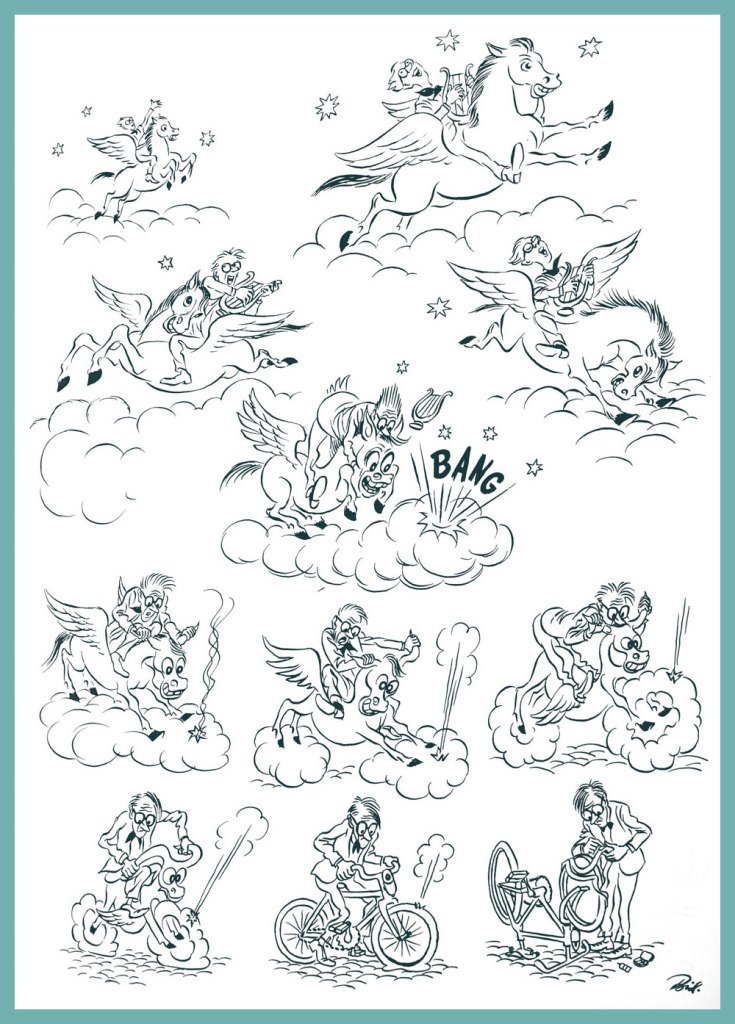
« On the wings of Pegasus. »
« Amateur photographer »
« Self-criticism »
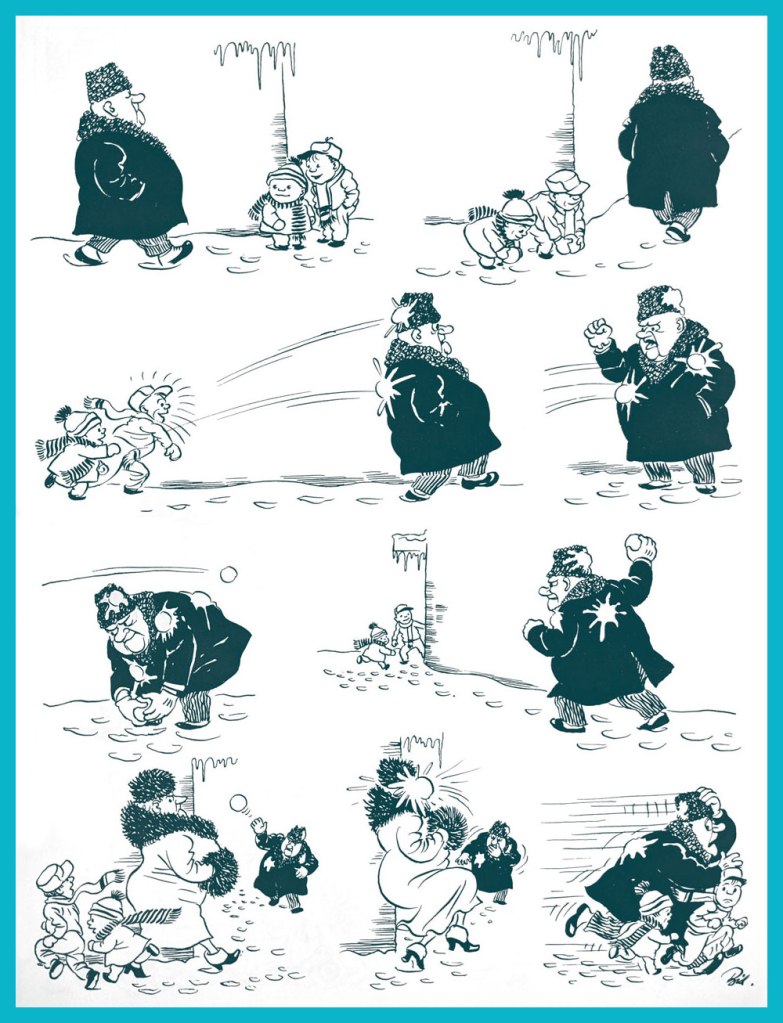
« Direct hit »
« Life’s journey »
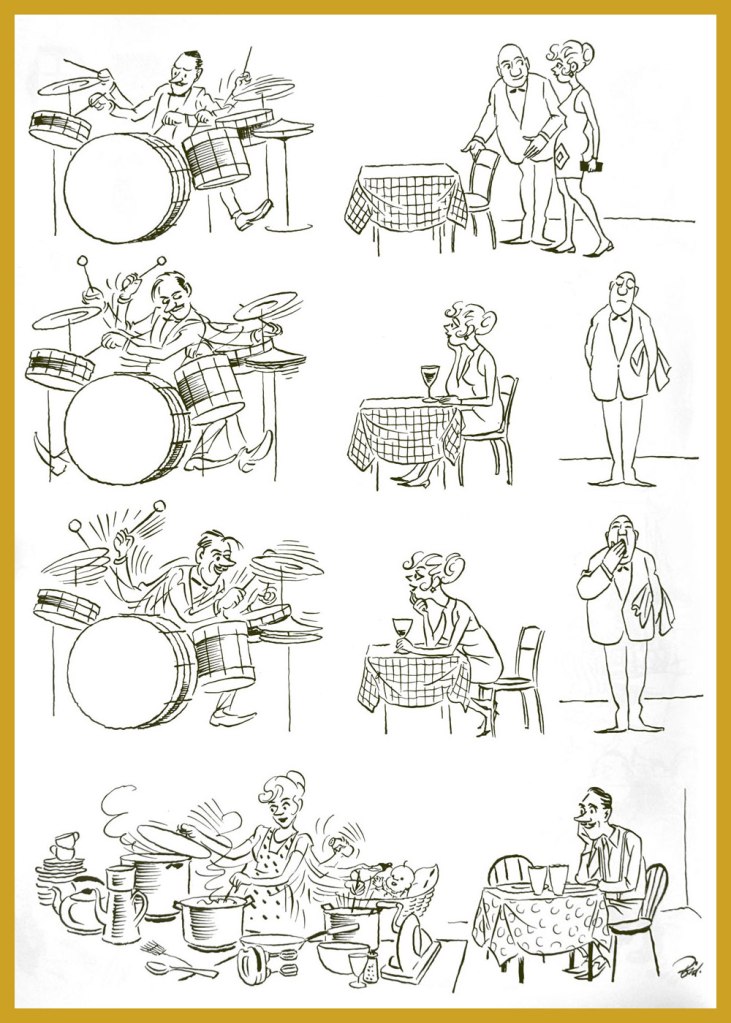
« Wife of a jazzman »
« Solitude »
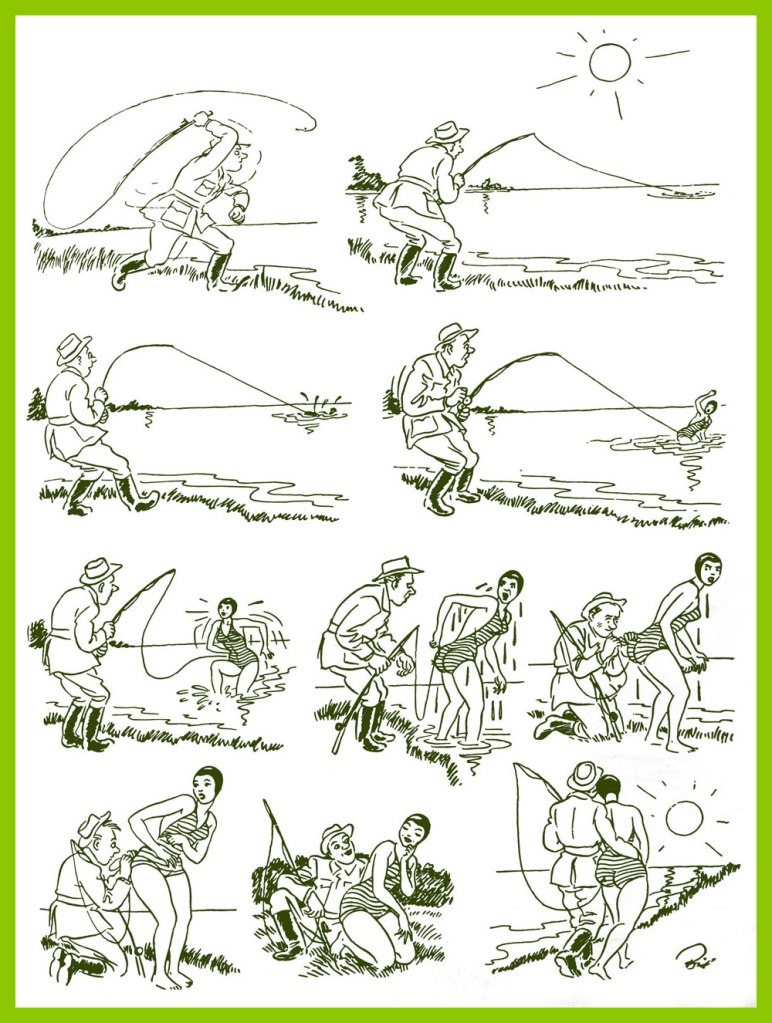
« Fished out »
«The mirror of the soul »
« An extended game »
« A perfect example »

Finally, here is a charming cartoon that Soviet animation director Lev Atamanov produced in collaboration with Bidstrup during one of his many visits to the USSR.

I hope your enjoyed this walk down history’s lane. And if you’d like to see more, while Herluf Bidstrup may be relatively obscure, you can still see a nice collection of his cartoons here and here.

~ ds

A Secret, Silken World: Max Andersson’s “Lolita’s Adventures” (1995)

« Most of us will still take nihilism over neanderthalism. » — David Foster Wallace

It’s become so quiet” “Yes“; from Galago no. 40 (1994, Atlantic Förlags AB)

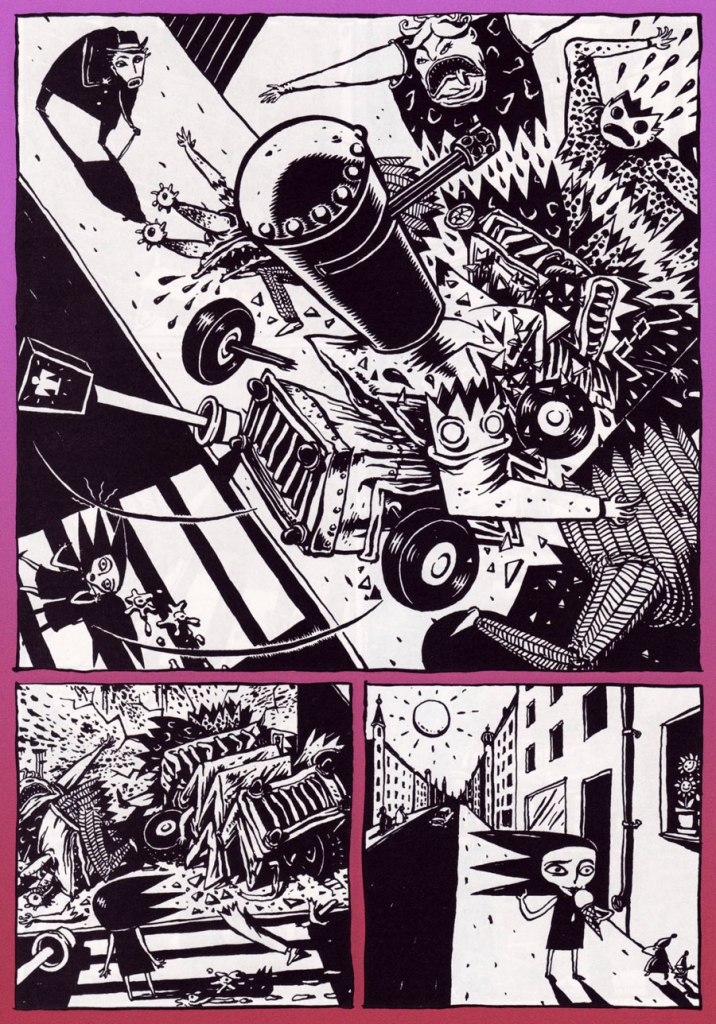
Today, let’s dip a toe (at the risk of losing it) into the midnight domain of Swedish cartoonist and filmmaker Max Andersson (b. 1962). It’s a relentlessly-perilous scene, but like Kaz’s Underworld comic strip or Arnt Jensen‘s Limbo video game, I find it unexpectedly comforting in spite of (and thanks to) all the darkness, both thematic and in density of ink. In Andersson’s case, might it be owing to the author’s kindness to his protagonists? That’s a factor with odds I rather favour.

I don’t doubt that certain readers of a more sensitive cast will differ, but I posit that the cheerful lack of clemency the artist affords the callous, the cruel and the pernicious makes Andersson’s universe a profoundly moral one. Contrary to, say, your average American action blockbuster, such a purge of the villainous doesn’t restore the status quo… because here, malevolence is the status quo. Andersson’s put-upon little people are true outsiders, and his stories feel like Kafka, but blessed with dénouements far merrier yet merited.

Jolly carnage! Lolita’s Adventures appeared in the third issue (July, 1995) of Fantagraphics’ outstanding anthology title Zero Zero (27 issues, 1995-2000).

See? A happy ending and all, and even a rare glimpse of daylight.

Soon after he began to publish his work, Gary Groth spoke with Andersson (The Comics Journal no. 174 (Feb. 1995, Fantagraphics):

Groth: What would you point to as your defining influences? How did you develop this approach, style and point of view?

Andersson: What I always have in my backbone is the style of classic comics, the stuff I read when I was a kid.

G: I don’t see much Tintin.

A: No, but it’s there if you look closely. The basic technique of how to tell a story well. I try to do that because I want the storytelling to work, to be easy to read.

G: Were you influenced by sources outside of comics — film, literature?

A: Yeah, more of those than comics. The German Expressionist movies of the ’20s, Nosferatu; and artists from the period, like George Grosz.

And don’t leave out old cartoons! Andersson’s thoroughly animist way dovetails neatly with early animation’s unhinged, anything-can-happen mode. By which I mean that anything and everything possessed motion and sentience, be they boulders or pebbles, thunderclouds, petals or creepers, sparks or flames, pantaloons or braces, blunderbusses or bassoons…

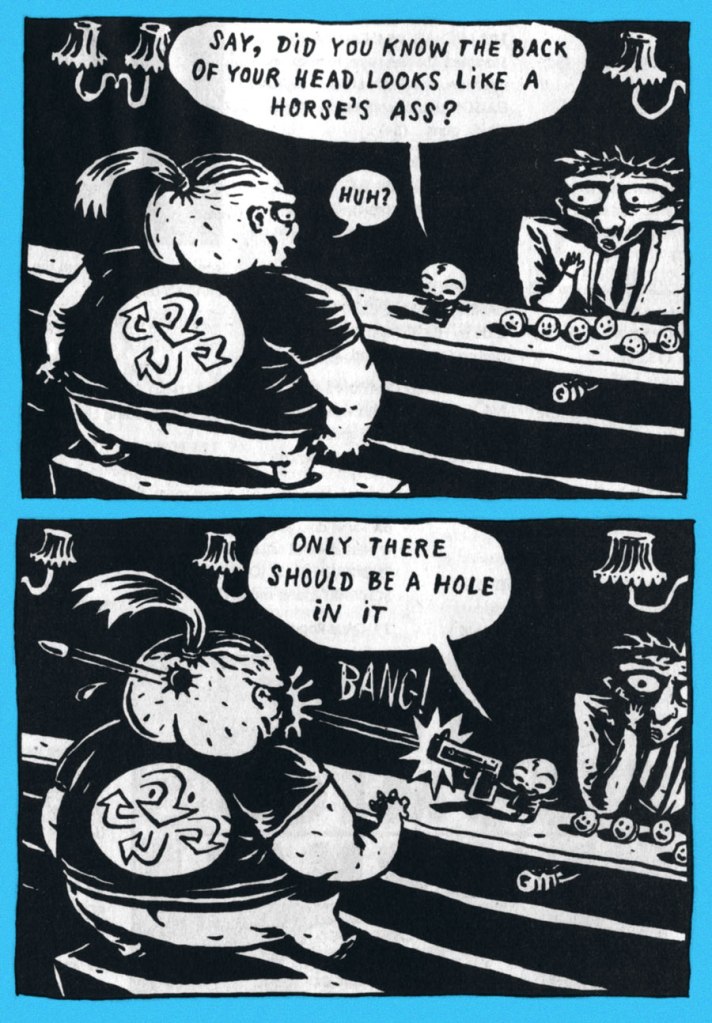
As a bonus, a sequence from Andersson’s breakthrough work, Pixy (1993). The title character is the fœtus with a pistol, and the happy little fellows on the counter are units of money. Highly recommended, and likely available in the language of your choice.

About Pixy, fellow dweller-in-darkness Charles Burns exulted: « So you think it’s a cold, creepy, world out there, huh? Hah! Just wait’ll you get a load of Max Andersson’s Pixy… safe sex suits, buildings that eat people, drunken fœtuses with bazookas, money that shits on you, recyclable bodies… hey, wait a minute, that’s not creepy, that’s fun. MY kind of fun. »

For more dope on this important creator’s endeavours, do sidle over to his official website!

-RG

Tentacle Tuesday: Git Outta Here, 2020!

May the gentleman octopus grant you a Happy New Year!

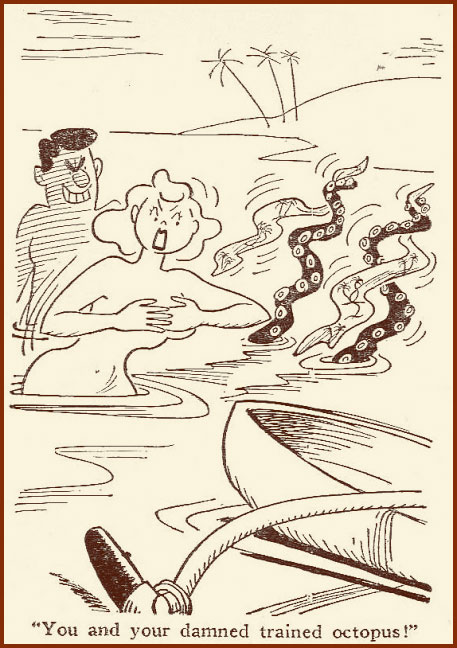
Greetings, pretty cephalopods and cephalopodettes! This is the last Tentacle Tuesday of the year, and as is my custom, I return to a sub-topic close to my heart: women entangled in tentacles. Nothing crass, mind you – we have our standards!

Original art for a cartoon published in Wham! (December 1954, Wolf Books). Art by George Wolfe. I imagine the three guys whose arms are grabbing her colliding with one another in the door frame…

As the signature attests, the artist is George Wolfe (1911 – 1993), who has had an illustrious, though mostly forgotten, career as a magazine cartoonist with published work in Esquire, Saturday Evening Post, New York Herald Tribune, etc. He also had a few syndicated comic strips under his belt, as well as winning several prestigious awards (namely, the Reuben, the highest award of the cartooning profession). Touring Tessie, created by Wolfe for Wolf Books (has a nice ring to it, doesn’t it?), was the so-called hostess of this magazine, and its main attraction. Do yourself a favour and head over to The Wolves of Broadway VII: The Alpha Female to peruse more Tessie cartoons and learn more about just what kind of gal she was.

Tessie is one again getting entangled in the clutches of an octopus… this time a more literal interpretation.
The image used for the cover of Wham! (April 1954, Wolf Books). Another trained octopus – working for his own account and calling the shots!

From the cartoony to a more realistic approach –

Detail from the original cover art of Bold Men vol. 5, no 2 (March 1961, Cape Magazine Management). Bold Men is an “interest magazine focusing on pictorials and adventure stories”, explains mycomicshop.com, but with this issue featuring stories like How Nazi Bormann’s Cruel Lust will Betray Him! and The Deadly Blonde Witch of Waikiki! , I’m not sure that “bold” is the right word here.

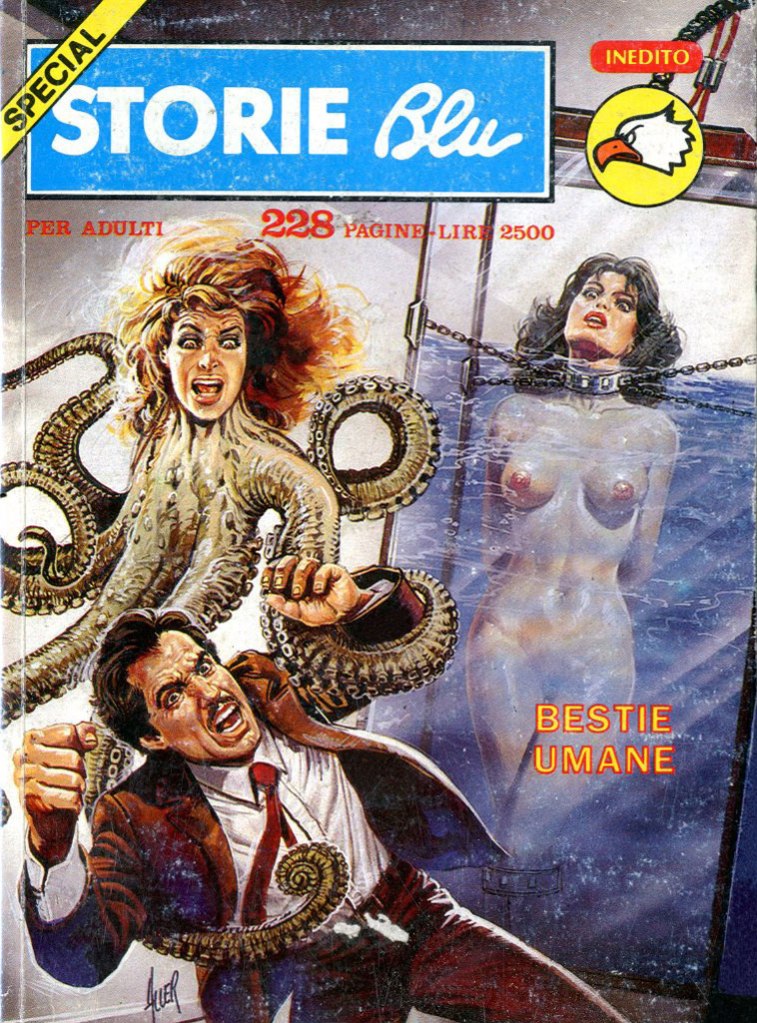
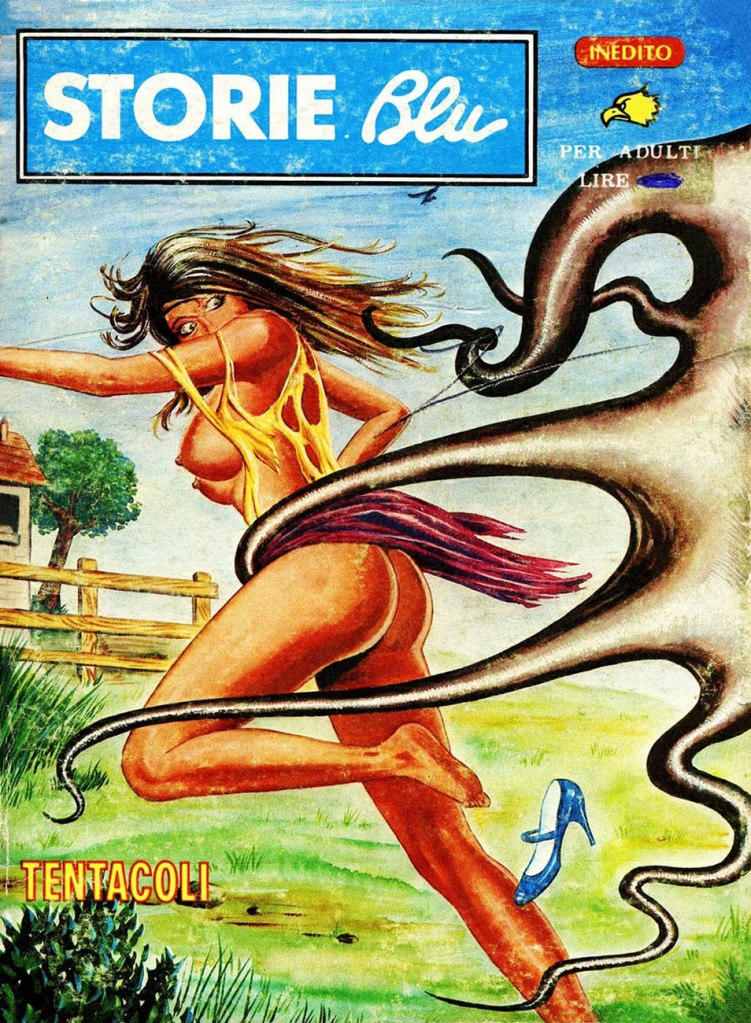
The following three covers are from Storie Blu, an Italian erotic, science-fiction comics series published by Ediperiodici (also known as ErreGI), Edifumetto’s main competitor in the adult comics sector. Ediperiodici disseminated a huge number of erotic series running the gamut from A all the way to B in terms of genre: erotic… horror, western, spy, jungle, military, fantasy, etc. If you want to get an idea of what the stuff looked like, take a peek at Lucifera, Maghella (in-house favourite) or Messalina.

Storie Blu ran between 1979 and 1990, for a respectable 122 issues and two supplements (click here for a full list in Italian).

Storie Blu no. 28 (1983, Ediperiodici). Psycho-monsters, announces the cover!
Storie Blu no. 39 (1983, Ediperiodici). This cover is a good example of the “what the hell is going on here” approach Italian erotica often prefers – RG commented that the tentacled female must be the guy’s ex-wife, and his current wife is in the fish-tank. Anything’s possible! Cover is by Giovanni Alessandri (not the grammarian from the 16th century, as you may have initially thought!), who went under Aller.
Storie Blu no. 81 (1986, Ediperiodici). The cover story was scripted by Carmelo Gozzo and illustrated by Alberto Giolitti (who, I believe, also drew this cover) – you can read a synopsis and take a look at some art here.

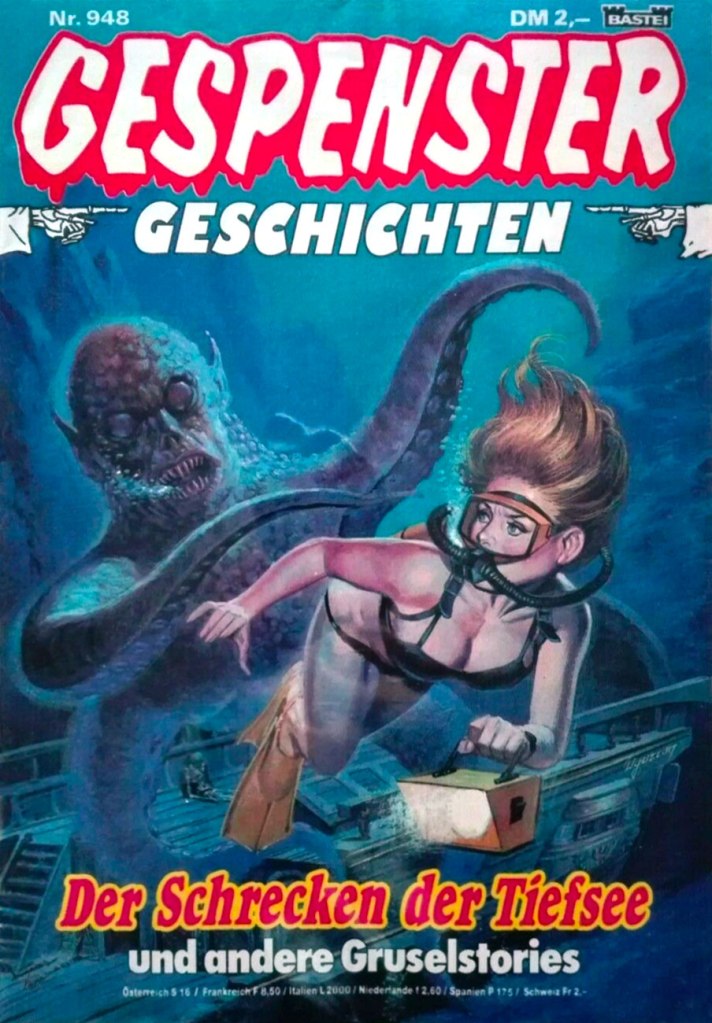
Moving on to another European country… Gespenster Geschichten‘s sister publication Spuk Geschichten already has a Tentacle Tuesday: A Torrent of Teutonic Tentacles.

Gespenster Geschichten no. 948 (1991, Bastei Verlag). Cover by Turkish painter/illustrator Ugurcan Yüce, who moved to Germany in his 30s and contributed quite a lot of covers to publishing house Bastei Verlag, which published (and continues to) many highly successful popular pulp and comic series.

Just one more for the road, what do you say?

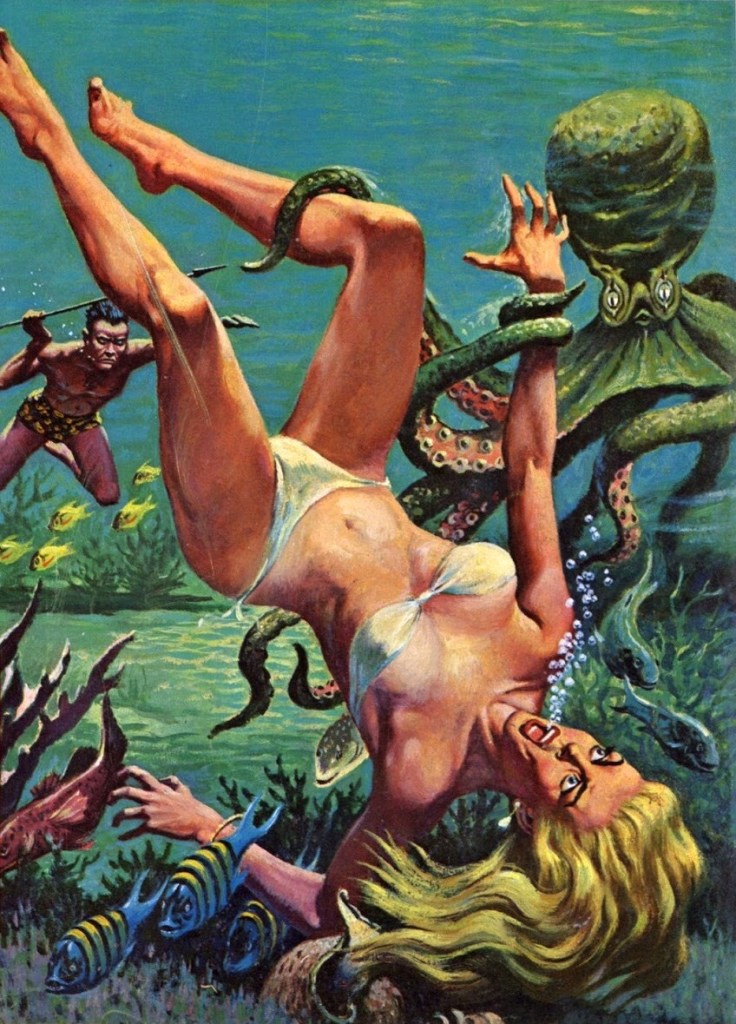
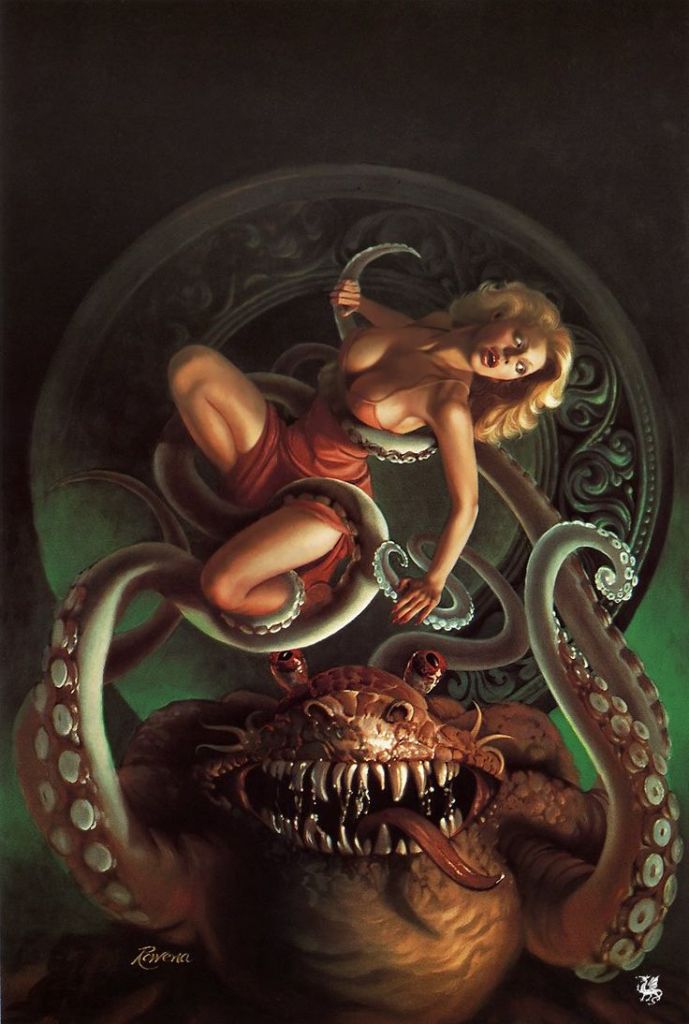
Painting by Rowena Morrill (whose name appropriately sounds like something out of some fantasy novel). This has been used as a cover for a German edition of Creepy… but I prefer to provide it sans captions or logos.

~ ds
Treasured Stories: “Christmas Dinner” (1979)

« She kept her ears permanently tuned to the chicken voices outside, so knew immediately when a coyote had crept into the yard, and barrelled screaming for the front door before the rest of us had a clue. » ― Barbara Kingsolver

Given how muted the holiday season is likely to be for most of us, and in light of how much our readers appear to enjoy our past Christmas offerings — (all year long!), I’d thought I’d get an early start on the festivities.

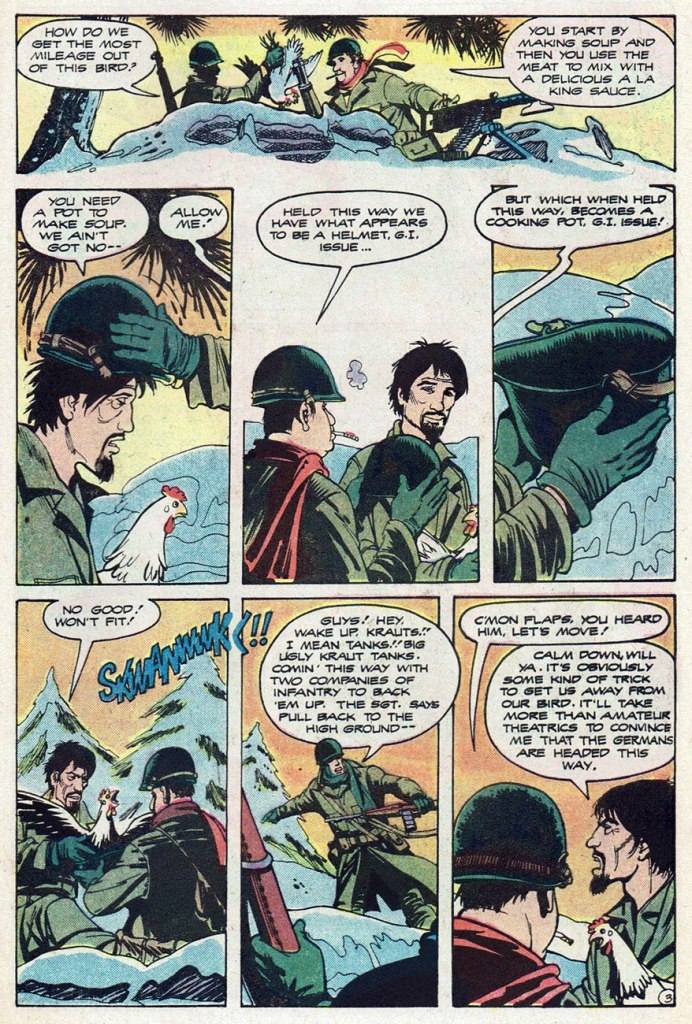
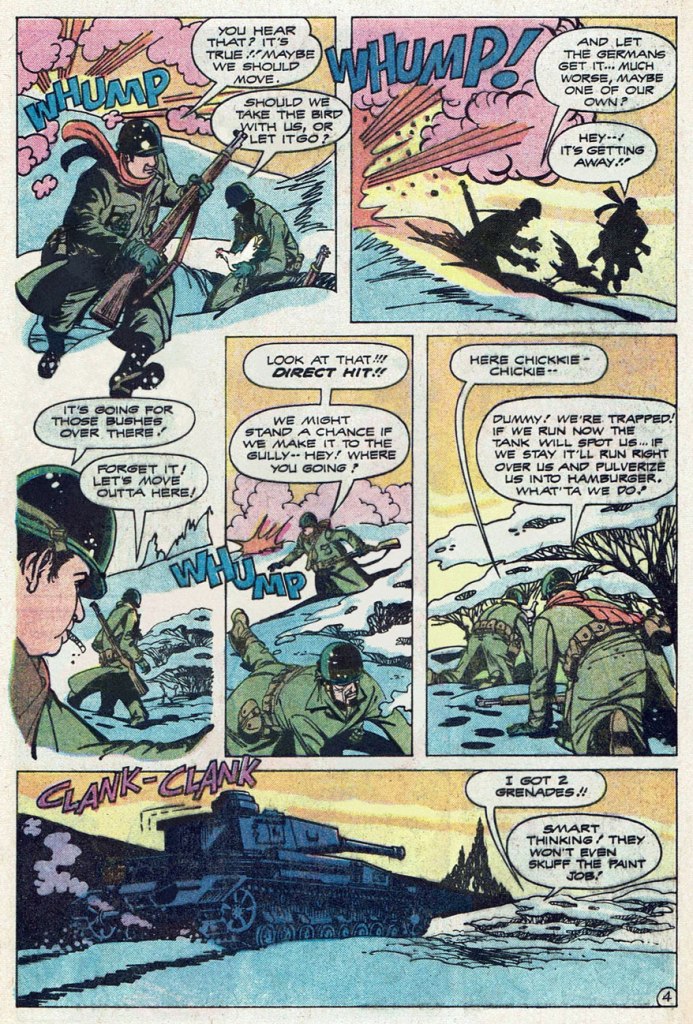
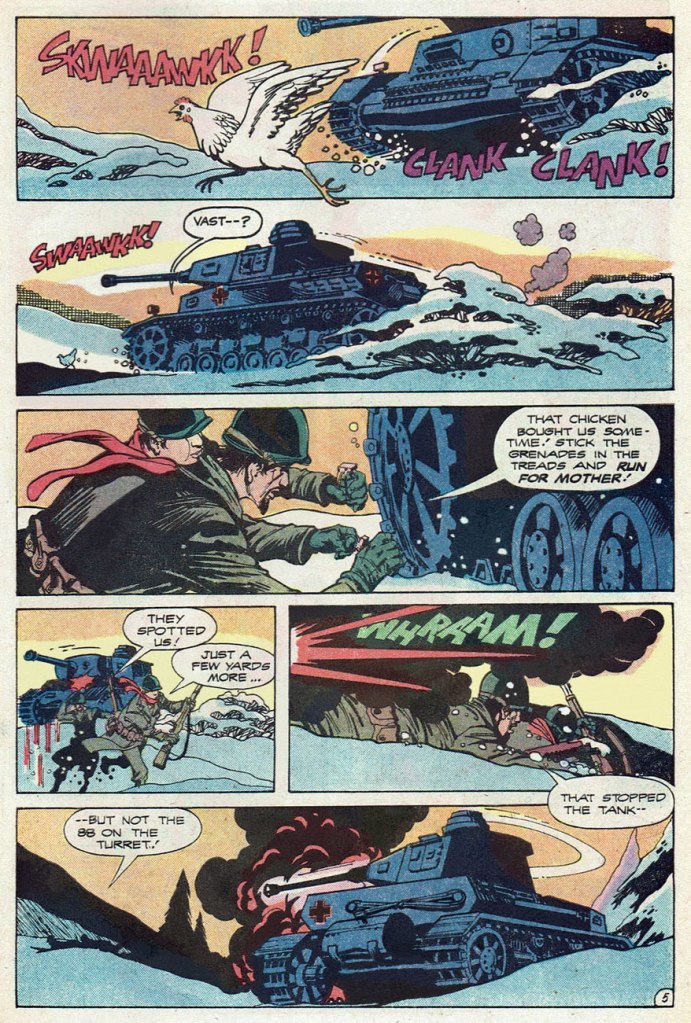
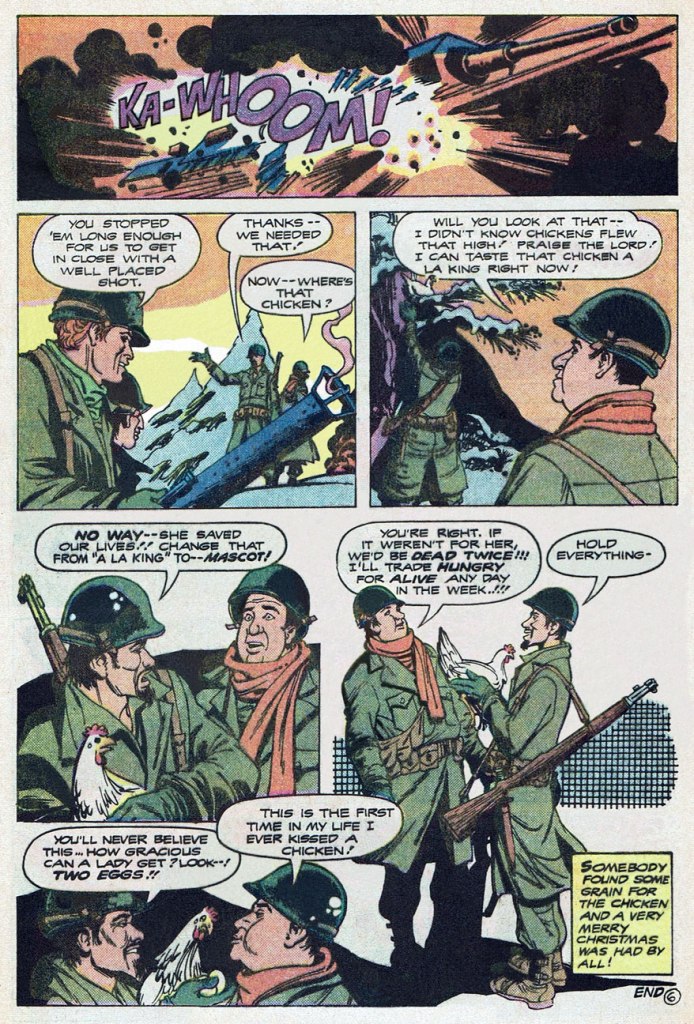
Here’s a fine, but truly obscure little Christmas fable. It was buried in the back of an issue of The Unknown Soldier, at a time when the DC war line was well into its final decline.

… as much of a ‘very merry Christmas’ one may possibly enjoy in the midst of war, far from home and loved ones, at any rate. I would have enjoyed seeing more of those two kind-hearted doofuses, Burf and Flaps… and their chicken mascot. I wonder what name they would have given her…

According to editor Paul Levitz, Christmas Dinner‘s script had been purchased six or seven years earlier by his predecessor Archie Goodwin but had lain fallow in the interim. It was written by one Janus Mitchell (his sole credit in comics, but we may be in the presence of pseudonymous shenanigans) and was finally assigned for illustration to Teny Henson (often credited in the US as ‘Tenny Henson, as he is here), one of my favourite creators from the ranks of the Filipino Komiks community. In America, Henson’s work mostly appeared in DC publications for about a decade (1974-83), beginning with the plum commissions of inking a returning Sheldon Mayer (post-cataract surgery) on his Rudolph the Red-Nosed Reindeer Limited Collectors’ Edition giants, and inking Ramona Fradon‘s pencils on DC’s underrated second revival of Plastic Man for a pair of issues. All in all, Teny flew under the fanboy radar, chiefly providing artwork for mystery and war short stories, and always at a high level of craft and inspiration.

I love the economy and precision of his line, his limpid storytelling, and his mastery of an aesthetic merrily at play in the sweet spot between the cartoonish and the representational. Fittingly, he went on to work in the animation field.

This is The Unknown Soldier no. 237 (Mar. 1980, so on the stands in Dec. 1979, DC), picking up its numbering from the venerable Star-Spangled War Stories; cover, of course, by Mr. Joe Kubert, though by no means among his finer moments — that ‘Nazis in ambush’ formula was getting pretty long in the tooth by then.

Watch for more holiday goodies coming your way!

-RG

Tentacle Tuesday Masters: Kellie Strøm

One might call the illustrator and comics artist Kellie Strøm a bit of a cosmopolitan –  born in Denmark, he grew up in Ireland and, in adulthood, made London his place of residence. He has accomplished much, but seemingly obtained little recognition for it – his graphic novel (The Acid Bath Case, 1992, published by Kitchen Sink), a collaboration with Stephen Walsh, seems to have been lost in the rivers of time, despite being a striking showcase of Strøm’s black-and-white, precise-yet-graceful style. He also has a great eye for colour, as becomes evident from a quick glance at Star Wars comics he’s illustrated (but does anybody read Star Wars comics?), or, in a much more pleasant and hopefully longer-lasting and farther-reaching vein, his paintings for children’s books. 

A panel from The Acid Bath Case (1992, Kitchen Sink). These may not be tentacles per se, but as far as I’m concerned, they qualify!

Personally, I have a soft spot for his illustrations in glorious full colour – I believe that it’s a rare skill to be able to use a full rainbow palette and not end up with gaudy or downright ugly results. Let’s have a look!

That thing is soon growing up to be a tentacled monstrosity, but right now it’s all pretty colours!

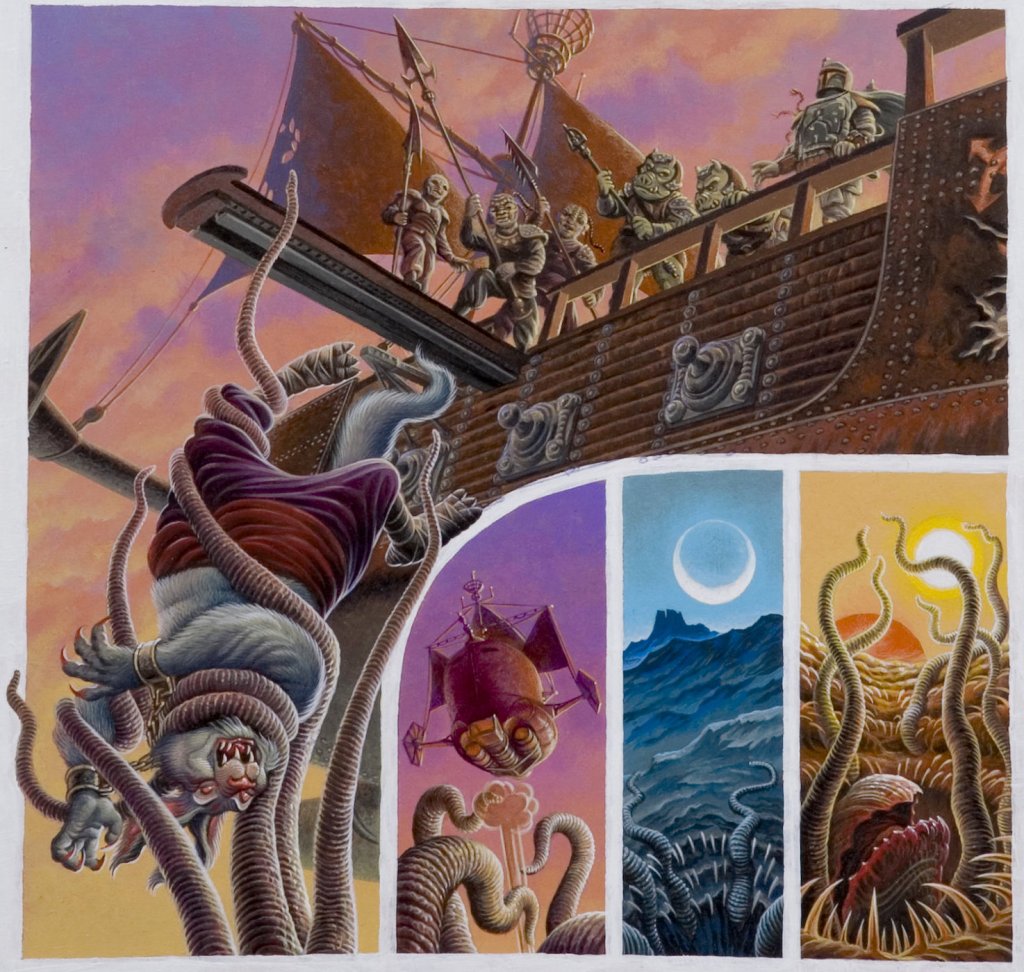
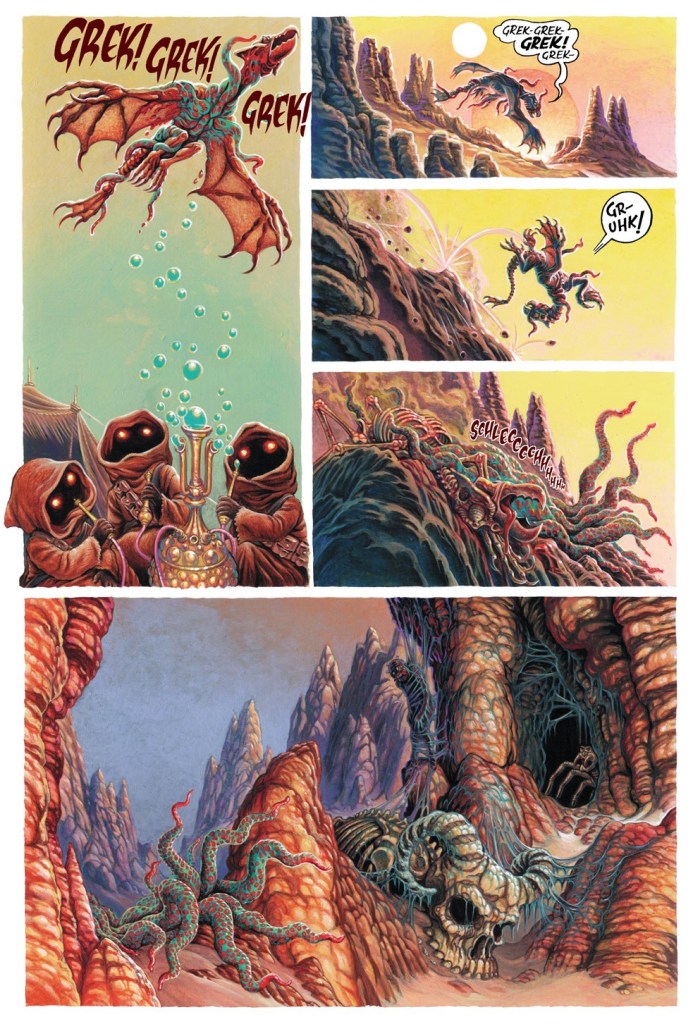
The following are pages from Fortune, Fate, and the Natural History of the Sarlacc, written by Mark Schultz and published in Star Wars Tales no. 6 (2000, Dark Horse). Watch an unfortunate victim plunge into the gullet of a merciless tentacled beast!

For comparison purposes: this is the original art…

And the following are pages from the printed comic:

I also mentioned Strøm’s career as an illustrator in children books. The results are beautiful, and, I sincerely hope, well-remunerated.

Panels from Het Zeemans – ABC (2008, Rubinstein Publishing) – or, in other words, Sailors’ ABC:

I didn’t have the heart to remove the copyright from this image! Visit Strøm’s website here. Look how many delightful tentacles one can squish into one panel!

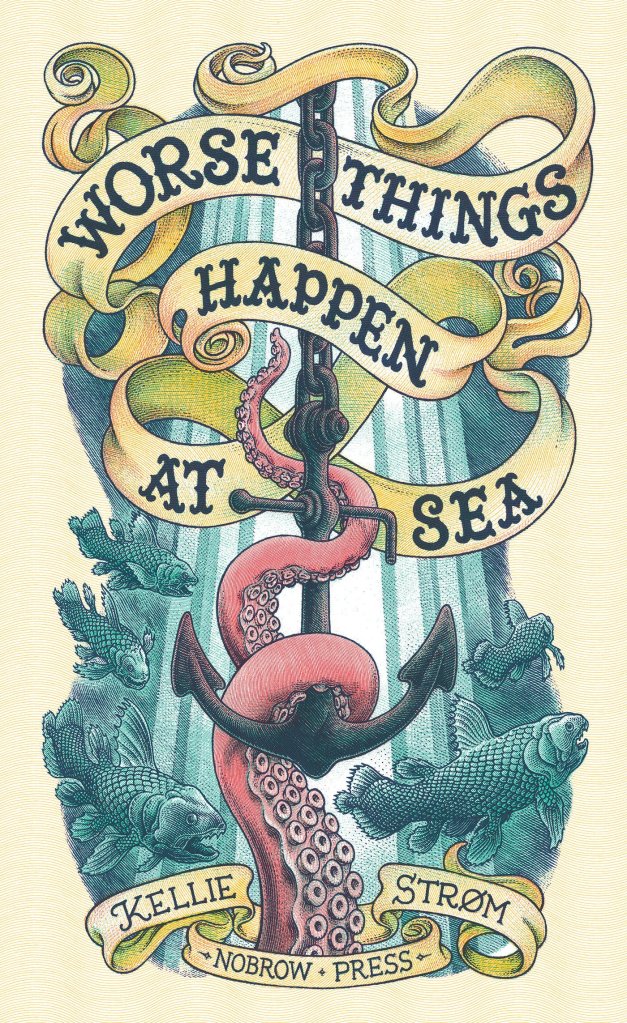
2014 saw the release of the tentacle-wealthy Worse Things Happen at Sea (Nobrow Press), in which « historical ships are attacked, enveloped and engorged by monstrous sea creatures surfacing from the deepest depths of the darkest oceans. » Must be Strøm’s Nordic roots re-surfacing, though apparently he cannot swim!

~ ds

Tentacle Tuesday: Perdonate il mio tentacolo!

I’d like to thank my Italian collega for making sure this title was in impeccable Italian, and for not backing away slowly when I asked her, completely out of the blue and without context, how to say “pardon my tentacle”. Most people would have run.

Welcome to our Latin Tentacle Tuesday! Poor Italy is the brunt of quite a few jokes, and even most positive articles about it are nothing but shallow fluff designed to sell airplane tickets and inspirational posters about food and love. All I can say is that Italians love their tentacles as much as any other hot-blooded nation. 😉

Più was a comics magazine licensed from Pif Gadget in 1982. Just like its fountainhead, Più offered a gadget with every issue, which, as I understand from nostalgic posts about it on various blogs, was a prime selling point among its young and enthusiastic clientele. As for comics, reprints of some French comics straight from Pif’s pages were rounded out with fresh Italian material. Given that Pif was publishing quite a few Italian artists at that time, this only seems fair! And on the subject of the latter, co-admin RG, whom I may call a Pif historian with no fear of controversy, has written a number of posts about the writers and artists featured within Pif Gadget’s pages during its heyday… a good place to start digging in is my favourite of these posts, Jean Cézard and Arthur le fantôme.

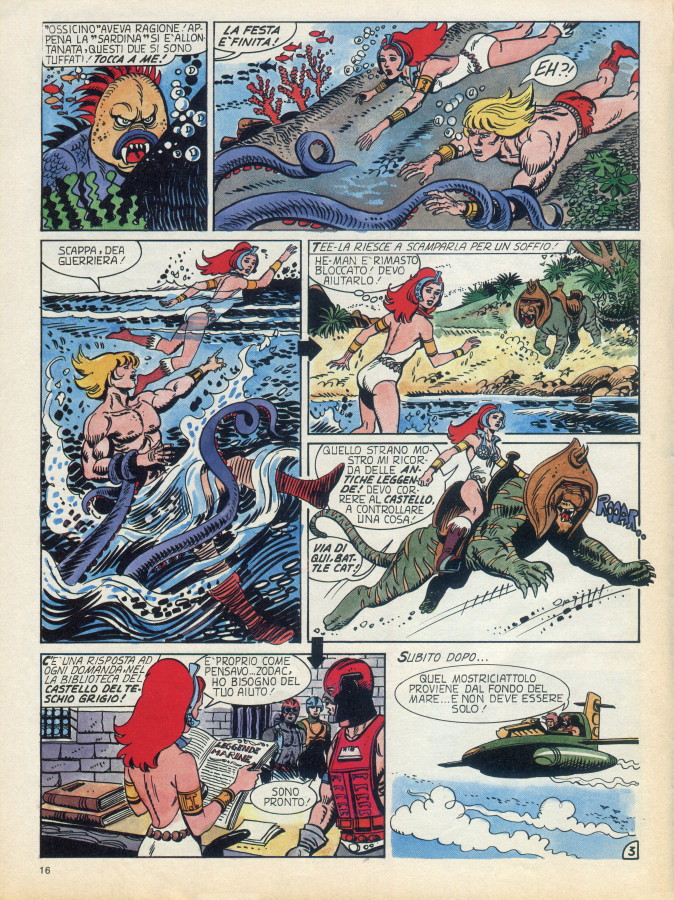
Moving on: the following Masters of the Universe pages are from Negli Oceani di Eternia, published in Più no. 76 (March 1984, Editoriale Domus).

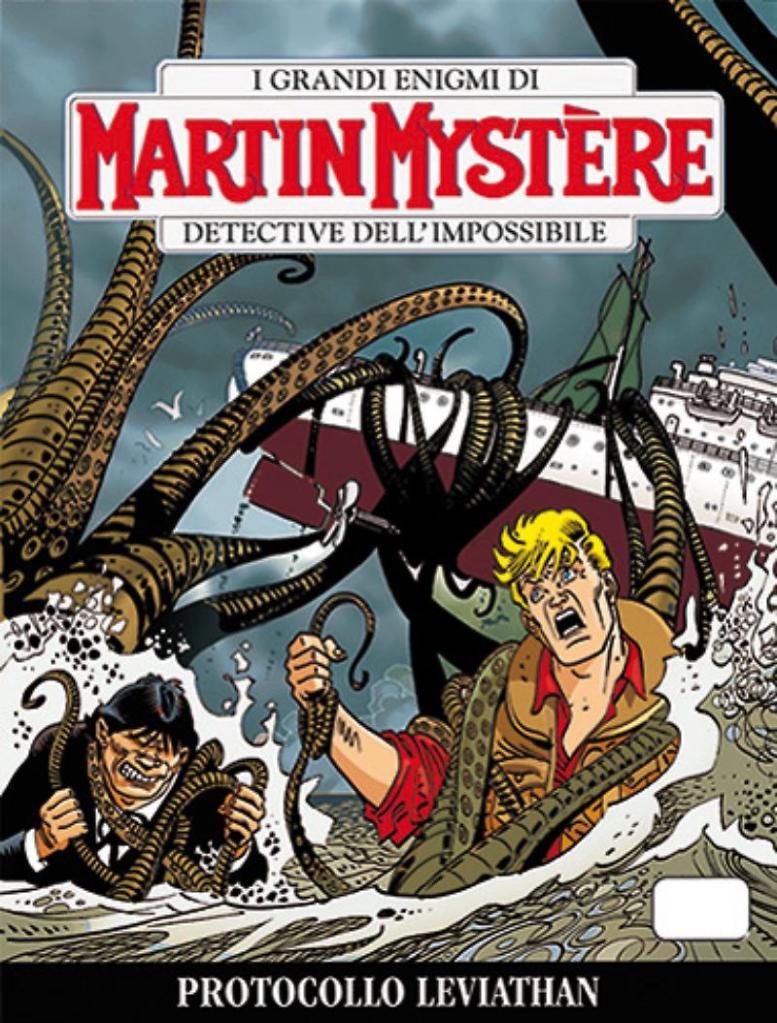
Created by writer Alfredo Castelli and artist Giancarlo Alessandrini, Martin Mystère is an exceedingly popular comic book series (as a matter of fact, the best selling comic book in Italy – in case you’re wondering what that means, around 20 thousand copies a month)*. Its title comes from the eponymous main character, Martin Jacques Mystère, the usual walking collection of tropes: good looking art historian, archaeologist-anthropologist à la Indiana Jones, collector of rare objects, and so on. No self-respecting adventurer goes around without a sidekick, and Mystère’s assistant is Java, an amazingly strong, quite mute Neanderthal man (speaking of tropes, that one is a doozy). One might also say that he’s quite international: an Italian-created American character with a French name who lives in New York City and frequently helps its finest to elucidate crimes…

*I stand corrected by one of our readers, who pointed out that Italy’s most popular comics series is Tex, which sells around 200 thousand copies a month (compared to Martin Mystère’s 20 thousand). Thanks, Darko!

Martin Mystère no. 103 (October 1990). Cover by Giancarlo Alessandrini.
Martin Mystère no. 328 (August 2013). Cover by Giancarlo Allesandrini.

This series started in 1982, and is still around, so you can just imagine how many tentacles Martin has tangled with in some 378-odd issues. Yet high-res images are scarce online, so I asked co-admin RG to whip up this nifty collage of some of his tentacular exploits:

Issues no. 163, no. 181, no. 237 and no. 297, with covers by Giancarlo Allesandrini.

Our next (and last stop) is another very popular series, Zagor. Its beginnings go all the way to 1962 (ancient, no doubt), when editor/writer Sergio Bonelli and artist Gallieno Ferri banded together to concoct a comic book series.

Its protagonist Zagor, or Patrick Wilding, is another American. If Martin Mystère represented the suave, erudite adventurer-about-town, Zagor is a kind of avenger-slash-protector, of the “be peaceful or I’ll beat the crap out of you” school. His origin story makes for rather uncomfortable reading: after tracking down massacring a whole family branch of Abenaki Indians to avenge his parents’ death and realizing that he made a boo-boo (by finding evidence that his father was a murdering, power-abusing sadist who was killed purely in retribution for his criminal acts… which is another can of worms), he decides to redeem his sins by ensuring peace between different Indian tribes and trappers by whatever means necessary.

Zagor no. 42 (December 1968), illustrated by Gallieno Ferri and written by Guido Nolitta (Sergio Bonelli’s nom de plume).
Inside art from Zagor no. 42, illustrated by Gallieno Ferri and written by Guido Nolitta.

His sidekick? Chico, a walking stereotype down to his full name (Chico Felipe Cayetano Lopez Martinez y Gonzales) whose presence is played for some mean laughs. «He is short, fat, extremely clumsy and voracious, corrupt, boastful, but also likeable.» Um, yeah, that sounds likeable, all right. If you’re thinking that Chico is also obsessed by food (he’s Mexican and fat, right?) and that it gets him into all sorts of stupid peril, you are perfectly correct. Gordo, this is not.

Interestingly, Zagor is most popular outside of his native Italy. Specifically, he retains popularity in the former Yugoslavian republics (Bosnia, Herzegovina, Slovenia, Croatia, Serbia…) and Turkey. Stories continue to be published in Italian up until this day, but from what I’ve been able to gather, the books sell at a much brisker pace once they’re translated to languages spoken by inhabitants of the aforementioned countries.

Zagor no. 626 (September 2017). Cover by Alessandro Piccinelli. Okay, so those are not tentacles per se, but it says TENTACOLI! right on the cover, so I’m not arguing.
Zagor no. 662 (September 2020). Cover by Alessandro Piccinelli.

~ ds
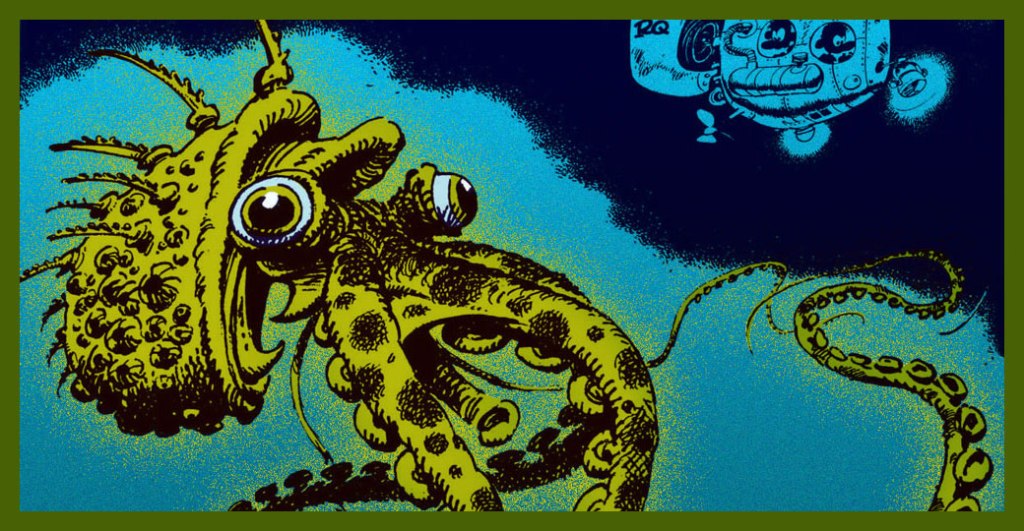
Tentacle Tuesday: dans la galère tentaculaire…

… in which we continue our exploration of tentacles slithering their way into Franco-Belgian comics!

In an orderly fashion, please.

The other day, a friend heartily recommended a certain movie to me, pointing out that it was ‘ancient’ and therefore probably available online for free. When I checked the year, it turned out to have been from 1995 which, excuse me, hardly qualifies as prehistoric. What can be considered ‘old’, then, people in their early thirties will ask? Why, this magazine cover, for instance.

Le Petit journal illustré (May 21st, 1922). The bottom says “a drama at the bottom of the sea”, with details of how a diver was attacked by an octopus and cannot get out his knife to fight against his repellent aggressor.

Skipping some thirty years ahead, I believe we’re still in “old” territory.

A page from « Zette reporter : Aventure en Pacifique », published in Lisette n° 38 (September 16th, 1956). Script by François Drall, illustration by Yvan Marié. The girls, after witnessing a fight between a giant shark and octopus, now seek to escape the clutches of the victor’s eight appendages.

Lisette was a comics magazine specifically aimed at female readership (to be more precise, it was marketed to girls between 7 and 15 years old). The interesting part is that it often featured articles about traditionally men-dominated careers, some of which had only been very recently accessible to women… for instance, an interview with Anne Chopinet (one of first women accepted in l’École polytechnique) and a reportage on women air pilots back when this was an almost exclusively man-only club.

Moving on to further, more energetic octopus-evading tactics… we have Bob Morane, originally a hero harking from adventure books written by prodigiously prolific Belgian novelist Henri Vernes, and published by Belgian éditeur Marabout. The number of adventures Morane has lived through is rather staggering: around 200 novels + about 80 comics albums. Now there’s a challenge for the serious collector!

Original art from Bob Morane et l’oiseau du feu (1960). Illustrated by Dino Attanasio.

Co-admin RG has already spoken about Toute la gomme, but he kindly held back this terrific tentacular page for my TT feature!

Scripted by Antoine Raymond (a.k.a. Vicq), illustrated by Will, 1962.

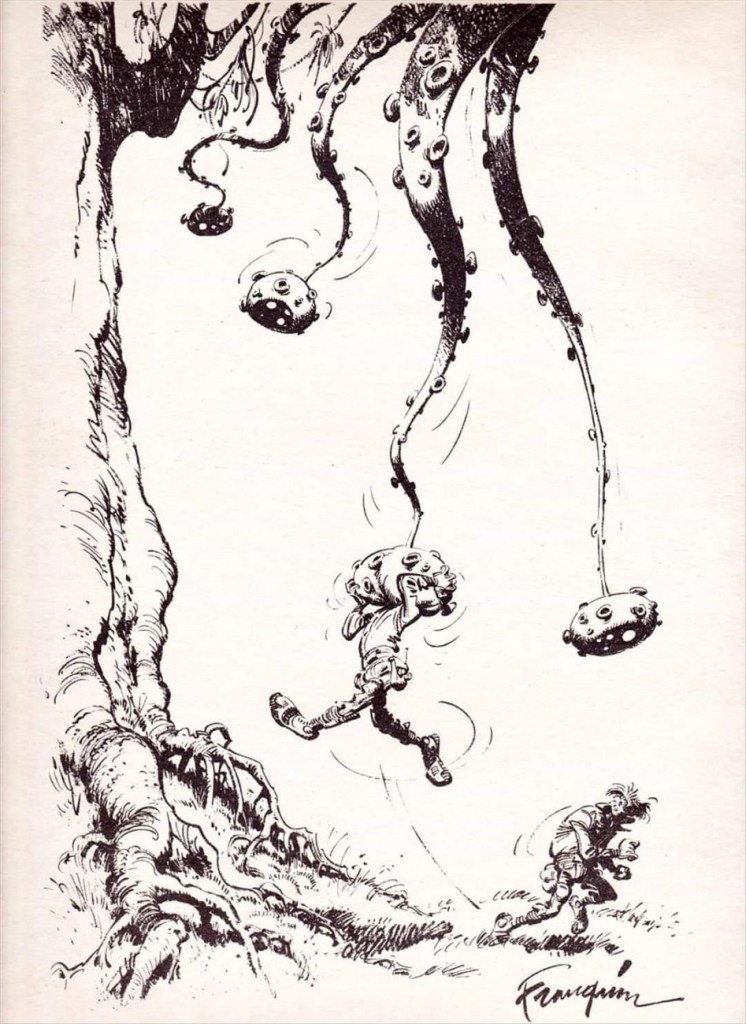
Co-admin RG called André Franquin‘s œuvre “an embarrassment of riches” in his Faites gaffe, monsieur Franquin! post. I thoroughly agree, and am very pleased to report (though this is in no way surprising) that tentacles are part of his vast répertoire.

Pages from what’s collectively known as Idées noires (Franquin’s Last Laugh in English). These dark strips and cartoons were Franquin’s « l’humour du désespoir », the humour of despair, and appeared in Le trombone illustré (Spirou’s magazine supplement) in 1977 and, with the discontinuation of the latter, moved to Fluide Glacial until 1983.

I’d better stop here. After all, I wouldn’t want to go as far as ‘modern’ times… say, from the 90s and onward, although it’s scary to think that was still 30 years ago!

~ ds

Lovely colours (by co-admin RG), aren’t they?

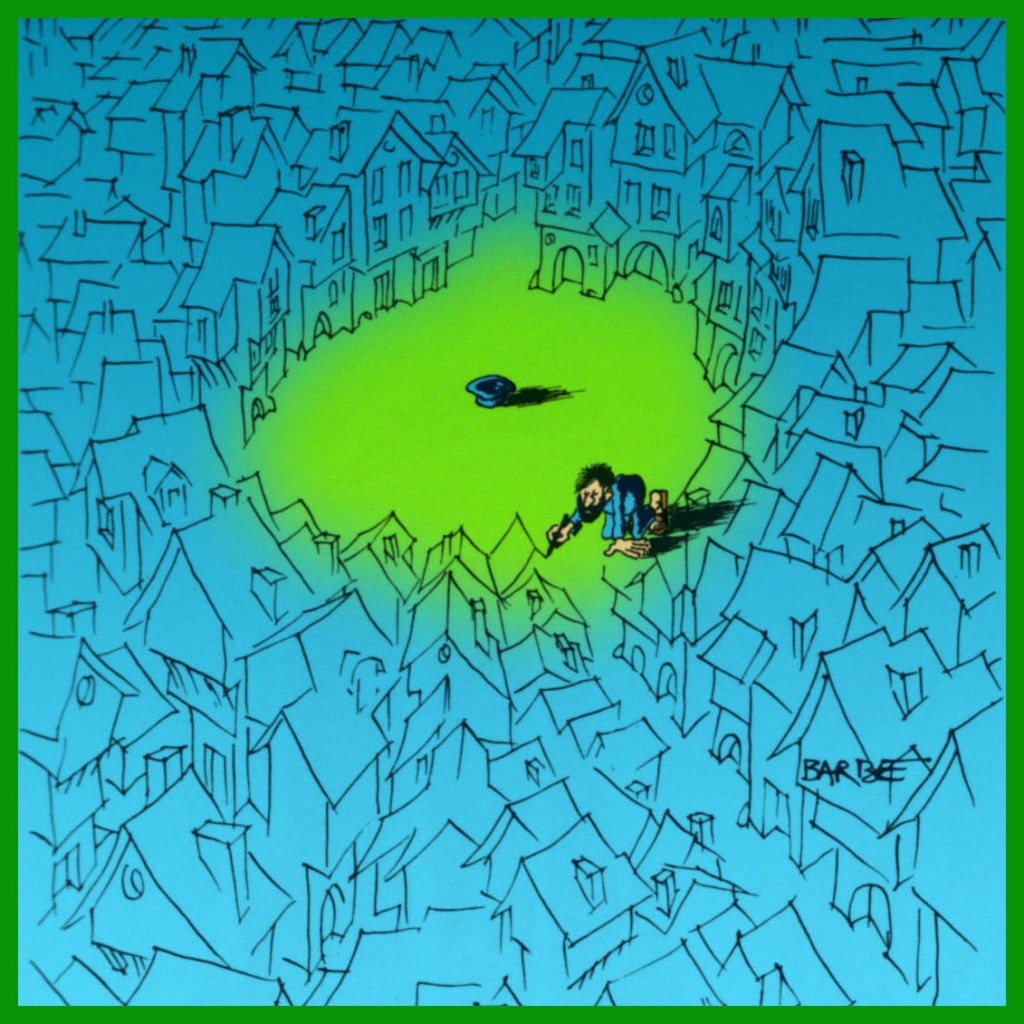
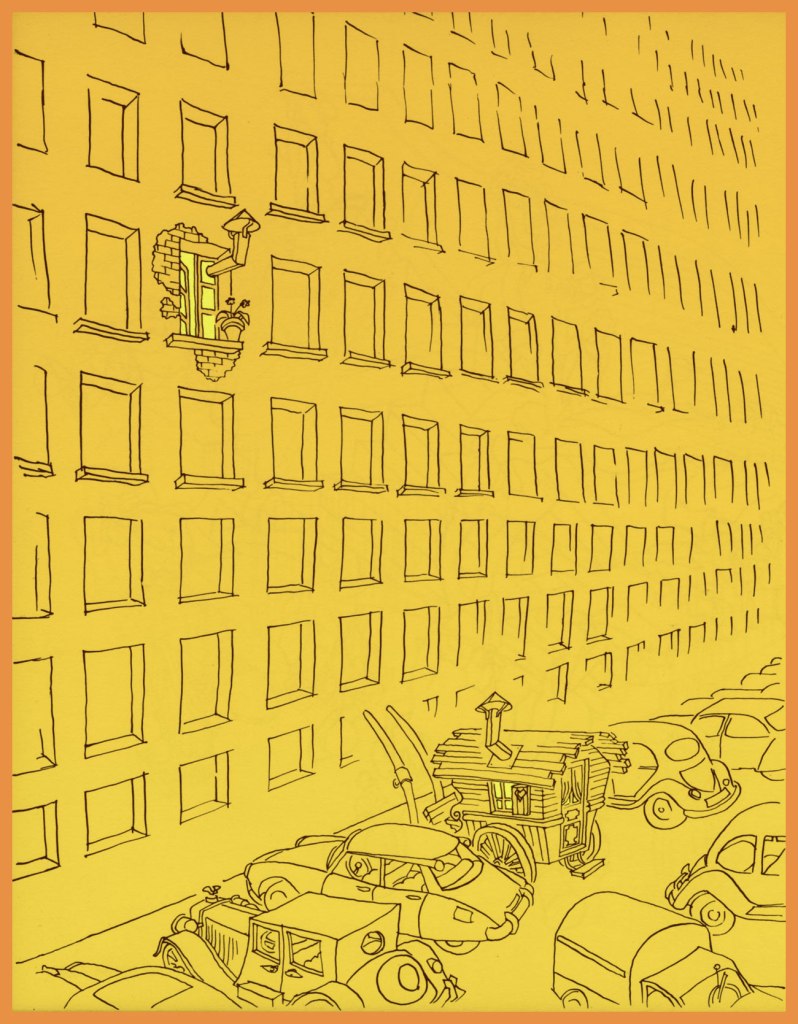
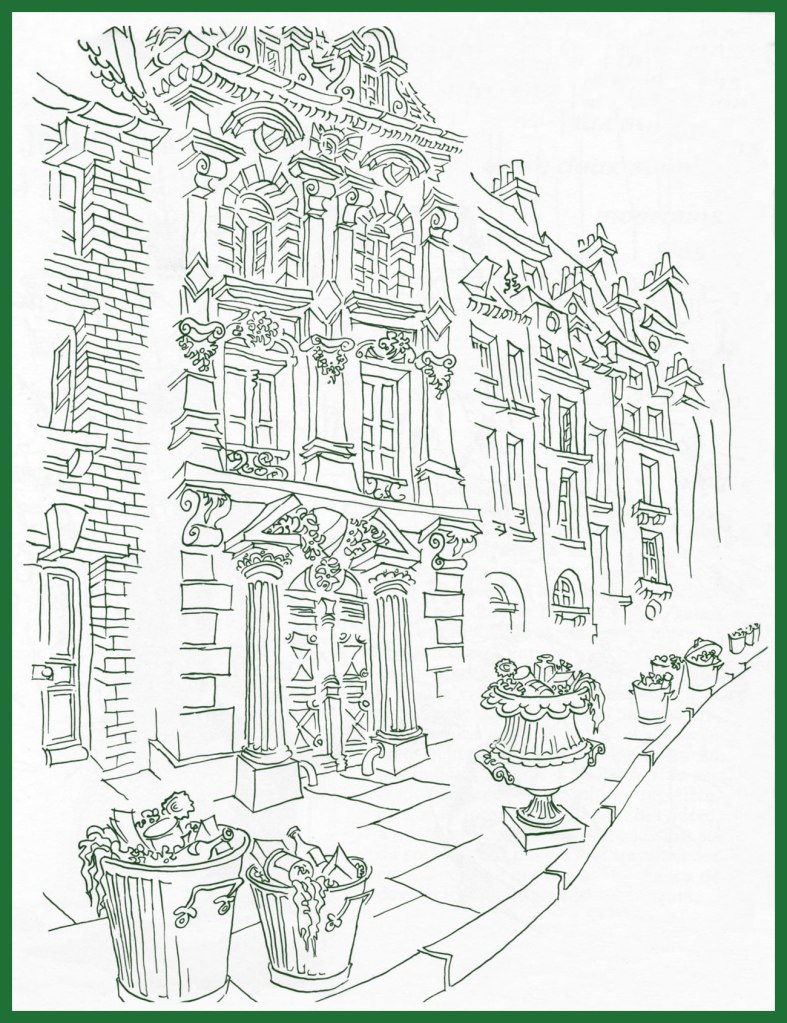
Jean Barbe, Architect of the Absurd*

« In my youth I thought of writing a satire on mankind! but now in my age I think I should write an apology for them. » — Horace

Cartoonist and illustrator André-François Barbe (1936-2014) was born in Nîmes, France.

After an abortive stint in the French air force, he spent a few years fiddling around in Air France’s employ. His earliest professional drawings saw print in the venerable Le Rire (1894-1971) in 1958. After a few years of tentative, but increasingly encouraging results, he finally made his decisive move in 1965, joining the shaky ranks of full-time cartoonists.

Fittingly, Barbe was an unabashedly chatty man in person… while his work scarcely required words.

While frequently satirical in subject, Barbe’s approach never stoops to easy mockery or gratuitous acerbity. Instead, one finds grace and lyrical elegance… now and then flavoured with a tangy venom chaser. In this finespun register, I’d place him in a class with the likes of Saul Steinberg, Jean-Jacques Sempé, Jean-Michel Folon, Jean-Claude Suares, Guillermo Mordillo, Shel Silverstein, Joaquín ‘Quino‘ Lavado and Maurice Henry.
A self-portrait of the bewhiskered (of course!) young artiste at his easel.
Remember how deep our television sets used to be?
This one anticipates a similar concept later mined by his Argentine contemporary, Guillermo Mordillo. To wit, check out co-admin ds’ Mordillo gallery… you’ll know just which cartoon I mean.
Like Gerard Hoffnung before him, Barbe was a connaisseur of classical music. He would frequently return to this theme.
M.C. Escher meets the bourgeois promeneurs!
He takes on the Army…
… and the Clergy…
… and the bourgeoisie.

By the early 1970s, Barbe was increasingly devoting his pen and his interest to erotic subjects, and that’s the work he’s most associated with. Though that material held greater commercial clout, the work remained flawlessly executed and formally explorative… at least at first. Then, I’d argue that it became a bit of a cul-de-sac. Personally, I’ve always found it a bit chilly in its execution, quite a liability for erotica. Your kilométrage may vary.

Speaking of distances, Barbe was always a bit of a routard, an adventurous traveller. Here’s one instance of particular interest:

In the 1980s, on the initiative of his brother Michel Barbe, a history and geography teacher in Marseille, he took part in a conference given by Haroun Tazieff on the subject of volcanism. Owing to the quality of his drawing skill, he was allowed to accompany, in 1982, an exploratory scientific journey to the volcanic region of the Djibouti Rift. This expedition, led by Lucy co-discoverer Maurice Taieb, enlisted 32 professors who explored the basalt flows in the Assal Lake depression.

-RG

*a handy description I’ve rifled from the ever-erudite Jacques Sternberg.

Hallowe’en Countdown IV, Day 28

« The world dies over and over again, but the skeleton always gets up and walks. » — Henry Miller

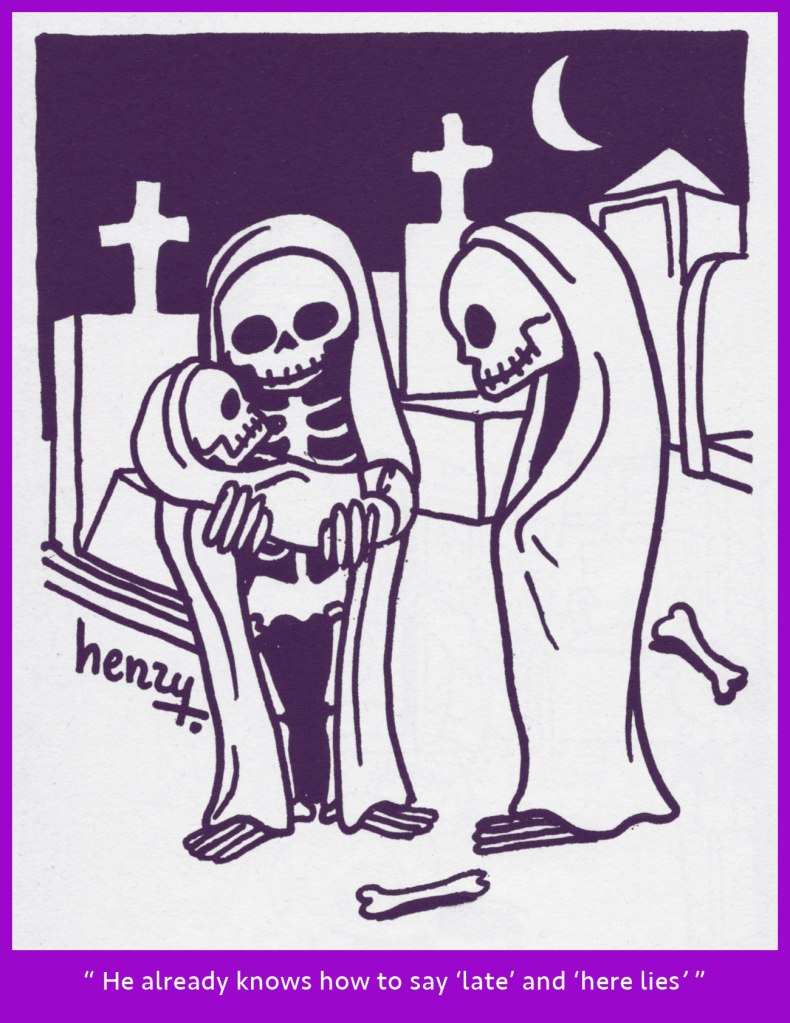
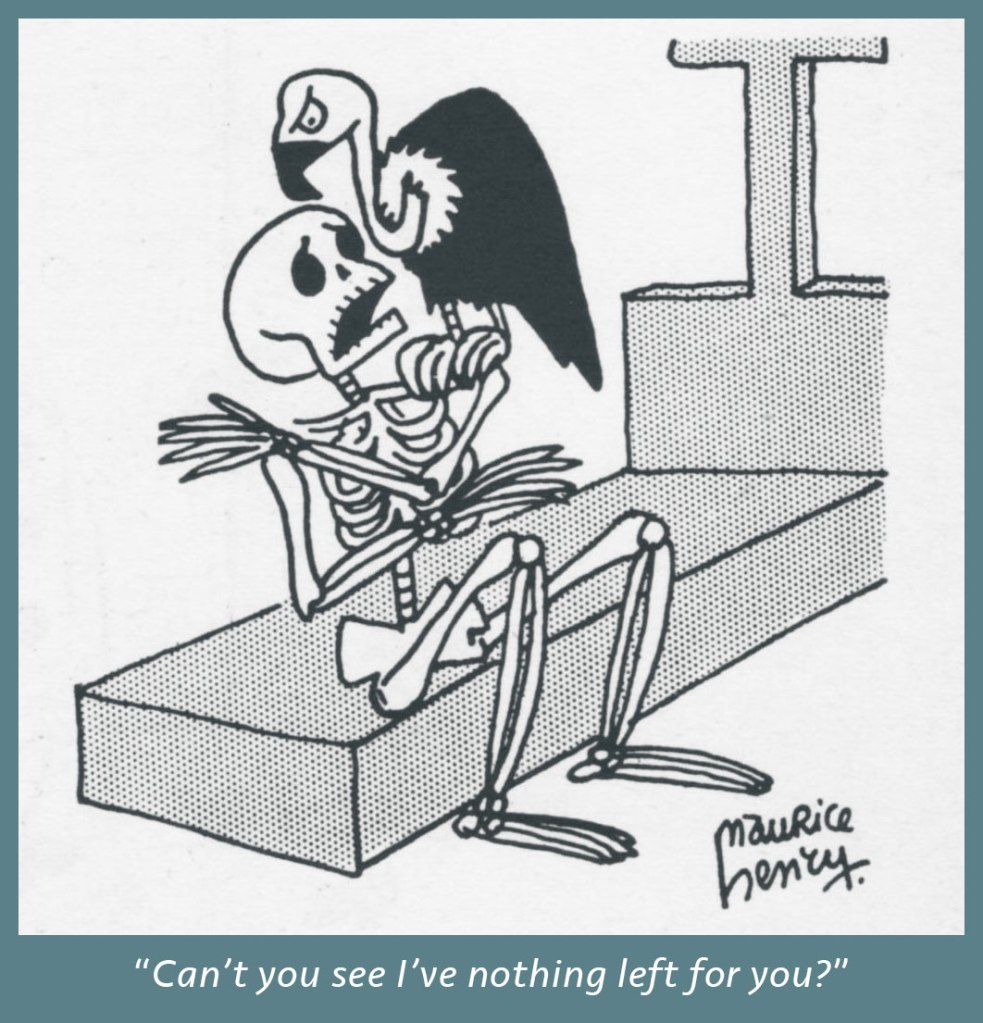
A few months back, while assembling a post about polymorphic French surrealist Maurice Henry (1907-1984), I marvelled and chuckled at his multitude of skeleton-themed cartoons. I made a mental note to devote a Hallowe’en post to them… and that memo only floated to the top of my consciousness a couple of days ago. Just in time!

(1935)
(1936)
(1938)
(1940)
(1941)
(1947)
(1950)
(1950)
(1958)
This one doesn’t feature skeletons, but I had to include it, given how stunningly *dark* it is for its (or any) era… can you imagine something like this published in the USA in… 1935? For more context, here’s the Bluebeard ditty.
In closing, and just for kicks: sixteen faces of the playfully photogenic Monsieur Henry. This one-man assembly featured on the back cover of Maurice Henry 1930-1960 (1961, Jean-Jacques Pauvert), a remarkable collection.

Trust me, I’m only scratching the surface of this man’s genius. If you’ll bear with me, we’re not done with him.

-RG

Hallowe’en Countdown IV, Day 23

« A detective sees death in all the various forms at least five times a week. » — Salvatore Albert Lombino, aka Ed McBain, aka Evan Hunter

Spanning nearly a full century since yesterday’s instalment, we now move ahead to a recent work from my favourite European bédéiste of the past quarter-century, David Beauchard, better known as David B. (b. 1959).

Among the traits I most admire in Monsieur Beauchard are his artistic integrity and his explorative drive. To wit, here he evokes the grimy spirit of late 19th century feuilleton serials, providing a narrative consisting of illustrated chapter headings… devoid of the main text. The reader is left to fill in the narrative gaps, enlisted in a bold compact with the artist and required to draw upon his own imagination.

A few choice excerpts (I left out the bits with tentacles… it’s not my department, after all!):

Le mort détective was issued just last year (yes, roughly an eternity ago) by rightly-celebrated French publisher L’Association.
So it begins… with the title page, naturally.
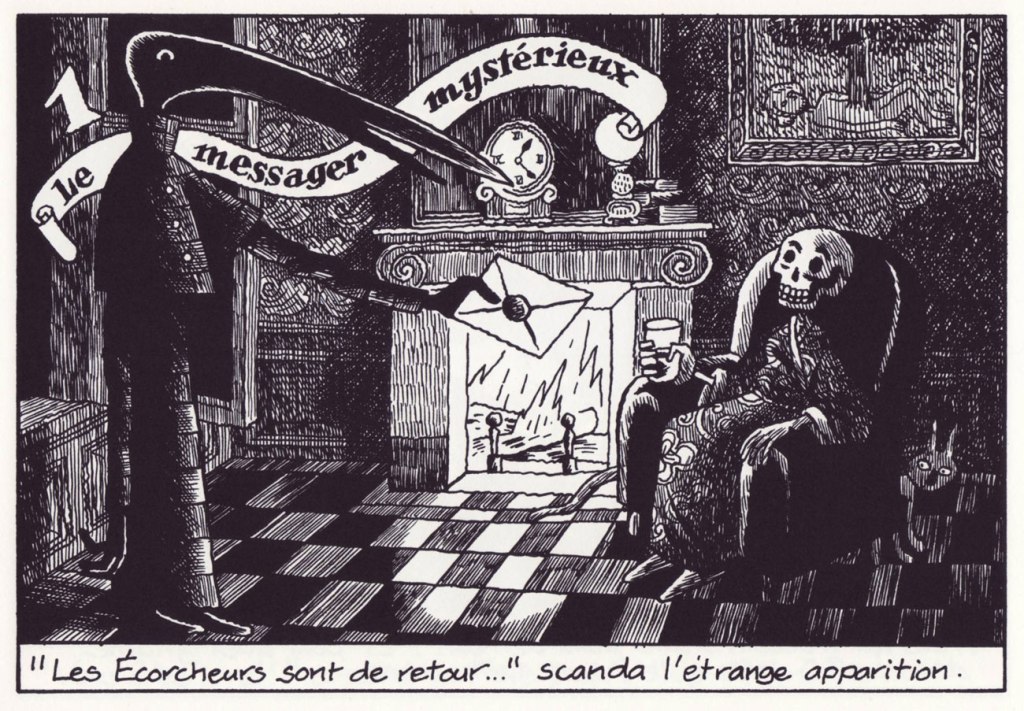
1 – The mysterious messenger: “The Flayers have returned…‘ chanted the strange apparition”.
2 – The skinned dwarf: “But who needs a dwarf’s skin… and to what ignoble purpose?“, panted the Dead Detective…
6 – The dwarf-skin coat: “The Great Old Man is a priest of the Yellow Dwarf God‘, murmured the Dead Detective to the Girl of a Thousand Daggers…”
10- The macabre post: “The Bad Postman distributes mysterious mailings.”
11- The word from the Hereafter: “The severed head exhaled a terrifying prophecy.”
22- The mass grave: “The Girl of a Thousand Daggers has sent a bouquet.“, he said in a dying voice.
41 – “The altar of fear: “Let’s flee!‘, exclaimed the Girl of a Thousand Daggers.”
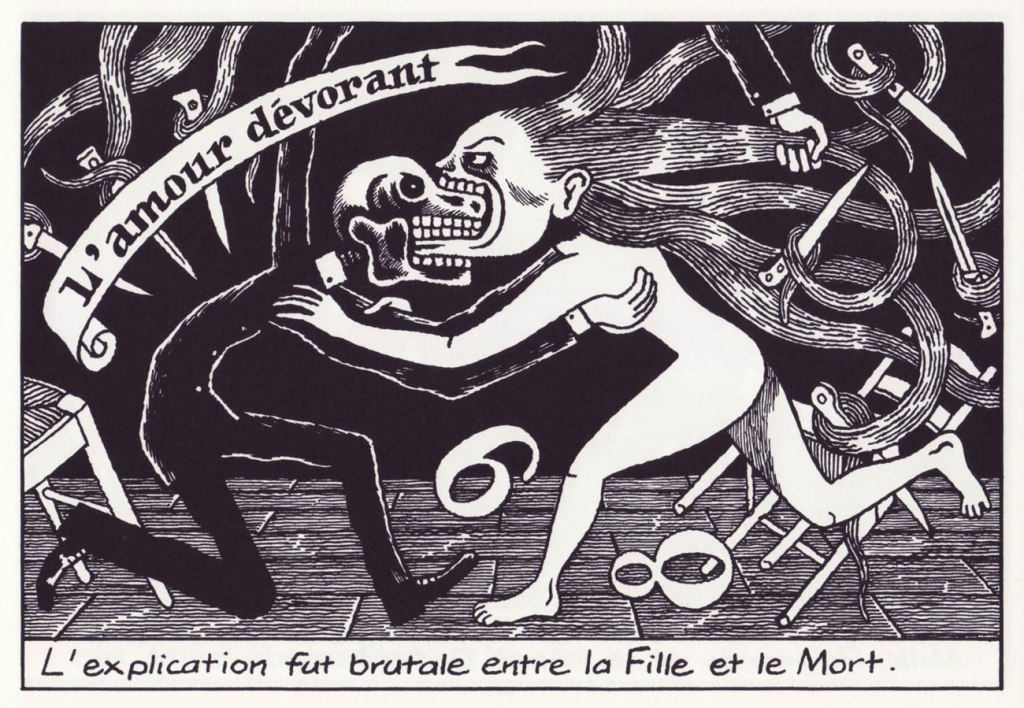
68 – “The Devouring Love: Explanations were brutal between the Girl and the Dead One.”
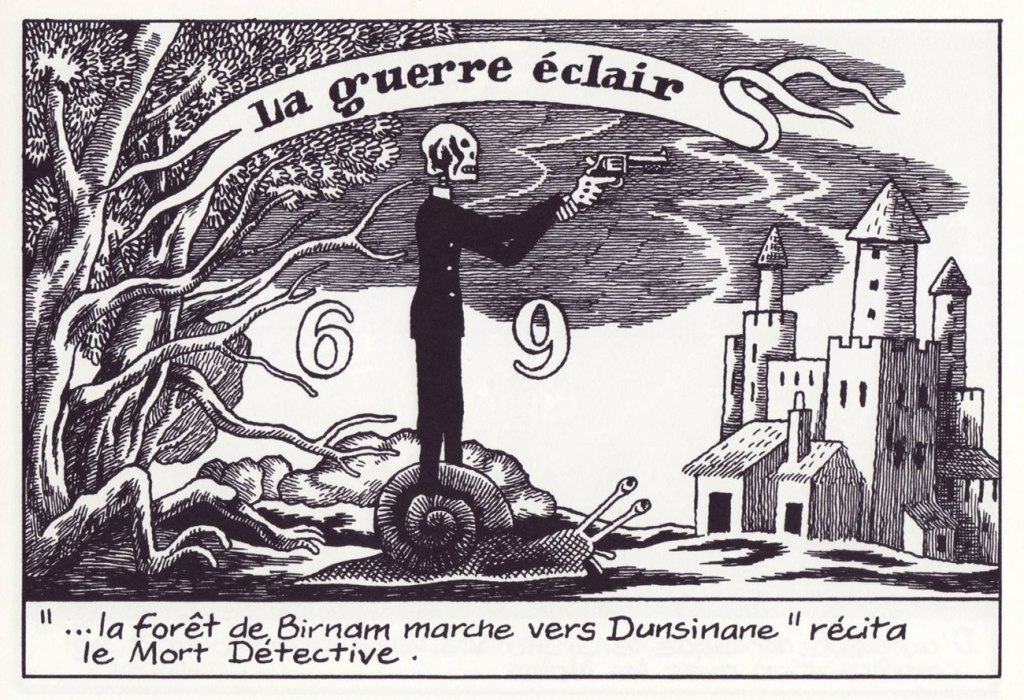
69 – “The Flash War: … ‘Birnam Forest walks towards Dunsinane‘, recited the Dead Detective.”

-RG