Today’s linguistic lesson: what’s a snarf? I’ll let Kurt Vonnegut answer that one:
« Do you know what a twerp is? When I was in Shortridge High School in Indianapolis 65 years ago, a twerp was a guy who stuck a set of false teeth up his butt and bit the buttons off the back seats of taxicabs. (And a snarf was a guy who sniffed the seats of girls’ bicycles.) »
Here’s a typical illustration of a snarf, albeit a shockingly rich one, with a fittingly well-developed proboscis, in his not-so-natural habitat: golden-hour hues, a cozy armchair, and selection of vintage selles de vélo. Next time you see a bicycle with its seat stolen (let’s face it, these saddles *must* be acquired in illicit fashion), you’ll thank me for this mental image.
This is Snarf no. 11, 1989. Dennis Kitchen gave his comic book series an apt title!
The cover by Rand Holmes (1942-2002), a Canadian underground comix artist probably best known for his Harold Hedd comic strip. (Look for the compendium of his exploits published by Last Gasp, Anus Clenching Adventures With Harold Hedd!)
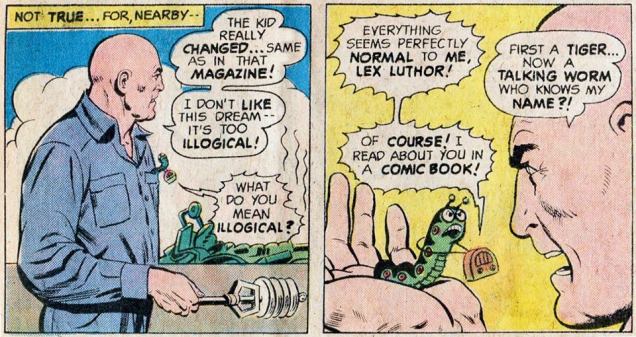
Beware of the man who only dreams logical dreams! That says a lot about Luthor’s personality, actually.
This legendary encounter between Mr. Mind and Luthor comes to us from “Captain Marvel Meets… Lex Luthor?!”, written by Dennis O’Neil, pencilled by Bob Oksner and inked by Tex Blaisdell. It’s part of a 100-page issue (Shazam! no. 15, November-December 1974), which I think was my first exposure to The Big Red Cheese… and I was instantly hooked, even though I’m not generally fond of cross-overs (or, generally speaking, super-heroes). These issues may not cost 60 cents anymore, but they’re still totally worth tracking down!
Mr. Mind is usually considered to be a worm, but frankly, he looks more like a caterpillar (which is more dignified, anyway). In his quest for world dominion, he hatched many a plan to topple world order, some of which I will enumerate for readers’ enjoyment so you can admire the impressive span of Mr. Mind’s machinations:
To crush North America beneath a giant glacier using a giant gyroscope that makes the Earth shift on its axis.
To make Captain Marvel his mental slave using Billy Batson.
To topple all the buildings in Captain Marvel’s home city by controlling an army of worms and termites.
To trap the United States in eternal darkness by stopping the Earth’s rotation.
To use the ten-mile-long gun “Great Big Bertha” to literally blow holes in America and Russia.
To invade Scotland from an artificial floating island of ice.
To cause a giant volcano to erupt in the middle of Britain.
So if you encounter an angry-looking (but myopic) caterpillar on your travels, please mind what you say.
Tuesdays sure roll around quickly, but that’s okay – another week, another fresh batch of prehensile, slimy tentacles for our enjoyment. I’ll open Tentacle Tuesday with an “oldie but goodie”. (Speaking of that, I have an irrational pet peeve: comic shop owners who, upon seeing a customer carefully clutching a stack of 70s comics he meticulously unearthed from a grimy comic box stashed in the darkest corner of the store, say, with a slightly condescending grin, “oh, you’ve found some oldies!” The comment is no doubt well-intentioned, but there are nicer ways to start the conversation.)
And a-one
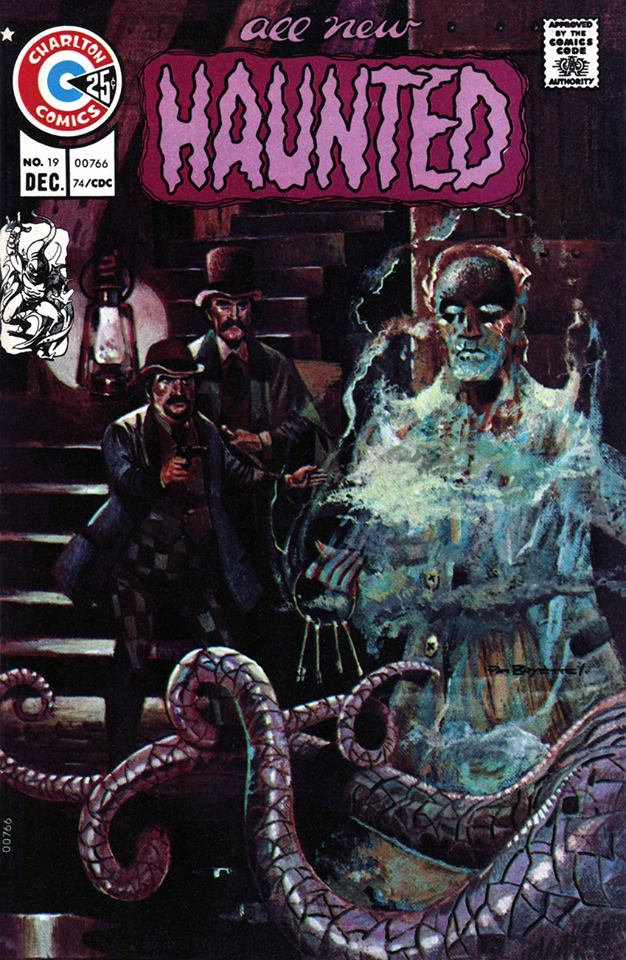
First on the list for today is this painted beauty by Pat Boyette, from Haunted no. 19, December 1974. Just look at those shiny, healthy tentacles – just the kind to gently grab your ankle and drag you into murky waters. Their diaphanous keeper doesn’t exactly inspire confidence, either.
This issue is worth picking up for more than its cover. It remains excellent when one opens its pages: there are three stories, and they’re all worthwhile – the beautiful “The Unholy!” by Pete Morisi (PAM! PAII!) (written by his son, Steve Morisi, and therefore unfortunately not making a lick of sense), the moody “There Ain’t No Hell!” by Sanho Kim and Joe Gill, and, the cherry on the cake (and story on the cover), the quietly-elegant-but-with-tentacles “The Keeper”, illustrated by Boyette (and also written by Joe Gill).
“You bawled me out many a time for not feeding your pets, your lordship… this time, they’ll feast!”
And a-two
Just like octopuses (who eat small crabs and scallops, as well as snails, fish, turtles, crustaceans, and of course other octopuses), I like a little variety in my diet, so number 2 is humorous rather than scary. How did this octopus manage to figure out which of its tentacles to stick into shorts? Who’s the happy little slug with chickenpox holding up letter “A”? Why does an octopus have beaver teeth?
This is Ha Ha Comics no. 66 (Jun – Jul 1949), published by American Comics Group, or more technically Creston, an imprint of ACG. This seems to be a rather rare issue, unavailable on Comic Book Plus although they have pretty much every other issue of Ha Ha. Thanks to an Ebayer selling this comic, however, I can state with some degree of certainly that this issue features – as advertised – an all-star cast, featuring not only the habitués Izzy and Dizzy (a pair of trouble-prone mice), but also Anthony & Cleopatra, the Impulsive Imps, Robespierre, Hard-Hearted Hannah, Wigglin’ Willie the Worm and Shilly and Shally. Doesn’t it all sound like some sort of battle of the bands? As for the artist of the cover, it’s Dan Gordon, storyboard artist and film director mostly known for his work at Famous Studios and Hanna-Barbera Productions – he did quite a few “funny animals” titles for ACG.
And a-three!
T.T. number 3 is colourful. It also leads to the question “vegetable, mineral or animal?” These tentacles seem to be rather plant-like… if plants had eyeballs attached by blood vessels.
Judging by the adventures of Space Family Robinson, most planets are inhabited by aliens with tentacles. One would think that they’d be very well prepared for this eventuality (not to mention kind of bored by it), but no, the tentacles always take them by surprise.
Apart from tentacles, this has some of my other favourite things: a pterodactyl (or at least some creature approximating a pterodactyl), a vibrant sunset, and eyeballs.
This is the back cover of Space Family Robinson no. 9 (Gold Key/Western, August 1964), which is just like the front cover minus the text. Painted by George Wilson, who has a nice sense of colour. (Hurray for saturated colours in this sepia-and-grey or orange-and-teal world.)
In the beginning, oh, long before that. When light was deciding who should be in and who should be out of the spectrum, Yellow was in trouble. Even then it seems that green, you know how green can be, didn’t want yellow in. Some silly primal envy I suppose, but for whatever cause, the effect was bad on yellow. And caused yellow to weep yellow tears for several eternals, before there were years. Until blue heard what was up between green and yellow and took green aside for a serious talk, in which blue pointed out that if yellow and blue were to get together, not that they would, but if they did (a gentle threat), they could make their own green. “Ooh”, said green with some understanding. Naturally, by a sudden change of hue, green saw the light and yellow got in. Worked out fine, yellow got lemons and green got limes.*
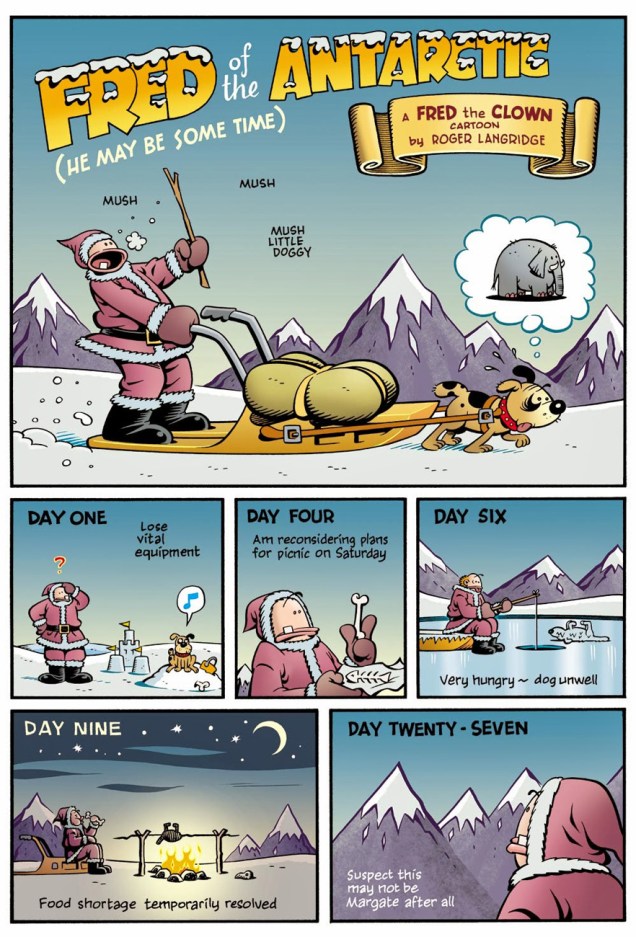
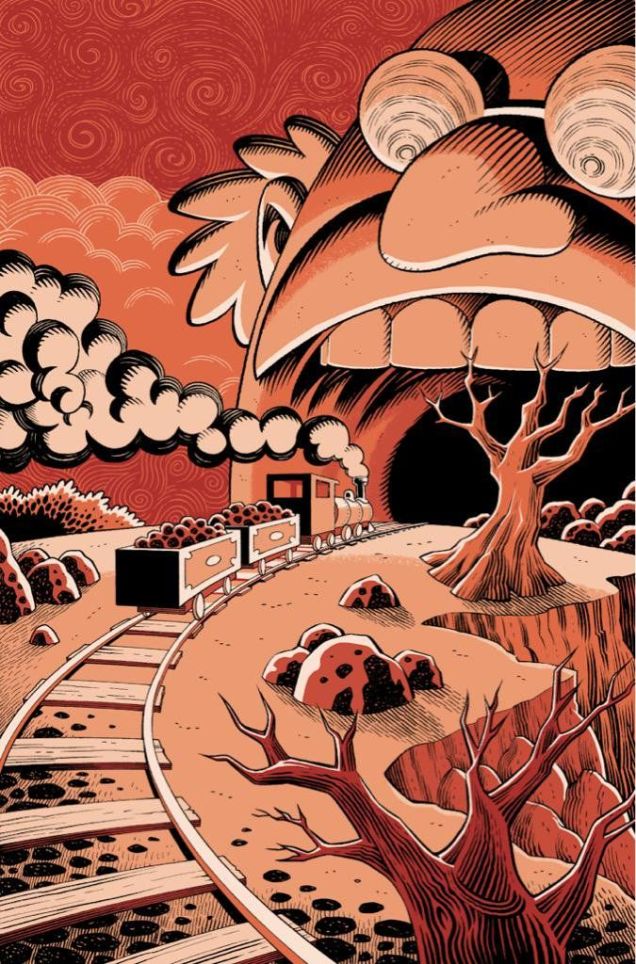
I’d like to talk about a book that’s coming out in October -“The Iron Duchess” by Roger Langridge. There’s two reasons to be excited about it: it’s a solo Langridge project; and it features Fred the Clown, a favourite character of many a R.L. aficionado. This graphic novel was initially self-published about a year ago, but Fantagraphics (displaying their usual impeccable taste) has picked it up since then, so it’s now commonly available through major stores.
But, you may ask, who is Fred the Clown and why should you care? Instead of blabbing incomprehensibly as I’m prone to doing when talking about Langridge (imagine a dog trying to explain its excitement about a juicy bone – there’s just going to be a lot of tail-wagging and drooling), I prefer to quote the back-cover blurb from the first Fred the Clown collection (equally highly recommended, published in 2004 also by Fantagraphics):
“Existential clown comedy as you like it. SEE! Fred the Clown get slapped regularly in his single-minded pursuit of l’amour! HEAR! The screams of his lady friends from several blocks away! SMELL! Fred the Clown’s scientifically improbable collection of fungal infections! The signature creation of cartoonist Roger Langridge, Fred the Clown is the thinking man’s idiot. Fred has an eye for the ladies, as well as several other organs, but the only part of themselves they’re willing to share with him is a carefully placed kneecap… Fred the Clown’s misadventures are a curious balance of bleakness and joyful absurdism; the universe may dump on Fred from a great height, but he never gives up. More often than not, they involve the pursuit of a lady—any lady will do, it seems, but bearded ladies are at the top of the list.”
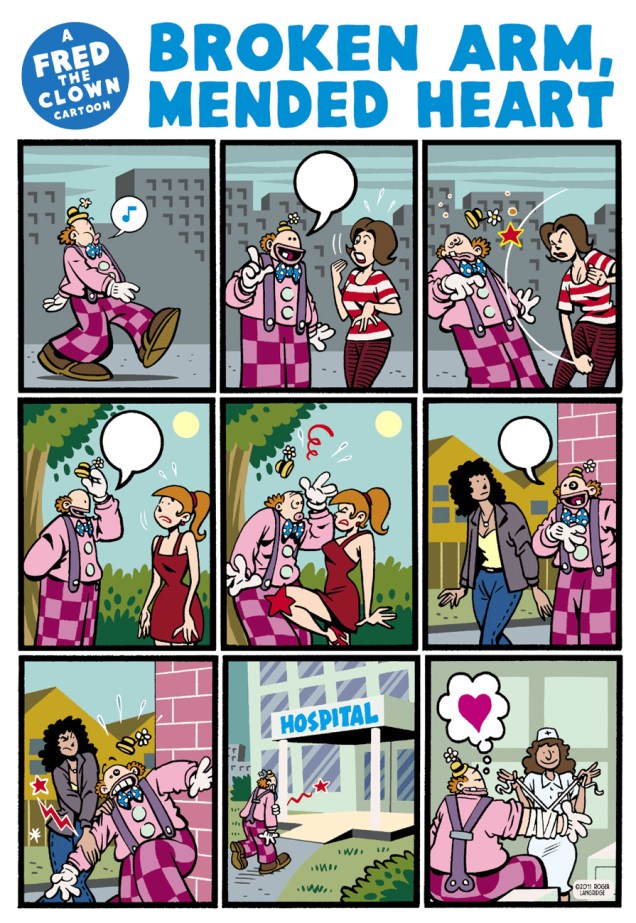
Just look at this striking art and Langridge’s impeccable sense of timing:
(Fred the Clown in his initial black-and-white format.)
To which I can add that I normally can’t *stand* clowns, and Fred is the only cartoon clown whom I not only tolerate but whose antics I actually enjoy.
But to get back to the Duchess: *this* story doesn’t have bearded ladies, but it does have a (very) mad scientist, a damsel in dire and completely improbable peril, enough twists in the plot to make you yelp (and giggle) out loud (great for embarrassing yourself in public!), and heart-warming inter-species friendship, perhaps even romance. After all, there is a train involved; a train means somebody can be tied to the railroad tracks, or a couple can escape – or not – an evil father… I love people who can take a conventional story and run off with it while still “obeying” all the rules of the genre.
It’s an entirely mute story, if you don’t count evil cackling as dialogue. Fred’s best friend is a pig, by the way, and as far as I’m concerned that’s another reason to love this goofball. The pig’s also considerably more intelligent than him.
It’s exciting, riveting and really funny. Did I mention the beautiful art, expert shading, etc., etc.? Just pick it up already. Langridge can deftly illustrate anything his freaky brain comes up with, which includes animals (especially horses, which most comic artists seem to struggle with), ugly people (ditto – it seems that artists often can draw either pretty people, or grotesque ones, but rarely both)… and he’s great at architecture and perspective, too.
In an ideal world, Langridge would have free rein – and enough financial support – to draw the stories that are clearly close to his heart, instead of being forced (although he’s very gallant about it) to write for projects illustrated by pencillers/inkers so impressively inept that these comics, that should be excellent just by virtue of having a fantastic writer, become completely unreadable. Let’s at least take things one step closer to this ideal by adding the Iron Duchess to our comic book collections.
Dare to take a train ride into the dark tunnel of creativity (but avoid awkward metaphors along the way.)
Don’t forget to visit Langridge’s Hotel Fred, his official website, where you can purchase original art, books, and also see lots of goodies like sketches, commissions, unpublished pages, and whatever else he’s got lying around.
Mr. (Quincy) Magoo was born in 1949 in the United Productions of America (UPA) animation studio. His creation was a collaborative effort – in other words, no-one really knows who came up with the idea, although we can mention Millard Kaufman, who wrote the script for Magoo’s first outing in a cartoon titled “The Ragtime Bear”, director John Hubley, and of course Jim Backus, the actor who voiced Magoo and was encouraged to ad-lib and generally jazz up the dialogue in any way he wanted. He became a comic book character in 1952, and appeared in Dell Comics for a dozen issues or so.
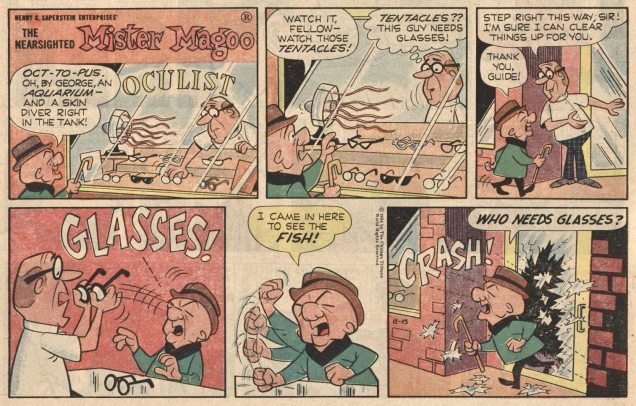
In case you’re not already familiar with him, Mr. Magoo is wealthy, short, and nearly (and catastrophically) blind, which he stubbornly refuses to acknowledge. Needless to say, Magoo’s immoderate myopia leads to many madcap adventures and increasingly improbable situations; as far as I am concerned, the zanier, the better!
In 1964, the Chicago Tribune syndicated a Mister Magoo comic strip that was drawn by Pete Alvarado and written by Don Sheppard. Here’s one of them, a Sunday strip in (glorious, right?) colour, 1964.
Once upon a time (or, more precisely, a handful of years ago), we started a little weekly celebration of tentacle glory in comics and called it Tentacle Tuesday. (My husband came up with that alliteration; I hope he’s willing to share the credit for this pithy little phrase with others, as I honestly don’t know whether he was first to dream it up. By now, #tentacletuesday is a hashtag and there’s a Facebook page with that title). Yet “real life” (read: “a sad existence tragically devoid of octopuses”) got in the way, and although we’ve often thought about Tentacle Tuesday, no offerings were made at the Octopoda altar. We’d spot some glorious tentacles while reading comics, and wistfully dream of sharing them with a like-minded audience, but the impulse would pass, leaving behind vague but lingering regrets.
Well, we are back. Let’s keep Tentacle Tuesday going strong, for after all, comics and tentacles are among the universe’s greatest achievements. Let the cephalopod fiesta begin – we welcome you to this blog’s first-ever installment of Tentacle Tuesday!
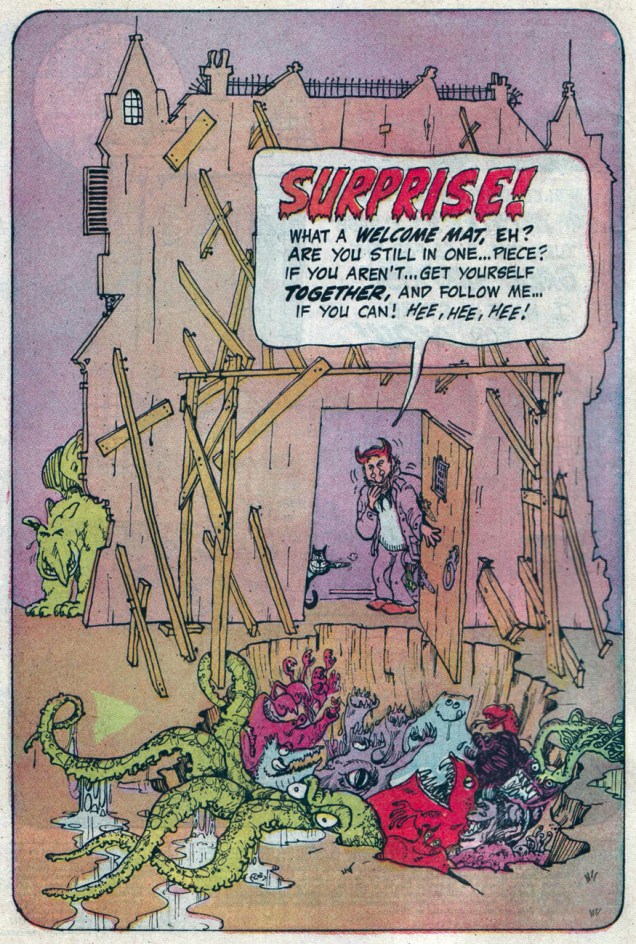
Our first offering features, quite naturally, a Welcome Mat leading to a trapped, angry octopus, who seems to be indignant about being stuck in a pit with a bunch of uncouth, plebeian imaginary monsters. Claws, pincers, and talons, razor-sharp teeth and dendritic horns? Ha, *he* has tentacles! And if the other denizens of this trap are purely monster-under-the-bed material and act as if they’re drunks at a party, Mr. Octopus here is a professional who takes his job of being terrifying seriously.
This is a pin-up, if I may call it that, by the easily identifiable Sergio Aragonés, scanned from DC’s House of Mystery no. 189 (Nov./Dec. 1970). The giggling guy is Cain, the so-called host of the House of Mystery, and is every bit inclined to betray and double-cross as his Biblical namesake. Incidentally, number 189 is an excellent issue: Eyes of the Cat, with art by Jerry Grandenetti and Wally Wood, is both gorgeous and scary, with bonus points for prominently featuring a black cat (which Neal Adams made look like a rat on the cover – if you don’t believe me, try http://pencilink.blogspot.ca/2008/05/house-of-mystery-189-neal-adams-cover.html ) It is followed by The Deadly Game of G-H-O-S-T by Leonard Starr, and the issue wraps up elegantly with The Thing in the Chair with art by Tom Sutton.
⇔
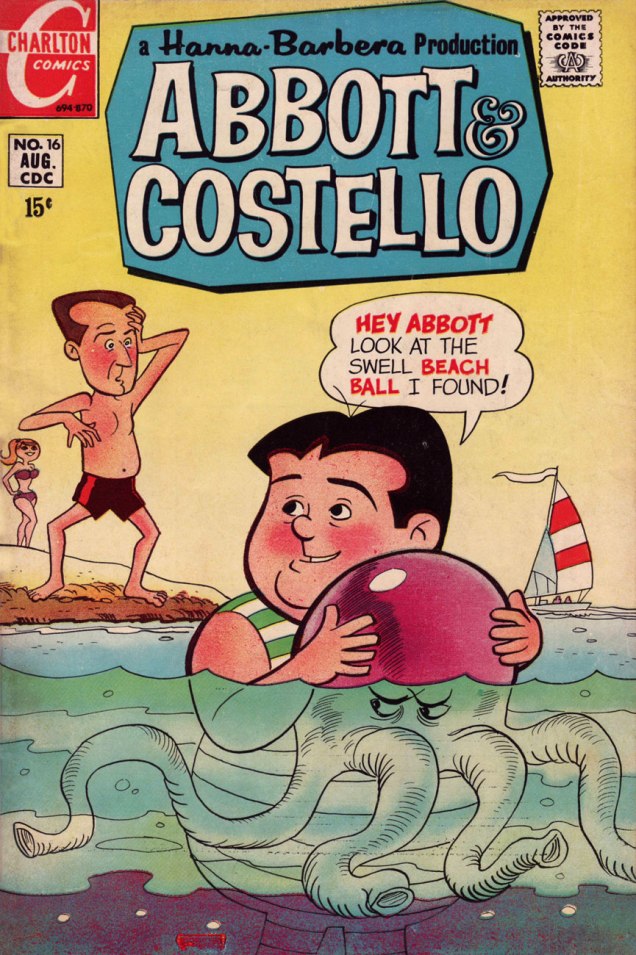
In a slightly different vein, but equally lighthearted, is this cover of Abbott & Costello no. 16 (Aug. 1970, Charlton). I hope our readers shall be too polite to point out that Tony Tallarico, the artist, made tentacles look more like elephant trunks, or that this… creature… has but four of them, which would make him probably the only quadripartite octopus in existence (they’re supposed to have 8, for those of us who are a little hazy on the specifics). Now, if only Charlton paid by the tentacle rather than by the page…
This comics series was of course based on the American comedy duo of Bud Abbott and Lou Costello, of early 40s and 50s fame. Fast-forward to 1967, and with Costello having long passed on (in 1959), the pair was miraculously given a new, two-dimensional lease on life (hey, you take what you can get… comedy’s a vicious game!) through the auspices of Hanna-Barbera Productions, and Charlton landed the comics licence and ran with it… for a healthy twenty-two issues. The first eight or nine of these, featuring the madcap talents of artist Henry Scarpelli and (especially) scripter Steve Skeates, are the ones to seek out. You have been warned!






 Who's Out There?